Sample Read
Contents INDUSTRIES (DEVELOPMENT AND REGULATION) ACT, 1951 PAGE
CHAPTER I PRELIMINARY 1. Short title, extent and commencement
1
2. Declaration as to expediency of control by the Union
1
3. Definitions
2
4. [Omitted by the Industries (Development and Regulation) Amendment Act, 1953, w.e.f. 1-10-1953]
4
CHAPTER II THE CENTRAL ADVISORY COUNCIL AND DEVELOPMENT COUNCILS 5. Establishment and constitution of Central Advisory Council and its functions
4
6. Establishment and constitution of Development Councils and their functions
5
7. Reports and accounts of Development Councils
6
8. Dissolution of Development Councils
6
9. [Omitted by the Taxation Laws (Amendment) Act, 2017, w.e.f. 1-72017]
7
CHAPTER III REGULATION OF SCHEDULED INDUSTRIES 10. Registration of existing Industrial undertakings I-5
8
CONTENTS
I-6 PAGE
10A. Revocation of registration in certain cases
9
11. Licensing of new industrial undertakings
9
11A. Licence for producing or manufacturing new articles
10
11B. Power of Central Government to specify the requirements which shall be complied with by small scale industrial undertakings
10
12. Revocation and amendment of licences in certain cases
12
13. Further provision for licensing of industrial undertakings in special cases
12
14. Procedure for the grant of licence or permission
13
15. Power to cause investigation to be made into scheduled industries or industrial undertakings
13
15A. Power to investigate into the affairs of a company in liquidation
14
16. Powers of Central Government on completion of investigation under section 15
14
17. [Omitted by the Industries (Development and Regulation) Amendment Act, 1953, w.e.f. 1-10-1953]
15
18. Power of persons or body of persons appointed under section 15 or section 15A to call for assistance in any investigation
16
CHAPTER IIIA DIRECT MANAGEMENT OR CONTROL OF INDUSTRIAL UNDERTAKINGS BY CENTRAL GOVERNMENT IN CERTAIN CASES 18A. Power of Central Government to assume management or control of an industrial undertaking in certain cases
16
18AA. Power to take over industrial undertakings without investigation under certain circumstances
18
18B. Effect of notified order under section 18A
20
18C. Contracts in bad faith, etc., may be cancelled or varied
21
18D. No right to compensation for termination of office or contract
21
18E. Application of Act 7 of 1913
21
18F. Power of Central Government to cancel notified order under section 18A
22
CHAPTER IIIAA MANAGEMENT OR CONTROL OF INDUSTRIAL UNDERTAKINGS OWNED BY COMPANIES IN LIQUIDATION 18FA. Power of Central Government to authorise, with the permission of the High Court, persons to take over management or control of industrial undertakings
22
I-7
CONTENTS PAGE
CHAPTER IIIAB POWER TO PROVIDE RELIEF TO CERTAIN INDUSTRIAL UNDERTAKINGS 18FB. Power of Central Government to make certain declarations in relation to industrial undertakings, the management or control of which has been taken over under section 18A, section 18AA or section 18FA
24
CHAPTER IIIAC LIQUIDATION OR RECONSTRUCTION OF COMPANIES 18FC. Power of Central Government to call for report on the affairs and working of managed company
25
18FD. Decision of Central Government in relation to managed company
26
18FE. Provisions where Government decides to follow the course of action specified in section 18FD(1)
26
18FF. Provisions where Government decides to follow the course of action specified in section 18FD(2)
28
18FG. Preparation of inventory of assets and liabilities and list of members and creditors of managed company
31
18FH. Stay of Suits and other Proceedings
32
CHAPTER IIIB CONTROL OF SUPPLY, DISTRIBUTION, PRICE, ETC., OF CERTAIN ARTICLES 18G. Power to control supply, distribution, price, etc., of certain articles
32
CHAPTER IV MISCELLANEOUS 19. Powers of inspection
34
20. General prohibition of taking over management or control of industrial undertakings
35
21. Certain administrative expenses of Development Councils to be paid from moneys provided by Parliament
35
22. Power of the Central Government to issue directions to Development Councils
35
23. Decision of Central Government final respecting certain matters
36
24. Penalties
36
24A. Adjudication
37
CONTENTS
I-8 PAGE
24B. Appeal
38
24C. Recovery
38
25. Delegation of powers
38
26. Power to issue directions
39
27. [Omitted by the Jan Vishwas (Amendment of Provisions) Act, 2023, w.e.f. 12-12-2023]
39
28. Burden of proof in certain cases
39
29. [Omitted by the Jan Vishwas (Amendment of Provisions) Act, 2023, w.e.f. 12-12-2023]
39
29A. [Omitted by the Jan Vishwas (Amendment of Provisions) Act, 2023, w.e.f. 12-12-2023]
40
29B. Power to exempt in special cases
40
29C. Protection of action taken under the Act
42
29D. Debts incurred by the authorised person to have priority
43
29E. Validation
43
30. Power to make rules
43
31. Application of other laws not barred
46
32. [Omitted by the Repealing and Amending Act, 1957, w.e.f. 17-91957]
46
FIRST SCHEDULE
46
SECOND SCHEDULE
52
THIRD SCHEDULE
53
SUBJECT INDEX
55
Industries (Development and Regulation) Act, 1951 [65 OF 1951]*
An Act to provide for the development and regulation of certain industries. BE it enacted by Parliament as follows:— CHAPTER I PRELIMINARY Short title, extent and commencement. 1. (1) This Act may be called the Industries (Development and Regulation) Act, 1951. (2) It extends to the whole of India 1[***]. (3) It shall come into force on such date2 as the Central Government may, by notification in the Official Gazette, appoint. Declaration as to expediency of control by the Union. 2. It is hereby declared that it is expedient in the public interest that the Union should take under its control the industries specified in the First Schedule. COMMENTS CASE LAWS
In a dispute concerning minimum wages, the appellant contested the award fixing basic wages and dearness allowance under the Industrial Disputes Act, 1947. The Supreme Court held that a statutory minimum wage notification issued under the Minimum Wages Act, 1948, provides a reliable basis for wage determination. The Court ruled that, while the notification applied from January 8, 1953, its standards could guide wage fixation for prior periods in the absence of more suitable evidence. Further, the Court dismissed the appellant’s claim regarding procedural invalidity, holding that the Government
*Dated 31-10-1951 1. Words “except the State of Jammu and Kashmir” omitted by the Industries (Development and Regulation) Amendment Act, 1961, w.e.f. 15-2-1962. 2. Enforced with effect from 8-5-1952 vide Notification No. SRO 811, dated 8-5-1952.
1
S. 3
INDUSTRIES (DEVELOPMENT AND REGULATION) ACT, 1951
2
appropriately appointed a new tribunal after the prior judge’s unavailability. Lastly, the Court clarified that the textile industry’s inclusion in the Industrial (Development and Regulation) Act, 1951, did not itself designate it as “controlled” under section 2(a)(i) of the Industrial Disputes Act without explicit specification by the Central Government. Appeal dismissed. — Bijay Cotton Mills Ltd. v. Its Workmen AIR 1960 SC 692.
Definitions. 3. In this Act, unless the context otherwise requires,— (a) “Advisory Council” means the Central Advisory Council established under section 5; 3
[(aa) “ancillary industrial undertaking” means an industrial undertaking which, in accordance with the proviso to sub-section (1) of section 11B and the requirements specified under that sub-section, is entitled to be regarded as an ancillary industrial undertaking for the purposes of this Act;]
4 5
[ [(ab)] “current assets” means bank balances and cash and includes such other assets or reserves as are expected to be realised in cash or sold or consumed within a period of not more than twelve months in the ordinary course of business, such as stock-in-trade, amounts due from sundry debtors for sale of goods and for services rendered, advance tax payments and bills receivable, but does not include sums credited to a provident fund, a pension fund, a gratuity fund or any other fund for the welfare of the employees, maintained by a company owning an industrial undertaking;] 6
[(ac)] “current liabilities” means liabilities which must be met on demand or within a period of twelve months from the date they are incurred; and includes any current liability which is suspended under section 18FB;] (b) “Development Council” means a Development Council established under section 6;
7
[(bb) “existing industrial undertaking” means— (a) in the case of an industrial undertaking pertaining to any of the industries specified in the First Schedule as originally enacted, an industrial undertaking which was in existence on the commencement of this Act or for the establishment of which effective steps had been taken before such commencement, and (b) in the case of an industrial undertaking pertaining to any of the industries added to the First Schedule by an amendment thereof, an industrial undertaking which is in existence on the coming into force of such amendment or for the establishment of which
3. Inserted by the Industries (Development and Regulation) Amendment Act, 1984, w.r.e.f. 12-1-1984. 4. Clauses (aa) and (ab) inserted by the Industries (Development and Regulation) Amendment Act, 1971, w.r.e.f. 1-11-1971. 5. Clause (aa) relettered as clauses (ab) by the Industries (Development and Regulation) Amendment Act, 1984, w.r.e.f. 12-1-1984. 6. Clause (ab) relettered as clause (ac), ibid. 7. Inserted by the Industries (Development and Regulation) Amendment Act, 1953, w.e.f. 1-10-1953.
3
INDUSTRIES (DEVELOPMENT AND REGULATION) ACT, 1951
S. 3
effective steps had been taken before the coming into force of such amendment;] (c) “factory” means any premises, including the precincts thereof, in any part of which a manufacturing process is being carried on or is ordinarily so carried on— (i) with the aid of power, provided that fifty or more workers are working or were working thereon on any day of the preceding twelve months; or (ii) without the aid of power, provided that one hundred or more workers are working or were working thereon on any day of the preceding twelve months and provided further that in no part of such premises any manufacturing process is being carried on with the aid of power; 7a
[(cc) “High Court” means the High Court having jurisdiction in relation to the place at which the registered office of a company is situate;] (d) “industrial undertaking” means any undertaking pertaining to a scheduled industry carried on in one or more factories by any person or authority including Government;
8
[(dd) “new article”, in relation to an industrial undertaking which is registered or in respect of which a licence or permission has been issued under this Act, means— (a) any article which falls under an item in the First Schedule other than the item under which articles ordinarily manufactured or produced in the industrial undertaking at the date of registration or issue of the licence or permission, as the case may be, fall; (b) any article which bears a mark as defined in the Trade Marks Act, 1940 (5 of 1940)9, or which is the subject of a patent, if at the date of registration or issue of the licence or permission, as the case may be, the industrial undertaking was not manufacturing or producing such article bearing that mark or which is the subject of the patent;] (e) “notified order” means an order notified in the Official Gazette; (f) “owner” in relation to an industrial undertaking, means the person who, or the authority which, has the ultimate control over the affairs of the undertaking, and, where the said affairs are entrusted to a manager, managing director or managing agent, such manager, managing director or managing agent shall be deemed to be the owner of the undertaking; (g) “prescribed” means prescribed by rules made under this Act; (h) “schedule” means a Schedule to this Act;
7a. Inserted by the Industries (Development and Regulation) Amendment Act, 1971, w.e.f. 1-11-1971. 8. Inserted by the Industries (Development and Regulation) Amendment Act, 1953, w.e.f. 1-10-1953. 9. Repealed. Now See Trade Marks Act, 1999.
S. 5
INDUSTRIES (DEVELOPMENT AND REGULATION) ACT, 1951
4
(i) “schedule industry” means any of the industries specified in the First Schedule; 10
[(j) “small scale industrial undertaking” means an industrial undertaking which, in accordance with the requirements specified under sub-section (1) of section 11B, is entitled to be regarded as a small scale industrial undertaking for the purpose of this Act;]
10a 11
[ [(k)] words and expressions used herein but not defined in this Act and defined in the Companies Act, 1956 (1 of 1956), have the meanings respectively assigned to them in that Act.] COMMENTS
CASE LAWS
The appellant union sought to hold Assam Industrial Development Corporation (AIDC) liable for the employment benefits of the workers of Industrial Paper (Assam) Ltd. (IPAL). The Labour Court found that AIDC, as a promoter of IPAL, could not be considered the owner of the project. Both the single and Division Bench of the Gauhati High Court affirmed that AIDC had merely acted as a nodal agency, promoting IPAL during its initial stages. The Supreme Court held that IPAL was a separate and independent company, not a subsidiary of AIDC. Thus, AIDC could not be held responsible for the employment obligations of IPAL’s staff. The appeal was dismissed without imposing costs. — Industrial Paper (Assam) Ltd. Employees Union v. Management, Assam Industrial Development Corporation AIR 2007 SC 985.
Saving. 4. 12[Omitted by the Industries (Development and Regulation) Amendment Act, 1953, w.e.f. 1-10-1953.] CHAPTER II THE CENTRAL ADVISORY COUNCIL AND DEVELOPMENT COUNCILS Establishment and constitution of Central Advisory Council and its functions. 5. (1) For the purpose of advising it on matters concerning the development and regulation of scheduled industries, the Central Government may, by notified order, establish a Council to be called the Central Advisory Council. (2) The Advisory Council shall consist of a Chairman and such other members, not exceeding thirty in number, all of whom shall be appointed by the Central 10. Inserted by the Industries (Development and Regulation) Amendment Act, 1984, w.r.e.f. 12-1-1984. 10a. Inserted by the Industries (Development and Regulation) Amendment Act, 1971, w.e.f. 1-11-1971. 11. Clause (j) relettered as clause (k) by the Industries (Development and Regulation) Amendment Act, 1984, w.r.e.f. 12-1-1984. 12. Prior to its omission, section 4 read as under:— “4. Saving. - Nothing in this Act shall apply to an industrial undertaking if the capital invested therein does not exceed rupees one lakh.”
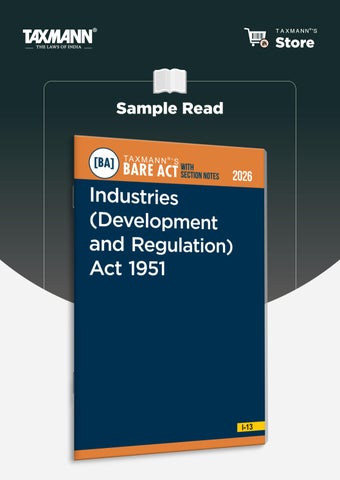
Industries (Development and Regulation) Act 1951 – Bare Act with Section Notes AUTHOR : : PUBLISHER DATE OF PUBLICATION : : EDITION ISBN NO : : No. of Pages BINDING TYPE :
Taxmann’s Editorial Board Taxmann December 2025 2026 Edition 9789371269186 68 Paperback
Rs. 125 DESCRIPTION Industries (Development and Regulation) Act 1951 [Bare Act with Section Notes] by Taxmann is a comprehensive legal text that outlines the statutory framework for regulating India’s core industrial sectors. It governs the development and oversight of ‘scheduled industries’ and details how the central government supervises, licenses, and controls industrial undertakings. The 2026 Edition incorporates crucial judicial interpretations and recent amendments, ensuring readers understand the law’s scope and application. This book is intended for the following audience: •
Legal Professionals & Advocates
•
Company Secretaries & Compliance Officers
•
Industry Stakeholders & Entrepreneurs
•
Government Officers & Policy Makers
•
Students & Academics
The Present Publication is the 2026 Edition, covering the amended and updated text of the Industries (Development and Regulation) Act [Act No. 65 of 1951] with the following noteworthy features: •
[Authentic Text with Amendments] Presents the complete IDRA 1951, incorporating all current amendments
•
[Recent Amendments & Judicial Decisions] References pivotal case laws to illustrate evolving industrial regulation
•
[Updated with the Jan Vishwas (Amendment of Provisions) Act 2023] Reflects the latest changes aimed at decriminalising and rationalising offences
•
[User-friendly Format] Systematically arranged sections, sub-sections, and definitions for quick navigation
•
[Case Law References] Highlights Supreme Court and High Court judgments interpreting key provisions
•
[Tables & Schedules] Comprehensive coverage of scheduled industries, Development Councils’ roles, and other relevant details
Buy Now