Store
© Taxmann Price : ` 115 Law stated in this book is as updated till 25th November, 2025 Published by : Taxmann Publications (P.) Ltd. Sales & Marketing : 59/32, New Rohtak Road, New Delhi-110 005 India Phone : +91-11-45562222 Website : www.taxmann.com E-mail : sales@taxmann.com Regd. Office : 21/35, West Punjabi Bagh, New Delhi-110 026 India Printed at : Tan Prints (India) Pvt. Ltd. 44 Km. Mile Stone, National Highway, Rohtak Road Village Rohad, Distt. Jhajjar (Haryana) India E-mail : sales@tanprints.com Disclaimer Every effort has been made to avoid errors or omissions in this publication. In spite of this, errors may creep in. Any mistake, error or discrepancy noted may be brought to our notice which shall be taken care of in the next edition. It is notified that neither the publisher nor the author or seller will be responsible for any damage or loss of action to any one, of any kind, in any manner, therefrom. It is suggested that to avoid any doubt the reader should cross-check all the facts, law and contents of the publication with original Government publication or notifications. No part of this book may be reproduced or copied in any form or by any means [graphic, electronic or mechanical, including photocopying, recording, taping, or information retrieval systems] or reproduced on any disc, tape, perforated media or other information storage device, etc., without the written permission of the publishers. Breach of this condition is liable for legal action. For binding mistake, misprints or for missing pages, etc., the publisher’s liability is limited to replacement within seven days of purchase by similar edition. All expenses in this connection are to be borne by the purchaser. All disputes are subject to Delhi jurisdiction only.
Contents INDIAN EASEMENTS ACT, 1882 PAGE
PRELIMINARY 1. Short title
1
2. Savings
2
3. Construction of certain references to Act XV of 1877 and Act IX of 1871
2
CHAPTER I OF EASEMENTS GENERALLY 4. “Easement” defined
2
5. Continuous and discontinuous, apparent and non-apparent, easements
4
6. Easement for limited time or on condition
5
7. Easements restrictive of certain rights
5
CHAPTER II IMPOSITION, ACQUISITION AND TRANSFER OF EASEMENTS 8. Who may impose easements
7
9. Servient owners
8
10. Lessor and mortgagor
8
11. Lessee
9
12. Who may acquire easements
9
I-5
CONTENTS
I-6 PAGE
13. Easements of necessity and quasi easements
10
14. Direction of way of necessity
13
15. Acquisition by prescription
14
16. Exclusion in favour of reversioner of servient heritage
17
17. Rights which cannot be acquired by prescription
17
18. Customary easements
18
19. Transfer of dominant heritage passes easement
19
CHAPTER III INCIDENTS OF EASEMENTS 20. Rules controlled by contract or title
19
21. Bar to use unconnected with enjoyment
20
22. Exercise of easement-confinement of exercise of easement
20
23. Right to alter mode of enjoyment
21
24. Right to do acts to secure enjoyment
22
25. Liability for expenses necessary for preservation of easement
23
26. Liability for damage from want of repair
23
27. Servient owner not bound to do anything
24
28. Extent of easements
24
29. Increase of easement
26
30. Partition of dominant heritage
27
31. Obstruction in case of excessive user
28
CHAPTER IV DISTURBANCE OF EASEMENTS 32. Right to enjoyment without disturbance
29
33. Suit for disturbance of easement
29
34. When cause of action arises for removal of support
30
35. Injunction to restrain disturbance
31
36. Abatement of obstruction of easement
32
CHAPTER V EXTINCTION, SUSPENSION AND REVIVAL OF EASEMENTS 37. Extinction by dissolution of right of servient owner
32
38. Extinction by release
33
I-7
CONTENTS PAGE
39. Extinction by revocation
34
40. Extinction on expiration of limited period or happening of dissolving condition
34
41. Extinction on termination of necessity
34
42. Extinction of useless easement
35
43. Extinction by permanent change in dominant heritage
35
44. Extinction on permanent alteration of servient heritage by superior force
36
45. Extinction by destruction of either heritage
36
46. Extinction by unity of ownership
36
47. Extinction by non-enjoyment
37
48. Extinction of accessory rights
39
49. Suspension of easement
39
50. Servient owner not entitled to require continuance
39
51. Revival of easements
40 CHAPTER VI LICENCES
52. “Licence” defined
41
53. Who may grant licence
42
54. Grant may be express or implied
42
55. Accessory licences annexed by law
42
56. Licence when transferable
43
57. Grantor’s duty to disclose defects
43
58. Grantor’s duty not to render property unsafe
43
59. Grantor’s transferee not bound by licence
44
60. Licence when revocable
44
61. Revocation express or implied
45
62. Licence when deemed revoked
45
63. Licensee’s rights on revocation
46
64. Licensee’s rights on eviction
46
SUBJECT INDEX
47
Indian Easements Act, 1882* [5 OF 1882] An Act to define and amend the law relating to Easements and Licensees. Preamble WHEREAS it is expedient to define and amend the law relating to Easements and Licensees. It is hereby enacted as follows:— PRELIMINARY Short title. 1. This Act may be called the Indian Easements Act, 1882. Local extent : It extends1 to the territories respectively administered by the Governor of Madras in Council and the Chief Commissioners of the Central Provinces and Coorg; Commencement : And it shall come into force on the first day of July, 1882. STATE AMENDMENTS KARNATAKA Section 1
For the entry under the heading “Local Extent” substitute, “It extends to the whole of the State of Karnataka.” [Vide the Central Law (Karnataka Extension) Act, 1978, w.e.f. 22-12-1978]
* Dated 17-2-1882. 1. This Act extends to — (i) Union Territory of Jammu and Kashmir; and Union Territory of Ladakh by the Jammu and Kashmir Reorganisation Act, 2019, w.e.f. 31-10-2019; (ii) Ajmer-Merwara by the Scheduled District Act, 1874; (iii) Bombay and U.P. by the Easements (Extending) Act, 1891; (iv) Madhya Pradesh by the Madhya Pradesh Extension of Laws Act, 1958; (v) Punjab by the Indian Easements (Punjab Extension) Act, 1961; (vi) Kerala by the Indian Easements (Extension) Act, 1961; (vii) Pondicherry by the Pondicherry (Extension of Laws) Act, 1968. This Act has been repealed in its application to Bellary District by the Mysore Laws (Extension to Bellary and Amendment) Act, 1955.
1
S. 4
INDIAN EASEMENTS ACT, 1882
2
Savings. 2.
Nothing herein contained shall be deemed to affect any law not hereby expressly repealed; or to derogate from— (a) any right of the 2[Government] to regulate the collection, retention and distribution of the water of rivers and streams flowing in natural channels, and of natural lakes and ponds, or of the water flowing, collected, retained or distributed in or by any channel or other work constructed at the public expense for irrigation; (b) any customary or other right (not being a licence) in or over immovable property which the 2[Government], the public or any person may possess irrespective of other immovable property; or (c) any right acquired, or arising out of a relation created, before this Act comes into force.
[Construction of certain references to Act XV of 1877 and Act IX of 1871.
3
3. All references in any Act or Regulation to sections 26 and 27 of the Indian Limitation Act, 1877* or to sections 27 and 28 of Act No. IX of 18714 shall, in the territories to which this Act extends, be read as made to sections 15 and 16 of this Act.] COMMENTS SECTION NOTES
3.1 Reference to Prior Limitation Acts:
This section addresses statutory references made in any other Act or Regulation to certain provisions of earlier Limitation Acts:
Indian Limitation Act, 1877: References to sections 26 and 27.
Indian Limitation Act, 1871: References to sections 27 and 28.
3.2 Substitution with Current Provisions:
In the territories where the Indian Easements Act, 1882, applies, these references to the earlier Limitation Acts are to be read as references to sections 15 and 16 of this Act.
CHAPTER I OF EASEMENTS GENERALLY “Easement” defined. 4. An easement is a right which the owner or occupier of certain land possesses, as such, for the beneficial enjoyment of that land, to do and continue to do something,
2. Substituted for “Crown” by the Adaptation of Laws Order, 1950, w.e.f. 26-1-1950. 3. Substituted by the Repealing and Amending Act, 1914. 4. Repealed by the Indian Limitation Act, 1877. * See now the Limitation Act, 1963.
3
INDIAN EASEMENTS ACT, 1882
S. 4
or to prevent and continue to prevent something being done, in or upon, or in respect of, certain other land not his own. Dominant and servient heritages and owners: The land for the beneficial enjoyment of which the right exists is called the dominant heritage, and the owner or occupier thereof the dominant owner; the land on which the liability is imposed is called the servient heritage, and the owner or occupier thereof the servient owner. Explanation.— In the first and second clauses of this section, the expression “land” includes also things permanently attached to the earth; the expression “beneficial enjoyment” includes also possible convenience, remote advantage, and even a mere amenity; and the expression “to do something” includes removal and appropriation by the dominant owner, for the beneficial enjoyment of the dominant heritage, of any part of the soil of the servient heritage, or anything growing or subsisting thereon. Illustrations (a) A, as the owner of a certain house, has a right of way either over his neighbour B’s land for purposes connected with the beneficial enjoyment of the house. This is an easement. (b) A, as the owner of a certain house, has the right to go on his neighbours B’s land, and to take water for the purposes of his household, out of a spring therein. This is an easement. (c) A, as the owner of a certain house, has the right to conduct water from B’s stream to supply the fountains in the garden attached to the house. This is an easement. (d) A, as the owner of a certain house and farm, has the right to graze a certain number of his own cattle on B’s field, or to take, for the purpose of being used in the house, by himself, his family, guests, lodgers and servants, water or fish out of C’s tank, or timber out of D’s wood, or to use, for the purpose of manuring his land, the leaves which have fallen from the trees in E’s land. These are easements. (e) A dedicates to the public the right to occupy the surface of certain land for the purpose of passing and re-passing. This right is not an easement. (f) A is bound to cleanse a water course running through his land and keep it free from obstruction for the benefit of B, a lower riparian owner. This is not an easement. COMMENTS SECTION NOTES
4.1 Easement Defined:
An easement is a legal right that the owner or occupier of one piece of land holds over another piece of land.
This right is granted for the beneficial enjoyment of the dominant land.
The easement allows the dominant owner to either:
Do or continue to do something on the servient land, or
Prevent or continue to prevent something from being done on the servient land.
4.2 Dominant and Servient Heritages:
The land that benefits from the easement is known as the dominant heritage, and the person benefiting is called the dominant owner.
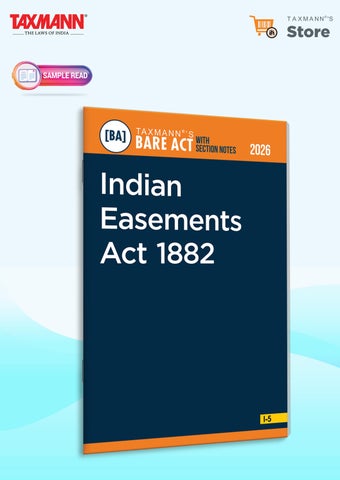
INDIAN EASEMENTS ACT 1882 – BARE ACT WITH SECTION NOTES AUTHOR PUBLISHER DATE OF PUBLICATION EDITION ISBN NO NO. OF PAGES BINDING TYPE
: : : : : : :
TAXMANN'S EDITORIAL BOARD TAXMANN DECEMBER 2025 2026 EDITION 9789371262507 60 PAPERBACK
Rs. 115
DESCRIPTION Indian Easements Act 1882 [Bare Act with Section Notes] by Taxmann provides a comprehensive reference to the Act, with detailed section notes. This 2026 Edition covers all amendments (including State Amendments) and pivotal case law, clarifying rules on easements, licenses, and related property rights in a concise format. It is intended for the following audience: • Legal Practitioners & Judiciary • Real Estate & Property Professionals • Government Officials & Policymakers • Law Students & Researchers • Laypersons & Enthusiasts The Present Publication is the 2026 Edition, covering the amended and updated text of the Indian Easements Act [Act No. 5 of 1882], with the following noteworthy features: • [Section Notes] Brief explanations of definitions, scope, and legal outcomes • [Pre-amendment Provisions] Footnotes of original text for clarity on the law's evolution • [Case Law References] Key judgments for practical application • [Customary & Prescriptive Easements] How long-standing use and local practices shape property rights • [Analytical Explanation] Distinguishing licenses from easements, including revocation • [User-friendly Layout] Organised chapters, headings, and a subject index for quick reference • [Latest Updates & Amendments] Reflecting the law's most recent changes
BUY NOW