Input Tax Credit
Question 319: How does Input Tax Credit Mechanism work?
Answer : This is the most common word with which we associate present day taxation system. Lesser the cascading effect of taxes, better is the taxation system. In an ideal taxation system, taxes never form part of cost of the product, until the goods or services reach the final consumer. This is possible only when credit of any taxes paid in the course of business, by the recipient of goods or services is allowed to him. Thus, entire taxes paid by him are set off against his output tax liability and there is no cascading impact of taxes. The taxes attach themselves with the cost only when the goods or services are finally consumed by the consumer.
Input Tax Credit is nothing but credit of the input tax. The next question that arises is what is input tax? Here also as the name suggests it is tax on inputs. The next question now arises is what are inputs for a business? The inputs for a business can be divided into three parts:
(a) Input Services
(b) Capital Goods
(c) Input Goods other than Capital Goods i.e. Raw Material etc.
A business uses Input Services, Capital Goods and Input Goods other than Capital Goods for adding value to the goods or services supplied. Thus, credit of the taxes paid on receipt of Input Services, Capital Goods and Input Goods other than Capital Goods forms the basic foundation upon which the credit structure works. There needs to be a seamless flow of the Input Tax Credit from one business to another with respect to Input Services, Capital Goods and Input Goods other than Capital Goods, used or intended to be used in the course or furtherance of business.
Question 320: What is meant by “used or intended to be used in the course or furtherance of business”?
Answer : This condition represents a major shift in the scheme of Indirect Taxes i.e. Input Tax charged on any supply used or intended to be used in the course or furtherance of business. The words “used or intended to be used” and “in the course or furtherance of business” are very general. The two way expansion of the eligibility to take Input tax credit is as follows:
(
i) “Used or intended to be used”: The section does not restrict entitlement of credit of Input Tax on supplies which have been used in or in relation to or for the purpose of making outward supplies. But it has been so worded to take within its ambit all supplies used or intended to be used by the recipient in the course or furtherance of business. If the definition of Input Tax had been linked with the goods or services or both in or in relation to or only for the purpose of making outward supplies, then input tax would have been restricted to limited supplies. However the definition of input tax is not restricted to “used for making outward supplies” but encompasses all supplies expression “used or intended to be used in the course of furtherance of business”.
(ii) “In the course or furtherance of business”: Prevalent laws used to restrict the claim of Input Tax Credit by using words and used to link it with specific uses. The provisions of CGST Act, 2017 widen the scope by use of words “in the course or furtherance of business”.
The words “in the course of business” have defined by Businessdictionary.com as follows:
“Daily or regular routine peculiar to a firm or trade, involving purchase, production, and sale of usual goods and/or services, and payment and receipt of money.”
The word “furtherance” have been defined by Businessdictionary. com as follows:
furtherance is the act of helping, or an advancement, preposition for, for the sake of, in favour of, in the name of, in the service of, on account of, on behalf of
Thus, “In the course or furtherance of business” would include all such activities which are being carried out by any registered person during the course of running of business and also activities which would further the interest of business. This would entail the registered person to claim credit of wide ranging supplies i.e. any goods or services or
both procured for the purpose of use or intended to be used in the course of business or furtherance of business.
Question 321: What are Input Services? - Section 2(60) of CGST Act, 2017
Answer : Input Services are services which are used or intended to be used in the course or furtherance of business. CGST Act has given a very broad based definition for Input service. Any service used in the course or furtherance of business, would be classified as Input Service.
Question 322: What are Capital Goods? - Section 2(19) of CGST Act, 2017
Answer : The definition of Capital Goods is very broad and contains only two conditions which are as follows:
(a) Capital Goods are goods which have been capitalized in the books of account of the person claiming the credit.
(b) Capital goods are goods which are used or intended to be used in the course or furtherance of business.
Question 323: What is Input? - Section 2(59) of CGST Act, 2017
Answer : Input means any goods other than capital goods and which are used or intended to be used in the course or furtherance of business. It is again a very broad based definition and any goods used in the course or furtherance of business, would be classified as Inputs.
Question 324: Does CGST Act, 2017 propagates liberal allowability of Input Tax Credit with minimum restrictions?
Answer : Yes, Provisions of CGST Act, 2017 propagate liberal allowability of Input Tax Credit. The credit mechanism has been simplified to provide that any tax paid on the receipt of goods or services or both which would be used or intended to be used in the course or furtherance of business, would be allowed as Input Tax Credit.
This is a major shift from the provisions of present law which provide Input Tax credit with restrictions.
Question 325: Whether a person can claim Input Tax Credit as an inherent right or whether he needs to fulfil the conditions as laid down in the law to claim credit of Input Tax?
Answer : A claim of Input Tax Credit is not an inherent right which a person can claim independent of the provisions of the law and without fulfilling conditions and restrictions as may be laid down. A claim of Input Tax Credit is an entitlement created under the statute and cannot be claimed independent of the Provision.
Hon’ble Bombay High Court in the case Mahalaxmi Cotton Ginning Pressing and Oil Industries v. State of Maharashtra analyzed the set-off provision and held that the purpose of set-off is to obviate a cascading effect of the tax burden on the ultimate consumer and this element of legislative policy is to be balanced with the need for securing tax compliance and ensuring against a loss of legitimate revenue owed to the Government.
After analysing the erstwhile provisions contained in the Bombay Sales Tax Act and the Maharashtra Value Added Tax Act, the Division Bench of the Bombay High Court held that a set-off constitutes a concession granted by the legislature and, in the absence of set-off, the selling dealer would be liable to pay tax on the sale consideration and there is no independent right to a set-off apart from section 48.
In Mohammed Haji Manachithodi Agencies v. State of Kerala [2012 (3) KLT (SN) 17], the Division Bench of the Kerala High Court held that the set-off is in the nature of a concession and no dealer has a right to claim input tax credit independent of the provision of section 11 of the Kerala VAT Act.
On this very same issue Hon’ble Rajasthan High Court in the matter of Panwar Trading Corporation v. State of Rajasthan held that:
“The availment of ITC is creature of Statute. The concession of ITC is granted by the State Government so that the beneficiaries of the concession are not required to pay the tax or duty which they are otherwise liable to pay under Rajasthan VAT Act. In extending the concession, it is open to the Legislature to impose conditions. Section 18 is one such condition imposed making it mandatory for the registered dealer to claim ITC within 90 days under sub-section (2), from the date of issuance of invoice, and no ITC will be allowed on certain purchases under sub-section (3). The entitlement to claim Input Tax Credit is created by Rajasthan VAT Act and the terms on which Input Tax Credit can be claimed must be strictly observed.”
Therefore, conditions and restrictions as laid down under the law need to be fulfilled for the allowability of claim of credit of Tax paid on goods or services.
Question 326: Who would be eligible to claim credit of Input Tax under GST?
Answer : As a thumb rule, a registered person would be eligible to claim credit of Input Tax. Unregistered person would not be able to claim Input Tax Credit for the period prior to registration. However, Section 18(1)(a) and 18(1)(b) entitle a person to claim credit of the Tax paid on inputs which were procured during the period when such person was an unregistered person and such inputs are held in stock or inputs are contained in semi-finished or finished goods held in stock as on following dates:
(a) Under section 18(1)(a): as on the day immediately preceding the date from which he becomes liable to pay tax and
(b) Under section 18(1)(b): immediately preceding the date of grant of registration.
Section 18(1)(a) and 18(1)(b) of the provisions of the CGST Act, 2017 have only limited applicability and are applicable when:
(a) Section 18(1)(a) : a person applies for registration within thirty days from the date on which he becomes liable for registration and
(b) Section 18(1)(b) : a person applies for Voluntary Registration. In any other case, a person would not be able to claim credit of tax paid on inputs which were received during the period when such person was an unregistered person.
Case Study:
A applies for registration after thirty days from the date he was liable to be registered under GST. In such case, he would not be entitled to Input Tax Credit on inputs which were received during the period when such person was unregistered person and such inputs are held in stock as on the date when such person was liable to be registered under the law.
Question 327: What are the basic conditions to claim credit of Input Tax? - Section 16(2) of CGST Act, 2017
Answer : The basic conditions to be satisfied under the law for the purpose of claim of Input Tax Credit by a registered person are as follows:
(a) Registered person should be in possession of a tax invoice or debit note issued by a supplier registered under this Act, or such other taxpaying documents as follows:
i. an invoice issued by the supplier of goods or services or both in accordance with the provisions of section 31;
ii. an invoice issued in accordance with the provisions of clause (f)of sub-section (3) of section 31, subject to payment of tax;
iii. a debit note issued by a supplier in accordance with the provisions of section 34;
iv. a bill of entry or any similar document prescribed under the Customs Act, 1962 or rules made thereunder for assessment of integrated tax on imports;
v. an ISD invoice or ISD credit note or any document issued by an Input Service Distributor in accordance with the provisions of sub-rule (1) of Rule 54.
(b) Registered person should have received the goods or services or both: Prior to the CGST Amendment Act, 2018, Explanation to clause (b) of sub-section (2) of Section 16 contained deeming provision relating to the receipt of goods wherein even though a registered person i.e. buyer or his agent, has not actually received the goods but has only provided instruction before or during the movement of the goods, to the supplier to deliver the goods to the actual recipient or any other person by way of transfer of documents of title to the goods or otherwise, it would be deemed that goods so delivered to the recipient have been first received by the taxable person and then by the actual recipient of the goods.
Vide CGST Amendment Act, 2018 (Effective from 1st February 2019); Explanation to clause (b) of sub-section (2) of Section 16 has been amended to introduce same concept in case of services as well, wherein a registered person would be deemed to have received services wherein services are provided by the supplier to a third person on the direction of and on account of such registered person.
The Players Role Played
Supplier
Other Person
Buyer
Supplier provides the service
Receives the services from the supplier
Registered person gives direction to the supplier to provide services to the recipient.
(c) The tax charged in respect of such supply has been actually paid to the Government, either in cash or through utilization of input tax credit admissible in respect of the said supply.
Section 16(2)(c) of CGST Act, 2017 contains provision that subject to the provisions of section 41, tax charged in respect of such
(
(
supply has been actually paid to the Government, either in cash or through utilisation of input tax credit admissible in respect of the said supply.
Section 41 has been substituted to by Finance Act, 2022 to do away with the word “claim” and bring in the concept of “availment”; and also, to remove the concept of provisional availment of ITC. The concept of provisional availment was there in GSTR-1/2/3 model. The provisions of sub-section (2) to Section 41 now provides that credit of input tax availed by a registered person in respect of such supplies of goods or services or both, the tax payable whereon has not been paid by the supplier, would be required to be reversed along with applicable interest, by the said person. Further when the said supplier makes payment of the tax payable in respect of the aforesaid supplies, the said registered person may reavail the amount of credit reversed by him. The enabling Rule 37A has also been brought in the CGST Rules, 2017 for implementation of the provision.
d) Registered person should have furnished return under section 39.
e) Uploading of the details of outward supplies by the supplierFinance Act, 2021 has amended section 16 of the Central Goods and Services Tax Act by inserting a new clause (aa) in sub-section (2), so as to provide that input tax credit on invoice or debit note may be availed only when the details of such invoice or debit note has been furnished by the supplier in the statement of outward supplies and such details have been communicated to the recipient of such invoice or debit note. Therefore, with effect from 01.01.2022, a recipient would only be eligible for input tax credit provided the details of the same have been uploaded by the supplier in statement of outward supplies i.e. GSTR-1 as amended in GSTR-1A if any or IFF.
(f) By way of Finance Act, 2022, Section 16(2)(ba) has been inserted to provide that a registered person would only be able to claim input tax credit provided the details of input tax credit in respect of the said supply communicated to such registered person under section 38 has not been restricted.
It would be worthwhile to highlight that previous Section 38 has been substituted and the newly substituted Section 38 provides that the details of inward supplies shall be made available to the recipients in a prescribed manner. This is essentially an enabling provision to provide for GSTR-2B. The requirement of reversal of input tax credit arises from Chapter V, and is, therefore, not
required to be mentioned under this section. Further newly substituted section 38 provides to withhold the credit of the recipient on account of following action/defaults by the supplier-
(i) New Registration- ITC will be restricted on supplies furnished by a supplier within the prescribed period after the supplier’s registration under the GST law.
(ii) Default in payment of Tax- ITC will be restricted on supplies furnished by a supplier who has not paid their taxes, and where such default has continued for a prescribed period.
(iii) Difference in outward liability declared in GSTR-3B and GSTR-1- ITC will be restricted on such supplies on which the supplier has tax liability higher than the tax actually paid during the said period and by such limit prescribed.
(iv) Difference in ITC Claimed in GSTR-3B and reflected in GSTR-2A- ITC will be restricted on supplies furnished by a supplier where the supplier has claimed ITC more than what was allowed as per clause (a). In this part, too, it says that the excess is determined by the limit prescribed.
(v) Failure to pay Tax Liability in Cash- ITC will be restricted on supplies furnished by a supplier who has failed to pay their tax liability as per Section 49(12), subject to the conditions and restrictions prescribed.
(vi) Any other reason- ITC will be restricted on supplies furnished by a supplier where the supplier belongs to such other class of persons as may be prescribed.
Question 328: If Aditya has purchased goods from Raja vide invoice dated 28th July, 2017 but he receives the goods on 1st August, 2017. When he would be eligible to take credit with respect to the tax paid on the invoice?
Answer: Section 16 of the CGST Act provides that a person would be eligible to claim Input Tax Credit in respect of goods only when he has received the goods. Therefore, as Aditya has received the goods from Raja on 1st August, 2017, he would be able to claim Input Tax Credit in the month of August only and not in the month of July.
Question 329: If Sarita had paid an advance of ` 20,000 to Ritu for purchase of Computer on 28th July, 2017. Sarita receives
the delivery of computer on 1st August, 2017. When Sarita would be eligible to take credit with respect to the tax paid on advance of ` 20,000 to Ritu?
Answer: Section 16 of the CGST Act provides that a person would be eligible to claim Input Tax Credit in respect of goods only when he has received the goods. Therefore, as Sarita has received delivery of computer from Ritu on 1st August, 2017, she would be able to claim Input Tax Credit in the month of August only and not in the month of July.
Question 330: How a registered person would be treated to have received goods wherein such registered person without taking delivery of the goods instructs the supplier to deliver the goods to another recipient. Such instruction is given to the supplier by the registered person by transfer of documents of title of the goods during their movement.
Answer : This provision introduces a deeming fiction with reference to the registered person i.e. buyer or his agent, who has not actually received the goods but has only provided instruction before or during the movement of the goods, to the supplier to deliver the goods to the actual recipient or any other person by way of transfer of documents of title to the goods or otherwise. It is deemed that goods so delivered to the recipient have been first received by the taxable person and then by the actual recipient of the goods.
Case Study:
Consider an e.g. A in Delhi purchased goods from B in Mumbai. However, before the movement of the goods starts, A instructs B to dispatch goods to C in Chennai.
Lets Understand the
The Players Role Played
A- Buyer i.e. third party (a) “A” gives direction to deliver goods to “C” (b) The direction is given before or during the movement of the goods.
B-Supplier (a) “B” delivers the goods to “C”
C-Recipient (a) “C” receives the goods as per direction of “A” (b) The goods are delivered to “C” by way of transfer of documents of title to the goods or otherwise.
Impact: With the deeming fiction been created with the insertion of this section, it would be deemed that “A” has received the goods without physically receiving them.
In the matter of Ms. Umax Packaging (GST AAR Rajasthan)-2nd November, 2018 Applicant engaged in manufacture of plastic pouches in Jodhpur proposes to purchase goods from M/s Uma Polymers Ltd., Guwahati and further supply said goods to M/s Pratap Snacks Ltd., Guwahati. Applicant would direct M/s Uma Polymers Ltd., Guwahati to deliver the goods to M/s Pratap Snacks, Guwahati. AAR held that in view of provisions of Explanation to Section 16(2)(b) of CGST Act, 2017, it would be deemed that applicant has received goods from M/s Uma Polymers Ltd., Guwahati and thereafter the said goods are dispatched to M/s Pratap Snacks Ltd., Guwahati. Thus, M/s Uma Polymers Ltd., Guwahati can charge IGST from the applicant, against which the applicant i.e. M/s Umax Packaging, Jodhpur are eligible to claim full input tax credit as per the relevant provisions of Sections 16 and 17 of Chapter V of CGST Act, 2017.
Question 331: What would happen in case goods covered under single invoice are delivered in lots?
Answer : In case goods forming part of single invoice are received in instalments by the recipient, then Input Tax Credit can only be claimed in the return period upon the receipt of the last lot or instalment of the goods by the recipient.
Question 332: What would happen in case of non-payment by the recipient to the supplier of the value of goods or services or both alongwith tax payable thereon within one hundred eighty days?
Answer : A has supplied services of Rs. 20,000 to B and has charged GST of Rs. 3,600. If B does not make payment of Rs. 23,600 to the supplier within 180 days from the date of invoice of the supplier, what happens to the claim of credit of input tax of A.
The law provides that if the recipient fails to pay to the supplier amount towards value of supply alongwith the tax payable thereon within the period of 180 days from the date of issue of invoice by the supplier, an amount equal to the input tax credit availed by the recipient proportionate to such amount not paid to the supplier would be added to the output tax liability of the recipient alongwith interest. The recipient would be required to furnish the details of such supply, the amount of value not paid and the amount of input tax credit availed of proportionate to such amount not paid to the supplier in FORM GSTR-2 for the month immediately following the period of one hundred and eighty days from the date of issue of invoice.
However, once the recipient makes the payment of amount towards the value of supply of goods or services or both alongwith tax payable thereon, he would be entitled to avail credit of Input tax on payment made by him.
Thus, in the given example, If B does not pays A value of services alongwith tax payable thereon within 180 days of the date of issue of invoice, then B would be required to reverse the credit of the taxes charged by A in the invoice. If and when B would pay to A the due amount, B would be again entitled to claim credit of the taxes paid to A. Previously, the statutory provision provided that an amount equal to the input tax credit availed by the recipient should be added to his output tax liability along with interest thereon in cases wherein he fails to pay to the supplier of goods or services or both, the amount towards the value of supply along with tax payable thereon within a period of one hundred and eighty days from the date of issue of invoice by the supplier. Further, subsequent to the reversal, recipient was entitled to avail of the credit of input tax on payment made by him of the amount towards the value of supply of goods or services or both along with tax payable thereon.
However, by way of amendment by Finance Act, 2023, it has been provided that on non-payment to the supplier within 180 days, input tax credit shall not be added to the output tax liability of the recipient but such input tax credit shall be required to be reversed alongwith interest under section 50 of CGST Act, 2017. Further now third proviso to Section 16(2) specifically requires that recipient shall make payment towards the value of supply of goods or services or both to the supplier along with tax payable thereon for being entitled to avail of the credit of such input tax. Both these amendments align the said sub-section with the return filing system provided in the Act.
Question 333: Whether a person applying for new registration within thirty days of becoming liable for registration would be entitled to claim of credit of tax paid on inputs held in stock and inputs contained in semi-finished or finished goods held in stock as on the date when he becomes liable for registration?
Answer: Yes, a person applying for new registration within thirty days of becoming liable for registration would be entitled to claim of credit of tax paid on inputs held in stock and inputs contained in semi-finished or finished goods held in stock as on the date when he become liable for registration.
GST MADE EASY – ANSWER TO ALL YOUR QUERIES ON GST
AUTHOR : Arpit Haldia
PUBLISHER : Taxmann
DATE OF PUBLICATION : May 2026
EDITION : 15th Edition | 2026
ISBN NO : 9789371264679
NO. OF PAGES : 604
BINDING TYPE : Paperback
1,795
DESCRIPTION
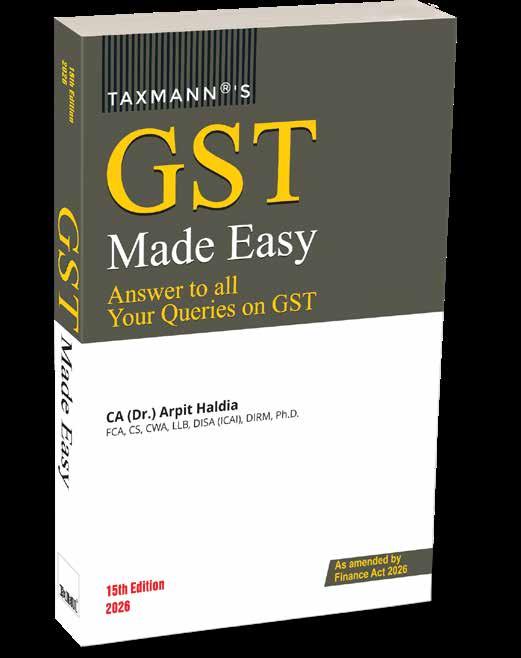
GST Made Easy – Answer to all Your Queries on GST is a question-and-answer-based practitioner's manual that has, across fifteen Editions, established itself as the entry-point reference for GST in daily practice. Rather than mirror the statute chapter-by-chapter, the book reverse-engineers the law from the queries practitioners, businesses and students actually face—close to 800 of them—and answers each with the operative provision, the procedural rule, the relevant CBIC circular, and where useful, a worked numerical illustration or an AAR/judicial precedent. This Edition covers the recast Section 15(3)(b) and Section 34 framework on post-supply discounts, the extension of provisional refund to inverted duty structure cases under Section 54(6), the removal of the ₹1,000 threshold for export refunds under Section 54(14), and the omission of Section 13(8)(b) of the IGST Act on intermediary services—together with the corresponding CBIC circulars and instructions issued through 2025-26. This book is intended for the following audience:
• Tax Professionals—Chartered Accountants, Company Secretaries and Cost Accountants
• Industry & In-house Tax Teams
• Students of Professional Examinations
• Business Owners and Entrepreneurs
• Departmental Officers
• Academia & Researchers
The Present Publication is the 15th Edition | 2026, amended by the Finance Act 2026. It is authored by CA. (Dr) Arpit Haldia, and incorporates the following noteworthy features:
• [Finance Act 2026 Updated] A dedicated front-matter section walks through every Finance Act 2026 amendment with the pre-amendment position, the amended position, and the practical consequence
• [Question-Answer Format] Close to 800 numbered questions arranged in the natural sequence in which a GST transaction unfolds—registration, supply, time, value, place, ITC, payment, return, assessment, refund, recovery
• [Statutory Anchor with Every Answer] Each answer cites the operative section, sub-section, rule or notification, allowing the reader to trace the legal basis without leaving the page
• [Worked Numerical Illustrations] Computational issues—ITC set-off, TDS triggers, time of supply, the Rule 89(5) refund formula, Rule 86B applicability—are answered with step-by-step calculations
• [Case Studies & Precedents Embedded] Over a hundred practical case studies, including AAR rulings (Cochin Plantations, Goa Tourism Development Corporation, Rites Ltd., Skipper Ltd., Bindu Ventures, Prodair Air Products) and High Court/Supreme Court decisions, are integrated against the question they answer
• [CBIC Circulars Consolidated] At the close of each substantive chapter, a tabular gist of every relevant CBIC circular—over 250 across the book—with date and one-line summary
• [Forms Directory] Each chapter ends with a forms table mapping every relevant GST form (REG, GSTR, RFD, ITC, DRC, PMT, ARA, EWB, ENR) to its governing rule and purpose
• [FAQ Integration] Where the GST Council, Law Committee or CBIC has released FAQs, they are reproduced and harmonised with the current legal position, distinguishing answers since overtaken by amendment or circular
• [Pedagogical Progression] Within each chapter, questions move from foundational (what, who, when) to operational (how, by what date, in which form) to litigation-oriented (what if disputed, what is the remedy)