5
ROAD CHECKS AND VERIFICATION OF DOCUMENTS AND CONVEYANCES
5.1 Background
There are no physical barriers like check posts. Hence, provision of road checks has been made.
The Commissioner or an officer empowered by him in this behalf may authorise the proper officer to intercept any conveyance to verify the e-way bill or the e-way bill number in physical form for all Inter-State and Intra-State movement of goods [rule 138B(1) of CGST Rules]
The Commissioner shall get Radio Frequency Identification Device Readers (RFIDR) installed at places where the verification of movement of goods is required to be carried out and verification of movement of vehicles shall be done through such device readers where the e-way bill has been mapped with the said device [rule 138B(2) of CGST Rules]
The physical verification of conveyances shall be carried out by the proper officer as authorised by the Commissioner or any officer empowered by him in this behalf - Rule 138B(3) of CGST Rules.
Physical verification on basis of specific intelligence - On receipt of specific information on evasion of tax, physical verification of a specific conveyance can also be carried out by any other officer after obtaining necessary approval of the Commissioner or
an officer authorised by him in this behalf [proviso to rule 138B(3) of CGST Rules]
5.1-1 Inspection and verification of goods during road checks
A summary report of every inspection of goods in transit shall be recorded online by the proper officer in Part A of FORM GST EWB-03 within twenty four hours of inspection and the final report in Part B of FORM GST EWB-03 shall be recorded within three days of such inspection [rule 138C(1) of CGST Rules]
Commissioner or any other officer authorised by him can extend the period of three days by further three days for submission of final report - proviso to rule 138C(1) of CGST Rules inserted w.e.f. 19-6-2018.
The period of 24 hours or three days shall be counted from midnight of the date on which the vehicle is intercepted - Explanation to rule 138C(1) of CGST Rules inserted w.e.f. 19-6-2018.
No further verification in State if once verification done - The physical verification of goods being transported on any conveyance has been done during transit at one place within the State or Union Territory or in any other State or Union Territory, no further physical verification of the said conveyance shall be carried out again in the State or Union Territory, unless a specific information relating to evasion of tax is made available subsequently [rule 138C(2) of CGST Rules]
5.1-2 Transporter can upload details if vehicle detained for more than 30 minutes
If a vehicle has been intercepted and detained for a period exceeding thirty minutes, the transporter may upload the said information in form GST EWB-04 on the common portal [rule 138D of CGST Rules]
It is not clear what action will be taken and by whom. In fact, the officer may get alloyed, and his ‘rate’ and ‘charges’ will increase!
5.1-3 Procedure for road checks
CBI&C has issued detailed circular No. 41/15/2018-GST dated 13-4-2018, elaborating procedure for interception of conveyances
for inspection of goods in movement, detention, release and confiscation of contravening goods and conveyances [see Appendix 9 for text of circular and forms].
Sections 129 and 130 of CGST of CGST Act have been radically changed w.e.f. 1-1-2022. Hence, some of the following instructions in the circular need change.
Proper Officer authorised by jurisdictional Commissioner can conduct interception and inspection of conveyances and goods in the prescribed jurisdictional area [para 2(a) of Circular].
The proper officer can intercept a vehicle. If prima facie, no discrepancy is found, he can release the vehicle.
E-way Bill number may be available on the print out, SMS or it may be written on invoice. Any of this mode is permissible.
All these forms of having an E-way Bill are valid. Wherever a facility exists to verify the E-way Bill electronically, the same shall be so verified, either by logging on to http://mis.ewaybillgst.gov.in or the Mobile App or through SMS by sending EWBVER <EWB_ NO>to the mobile number 77382 99899(For example EWBVER 120100231897)
If proper officer intends to undertake inspection, he should first record the statement of person in charge of conveyance (normally driver) in form GST MOV01. In addition, the proper officer shall issue order of physical verification in form GST MOV-02.
Within 24 hours of issue of such order, the proper officer shall prepare a report in part A of form GST EWB-03 and upload the same on common portal.
Within three (*) days from order in form GST MOV-02, the proper officer shall conclude inspection proceedings. This period can be extended by Additional/Joint Commissioner by issuing order in form GST MOV-03. Copy of that order shall be served on the person-in-charge of the conveyance [* - The words were ‘working’. This word has been deleted vide CBI&C Circular No. 49/23/2018-GST dated 21-6-2018. Thus, now, the proceedings should be concluded in ‘three days’ and not ‘three working days’].
The final report shall be prepared in form GST MOV-04. Its copy will be served on the person in charge of conveyance. The final report shall be uploaded in part B of form GST EWB-03.
If no discrepancy was found, release order shall be issued in form GST MOV-05. If discrepancy is noticed, order of detention shall be served in form GST MOV-6 and a notice in form GST MOV-07, specifying tax and payable.
If penalty is paid as per provisions of section 129(1)(a) or 129(1) (b) of CGST Act, goods and conveyance will be released by issuing order in form GST MOV-05. The order in form GST MOV-09 will be uploaded on common portal, demand will be added in electronic liability register and amount will be debited from electronic cash ledger or electronic credit ledger of the concerned person [really, penalty cannot be paid through electronic credit ledger].
If the person in charge refuses to pay the penalty, the goods and conveyance shall be released on receipt of bond in form GST MOV-08 and security in form of bank guarantee equal to amount specified in section 129(1)(a) or 129(1)(b) of CGST Act.
If objection is raised, personal hearing shall be given and speaking order shall be passed in form GST MOV-09, quantifying tax and penalty payable. On payment of such amount release order shall be issued in form GST MOV05 and uploaded.
Instructions for confiscation of goods, as applicable upto 1-12022 - The provision relating to confiscation of offending goods and conveyance has been deleted w.e.f. 1-1-2022. There will be direct sale of goods without confiscation. Hence, following instructions are not relevant after 1-1-2022.
If amount is not paid within fourteen days of order of detention in form GST MOV06, notice proposing confiscation of goods shall be issued in form GST MOV-10.
In case of public conveyance, notice shall be issued proposing to impose fine equal to tax payable on the goods being transported in lieu of confiscation of conveyance.
Order of confiscation of goods and conveyance shall be issued in form GST MOV-11. This will be added to electronic liability register. If the person is unregistered, temporary ID shall be created.
After issue of order in form GST MOV-11, earlier order under GST MOV-09 shall be withdrawn.
If the owner does not pay within specified time, goods and conveyance shall be auctioned.
5.2 Penalty for transporting goods without valid documents - Provisions w.e.f. 1-1-2022
Provisions relating to detention, seizure and release of goods and conveyances in transit are revamped w.e.f. 1-1-2022. Sections 129 and 130 of CGST Act have been amended for this purpose. The provisions apply if goods are transported in contravention of provisions of CGST Act and Rules.
The revised provisions, as contained in amended section 129 of CGST Act are discussed below. The existing provisions are discussed later. The revised provisions, effective from 1-1-2022, are broadly as follows.
Proceedings under section 129 of CGST Act have been de-linked from provisions in sections 73 and 74 of CGST Act, relating to determination of tax not paid or short paid
Goods and conveyance can be detained and seized if goods are being transported in contravention of provisions of GST Act and Rules [may be any contravention, not merely relating to e-way bill].
If goods are taxable, penalty equal to 200% of tax payable will be imposed. In case of exempted goods, penalty equal to 2% of value of goods or Rs 25,000 whichever is lower –section 129(1)(a) of CGST Act [earlier, there was provision of payment of tax plus penalty equal to 100% of tax payable in case of taxable goods. Now, tax is payable through return as usual and only penalty payable for contravention].
Provisions of release of seized goods on bond and security as contained in section 67(6) of CGST Act shall not apply to goods seized under section 129 of CGST Act. Thus, release of goods and conveyance will be as per provisions of section 129 of CGST Act only.
Goods can be released either on payment of entire penalty or on provision of security for amount equal to penalty (may be in cash or in form of bank guarantee).
Conveyance can be released on payment of penalty of Rs one lakh - first proviso to section 129(6) of CGST Act as substituted w.e.f. 1-1-2022.
Notice of seizure of goods or conveyance shall be issued within seven days and order for penalty shall be issued within seven days from date of notice - section 129(3) of CGST Act as substituted.
Sale or disposal of goods if person fails to pay penalty within 15 days from date of receipt of order imposing penalty. This period of 15 days can be reduced in case of hazardous goods or goods that are likely to deteriorate - section 129(6) of CGST Act as substituted vide section 117 of Finance Act, 2021 w.e.f. 1-1-2022.
The goods are not confiscated. Hence, balance amount is required to be refunded to owner of goods.
Appeal can be filed on payment of 25% of penalty imposed, as per proviso to section 107(6) of CGST Act inserted w.e.f. 1-1-2022. There is provision for release of seized goods on furnishing security (mere bond is not sufficient). Hence, it may be advisable to pay 25% penalty and give security of balance amount, as security in form of bank guarantee costs money in form of bank charges. Banks often insist on deposit also.
No provision for confiscation of goods or conveyance when goods are seized in transit. The goods can be sold straight away, if security is not provided or penalty not paid [section 130 de-linked from section 129].
Provisions of confiscation of goods or conveyances and penalty as contained in section 130 of CGST Act will not apply to detention and seizure under section 129 of CGST Act.
The amended statutory provisions are as follows –Detention and seizure of goods and conveyance if goods transport in contravention of CGST Act or Rules - Notwithstanding
anything contained in the CGST Act, where any person transports any goods or stores any goods while they are in transit in contravention of the provisions of this Act or the rules made thereunder, all such goods and conveyance used as a means of transport for carrying the said goods and documents relating to such goods and conveyance shall be liable to detention or seizure and after detention or seizure, shall be released - (a) on payment of penalty equal to 200% of the tax payable on such goods and, in case of exempted goods, on payment of an amount equal to 2% of the value of goods or Rs 25,000, whichever is less, where the owner of the goods comes forward for payment of such penalty (b) on payment of penalty equal to 50% of the value of the goods or 200% of the tax payable on such goods, whichever is higher, and in case of exempted goods, on payment of an amount equal to 5% of the value of goods or Rs 25,000, whichever is less, where the owner of the goods does not come forward for payment of such penalty [If owner does not come forward, the penalty can be recovered only by sale of seized goods) (c) upon furnishing a security equivalent to the amount payable under clause (a) or clause (b) in such form and manner as may be prescribed – section 129(1) of CGST Act substituted vide Finance Act, 2021 w.e.f. 1-1-2022. [Really, in case of exempted goods, e-way bill is not required].
Powers of police to seize goods for suspected violation of provisions of any law - Police can detain and seize goods which they believe are being transported in violation of any law. However, subsequently, they should hand over goods to concerned department which is empowered to enforce that law - Sangai Enterprise v. State of Assam - (2020) 77 GST 592 = 111 taxmann. com 143 (Gau HC). [In this case, the goods were smuggled and hence violation of Customs Act].
However, in Vishal Gupta v. State of Uttar Pradesh (2022) 138 taxmann.com 177 (All HC), it was held that police has no authority to check invoice, e-way bill etc and take account of goods [really if goods appear to be smuggled etc., police can check].
No detention or seizure without serving order - No such goods or conveyance shall be detained or seized without serving an order of detention or seizure on the person transporting the goods - Proviso to section 129(1) of CGST Act.
Detention and confiscation only of consignments for which there is violation - It is possible that in a vehicle there may be 25 consignments, out of which e-way bill for 20 consignments is available and only five consignments are without e-way bill. In such case, detention and confiscation should be only of those five consignments and not all 25 consignments - CBI&C circular No. 49/23/2018-GST dated 21-6-2018.
[No provision of confiscation after 1-1-2022, but detention allowable].
Who is ‘owner of goods’ - If invoice or delivery challan or other specified document is accompanying the goods, then either consignor or consignee should be deemed to be the owner. If invoice or other document is not accompanying the goods, the proper officer shall determine who should be declared to be owner of goods - para 6 of CBI&C circular No. 76/50/2018-GST dated 31-12-2018.
If a person presents tax invoice and e-way bill, he shall be deemed to be owner of goods and goods can be released to him - Halder Enterprises v. State of UP (2024) 80 GSTL 357 = 13 Centax 144 (All HC DB) - same view Sahil Traders v. State of UP (2023) 76 GSTL 70 = 8 Centax 27 = 152 taxmann.com 24 = 99 GST 51 (All HC DB) * Sanjay Sales Agency v. State of UP (2024) 80 GSTL 53 = 12 Centax 144 = 156 taxmann.com 298 (All HC DB).
Release of goods on payment of penalty or providing security equal to penalty - Goods seized can be released either on payment of penalty or on providing security equal to penalty.
In State of Uttar Pradesh v. Kay Pan Fragrance (P.) Ltd. [2019] 112 taxmann.com 81 = 77 GST 576 = (2020) 5 SCC 811 (SC), it has been held that release of seized goods should be only as per provisions of CGST Act and relevant rules. High Court should not give any relaxation in these requirements.
In State of UP v. GLS Films (2022) 93 GST 836 = 140 taxmann.com 436 (SC), it was ordered that decision in case of Kay Pan Fragrance (P.) Ltd. should be followed by High Courts.
Issue of Notice and passing of order by proper officer - The proper officer detaining or seizing goods or conveyance shall issue
a notice within seven days of such detention or seizure, specifying the penalty payable, and thereafter, pass an order within a period of seven days from the date of service of such notice, for payment of penalty under section 129(1)(a) or 129(1)(b) of CGST Act –section 129(3) of CGST Act substituted w.e.f. 1-1-2022.
Deputy/Assistant Commissioner of Central Tax has been designated as ‘proper officer’ for the purpose of section 129(3) - CBI&C circular No. 3/3/2017-GST dated 5-7-2017 [State Government will prescribe ‘proper officer’ for purpose of SGST in the respective State].
In Allcargo Logistics v. State of Gujarat (2026) 113 GST 699 = 182 taxmann.com 49 (Guj HC DB), the order of detention has to be quashed as it was issued beyond statutory period of seven days –relying on Khatu Enterprises v. State of Gujarat (2025) 180 taxmann. com 247 (Guj HC DB).
Opportunity of personal hearing - No penalty shall be determined under section 129(3) without giving the person concerned an opportunity of being heard - section 129(4) of CGST Act substituted w.e.f. 1-1-2022.
Closure of notice on payment of penalty - On payment of amount referred in section 129(1), all proceedings in respect of the notice specified in section 129(3) shall be deemed to be concluded - section 129(5) of CGST Act.
Where the person concerned makes payment of the amount referred to in section 129(1) within seven days of the notice issued under section 129(3) of CGST Act but before the issuance of order under the said section 129(3) he shall intimate the proper officer of such payment in form GST DRC-03and the proper officer shall issue an order in form GST DRC-05concluding the proceedings in respect of the said notice - rule 142(3) of CGST Rules [The words in italics inserted w.e.f. 1-1-2022. Earlier, the words were ‘fourteen days of detention or seizure of the goods and conveyance,’].
Sale of seized goods or conveyance if penalty not paid within 15 days of the order - Where the person transporting any goods or the owner of such goods fails to pay the amount of penalty under section 129(1) within fifteen days from the date of receipt of the copy of the order passed under section 129(3), the goods or conveyance so detained or seized shall be liable to be sold or
disposed of otherwise, in such manner and within such time as may be prescribed, to recover the penalty payable under section 129(3) of CGST Act - section 129(6) of CGST Act w.e.f. 1-1-2022. Since goods are not confiscated, balance amount has to be refunded to owner of goods.
Release of conveyance on payment of penalty of Rs one lakhThe conveyance shall be released on payment by the transporter of penalty under section 129(3) or Rs one lakh, whichever is less - first proviso to section 129(6) of CGST Act substituted w.e.f. 1-1-2022.
Immediate disposal and sale if goods are perishable or hazardous - where the detained or seized goods are perishable or hazardous in nature or are likely to depreciate in value with passage of time, the said period of fifteen days may be reduced by the proper officer – second proviso to section 129(6) of CGST Act substituted w.e.f. 1-1-2022.
‘Proper Officer’ to reduce the period of fourteen days under proviso to section 129(6) of CGST Act, for the purpose of CGST is Additional Commissioner/Joint Commissioner of Central Tax, vide CBI&C circular No. 3/3/2017-GST dated 5-7-2017 [State Government will prescribe ‘proper officer’ for purpose of SGST in the respective State].
Disposal of perishable, hazardous and depreciable seized goodsIf goods seized are of perishable, hazardous or depreciable nature, these should be disposed of by proper officer. The list of such goods has been given in Notification No. 27/2018-CT dated 13-6-2018. The list covers salt, raw hides, newspapers, cell, batteries, fireworks, red sander, sandalwood, food articles, unclaimed goods which are depreciable on account of change in technology, change in model etc.
5.2-1 Procedure for imposition of penalty
The proper officer shall serve, along with the (a) notice issued under section 52 or section 73 or section 74 or section 76 or section 122 or section 123 or section 124 or section 125 or section 127 or section 129 or section 130, a summary thereof electronically in
form GST DRC-01 (b) statement under section 73(3) of section 74(3), a summary thereof electronically in FORM GST DRC-02, specifying therein the details of the amount payable – rule 142(1) of CGST Rules inserted w.e.f. 1-4-2019.
The proper officer may, before service of notice to the person chargeable with tax, interest and penalty, under section 73(1) or sub-section (1) of section 74(1), as the case may be, communicate the details of any tax, interest and penalty as ascertained by the said officer, in Part A of FORM GST DRC-01A - rule 142(1A) of CGST Rules as amended on 15-10-2020. [Till 15-10-2020, the word was ‘shall’. It has been replaced by ‘may’].
The taxable person can make partial payment or make submissions against proposed liability, he can make submission in part B of form GST DRC-01A - rule 142(2A) of CGST Rules inserted w.e.f. 9-10-2019.
Where, before the service of notice or statement, the person chargeable with tax makes payment of the tax and interest in accordance with the provisions of section 73(5) or, as the case may be, tax, interest and penalty in accordance with the provisions of section 74(5), or where any person makes payment of tax, interest, penalty or any other amount due in accordance with the provisions of the Act he shall inform the proper officer of such payment in form GST DRC-03 and the proper officer shall issue an acknowledgement, accepting the payment made by the said person in form GST DRC- 04 - rule 142(2) of CGST Rules inserted w.e.f. 1-4-2019.
Where the person chargeable with tax makes payment of tax and interest under section 73(8) or, as the case may be, tax, interest and penalty under section 74(8) within thirty days of the service of a notice under rule 142(1), or where the person concerned makes payment of the amount referred to in section 129(1) within seven days of the notice issued under section 129(3) but before the issuance of order under the said section 129(3) he shall intimate the proper officer of such payment in form GST DRC-03and the proper officer shall issue an order in form GST DRC-05concluding the proceedings in respect of the said notice – rule 142(3) of CGST Rules inserted w.e.f. 1-4-2019. [The words in italics inserted w.e.f.
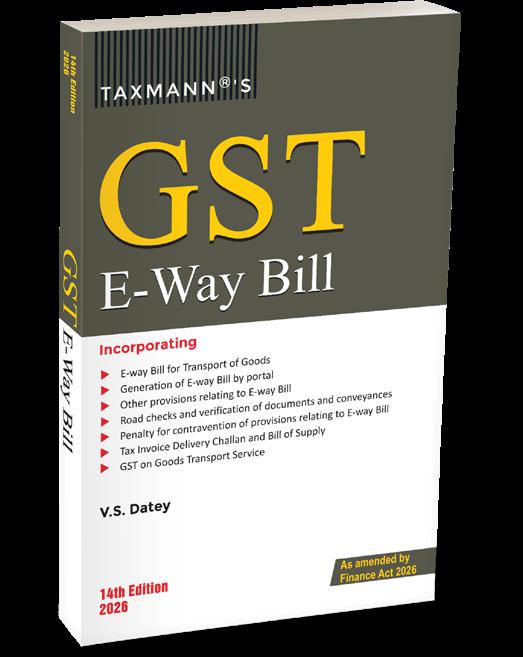
GST E-WAY BILL
AUTHOR : V.S.
Datey
PUBLISHER : Taxmann
DATE OF PUBLICATION : May 2026
EDITION : 14th Edition | 2026
ISBN NO : 9789375610311
NO. OF PAGES : 428
BINDING TYPE : Paperback
1,095
DESCRIPTION
GST E-Way Bill is a focused, end-to-end commentary on the e-way bill regime, together with the four allied subjects that always accompany it in practice—tax invoice, delivery challan, bill of supply, and GST on goods transport services. It begins from the statutory source and works outward to portal mechanics on ewaybillgst.gov.in and the second portal ewaybill2.gst.gov.in, GSTN advisories, NIC instructions, CBI&C circulars, and the body of Supreme Court, High Court and Appellate Authority case law accumulated since 1-4-2018. The result is a single reference that answers, in sequence, the four questions a practitioner actually asks: when must I generate an e-way bill, how do I generate and keep it valid, what document set must accompany the goods, and what happens—legally and procedurally—when an officer stops the truck.
The book is written for the readers who deal with the operational side of GST on the movement of goods, namely:
• Tax Professionals — Chartered Accountants, Cost Accountants, Company Secretaries and GST Practitioners
• Advocates and Counsel
• In-House Indirect Tax, Finance, Dispatch and Logistics Teams
• Transporters, Freight Forwarders, Multimodal Operators, Registered Leaseholders of Railway Parcel Space, and Warehouse and Godown Operators
• Officers of the Central and State GST Departments
• Faculty and Post-Graduate Students
The Present Publication is the 14th Edition | 2026, amended by the Finance Act 2026. This book is authored by V.S. Datey with the following noteworthy features:
• [Clause-by-Clause Rule Treatment] Each sub-rule of Rules 138 to 138F is analysed alongside its statutory anchor in the CGST Act, so the reader sees the entire regulatory cascade in one place
• [Interpretive Layer Over the Rule Text] The author flags drafting infelicities, the practical impossibility of certain compliances, and the unresolved questions field officers and assessees actually fight over
• [Unified FORM-Set Treatment] Combined coverage of the entire FORM-set—GST EWB-01 to EWB-06, MOV-01 to MOV-11, and DRC-01/01A, DRC-02, DRC-03, DRC-05, DRC-07 and DRC-12—with the legal hook for each form
• [Updated Advisories, Instructions and Circulars] A continuously updated treatment of GSTN advisories, NIC instructions and CBI&C circulars
• [Self-Contained Statute-cum-Rules Companion] Verbatim reproduction of the relevant CGST Act sections and the entire e-way bill rules in the appendix
• [Detention, Confiscation and 'Highway Robbery' Jurisprudence] A separate chapter, supported by a dedicated case-law chapter, covering Hindustan Steel v. State of Orissa, Synergy Fertichem v. State of Gujarat, Kay Pan Fragrance, Satyam Shivam Papers, Shyam Sel, Halder Enterprises, Sahil Traders, Sanjay Sales Agency and Allcargo Logistics
• [Stand-Alone GTA Commentary] Self-contained treatment of the forward-charge option of 5% (without ITC) or 18% (with ITC) effective 22-9-2025, the reverse-charge mechanism, the consignment-note test, the inclusion of free-is suediesel in value, and Annexures V and VI
• [Official User Manuals Reproduced in Full] The Web System User Manual 2025, Offline Tool 2018, SMS Operations User Manual 2018 and API/site-to-site Integration User Manual 2017
• [Latest Portal and Authentication Infrastructure] The second portal effective 1-6-2024, mandatory multi-factor authentication from 1-4-2025, OTP delivery via SMS, the Sandes app and the offline NIC-GST-Shield app, and the 180-day generation window
• [Cross-System Integration] A dedicated section on integration with FASTag, Vahan, the e-invoice/IRN system, RFID, and the Indian Railways PMS and FOIS