

Sample Read

© Taxmann
Price : ` 695
Fifth Edition : April 2026
Published by :
Taxmann Publications (P.) Ltd.
Sales & Marketing :
59/32, New Rohtak Road, New Delhi-110 005 India
Phone : +91-11-45562222
Website : www.taxmann.com
E-mail : sales@taxmann.com
Regd. Office :
21/35, West Punjabi Bagh, New Delhi-110 026 India
Printed at :
Tan Prints (India) Pvt. Ltd.
44 Km. Mile Stone, National Highway, Rohtak Road Village Rohad, Distt. Jhajjar (Haryana) India
E-mail : sales@tanprints.com
Disclaimer
Every effort has been made to avoid errors or omissions in this publication. In spite of this, errors may creep in. Any mistake, error or discrepancy noted may be brought to our notice which shall be taken care of in the next edition. It is notified that neither the publisher nor the author or seller will be responsible for any damage or loss of action to any one, of any kind, in any manner, therefrom. It is suggested that to avoid any doubt the reader should cross-check all the facts, law and contents of the publication with original Government publication or notifications.
No part of this book may be reproduced or copied in any form or by any means [graphic, electronic or mechanical, including photocopying, recording, taping, or information retrieval systems] or reproduced on any disc, tape, perforated media or other information storage device, etc., without the written permission of the publishers. Breach of this condition is liable for legal action. For binding mistake, misprints or for missing pages, etc., the publisher’s liability is limited to replacement within seven days of purchase by similar edition. All expenses in this connection are to be borne by the purchaser.
All disputes are subject to Delhi jurisdiction only.
The amount was so high, that the Lord ran out of money. Chitragupta said: “There’s only one way, to pay income tax on earth, in Bharat Desh. Sell all your very expensive original ornaments and pay tax. I warned you, Sire, you would lose your old ornaments. But, you did not pay attention.”
India was once known as “sone ki chidiya” for she could buy the gold of the entire world. Today, also India is the biggest consumer of gold in the international arena.
“Gold will be around. Gold will be money when the dollar and the Euro and the Yuan and the Ringgit are mere memories” said financial analyst Richard Russell.
This book is about how to save taxes, on gold. Whether you are a buyer, seller, investor, you would not like to face heavy tax burden, while fondly handling the shining, yellow gold. The book encompasses all aspects of gold and income-tax.
The “baby” GST has also been covered. Silver, the brother of gold, which has quietly strode into the limelight, makes its appearance in the book.
I wish to offer my thanks to TAXMANN, who has given me the opportunity to write a book for the largest tax publishing house in the country. I thank my parents, who encouraged me by saying “Well done” when each success came in life. I thank my elder brother, who was also in civil services, for encouragement.
This is the first book on Gold and Taxes, which has been written, in the country. Its simple, full of examples, cases and tables. The book would bring shine to your bookshelf. My fond hope is that India becomes jeweller to the world!
MEENAKSHI SUBRAMANIAM

SEARCH, SEIZURE
GOLD MONETIZATION SCHEME
COINS
TRADERS & GOLD
INHERITING
13.1
13.2
13.4
13.5
13.6
13.7
GOLD & SILVER UTENSILS
STRIDHAN
14.1
GOLD & GST
GST & GOLD TRADERS
GOLD MUTUAL FUNDS
19
JEWELLERY IN BANK LOCKERS
TRADING OF GOLD FUTURES AND
HOW NRIs CAN INVEST IN
TDS & TCS ON GOLD
Appendix 2 : Cost Inflation Index for Gold, sold after 1-4-2017, notified by CBDT on 12-6-2023 for financial year 2001-02 and subsequent years
:
:

How Much Gold Can You Hold 1
1.1 INTRODUCTION
Once, a fairy noticed a 50 year old man and his wife and asked both to make one wish each. The wife said, ‘I want lots of gold.’ She got her wish. The man said, ‘I want a wife, 25 years younger than me.’ Now, the man is saying, ‘I should also have asked for gold and lived happily.’ The fairy had made the man, older by 25 years, so that he was a senior citizen, of 75 years.
How much gold can a person have? Many people believe that CBDT Instruction No. 1916, dated 11-5-1994 which specifies how much can be seized during a raid lays down limits to how much jewellery an individual can possess.
The Finance Ministry had clarified on December 1, 2018 “There is no limit on holding of gold jewellery or ornaments by anybody provided it is acquired from explained sources of income including inheritance.”
However, with apprehensions continuing to persist in the absence of clarity on limit of holding, the ministry came out with another statement hours later saying there is no limit on gold holding from explained sources of income.
This means that Legitimate holding of jewellery up to any extent is fully protected.
1.1-1 CBDT Instruction Stays Firm
The CBDT instruction remains a guiding principle, not an ominous ceiling on wealth. For more than 30 years, the rule has ruled and
continues to rule. What is more, the new Income-tax Act, 2025 has also not enunciated any new principles. The recent Budget 2026 has also maintained status quo. The CBDT instruction continues to command respect, as a beacon for Department and taxpayers. However, the new Income-tax Act, 2025 and the latest Budget 2026 have turned section 247 of the ITA 2025 [Corresponding to section 132 of the ITA 1961] which relates to CBDT instruction into a strict search contraption. Anything from whatsapp chats to digital passwords can pried open. Although what Netflix movies would reveal about gold belonging to an individual is a riddle wrapped in a puzzle !
1.2 CBDT INSTRUCTION NO. 1916, DATED 11-5-1994
The CBDT Instruction No. 1916 (F. No. 286/63/93-IT (INV. II), dated 11-5-1994 is reproduced herein under:—
Guidelines for seizure of jewellery and ornaments in course of search
Instances of seizure of jewellery of small quantity in course of operations under section 247 of the ITA 2025 [Corresponding to section 132 of the ITA 1961] have come to the notice of the Board. The question of a common approach to situations where search parties come across items of jewellery, has been examined by the Board and following guidelines are issued for strict compliance:
(i) In the case of a wealth-tax assessee, gold jewellery and ornaments found in excess of the gross weight declared in the wealth-tax return only need be seized.
(ii) In the case of a person not assessed to wealth-tax gold jewellery and ornaments to the extent of 500 gms. per married lady, 250 gms. per unmarried lady and 100 gms. per male member of the family need not be seized.
(iii) The authorised officer may, having regard to the status of the family, and the custom and practices of the community to which the family belongs and other circumstances of the case, decide to exclude a larger quantity of jewellery and ornaments from seizure. This should be reported to the Director of Income-tax/ Commissioner authorising the search at the time of furnishing the search report.
(iv) In all cases, a detailed inventory of the jewellery and ornaments found must be prepared to be used for assessment purposes.
These guidelines may please be brought to the notice of the officers in your region.
It was also clarified that no seizure should be made by the Search Party of the Jewellery and Ornaments found during the course of search proceedings under section 247 of the ITA 2025 [Corresponding to section 132 of the ITA 1961], where the same have been duly declared in the wealth-tax returns filed by the taxpayer or where such ornaments are within the prescribed limits of 100, 250 or 500 grams as stated in the said instruction.
The CBDT directed that in the case of a person not assessed to wealth-tax, gold jewellery and ornaments to the extent of 500 gms. per married lady, 250 gms. per unmarried lady and 100 gms. per male member of the family, need not be seized.
1.2-1 Take advantage of CBDT’S kindness
There is a big tax benefit, which allows you to keep more gold, thanks to CBDT instruction No. 1916, dated 11-5-1994, that taxpayers may note. How does this take place?
Illustration
A family of four (husband, wife, unmarried son & daughter) possess 950 gm of gold. The limit set by CBDT is adhered to. The big surprise is that family possesses more than ` 1 crore, as per CBDT rule.
TABLE
GOLD BENEFIT, UNDER CBDT INSTRUCTION
FAMILY MEMBERQUANTITY OF GOLD
WIFE500 GM
HUSBAND100 GM
UNMARRIED DAUGHTER250 GM
UNMARRIED SON100 GM
TOTAL QUANTITY OF GOLD (see Note) 950 GM
ASSUMING 10 GM COSTS ` 1,25,000
TOTAL AMOUNT OF GOLD IN RUPEES = 1.2 CRORES (approx.}
Note: In case, there are more members in family, one can have more gold. For instance, mother-in-law, father-in-law, jija, devar etc.; etc.; can all have gold, increasing the quantity. The CBDT has not laid down any restrictions.
Therefore, at steep price of ` 1.25 lakh per 10 grams, the gold works out to roughly ` 1.2 crore in value. How has this gold miracle occurred?
Gold prices have shot up, going through the roof. Thus, it means that a woman having 500 gm had gold worth 2.5 lakhs in 1994, but now same gold which she is allowed to keep, legally, is worth ` 43.50 lakhs. The income tax authorities have to accept that she can keep 500 gm of gold, though it’s worth ` 43.50 lakhs now, not 2.5 lakhs.
The instruction has not been updated. There has also been no change in taxation of gold and silver. Hence, do note that there’s this tax loophole in India because of which people can keep ` 1 crore worth of gold without paying any tax on it.
1.3 APPLICATION OF INSTRUCTION NO. 1916 TO ASSESSMENT?
The divergent view of the Chennai High Court, in paragraphs 8 and 10 in the case of V.G.P. Ravidas v. Asstt. CIT [2014] 51 taxmann.com 16/[2015] 228 Taxman 93 (Mad.)(Mag.), suggest that the Instruction No. 1916 has a limited application and should be applied by the search authorities in deciding whether the jewellery and ornaments found during the search to the extent of the specified quantities be seized or not. Such divergent view of the judiciary appears to be suggesting that the scope of the instructions is not extended to the assessment of income and an assessee therefore cannot simply rely on the said instructions to plead that the possession of the jewellery to the extent of the specified quantity be treated as explained. An outcome of the observations of the High Court, is that an assessee is required to explain the possession of the jewellery in assessment of the income to the satisfaction of the AO independent of the fact that the jewellery was not seized and has to lead evidences in support of its possession though for the purposes of seizure, its possession was found to be reasonable by the search authorities.
1.4
SOME CASE STUDIES
1.4-1 Gold found in limit to be treated as explained
The issue had come up for the consideration of the Rajasthan High Court in the case of CIT v. Satya Narain Patni [2014] 46 taxmann. com 440/224 Taxman 312 (Raj.).
A search was carried out at the business and residential premises of the assessee on 30-6-2004. During the course of search, gold jewellery weighing 2,202.464 gms. valued at ` 10,53,520 and silver items valued at ` 93,678 were found. Looking to the status of the assessee and the statement given during the course of the search operation by various family members and considering the fact that there were four married ladies in the house, including the wife of the assessee, no jewellery was seized by the authorised officer.
In assessment of the income, however, the jewellery to the extent of 1,600 gms. was treated as reasonable by the AO. The balance jewellery weighing 602.464 gms. was treated as unexplained in the absence of any satisfactory explanation from the assessee and the value of the same which was determined at ` 2,88,176, was added back to the income of the assessee, treating the same as purchased out of Income from undisclosed sources of the assessee. In an appeal by the assessee, the Commissioner (Appeals), deleted the additions made by the AO of the value of the jewellery to the tune of ` 2,88,176. The Tribunal, on appreciation of facts and evidence available on record, also confirmed the order of CIT(A).
The Revenue, in the appeal before the Rajasthan High Court, contended that the AO had given due credit for the jewellery belonging to the various family members; that almost 75% of the jewellery found was treated as explained by the AO himself; only where the assessee or family members were not in a position to explain the balance jewellery, the addition was made; that the assessee or/ and other family members were not in a position to adequately explain the source of receipt of aforesaid jewellery and it was the duty of the assessee to lead proper evidence, but since no evidence was led, the AO after giving due credit for 1,600 gms. of jewellery, and being not satisfied with the balance, made the addition which was correct and justified; that the circular of the Board referred to by the Tribunal dated 11-5-1994, simply laid down that in case a
person was not assessed to wealth-tax, then in that case, jewellery and ornaments to the extent of 500 gms. per married lady, 250 gms. per unmarried lady and 100 gms. per male member of the family need not be seized, but that did not mean that the AO was debarred from questioning the possession of the items found; that the circular emphasised only that jewellery would not be seized. However, the AO was duty bound to seek explanation of owning and possessing of such jewellery. The Rajasthan High Court, on due consideration of the facts of the case, and importantly, relying on the Instruction No. 1916 of the CBDT, dismissed the appeal of the Income-tax Department by holding as under:
“12. It is true that the circular of the CBDT, referred to supra dated 11-5-1994 only refers to the jewellery to the extent of 500 gms. pre-married lady, 250 gms. per unmarried lady and 100 gms. per male member of the family, need not be seized and it does not speak about the questioning of the said jewellery from the person who has been found with possession of the said jewellery. However, the Board, looking to the Indian customs and traditions, has fairly expressed that jewellery to the said extent will not be seized and once the Board is also of the express opinion that the said jewellery cannot be seized, it should normally mean that any jewellery, found in possession of a married lady to the extent of 500 gms., 250 gms. per unmarried lady and 100 gms. per male member of the family will also not be questioned about its source and acquisition. We can take notice of the fact that at the time of wedding, the daughter/daughter-in-law receives gold ornaments jewellery and other goods not only from parental side but in-laws side as well at the time of ‘Vidai’ (farewell) or/and at the time when the daughter-in-law enters the house of her husband. We can also take notice of the fact that thereafter also, she continues to receive some small items by various other close friends and relatives of both the sides as well as on the auspicious occasion of birth of a child whether male or female and the CBDT, looking to such customs prevailing throughout India, in one way or the another, came out with this Circular and we accordingly are of the firm opinion that it should also mean that to the extent of the aforesaid jewellery, found in possession of the various persons, even source cannot be questioned. It is certainly ‘Stridhan’ of the woman and normally no question at least to the said extent can be made. However, if the authorized officers or/and the Assessing Officers, find jewellery beyond the said weight, then certainly they can question the source of acquisition of the jewellery and also in appropriate cases, if no proper
explanation has been offered, can treat the jewellery beyond the said limit as unexplained investment of the person with whom the said jewellery has been found.”
The High Court noted that, looking to the status of the family and the jewellery found in possession of four ladies, the quantum of jewellery was held to be reasonable and therefore, the authorised officers, in the first instance, did not seize the said jewellery as the same was within the tolerable limit or the limits prescribed by the Board. Thus, in the view of the court, subsequent addition was held to be not justified and was thus rightly deleted by both the two appellate authorities, namely, Commissioner (Appeals) as well as the tribunal.
The High Courts, relying on the instructions of the CBDT, have consistently held that the possession of the jewellery and ornaments to the extent of the quantities specified in the instruction is to be treated as reasonable and therefore explained and should not be the subject matter of additions in assessment of the total income of a person.
The Gujarat High Court in CIT v. Ratanlal Vyaparilal Jain [2010] 2 taxmann.com 997 (Guj.), the Allahabad High Court in CIT v. Ghanshyam Das Johri [2014] 41 taxmann.com 295 (All.) and the Rajasthan High Court in yet another case, CIT v. Kailash Chand Sharma [2005] 146 Taxman 376 (Raj.) have consistently held that the possession of the jewellery of the quantities specified in the instruction issued by the CBDT is reasonable and therefore should be held to be explained in the hands of assessee and should not be the subject matter of addition by the AO on the ground that the assessee was unable to explain the possession thereof to his satisfaction.
The Courts have time and again held that the basis of Instruction No. 1916 is recognition of the customs prevailing in Hindu Society. It has been so held by Hon’ble Gujarat High Court in the case of Ratanlal Vyaparilal Jain (supra). It has been observed as under:” Thus, although Circular has been issued for the purpose of nonseizure of jewellery during the course of search, the basis for the same recognizes customs prevailing in Hindu Society.”
In the case of CIT v. Ghanshyam Das Johri [2014] 41 taxmann. com 295 (All.), the Allahabad High Court held that if one goes with CBDT’s Instruction No. 1916, dated 11-5-1994 then a married lady of reputed family is expected to own 500 gms. of ornaments. Therefore,
jewellery found in possession to that extent could not be treated as undisclosed investment.
In Kailash Chand Sharma case (supra), learned counsel for the respondent contended that the circular to which reference has been made above, has nothing to do with the assessment of undisclosed investment found at the time of search. The circular only relates to exemption from seizure to some extent but does not exclude the jewellery found during the search of assessee from assessment, if otherwise the explanation about acquisition by the assessee is not found to be satisfactory. Learned counsel for the Revenue relied on Part IV of the Circular, dated 11th May, 1994.
1.4-2 Relaxation to be allowed from seizure and not from treating them unexplained
The Chennai High Court in the case of V.G.P. Ravidas v. Asstt. CIT [2014] 51 taxmann.com 16/[2015] 228 Taxman 93 (Mag.)(Mad.) offered certain observations that are found to be inconsistent with the near unanimous view of the High Courts that the possession of the jewellery and ornaments, to the extent of the quantities specified by the CBDT, should be held to be explained.
In this case, the assessees filed the original return of income for the assessment year 2009-2010 on 30-9-2009. The Assessing Officer, pursuant to a search u/s 132, reopened the assessment and a reassessment was completed by him on 29-12-2010. The AO in so assessing the income, treated excess gold jewellery found and seized, of 242.200 gms. and 331.700 gms. respectively, as the unexplained income.
The assessees appeals before the Commissioner (Appeals), were dismissed. The Tribunal confirmed the order passed by the Commissioner (Appeals). In the appeal before the High Court, the short question that arose for consideration was whether the assessees in both the cases were entitled to plead that the quantum of excess gold jewellery seized did not warrant inclusion in the income of the assessees as unexplained investment in the light of the Board Instruction No.1916 [F.No. 286/63/93-IT (INV.II)], dated 11-5-1994.
The Chennai High Court while dismissing the appeals, on the facts of the case before it, inter alia observed in paragraph 10 of its order as under:
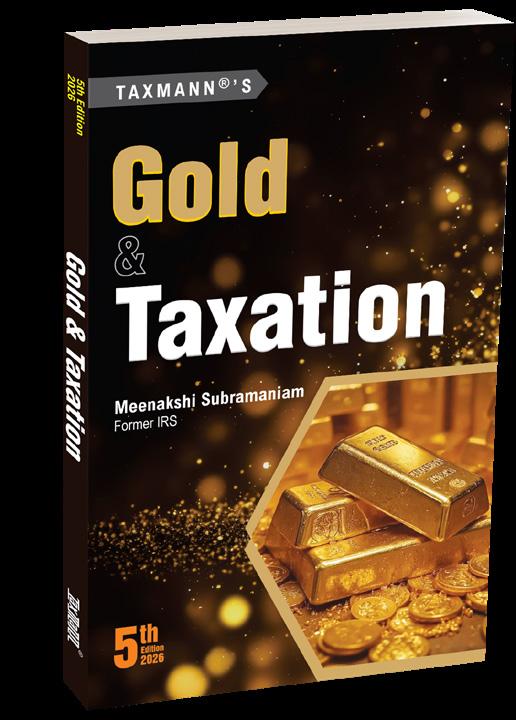
Gold & Taxation
AUTHOR : Meenakshi Subramaniam
PUBLISHER : Taxmann
DATE OF PUBLICATION : April 2026
EDITION : 5th Edition | 2026
ISBN NO : 9789371266437
No. of Pages : 368
BINDING TYPE : Paperback
Rs. 695
DESCRIPTION
Gold & Taxation is the first and only dedicated treatise in India on the taxation of gold and silver across all forms of ownership, investment, and trade. Now in its Fifth Edition, it has been comprehensively revised to incorporate the Income-tax Act 2025 (ITA 2025), Union Budget 2026, and the latest GST framework for the gold and silver sector.
The book covers gold across every form—jewellery, coins, biscuits, bars, ETFs, Sovereign Gold Bonds, Mutual Funds, Electronic Gold Receipts, futures and options, and bank locker holdings. Silver receives co-equal treatment with its own dedicated chapter. GST is addressed at both retail and trader levels, including HSN codes, ITC, and compliance forms.
Written in a style that is a deliberate departure from standard legal reference books, the author uses anecdote, wit, and worked examples alongside statutory text. The preface itself opens with a conversation between Chitragupta and a wealthy soul who failed to pay income tax on his gold.
The book serves a wide but defined audience, each segment finding something directly actionable:
• Individual Taxpayers and Families
• Women and Families Navigating Stridhan Claims
• Jewellers, Bullion Traders, Karigar Operators, and Goldsmith Businesses
• Chartered Accountants, Tax Advocates, and Consultants
• Investors in Gold ETFs, Sovereign Gold Bonds, Gold Mutual Funds, Silver ETFs, Gold Futures and Options, and Electronic Gold Receipts
• NRIs
• Students and Professionals
The Present Publication is the 5th Edition, authored by Meenakshi Subramaniam, with the following noteworthy features:
• [First Book of its Kind] The only dedicated treatise in India on gold taxation—consolidating income-tax law, GST, valuation, case law, and investment taxation into a single volume
• [Updated for ITA 2025] Every provision cited under the new Act with ITA 1961 cross-references in brackets—e.g., Section 247 of ITA 2025 [Corresponding to Section 132 of ITA 1961]
• [Budget 2026 Incorporated] Reflects all Union Budget 2026 amendments, including status quo on CBDT Instruction No. 1916 gold holding thresholds
• [Capital Gains Overhaul] Removal of indexation, 12.5% LTCG rate, and slab-rate STCG—fully analysed with worked illustrations and planning strategies
• [Extensive Case Law] Rulings from the Supreme Court, seventeen High Courts, and ITAT—spanning decades, with outcomes clearly stated for direct practitioner use
• [FAQ Architecture] Every chapter ends with a structured, theme-categorised FAQ section addressing the questions practitioners and taxpayers actually ask
• [Worked Numerical Scenarios] Multiple labelled scenarios per chapter—tracing transactions from facts through computation to final tax payable
• [Comparative Tables] Side-by-side comparisons across instruments, schemes, and tax treatments—including GDS 1999 vs. GMS 2015, Gold ETFs vs. Sovereign Gold Bonds, and CBDT seizure limit calculations by family composition
• [Dual Tax Coverage] Income tax and GST both addressed—including HSN codes, making charges, ITC, karigar services, job worker provisions, composition scheme, and anti-profiteering
• [Silver as Primary Subject] Dedicated coverage of silver jewellery, coins, bars, silverware, and Silver ETFs across income tax and GST
• [ITA 2025 Digital Search] Among the first publications to analyse the new statutory authority to override encryption, access cloud data, and intercept WhatsApp communications in gold-related searches
• [PMLA Intersection] Covers the 2020 notification bringing jewellers under PMLA, KYC thresholds for cash gold transactions, and rulings where PMLA proceedings overrode income-tax search actions