Sample Read
Contents GENERAL CLAUSES ACT, 1897 PAGE
PRELIMINARY 1. Short title
1
2. [Repealed by the Repealing and Amending Act, 1903]
1
GENERAL DEFINITIONS 3. Definitions
1
4. Application of foregoing definitions to previous enactments
11
4A. Application of certain definitions to Indian laws
11
GENERAL RULES OF CONSTRUCTION 5. Coming into operation of enactments 5A. [Omitted by the India (Adaptation of Existing Indian Laws) Order, 1947] 6. Effect of repeal
12 13 13
6A. Repeal of Act making textual amendment in Act or Regulation
15
7. Revival of repealed enactments
15
8. Construction of references to repealed enactments
15
9. Commencement and termination of time
16
10. Computation of time
17
11. Measurement of distances
17
12. Duty to be taken pro rata in enactments
17
13. Gender and number
17
13A. [Omitted by the Adaptation of Laws Order, 1950, w.e.f. 26-1-1950] I-5
18
CONTENTS
I-6 PAGE
POWERS AND FUNCTIONARIES 14. Powers conferred to be exercisable from time to time
18
15. Power to appoint to include power to appoint ex officio
18
16. Power to appoint to include power to suspend or dismiss
18
17. Substitution of functionaries
18
18. Successors
19
19. Official chiefs and subordinates
19
PROVISIONS AS TO ORDERS, RULES, ETC., MADE UNDER ENACTMENTS 20. Construction of Orders, etc., issued under enactments
19
21. Power to issue, to include power to add to, amend, vary or rescind notifications, orders, rules or bye-laws
20
22. Making of rules or bye-laws and issuing of orders between passing and commencement of enactment
21
23. Provisions applicable to making of rules or bye-laws after previous publication
21
24. Continuation of orders, etc. issued, under enactments repealed and re-enacted
22
MISCELLANEOUS 25. Recovery of fines
22
26. Provision as to offences punishable under two or more enactments
22
27. Meaning of service by post
23
28. Citation of enactments
23
29. Saving for previous enactments, rules and bye-laws
23
30. Application of Act to Ordinances
24
30A. [Omitted by the (Adaptation of Indian Laws) Order, 1937]
24
31. [Omitted by the (Adaptation of Indian Laws) Order, 1937]
24
SCHEDULE : [Repealed by the Repealing and Amending Act, 1903]
24
SUBJECT INDEX
25
General Clauses Act, 18971 [10 OF 1897]2 An Act to consolidate and extend the General Clauses Act, 1868 and 1887. WHEREAS it is expedient to consolidate and extend the General Clauses Acts, 1868 (1 of 1868) and 1887 (1 of 1887); it is hereby enacted as follows:— PRELIMINARY Short title. 1. (1) This Act may be called the General Clauses Act, 1897; 3[***]. (2) 4[***] Repeal. 2. [Repealed by the Repealing and Amending Act, 1903.] GENERAL DEFINITIONS 5
[Definitions.
3. In this Act, and in all Central Acts and Regulations made after the commencement of this Act, unless there is anything repugnant in the subject or context,— 1. This Act has been declared to be in force in the Santhal Parganas by the Santhal Parganas Settlement Regulation, 1872; in Panth Piploda by the Panth Piploda Laws Regulation, 1929; in Khondmals District by the Khondmals Laws Regulation, 1936; and in the Angul District by the Angul Laws Regulation, 1936. The Act has been partially extended to Berar by the Berar Laws Act, 1941 and to the new Provinces and Merged State by the Merged State (Laws) Act, 1949. The Act has been extended to— Goa, Daman and Diu with modifications by the Goa, Daman and Diu (Laws) Regulation, 1962, w.e.f. 6-12-1962; Dadra and Nagar Haveli by the Dadra and Nagar Haveli (Laws) Regulation, 1963, w.e.f. 1-7-1965; Pondicherry by the Pondicherry (Laws) Regulation, 1963, w.e.f. 1-101963 and Laccadive, Minicoy and Amindivi Islands by the Laccadive, Minicoy and Amindivi Islands (Laws) Regulation, 1965, w.e.f. 1-10-1967. Extended as whole to the Union territory of Jammu and Kashmir and Union territory of Ladakh by the Jammu and Kashmir Reorganisation Act, 2019, w.e.f. 31-10-2019. 2. Dated 11-3-1897. 3. Word “and” omitted by the Repealing and Amending Act, 1914. 4. Omitted, ibid. 5. Substituted by the Adaptation of Laws Order, 1950, w.e.f. 26-1-1950.
1
S. 3
GENERAL CLAUSES ACT, 1897
2
(1) “abet”, with its grammatical variations and cognate expressions, shall have the same meaning as in the Indian Penal Code (45 of 1860)*; (2) “act”, used with reference to an offence or a civil wrong, shall include a series of acts, and words which refer to acts done extend also to illegal omissions; (3) “affidavit” shall include affirmation and declaration in the case of persons by law allowed to affirm or declare instead of swearing; (4) “barrister” shall mean a barrister of England or Ireland, or a member of the Faculty of Advocates in Scotland; (5) “British India” shall mean, as respects the period before the commencement of Part III of Government of India Act, 1935, all territories and places within His Majesty’s dominions which were for the time being governed by His Majesty through the Governor-General of India or through any Governor or Officer subordinate to the Governor-General of India, and as respects any period after that date and before the date of the establishment of the Dominion of India means all territories for the time being comprised within the Governors’ provinces and the Chief Commissioners’ provinces, except that a reference to British India in an Indian law passed or made before the commencement of Part III of the Government of India Act, 1935, shall not include a reference to Berar; (6) “British possession” shall mean any part of Her Majesty’s dominions exclusive of the United Kingdom, and where parts of those dominions are under both a Central and a Local Legislature, all parts under the Central Legislature shall, for the purposes of this definition, be deemed to be one British possession; (7) “Central Act” shall means an Act of Parliament, and shall include— (a) an Act of the Dominion Legislature or of the Indian Legislature passed before the commencement of the Constitution, and (b) an Act made before such commencement by the Governor-General in Council or the Governor-General, acting in a legislative capacity; 6
[(8) “Central Government” shall,— (a) in relation to anything done before the commencement of the Constitution, mean the Governor-General or the Governor-General in Council, as the case may be; and shall include,— (i) in relation to functions entrusted under sub-section (1) of section 124 of the Government of India Act, 1935, to the Government of a Province, the provincial Government acting within the scope of the authority given to it under that sub-section; and (ii) in relation to the administration of a Chief Commissioner’s Province, the Chief Commissioner acting within the scope of
6. Substituted by the Adaptation of Laws (Amendment) Order, 1950, w.r.e.f. 26-1-1950. *See Bharatiya Nyaya Sanhita, 2023 (45 of 2023) [Vide Notification No. S.O. 2790(E), dated 16-7-2024].
3
GENERAL CLAUSES ACT, 1897
S. 3
the authority given to him under sub-section (3) of section 94 of the said Act; and (b) in relation to anything done or to be done after the commencement of the Constitution, mean the President; and shall include,— (i) in relation to functions entrusted under clause (1) of article 258 of the Constitution, to the Government of a State, the State Government acting within the scope of the authority given to it under that clause; 7[***] (ii) in relation to the administration of a Part C State 8[before the commencement of the Constitution (Seventh Amendment) Act, 1956], the Chief Commissioner or the Lieutenant-Governor or the Government of a neighbouring State or other authority acting within the scope of the authority given to him or it under article 239 or article 243 of the Constitution, as the case may be;] 8[and] 8
[(iii) in relation to the administration of a Union Territory, the administrator thereof acting within the scope of the authority given to him under article 239 of the Constitution;]
(9) “Chapter” shall mean a Chapter of the Act or regulation in which the word occurs; (10) “Chief Controlling Revenue Authority” or “Chief Revenue Authority” shall mean— (a) in a State where there is a Board of Revenue, that Board; (b) in a State where there is a Revenue Commissioner, that Commissioner; (c) in Punjab, the Financial Commissioner; and (d) elsewhere, such authority as, in relation to matters enumerated in List I in the Seventh Schedule to the Constitution, the Central Government, and in relation to other matters, the State Government, may by notification in the Official Gazette, appoint; (11) “Collector” shall mean, in a Presidency-town, the Collector of Calcutta, Madras or Bombay, as the case may be, and elsewhere the chief officer-in-charge of the revenue-administration of a district; (12) “Colony”— (a) in any Central Act passed after the commencement of Part III of the Government of India Act, 1935, shall mean any part of His Majesty’s Dominions exclusive of the British Islands, the Dominions of India and Pakistan (and before the establishment of those Dominions, British India), any Dominions as defined in the Statute of Westminster, 1931, any Province or State forming part of any of the said Dominions, and British Burma; and 7. Word “and” omitted by the Adaptation of Laws (No. 1) Order, 1956, w.e.f. 1-11-1956. 8. Inserted, ibid.
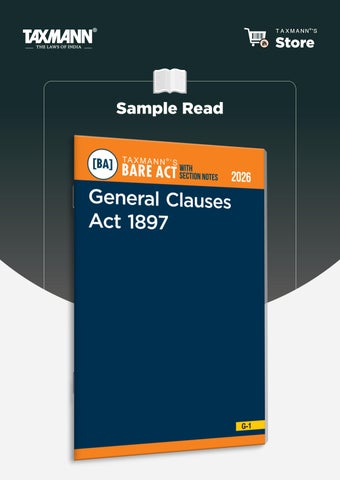
General Clauses Act 1897 – Bare Act with Section Notes AUTHOR : PUBLISHER : DATE OF PUBLICATION : EDITION : ISBN NO : No. of Pages : BINDING TYPE :
Taxmann’s Editorial Board Taxmann December 2025 2026 Edition 9789371262774 40 Paperback
Rs. 85 DESCRIPTION General Clauses Act 1897 [Bare Act with Section Notes] by Taxmann is a core statutory reference that explains the interpretative framework applicable to Central Acts, Regulations, Rules, Notifications, and subordinate legislation in India. Regarded as the key to statutory interpretation, the Act lays down uniform definitions, rules of construction, and saving provisions that operate across the entire legislative landscape. The 2026 Edition presents the complete and updated text of the Act, supported by concise section-wise notes, select judicial references, and contextual explanations aligned with post-constitutional developments, including the transition from the IPC, CrPC, and Evidence Act to the Bharatiya Nyaya Sanhita, Bharatiya Nagarik Suraksha Sanhita, and Bharatiya Sakshya Adhiniyam. This Edition ensures accuracy, clarity, and contemporary relevance. This book is intended for the following audience: •
Judges & Judicial Officers
•
Advocates & Litigators
•
Legislative Drafters & Government Officials
•
Law Students & Academicians
•
Corporate Legal Teams & Compliance Professionals
The Present Publication is the 2026 Edition, covering the amended and updated text of the General Clauses Act 1897 [Act No. 10 of 1897], with the following noteworthy features: •
[Bare Text and Section Notes] Complete statutory text with concise section-wise notes explaining key concepts, definitions, and interpretative principles
•
[Updated Coverage] Incorporates current amendments, adaptations, and references in line with recent legislative reforms
•
[Pre-amendment Provisions] Includes pre-amendment text in relevant footnotes to enable understanding of the earlier legal position
•
[User-friendly Layout] Clear section-wise arrangement with headings, sub-headings, and an easyto-use table of contents
•
[Case Law References & Illustrations] Select Supreme Court and High Court rulings highlighting the practical application of interpretative rules
•
[Comparison with Related Statutes] Notes drawing contextual links with other key enactments, particularly the new criminal law codes
Buy Now