
Sample Read


© All rights reserved
Price : ` 395
Fifth Edition : June 2026
Published by :
Taxmann Publications (P.) Ltd.
Sales & Marketing : 59/32, New Rohtak Road, New Delhi-110 005 India
Phone : +91-11-45562222
Website : www.taxmann.com
E-mail : sales@taxmann.com
Regd. Office : 21/35, West Punjabi Bagh, New Delhi-110 026 India
Printed at :
Tan Prints (India) Pvt. Ltd.
44 Km. Mile Stone, National Highway, Rohtak Road Village Rohad, Distt. Jhajjar (Haryana) India
E-mail : sales@tanprints.com
Disclaimer
Every effort has been made to avoid errors or omissions in this publication. In spite of this, errors may creep in. Any mistake, error or discrepancy noted may be brought to our notice which shall be taken care of in the next edition. It is notified that neither the publisher nor the author or seller will be responsible for any damage or loss of action to any one, of any kind, in any manner, therefrom.
No part of this book may be reproduced or copied in any form or by any means [graphic, electronic or mechanical, including photocopying, recording, taping, or information retrieval systems] or reproduced on any disc, tape, perforated media or other information storage device, etc., without the written permission of the publishers. Breach of this condition is liable for legal action.
For binding mistake, misprints or for missing pages, etc., the publisher’s liability is limited to replacement within seven days of purchase by similar edition. All expenses in this connection are to be borne by the purchaser. All disputes are subject to Delhi jurisdiction only.


CHAPTER 2
QUICK REVISION OF THE CHAPTER
IMPORTANT CONCEPTS
Indices:
The power or exponent of any number or a variable is known as Index. Plural of Index is Indices, Indices provide a compact algebraic notation for repeated multiplication. For solving expression with Indices, the law of exponents is applied. In the expression x5, the power 5 is known as Index and x is known as Base.
Basic rules of Indices:
(1) am × an = am + n
(2) am/an = am – n
(3)1/am = a–m
(4) a0 = 1
(5)If in an equation bases on both sides are same, powers can be equated.
(6) If in an equation powers or indices on both sides are same, bases can be equated.
Logarithm:
Definition:
If ax= N and a > 0, N > 0 then x = loga N and read as logarithm of N to the base ‘a’ or in other words log N to the base ‘a’.
So, logarithm of a positive number N signifies that for a given base ‘a’ it is the power to which ‘a’ must be raised to produce the positive number ‘N’.
Common and Natural Logarithms:
Common Logarithms are the logarithms for which the base is considered as 10. For any calculation with logarithms, if base is taken as 10, the logarithms are considered to be Common Logarithms. In such scenarios, the base to a logarithm is not generally mentioned but is assumed to be 10.
When the base of Logarithm is e (where e means exponential and having value 2.718) then it is called Natural Logarithm. Its extensive use is seen in Calculus.
Laws followed for Logarithms:
(1) Logarithm of the product of the numbers would be equal to the sum of their logarithms.
Loga(mn) = loga m + loga n
(2) Logarithms of the quotient of two numbers would be equal to the difference of their logarithms.
Loga(m/n) = loga m – loga n
(3) Logarithm of any number raised to a power would be equal to the product of the logarithm of the number and the power.
Loga mn = n Loga m
(4) For any logarithm where base is same as the number, the value of logarithm would always be one (1). The value of base or number should not be equal to 1 and should be a positive number (> 0).
Loga a = 1
(5) For any logarithm where number is 1 and the base is a positive number, then value would always be zero.
Loga 1 = 0
(6) The base of a logarithm for a number would be equal to the reciprocal of the logarithm with the number replaced by base.
Loga m = 1/Logm a
(7) Change of Base for Logarithm: The logarithm of a number with a base can be changed with the introduction of the base and number splitted into two expressions of logarithms. The base and the number would be same with a new variable introduced both as base and number to the new logarithmic expressions.
Loga m = Loga n × Logn m
PAST EXAMINATION QUESTIONS
THEORY QUESTIONS
LOGARITHMS
Q. 1. The logarithm of any number to the same base is:
(a) Unity
(b) Zero
(c) Infinity
(d) Non-existence [March 2016]
Ans. (a) Unity
Q. 2. The whole of the integral part of a logarithm is called:
(a) Characteristic
(b) Mantissa
(c) Both
(d) None of these [June 2016]
Ans. (a) Characteristic
Q. 3. Logarithm of unity to any nonzero base is:
(a) 1
(b) 10
(c) 0
(d) None of these [Dec. 2016] [Modified]
Ans. (c) 0
Q. 4. Given log10 1372 = 3.1374 The mantissa for log10 13.72 is:
(a) 1.374
(b) 0.1374
(c) 13.74
(d) None of these [Dec. 2016] [Modified]
Ans. (b) 0.1374
Note: log10 13.72 = 1.1374, Hence, Mantissa is 0.1374
Q. 5. The value of Log7 7 is:
(a) 0
(b) –1
(c) 1/2
(d) 1 [June 2017]
Ans. (d) 1
Q. 6. The value of logarithm of 1 to the base 10 is:
(a) 2
(b) 10
(c) 0
(d) 1 [June 2018]
Ans. (c) 0
NUMERICAL QUESTIONS
INDICES
Q. 1. If 3x + 1 + 3x – 1 = 270 then the value of x is:
(a) 5
(b) 3
(c) 4
(d) 8 [June 2013]
Ans. (c) 4
Working Note:
3x + 1 + 3x – 1 = 270
3x 31 + 3x 3-1 = 270
3x (31 + 3–1) = 270
3x (3 + 1/3) = 270
3x (10/3) = 270
3x = 270 (3/10)
3x = 81
3x = 34
Therefore, x = 4
Q. 2. If x = 7 – 43 , then the value of ()x+1x is:
(a) 2 3
(b) 43
(c) 4
(d) 6 [June 2013]
Ans. (c) 4
Working Note: x = 7 – 43
x = 4 + 3 – 43 x = ()2 23 23 x =−
Now, () 1/ xx +
= () ()231/23 −+−
= () () 2 231/23 ⎡⎤−+− ⎢⎥ ⎣⎦ = ()7431/23 ⎡⎤−+− ⎣⎦ = ()843/23 ⎡⎤ ⎣⎦ = () ()423/23 = 4
Q. 3. The value of 6+6+6 + ...... to infinity is:
(a) 6
(b) 4
(c) –2
(d) 3
[March 2015, Sept. 2015, March 2016]
Ans. (d) 3
Working Note:
Let x = 666 ++ +......
Squaring Both sides we get,
x2 = 6 + x
x2 – x – 6 = 0
x2 – 3x + 2x – 6 = 0
x (x – 3) + 2 (x – 3) = 0
(x + 2) (x – 3) = 0
x + 2 = 0
x = –2 (Not possible. As Square root cannot be done for negative value)
x – 3 = 0
x = 3
Q. 4. If a1/3 + b1/3 + c1/3 = 0, then (a + b
+ c)³ =
(a) 3 abc
(b) 27 abc
(c) –27 abc
(d) None of these [June 2015]
Ans. (b) 27 abc
Working Note:
If (a + b + c) = 0 than,
a3 + b3 + c3 = 3abc
Here, a = a1/3 , b = b1/3 , c = c1/3, Therefore,
(a1/3)3 + (b1/3)3 + (c1/3)3 = 3 a1/3 b1/3 c1/3
a + b + c = 3 a1/3 b1/3 c1/3
Doing cube on both sides we get,
(a + b+ c)3 = (3 a1/3 b1/3 c1/3)3
(a + b+ c)3= 27abc
Q. 5. If 3x = 9y, then (6y/x) – 1
(a) 1
(b) 2
(c) 1/2
(d) 0 [Sept. 2015]
Ans. (a) 1
Working Note:
3x = 9y
x = 3y
Now, 6y/x – 1 = 6y/3y – 1 = 2 – 1 = 1
Q. 6. If x + 4 = 4, 2x – 5y = 1 then x & y are:
(a) (1, 0)
(b) (0, –1/5)
(c) (1, 1/5)
(d) (1/5, 0) [Sept. 2015]
Ans. (b) (0, –1/5)
Working Note:
x + 4 = 4
x = 0
2x – 5y = 1
2 (0) – 5y = 1
–5y = 1
y = –1/5
Q. 7. If x = 2+5 , then x3 + 3x2 –29x:
(a) 7
(b) 10
(c) 0
(d) None of these [Dec. 2015]
Ans. (a) 7
Working Note:
x = 25 +
Doing Cube on both sides we get,
x3 = ()3 25 +
x3 = 23 + 3(2)2 () () () 23 53(2)55 ++
x3 = 8 + 12 () ()53055 ++
x3 = 38 + 12 () ()555 +
x3 = 38 + 17 () 5
Adding 3x2 on both sides we get,
x3 + 3x2 = 38 + 17 () ()2 5325 ++
x3 + 3x2 = 38 + 17 () ()2 2 322(2)55 ⎛⎞ + ++ ⎝⎠
x3 + 3x2 – 29x = 65 + 29 () ()558295
x3 + 3x2 – 29x = 65 + 29 () ()558295
x3 + 3x2 – 29x = 7
Q. 8. If 3x = 5y = (225)z, then Z:
(a) XY/X + Y
(b) XY/2(X + Y)
(c) 2(X + Y)
(d) None of these [March 2016]
Ans. (b) XY/2(X + Y)
Working Note:
Let, 3x = 5y = (225)z = k
3x = k
3 = k1/x [Equation 1]
5y = k
5 = k1/y [Equation 2]
225z = k
152z = k
15 = k1/2z [Equation 3]
Multiplying Equation 1 and 2, we get,
(3) (5) = (k1/x) (k1/y)
15 = k1/x + 1/y [Inserting Value of 15 from Equation 3]
k1/2z = k1/x + 1/y
1/2z = 1/x + 1/y
1/2z = (y + x)/xy
xy/(x + y) = 2z
z = xy/2(x + y)
x3 + 3x2 = 38 + 17 () () ( )534455 +++
x3 + 3x2 = 38 + 17 () ()527125 ++
x3 + 3x2 = 65 + 29 () 5
Deducting 29x from both side we get,
x3 + 3x2 – 29x = 65 + 29 () ()52925 −+ () 5
Q. 9. 64x = 22 , then X:
(a) 1/6
(b) 1/2
(c) 1/4
(d) None of these [June 2016]
Ans. (c) 1/4
Working Note:
64x = 22
(26)x = ()3 2
()12 2 x = ()3 2
12x = 3
x = 3/12
x = 1/4
Q. 10. The digit in the unit place of (2 (4)x)2 +1 (where x is a positive integer) is:
(a) 1
(b) 5
(c) 3
(d) None of these [June 2016]
Ans. (b) 5
Working Note:
Let x = 1, Therefore,
(2 (4)1)2 + 1
= 82 + 1 = 65
Let x = 2, Therefore,
(2 (4)2)2 + 1 = (2 (16))2 + 1
= 322 + 1 = 1,025
Hence, for any value of x the digit in unit place shall be 5.
Q. 11. If ax= by = cz and b2 = ac then xy + yz = ?
(a) x2
(b) –xz
(c) 2xz
(d) None of these [June 2016]
Ans. (c) 2xz
Working Note:
Let, ax= by = cz = k
ax = k
a = k1/x [Equation 1] by = k
b = k1/y [Equation 2]
cz = k
c = k1/z [Equation 3]
Now, b2 = ac, Therefore,
(k1/y)2 = (k1/x) (k1/z) [Putting values from Equation 1, 2 and 3]
k2/y = k(1/x + 1/z)
2/y = 1/x + 1/z
2/y = (z + x)/xz
2xz = yz + xy
Q. 12. In the equation 2x – y = 5, if x = 4 then y = ?
(a) 3
(b) 4
(c) –2
(d) –5 [June 2016]
Ans. (a) 3
Working Note:
2x – y = 5
2 (4) – y = 5
8 – y = 5
y = 3
Q. 13. If 2x + (1/2x) = 5/2 the value of x is:
(a) –1
(b) 1
(c) 0
(d) 1 [Dec. 2016]
Ans. (b) 1
Working Note:
Let 2x = a, Therefore, a + 1/a = 5/2
(a2 + 1)/a = 5/2
2a2 + 2 = 5a
2a2 – 5a + 2 = 0
2a2 – 4a – 1a + 2 = 0
2a (a – 2) – 1 (a – 2) = 0
(2a – 1) (a – 2) = 0
2a – 1 = 0
2a = 1
a = ½ [Equation 1]
a – 2 = 0
a = 2 [Equation 2]
Now Putting a = 2x in Equation 1 we get,
2x = 1/2
2x = 2–1
x = –1
Now Putting a = 2x in Equation 2 we get,
2x = 2
x = 1
So, x = 1
Q. 14. Solve for t : t1-t13 += 1-tt6
(a) 4/13, 9/13
(b) 9/13, 9/13
(c) –4/13, 9/13
(d) –9/13, 4/13 [Dec. 2017] [Modified]
Ans. (a) 4/13, 9/13
Working Note:
Let, 1 t t = a, Therefore,
a + 1/a = 13/6
(a2 + 1)/a = 13/6
6a2 + 6 = 13a
6a2 – 13a + 6 = 0
6a2 – 9a – 4a + 6 = 0
3a (2a – 3) – 2 (2a – 3) = 0
(3a – 2) (2a – 3) = 0
3a – 2 = 0
3a = 2
a = 2/3 (Equation 1)
or
2a – 3 = 0
2a = 3
a = 3/2 (Equation 2)
Now, Putting the value of a in both the
a = 2/3 1 t t = 2/3
Squaring both sides, we get,
t/(1 – t) = 4/9
9t = 4 (1 – t)
9t = 4 – 4t
13t = 4
t = 4/13 or a = 3/2 1 t t = 3/2
Squaring both sides, we get,
t/(1 – t) = 9/4
4t = 9 (1 – t)
4t = 9 – 9t
13t = 9
t = 9/13
Q. 15. If 3x – 1 – 3x – 3 = 8, then the value of (x2 – x + 4) is: (a) 10 (b) 8 (c) 12 (d) 15 [June 2018]
Ans. (a) 10
Working Note:
3x – 1 – 3x – 3 = 8
3x 3–1 – 3x 3–3 = 8
3x (3–1 – 3–3) = 8
3x (1/3 – 1/27) = 8
3x (9 – 1)/27 = 8
3x 8/27 = 8
3x = 27
3x = 33
x = 3
x2 – x + 4
= (3)2 – 3 + 4 = 9 – 3 + 4 = 10
Q. 16. The value of (32)1/5 is:
(a) 1/2
(b) 2
(c) 4
(d) None of these [June 2018] [Modified]
Ans. (b) 2
Working Note:
(32)1/5 = (25)1/5 = 2
Q. 17. The value of x when 2x = 3x is:
(a) 1
(b) 0
(c) 6
(d) None of these [June 2018] [Modified]
Ans. (b) 0
Working Note:
Base of 2 and 3 with power x can only be same when x = 0, that will result into both 20 = 1 and 30 = 1.
Q. 18. If p = 2+3 , then 1/p =
(a) 2-3
(b) 3+2
(c) 32
(d) None of these [June 2018] [Modified]
Ans. (d) None of these
Working Note:
1/p = 1/ () 23 + , Therefore, the correct answer is None of these.
Q. 19. (–2)5 = (a) 32
(b) 1/32
(c) –32
(d) None of these [Dec. 2018] [Modified]
Ans. (c) –32
Working Note:
(–2)5 = –2 × –2 × –2 × –2 × –2 = –32
Q. 20. The value of (25/4)4 is:
(a) 30
(b) 23
(c) 31
(d) 32 [June 2019]
Ans. (d) 32
Working Note: (25/4)4 = 25/4 × 4 = 25 = 32
Q. 21. If 2x – 1 + 2x + 1 = 80, then the value of x is:
(a) 8 (b) 4
(c) 5
(d) 10 [Dec. 2019]
Ans. (c) 5
Working Note:
2x – 1 + 2x + 1 = 80
(2x) (2–1) + (2x) (21) = 80
2x [2–1 + 21] = 80
2x [1/2 + 2] = 80
2x (5/2) = 80
2x = 80 × 2/5
2x = 32
2x = 25 x = 5
Q. 22. Find the value of ⎛⎞
4 5 1 ×(243) 81
(a) 27
(b) 9
(c) 81
(d) None of these [Dec. 2019] [Modified]
Ans. (b) 9
Working Note: () 3 1 4 5 1 243 82 ⎛⎞ × ⎜⎟ ⎝⎠
= (81)3/4 × (243)–1/5 = (34)3/4 × (35)–1/5 = 33 – 3–1 = 33 – 1 = 32 = 9
Q. 23. If 3x = 1/243 then the value of x is:
(a) 5
(b) –5
(c) –1/5
(d) 1/5 [Dec. 2019] [Modified]
Ans. (b) –5
Working Note:
3x = 1/243
3x = 1/35
3x = 3–5
x = –5
Q. 24. If 9 × 81x = 27(x – 3) then the value of x is:
(a) 10 (b) 11 (c) 9 (d) –11 [Dec. 2022]
Ans. (d) –11
Working Note:
9 × 81x = 27(x – 3)
32 × 34x = 33(x – 3)
3(2 + 4x) = 3(3x – 9)
2 + 4x = 3x – 9 x = –11
Q. 25. If x = 5+26 then ()x+1/x is equal to:
(a) 32 (b) 3
(c) 23
(d) 2
Ans. (c) 23
Working Note:
x = 5 + 26
x = 3 + 2 + 2 32
x = ()2 32 + Now, () 1/ xx +
[Dec. 2022]
= () () 32)1/32 +++
= () () () 32)32)1/32 ++++
= () ()5261/32 +++ () ()626/32 ++ = () 233232/32 ++ = () ()2332/32 ++
= 23
Q. 26. 9 × 81x = 1/(27x – 3) find the value of x.
(a) 2
(b) –2
(c) 1
(d) 0 [June 2023]
Ans. (c) 1
Working Note:
9 × 81x = 1/27(x – 3)
32 × 34x = 1/33(x – 3)
3(2 + 4x) = 1/3(3x – 9)
3(2 + 4x) × 3(3x – 9) = 1
3(2 + 4x + 3x – 9) = 1
3(7x – 7) = 1
3(7x – 7) = 30
7x – 7 = 0
7x = 7
x = 1
Q. 27. If 32x + 4 = 33x then the value of x is:
(a) 1
(b) 2
(c) 3
(d) 4 [Dec. 2023]
Ans. (d) 4
Working Note:
32x + 4 = 33x
2x + 4 = 3x
3x – 2x = 4 x = 4
Q. 28. If (300)8 =65.61 × 10x, then the value of x is:
(a) 14
(b) 16
(c) 18
(d) 20 [June 2024]
Ans. (c) 18
Working Note:
(300)8 = 65.61 × 10x (3 × 100)8 = (6561/100) 10x
38 × 1016 = (38/102) 10x
1016 = 10x – 2 16 = x – 2 x = 18
Q. 29. If 3x – y= 27 and 3x + y= 243, then x is equal to:
(a) 0
(b) 2
(c) 4
(d) 6 [June 2024]
Ans. (c) 4
Working Note:
3x – y= 27
3x – y= 33
x – y = 3 [Equation 1]
3x + y= 243
3x + y= 35
x + y = 5 [Equation 2]
Solving Equations 1 and 2, We get,
2x = 8
x = 4
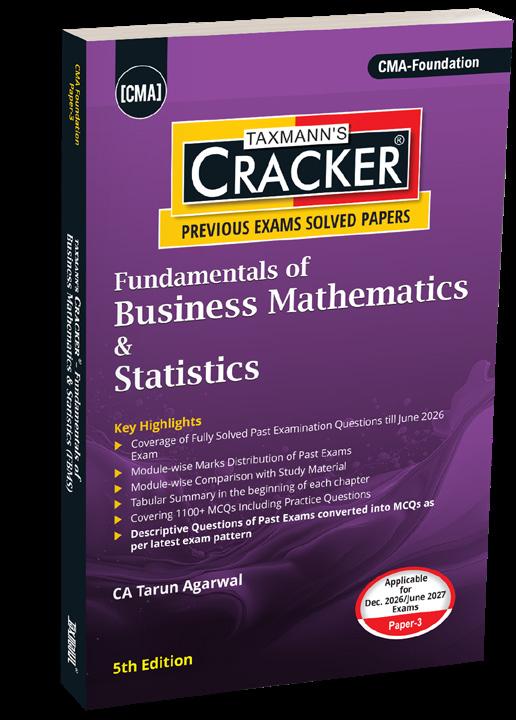
Fundamentals of Business Mathematics & Statistics (FBMS | Maths) | CRACKER
AUTHOR : Tarun Agarwal
PUBLISHER : Taxmann
DATE OF PUBLICATION : June 2026
EDITION : 5th Edition
ISBN NO : 9789375619741
No. of Pages : 336
BINDING TYPE : Paperback
395
DESCRIPTION
Fundamentals of Business Mathematics & Statistics (FBMS | Maths) – CRACKER is an exam-oriented question bank built to help students crack Paper 3 of the CMA Foundation examination (ICMAI). Since the Foundation paper is entirely MCQ/OMR-based, it rewards conceptual recall and speed—so this title keeps theory to a minimum and puts the student straight into exam-style practice, question after question.
Every chapter opens with a quick revision of key concepts and formulae, then moves into a comprehensive MCQ bank. The questions are drawn from actual past exams, each tagged with its term and solved with a step-by-step ‘Working Note’ that teaches the method, not just the answer. In all, the book delivers 1,100+ MCQs (including original practice questions) and fully solved past-exam questions up to the June 2026 exam—making it one of the most current revision companions for this paper. Current for the December 2026 & June 2027 Attempts.
The Present Publication is the 5th Edition | June 2026, authored by CA. Tarun Agarwal, with the following noteworthy features:
• [Fully Solved Past-Exam Questions till June 2026] Real past questions, each fully solved, with coverage up to the latest June 2026 paper—so practice reflects current trends, not dated material
• [1,100+ MCQs Including Practice Questions] Past-exam questions plus original practice MCQs give the repetition needed to build accuracy and speed
• [Descriptive Questions Converted into MCQs (Latest Pattern)] Earlier descriptive questions are recast as MCQs, preserving years of exam history in the current objective format
• [Step-by-Step ‘Working Notes’ with Every Solution] Each answer is backed by a clear worked ‘Working Note’, turning the bank into a self-teaching tool
• [Module-Wise Marks Distribution of Past Exams] A front-matter chart of topic-wise marks across June and December sittings (2023 to June 2026), with averages—a built-in map for prioritising study
• [Module-Wise Comparison with the ICMAI Study Material] Every chapter is mapped to its official CMA module number for seamless cross-reference
• [Tabular Quick-Revision Summary in Every Chapter] All 27 chapters open with a quick recap of key concepts, properties and formulae
• [Four Fully Solved Recent Papers (Dec 2024 – June 2026)] Complete solved papers for December 2024, June 2025, December 2025 and June 2026, in the actual exam’s section format