Sample Read
© Taxmann Price : ` 355 Law stated in this book is as updated till 15th August, 2026 Published by : Taxmann Publications (P.) Ltd. Sales & Marketing : 59/32, New Rohtak Road, New Delhi-110 005 India Phone : +91-11-45562222 Website : www.taxmann.com E-mail : sales@taxmann.com Regd. Office : 21/35, West Punjabi Bagh, New Delhi-110 026 India Printed at : Tan Prints (India) Pvt. Ltd. 44 Km. Mile Stone, National Highway, Rohtak Road Village Rohad, Distt. Jhajjar (Haryana) India E-mail : sales@tanprints.com Disclaimer Every effort has been made to avoid errors or omissions in this publication. In spite of this, errors may creep in. Any mistake, error or discrepancy noted may be brought to our notice which shall be taken care of in the next edition. It is notified that neither the publisher nor the author or seller will be responsible for any damage or loss of action to any one, of any kind, in any manner, therefrom. It is suggested that to avoid any doubt the reader should cross-check all the facts, law and contents of the publication with original Government publication or notifications. No part of this book may be reproduced or copied in any form or by any means [graphic, electronic or mechanical, including photocopying, recording, taping, or information retrieval systems] or reproduced on any disc, tape, perforated media or other information storage device, etc., without the written permission of the publishers. Breach of this condition is liable for legal action. For binding mistake, misprints or for missing pages, etc., the publisher’s liability is limited to replacement within seven days of purchase by similar edition. All expenses in this connection are to be borne by the purchaser. All disputes are subject to Delhi jurisdiction only.
Contents ENERGY CONSERVATION ACT, 2001 PAGE
CHAPTER I PRELIMINARY 1. Short title, extent and commencement
1
2. Definitions
1 CHAPTER II BUREAU OF ENERGY EFFICIENCY
3. Establishment and incorporation of Bureau of Energy Efficiency
6
4. Management of Bureau
6
5. Meeting of Governing Council
9
6. Vacancies, etc., not to invalidate proceedings of Bureau, Governing Council or Committee
9
7. Removal of member from office
9
8. Constitution of Advisory Committees and other committees
10
9. Director-General of Bureau
10
10. Officers and employees of Bureau
10
11. Authentication of orders and decisions of Bureau
10
I-5
I-6
CONTENTS
PAGE
CHAPTER III TRANSFER OF ASSETS, LIABILITIES, ETC., OF ENERGY MANAGEMENT CENTRE TO BUREAU 12. Transfer of assets, liabilities and employees of Energy Management Centre
11
CHAPTER IV POWERS AND FUNCTIONS OF BUREAU 13. Powers and functions of Bureau 13A. Prohibition of use deceptive name, etc.
11 14
CHAPTER V POWER OF CENTRAL GOVERNMENT TO FACILITATE AND ENFORCE EFFICIENT USE OF ENERGY AND ITS CONSERVATION 14. Power of Central Government to enforce efficient use of energy and its conservation
14
14A. Issuance of energy savings certificate
17
14AA. Issuance of carbon credit certificate
18
14B. Power of Central Government to specify value of energy
18
CHAPTER VI POWER OF STATE GOVERNMENT TO FACILITATE AND ENFORCE EFFICIENT USE OF ENERGY AND ITS CONSERVATION 15. Power of State Government to enforce certain provisions for efficient use of energy and its conservation 15A. Budget of designated agency
18 19
16. Establishment of Fund by State Government
19
17. Power of inspection
20
18. Power of Central Government or State Government to issue directions
21
CHAPTER VII FINANCE, ACCOUNTS AND AUDIT OF BUREAU 19. Grants and loans by Central Government
21
20. Establishment of Fund by Central Government
21
21. Borrowing powers of Bureau
21
I-7
CONTENTS PAGE
22. Budget
22
23. Annual report
22
24. Annual report to be laid before Parliament
22
25. Accounts and audit
22 CHAPTER VIII
PENALTIES AND ADJUDICATION 26. Penalty
23
27. Power to adjudicate
25
27A. Power of State Commission to make regulations
26
28. Factors to be taken into account by adjudicating officer
26
29. Civil court not to have jurisdiction
26
CHAPTER IX APPELLATE TRIBUNAL FOR ENERGY CONSERVATION 30. Appellate Tribunal
26
31. Appeal to Appellate Tribunal
27
31A. Procedure and powers of Appellate Tribunal
28
32. to [Omitted by the Energy Conservation (Amendment) Act, 2010, w.e.f. 43. 24-8-2010]
28
44. Right of appellant to take assistance of legal practitioner or accredited auditor and of Government to appoint presenting officers
30
45. Appeal to Supreme Court
31 CHAPTER X
MISCELLANEOUS 46. Power of Central Government to issue directions to Bureau
31
47. Power of Central Government to supersede Bureau
31
48. Default by companies
32
49. Exemption from tax on income
34
50. Protection of action taken in good faith
34
51. Delegation
35
52. Power to obtain information
35
53. Power to exempt
35
CONTENTS
I-8 PAGE
54. Chairperson, Members, officers and employees of the Appellate Tribunal, Members of State Commission, Director-General, Secretary, members, Officers and employees of the Bureau to be public servants
35
55. Power of Central Government to issue direction
35
56. Power of Central Government to make rules
35
57. Power of State Government to make rules
37
58. Power of Bureau to make regulations
38
59. Rules and regulations to be laid before Parliament and State Legislature
39
60. Application of other laws not barred
39
61. Provisions of act not to apply in certain cases
39
62. Power to remove difficulty
39
SCHEDULE
40
SUBJECT INDEX
43
ENERGY CONSERVATION (THE FORM AND MANNER FOR SUBMISSION OF REPORT ON THE STATUS OF ENERGY CONSUMPTION BY THE DESIGNATED CONSUMERS) RULES, 2007 1. Short title and commencement
47
2. Definitions
47
3. Submission of Report on the status of energy consumption by Designated Consumer
48
4. Authentication of Data
48
5. Supply of data to the Bureau
48
FORM: Details of information regarding total energy consumed and specific energy consumption per unit of production
49
I-9
CONTENTS PAGE
ENERGY CONSERVATION (FORM AND MANNER AND TIME FOR FURNISHING INFORMATION WITH REGARD TO ENERGY CONSUMED AND ACTION TAKEN ON RECOMMENDATIONS OF ACCREDITED ENERGY AUDITOR) RULES, 2008 1. Short title and commencement
57
2. Definitions
57
3. Form and time limit for furnishing of information by the designated consumers with regard to energy consumed and action taken on the recommendations of the accredited energy auditor 4. Manner of furnishing information
57
FORM 1: Details of energy consumed and specific energy consumption, product-wise, based on verified data FORM 2: Details of action taken on recommendations of accredited energy auditor for improving energy efficiency FORM 3: Details of energy efficiency improvement measures implemented, investment made and savings in energy achieved and progress made in the implementation of other recommendations
58
58
64 66
ENERGY CONSERVATION (MANNER OF HOLDING INQUIRY) RULES, 2009 1. Short title and commencement
67
2. Definitions
67
3. Manner of holding inquiry by an adjudicating officer
67
BUREAU OF ENERGY EFFICIENCY (MANNER AND INTERVALS OF TIME FOR CONDUCT OF ENERGY AUDIT) REGULATIONS, 2010 1. Short title and commencement
69
2. Definitions
70
3. Intervals of time for conduct of energy audit
70
4. Manner of energy audit
70
CONTENTS
I-10 PAGE
5. Prioritisation and preparation of action plan
72
6. Structure of the energy audit report
72
FORM 1: Details of validated data on energy consumed and specific energy consumption per unit of production
73
FORM 2: Details of energy saving measures recommended in the energy audit report (year)
78
FORM 3: Details of energy conservation measures implemented, investment made and savings in energy achieved and progress made in the implementation of other recommendations
80
FORM 4: Format
81
ENERGY CONSERVATION (INSPECTION) RULES, 2010 1. Short title and commencement
84
2. Definitions
84
3. Inspecting Officer
85
4. Inspection of processes and equipment
86
4A. Inspection of designated consumers
86
5. Procedure for Inspection
87
6. Inspection report
88
7. Submission of report
89
FORM I: Check-List for Inspection under Standard and Labelling Programme
90
FORM II: Format for Inspection Report
91
ENERGY CONSERVATION (ENERGY CONSUMPTION NORMS AND STANDARDS FOR DESIGNATED CONSUMERS, FORM, TIME WITHIN WHICH, AND MANNER OF PREPARATION AND IMPLEMENTATION OF SCHEME, PROCEDURE FOR ISSUE OR PURCHASE OF ENERGY SAVING CERTIFICATE AND VALUE OF PER METRIC TONNE OF OIL EQUIVALENT OF ENERGY CONSUMED) RULES, 2012 1. Short title and commencement
93
2. Definitions
94
I-11
CONTENTS PAGE
3. Establishment of energy consumption norms and standards
98
4. Procedure for establishment of energy consumption norms and standards
104
5. Form, manner and time for preparation of scheme for implementation of efficient use of energy and its conservation
107
6. Assessment of performance
107
7. Procedure for monitoring and verification
111
8. Check-verification
112
9. Procedure regarding compliance with energy consumption norms and standards and issue of energy savings certificate
116
10. Obligations of accredited energy auditor
118
11. Recommendation for issue of energy savings certificates
120
12. Procedure for issue of energy savings certificate
124
13. Compliance of energy consumption norms and standards
126
14. Establishment of new baseline for next cycle
127
15. Obligations of the designated consumers
127
16. Specification of value of energy
128
FORM A: Performance assessment document
130
FORM B: Certificate of verification
133
FORM C: Certificate of Check-Verification
134
FORM D: Compliance of energy consumption norms and standard document
135
SCHEDULE I
136
SCHEDULE II
136
ENERGY CONSERVATION BUILDING CODE RULES, 2018 1. Short title and commencement
137
2. Definitions
137
3. Application
139
4. Compliance mechanism
140
5. Procedure for erection of Code compliant building
140
6. Committees
145
7. Responsibilities and duties of the owner
148
8. Role, responsibilities and duties of the Empanelled Energy Auditors (Building)
149
CONTENTS
I-12 PAGE
9. Responsibilities and duties of State designated agency
150
10. Miscellaneous
151
FORM I: Application for seeking building permit in respect of erection/reerection/making alteration in the Energy Conservation Building Code compliant Building
151
FORM II: Undertaking by owner for construction of the Energy Conservation Building Code compliant building
152
FORM III: Certificate from Empanelled Energy Auditors (Building) to be enclosed with the application for Building Permit for Energy Conservation Building Code compliant building
153
FORM IV: Certificate of Inspection by Empanelled Energy Auditors (Building) on review of Building Permit Application in respect of the proposed building- Communication of omissions and non-compliance to owner
153
FORM V: Certificate of Inspection by Empanelled Energy Auditors (Building) on review of building permit application enclosing construction documents and compliance forms in respect of Energy Conservation Building Code compliant building
154
FORM VI: Notice for commencement of construction work of Energy Conservation Building Code compliant building
155
FORM VII: Certificate of Inspection by Empanelled Energy Auditors (Building) on review of construction works enclosing construction documents and compliance forms in respect of Energy Conservation Building Code compliant building- Issue of certificate of compliance
155
FORM VIII: Certificate of Inspection by Empanelled Energy Auditors (Building) on review of construction works enclosing construction documents and compliance forms in respect of Energy Conservation Building Code compliant building- Issue of certificate of non-compliance
156
FORM IX: Notice of completion
157
FORM X: Certificate of Inspection by Empanelled Energy Auditors (Building) on review of completion of construction works enclosing construction documents and compliance forms in respect of Energy Conservation Building Code compliant building- Issue of certificate of compliance
158
FORM XI: Certificate of Inspection by Empanelled Energy Auditors (Building) on review of completion of construction works in respect of Energy Conservation Building Code compliant building- Communication of omissions and non-compliance to owner
159
I-13
CONTENTS
PAGE
FORM XII: Occupancy Certificate
160
FORM XIII: Energy performance index Report Submission by Empanelled Energy Auditors (Building) to State designated agency after the building has become fully operational
161
BUREAU OF ENERGY EFFICIENCY (MANNER AND INTERVALS OF TIME FOR CONDUCT OF ENERGY AUDIT OF COMMERCIAL BUILDINGS OR ESTABLISHMENTS) REGULATIONS, 2018 1. Short title, commencement and application
162
2. Definitions
163
3. Intervals of time for conduct of energy audit
163
4. Manner of energy audit
163
5. Prioritisation and preparation of action plan
165
6. Structure of the energy audit report
166
FORM I: Details of validated data on energy consumed and energy performance index
167
FORM II: Details of energy saving measures recommended in the energy audit report (year)
168
FORM III: Details of energy conservation measures implemented, investment made and savings in energy achieved and progress made in the implementation of other recommendations
169
FORM IV: Guidelines for preparation of energy audit report
170
ENERGY CONSERVATION (MINIMUM QUALIFICATION FOR ENERGY AUDITORS, ENERGY AUDITORS (BUILDING) AND ENERGY MANAGERS) RULES, 2020 1. Short title and commencement
173
2. Definitions
173
3. Qualification for a person to be recognised as certified Energy Auditor or Energy Auditor (Building) or Energy Manager
174
CONTENTS
I-14 PAGE
4. Minimum Qualification for appearing in the National Examination for the certification of Energy Auditor or Energy Auditor (Building) or Energy Manager
174
BUREAU OF ENERGY EFFICIENCY (MANNER AND INTERVALS FOR CONDUCT OF ENERGY AUDIT IN ELECTRICITY DISTRIBUTION COMPANIES) REGULATIONS, 2021 1. Short title, application and commencement
176
2. Definitions
176
3. Intervals of time for conduct of annual energy audit
177
4. Intervals of time for conduct of periodic energy accounting
177
5. Pre-requisites for annual energy audit and periodic energy accounting
178
6. Reporting requirements for annual energy audit and periodic energy accounting
179
7. Manner of annual energy audit and periodic energy accounting
179
8. Prioritization and preparation of action plan
180
9. Structure of the annual energy audit report
181
10. Report of Bureau
182
FIRST SCHEDULE: Trajectory for meter installation
182
SECOND SCHEDULE: Annual energy audit report or periodic energy accounting report
183
BUREAU OF ENERGY EFFICIENCY (APPLIANCE LABELLING AND COMPLIANCE) REGULATIONS, 2026 CHAPTER I GENERAL 1. Short title and commencement
206
2. Definitions
206
I-15
CONTENTS PAGE
CHAPTER II APPLIANCE LABELLING AND REGISTRATION 3.
207
4. Application for permission for label display
207
5. Grant of permission
207
6. Particulars to be displayed on the label
208
7. Manner of display of label
209
8. Time-limit for display of labels
209
9. Label Fee
209
10. Refund of label security deposit
210
11. Mode of Payment
210 CHAPTER III
LABELLING COMPLIANCE AND ENFORCEMENT 12. Compliance verification by the Bureau
210
13. Label verification
211
14. Check testing
211
15. Failure in check testing
212
16. Operational Manual on Standards and Labelling Programme
213
SCHEDULE A : List of Mandatory Appliances or equipment along with their Labelling Fee
213
SCHEDULE B : List of voluntary appliances or equipments
214
SCHEDULE C : Particulars to be displayed on label and Manner of Display of Label
215
SCHEDULE D : List of regulations superseded by the Bureau of Energy Efficiency (Appliance Labelling and Compliance) Regulations, 2026
239
BUREAU OF ENERGY EFFICIENCY (CERTIFICATION OF ENERGY AUDITORS, ENERGY AUDITORS (BUILDING) AND ENERGY MANAGERS) REGULATIONS, 2025 1. Short title and commencement
241
2. Definitions
242
3. Conduct of National Examination
242
CONTENTS
I-16 PAGE
4. Eligibility for appearing in National Examination
242
5. Fees and application process for National Examination
242
6. Subjects, duration of examination and maximum marks for each paper
244
7. Certification of Energy Auditors, Energy Auditor (Building), and Energy Managers
246
8. Duties or Responsibilities of Energy Auditors, Energy Auditor (Building), and Energy Managers
246
9. Register of Certified Energy Auditors, Certified Energy Auditors (Building) and Certified Energy Managers
247
10. Validity of certification
247
11. Cancellation of certification
247
12. Issue of duplicate certificate or identity card
248
13. Constitution of Advisory Committees
248
FORM I: Application for appearing in the National Examination for Certification of energy Manager/Energy Auditor/Energy Auditors (Buildings)
248
FORM IIA: Certificate for Certified Energy Manager
251
FORM IIB: Certificate for Certified Energy Auditor
251
FORM IIC: Certificate for Certified Energy Auditor (Building)
252
FORM III: Register of Certified Energy Manager/Auditor/Auditor (Buildings)
252
FORM IV: Format for Identity Card
254
FORM V: Application for Renewal of certification
254
SCHEDULE I : Subjects for National Examination for Certification of Energy Auditor or Energy Manager and Certification of Energy Auditor (Building)
255
SCHEDULE II : Functions and responsibilities of Energy Professionals specified in the Energy Conservation Act, 2001 (52 of 2001)
260
ENERGY CONSERVATION (COMPLIANCE ENFORCEMENT) RULES, 2025 1. Short title and commencement
262
2. Applicability
263
3. Norms and Standards
263
4. Reporting
263
5. Verification
263
I-17
CONTENTS PAGE
6. Process of compliance
263
7. Jurisdiction of the State Commission
263
8. Penalties credited in the Central Energy Conservation Fund
264
9. Responsibility of Bureau
264
CARBON CREDIT TRADING SCHEME, 2023 1. Short title and commencement
265
2. Definitions
265
3. National Steering Committee for Indian Carbon Market
266
4. Functions of National Steering Committee
267
5. Bureau as administrator and its functions
268
6. Registry and its Functions
269
7. Commission as Regulator for trading activities under Indian Carbon Market
269
8. Technical Committee and its Functions
269
9. Accredited Carbon Verification Agency
270
10. Trading of carbon credit certificates
270
11. Compliance Mechanism
270
11A. Offset Mechanism
271
12. Detailed procedure
271
13. Power to issue directions
271
Energy Conservation Act, 2001 [ACT NO. 52 OF 2001]1 An Act to provide for efficient use of energy and its conservation and for matters connected therewith or incidental thereto. BE it enacted by Parliament in the Fifty-second Year of the Republic of India as follows:— CHAPTER I PRELIMINARY Short title, extent and commencement. 1. (1) This Act may be called the Energy Conservation Act, 2001. (2) It extends to the whole of India2[***]. (3) It shall come into force on such date3 as the Central Government may, by notification in the Official Gazette, appoint; and different dates may be appointed for different provisions of this Act and any reference in any such provision to the commencement of this Act shall be construed as a reference to the coming into force of that provision. Definitions. 2. In this Act, unless the context otherwise requires — (a) “accredited energy auditor” means 4[an energy auditor accredited in accordance with the provisions of] clause (p) of sub-section (2) of section 13; 1. Dated 29-9-2001 2. Word “except the State of Jammu and Kashmir” omitted by the Jammu and Kashmir Reorganisation Act, 2019, w.e.f. 31-10-2019. 3. NOTIFICATION NO. S.O. 268(E), DATED 1-3-2002. - In exercise of the powers conferred by sub-section (3) of section 1 of the Energy Conservation Act, 2001 (52 of 2001), the Central Government hereby appoints the 1st day of March, 2002 as the date on which the provisions of sections 1 to 29 and 46 to 62 of the said Act shall come into force. NOTIFICATION NO. S.O. 1433(E), DATED 21-6-2012 - In exercise of the powers conferred by sub-section (3) of section 1 of the Energy Conservation Act, 2001 (52 of 2001), the Central Government hereby appoints the 28th day of June, 2012 as the date on which the provisions of sections 30, 31, 44 and 45 of the said Act shall come into force. 4. Substituted for “an auditor possessing qualifications specified under” by the Energy Conservation (Amendment) Act, 2010, w.e.f. 24-8-2010.
1
S. 2
ENERGY CONSERVATION ACT, 2001
2
(b) “Appellate Tribunal” means the Appellate Tribunal for Energy Conservation 5[referred to in section 30]; 6
[(c) “building” means any structure or erection or part of a structure or erection— (i) constructed after the rules relating to energy conservation building codes have been notified by the Central Government under clause (p) of section 14 and by the State Government under clause (a) of section 15; (ii) which has a minimum connected load of 500 kW or contract demand of 120 Kilovolt Ampere (kVA); and (iii) which is used or intended to be used for commercial purposes or as an office building or for residential purpose: Provided that the State Government may specify a lower connected load or contract demand than the load or demand specified above;] (d) “Bureau” means the Bureau of Energy Efficiency established under subsection (1) of section 3;
7
[(da) “carbon credit certificate” means the certificate issued by the Central Government or any agency authorized by it under section 14AA; (db) “carbon credit trading scheme” means the scheme for reduction of carbon emissions notified by the Central Government under clause (w) of section 14;] (e) “Chairperson” means the Chairperson of the Governing Council; (f) “designated agency” means any agency designated under clause (d) of section 15; (g) “designated consumer” means any consumer specified under clause (e) of section 14; 8
[(h) “energy” means any form of energy derived from fossil fuels or non-fossil sources or renewable sources;]
5. Substituted for “established under section 30” by the Energy Conservation (Amendment) Act, 2010, w.e.f. 24-8-2010. 6. Substituted by the Energy Conservation (Amendment) Act, 2022, w.e.f. 1-1-2023. Prior to substitution, clause (c) as substituted by the Energy Conservation (Amendment) Act, 2010, w.e.f. 24-8-2010, read as under: ‘(c) “building” means any structure or erection or part of structure or erection after the rules relating to energy conservation building codes have been notified under clause (p) of section 14 and clause (a) of section 15 and includes any existing structure or erection or part of structure or erection, which is having a connected load of 100 Kilowatt (kW) or contract demand of 120 Kilo-volt Ampere (kVA) and above and is used or intended to be used for commercial purposes;’; 7. Inserted by the Energy Conservation (Amendment) Act, 2022, w.e.f. 1-1-2023. 8. Substituted by the Energy Conservation (Amendment) Act, 2022, w.e.f. 1-1-2023. Prior to substitution, clause (h) read as under: (h) “energy” means any form of energy derived from fossil fuels, nuclear substances or materials, hydro-electricity and includes electrical energy or electricity generated from renewable sources of energy or bio-mass connected to the grid;”
3
ENERGY CONSERVATION ACT, 2001
S. 2
(i) “energy audit” means the verification, monitoring and analysis of use of energy including submission of technical report containing recommendations for improving energy efficiency with cost benefit analysis and an action plan to reduce energy consumption; 9
[(ia) “energy auditor” means any individual possessing the qualifications prescribed under clause (m) of section 14;]
10
[(j) “energy conservation building codes” means the norms and standards of energy consumption expressed in terms of per square metre of the area wherein energy is used and includes the location of the building;] (k) “energy consumption standards” means the norms for process and energy consumption standards specified under clause (a) of section 14; (l) “Energy Management Centre” means the Energy Management Centre set up under the Resolution of the Government of India in the erstwhile Ministry of Energy, Department of Power No. 7(2)/87- EP(Vol. IV), dated the 5th July, 1989 and registered under the Societies Registration Act, 1860(21 of 1860);
(m) “energy manager” means any individual possessing the qualifications prescribed under clause (m) of section 14; 11
[(ma) “energy savings certificate” means any energy savings certificate issued to the designated consumers under sub-section (1) of section 14A;
(maa) “equipment or appliance” means any equipment or appliance which consumes, generates, transmits or supplies energy and includes any device that consumes any form of energy and produces a desired work;] (n) “Governing Council” means the Governing Council referred to in section 4; (o) “member” means the member of the Governing Council and includes the Chairperson; (p) “notification” means a notification in the Gazette of India or, as the case may be, the Official Gazette of a State; (q) “prescribed” means prescribed by rules made under this Act; 12
[(qa) “registered entity” means any entity, including designated consumers, registered for carbon credit trading scheme specified under clause (w) of section 14;] (r) “regulations” means regulations made by the Bureau under this Act; (s) “Schedule” means the Schedule to this Act;
9. Inserted by the Energy Conservation (Amendment) Act, 2022, w.e.f. 1-1-2023. 10. Substituted, ibid. Prior to substitution, clause (j) read as under: ‘(f) “energy conservation building codes” means the norms and standards of energy consumption expressed in terms of per square metre of the area wherein energy is used and includes the location of the building;’ 11. Inserted by the Energy Conservation (Amendment) Act, 2010, w.e.f. 24-8-2010. 12. Inserted by the Energy conservation (Amendment) Act, 2022, w.e.f. 1-1-2023.
S. 2
ENERGY CONSERVATION ACT, 2001
4
(t) “State Commission” means the State Electricity Regulatory Commission established under sub-section (1) of section 17 of the Electricity Regulatory Commissions Act, 1998 (14 of 1998); 12a
[(ta) “vehicle” shall have the same meaning as assigned to it in clause (28) of section 2 of the Motor Vehicles Act, 1988 (59 of 1988); (tb) “vessel” includes every description of water craft used or capable of being used in inland waters or in coastal waters, including any ship, boat, sailing vessel, tug, barge or other description of vessel including non-displacement craft, amphibious craft, wing-in-ground craft, ferry, roll-on-roll-off vessel, container vessel, tanker vessel, gas carrier or floating unit or dumb vessel used for transportation, storage or accommodation within or through inland waters and coastal waters;] (u) words and expressions used and not defined in this Act but defined in the Indian Electricity Act, 1910 (9 of 1910) or the Electricity (Supply) Act, 1948 (54 of 1948) or the Electricity Regulatory Commissions Act, 1998 (14 of 1998) shall have the meanings respectively assigned to them in those Acts. COMMENTS
SECTION NOTES
2.1 “Building” [Section 2(c)] The term “building” means any structure or erection. It also includes any part of a structure or erection. The following conditions must be met for a structure or erection to be considered a
“building”. Construction timing and Notification: The building must be constructed after the rules relating to energy conservation
building codes have been notified. These rules are notified by: z The Central Government under clause (p) of section 14, and z The State Government under clause (a) of section 15. Load or demand thresholds: The building must have a minimum connected load of 500 kW. Alternatively, the building must have a contract demand of 120 Kilovolt Ampere
(kVA). Purpose of use: The building must be used or intended to be used: z For commercial purposes, or z As an office building, or z For residential purpose.
12a. Inserted by the Energy Conservation (Amendment) Act, 2022, w.e.f. 1-1-2023.
5
ENERGY CONSERVATION ACT, 2001
S. 2
2.1-1 Proviso to clause (c) The State Government may specify: A connected load that is lower than the load specified above. A contract demand that is lower than the demand specified above.
2.2 “Energy audit” [Section 2(i)] The term “energy audit” means: The verification of the use of energy The monitoring of the use of energy, and The analysis of the use of energy. An energy audit includes the submission of a technical report which must contain: Recommendations for improving energy efficiency, A cost benefit analysis, and An action plan to reduce energy consumption.
2.3 “Energy Management Centre” [Section 2(l)] “Energy Management Centre” means the centre: Set up under the Resolution of the Government of India in the erstwhile Ministry
of Energy, Department of Power. z The specific resolution is identified by the number 7(2)/87- EP(Vol. IV). z The date of this resolution is the 5th of July, 1989. Registered under the Societies Registration Act, 1860.
2.4 “Vessel” [Section 2(tb)] The term “vessel” includes every description of water craft. The water craft must be used or capable of being used in inland waters. Alternatively, the water craft may be used or capable of being used in coastal waters. The definition explicitly includes: Any ship, boat, sailing vessel, tug, or barge, or Other descriptions of vessels such as non-displacement craft, amphibious craft,
and wing-in-ground craft, or A ferry, roll-on-roll-off vessel, container vessel, tanker vessel, and gas carrier, or A floating unit or a dumb vessel. Included vessels may be used for transportation, storage, or accommodation. These functions must be carried out within or through inland waters and coastal
waters.
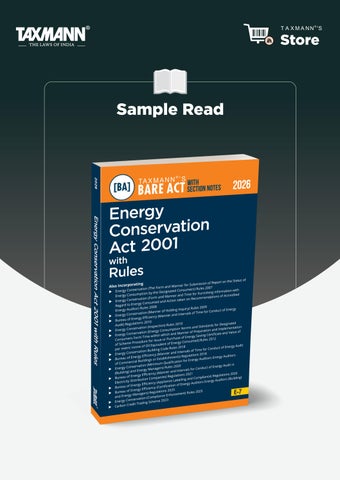
ENERGY CONSERVATION ACT 2001 WITH RULES – BARE ACT WITH SECTION NOTES AUTHOR : PUBLISHER : DATE OF PUBLICATION : EDITION : ISBN NO : NO. OF PAGES : BINDING TYPE :
Taxmann's Editorial Board Taxmann September 2026 2026 Edition 9789375616504 290 Paperback
Rs. 355 DESCRIPTION The Energy Conservation Act 2001 with Rules [Bare Act with Section Notes] by Taxmann is a one-volume statutory reference on India's energy conservation law. It carries the Energy Conservation Act 2001 with eight sets of Rules, five sets of Bureau of Energy Efficiency (BEE) Regulations and the Carbon Credit Trading Scheme 2023. The text of the Act is available in official sources. This book adds the material needed to use it: Section Notes on key provisions, footnotes that trace amendments, the prescribed forms, and a detailed table of contents with a subject index to the Act. Much of the law's working detail sits in rules, regulations and schemes. This book brings together 14 of them, notified between 2007 and 2025, with their forms and amendment history. Seven have since been amended, the 2012 Rules alone in six different years. This book is intended for the following audience: • Designated Consumers • Energy Professionals • Appliance and Equipment Businesses • Building Sector • Electricity Distribution Companies • Regulators and Adjudicators • Legal and Sustainability Advisers The Present Publication is the 2026 Edition, covering the amended and updated text of the Energy Conservation Act [Act No. 52 of 2001] with Rules. The law stated in this book is updated till 15th August 2026. The Act incorporates the amendments made by the Energy Conservation (Amendment) Act 2010 (effective 24th August 2010), the Jammu and Kashmir Reorganisation Act 2019 (effective 31st October 2019) and the Energy Conservation (Amendment) Act 2022 (effective 1st January 2023). The Schedule to the Act includes the changes made by Notification S.O. 09(E) dated 3rd January 2022. The noteworthy features of the book are as follows: • [Section Notes] Five provisions carry Section Notes: the definitions in section 2, and sections 13A (deceptive names), 26 (penalties), 48 (default by companies) and 50 (good-faith protection). The notes run to 21 numbered paragraphs in short, layered bullet points • [Amendment Trail] The Act carries 70 footnotes, 67 of which record the source and date of a change. Across the book, 49 footnotes reproduce the earlier text of substituted or omitted provisions. These include sections 32 to 43, omitted in 2010 • [Commencement Notifications] Footnotes reproduce the three notifications that brought the Act into force (2002 and 2012) and set up the Bureau (2002) • [Notification Details] Each of the 14 instruments opens with its notification number and date. The five BEE Regulations also record their draft notification and public consultation • [38 Forms] All 38 forms listed in the contents are printed, from energy reports and applications to certificates and registers. Report and energy accounting formats for electricity distribution companies are included too • [Label Artwork] Schedule C of the 2026 Labelling Regulations prints label artwork for 13 appliance heads. It includes dimensioned drawings, colour codes, font sizes, and rules on material and placement • [Fee and Examination Tables] Schedules A and B of the 2026 Labelling Regulations give label fees for 18 mandatory and 25 voluntary appliance entries. The 2025 Certification Regulations add five tables on fees, papers, marks and attempts, and a subject-wise syllabus • [Quick Navigation] A 13-page contents lists every section, rule, regulation, paragraph, form and schedule with page numbers. A four-page Subject Index covers the Act
Buy Now