
Sample Read


© All rights reserved
Price : ` 425
Fifth Edition : June 2026
Published by :
Taxmann Publications (P.) Ltd.
Sales & Marketing : 59/32, New Rohtak Road, New Delhi-110 005 India
Phone : +91-11-45562222
Website : www.taxmann.com
E-mail : sales@taxmann.com
Regd. Office : 21/35, West Punjabi Bagh, New Delhi-110 026 India
Printed at :
Tan Prints (India) Pvt. Ltd.
44 Km. Mile Stone, National Highway, Rohtak Road Village Rohad, Distt. Jhajjar (Haryana) India
E-mail : sales@tanprints.com
Disclaimer
Every effort has been made to avoid errors or omissions in this publication. In spite of this, errors may creep in. Any mistake, error or discrepancy noted may be brought to our notice which shall be taken care of in the next edition. It is notified that neither the publisher nor the author or seller will be responsible for any damage or loss of action to any one, of any kind, in any manner, therefrom. It is suggested that to avoid any doubt the reader should cross-check all the facts, law and contents of the publication with original Government publication or notifications.
No part of this book may be reproduced or copied in any form or by any means [graphic, electronic or mechanical, including photocopying, recording, taping, or information retrieval systems] or reproduced on any disc, tape, perforated media or other information storage device, etc., without the written permission of the publishers. Breach of this condition is liable for legal action.
For binding mistake, misprints or for missing pages, etc., the publisher’s liability is limited to replacement within seven days of purchase by similar edition. All expenses in this connection are to be borne by the purchaser. All disputes are subject to Delhi jurisdiction only.


7
CHAPTER
Case for Opinion Writing
Q1. Summarize standards applicable to preparation of an opinion. Mention the common purposes for which legal opinion are sought. [Dec. 2019 (4 Marks)]
OR
Q2. There are some standards which are applicable for preparation of an opinion. Explain. [Dec. 2020 (4 Marks)]
Ans.:
Standards Applicable to Preparation of an Opinion
(1)Generally: A professional is expected to be well informed and to exercise such skill, prudence and diligence as professionals of ordinary skill and capacity commonly possess and exercise in the performance of the tasks which they undertake.
(2) Customary Practice: An attorney does not ordinarily guarantee the soundness of his opinions and, accordingly, is not liable for every mistake he may make in his practice. He is expected, however, to possess knowledge of those plain and elementary principles of law which are commonly known by well-informed attorneys, and to discover those additional rules of law which, although not commonly known, may readily be found by standard research techniques.
(3) Fraudulent or MisleadingOpinions: An opinion giver may be liable for an opinion that constitutes fraudulent misrepresentation. A professional owes a duty to non-clients to refrain from fraudulent misrepresentation. It is generally understood that, regardless of compliance with other standards, and even if an opinion is technically correct, a professional should not render an opinion that he recognizes would be misleading to the opinion recipient.
(4) Ethical Issues: Relating to the Provision of Opinions to Non-clients A professional delivering an opinion letter to a non-client should also consider ethical principles. For example, rendering an opinion to a nonclient may conflict with the opinion giver’s ethical obligations to maintain
the confidences of its client. He should decline to give legal opinion in such cases.
Case for Opinion Writing:
(1) Lawfulness of an action: Opinion letters are given when one wants to know if an action is lawful.
(2) Legal consequences: Sometimes a party entering into a transaction obtains legal opinion to ascertain if the action will lead to desired legal consequences.
(3) Regulatory requirements: Sometimes legal opinion has to be sought because it is mandated by law to get the opinion of outside legal expert.
(4) Compliance: A legal opinion can be sought for assessing the requirements of the regulatory regime so that the querist can meet the compliance requirement.
(5) Protective shield: Clients sometimes desire the protection of an expert’s legal opinion to be used as evidence of lack of mens rea in certain proceedings.
(6) Designed to mislead: Sometimes promoters of unscrupulous schemes obtain as many opinions from different experts as is possible and use the one which is favourable to their scheme of things.
(7) To satisfy contractual requirements: Sometimes a clause in commercial contracts require the opinion of an expert. e.g.: an opinion given by issuer’s counsel to investors in connection with the sale of securities or by borrower’s counsel to the lender pursuant to a loan agreement.
(8) Due Diligence: Professionals and clients often cite due diligence as the principal reason for requesting opinion letters in business transactions.
Types of Legal Opinions
Q3. Throw light upon the types of legal opinions. [Scoring Question] OR
Q4. Advices on Law and Advices on Evidence? [Dec. 2022 (4 Marks)] Ans.:
(1) Advices on Transaction: Due diligence is the principal reason for opinion letters in business transactions. An opinion letter may be one component of a party’s due diligence, but it is not normally a substitute for due diligence performed by the opinion recipient and its counsel.
(2) Advices on Law: Sometimes the client would want to know how the law will apply to a given situation. Without in-depth knowledge of law and legal research one cannot give an opinion to the satisfaction of the client. The proper way is to start with the cases and work through to reach a deduction as to the principle of law that covers the situation. This is topdown reasoning should be avoided.
(3) Opinions on Facts: The third type of opinion is one which is predominantly related to facts. One is given a series of statements and documents and asked whether on that material there are reasonable prospects of prosecuting or defending the claim. The matter may be a simple personal injury case in which the law is well settled. The real question is whether one’s side’s witnesses will be believed or not. The first problem about this sort of opinion is that seldom does one have any real knowledge of what the other side’s witnesses are going to say. One often has little idea of the quality of one’s own witnesses and none at all of that of the oppositions. Here one has to search relevant material from the material one is provided with and then arrive at the probabilities of success or failure.
(4) Advices on Evidence: A special type of opinion is a brief to advice on evidence. When advising on fact or law one should not be too positive. In relation to advices on quantum of damages one can never be sure so it is advisable to not give a precise figure but a range. Where the law is in a state of flux or doubtful the legal expert should always draw attention to this explaining why one cannot be more positive.
Quality of Writing
Q5. Why is it essential for a legal opinion to be written in plain and understandable language? [Scoring Question]
Ans.: The primary purpose of a legal opinion is to effectively communicate advice to clients, whether they are professionals or laypeople. Clarity and precision in language are imperative to ensure the advice conveyed is easily comprehensible. It’s crucial to avoid archaic language and legalese, aiming for clear, concise explanations that use plain English whenever possible. While specialized legal advice may require technical terms for precise meaning, the use of unnecessary jargon should be avoided. Perfect grammar, precise language, and accurate punctuation are essential for effective communication.
Form and Elements of the Opinion Letter
Q6. Could you describe the typical components covered in a legal opinion despite the absence of a legally prescribed form? [Scoring Question] OR
Q7. Explain Form and Elements of the Opinion Letter? [ICSI Study Material] OR
Q8. Mention the points which will cover a legal opinion? [Aug. 2021 (4 Marks)]
Ans.:
While there’s no standardized legal form mandated by law; legal opinions tend to adhere to a customary structure. They usually encompass several key elements:
Introductory Matters: Such as the date, the identity of the opinion recipient, the role of the opinion giver giving the opinion, and the purpose for which the opinion is given.
References: A general or specific recitation of the documents and other factual and legal matters reviewed by the opinion giver, including in some instances a statement of reliance on various factual assumptions.
Legal Conclusions and Qualification: The legal conclusions expressed in the opinion, and any qualifications to the legal conclusions.
Peculiar Matter: Matters peculiar to the particular opinion, such as matters relative to opinions of local counsel in other jurisdictions and specific limitations on the use of the opinion.
Signature: the signature of the opinion giver.
Q9. What are the typical components and considerations in drafting a legal opinion, even though there’s no legally prescribed form?
[Scoring Question]
Ans.:
Crafting a legal opinion typically entails several crucial elements:
(1) Introductory Matters:
Title: How is a legal opinion generally titled, and what information does the heading typically contain?
Date and Addressee: What important details about the date and recipient are commonly included in a legal opinion? How is the recipient specified and who can rely on the opinion as a matter of practice?
(2) Introduction: How is the introduction of a legal opinion structured, especially concerning outlining the issues addressed and ensuring clarity in framing the questions?
(3) Definitions: Why is it advisable to define principal terms used in a legal opinion, especially those derived from statutory law or in the underlying agreement?
(4) Understanding Facts of the Case: What is the importance of detailing the facts upon which the legal opinion is based? How does this process aid in identifying gaps, assumptions, and necessary further instructions?
(5) Research on Relevant Case Laws: How are legal opinions supported by relevant case laws and statutory provisions? What criteria are followed in citing authorities to support legal propositions?
(6) Expression of the Opinion: What constitutes the substantive portion of a legal opinion, especially concerning providing concise answers or precise conclusions based on analysis and factual context?
(7) Qualifications: In what instances are legal opinions subject to qualifications, and how are these qualifications typically framed to narrow the scope of the opinion or address exceptions?
(8) Special Matters: How does a legal opinion cover foreign law, and what considerations arise when relying on local counsel or specialized counsel?
(9) Signature: What customary practices are followed regarding the signature of a legal opinion, especially concerning the manner in which it’s signed and by whom?
(10) Usual Disclaimers: Why are disclaimers important in legal opinions, and what key information do these disclaimers commonly cover to protect against potential malpractice claims?
This comprehensive approach ensures that a legal opinion covers essential aspects, provides reliable advice, and safeguards against potential legal pitfalls.
Q10. “The opinion giver may also be requested to furnish an opinion on matters governed by the laws of some other country.” Comment and discuss the reliance of the opinion of local counsel on foreign laws. [June 2022 (5 Marks)]
Ans.:
Foreign Law and Reliance on Local Counsel
The principal opinion giver for a party in a business transaction typically renders an opinion covering the laws of the state and applicable central laws and sets forth this limitation in the text of the opinion. The opinion giver may also be requested to furnish an opinion on matters governed by the laws of some other country. Unless the limited nature of the review of another jurisdiction’s law is described in the opinion, because the opinion giver would likely be held to the same standard as a lawyer licensed or otherwise competent to give advice on the law of the other jurisdiction, the opinion giver will, in most instances, seek the advice and opinion of local counsel.
An opinion giver should, however, always be cognizant of the fact that rendering an opinion based upon legal principles applicable in foreign jurisdictions exposes the opinion giver to liability for a negligent interpretation of that law. The retention of local counsel to furnish an opinion raises different questions with respect to the principal opinion giver’s responsibility for the opinions expressed in the local lawyer’s opinion.
If the principal opinion giver renders an opinion on the same matters as the local lawyer, the opinion giver customarily expresses its reliance on the local counsel’s opinion (an example of recommended language is included below) rather than simply restating the local counsel’s opinion in the body of its opinion:
In rendering the opinions expressed in paragraphs, and , we have relied [solely] on the opinion of , in so far as such opinions relate to the laws of , and we have made no independent examination of the laws of that jurisdiction.
When expressly stating reliance on the opinion of local counsel, the principal opinion giver’s sole responsibility is to exercise reasonable care in the selection of local counsel (if, in fact, the principal opinion giver selects such counsel). The opinion giver is not responsible for independently investigating or otherwise verifying the law of the foreign jurisdiction. The principal opinion giver may assume a broader responsibility to examine the statutory and case law of the foreign jurisdiction if the principal opinion giver’s opinion letter states that the opinion giver “concurs” with the legal opinions provided in the opinion letter of local counsel or that the local counsel’s opinion letter is satisfactory in substance. The preferred and more recent common practice is for the local counsel’s opinion letter to be addressed to the recipient of the principal opinion letter (rather than to the principal opinion giver) and for the principal opinion giver not to render an opinion on that subject.
Q11. While forming an opinion, comment on “reliance put by opinion giver on the certificates of public official” while understanding the facts of a case. [June 2024 (5 Marks)]
Ans.: Reliance on Certificates of Public Officials: Usually opinions include legal conclusions concerning the corporate nature and existence of the Company and its ability to transact business. They also often include legal conclusions concerning the good standing and ability of the Company to transact business in other jurisdictions.
These opinions customarily are based on certificates of public officials in the various jurisdictions involved. The principal certificate among them is the certified copy of the Articles of Incorporation, together with amendments. This certification represents conclusive evidence of the formation of the corporation and prima facie evidence of its existence for all purposes.
Certain certificates maybe required from various state agencies. For example, in loans backed by mortgage of immovable property, certificates showing the title to the property may be required. Many states have implemented websites on which such information can be accessed at any time. The information on any particular website can only be relied upon as current to the extent specified by the state agency responsible for that website.
Because certificates of public officials will normally bear a date before the delivery of the opinion, the opinion giver must decide what additional verification, if any, is necessary for purposes of the opinion. Additional verification may or may not be necessary depending upon the facts and circumstances of the case. In general, customary practice does not require that every certificate be updated. Opinion recipients routinely accept opinions that in part are based on certificates of a reasonably recent date.
Things to be Kept in Mind While Preparing for Opinion
Q12. Mention the things to be kept in mind while preparing for opinion. [Scoring Question] OR
Q13. What are the things to be kept in mind while preparing for opinion letter? [ICSI Study Material]
Ans.:
Opinions that are not Cost-Effective
Opinion givers are held to certain standards of skill and care in rendering legal opinions. Although the nature and extent of the applicable standards of care are not defined, the opinion giver is obligated to avoid misleading opinion recipients about the scope and depth of any investigation undertaken.
Moreover, professionals are responsible for conducting customary legal and factual diligence in rendering legal opinions. For this reason, rendering an opinion letter is a costly process, even in the context of a relatively straightforward matter or business transaction.
Inappropriate Scope
In a business transaction a number of opinions would be considered inappropriate because their scope is not reasonably within the competence of the opinion giver or they are not cost-justified.
Examples:
the client is qualified to do business as a foreign corporation in all jurisdictions in which its property or activities require qualification or in which the failure to qualify would have a material adverse effect on the client;
the client is not in material violation of any central, state or local law, regulation or administrative ruling; and the client is not in material violation of any contract, indenture or undertaking to which it is a party or by which it may be bound.
The common characteristic of these examples is that they are essentially open-ended. Requests for opinions of this sort inherently cast into question whether the party requesting the opinion may be effectively seeking legal “insurance” rather than legal “assurance.” an opinion giver may properly refuse to give such opinions.
Fraudulent or Misleading Opinions and the Limits of Professional Competence
A professional should not render an opinion that he/she knows would be misleading. In addition, a professional should not render an opinion based on factual assumptions if he/she knows that the assumptions are false
or that reliance on those facts is unreasonable. In addition, a professional should not be asked to render opinions on matters that are outside his or her area of professional competence.
In no event should a professional be asked for opinions that are generally beyond the professional competence of professionals from that area of practice, such as asking a Professional to express his opinion on financial statement analysis or valuation.
The Time to prepare Opinion Letter
Sometimes one may be faced with the necessity of giving an urgent opinion or one when the time is not available to allow one to perform the depth of research one would wish. This may occur because the matter is truly urgent.
Even in these circumstances one should not make the mistake of giving a half-baked, half thought out opinion over the telephone and promising the written advice at a later date.
If the opinion giver is wrong not only, will he face considerable embarrassment in correcting his informal opinion but if his client has acted on the faith of it, the opinion giver will have no defence to a claim for damages.
Example: Mr. A, comes to you for taking opinion on a matter, which is required to be used in a return to be filled on the next day. In this scenario, proper due diligence should be done before giving any opinion.
Q14. ‘A Company Secretary should not render any fraudulent or misleading opinion’. Discuss. [Dec. 2021 (4 Marks)]
Ans.: A Company Secretary should not render an opinion that he/she knows would be misleading. In addition, a professional should not render an opinion based on factual assumptions if he/she knows that the assumptions are false or that reliance on those facts is unreasonable. In addition, a professional should not be asked to render opinions on matters that are outside his or her area of professional competence.
In no event should a professional be asked for opinions that are generally beyond the professional competence of professionals from that area of practice, such as asking a Professional to express his opinion on financial statement analysis or valuation.
Standards Applicable to Preparation of an Opinion
Q15. There are some standards which are applicable for preparation of an opinion. Explain. [Dec. 2020 (4 Marks)]
Ans.:
Following are the standards applicable for preparation of an opinion: (a) Generally: A professional is expected to be well informed and to exercise such skill, prudence and diligence as professionals of ordinary skill and
(
(
capacity commonly possess and exercise in the performance of the tasks which they undertake.
b) Customary Practice: An attorney does not ordinarily guarantee the soundness of his opinions and, accordingly, is not liable for every mistake he may make in his practice. He is expected, however, to possess knowledge of those plain and elementary principles of law which are commonly known by well informed attorneys, and to discover those additional rules of law which, although not commonly known, may readily be found by standard research techniques.
The opinion preparers should devote the time needed to interpret and apply legal principles relevant to the situation at hand, ascertain (through appropriate inquiry and certificates of officers of the Company) the facts that underlie the opinion, and identify areas of significant uncertainty (if any) in the interpretation and application of legal principles. In certain cases, opinion givers may conclude that it is necessary to conduct research with respect to particular legal principles or to conduct an investigation of the underlying facts relevant to the opinion.
c) Fraudulent or Misleading Opinions: An opinion giver may be liable for an opinion that constitutes fraudulent misrepresentation. A professional owes a duty to non-clients to refrain from fraudulent misrepresentation. It is generally understood that, regardless of compliance with other standards, and even if an opinion is technically correct, a professional should not render an opinion that he recognizes would be misleading to the opinion recipient.
(
d) Ethical Issues Relating to the Provision of Opinions to Non-clients: A professional delivering an opinion letter to a non-client should also consider ethical principles. For example, rendering an opinion to a nonclient may conflict with the opinion giver’s ethical obligations to maintain the confidences of its client. He should decline to give legal opinion in such cases.
Company Secretary Auditing Standard on Opinion Writing
Q16. What is Company Secretaries Auditing Standard (CSAS-3) and what is the process of forming an opinion under this standard? [Dec. 2025 (5 Marks)]
OR
Q17. Explain the process of preparing a legal opinion as per the Company Secretary Auditing Standard (CSAS-3), highlighting the importance of facts and legal research. [Dec. 2025 (5 Marks)]
Ans.: CSAS-3 (Company Secretaries Auditing Standard-3) deals with forming an opinion and reporting thereon. It requires the Auditor to evaluate audit
evidence and express an opinion on compliance with applicable laws and proper maintenance of records during a secretarial audit.
Process of forming an opinion under CSAS-3:
1. Materiality: The Auditor should consider all relevant audit evidence, apply professional judgment and objectivity, ensure timeliness, and verify facts by considering replies and contradictory evidence.
2. Precedence and Practices: The Auditor should follow generally accepted practices and past precedents while forming the opinion.
3. Use of Third-Party Reports: If the opinion is based on third-party reports, the Auditor must disclose this fact, consider key observations, and verify them through additional tests wherever possible.
4. Type of Opinion: An unmodified opinion is given where there is full compliance with laws and proper records. A modified opinion is given in case of non-compliance, misstatement, or lack of sufficient audit evidence.
5. Reporting and Responsibility: The Auditor’s Report should mention the Auditor’s responsibility, applicable standards followed, inherent limitations of audit, and be properly addressed to the appointing authority. Modified opinions should be highlighted in bold or italics.
Q18. Examine the significance of materiality in the process of forming an opinion according to CSAS-3. [Scoring Question]
Ans.:
The Auditor shall consider Materiality while forming his opinion and adhere to:
The principle of completeness that requires the Auditor to consider all relevant Audit Evidence before issuing a report;
The principle of objectivity that requires the Auditor to apply professional judgment and scepticism in order to ensure that all reports are factually correct and that findings or conclusions are presented in a relevant and appropriate manner.
The principle of timeliness that implies preparing the report in due time; and
The principle of a contradictory process that implies checking the accuracy of facts and incorporating responses from concerned persons.
Q19. Examine the stages involved in developing a Modified Opinion within the CSAS-3 opinion-forming process. [Scoring Question]
Ans.: The Auditor shall express modified opinion when the Auditor concludes that:
(a) based on the Audit Evidence obtained, there is non-compliance with the applicable laws in terms of timelines or process; or
(
b) based on the Audit Evidence obtained, the Records as a whole are not free from Misstatement; or are not maintained in accordance with applicable laws; or
(
c) he is unable to obtain sufficient and appropriate Audit Evidence to conclude that there is due compliance with the applicable laws in terms of timelines and process; or
(
d) he is unable to obtain sufficient and appropriate Audit Evidence to conclude that the Records as a whole are free from Misstatement; or are maintained in accordance with applicable laws.
Whenever the Auditor expresses a modified opinion or disclaims an opinion, the text of the opinion shall be either in italics or bold letters.
Q20. Examine the Auditor’s Responsibility stage within the framework of forming an opinion according to CSAS-3. [Scoring Question]
Ans.:
The Auditor’s Report shall include a section with the heading “Auditor’s Responsibility”. Auditor’s Report shall state that the responsibility of the Auditor is to express opinion on the compliance with the applicable laws and maintenance of records based on audit.
The Auditor’s Report shall also state that the audit was conducted in accordance with applicable Standards. The Auditor’s Report shall also explain that those Standards require that the Auditor comply with statutory and regulatory requirements and plan and perform the audit to obtain reasonable assurance about compliance with applicable laws and maintenance of Records.
Auditor’s Report shall also state that due to the inherent limitations of an audit including internal, financial and operating controls, there is an unavoidable risk that some Misstatements or material non-compliances may not be detected, even though the audit is properly planned and performed in accordance with the Standards.
Q21. Discuss in brief about Form of an Opinion. [Scoring Question]
Ans.:
Form of an Opinion:
Unmodified Opinion: The Auditor shall express an unmodified opinion when based on Audit Evidence, the Auditor concludes that: there is due compliance with the applicable laws in terms of timelines and process; and the Records as relevant for the audit verified by him as a whole are free from Misstatement and maintained in accordance with the applicable laws.
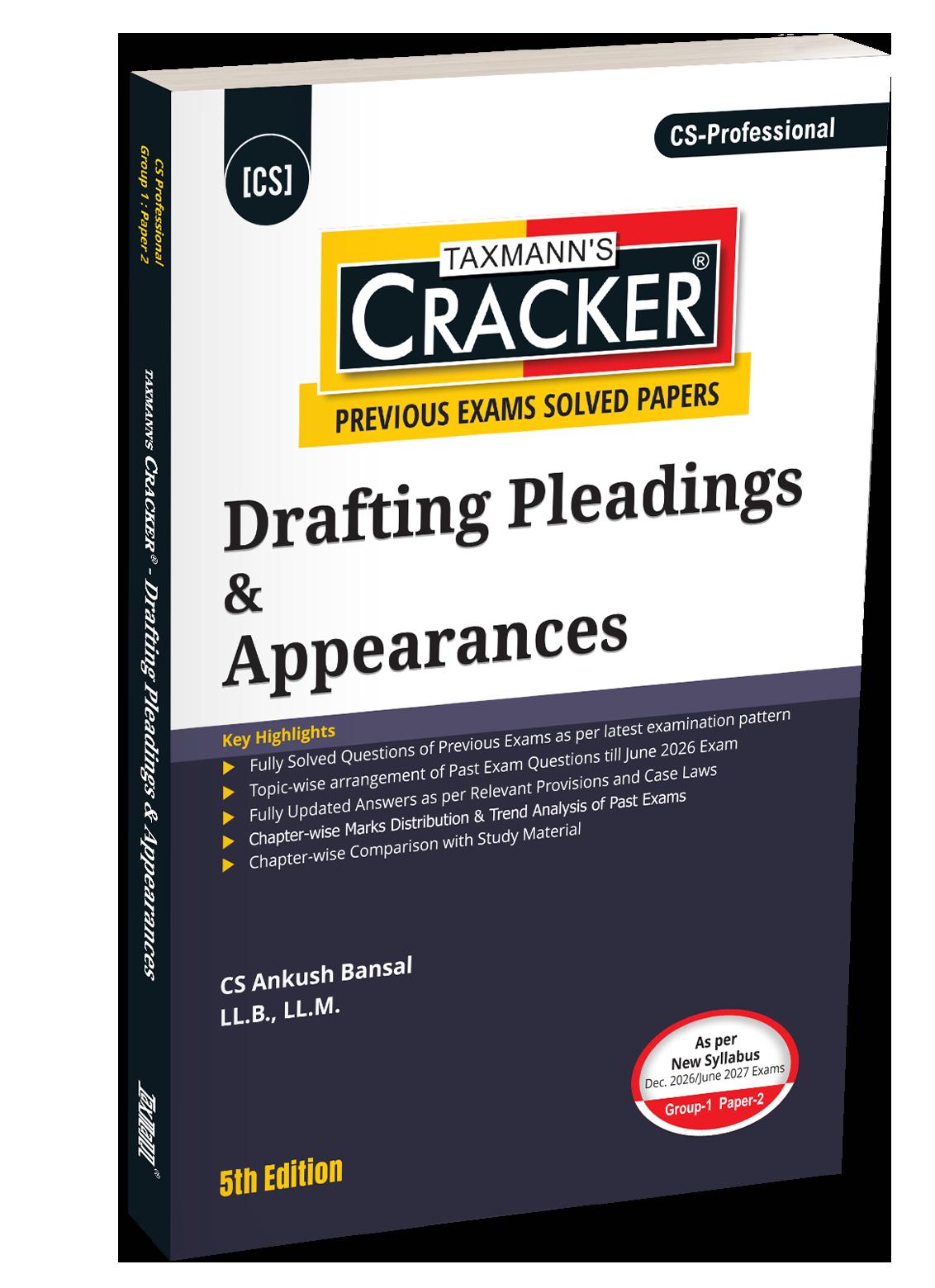
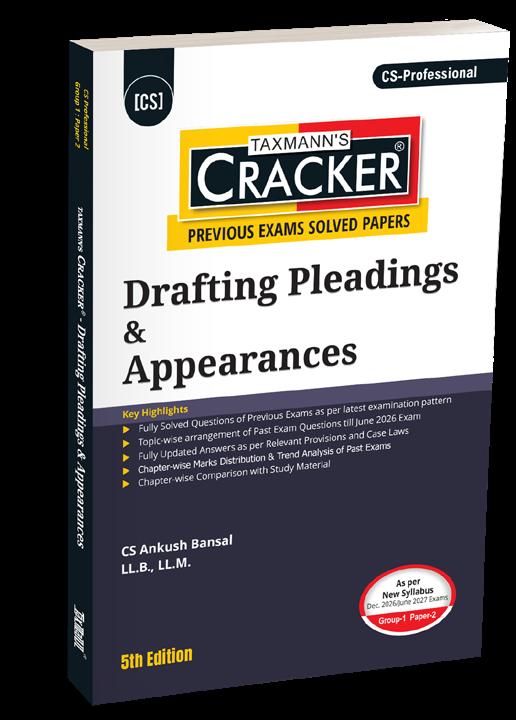
Drafting Pleadings & Appearances (Drafting/ DPA) | CRACKER
AUTHOR : Ankush Bansal
PUBLISHER : Taxmann
DATE OF PUBLICATION : June 2026
EDITION : 5th Edition
ISBN NO : 9789375610977
No. of Pages : 408
BINDING TYPE : Paperback
Rs. 425
DESCRIPTION
Drafting Pleadings & Appearances – CRACKER is a question-bank-led revision volume for CS-Professional | Group 1 – Paper 2. Rather than restating theory, it reproduces the questions ICSI has actually set, arranges them topic-by-topic, and answers each in full— with the governing provisions, leading case law and, where the paper demands it, a readyto-reproduce specimen draft. The result is a self-contained companion for the final weeks before the exam.
The Present Publication is the 5th Edition June 2026, authored by CS Ankush Bansal, with the following noteworthy features:
• [Complete Solved Question Bank] Over 470 questions across all 14 chapters, solved in line with the latest examination pattern
• [Two Decades of Past Papers] Mostly previous-exam questions, each tagged with the sitting(s) and marks in which it appeared, from the mid-2000s up to June 2026
• [Probability-Graded Tagging] Scoring Questions (high-recurrence areas) and Expected Questions (anticipated topics) direct revision to where the marks are
• [Specimen Drafts & Ready Formats] 25-plus specimen drafts embedded in the answers, covering the paper’s practical, reproduce-under-pressure component
• [Anchored in Case Law] Answers cite leading precedents—Mohiri Bibi v. Dharmodas Ghose, Suraj Lamp & Industries v. State of Haryana, Prakash Gupta v. SEBI, SEBI v. Bhavesh Pabari—alongside the relevant provisions
• [Marks Distribution & Trend Analysis] Chapter-wise mapping across the five most recent sittings (June 2024–June 2026), showing where marks concentrate
• [Study-Material Mapping] Chapter-wise comparison with the ICSI Study Material for gap-free coverage
• [Latest Solved Paper] The June 2026 paper, fully solved with suggested answers, as a recent end-to-end self-test