Store
© Taxmann Price : ` 95 Law stated in this book is as updated till 25th November, 2025 Published by : Taxmann Publications (P.) Ltd. Sales & Marketing : 59/32, New Rohtak Road, New Delhi-110 005 India Phone : +91-11-45562222 Website : www.taxmann.com E-mail : sales@taxmann.com Regd. Office : 21/35, West Punjabi Bagh, New Delhi-110 026 India Printed at : Tan Prints (India) Pvt. Ltd. 44 Km. Mile Stone, National Highway, Rohtak Road Village Rohad, Distt. Jhajjar (Haryana) India E-mail : sales@tanprints.com Disclaimer Every effort has been made to avoid errors or omissions in this publication. In spite of this, errors may creep in. Any mistake, error or discrepancy noted may be brought to our notice which shall be taken care of in the next edition. It is notified that neither the publisher nor the author or seller will be responsible for any damage or loss of action to any one, of any kind, in any manner, therefrom. It is suggested that to avoid any doubt the reader should cross-check all the facts, law and contents of the publication with original Government publication or notifications. No part of this book may be reproduced or copied in any form or by any means [graphic, electronic or mechanical, including photocopying, recording, taping, or information retrieval systems] or reproduced on any disc, tape, perforated media or other information storage device, etc., without the written permission of the publishers. Breach of this condition is liable for legal action. For binding mistake, misprints or for missing pages, etc., the publisher’s liability is limited to replacement within seven days of purchase by similar edition. All expenses in this connection are to be borne by the purchaser. All disputes are subject to Delhi jurisdiction only.
Contents DOWRY PROHIBITION ACT, 1961 PAGE
1. Short title, extent and commencement
1
2. Definition of “dowry”
1
3. Penalty for giving or taking dowry
3
4. Penalty for demanding dowry
6
4A. Ban on advertisement
11
5. Agreement for giving or taking dowry to be void
12
6. Dowry to be for the benefit of the wife or her heirs
12
7. Cognizance of offences
15
8. Offences to be cognizable for certain purposes and to be nonbailable and non-compoundable
18
8A. Burden of proof in certain cases
19
8B. Dowry Prohibition Officers
20
9. Power to make rules
21
10. Power of the State Government to make rules
22
SUBJECT INDEX
25
I-5
CONTENTS
I-6 PAGE
DOWRY PROHIBITION (MAINTENANCE OF LISTS OF PRESENTS TO THE BRIDE AND BRIDEGROOM) RULES, 1985 1. Short title and commencement
27
2. Rules in accordance with which lists of presents are to be maintained
27
Dowry Prohibition Act, 1961 [28 OF 1961]*
An Act to prohibit the giving or taking of dowry. BE it enacted by Parliament in the Twelfth Year of the Republic of India as follows:— Short title, extent and commencement. 1. (1) This Act may be called the Dowry Prohibition Act, 1961. (2) It extends to the whole of India 1[***]. (3) It shall come into force on such date2 as the Central Government may, by notification in the Official Gazette, appoint. Definition of “dowry”. 2. In this Act, “dowry” means any property or valuable security given or agreed to be given either directly or indirectly— (a) by one party to a marriage to the other party to the marriage; or (b) by the parents of either party to a marriage or by any other person, to either party to the marriage or to any other person, at or before 3[or any time after the marriage] 4[in connection with the marriage of the said parties but does not include] dower or mahr in the case of persons to whom the Muslim Personal Law (Shariat) applies.
*Dated 20-5-1961. 1. Words “except the State of Jammu and Kashmir” omitted by the Jammu and Kashmir Reorganisation Act, 2019, w.e.f. 31-10-2019. 2. With effect from 1-7-1961. 3. Substituted for “or after the marriage” by the Dowry Prohibition (Amendment) Act, 1986, w.e.f. 19-11-1986. 4. Substituted for “as consideration for the marriage of the said parties, but doesn’t include” by the Dowry Prohibition (Amendment) Act, 1984, w.e.f. 2-10-1985.
1
S. 2
DOWRY PROHIBITION ACT, 1961
2
[***]
5
Explanation II.— The expression “valuable security” has the same meaning as in section 30 of the Indian Penal Code (45 of 1860)*. COMMENTS SECTION NOTES
The term “dowry” means any property or valuable security given on agreed to be given either directly or indirectly— (a) by one party to a marriage to the other party to the marriage; or (b) by the parents of either party to a marriage or by any other person, to either party to the marriage or to any other person
Such giving or agreement is at or before or any time after the marriage in connection with the marriage of the said parties,
The term “dowry” does not include dower or mahr in the case of persons to whom the Muslim Personal Law (Shariat) applies.
The expression “valuable security” has the same meaning as in section 30 of the Indian Penal Code [now section 2(31) of Bharatiya Nyaya Sanhita, 2023 (BNS)]
See also Section 3(2) CASE LAWS
Definition of Dowry - Expansive Interpretation in Demand for Money - The Supreme Court examined whether a demand for money for constructing a house falls within the ambit of “dowry” as defined under section 2 of the Dowry Prohibition Act. The High Court had erroneously held that such a demand does not qualify as dowry. The Supreme Court disagreed, ruling that any demand made directly or indirectly in connection with marriage, including money for construction purposes, constitutes dowry. It emphasized the need for an expansive interpretation to address the social evil of dowry. The conviction under sections 304B and 498A IPC was restored, reducing the sentence to seven years of rigorous imprisonment - State of Madhya Pradesh v. Jogendra AIRONLINE 2022 SC 24. STATE AMENDMENT HARYANA
Section 2 Substitute— ‘2. Definitions.—In this Act, unless the context otherwise requires,— (i) “dowry” means any property or valuable security given or agreed to be given either directly or indirectly,— 5. Omitted by the Dowry Prohibition (Amendment) Act, 1984, w.e.f. 2-10-1985. Prior to its omission, Explanation I read as under: “Explanation I.—For the removal of doubts, it is hereby declared that any presents made at the time of a marriage to either party to the marriage in the form of cash, ornaments, clothes or other articles, shall not be deemed to be dowry within the meaning of this section, unless they are made as consideration for the marriage of the said parties.” * Now section 2(31) of the Bharatiya Nyaya Sanhita, 2023.
3
DOWRY PROHIBITION ACT, 1961
S. 3
(a) by one party to a marriage to the other party to the marriage; or (b) by the parents of either party to a marriage or by any other person, to either party to the marriage or to any other person, at or before or after the marriage as consideration for the marriage of the said parties, but does not include dower or mahr in the case of persons to whom the Muslim Personal Law (Shariat) applies. Explanation I.—For the removal of doubts it is hereby declared that any presents made at the time of marriage of either party to the marriage in the form of cash, ornaments, clothes or other articles, shall not be deemed to be dowry within the meaning of this section, unless they are made as consideration for the marriage of the said parties. Explanation II.—The expression “valuable security” has the same meaning as in section 30 of the Indian Panel Code (45 of 1860)*. (ii) “Marriage expenses” shall include expenses incurred directly or indirectly at or before the marriage on,— (a) Thakka, Sagai, Tikka, Shagun and Milni ceremonies; (b) the gifts made by one party to a marriage to the other party to the marriage or by the parents, grand-parents and brothers of either party to a marriage, to either party to the marriage or the blood relations thereof; (c) illumination, food and the arrangements for serving food to the members of the marriage party and other expenses incidental thereto. Explanation.—For the removal of doubts it is hereby declared that any gifts made by a person other than those specified in sub-clause (b), at the time of marriage to either party to the marriage shall not be deemed to be marriage expenses’ - [Vide Dowry Prohibition (Haryana Amendment) Act, 1976, w.e.f. 5-8-1976].
Penalty for giving or taking dowry. 3. 6 [(1)] If any person, after the commencement of this Act, gives or takes or abets the giving or taking of dowry, he shall be punishable 7[with imprisonment for a term which shall not be less than 8[five years, and with fine which shall not be less than fifteen thousand rupees or the amount of the value of such dowry, whichever is more]: Provided that the Court may, for adequate and special reasons to be recorded in the judgment, impose a sentence of imprisonment for a term of less than 9[five years].] [(2) Nothing in sub-section (1) shall apply to, or in relation to,—
10
6. Section 3 renumbered as sub-section (1) thereof by the Dowry Prohibition (Amendment) Act, 1984, w.e.f. 2-10-1985. 7. Substituted for “with imprisonment which may extend to six months, or with fine which may extend to five thousand rupees, or with both”, ibid. 8. Substituted for “six months, but which may extend to two years, and with fine which may extend to ten thousand rupees or the amount of the value of such dowry, whichever is more” by the Dowry Prohibition (Amendment) Act, 1986, w.e.f. 19-11-1986. 9. Substituted for “six months”, ibid. 10. Inserted by the Dowry Prohibition (Amendment) Act, 1984, w.e.f. 2-10-1985. * Now section 2(31) of the Bharatiya Nyaya Sanhita, 2023.
S. 3
DOWRY PROHIBITION ACT, 1961
4
(a) presents which are given at the time of a marriage to the bride (without any demand having been made in that behalf): Provided that such presents are entered in a list maintained in accordance with the rules made under this Act; (b) presents which are given at the time of a marriage to the bridegroom (without any demand having been made in that behalf): Provided that such presents are entered in a list maintained in accordance with the rules made under this Act: Provided further that where such presents are made by or on behalf of the bride or any person related to the bride, such presents are of a customary nature and the value thereof is not excessive having regard to the financial status of the person by whom, or on whose behalf, such presents are given.] COMMENTS SECTION NOTES
Section 3(1) of the said Act provides for penalty for the offence of giving or taking or abetting the giving or taking of dowry. Section 3(2) provides that nothing in sub-section (1) shall apply to, or in relation to,— (a) presents which are given at the time of a marriage to the bride (without any demand having been made in that behalf) subject to the condition that:
Such presents are entered in a list maintained in accordance with the rules made under this Act; [See Rule 2 of the Dowry Prohibition (Maintenance of Lists of Presents to the Bride and Bridegroom) Rules, 1985]
(b) presents which are given at the time of a marriage to the bridegroom (without any demand having been made in that behalf) subject to the condition that:
Such presents are entered in a list maintained in accordance with the rules made under this Act [See Rule 2 of the Dowry Prohibition (Maintenance of Lists of Presents to the Bride and Bridegroom) Rules, 1985]; and
Where such presents are made by or on behalf of the bride or any person related to the bride, such presents are of a customary nature and the value thereof is not excessive having regard to the financial status of the person by whom, or on whose behalf, such presents are given.
Giving or taking of presents in (a)/(b) above shall not be an offence u/s 3(1) and
is not punishable u/s 3(1).
The offence u/s 3(1) is non-bailable and non-compoundable [Section 8 (2)] See Section 8A for burden of proof in prosecution for the offence of taking dowry or the abetting of taking dowry. CASE LAWS Quashing of Complaint - Absence of Evidence for Dowry Demand - The Supreme
Court considered a petition to quash an FIR filed under sections 498-A IPC and section 3 of the Dowry Prohibition Act. The appellant’s in-laws were accused of demanding dowry, but the Court found that the complaint did not establish a prima facie case for dowry demand against the in-laws. It held that vague and unsubstantiated allegations do not suffice to proceed with charges under the Dowry Prohibition Act. The appeal was allowed, and the FIR against the in-laws was quashed, while proceedings against the husband were left unaffected for trial - Tabrez Khan Alias Guddu v. State of Uttar Pradesh 2019 (5) ALJ 144.
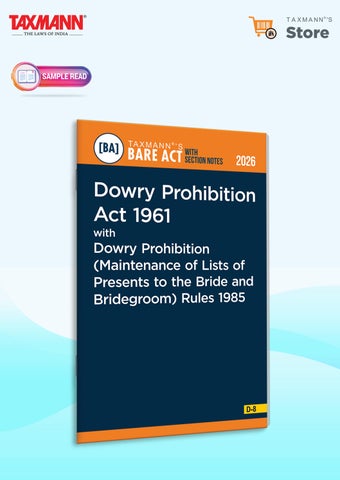
DOWRY PROHIBITION ACT 1961 WITH DOWRY PROHIBITION (MAINTENANCE OF LISTS OF PRESENTS TO THE BRIDE AND BRIDEGROOM) RULES 1985 – BARE ACT WITH SECTION NOTES AUTHOR PUBLISHER DATE OF PUBLICATION EDITION ISBN NO NO. OF PAGES BINDING TYPE
: : : : : : :
TAXMANN'S EDITORIAL BOARD TAXMANN DECEMBER 2025 2026 EDITION 9789371260008 36 PAPERBACK
Rs. 95
DESCRIPTION Dowry Prohibition Act 1961 with Dowry Prohibition (Maintenance of Lists of Presents to the Bride and Bridegroom) Rules 1985 [Bare Act with Section Notes] by Taxmann is a comprehensive legal text on India's dowry prohibition laws. It consolidates the principal Act, subsequent amendments, relevant Rules, and section-wise notes to guide readers through the legal framework, including the procedures for maintaining lists of presents exchanged at marriages. This book is intended for the following audience: • Legal Practitioners & Judiciary • Law Students & Academics • Social Workers & NGOs • General Readers The Present Publication is the 2026 Edition, covering the amended and updated text of the Dowry Prohibition Act [Act No. 28 of 1961] and Rules, with the following noteworthy features: • [Complete Text of the Act] Reflecting all amendments up to the latest date • [Dowry Prohibition (Maintenance of Lists of Presents) Rules 1985] Guidelines on maintaining lists of gifts exchanged during marriage • [Section-by-section Notes] Interpretations and clarifications in concise language • [Case Law References] Illustrative judgments showcasing the practical application of the Act • [State Amendments & Variations] Summaries of different State-level modifications for jurisdictional comparisons • [Pre-amendment Provisions] Text of earlier provisions for understanding historical context and transitional application • [User-friendly Formatting] Bold headings, clear fonts, and structured layout for quick reference
BUY NOW