RELEVANT UNDER INCOME-TAX ACT 2025
SECTION 2(5) OF THE 2025 ACT
“AGRICULTURAL INCOME”, DEFINED [SEC. 2(1A) OF THE 1961 ACT]
AGRICULTURE/AGRICULTURAL OPERATIONS
‘Agriculture’ meaning - ‘Agriculture’, in its root sense, means ager (field), and culture (cultivation), cultivation of a field which of course implies expenditure of human skill and labour upon land. The term ‘agriculture’ cannot be confined merely to the production of grain and food products for human beings and beasts but must be understood as comprising all the products of the land which have some utility either for consumption or for trade and commerce and would also include forest product such as timber, sal and piyasal trees, casuarina plantations, tendu leaves, borra nuts, etc. [CIT v. Raja Benoy Kumar Sahas Roy [1957] 32 ITR 466 (SC)].
Irrespective of nature of produce or product of land, whatever is grown on land with assistance of human labour and effort and whatever does not grow wild or spontaneously on soil without human labour and effort would be an agricultural product and the process of producing it would be ‘agriculture’ [CIT v. Namdhari Seeds (P.) Ltd. [2011] 16 taxmann.com 83/203 Taxman 565 (Kar.)].
Combination of basic and subsequent operations - The primary sense in which the term agriculture is understood is agar — field and cultra — cultivation, i.e., the cultivation of the field, and if the term is understood only in that sense agriculture would be restricted only to cultivation of the land in the strict sense of the term meaning thereby, tilling of the land, sowing of the seeds, planting and similar operations on the land. They would be the basic operations and would require the expenditure of human skill and labour upon the land itself. There are, however, other operations which have got to be resorted to by the agriculturist and which are absolutely necessary for the purpose of effectively raising the produce from the land. They are operations to be performed after the produce sprouts from the land, e.g., weeding, digging the soil around the growth, removal of undesirable undergrowths and all operations which foster the growth and preserve the same not only from insects and pests but also from depredation from outside, tending, pruning, cutting, harvesting, and rendering the produce fit for the market. The latter would all be agricultural operations when taken in conjunction with the basic operations above described, and it would be futile to urge that they are not agricultural operations at all. But even though these subsequent operations may be assimilated to agricultural operations, when they are in conjunction with these basic operations could it be said that even though they are divorced from these basic operations they would nevertheless enjoy the characteristic of agricultural operations? Can one eliminate
these basic operations altogether and say that even if these basic operations are not performed in a given case the mere performance of these subsequent operations would be tantamount to the performance of agricultural operations on the land so as to constitute the income derived by the assessee therefrom agricultural income within the definition of that term? Mere performance of these subsequent operations on the products of the land, where such products have not been raised on the land by the performance of the basic operations would not be enough to characterize them as agricultural operations. In order to invest them with the character of agricultural operations, these subsequent operations must necessarily be in conjunction with and a continuation of the basic operations which are the effective cause of the products being raised from the land. It is only if the products are raised from the land by the performance of these basic operations that the subsequent operations attach themselves to the products of the land and acquire the characteristic of agricultural operations [CIT v. Raja Benoy Kumar Sahas Roy [1957] 32 ITR 466 (SC)].
AGRICULTURAL INCOME
Scope of provision - There are three parts to the definition of “agricultural income” in this section. Sub-clauses (a) and (b) to section 2(1A) of the 1961 Act [corresponding to section 2(5)(a) and (b) of the 2025 Act] deal with “rent” or “revenue” derived from land or income derived from such land used for 'agricultural purposes'. The common denominator in these sub-clauses is either “rent” or “revenue” derived from land or income derived from land used for “agricultural purposes”. Sub-clause (c) to section 2(1A) of the 1961 Act [corresponding to section 2(5)(c) of the 2025 Act] deals with income from building situated on “such land” and/ or “any land”. Only these categories of income are “agricultural income” within the meaning of this section.
It is made clear that what is contemplated in sub-clauses (a) and (b) to section 2(1A) of the 1961 Act [corresponding to section 2(5)(a) and (b) of the 2025 Act] is income from the use of land for “agricultural purpose” which is used for any of the three mentioned categories in sub-clause (b) to section 2(1A) of the 1961 Act [corresponding to section 2(5)(b) of the 2025 Act]. There is a subtle difference between the income contemplated in these sub-clauses. Sub-clause (a) to section 2(1A) of the 1961 Act [corresponding to section 2(5)(a) of the 2025 Act] would cover with any income from “rent” or “revenue” derived from land which is/are used for “agricultural purpose”. The bottom line is such land should be situated in India and such land is used for “agricultural purposes”. Although not illustrated, sub-clause (a) to section 2(1A) of the 1961 Act [corresponding to section 2(5)(a) of the 2025 Act] could cover the situation where there is a tenancy of land used for “agricultural purposes” or where direct revenue is derived from the land used for “agricultural purposes”. Sine qua non for that income to qualify as an “agricultural income” is that such income should be derived from land used for “agricultural purposes”.
Sub-clause (b) to section 2(1A) of the 1961 Act [corresponding to section 2(5)(b) of the 2025 Act] is another species of “agricultural income” from “such land”. Use of the expression “such land” implies “agricultural land” used for “agricultural purpose”. The first situation that is contemplated in sub-clause (b)(i) to section 2(1A) of the 1961 Act [corresponding to section 2(5)(b)(i) of the 2025 Act] is relatable to direct income from “agriculture” simpliciter from “such land”. The second situation that is contemplated in sub-clause (b)(ii) to section 2(1A) of the 1961 Act [corresponding to section 2(5)(b)(ii) of the 2025 Act] is relatable again to “agricultural income” from “such land” where there is performance of any process ordinarily employed either by a “cultivator” to render the produce raised fit to be taken to the market, or by “receiver of rent-in-kind” to render the produce received fit to be taken to market. The third such category as mentioned in sub-clause (b)(iii) to section 2(1A) of the 1961 Act [corresponding to section 2(5)(b)(iii) of the 2025 Act] is confined to “income from sale” of the produce raised or received by such “cultivator” or “receiver of rent-in-kind” in respect of which the process is carried out by the above-named persons to make the agricultural produce marketable. It should be from the produce from land used for “agricultural purpose”. What is contemplated in the second and third situation is performance of actions to render the agricultural produce marketable and/or sale coupled with performance by a cultivator (other than the land owner) or income received by the owner in the form of rent-in-kind from the cultivator.
As far as the third specie of “agricultural income” contemplated in sub-clause (c) to section 2(1A) of the 1961 Act [corresponding to section 2(5)(c) of the 2025 Act] is concerned, it would cover the situation where the income is received from any “building”, which is either owned and/or occupied by the “receiver of the rent” or “receiver of the revenue” of “any land”. The first sub-category in this sub-clause would relate to income derived from “any building” either by the owner of the building i.e., receiver of rent or from revenue from any such land. Such buildings should be situated in the land meant for “agricultural purpose” to qualify as income from agriculture. As far as the second and third situation are concerned, it would relate to any income derived from any building of “any land”. The second situation will relate to buildings occupied by the “cultivator”, while the third category would relate to buildings occupied by the “receiver of rent-in-kind”. Under both these circumstances also, the performance/sale contemplated in sub-clause (b)(ii) and (iii) to section 2(1A)of the 1961 Act [corresponding to section 2(5)(b)(ii) and (iii) of the 2025 Act] has to be satisfied [PCIT v. British Agro Products (India) (P.) Ltd. [2025] 175 taxmann.com 618 (Mad.), SLP notice issued in British Agro Products (India) (P.) Ltd. v. PCIT [2025] 178 taxmann.com 286 (SC)].
‘Rent’ or ‘revenue’, meaning of - The word ‘rent’ means payment of money in cash or in kind by any person to the owner in respect of grant of right to use land. The expression ‘revenue’ is, however, used in the broad sense of return, yield or income and not in the sense of land revenue only [Raza Buland Sugar Co. Ltd. v. CIT [1980] 3 Taxman 266 (All.)].
Land to be used for agricultural purposes - In order to come within the category of ‘agricultural land’, a land must not only be capable of being used for agricultural purposes but should have been actually used as such at some point of time and a temporary non-user for agricultural purposes will not affect character of land [Shiv Shankar Lal v. CIT [1974] 94 ITR 433 (Delhi)].
‘Process ordinarily employed by a cultivator’ or not? - (1) Feeding of mulberry leaves to silk worms is not a ‘process ordinarily employed by cultivators’ of mulberry leaves to make leaves marketable by converting them into silk cocoons [K. Lakshmanan & Co. v. CIT [2000] 108 Taxman 167 (SC)].
Agricultural process or not? - (1) When there is no growing, irrigating or manuring trees which grow naturally without watering, manuring, etc., and give wealth which is a natural product from such trees, extracting and vending of toddy from such trees was not an ‘agricultural process’ [Sri Ranganatha Enterprises v. CIT [1998] 100 Taxman 552 (Kar.)].
(2) Coffee seeds subjected to only curing and pulping is ‘agricultural process’ [P. Chidambaram v. Asstt. CIT [2018] 90 taxmann.com 166 (Mad.)].
Sale of agricultural produce - Section 2(1A)(b)(iii) of the 1961 Act [corresponding to section 2(5)(b)(iii) of the 2025 Act] in terms and expressly refers to the income derived from sale. It refers to the sale price realised either by the cultivator or the receiver of rent-in-kind by the sale of the produce in respect of which the process as contemplated by item (ii) has been performed. It is significant that the sale to which item (iii) refers must be the sale of produce which has not been subjected to any process other than that contemplated by item (ii). Therefore, it is clear that income derived from sale of agricultural produce has been provided for by items (ii) and (iii) and prima facie that would show that item (i) which does not refer to sale even indirectly cannot be intended to cover cases of income derived from the sale of agricultural produce [Dooars Tea Co. Ltd. v. CAgIT [1962] 44 ITR 6 (SC)].
Building owned and occupied to have connection with land - The word ‘requires’ in proviso to section 2(1A)(c) of the 1961 Act [corresponding to section 2(5)(c)(ii) of the 2025 Act] means that the assessee demands to appropriate the building for the purpose of a dwelling house, or as a store house, or other out-building and the words ‘by reason of his connection with the land’ mean that only the fact of his being a receiver of rent or revenue or the fact of his being a cultivator, or the fact that he is a receiver of rent in kind entitles him to claim any building as a dwelling house, a store house or an out-building. If he could not occupy any of these positions in connection with the land, he is not entitled to claim as tax free accommodation of the kind specified [Raja Rajendra Narayan Bhanja Deo v. CIT (1929) 4 ITC 15 (Pat. - FB)].
Clubbing of minor’s agricultural income for rate purposes - The agricultural income of the minor son of the assessee has to be included in the income of the assessee for the purpose of determining the rate of income-tax applicable to the income of the assessee [Suresh Chand Talera v. UOI [2006] 152 Taxman 348 (MP)].
ILLUSTRATIONS HELD TO BE ‘AGRICULTURAL INCOME’
Compensation - Where land of assessee-tea company was requisitioned by State Government and same was given to refugees who carried on cultivation thereon and at time of requisition assessee too was carrying on agricultural operations on land, compensation received by assessee was to be treated as agricultural income [CIT v. All India Tea & Trading Co. Ltd. [1996] 85 Taxman 391 (SC)].
Firewood - Income derived from sale of firewood [CIT v. Tamilnadu Forest Plantation Corporation [2003] 130 Taxman 306 (Mad.)].
Latex (and its scrap) - Income from sale of latex after its conversion into sole crepe [CIT v. Woodland Estates Ltd. [1965] 58 ITR 612 (Ker.)].
Leasing income - If a tea estate engaged in producing agricultural product is leased out, the rent or share of profits derived from it will certainly be treated as agricultural income [CIT v. Haroocharai Tea Co. [1978] 111 ITR 495 (Gau.)].
Nursery - (1) Since assessee had carried out operations such as tilling of land, weeding, watering, etc., upon land owned by it and when plants were established in soil they were shifted in suitable containers for sale, therefore, sale proceeds from said business of nursery carried on by assessee constitute income from agriculture [Puransingh M. Verma v. CIT [2015] 56 taxmann.com 218/230 Taxman 470 (Guj.)].
(2) Growing of plants in nursery is an agricultural activity as this involves all activities of agricultural farming [CIT v. K. N. Pannirselvam [2016] 75 taxmann.com 98/243 Taxman 219 (Mad.)].
Plant grown in pots - Income from plants grown in pots [CIT v. Soundarya Nursery [2002] 123 Taxman 372 (Mad.)].
Protectional trees - Income derived from sale of trees planted for protection of tea bushes [CIT v. Kanan Devan Mills Produce Co. Ltd. [1992] 63 Taxman 235 (Cal.)].
Seeds - (1) Income from sale of seeds [CIT v. Soundarya Nursery [2002] 123 Taxman 372 (Mad.)]. However, income arising by sale of hybrid seeds not held to be ‘agricultural income’ [CIT v. Namdhari Seeds (P.) Ltd. [2011] 16 taxmann.com 83/203 Taxman 565 (Kar.)].
(2) Income derived from pea seeds where conversion of raw peas into pea seeds had only been done keeping in view that there was no market readily available for sale of raw peas [CIT v. Rana Gurjit Singh [2012] 21 taxmann.com 93 (P&H)].
Tobacco grower - Income of tobacco grower adopting the method of flue curing [CIT v. Katragadda Madhusudhana Rao [1944] 12 ITR 1 (Mad.)].
Toddy - Income derived from toddy when it is received by actual cultivator, whether owner or lessee of land on which trees grow, is agricultural income. However, if income is obtained by a person who has not produced trees from which toddy is tapped, or has not done any agricultural operation whereby those trees have been raised, it is not ‘agricultural income’ [Yagappa Nadar v. CIT [1927] 2 ITC 470 (Mad.)].
Transplantation - Activities of sowing seeds and developing plants on assessee’s own land and thereafter, transplanting those plants on land of customer are different from operations carried out on land belonging to customers. Therefore, activity carried out at initial stage was an agricultural activity and income derived from it was agricultural income. However, income received by assessee from later part of contract was not derived from its own land but was derived from service which assessee rendered to customer in taking care of its plants, same was not ‘agricultural income’ [Forest Development Corporation of Maharashtra Ltd. v. Addl. CIT [2017] 84 taxmann.com 214/250 Taxman 41 (Bom.)].
ILLUSTRATIONS HELD NOT TO BE ‘AGRICULTURAL INCOME’
Cocoons - Income derived from sale of cocoons raised by it growing and feeding mulberry leaves to silkworms [K. Lakshmanan & Co. v. CIT [2000] 108 Taxman 167 (SC)].
Damages - Where assessee had stopped agricultural operations on rubber plantation sold by it, damages received from vendees for delayed payment of sale consideration could not be treated as agricultural income [Malabar Industrial Co. Ltd. v. CIT [2000] 109 Taxman 66 (SC)].
Dairy farming - Dairy farming will not be agricultural operation and income from dairy farming will not also be ‘agricultural income’ [State of Orissa v. Ram Chandra Choudhury [1962] 46 ITR 246 (Ori.)].
Dividend - Dividend income cannot be said to be an income derived from land which is used for agricultural purposes [Mrs. Bacha F. Guzdar v. CIT [1955] 27 ITR 1 (SC)].
Eucalyptus oil - Sale proceeds of eucalyptus oil extracted by the assessee from the leaves of the eucalyptus trees grown by it would not be in the nature of agricultural income [CIT v. Stanes Amalgamated Estates Ltd. [1998] 232 ITR 443 (Mad.)].
Existing harvested crops - Where the assessee-company had purchased an estate alongwith crops which had already been harvested and had paid separately for the crop, it was held that income from the crop was not agricultural income since such income had not arisen out of any agricultural operations carried on by the assessee [Commissioner of Agricultural Income-tax v. New Ambadi Estates Ltd. [1967] 63 ITR 325 (SC)].
Film shooting - Income earned by permitting film producers to shoot their films in his garden since shooting of films is an activity which has absolutely no nexus with agricultural operation or with land excepting that shooting is done on land which may be or has been an agricultural land yielding some agricultural income [B. Nagi Reddi v. CIT [2002] 125 Taxman 20 (Mad.)].
Fisheries - Income derived from fisheries [Emperor v. Probhat Chandra Barua [1924] 1 ITC 284 (Cal.)]. Also see, v. T. S. Sevuga Pandia Thevar v. CIT [1932] 6 ITC 255/[1933] 1 ITR 78 (Mad.).
Interest - Interest on arrears of rent payable by a ryot to a landholder under Madras Estates Land Act [Al. VR. v. P. Pethaperumal Chettiar v. CIT [1943] 11 ITR 532 (Mad.)]. However, in Srimati Lakshmi Daiji v. CIT [1944] 12 ITR 309 (Pat.); Mst. Sarju Bai v. CIT [1947] 15 ITR 137 (All.), it has been held that interest on arrears of rent is an ‘agricultural income’.
Lac cultivation - Income from sale of lac cultivation [Beohar Singh Raghubir Singh v. CIT [1948] 16 ITR 433 (Nag.)].
Land situated outside India - Income from agricultural lands situated in Pakistan is not ‘agricultural income’ within the meaning of the Indian income-tax [CIT v. Carew & Co. Ltd. [1979] 2 Taxman 300 (SC)].
Plantation service - Where assessee-company provided plantation service to customer by taking care of saplings and then transplanting them at customer’s premises, income received by assessee was not derived from land but from service rendered by it to owner, thus, same could not be classified as agricultural income [Forest Development Corporation of Maharashtra Ltd. v. Addl. CIT [2017] 84 taxmann.com 214/250 Taxman 41 (Bom.)].
Plantation under controlled condition - Where assessee had derived income from sale of white button mushrooms grown in its factory under controlled conditions, since button mushrooms were not raised in land used for agricultural purpose, income from sale of button mushrooms would not come within purview of definition of “agricultural income” [PCIT v. British Agro Products (India) (P.) Ltd. [2025] 175 taxmann.com 618 (Mad.), SLP notice issued in British Agro Products (India) (P.) Ltd. v. PCIT [2025] 178 taxmann.com 286 (SC)].
Rent - (1) Income realised from malikana was not rent or revenue derived from land and, hence, not an agricultural income [Raja Mustafa Ali Khan v. CIT [1948] 16 ITR 330 (PC)].
(2) Where salami was in the form of a lump sum non-recurring payment made by a prospective tenant to the landlord as a consideration for the settlement of agricultural land and parting with certain rights of the landlord in the land in favour of the prospective tenant, and was paid
anterior to the constitution of relationship of landlord and tenant, and the manner in which the leases were dealt with and the fact that in no case was a non-occupancy tenant evicted and his tenure was allowed to mature into an occupancy holding would show that the leases were in practice not precarious, but had an element of stability and permanency attached to them, and salami so paid was neither ‘rent’ nor ‘revenue’ [Member for the Board of Agricultural Income-tax v. Smt. Sindhurani Chaudhurani [1957] 32 ITR 169 (SC)].
Rubber trees - Sale of old and unyielding rubber trees would not give rise to ‘agricultural income’ [CIT v. Harrisons Malayalam Ltd. [2019] 108 taxmann.com 525/266 Taxman 414 (Ker.)].
Salary/Remuneration - (1) Amounts paid by a company owning agricultural lands on which tea is grown to its employees as salary would not become ‘agricultural income’ in hands of employees merely because salary was paid by a company which was engaged in agriculture and derived its income therefrom [CIT v. Kodanad Tea Estates Co. [2000] 112 Taxman 626 (Mad.)].
(2) Remuneration received by partner of assessee-firm from a company which owned agricultural lands does not constitute agricultural income [CIT v. Kodanad Tea Estates Co. [2000] 112 Taxman 626 (Mad.)]. However, in CIT v. R. M. Chidambaram Pillai [1977] 106 ITR 292 (SC), it has been held that where salary was paid to a partner of a firm which grew and sold tea, the salary to the extent of 60% was exempt and the remaining 40% alone was taxable in the partner’s hands.
Spontaneous growth items - Income from sale of forest trees, wild grass, etc., of spontaneous growth growing on land which is assessed to land revenue naturally and without intervention of human agency [Maharajadhiraj Sir Kameshwar Singh v. CIT [1957] 32 ITR 587 (SC); CIT v. Jyotikana Chowdhurani [1957] 32 ITR 705 (SC)].
Sub-licensing - Assessee held not entitled to claim exemption where he had acquired rights from a third party to cut standing rubber trees and take away wood but due to some delay, such assessee had given a sub-licence to another to tap and take latex from standing trees and derived income from sale of latex [Bharat Timber Trading Co. v. CIT [2007] 158 Taxman 334 (Kar.)].
Subsidy - Rubber replantation subsidy [CIT v. Malayalam Plantations (India) Ltd. [1994] 77 Taxman 26 (Ker.)].
Sugarcane - Income from sale of gur manufactured from sugarcane is not ‘agricultural income’ [Seth Banarasi Dass Gupta v. CIT [1987] 32 Taxman 112A (SC)].
Tender forms - Receipt by a State Government undertaking engaged in cultivation of sugarcane by way of sale of tender forms does not partake of the character of agricultural income since the connection with the agricultural operation of such income is very remote [State Farming Corpn. v. CIT [1989] 46 Taxman 257 (Ker.)].
Timber - Income derived from land by letting it out for purposes of staking timber [Har Prasad v. Emperor [1924] 1 ITC 417 (Lah.)].
Transfer of land - (1) ‘Agricultural income’ included only yield derived from agricultural operations, or rent or revenue arising out of agricultural land, and not sale of agricultural land itself [Singhai Rakesh Kumar v. UOI [2001] 115 Taxman 101 (SC)1].
(2) Income arising from transfer of agricultural land that falls within the terms of section 2(14)(iii) of the 1961 Act [corresponding to section 2(22)(iii) of the 2025 Act] falls outside the ambit of revenue derived from land and, therefore, outside the ambit of ‘agricultural income’ [CIT v. Ajit Kumar Arya [2009] 180 Taxman 333 (Raj.)].
APPORTIONMENT OF INCOME UNDER RULES 7, 7A, 7B & 8 OF 1962 RULES
‘Market’ under rule 7 - ‘Market’ does not mean an open market where buyers and sellers get together for the purpose of purchase and sale of goods. If the market is controlled by the Government regulation, sale and purchase of sugarcane within the framework of these regulations will be the ordinary mode of selling sugarcane. No special significance can be read into the phrase ‘ordinarily sold’ [Thiru Arooran Sugars Ltd. v. CIT [1997] 93 Taxman 579 (SC)].
Apportionment of income under rule 7A - While income from scrap generated in industrial activity of processing latex into products referred to in rule 7A(1) has to be brought to Central Income-tax, income from sale of scrap rubber which is generated in course of extraction of rubber latex from trees cannot be brought to central income-tax by applying rule 7A because such scrap is generated in course of taking yield which is purely an agricultural operation [CIT v. State Farming Corpn. of Kerala Ltd. [2011] 11 taxmann.com 239/199 Taxman 371 (Ker.)].
Apportionment of income under rule 8 - In case of assessee growing and manufacturing tea in Darjeeling, income from tea grown and manufactured would be assessed by the AO under the 1961 Act and thereafter 40% of such assessed income would be taxed under the 1961 Act and balance 60% would be taxed under the Bengal Agricultural Income-tax Act, 1944 by Agricultural ITO. In case assessee directly sells green tea leaves resulting in an income from agricultural products, it cannot be taken as incidental income to business and whatever income is derived from sale of green tea leaves will be assessed by Agricultural ITO under the 1944 Act and not under the 1961 Act [UOI v. Belgachi Tea Co. Ltd. [2008] 170 Taxman 209 (SC)].
Receipts of premium on import licence, sale of scrap, miscellaneous garden income and excise duty having direct nexus with assessee’s activities of growing, manufacturing and selling of tea should be treated assessee’s composite income before apportionment thereof in terms of rule 8 [McLeod Russel India Ltd. v. CIT [2013] 38 taxmann.com 273/218 Taxman 139 (Gau.)].
Business expenses allowable - (1) In computing income from sale of tea leaves as if it is income derived from business for the purposes of rule 8, it is impossible to comprehend that expenditure incurred by assessee, wholly and exclusively, for purposes of business should be disregarded. Assessee was lawfully entitled to adjust loss which arose as a result of business activity under rule 8 [Hindustan Unilever Ltd. v. DCIT [2010] 191 Taxman 119 (Bom.)].
(2) Since in cases where rule 8 applies income which is brought to tax as business income is only 40% of composite income, only 40% of depreciation allowed at prescribed rate is required to be taken into account because that is ‘depreciation actually allowed’ [CIT v. Doom Dooma India Ltd. [2009] 178 Taxman 261 (SC)].
(3) Cess payable under Assam Agricultural Income-tax Act on green tea leaf is allowable as business expenditure in computing composite income [Hindustan Lever Ltd. v. CIT [2011] 11 taxmann.com 64 (Cal.)].
(4) Assessee-company, engaged in rubber plantations and processing natural rubber, was eligible for allowance of cost of replanting expenses in view of rule 7A(2) since rule 7A(2) entitles allowance towards cost of planting rubber plants in replacement of dead plants in a time to field produce rubber plantation [Rehabilitation Plantations Ltd. v. CIT [2022] 143 taxmann.com 377 (Ker.)].
No apportionment required - Where the assessee received compensation from the insurance company for loss to its tea garden by hailstorm, the entire receipt under the insurance policy would be assessable as ‘agricultural income’ and no part of the said income could be apportioned under rule 8 [Camellia Tea Group (P.) Ltd. v. CIT [1993] 70 Taxman 350 (Cal.)].
SECTION 2(6) OF THE 2025 ACT
“AMALGAMATION”, DEFINED [SEC. 2(1B) OF THE 1961 ACT]
NCLT when cannot deny sanction to scheme of amalgamation - Where the petitioner companies have clearly made out a case of operational synergy between the amalgamating companies and that the scheme is for business consolidation and the tax arrangements are merely a consequential fall out of the implementation of the scheme, the NCLT cannot deny sanction to the scheme especially when the Department has not pointed out any flaws in valuation report/share exchange ratio and the Registrar of Companies/Regional Director/Competition Commission of India/Official Liquidator have not objected to the Scheme [Panasonic India (P.) Ltd., In Re [2022] 138 taxmann.com 570 (NCLT - Chandigarh)].
SECTION 2(11) OF THE 2025 ACT
“ASSESSEE”, DEFINED
[SEC. 2(7) OF THE 1961 ACT]
Meaning - It is not correct to contend that unless there are actual assessment proceedings pertaining to any person, he cannot be considered to be an assessee [ITO v. Delhi Development Authority [2002] 120 Taxman 120 (SC)].
Ship owner or charterer, not an ‘assessee’ - ‘Assessee’ does not encompass the ship owner or charterer in section 172(1) of the 1961 Act [corresponding to section 316(1) of the 2025 Act] [CIT v. Taiyo Gyogyo Kabushiki Kaisha [2000] 111 Taxman 343 (Ker.)].
SECTION
2(12)
OF THE 2025 ACT
“ASSESSING OFFICER”, DEFINED [SEC. 2(7A) OF THE 1961 ACT]
Meaning and implication - AO is not only confined to AO making regular assessment only, but also include others who may come within the purview of the said section [Peerless General Finance & Investment Co. Ltd. v. AO [2001] 117 Taxman 253 (All.)].
SECTION
2(13)
OF THE 2025 ACT
“ASSESSMENT”, DEFINED [SEC. 2(8) OF THE 1961 ACT]
Meaning - The word ‘assessment’ is used in the Act in a number of provisions in a comprehensive sense and includes all proceedings starting with the filing of the return or issue of notice and ending with determination of tax payable by the assessee [S. Sankappa v. ITO [1968] 68 ITR 760 (SC)].
The expression ‘assessment’ in a given provision must be determined on an examination of the relevant provisions in question and the fact that it is used in the narrower sense elsewhere will not mean that it is so used in the provision under examination. The word can be used to cover the whole procedure to ascertain the liability and the machinery for enforcement [C. A. Abraham v. ITO [1961] 41 ITR 425 (SC)].
SECTION 2(17) OF THE 2025 ACT
“BLOCK OF ASSETS”, DEFINED [SEC. 2(11) OF THE 1961 ACT]
Meaning - Section 2(11) of the 1961 Act [corresponding to section 2(17) of the 2025 Act] does not make any distinction between different units or different type of businesses, which may be carried on by an assessee. Therefore, all assets, which may be of different types, but in respect of which same % of depreciation is prescribed, are to be treated and form part of block of assets [CIT v. Ansal Properties & Infrastructure Ltd. [2012] 20 taxmann.com 770/207 Taxman 61 (Delhi)].
SECTION 2(20) OF THE 2025 ACT
“BUSINESS”, DEFINED [SEC. 2(13) OF THE 1961 ACT] BUSINESS
Inclusive definition - The definition of ‘business’ is an inclusive one and not exhaustive. The word “business” connotes some real, substantial and systematic or organised course of activity or conduct with a set purpose [Narain Swadeshi Weaving Mills v. CEPT [1954] 26 ITR 765 (SC)]. Also see, CIT v. A. Dharma Reddy [1969] 73 ITR 751 (SC); Barendra Prosad Ray v. ITO [1981] 6 Taxman 19 (SC).
It may also include an activity which may be called ‘quiescent’ [CIT v. Calcutta National Bank Ltd. [1959] 37 ITR 171 (SC)].
Tests to determine whether ‘business’ or not? - In taxing statutes, the word “business” is used in the sense of an occupation or profession which occupies the time, attention and labour of a person, normally with the object of making profit. To regard an activity as ‘business’, there must be a course of dealings, either actually continued or contemplated to be continued with a profit motive, and not for sport or pleasure. Whether or not a person carries on business in a particular commodity must depend upon the volume, frequency, continuity and regularity of transactions of purchase and sale in a class of goods and the transaction must ordinarily be entered into with a profit motive. Such motive must pervade the whole series of transactions effected by the person in the course of his activity [State of Gujarat v. Raipur Manufacturing Co. Ltd. [1967] 19 STC 1 (SC)]. Also see, Sole Trustee, Loka Shikshana Trust v. CIT [1975] 101 ITR 234 (SC).
Single or isolated transaction may also amount to ‘business’ - A single and isolated transaction has been held to be conceivably capable of falling within the definition of business as being an adventure in the nature of trade provided the transaction bears clear indicia of trade [Narain Swadeshi Weaving Mills v. CEPT [1954] 26 ITR 765 (SC)].
Digital marketing - Digital marketing cannot be treated as profession, but it should be treated as ‘business’ and, thus, merely because assessee carried on digital marketing business through computers, it could not be treated as profession [Vajra Global Consulting Service LLP v. Asstt. DIT [2025] 177 taxmann.com 734 (Madras)].
TRADE
Meaning - ‘Trade’, in its primary meaning, is the exchanging of goods for goods or goods for money; in its secondary meaning, it is repeated activity in the nature of business carried on with a profit motive, the activity being manual or mercantile, as distinguished from the liberal arts or learned professions or agriculture [State of Punjab v. Bajaj Electricals Ltd. [1968] 70 ITR 730 (SC)].
‘Trade’ and ‘commerce’, distinct - In ordinary parlance, ‘trade’ and ‘commerce’ carry with them the idea of purchase and sale with a view to make profit. If a person buys goods with a view to sell them for profit, it is an ordinary case of ‘trade’. If the transactions are on a large scale, it is called ‘commerce’. Nobody can define the volume of business which would convert a ‘trade’ into ‘commerce’; but everybody understands the distinction between the two with sufficient vagueness [Sri Gajalakshmi Ginning Factory Ltd. v. CIT [1952] 22 ITR 502 (Mad.)].
ADVENTURE IN THE NATURE OF TRADE
Meaning and implication - The words “any adventure” clearly comprehend even a single venture or an isolated transaction [Behari Lal Jhandu Mall, In Re [1944] 12 ITR 209 (Lahore)]. It is patent that the words “in the nature of trade” postulates the existence of certain elements in the adventure which, in law, would invest it with the character of a trade or business; and that would make the question and its decision one of mixed law and fact. Therefore, the reference to the words “any adventure in the nature of trade” clearly suggests that the transaction cannot properly be regarded as trade or business. It is allied to transactions that constitute trade or business but may not be trade or business itself. It is characterised by some of the essential features that make up trade or business but not by all of them; and so, even an isolated transaction can satisfy the description of an ‘adventure in the nature of trade’ [G. Venkataswami Naidu & Co. v. CIT [1959] 35 ITR 594 (SC)].
Sometimes, it is said that a single plunge in the waters of trade may partake of the character of an ‘adventure in the nature of trade’. This statement may be true; but in its application, due regard must be shown to the requirement that the single plunge must be in the waters of trade, i.e., at least some of the essential features of trade must be present in the isolated or single transaction. On the other hand, it is sometimes said that the appearance of one swallow
does not make a summer. This may be true if, in the metaphor, summer represents trade; but it may not be true if summer represents an ‘adventure in the nature of trade’ because when the provision refers to an adventure in the nature of trade, it is obviously referring to transactions which individually cannot themselves be described as trade or business but are essentially of such a similar character that they are treated as in the nature of trade [G. Venkataswami Naidu & Co. v. CIT [1959] 35 ITR 594 (SC)].
Burden of proof - In a case where a transaction under examination is not in the line of the business of the assessee and is an isolated or a single instance of a transaction, the burden lies on the Revenue to bring the case within the words of the statute, namely, that it was an adventure in the nature of trade [Saroj Kumar Mazumdar v. CIT [1959] 37 ITR 242 (SC)].
Guiding principles/tests - It is often said that a transaction of purchase followed by resale can either be an investment or an ‘adventure in the nature of trade’. There is no middle course and no half-way house. This statement may be broadly true; and some judicial decisions apply the test of the initial intention to resell in distinguishing adventures in the nature of trade from transactions of investment. Even in the application of this test, distinction will have to be made between initial intention to resell at a profit which is present but not dominant or sole, in other words, cases do often arise where the purchaser may be willing, and may intend to sell the property purchased at profit, but he would also intend and be willing to hold and enjoy it if a really high price is not offered. The intention to resell in such cases may be coupled with the intention to hold the property. Cases may, however, arise where the purchase has been made solely and exclusively with the intention to resell at a profit and the purchaser has no intention of holding the property for himself or otherwise enjoying or using it. The presence of such an intention is, no doubt, a relevant factor and unless it is offset by the presence of other factors, it would raise a strong presumption that the transaction is an ‘adventure in the nature of trade’. Even so, the presumption is not conclusive, and it is conceivable that, on considering all the facts and circumstances in the case, the Court may, despite the said initial intention, be inclined to hold that the transaction was not an ‘adventure in the nature of trade’ [G. Venkataswami Naidu & Co. v. CIT [1959] 35 ITR 594 (SC)]. However, in Janki Ram Bahadur Ram v. CIT [1965] 57 ITR 21 (SC), it has been held that a profit motive in entering into a transaction of purchase of land is not decisive for an accretion to capital and does not become taxable income merely because an asset was acquired in the expectation that it may be sold at profits.
A man may buy a horse, a book or a piece of land. They may be for use or enjoyment by himself. If a man buys a decree, it is impossible to say that the subject-matter of purchase is for use and enjoyment. The scale (or magnitude) of the transaction is also a material factor. If a man goes into the market and buys an immense quantity of a metal or cotton or toilet paper as in the case of Livingston v. Commissioners of Inland Revenue [1927] 11 TC 538, it would not be natural and reasonable to suppose that the thing purchased was for personal use. The purpose, the motive or intention in entering into the transaction will also be a proper matter for consideration.
The relation of the particular transaction to the ordinary business of the assessee would be a proper element to be taken into account [Balgownie Land Trust Ltd. v. Commissioners of Inland Revenue [1929] 14 TC 684].
Cases of realisation of investments consisting of purchase and resale, though profitable, are clearly outside the domain of adventures in the nature of trade. In deciding the character of such transactions, several factors are treated as relevant. Was the purchaser a trader and were the purchase of the commodity and its resale allied to his usual trade or business or incidental to it? Affirmative answers to these questions may furnish relevant data for determining the character of the transaction. What is the nature of the commodity purchased and resold and in what quantity was it purchased and resold? If the commodity purchased is generally the subject-matter of trade, and if it is purchased in very large quantities, it would tend to eliminate the possibility of investment for personal use, possession or enjoyment. Did the purchaser by any act subsequent to the purchase improve the quality of the commodity purchased and thereby made it more readily resaleable? What were the incidents associated with the purchase and resale? Were they similar to the operations usually associated with trade or
business? Are the transactions of purchase and sale repeated? In regard to the purchase of the commodity and its subsequent possession by the purchaser, does the element of pride of possession come into the picture? Thus, the nature of the operations involved in acquiring and disposing of a thing may also be relevant.
It is true that a consideration of all the above questions may not be necessary in deciding a particular case. A clear answer to one or other of the questions, thus, raised may be decisive in some cases. But all or some of them would have to be answered in many cases [Jaldu Manikyala Rao v. CIT [1955] 28 ITR 220 (AP)]. In considering these decisions, it would be necessary to remember that they do not purport to lay down any general or universal test. The presence of all the relevant circumstances mentioned in any of them may help the court to draw a similar inference; but it is not a matter of merely counting the number of facts and circumstances pro and con; what is important to consider is their distinctive character. In each case, it is the total effect of all relevant factors and circumstances that determines the character of the transaction [G. Venkataswami Naidu & Co. v. CIT [1959] 35 ITR 594 (SC)].
Thus, it would not be difficult to decide whether a given transaction is an ‘adventure in the nature of trade’ or not; it is the cases on the border line that cause difficulty. It is, in general, easier to hold that a single transaction entered into by an individual in the line of his own trade (although not part and parcel of his ordinary business) is an ‘adventure in the nature of trade’ than to hold that a transaction entered into by an individual outside the line of his own trade or occupation is an ‘adventure in the nature of trade’. But what is a good deal more important is the nature of the transaction with reference to the commodity dealt in. Therefore, it is impossible to evolve any formula which can be applied in determining the character of isolated transactions which come before the Courts in tax proceedings. It would besides be inexpedient to make any attempt to evolve such a rule or formula.
The line of demarcation between cases of isolated transactions of purchase and sale being ventures in the nature of trade, and those which are not such ventures, if any, is very thin. The cases in which single transactions have been held not to belong to the class of ventures in the nature of trade and the considerations which led the Courts to hold that such ventures were not liable to income-tax. On the other side of the line, there is a series of cases in which single transactions have been held to have been ventures in the nature of trade and were liable to income-tax [Saroj Kumar Mazumdar v. CIT [1959] 37 ITR 242 (SC)].
SECTION 2(22) OF THE 2025 ACT
“CAPITAL ASSET”, DEFINED [SEC. 2(14) OF THE 1961 ACT]
PROPERTY OF ANY KIND [SECTION 2(22)(a) OF THE 2025 ACT/SECTION 2(14)(a) OF THE 1961 ACT]
Meaning - The definition of “capital asset” is of the wide amplitude to include every possible interest that a person may hold and enjoy. The definition of “capital asset” refers to property of any kind ‘held’ by an assessee in contradistinction to the use of the word(s) ‘owner’ or ‘owned’. ‘Property’ is a term of the widest import and, subject to any limitation which the context may require, it signified every possible interest that a person can hold or enjoy [Madathil Brothers v. DCIT [2008] 301 ITR 345 (Mad.)].
Business undertaking - Banking business undertaking of assessee acquired as a whole by the Government under the Banking Companies (Acquisition & Transfer of Undertakings) Act, 1970 is a ‘capital asset’ [Syndicate Bank Ltd. v. Addl. CIT [1986] 29 Taxman 32 (Kar.)]. Also see, Karvalves Ltd. v. CIT [1992] 60 Taxman 483 (Ker.).
Fixed deposits - Fixed deposit, either with banks or with a public sector company, is not an excluded asset under the definition of ‘capital assets’ [CIT v. East India Charitable Trust [1994] 73 Taxman 380 (Cal.)].
Leasehold rights - Limited right given to lessee to hold and possess facilities (plant and machinery) leased to it for a limited period of 10 years, with further restriction on sub-letting it or transferring any right or interest therein to anyone without permission of lessor and with lease agreement making it explicit that at end of lease period facilities leased to it would
revert to lessor could not be held as ‘capital asset’ [Teletube Electronics Ltd. v. CIT [2015] 61 taxmann.com 350/235 Taxman 111 (Delhi)].
Loan - Loan given by assessee to its subsidiary company would be covered by the meaning of ‘capital asset’ [CIT v. Siemens Nixdorf Information Systemse GmbH [2020] 114 taxmann. com 531 (Bom.), SLP dismissed in CIT(IT) v. Siemens Nixdorf Information Systems GmbH [2023] 150 taxmann.com 383/293 Taxman 1/453 ITR 741 (SC)].
Mortgage - A mortgage is a ‘capital asset’ because by the mortgage, there is a transfer of interest in the property mortgaged from the mortgagor to the mortgagee [Bafna Charitable Trust v. CIT [1998] 101 Taxman 244 (Bom.)].
Purchasing/Booking rights - Booking rights or rights to purchase or rights to obtain title of property is capital asset [CIT v. Ram Gopal [2015] 55 taxmann.com 536/230 Taxman 205 (Delhi)].
Right to sue - Section 6 of the Transfer of Property Act, 1882, which uses the same expression ‘property of any kind’ in the context of transferability, makes an exception in the case of a mere right to sue. The decisions thereunder make it abundantly clear that the right to sue for damages is not an actionable claim. It cannot be assigned. Transfer of such a right is as much opposed to public policy as is gambling in litigation. As such, it will not be quite correct to say that such a right constitutes a ‘capital asset’ which in turn has to be ‘an interest in property of any kind’ [CIT v. Abhasbhoy A. Dehgamwalla [1991] 59 Taxman 498 (Bom.)].
Route permits - Route permits for plying buses issued by authorities under the Motor Vehicles Act are property for the deprivation of which compensation is payable to the permit holder and, hence, such route permits are ‘capital assets’ in the hands of the assessee-transport company [Addl. CIT v. Ganapathi Raju Jegi, Sanyasi Raju [1979] 119 ITR 715 (AP); S. Vaidyanathaswami v. CIT [1979] 119 ITR 369 (Mad.)].
Stock exchange card - Stock exchange card sold by stock exchange held to be treated as ‘capital asset’ [CDR. P. J. Mathew v. ITO [2010] 188 Taxman 376 (Ker.)].
Stock options - Stock option, being a right to purchase shares underlying options, held to be a ‘capital asset’ [Chittharanjan A. Dasannacharya v. CIT [2020] 122 taxmann.com 162/ [2021] 276 Taxman 433 (Kar.)].
Tenancy rights - Tenant’s tenancy right in premises rented by him is a ‘capital asset’ [Shiv Charan Singh v. CIT [1984] 17 Taxman 225 (Del.); Asstt. CIT v. G. C. Shah & Co. [2015] 58 taxmann.com 49 (Guj.)].
Trees - Trees standing on agricultural lands constitute a ‘property of any kind’ and are ‘capital assets’ [Travancore Tea Estates Co. Ltd. v. CIT [1974] 93 ITR 314 (Ker.)]. Also see, Emerald Valley Estates Ltd. v. CIT [1996] 88 Taxman 335 (Kar.).
PERSONAL
EFFECTS [SECTION 2(22)(ii) & 2(22)(b) OF THE 2025 ACT/SECTION 2(14)(ii) OF THE 1961 ACT]
‘Personal use’ in the context of “personal effects” - A close scrutiny of the context in which the expression “personal use” occurs shows that only those effects can legitimately be said to be personal which pertain to the assessee’s person. The enumeration of articles like wearing apparel, jewellery, and furniture also shows that the Legislature intended only those articles to be included in the definition which were intimately and commonly used by the assessee [H. H. Maharaja Rana Hemant Singhji v. CIT [1976] 103 ITR 61 (SC)].
For items to be classified as ‘personal effects’, some degree of connection between person of assessee and items is necessary but assessee need not necessarily be able to wear item on his/ her person [Smt. Shree Kumari Mundra v. CIT [2000] 112 Taxman 253 (Cal.)].
The capability of a car for personal use would not ipso facto lead to automatic presumption that every car would be personal effects so as to be excluded from capital assets of assessee. Where assessee failed to adduce any evidence with regard to vintage car being put to personal use, vintage car owned by assessee was not his personal effect and, thus, gain arising on sale thereof was liable to be taxed under the head ‘Capital gains’ [Narendra I. Bhuva v. Asstt.CIT [2025] 177 taxmann.com 540 (Bombay)].
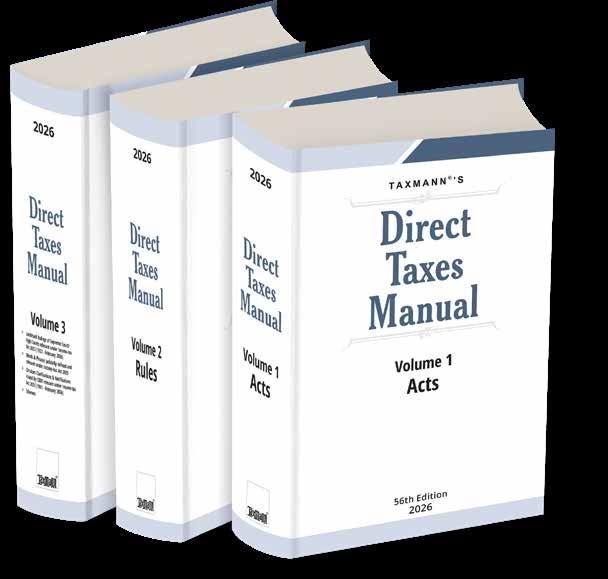
DIRECT TAXES MANUAL
AUTHOR : Taxmann's Editorial Board
PUBLISHER : Taxmann Publications
DATE OF PUBLICATION : April 2026
EDITION : 56th Edition | 2026
ISBN NO : 9789375619420
NO. OF PAGES : 5124
BINDING TYPE : Hardbound
8,725
DESCRIPTION
Direct Taxes Manual is the most exhaustive statutory reference compilation in Indian direct taxation—authoritative across 56 consecutive annual Editions. The 2026 Edition arrives at the most consequential juncture in post-independence Indian tax history: the full transition from the Income-tax Act 1961 to the Income-tax Act 2025 (Act No. 30 of 2025).
Volume 1 presents the ITA 2025—a restructured, 536-section, 23-chapter statute with 15 Schedules—as its primary legislative text, fully amended by the Finance Act 2026. The 1961 Act is preserved through an elaborate bidirectional cross-reference architecture that maps every section, rule, and form between the two regimes. The Finance Act, 2026 amends both Acts simultaneously—the ITA 1961 for AY 2026-27 and the ITA 2025 for tax year 2026-27 onwards. Volume 2 reproduces the Income-tax Rules 2026 (incorporating G.S.R. No. 198(E) dated 20 March 2026) alongside 27 additional divisions of subordinate legislation, procedural schemes, and tax administration frameworks Volume 3 compiles over a century of judicial precedent (1922–February 2026), six decades of CBDT administrative guidance (1961–February 2026), and a comprehensive lexicon of judicially interpreted statutory terms—all re-indexed section-by-section against the Income-tax Act 2025. This book is intended for the following audience:
• Chartered Accountants and Tax Consultants
• Advocates and Litigation Specialists
• Corporate Tax and Transfer Pricing Teams
• Non-Profit Organisations and Their Advisors
• Government Tax Officers (IRS/CBDT)
• Financial Institutions and Banks
• Law Faculty and Tax Researchers
The Present Publication is the 56th Edition | 2026, edited by Taxmann's Editorial Board, with the following noteworthy features:
• [Income-tax Act 2025—First Edition as Primary Statute] The 56th Edition is the first to present the ITA 2025 (Act No. 30 of 2025) as the primary statute, fully amended by the Finance Act 2026—with a chapter-wise arrangement of sections, editorial footnotes cross-referring every provision to its 1961 Act counterpart, an Allied Laws Appendix (Companies Act 2013 Schedule III, PMLA, SEBI Regulations, and others), and a comprehensive subject index
• [Finance Act 2026—Both Regimes Covered] The complete text of the Finance Act, 2026 is reproduced—covering amendments to the ITA 1961 (Part A: Sections 4–34, AY 2026-27) and the ITA 2025 (Part B: Sections 35–158, tax year 2026-27 onwards)—along with Chapter VI (Miscellaneous) and the First Schedule (tax rates)
• [Bi-Directional Cross-Reference Tables—Acts, Rules, and Forms] Six exhaustive cross-reference tables are placed at the front of Volumes 1 and 2
o Volume 1 carries two bi-directional section concordances (ITA 1961 ITA 2025)
o Volume 2 carries four tables covering bi-directional rule mappings (IT Rules 1962 IT Rules 2026) and form mappings (IT Forms 1962 ↔ IT Forms 2026)—each with headings on both sides
o These tables are the primary transitional navigation tool for practitioners working across both regimes simultaneously
• [Income-tax Rules 2026—Complete Text with Computational Illustrations] The full text of the IT Rules 2026 (incorporating G.S.R. No. 198(E) dated 20-03-2026) is reproduced with an arrangement of rules, detailed computational illustrations—including Rule 81's TNMM weighted average PLI calculations with multi-year tabular comparables—an Allied Laws Appendix, and a subject index
• [Landmark Rulings of Supreme Court and High Courts (1922–February 2026)] Over a century of direct tax judicial precedent, systematically re-indexed against the ITA 2025 with 1961 Act section references in brackets. Entries are substantive digests—covering foundational questions (accrue/arise/receive under Section 5; control and management under Section 6), capital gains (stamp duty valuation under Section 78; residential house exemption under Section 82), and 2024–2025 Supreme Court decisions—navigable through a section-key and alphabetical key
• [Words and Phrases Judicially Defined—Cross-Indexed to the 2025 Act] A dedicated compilation of judicially interpreted statutory terms —'business,' 'trade,' 'adventure,' 'accrue,' 'arise,' 'agricultural income,' 'control and management,' 'amalgamation,' and others—with structured digests of Supreme Court and High Court rulings, carrying both the 2025 Act section reference and the corresponding 1961 Act section, navigable through a section-key and alphabetical key
• [CBDT Circulars, Clarifications and Notifications (1961–February 2026)] The complete CBDT administrative guidance archive—six decades, organised by section of the 2025 Act with 1961 Act cross-references—covering TDS/TCS e-filing procedures, bad debt write-off instructions (Instruction No. 17/2008), depreciation on hire-purchase assets, sector-specific notifications (NABARD, OIDB, NDDB, Credit Guarantee Fund Trust), and exemption notifications; navigable through a section-key and alphabetical key
• [28 Divisions of Subordinate Legislation in Volume 2] Volume 2 is organised into 28 self-contained divisions covering the complete spectrum of direct tax procedural law—the IT Rules 2026, ICDS, all five faceless proceedings schemes, e-Appeals, e-Advance Rulings, e-Dispute Resolution, ITAT Rules, 1963, Capital Gains Accounts Scheme, DRP Rules, Certificate Proceedings Rules, and savings-linked investment schemes, among others
• [Foreign Assets of Small Taxpayers Disclosure Scheme 2026] The complete text of the newly introduced scheme is reproduced in Volume 1, immediately accessible to practitioners advising on its compliance window
• [Direct Tax Vivad Se Vishwas Framework] The full framework is consolidated in Volume 1—the Scheme text, Rules, and all relevant CBDT notifications and circulars—providing practitioners with the complete dispute settlement reference in one place