Sample Read
© All rights reserved Price : ` 2995 Law stated in this book is as amended by the Finance Act, 2026 and updated till 1st August, 2026 Published by : Taxmann Publications (P.) Ltd. Sales & Marketing : 59/32, New Rohtak Road, New Delhi-110 005 India Phone : +91-11-45562222 Website : www.taxmann.com E-mail : sales@taxmann.com Regd. Office : 21/35, West Punjabi Bagh, New Delhi-110 026 India Printed at : Tan Prints (India) Pvt. Ltd. 44 Km. Mile Stone, National Highway, Rohtak Road Village Rohad, Distt. Jhajjar (Haryana) India E-mail : sales@tanprints.com Disclaimer Every effort has been made to avoid errors or omissions in this publication. In spite of this, errors may creep in. Any mistake, error or discrepancy noted may be brought to our notice which shall be taken care of in the next edition. It is notified that neither the publisher nor the author or seller will be responsible for any damage or loss of action to any one, of any kind, in any manner, therefrom. It is suggested that to avoid any doubt the reader should cross-check all the facts, law and contents of the publication with original Government publication or notifications. No part of this book may be reproduced or copied in any form or by any means [graphic, electronic or mechanical, including photocopying, recording, taping, or information retrieval systems] or reproduced on any disc, tape, perforated media or other information storage device, etc., without the written permission of the publishers. Breach of this condition is liable for legal action. For binding mistake, misprints or for missing pages, etc., the publisher’s liability is limited to replacement within seven days of purchase by similar edition. All expenses in this connection are to be borne by the purchaser. All disputes are subject to Delhi jurisdiction only.
Contents PAGE
About the Author
I-5
Acknowledgement
I-7
About this Book
I-9
Guide to Finance Act, 2026
I-15
List of Cases
I-21 DIVISION ONE CUSTOMS ACT, 1962
Arrangement of sections
1.3
Text of Customs Act, 1962 with Section Notes
1.17
Section-Rules Index
1.741
Other common Circulars issued under Customs Act, 1962
1.755
Customs subordinate legislations — Table of operative status
1.767
DIVISION TWO CUSTOMS TARIFF ACT, 1975 Arrangement of sections
2.3
Text of Customs Tariff Act, 1975 with Section Notes
2.5
Section-Rules Index
2.71 DIVISION THREE
RULES & REGULATIONS Customs (Compounding of Offences) Rules, 2005
3.3
Warehoused Goods (Removal) Regulations, 2016
3.11
I-11
CONTENTS
I-12 PAGE
Warehouse (Custody and Handling of Goods) Regulations,
2016
3.17
Special
Warehouse (Custody and Handling of Goods) Regulations, 2016
3.25
Public Warehouse Licensing Regulations, 2016
3.31
Private Warehouse Licensing Regulations, 2016
3.37
Special Warehouse Licensing Regulations, 2016
3.43
Deferred Payment of Import Duty Rules, 2016
3.49
Pre-Notice Consultation Regulations, 2018
3.53
Bill
of Entry (Electronic Integrated Declaration and Paperless Processing) Regulations, 2018
3.57
Sea Cargo Manifest and Transhipment Regulations, 2018
3.63
Customs Brokers Licensing Regulations, 2018
3.109
Customs Audit Regulations, 2018
3.137
Exports by Post Regulations, 2018
3.143
Shipping
Bill (Electronic Integrated Declaration and Paperless Processing) Regulations, 2019
3.149
Transhipment of Cargo to Nepal under Electronic Cargo
Tracking Systems Regulations, 2019
3.155
Manufacture and Other Operations in Warehouse (No. 2)
Regulations, 2019
3.163
Transportation
of Goods (Through Foreign Territory) Regulations, 2020
3.173
Customs (Administration of Rules of Origin under Trade
Agreements) Rules, 2020 Customs Authority for Advance Ruling Regulations, 2021
3.185 3.199
Customs (Verification of Identity and Compliance) Regula-
tions, 2021 Electronic Duty Credit Ledger Regulations, 2021
3.215 3.221
Shipping
Bill (Post Export Conversion in Relation to Instrument Based Scheme) Regulations, 2022
3.227
Customs (Electronic Cash Ledger) Regulations, 2022
3.231
Controlled Delivery (Customs) Regulations, 2022
3.243
Passenger Name Record Information Regulations, 2022
3.251
I-13
CONTENTS
PAGE Customs (Import of Goods at Concessional Rate of Duty or
for specified End Use) Rules, 2022
3.259
Postal
Export (Electronic Declaration and Processing) Regulations, 2022
3.277
Customs (Assistance in Value Declaration of Identified
Imported Goods) Rules, 2023
3.289
Customs (On-Arrival Movement for Storage and Clearance
at Authorised Importer Premises) Regulations, 2025 Postal Imports Regulations, 2025
3.299 3.307
Export
Entry (Post Export Conversion in Relation to Instrument based Scheme) Regulations, 2025
3.317
Customs (Finalisation of Provisional Assessment) Regula-
tions, 2025
3.323
Customs (Voluntary Revision of Entries Post Clearance)
Regulations, 2025
3.331
Baggage Rules, 2026
3.337
Customs Baggage (Declaration and Processing) Regulations,
2026
3.349
Customs Act, 1962 [52 OF 1962]* An Act to consolidate and amend the law relating to customs. Be it enacted by Parliament in the Thirteenth Year of the Republic of India as follows:— CHAPTER I PRELIMINARY Short title, extent and commencement. 1. (1) This Act may be called the Customs Act, 1962. (2) It extends to the whole of India 1[, fishing and fishing related activities by Indian-flagged fishing vessels beyond territorial waters of India] 2[and, save as otherwise provided in this Act, it applies also to any offence or contravention thereunder committed outside India by any person]. (3) It shall come into force on such date3 as the Central Government may, by notification in the Official Gazette, appoint. COMMENTS
SECTION NOTES u
Section 1 of the Customs Act, 1962 is the opening provision of the statute. It gives the Act its short title, fixes its territorial reach, and empowers the Central Government to bring the Act into force. Every other provision of the Customs Act, 1962 operates within the framework laid down here.
1.1 Short title u
Section 1(1) of the Customs Act, 1962 states that the statute may be cited as the Customs Act, 1962. This is the formal name by which the legislation is referred to in courts, notifications and departmental records.
1.2 Extent and extra-territorial application u
Section 1(2) of the Customs Act, 1962 extends the statute to the whole of India. By an amendment inserted by the Finance Act, 2026, w.e.f. 30-3-2026, its reach has been expressly stretched to fishing and fishing related activities by Indian-flagged fishing vessels beyond the waters of India.
* Dated 13-12-1962. 1. Inserted by the Finance Act, 2026, w.e.f. 30-3-2026. 2. Inserted by the Finance Act, 2018, w.e.f. 29-3-2018. 3. With effect from 1-2-1963; vide Notification No. G.S.R. 155(E), dated 23-1-1963.
1.17
S. 2 u
CUSTOMS ACT, 1962
1.18
Section 1(2) of the Customs Act, 1962 further provides, by way of the Finance Act, 2018 amendment w.e.f. 29-3-2018, that save as otherwise provided, the Act applies to any offence or contravention committed outside India by any person. This is the extra-territorial arm of the Customs Act, 1962 and is important when dealing with smuggling and related offences committed abroad. Thus, the extension of scope outside India is only for purpose of offences and not for any other purposes.
1.3 Parliament can enact Legislation with regard to extra-territorial aspects u
Parliament can enact Legislation with regard to extra-territorial aspects of certain events - Union of India v. Mohit Minerals (P.) Ltd. [2022] 138 taxmann.com 331 (SC 3-member bench).
1.4 Commencement u
Section 1(3) of the Customs Act, 1962 leaves the date of commencement to be appointed by the Central Government through a notification in the Official Gazette. The Act was brought into force on 1-2-1963 vide Notification No. GSR 155(E), dated 23-1-1963.
Definitions. 2. In this Act, unless the context otherwise requires,— [(1) “adjudicating authority” means any authority competent to pass any order or decision under this Act, but does not include the Board, 3b[Commissioner (Appeals)] or Appellate Tribunal;
3a
(1A) “aircraft” has the same meaning as in the Aircraft Act, 1934 (22 of 1934); (1B) “Appellate Tribunal” means the Customs, Excise and 4[Service Tax] Appellate Tribunal constituted under section 129;] [(2) “assessment” means determination of the dutiability of any goods and the amount of duty, tax, cess or any other sum so payable, if any, under this Act or under the Customs Tariff Act, 1975 (51 of 1975) (hereinafter referred to as the Customs Tariff Act) or under any other law for the time being in force, with reference to—
5
(a) the tariff classification of such goods as determined in accordance with the provisions of the Customs Tariff Act; (b) the value of such goods as determined in accordance with the provisions of this Act and the Customs Tariff Act; (c) exemption or concession of duty, tax, cess or any other sum, consequent upon any notification issued therefor under this Act or under the Customs Tariff Act or under any other law for the time being in force;
3a. 3b. 4. 5.
Substituted by the Finance (No. 2) Act, 1980, w.e.f. 11-10-1982. Substituted for “Collector (Appeals)” by the Finance Act, 1995, w.e.f. 26-5-1995. Substituted for “Gold (Control)” by the Finance Act, 2003, w.e.f. 14-5-2003. Substituted by the Finance Act, 2018, w.e.f. 29-3-2018. Prior to its substitution, clause (2), as substituted by the Finance Act, 2011, w.e.f. 8-4-2011, read as under: ‘(2) “assessment” includes provisional assessment, self-assessment, re-assessment and any assessment in which the duty assessed is nil;’
1.19
CH. I : PRELIMINARY
S. 2
(d) the quantity, weight, volume, measurement or other specifics where such duty, tax, cess or any other sum is leviable on the basis of the quantity, weight, volume, measurement or other specifics of such goods; (e) the origin of such goods determined in accordance with the provisions of the Customs Tariff Act or the rules made thereunder, if the amount of duty, tax, cess or any other sum is affected by the origin of such goods; (f) any other specific factor which affects the duty, tax, cess or any other sum payable on such goods, and includes provisional assessment, self-assessment, re-assessment and any assessment in which the duty assessed is nil;] (3) “baggage” includes unaccompanied baggage but does not include motor vehicles; [(3A) “beneficial owner” means any person on whose behalf the goods are being imported or exported or who exercises effective control over the goods being imported or exported;]
6
(4) “bill of entry” means a bill of entry referred to in section 46; (5) “bill of export” means a bill of export referred to in section 50; (6) “Board” means the 6a[7[Central Board of Indirect Taxes and Customs] constituted under the Central Boards of Revenue Act, 1963 (54 of 1963)]; (7) “coastal goods” means goods, other than imported goods, transported in a vessel from one port in India to another; [(7A) “Commissioner (Appeals)” means a person appointed to be a Commissioner of Customs (Appeals) under sub-section (1) of section 4;
8
[(7B) “common portal” means the Common Customs Electronic Portal referred to in section 154C;]
9
[(8) 11[“Principal Commissioner of Customs or Commissioner of Customs”], except for the purposes of Chapter XV, includes an Additional Commissioner of Customs;]
10
(9) “conveyance” includes a vessel, an aircraft and a vehicle; (10) “customs airport” means any airport appointed under clause (a) of section 7 to be a customs airport 12[and includes a place appointed under clause (aa) of that section to be an air freight station]; 6. Inserted by the Finance Act, 2017, w.e.f. 31-3-2017. 6a. Substituted by the Central Board of Revenue Act, 1963, w.e.f. 1-1-1964. 7. Substituted for “Central Board of Excise and Customs” by the Finance Act, 2018, w.e.f. 29-32018. 8. Clause (7A) substituted by the Finance Act, 1995, w.e.f. 26-5-1995. Earlier, clause (7A) was inserted by the Finance (No. 2) Act, 1980, w.e.f. 11-10-1982. 9. Inserted by the Finance Act, 2021, w.e.f. 28-3-2021. 10. Substituted by the Finance Act, 1995, w.e.f. 26-5-1995. Earlier, clause (8) was substituted by the Finance Act, 1992, w.e.f. 14-5-1992. 11. Substituted for “Commissioner of Customs” by the Finance (No. 2) Act, 2014, w.e.f. 6-8-2014. 12. Inserted by the Finance Act, 2012, w.e.f. 28-5-2012.
S. 2
CUSTOMS ACT, 1962
1.20
(11) “customs area” means the area of a customs station 13[or a warehouse] and includes any area in which imported goods or export goods are ordinarily kept before clearance by Customs Authorities; (12) “customs port” means any port appointed under clause (a) of section 7 to be a customs port 13a[, and includes a place appointed under clause (aa) of that section to be an inland container depot]; (13) “customs station” means any customs port, 14[customs airport, international courier terminal, foreign post office] or land customs station; (14) “dutiable goods” means any goods which are chargeable to duty and on which duty has not been paid; (15) “duty” means a duty of customs leviable under this Act; (16) “entry” in relation to goods means an entry made in a bill of entry, shipping bill or bill of export and includes 15[***] the entry made under the regulations made under section 84; (17) “examination”, in relation to any goods, includes measurement and weighment thereof; (18) “export”, with its grammatical variations and cognate expressions, means taking out of India to a place outside India; (19) “export goods” means any goods which are to be taken out of India to a place outside India; (20) “exporter”, in relation to any goods at any time between their entry for export and the time when they are exported, includes 16[any owner, beneficial owner] or any person holding himself out to be the exporter; [(20A) “foreign post office” means any post office appointed under clause (e) of sub-section (1) of section 7 to be a foreign post office;]
17
(21) “foreign-going vessel or aircraft” means any vessel or aircraft for the time being engaged in the carriage of goods or passengers between any port or airport in India and any port or airport outside India, whether touching any intermediate port or airport in India or not, and includes— (i) any naval vessel of a foreign Government taking part in any naval exercises; (ii) any vessel engaged in fishing or any other operations outside the territorial waters of India; (iii) any vessel or aircraft proceeding to a place outside India for any purpose whatsoever;
13. Inserted by the Taxation Laws (Amendment) Act, 2017, w.e.f. 1-7-2017. 13a. Inserted by the Finance Act, 1983, w.e.f. 13-5-1983. 14. Substituted for “customs airport” by the Finance Act, 2017, w.e.f. 31-3-2017. 15. Words “in the case of goods imported or to be exported by post, the entry referred to in section 82 or” omitted, ibid. 16. Substituted for “any owner”, ibid. 17. Inserted, ibid.
1.21
CH. I : PRELIMINARY
S. 2
[(21A) “Fund” means the Consumer Welfare Fund established under section 12C of the Central Excise Act, 1944 (1 of 1944);]
18
(22) “goods” includes— (a) vessels, aircrafts and vehicles; (b) stores; (c) baggage; (d) currency and negotiable instruments; and (e) any other kind of movable property; (23) “import”, with its grammatical variations and cognate expressions, means bringing into India from a place outside India; (24) 19[“arrival manifest or import manifest”] or “import report” means the manifest or report required to be delivered under section 30; (25) “imported goods” means any goods brought into India from a place outside India but does not include goods which have been cleared for home consumption; (26) “importer”, in relation to any goods at any time between their importation and the time when they are cleared for home consumption, includes 20 [any owner, beneficial owner] or any person holding himself out to be the importer; (27) “India” includes the territorial waters of India; (28) “Indian Customs Waters” means the 20a[waters extending into the sea up to the limit of 21[Exclusive Economic Zone under section 7] of the Territorial Waters, Continental Shelf, Exclusive Economic Zone and other Maritime Zones Act, 1976 (80 of 1976)] and includes any bay, gulf, harbour, creek or tidal river; [(28A) “Indian-flagged fishing vessel” means a vessel which is used or intended to be used for the purpose of fishing in the seas and entitled to fly the flag of India;]
21a
[ [(28B)] “international courier terminal” means any place appointed under clause (f) of sub-section (1) of section 7 to be an international courier terminal;]
22 23
18. Inserted by the Central Excises and Customs Laws (Amendment) Act, 1991, w.e.f. 20-9-1991. 19. Substituted for “import manifest” by the Finance Act, 2018, w.e.f. 29-3-2018. 20. Substituted for “any owner” by the Finance Act, 2017, w.e.f. 31-3-2017. 20a. Substituted by the Customs, Central Excises and Salt and Central Boards of Revenue (Amendment) Act, 1978, w.e.f. 1-7-1978. 21. Substituted for “contiguous zone of India under section 5” by the Finance Act, 2018, w.e.f. 29-3-2018. 21a. Inserted by the Finance Act, 2026, w.e.f. 30-3-2026. 22. Inserted by the Finance Act, 2017, w.e.f. 31-3-2017. 23. Renumbered by the Finance Act, 2026, w.e.f. 30-3-2026.
S. 2
CUSTOMS ACT, 1962
1.22
(29) “land customs station” means any place appointed under clause (b) of section 7 to be a land customs station; (30) “market price”, in relation to any goods, means the wholesale price of the goods in the ordinary course of trade in India; [(30A) “National Tax Tribunal” means the National Tax Tribunal established under section 3 of the National Tax Tribunal Act, 2005;]
23a
[(30AA) “notification” means notification published in the Official Gazette and the expression “notify” with its cognate meaning and grammatical variation shall be construed accordingly;]
24
[(30B) “passenger name record information” means the records prepared by an operator of any aircraft or vessel or vehicle or his authorised agent for each journey booked by or on behalf of any passenger;]
25
(31) “person-in-charge” means,— (a) in relation to a vessel, the master of the vessel; (b) in relation to an aircraft, the commander or pilot-in-charge of the aircraft; (c) in relation to a railway train, the conductor, guard or other person having the chief direction of the train; (d) in relation to any other conveyance, the driver or other person-incharge of the conveyance; (32) “prescribed” means prescribed by regulations made under this Act; (33) “prohibited goods” means any goods the import or export of which is subject to any prohibition under this Act or any other law for the time being in force but does not include any such goods in respect of which the conditions subject to which the goods are permitted to be imported or exported have been complied with; (34) “proper officer”, in relation to any functions to be performed under this Act, means the officer of customs who is assigned those functions by the Board or the 26[Principal Commissioner of Customs or Commissioner of Customs] 27[under section 5]; (35) “regulations” means the regulations made by the Board under any provision of this Act; (36) “rules” means the rules made by the Central Government under any provision of this Act; 23a. Clause (30A) was to be inserted by the National Tax Tribunal Act, 2005. However, National Tax Tribunal Act, 2005 was declared as unconstitutional by the Supreme Court in Madras Bar Association v. Union of India [2014] 49 taxmann.com 515. 24. Inserted by the Finance Act, 2018, w.e.f. 29-3-2018. 25. Inserted by the Finance Act, 2017, w.e.f. 31-3-2017. 26. Substituted for “Chief Commissioner of Customs” by the Finance (No. 2) Act, 2014, w.e.f. 6-8-2014. 27. Inserted by the Finance Act, 2022, w.e.f. 30-3-2022.
1.23
CH. I : PRELIMINARY
S. 2
(37) “shipping bill” means a shipping bill referred to in section 50; (38) “stores” means goods for use in a vessel or aircraft and includes fuel and spare parts and other articles of equipment, whether or not for immediate fitting; (39) “smuggling”, in relation to any goods, means any act or omission which will render such goods liable to confiscation under section 111 or section 113; (40) “tariff value”, in relation to any goods, means the tariff value fixed in respect thereof under sub-section (2) of section 14; (41) “value”, in relation to any goods, means the value thereof determined in accordance with the provisions of sub-section (1) 28[or sub-section (2) of section 14]; (42) “vehicle” means conveyance of any kind used on land and includes a railway vehicle; [(43) “warehouse” means a public warehouse licensed under section 57 or a private warehouse licensed under section 58 or a special warehouse licensed under section 58A;]
29
(44) “warehoused goods” means goods deposited in a warehouse; (45) 30[***] COMMENTS u
Section 2 of the Customs Act, 1962 contains the definitions that apply throughout the Act, unless the context otherwise requires. Many clauses have been inserted or substituted over the years by successive Finance Acts. Each numbered clause is discussed below in the order in which it appears in the statute. ADJUDICATING AUTHORITY [SECTION 2(1)]
SECTION NOTES 2.1 Adjudicating authority u
Clause (1) of section 2 of the Customs Act, 1962 defines “adjudicating authority” as any authority competent to pass an order or decision under the Act. It expressly excludes the Board, the Commissioner (Appeals) and the Appellate Tribunal, because these bodies act as reviewing rather than first-level authorities. The word “Collector (Appeals)” in
28. Substituted for “sub-section (1) of section 14” by the Finance Act, 2007 w.e.f. 10-10-2007. 29. Substituted by the Finance Act, 2016, w.e.f. 14-5-2016. Prior to its substitution, clause (43) read as under: ‘(43) “warehouse” means a public warehouse appointed under section 57 or a private warehouse licensed under section 58;’ 30. Omitted by the Finance Act, 2016, w.e.f. 14-5-2016. Prior to its omission, clause (45) read as under: ‘(45) “warehousing station” means a place declared as a warehousing station under section 9.’
S. 2
CUSTOMS ACT, 1962
1.24
the original text was replaced by “Commissioner (Appeals)” by the Finance Act, 1995 (w.e.f. 26-5-1995). u
Section 2(1) of Customs Act, 1962 defines adjudicating authority as an authority competent to pass any order or decision under the Act, excluding Commissioner (Appeals) and Appellate Tribunal. Order of provisional release of goods seized in adjudication and passed by Commissioner, though intimated by Joint Commissioner to appellant, is in the nature of an adjudicating order. Despite the fact that order is interlocutory one and intimated via letter of Jt. Commissioner, the same is appealable. Mumbai Tribunal in Dhananjay Kumar v. Commissioner of Customs 2008 (230) E.L.T. 684 (Tri. - Mumbai). AIRCRAFT [SECTION 2(1A)]
SECTION NOTES 2.2 Aircraft u
Clause (1A) of section 2 of the Customs Act, 1962 adopts the meaning of “aircraft” given in the Aircraft Act, 1934. The Customs Act does not lay down a separate definition.
u
Section 2 (1) of the Aircraft Act, 1934 defines ‘Aircraft’ as under:
‘aircraft’ means any machine which can derive support in the atmosphere from reactions of the air, [other than reactions of the air against the earth’s surface] and includes balloons whether fixed or free, airships, kites, gliders and flying machines. APPELLATE TRIBUNAL [SECTION 2(1B)] SECTION NOTES 2.3 Appellate Tribunal u
Clause (1B) of section 2 of the Customs Act, 1962 defines the “Appellate Tribunal” as the Customs, Excise and Service Tax Appellate Tribunal constituted under section 129 of the Act. The word “Service Tax” was substituted for “Gold (Control)” by the Finance Act, 2003 (w.e.f. 14-5-2003) to reflect the Tribunal’s current jurisdiction.
u
The Supreme Court in Northern Plastics Ltd. v. Hindustan Photo Films Mfg. Co. Ltd. 1997 (91) E.L.T. 502 (S.C.), has held that CEGAT is a creature of statute and derives its jurisdiction and powers only from the statute creating it and not outside the statute. ASSESSMENT [SECTION 2(2)]
SECTION NOTES 2.4 Assessment u
Clause (2) of section 2 of the Customs Act, 1962 substituted by the Finance Act, 2018 (w.e.f. 29-3-2018), defines “assessment” as the determination of the dutiability of any goods and the amount of duty, tax, cess or any other sum payable under the Act, the Customs Tariff Act, 1975 or any other law. The determination is made with reference to tariff classification, value, exemption, quantity or measurement, origin and any other specific factor that affects duty. The definition expressly includes provisional assessment, self-assessment, re-assessment and nil assessments, so that every kind of determination of tax liability falls within the term.
1.25
CH. I : PRELIMINARY
S. 2
BAGGAGE [SECTION 2(3)] SECTION NOTES 2.5 Baggage u
Clause (3) of section 2 of the Customs Act, 1962 defines “baggage” to include unaccompanied baggage but to exclude motor vehicles. This is why cars, even those accompanying a passenger, cannot be cleared as baggage.
u
Madras Tribunal in Noorul Ayin v. Commissioner of Customs (2025) 29 Centax 213 (Tri.Mad), has held that goods recovered from person/luggage of passengers of domestic flight could not be presumed to be part of ‘baggage’ as defined under the Customs Act, 1962. BENEFICIAL OWNER [SECTION 2(3A)]
SECTION NOTES 2.6 Beneficial owner u
Clause (3A) of section 2 of the Customs Act, 1962 inserted by the Finance Act, 2017 (w.e.f. 31-3-2017), defines “beneficial owner” as any person on whose behalf goods are being imported or exported, or who exercises effective control over them. The term widens the net of liability so that it reaches the real party behind a transaction and not just the named importer or exporter.
u
Delhi Tribunal in Pawan Munjal v. Commissioner of Customs (2024) 20 Centax 318 (Tri.-Del), has held that concept of beneficial owner as defined under Section 2(3A) of Customs Act, 1962 cannot be made applicable if owner of seized goods is available. BILL OF ENTRY [SECTION 2(4)]
SECTION NOTES 2.7 Bill of entry u
Clause (4) of section 2 of the Customs Act, 1962 defines “bill of entry” as the bill of entry referred to in section 46 of the Act. It is the key document filed by an importer to clear imported goods. BILL OF EXPORT [SECTION 2(5)]
SECTION NOTES 2.8 Bill of export u
Clause (5) of section 2 of the Customs Act, 1962 defines “bill of export” as the bill of export referred to in section 50 of the Act. It is used for export of goods by land.
S. 2
CUSTOMS ACT, 1962
1.26
BOARD [SECTION 2(6)] SECTION NOTES 2.9 Board u
Clause (6) of section 2 of the Customs Act, 1962 defines “Board” as the Central Board of Indirect Taxes and Customs (CBIC) constituted under the Central Boards of Revenue Act, 1963. The name was substituted from “Central Board of Excise and Customs” by the Finance Act, 2018 (w.e.f. 29-3-2018). COASTAL GOODS [SECTION 2(7)]
SECTION NOTES 2.10 Coastal goods u
Clause (7) of section 2 of the Customs Act, 1962 defines “coastal goods” as goods other than imported goods that are transported in a vessel from one port in India to another. Coastal goods are subject to special procedures in Chapter XI of the Act. COMMISSIONER (APPEALS) [SECTION 2(7A)]
SECTION NOTES 2.11 Commissioner (Appeals) u
Clause (7A) of section 2 of the Customs Act, 1962 defines the “Commissioner (Appeals)” as a person appointed to be a Commissioner of Customs (Appeals) under section 4(1) of the Act. He is the first appellate authority under the Act. COMMON PORTAL [SECTION 2(7B)]
SECTION NOTES 2.12 Common portal u
Clause (7B) of section 2 of the Customs Act, 1962 inserted by the Finance Act, 2021 (w.e.f. 28-3-2021), defines the “common portal” as the Common Customs Electronic Portal referred to in section 154C of the Act. It is the single electronic interface through which most customs filings are made. PRINCIPAL COMMISSIONER OF CUSTOMS OR COMMISSIONER OF CUSTOMS [SECTION 2(8)]
SECTION NOTES 2.13 Principal Commissioner of Customs or Commissioner of Customs u
Clause (8) of section 2 of the Customs Act, 1962 defines the “Principal Commissioner of Customs or Commissioner of Customs”. For the purposes of Chapter XV (appeals), the expression also includes an Additional Commissioner of Customs. The words “Principal Commissioner of Customs or” were inserted by the Finance (No. 2) Act, 2014 (w.e.f. 6-8-2014).
1.27
CH. I : PRELIMINARY
S. 2
CONVEYANCE [SECTION 2(9)] SECTION NOTES 2.14 Conveyance u
Clause (9) of section 2 of the Customs Act, 1962 defines “conveyance” inclusively to cover a vessel, an aircraft and a vehicle. The definition, read with clause (42), is wide enough to cover every common mode of transport that brings goods to India or takes the goods from India. CUSTOMS AIRPORT [SECTION 2(10)]
SECTION NOTES 2.15 Customs airport u
Clause (10) of section 2 of the Customs Act, 1962 defines a “customs airport” as any airport appointed under section 7(a) of the Act. It also includes a place appointed under section 7(aa) of the Act to be an air freight station, which was added by the Finance Act, 2012 (w.e.f. 28-5-2012). CUSTOMS AREA [SECTION 2(11)]
SECTION NOTES 2.16 Customs area u
Clause (11) of section 2 of the Customs Act, 1962 defines “customs area” as the area of a customs station or a warehouse, and any area where imported or export goods are ordinarily kept before clearance by customs authorities. The words “or a warehouse” were added by the Taxation Laws (Amendment) Act, 2017 (w.e.f. 1-7-2017) to align the customs area with warehoused goods. CUSTOMS PORT [SECTION 2(12)]
SECTION NOTES 2.17 Customs port u
Clause (12) of section 2 of the Customs Act, 1962 defines a “customs port” as any port appointed under section 7(a) of the Act. It also includes a place appointed under section 7(aa) to be an inland container depot, which extends the reach of customs control inland.
u
Inland Container Depots (ICDs) can be termed as ‘Inland Ports’ - CIT v. Container Corporation of India Ltd. (2018) 93 taxmann.com 31 (SC). CUSTOMS STATION [SECTION 2(13)]
SECTION NOTES 2.18 Customs station u
Clause (13) of section 2 of the Customs Act, 1962 defines a “customs station” as any customs port, customs airport, international courier terminal, foreign post office or land customs station. The list was widened by the Finance Act, 2017 (w.e.f. 31-3-2017) to include international courier terminals and foreign post offices.
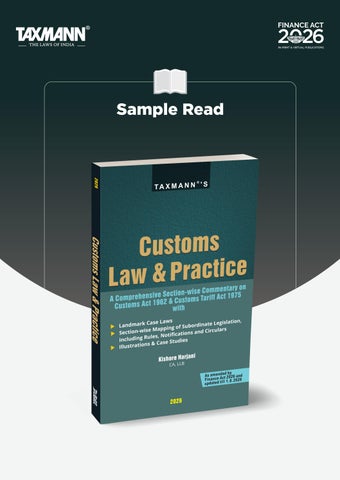
CUSTOMS LAW & PRACTICE AUTHOR : PUBLISHER : DATE OF PUBLICATION : EDITION : ISBN NO : NO. OF PAGES : BINDING TYPE :
Kishore Harjani Taxmann August 2026 2026 Edition 9788167010001 1260 Paperback
Rs. 2,995 DESCRIPTION Customs Law & Practice is a practical, research-oriented and citation-friendly single-volume commentary on India's customs law. It brings together the Customs Act 1962 and the Customs Tariff Act 1975 in a structured, section-wise format, so that the practitioner need not move among multiple books, notifications, circulars, rules, and case law sources to understand the law applicable to a particular provision. The underlying philosophy is simple: the bare statute gives the text of the law, whereas professional practice requires much more. Each provision is therefore presented alongside its amendment history, detailed analysis, judicial interpretation, subordinate legislation, departmental circulars and—wherever computation, timing, classification or characterisation can materially affect the outcome—practical illustrations. The result is a consolidated reference designed to move seamlessly from the text of the law to its application. Its consistent presentation serves both the professional seeking a quick answer and the researcher tracing an issue end-to-end: locate the provision, follow its legislative history, identify the applicable rules and regulations, review the departmental position, and examine the leading judicial authorities. This makes it equally suited to advisory assignments, litigation, audits, investigations, assessments, refund and drawback matters and day-to-day import and export compliance—whether the need is to draft a reply, appeal or opinion, to bridge the statutory framework to the administrative guidance that governs actual practice, or to evaluate compliance exposure. This book is intended for the following audience: • Chartered Accountants, Cost Accountants and Company Secretaries • Advocates and Litigation Counsel • Customs Brokers, Freight Forwarders, Custodians and Logistics Professionals • Importers, Exporters and EXIM/Trade-Compliance Teams • In-house Finance, Tax and Legal Teams • Customs and Departmental Officers • Academicians, Students and Researchers • Trade Policy and FTA Professionals The Present Publication is the 2026 Edition, as amended by the Finance Act 2026 and updated till 1st August 2026. It is authored by Kishore Harjani, and is structured to provide a current and reliable statement of the law while retaining the historical trail necessary for understanding how the provisions have evolved. The book carries the following noteworthy features: • [Comprehensive Section-wise Coverage] Detailed commentary on the Customs Act 1962 and the Customs Tariff Act 1975, including provisions since omitted, with reference to their earlier statutory position wherever relevant • [Complete Amendment Trail] Amendments, insertions, substitutions, omissions and renumbering are tracked throughout, with the earlier wording retained where material, so that the law applicable at any past date can be reconstructed • [Strong Judicial Perspective] Landmark rulings and supporting decisions are mapped to the provisions they interpret, making the case-law component practical rather than merely a list of authorities • [The Statute-to-Rule Bridge] Rules and regulations framed under each provision are systematically mapped, taking the reader directly from the enabling provision to the delegated legislation that gives it effect • [Circulars and Departmental Guidance] CBIC circulars and instructions are set out substantively—the administrative position and its practical significance, with references for verification. In all, 325 distinct circulars, 182 notifications and 115 instructions are cited, together with instruments of other authorities that influence customs practice • [Practical Illustrations] 138 worked illustrations sit at the provisions where calculations, timelines, procedural requirements or legal characterisation can change the result, translating technical provisions into practical fact situations • [Finance Act 2026 Guide] A dedicated opening section explains each customs amendment made by the Finance Act 2026, including commencement and comparative treatment • [Rules of Origin] 18 frameworks consolidated in one place, from the GSTP Rules of 1989 to the India–UK CETA Rules 2026, for professionals handling preferential trade agreements and origin claims • [Rules, Regulations and Statutory Forms] Thirty-six sets of subordinate legislation reproduced in an accessible arrangement, with the important forms, annexures and appendices • [Customs Tariff with Interpretative Framework] The Tariff Act commentary is supplemented by the General Rules for Interpretation, explanatory material, units and abbreviations and the Export Tariff, supported by examples and authority • [Additional Practical Materials] A dedicated compilation of common circulars and administrative instruments issued by authorities such as RBI, CBDT and FSSAI, where they intersect with customs practice
Buy Now