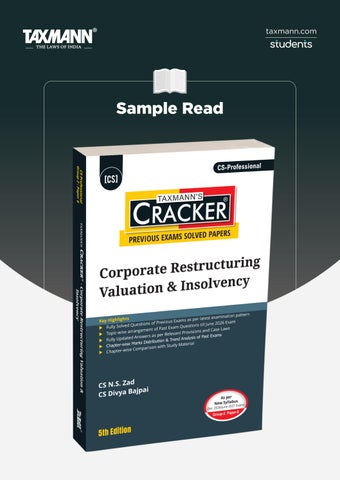

Sample Read

© All rights reserved
Price : ` 595
Fifth Edition : June 2026
Published by :
Taxmann Publications (P.) Ltd.
Sales & Marketing :
59/32, New Rohtak Road, New Delhi-110 005 India
Phone : +91-11-45562222
Website : www.taxmann.com
E-mail : sales@taxmann.com
Regd. Office : 21/35, West Punjabi Bagh, New Delhi-110 026 India
Printed at :
Tan Prints (India) Pvt. Ltd.
44 Km. Mile Stone, National Highway, Rohtak Road Village Rohad, Distt. Jhajjar (Haryana) India
E-mail : sales@tanprints.com
Disclaimer
Every effort has been made to avoid errors or omissions in this publication. In spite of this, errors may creep in. Any mistake, error or discrepancy noted may be brought to our notice which shall be taken care of in the next edition. It is notified that neither the publisher nor the author or seller will be responsible for any damage or loss of action to any one, of any kind, in any manner, therefrom. It is suggested that to avoid any doubt the reader should cross-check all the facts, law and contents of the publication with original Government publication or notifications.
No part of this book may be reproduced or copied in any form or by any means [graphic, electronic or mechanical, including photocopying, recording, taping, or information retrieval systems] or reproduced on any disc, tape, perforated media or other information storage device, etc., without the written permission of the publishers. Breach of this condition is liable for legal action.
For binding mistake, misprints or for missing pages, etc., the publisher’s liability is limited to replacement within seven days of purchase by similar edition. All expenses in this connection are to be borne by the purchaser. All disputes are subject to Delhi jurisdiction only.


TAXATION & STAMP DUTY ASPECTS OF CORPORATE RESTRUCTURING CHAPTER 7
Q1. The word ‘Amalgamation’ or ‘Merger’ is not defined anywhere in the Companies Act, 2013. Comment[Dec. 2009 (2 Marks)]
Ans.: The word ‘amalgamation’ or ‘merger’ is not defined anywhere in the Companies Act, 2013. However, Section 2(1B) of the Income-tax Act, 1961 defines ‘amalgamation’. “Amalgamation” in relation to companies, means the merger of one or more companies with another Amalgamation [Section 2(1B)]: Amalgamation in relation to companies, means the merger of one or more companies with another company or the merger of two or more companies to form one company (the company or companies which so merge being referred to as the amalgamating company or companies and the company with which they merge or which is formed as a result of the merger, as the amalgamated company), in such a manner that –
(1)All property of amalgamating company becomes the property of amalgamated company by virtue of the amalgamation.
(2)All liabilities of amalgamating company become the liabilities of amalgamated company by virtue of the amalgamation.
(3) Shareholders holding not less than 3/4th (75%) in value of shares in amalgamating company become shareholders of amalgamated company by virtue of the amalgamation, otherwise than as a result of the acquisition of the property of one company by another company pursuant to the purchase of such property by the other company or as a result of the distribution of such property to the other company after the winding up of the first mentioned company.
Thus, for a merger to be qualified as an ‘amalgamation’ for the purpose of the Income-tax Act, 1961, above 3 conditions have to be satisfied.
Q2. Yellow Overseas Ltd. (YOL) merged with Yellow India Ltd. (YIL). YOL availed the benefit of amortization of preliminary expenses only for two years till merger order. Whether YIL is eligible to avail this benefit for the remaining period? Substantiate your answer.
[June 2016 (5 Marks)]
Ans. Amortization of preliminary expenses: As per Section 35D of the Income-tax Act, 1961 deduction of preliminary expenses is available for 5 years. If before claiming deduction of all 5 years, the company is transferred to another company in scheme of amalgamation then amalgamated company can claim deduction for the remaining period.
Example: X Ltd. is entitled to claim deduction of ` 50,000 on account of preliminary expenses i.e. ` 10,000 in each year for 5 years. Suppose X Ltd. claim deduction of ` 10,000 in each year for 2 years i.e. total ` 20,000 and it is merged with Y Ltd. then Y Ltd. can claim deduction of ` 30,000 for the remaining 3 years commencing form the year in which amalgamation take place.
In view of above, Yellow India Ltd. (amalgamated company) can claim deduction for the remaining 3 years of preliminary expenses incurred by Yellow Overseas Ltd.
Q3. Discuss in brief the provisions regarding carry forward and set-off of accumulated business losses and unabsorbed depreciation by an amalgamated company. [Dec. 2016 (5 Marks)]
Ans. Carry forward and set off of accumulated loss and unabsorbed depreciation allowance in case of amalgamation [Section 72A of the Income-tax Act, 1961]:
(1) Applicability: Provisions are applicable in following cases –
Where there has been an amalgamation of –
(a) A company owning an industrial undertaking or a ship or a hotel with another company; or
(b) A banking company with SBI or subsidiary bank or
(c) One or more public sector company or companies engaged in the business of operation of aircraft with one or more public sector company or companies engaged in similar business.
In case of above cases of amalgamation, the accumulated loss/unabsorbed depreciation of the amalgamating company shall be deemed to be the loss/ unabsorbed depreciation of the amalgamated company for the previous year in which the amalgamation was effected.
The said accumulated loss can be carried forward for further 8 years in the hands of amalgamated company.
(2) Conditions: The accumulated loss or the unabsorbed depreciation shall be allowed set-off in the assessment of the amalgamated company if following conditions are fulfilled –
For amalgamating company:
(1) Amalgamating company has loss or depreciation for last 3 years.
(2) Amalgamating company has held continuously 75% of assets for last 2 years prior to the date of amalgamation.
For amalgamated company:
(1) Amalgamated company holds continuously for 5 years, 75% of fixed assets of the amalgamating company acquired in a scheme of amalgamation.
(2) Amalgamated company continues the business of the amalgamating company for period of 5 years from the date of amalgamation.
(3) Amalgamated company fulfils other prescribed conditions.
(3) Consequence of non-compliance of conditions: In a case the aforesaid conditions are not complied with, the set off of loss or allowance of depreciation made in any previous year in the hands of the amalgamated company shall be deemed to be the income of the amalgamated company chargeable to tax for the year in which such conditions are not complied with.
Q4. Apart from availing the benefit of set off and carry forward of unabsorbed depreciation and accumulated losses, what are the other tax benefits if the strategy of the acquirer to merge with a loss-making company is in the form of a reverse merger? [Dec. 2017 (5 Marks)]
Ans. Form taxation angel, when profit making company merge with sick or a company with accumulated losses, it is known as reverse merger. If the scheme of merger gets approval of the competent authority under section 72A of the Income-tax Act, 1961, the resultant company avails the opportunity of getting losses of sick undertakings offset against profit making undertakings of the transferee company. Even if approval by Competent Authority is not obtained, the merged undertakings of the resultant company still avail other benefits and privileges as detailed below under the Income-tax Act, 1961:
(a) The benefit of amortization of preliminary expenses under section 35D for the balance unexpired period out of 10 or 5 years shall be available to the resultant company.
(b) Deduction of capital expenditure on scientific research under section 35 can be availed by the resultant company.
(c) Deduction of expenditure for patent or copyrights under section 35A for the balance unexpired period of out of 14 years.
(d) Deduction of expenses towards amalgamation or demerger under section 35DD for next 5 years in equal instalments.
(e) Similarly benefits under sections 35AB(3) and 35ABB are available to resultant company for the unexpired period if incurred for expenditure on know-how and telecom licenses respectively.
Q5. Define capital assets as per the Income-tax Act, 1961. [Dec. 2019 (3 Marks)]
Ans. Capital Asset: As per Section 2(14) of the Income-tax Act, 1961, Capital Asset means —
(a) Property of any kind held by an assessee, whether or not connected with his business or profession.
(b) Any securities held by FII which has invested in such securities in accordance with the regulations made under the SEBI Act, 1992.
(c) Any Unit Linked Insurance Policy to which exemption under section 10(10D) does not apply on account of the applicability of the fourth and fifth provisos thereof.
Capital Asset does not include —
(
i) Any stock-in-trade other than the securities referred to in sub-clause (b), consumable stores or raw materials held for the purposes of his business or profession.
(ii) Personal effects, that is to say, movable property (including wearing apparel and furniture) held for personal use by the assessee or any member of his family dependent on him, but excludes —
(a) Jewellery
(
b) Archaeological collections
(
c) Drawings
(d) Paintings
(e) Sculptures
(f) Any work of art.
(
iii) Agricultural land in India, not being land situate —
(a) In any area which is comprised within the jurisdiction of a municipality (whether known as a municipality, municipal corporation, notified area committee, town area committee, town committee, or by any other name) or a cantonment board and which has a population of not less than 10,000.
(b) In any area within the distance, measured aerially —
(I) Not being more than 2 kilometres, from the local limits of any municipality or cantonment board referred to in item (a) and which has a population of more than 10,000 but not exceeding 1,00,000.
(II) Not being more than 6 kilometres, from the local limits of any municipality or cantonment board referred to in item (a) and which has a population of more than 1,00,000 but not exceeding 10,00,000.
(III) Not being more than 8 kilometres, from the local limits of any municipality or cantonment board referred to in item (a) and which has a population of more than 10,00,000.
(iv) 6½ per cent Gold Bonds, 1977, or 7 per cent Gold Bonds, 1980, or National Defence Gold Bonds, 1980, issued by the Central Government.
(
(
v) Special Bearer Bonds, 1991, issued by the Central Government.
vi) Gold Deposit Bonds issued under the Gold Deposit Scheme, 1999 or deposit certificates issued under the Gold Monetisation Scheme, 2015 notified by the Central Government.
Q6. What is deemed dividend under section 2(22)(e) of the Income-tax Act, 1961? Discuss its taxability. [Dec. 2021 (5 Marks)]
Ans. Loans and advances to certain shareholders/concerns shall be deemed to be dividend: Section 2(22)(e) of the Income-tax Act, 1961 defines the term deemed dividend as any payment by a company, not being a company in which public are substantially interested, of any sum by way of advance or loan to the following:
(
a) To a shareholder, being a person who is the beneficial owner of the shares (not being shares entitled to a fixed rate of dividend whether with or without a right to participate in profits), holding not less than 10% of the voting rights, or
(
b) To any concern in which such shareholder is a member or a partner and in which he has a substantial interest.
(
c) On behalf, of for the individual benefit, of any such shareholder, to the extent to which the company in either case possesses accumulated profits. Exceptions to deemed dividend:
1. Any advance or loan made, to a shareholder or to such concern in which the shareholder is interested, by a company in the ordinary course of its business, where the lending of money is a substantial part of the business of the company.
2. Any dividend paid by a company which is set off by the company against the whole or any part of any sum previously paid by it and treated as a dividend within the meaning of sub-clause (e), to the extent to which it is so set off.
3. Any payment made by a company on purchase of its own shares from a shareholder in accordance with the provisions of Section 68 of the Companies Act, 2013.
4. Any distribution of shares pursuant to a demerger by the resulting company to the shareholders of the demerged company (whether or not there is a reduction of capital in the demerged company).
Taxability of deemed dividend: With effect from 1-4-2020, the dividend including deemed dividend shall be taxable in the hands of recipient (i.e. shareholders). Hence, deemed dividend referred to in Section 2(22)(e) shall also be taxable in hands of shareholders who satisfies conditions laid down under section 2(22)(e).
Q7. M/s W Inc. a foreign company holds 100 shares in M/s I Ltd., an Indian company, @ ` 10 per share for last five years and the market value of such shares is ` 3,500/- per share, and transfers the same, in case of
a demerger, to another resulting foreign company M/s R Plc., explain how such transaction will be taxed for the purpose of capital gain under section 45 of Income-tax Act, 1961. [Dec. 2025 (5 Marks)]
Ans.:
Section 45 of the Income-tax Act, 1961 levies tax on capital gains arising on the transfer of a capital asset. Section 2(47) of the Act defines the term “transfer” in relation to a capital asset.
Section 47 of the Act sets out certain transfers that are exempt from the provisions of Section 45 (the charging provision for tax on capital gains) and such transfers are exempt from tax on capital gains.
Section 47(vic) of the Income-tax Act, 1961 provides that – nothing contained in section 45 shall apply to any transfer in a demerger, of a capital asset, being a share or shares held in an Indian company, by the demerged foreign company to the resulting foreign company, if –
(
a) The shareholders holding not less than 3/4th in value of the shares of the demerged foreign company continue to remain shareholders of the resulting foreign company; and
(
b) Such transfer does not attract tax on capital gains in the country, in which the demerged foreign company is incorporated.
However, provisions of Sections 230 to 232 of the Companies Act, 2013 shall not apply in case of demergers referred to in this clause.
Thus, transaction in question is not be regarded as transfer and hence not liable to any capital gain tax.
Q8. Explain the provisions of the Income-tax Act, 1961 in relation to computation of capital gains arising out of slump sale. [June 2016 (5 Marks)] Or
Explain the tax aspects on slump sale.
[Dec. 2016 (5 Marks)], [June 2021 (3 Marks)] Or
Raja Ltd. has sold entire engineering division to Vibha Ltd for ` 2,500 Crore while retaining other remaining business of chemicals and fertilizers with it:
- Is this sale of engineering division slump sale?
- How the gain/loss on slump sale is calculated?
- Explain the taxation aspects of slump sale.
[June 2024 (5 Marks)]
Ans. Various provisions of the Income-tax Act, 1961relating to slump sale are as under:
Slump Sale [Section 2(42C)]: Slump sale means the transfer of one or more undertakings as a result of the sale for a lump sum consideration without values being assigned to the individual assets and liabilities in such sales.
Special provision for computation of capital gains in case of slump sale [Section 50B]:
(1) Any profits or gains arising from the slump sale effected in the previous year shall be chargeable to income-tax as capital gains arising from the transfer of long-term capital assets and shall be deemed to be the income of the previous year in which the transfer took place.
However, any profits or gains arising from the transfer under the slump sale of any capital asset being one or more undertakings owned and held by an assessee for not more than 36 months immediately preceding the date of its transfer shall be deemed to be the capital gains arising from the transfer of short-term capital assets.
Thus, if the undertaking is transferred after holding 36 months, income from it will be LTCG otherwise it will be STCG.
(2) For the purpose of computation of capital gain on clump sale, the “net worth” of the undertaking/division shall be deemed to be the cost of acquisition and the cost of improvement.
(3) Every assessee, in case of slump sale, shall furnish a report of CA in prescribed form electronically along with return of income. Such report should indicate the computation of the net worth of the undertaking/division and certification that the net worth of the undertaking or division has been correctly arrived as per Section 50B.
Meaning of Net Worth: Net worth shall be the aggregate value of total assets of the undertaking/division as reduced by the value of liabilities of such undertaking/division as appearing in its books of account. However, any change in the value of assets on account of revaluation of assets shall be ignored for the purposes of computing the net worth.
Valuation of Assets: For computing the net worth, the aggregate value of total assets shall be —
(a) In case of depreciable assets: The WDV of the block of assets.
(b) In case of capital assets in respect of which the whole of the expenditure has been allowed or is allowable as a deduction under section 35AD: Nil.
(c) In case of other assets: The book value of such assets.
It is to be noted that benefit of indexation is not available even if asset is long-term capital assets while computing capital gain in case of transfer of undertaking or division in a slump sale.
Capital Gain in Slump Sale is computed as shown below:
Full value of consideration being lump sum consideration xxxx
(-) Expenditure incurred in connection with transfer (xxx)
(-) Cost of acquisition being Net Worth of undertaking (xxx)
Capital gain on account of slump salexxxx
Tax Rates: The rates of tax applicable to the capital gain in a slump sale are as follows:
Short Term Capital Gain (STCG) : Normal Rates of taxation
Long Term Capital Gain (LTCG) : 20%
Thus, if Raja Ltd. sale entire engineering division to Vibha Ltd. for lump sum consideration of ` 2,500 Crore, it amounts to Slump Sale within the meaning of section 2(42C) of the Income-tax Act, 1961.
Q9. Blue Springs Ltd. incorporated a new company namely Defence Springs Ltd. and transferred its defence component division to it on slump sale basis for a lump sum consideration of ` 255 lakh. The assets and liabilities of the defence component division are as under: (
)
Calculate the following —
(i) Aggregate value of total assets
(ii) Book value of net assets
(iii) Net worth of the defence component division; and (iv) Capital gains as per Section 50B of the Income-tax Act, 1961. [June 2016 (5 Marks)]
Ans.: Computation of net worth of defence component division:
Particulars(` in lakh)
Liquid assets30
Trade liabilities(60)
Secured loans (80 – 35)(45)
Short-term loans(35)
Net worth 140
Computation of capital gain: Particulars (` in lakh)
Full value of consideration 255
(-) Expenses for transfer-
(-) Cost acquisition being net worth (140)
Taxable capital gain115
If the defence component division is transferred after holding 36 months, income from it will be LTCG otherwise it will be STCG.
Q10. “Price received on sale of an undertaking as a Going Concern is a Capital Receipt”. Comment on the statement with judicial pronouncements, supporting the statement. [Dec. 2018 (3 Marks)] Or
Profit on Slump Sale is a Capital Receipt. Explain and support the statement through decided case laws. [June 2022 (5 Marks)]
Ans. Any sale of an undertaking as a going concern for a lump sum consideration is a slump sale in which values are not assigned to individual assets and liabilities that are sold. Normally, any sale of a capital asset is considered as capital receipts and subjected to capital gain tax and stock in trade is subjected to tax as revenue profit or loss.
Supreme Court held in CIT v. West Coast Chemicals and Industries Ltd. and CIT v. Mugneeram Bangur & Co., where a slump price is paid, and no portion is attributable to the stock-in-trade, since it may not be possible to say that there is a profit other than what is resulted as the appreciation of capital.
Gujarat and Bombay High Courts have also held that there will be a capital gain only when a sale of business as a whole occurs. Undertaking of a business is a capital asset as its disposal at slump price is capital receipt which can attract capital gain tax alone.
The Bombay High Court also recognized that there will be a capital gains tax when a sale of business as a whole occurs. [Killick Nixon and Co. v. CIT]
Where Assessee Company had sold its entire running business with all assets and liabilities in one go, the Supreme Court held it was a slump sale of a long term capital asset and be taxed under section 50B and not under section 50(2).
Section 50(2) applies to a case where any block of assets are transferred by assessee. [CIT v. Equinox Solution (P.) Ltd.]
Q11. “In comparison to demerger, slump sale is not generally tax efficient.” Comment briefly with any case that had taken place. [Dec. 2019 (5 Marks)]
Ans. Various provisions of the Income-tax Act, 1961relating to slump sale are as under:
Slump Sale [Section 2(42C)]: Slump sale means the transfer of one or more undertakings as a result of the sale for a lump sum consideration without values being assigned to the individual assets and liabilities in such sales.
Special provision for computation of capital gains in case of slump sale [Section 50B]:
Any profits or gains arising from the slump sale effected in the previous year shall be chargeable to income-tax as capital gains arising from the transfer of long-term capital assets and shall be deemed to be the income of the previous year in which the transfer took place.
However, any profits or gains arising from the transfer under the slump sale of any capital asset being one or more undertakings owned and held by an assessee for not more than 36 months immediately preceding the date of its transfer shall be deemed to be the capital gains arising from the transfer of short-term capital assets.
Thus, if the undertaking is transferred after holding 36 months, income from it will be LTCG otherwise it will be STCG.
It is to be noted that benefit of indexation is not available even if asset is long-term capital assets while computing capital gain in case of transfer of undertaking or division in a slump sale.
Tax Rates: The rates of tax applicable to the capital gain in a slump sale are as follows:
Short Term Capital Gain (STCG) : Normal Rates of taxation
Long Term Capital Gain (LTCG) : 20%
In the year 2010, Abbott Healthcare acquired the Formulation Business from Piramal Health Care Ltd.
Demerger: Demerger is a form of corporate restructuring in which the entity’s business operations are segregated into one or more components. After demerger new entity emerges known as resulting company and original entity is known as demerged entity. Demerger does not attract tax liability if it is in compliance with provisions of the Income-tax Act, 1961.
In view of above discussion, in comparison to demerger, slump sale is not generally tax efficient.
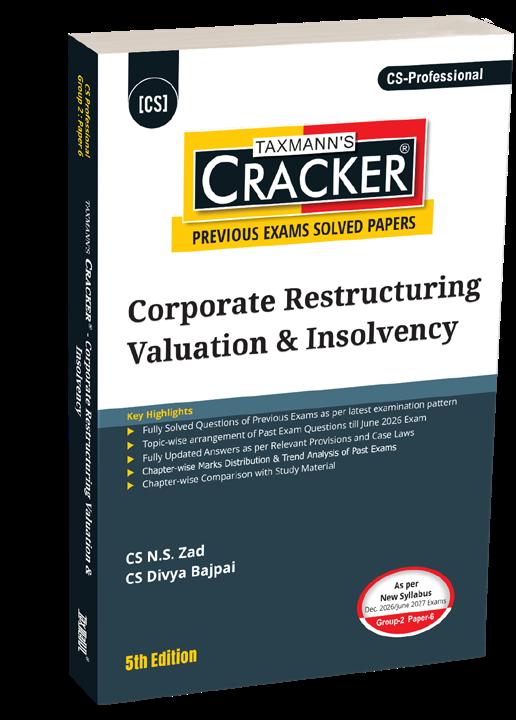
Corporate Restructuring Valuation & Insolvency (CRVI) | CRACKER
AUTHOR : N.S. Zad, Divya Bajpai
PUBLISHER : Taxmann
DATE OF PUBLICATION : June 2026
EDITION : 5th Edition
ISBN NO : 9789375613404
No. of Pages : 576
BINDING TYPE : Paperback
Rs. 595
DESCRIPTION
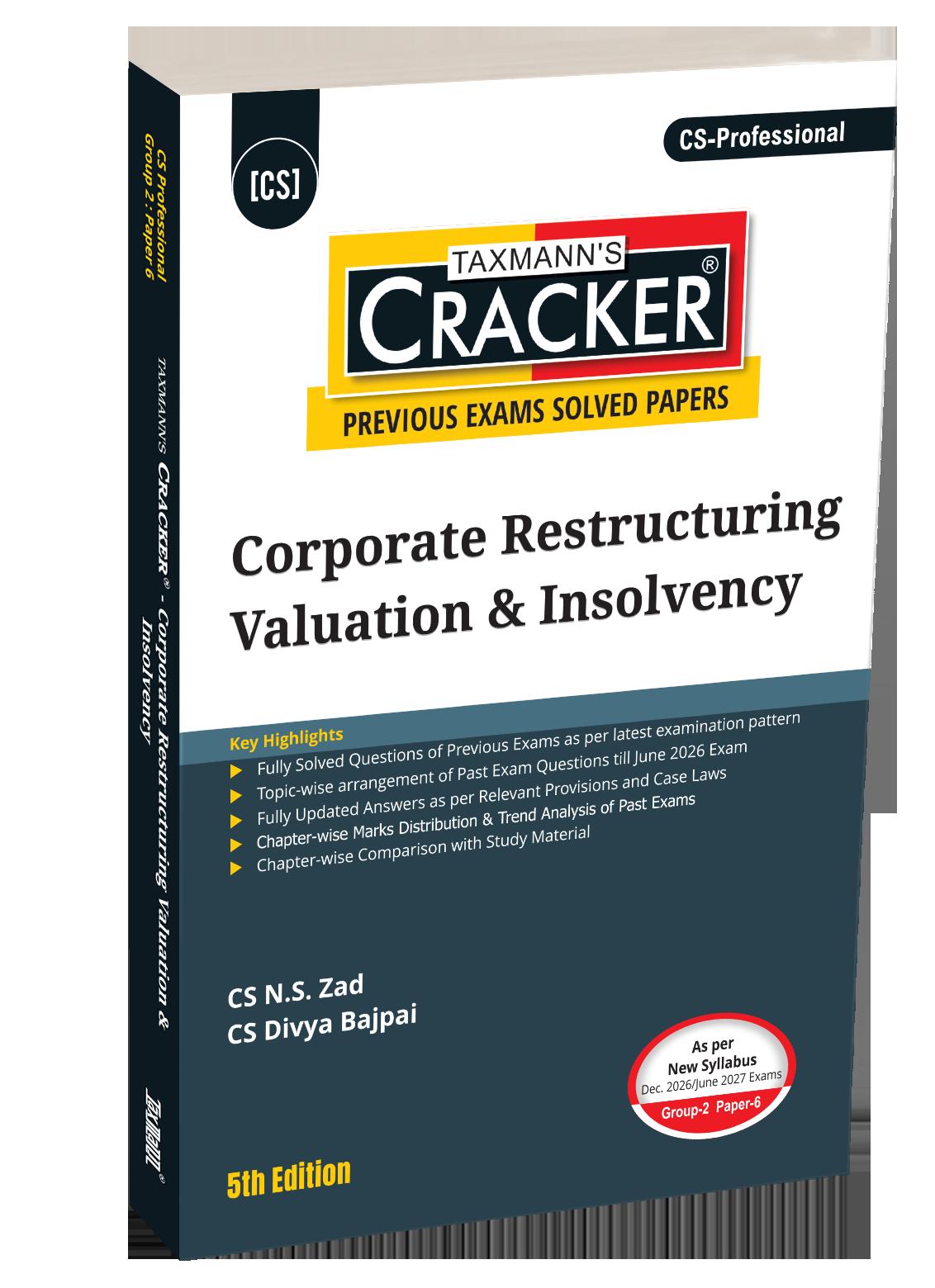
Corporate Restructuring, Valuation & Insolvency – CRACKER s a fully solved, exam-oriented question bank for CS-Professional (Group 2 | Paper 6) under the new ICSI syllabus, built for the final phase of preparation. Rather than re-teaching the subject, it reproduces past questions, arranges them topicwise within each chapter, and answers them in the form the examiner rewards. Its strength is the depth of those answers. Valuation problems are worked step by step (Discounted Cash Flow, Net Asset Value, comparable-company and brand approaches); insolvency answers are anchored to the Insolvency and Bankruptcy Code 2016, IBBI regulations, and the deciding case law; and restructuring answers carry the relevant provisions of the Companies Act 2013, the Competition Act 2002, the SEBI Takeover Regulations, and the Income-tax Act 1961—building recall, answerwriting discipline, and statutory accuracy in a single source.
The Present Publication is the 5th Edition | June 2026, authored by CS N.S. Zad and CS Divya Bajpai, with the following noteworthy features:
• [Fully Solved Questions] Previous-exam questions answered to the latest examination pattern
• [Topic-Wise Arrangement] Past questions folded into the chapter bodies through the December 2025 session, so one concept can be drilled across years in a single place
• [Latest Solved Paper (June 2026)] The June 2026 paper reproduced in full with suggested answers and mapped chapter-wise in the trend analysis
• [Fully Updated Answers] Revised to provisions, amendments, and judicial precedents in force— with section references, leading case law (e.g., S.K. Gupta v. K.P. Jain), and recent regulator circulars (such as the IBBI’s VRIN circular)
• [Worked Solutions & Process Maps] Step-by-step solutions for valuation/computation questions and ready document checklists with stage-wise process maps (e.g., the Stage 1–8 NCLT route for a scheme of amalgamation)
• [Marks Distribution & Trend Analysis] Chapter-wise, June 2022 to June 2026, with each question tagged practical or descriptive
• [Comparison with the ICSI Study Material] Chapter-wise mapping of each chapter to its source module
• [Dedicated Case-Study Chapter] A concluding chapter of integrated case studies for the 20mark application component