PREFACE TO SECOND EDITION
The overwhelmingly positive response to the first edition of this book has been both humbling and deeply encouraging. It reaffirmed our belief that sound corporate governance is no longer a peripheral concern but a defining pillar of sustainable business, ethical leadership, and stakeholder trust. In preparing this second edition, we have updated every chapter to reflect the rapid developments in the field. Recent amendments to the Companies Act, 2013, SEBI (LODR) Regulations, 2015, and related statutory frameworks have been carefully incorporated to maintain conceptual clarity and regulatory accuracy.
It is our hope that this updated edition continues to contribute meaningfully to the study and practice of corporate governance. As the field evolves, we remain committed to refining and expanding future editions to reflect emerging trends and the growing expectations of the academic and corporate community. 15-12-2025 ARUNA JHA ANUJ BHATIA
I-5
TAXMANN®
We are sincerely grateful to our colleagues, reviewers, corporate practitioners, and students whose thoughtful feedback and conversations have enriched this revised edition. We also extend our heartfelt thanks to the academic community and institutions that adopted the first edition and supported its use in classrooms and discussions.
Contents
PAGE
About the Author
I-3
Preface to Second Edition
I-5
Syllabus
I-7
1 INTRODUCTION TO CORPORATE GOVERNANCE Introduction ϐ 1.2-1 ϐ 1.2-2 ϐ 1.3 Ȁ ϐ 1.4 Principles/Four Pillars of Corporate Governance 1.5 Corporate Governance and Management 1.5-1 Where Do Corporate Governance and Management Fit? 1.5-2 Ƭ Management – Symbiotic Relationship Practical Exercise References
1 2 2 2 3 5 6 7 8 9 9 9
2 THEORETICAL FRAMEWORK OF CORPORATE GOVERNANCE 2.1
Introduction
11 I-9
TAXMANN®
1.1 1.2
I-10
CONTENTS
PAGE
2.2
TAXMANN®
2.3
2.4
2.5
2.6
Agency/Shareholder Theory
13
2.2-1
Concept
13
2.2-2
Who is the Principal?
13
2.2-3
Who is the Agent?
13
2.2-4
Key Aspects
13
2.2-5
Some Ways to Reduce Agency Cost
14
2.2-6
Ownership Pattern and Agency Problem
15
2.2-7
Limitations
15
Stewardship Theory
16
2.3-1
Concept
16
2.3-2
Who is a Steward?
16
2.3-3
Key Aspects
16
2.3-4
ϐ
17
2.3-5
Limitations
17
Stakeholder Theory
18
2.4-1
Concept
18
2.4-2
Who is a Stakeholder?
18
2.4-3
Key Aspects
18
2.4-4
ϐ
19
2.4-5
Limitations
20
2.4-6
Comparison between Agency Theory and Stewardship Theory
21
2.4-7
Difference between the Agency/Shareholder and Stakeholder perspective to Corporate Governance
22
Resource Dependency Theory (RDT)
22
2.5-1
Concept
22
2.5-2
What are Resources?
22
2.5-3
Key Aspects
23
2.5-4
ϐ
24
2.5-5
Limitations
24
Managerial Hegemony Theory (MHT)
25
2.6-1
25
Concept
CONTENTS
I-11 PAGE
2.7
2.6-2
What is Hegemony?
25
2.6-3
What is Managerial Hegemony?
25
2.6-4
Key Aspects
25
2.6-5
ϐ
27
2.6-6
Limitations
28
Summary
28
29
Practical Exercise
29
References
30
3 MODELS OF CORPORATE GOVERNANCE Introduction
32
3.2
Anglo-Saxon Model
32
3.3
German Model
34
3.4
Japanese Model
36
3.5
Comparison of Anglo-Saxon, German, and Japanese Models
38
3.6
Indian Model - Modern
40
3.6-1
Introduction
40
3.6-2
Features
41
3.6-3
Key issues in Corporate Governance in India
42
Indian Model – Ancient (Kautilya’s and Corporate Governance)
43
3.7-1
Art of Governance as per Kautilya’s Arthashastra
43
3.7-2
Principles of Good Governance: Dharma, Artha, and Kama
43
3.7-3
Ideal Leadership Model - Rajarshi: The Sage-Like King
44
3.7-4
Theory of Strategic Alliance in Management - The Mandala Theory
45
3.7-5
CSR and Sustainability - Extension of Concept of
45
3.7-6
Whistle blowing and Prevention of Frauds and Errors
46
3.7
46
TAXMANN®
3.1
I-12
CONTENTS
PAGE
Practical Exercises
47
References
47
4 BOARD AND BOARD COMMITTEES : THE EPICENTRE OF GOVERNANCE Introduction
48
4.2
The Board and Directors – Legal Provisions
49
4.3
Board Committees and their Functions
54
4.3-1
Feature of Board Committees
54
4.3-2
Functions of Board Committees
55
4.3-3
Kind of Board Committees
55
4.3-4
Mandatory Board Committees under the Companies Act, 2013
56
4.3-5
Audit Committee - Section 177
56
4.3-6
Nomination and Remuneration Committee - Section 178
57
4.3-7
Stakeholders Relationship Committee - Section 178
58
4.3-8
CSR Committee - Section 135
59
4.3-9
Non-Mandatory Committees
60
TAXMANN®
4.1
60
Practical Exercises
61
5 INSIDER TRADING AND WHISTLE BLOWING: QUIRKY GOVERNANCE 5.1
Introduction
62
5.2
Insider Trading
62
5.2-1
Meaning
62
5.2-2
Legal Position
63
5.2-3
Rationale for Insider Trading Regulations
63
5.2-4
SEBI (Prohibition of Insider Trading) Regulations, 2015
63
CONTENTS
I-13 PAGE
5.3
Whistle Blowing
65
5.3-1
Introduction
65
5.3-2
ϐ
65
5.3-3
Types of Whistle-Blowing
65
5.3-4
Pros and Cons of Whistle-Blowing
67
5.3-5
Advantages of a Good Whistle-Blower Policy to Organization
68
5.3-6
Whistle-Blowing Laws in India
69
72
Practical Exercises
72
References
72
6
6.1
6.2
6.3
Shareholder Activism
73
6.1-1
Introduction
73
6.1-2
ϐ
73
6.1-3
Features
73
6.1-4
Advantages
74
6.1-5
Disadvantages
74
6.1-6
Shareholder Activism in India
75
6.1-7
Important Changes Introduced by the Companies Act, 2013
78
Class Action Suits
78
6.2-1
Introduction
78
6.2-2
ϐ
79
6.2-3
Advantages of Class Action Suits
79
6.2-4
Disadvantages of Class Action Suits
80
6.2-5
Class Action Suits in India
80
Institutional Investors
82
TAXMANN®
SHAREHOLDER ACTIVISM, INSTITUTIONAL INVESTORS AND CLASS ACTION SUITS: NEW PARADIGM OF CORPORATE GOVERNANCE
I-14
CONTENTS
PAGE
6.3-1
Introduction
82
6.3-2
ϐ
82
6.3-3
Are Institutional Investors Relevant?
84
6.3-4
Mechanism of Institutional Investors’ Participation
85
6.3-5
Role of Institutional Investors in Corporate Governance
86
6.3-6
Challenges Faced by Institutional Investors
87
6.3-7
SEBI’s Stewardship Code for Institutional Investors (2019)
88
89
Practical Exercises
90
References
90
TAXMANN®
7 CORPORATE SOCIAL RESPONSIBILITY AND CORPORATE GOVERNANCE 7.1
Introduction
92
7.2
ϐ ȋCSR)
92
7.3
Business Case of CSR
93
7.4
Arguments Against CSR
94
7.5
Trusteeship Model of CSR
94
7.5-1
Trusteeship Model of CSR
94
7.5-2
Philosophical Foundations
94
96
Practical Exercises
96
References
96
8 MAJOR CORPORATE FAILURES IN DEVELOPED WORLD 8.1
The Bank of Credit and Commerce International Scandal ȍ Ȏ
98
8.1-1
Background
98
8.1-2
Description of Crisis
98
CONTENTS
I-15 PAGE
8.2
8.3
8.4
8.6
Major Governance Issues
99
8.1-4
Aftermath
100
Maxwell Communications (UK)
101
8.2-1
Background
101
8.2-2
Description of Crisis
101
8.2-3
Major Governance Issues
102
8.2-4
Aftermath
104
Enron
104
8.3-1
Background
104
8.3-2
Description of the Crisis
105
8.3-3
Major Governance Issues
106
8.3-4
Aftermath
108
Worldcom (US)
108
8.4-1
Background
108
8.4-2
Description of the Crisis
109
8.4-3
Major Governance Issues
110
8.4-4
Aftermath
111
Vivendi (France)
112
8.5-1
Background
112
8.5-2
Description of Crisis
113
8.5-3
Major Governance Issues
114
8.5-4
Aftermath
115
Lehman Brothers
115
8.6-1
Background
115
8.6-2
Description of Crisis
116
8.6-3
Corporate Governance Issues
118
8.6-4
Aftermath
119
120
Practical Exercises
120
References
121
TAXMANN®
8.5
8.1-3
I-16
CONTENTS
PAGE
9 CORPORATE GOVERNANCE CODES AND STANDARDS ACROSS THE GLOBE 9.1
Introduction
122
9.2
Cadbury Report (UK), 1992
122
9.3
The Sarbanes-Oxley Act of 2002 (USA)
124
9.4
G20/OECD Principles of Corporate Governance (2023)
127
9.4-1
127
Evolution of OECD Principles
132
Practical Exercises
133
10 TAXMANN®
CASES OF CORPORATE GOVERNANCE FAILURES IN INDIA 10.1
10.2
10.3
10.4
Satyam Scam
134
10.1-1 Background
134
10.1-2 Description of Crisis
134
10.1-3 Major Governance Issues
136
10.1-4 Aftermath
137
ϐ ȋ Ȍ
138
10.2-1 Background
138
10.2-2 Description of Crisis
138
10.2-3 Major Governance Issues
140
10.2-4 Aftermath
141
Punjab National Bank (PNB) Heist
142
10.3-1 Background
142
10.3-2 Description of Crisis
142
10.3-3 Major Governance Failure
144
10.3-4 Aftermath
145
Ƭ
146
10.4-1 Background
146
10.4-2 Description of Crisis
146
CONTENTS
I-17 PAGE
10.5
10.6
10.7
10.4-3 Major Governance Failure
148
10.4-4 Aftermath
150
ICICI Bank Scam
151
10.5-1 Background
151
10.5-2 Description of Crisis
151
10.5-3 Major Corporate Governance Issues
152
10.5-4 Aftermath
153
154
10.6-1 Background
154
10.6-2 Description of Crisis
155
10.6-3 Major Governance Issues
156
10.6-4 Aftermath
157
Common Governance Problems in Corporate Failures
158 163
Practical Exercises
164
References
164
11 CORPORATE GOVERNANCE REFORMS IN INDIA 11.1
Introduction
166
11.2
Important Provisions of the Companies Act, 2013
167
11.3
SEBI (Listing Obligations and Disclosure Requirements) Regulations
170
11.3-1 Background
170
11.3-2 Applicability
170
11.3-3 Composition and role of the Board of Directors (the Board)
171
11.3-4 The Institution of Independent Directors
174
11.3-5 Monitoring Group Entities
175
11.3-6 Related Party Transactions
176
11.3-7 Disclosures on the Website of a Listed Entity
176
TAXMANN®
I-18
CONTENTS
PAGE
11.4
TAXMANN®
11.5
Board Committees as per ȍ Ȏ Regulations, 2015
177
11.4-1 Comparison of Various Committee under the Companies Act, 2013 and SEBI (LODR) Regulations, 2015
177
Kotak Committee (2017)
181
11.5-1 Board Composition and Roles
182
11.5-2 Independent Directors
182
11.5-3 Constitution and Role of Board Committees
182
11.5-4 Related Party Transactions (RPTs)
183
184
Practical Exercises
185
References - Web Resources
185
Paper: Corporate Governance, B. Com. (Hons.) - May 2025, Sem VI
187
Paper: Corporate Governance, B. Com. - May 2025, Sem VI
189
5 CHAPTER
INSIDER TRADING AND WHISTLE BLOWING: QUIRKY GOVERNANCE
Learning Objectives Examine the concept of Insider Trading and the regulations governing
it. Develop an understanding of the different aspects of whistle-blowing
TAXMANN®
ϐ 5.1 INTRODUCTION Every corporate has a number of stakeholders and some of them have better access to valuable non-public information than others which they can use to their advantage. Examples of two such important instances are - first, when some people trade on the basis of price sensitive non-public information (insider trading) and second, when someone makes public information, especially negative, about corporate conduct and corporate performance (whistle blowing). Macey (2008) has labelled these two along with short selling as quirky governance. 5.2 INSIDER TRADING 5.2-1 Meaning Insider trading is transacting in securities of the company by an insider on the basis of Unpublished Price Sensitive Information (UPSI). ϐ ȋ Ȍ ǡ ʹͲͳͷǣ Insiderǣ Dz dz
to unpublished price sensitive information; Connected personǣ
ǡ ϐ 62
ǣ
63
ϐ Ǣ Dz dzǢ Unpublished Price Sensitive Information (UPSI):
to securities of a company that is not generally available, and, upon being available, is likely to materially affect the price of the company’s securi Ǥ ϐ ǡ ǡ ǡ ϐ managerial personnel. 5.2-2 Legal Position Insider Trading in India is an offence on the basis of non-public price sensitive information according to (Prohibition of Insider Trading) , ʹͲͳͷ.ͳ 5.2-3 Rationale for Insider Trading Regulations Most of the countries in the world prohibit insider trading in some form or the other. Some of the important reasons for doing it are as followsǣ
(ii) ϔ ǣ plained and sudden increase or decrease in prices of the securities. Such ϐ ǯ ϐ company. (iii) Against good corporate governance practicesǣ as it enriches few at the cost of wider stakeholders. Transparency and ϐ Ǥ nance cannot be, therefore, attained. 5.2-4 SEBI (Prohibition of Insider Trading) Regulations, 2015 The Securities and Exchange of India ( ) has notified the (Prohibition of Insider Trading) , ʹͲͳͷ on ͳͷ January, ʹͲͳͷ. These supersede the related to Insider Trading in ͳͻͻʹ by . The new are stricter and have imposed huge penalties for non-compliance and contravention. Some of the important provisions of these areǣ ͳǤ ͳͻͷ ǡ ʹͲͳ͵ ǡ ʹͲͳǤ
TAXMANN®
(i) ϔ : ϐ Ǥ ϐ market information, all the market participants should be able to access information equally. Insider trading results in distortions in capital markets as some participants have superior information than others.
64
(i) ϔ ǣ The major responsibility for monitoring ϐ Ǥ (ii) Prohibition on the exercise of ESOPs: Designated persons have been Ǥ (iii) ǣ ǡ ϐ ǡ ϐ Ǥ
TAXMANN®
(iv)
2ǣ The concept of a trading plan allows insiders to trade in compliance with the regulations without Ǥ Ǯ ǯ by an insider for trades to be executed at a future date. It is particularly suitable for individuals within an organization who may, by way of their position, seniority, or any other reason, be in possession of UPSI at all Ǥ ǡ Ǥ ϐ Ǥ ǡ carried out on behalf of the insider. The time gap for the commencement ͳʹͲ Ǥ ϐ within two trading days of receipt.
(v) ǣ The disclosures made under these regulations shall be maintained by the company for a minimum period of eight years in a structured digital database. In this database, records about the persons who possess UPSI are kept. The data on SDD must be managed with a trusted database software instead of using software such as MS ǡ ǡ ǡ Ǥ (vi)
: Ǧ Ǥ ʹͲͳͻǡ ϐ Ǥ ʹͲʹͳǡ Ǧ trading cases to ` ͳͲ ` ͳ Ǥ
These new have been issued by to ensure a level playing field in the securities market for all the investors and to safeguard their interest as well.
ʹǤ ǣȀȀ Ǥ Ǥ Ȁ Ȁ Ȁ Ǧ Ǧ Ǧ Ǧ Ǧ Ǧ Ǧ Ǧ and-implications
ǣ
65
5.3 WHISTLE BLOWING 5.3-1 Introduction The act of an insider making public acts of corruption, illegal practices, and other forms of unethical behaviour by organisations is common throughout the . For such acts, U.S. civic activist Nader, gave the term whistle blowing in ͳͻͲ’s and such insiders are called whistle-blowers. The scope of the term has become wider over the years. Since ͳͻͻͲ’s, the act of an employee raising these concerns internally outside the normal chain of command are also being termed as whistle blowing. 'H¿QLWLRQ to (2006), “A whistle-blower is a person who exposes any kind of information or activity that is deemed illegal, unethical, or not correct within an organization that is either private or public.”
(i) Ǧ person in a contractual relationship with a company. (ii)
Ȁ internally outside the usual hierarchical line.
(iii)
has an authority to do so.
(iv) Ǥ 5.3-3 Types of Whistle-Blowing blowing can be classified on the basis ofǣ (i) External Whistle-Blowing and Internal Whistle-Blowing (a) If the whistle-blower reports misconduct to a person outside the organization, such as regulatory agency or the media, it is termed as external whistle-blowing. Internal whistle-blowing is a situation when a whistle-blower reports misconduct to another person within the organization but outside the usual line of command.
ǡ legal clerk and environmental advocate who gained recognition ǡ
TAXMANN®
Important features of whistle-blowing, on the basis of above definition, are as followsǣ
66
ǡ ϐ Ƭ ȋ Ƭ ȌǤ hexavalent chromium, a harmful chemical linked to severe health Ǥ ͳͻͻͲ ǡ ǡ Ƭ ǯ Ǥ ̈́͵͵͵ million settlement for the affected residents, one of the largest environmental settlements in U.S. history, and raised awareness Ǥ ǡ ǡ and is an example of an internal whistle blower.
TAXMANN®
(b)
ǯ ϐ Ǧ ǯ Ǥ ǡ the damage to reputation of the entity done by external whistle Ǥ ϐ and penalties imposed by regulatory authorities. To whom it has been reported to by whistle-blower
Disclosure of identity of whistle-blower
External
Open
Internal
Anonymous
Figure: 5.1 Types of Whistle-blowing
(ii) Ǧ Ǧ (a) Ǧ formation, it is said to be open whistle-blowing and if identity is concealed, it is termed as anonymous whistle-blowing. The main advantage with open whistle-blowing is that the security can be Ȁ information.
ǣ
67
(b) In many situations, open whistle blowers have been hugely rewarded in terms of money and, thus, the real motive behind whis Ǧ Ǥ may not be taken seriously by the regulators or the organization and burden of protection of whistle-blower is also not there. 5.3-4 Pros and Cons of Whistle-Blowing Ǧ Ǧ Ǥ others may have to face a backlash or mistrust of others. (i) Pros of Whistle-Blowing
(b) Legal protection: Many people face retaliation when they become Ǧ Ǥ them from adverse consequences. To take an example, in India ǡ ʹͲͳͶ blower who has made a public interest disclosure related to an act of corruption, misuse of power, or criminal offense by a public servant. (c) Reduces risk: illegal or unethical activity is to protect colleagues and other Ǥ Ǧ acts as a safeguard. (d) Ethical responsibility: Ǧ to do so by his sense of right and wrong. For example, Sherron ǡ Ǧ Ǧ Ǧ ʹͲͲͳ Ǥ ϐ Enron’s demise.
TAXMANN®
(a) Financial compensation: ǡ Ǧ Ȁ Ǧ ϐ Ǥ example, whistle-blowers in the US are, generally, entitled to a part Ǥ ǡ Ǧ Ǧ ̈́ͷͲͲ ʹͲͳ͵ǡ ̈́Ͷͺ Ǥ ǡ Ǧ ϐ securities fraud.
68
(ii) Cons of Whistle-blowing
TAXMANN®
(a) Retaliation: Ǧ ǡ Ǥ Ǥ of several top-secret United States mass surveillance programs to ϐ Ǥ ʹͲʹͶǡ Ǧ his company but still they have faced retaliation.͵ (b) ϔ : Many whistle-blowers face an ethical dilemma - whether to protect the short-term interest of colleagues and the organization or to protect the public at large; whether to be disloyal, whether to protect short-term interest of the shareholders Ǥ ǡ ǡ in exposing what was, at the time, the largest case of corporate Ǥ ǡ ǡ Dz Ǥ ǤdzͶ She knew after the exposure; thousands of employees would lose their jobs Ǥ ǡ ǡ would also lose millions in revenue. Despite being sure that she ǡ ϐ to move forward from the scandal even after disclosure, as the fallout affected not just the company, but also her own personal and professional life. 5.3-5 Advantages of a Good Whistle-Blower Policy to Organization The revelation made by the whistle-blower should be handled promptly by the organization. Many large-scale corporate frauds have come to light through internal whistle-blowing. To ensure transparency and continuous trust and support from all the stakeholders, it is imperative for every organization to lay down a clear and comprehensive whistle blowing policy. Some of the advantages ǣ
͵Ǥ ǣȀȀ Ǥ Ǥ Ȁ Ȁ ȀʹͲʹͶǦͳͲǦͲͺȀ Ǧ Ǧ Ǧ ͶǤ ǣȀȀ Ǥ Ǥ Ȁ ȀʹͲͳ͵ȀͳͳȀͳͶǦ Ǧ Ǧ Ǧ Ǧ Ǧ Ǧ -ethics. shtml
Enhanced shareholders’ confidence
ǣ
Exposure of organisation to certain kinds of risks such as malpractices, fraud or corruption reduces.
More effective
69
Protects interest of stakeholders
Prevents legal action against the organisation
Figure 5.2 Advantages of Whistle-Blower Policy
5.3-6 Whistle-Blowing Laws in India Ǧ Ǧ Ǥ ǡ ʹͲͳ͵ ǯ Ǧ Ȁ Ǥ Ǧ lowers ǡ ʹͲͳͶǤ
ǡ ʹͲͳ͵ǡ corporate scandals. It prescribes stricter compliance, vigil and disclo Ǥ ǣ
ͳȋͻȌ ͳȋͳͲȌ ȋ Ȍ ǡ ʹͲͳͶ ǣ (a) Establishment of vigil mechanism Every listed company and the companies belonging to the
following class or classes shall establish a vigil mechanism for their directors and employees to report their genuine concerns or grievances— i. the companies which accept deposits from the public; ii. the companies which have borrowed money from ϐ ϐ
ͳȋͻȌ to establish vigil mechanism for directors and employees to
TAXMANN®
(i) The Companies Act, 2013 and Whistle-Blowing
70
report genuine concerns, in case of a listed company, such mechanism is available to all stakeholders. (b) Overseeing of vigil mechanism
ϐ ǡ themselves and the others on the committee would deal with the matter on hand.
ǡ nominate a director to play the role of audit committee for the purpose of mechanism to whom other directors and employees may represent concerns.
(c) Safeguard against victimisation and direct access Policy against victimisation of employees and directors who
TAXMANN®
avail of the mechanism should be laid.
mittee in exceptional cases.
(d) Disclosure The company must disclose details of the mechanism on its website ǯ Ǥ (e) Safeguard against frivolous complaints
ϐ ǡ take suitable action against concerned director or employee including reprimand.
(f) Ǧ ǣ dent Directors
and functional vigil mechanism. Ensure that interests of a person who uses the mechanisms
are not affected.
ǣ
71
(ii) SEBI and Whistle-Blowing
ȋ Ȍ ǡ ʹͲͳͷ ȋ ȌǤ ǡ the internal reporting mechanisms of companies. The goal is to externalize the reporting process, thereby enhancing the security and anonymity of whistleblowers, which is expected to lead to an increase in reported violations.
ǡ ϐ
encourage whistleblowing.
a reward and will notify the informant or their legal representative ϐ ϐ Ǥ ͳͲΨ ǡ ͳͲ ǡ ϐ time to time.
ͳͶǡ ʹͲͳͶǡ Ǧ ǡ ʹͲͳͶ Ǥ ǣ (aȌ sure (whistle-blowers) related to an act of corruption, misuse of power, or criminal offence by a public servant. (bȌ ȋ Ȍ complaints, assess public disclosure requests, and safeguard complainants. (c) Every complaint must include the identity of the complainant. (dȌ ϐ ϐ ǯ ǡ approval. (eȌ complaints.
Ǧ interests—the need to protect the whistle-blowers against the need to protect public officials from unnecessary harassment.
TAXMANN®
(iii) Whistle-Blowers Protection Act, 2014
72
TEST YOUR KNOWLEDGE
TAXMANN®
ͳǤ ǫ ǫ ʹǤ ǣ (aȌ ȋ Ȍ ǡ ʹͲͳͷǤ (bȌ ǡ ʹͲͳ͵ Ǧ Ǥ ͵Ǥ ǣ (aȌ Ǧ Ǧ Ǥ (bȌ Ǧ Ǧ Ǥ ͶǤ Ǥ ǫ ͷǤ Dz Ǥ Ǥdz blower policy to the organisation and explain the provisions contained ǡ ʹͲͳ͵ policy and protection of whistle blowers. (University of Delhi, 2024) PRACTICAL EXERCISES
ͳǤ Ǥ Ǥ
ʹǤ Ǧ ȋ Ȍǡ ȋ Ȍ proving corporate governance.
͵Ǥ Ǥ strengths and weaknesses and propose improvements to enhance transparency and protection for whistle blowers.
ͶǤ Ǧ of applicable laws in India for a listed company. REFERENCES
ͳǤ ǡ Ǥ Ǥ ȋʹͲͲͺȌǤ Corporate governance: Promises kept, promises broken. Princeton University Press.
ʹǤ ǡ Ǥ ȋʹͲͲȌǤ Whistleblowing and Organizational Social Responsibility: A Global AssessmentǤ Ǥ
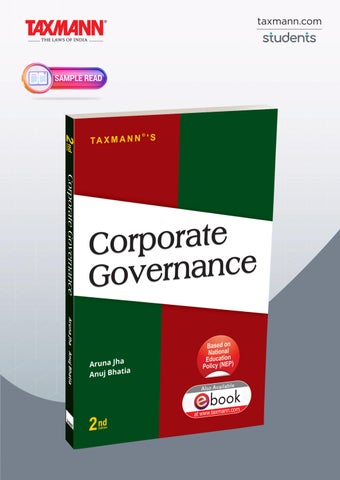
Corporate Governance AUTHOR
:
ARUNA JHA, ANUJ BHATIA
PUBLISHER
:
TAXMANN
DATE OF PUBLICATION
:
DECEMBER 2025
EDITION
:
2ND EDITION
ISBN NO
:
9789375618430
NO. OF PAGES
:
208
BINDING TYPE
:
PAPERBACK
Rs. 295
DESCRIPTION Corporate Governance is a comprehensive, syllabus-aligned textbook that presents governance as an integrated discipline—bringing together theory, law, practice, ethics, and case studies across Indian and global contexts. This Edition has been fully updated to reflect: •
Amendments to the Companies Act 2013
•
Updates to SEBI (Listing Obligations and Disclosure Requirements) Regulations 2015
•
Post-Kotak Committee reforms and the evolving expectations around Board performance, disclosures, and stewardship
The authors emphasise corporate governance as a core pillar of sustainable business, ethical leadership, and stakeholder trust. This book is intended for the following audience: •
B.Com. (Hons.) and B.Com. Students
•
Faculty Members & Academic Institutions
•
Corporate Professionals & Compliance Officers
•
Researchers, Policymakers & CSR/ESG Professionals
The Present Publication is the 2nd Edition, authored by Prof. (Dr) Aruna Jha and Anuj Bhatia, with the following noteworthy features: • • •
[Learning Objectives & Outcomes] Each chapter begins with clearly stated objectives to guide student understanding [Integrated Theory–Law–Practice Approach] Content moves systematically from concepts and models to legal provisions, practical application, case studies, and exam-oriented exercises [Case-embedded Treatment] o Global Failures – BCCI, Maxwell, Enron, WorldCom, Vivendi, Lehman Brothers
o Indian Failures – Satyam, Kingfisher, PNB Heist, IL&FS, ICICI Bank scandal, Yes Bank, plus a synthesis of common governance issues •
[Board-centric Governance Focus] Dedicated chapter on Boards and Board Committees covering directors’ roles, independent directors, board powers, and mandatory committees under the Companies Act
•
[Regulatory Deep-dive] Consolidated treatment of Birla, Naresh Chandra, Narayana Murthy, and Kotak Committees, along with Clause 49, Companies Act 2013, SEBI LODR 2015, and subsequent amendments
•
[Ancient Indian Thought & Ethics] Integrates Kautilya’s Arthashastra, Gandhian Trusteeship, Rajarshi leadership, and Mandala theory to connect traditional Indian philosophies with modern governance
•
[Assessment Support] Includes University exam papers (B.Com. (Hons.) and B.Com., May 2025, Sem VI) mapped to chapters and units
BUY NOW