Store
Contents BORDER SECURITY FORCE ACT, 1968 PAGE
CHAPTER I PRELIMINARY 1. Short title and commencement
1
2. Definitions
1
3. Persons subject to this Act
3
CHAPTER II CONSTITUTION OF THE FORCE AND CONDITIONS OF SERVICE OF THE MEMBERS OF THE FORCE 4. Constitution of the Force
4
5. Control, direction, etc.
4
6. Enrolment
4
7. Liability for service outside India
4
8. Resignation and withdrawal from the post
4
9. Tenure of service under the Act
5
10. Termination of service by Central Government
5
11. Dismissal, removal or reduction by the Director-General and by other officers
5
12. Certificate of termination of service
6
13. Restrictions respecting right to form association, freedom of speech, etc.
6
I-5
CONTENTS
I-6 PAGE
CHAPTER III OFFENCES 14. Offences in relation to the enemy and punishable with death
6
15. Offences in relation to the enemy and not punishable with death
8
16. Offences punishable more severely on active duty than at other times
9
17. Mutiny
11
18. Desertion and aiding desertion
12
19. Absence without leave
13
20. Striking or threatening superior officers
15
21. Disobedience to superior officer
16
22. Insubordination and obstruction
17
23. False answers on enrolment
18
24. Certain forms of disgraceful conduct
18
25. Ill-treating a subordinate
20
26. Intoxication
20
27. Permitting escape of person in custody
20
28. Irregularity in connection with arrest or confinement
21
29. Escape from custody
22
30. Offences in respect of property
22
31. Extortion and corruption
24
32. Making away with equipment
24
33. Injury to property
25
34. False accusations
26
35. Falsifying official documents and false declarations
27
36. Signing in blank and failure to report
28
37. Offences relating to Security Force Court
29
38. False evidence
30
39. Unlawful detention of pay
30
40. Violation of good order and discipline
31
41. Miscellaneous offences
32
42. Attempt
34
43. Abetment of offences that have been committed
34
I-7
CONTENTS PAGE
44. Abetment of offences punishable with death and not committed
35
45. Abetment of offences punishable with imprisonment and not committed
36
46. Civil offences
36
47. Civil offences not triable by a Security Force Court
37
CHAPTER IV PUNISHMENTS 48. Punishments awardable by Security Force Courts
38
49. Alternative punishments awardable by Security Force Courts
40
50. Combination of punishments
41
51. Retention in the Force of a person convicted on active duty
41
52. Punishments otherwise than by Security Force Courts
41
53. Minor punishments
42
54. Limit of punishments under section 53
43
55. Punishment of persons of and below the rank of subordinate officers by Deputy Inspector-General and others
44
56. Collective fines
45 CHAPTER V
ARREST AND PROCEEDINGS BEFORE TRIAL 57. Custody of offenders
45
58. Duty of Commandant in regard to detention
45
59. Interval between committal and trial
46
60. Arrest by civil authorities
46
61. Capture of deserters
46
62. Inquiry into absence without leave
46
63. Force police officers
47 CHAPTER VI
SECURITY FORCE COURTS 64. Kinds of Security Force Courts
47
65. Power to convene a General Security Force Court
47
66. Power to convene a Petty Security Force Court
47
67. Contents of warrants issued under sections 65 and 66
47
CONTENTS
I-8 PAGE
68. Composition of General Security Force Court
48
69. Composition of a Petty Security Force Court
48
70. Summary Security Force Court
48
71. Dissolution of a Security Force Court
48
72. Powers of a General Security Force Court
49
73. Powers of a Petty Security Force Court
49
74. Powers of a Summary Security Force Court
49
75. Prohibition of second trial
49
76. Period of limitation for trial for an offence of desertion in certain cases
50
77. Trial, etc., of offender who ceases to be subject to this Act
50
78. Application of Act during term of sentence
50
79. Place of trial
50
80. Choice between criminal court and Security Force Court
50
81. Power of criminal court to require delivery of offender
50
CHAPTER VII PROCEDURE OF SECURITY FORCE COURTS 82. Presiding Officer
51
83. Law Officer
51
84. Challenges
51
85. Oaths of member, Law Officer and witness
51
86. Voting by members
51
87. General rule as to evidence
52
88. Judicial notice
52
89. Summoning witnesses
52
90. Documents exempted from production
52
91. Commissions for examination of witnesses
53
92. Examination of witness on commission
53
93. Conviction of offence not charged
54
94. Presumption as to signatures
54
95. Enrolment paper
54
96. Presumption as to certain documents
55
97. Reference by accused to Government officer
55
98. Evidence of previous convictions and general character
56
I-9
CONTENTS PAGE
99. Lunacy of accused
56
100. Subsequent fitness of lunatic accused for trial
56
101. Transmission to Central Government of orders under section 100
57
102. Release of lunatic accused
57
103. Delivery of lunatic accused to relatives
57
104. Order for custody and disposal of property pending trial
57
105. Order for disposal of property regarding which offence is committed
58
106. Powers of Security Force Court in relation to proceedings under this Act
58
CHAPTER VIII CONFIRMATION AND REVISION 107. Finding and sentence not valid, unless confirmed
58
108. Power to confirm finding and sentence of General Security Force Court
58
109. Power to confirm finding and sentence of Petty Security Force Court
59
110. Limitation of powers of confirming authority
59
111. Power of confirming authority to mitigate, remit or commute sentences
59
112. Confirming of findings and sentences on board a ship
59
113. Revision of finding or sentence
59
114. Finding and sentence of a Summary Security Force Court
59
115. Transmission of proceedings of Summary Security Force Courts
59
116. Alteration of finding or sentence in certain cases
60
117. Remedy against order, finding or sentence of Security Force Court
60
118. Annulment of proceedings
61
CHAPTER IX EXECUTION OF SENTENCE, PARDONS, REMISSIONS, ETC. 119. Form of sentence of death
61
120. Commencement of sentence of imprisonment
61
121. Execution of sentence of imprisonment
62
CONTENTS
I-10 PAGE
121A. Period of Custody undergone by a person to be set-off against the imprisonment
62
122. Temporary custody of offender
62
123. Execution of sentence of imprisonment in special cases
62
124. Conveyance of prisoner from place to place
62
125. Communication of certain orders to prison officers
63
126. Execution of sentence of fine
63
127. Informality or error in the order or warrant
63
128. Pardon and remission
63
129. Cancellation of conditional pardon, release on parole or remission
63
130. Suspension of sentence of imprisonment
64
131. Orders pending suspension
64
132. Release on suspension
64
133. Computation of period of suspension
64
134. Order after suspension
64
135. Reconsideration of case after suspension
64
136. Fresh sentence after suspension
65
137. Scope of power of suspension
65
138. Effect of suspension and remission on dismissal
65
CHAPTER X MISCELLANEOUS 139. Powers and duties conferable and imposable on members of the Force
65
140. Protection for acts of members of the Force
66
141. Power to make rules
67
142. Provisions as to existing Border Security Force
70
SUBJECT INDEX
73
BORDER SECURITY FORCE RULES, 1969 CHAPTER I PRELIMINARY 1. Short title and application
79
2. Definitions
79
I-11
CONTENTS
PAGE
3. Reports and applications
80
4. Forms in appendices
80
5. Exercise of power vested in holder of an officer in the Force
80
6. Case unprovided for
80 CHAPTER II RECRUITMENT
7. Disqualification
80
8. Ineligibility of aliens
81
9. Appointment of officers
81
10. Probation
81
11. Appointment of subordinate officers and under-officers
82
11A. Commissions
82
12. Enrolling Officers
82
13. Procedure for enrolment, mode of enrolment and other matters connected therewith
82
CHAPTER III ORGANISATION 14. Constitution of the Force
83
14A. Ranks
83
15. The task of the Force and command and control thereto
85
16. Command
86 CHAPTER IV TERMINATION OF SERVICE
17. Termination of service on grounds of furnishing false or incorrect information at the time of appointment or enrolment
88
17A. Discharge from the service on ground of unsatisfactory progress in basic training
88
18. Retirement on grounds of physical unfitness
89
19. Resignation
89
20. Termination of service of officers by the Central Government on account of misconduct
90
21. Termination of service of officers by the Central Government on grounds other than misconduct
92
CONTENTS
I-12 PAGE
22. Dismissal or removal of person other than officer on account of misconduct
93
23. Dismissal or removal by Central Government
94
23A. Termination of service on conviction on a criminal charge
94
24. Retirement of subordinate officers and enrolled persons
94
25. Retirement of subordinate officers and enrolled persons on grounds of physical unfitness
94
26. Retirement of enrolled persons on grounds of unsuitability
95
27. Retirement of subordinate officers on grounds of unsuitability
95
28. Powers to be exercised by a superior officer or authority
96
28A. Petition
96
29. Passing of orders relating to absence from duty
96
30. Date of dismissal, removal, resignation, retirement
97
CHAPTER V ARREST AND INVESTIGATION 31. Forms of arrest
97
32. Authority to order arrest
97
33. Arrest how imposed
97
34. Release from arrest during investigation
98
35. Release without prejudice to re-arrest
98
36. Arrest when to be imposed
98
37. Special provision in case of intoxicated person
99
38. Arrest in case of persons whose trial has been ordered
99
39. Delay reports
99
40. Rights of a person under arrest
99
40A.
100 CHAPTER VI CHOICE OF JURISDICTION BETWEEN SECURITY FORCE COURT AND CRIMINAL COURT
41. Trial of cases either by Security Force Court or criminal court
101
42. Cases not to be tried by Security Force Court
101
I-13
CONTENTS
PAGE
CHAPTER VII INVESTIGATION AND SUMMARY DISPOSAL 43. Offence report
102
44. Charge Sheet
102
45. Hearing of the charge against an enrolled person
102
45A. Hearing of charge by an officer specified under section 53 of the Act
103
45B. Hearing of charge against an officer and a subordinate officer
103
46. Attachment to another unit
105
47. Charges not to be dealt with summarily
105
48. Record of evidence
105
48A.
106
49. Abstract of evidence
106
50. Investigation of cases by police
107
51. Disposal of case against an enrolled person by Commandant after record or abstract of evidence
107
51A. Disposal of case against an officer or a subordinate officer after preparation of record of evidence or abstract of evidence
108
52. Application for a court
108 CHAPTER VIII
CHARGES AND MATTERS ANTECEDENT OF TRIAL 53. Charge Sheet
109
54. Charges
109
55. Joint charges
109
56. Validity of charge sheet
110
57. Amendment of the charge by the Security Force Court
110
58. Amendment of charge by convening officer
110
Convening of General and Petty Security Force Court 59. Action by a superior authority on receiving an application for convening a court
111
60. Disqualification of officers for serving on General and Petty Security Force Courts
112
61. Composition of General and Petty Security Force Courts
112
62. Duties of convening officer when convening courts
112
CONTENTS
I-14 PAGE
63. Preparation of defence by the accused
113
64. Summoning of defence witnesses
114
CHAPTER IX PROCEDURE FOR SECURITY FORCE COURTS 65. Assembly and swearing of Court
114
66. Commencement of trial
115
67. Swearing or affirming of members
116
68. Swearing or affirmation of Law Officer and other officers
116
69. Objection to interpreter or shorthand writer
118
70. Objection of Law Officer and prosecutor
118
71. Arraignment
118
72. Plea to jurisdiction
118
73. Objection to the charge
118
74. Plea in bar of trial
119
75. Application for separate trial
120
76. Application for trial on separate charge sheet
120
77. Pleading to the charge
120
78. Acceptance of plea of guilty
120
79. Plea on alternative charge
121
80. Order of trial where plea of guilty and not guilty
121
81. Procedure on a plea of guilty
122
82. Change of plea
122
83. Procedure on plea of not guilty
122
84. Opening address
123
85. Additional witness
123
86. Dropping witnesses
123
87. Withdrawal of witnesses
123
88. Examination of witnesses
123
89. Questioning by the court
124
90. Reading over of evidence
124
91. Calling or recalling witnesses by the Court
124
92. Submission of no case to answer and stopping of cases
125
93. Case for the defence
125
94. Witnesses for defence
126
I-15
CONTENTS PAGE
95. Witnesses in reply
126
96. Closing addresses
126
97. Summing up by Law Officer
126
98. Deliberation on finding
126
99. Record and announcement of finding
127
100. Procedure on acquittal
128
101. Procedure on conviction
128
102. Sentence
128
103. Recommendation for mercy
128
104. Announcement of sentence and signing and transmission of proceedings
128
105. Revision
129
106. Confirmation and promulgation
129
CHAPTER X PROCEDURE OF SECURITY FORCE COURTS AND INCIDENTAL MATTERS 107. Seating of members
130
108. Responsibility of Presiding Officer
130
109. Power of Court over address of prosecutor and accused
131
110. Sitting in closed Court
131
111. Continuity of trial and adjournment of court
131
112. Suspension of trial
132
113. Proceedings on death or illness of accused
132
114. Death, retirement or absence of Presiding Officer
132
115. Presence throughout of all members of Court
132
116. Taking of opinions of members of Court
132
117. Procedure on incidental questions
132
118. Evidence when to be translated
133
119. Record in proceedings of transactions of a Security Force Court
133
120. Custody and inspection of proceedings
133
121. Review of General/Petty Security Force Court proceedings
134
122. Defending Officer, friend of accused and counsel
134
123. Requirements for appearance of counsel
134
124. Disqualification of Law Officer
135
CONTENTS
I-16 PAGE
125. Substitution on death, illness or absence of Law Officer
135
126. Power and duties of Law Officer
135
127. Finding of insanity
135
128. Preservation of proceedings
135
129. Right of person tried to copies of proceedings
136
130. Copy of proceedings not to be given in certain cases
136
131. Loss of proceedings
136
132. Offences by witnesses and others
137
CHAPTER XI SUMMARY SECURITY FORCE COURT 133. Proceedings
137
134. Evidence when to be translated
137
135. Assembly
138
136. Swearing or affirming of Court and interpreter
138
137. Swearing of court to try several accused persons
138
138. Arraignment of accused
139
139. Objection by accused to charge
139
140. Amendment of charge
139
141. Special pleas
139
142. General plea of “Guilty” or “Not Guilty”
139
143. Procedure after plea of “Guilty”
140
144. Withdrawal of plea of “Not Guilty”
141
145. Procedure after plea of “Not Guilty”
141
146. Witnesses in reply to defence
141
147. Evidence of witnesses
141
148. Verdict
141
149. Finding
141
150. Procedure on acquittal
142
151. Procedure on finding of “Guilty”
142
152. Sentence
142
153. Signing of proceedings
142
154. Charges in different charge sheets
142
155. Clearing the Court
142
I-17
CONTENTS PAGE
156. Adjournment
142
157. Friend of the accused
143
158. Memorandum to be attached to proceedings
143
159. Promulgation
143
160. Review of proceedings
143
161. Action by the Deputy Inspector General
143
CHAPTER XII EXECUTION OF SENTENCE 162. Direction about sentence of imprisonment
144
163. Warrants
144
164. Warrant in case of sentences of death
144
165. Changes in sentence
144
166. Sentence of dismissal
144 CHAPTER XIII PETITIONS
167. Petitions against finding and sentence of Court
145
168. Period of limitation
145
169. Mode of submitting petitions
145
CHAPTER XIV COURT OF INQUIRY 170. Composition
145
171. Assembly
146
172. Assembly order
146
173. Procedure of courts of inquiry
146
174. Court of inquiry when to be held
146
175. Action on the proceedings of a court of inquiry
147
176. Copies of court of inquiry proceedings
147
CHAPTER XIV-A DISPLEASURE AND WARNING 176A. Displeasure and warning
147
CONTENTS
I-18 PAGE
CHAPTER XV MISCELLANEOUS 177. Prescribed officer under section 11(2)
148
178. Authority prescribed for the purposes of section 13(1)
148
179. Extent of punishment
148
180. Manner of proceedings against a person under section 55(1)
149
181. Repeal and savings
149 CHAPTER XVI
TRANSITORY PROVISIONS 182. Transitory Provisions
149
APPENDIX I: Border Security Force Recruiting Form
149
APPENDIX II: Form of Delay Report
154
APPENDIX III
154
APPENDIX IV: Form for use at Summary proceedings of under-officers and other enrolled persons under section 53 of the Border Security Force Act
155
APPENDIX V: Form of Application for a Security Force Court
155
APPENDIX VI: Charge Sheet
156
APPENDIX VII: Forms as to Security Force Court
157
APPENDIX VIII
158
APPENDIX IX
158
APPENDIX X: Warrants under sections 121 and 125 of the Border Security Force Act, 1968
158
APPENDIX XI: Warrant committing to civil prison custody a person sentenced to death
161
APPENDIX XII: Warrant for use when the sentence of a person under sentence of death and committed to custody in a civil prison is commuted to a sentence of imprisonment for life
163
APPENDIX XIII: Report on unnatural death
165
APPENDIX XIV: Form for use at summary trials of or below the rank of subordinate officers
167
I-19
CONTENTS PAGE
CRIMINAL COURTS AND BORDER SECURITY FORCE COURTS (ADJUSTMENT OF JURISDICTION) RULES, 1969 1. Short title
169
2. Definitions
169
3. Trial of person subject to the Act
169
4. Notice by Magistrate
170
5. Procedure on notice to the Magistrate
170
6. Procedure on notice to Magistrate before commencement of trial
170
7. Intimation regarding trial of accused
171
8. Reference to Central Government for determination of court of trial
171
9. Delivery of accused to the Magistrate
171
BORDER SECURITY FORCE LEAVE RULES, 1971 1. Short title and commencement
172
2. Application of the Central Civil Service (Leave) Rules, 1972, to Border Security Force
172
3. Special earned leave in certain cases
172
4. Calculation of earned leave
173
SCHEDULE
173
BORDER SECURITY FORCE (DEDUCTIONS FROM PAY AND ALLOWANCES) RULES, 1978 1. Short title, application and commencement
176
2. Definitions
176
3. Deductions from pay and allowances of officers
176
4. Deductions from the pay and allowances of persons other than officer
177
5. Computation of time of absence or imprisonment for the purpose of clause (a) of rule 4
178
6. Limit of certain deductions
178
7. Deductions from public money due to person
178
I-20
CONTENTS
PAGE
8. Pay and Allowances of Prisoner of War during the inquiry into his conduct
178
9. Provision for dependents of prisoner of war from remitted deductions
178
10. Provision for dependents of prisoner of war from his pay and allowances
178
11.
178
12. Authority competent to order deductions
178
13. Remission of deductions
179
14. Powers to be exercised by a superior officer or authority
179
15. Transitory provisions
179
BORDER SECURITY FORCE (CEREMONIALS AND MARKS OF RESPECT) RULES, 1989 CHAPTER I 1. Short title and commencement
180
2. Definitions
180 CHAPTER II
NATIONAL ANTHEM AND NATIONAL SALUTE AND GENERAL SALUTE 3. National Anthem
180
4. National Salute
181
5. General salute
181
6. Courtesy call on Governors
181
7. Courtesy call by Inspectors General/Deputy Inspectors General or the Chief Minister of the State
181
CHAPTER III GUARD OF HONOUR 8. General
181
9. Time of guard mounting
181
10. Composition and Strength
182
11. Band/Pipes
182
12. Entitlement and Occasions
182
13. Layout of Guards of Honour
182
I-21
CONTENTS PAGE
14. Position of officer for the Border Security Force Guard
182
15. Position of Officers for Inter Force Guard
183
16. Position of band
183
17. Saluting dais and flags
183
18. Position of Orderly Officers
183
19. Position of Conducting Officers
183
20. Procedure for flying flag
183
21. Salutes
184
22. Inspection
184
23. Marching off the guard
185
24. Reduction in strength
185 CHAPTER IV
CEREMONIAL GUARDS 25. Forms of guard
185
26. Selection of form of guard
185
27. Ceremonial Guards
185
28. Time for mounting ceremonial guard
185
29. Dress for Ceremonial Guard
186
30. Procedure for fall in of guard
186
CHAPTER V 31. Object of ceremonial parades
186
32. Rehearsal
186
33. Procedure
186
34. Review and Inspections
186
35. Arrival time of officers senior to parade commander
186
36. Saluting at the time of National Salute
187
37. Band Tunes
187
38. Forms of parade
187
39. Formation for inspection
187
40. Points for special attention
187
41. Special arrangements when the inspection is on foot
187
42. Participation by other Government Forces
188
CONTENTS
I-22 PAGE
43. General arrangements
188
44. Arrangements before the ceremony
188
45. Arrangement for the ceremony
188
46. Arrangements for dispersal
189
47. Cordoning of route
189
48. Arrangements for spectators
189
49. Programmes
189
50. Arrangement
189
51. Ceremonial “TEEN JAI”
189
52. Words of command and drill procedure
190
CHAPTER VI 53. Commemoration parade
190
54. Procedure
190 CHAPTER VII
55. BSF funerals
191
56. BSF funerals in case of recruits, boys, non-combatant personnel
191
57. Escorts
191
58. Transport
192
59. Border Security Force funeral to retired Force personnel
192
60. Detailed procedure
192 CHAPTER VIII ATTESTATION PARADE
61. General
192
62. Address by officer taking salute
193
63. Departure of religious teachers
193
64. Conclusion
193 CHAPTER IX HONOURS AND SALUTE
65. General instructions
193
66. Salute and National Anthem
194
I-23
CONTENTS PAGE
67. Compliments to officers in service of any other country
194
68. Two minutes’ silence-commemoration of particular day/event
194
69. Salute to funeral
194
70. Compliment by armed parties while marching
194
71. Returning of salute by officer commanding
194
72. Salute by Officers while on duty, parade and boarding a ship
194
73. Saluting by subordinate officers and other ranks
195
74. Salutation by civilian VIPs
195
CHAPTER X FLYING OF FLAG 75. National Flag
196
76. Border Security Force Flags
196
77. Flags for motor vehicles (Car/Jeeps)
196
78. The officers shall fly their entitled flags as under
196
CHAPTER XI 79. Star Plates
196
80. Star Plate
197
81. Dress of Border Security Force Drivers
197
CHAPTER XII GUARDS AND SENTRIES 82. Compliment by guards of the President and entitled VIPs
197
83. Compliments by Guards between Reveille and retreat
197
84. Turn out of guards to armed parties
197
85. Compliments where not entitled
197
86. Salute to general officer
198
87. Honour paid by sentries to the President dignitaries and armed parties/unit
198
88. Compliment to officers of other Forces
198
CHAPTER XIII 89. Guards at residence
198
CONTENTS
I-24 PAGE
CHAPTER XIV 90. Border out post guard at Reveille
199
91. Posting of the sentry at the Border out post first sentry
199
92. On the word of command “Sentry Check” by the right guard commander
199
93. Position of Sentries
199
94. The right guard commander order guard march off
199
95. Arms and ammunition carried by sentries
199
96. Movement on beat by sentries
200
97. Compliments by the sentries
200
98. Ceremonial guard at Border out post
200
99. Guard of honour at Border Out Post for VIP
200
100. Fall-in of guard
200
101. Fall-in of band
200
102. Procedure
201
103. Reporting by guard commander
201
104. Border Out Post at the time of retreat
201
105. Position of guard commander of the other country
201
106. Procedure
201
107. Joint briefing of guards by guard commander of both countries
202
108. Flag
202
109. Reporting by Company/Border Out Post Commander to VIP
202
110. Tasks
202
111. Stand down
202
112. Visit to cook house, stores by VIP
202
113. Departure of VIP
202
APPENDIX A: Guard of honour-composition and strength
203
APPENDIX B: Guard of honour-civilian VIPs
203
APPENDIX C: Guard of honour-military/BSF VIP
204
APPENDIX D: Force/Border Guards
205
APPENDIX E: Layout of Guard of Honour
205
APPENDIX F: Layout of Guard of Honour
206
I-25
CONTENTS PAGE
APPENDIX G: Layout of Guard of Honour
207
APPENDIX H: Ceremonial Guards
208
APPENDIX I: Flag for Motor Vehicle (Car/Jeeps)
209
Border Security Force Act, 1968 [47 OF 1968]1 An Act to provide for the constitution and regulation of an Armed Force of the Union for ensuring the security of the borders of India and for matters connected therewith. BE it enacted by Parliament in the Nineteenth Year of the Republic of India as follows:CHAPTER 1 PRELIMINARY Short title and commencement. 1. (1) This Act may be called the Border Security Force Act, 1968. (2) It shall come into force on such date2 as the Central Government may, by notification in the Official Gazette, appoint. Definitions. 2. (1) In this Act, unless the context otherwise requires,(a) “active duty”, in relation to a person subject to this Act, means any duty as a member of the Force during the period in which such person is attached to, or forms part of, a unit of the Force(i) which is engaged in operations against an enemy, or (ii) which is operating at a picket or engaged on patrol or other guard duty along the borders of India, and includes duty by such person during any period declared by the Central Government by notification in the Official Gazette as a period of active duty with reference to any area in which any person or class of persons subject to this Act may be serving; (b) “battalion” means a unit of the Force constituted as a battalion by the Central Government; 1. Dated 2-9-1968. 2. Enforced with effect from 1-3-1969 by Notification No. S.O. 732, dated 20-2-1969.
1
S. 2
BORDER SECURITY FORCE ACT, 1968
2
(c) “Chief Law Officer” and “Law Officer” mean, respectively, the Chief Law Officer and a Law Officer of the Force appointed by the Central Government; (d) “civil offence” means an offence which is triable by a criminal court; (e) “civil prison” means any jail or place used for the detention of any criminal prisoner under the Prisons Act, 1894 (9 of 1894), or under any other law for the time being in force; (f) “Commandant”, when used in any provision of this Act with reference to any unit of the Force, means the officer whose duty it is under the rules to discharge with respect to that unit, the functions of a Commandant in regard to matters of the description referred to in that provision; (g) “criminal court” means a court of ordinary criminal justice in any part of India; (h) “Deputy Inspector-General” means a Deputy Inspector-General of the Force appointed under section 5; (i) “Director-General” means the Director-General of the Force appointed under section 5; (j) “enemy” includes all armed mutineers, armed rebels, armed rioters, pirates and any person in arms against whom it is the duty of any person subject to this Act to take action; (k) “enrolled person” means an under-officer or other person enrolled under this Act; (l) “Force” means the Border Security Force; (m) “Force custody” means the arrest or confinement of a member of the Force according to rules; (n) “Inspector-General” means the Inspector-General of the Force appointed under section 5; (o) “member of the Force” means an officer, a subordinate officer, an under-officer or other enrolled person; (p) “notification” means a notification published in the Official Gazette; (q) “offence” means any act or omission punishable under this Act and includes a civil offence; (r) “officer” means a person appointed or in pay as an officer of the Force, but does not include a subordinate officer or an under-officer; (s) “prescribed” means prescribed by rules made under this Act; (t) “rule” means a rule made under this Act; (u) “Security Force Court” means a court referred to in section 64; (v) “subordinate officer” means a person appointed or in pay as a Subedar-Major, a Subedar or a Sub-Inspector of the Force; (w) “superior officer”, when used in relation to a person subject to this Act, means,-
3
BORDER SECURITY FORCE ACT, 1968
S. 3
(i) any member of the force to whose command such person is for the time being subject in accordance with the rules; (ii) any officer of higher rank or class or of a higher grade in the same class, and includes when such person is not an officer, a subordinate officer or an under-officer of higher rank, class or grade; (x) “under-officer” means a Head Constable, Naik and Lance Naik of the Force; (y) all words and expressions used and not defined in this Act but defined in the Indian Penal Code (45 of 1860) shall have the meanings assigned to them in that Code. (2) In this Act, references to any law not in force in the State of Jammu and Kashmir shall be construed as references to the corresponding law in force in that State. COMMENTS SECTION NOTES
2.1 “Active Duty” “Active duty”, in relation to a person subject to this Act, means any duty as a member
of the Force during the period in which such person is attached to, or forms part of, a unit of the Force: Clause (i): Engaged in operations against an enemy, or Clause (ii): Operating at a picket or engaged on patrol or other guard duty along
the borders of India. Active Duty includes duty by such person during any period declared by the Central
Government by notification in the Official Gazette as a period of active duty with reference to any area in which any person or class of persons subject to this Act may be serving. 2.2 Definition of “Commandant” [Section 2(f)] The term “Commandant,” when used in any provision of this Act regarding a unit of
the Force, refers to: The officer whose responsibility, according to the rules, is to discharge the functions
of a Commandant with respect to: z Matters described in that provision.
2.3 Definition of “Superior Officer” [Section 2(w)] “Superior officer,” when used in relation to a person subject to this Act, means: [Clause (i)]: Any member of the force under whose command that person is
currently subject, in accordance with the rules. [Clause (ii)]: Any officer of higher rank or class, or of a higher grade within the
same class, and includes, when the person is not an officer, a subordinate officer or an under-officer of higher rank, class or grade.
Persons subject to this Act. 3. (1) The following persons shall be subject to this Act, wherever they may be, namely:—
S. 8
BORDER SECURITY FORCE ACT, 1968
4
(a) Officers and Subordinate Officers; and (b) under-officers and other persons enrolled under this Act. (2) Every person subject to this Act shall remain so subject until retired, discharged, released, removed or dismissed from the Force in accordance with the provisions of this Act and the rules. CHAPTER II CONSTITUTION OF THE FORCE AND CONDITIONS OF SERVICE OF THE MEMBERS OF THE FORCE Constitution of the Force. 4. (1) There shall be an armed force of the Union called the Border Security Force for ensuring the security of the borders of India. (2) Subject to the provisions of this Act, the Force shall be constituted in such manner as may be prescribed and the conditions of service of the members of the Force shall be such as may be prescribed. Control, direction, etc. 5. (1) The general superintendence, direction and control of the Force shall vest in, and be exercised by, the Central Government and subject thereto and to the provisions of this Act and the rules, the command and supervision of the Force shall vest in an officer to be appointed by the Central Government as the Director-General of the Force. (2) The Director-General shall, in the discharge of his duties under this Act, be assisted by such number of Inspectors-General, Deputy Inspectors-General, Commandants and other officers as may be prescribed by the Central Government. Enrolment. 6. (1) The persons to be enrolled to the Force, the mode of enrolment, and the procedure for enrolment shall be such as may be prescribed by the Central Government. (2) Notwithstanding anything contained in this Act and the rules, every person who has, for a continuous period of three months, been in receipt of pay as a person enrolled under this Act and borne on the rolls of the Force shall be deemed to have been duly enrolled. Liability for service outside India. 7. Every member of the Force shall be liable to serve in any part of India as well as outside India. Resignation and withdrawal from the post. 8. No member of the Force shall be at liberty,(a) to resign his appointment during the term of his engagement; or (b) to withdraw himself from all or any of the duties of his appointment, except with the previous permission in writing of the prescribed authority.
5
BORDER SECURITY FORCE ACT, 1968
S. 11
Tenure of service under the Act. 9. Every person subject to this Act shall hold office during the pleasure of the President. Termination of service by Central Government. 10. Subject to the provisions of this Act and the rules, the Central Government may dismiss or remove from the service any person subject to this Act. Dismissal, removal or reduction by the Director-General and by other officers. 11. (1) The Director-General or any Inspector-General may dismiss or remove from the service or reduce to a lower grade or rank or the ranks any person subject to this Act other than an officer. (2) An officer not below the rank of Deputy Inspector-General or any prescribed officer may dismiss or remove from the service any person under his command other than an officer or a subordinate officer of such rank or ranks as may be prescribed. (3) Any such officer as is mentioned in sub-section (2) may reduce to a lower grade or rank or the ranks any person under his command except an officer or a subordinate officer. (4) The exercise of any power under this section shall be subject to the provisions of this Act and rules. COMMENTS CASE LAWS Dismissal without formal inquiry valid if conduct renders retention undesirable
- The respondent, a BSF constable, was dismissed from service after remaining absent without leave from 21st December 1983 to 5th May 1984. Despite being served notices to rejoin duty, he neither responded nor returned. A show cause notice was then issued stating that his continued retention in service was undesirable, and dismissal was proposed. The respondent failed to reply. Later, he filed a suit claiming the dismissal was void for lack of an inquiry under BSF Act provisions. The Supreme Court held that under section 11(2), read with Rule 177 of the BSF Rules, the Commandant was the prescribed authority to dismiss any person under his command, other than officers and subordinate officers. It further clarified that after the introduction of Rule 20, a show cause notice must be issued and an inquiry is necessary only if demanded. Since the respondent did not deny the charges or request an inquiry, and the show cause procedure was properly followed, the dismissal was valid. Treating the period of absence as extraordinary leave did not invalidate the dismissal, which was based on undesirability of retention, not as punishment for misconduct. - Union of India and Others v. Ram Pal AIR 1996 SUPREME COURT 1500. Independent power of commandant to dismiss without Security Force Court Trial
- The appellant, a constable in the BSF, was dismissed from service by the Commandant after overstaying his leave without sufficient cause. The dismissal was challenged on the ground that no Security Force Court had tried him under section 19 of the Act for the alleged misconduct, and therefore, the Commandant lacked authority to impose such punishment. The Supreme Court held that section 11(2) of the BSF Act confers an independent power on the Commandant, as the Prescribed Officer under Rule 177 of the BSF Rules, to dismiss any person under his command (other than an officer or subordinate officer), without requiring a Security Force Court trial. The Court clarified
S. 14
BORDER SECURITY FORCE ACT, 1968
6
that section 11(4), which makes the exercise of such power subject to the Act and Rules, does not limit the authority of the Commandant to cases where a Security Force Court has awarded punishment. Since the delinquent had been given an opportunity to explain but failed to respond, the dismissal did not violate natural justice. The appeal was dismissed. - Sri Gouranga Chakraborty v. State of Tripura and Another AIR 1989 SUPREME COURT 1321.
Certificate of termination of service. 12. A subordinate officer, or an under-officer or other enrolled person who is retired, discharged, released, removed or dismissed from the service shall be furnished by the officer, to whose command he is subject, with a certificate in the language which is the mother tongue of such person and also in Hindi or English language setting forth(a) the authority terminating his service; (b) the cause for such termination; and (c) the full period of his service in the Force. Restrictions respecting right to form association, freedom of speech, etc. 13. (1) No person subject to this Act shall, without the previous sanction in writing of the Central Government or of the prescribed authority,— (a) be a member of, or be associated in any way with, any trade union, labour union, political association or with any class of trade unions, labour unions or political associations; or (b) be a member of, or be associated in any way with, any society, institution, association or organisation that is not recognised as part of the Force or is not of a purely social, recreational or religious nature; or (c) communicate with the press or publish or cause to be published any book, letter or other document except where such communication or publication is in the bona fide discharge of his duties or is of a purely literary, artistic or scientific character or is of a prescribed nature. Explanation.— (1) If any question arises as to whether any society, institution, association or organisation is of a purely social, recreational or religious nature under clause (b) of this sub-section, the decision of the Central Government thereon shall be final. (2) No person subject to this Act shall participate in, or address, any meeting or take part in any demonstration organised by any body of persons for any political purposes or for such other purposes as may be prescribed. CHAPTER III OFFENCES Offences in relation to the enemy and punishable with death. 14. Any person subject to this Act who commits any of the following offences, that is to say,-
7
BORDER SECURITY FORCE ACT, 1968
S. 14
(a) shamefully abandons or delivers up any post, place or guard, committed to his charge or which it is his duty to defend; or (b) intentionally uses any means to compel or induce any person subject to this Act or to military, naval or air force law to abstain from acting against the enemy or to discourage such person from acting against the enemy; or (c) in the presence of the enemy, shamefully casts away his arms, ammunition, tools or equipment or misbehaves in such manner as to show cowardice; or (d) treacherously holds correspondence with, or communicates intelligence to, the enemy or any person in arms against the Union; or (e) directly or indirectly assists the enemy with money, arms, ammunition, stores or supplies or in any other manner whatsoever; or (f) in time of active operation against the enemy, intentionally occasions a false alarm in action, camp quarters, or spreads or causes to be spread reports calculated to create alarm or despondency; or (g) in time of action leaves his Commandant or other superior officer or his post, guard, picket, patrol or party without being regularly relieved or without leave; or (h) having been captured by the enemy or made a prisoner of war, voluntarily serves with or aids the enemy; or (i) knowingly harbours or protects an enemy not being a prisoner; or (j) being a sentry in time of active operation against the enemy or alarm, sleeps upon his post or is intoxicated; or (k) knowingly does any act calculated to imperil the success of the Force or the military, naval or air force of India or any forces co-operating therewith or any part of such forces, shall, on conviction by a Security Force Court, be liable to suffer death or such less punishment as is in this Act mentioned. COMMENTS SECTION NOTES
14.1 Offences and punishment Any person subject to this Act who commits any of the following offences shall, upon
conviction by a Security Force Court, be liable to death or a lesser punishment as mentioned in this Act: [Clause (a)]: Abandonment of Post z Shamefully abandons or delivers up any post, place, or guard committed
to their charge or which it is their duty to defend. [Clause (b)]: Compulsion/Inducement to Abstain from Action z Intentionally uses any means to compel or induce any person subject to
this Act or to military, naval, or air force law to abstain from acting against the enemy or to discourage such person from acting against the enemy.
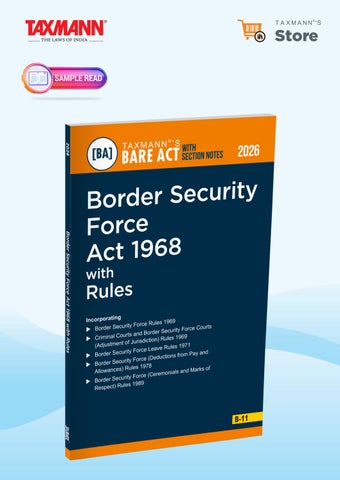
BORDER SECURITY FORCE ACT 1968 WITH RULES – BARE ACT WITH SECTION NOTES AUTHOR PUBLISHER DATE OF PUBLICATION EDITION ISBN NO NO. OF PAGES BINDING TYPE
: : : : : : :
TAXMANN’S EDITORIAL BOARD TAXMANN NOVEMBER 2025 2026 EDITION 9789371261555 236 PAPERBACK
Rs. 295
DESCRIPTION Border Security Force Act 1968 with Rules [Bare Act with Section Notes] by Taxmann is a compact and authoritative reference on the legislation governing the constitution, powers, duties, offences, discipline, and legal framework of the Border Security Force (BSF). This Edition provides the fully updated text of the BSF Act and the Border Security Force Rules 1969, reflecting all amendments to date. Presented as a Bare Act with Section Notes, it offers clear, practical explanations that aid interpretation and application—making it a dependable resource for personnel, practitioners, and administrators engaged in border security law. This book is intended for the following audience: • BSF Officers, Subordinate Officers & Personnel • Legal Practitioners & Defence Lawyers • Administrative & Disciplinary Authorities • Policy Analysts, Researchers & Academicians • Training Institutions The Present Publication is the 2026 Edition, covering the amended and updated text of the Border Security Force Act [Act No. 47 of 1968] and Rules, with the following noteworthy features: • [Complete & Updated Statutory Text] Includes the latest amendments, notifications, and changes • [Pre-amendment Provisions] Footnoted extracts of earlier text to show the legal position prior to amendments • [Section Notes for Clarity] Brief, well-structured notes explaining purpose, scope, and statutory implications • [Covers Both Act & Rules] BSF Act 1968 presented alongside the BSF Rules for seamless understanding • [User-friendly Navigation] Structured headings, tables of contents, numbered paragraphs, and a detailed subject index • [Operational & Procedural Coverage] Enrolment, service conditions, offences, Security Force Courts, custody, trials, appeals, administrative powers • [Appendices for Practical Utility] Guard protocols, ceremonial guidelines, flag usage, and rule-based layouts
BUY NOW