Sample Read
© Taxmann Published by : Taxmann Publications (P.) Ltd. Sales & Marketing : 59/32, New Rohtak Road, New Delhi-110 005 India Phone : +91-11-45562222 Website : www.taxmann.com E-mail : sales@taxmann.com Regd. Office : 21/35, West Punjabi Bagh, New Delhi-110 026 India Printed at : Tan Prints (India) Pvt. Ltd. 44 Km. Mile Stone, National Highway, Rohtak Road Village Rohad, Distt. Jhajjar (Haryana) India E-mail : sales@tanprints.com Disclaimer Every effort has been made to avoid errors or omissions in this publication. In spite of this, errors may creep in. Any mistake, error or discrepancy noted may be brought to our notice which shall be taken care of in the next edition. It is notified that neither the publisher nor the author or seller will be responsible for any damage or loss of action to any one, of any kind, in any manner, therefrom. It is suggested that to avoid any doubt the reader should cross-check all the facts, law and contents of the publication with original Government publication or notifications. No part of this book may be reproduced or copied in any form or by any means [graphic, electronic or mechanical, including photocopying, recording, taping, or information retrieval systems] or reproduced on any disc, tape, perforated media or other information storage device, etc., without the written permission of the publishers. Breach of this condition is liable for legal action. For binding mistake, misprints or for missing pages, etc., the publisher’s liability is limited to replacement within seven days of purchase by similar edition. All expenses in this connection are to be borne by the purchaser. All disputes are subject to Delhi jurisdiction only.
Contents BIOLOGICAL DIVERSITY ACT, 2002 PAGE
CHAPTER I PRELIMINARY 1. Short title, extent and commencement
2
2. Definitions
2 CHAPTER II
REGULATION OF ACCESS TO BIOLOGICAL RESOURCES 3. Certain persons not to undertake Biodiversity related activities without approval of National Biodiversity Authority
7
4. Results of research not to be transferred to certain persons without approval of National Biodiversity Authority
8
5. Certain provisions not to apply to certain collaborative research projects
8
6. Application for intellectual property rights not to be made without approval of National Biodiversity Authority
9
7. Prior intimation to State Biodiversity Board for accessing biological resource for certain purposes
10
CHAPTER III NATIONAL BIODIVERSITY AUTHORITY 8. Establishment of National Biodiversity Authority
11
9. Conditions of service of Chairperson, members and MemberSecretary
13
I-5
CONTENTS
I-6 PAGE
10. Chairperson to be Chief Executive of National Biodiversity Authority 10A. Member-Secretary
13 13
11. Removal of members
13
12. Meetings of National Biodiversity Authority
13
13. Committees of National Biodiversity Authority
14
14. Officers and employees of National Biodiversity Authority
14
15. Authentication of orders and decisions of National Biodiversity Authority
15
16. Delegation of powers
15
17. Expenses of National Biodiversity Authority to be defrayed out of the Consolidated Fund of India
15
CHAPTER IV FUNCTIONS AND POWERS OF THE NATIONAL BIODIVERSITY AUTHORITY 18. Functions and powers of National Biodiversity Authority
15
CHAPTER V APPROVAL BY THE NATIONAL BIODIVERSITY AUTHORITY 19. Approval by National Biodiversity Authority for undertaking certain activities
16
20. Transfer of results of research
17
21. Determination of fair and equitable benefit sharing by National Biodiversity Authority
18
CHAPTER VI STATE BIODIVERSITY BOARD 22. Establishment of State Biodiversity Board
20
23. Functions of State Biodiversity Board
21
24. Power of State Biodiversity Board to restrict certain activities violating the objectives of conservation, etc.
22
25. Provisions of sections 9 to 17 to apply with modifications to State Biodiversity Board
23
I-7
CONTENTS PAGE
CHAPTER VII FINANCE, ACCOUNTS AND AUDIT OF NATIONAL BIODIVERSITY AUTHORITY 26. Grants or loans by the Central Government
23
27. Constitution of National Biodiversity Fund
23
28. Annual report of National Biodiversity Authority
24
29. Budget, accounts and audit
24
30. Annual report to be laid before Parliament
25
CHAPTER VIII FINANCE, ACCOUNTS AND AUDIT OF STATE BIODIVERSITY BOARD 31. Grants of money by State Government to State Bio-diversity Board
25
32. Constitution of State Biodiversity Fund
25
33. Annual report of State Biodiversity Board
26
34. Audit of accounts of State Biodiversity Board
26
35. Annual report of State Biodiversity Board to be laid before State Legislature
26
CHAPTER IX DUTIES OF THE CENTRAL AND THE STATE GOVERNMENTS 36. Central Government to develop national strategies and plans for conservation, promotion and sustainable use of biological diversity
26
36A. Measures to be taken by National Biodiversity Authority
28
36B. State Government to develop strategies and plans for conservation and sustainable use of biological diversity
28
37. Biodiversity heritage sites
28
38. Power of Central Government to notify threatened species
29
39. Power of Central Government to designate repositories
29
40. Provisions of this Act not to apply in certain cases
30
CHAPTER X BIODIVERSITY MANAGEMENT COMMITTEES 41. Constitution of Biodiversity Management Committees
30
CONTENTS
I-8 PAGE
CHAPTER XI LOCAL BIODIVERSITY FUND 42. Grants to Local Biodiversity Fund
32
43. Constitution of Local Biodiversity Fund
32
44. Application of Local Biodiversity Fund
32
45. Annual statement of Biodiversity Management Committees
33
46. Audit of accounts of Biodiversity Management Committees
33
47. Annual report, etc., of the Biodiversity Management Committee to be submitted to District Magistrate
33
CHAPTER XII MISCELLANEOUS 48. National Biodiversity Authority to be bound by the directions given by Central Government
33
49. Power of State Government to give directions
34
50. Settlement of disputes
34
51. Members, officers, etc., of National Biodiversity Authority and State Biodiversity Board deemed to be public servants
35
52. Appeal
35
52A. Appeal to National Green Tribunal
35
53. Execution of determination or order
36
54. Protection of action taken in good faith
36
55. Penalties
37
55A. Adjudication of penalties
38
55B. Power to enter, inspect, survey, etc.
38
56. Penalty for contravention of directions or orders of Central Government, State Government, National Biodiversity Authority and State Biodiversity Boards
39
57. Offences by companies
40
58. [Omitted by the Biological Diversity (Amendment) Act, 2023, w.e.f. 1-4-2024]
41
59. Act to have effect in addition to other Acts
41
59A. Act not to apply to certain persons 60. Power of Central Government to give directions to State Government
41 42
I-9
CONTENTS PAGE
61. Cognizance of offences
42
62. Power of Central Government to make rules
42
63. Power of State Government to make rules
44
64. Power to make regulations
44
65. Power to remove difficulties
45
SUBJECT INDEX
47
BIOLOGICAL DIVERSITY RULES, 2024 1. Short title and commencement
51
2. Definitions
51
3. Manner of selection and appointment of Chairperson
51
4. Term of office of the Chairperson
52
5. Pay and allowances
52
6. Term of office and allowances of non-official Members
52
7. Filling of vacancies of non-official Members
52
8. Removal of the Members
52
9. Member-Secretary
53
10. Meetings of Authority
53
11. General functions of Authority
54
12. Powers and duties of Chairperson
55
13. Procedure for access to biological resources and knowledge associated thereto
56
14. Restricting access to biological resources and knowledge associated with such biological resources
57
15. Procedure for seeking approval for sharing or transferring results of research to persons covered under sub-section (2) of section 3 of the Act
58
16. Procedure for registration and obtaining prior approval from Authority before grant of intellectual property rights
59
17. Revocation of access or approval
61
18. Measures for monitoring and regulating the use in India of biological resource or associated traditional knowledge obtained from any foreign country
61
19. Procedure for obtaining a certificate of origin for cultivated medicinal plants
62
20. Procedure for conducting non-commercial research or research for emergency purposes outside India by Indian researcher or institution
62
CONTENTS
I-10 PAGE
21. Management and utilisation of National Biodiversity Fund
63
22. Appeal for settlement of disputes under section 50 of the Act
63
23. Manner of inquiry by the Adjudicating Officer
64
24. Appeals from Order of Adjudicating Officer
66
25. Factors to be considered while determining quantum of penalty
66
26. Deposition of the penalty amount
66
FIRST SCHEDULE: Application Forms and Fees
67
SECOND SCHEDULE
68
BIOLOGICAL DIVERSITY (ACCESS TO BIOLOGICAL RESOURCES AND KNOWLEDGE ASSOCIATED THERETO AND FAIR AND EQUITABLE SHARING OF BENEFITS) REGULATIONS, 2025 1. Short title and commencement
97
2. Definitions
97
3. Mode of benefit sharing for accessing biological resource including digital sequence information or knowledge associated thereto for research or bio-survey and bio-utilisation under section 3 of the Act
98
4. Mode of benefit sharing for access to biological resource or associated knowledge for commercial utilisation under section 3 of the Act
98
5. Procedure for prior intimation for commercial utilisation by persons covered under section 7 of the Act
99
6. Collection fees
101
7. Mode of benefit sharing for sharing or transferring results of research relating to biological resource or traditional knowledge associated thereto
101
8. Mode of benefit sharing for commercialisation of intellectual property rights by persons covered under section 3 of the Act
102
9. Mode of benefit sharing for commercialisation of intellectual property rights by persons covered under section 7 of the Act
102
10. Deposition of novel microbial strain in the repositories outside India for publication
103
11. Criteria for determination of benefit sharing
103
12. Sharing of benefits among Authority, Board or Council and benefit claimer
104
I-11
CONTENTS PAGE
13. The agreement for approvals
105
14. Reporting compliance with the terms and conditions of approval
106
FORM A: Format of Annual statement to be filed by a person or entity covered under sub-section (2) of section 3 or section 7 of the Act having annual turnover of more than one crore for disclosing the details of biological resource or associated knowledge used or consumed for commercial utilisation
106
FORM B: Model Application format for prior intimation to the Board or Council for access to biological resources, digital sequence information or knowledge associated thereto for commercial utilisation by persons covered under section 7 of the Act
107
FORM C: Approval with or without modifications to the mutually agreed terms and conditions
109
FORM D: Order of Rejection
110
FORM E: Application for giving prior intimation to the National Biodiversity Authority for deposition of microorganism by an Indian researcher in repositories outside India for claim of discovery of novel strain from India for publication
111
FORM F: Fair and equitable benefit sharing options
112
CONVENTION ON BIOLOGICAL DIVERSITY ARTICLE 1: Objectives
115
ARTICLE 2: Use of Terms
116
ARTICLE 3: Principle
117
ARTICLE 4: Jurisdictional Scope
117
ARTICLE 5: Cooperation
117
ARTICLE 6: General Measures for Conservation and Sustainable use
117
ARTICLE 7: Identification and Monitoring
118
ARTICLE 8: In-situ Conservation
118
ARTICLE 9: Ex-situ Conservation
119
ARTICLE 10: Sustainable use of Components of Biological Diversity
120
ARTICLE 11: Incentive Measures
120
ARTICLE 12: Research and Training
120
ARTICLE 13: Public Education and Awareness
121
ARTICLE 14: Impact Assessment and Minimizing Adverse Impacts
121
ARTICLE 15: Access to Genetic Resources
122
CONTENTS
I-12 PAGE
ARTICLE 16: Access to and Transfer of Technology
123
ARTICLE 17: Exchange of Information
123
ARTICLE 18: Technical and Scientific Cooperation
124
ARTICLE 19: Handling of Biotechnology and Distribution of its Benefits
124
ARTICLE 20: Financial Resources
125
ARTICLE 21: Financial Mechanism
126
ARTICLE 22: Relationship with other International Conventions
127
ARTICLE 23: Conference of the Parties
127
ARTICLE 24: Secretariat
128
ARTICLE 25: Subsidiary body on Scientific, Technical and Technological Advice
129
ARTICLE 26: Reports
130
ARTICLE 27: Settlement of Disputes
130
ARTICLE 28: Adoption of Protocols
130
ARTICLE 29: Amendment of the Convention or Protocols
131
ARTICLE 30: Adoption and Amendment of Annexes
131
ARTICLE 31: Right to Vote
132
ARTICLE 32: Relationship between this Convention and its Protocols
132
ARTICLE 33: Signature
133
ARTICLE 34: Ratification, Acceptance or Approval
133
ARTICLE 35: Accession
133
ARTICLE 36: Entry into Force
134
ARTICLE 37: Reservations
134
ARTICLE 38: Withdrawals
134
ARTICLE 39: Financial Interim Arrangements
135
ARTICLE 40: Secretariat Interim Arrangements
135
ARTICLE 41: Depositary
135
ARTICLE 42: Authentic Texts
135
ANNEX I: Identification and Monitoring
136
ANNEX II
136
I-13
CONTENTS PAGE
GUIDELINES FOR INTERNATIONAL COLLABORATION RESEARCH PROJECTS INVOLVING TRANSFER OR EXCHANGE OF BIOLOGICAL RESOURCES OR INFORMATION RELATING THERETO BETWEEN INSTITUTIONS INCLUDING GOVERNMENT SPONSORED INSTITUTIONS AND SUCH INSTITUTIONS IN OTHER COUNTRIES Guidelines for International Collaboration Research Projects Involving
139
Transfer or Exchange of Biological Resources or Information relating thereto between institutions including government sponsored institutions and such institutions in other countries NOTIFICATIONS
142
Biological Diversity Act, 2002 [18 OF 2003]* An Act to provide for conservation of biological diversity, sustainable use of its components and fair and equitable sharing of the benefits arising out of the use of biological resources, knowledge and for matters connected therewith or incidental thereto. WHEREAS India is rich in biological diversity and associated traditional and contemporary knowledge system relating thereto; AND WHEREAS India is a 1[Party] to the United Nations Convention on Biological Diversity signed at Rio de Janeiro on the 5th day of June, 1992; AND WHEREAS the said convention came into force on the 29th December, 1993; AND WHEREAS the said convention reaffirms the sovereign rights of the States over their biological resources; AND WHEREAS the said convention has the main objective of conservation of biological diversity, sustainable use of its components and fair and equitable sharing of the benefits arising out of utilization of genetic resources; [AND WHEREAS India is a Party to the Nagoya Protocol on access to genetic resources and the fair and equitable sharing of benefits arising from their utilisation to the convention on Biological Diversity which was adopted on the 29th October, 2010 in Nagoya, Japan; 2
AND WHEREAS it is considered necessary to provide for conservation, sustainable utilisation, fair and equitable sharing of the benefits arising out of utilisation of biological resources and also to give effect to the said Convention.] BE it enacted by Parliament in the Fifty-third Year of the Republic of India as follows:—
*Dated 5-2-2003. 1. Substituted for “party” by the Biological Diversity (Amendment) Act, 2023, w.e.f. 1-4-2024. 2. Substituted, ibid. Prior to its substitution, the preamble read as under: “AND WHEREAS it is considered necessary to provide for conservation, sustainable utilization and equitable sharing of the benefits arising out of utilization of genetic resources and also to give effect to the said convention;”
1
S. 2
BIOLOGICAL DIVERSITY ACT, 2002
2
CHAPTER I PRELIMINARY Short title, extent and commencement. 1. (1) This Act may be called the Biological Diversity Act, 2002. (2) It extends to the whole of India. (3) It shall come into force on such date† as the Central Government may, by notification in the Official Gazette, appoint: Provided that different dates may be appointed for different provisions of this Act and any reference in any such provision to the commencement of this Act shall be construed as a reference to the coming into force of that provision. Definitions. 2. In this Act, unless the context otherwise requires,— 3
[(a) “access” means collecting, procuring or possessing any biological resource occurring in or obtained from India or traditional knowledge associated thereto, for the purposes of research or bio-survey or commercial utilisation;
(aa) “benefit claimers” means the conservers of biological resources, their by-products, creators or holders of traditional knowledge associated thereto (excluding codified traditional knowledge only for Indians) and information relating to the use of such biological resources, innovations and practices associated with such use and application;]
†S.O. 1146(E), dated 1-10-2003—In exercise of the powers conferred by sub-section (3) of section 1 of the Biological Diversity Act, 2002 (18 of 2003), the Central Government hereby appoints the 1st day of October, 2003 as the date on which the following sections of the said Act shall come into force, namely:— (1) Sections 1 and 2; (2) Sections 8 to 17 (both inclusive); (3) Sections 48, 54, 59, 62, 63, 64 and 65. S.O. 753(E), dated 1-7-2004— In exercise of the powers conferred by sub-section (3) of section 1 of the Biological Diversity Act, 2002 (18 of 2003), the Central Government hereby appoints the 1st day of July, 2004, as the date on which the following sections of the said Act shall come into force, namely:— (1) sections 3 to 7 (both inclusive); (2) sections 18 to 47 (both inclusive); (3) sections 49 to 53 (both inclusive); (4) sections 55 to 58 (both inclusive); (5) sections 60 and 61. 3. Substituted by the Biological Diversity (Amendment) Act, 2023, w.e.f. 1-4-2024. Prior to its substitution, clause (a) read as under: ‘(a) “benefit claimers” means the conservers of biological resources, their by-products, creators and holders of knowledge and information relating to the use of such biological resources, innovations and practices associated with such use and application;’
3
BIOLOGICAL DIVERSITY ACT, 2002
S. 2
(b) “biological diversity” 4[or “biodiversity”] means the variability among living organisms from all sources and the ecological complexes of which they are part and includes diversity within species or between species and of eco-systems; 5
[(c) “biological resources” include plants, animals, micro-organisms or parts of their genetic material and derivatives (excluding value added products), with actual or potential use or value for humanity, but does not include human genetic material;] (d) “bio-survey and bio-utilisation” means survey or collection of species, sub-species, genes, components and extracts of biological resource for any purpose and includes characterisation, inventorisation and bioassay; (e) “Chairperson” means the Chairperson of the National Biodiversity Authority or, as the case may be, of the State Biodiversity Board;
4
[(ea) “codified traditional knowledge” means the knowledge derived from authoritative books specified in the First Schedule to the Drugs and Cosmetics Act, 1940 (23 of 1940);] (f) “commercial utilization” means end user of biological resources for commercial utilization such as drugs, industrial enzymes, food flavours, fragrance, cosmetics, emulsifiers, oleoresins, colours, extracts and genes used for improving crops and livestock through genetic intervention, but does not include conventional breeding or traditional practices in use in any agriculture, horticulture, poultry, dairy farming, animal husbandry or bee keeping;
6
[(fa) “derivative” means a naturally occurring biochemical compound or metabolism of biological resources, even if it does not contain functional units of heredity;] (g) “fair and equitable benefit sharing” means sharing of benefits as determined by the National Biodiversity Authority under section 21;
6
[(ga) “folk variety” means a cultivated variety of plant that was developed, grown and exchanged informally among farmers; (gb) “India” means the territory of India as referred to in Article 1 of the Constitution, its territorial waters, seabed and sub-soil underlying such waters, continental shelf, exclusive economic zone or any other maritime zone as 7[referred] to in the Territorial Waters, Continental Shelf, Exclusive Economic Zone and Other Maritime Zones Act, 1976 (80 of 1976), and the air space above its territory;
4. Inserted by the Biological Diversity (Amendment) Act, 2023, w.e.f. 1-4-2024. 5. Substituted, ibid. Prior to its substitution, clause (c) read as under: ‘(c) “biological resources” means plants, animals and micro-organisms or parts thereof, their genetic material and by-products (excluding value added products) with actual or potential use or value, but does not include human genetic material;’ 6. Inserted, ibid. 7. Corrected by corrigendum, dated 9-8-2023.
S. 2
BIOLOGICAL DIVERSITY ACT, 2002
4
(gc) “landrace” means primitive cultivar that was grown by ancient farmers and their successors;] (h) “local bodies” means Panchayats and Municipalities, by whatever name called, within the meaning of clause (1) of article 243B and clause (1) of article 243Q of the Constitution and in the absence of any Panchayats or Municipalities, institutions of self-government constituted under any other provision of the Constitution or any Central Act or State Act; (i) “member” means a member of the National Biodiversity Authority or a State Biodiversity Board and includes the Chairperson; 7a
[(ia) “Member-Secretary” means the full time Secretary of the National Biodiversity Authority, or of the State Biodiversity Board, as the case may be;] (j) “National Biodiversity Authority” means the National Biodiversity Authority established under section 8; (k) “prescribed” means prescribed by rules made under this Act; (l) “regulations” means regulations made under this Act; (m) “research” means study or systematic investigation of any biological resource or technological application, that uses biological systems, living organisms or derivatives thereof to make or modify products or processes for any use; (n) “State Biodiversity Board” means the State Biodiversity Board established under section 22; (o) “sustainable use” means the use of components of biological diversity in such manner and at such rate that does not lead to the long-term decline of the biological diversity thereby maintaining its potential to meet the needs and aspirations of present and future generations; (p) “value added products” means products which may contain portions or extracts of plants and animals in unrecognizable and physically inseparable form. COMMENTS
SECTION NOTES
2.1 Definition of “Access” [Section 2(a)] Nature of activities included Access involves the collecting, procuring, or possessing of: z Any biological resource occurring in or obtained from India. z Traditional knowledge associated with such biological resources. Specific purposes of access The aforementioned activities must be conducted for the purposes of: z Research.
7a. Inserted by the Biological Diversity (Amendment) Act, 2023, w.e.f. 1-4-2024.
5
BIOLOGICAL DIVERSITY ACT, 2002
S. 2
z Bio-survey. z Commercial utilisation.
2.2 Definition of “Benefit Claimers” [Section 2(aa)] Categories of persons Benefit claimers are individuals or entities who are: z Conservers of biological resources and their by-products. z Creators or holders of traditional knowledge associated with biological
resources. Scope of information and exclusions The definition includes information relating to: z The use of such biological resources. z Innovations and practices associated with such use and application. For Indian citizens, the definition excludes codified traditional knowledge.
2.3 Definition of “Biological Diversity” or “Biodiversity” [Section 2(b)] Variability among living organisms Biological diversity refers to the variability among living organisms from all
sources. It includes the ecological complexes of which these organisms are a part. Inclusion of diversity levels The term specifically includes: z Diversity within species. z Diversity between species. z Diversity of eco-systems.
2.4 Definition of “Biological Resources” [Section 2(c)] Inclusions within biological resources Biological resources include: z Plants, animals, and micro-organisms. z Parts of the genetic material of plants, animals, or micro-organisms. z Derivatives of these organisms, excluding value-added products. Criteria for value and exclusions The resources must possess: z Actual use or value for humanity. z Potential use or value for humanity. Human genetic material is explicitly excluded from this definition.
2.5 Definition of “Bio-survey and Bio-utilisation” [Section 2(d)] Nature of activities Bio-survey and bio-utilisation means the survey or collection of: z Species and sub-species. z Genes, components, and extracts of biological resources.
S. 2
BIOLOGICAL DIVERSITY ACT, 2002
6
Purpose and included processes These activities may be conducted for any purpose. The definition includes the processes of: z Characterisation. z Inventorisation. z Bioassay.
2.6 Definition of “Commercial Utilisation” [Section 2(f)] End uses for commercial purposes Commercial utilisation means the end uses of biological resources for commercial
purposes, such as: z Drugs and industrial enzymes. z Food flavours, fragrance, and cosmetics. z Emulsifiers, oleoresins, and colours. z Extracts and genes used for improving crops and livestock through genetic
intervention. Exclusions from commercial utilisation The definition does not include: z Conventional breeding. z Traditional practices in use in any agriculture, horticulture, poultry, dairy
farming, animal husbandry, or bee keeping. 2.7 Definition of “India” [Section 2(gb)] Territorial and maritime scope India means the territory of India as referred to in Article 1 of the Constitution. It includes: z Territorial waters, the seabed, and the sub-soil underlying such waters. z The continental shelf and the exclusive economic zone. z Any other maritime zone as referred to in the Territorial Waters, Continental
Shelf, Exclusive Economic Zone and Other Maritime Zones Act, 1976. Atmospheric scope The definition includes the air space above the territory of India.
2.8 Definition of “Local Bodies” [Section 2(h)] Constitutional entities Local bodies mean Panchayats and Municipalities, regardless of their specific
names. These are defined within the meaning of clause (1) of article 243B and clause (1)
of article 243Q of the Constitution. Alternative institutions In the absence of Panchayats or Municipalities, local bodies include institutions
of self-government constituted under: z Any other provision of the Constitution. z Any Central Act or State Act.
7
BIOLOGICAL DIVERSITY ACT, 2002
S. 3
2.9 Definition of “Research” [Section 2(m)] Nature of investigation Research means a study or systematic investigation of: z Any biological resource. z Technological applications. Methodology and objective The investigation must use biological systems, living organisms, or derivatives
thereof. The objective is to make or modify products or processes for any use.
2.10 Definition of “Sustainable Use” [Section 2(o)] Manner and rate of use Sustainable use means the use of components of biological diversity in a specific
manner and at a specific rate. Long-term sustainability goals The use must be conducted so that it: z Does not lead to the long-term decline of biological diversity.
z Maintains the potential of biological diversity to meet the needs and aspirations of present and future generations.
CHAPTER II REGULATION OF ACCESS TO BIOLOGICAL 8[RESOURCES] Certain persons not to undertake Biodiversity related activities without approval of National Biodiversity Authority. 3. (1) No person referred to in sub-section (2) shall, without previous approval of the National Biodiversity Authority, obtain any biological resource occurring in India or knowledge associated thereto for research or for commercial utilisation or for bio-survey and bio-utilisation. (2) The persons who shall be required to take the approval of the National Biodiversity Authority under sub-section (1) are the following, namely:— (a) a person who is not a citizen of India; (b) a citizen of India, who is a non-resident as defined in clause (30) of section 2 of the Income-tax Act, 1961 (43 of 1961); (c) a body corporate, association or organisation— (i) not incorporated or registered in India; or 9
[(ii) incorporated or registered in India under any law for the time being in force, which is controlled by a foreigner within the mean-
8. Substituted for “DIVERSITY” by the Biological Diversity (Amendment) Act, 2023, w.e.f. 1-4-2024. 9. Substituted, ibid. Prior to its substitution, sub-clause (ii) read as under: “(ii) incorporated or registered in India under any law for the time being in force which has any non-Indian participation in its share capital or management.”
S. 5
BIOLOGICAL DIVERSITY ACT, 2002
8
ing of clause (27) of section 2 of the Companies Act, 2013 (18 of 2013).] 10 [Results of research not to be transferred to certain persons without approval of National Biodiversity Authority.
4. No person or entity shall share or transfer any result of the research on any biological resource occurring in, or obtained or accessed from, India or traditional knowledge associated thereto, for monetary consideration or otherwise, to a person or body corporate referred to in sub-section (2) of section 3, without the prior written approval of the National Biodiversity Authority, except the codified traditional knowledge which is only for Indians: Provided that the provisions of this section shall not apply if publication of research papers or dissemination of knowledge in any seminar or workshop involving financial benefit is as per the guidelines issued by the Central Government: Provided further that where the results of research are used for further research, then, the registration with the National Biodiversity Authority shall be necessary: Provided also that if the results of research are used for commercial utilisation or for obtaining any intellectual property rights, within or outside India, prior approval of the National Biodiversity Authority shall be required to be taken in accordance with the provisions of this Act.] 11
[Certain provisions] not to apply to certain collaborative research projects.
5. 12[(1) The provisions of section 3 shall not apply to collaborative research projects involving transfer or exchange of biological resource or traditional knowledge associated thereto between institutions, including Government
10. Substituted by the Biological Diversity (Amendment) Act, 2023, w.e.f. 1-4-2024. Prior to its substitution, section 4 read as under: “4. Results of research not to be transferred to certain persons without approval of National Biodiversity Authority.—No person shall, without the previous approval of the National Biodiversity Authority, transfer the results of any research relating to any biological resources occurring in, or obtained from, India for monetary consideration or otherwise to any person who is not a citizen of India or citizen of India who is non-resident as defined in clause (30) of section 2 of the Income-tax Act, 1961 (43 of 1961), or a body corporate or organization which is not registered or incorporated in India or which has any non-Indian participation in its share capital or management. Explanation :— For the purposes of this section, “transfer” does not include publication of research papers or dissemination of knowledge in any seminar or workshop, if such publication is as per the guidelines issued by the Central Government.” 11. Substituted for “Sections 3 and 4”, ibid. 12. Substituted, ibid. Prior to its substitution, sub-section (1) read as under: “(1) The provisions of sections 3 and 4 shall not apply to collaborative research projects involving transfer or exchange of biological resources or information relating thereto between institutions, including Government sponsored institutions of India, and such institutions in other countries, if such collaborative research projects satisfy the conditions specified in sub-section (3).”
9
BIOLOGICAL DIVERSITY ACT, 2002
S. 6
sponsored institutions of India, and such institutions in other countries, if such collaborative research projects satisfy the conditions specified in sub-section (3).] (2) All collaborative research projects, other than those referred to in sub-section (1) which are based on agreements concluded before the commencement of this Act and in force shall, to the extent the provisions of agreement are inconsistent with the provisions of this Act or any guidelines issued under clause (a) of sub-section (3), be void. (3) For the purposes of sub-section (1), collaborative research projects shall— (a) conform to the policy guidelines issued by the Central Government in this behalf; (b) be approved by the Central Government. Application for intellectual property rights not to be made without approval of National Biodiversity Authority. 6. 13[(1) Any person or entity covered under sub-section (2) of section 3 applying for an intellectual property right, by whatever name called, in or outside India, for any invention based on any research or information on a biological resource which is accessed from India, including those deposited in repositories outside India, or traditional knowledge associated thereto, shall obtain prior approval of the National Biodiversity Authority before grant of such intellectual property rights. (1A) Any person covered under section 7 applying for any intellectual property right, by whatever name called, in or outside India, for any invention based on any research or information on a biological resource which is accessed from India, including those deposited in repositories outside India, or traditional knowledge associated thereto, shall register with the National Biodiversity Authority before grant of such intellectual property rights. (1B) Any person covered under section 7 who has obtained intellectual property right, by whatever name called, in or outside India, for any invention based on any research or information on a biological resource which is accessed from India, including those deposited in repositories outside India, or traditional knowledge associated thereto, shall obtain prior approval of the National 14[Biodiversity] Authority at the time of commercialisation.]
13. Substituted by the Biological Diversity (Amendment) Act, 2023, w.e.f. 1-4-2024. Prior to its substitution, sub-section (1) read as under: “(1) No person shall apply for any intellectual property right, by whatever name called, in or outside India for any invention based on any research or information on a biological resource obtained from India without obtaining the previous approval of the National Biodiversity Authority before making such application: Provided that if a person applies for a patent, permission of the National Biodiversity Authority may be obtained after the acceptance of the patent but before the sealing of the patent by the patent authority concerned: Provided further that the National Biodiversity Authority shall dispose of the application for permission made to it within a period of ninety days from the date of receipt thereof.” 14. Corrected by corrigendum, dated 9-8-2023.
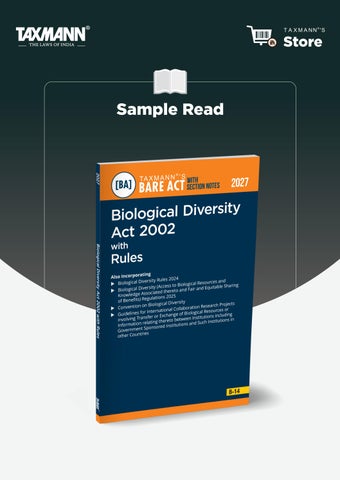
BIOLOGICAL DIVERSITY ACT 2002 WITH RULES – BARE ACT WITH SECTION NOTES AUTHOR : PUBLISHER : DATE OF PUBLICATION : EDITION : ISBN NO : NO. OF PAGES : BINDING TYPE :
Taxmann's Editorial Board Taxmann October 2026 2027 Edition 9789375619871 200 Paperback
Rs. 245 DESCRIPTION Biological Diversity Act 2002 with Rules [Bare Act with Section Notes] by Taxmann is a single-volume working Edition of the Act as amended by the Biological Diversity (Amendment) Act 2023, with its Rules, Regulations and exemption notifications. The statutory text is freely available; this book supplies the apparatus around it—amendment footnotes that keep the earlier wording, Section Notes, High Court case laws, every form under the Rules and Regulations, the Convention on Biological Diversity and a Subject Index. The book solves a practical problem. Anyone working under the Act must consult six sources: • The amended Act • Its earlier wording • The Rules 2024 and their forms • The 2025 benefit-sharing Regulations • The section 40 exemption notifications • The case law This volume prints the first in full, keeps the second in footnotes, reproduces the third and fourth with their forms, prints the fifth and summarises nine High Court rulings. This book is intended for the following audience: • Compliance and Legal Teams in AYUSH, Pharmaceutical, Food, Cosmetics and Seed Companies • Foreign Companies, NRIs and Foreign-Controlled Indian Entities • Patent Attorneys and IP Counsel • Scientists, Universities and Research Institutions • Exporters and Traders of Agricultural, Horticultural and Medicinal Produce • Officials of the National Biodiversity Authority, State Biodiversity Boards, Biodiversity Management Committees and Local Bodies • Advocates, Counsel and Adjudicating Officers • Environmental, ESG and Sustainability Consultants • Law Students, Researchers and Law Libraries The Present Publication is the 2027 Edition, covering the amended text of the Biological Diversity Act 2002 [Act No. 18 of 2003] and the Biological Diversity Rules 2024, with the law stated as updated till 20th September 2026. It has the following noteworthy features: • [Amendment Footnotes – The Core Editorial Feature] Ninety-six footnotes record how the text reached its present form. Thirty-nine reproduce the earlier wording in full, twenty-five name the words replaced, and nine record corrections made by the corrigendum of 9th August 2023 • [Enforcement Settled at the Head of the Act] The date of the Act and both commencement notifications, S.O. 1146(E) of 1st October 2003 and S.O. 753(E) of 1st July 2004, are footnoted at the head of the Act • [Section Notes on Ten Definitions] Ten numbered notes break ten of the twenty-three definitions in section 2 into sub-heads, points and sub-points • [Section Notes on Liability] Five notes under sections 55, 56 and 57 set out who is liable, for what, and the minimum and maximum amounts • [Case Laws Under the Sections They Concern] Nine High Court rulings from 2016 to 2022, summarised under eight sections, each with a bold issue head and its citation • [The Rules 2024, Amended to 2025] Twenty-six rules, the fee schedule and all seventeen forms, with the 2025 amendments on the certificate of origin for cultivated medicinal plants marked • [The 2025 Benefit-Sharing Regulations] Fourteen regulations with Forms A to F, and the turnover-based rates set out as tables • [Two Exemption Notifications Under Section 40] The four hundred and twenty-one entry list of items normally traded as commodities, with its Notes and declaration form, and the 2014 notification on food and forage crops • [The Convention and the 2006 Guidelines] The Convention on Biological Diversity in full and the 2006 Guidelines for International Collaboration Research Projects • [Research Tools] The book includes: o A Contents list with page references for every section, rule, regulation and Article o A Subject Index to the Act, of fifty-two main heads and sixty-nine sub-entries o Running heads with section, rule, regulation and Article references • [Authoritative Bare Act Presentation] The statutory text is reproduced as amended. A boxed COMMENTS device separates it from the editorial matter, so Parliament's words are never confused with the publisher's notes
Buy Now