Nature, Objective and Scope of Audit
1.1 – Meaning and Nature of Auditing
Q.1 Lalji Bhai has purchased shares of a company listed on NSE. The audited financial statements of the company provide picture of healthy financial performance having robust turnover, low debt and good profits. On above basis, he is absolutely satisfied that money invested by him is safe and there is no chance of losing his money. Do audited results and audit reports of companies provide such assurance to investors like Lalji Bhai? Is thinking of Lalji Bhai correct?
Ans.: Objectives of Audit:
An audit does not provide assurance to investor in shares regarding safety of his money. Share prices of securities are affected by range of factors.
An audit only provides reasonable assurance that financial statements are free from material misstatement whether due to fraud or error.
Conclusion: Thinking of Lalji Bhai is not correct.
Q.2 Good deeds L td. is engaged in business of recycling of wastes from dumping grounds of municipal corporation of Indore to usable manure. It is, in this way, also, helping to make the city clean.
During course of audit by Zoha & Zoha, a firm of auditors, it is observed by auditors that company has received a notice from Central Bench of National Green Tribunal for not following certain environmental regulations involving imposition of hefty monetary penalty on the company. The company is yet to reply to the notice. The auditors point out that same is not stated in notes to accounts in financial statements. The company points out that auditors are going beyond scope of their work. Does such a matter fall within scope of audit?
Ans.: Scope of Audit:
An Audit of Financial Statements include within its scope the following:
(1) Coverage of all aspects of entity: Audit of F.S. should be organized adequately to cover all aspects of the entity relevant to the F.S.
(2) Reliability and sufficiency of financial information: Auditor should be reasonably satisfied that information contained in accounting records and other source data (like bills, vouchers, documents etc.) is reliable and provide sufficient basis for preparation of F.S.
(3) Proper disclosure of financial information : Auditor should decide whether relevant information is properly disclosed in F.S in compliance with applicable statutory requirements. For this purpose, auditor is required to study & assess accounting systems and internal controls.
Conclusion: Proper disclosure of financial information is well within scope of audit.
Q.3 A huge fire broke out in NOIDA plant of KT L td. Plant assets comprising building, machinery and inventories were insured from branch of a public sector insurance company. Apart from insurance surveyor who was deputed for assessing loss, regional office of Insurance Co. also appointed a CA for verification of books of account/financial records of the company & circumstances surrounding loss. He was also requested to submit early report. Would report by CA in nature of audit report?
Ans.: Examination of Books of Accounts for a specific purpose:
An Audit is independent examination of Financial Information of any entity, whether profit oriented or not, and irrespective of its size or legal form, when such an examination is conducted with a view to expressing an opinion thereon
Audit is not an official investigation into alleged wrong doing.
In this case, CA was appointed for verification of books of accounts/financial records and circumstances surrounding the loss is for a specific objective to determine genuineness of loss and any issue affecting liability of insurance company.
Conclusion: Work performed by CA is nature of investigation and hence his report will not be in nature of audit report.
Q.4 “Choosing of appropriate accounting policies in relation to accounting issues is responsibility of management”. Do you agree? Discuss duty of auditor, if any, in relation to accounting policies.
Ans.: Selection of Accounting Policies:
Choosing of appropriate accounting policies is responsibility of management. Role of auditor lies in evaluating selection and consistent application of accounting policies by management.
Auditor’s duties in relation to accounting policies includes
(a) to evaluate whether accounting policies selected by management are proper and (b) whether chosen policy has been applied consistently on a period-to-period basis.
Q.5 The person conducting audit should take care to ensure that financial statements would not mislead anybody. Explain stating clearly the meaning of Auditing. [RTP -May 20, MTP-Oct. 21]
Ans.: Meaning of Audit:
An Audit is independent examination of Financial Information of any entity, whether profit oriented or not, and irrespective of its size or legal form, when such an examination is conducted with a view to expressing an opinion thereon.
This definition has the following implications:
(a) Audit is independent examination of financial information.
(b) Requirement of audit applies in case of every entity, whether profit oriented or not (NGO or a Charitable Trust), whatever is business size of entity (Small Size entity or large size entity), whatever is the legal form of the entity (proprietor, partnership, LLP or company).
(c) Purpose of audit is to express an opinion on the F.S. by means of written audit report.
Points to be ensured that F.S. not misled anybody: Refer Answer of Q. No. 17.
Q.6 Both accounting and auditing are closely related with each other. Explain. [RTP-Nov. 20]
Ans.: Relationship between accounting and auditing:
Accounting and auditing are closely related with each other as auditing reviews the financial statements which are nothing but a result of the overall accounting process.
Auditing begins when accounting ends.
It requires that the auditor must have a thorough and sound knowledge of generally accepted principles of accounting before he can review the financial statements.
Q.7 CA N is the auditor of SR Ltd. The auditor expressed his opinion on the financial statements without ascertaining as to whether the financial statements as a whole were free from material misstatements or not. In your opinion, whether CA N has complied with objectives of audit considering the applicability of relevant SA? [May 22 (3 Marks); MTP-April 23; RTP- Nov. 23]
Ans.: Objectives of Auditor:
As per SA-200 “Overall Objectives of the Independent Auditor”, in conducting an audit of financial statements, the overall objectives of the auditor are:
(i) To obtain reasonable assurance about whether the financial statements as a whole are free from material misstatement, whether due to fraud or error, thereby enabling the auditor to express an opinion on whether the financial statements are prepared, in all material respects, in accordance with an applicable financial reporting framework; and
(ii) To report on the financial statements, and communicate as required by the SAs, in accordance with the auditor’s findings.
In the given case of SR Ltd., CA N expressed his opinion on the financial statements of SR Ltd. without obtaining reasonable assurance about whether the financial statements as a whole are free from material misstatement or not. Therefore, it can be concluded that CA N did not comply with the objective of audit as stated in SA 200.
Q.8 An audit is distinct from investigation. However, it is quite possible that sometimes investigation results from the prima facie findings of the auditor. Discuss. [RTP-May 23]
Ans.: Audit vs. Investigation:
Audit is distinct from investigation. Investigation is a critical examination of the accounts with a special purpose. For example, if fraud is suspected and it is specifically called upon to check the accounts whether fraud really exists, it takes character of investigation.
The objective of audit, on the other hand, is to obtain reasonable assurance about whether the financial statements as a whole are free from material misstatement, whether due to fraud or error, thereby enabling the auditor to express an opinion.
Therefore, audit is never started with a pre-conceived notion about state of affairs; about wrongdoing; about some wrong having been committed. The auditor seeks to report what he finds in normal course of examination of accounts.
However, it is quite possible that sometimes investigation results from the prima facie findings of the auditor. It may happen that auditor has given some findings of serious concern. Such findings may prompt for calling an investigation.
Q.9 The auditor should decide whether relevant information is properly disclosed in the financial statements. Explain with reference to scope of audit. [MTP -March 24]
Ans.: Disclosure of Information in the Financial Statements:
The auditor should decide whether relevant information is properly disclosed in the financial statements. He should also keep in mind applicable statutory requirements in this regard.
It is done by ensuring that F.S. properly summarize transactions and events recorded therein and by considering the judgments made by management in preparation of financial statements.
Q.10
The management responsible for preparation and presentation of F.S. makes many judgments in this process of preparing and presenting F.S. For example, choosing of appropriate accounting policies in relation to various accounting issues like choosing method of charging depreciation on fixed assets or choosing appropriate method for valuation of inventories.
The auditor evaluates selection and consistent application of accounting policies by management; whether such a selection is proper and whether chosen policy has been applied consistently on a period-to-period basis.
M Motors Ltd is a leading Indian automobile manufacturer with many offerings across commercial, passenger and electric vehicles. The Company is pioneering India’s electric vehicle transition and enjoys considerable advantage in one of the fastest growing automotive markets.
GR & Associates have been appointed as its statutory auditors for financial year 202 5-26. J and K are newly appointed audit assistants in the firm and are part of engagement team constituted for purpose of audit of M Motors Ltd. However, they are confused about what such an audit tends to achieve. They perceive audit as a guarantee against possible errors or frauds in financial statements. Do you agree with perception of both the assistants? In this context, outline objectives of an independent audit conduc ted in accordance with Standards on Auditing. [RTP - May 24] Or
Micky & Associates, Chartered Accountants, were appointed as the auditors of STI Ltd., a Textile manufacturing company, for the financial year 202 5-26. Management of the company discussed with the newly appointed auditors that the company has been suffering losses for the last few years and also the Directors are suspecting that accounts are not properly maintained and might contain errors and frauds. So, in the given situation, management of the company requested the auditors to give complete assurance/guarantee about the financial statements of the company.
Can the auditors give complete assurance/guarante e in the above situation? Discuss with reference to objectives of Audit. [RTP-Jan. 26]
Ans.: Objectives of an Independent Audit:
In conducting audit of F.S., objectives of auditor in accordance with SA-200 “Overall Objectives of the Independent auditor and the conduct of an audit in accordance with Standards on Auditing” are:
(a) To obtain reasonable assurance about whether the financial statements as a whole are free from material misstatement, whether due to fraud or error, thereby enabling the auditor to express an opinion on whether the financial statements are prepared, in all material respects, in accordance with an applicable financial reporting framework; and
(b) To report on the financial statements, and communicate as required by the SAs, in accordance with the auditor’s findings.
An analysis of above brings out following points clearly:
(1) Auditor’s objective is to obtain a reasonable assurance whether financial statements as a whole are free from material misstatement whether due to fraud or error.
Reasonable assurance is to be distinguished from absolute assurance. Absolute assurance is a complete assurance or a guarantee that financial statements are free from material misstatements. However, reasonable assurance is not a complete guarantee. Although it is a high-level of assurance but it is not complete assurance.
Nature, Objective and Scope of Audit
Audit of F.S. is carried out by the auditor with professional competence and skills in accordance with SAs. Audit procedures are applied in accordance with SAs, audit evidence is obtained and evaluated. On the basis of that, conclusions are drawn and opinion is formed. It leads to high level of assurance which is called as reasonable assurance but it is not absolute assurance.
(2) Misstatements in financial statements can occur due to fraud or error or both. The auditor seeks to obtain reasonable assurance whether financial statements as a whole are free from material misstatements caused by fraud or error. He has to see effect of misstatements on financial statements as a whole, in totality.
(3) Obtaining reasonable assurance that financial statements as a whole are free from material misstatements enables the auditor to express an opinion on whether the financial statements are prepared, in all material respects, in accordance with an applicable financial reporting framework.
(4) The opinion is reported and communicated in accordance with audit findings through a written report as required by Standards on Auditing.
Conclusion: Therefore, perception of both assistants is not proper. Auditor of financial statements does not seek to provide guarantee that financial statements are free from material misstatements caused by frauds or errors. He obtains reasonable assurance.
Q.11 The management of Cool Drinks Limited suspects that some employees of the company may be involved in making fraudulent payments to dummy workers at its various plants in the country. Therefore, they are considering appointment of a firm of auditors to conduct audit involving detailed examination of accounts. However, one senior person among Board members, Mr. P, objects to use of word “audit” in proposed assignment. Comment. Also, discuss how audit is different from investigation. [MTP-July 24]
Ans.: Audit vs. Investigation:
Audit is distinct from investigation. Investigation is a critical examination of the accounts with a special purpose. For example, if fraud is suspected and it is specifically called upon to check the accounts whether fraud really exists, it takes character of investigation. Objective of audit, on the other hand, is to obtain reasonable assurance about whether F.S. as a whole are free from material misstatement, whether due to fraud or error, thereby enabling the auditor to express an opinion.
Scope of audit is general and broad whereas scope of investigation is specific and narrow.
In the given situation, management of company suspects that some of its employees may be involved in making fraudulent payments on account of dummy workers at its different plants in the country. Such an assignment is in the nature of “investigation”.
Conclusion: Mr. P is right in objecting the use of word “audit” in the proposed assignment.
Q.12 PD & Co., Chartered Accountants, were appointed as the statutory 3 auditors of MR Limited for the financial year 2025-26. MR Limited included the following clause in the appointment letter to the auditors: "The Auditor shall be responsible for detecting the frauds that may happen in the company during the financial year 202 5-26."
The auditor objected to inclusion of such a clause in the appointment letter. Discuss in the light of scope of audit. [Sep. 24 (3 Marks)]
Ans.: Scope of Audit in detection of Fraud:
In conducting audit of financial statements objectives of auditor, in accordance with SA 200, “Overall Objectives of the Independent auditor and the conduct of an audit in accordance with Standards on Auditing” is to obtain reasonable assurance about whether the financial statements as a whole are free from material misstatement, whether due to fraud or error, thereby enabling the auditor to express an opinion.
An audit is not an official investigation into alleged wrongdoing. The auditor does not have any specific legal powers of search or recording statements of witness on oath which may be necessary for carrying out an official investigation.
Audit is distinct from investigation. Investigation is a critical examination of the accounts with a special purpose. For example, if fraud is suspected and it is specifically called upon to check the accounts whether fraud really exists, it takes character of investigation.
The scope of audit is general and broad whereas scope of investigation is specific and narrow.
Conclusion: Thus, inclusion of such a clause in the engagement letter is uncalled for and outside the scope of audit.
Q.13 RST Ltd., a mid-sized trading company, recently faced challenges in securing a bank loan due to doubts about the reliability of its financial statements. The management realised the importance of having audited accounts to build confidence among lenders and other stakeholders. Elucidate the benefits and need of an audit. [MTP-Dec. 24]
Or
OPQ Ltd. is a widely held company engaged in manufacturing activities. The management of the company is responsible for preparation of financi al statements. The shareholders of the company are not involved in day-to-day operations.
Recently, during a board meeting, one of the directors questioned the necessity of conducting a statutory audit, stating that it only increases cost and does not add significant value. However, the CFO of the company argued that audit plays a crucial role in enhancing the reliability of financial information and safeguarding stakeholder interests.
In the given context, explain the benefits of audit to various stakeholders. [MTP -April 26]
Ans.: Advantage of Audit of Financial Statement :
(a) Audited accounts provide high quality information. It gives confidence to users that information on which they are relying is qualitative and it is the outcome of an exercise carried out by following Auditing Standards recognized globally.
(b) In case of companies, shareholders may or may not be involved in daily affairs of the company. F.S. are prepared by management consisting of directors. As shareholders are owners of the company, they need an independent mechanism so that financial information is qualitative and reliable. Hence, their interest is safeguarded by an audit.
(c) Audit acts as a moral check on employees from committing frauds for the fear of being discovered by audit.
(d) Audited F.S. are helpful to government authorities for determining tax liabilities.
(e) Audited F.S. can be relied upon by lenders, bankers for making their credit decisions i.e., whether to lend or not to lend to a particular entity.
(f) Audit may also detect fraud or error or both.
(g) Audit reviews existence and operations of various controls operating in any entity. Hence, it is useful at pointing out deficiencies.
Therefore, audit is not merely a statutory requirement but an essential mechanism that enhances credibility of financial statements, protects stakeholder interests, and supports informed decisionmaking.
Q.14 XYZ Ltd., a manufacturing company based in India, operates multiple plants across the country and deals in complex machinery, which requires specialized maintenance and valuation expertise. XYZ Ltd. appointed CA Dhruv as Statutory auditor. During the audit, he observed that the management consistently applied the same method for valuation of inventory over the past few years, but this year, without proper disclosure, they switched to a different valuation method, which resulted in higher reported profits. D oes such a matter fall within scope of audit?
Ans.: Scope of Audit in detection of Fraud:
[RTP-May 25]
The purpose of an audit is to enhance the degree of confidence of intended users in the financial statements. The scope of audit of financial statements includes coverage of all aspects of entity, reliability and sufficiency of financial information and proper disclosure of financial information.
In the given situation, CA. Dhruv observed that the management consistently applied the same method for valuation of inventory over the past few years, but this year, without proper disclosure, they switched to a different valuation method, which resulted in higher profits.
Since proper disclosure of financial information is covered under the scope of audit, thus, the auditor should decide whether relevant information is properly disclosed in the financial statements. He should also keep in mind applicable statutory requirements in this regard.
The management responsible for preparation and presentation of financial statements makes many judgments in this process of preparing and presenting financial statements. For example, choosing appropriate accounting policies in relation to various accounting issues like choosing method of charging depreciation on fixed assets or choosing appropriate method for valuation of inventories.
The auditor evaluates selection and consistent application of accounting policies by management; whether such a selection is proper and whether chosen policy has been applied consistently on a period-to-period basis.
Conclusion: It can be concluded that proper disclosure of financial information is well within scope of audit.
Q.15 You are auditing the financial statements of JEN Ltd., a manufacturing company. During a meeting, Mr. Jai CEO questions the auditor’s ability to detect all material misstatements, including those caused by fraud. He insists that since the auditor is a professional, the audit should provide absolute assurance on the accuracy of the financial statements. Is the contention of Mr. Jai correct. Discuss the objectives of auditor in accordance with relevant SA. [MTP -July 25]
Ans.: Objectives of an Independent auditor:
In conducting audit of financial statements, objectives of auditor in accordance with SA-200 “Overall Objectives of the Independent auditor and the conduct of an audit in accordance with Standards on Auditing” are:
(i) To obtain reasonable assurance about whether the financial statements as a whole are free from material misstatement, whether due to fraud or error, thereby enabling the auditor to express an opinion on whether the financial statements are prepared, in all material respects, in accordance with an applicable financial reporting framework; and
(ii) To report on the financial statements, and communicate as required by the SAs, in accordance with the auditor’s findings.
Audit of financial statements is carried out by the auditor with professional competence and skills in accordance with Standards on Auditing. Audit procedures are applied in accordance with SAs, audit evidence is obtained and evaluated. On basis of that, conclusions are drawn, and opinion is formed. It leads to high level of assurance which is called as reasonable assurance, but it is not absolute assurance.
It may be noted that absolute assurance is a complete assurance or a guarantee that financial statements are free from material misstatements. However, reasonable assurance is not a complete guarantee. Although it is a high-level of assurance, but it is not complete assurance.
Misstatements in financial statements can occur due to fraud or error or both. The auditor seeks to obtain reasonable assurance whether financial statements as a whole are free from material misstatements caused by fraud or error.
In the given case, Mr. Jai, CEO of JEN Ltd., questions the auditor’s ability to detect all material misstatements and insists that auditor should provide absolute assurance. As per SA 200, the auditor’s objective is to obtain reasonable assurance. Therefore, contention of the CEO Mr. Jai is not correct.
Q.16 Mini & Associates, Chartered Accountants, were appointed as the auditor of CIN Ltd., a construction company. During the audit, CA Mini, a Partner of the firm noticed the following:
• The company has several ongoing projects, but only selected project revenues have been reported.
• Several expense vouchers are either missing or are handwritten and lack proper authorisation.
• The company has changed its depreciation method from the straight -line method to the writtendown value method without adequate disclosure in the financial statements. These matters were brought to the attention of management. However, management argued that these issues fall outside the auditor’s scope of responsibility. Whether contention of the management is correct? [RTP-Sep. 25]
Ans.: The following points are included in scope of audit of financial statements:
(1) Coverage of all aspects of entity:
Audit of financial statements should be organised adequately to cover all aspects of the entity relevant to the financial statements being audited.
(2) Reliability and sufficiency of financial information:
The auditor should be reasonably satisfied that information contained in underlying accounting records and other source data (like bills, vouchers, documents etc.) is reliable and sufficient basis for preparation of financial statements.
The auditor makes a judgment of reliability and sufficiency of financial information by making a study and assessment of accounting systems and internal controls and by carrying out appropriate tests, enquiries and procedures.
(3) Proper disclosure of financial information:
The auditor should also decide whether relevant information is properly disclosed in the financial statements. He should also keep in mind applicable statutory requirements in this regard.
It is done by ensuring that financial statements properly summarize transactions and events recorded therein and by considering the judgments made by management in preparation of financial statements.
In view of above, the management’s contention is not correct. The matters identified by CA Mini such as incomplete revenue recognition, missing or unauthorised expense vouchers, and inadequate disclosure of changes in accounting policy are well within the scope of the audit of financial statements, as they impact the reliability, completeness, and proper presentation of financial information.
Q.17 CA students Sriranga and Manga were discussing on the assurance, which the auditing services provide to the users, in the form of opinion on financial statements, by means of a written report. Such an assurance lends credibility to financial statements. You are required to state some of the aspects examined by the auditor, to ensure that the financial statements which are audited are not misleading. [Sep. 25 (4 Marks)]
Ans.: Aspects to be examined to ensure that F.S. which are audited are not misleading:
Aspects to be examined by the auditor to ensure that the financial statements which are audited are not misleading are as under:
(i) the accounts have been drawn up with reference to entries in the books of account.
(ii) the entries in the books of account are adequately supported by sufficient and appropriate evidence.
(iii) none of the entries in the books of account has been omitted in the process of compilation
(iv) the information conveyed by the statements is clear and unambiguous.
(v) the financial statement amounts are properly classified, described and disclosed in conformity with accounting standards; and
(vi) the statement of accounts presents a true and fair picture of the operational results and of the assets and liabilities.
Q.18 RKP & Co., Chartered Accountants, were appointed as the statutory auditors of Orion Engineering Ltd., a company engaged in manufacturing heavy industrial equipment. During the course of audit, certain shareholders raised concerns before the auditors regarding the following matters:
1. They asked the auditor to certify whether the sophisticated imported machinery installed in the factory was in perfect physical condition and to estimate its remaining useful life.
2. Some shareholders also requested the auditor to confirm the genuineness of certain supplier invoices and contracts, alleging that some documents might be forged.
3. A group of investors further demanded that the auditor conduct a detailed investigation into an alleged fraud by a senior employee, including questioning employees and recording statements under oath.
With reference to the above situation, explain the matters which fall outside the scope of an audit. Also distinguish between audit and investigation. [MTP -March 26]
Ans.: Matters that fall outside the scope of an audit:
In the given case, the shareholders of Orion Engineering Ltd. have requested the auditor to perform certain activities which fall outside the normal scope of audit. The scope of audit does not include the following:
1. Matters outside the auditor’s technical competence : An auditor is not expected to perform duties that require specialised technical expertise beyond accounting and auditing knowledge. For instance, determining the physical condition or useful life of sophisticated machinery or assessing the structural suitability of buildings requires technical skills of engineers or other experts. Therefore, the auditor cannot certify such matters.
2. Authentication of documents: An auditor is not an expert in detecting forgery or verifying the genuineness of documents. While the auditor may examine documents as audit evidence, he cannot guarantee their authenticity because he does not possess specialised expertise in forensic document verification.
3. Conducting an official investigation: An audit is not an official investigation into alleged wrongdoing. The auditor does not possess legal powers such as searching premises or recording statements of witnesses on oath, which are generally available to investigative authorities.
4. Audit is distinct from investigation : Investigation involves a critical examination of accounts with a specific purpose, such as determining whether fraud exists. Its scope is specific and narrow.
On the other hand, the objective of audit is to obtain reasonable assurance about whether the financial statements as a whole are free from material misstatement, whether due to fraud or error, thereby enabling the auditor to express an opinion. The scope of audit is general and broad, whereas the scope of investigation is specific and narrow.
Accordingly, in the given case, the auditor of Orion Engineering Ltd. is justified in clarifying that certification of technical condition of machinery, authentication of documents, and conducting a detailed fraud investigation fall outside the normal scope of audit and such matters may require involvement of experts or a separate investigation.
1.2 – Inherent Limitations of Audit
Q.19 Zeeba Products is a partnership firm engaged in trading of designer dresses. The firm has appointed JJ & Co, Chartered accountants to audit their accounts for a year. The auditors were satisfied with control systems of firm, carried out required procedures and necessary verifications. In particular, they carried out sample checking of purchases, traced purchase bills to GST portal and also made confirmations from suppliers. They were satisfied with audit evidence obtained by them as part of audit exercise. An audit report was submitted to the firm giving an opinion that financial statements reflected true and fair view of state of affairs of the firm.
However, later on, it was discovered that purchase manager responsible for procuring dresses from one location was also booking fake purchases of small values by colluding with unethical dealers. Payments to these dealers were also made in connivance with accountant through banking channel.
The partners of firm blame auditors for futile audit exercise. Are partners of firm correct in their view point? Imagine any probable reason for such a situation.
Ans.: Inherent Limitations of an Audit:
An Audit suffers from inherent limitations due to which auditor is not expected to, and cannot, reduce audit risk to zero and cannot therefore obtain absolute assurance that the F.S. are free from material misstatement due to fraud or error.
Circumstances as given in questions is an example of failure of internal controls of the firm. The internal control has not operated due to collusion between employees which is a limitation of internal control itself. The auditor has relied upon internal controls. It is very nature of financial reporting that management is responsible for devising suitable internal controls.
Conclusion: Partners of the firm are not correct. This is an inherent limitation of audit.
AUDITING & ETHICS (AUDITING) | CRACKER
AUTHOR :
PUBLISHER :
DATE OF PUBLICATION :
EDITION :
ISBN NO :
NO. OF PAGES :
BINDING TYPE : Pankaj Garg Taxmann June 2026 18th Edition 9789375618645 736
1,195
DESCRIPTION
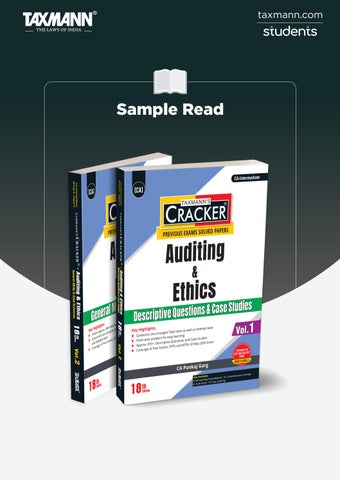
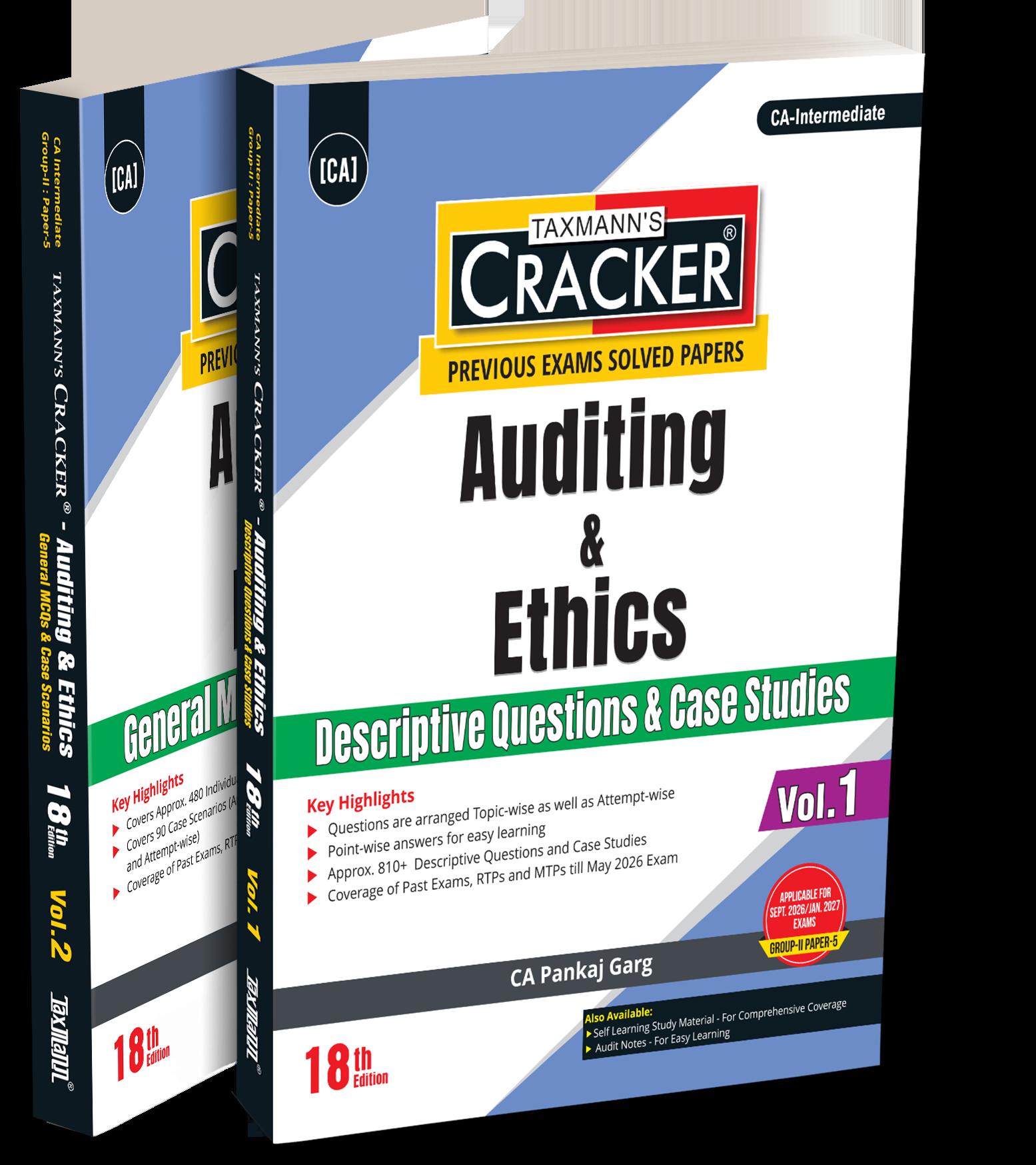
Auditing & Ethics | CRACKER is a dedicated question-bank companion for CA-Intermediate Group II – Paper 5. It converts the complete syllabus into examination-form practice across two volumes: Volume 1 covers the descriptive component (theory questions and case studies), and Volume 2 covers the objective component (individual MCQs and integrated case scenarios), together reproducing the exact descriptive-plus-objective architecture of the 100-mark paper. Every question is answered in the crisp, point-wise manner ICAI rewards, making the book a tool for the revision phase—where the task is no longer learning the subject but reproducing it accurately and at speed.
The Present Publication is the 18th Edition, authored by Pankaj Garg. The noteworthy features of the book are as follows:
•[Dual Arrangement (Topic-wise & Attempt-wise)] Questions are arranged both topic-wise and attempt-wise, so a concept can be drilled in isolation or tracked across past papers for its recurrence and weightage
•[Point-wise Model Answers] Answers are point-wise throughout, mirroring the institute's marking style for quick revision and easy reproduction in the exam hall
•[Marks-distribution Tables] Every chapter opens with a chapter-wise marks-distribution table of recent attempts, letting effort be allocated by examination weightage
•[Source-tagged Questions] Each question carries its source tag—past attempt, RTP or MTP—making the book a verifiable record of what has actually been asked
•[Exam, RTP & MTP Coverage] Covers Past Examinations, RTPs and MTPs up to the May 2026 Exam
•[Latest Solved Paper] The fully solved May 2026 paper is included in both volumes—descriptive answers in Volume 1, MCQs and case scenarios in Volume 2
•[Extensive Question Bank] Approx. 810+ descriptive questions and case studies in Volume 1; approx. 480 individual MCQs and 90 case scenarios in Volume 2
•[Integrated Case Scenarios] Volume 2 case scenarios are full, multi-issue business situations—covering advance classification, drawing-power computation, security and NPA assessment—each followed by linked MCQs, replicating the integrated-case format of the paper