Store
© Taxmann Price : ` 85 Law stated in this book is as updated till 15th November, 2025 Published by : Taxmann Publications (P.) Ltd. Sales & Marketing : 59/32, New Rohtak Road, New Delhi-110 005 India Phone : +91-11-45562222 Website : www.taxmann.com E-mail : sales@taxmann.com Regd. Office : 21/35, West Punjabi Bagh, New Delhi-110 026 India Printed at : Tan Prints (India) Pvt. Ltd. 44 Km. Mile Stone, National Highway, Rohtak Road Village Rohad, Distt. Jhajjar (Haryana) India E-mail : sales@tanprints.com Disclaimer Every effort has been made to avoid errors or omissions in this publication. In spite of this, errors may creep in. Any mistake, error or discrepancy noted may be brought to our notice which shall be taken care of in the next edition. It is notified that neither the publisher nor the author or seller will be responsible for any damage or loss of action to any one, of any kind, in any manner, therefrom. It is suggested that to avoid any doubt the reader should cross-check all the facts, law and contents of the publication with original Government publication or notifications. No part of this book may be reproduced or copied in any form or by any means [graphic, electronic or mechanical, including photocopying, recording, taping, or information retrieval systems] or reproduced on any disc, tape, perforated media or other information storage device, etc., without the written permission of the publishers. Breach of this condition is liable for legal action. For binding mistake, misprints or for missing pages, etc., the publisher’s liability is limited to replacement within seven days of purchase by similar edition. All expenses in this connection are to be borne by the purchaser. All disputes are subject to Delhi jurisdiction only.
Contents ARMED FORCES (SPECIAL POWERS) ACT, 1958 PAGE
1. Short title and extent
1
2. Definitions
1
3. Power to declare areas to be disturbed areas
2
4. Special powers of the armed forces
3
5. Arrested persons to be made over to the police
3
6. Protection to persons acting under Act
4
7. Repeal and Saving
6
SUBJECT INDEX
7
ARMED FORCES (EMERGENCY DUTIES) ACT, 1947 1. Short title and extent
9
2. Emergency duties of Armed Forces
9
3. Validation of certain past commands
10
SUBJECT INDEX
11
ARMED FORCES (PUNJAB AND CHANDIGARH) SPECIAL POWERS ACT, 1983 1. Short title, extent and commencement
13
2. Definitions
13
3. Power to declare areas to be disturbed areas
13
4. Special powers of the armed forces
14
I-5
CONTENTS
I-6 PAGE
5. Power of search to include powers to break open locks, etc.
14
6. Arrested person and seized property to be made over to the police
14
7. Protection of persons acting in good faith under this Act
15
8. Repeal and saving
16
SUBJECT INDEX
17
ARMED FORCES (JAMMU AND KASHMIR) SPECIAL POWERS ACT, 1990 1. Short title, extent and commencement
19
2. Definitions
19
3. Power to declare areas to be disturbed areas
19
4. Special powers of the armed forces
20
5. Power of search to include powers to break open locks, etc.
21
6. Arrested persons and seized property to be made over to the police
21
7. Protection of persons acting in good faith under this Act
22
8. Repeal and saving
22
SUBJECT INDEX
23
Armed Forces (Special Powers) Act, 1958 [28 OF 1958]1 An Act to enable certain special powers to be conferred upon members of the armed forces in disturbed areas 2[in the States of Assam, Manipur, Meghalaya, Nagaland and Tripura and the Union territories of Arunachal Pradesh and Mizoram]. BE it enacted by Parliament in the Ninth Year of the Republic of India as follows:— Short title and extent. 1. (1) This Act may be called 3[the Armed Forces (Special Powers) Act, 1958]. [(2) It extends to the whole of the States of 5[Arunachal Pradesh, Assam, Manipur, Meghalaya, Mizoram, Nagaland and Tripura].] 4
Definitions. 2. In this Act, unless the context otherwise requires,— (a) “armed forces” means the military forces and the air forces operating as land forces, and includes any other armed forces of the Union so operating; (b) “disturbed area” means an area which is for the time being declared by notification under section 3 to be a disturbed area; (c) all other words and expressions used herein, but not defined and defined in the Air Force Act, 1950 (45 of 1950), or the Army Act, 1950 (46 of 1950), shall have the meanings respectively assigned to them in those Acts.
1. Dated 11-9-1958. 2. Substituted for “in the State of Assam and the Union territory of Manipur” by the Armed Forces (Assam and Manipur) Special Powers (Amendment) Act, 1972, w.e.f. 5-4-1972. 3. Substituted for “the Armed Forces (Assam and Manipur) Special Powers Act, 1958”, ibid. 4. Substituted, ibid. Prior to its substitution, sub-section (2) read as under: “(2) It extends to the whole of the States of Assam and the Union territory of Manipur.” 5. Substituted for “Assam, Manipur, Meghalaya, Mizoram, Nagaland and Tripura and the Union territory of Arunachal Pradesh” by the State of Arunachal Pradesh Act, 1986, w.e.f. 20-2-1987. Prior to their substitution, said words were amended by the State of Mizoram Act, 1986, w.e.f. 14-8-1986.
1
S. 3
ARMED FORCES (SPECIAL POWERS) ACT, 1958
2
[Power to declare areas to be disturbed areas.
6
3.
If, in relation to any State or Union territory to which this Act extends, the Governor of that State or the Administrator of that Union territory or the Central Government, in either case, is of the opinion that the whole or any part of such State or Union territory, as the case may be, is in such a disturbed or dangerous condition that the use of armed forces in aid of the civil power is necessary, the Governor of that State or the Administrator of that Union territory or the Central Government, as the case may be, may, by notification in the Official Gazette, declare the whole or such part of such State or Union territory to be a disturbed area.] COMMENTS CASE LAWS Declaration of Disturbed Area – Scope of Discretion - The Supreme Court examined
the constitutional validity of section 3 of the Armed Forces (Special Powers) Act, 1958, which empowers the Central Government or the Governor of a State to declare any area as a “disturbed area” if it is in such a condition that the use of armed forces is necessary to aid civil power. The Court upheld the provision, stating that the authority to make such a declaration is based on subjective satisfaction and is not arbitrary or unreviewable. The judgment emphasized that the declaration must be founded on objective material indicating a serious breakdown of public order. While judicial review is limited, the declaration is not immune from scrutiny in cases of mala fides or abuse of power. The provision was found to be a necessary constitutional mechanism in areas afflicted by internal disturbances — Naga People’s Movement of Human Rights v. Union of India AIR 1998 SUPREME COURT 431. Declaration of Disturbed Area – Constitutional Validity and Safeguards - The
Supreme Court upheld the validity of section 3 of the Armed Forces (Special Powers) Act, 1958, which empowers the Central Government, the Governor of a State, or the Administrator of a Union Territory to declare an area as “disturbed.” This declaration authorizes the use of armed forces in aid of civil power. The Court clarified that this power is not arbitrary or unguided and must be exercised based on a grave situation of law and order breakdown. The declaration must be for a limited duration and reviewed periodically, preferably within six months, to prevent misuse or overreach. It was held that such power is essential for the Union to discharge its duty under Article 355 of the Constitution, but its exercise must be justified by material circumstances warranting armed force deployment — Extra Judicial Execution Victim Families Association v. Union of India AIR 2016 SUPREME COURT 3400.
6. Substituted by the Armed Forces (Assam and Manipur) Special Powers (Amendment) Act, 1972, w.e.f. 5-4-1972. Prior to its substitution, section 3 read as under: “3. Power to declare areas to be disturbed areas.—If the Governor of Assam or the Chief Commissioner of Manipur is of the opinion that the whole or any part of the State of Assam or the Union territory of Manipur, as the case may be, is in such a disturbed or dangerous condition that the use of armed forces in aid of the civil power is necessary, he may, by notification in the Official Gazette, declare the whole or any part of the State or Union territory to be a disturbed area.”
3
ARMED FORCES (SPECIAL POWERS) ACT, 1958
S. 5
Special powers of the armed forces. 4. Any commissioned officer, warrant officer, non-commissioned officer or any other person of equivalent rank in the armed forces may, in a disturbed area,– (a) if he is of opinion that it is necessary so to do for the maintenance of public order, after giving such due warning as he may consider necessary, fire upon or otherwise use force, even to the causing of death, against any person who is acting in contravention of any law or order for the time being in force in the disturbed area prohibiting the assembly of five or more persons or the carrying of weapons or of things capable of being used as weapons or of fire-arms, ammunition or explosive substances; (b) if he is of opinion that it is necessary so to do, destroy any arms dump, prepared or fortified position or shelter from which armed attacks are made or are likely to be made or are attempted to be made, or any structure used as a training camp for armed volunteers or utilised as a hide-out by armed gangs or absconders wanted for any offence; (c) arrest, without warrant, any person who has committed a cognizable offence or against whom a reasonable suspicion exists that he has committed or is about to commit a cognizable offence and may use such force as may be necessary to effect the arrest; (d) enter and search without warrant any premises to make any such arrest as aforesaid or to recover any person believed to be wrongfully restrained or confined or any property reasonably suspected to be stolen property or any arms, ammunition or explosive substances believed to be unlawfully kept in such premises, and may for that purpose use such force as may be necessary. COMMENTS CASE LAWS Scope of Operational Powers – Use of Force in Disturbed Areas - The Supreme
Court elaborated on the extent of powers conferred under section 4 of the Armed Forces (Special Powers) Act, 1958, which authorizes personnel of the armed forces to use force, even to the extent of causing death, for maintaining public order in disturbed areas. The provision was challenged on grounds of violating fundamental rights. The Court upheld the constitutional validity of section 4, stating that its operation is limited to areas declared as “disturbed” and subject to safeguards, such as due warning before the use of force. It ruled that while the powers are extraordinary, they are not arbitrary and are intended to be exercised with restraint and accountability. The judgment clarified that section 4 is an enabling provision granting essential authority for armed forces to function effectively in areas experiencing serious law and order breakdowns — Naga People’s Movement of Human Rights v. Union of India AIR 1998 SUPREME COURT 431.
Arrested persons to be made over to the police. 5. Any person arrested and taken into custody under this Act shall be made over to the officer in charge of the nearest police station with the least possible delay, together with a report of the circumstances occasioning the arrest.
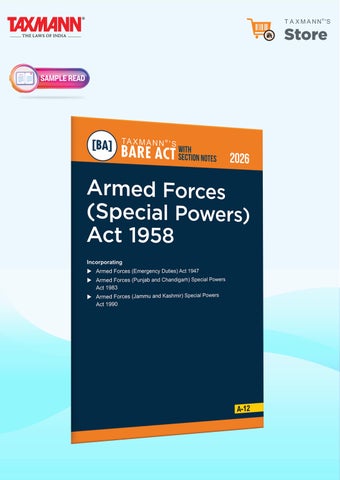
ARMED FORCES (SPECIAL POWERS) ACT 1958 – BARE ACT WITH SECTION NOTES AUTHOR PUBLISHER DATE OF PUBLICATION EDITION ISBN NO NO. OF PAGES BINDING TYPE
: : : : : : :
TAXMANN'S EDITORIAL BOARD TAXMANN NOVEMBER 2025 2026 EDITION 9789371264198 32 PAPERBACK
Rs. 85
DESCRIPTION Armed Forces (Special Powers) Act 1958 [Bare Act with Section Notes] by Taxmann is a compact statutory reference on India's 'special powers' framework in disturbed areas. It provides the updated text of AFSPA along with three allied enactments on emergency duties and territorial special powers. The Edition blends authentic Bare Act text with brief section notes and key case-law extracts, helping readers quickly grasp the statutory scheme, its constitutional scrutiny, and its application in internal security, counter-insurgency and human rights contexts. This book is intended for the following audience: • Advocates & Litigation Counsel • Government Law Officers & Military Legal Officers • Human Rights & Civil Liberties Practitioners/NGOs • Judges, Judicial Officers & AFT Practitioners • Researchers, Academicians & Students • Policy Analysts & Think-Tanks The Present Publication is the 2026 Edition, covering the amended and updated text of the Armed Forces (Special Powers) Act [Act No. 28 of 1958], with the following noteworthy features: • [Complete AFSPA Regime in One Volume] Includes AFSPA 1958 together with: o Armed Forces (Emergency Duties) Act 1947 o Armed Forces (Punjab and Chandigarh) Special Powers Act 1983 o Armed Forces (Jammu and Kashmir) Special Powers Act 1990 • [Pre-amendment Provisions] Reproduces earlier versions of amended provisions in footnotes to clarify the pre-amendment legal position and its temporal applicability • [Bare Act with Section Notes] Each section is followed by concise notes explaining: o Scope and object of the provision o Key expressions and operative thresholds o Practical implications for armed forces and civil authorities • [Integrated Case-Law References] Brief notes on significant decisions dealing with: o Constitutional review of AFSPA and "disturbed area" declarations o Limits and safeguards on the use of force and operational powers o Duty to hand over arrested persons to the civil police o Bar on prosecution without Central Government sanction, including recent Supreme Court rulings such as Rabina Ghale v. Union of India and other leading cases • [Emphasis on Safeguards & Accountability] Draws attention to: o The requirement of 'least possible delay' in handing over persons and seized property o Prior sanction conditions for prosecution and other legal proceedings o Judicial expectations on review and oversight arising from constitutional jurisprudence • [User-friendly Subject Indexes] Act-wise subject indexes for quick access to key topics (e.g., disturbed area, special powers, arrest, search, prosecution sanction, repeal & saving)
BUY NOW