

Practical Insights on Ind AS and SAs
Key Transition Provisions for Accounting of Joint Ventures on First-time Adoption of Ind AS

CA Bhawna Grover Manager - Research and Advisory, Taxmann

CA Prajwal Jha Associate - Research and Advisory, Taxmann

Practical Insights on Ind AS and SAs
Key Transition Provisions for Accounting of Joint Ventures on First-time Adoption of Ind AS
CA Bhawna Grover Manager - Research and Advisory, Taxmann
CA Prajwal Jha Associate - Research and Advisory, Taxmann

Taxmann presents Practical Insights on Ind AS and SAs, a weekly series exclusively for Accounts and Audit Module subscribers of Taxmann.com, focusing on the practical application of Ind AS and Standards on Auditing through structured, issue-based analysis
Background
Applicability of Ind AS 101 has been the central theme of this article series, with each edition examining a specific transition provision available to first-time adopters.
Earlier articles have discussed the mandatory exceptions to retrospective application, the concept of
(a) deemed cost for non-financial assets;
(b) transition provisions relating to the classification and measurement of financial instruments;
(c) share-based payment transactions;
(d) cumulative translation differences;
(e) long-term foreign currency monetary items;
(f) leases;
(g) investments in subsidiaries, associates and joint ventures
Building on this foundation, this edition focuses on the transition from proportionate consolidation under AS 27 to the equity method under Ind AS 28 for interests in joint ventures. It explains the rationale for this fundamental change, the manner of determining the opening carrying amount of the investment, impairment testing, treatment of negative net assets, deferred tax implications, and the disclosure requirements prescribed under Ind AS 101, thereby providing a comprehensive understanding of this important transition provision.
1. Introduction
One of the significant accounting changes introduced by Ind AS relates to the accounting for interests in joint ventures in consolidated financial statements. Under the previous GAAP, entities accounted for jointly controlled entities using the proportionate consolidation method prescribed by AS 27, Financial Reporting of Interests in Joint Ventures. However, Ind AS 28, Investments in Associates and Joint Ventures, read with Ind AS 111, Joint Arrangements, requires investments in joint ventures to be accounted for using the equity method. Consequently, a first-time adopter is required to replace proportionate consolidation with the equity method while preparing its Opening Ind AS Consolidated Balance Sheet.
This transition is not merely a change in presentation. It fundamentally changes the manner in which the assets, liabilities, income and expenses of a joint venture are reflected in the consolidated financial statements. Recognising the practical challenges involved in making this transition retrospectively, Ind AS 101 provides specific provisions to facilitate the transition.
2. Understanding the Proportionate Consolidation Method under AS 27
Under AS 27, a venturer was required to incorporate its proportionate share of each asset, liability, income and expense of the jointly controlled entity into its consolidated financial statements. In other words, instead of recognising a single investment balance, the venturer recognised its share of every individual line item of the joint venture.
Accordingly, if a venturer held a 50% interest in a jointly controlled entity, 50% of the joint venture’s assets, liabilities, revenues and expenses were combined with the corresponding items in the venturer’s consolidated financial statements. The joint venture itself was not shown as a separate investment; rather, its financial statement components were consolidated line by line in proportion to the ownership interest.
This method enabled users to observe the venturer’s proportionate interest in the underlying assets and obligations of the joint venture. However, it often resulted in larger
consolidated balance sheets and did not always reflect the legal rights and obligations arising from the joint arrangement.
2.1. Practical Illustration – Proportionate Consolidation under AS 27
Suppose Alpha Limited and Beta Limited establish AB Infrastructure Limited as a jointly controlled entity, with each company holding a 50% interest.
The Balance Sheet of AB Infrastructure Limited is as follows:
Under AS 27, Alpha Limited would proportionately consolidate 50% of these balances in its consolidated financial statements.
Accordingly, Alpha Limited would recognise:
No separate line item titled “Investment in Joint Venture” would appear in the consolidated Balance Sheet because the investment would effectively be replaced by Alpha Limited’s share of the individual assets and liabilities of the joint venture.
Similarly, if the joint venture earned a profit of ₹100 lakh during the year, Alpha Limited would include ₹50 lakh of revenue and expenses through proportionate consolidation, rather than recognising a single share of profit.
3. Equity Method under Ind AS 28
With the introduction of Ind AS, the accounting approach for joint ventures changed significantly. Ind AS 111 classifies joint arrangements either as joint operations or joint ventures based on the rights and obligations of the parties. Where the arrangement qualifies as a joint venture, Ind AS 28 requires the investment to be accounted for using the equity method.
Under the equity method, the investor does not recognise its share of the joint venture’s individual assets and liabilities. Instead, the entire investment is presented as a single line item in the consolidated Balance Sheet.
The investment is initially recognised at cost. Subsequently, the carrying amount is adjusted to reflect:
a) the investor’s share of the joint venture’s profit or loss;
b) the investor’s share of other comprehensive income;
c) dividends received from the joint venture; and
d) any impairment losses, where applicable.
Accordingly, the consolidated financial statements reflect the investor’s net interest in the joint venture rather than proportionately recognising the underlying assets and liabilities.
This approach better reflects the substance of a joint venture, where the venturers generally have rights to the net assets of the arrangement rather than direct rights over individual assets or obligations for individual liabilities.
3.1. Practical Illustration – Equity Method under Ind AS 28
Continuing the previous illustration, assume Alpha Limited acquires its 50% interest in AB Infrastructure Limited for ₹300 lakh. During the year, AB Infrastructure Limited earns a profit of ₹80 lakh. Out of which, it declares dividends of ₹20 lakh, of which Alpha Limited receives ₹10 lakh.
The investment would be accounted for as follows:
In Alpha Limited’s consolidated Balance Sheet, a single line item titled “Investment in Joint Venture” of ₹330 lakh would be presented.
In the Consolidated Statement of Profit and Loss, Alpha Limited would recognise only “Share of Profit of Joint Venture Accounted for Using the Equity Method” amounting to ₹40 lakh.
Unlike the previous GAAP, no proportionate share of the joint venture’s property, inventory, borrowings or trade payables would appear separately in the consolidated financial statements.
The transition from proportionate consolidation to the equity method therefore represents a fundamental shift in the accounting model. Rather than reflecting the investor’s proportionate interest in each asset and liability of the joint venture, Ind AS focuses on the investor’s interest in the net assets of the joint venture. Consequently, entities adopting Ind AS for the first time must replace line-by-line consolidation with a single investment balance measured in accordance with the transition provisions prescribed in Ind AS 101, which are discussed in the subsequent sections.
4. Measurement of Initial Investment in the Joint Venture
Once a first-time adopter replaces the proportionate consolidation method prescribed under AS 27 with the equity method required by Ind AS 28, the next practical issue is determining the initial carrying amount of the investment in the joint venture on the date of transition.
Since the joint venture was not previously recognised as a separate investment in the consolidated financial statements, there is no existing investment balance that can simply be carried forward. Instead, the investment has to be reconstructed from the amounts that were previously recognised through proportionate consolidation.
To facilitate this transition, Paragraphs D31AA and D31AB of Ind AS 101 prescribe a practical approach for measuring the initial investment. Rather than requiring entities to retrospectively determine the historical cost of the investment under the equity method, the Standard permits the investment to be measured using the carrying amounts already reflected in the consolidated financial statements immediately before transition.
4.1. Determination of the Initial Carrying Amount
On the date of transition, the carrying amount of the investment in the joint venture is determined by aggregating the carrying amounts of all the assets and liabilities that were previously recognised through proportionate consolidation. Accordingly, the venturer should:
a) aggregate the carrying amounts of its share of the joint venture’s assets that were included in the consolidated financial statements;
b) deduct the carrying amounts of its share of the joint venture’s liabilities; and
c) include any goodwill relating to the acquisition of the joint venture.
The resulting net amount becomes the carrying amount of the investment in the joint venture on the date of transition. Thus, this amount is treated as the deemed cost of the investment for the purpose of applying the equity method under Ind AS 28.
4.2. Practical Illustration – Determining the Initial Investment
A Limited holds a 40% interest in XY Joint Venture Limited. Under AS 27, it accounted for the investment using the proportionate consolidation method.
Immediately before the transition to Ind AS, the following amounts relating to A Limited’s share in the joint venture were included in its consolidated balance sheet.
Further, goodwill of ₹50 lakh had arisen on acquisition of the joint venture and was recognised separately in the consolidated financial statements.
4.3. Computation of Initial Investment
Accordingly, A Limited would derecognise the individual assets and liabilities relating to the joint venture and recognise a single line item “Investment in Joint Venture” amounting to ₹650 lakh in its Opening Ind AS Consolidated Balance Sheet.
This amount would thereafter be treated as the deemed cost of the investment, and all subsequent accounting would be carried out using the equity method prescribed under Ind AS 28.
5. Allocation of Goodwill forming part of a Larger Cash-Generating Unit
In many cases, goodwill recognised on acquisition of a joint venture may not exist as a separately identifiable asset. Instead, it may have been allocated to a larger CashGenerating Unit (CGU) or a group of CGUs for the purpose of impairment testing under the previous accounting framework.
Recognising this practical issue, Paragraph D31AA of Ind AS 101 requires that where goodwill forms part of a larger CGU, an appropriate portion of that goodwill should first be allocated to the joint venture before determining the initial carrying amount of the investment.
The allocation is made on the basis of the relative carrying amounts of:
a) the joint venture; and
b) the CGU (or group of CGUs) to which the goodwill had been allocated.
Once the relevant portion of goodwill is identified, it is added to the carrying amount of the investment determined on transition.
5.1. Practical Illustration – Allocation of Goodwill
Suppose Beta Limited acquired several businesses, including a 50% interest in a joint venture, and recognised goodwill of ₹120 lakh. Instead of being allocated specifically to the joint venture, the goodwill was allocated to a larger CGU comprising multiple businesses.
Immediately before transition, the carrying amounts of the businesses within the CGU are:
Since the joint venture represents 800/3,000 (26.67%) of the carrying amount of the CGU, the same proportion of goodwill is allocated to the joint venture.
Allocated goodwill:
₹ 120 lakh × 26.67% = ₹32 lakh
Assume the net carrying amount of the assets and liabilities relating to the joint venture is ₹800 lakh. Accordingly, the initial investment under the equity method would be:
6. Impairment Testing on Transition
After determining the deemed cost of the investment in the joint venture, a first-time adopter is required to test the investment for impairment in accordance with Ind AS 36, Impairment of Assets, even if there is no indication that the investment is impaired. This requirement is unique to the transition process and ensures that the investment recognised under the equity method does not exceed its recoverable amount on the date of transition.
If the recoverable amount of the investment is lower than its deemed cost, the resulting impairment loss is recognised by adjusting retained earnings in the Opening Ind AS Balance Sheet. Since the adjustment relates to the transition date, it is not recognised in the Statement of Profit and Loss.
This mandatory impairment assessment ensures that the investment is brought into the Opening Ind AS Balance Sheet at an amount that faithfully represents its recoverable economic value.
6.1. Practical Illustration – Impairment of Investment on Transition
Assume that Alpha Limited determines the deemed cost of its investment in a joint venture at ₹150 crore after transitioning from proportionate consolidation to the equity method. On applying Ind AS 36, the recoverable amount of the investment is determined to be ₹138 crore.
Accordingly, Alpha Limited will recognise an impairment loss of ₹12 crore in the Opening Ind AS Balance Sheet by reducing the carrying amount of the investment from ₹150 crore to ₹138 crore. The corresponding adjustment will be made directly to retained earnings.
7. Deferred Tax Implications
The transition from proportionate consolidation to the equity method may also give rise to temporary differences between the carrying amount of the investment recognised under Ind AS and its corresponding tax base.
Although Paragraphs 15 and 24 of Ind AS 12 provide certain exemptions from recognising deferred tax assets and deferred tax liabilities in specific situations, these exemptions do not apply to temporary differences arising from the recognition of an investment in a joint venture on first-time adoption of Ind AS.
Accordingly, any deferred tax arising from the transition adjustments should be recognised in accordance with Ind AS 12, and the corresponding impact should also be adjusted against retained earnings in the Opening Ind AS Balance Sheet. This ensures that all tax effects associated with the transition are appropriately reflected in the opening financial position.
8. Treatment of Negative Net
Assets
While transitioning from the proportionate consolidation method to the equity method, it is possible that the aggregate carrying amount of the assets and liabilities previously consolidated results in negative net assets. This situation generally arises where the joint venture has incurred substantial accumulated losses, causing its liabilities to exceed its assets.
Ind AS 101 does not permit an entity to automatically recognise a negative investment balance. Instead, the accounting treatment depends on whether the venturer has an obligation to absorb those losses.
If the venturer has a legal or constructive obligation to meet the obligations of the joint venture, for example, through a guarantee, funding commitment, or contractual arrangement, it is required to recognise a corresponding liability in the Opening Ind AS Balance Sheet.
However, where no such obligation exists, the negative net assets are not recognised as a liability. Instead, the amount is adjusted directly against retained earnings on the date of transition. In such cases, the entity is also required to disclose the amount of cumulative unrecognised losses relating to the joint venture and explain the accounting treatment adopted.
This requirement ensures that liabilities are recognised only where the venturer is genuinely obligated to bear the losses of the joint venture, while maintaining transparency through appropriate disclosures.
8.1. Practical Illustration – Negative Net Assets
Delta Limited holds a 50% interest in a joint venture. Under the previous GAAP, the company proportionately consolidated its share of the joint venture’s assets and liabilities. On the date of transition, the carrying amounts attributable to Delta Limited are as follows:
Share of Assets: ₹80 crore
Share of Liabilities: ₹95 crore
Accordingly, the aggregate of assets and liabilities results in negative net assets of ₹15 crore.
Case 1 – Legal obligation exists
Assume Delta Limited has provided a financial guarantee to lenders of the joint venture and is contractually obligated to fund any deficit arising in the joint venture.
Since a legal obligation exists, Delta Limited will recognise a liability of ₹15 crore in its Opening Ind AS Balance Sheet. The investment in the joint venture will accordingly reflect this obligation.
Case 2 – No legal or constructive obligation
Assume instead that Delta Limited has no contractual commitment to fund the losses of the joint venture and is not otherwise obligated to meet its liabilities.
In this case, no liability will be recognised. Instead, the ₹15 crore negative amount will be adjusted against retained earnings on the date of transition. Additionally, Delta Limited will disclose that cumulative losses of the joint venture remain unrecognised because it has no obligation to absorb those losses.
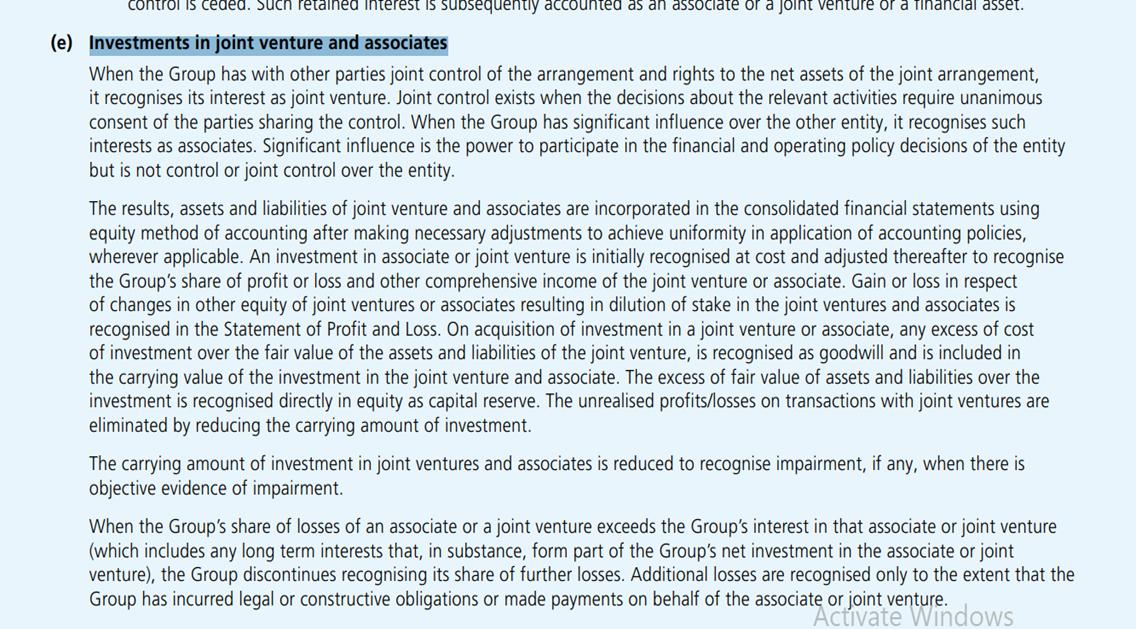
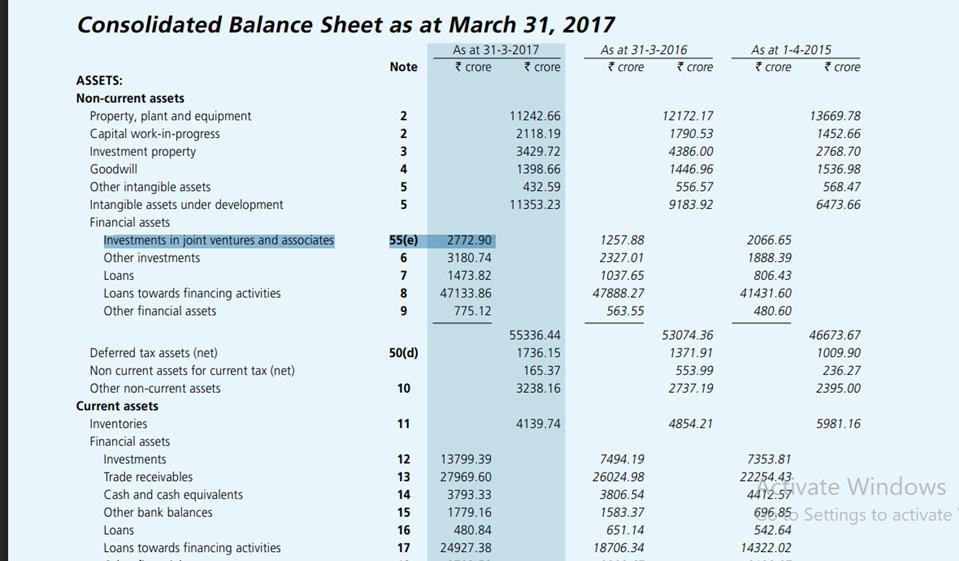
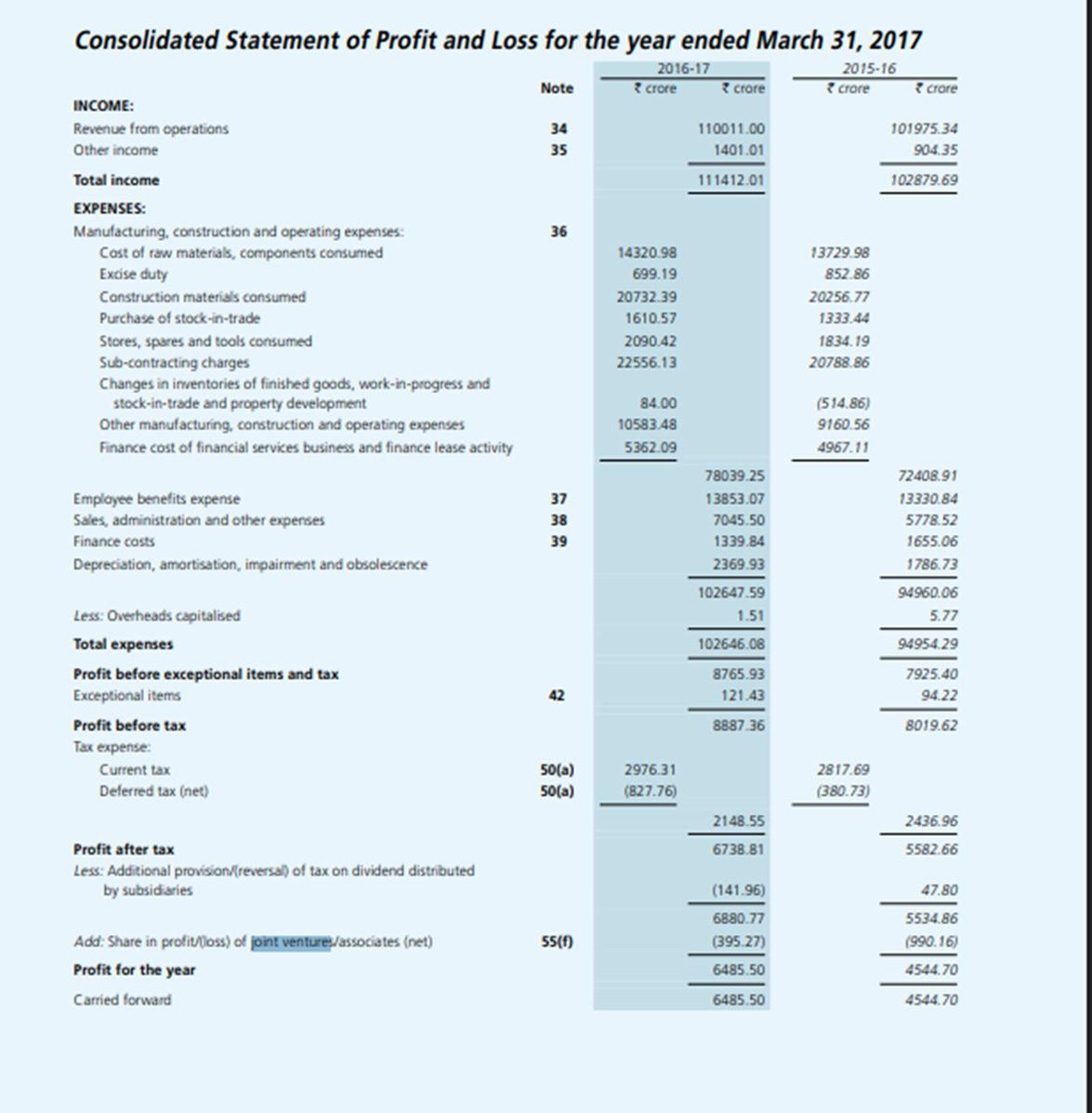
The following extracts from the Consolidated Financial Statements of Larsen & Toubro Limited for the FY ending 31st March 2017 is presented for better understanding of the concepts discussed above:
(a) Extract of the Significant Accounting Policies
(b) Extract of the Consolidated Balance Sheet as at 31st March, 2017
(c) Extract of the Consolidated Statement of Profit and Loss for the year ended 31st March, 2017
9. Disclosure of Assets and Liabilities aggregated into the Investment Balance
After applying the transition provisions and recognising the investment in the joint venture under the equity method, the investment is presented as a single line item in the consolidated balance sheet. However, users of the financial statements may find it difficult to understand the composition of this investment because, under the previous GAAP, the underlying assets and liabilities were presented separately through proportionate consolidation.
To enhance transparency, Ind AS 101 requires a first-time adopter to disclose a breakdown of the assets and liabilities that have been aggregated into the single-line investment balance on the date of transition. The disclosure should be provided for all joint ventures affected by the transition.
This disclosure enables users to understand how the carrying amount of the investment has been derived and facilitates comparison between the previous GAAP presentation and the new presentation under the equity method. It also provides greater clarity regarding the nature and magnitude of the assets and liabilities that are no longer presented separately in the consolidated financial statements.
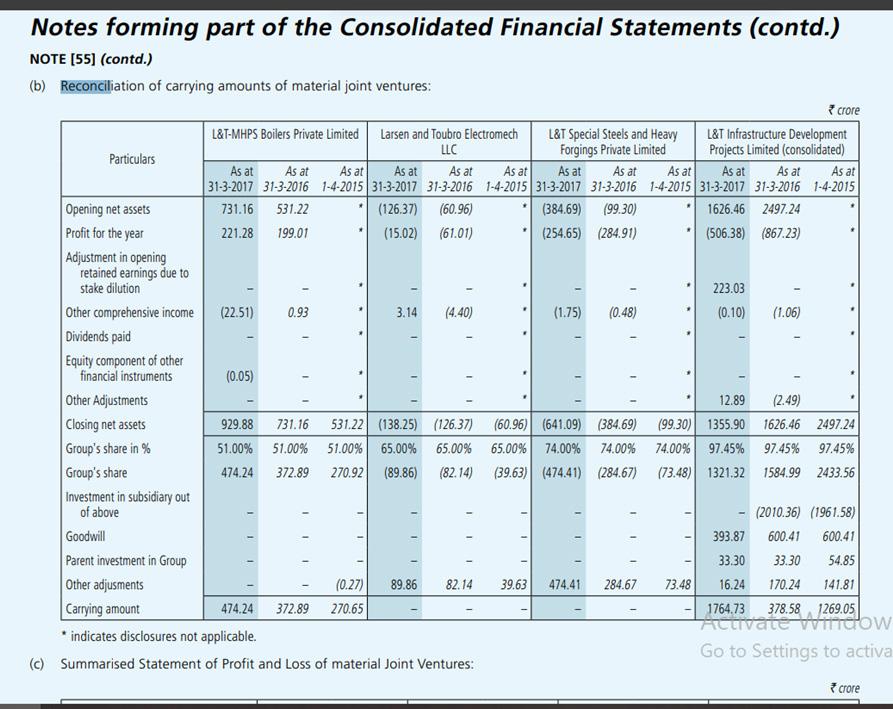
The following extracts from the Consolidated Financial Statements of Larsen & Toubro Limited for the FY ending 31st March 2017 is presented for better understanding of the concepts discussed above:
(a) Extract of the Reconciliation of carrying amount of JVs in Consolidated Financial Statements
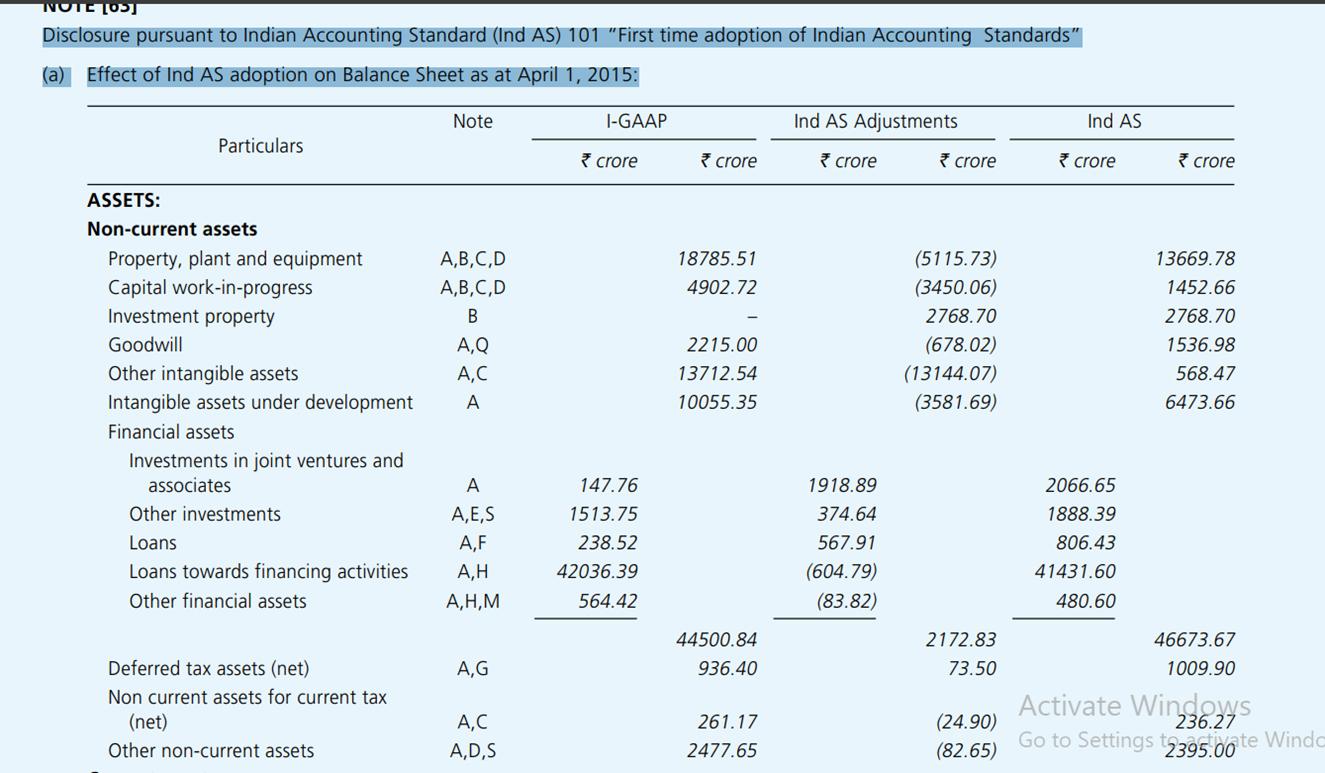
(b) Extract of the disclosure of the effect of Ind AS Adoption on the balance sheet at Transition date
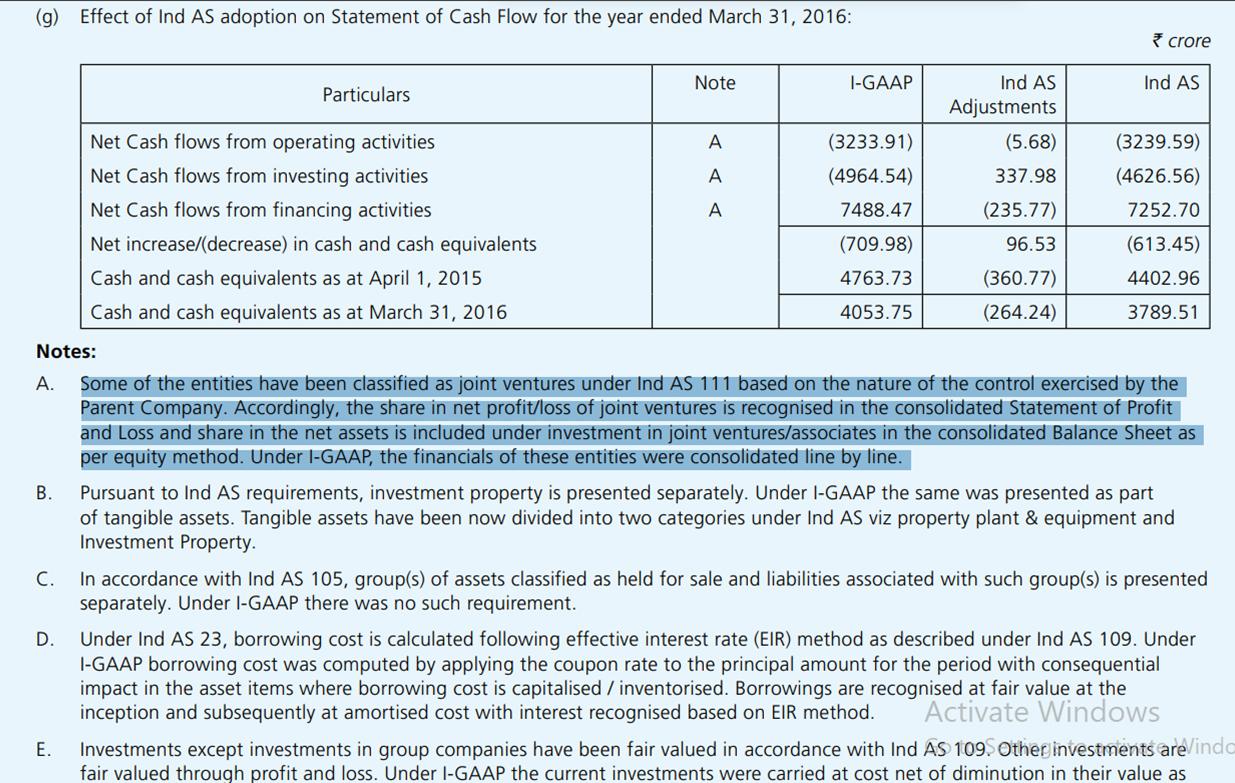
(c) Extract of Disclosure about the adoption of Equity method under Ind AS 111
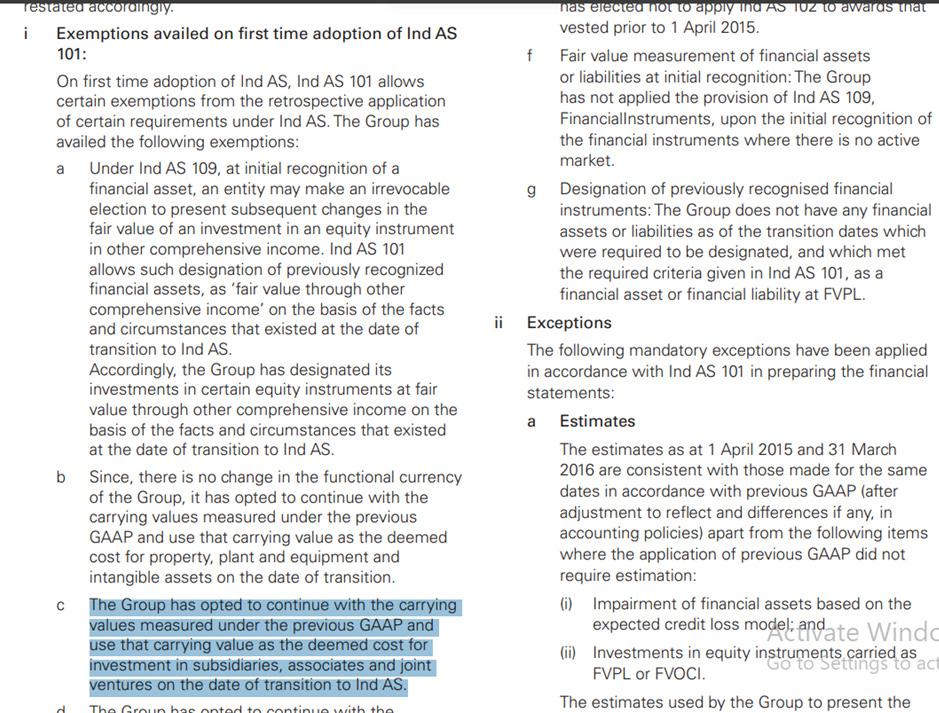
The following extracts from the Consolidated Financial Statements of Hindustan Construction Company Limited for the FY ending 31st March 2017 is presented for better understanding of the concepts discussed above:
(a) Extract of Disclosure about the exemption availed of for first-time adoption of Ind AS
10. Conclusion
The transition from proportionate consolidation to the equity method is one of the most significant accounting changes encountered by entities with interests in joint ventures during first-time adoption of Ind AS. Rather than requiring a complete retrospective reconstruction of historical transactions, Ind AS 101 provides practical transition provisions that enable entities to establish the opening carrying amount of the investment in a systematic and consistent manner. The accompanying requirements relating to impairment testing, recognition of negative net assets, deferred tax consequences, and enhanced disclosures further ensure that the transition results in financial statements that faithfully represent the entity’s economic interest in its joint ventures. A sound understanding of these provisions is therefore essential for ensuring a smooth transition to Ind AS while maintaining comparability, transparency, and compliance with the principles underlying the equity method.

About Us

Founded 1972


Evolution From a small family business to a leading technology-oriented Publishing/Product company

Expansion

Launch of Taxmann Advisory for personalized consulting solutions
Our Vision

Aim
Achieve perfection, skill, and accuracy in all endeavour
Growth
Evolution into a company with strong independent divisions: Research & Editorial, Production, Sales & Marketing, and Technology

Future
Continuously providing practical solutions through Taxmann Advisory
Our Strength
Core
Editorial and Research Division
Team
Over 200 motivated legal professionals (Lawyers, Chartered Accountants, Company Secretaries)
Expertise
Monitoring and processing developments in judicial, administrative, and legislative fields with unparalleled skill and accuracy
Impact
Helping businesses navigate complex tax and regulatory requirements with ease

Taxmann Today
Legacy Innovation Commitment
Over 60 years of domain knowledge and trust
Technology-driven solutions for modern challenges
Ensuring perfection, skill, and accuracy in every solution provided
Our Core Domain Areas
Income Tax
Corporate Tax Advisory
Trusts & NGO Consultancy
TDS Advisory
Global Mobility Services
Personal Taxation
Training
Due Diligence
Foreign Exchange Management Laws
Due Dilligence
Advisory Services
Assistance in compounding of offences
Transactions Services
Investment outside India
Your Partners for Frictionless Advice
Goods
Transaction Advisory
Business Restructuring
Classification
Due Diligence
Training
Advisory
Trade Facilitation Measures
Corporate
Corporate Structuring
VAT Advisory
Residential Status
A Glimpse of the People Behind Taxmann

Naveen Wadhwa Research and Advisory [Corporate and Personal Tax]
Chartered Accountant (All India 24th Rank)
14+ years of experience in Income tax and International Tax
Expertise across real estate, technology, publication, education, hospitality, and manufacturing sectors
Contributor to renowned media outlets on tax issues

Vinod K. Singhania
Expert on Panel | Research and Advisory (Direct Tax)
Over 35 years of experience in tax laws
PhD in Corporate Economics and Legislation
Author and resource person in 800+ seminars

V.S. Datey
Expert on Panel | Research and Advisory [Indirect Tax]
Holds 30+ years of experience
Engaged in consulting and training professionals on Indirect Taxation
A regular speaker at various industry forums, associations and industry workshops
Author of various books on Indirect Taxation used by professionals and Department officials

S.S. Gupta
Expert on Panel | Research and Advisory [Indirect Tax]
Chartered Accountant and Cost & Works Accountant
34+ Years of Experience in Indirect Taxation
Bestowed with numerous prestigious scholarships and prizes
Author of the book GST – How to Meet Your Obligations', which is widely referred to by Trade and Industry

Manoj Fogla
Expert on Panel | Research and Advisory [Charitable Trusts and NGOs]
Over three decades of practising experience on tax, legal and regulatory aspects of NPOs and Charitable Institutions
Law practitioner, a fellow member of the Institute of Chartered Accountants of India and also holds a Master's degree in Philosophy
PhD from Utkal University, Doctoral Research on Social Accountability Standards for NPOs
Author of several best-selling books for professionals, including the recent one titled 'Trust and NGO's Ready Reckoner' by Taxmann
Drafted publications for The Institute of Chartered Accountants of India, New Delhi, such as FAQs on GST for NPOs & FAQs on FCRA for NPOs.
Has been a faculty and resource person at various national and international forums

the UAE
Chartered Accountant (All India 36th Rank)
Has previously worked with the KPMG

Contact Us

Taxmann Delhi
59/32, New Rohtak Road
New Delhi – 110005 | India
Phone | 011 45562222
Email | sales@taxmann.com
Taxmann Mumbai
35, Bodke Building, Ground Floor, M.G. Road, Mulund (West), Opp. Mulund Railway Station Mumbai – 400080 | Maharashtra | India
Phone | +91 93222 47686
Email | sales.mumbai@taxmann.com
Taxmann Pune
Office No. 14, First Floor, Prestige Point, 283 Shukrwar Peth, Bajirao Road, Opp. Chinchechi Talim, Pune – 411002 | Maharashtra | India
Phone | +91 98224 11811
Email | sales.pune@taxmann.com
Taxmann Ahmedabad
7, Abhinav Arcade, Ground Floor, Pritam Nagar Paldi
Ahmedabad – 380007 | Gujarat | India
Phone: +91 99099 84900
Email: sales.ahmedabad@taxmann.com
Taxmann Hyderabad
4-1-369 Indralok Commercial Complex Shop No. 15/1 – Ground Floor, Reddy Hostel Lane Abids Hyderabad – 500001 | Telangana | India
Phone | +91 93910 41461
Email | sales.hyderabad@taxmann.com
Taxmann Chennai No. 26, 2, Rajan St, Rama Kamath Puram, T. Nagar
Chennai – 600017 | Tamil Nadu | India
Phone | +91 89390 09948
Email | sales.chennai@taxmann.com
www.taxmann.com
Taxmann Bengaluru
12/1, Nirmal Nivas, Ground Floor, 4th Cross, Gandhi Nagar
Bengaluru – 560009 | Karnataka | India
Phone | +91 99869 50066
Email | sales.bengaluru@taxmann.com
Taxmann Kolkata Nigam Centre, 155-Lenin Sarani, Wellington, 2nd Floor, Room No. 213
Kolkata – 700013 | West Bengal | India
Phone | +91 98300 71313
Email | sales.kolkata@taxmann.com
Taxmann Lucknow
House No. LIG – 4/40, Sector – H, Jankipuram Lucknow – 226021 | Uttar Pradesh | India
Phone | +91 97924 23987
Email | sales.lucknow@taxmann.com
Taxmann Bhubaneswar
Plot No. 591, Nayapalli, Near Damayanti Apartments
Bhubaneswar – 751012 | Odisha | India
Phone | +91 99370 71353
Email | sales.bhubaneswar@taxmann.com
Taxmann Guwahati
House No. 2, Samnaay Path, Sawauchi Dakshin Gaon Road
Guwahati – 781040 | Assam | India
Phone | +91 70866 24504
Email | sales.guwahati@taxmann.com