

Sample Read

© NATIONAL INSTITUTE OF SECURITIES MARKETS, MUMBAI, 2026
PRINTING AND PUBLISHING RIGHTS WITH THE PUBLISHER
All rights reserved. No part of this publication may be reproduced, stored in or introduced into a retrieval system, or transmitted in any form or by any means (electronic, mechanical, photocopying, recording or otherwise), without the prior written permission of National Institute of Securities Markets.
Any person who does any unauthorised act in relation to this publication may be liable to criminal prosecution and civil claims for damages.
While every care has been taken in compiling the information contained in this publication, National Institute of Securities Markets accepts no responsibility for any errors or omissions.
Workbook Version : January 2026
Price : ` 680
Published by :
Taxmann Publications (P.) Ltd.
Sales & Marketing :
59/32, New Rohtak Road, New Delhi-110 005 India
Phone : +91-11-45562222
Website : www.taxmann.com, E-mail : sales@taxmann.com
Mumbai
35, Bodke Building, Ground Floor, M.G. Road, Opp. Railway Station, Mulund (West), Mumbai-400080
Mobile : 09322247686, 9619668669, 7045453844/45/48/51
E-mail : sales.mumbai@taxmann.com; nileshbhanushali@taxmann.com
Regd. Office : 21/35, West Punjabi Bagh, New Delhi-110 026 India
Printed at : Tan Prints (India) Pvt. Ltd.
44 Km. Mile Stone, National Highway, Rohtak Road, Village Rohad, Distt. Jhajjar (Haryana) India
E-mail : sales@tanprints.com
DISCLAIMER
The contents of this publication do not necessarily constitute or imply its endorsement, recommendation, or favoring by the National Institute of Securities Markets (NISM) or the Securities and Exchange Board of India (SEBI). This publication is meant for general reading and educational purpose only.
The statements/explanations/concepts are of general nature and may not have taken into account the particular objective/move/aim/need/circumstances of individual user/reader/organization/institute. Thus NISM and SEBI do not assume any responsibility for any wrong move or action taken based on the information available in this publication.
Therefore before acting on or following the steps suggested on any theme or before following any recommendation given in this publication user/reader should consider/seek professional advice.
The publication contains information, statements, opinions, statistics and materials that have been obtained from sources believed to be reliable and the publishers of this title have made best efforts to avoid any errors. However, publishers of this material offer no guarantees and warranties of any kind to the readers/users of the information contained in this publication.
Since the work and research is still going on in all these knowledge streams, NISM and SEBI do not warrant the totality and absolute accuracy, adequacy or completeness of this information and material and expressly disclaim any liability for errors or omissions in this information and material herein. NISM and SEBI do not accept any legal liability what-so-ever based on any information contained herein.
While the NISM Certification examination will be largely based on material in this workbook, NISM does not guarantee that all questions in the examination will be from material covered herein.
UNDERSTANDING FINANCIAL
CHAPTER
CHAPTER 9
LAUNDERING ACT,
CHAPTER 10
SEBI (KYC REGISTRATION AGENCY)
CHAPTER 11
SEBI (FOREIGN PORTFOLIO INVESTORS)
CHAPTER 12
12.6
12.7
CHAPTER 13
DEPOSITORIES ACT 1996
CHAPTER 16
SEBI (INVIT) REGULATIONS
CHAPTER 17
SEBI (REIT) REGULATIONS

CHAPTER 6
SEBI (INTERMEDIARIES) REGULATIONS, 2008
LEARNING OBJECTIVES:
After studying this chapter, you should know about the:
Ø Obligations of Intermediaries
Ø Inspection and other disciplinary proceedings for intermediaries
Ø Actions in case of default by members
Ø Code of conduct for intermediaries
Ø Fit and Proper Criteria
Ø ODR Framework introduced by SEBI
Ø Compliance relating to Cyber Security Framework
Ø Compliance relating to Artificial Intelligence and Machine Learning
6.1 Introduction
The SEBI (Intermediaries) Regulations, 2008 were notified in the official gazette on 26th May 2008. These regulations have 6 chapters and 4 schedules. In this chapter, we have summarized and discussed some of them.
Candidates, however, are advised to go through the regulation in detail for better understanding.
The Regulations define Intermediaries as a person mentioned in sub-section (2) clauses (b) and (ba) of section 11, sub-sections (1) and (1A) of section 12 of the SEBI
SEBI (INTERMEDIARIES) REGULATIONS, 2008
Act, 1992 and includes asset management company in relation to SEBI (Mutual Fund) Regulations 1996, a clearing member of a clearing corporation or clearing house, foreign portfolio investor, trading member of derivatives segment or currency derivatives segment of stock exchange but does not include foreign venture capital investor, mutual fund, collective investment scheme and venture capital fund.
6.2 General Obligations of Intermediaries
The SEBI (Intermediaries) Regulations, 2008 prescribes that
(1) An intermediary shall provide the Board with a certificate of its compliance officer on the 1st April of each year certifying:
Ø the compliance by the intermediary with all the obligations, responsibilities and the fulfilment of the eligibility criteria on a continuous basis under these regulations and the relevant regulations;
Ø that all disclosures made as prescribed by SEBI.
(2) Each intermediary shall prominently display a photocopy of the certificate at all its offices including branch offices.
(3) The intermediary shall also prominently display the name and contact details of the compliance officer to whom a complaint may be made in the event of any investor grievance.
(4) The intermediary shall maintain such books, accounts and records as specified in the relevant regulations.
(5) The intermediary shall make endeavours to redress investor grievances promptly but not later than forty-five days of receipt thereof and when called upon by the Board to do so it shall redress the grievances of investors within the time specified by the SEBI.
(6) The intermediary shall maintain records regarding investor grievances received by it and redressal of such grievances.
(7) The intermediary shall at the end of each quarter of a Financial Year ending on 31st March upload information about the number of investor grievances received, redressed and those remaining unresolved beyond three months of the receipt thereof by the intermediary on the website specified by SEBI.
Responsibility for the use of Artificial Intelligence:
Any person regulated by the Board who uses artificial intelligence and machine learning tools and techniques, either designed by it or procured from third-party technology service providers, irrespective of the scale and scenario of adoption of such tools for conducting its business and servicing its investors, shall be solely responsible –
(a) for the privacy, security and integrity of investors’ and stakeholders’ data including data maintained by it in a fiduciary capacity throughout the processes involved;
(
b) for the output arising from the usage of such tools and techniques it relies upon or deals with; and
(c) or the compliance with applicable laws in force.
(2) The Board may, in case of violation of the provisions of sub-regulation (1), take such action as it may deem fit including action under Chapter V of these regulations.
Explanation: For the purpose of this regulation,-
(a) the expression “artificial intelligence and machine learning tools and techniques” may include any application or software program or executable system or a combination thereof, offered by the person regulated by the Board to investors/ stakeholders or used internally by it to facilitate investing and trading or to disseminate investment strategies and advice or to carry out its activities including compliance requirements and the same are portrayed as part of the products offered to the public or under usage for compliance or management or other business purposes;
(
b) the expression “person regulated by the Board” shall have the same meaning as provided under Explanation 1 to regulation 16A.16
6.2-1 Appointment of Compliance Officer
As already stated in chapter 3, an intermediary is required to appoint a compliance officer for monitoring the compliance by it of the requirements of the Act, rules, regulations, notifications, guidelines, circulars and orders made or issued by SEBI, or
16 https://www.sebi.gov.in/legal/regulations/dec-2025/securities-and-exchange-board-of-india-intermediaries-regulations2008-last-amended-on-december-5-2025-_98642.html
SEBI (INTERMEDIARIES) REGULATIONS, 2008
the Central Government, or the rules and regulations and bye-laws of the concerned stock exchanges or the SRO, where applicable. Provided, the intermediary may not appoint compliance officer if it is not carrying on the activity of the intermediary. The compliance officer shall report to the intermediary or its board of directors in writing, of any material non-compliance by the intermediary.
6.2-2 Code of Conduct
An intermediary and its directors, officers, employees and key management personnel shall continuously abide by the code of conduct specified in the Schedule III of SEBI (Intermediaries) Regulations.
6.3 Inspection and Disciplinary Proceedings
6.3-1 Obligation of the intermediary on Inspection
Under regulation 19 of the SEBI (Intermediaries) Regulations, 2008
1. It shall be the duty of every director, proprietor, partner, trustee, officer, employee and any agent of an intermediary which is being inspected, to produce to the inspecting authority such books, accounts, records including telephone records and electronic records and documents in his custody or control and furnish to the inspecting authority with such statements and information relating to its activities within such time as the inspecting authority may require.
2. The intermediary shall allow the inspecting authority to have reasonable access to the premises occupied by such intermediary or by any other person on its behalf and also extend reasonable facility for examining any books, records including telephone records and electronic records and documents in the possession of the intermediary or any such other person and also provide copies of documents or other material which in the opinion of the inspecting authority are relevant for the purposes of the inspection.
3. Without prejudice to the provisions the Act, the inspecting authority shall, in the course of inspection, be entitled to examine or record statements of any principal officer, director, trustee, partner, proprietor or employee of such intermediary.
4. It is the duty of every director, proprietor, trustee, partner, officer and employee of such intermediary to give to the inspecting authority all assistance which the inspecting authority may reasonably require in connection with the inspection.
6.4 Action in Case of Default and Manner of Suspension and Cancellation of Certificate
1. Where any intermediary fails to comply with any of the conditions of registration or contravenes any of the provisions of the securities laws (i.e. SEBI Act or SCRA or Depository Act or rules and regulations made thereunder) or directions, instructions or circulars issued thereunder, in terms of Regulation 24(2), the Executive Director shall appoint an officer not below the rank of a Division Chief, as a designated authority. The Executive Director may, at his discretion, appoint a bench of 3 officers each of whom will not be below the rank of Division Chief to enquire into and to make recommendations as to the action to be taken. No officer who has conducted an investigation or inspection in respect of the alleged violation can be appointed as a designated authority.
2. The designated authority shall issue a notice to a person against whom an enquiry has been initiated, to show cause as to why the action, as contemplated against such person, should not be recommended.
3. The notice shall specify the period (not exceeding 21 days) within which a written reply should be submitted along with documentary evidence, if any, in support of such written reply.
4. Every notice shall specify the contravention alleged to have been committed by notice by indicating the provisions of the securities laws or the direction or the order of the SEBI which are alleged to have been contravened.
5. Moreover, there shall be annexed to the notice copies of documents relied upon by SEBI along with the extracts of relevant portions of the reports containing the findings arrived at in an inquiry, investigation or inspection, if any.
6. The designated authority may grant a request for inspection of documents.
7. The designated authority shall grant an opportunity of personal hearing and issue or cause to issue a notice scheduling a date for hearing.
8. If the noticee does not reply to the notice or fails to appear on the scheduled date of hearing and the designated authority is satisfied that sufficient opportunity has been given to the noticee, the designated authority may conclude the proceedings after recording the reasons for doing so, on the basis of the material available on record.
6.4-1 Recommendation of Action
After considering material available on record and the reply, the designated authority may by way of a report, recommend the following measures:
(i) Disposing of the proceedings without adverse action
(ii) Cancellation of certificate of registration;
(iii) Suspension of certificate of registration for a specified period;
(iv) Prohibition of the noticee from taking up any new assignment or contract or launch new scheme for such period as may be specified;
(v) Debarment of an officer of the noticee from being employed or associated with any registered intermediary or other person associated with the securities market for such period as may be specified;
(vi) Debarment a branch or an office of the noticee from carrying out activities for such period as may be specified;
(vii) Issuance of a regulatory censure to the noticee.
The designated authority shall endeavour to submit the report within 120 days from the date of receipt of reply to the notice or date of personal hearing whichever is later.
6.4-2 Order
Regulation 27 specifies on receipt of the report containing measures by the designated authority, the competent authority shall cause to forward a copy of the report submitted by the designated authority and call upon the noticee to make a submission, in writing, as to why measures recommended by the designated authority should not be taken. The noticee shall submit not exceeding twenty-one days from date of service, written submission along with documentary evidence if any, in support of the written submission.
After considering the submission of the noticee, the competent authority may if deemed fit, for records to be recorded it in writing, remit the matter to the designated authority to enquire afresh or to further enquire afresh or to further enquire and resubmit the report.
The competent authority may grant an opportunity of personal hearing where the designated authority has recommended cancellation of certificate of registration or the competent authority is of the prima facie view that it is a fit case for cancellation of certificate of registration.
After considering the facts and circumstances of the case, material on record and the written submission, if any, the competent authority shall endeavour to pass an appropriate order within 120 days from the date of submission or personal hearing, whichever is later.
6.4-3 Common Order
The competent authority may pass a common order in respect of a number of noticees where the subject matter in question is substantially the same or similar in nature.
6.4-4 Special Procedure for action on expulsion from membership of the stock exchange (s) or clearing corporation(s) or termination of all the depository participant agreements with depository (ies)
(1) Notwithstanding anything contained in these regulations, the procedure as provided under this regulation shall be applied to -
(
a) the stock broker or a clearing member, in respect of which intimation has been received by SEBI from all the stock exchange(s) or the clearing corporation(s), as the case may be, of which it was a member, that such stock broker or clearing member has been expelled as its member;
(
b) a depository participant, in respect of which intimation has been received by SEBI from all the depository(ies) where the participant was admitted, that the depository participant agreement has been terminated by the depository(ies);
(
c) a person found to have made claim(s) of return or performance in respect of or related to a security or securities, unless otherwise permitted by SEBI to make such claim(s);
(
d) a person which fails to pay the fees, to SEBI or to such body as may be specified, in terms of provisions of the relevant regulations governing such a person;
(
e) a person not traceable at its physical address and email address available in the records of SEBI;
(
f) a person which has failed to submit periodic reports to the Board for three consecutive periods or such other period(s) as may be specified in the relevant regulations or circulars issued thereunder which govern such a person;
(
g) a person which has admitted to have violated any of the provisions of the securities laws or directions, instructions or circulars issued by the Board.
(2)The competent authority shall issue a notice to the person referred to in subregulation (1) communicating the grounds for initiation of the proceedings under this regulation and the violation(s) alleged to have been committed by such person.
(3)The notice issued under sub-regulation (2) shall require the noticee to make submission(s), if any, within twenty-one calendar days from the date of receipt of the notice, only through a written response, along with documentary evidence, if any, as to why the certificate of registration granted under the Act and the regulations made thereunder shall not be cancelled or suspended:
Provided that the competent authority may, for the reasons to be recorded, permit the noticee to submit a written response within a further period not exceeding fifteen calendar days.
(4)No further opportunity beyond the timelines specified in sub-regulation (3) shall be allowed.
(5)After considering the facts and circumstances of the case, material on record and the written submissions, if any, the competent authority shall endeavor to pass an order within twenty-one calendar days from—
(i) the date of receipt of the written submissions of the noticee; or
(ii) the date of expiry of the time period granted by the competent authority to file the written submissions under sub-regulation (3), in case no written submissions are filed within the specified period.
(6)No opportunity of personal hearing shall be granted while disposing of the proceedings initiated under this regulation.
(7)The competent authority shall pass an appropriate order of cancellation or suspension of the certificate of registration of the noticee or any other order, as deemed fit.
(8)The competent authority may, while passing the order, impose such conditions upon the noticee as it deems fit to protect the interest of the investors or the clients of the noticee or the securities market.
(9)While passing the order, the competent authority shall, wherever considered necessary, require the noticee to satisfy the Board on the following—
(
a) arrangements made for maintenance and preservation of records and other documents as required under the relevant regulations;
(
b) redressal of investor grievances;
(
c) transfer of records, funds or securities of its clients;
(
d) arrangements made for ensuring continuity of ser vice to the clients;
(
e) defaults or pending action, if any;
(
f) such other conditions in the interest of investors or the client(s) of the noticee or the securities market.
(10)On and from the date of cancellation of the certificate of registration, the noticee shall forthwith –
(
a) return to the Board the certificate of registration so cancelled, if the same has been issued in the physical form and shall not represent itself to be a holder of the certificate for any purpose;
(b) cease to carr y on any activity in relation to which the certificate had been granted;
(
c) transfer its activities to another person holding a valid certificate of registration to carry on such activity or allow its clients or investors to withdraw or transfer their securities or funds held in its custody or to withdraw any assignment given to it, without any additional cost to such client or investor;
(
d) make provisions as regards any liability incurred or assumed by it;
(
e) take such other action including action relating to any record(s) or document(s) and securities or money of the investors that may be in the custody or control of such person, within the time and in the manner, as may be required under
SEBI (INTERMEDIARIES) REGULATIONS, 2008
the relevant regulations or as may be directed by the competent authority while passing the order under this regulation.
(11)A copy of the order passed under this regulation shall be–
(a) sent to the noticee;
(b) sent to the stock exchange(s) or the clearing corporation(s) or the depository(ies) or the body or body corporate recognized by SEBI for administration and supervision of the intermediary, as the case may be, and shall be uploaded on their respective websites; and
(
c) uploaded on the website of SEBI.
6.4-5 Surrender of certificate of registration
An intermediary may surrender the certificate of registration by making a request to the SEBI. SEBI, while disposing such request, may require the intermediary to satisfy SEBI as to the factors it deems fit, including but not limited to the following:
i. the arrangements made by the person for maintenance and preservation of records and other documents required to be maintained under the relevant regulations;
ii. redressal of investor grievances;
iii. transfer of records, funds or securities of its clients;
iv. the arrangements made by it for ensuring continuity of service to the clients;
v. defaults or pending action, if any.
While accepting the surrender, SEBI may also impose such conditions upon the intermediary as it deems fit for protection of the investors or its clients or the securities market and such intermediary shall comply with such conditions.
6.4-6 Effect of debarment, suspension, cancellation or surrender
On and from the date of debarment or suspension of the certificate, the concerned person shall
(a) not undertake any new assignment or contract or launch any new scheme and during the period of such debarment or suspension it shall cease to carry on any activity in respect of which certificate had been granted;
(
b) allow its clients or investors to withdraw or transfer their securities or funds held in its custody or withdraw any assignment given to it, without any additional cost to such client or investor;
(
(
c) make provisions as regards liability incurred or assumed by it;
d) take such other action including the action relating to any records or documents and securities or money of the investors that may be in custody or control of such person, within the time period and in the manner, as may be required under the relevant regulations or as may be directed by SEBI while passing the order.
On and from the date of surrender or cancellation of the certificate, the concerned person shall
i. return the certificate of registration so cancelled to SEBI and shall not represent itself to be a holder of the certificate for carrying out the activity for which such certificate had been granted;
ii. cease to carry on any activity in respect of which the certificate had been granted;
iii. transfer its activities to another person holding a valid certificate of registration to carry on such activity and allow its clients or investors to withdraw or transfer their securities or funds held in its custody or to withdraw any assignment given to it, without any additional cost to such client or investor;
iv. make provisions as regards liability incurred or assumed by it;
v. take such other action including the action relating to any records or documents and securities or money of the investors that may be in custody or control of such person, within the time period and in the manner, as may be required under the relevant regulations or as may be directed by SEBI while passing orders.
Regulation 34 states the manner of service of notice and order publication. It states that any notice issued or order passed under these regulations may be served –
i. by hand delivery to the concerned person or duly authorized agent or
ii. by delivery at address available on the records of SEBI and addressed to that person or his duly authorised agent, by registered post acknowledgement due or by speed post or by such courier service or by electronic mail service or by any other means of transmission which affords a record of delivery or
SECURITIES INTERMEDIARIES
COMPLIANCE (FUND)
AUTHOR : National Institute of Securities Markets (NISM) | An Educational Initiative of SEBI
PUBLISHER : Taxmann
DATE OF PUBLICATION : May 2026
EDITION : Workbook Version - January 2026
ISBN NO : 9789375615743
NO. OF PAGES : 456
BINDING TYPE : Paperback
Rs. 680
DESCRIPTION
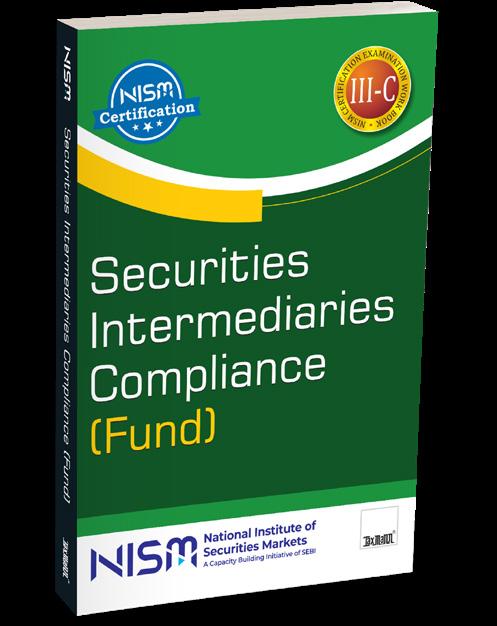
Securities Intermediaries Compliance (Fund) by NISM sets out the minimum common knowledge benchmark for persons discharging the compliance function at SEBI-registered fund-based intermediaries—Mutual Funds, Alternative Investment Funds (AIFs), Infrastructure Investment Trusts (InvITs), and Real Estate Investment Trusts (REITs).
It serves two purposes: it is the prescribed preparatory text for the NISM-Series-III-C examination, and it stands on its own as a working compendium of the statutes, regulations, codes of conduct, and SEBI frameworks a Compliance Officer consults in practice. Its distinctive approach is the lens it applies throughout—every statute and regulation is read from the standpoint of the Compliance Officer's obligations, independence, and reporting duties, tracing the full regulatory perimeter from the architecture of the Indian financial system down to the four product-specific regimes within a single, examination-aligned reference.
This book is intended for the following audience:
• Candidates Registering for the NISM-Series-III-C
• Compliance Officers and Compliance-Function Staff
• Associated Persons Required to Obtain this Certification
• Asset-Management, Trustee, Sponsor, and Investment-Manager Personnel
• Legal, Company-Secretarial, Audit, and Risk Professionals
• Students and Job Aspirants
The Present Publication is the January 2026 Workbook Version, developed in collaboration with the NISM Certification Team and Vatsalya Advisory Services LLP (Designated Partner, Mr. B. Renganathan). It is published exclusively by Taxmann, with the following noteworthy features:
• [Weightage-Aligned Sequencing] Content mirrors the official chapter-wise examination weightages, so study effort can be allocated against the marks each topic carries
• [Defined Learning Objectives] Every chapter opens with explicit Learning Objectives stating the competencies to be acquired
• [Chapter-End Review Questions] Each of the seventeen chapters closes with multiple-choice Review Questions for self-assessment in the actual examination format
• [Two-Part Modular Architecture] A clean separation of the generic regulatory foundation from the four intermediary-specific regulations, allowing independent revision of either block
• [Updated to 2026] Statutory and regulatory positions stated as of the January 2026 version, incorporating current SEBI master circulars and frameworks
• [Compliance-Officer Orientation] Appointment, independence, reporting lines to the Board and to SEBI, codes of conduct, and penal consequences of default treated as live functional requirements
• [Dual-Purpose Reference] Self-contained and equally usable for examination preparation and day-to-day compliance work