© All copyright with All India Federation of Tax Practitioners, Mumbai Price : ` 745 Edition : 2026 Published by : Taxmann Publications (P.) Ltd. Sales & Marketing : 59/32, New Rohtak Road, New Delhi-110 005 India Phone : +91-11-45562222 Website : www.taxmann.com E-mail : sales@taxmann.com Mumbai : 35, Bodke Building, M.G. Road, Opp. Railway Station, Mulund (W), Mumbai - 400 080 Mob. +91-9322247686, 9619668669, 7045453844/45/51 E-mail : sales.mumbai@taxmann.com Regd. Office : 21/35, West Punjabi Bagh, New Delhi-110 026 India Printed at : Tan Prints (India) Pvt. Ltd. 44 Km. Mile Stone, National Highway, Rohtak Road Village Rohad, Distt. Jhajjar (Haryana) India E-mail : sales@tanprints.com Disclaimer Every effort has been made to avoid errors or omissions in this publication. In spite of this, errors may creep in. Any mistake, error or discrepancy noted may be brought to our notice which shall be taken care of in the next edition. It is notified that neither the publisher nor the AIFTP or seller will be responsible for any damage or loss of action to any one, of any kind, in any manner, therefrom. It is suggested that to avoid any doubt the reader should cross-check all the facts, law and contents of the publication with original Government publication or notifications. No part of this book may be reproduced or copied in any form or by any means [graphic, electronic or mechanical, including photocopying, recording, taping, or information retrieval systems] or reproduced on any disc, tape, perforated media or other information storage device, etc., without the written permission of the AIFTP. Breach of this condition is liable for legal action. For binding mistake, misprints or for missing pages, etc., the publisher’s liability is limited to replacement within seven days of purchase by similar edition. All expenses in this connection are to be borne by the purchaser. All disputes are subject to Mumbai jurisdiction only.
CONTENTS
PAGE
President Message Chairperson’s message (Indirect Taxation Publication Committee) About All-India Federation of Tax Practitioners (AIFTP) Indirect Tax Publication Committee About the Author
I-3 I-4 I-6 I-10 I-11
PART I ESSENTIAL ASPECTS OF GST LAW
1. 2. 3. 4. 5. 6. 7. 8. 9. 10. 11. 12. 13. 14. 15. 16. 17. 18.
Purpose of commercial contracts Assertions in allied laws Prejudice from audit disclosures Deemed supply Free-issue-material Discounts galore Employment contracts ESOP Corporate guarantee Effect of TDS on benefits-in-kind (194R) ISD not really mandatory Power self-assessment Limitations of Proper Officer Scrutiny Best judgment Audit Inspection Search
I-13
3 5 7 9 11 14 16 18 20 27 29 36 40 42 45 47 51 55
Contents PAGE
19. 20. 21. 22. 23. 24. 25. 26. 27. 28. 29.
Interest burden during litigation Confiscation barred without seizure Power of remand Prejudice of replying ‘without prejudice’ Purpose of rectification Appellate remedy Perils of revision Prepare for Tribunal Tribunal Procedures Remedies to legal heirs Conclusion
58 63 70 76 91 92 97 99 104 122 127
PART II DRAFT REPLIES TO EMERGING ISSUES
Form GSTR 1 v. Form GSTR 3B - Show Cause Notice
131
Form GSTR 2A (ITC) v. Form GSTR 3B - Show Cause Notice
137
Form GSTR 7 (TDS) v. Form GSTR 3B - Show Cause Notice
142
Belated Credit [Section 16(4)] - Show Cause Notice
146
Late fee [Section 47] - Show Cause Notice
150
General penalty [Section 125] - Show Cause Notice
153
Creditors [2nd Proviso Section 16(2)] v. Form 3B Show Cause Notice
155
E-way Bill [EWB] v. Form GSTR 3B - Show Cause Notice
159
Expenditure [Output Tax] v. Form GSTR 3B Show Cause Notice
164
Non-genuine suppliers [Input Tax Credit] - Show Cause Notice
170
Other income [Output Tax] v. Form GSTR 3B Show Cause Notice
176
I-14
Contents PAGE
Reverse Charge Mechanism [RCM] v. Form 3B Show Cause Notice
181
Form SPL 4 [Amnesty Scheme]
187
Mandatory CGST-SGST [Section 77] - Show Cause Notice
191
Form GSTR 2B v. Form GSTR 3B - Show Cause Notice
194
Demand of Interest only - Show Cause Notice
200
List of Cases
207
I-15
FORM GSTR 1 v. FORM GSTR 3B SHOW CAUSE NOTICE Sir, Sub: DRC6 reply to show cause notice – reg. Ref: (a) Shri. ……………… Proprietor: M/s ………………. (b) GSTIN…………………… (“Noticee”) (c) DRC1 No…………….dated……….. (d) Disputed Tax Period This is with reference to above referred show cause notice in Form DRC1 dated ……………received on or about…………. (‘Impugned SCN’) wherein the sole demand is for output tax totalling to Rs……………. along with interest and penalty under section 73/74 of Karnataka GST Act due to mismatch of data between GSTR-1 for the Disputed Tax Period and corresponding GSTR-3B. In this regard, it is submitted that the entire demand is disputed, and allegations rejected for being contrary to facts and to law on the following grounds: 1.
Noticee has discharged output tax in accordance with law and there is no output tax liability, whether on forward charge basis or reverse charge basis, that remains undischarged for Disputed Tax Period. Without any incidence of tax, demand for output tax based on data differences is violative of known tenets of taxation.
2.
Impugned SCN is issued after conducting audit under section 65 of Karnataka GST Act where all books of accounts and other records including tally back-up (soft copy) were made available which is duly acknowledged. In spite of the above, to make this demand citing nonavailability of information and detailed reconciliation
131
Practical guide to emerging areas in GST with draft replies to SCN
without making a written request that went unattended by Noticee is surprising as well as unjust. 3.
Impugned SCN does not state the statutory provisions needed to attract the incidence of tax such as (i) category of supplies as goods or services (ii) taxability of supplies (iii) HSN code (iv) time of supply (v) place of supply. Without these taxing ingredients, demand for output tax cannot be made based on guesswork, estimation and conjecture.
4.
Demand for output tax as CGST-SGST is violative of section 77 of Karnataka GST Act and section 19 of Integrated GST Act.
5.
With allegations in Impugned SCN being disputed by Noticee, burden of proof continues to remain on Revenue to demonstrate the incidence of output tax and hence validity of this demand. Without discharging this burden of proof, demand is not sustainable in law.
6.
Mismatch of data is itself erroneous for the reason that: (a) Data appearing in GSTR1 cannot be relied upon without excluding the deferment of adjustment permitted under section 37(3) of Karnataka GST Act; (b) Output tax liability appearing in GSTR1 must exclude liability discharged in earlier tax period; (c)
Output tax liability appearing in GSTR-1 must also exclude liability discharged in subsequent tax period and duly reported in GSTR-9 Part V where tax discharged is reported in Table 14;
(d) Output tax liability appearing in GSTR-1 must also exclude liability reversed and tax liability adjusted in subsequent tax period; (e)
Reporting of ‘net values’ and offline adjustment of ‘negative values’ permitted vide circular 26/26/2017-
132
Form GSTR 1 v. Form GSTR 3B - Show Cause Notice
GST dated 29 Dec 2017 must also be excluded which reads as: “4. It is clarified that as return in FORM GSTR3B do not contain provisions for reporting of differential figures for past month(SC), the said figures may be reported on net basis alongwith the values for current month itself in appropriate tables i.e. Table No. 3.1, 3.2, 4 and 5, as the case may be. It may be noted that while making adjustment in the output tax liability or input tax credit, there can be no negative entries in the FORM GSTR-3B. The amount remaining for adjustment, if any, may be adjusted in the return(SC) in FORM GSTR-3B of subsequent month(SC) and, in cases where such adjustment is not feasible, refund may be claimed. Where adjustments have been made in FORM GSTR-3B of multiple months, corresponding adjustments in FORM GSTR-1 should also preferably be made in the corresponding months.” (f)
While prohibiting any recovery action in respect of output tax based on mere data differences vide CBIC instructions 1/2022-GST dated 7 Jan 2022 reads as:
“3.2 There may, however, be some cases where there may be a genuine reason for difference between the details of outward supplies declared in GSTR-1 and those declared in GSTR-3B. For example, the person may have made a typographical error or may have wrongly reported any detail in GSTR-1 or GSTR-3B, Such errors or omissions can be rectified by the said person in a subsequent GSTR-1/ GSTR-3B as per provisions of sub-section (3) of section 37 of provisions of sub-section (9) of section 39, as the case may be. There may also be cases, where a supply could not be declared by the registered person in GSTR-1 of an earlier tax period, though the
133
Practical guide to emerging areas in GST with draft replies to SCN
tax on the same was paid by correctly reporting the said supply in GSTR-3B. The details of such supply may now be reported by the registered person in GSTR-1 of the current tax period. IN such cases, there could be a mis-match in the GSTR-1 and GSTR-3B (liability reported in GSTR-1 > tax paid in GSTR-3B) in the current tax period. Therefore, in all such cases, an opportunity must be provided to the concerned registered person to explain the differences between GSTR-1 and GSTR-3B, if any, and for short payment of non-payment of the amount of self-assessed tax liability, and interest thereon, before any action is taken under section 79 of the Act is taken for recovery of the said amount.” 7.
It is important to note that data for 18 to 20 months should have been considered to carry out any such data driven comparison for the conclusions to even be considered valid and prima facie reliable. By carrying out such a linear comparison, no demand is sustainable in law.
8.
Further, GSTR-21 data taken for comparison is itself not matching with data appearing in GSTR-9 Table 4N and 13 for the Disputed Tax Period. This data is also not matching with the GSTR-1 report downloaded by Noticee earlier for the Disputed Tax Period.
9.
GST being a self-assessment-based tax regime, Noticee is entitled to examine inward supplies and claim input tax credit based on satisfaction of vesting conditions and other restrictions. When burden in section 155 of Karnataka GST Act stands discharged, allegation based on data differences are contrary to law and demand would not be sustainable in law.
10. In the absence of any demand for output tax, demand for interest is not sustainable in law. 11. In the absence of any demand for output tax, demand for penalty is not sustainable in law without the required
134
Form GSTR 1 v. Form GSTR 3B - Show Cause Notice
animus. Any demand for penalty is subject to general discipline in section 126 of Karnataka GST Act which cannot be overlooked. Penalty cannot be imposed in a mechanical or routine manner without showing mala fides. 12. Impugned SCN could not be issued under section 74 of Karnataka GST Act without showing (i) which of the special circumstances needed exist and (ii) what were the gains that Noticee would stand to derive to support ‘evasion of tax’. In the absence of these special circumstances, Impugned SCN is bad in law. Reliance is placed on circular 185/17/2022-GST dated 27 Dec 2022. 13. Grounds on which any allegation is made in Impugned SCN cannot be altered, detracted from or improved in adjudication and above cited deficiencies in Impugned SCN will be fatal to support this demand and any deviation to salvage the demand will be in direct violation of section 75(7) of Karnataka GST Act. 14. Demand for output tax in Impugned SCN is contrary judicial authorities, namely: (a) Apex Court in Govind Saran Ganga Saran v. CST AIR 1985 SC 1041 where ‘four ingredients’ are held to be required in any proceedings to demand tax. (b) Nazir Ahmed v. King Emperor AIR 1936 PC 253 wherein it was held: “When a statute requires a thing to be done in a particular manner, it must be done in that manner or not at all.” (c)
CCE v. Brindavan Beverages (P) Ltd. [2007] 2007 taxmann.com 728/(213) ELT 487 (SC)
(d) Oryx Fisheries (P) Ltd. v. UoI 2011 (266) ELT 422 (SC).
135
Practical guide to emerging areas in GST with draft replies to SCN
RELIEF SOUGHT In view of the foregoing, there is no demand that remains undischarged and the demand in Impugned SCN is contrary to facts and to law. It is most respectfully requested that the entire demand be dropped in the interests of justice after granting opportunity for Noticee to be heard in person through an Authorized Representative. Request you to kindly acknowledge receipt of this reply and oblige.
136
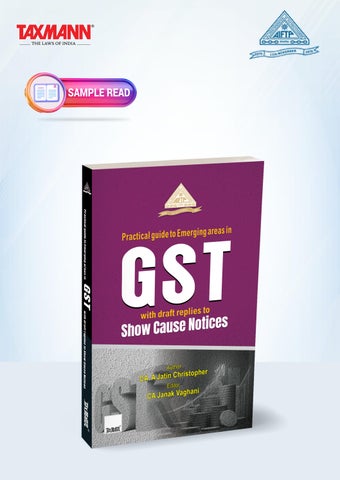
PRACTICAL GUIDE TO EMERGING AREAS IN GST WITH DRAFT REPLIES TO SHOW CAUSE NOTICES AUTHOR
: A Jatin Christopher, All India Federation of Tax Practitioners
Rs. 745/-
PUBLISHER
: Taxmann Publications
DATE OF PUBLICATION
: December 2025
EDITION
: 2026 Edition
ISBN NO
: 9789375618492
NO. OF PAGES
: 228
BINDING TYPE
: PAPERBACK
DESCRIPTION Practical Guide to Emerging Areas in GST with Draft Replies to Show Cause Notices is a focused, litigation-ready GST resource that goes beyond a conventional commentary. It identifies the precise areas where GST disputes are intensifying across audits, scrutiny, investigations, and adjudications, and provides a principled, evidence-based, draft-ready framework for defending taxpayers. The book is structured in two integrated parts: • Part I explains GST through first principles, case law, inter-statute comparison, and administrative law, clarifying not only what the law is but why certain departmental approaches are legally unsustainable • Part II translates these principles into carefully drafted replies to commonly issued SCNs, effectively bridging advanced legal analysis with practical drafting Together, the book equips readers to respond with clarity, authority, and procedural precision. This book is intended for the following audience: • GST & Indirect Tax Practitioners • Corporate Tax, Finance & Compliance Leaders • Litigators & Dispute-resolution Specialists • GST Officers & Administrators • Scholars & Advanced Students of Taxation The Present Publication is the Latest Edition, commissioned by the All-India Federation of Tax Practitioners (AIFTP) and published exclusively by Taxmann. It is authored by CA. A Jatin Christopher, edited by CA. Janak Vaghani, with the following noteworthy features: • [Advanced Coverage of High-risk GST Disputes] including deemed supply, discounts, cross-charge vs ISD, corporate guarantees, ESOPs, section 194R perquisites, fake ITC, section 16(4) credits, interest, confiscation, and jurisdictional lapses • [Clear Exposition of Departmental Powers & Limits] explaining scrutiny, audit, investigation, section 67 powers, "reasons to believe," proper officer jurisdiction, and defects in SCNs and authorisations • [Ready-to-use Draft Replies] supported by statutory provisions, CBIC circulars, and case law, covering return mismatches, ITC disputes, e-way bill issues, RCM, penalties, interest-only demands, amnesty replies, and non-genuine supplier allegations • [Built-in Litigation Strategy] addressing burden of proof, fatal SCN defects, misuse of' without prejudice,' and disciplined use of remand and revision • [Case-law Integration] with leading Supreme Court and High Court rulings embedded into analysis and drafting
BUY NOW