WWW.TAXI-POINT.CO.UK OVER SEVEN MILLION MAGAZINE READS AND COUNTING...
1 | TAXIPOINT | JANUARY 2026 | EDITION 81
THE UK’S #1 TAXI NEWS
Edition 81 | JANUARY 2026
IMAGE CREDIT: NUMBER 10 (CROWN COPYRIGHT UNDER OPEN GOVERNMENT LICENCE
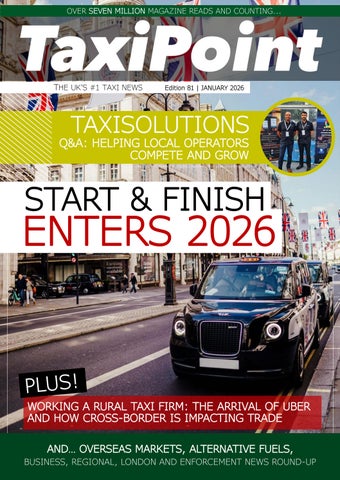
START & FINISH
ENTERS 2026
BUSINESS, REGIONAL, LONDON AND ENFORCEMENT NEWS ROUND-UP
2 | TAXIPOINT | JANUARY 2026 | EDITION 81
WWW.TAXI-POINT.CO.UK
3 | TAXIPOINT | JANUARY 2026 | EDITION 81
WWW.TAXI-POINT.CO.UK
FROM THE EDITOR PERRY RICHARDSON
TaxiPoint Chief Editor: Perry Richardson TaxiPoint Publishing & Advertising Manager:
INTERESTING YEAR AHEAD
Lindsey Richardson Visit us online at: www.taxi-point.co.uk Write to us at: contact@taxi-point.co.uk Advertising enquiries at: advertising@taxi-point.co.uk The publishers reserve the right to refuse, withdraw, amend or otherwise deal with all advertisements without explanation. All advertisers must comply with the British Code of Advertising practice. The views expressed in this publication are not necessarily those of the publishers. All written and image rights are reserved by the author as displayed. Reproduction in whole or in part without prior permission from the publisher is strictly prohibited. Copyright brand TaxiPoint 2026. Creative Common image licences displayed where applicable.
Beyond licensing, the regulatory net is tightening in other areas. Digital tax reporting under Making Tax Digital will Welcome to the January 2026 edition of TaxiPoint Magazine. As fundamentally change how many the new year begins, the UK taxi self-employed drivers manage their finances. Ride-hailing and private hire industry finds platforms are rolling out new VAT itself on the cusp of structural rules that could alter pricing and change that will shape how the trade operates for years to come. demand in the capital. Clean air policies continue to accelerate After a decade marked by the shift towards electric vehicles, fragmented regulation, uneven even as incentives are scaled enforcement and rapid technological disruption, 2026 is back. And, for the first time, emerging as a decisive moment. autonomous taxi trials are set to move from theory to live At the centre of the debate is the operation on UK roads. long-anticipated and talked about Stay tuned to TaxiPoint this year move towards national taxi and as we examine what these PHV licensing standards. With changes mean in practical terms Parliament’s Transport for the trade, and how 2026 may Committee expected to publish redraw the industry’s operating its findings early this year, and landscape. new powers already being lined up for regional authorities, the Happy New Year and be lucky, prospect of a single national baseline for safeguarding and accessibility appears closer than ever. That reform is tightly linked to the growing pressure to resolve cross-border hiring, a Perry Richardson practice that has undermined local regulation and frustrated TaxiPoint Editor and Founder councils and drivers alike.
4 | TAXIPOINT | JANUARY 2026 | EDITION 81
WWW.TAXI-POINT.CO.UK
WORKING A RURAL TAXI FIRM: SARAH IBBETSON DISCUSSES THE ARRIVAL OF UBER AND HOW CROSS-BORDER IS IMPACTING TRADE
T
Q&A
axiPoint spoke with Sarah Ibbetson, a rural taxi operator based in the Lake District, following her submission of written evidence to the Transport Select Committee as part of its inquiry into taxi and private hire vehicle licensing.
In your recent evidence supplied to the Taxi and Private Hire Licensing Inquiry, you describe Uber’s arrival in Cumbria as “almost cataclysmic”. What did that actually look like on the ground for you and other local drivers?
Ibbetson sets out how the arrival of Uber in Cumbria has affected local operators, outlining the commercial, operational and social consequences for a seasonal rural trade that relies heavily on summer income to remain viable year-round.
Last summer Uber arrived in Windermere. Dozens of out-of-area cars appeared for the summer months, offering bargain prices and undercutting our rates. They weren’t locals who had got their licences elsewhere. These were strangers, licensed in Wolverhampton and coming from Blackburn and
5 | TAXIPOINT | JANUARY 2026 | EDITION 81
WWW.TAXI-POINT.CO.UK
Preston. Lines of them parked on local roads overnight with seats tipped back and the drivers wrapped in sleeping bags.
Taxi drivers here are a valuable resource of local knowledge. Many visitors are complete newcomers, and we know our area well. We can recommend They had come for the quick profits of the summer activities for families. We know where disabled people can find appropriate walks. We are familiar trade. with local conditions. I might warn a customer that This is a major tourist destination, and summer a particular walk is likely to be very muddy, or that income is high. Thousands of people visit, and many stock have been moved into a field and to take care use taxis. We are kept very busy, as these drivers with their dog. I can tell stories about buildings and obviously knew. people, know history and can suggest good places to eat. However, we need those seasonal profits in order to keep our businesses operating over the quiet We deal with customers who have been drinking, winter months. There are not huge numbers of local especially at nights. Several times a week I pick up people, but they still need taxis, even when the customers who can’t remember what their hotel is tourists are gone. Hotels are open and their staff called and have to work it out from the information need to get about. The elderly need transport. they can remember. We always get people home. Children need to get to school. If we go out of business then that resource will be The influx of summer cash enables us to carry on lost. providing a service throughout the winter. Uber, of course, does not bother hanging about to provide a small-scale service for a handful of locals. One or two turn up at weekends, to profit from any remaining tourists, but they have mostly gone now and taken the summer profits with them.
The effect on us as a trade has been devastating. Turnover this year has dropped by more than 30%. There is a lot of winter still to go, and we are looking at an exceedingly bleak few months. The damage is not just financial, it is social and emotional. Drivers are working longer and longer hours in an attempt to make ends meet, and competition is becoming fierce for extremely scarce work. If we can’t survive then there will be no taxis here in winter. Taxis will become a summertime facility for tourists. Nobody wants that.
Local taxi drivers like yourself are vetted, tested on local knowledge, and monitored by the council. How does it feel competing against drivers who may never even have visited the area before turning up for the tourist season?
“IF WE CAN’T SURVIVE THEN THERE WILL BE NO TAXIS HERE IN WINTER. TAXIS WILL BECOME A SUMMERTIME FACILITY FOR TOURISTS. NOBODY WANTS THAT.”
6 | TAXIPOINT | JANUARY 2026 | EDITION 81
WWW.TAXI-POINT.CO.UK
Local knowledge is crucial here. Reliance on the You raise serious concerns about internet is ridiculously over-optimistic. enforcement being effectively impossible when vehicles are licensed hundreds of miles away. What do you think should be done? Ban out-of-area working. Enforcement is impossible. Out-of-area cars are hacking outside nightclubs and from any taxi ranks they find empty. There are no licensing officers around at two in the morning in Windermere, and six police officers cover all of South Cumbria. The system has worked because we are basically law-abiding and trustworthy. The cars that are flooding our area do not seem to care about the rules. When they think the police might turn up, they take off the plates and melt away. All we can do is email Wolverhampton, who might respond a week later, if at all. That doesn’t get the hacking driver off our ranks or give his illegally earned money to a local driver. It is lost forever. Even if our council is given powers of enforcement to use on them, who will pay for it? Our council has the income from three hundred drivers, why should they spend it on policing another hundred from Preston?
For many urban cabbies, mobile apps and card payment devices are used throughout the day. How does that differ where you work? There is not enough mobile signal in many parts of the Lake District for drivers to rely on mobile apps and card payment devices. We use them, and we are developing our own ride-hailing app, but they can’t form a realistic basis for a business here. It is not unusual for mobile phone masts to fail, sometimes for days at a time. When it happened last summer, Uber fell apart. Passengers were left stranded. Journeys had to be halted because the driver couldn’t find his destination. Uber drivers were flagging us, asking for directions.
Will a ‘one-size-fits-all’ National Standards system actively help rural taxi drivers? Not really, because one size doesn’t fit all, and I suspect that if we have a national minimum standard, suddenly every authority will only enforce that, and it will be a race to the bottom. Drivers must have local knowledge, which a national system is unlikely to enforce. They must not only not be criminals, they must be trustworthy. Passengers are utterly dependent on us. Much of the Lake District is remote and isolated, and many customers are already anxious, going to destinations where there are neither streetlights nor mobile phone signal. Proposals for minimum standards seem to me to be inadequate. At the moment, we have a first-class taxi service here, with knowledgeable, reliable, scrupulous operators, but it is coming under threat. I hope very much that the Government acts to preserve it.
7 | TAXIPOINT | JANUARY 2026 | EDITION 81
WWW.TAXI-POINT.CO.UK
8 | TAXIPOINT | JANUARY 2026 | EDITION 81
A
WWW.TAXI-POINT.CO.UK
WHAT THE UK TAXI MARKET COULD BORROW FROM OVERSEAS MARKETS
cross the global taxi and fleet operators are tightening sector, the most compliance and improving successful innovations passenger confidence through tend to be the ones that combine better data and more targeted operational discipline with digital regulation. infrastructure, rather than Japan remains the reference chasing novelty for its own sake. point for passenger-facing The UK’s licensed taxi and private service. Tokyo’s large fleet hire markets already have strong operators are known for foundations in safety and formal driver presentation accessibility, but international and strict conduct examples show how governments expectations, including suit-
and-tie dress codes and white gloves in many firms, with structured pre-shift routines that can include checks such as breathalysers before vehicles go
9 | TAXIPOINT | JANUARY 2026 | EDITION 81
LEVC AD
WWW.TAXI-POINT.CO.UK
10 | TAXIPOINT | JANUARY 2026 | EDITION 81
WWW.TAXI-POINT.CO.UK
out. For passengers, the verification, clearer audit trails experience is built around and, crucially for regulators, a consistency, clean vehicles and model where compliance can be predictable etiquette, down to monitored digitally rather than details such as rear doors that relying on resource-heavy street open automatically on many taxis, enforcement. discouraging customers from A UK parallel would be a more handling them. integrated national standard For UK drivers it’s not about copying uniforms, but about making service quality measurable and enforceable. A tighter link between licensing outcomes and real-world service standards could include more structured customer-service refresher training and fleet-level quality systems that mirror the way some Japanese companies treat taxi driving as a managed profession rather than solely an individual trade. The operational impact is seen to be lower churn, fewer incidents, and a product that is easier to sell to corporate accounts and transport passengers who value reliability over novelty. In Estonia, the headline innovation is not a single taxi app, but a national approach to digital public services that enables secure data exchange between government and business systems. The country’s X-Road interoperability layer is designed to let public and private databases exchange verified information securely, reducing the need for duplicate checks and paperwork. In transport, that same philosophy supports faster
incentives and coordinated deployment. The business relevance is that a full-fleet transition is less about vehicle technology and more about power supply, large scale depot charging facilities, downtime and financing models that keep drivers earning.
licensing data model across councils, addressing long-running For the UK, the biggest barrier is issues such as out-of-area working not vehicle availability, but and inconsistent enforcement charging access and the capacity. The UK does not need a economics for owner-drivers. single national licensing authority Overseas examples point to a to improve this, but it does need need for dedicated taxi charging better data sharing and faster infrastructure, predictable verification across boundaries. electricity pricing, and financing
Electrification is another area where overseas markets have moved from pilots to mandates. Shenzhen has been one of the most cited examples of largescale electrification in dense urban operations, with policydriven expansion of electric taxis alongside wider electric public transport efforts, backed by
that reflects high-mileage commercial use. A rapid EV transition without that backbone risks pushing costs onto drivers and shrinking supply at peak times, which is counterproductive for passengers and for cities trying to reduce car use.
11 | TAXIPOINT | JANUARY 2026 | EDITION 81
WWW.TAXI-POINT.CO.UK
Accessibility offers a different accessible street-hail vehicles. Safety innovations for women are model of regulatory innovation, This approach treats accessibility now being formalised in several where rules are structured as a system requirement, not an markets, though they remain around outcomes rather than optional fleet niche, and creates a constrained by driver supply. In aspiration. To be fair, London and compliance framework that can India, updated rules for cab other UK cities that mandate the be measured through dispatch aggregators have introduced use of 100% Wheelchair performance and trip data. gender preference options Accessible Vehicles (WAV) are The lesson from New York is that intended to allow riders, global market leaders in their own regulators can set clearer particularly women, to choose right. However, there remains a same-gender drivers when accessible service requirements decline in the overall number of booking. In the US, Uber has been while also supporting operators WAV taxis licensed in the UK as a financially where vehicle costs are piloting similar “Women whole. In New York City, the Taxi higher. In practice, it means Preferences” features in selected and Limousine Commission has cities, allowing women riders to moving from broad statements used a mixture of mandates and about inclusion to specific service request women drivers and financial support to increase levels, such as maximum waits for women drivers to prefer women WAVs, including rules applying to accessible vehicles, supported by passengers, with the option to for-hire vehicle bases and widen matching if waits are too data rather than anecdote. programmes supporting long. The operational reality is
12 | TAXIPOINT | JANUARY 2026 | EDITION 81
WWW.TAXI-POINT.CO.UK
that these features only work at to create widespread women-only new technology. Japan shows scale if more women are recruited provision overnight. Councils and how service culture can be and retained as drivers, and that operators can still support safety operationalised, Estonia shows requires safer working conditions, through stronger national how digital government reduces better facilities and predictable minimum standards and better friction, Shenzhen shows how earnings. incident reporting. fleet transition depends on infrastructure, and New York For the UK, the best-adapted The strategic point for the UK shows how accessibility can be version may be a mix of voluntary industry is that global best mandated through measurable features and targeted supplypractice increasingly sits at the requirements and funding. The building, rather than attempting intersection of regulation and UK can adopt the same mindset by treating licensing as a datadriven system, investing in shared enforcement capability across regions, and building infrastructure that supports the transition to cleaner vehicles without destabilising driver livelihoods.
13 | TAXIPOINT | JANUARY 2026 | EDITION 81
WWW.TAXI-POINT.CO.UK
14 | TAXIPOINT | JANUARY 2026 | EDITION 81
WWW.TAXI-POINT.CO.UK
10 ALTERNATIVE AND RENEWABLE FUEL CONCEPTS FOR THE LEVC TX Previously we have presented our bi-fuel evolution system for the LEVC TX. Developed in collaboration ARTICLE BY: with Prins Alternative Fuel Systems and HP Taxi, SBL-Automotive can present 10 alternative and this allows the adoption of Liquefied Petroleum Gas renewable fuel concepts for the LEVC TX. 10 fuels (LPG), biopropane, Compressed Natural Gas (CNG), that can be used by the range extender engine in and biomethane in place of using petrol as fuel for place of using petrol and further demonstrating the the range extender engine. scope of our bi-fuel evolution concept. LPG is an alternative lower carbon emission fuel Alternative fuels – alternatives to petrol which are and is a blend of propane and butane. Biopropane other non-renewable fuels. is a drop-in replacement for LPG and is a renewable net zero carbon emission fuel. CNG is composed Renewable fuels – made from renewable primarily of methane and is another alternative feedstocks and using renewable energy. lower carbon emission fuel. Biomethane is a dropIMAGE CREDIT: SBL-AUTOMOTIVE
15 | TAXIPOINT | JANUARY 2026 | EDITION 81
WWW.TAXI-POINT.CO.UK
in replacement for CNG and is a renewable net zero expand the refuelling infrastructure in parallel to carbon emission fuel. offering our bi-fuel evolution systems. Our bi-fuel evolution system is available now to evolve LEVC TXs so they can adopt these lower cost and lower carbon emission alternative fuels as well as lower cost and net zero carbon emission renewable fuels. LEVC TXs licensed by Birmingham City Council are permitted to adopt our bi-fuel evolution system and it is available now to adopt the use of LPG or biopropane fuels. This is available for both customer vehicles already licensed for use in Birmingham and also for rental taxis provided to Birmingham drivers by HP Taxi. We’re also in discussions with numerous other Licensing Authorities across the UK and hope to announce the availability of our bi-fuel evolution systems in other regions soon. We’re also working with LPG. biopropane, CNG and biomethane suppliers to
But these aren’t the only fuels than can be adopted for the range extender engine.
We have also previously presented further bi-fuel evolution concepts adopting hydrogen, hythane and ammonia. We are now presenting a further 3 bi -fuel concepts and presenting all 10 alternative and renewable fuel concepts together. Internal combustion engines don’t need to use fossil fuels. In fact, the internal combustion engine pre-dates the petroleum industry and early internal combustion engines used fuels which would now be called renewable fuels or biofuels e.g. plant based oils and derived alcohol products. The current political, legislative and environmental focus on lowering carbon or carbon dioxide emissions in all sectors of society and industry doesn’t actually require banning or moving away
16 | TAXIPOINT | JANUARY 2026 | EDITION 81
WWW.TAXI-POINT.CO.UK
from using internal combustion been made worldwide in numerous engines. Instead, to reduce or locations for decades. eliminate net carbon dioxide This is in contrast to the current emissions, you just need to change battery manufacturing industry with the fuel the engine uses! Nonis concentrated in a few global carbon dioxide emissions can be locations for both battery material eliminated through use of processing and battery production. modern advanced exhaust after The EU and US have no domestic treatment systems. A further battery material or battery concept we are also presenting production industries. The takes advantage of the traction geopolitical risk should not be battery of the range extender overlooked of them, effectively LEVC TX to heat the after relying on certain global regions for treatment system prior to and all their battery production. during a cold start and during Alternative and renewable fuels lower load engine operation, used in internal combustion engines improving and maximising are thus a robust alternative to an after treatment performance. otherwise planned battery EV only All of the 10 alternative and renewable fuels presented here can be made locally and sustainably within the country that the vehicles operate. Local production eliminates long distance transportation costs and adds security to the supply, independent of geopolitical factors. This logic applies to the internal combustion engine too which has
future for vehicles as both the internal combustion engines and renewable fuels can be made locally and globally.
DOES THE LEVC TX’S RANGE EXTENDER ENGINE NEED TO BE FUELLED BY PETROL? WE CAN THINK OF 10 REASONS WHY IT DOESN’T.
IMAGE CREDIT: SBL-AUTOMOTIVE
17 | TAXIPOINT | JANUARY 2026 | EDITION 81
WWW.TAXI-POINT.CO.UK
18 | TAXIPOINT | JANUARY 2026 | EDITION 81
WWW.TAXI-POINT.CO.UK
WHY THE 2017 ‘START OR FINISH’ RULE STILL SITS AT THE CENTRE OF THE CROSSBORDER HIRING DEBATE
W
hen Transport for London (TfL) set out its proposals to tackle cross-border hiring in late 2017, one idea quickly became the focal point of the debate: the introduction of a statutory requirement that every taxi or private hire journey must either start or finish in the area in which the driver and vehicle are licensed. Eight years later, that “start or finish” rule continues to dominate discussions among drivers, regulators and police, despite never being enacted.
another, often hundreds of miles away. The report said it was “unlikely that Parliament intended” for the law to be used in this way, particularly once app -based platforms enabled national dispatch with little regard for local boundaries. The proposed a-to-b or b-to-a rule known as ABBA was deliberately simple. A journey could begin in the licensed area and end elsewhere, or start elsewhere and finish back in the licensed area. What would no longer be permitted was vehicles operating all day, every day, entirely outside the authority that licensed them. TfL argued this would preserve flexibility while restoring a basic link between licensing, enforcement and local accountability.
In its submission to the Department for Transport’s Taxi and Private Hire Task and Finish Working Group, TfL argued that cross-border hiring had moved beyond a fringe issue and was actively undermining public safety and local licensing standards. The start or finish requirement was Crucially, the proposal was designed to work presented not as a silver bullet, but as the structural alongside national minimum standards and national anchor needed to make other reforms workable. enforcement powers. TfL warned that introducing At the time, TfL was explicit about the problem it was trying to solve. Drivers and operators were legally licensing in one authority while working almost entirely in
any one element in isolation would fail. Without a start or finish rule,
19 | TAXIPOINT | JANUARY 2026 | EDITION 81
WWW.TAXI-POINT.CO.UK
isolation would fail. Without a start or finish rule, Metropolitan Police described cross-border hiring enforcement officers would still be chasing vehicles as “the single largest risk to policing nationally” and licensed elsewhere. Without enforcement powers, a explicitly endorsed the logic of requiring journeys to start or finish rule would be meaningless. That start or finish in the licensed area. Whether there interdependence has proven to be one of the has been a change in their views is unknown as the reform’s biggest political obstacles. Met Police has not chosen to submit evidence to the ongoing Transport Select Committee Inquiry Eight years on, the same structural weaknesses remain and it has taken the shocking Casey Report around taxi and PHV licensing. However, other to reignite meaningful discussion on the topic again. police forces did highlight their concerns around safeguarding fault lines TfL identified some eight Local licensing officers still have little powers over out-of-area vehicles. Councils still bear enforcement years ago. costs without receiving licence fee income. Drivers continue to licence-shop between authorities with lower fees, faster processing or lighter conditions. The absence of a start or finish rule means there is still no legal trigger that clearly places responsibility back on the licensing authority benefiting from the fees. Support for the proposal has remained broad among regulators and police. In 2017, the
Local authorities outside London have also continued to reference the proposal as the most workable option. A start or finish rule would immediately reduce the number of vehicles they are expected to regulate without having trained or funded enforcement for. Opposition to the proposal has largely come from sections of the trade that have benefitted from the loophole. Some operators argue it would reduce
20 | TAXIPOINT | JANUARY 2026 | EDITION 81
WWW.TAXI-POINT.CO.UK
flexibility, harm cross-boundary business and increase red tape further. Those concerns were anticipated in the original TfL report, which proposed exemptions for specialist services such as chauffeurs, school transport and certain contracted work. TfL also suggested transitional arrangements and the ability for operators to hold licences in multiple authorities where genuinely required. Despite this, successive governments have not taken the proposal forward. Part of the hesitation has been legislative bandwidth, with taxi and private hire reform repeatedly deprioritised. There has also been reluctance to reopen a complex area of law involving nearly 300 licensing authorities, each with different standards, fees and political pressures.
Another factor is scale. Since 2017, private hire numbers have continued to grow, and app-based platforms have become even more embedded. What was once framed as a corrective measure is now seen by some policymakers as a potentially disruptive intervention in a much larger market. Critics argue that the longer reform is delayed, the harder it becomes to unwind entrenched operating models. Yet that same growth has strengthened the case for action. Issues TfL warned about in 2017, including congestion, emissions, declining driver earnings and uneven safety standards, are now central to national policy discussions. The start or finish rule remains one of the few proposals that directly addresses the geographical mismatch at the heart of those problems.
The persistence of the idea reflects its underlying logic. Licensing is local, enforcement is local and passenger expectations are local. Without a rule that ties daily operations back to the licensing authority, those systems remain misaligned. Eight years on, the debate has not moved on because the problem has not changed. As pressure builds for wider reform, including potential for stronger national standards, the start or finish proposal continues to resurface. Its longevity is less a sign of controversy than of unfinished business. Until the legal framework changes, the same arguments made in 2017 will continue to be made.
21 | TAXIPOINT | JANUARY 2026 | EDITION 81
WWW.TAXI-POINT.CO.UK
22 | TAXIPOINT | JANUARY 2026 | EDITION 81
WWW.TAXI-POINT.CO.UK
INSIDE TAXISOLUTIONS’ APPROACH TO HELPING LOCAL OPERATORS COMPETE AND GROW
A
IMAGE CREDIT: TAXISOLUTIONS
s competition intensifies across the taxi and private hire sector, operators are under growing pressure to stand out locally while keeping costs under control. TaxiPoint spoke to TaxiSolutions to understand how targeted digital marketing, from search visibility to reputation management, is being used by operators to win bookings, defend their patch against national apps, and build more resilient businesses. In this Q&A, TaxiSolutions explain where operators should be focusing their efforts and why digital strategy is now closely tied to day-to-day operations.
What does TaxiSolutions offer to the taxi & PHV industry? TaxiSolutions helps operators drive bookings and build a stronger local brand through practical, measurable digital marketing. In simple terms: we help you get found, get chosen, and get rebooked. Our work typically covers:
•
Reputation and review management to increase trust and conversion (especially on Google via ReviewMaster).
•
Campaign strategy for key revenue drivers like airport transfers, corporate accounts, events, peak-season travel, and app adoption.
•
Performance reporting that ties activity back to outcomes (calls, web enquiries, app clicks, quote requests), so you can see what’s working and what to adjust.
•
Social media management and content planning that keeps your brand visible week to week. The industry is competitive, margins can be tight,
•
Local SEO and website optimisation so you and customer expectations are high. Our job is to show up when people search “taxi near me”, remove the guesswork and build a consistent digital “airport transfer”, “7 seater”, “school run engine that supports real operations. taxi”, and other high-intent terms in your area.
23 | TAXIPOINT | JANUARY 2026 | EDITION 81
WWW.TAXI-POINT.CO.UK
24 | TAXIPOINT | JANUARY 2026 | EDITION 81
WWW.TAXI-POINT.CO.UK
vehicle options (especially 6/7/8 seaters), meet-and-greet, luggage space, late-night coverage, corporate travel, and “how to book” tutorials.
How important are social media and SEO today? They’re no longer “nice to have” — they’re how most customers decide who to book.
•
SEO captures demand that already exists. When someone needs a taxi now (or an airport transfer next week), they search. If you don’t appear on Google Maps and in local results, you’re invisible at the moment it matters most.
Images still matter, especially for clear service messages: pricing structures (where applicable), app download prompts, vehicle types, and seasonal campaigns.
•
Text is underrated when it’s helpful: local travel tips, event reminders, road closure updates, and simple Q&As such as “can I prebook at 4am?” or “do you do larger groups?”
•
Audio/podcasts are growing, but for most local operators they’re a “later” play. The faster win is using voiceover on short videos.
Social media builds familiarity and preference. People may not book from a post immediately, but repeated exposure builds trust. When they do need you, you’re the name they remember. Social also helps defend your patch against national apps by reinforcing what locals care about: reliability, coverage, and community presence. The strongest operators treat both as part of the same system: SEO brings high-intent traffic in, social builds trust and keeps your brand “top of mind”.
The key shift: don’t post “because you should” - post to answer common customer questions and remove friction from booking.
How can operators use technology to recruit drivers and customers? Recruitment and customer growth both improve when you treat them like funnels: target → capture → nurture → convert.
For driver recruitment, technology helps you:
IMAGE CREDIT: TAXISOLUTIONS
•
Run hyper-local recruitment ads (by postcode, radius, shift pattern, vehicle type).
•
Send candidates to a simple mobile-first landing page with clear benefits and an “apply in 60 seconds” form.
•
Use automation (email/WhatsApp/SMS) to follow up instantly, book interviews, and reduce drop-off.
Social media moves fast. What should operators focus on right • Track which sources bring the best drivers, so you spend budget where it works. now? For customer acquisition, technology helps you: Trends change, but the winners stay consistent: • clarity, trust, and relevance. Formats should support that. •
•
Short-form video (15–30 seconds) is currently the most effective for reach. It doesn’t need to be “influencer-style”. Quick clips that show real-life services work well: airport runs,
Improve conversion with a faster website, clear CTAs, and frictionless booking journeys. Promote app adoption with trackable links and campaigns focused on benefits (speed, convenience, booking history, priority in peaks).
25 | TAXIPOINT | JANUARY 2026 | EDITION 81
•
Use retargeting so people who visited your site or clicked your app link see you again when they’re ready to book.
•
Build business account pipelines through LinkedIn outreach, local landing pages, and targeted campaigns by sector (hospitality, construction, care, offices).
In both cases, the advantage is speed and consistency: the right message, to the right people, with follow-up that doesn’t rely on someone remembering to call them back.
How can digital reviews enhance reputation and trust today?
WWW.TAXI-POINT.CO.UK
people will pay a little more for confidence and reliability. Practical ways to use reviews: •
Generate them consistently: ask at the right moment (after a successful job) and make it easy with a direct link/QR code.
•
Respond professionally: polite, calm replies show accountability and reassure future customers.
•
Use reviews as content: testimonials, screenshots (with permission), and “what customers say about us” posts are high-trust marketing.
•
Spot operational insights: reviews highlight recurring issues (late pickups, booking friction, vehicle expectations) so you can fix root causes, not just optics.
Word of mouth still matters - it’s just become visible and searchable. A strong review profile (especially In a crowded market, reputation is often the on Google) acts like a public referral engine. It builds difference between being “one of many” and being trust before a customer even clicks your website. the operator people actively choose. For operators, reviews also reduce price sensitivity:
26 | TAXIPOINT | JANUARY 2026 | EDITION 81
WWW.TAXI-POINT.CO.UK
TOUGHER PENALTIES FOR CABBIES AND PHV DRIVERS FOR ILLEGAL NUMBER PLATES COULD FORCE COMPLIANCE RESET IN TAXI SECTOR
C
alls to increase including among licensed taxis. penalties for illegal Despite targeted enforcement, number plates are non-compliance remains high, gaining traction in Westminster, prompting questions over with MPs questioning whether whether current penalties are meaningful compliance in the taxi simply being absorbed as a cost and private hire sector can be of doing business. achieved without tougher Transport for London (TfL) sanctions that materially change enforcement data submitted to driver behaviour. the inquiry showed that 41 The debate follows the publication of the All-Party Parliamentary Group for Transport Safety report into vehicle registration plates, which found widespread use of ghost, stealth and cloned plates,
2023 onwards, subsequent checks still found 38 per cent of vehicles in breach, suggesting enforcement alone has delivered only limited improvement.
Under current rules, the use of an illegal plate typically results in a fine but does not carry penalty points, and vehicles are rarely seized unless linked to wider percent of licensed taxis checked offending. MPs involved in the using specialist ghost-plate inquiry detection cameras were found to have non-compliant plates. After more than 4,200 penalties were issued from July
27 | TAXIPOINT | JANUARY 2026 | EDITION 81
argue this weakens deterrence, particularly in parts of the trade where plate manipulation is used to avoid airport charges, congestion fees and road pricing schemes.
WWW.TAXI-POINT.CO.UK
The issue has taken on greater significance as the taxi and private hire industry faces wider scrutiny following the Casey Report, which highlighted serious safeguarding failures and called for higher standards of The APPG report recommends compliance and enforcement. increasing fines, introducing penalty points for illegal plate use Policymakers have warned that reforms aimed at improving and giving enforcement bodies passenger safety rely on the powers to seize vehicles ability to reliably identify licensed belonging to repeat offenders. vehicles, something undermined MPs say these measures would by widespread plate tampering. bring number plate offences closer in line with other vehiclerelated breaches that already attract licence endorsements and, in some cases, immediate suspension from licensed work.
enforcement. The report notes that many compliant operators feel disadvantaged when competitors use illegal plates to reduce operating costs while facing minimal consequences if caught.
The APPG argues that tougher penalties could act as a catalyst for a broader compliance reset across the sector, reinforcing the message that licensed status carries obligations as well as privileges. It also suggests that Licensing authorities have also stronger sanctions could make raised concerns that without reform of the plate supply chain stronger penalties, honest drivers self-funding, reducing the burden are being undercut by those on police and local authorities. willing to evade charges and
28 | TAXIPOINT | JANUARY 2026 | EDITION 81
WWW.TAXI-POINT.CO.UK
CAN TAXI DRIVERS LEGALLY PLAY MUSIC ON PASSENGER REQUEST? WHAT UK LICENSING RULES ACTUALLY SAY
W
hether a taxi driver Under the Copyright, Designs and can legally play Patents Act 1988, playing music at a recorded music outside of a passenger’s request is not as private domestic setting can straightforward as many in the amount to a public performance. trade assume. In the UK, the issue Taxis, private hire vehicles and hinges on copyright law and minicabs are commercial whether music played inside a environments, even though they licensed vehicle is classed as a are small and access is limited to public performance, which would the driver and fare-paying normally require a licence from passengers. This distinction music rights organisations. matters, because public
performance of music typically requires permission from rights holders, administered in the UK by PRS for Music and PPL. PRS for Music covers composers, songwriters and publishers, while PPL represents performers and record companies. Businesses that play recorded music publicly, including shops, offices and hospitality venues, usually need licences from these bodies. In
29 | TAXIPOINT | JANUARY 2026 | EDITION 81
principle, a licensed vehicle falls into the same category, as it is being used for commercial gain and passengers are members of the public rather than private guests.
The situation changes when passengers connect their own device to the vehicle’s audio system via Bluetooth or cable. In this scenario, the driver is not selecting, controlling or providing the music. The passenger is In practice, enforcement in taxis has historically been minimal, and effectively playing their own neither PRS nor PPL are known to privately licensed content from a actively target individual drivers. personal device. This significantly reduces risk for the driver, as the However, the absence of music is not being supplied as enforcement does not remove part of the service and the driver the underlying legal exposure. There is no blanket exemption in is not authorising or initiating the performance. While not tested copyright law that specifically allows taxi drivers to play music extensively in court, legal interpretations might consider through the vehicle’s sound this closer to private use by the system without a licence. passenger rather than a public Playing music in taxis sits in a grey performance by the driver. area of UK copyright law, with Many operators have quietly public performance rules, radio adopted this approach, either by exemptions and Bluetooth workarounds all carrying different leaving the audio system disconnected or explicitly levels of legal risk. allowing passengers to play their Radio broadcasts sit on slightly own music if they wish. From a firmer ground, but still not risk management perspective, without caveats. Playing the radio this is the safest option available in a workplace or commercial without obtaining a formal music setting is also considered a public licence. performance. Many businesses require a PRS and PPL licence to For drivers who wish to offer play radio stations audibly to staff music proactively, the only fully compliant route would be to hold or customers. Some limited exemptions exist, mainly for very appropriate PRS and PPL licences covering in-vehicle use. These small premises using domestic licences are not commonly radios at low volume, but these marketed to individual drivers are narrowly defined and not and would almost certainly be explicitly extended to licensed vehicles. As a result, a taxi playing disproportionate in cost and administration for sole traders, the radio for passengers could, which partly explains why uptake strictly speaking, still fall within across the sector is negligible. licensable use.
WWW.TAXI-POINT.CO.UK
Local licensing authorities generally do not police music copyright compliance, and conditions attached to taxi and private hire licences rarely address the issue directly. However, that does not override national copyright law, and complaints or disputes could theoretically expose drivers to claims.
For now, playing music on request remains widespread and largely unchallenged, but it is not risk-free. Allowing passengers to control their own audio via Bluetooth looks to offer the clearest mitigation, while relying on radio or driver-selected playlists sits in a legal grey zone that the industry has so far avoided confronting directly.
30 | TAXIPOINT | JANUARY 2026 | EDITION 81
BUSINESS NEWS
SHERBET MARKS DEPARTURE OF FOUNDING TAXI FLEET PARTNER LEE DRINKWATER IMAGE CREDIT: SHERBET
LYFT PLAN TO LAUNCH ‘DOZENS’ OF AUTONOMOUS VEHICLES ON FREENOW PLATFORM IN LONDON THIS YEAR AS PART OF TESTING
WWW.TAXI-POINT.CO.UK
Lyft has confirmed plans to begin testing autonomous vehicles in London this year through the Freenow platform, marking the first deployment of Baidu’s Apollo Go robotaxi technology in the UK and the wider region. The announcement was made by Lyft chief executive David Risher, who said riders in London would be the first outside Asia to experience Baidu’s autonomous vehicles operating within the Lyft and Freenow ecosystem. Initial testing is expected to start with dozens of vehicles, scaling to hundreds once regulatory approvals are secured. The programme will use fully electric RT6 vehicles developed by Baidu’s Apollo Go unit, which are purposebuilt for ride-hailing and designed to operate without a safety driver. Testing will take place pending approval from Transport for London and other UK regulators. Lyft said the rollout would form part of a hybrid network combining autonomous vehicles and human drivers, with the company positioning AVs as a supplement rather than a replacement to existing ride-hailing services. The firm said it is working closely with Transport for London and local stakeholders as part of the regulatory process.
Sherbet has confirmed that Lee Drinkwater, a founding partner and long-standing senior figure in its fleet operations, has stepped back from day-to-day involvement in the business, marking the end of a significant chapter in the company’s development. Drinkwater played a central role in the early formation and growth of Sherbet, helping to establish the operational framework and standards that underpin the business today. During his tenure, Drinkwater oversaw some of the largest licensed taxi fleets operating in London, with responsibility for between 700 and 800 vehicles at various points. His remit covered vehicle maintenance programmes, overhauls, MOT compliance, taxi production and fittings, meter installations, and the coordination of day-to-day driver support across the fleet. Asher Moses, Sherbet Founder and CEO, said: “Lee is a true operator and a man of integrity. He always believed in doing things properly, treating drivers fairly, and protecting the standards of the licensed London taxi. Building Sherbet alongside him has been an absolute honour.”
IMAGE CREDIT: FREENOW BY LYFT
31 | TAXIPOINT | JANUARY 2026 | EDITION 81
WWW.TAXI-POINT.CO.UK
HACKNEY SUPPORT FUND:
GREATER MANCHESTER TAXI DRIVERS URGED TO ACT QUICKLY AS £12,560 CLEAN CAB GRANTS OPEN
BOLT AND SINGLE HOMELESS PROJECT RAISE £100,000 THROUGH WINTER RIDE INITIATIVE
IMAGE CREDIT: LEVC
Bolt has raised £100,000 for the Single Homeless Project after running a week-long winter fundraising campaign across its London ridehailing network, targeting support for people facing homelessness during the coldest part of the year. Taxi drivers across Greater Manchester are being encouraged to move swiftly to secure up to £12,560 in grant support as part of the region’s £8 million Hackney Support Fund, with early indications showing strong demand from the trade.
contacted directly by email with application details. Funding is being allocated on a first-come, first-served basis, which has heightened urgency among some drivers keen to lock in support before the pot is exhausted.
London EV Company confirmed that all eligible drivers have now been
reducing the upfront cost of switching to a cleaner cab.
Once approved, drivers have The funding, delivered a four-month window to use through Greater the grant, a timeframe Manchester’s investment-led intended to keep vehicle Clean Air Plan, is designed to orders moving while giving help licensed hackney operators sufficient time to carriage drivers replace older, complete the purchase higher-polluting diesel taxis process. with zero-exhaust-emission The grant sits alongside capable vehicles. Drivers manufacturer support from selecting the LEVC TX as part LEVC, which has committed of their application can access up to £2 million in combined the full £12,560 grant, incentives for Greater representing one of the most Manchester drivers. These generous packages currently include extended warranties available to the taxi sector in and scrappage allowances on England. used TX vehicles, further
The Ride for Warmth initiative ran between 8 and 14 December 2025 as a dedicated ride option within the Bolt app. For each qualifying journey completed in London, Bolt donated £1 directly to the charity, allowing passengers to contribute without paying more for their trip. Single Homeless Project is one of London’s largest homelessness charities, supporting more than 10,000 people each year through accommodation, prevention services and recovery programmes. Winter and the festive period place added strain on frontline services, with higher demand for emergency shelter, food and cold-weather essentials.
IMAGE CREDIT: BOLT
32 | TAXIPOINT | JANUARY 2026 | EDITION 81
WWW.TAXI-POINT.CO.UK
UBER REVEALS THAT SERVICE FEES CAN REACH UP TO 49% IN UPDATED DRIVER TERMS
U
ber has confirmed in newly issued driver terms and conditions that its service fee can reach as high as 49 percent of a passenger fare, formalising in writing a charging structure that has long been debated by drivers, but rarely quantified so explicitly.
The revised terms state that Uber charges a service fee on a per-ride basis, calculated on the fare and any applicable fees or surcharges, excluding tips and certain third-party payments. The document specifies that this service fee may range from 3 percent to 49 percent, inclusive of VAT, depending on the trip and product type.
calculates its service fee, with the remainder paid to the driver as earnings for the journey. The percentage applied can vary significantly between trips, meaning drivers may see materially different effective take rates across a working day or week. Revised contractual wording sets out how ridehailing commissions are calculated and how much of each fare may be retained by the platform
The variability is driven by several factors, including journey length, demand levels, promotional discounts and incentive structures. Shorter trips or discounted journeys often attract higher percentage fees, while longer or higherUber does not describe the service fee as a value trips can result in a lower proportion being commission in the traditional sense. The company retained by the platform. This explains how fees says the fee does not directly represent the approaching the upper end of the stated range can amount it keeps from a driver’s fare. Instead, it is arise without being the norm for every journey. presented as a mechanism to cover a range of Drivers are informed in the terms that the service costs including platform operations, technology, fee percentage may be adjusted at Uber’s customer support, regulatory compliance, worker discretion and can differ between trips and benefits and applicable taxes such as VAT. products. Drivers can review weekly summaries in Under Uber’s model, passengers pay a total trip the driver app showing how much Uber retained price set by the platform. From that amount, Uber from rider fares.
33 | TAXIPOINT | JANUARY 2026 | EDITION 81
WWW.TAXI-POINT.CO.UK
OBI ANALYSIS SUGGESTS FESTIVE FARE VOLATILITY HAS FALLEN SHARPLY SINCE 2022 AS PLATFORMS MOVE TO LIMIT EXTREME PRICE SWINGS
R
ide-hailing price surges around New Year to customer frustration, Anburajan said, giving appear to be less severe than in previous platforms an incentive to smooth pricing in order years, according to new analysis from US- to retain users and protect demand. based pricing aggregator Obi, which shows a Obi’s analysis is based on hundreds of thousands steady decline in fare volatility during the holiday of rides booked through its app, which allows period. users to compare real-time prices across rideThe data covers the eight days from Christmas Eve to New Year’s Day and tracks pricing across major US ride-hailing platforms including Uber and Lyft. Obi found that the difference between high and low daily average fares has narrowed significantly over the past three years. In 2022, the variance stood at $7.91. That fell to $4.48 in 2023 and dropped again to $2.34 in 2024.
hailing services. The company argues that greater price transparency has itself become a constraint on aggressive surge pricing, as passengers can more easily switch between platforms. Separate research from the US National Bureau of Economic Research has estimated that New York City residents alone lose around $300 million a year by not comparing ride-hailing prices, highlighting the ongoing cost impact of fare differences even outside peak periods.
The findings suggest that ride-hailing companies have adjusted how they manage supply and demand during peak festive periods, reducing the While the data relates to US markets, the trend extreme surges that once characterised New Year may be of interest to UK and European regulators travel. Large fare spikes on New Year’s Eve have as scrutiny of ride-hailing pricing and consumer previously attracted public criticism and regulatory protection continues to intensify. scrutiny in several cities. Ashwini Anburajan, Chief Executive of Obi, said the week covering Christmas and New Year has historically combined high- and low-volume travel days, creating sharp pricing variability. She noted that the period also sees a higher proportion of riders with urgent travel needs, including people who would usually drive or use public transport. Unexpected surges or long waiting times can quickly lead
34 | TAXIPOINT | JANUARY 2026 | EDITION 81
WWW.TAXI-POINT.CO.UK
LONDON NEWS
THE KNOWLEDGE IS ON THE RISE! TFL MARKS 160 YEARS OF THE KNOWLEDGE AS APPLICATIONS RISE TO DECADE HIGH
T
ransport for London (TfL) has marked the 160th anniversary of the Knowledge of London, as new figures show applications to become a licensed London taxi driver are at their highest level in a decade following reforms to the qualification process.
committed candidates to progress more quickly through the system.
Data released by TfL shows the average time taken to complete the Knowledge has fallen from 5.25 years in 2020 to around three years in 2025. The authority said the reduction is the result of TfL said applications rose from 440 in 2022 to 742 measures set out in its Taxi and Private Hire Action by the end of November 2025, an increase of 68.6 Plan, which aims to support the trade over the next percent. The authority said the rise reflects renewed five years while ensuring service standards are interest in the profession and follows recent preserved. changes designed to make the Knowledge more Growing candidate numbers follow changes to the accessible while maintaining its long-standing Knowledge process aimed at speeding up requirements. qualification while retaining standards The Knowledge, first introduced in 1865, requires As of November 2025, there were 1,390 candidates applicants to memorise thousands of streets and actively undertaking the Knowledge. TfL said this points of interest across the capital. TfL said updates demonstrates a growing pipeline of future licensed to the process have reduced the time between oral taxi drivers at a time when the wider transport examinations, known as appearances, allowing sector is competing for skilled workers.
35 | TAXIPOINT | JANUARY 2026 | EDITION 81
The origins of the Knowledge are widely linked to concerns in the mid-19th century over drivers’ poor geographical understanding of London, with some historians pointing to complaints during the Great Exhibition of 1851. Candidates, traditionally referred to as knowledge boys or knowledge girls, spend months or years navigating the capital to learn routes in detail.
WWW.TAXI-POINT.CO.UK
including 72-year-old Peter Laszlo from Fulham, who passed after learning routes by bicycle, and 20year-old Connor Dill from Bromley, the youngest candidate to pass this year, who will qualify when he turns 21.
Helen Chapman, Director of Licensing and Regulation at TfL, said: “The Knowledge of London is the most respected taxi driver qualifications in the Academic research by University College London has world, and we are proud to see a renewed interest previously found that licensed taxi drivers develop a in this London icon during its 160th anniversary larger hippocampus, the part of the brain associated year. The recent increase in applications reflects the with memory and navigation, as a result of enduring prestige of becoming a licensed London mastering the Knowledge. taxi driver. This is a fascinating, varied career where, as your own boss, you choose where and when to TfL highlighted recent examples to illustrate the work.” breadth of candidates entering the profession,
BLACK CAB BOOST: RACHEL REEVES SAYS VAT RULE CHANGE WILL ALLOW LONDON BLACK CABS TO ‘COMPETE FAIRLY ON PRICE FROM 2026’ The Chancellor has said changes to VAT rules announced at the Budget will allow London’s black taxi drivers to compete more fairly on price with large online minicab operators from 2026, after years of what the trade describes as distorted competition.
reform would mean “traditional cab drivers will be able to compete fairly on prices in 2026”.
“Everyone should pay their fair share of tax,” Reeves said in the post. She added that the Government was “changing the rules so that large online minicab companies are unable to benefit unfairly from a niche tax scheme”, and said the
long argued that the use of TOMS by large app based operators created an uneven market. They say competitors were able to undercut prices not through lower costs or better efficiency, but through tax treatment that was never intended for urban taxi services.
The reference is to the removal of access to the Tour Operators Margin Scheme, a specialist VAT regime designed for genuine travel and holiday businesses, which some private hire platforms had In a video shared on social media, Rachel Reeves is used to significantly reduce the VAT paid on fares. seen speaking with Steve McNamara while sitting in By accounting for VAT only on profit rather than the the back of a London black cab. The post full fare, the scheme could cut the effective tax rate accompanies her explanation of why the to around four percent. Government has moved to block private hire Black taxis are not able to add VAT to a metered operators from using the Tour Operators Margin fare, but are not exempt from VAT should they Scheme (TOMS). meet thresholds. Representatives of the trade have
36 | TAXIPOINT | JANUARY 2026 | EDITION 81
WWW.TAXI-POINT.CO.UK
LONDON CITY AIRPORT TO INTRODUCE £8 DROP-OFF CHARGE FROM 6 JANUARY
IMAGE CREDIT: LONDON CITY AIRPORT
London City Airport will introduce a new drop-off in a penalty charge notice. Airport guidance charge for vehicles using its forecourt from 6 makes clear that the drop-off zone is for January 2026, becoming the latest UK airport to immediate set-down only. monetise short dwell times at terminal kerbsides. Passengers being collected will be required to
Under the new structure, drivers will be charged £8 for stays of up to five minutes. After that, a £1 per minute fee will apply, with a maximum permitted stay of ten minutes. Blue Badge holders will be exempt from the charge.
use the airport’s Short Stay car park rather than the forecourt.
Black taxis will initially be treated differently. Before the charge is applied to licensed taxis, Transport for London (TfL) will run its annual The airport said the move is intended to support public consultation on taxi fares. That process its wider transport strategy, which aims to limit will include a proposal from London City Airport private car use. It stated that around two-thirds to formally include the drop-off charge within the of passengers already arrive at or leave the taxi meter, mirroring existing arrangements at airport using public or other sustainable other major London airports. transport modes, and the charge is designed to If approved, the change would mean black cab push that figure higher. drivers do not personally absorb the £8 charge, Traffic on the forecourt, which include taxis and with the cost passed transparently to passengers private hire vehicles, will be enforced using through the meter. This approach is already in automatic number plate recognition cameras. place at Heathrow and Gatwick for certain Drivers have been warned not to wait in vehicles airport access fees. or leave them unattended, as doing so may result
37 | TAXIPOINT | JANUARY 2026 | EDITION 81
WWW.TAXI-POINT.CO.UK
REGIONAL NEWS
CROSS-BORDER REFORM: CAMBRIDGESHIRE AND PETERBOROUGH MAYOR BACKS SHIFT OF TAXI LICENSING POWERS TO MAYORAL AUTHORITIES
T
he Mayor of Cambridgeshire and Peterborough, Paul Bristow, has called for taxi and private hire vehicle licensing powers to be transferred from local councils to mayoral combined authorities, arguing the existing framework is no longer fit for purpose and is driving standards down. In a letter to the Secretary of State for Housing, Communities and Local Government dated 23 December 2025, Bristow said the regulatory system governing taxis and PHVs had “well and truly passed its used by date” and was failing both well and truly been lost,” he said, adding that the passengers and drivers. He said the proliferation of situation “needs to end”. individual licensing authorities had created The Mayor pointed to Wolverhampton as a “unacceptable local variations” in vehicle quality, prominent example of how the system has emissions, accessibility and safety. evolved. The council has become the largest taxi licensing authority in England outside London, with Bristow argued that cross-border licensing in around 50,000 licensed drivers, despite the vast particular had encouraged a race to the bottom. majority living and working elsewhere. Bristow “With ‘cross border’ licensing, these local said this illustrated how regulatory shopping had variations have been a means of driving down become embedded in the market. standards to a lowest common denominator, rather than encouraging best practice,” he wrote.
Bristow said he was working with Greater Manchester Mayor Andy Burnham to press Under current legislation, hackney carriages can only operate in the area where they are licensed, ministers for legislative change through amendments to the English Devolution and while PHVs can be licensed by any authority and Community Empowerment Bill. He said the aim work anywhere in England. Bristow said this imbalance had broken the link between operators was to enable regional licensing bodies that could apply consistent standards and limit extensive outand the communities they serve. “The link between operators and the areas they work in has of-area operation.
38 | TAXIPOINT | JANUARY 2026 | EDITION 81
WWW.TAXI-POINT.CO.UK
39 | TAXIPOINT | JANUARY 2026 | EDITION 81
WWW.TAXI-POINT.CO.UK
CASTLE POINT BOROUGH COUNCIL UPDATES TAXI AND PRIVATE HIRE LICENCE PLATES AND LIVERY
A report to the Executive Board of Blackburn with Darwin Borough Council recommends no change to existing MOT testing arrangements for taxis licensed in the borough, keeping testing restricted to the council’s own vehicle testing facility.
Castle Point Borough Council has begun rolling out updated licence plates and vehicle livery for licensed taxis and private hire vehicles, introducing a new council logo across identification markings used by drivers operating in the borough.
Under the current system, licensed taxi drivers are required to use the council’s Motor Vehicle Service Station at Davyfield Road for all MOT tests. The authority says staffing at the site is flexed to allow initial tests and retests to be booked within 24 hours where possible, in an effort to minimise vehicle downtime for drivers. Executive councillors are due to consider the report at a meeting on Thursday 8 January 2026. The paper includes findings from a consultation held earlier this year, which invited views from taxi operators, licensed drivers and members of the public on whether current MOT testing arrangements should be changed.
the front and rear of the vehicle, alongside white door stickers carrying licence details and an illuminated roof light. Private hire vehicles retain yellow rear plates and do not display roof lights, with door signage reminding passengers that journeys must be pre-booked through a licensed operator.
The changes apply to both hackney carriages and private The council said the hire vehicles and are refreshed branding is intended to make it easier for designed to provide clearer passengers to identify visual reassurance to correctly licensed vehicles, passengers while reinforcing particularly during the busy the legal distinction between Christmas and New Year taxis that can be hailed on period. The council confirmed the street or at ranks and the new designs are now private hire vehicles, which being issued, with local must be booked in advance. hackney carriage driver Shaid Licensing teams nationally Shah among the first to have raised concerns in receive the updated plates. recent years about passenger Under the revised scheme, confusion, particularly during hackney carriages continue to peak trading periods. display white licence plates at
IMAGE CREDIT: CASTLE POINT BOROUGH COUNCIL
BLACKBURN WITH DARWEN SET TO RETAIN COUNCILONLY MOT TESTING FOR TAXIS & PHVS
40 | TAXIPOINT | JANUARY 2026 | EDITION 81
WWW.TAXI-POINT.CO.UK
41 | TAXIPOINT | JANUARY 2026 | EDITION 81
WWW.TAXI-POINT.CO.UK
MIDDLE FINGERS UP:
BLACKPOOL CABBIES REPORT LATEST WORRYING OUT-OF-AREA PRIVATE HIRE INCIDENT ON TAXI RANKS AMID ONGOING CONCERNS
A
Blackpool hackney carriage driver has reported a worrying confrontation involving an out-of-area private hire vehicle using a designated taxi rank, reigniting concerns over cross-border rules and enforcement in the resort town. The incident occurred on 21 December 2025 at the taxi rank adjacent to The Flying Handbag Bar, an allday bar and late-night venue in the town centre. The rank, which accommodates around eight licensed taxis, is clearly marked for hackney carriage use only, according to the driver who documented the incident.
IMAGE CREDIT: SUPPLIED ANONOMOUSLY
A locally licensed taxi driver said a private hire lawful under current national legislation when vehicle, licensed outside the area, remained parked bookings are taken by the licensing authority that on the rank for several minutes. When a hackney issued the operator licence, the use of taxi ranks by carriage driver asked the private hire driver to private hire vehicles is illegal. move on, the request was met with verbal abuse Drivers operating hackney carriages in the town say before the vehicle eventually left the rank. the problem extends beyond rank misuse, with The hackney carriage driver who photographed the alleged touting outside nightlife venues, takeaways vehicle said they were left shaken by the and transport hubs described as an everyday encounter. In an image shared with TaxiPoint, the occurrence. They argue that such activity private hire driver was seen grinning and swearing undermines both passenger safety and the local with two middle fingers up while being licensing framework. photographed, behaviour the driver said has Speaking to TaxiPoint, the driver said the rise of become increasingly common. app-based private hire platforms has further Local drivers say Blackpool is routinely “inundated” weakened local control, with licensing officers with private hire vehicles licensed by authorities struggling to police vehicles licensed hundreds of such as Wolverhampton and Knowsley, particularly miles away on a daily basis. at weekends. While cross-border working remains
42 | TAXIPOINT | JANUARY 2026 | EDITION 81
WWW.TAXI-POINT.CO.UK
EDINBURGH TAXI TRADE ANGER OVER LENIENT ONEWEEK SUSPENSION FOR ILLEGAL PRIVATE HIRE WORK
A
decision by City of Edinburgh Council to suspend a private hire driver for one week after he was found to have illegally plied for hire and overcharged a passenger has triggered strong backlash from Edinburgh’s licensed black cab trade. The case, heard by the council’s licensing subcommittee, involved private hire driver Mr Hassan, who was found to have picked up a passenger without a valid pre-booking, a core breach of private hire licensing conditions. Council officials imposed a one-week suspension, a sanction that trade representatives say fails to reflect the seriousness of the offence or deter similar behaviour.
Hackney carriage drivers and their representatives argue that illegal plying for hire by private hire vehicles has become routine across the city, particularly around taxi ranks and nightlife hotspots. They say weak penalties and limited visible enforcement have allowed unlawful activity to proliferate, creating unfair competition and increasing risks to passengers. Keith Auld, a licensed hackney carriage driver and representative of Unite in the region, wrote formally to councillors expressing “deep concern and genuine dismay” at the decision. In his letter seen by TaxiPoint, Auld said illegal plying for hire was “widespread and persistent” in Edinburgh and warned that a short suspension risked signalling that breaches carry minimal consequences. Auld also criticised comments made during the hearing by Councillor Neil Ross, who suggested
there may have been “confusion” around the breach. Auld said this was untenable given the driver’s seven years of experience, adding that prebooking requirements are among the most basic rules governing private hire operation. The timing of the suspension has also drawn criticism. Trade representatives say a one-week ban imposed in January, traditionally a quieter period for drivers, does little to act as a deterrent. They argue that comparable offences in England are often dealt with through the criminal courts, with fines running into hundreds of pounds and penalty points imposed. Concerns have also been raised about insurance and public safety implications. Hackney representatives are asking whether the council
43 | TAXIPOINT | JANUARY 2026 | EDITION 81
WWW.TAXI-POINT.CO.UK
considered that carrying passengers without a valid for work. When challenged, the driver reportedly booking may invalidate private hire insurance, swore at her before driving off. potentially exposing passengers to uninsured In a letter to council officials, association member journeys. They have also questioned whether the David Horsburgh said the episode illustrated how incident was referred to Police Scotland for illegal plying for hire had moved from being a consideration of any criminal offences. professional issue to a personal safety concern, Tensions were further heightened following a separate incident reported a week after the suspension hearing. According to a letter sent to licensing officials, the daughter of a clerk from the Association of Hackney Carriage Drivers of the City of Edinburgh was waiting at the Lothian Road taxi rank after a Christmas night out when a private hire vehicle allegedly entered the rank canvassing
particularly for women waiting alone at night. He said the recent suspension decision had reinforced perceptions within the trade that enforcement was ineffective and that the risk of meaningful punishment was low.
North Ayrshire Council has confirmed it will not make further changes to its taxi and private hire driver dress code following a formal review of how the standards have been applied since their introduction last year.
trousers, tops, footwear and outerwear, with jogging trousers, hoodies, football shirts, sandals and flip-flops among items explicitly banned.
A report presented to the council’s Licensing Committee on 10 December 2025 said the revised Standards of Dress, approved in September 2024, remain appropriate and effective, despite some breaches by a small number of licence holders.
Hackney carriage representatives are now seeking assurances from the council on what practical steps will be taken to increase enforcement around ranks and peak hours, and how confidence in Edinburgh’s taxi and private hire licensing regime will be restored.
The report states that between 31 October 2023 and 10 September 2024, before the revised standards came into force, 10 taxi drivers received verbal warnings relating to dress. Since the updated code was implemented, a further 19 drivers have been verbally warned for noncompliance.
The dress code applies when vehicles are operating Licensing committee told no changes are required as taxis or private hire cars and requires drivers to despite ongoing non-compliance among a minority be clean, tidy and dressed in a professional of drivers. manner. Specific requirements cover headwear,
44 | TAXIPOINT | JANUARY 2026 | EDITION 81
WWW.TAXI-POINT.CO.UK
ENFORCEMENT NEWS LIVERPOOL TAXI DRIVER REPORTED OVER TARIFF BREACH DURING TUNNEL ENFORCEMENT OPERATION IMAGE CREDIT: LCC LICENSING
POLICE SCOTLAND TAXI OPERATION PROMPTS TWO VEHICLE PROHIBITION NOTICES AND ONE CAB SEIZED Police Scotland officers in the North East have reported multiple safety and compliance issues during a joint taxi and private hire vehicle enforcement operation across Moray. The checks were carried out on Friday 19 December 2025 by Road Policing officers working alongside Moray Council Licensing and the Driver and Vehicle Standards Agency (DVSA). The operation focused on vehicle safety standards and driver licensing compliance. Fifteen taxis and private hire vehicles were inspected during the day-long exercise. Officers identified four vehicle defects, with two vehicles issued immediate prohibitions preventing further use due to safety concerns. One taxi was subsequently seized after being found in operation despite an existing prohibition notice, Police Scotland said. Driving a prohibited vehicle is a criminal offence and can invalidate insurance cover.
IMAGE CREDIT: POLICE SCOTLAND
A Liverpool licensed taxi severity of the defects or any driver has been reported for follow up enforcement using an incorrect tariff action. following a joint enforcement Despite the breaches operation at the Kingsway identified, Liverpool City Tunnel carried out by Council said the overall level Liverpool City Council of compliance among drivers licensing officers and Mersey and vehicles checked was Tunnels Police. high, with the majority The roadside operation took meeting licensing and place overnight and focused regulatory requirements. on fare compliance, vehicle A Liverpool City council standards and driver licensing Licensing spokesperson said: among taxis and private hire ”LCC Licensing joined Mersey vehicles using the tunnel. The Tunnels Police in a roadside council said the tariff breach Op last night at the Kingsway was identified during checks Tunnel. A high level of on licensed vehicles compliance was found in operating through the route. relation to licensed vehicles/ Alongside the tariff issue, licensing officers recorded a small number of vehicle defects, with notices issued where faults were found. No details were provided on the
drivers. An LCC Taxi driver reported for using the incorrect tariff and a small number of vehicle defects issued.”
45 | TAXIPOINT | JANUARY 2026 | EDITION 81
WWW.TAXI-POINT.CO.UK
BLABY AND WOLVERHAMPTON COUNCILS CARRY OUT FIRST JOINT PRIVATE HIRE CHECKS IN CROSS-BORDER ENFORCEMENT DRIVE
A
joint taxi enforcement operation between Blaby District Council and City of Wolverhampton Council has resulted in multiple vehicles failing safety and compliance checks during a coordinated inspection exercise in Leicestershire.
IMAGE CREDIT: BLABY DISTRICT COUNCIL
Licensing officers from Blaby District Council worked alongside Wolverhampton counterparts, Leicestershire Police and the Driver and Vehicle Standards Agency (DVSA) to carry out unannounced roadside stops followed by in-depth undergo inspections every six months. The council has raised concerns that the growth of ride-hailing vehicle examinations. platforms has led to a sharp increase in vehicles Drivers were directed to attend Blaby District licensed elsewhere operating extensively within Council’s Whetstone depot, where each vehicle the district, without being subject to the same was subjected to inspections covering more than local oversight. 40 safety and mechanical checks. These included City of Wolverhampton Council has become one of seatbelts, switches, braking systems and the largest taxi and private hire licensing suspension components, reflecting the same authorities in England, with around 2,700 ridestandards applied to locally licensed vehicles. hailing drivers living in Leicestershire alone A total of 15 taxis were inspected, all of which licensed through Wolverhampton. That scale has were licensed by City of Wolverhampton Council made cross-border enforcement increasingly rather than Blaby. Of those, three vehicles were relevant for neighbouring councils. found to be fully compliant, while four were issued By involving Wolverhampton licensing officers advisory notices for minor defects. Enforcement directly, the operation allowed the issuing action was taken against the remaining vehicles authority to assess how its licensed drivers and that failed to meet required safety or licensing vehicles were performing outside their home area standards. and to take immediate regulatory action where Under Blaby District Council’s licensing conditions, standards were not met. taxis operating under its authority are required to
46 | TAXIPOINT | JANUARY 2026 | EDITION 81
WWW.TAXI-POINT.CO.UK
PHV LICENSEE MUST PAY £1,676 AFTER ALLOWING UNLICENSED AND UNINSURED SPEEDING DRIVER TO USE THEIR VEHICLE
A
private hire vehicle (PHV) owner has been fined £1,676 and handed eight penalty points after allowing an unlicensed and uninsured individual to drive the PHV, following a prosecution brought after a speeding offence earlier this year. The case was confirmed by PC Patrick Quinton, the Taxi Cop for Avon and Somerset Police, who said the matter stemmed from a speed limit offence detected in May 2025 involving a licensed PHV.
no insurance and permitting an unlicensed person to drive a private hire vehicle. The driver appeared before the court on 24 November 2025, where they were sentenced for both offences. The court imposed eight DVLA penalty points alongside a financial penalty and costs totalling £1,676.
PC Quinton confirmed that the case has now been referred to the relevant local authority licensing team for consideration of further action. Councils According to police, when the speeding offence was have powers to review, suspend or revoke private investigated, a licensed private hire driver who was hire driver licences where public safety or the registered keeper of the licensed vehicle, compliance concerns arise. nominated another individual as being behind the In a warning to the wider trade, PC Quinton said the wheel at the time. That person did not hold a case should serve as a reminder of the legal private hire driver licence, meaning they were not responsibilities attached to PHV licensing. He legally entitled to drive a PHV. cautioned drivers not to allow anyone else to drive Police said there was no evidence that the licensed driver was driving the vehicle themselves. As a result, prosecutors pursued charges for permitting
their licensed vehicle unless they hold the correct private hire driver licence, even if the individual is a family member.
47 | TAXIPOINT | JANUARY 2026 | EDITION 81
WWW.TAXI-POINT.CO.UK
RENTAL
MARKETING
APPS
APPS
OUTSOURCE
INSURANCE
CARD PAYMENTS
WWW.TAXI-POINT.CO.UK
VEHICLE SALES / RENTALS
FINANCE
48 | TAXIPOINT | JANUARY 2026 | EDITION 81