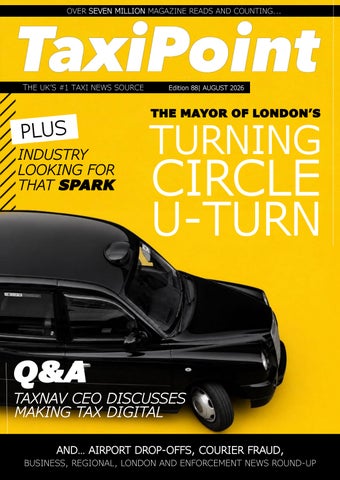
WWW.TAXI-POINT.CO.UK OVER SEVEN MILLION MAGAZINE READS AND COUNTING...
1 | TAXIPOINT | AUGUST 2026 | EDITION 88
THE UK’S #1 TAXI NEWS SOURCE
Edition 88| AUGUST 2026
THE MAYOR OF LONDON’S
INDUSTRY LOOKING FOR THAT SPARK
Q&A TAXNAV CEO DISCUSSES MAKING TAX DIGITAL
BUSINESS, REGIONAL, LONDON AND ENFORCEMENT NEWS ROUND-UP
2 | TAXIPOINT | AUGUST 2026 | EDITION 88
WWW.TAXI-POINT.CO.UK
3 | TAXIPOINT | AUGUST 2026 | EDITION 88
WWW.TAXI-POINT.CO.UK
FROM THE EDITOR PERRY RICHARDSON
KEEP YOUR EYES TaxiPoint Chief Editor: Perry Richardson TaxiPoint Publishing & Advertising Manager:
PEELED! operator or supplying the trade, there’s something for everyone in this month’s free digital edition.
Lindsey Richardson Visit us online at: www.taxi-point.co.uk Write to us at: contact@taxi-point.co.uk Advertising enquiries at: advertising@taxi-point.co.uk The publishers reserve the right to refuse, withdraw, amend or otherwise deal with all advertisements without explanation. All advertisers must comply with the British Code of Advertising practice. The views expressed in this publication are not necessarily those of the publishers. All written and image rights are reserved by the author as displayed. Reproduction in whole or in part without prior permission from the publisher is strictly prohibited. Copyright brand TaxiPoint 2026. Creative Common image licences displayed where applicable.
The latest edition of TaxiPoint Magazine has arrived and is packed with the latest stories, analysis and exclusive features shaping the UK taxi and private hire industry. From the future of London’s iconic turning circle and an in-depth look at what the industry needs to restore confidence, to a comprehensive Making Tax Digital Q&A with TaxNav CEO Paul Oldridge, Edition 88 covers the issues drivers, operators and businesses need to know.
TaxiPoint also has some exciting developments ahead. Over the coming months we will be launching a range of Premium Business Intelligence products designed to help businesses serving the taxi industry better understand and engage with the market. New packages will give SMEs greater opportunities to reach decision-makers and drivers across the trade with their products and services.
Keep your eyes peeled!
Alongside the headline features, Many thanks and be lucky, you’ll find the latest business news, licensing developments, enforcement updates and regional stories from across the UK, plus practical advice on tackling courier fraud, airport Perry Richardson drop-off charges, fleet investment and much more. Whether you’re TaxiPoint Editor and Founder behind the wheel, running an
4 | TAXIPOINT | AUGUST 2026 | EDITION 88
WWW.TAXI-POINT.CO.UK
LOOKING FOR THAT SPARK T
here is no shortage of potential turning points. National licensing reforms are being discussed. Cross-border hiring rules could be rewritten. Licensing authority boundaries may change. Manufacturers are preparing the next generation of purpose-built taxis. Drivers continue to wait for long-term electric vehicle grants aimed at wheelchair accessible taxis, while autonomous vehicle policy continues to evolve. Each of these developments has the potential to shape the industry’s future. Yet none has provided the certainty drivers, operators and manufacturers need before committing to their next major investment. That lack of confidence is becoming one of the biggest barriers to growth right now.
stretching well into the future. When nobody is quite sure what the market will look like in three, five or even ten years, hesitation becomes understandable. Much of the industry’s attention has focused on national licensing standards and reform of crossborder hiring. These issues have dominated discussions between local authorities, trade bodies and ministers, and rightly so. Greater consistency would improve confidence in the licensing system and reduce many of the tensions created by differing standards between authorities.
However, expecting legislative reform alone to deliver an immediate increase in driver numbers or trigger a wave of new vehicle purchases may be optimistic. Legislation creates the framework for long Buying a new taxi is one of the biggest financial -term stability rather than producing instant commitments many drivers will ever make. Training economic activity. Its greatest benefit may ultimately for a taxi licence requires months, and in some areas be for those considering entering the profession. even years, of commitment. Operators also invest in fleets, technology and staff based on expectations
5 | TAXIPOINT | AUGUST 2026 | EDITION 88
WWW.TAXI-POINT.CO.UK
Prospective drivers need confidence that licensing standards are settled, enforcement is consistent and the industry has a clear direction of travel. Before investing time and money into qualifying, they need to understand the rules they will be working under. At present, many instead see an industry still waiting for important decisions.
drivers are likely to remain cautious about investing tens of thousands of pounds in a vehicle expected to remain in service for many years.
Will autonomous services complement licensed drivers or compete directly with them? What protections will remain for licensed taxi services? How will purpose-built wheelchair accessible taxis fit within future transport strategies? Until those questions receive more definitive answers, many
wider package of confidence-building measures. Long -term government support for wheelchair accessible zero-emission taxis, together with commitments contained within the Mayor of London’s Taxi and Private Hire Action Plan, would help convert interest into purchasing decisions.
London may provide one opportunity to change that mood. The anticipated arrival of a new LEVC taxi could offer the positive signal many drivers have been waiting for. A new purpose-built black cab Licensing is only one part of the picture. Perhaps the would demonstrate continued manufacturer biggest unanswered question surrounds autonomous confidence in the licensed taxi market and could vehicles. Whether welcomed or opposed, the encourage drivers who have delayed replacing ageing technology continues to advance, but it remains vehicles. unclear how governments, regulators and licensing On its own, however, a new model is unlikely to authorities intend to integrate autonomous services transform investment. Drivers are more likely to alongside licensed taxi and private hire vehicles. place an order when a new vehicle is backed by a
6 | TAXIPOINT | AUGUST 2026 | EDITION 88
WWW.TAXI-POINT.CO.UK
Without that financial backing, enthusiasm may ageing vehicles. New applicants begin training. struggle to translate into sales, unless the cost of new Manufacturers commit to future products. Finance taxis is reduced. Drivers do not buy new vehicles becomes easier to justify because the long-term simply because something new reaches the outlook appears more predictable. showroom. They invest when the business case The UK taxi industry has repeatedly demonstrated its makes sense and when they believe the regulatory ability to adapt. It has embraced new technology, landscape will remain sufficiently stable throughout changing passenger expectations and increasingly the life of that vehicle. demanding environmental standards. A willingness to That is where political leadership has an important role. Every new government creates expectations that longstanding issues may finally be resolved. There is now an opportunity to provide the certainty the industry has been requesting for many years through clear decisions on licensing reform, autonomous vehicles and long-term support for accessible zero-emission taxis. Confidence is often overlooked as an economic driver, yet its influence is considerable. When confidence exists, businesses invest. Drivers replace
evolve has rarely been the problem. The catalyst that finally unlocks investment may not be a single announcement or one piece of legislation. Instead, it is likely to come from several complementary policies that together provide a coherent vision for the future of the sector. Until then, many drivers will continue to wait for the spark that transforms uncertainty into confidence.
7 | TAXIPOINT | AUGUST 2026 | EDITION 88
WWW.TAXI-POINT.CO.UK
8 | TAXIPOINT | AUGUST 2026 | EDITION 88
Q&A M
WWW.TAXI-POINT.CO.UK
PAUL OLDRIDGE TAXNAV CEO & FOUNDER IMAGE CREDIT: TAXNAV
aking Tax Digital (MTD) for Income Tax has now become a reality for hundreds of thousands of self-employed people across the UK, including many taxi and private hire drivers. With the first quarterly submission deadline fast approaching, there remains plenty of uncertainty around what the new system means in practice, who needs to comply and how drivers can make the transition as straightforward as possible. To help answer those questions, TaxiPoint is joined by Paul Oldridge, CEO and founder of TaxNav, a software business created specifically to simplify tax reporting for selfemployed taxpayers.
Paul founded TaxNav following a successful career in tax software development after selling his previous business. Recognising that HMRC’s Making submission, and it's rarely the whole income. A Tax Digital programme would fundamentally change cabbie's earnings usually come through at least three channels: app bookings, card payments taken the way Self Assessment is completed, he saw an in the cab, and cash off the rank, and none of those opportunity to create an affordable, easy-to-use three feed into each other automatically. People solution for the millions of taxpayers who do not think MTD is asking them to start keeping records. need complex accounting software. With 5 July Most drivers already have records, scattered across 2026 marking the end of the first quarter of the 2026/27 tax year, and taxpayers earning more than three different places. What MTD actually asks is for someone to pull those together and report them to £50,000 in 2024/25 now required to submit their first quarterly update by 7 August 2026, the timing HMRC on a fixed quarterly rhythm. That's the job that's been missing and the one that needs to be could not be more relevant. So let’s jump straight solved simply. in.
1. Biggest misconception?
2. Why is this sector so exposed?
Turnover decides whether you're in scope, not The one I hear most is that the job's already done because a booking app like Gett or Freenow already profit. The thresholds are public and HMRC will have informed you if you need to do it this year: but shows their fares. That's useful, but it's not a tax
9 | TAXIPOINT | AUGUST 2026 | EDITION 88
WWW.TAXI-POINT.CO.UK
anyone over £50,000 gross income is in from this without overclaiming expenses or double-counting April, that drops to £30,000 from April 2027, and platform fees. The drivers who did well weren't the £20,000 from April 2028. A driver running two apps most tech-confident ones. They were the ones who plus weekend cash work can clear £50,000 in fares picked a single place to bring everything together without taking home anywhere near that once fuel, early, instead of trying to reconstruct it the week vehicle finance, and platform commission come out. before the deadline. So drivers who'd never think of themselves as a "tax 4. Practical steps for drivers who know case" are walking into mandation now, and the next two thresholds bring almost everyone else in within MTD is coming? Work out which threshold catches you and when, three years. using the £50,000 / £30,000 / £20,000 staging 3. What has the pilot taught you? above, and check it against gross fares across all Being part of the HMRC pilot was hugely beneficial three income channels, not just what lands in the not just in refining the software experience, but in bank. Then pick one place where app payouts, card machine settlements, and cash jobs all feed in, now, understanding the issues and concerns users had. We had taxi and private hire drivers in the pilot and not in month two of mandation. Decide whether you're handling this yourself or with an accountant. the lesson was consistent. Digital record keeping was never the barrier for this group; drivers rely on The key thing is to choose a system and a software mobile apps for their work. What trips people up is now so you are comfortable you’ll be able to pull consolidation: turning three or four income sources the numbers together you need. Effectively all you need is a simple spreadsheet which matches what into one accurate figure, every three months,
10 | TAXIPOINT | AUGUST 2026 | EDITION 88
you write down or view, keep it in one place and you’re all set. Also you can just key the information in if that works better for you.
WWW.TAXI-POINT.CO.UK
drivers think about which one is right for them?
The price range is part of the confusion, not a 5. How different is quarterly reporting footnote to it. There are free tools built for VATregistered limited companies that don't suit a sole from Self Assessment? Self Assessment is one big annual reckoning. MTD IT trader cab driver, full accounting suites built for breaks that into four smaller updates of estimated people running payroll and stock, and everything in between. Most drivers don't need the expensive income and expenses, followed by a final end of that range. They need something built for declaration which will be like self-assessment but also will need to be through your chosen software, one job, getting accurate numbers to HMRC on time, four times a year, without forcing them to not HMRC. You're not expected to have polished, learn a bookkeeping system they'll never use the audited figures every quarter. You're expected to have a broadly accurate running picture, then tidy it rest of. That's deliberately where we sit. TaxNav isn't trying to replace Xero or Sage, it's built for the up at year end. The change is rhythm, not rigour: little and often, instead of one large push in January. people those tools weren't built for. We charge around £60 a year because the job we do is 6. Most common mistakes? genuinely smaller than full accounting software, and the price should reflect that. Treating the app payout as the full fare, when the booking platform's commission has already come off before it reaches you. Forgetting cash jobs because they don't sit on any statement at all. Mixing the mileage allowance with actual vehicle costs (you can only use one method, not both). And running personal and business spending through the same card, which makes untangling expenses at year end painful and error-prone.
7. How do you see AI, and Navi specifically, helping here? Navi is like your personal tax assistant. He fronts the technical and tax support built into TaxNav and 9. Looking ahead, what's your advice? makes it feel like a guide rather than a piece of Stop treating this as a deadline event and start software. His job is to point you to what needs doing, when, and where to go if you're not sure or treating it as a habit. The drivers who'll find this have a question. For a driver juggling two apps and easiest are the ones who build a five minute cash fares with no accountant, that's the difference quarterly check into their routine now, while it's still optional for them, rather than waiting until HMRC between feeling like you're on your own with this makes it compulsory. Once it's a habit, you stop and feeling like someone's pointing the way. noticing it. That's the whole point: you're sorted, 8. With so many MTD options out every quarter, without a January scramble.
there, from free tools to software costing hundreds a year, how should
11 | TAXIPOINT | AUGUST 2026 | EDITION 88
WWW.TAXI-POINT.CO.UK
12 | TAXIPOINT | AUGUST 2026 | EDITION 88
WWW.TAXI-POINT.CO.UK
T
he London black cab has long been defined For many within the trade, this is not simply a by more than its appearance. Accessibility, discussion about steering geometry. It is a debate purpose-built design and the ability to about what makes a London taxi different in an complete an exceptionally tight turning circle have increasingly competitive passenger transport combined to create a vehicle unlike almost any market. It also raises wider questions about how other taxi in the world. Now, one of those defining much value should be placed on preserving features characteristics is under review. that have helped distinguish the black cab for generations. Following a request from the Mayor of London, Transport for London is reviewing the capital’s long- Supporters of relaxing or removing the requirement standing turning circle requirement, reopening a argue that engineering compromises come at a debate that has surfaced whenever a new cost. Designing a vehicle capable of achieving the generation of taxis is discussed. The question is, famous turning circle places restrictions on chassis does the requirement still serve a practical purpose layout, steering components and overall vehicle in modern London? The answer, architecture. Greater design freedom could however, is far more potentially allow manufacturers to reduce complex. production costs, improve battery packaging, increase electric range or create a more efficient vehicle. Those arguments become more relevant as the industry waits for the next generation of purpose-built taxis. Much expectation now rests on LEVC’s forthcoming TX replacement. Drivers will judge it on affordability, operating costs, electric range and practicality at a time when confidence to invest remains fragile across much of the trade.
13 | TAXIPOINT | AUGUST 2026 | EDITION 88
WWW.TAXI-POINT.CO.UK
14 | TAXIPOINT | AUGUST 2026 | EDITION 88
WWW.TAXI-POINT.CO.UK
Purchase price has become one of the biggest Without those answers, the financial case remains issues facing drivers. Replacing a taxi represents largely theoretical. Equally, removing the one of the largest financial commitments many will requirement would mean giving up one of the few ever make. Rising vehicle costs, uncertainty characteristics that passengers immediately surrounding future grants for wheelchair accessible associate with London’s licensed taxis. Once such a electric taxis and ongoing questions over licensing defining feature is lost, it is unlikely to return. reform have all encouraged many drivers to delay The turning circle is not simply a piece of heritage. investment until there is greater certainty about the It continues to offer practical benefits across many future. parts of central London, allowing drivers to Against that backdrop, any proposal that could reposition quickly, negotiate narrow streets and genuinely lower vehicle prices deserves careful access ranks where larger turning circles can consideration. The challenge is that there is become a disadvantage. Although London’s road currently little public evidence showing exactly how network has evolved considerably, many much money would be saved by removing the experienced drivers still rely on that capability turning circle requirement. Would it reduce the throughout the working day. purchase price by hundreds of pounds, several There is also a broader commercial consideration. thousand pounds or only make a marginal London’s taxi trade increasingly competes against difference once development and certification costs private hire vehicles, ride-hailing platforms and, in are considered? the future, autonomous transport services. In that environment, retaining distinctive characteristics
15 | TAXIPOINT | AUGUST 2026 | EDITION 88
strengthens the case for purpose-built taxis rather than modified passenger cars. As competition increases, unique selling points arguably become even more valuable. That appears to be the view held by many drivers themselves. A recent survey conducted by the Licensed Taxi Drivers’ Association found that most respondents did not support removing the turning circle requirement. While opinions are not unanimous, the findings suggest there remains significant backing within the trade for retaining one of the black cab’s most recognisable design standards. The debate also exposes a wider challenge facing the industry. Ideally, London would have several manufacturers competing to supply purpose-built taxis. Greater competition could encourage innovation, improve specifications and place downward pressure on prices without requiring long-established vehicle standards to be relaxed.
WWW.TAXI-POINT.CO.UK
However, that level of competition depends on a healthy market capable of supporting multiple suppliers. Viewed in that context, the turning circle debate becomes part of a much larger discussion about the future of London’s taxi trade. If the next generation of taxis can deliver lower costs, greater electric range and modern design while retaining the features that have made the black cab globally recognised, the industry may avoid having to choose between tradition and commercial reality. There may never be complete agreement on the issue, and there may not be a single right answer. If removing the turning circle genuinely delivers substantial savings that encourage investment and strengthen the industry’s future, change may be justified. If the financial benefits prove modest, however, many will argue that one of the black cab’s defining advantages is worth preserving.
16 | TAXIPOINT | AUGUST 2026 | EDITION 88
WWW.TAXI-POINT.CO.UK
AIRPORT DROP-OFF CHARGE LEAGUE TABLE: WHICH UK AIRPORTS COST DRIVERS THE MOST AND WHERE CAN PASSENGERS SAVE MONEY?
P
assengers booking an airport taxi this summer could pay significantly different fares depending on which airport they are travelling to, as new RAC analysis highlights a widening gap between the UK’s most and least expensive terminal drop-off charges. The latest figures show London Gatwick and London Stansted jointly top the list as the UK’s most expensive airports for vehicle drop-offs,
charging drivers £10 to access terminal forecourts. Edinburgh and Bristol follow at £8.50, while Leeds Bradford, London City and Bournemouth each charge £8. For taxi drivers, these fees are an unavoidable part of the journey. Whether the fare is metered or fixed, the airport access charge is typically added to the passenger’s bill, meaning customers travelling to some airports can pay several pounds more before the taxi fare itself is even considered.
17 | TAXIPOINT | AUGUST 2026 | EDITION 88
WWW.TAXI-POINT.CO.UK
is even more expensive on a time basis, charging £8 for five minutes, making it the highest cost per minute at £1.60.
London Heathrow, Luton, Birmingham, Glasgow, Aberdeen and Southampton all charge £7, although the time allowed varies considerably. Heathrow permits no waiting, while Southampton offers up to 20 minutes, making it one of the better value options despite charging the same headline fee.
The figures also show some airports have held prices steady over the last year. Southampton, Liverpool John Lennon, East Midlands and Belfast City have not increased their charges, while London City introduced a drop-off fee for the first time, adding £8 to the cost of terminal access.
For professional taxi drivers carrying multiple At the other end of the table, Belfast City remains airport passengers each day, the difference the cheapest of the UK’s 20 busiest airports, between airports can quickly add up. A driver charging £4 for up to 10 minutes. Cardiff Wales completing several return trips to Gatwick or costs £4.50, while East Midlands and Belfast Stansted will pay almost double the access International each charge £5. Manchester charges compared with carrying passengers to charges £5.50 for five minutes, and both Belfast City, costs that are generally recovered Newcastle and Liverpool John Lennon charge £6. through the final fare paid by customers. While Manchester sits towards the cheaper end based on its headline fee, drivers receive only five minutes before extra charges apply. London City
IMAGE CREDITS: CORDIC
18 | TAXIPOINT | AUGUST 2026 | EDITION 88
WWW.TAXI-POINT.CO.UK
19 | TAXIPOINT | AUGUST 2026 | EDITION 88
WWW.TAXI-POINT.CO.UK
ADVERTORIAL ARTICLE
20 | TAXIPOINT | AUGUST 2026 | EDITION 88
WWW.TAXI-POINT.CO.UK
BUILT FOR THE DRIVER. BUILT FOR THE SHIFT. London black cab work demands a tablet into one TfL-compliant lot from the people who keep it setup. No juggling devices, no moving. Long hours, unpredictable trailing cables. Included as signal, payment systems that were standard: a FREE CCTV system and never designed with cab work in FREE 1-year meter rental. mind. The Curb System was built to "With everything coming through fix all of this, putting the tools one system, the day runs a lot drivers actually need into one smoother. I'm not switching purpose-built setup. between platforms or sitting around waiting for the next fare." – Scott Jerome, London black cab Card processing fees add up across driver a shift. On a typical £24 fare, Curb When signal drops, drivers save 21.6% on card processing fees compared to payments don't standard competitor rates. Across The Curb System is built with a full week, those savings are offline protection at its core. If meaningful.** signal drops, the transaction is
Save on every fare
**Savings based on competitor card processing rate of 3.75% + 20p per transaction.
Payments that don't wait for Monday Money earned on a Friday night or Saturday shift used to sit in limbo until the working week caught up. Curb drivers who opt into next-day payments see earnings land seven days a week before midday, including weekends. The cash is there while the moment still matters.
One screen. Everything you need. The Curb System brings the meter, payments, smart tipping, receipt printing and an 8.7-inch driver
Support at any hour Cab work doesn't run nine to five, and neither does Curb's support team. Round-the-clock assistance is available 24 hours a day, seven days a week, whenever you need it. "It feels like this system was built for cab drivers. Transactions are quicker, offline mode works perfectly, and I can focus on my passengers without worrying about tech issues.” – Stephen Jay, London black cab driver
Sign Up Now, Earn More
One Month Only: Sign Up Today captured locally through the meter and Get a £500 Sign Up Bonus!*
and settled automatically the moment connectivity returns. No declined card at the kerbside, no fares written off.
IMAGE CREDIT: CURB
Visit www.gocurb.co.uk/driver-sign -up to get started. For any questions, call 0333 666 1000 or email DriverServicesUK@gocurb.com. *Offer valid until 31st August 2026 and subject to change. Terms and conditions apply.
21 | TAXIPOINT | AUGUST 2026 | EDITION 88
WWW.TAXI-POINT.CO.UK
22 | TAXIPOINT | AUGUST 2026 | EDITION 88
WWW.TAXI-POINT.CO.UK
COURIER FRAUD: HOW TAXI DRIVERS ARE VITAL IN PROTECTING THE OVER 70’S BEING TARGETED ARTICLE BY: KHAQAN MUMTAZ
REPORT FRAUD PROTECT SERVICES CITY OF LONDON POLICE
T
REPORT FRAUD STATISTICS (2025) •
axi drivers play an important role in identifying suspicious activity and helping to protect individuals from losing further • money and high-value goods in courier fraud. This is because they are often one of the few people • who encounter victims whilst the fraud is in progress. This article aims to equip you with the valuable opportunity to build your knowledge and • confidence to recognise potential victims and intervene appropriately where necessary helping to prevent significant financial harm.
WHAT IS COURIER FRAUD? Courier fraud involves offenders contacting victims, • usually by telephone, falsely claiming to be from the police, a bank, or another trusted organisation. Victims are persuaded they are assisting in an investigation and are instructed to withdraw large sums of cash or purchase high-value items, which are then handed over to a “courier” who is part of the criminal network.
Those aged 70 or above make up the majority of courier fraud victims, with those aged between 76-96 years accounting for roughly 62% of all courier fraud reports. 46% of courier fraud victims in 2025 were women. Courier Fraud reports rose nearly 10% from 2024 to 2025, increasing from 1,721 reports in 2024 to 1,891 reports in 2025. From 2024 to 2025, the total financial loss to courier fraud victims who reported rose from £19.5 million to more than £21 million, with the average amount stolen per victim now around £15,311.08. London and surrounding regions account for around 65% of all courier fraud victims, with strong transport links enabling offenders to operate across neighbouring counties including Hertfordshire, Essex, Surrey and Kent.
23 | TAXIPOINT | AUGUST 2026 | EDITION 88
WWW.TAXI-POINT.CO.UK
24 | TAXIPOINT | AUGUST 2026 | EDITION 88
THE VITAL ROLE OF TAXI DRIVERS Taxi drivers can help to disrupt courier fraud. Victims of courier fraud often use local taxis to travel to and from the bank, bureau de change and jewellers as well as their homes.
Likewise, couriers also rely on taxis as they may arrive to towns and cities via train and hire a taxi from a rank to travel to a victim’s home in order to collect cash or valuables before returning shortly after to the train station. This means that taxi drivers are one of the few groups of people to witness unusual patterns of behaviour, in real time, leading to them being able to identity and help prevent an ongoing courier fraud.
HOW TAXI DRIVERS CAN HELP AND WARNING SIGNS TO LOOK OUT FOR
WWW.TAXI-POINT.CO.UK
QUESTIONS TO SUPPORT PASSENGERS If you have concerns, you are encouraged to sensitively ask:
Has anyone claiming to be from the police, your bank, or a fraud team asked you to withdraw or spend this money?
Have you been told you are assisting with a police or fraud investigation?
Has anyone advised you what to say or do while making this transaction?
Has someone arranged to collect money or items from you later?
Have you been asked to post money or valuables?
Remain vigilant for journeys involving potential couriers or vulnerable passengers.
If a customer answers “yes” to any of the above questions, they could be a victim of courier fraud.
Contact the Police on 999 if you believe you have picked up a suspected courier involved in fraud and state that you think a courier fraud is in progress – this will be treated as a priority.
Where appropriate, please remind customers that the police and banks will never ask members of the public to withdraw money, purchase goods, or assist with an investigation in this way.
If you believe a fraud is actively taking place and an Raise awareness among elderly passengers offender may be nearby, call 999 immediately and and note any unusual or repeat fares to state that you suspect a courier fraud in progress. banks, bureau de change, jewellers or similar WORKING TOGETHER TO PREVENT businesses.
HARM
Look out for elderly or vulnerable passengers Your role on the frontline of the community makes who appear anxious or distracted. you a powerful ally in protecting the public, Look out for passengers speaking on the particularly those most vulnerable, from this phone throughout the journey, especially if devastating crime. they are being instructed on what to do. We greatly value your support in helping to deliver Look out for requests to wait outside clear and trusted messaging, and in safeguarding premises briefly whilst large transactions those most at risk. take place. Thank you for your support. Look out for passengers requesting for quick If you would like further support, information or return trips to stations. guidance, please contact Business.Engagement@cityoflondon.police.uk.
25 | TAXIPOINT | AUGUST 2026 | EDITION 88
WWW.TAXI-POINT.CO.UK
26 | TAXIPOINT | AUGUST 2026 | EDITION 88
WWW.TAXI-POINT.CO.UK
‘FAMILY BADGE’ ARRANGEMENTS: THE ILLEGAL PRACTICE THREATENING PASSENGER TRUST AND SAFETY IN THE TAXI INDUSTRY
C
oncerns raised by taxi drivers in Dundee have brought attention to an issue many within the UK taxi industry say has existed for years but is becoming increasingly difficult to tackle.
Council has received complaints be, drivers and trade about individuals allegedly driving representatives in several licensed taxis without the licensing areas have privately appropriate driver’s licence. The expressed concerns that authority says it is aware of the economic pressures and limited allegations and that council enforcement resources may be officers, alongside Police creating opportunities for illegal activity. Allegations that licensed taxis are Scotland, carry out regular compliance checks on taxi ranks The alleged arrangements being driven by individuals who throughout the day and night. do not hold the required taxi generally involve a licensed driver’s licence, often referred to Although there is little published driver’s vehicle, badge or dispatch within the trade as “family badge” evidence showing how account being used by another arrangements, have prompted widespread the practice renewed calls for tougher may enforcement and stronger identity verification. According to a recent report by The Courier, Dundee City
27 | TAXIPOINT | AUGUST 2026 | EDITION 88
WWW.TAXI-POINT.CO.UK
person, often a family member or operating licensed vehicles. If an close associate, who has not been unlicensed individual is driving, licensed by the local authority. insurers may question whether cover remains valid depending on A licensed relief driver who has the circumstances, potentially been approved by the relevant exposing drivers, vehicle owners licensing authority can legally and passengers to significant drive the vehicle. However, financial and legal risks following someone using another driver’s credentials without holding their a collision. own taxi driver’s licence is operating outside the law.
to operate using another driver’s credentials. The increasing use of app-based dispatch systems could make technological solutions more practical, although any introduction of biometric verification would need to comply with data protection legislation and privacy requirements.
The practice can also place legitimate drivers at a commercial Enforcement remains one of the Taxi driver licensing is designed to disadvantage. Complying with taxi biggest challenges. Local licensing requirements involves ensure every person carrying authority licensing teams often ongoing costs, including licence passengers has passed the have limited resources, making it fees, medicals, DBS checks, necessary checks before entering difficult to carry out frequent insurance, vehicle testing and the trade. Depending on the roadside inspections or rank maintenance. Those operating licensing authority, this can checks. While councils and police illegally avoid many of these include enhanced criminal record have powers to investigate expenses while still competing for checks, medical examinations, allegations, illegal activity can be the same fares, creating an right-to-work verification, difficult to detect without uneven marketplace for drivers safeguarding training, driving intelligence from passengers, who comply with the rules. assessments and knowledge tests. operators or other drivers. These measures are intended to protect the travelling public and ensure drivers meet the standards expected of a licensed profession. When an unlicensed individual takes over that role, those safeguards are effectively bypassed. Passengers entering a licensed taxi expect the person behind the wheel to be the individual approved by the council. If that is not the case, public confidence in the licensing system can quickly be undermined. There are also important insurance considerations. Taxi insurance policies are generally based on licensed drivers
Trade representatives argue that Whether the issue is confined to a the issue is about far more than small number of cases or reflects commercial fairness. Unite has a wider problem is difficult to raised the matter with Dundee determine, as relatively few City Council licensing officers and prosecutions specifically linked to is seeking further discussions with so-called family badge Police Scotland, saying public arrangements are publicised. safety must remain the priority. Even so, the allegations highlight Among the measures suggested the importance of ensuring every are stronger identity verification licensed taxi is driven by the systems linked to dispatch individual who has been vetted technology, including facial and approved by the licensing recognition, alongside more authority. prominent identification displayed inside taxis so passengers can more easily verify who is driving them. Supporters believe these systems could make it far more difficult for someone
28 | TAXIPOINT | AUGUST 2026 | EDITION 88
WWW.TAXI-POINT.CO.UK
UBER’S £30-ANHOUR CLAIM CHALLENGED AS GMB SAYS DRIVERS’ EARNINGS NO LONGER MATCH SOARING COSTS
G
MB has challenged Uber’s claim that drivers are earning an average of £30 per hour, placing driver earnings at the centre of its latest discussions with the ride-hailing platform. In an update sent to members following a meeting with Uber recently, the union said the current fare structure remains “one of the biggest concerns” raised by drivers. GMB said members believe fares and overall earnings have failed to keep pace with increasing business costs, including fuel, insurance, maintenance and vehicle expenses. The union said it had called for a “fairer and more transparent fare
model”, including consideration of introducing a minimum permile rate for journeys.
Journey time calculations were also raised as an earnings issue during the meeting. While the union acknowledged that In its update to members, GMB distance estimates within the app said: “Fare Structure & Introduce are generally accurate, it argued a Minimum Per-Mile Rate. The that estimated journey times current fare structure remains often fail to reflect real-world one of the biggest concerns for traffic conditions, road closures drivers. Members feel fares & total earnings have not kept pace and major events. with increasing operating costs, According to GMB, these including fuel, insurance, inaccuracies have a direct impact maintenance, and vehicle costs.” on drivers’ income because time spent completing trips is not It added: “GMB has raised the always reflected in earnings. The need for a fairer and more transparent fare model, including union said: “Drivers should be consideration of a minimum per- fairly compensated for the time mile rate. GMB challenged Uber’s spent completing trips.” claim that drivers are earning on average £30 per hour.”
Long-distance trips outside a driver’s normal operating area also featured in the discussions.
29 | TAXIPOINT | AUGUST 2026 | EDITION 88
WWW.TAXI-POINT.CO.UK
30 | TAXIPOINT | AUGUST 2026 | EDITION 88
WWW.TAXI-POINT.CO.UK
CABBIES DITCH BUYING NEW CARS AS SOARING COSTS TRIGGERS HUGE SURGE IN DEMAND FOR USED VEHICLES, ACCORDING TO NEW THE TAXI CENTRE DATA Taxi and private hire drivers are have more than doubled. The increasingly opting for used figures point to a growing shift in vehicles as mounting operating buying habits as drivers look to costs reshape purchasing reduce upfront costs while decisions across the industry, continuing to meet licensing according to new data released by requirements. The Taxi Centre. The change comes as many The vehicle supplier says visits to its used vehicle pages have increased by more than a third over the past year, while enquiries for pre-owned models
competition for passenger bookings. Those factors are encouraging drivers to reconsider whether buying a brand-new vehicle remains the most commercially viable option.
The Taxi Centre says many drivers continue to face financial customers are instead choosing pressure from higher vehicle nearly-new or approved used prices, rising insurance premiums, models, allowing them to upgrade increasing maintenance and their vehicle at a lower cost to running costs, and tougher buying new without IMAGE CREDIT: THE TAXI CENTRE
31 | TAXIPOINT | AUGUST 2026 | EDITION 88
WWW.TAXI-POINT.CO.UK
compromising on passenger comfort, reliability or compliance with local authority licensing standards.
company Vertu’s network of "The volume of enquiries we're almost 200 dealerships, the receiving shows that affordability business says it can offer drivers a has become a major broader range of vehicles consideration. Professional alongside nationwide delivery and drivers are making commercial Among the vehicles attracting advice tailored to local licensing decisions about how best to interest is the Toyota Corolla invest their money in a Touring Sports, which remains a requirements. popular choice within the taxi and Stephen Porter, Branch Manager challenging economic environment. private hire sector due to its at The Taxi Centre, said: "What reputation for reliability, fuel efficiency and low running costs. The company said many nearlynew models offer similar levels of safety, technology and passenger comfort to new vehicles.
we're seeing is a significant change in buying behaviour amongst professional drivers.
“Drivers are looking for ways to manage costs while still providing a professional service and "Historically, many drivers would meeting the expectations of automatically look at purchasing a passengers and licensing new vehicle, but increasingly they authorities.”
The trend has prompted The Taxi Centre to expand its focus on approved used stock. By drawing on inventory from parent
are asking whether a carefully selected, high-quality used vehicle makes more financial sense for their business.
32 | TAXIPOINT | AUGUST 2026 | EDITION 88
WWW.TAXI-POINT.CO.UK
BUSINESS NEWS LONDON TAXI DRIVERS’ CHARITY FOR CHILDREN MARKS 98TH ANNUAL SUMMER OUTING WITH RETURN TO HERTFORDSHIRE ZOO
The volunteer-led charity said that almost 1,000 London schoolchildren, predominantly those with Special Educational Needs and Disabilities (SEND), have visited Hertfordshire Zoo through the annual outing over the last four years. Funded entirely through voluntary donations and delivered by volunteer licensed London taxi drivers, the LTCFC provides free outings, entertainment and equipment for children with special educational needs, disabilities and disadvantaged backgrounds. Drivers donate both their time and vehicles to transport the children, while sponsors help cover operational costs including fuel and event logistics. IMAGE CREDIT: LTCFC
CheckedSafe has appointed Dr Michael Galvin as its new Non-Executive Chairman, bringing more than four decades of experience across the road transport, taxi and private hire sectors to its board as the fleet compliance technology provider looks to accelerate its next phase of growth. The appointment comes as the company continues to expand its digital compliance and safety management offering across the transport sector. CheckedSafe said the move reinforces its commitment to stronger corporate governance, strategic expansion and continued innovation as demand for digital compliance tools grows. Dr Galvin joins the board with extensive commercial and boardlevel experience gained over more than 40 years in the road transport, taxi and private hire industries. He also recently became a Commissioner at the Independent Transport Commission, contributing to discussions on the future direction of transport policy.
IMAGE CREDIT: CHECKEDSAFE
The London Taxi Drivers’ Charity for Children (LTCFC) has completed its 98th annual summer outing, taking a convoy of London black cabs to Hertfordshire Zoo for the fourth consecutive year as part of one of the capital’s longest-running charitable traditions.
CHECKEDSAFE APPOINTS DR MICHAEL GALVIN AS NON-EXECUTIVE CHAIRMAN TO SUPPORT EXPANSION
33 | TAXIPOINT | AUGUST 2026 | EDITION 88
WWW.TAXI-POINT.CO.UK
34 | TAXIPOINT | AUGUST 2026 | EDITION 88
WWW.TAXI-POINT.CO.UK
UBER ENDS SEVEN-YEAR LONDON EV DRIVER FUNDING SCHEME WITH FINAL LUMP-SUM PAYMENT OFFER Uber has confirmed it is bringing its London EV Assistance programme to an end, marking the close of one of the company’s key financial incentives designed to encourage private hire drivers to switch to fully electric vehicles.
provided they meet the programme’s final eligibility requirements. To qualify, drivers must complete 150 trips in a fully electric vehicle within an eight-week period by 31 August 2026. The final lumpsum payments will then be processed automatically on 10 September 2026.
Drivers who are not currently using an electric vehicle but intend to switch can still qualify by moving to a fully electric vehicle and completing the required The ride-hailing platform said number of trips before the the scheme, introduced in deadline. However, drivers 2019, had achieved its who do not switch to an EV or primary objective of fail to meet the trip supporting “tens of requirement will lose access thousands” of drivers with to any remaining EV the transition to electric Assistance funding. Uber said vehicles while reducing rental those funds will instead be and ownership costs. The redirected towards future company now says that most initiatives aimed at of the available funding has encouraging drivers to adopt been distributed. electric vehicles. Drivers who still have EV The announcement Assistance remaining will no represents the end of a longer receive monthly significant chapter in Uber’s payments. Instead, Uber will electrification strategy in convert any remaining London. entitlement into a single upfront lump-sum payment,
TOYOTA AND UBER EXPAND EUROPEAN PARTNERSHIP TO WIDEN ACCESS TO ELECTRIFIED VEHICLES FOR RIDEHAIL DRIVERS Toyota Motor Europe and Uber have announced a new European partnership aimed at making it easier for ride-hailing drivers and fleet operators to access electrified vehicles through integrated vehicle, finance and insurance packages. The programme has begin rolling out across 10 European countries, including the UK, before expanding to additional markets. The initiative brings together Toyota Motor Europe, Toyota Financial Services, Toyota Insurance Services and KINTO Europe to provide drivers with preferential terms on new and approved used Toyota and Lexus vehicles, alongside flexible financing, leasing and usagebased insurance. Rather than focusing solely on batteryelectric vehicles, the partnership reflects Toyota’s multi-pathway strategy by offering hybrid, batteryelectric and approved used vehicles. The approach is intended to accommodate varying charging infrastructure, operating costs and working patterns across different European markets. Leonardo Carluccio, Toyota Motor Europe Vice President of Sales, said: “Professional drivers need electrified vehicles that work for them economically as well as operationally.”
35 | TAXIPOINT | AUGUST 2026 | EDITION 88
THISTLE CABS GROUP NAMED AYRSHIRE HOSPICE CHARITY PARTNER FOR 2026 Thistle Cabs Group has been announced as a charity partner of Ayrshire Hospice for 2026, with the taxi operator supporting the charity through a programme of fundraising activities across the year. According to Ayrshire Hospice, the partnership has already seen Thistle Cabs staff and supporters take part in coffee mornings, raffles and the Glasgow Kiltwalk, raising money to support the hospice’s services. More fundraising events are planned over the coming months. Stephanie Clark, Manager at Thistle Cabs Group, said: “Our partnership with Ayrshire Hospice as our winning charity for 2026 has been something we’re incredibly proud to be part of.
“Through the generosity of our customers, the dedication of our team, and the support of our local community, we’ve been able to raise valuable funds for a cause that touches so many lives. It’s been an honour to support the outstanding work the hospice does every day.” IMAGE CREDIT: AYRSHIRE HOSPICE
WWW.TAXI-POINT.CO.UK
CAB MY RIDE LAUNCHES LONDON ON-DEMAND SERVICE AS FIRM TARGETS CAPITAL EXPANSION Cab My Ride has launched its on-demand transport services across London as part of a wider UK expansion strategy, while beginning a major recruitment campaign for licensed private hire drivers and operators across the capital. The Hampshire-based transport operator and technology provider said the move marks one of the most significant developments in its growth, extending its presence beyond the South Coast where it has established operations serving airport transfers, cruise passengers, NHS transport, home-to-school services and corporate travel. The company says it has built a network serving thousands of travellers, travel agents, businesses and public sector organisations across the UK. It currently manages thousands of airport and cruise transfer bookings each month through Heathrow, Gatwick, London City Airport and Southampton Port. Arjan Sahota, Managing Director of Cab My Ride, said: “Our expansion into London represents one of the most important milestones in our company’s history. “Over the last six years, we have built a trusted transport network supporting airport passengers, cruise travellers, NHS staff and patients, schools, businesses and travel partners. London provides a huge opportunity for both our business and the drivers and operators who choose to work with us. “We have invested heavily in technology, support teams and partnerships to create a platform that helps drivers access additional work while providing passengers with a reliable and professional service.”
36 | TAXIPOINT | AUGUST 2026 | EDITION 88
WWW.TAXI-POINT.CO.UK
LONDON NEWS
DEMAND MOVES SOUTH OF THE RIVER: GREENWICH TOPS LONDON LEISURE TRAVEL GROWTH AS TAXI AND PHV DEMAND SHIFTS SOUTH EAST
F
reenow by Lyft data shows Greenwich recorded the strongest year-on-year increase in taxi and private hire trips, while Shoreditch continued to attract high passenger volumes.
attract visitors despite growing competition from newer leisure areas.
While Greenwich recorded the strongest growth, Shoreditch remained one of the capital’s busiest destinations, posting a further 12% increase in trip volumes. The East London district continues to
passenger demand alongside emerging neighbourhoods.
The data also pointed to increasing demand for destinations outside the West End. Peckham recorded a 13% rise in journeys, while Clapton saw The mobility platform said taxi and private hire trips increase by 12%. Nearby Deptford also vehicle (PHV) trips to and from Greenwich increased continued its upward trend, registering growth of by 27% during the first six months of 2026 more than 7%. compared with the same period in 2025. The figures More established visitor destinations continued to suggest more passengers are travelling beyond perform steadily. Notting Hill recorded a 6% London’s traditional entertainment districts in increase in journeys, Covent Garden grew by 5%, favour of emerging social and hospitality hotspots and the South Bank saw a 3% rise, indicating that across South East London. central London continues to generate strong
According to Freenow by Lyft, the figures are based on taxi and private hire journeys made between
37 | TAXIPOINT | AUGUST 2026 | EDITION 88
January and June 2026 compared with the same period a year earlier. The data reflects changing consumer habits as London’s food, drink and entertainment scene becomes more geographically diverse.
WWW.TAXI-POINT.CO.UK
Garden continue to draw crowds, we are seeing a surge into neighbourhoods like Greenwich, Peckham, and Clapton as Londoners explore new night time venues, restaurants or bars.”
He added: “Whether you’re heading to a rooftop Danny O’Gorman, UK General Manager at Freenow bar in Peckham, checking out the markets in by Lyft, said: “London’s social scene is so dynamic. Greenwich, or catching a flight to Heathrow, our The thousands of taxi and private hire trips map out drivers are ready to get you there safely and where in the city’s people are moving. While efficiently.” traditional locations like Shoreditch and Covent
TFL CONSULTS ON BANNING ALL SALVAGE VEHICLES FROM LONDON’S TAXI AND PRIVATE HIRE FLEET Transport for London (TfL) has launched a consultation proposing to ban all salvage vehicles from London’s licensed taxi and private hire fleet as part of wider efforts to improve passenger and driver safety. Under the proposals, any vehicle that has previously been recorded as salvage by insurers would no longer be eligible for a taxi or private hire vehicle licence. The changes would apply regardless of whether the vehicle had been professionally repaired and returned to the road. TfL says the move supports commitments set out in its Taxi and Private Hire Action Plan 2025, which aims to improve safety across the capital’s licensed fleet while supporting London’s Vision Zero ambition to eliminate deaths and serious injuries on the transport network. If approved following consultation, the changes are expected to come into force in autumn 2026. The consultation remains open until Sunday 13 September 2026.
The proposal would affect vehicles previously classified under insurance salvage categories S and N, which are currently permitted to return to the road after appropriate repairs and inspections. Category S vehicles have suffered structural damage, while Category N vehicles have sustained non-structural damage that may still affect important safety systems such as steering, brakes or airbags.
38 | TAXIPOINT | AUGUST 2026 | EDITION 88
WWW.TAXI-POINT.CO.UK
REGIONAL NEWS WELSH LABOUR PRESSES NEW GOVERNMENT TO REVIVE TAXI AND PHV BILL AS REGION FACES CROSSBORDER LICENSING CONCERNS
W
elsh Labour leader Ken Skates has called on the new Welsh Government to revive plans for a taxi and private hire vehicle Bill after the proposed legislation was left out of the First Minister’s initial law-making programme. Speaking in the Senedd on 14 July, Skates said he had expected the programme announced by First Minister Rhun ap Iorwerth to include legislation covering the taxi and private hire vehicle sector.
Skates argued that the need for legislation had increased since the White Paper was published. He said: “Since the White Paper, the need for this legislation has only increased. There’s no doubt about it.” He also pointed to advances in vehicle and booking technology as another reason for the Welsh Government to review the regulatory system.
“We now live in an age of rapidly evolving technology, particularly with regard to The previous Welsh Labour Government automation, that will fundamentally change how developed proposals through a White Paper people across Wales work, how they travel and intended to modernise taxi and private hire vehicle therefore how they use taxis and private hire regulation across Wales. The work included vehicles,” Skates said. measures designed to address cross-border hiring, He added: “This legislation, I believe, will only where drivers and vehicles licensed by one become more relevant and necessary as the pace authority operate mainly in another council area. of change continues to increase, and I’d urge the Skates told the Senedd: “Another Bill I’d hoped to see in today’s statement was a taxi and private hire vehicles Bill, which, as many Members will know, was developed as a white paper under the Welsh Labour Government.”
Government to give this matter close consideration.”
The First Minister did not directly respond to the taxi and private hire vehicle proposal during his reply to Skates. His statement covered the He said the legislation would have provided a Government’s first phase of legislation, framework to regulate the sector and tackle cross- understood to span roughly the first 18 months of border activity, which he described as “particularly the Senedd term, while leaving open the possibility prevalent in Cardiff and Newport”. of adding further Bills later.
39 | TAXIPOINT | AUGUST 2026 | EDITION 88
WWW.TAXI-POINT.CO.UK
40 | TAXIPOINT | AUGUST 2026 | EDITION 88
YELLOW TAXI RULE COULD FACE THE AXE AS HARTLEPOOL BOROUGH COUNCIL LAUNCHES CONSULTATION
WWW.TAXI-POINT.CO.UK
TAXI SHAKE-UP: CHELMSFORD PLANS BIGGEST LICENSING OVERHAUL IN YEARS WITH NEW ELECTRIC TAXI PUSH Chelmsford City Council is preparing a six-week consultation on a major overhaul of its Taxi Licensing Policy, aiming to strengthen safeguarding rules, modernise vehicle standards and reshape the future of the hackney carriage fleet.
Hartlepool Borough Council has opened a public consultation on plans to change its hackney carriage licensing policy by removing the long-standing requirement for licensed taxis to be painted or wrapped in a nonstandard shade of yellow. The council said it had received a request to amend the existing policy covering vehicle colour. Under the current rules, all hackney carriage vehicles “are required to be professionally painted or wrapped in a nonstandard production shade of yellow”. Hartlepool’s distinctive yellow taxis have formed part of the borough’s licensing policy for a number of years, helping hackney carriage vehicles stand apart from private hire vehicles. Removing the requirement could reduce costs for new vehicle owners entering the trade or replacing vehicles, as operators would no longer necessarily need to pay for specialist paintwork or vehicle wraps if the proposal is approved. The consultation is available through the council’s Your Say Our Future engagement platform and will remain open until Friday 28 August 2026.
The review, the first full update since 2021, reflects changes in national statutory guidance and local operational experience, with the council emphasising that protecting the public remains the core purpose of the licensing regime. A key proposal would see certain historic nonwheelchair accessible hackney carriage licences reissued only to fully electric taxis, ensuring any replacement vehicles remain electric to help modernise the fleet and reduce emissions.
The draft also updates vehicle age limits for both hackney carriage and private hire vehicles, strengthens safeguarding measures through enhanced DBS checks, expanded overseas criminal record checks and increased use of the NR3 register, and introduces clearer English language requirements for drivers.
41 | TAXIPOINT | AUGUST 2026 | EDITION 88
WWW.TAXI-POINT.CO.UK
Join TaxiPoint Premium to unlock more taxi and private hire industry news vital to your business. For just £4 per month you get all the latest exclusive Premium news and full unrivalled access to our Premium library. Join the Premium debate to stay one step ahead and to support the trade’s most trusted news source.
COULD FACIAL RECOGNITION STOP ILLEGAL TAXI DRIVING? THE TECHNOLOGY DIVIDING OPINION ACROSS THE TRADE As concerns grow over so-called ‘family badge’ arrangements, some within the taxi industry believe technology could help prove the licensed driver is the one actually behind the wheel.
TAXI INSURANCE COULD COME UNDER SCRUTINY IF UNLICENSED DRIVERS ARE FOUND BEHIND THE WHEEL IMAGE CREDIT: LA TRADING
MANCHESTER TAXI ADVERTISING NETWORK TO LAUNCH WITH 200-SCREEN ROLLOUT TARGETING PASSENGERS IN TRANSIT
‘ROBO-CABS’ FACE LONDON GRILLING AS TFL CHIEFS HAULED BEFORE ASSEMBLY TAKEME EXPANDS AGAIN WITH STS ACQUISITION AS SAWBRIDGEWORTH TAXI FIRMS COMBINE OPERATIONS FREENOW BACKS EARLIER INDUSTRY ENGAGEMENT WITH GOVERNMENT AT DFT POLICY EVENT IMAGE CREDIT: FREENOW
42 | TAXIPOINT | AUGUST 2026 | EDITION 88
WWW.TAXI-POINT.CO.UK
COUNCIL BLOCKS TWO PRIVATE HIRE LICENCE APPLICATIONS OVER UNDECLARED WOLVERHAMPTON HISTORY AND DRIVING OFFENCES
S
andwell Council has refused a new private that S.M. was a fit and proper person to hold a hire driver’s licence application after private hire driver’s licence. members found the applicant had failed to declare a previous licence refusal by City of Wolverhampton Council and omitted details of driving convictions during the application process. The decision was made by Sandwell’s General Licensing Sub-Committee at a meeting held on 27 April 2026. Members considered an application from a new private hire driver applicant identified only as S.M., who attended the hearing accompanied by his sister. During the hearing, councillors noted that S.M. had not declared on his Sandwell application that Wolverhampton Council had refused him a licence in September 2025 because of driving convictions. The committee also found that those previous driving convictions had not been disclosed on the application. The applicant further admitted committing another speeding offence, which had been dealt with through a speed awareness course. After considering the evidence, the Sub-Committee concluded that S.M. had been dishonest both during the application process and while giving evidence at the hearing. Members were reminded that the council’s licensing policy states that, in cases involving dishonesty, an applicant would not normally be eligible to apply for a licence until they have been conviction-free for a period of 10 years. The committee determined there were no substantial mitigating circumstances that justified departing from the council’s policy. Members also noted that private hire drivers occupy a position of trust and concluded they were unable to determine
As a result, the application was refused, with the applicant unable to reapply until after 27 April 2036 under the council’s policy. The applicant was advised of the right to appeal the decision to the Magistrates’ Court within 21 days. At the same meeting, the Sub-Committee also refused a second application from another prospective private hire driver, identified as M.U. Members found the applicant had failed to accurately declare why a City of Wolverhampton Council taxi licence had previously been revoked and had also omitted previous driving convictions from the Sandwell application. The committee again concluded the applicant had been dishonest and was not a fit and proper person to hold a private hire driver’s licence, meaning the individual will also be unable to apply again until after 27 April 2036 under the council’s policy.
43 | TAXIPOINT | AUGUST 2026 | EDITION 88
WWW.TAXI-POINT.CO.UK
NEW COUNCILS: HERTFORDSHIRE LOCAL GOVERNMENT SHAKE-UP TO RESHAPE HOW TAXIS ARE LICENSED ACROSS THE COUNTY
T
he Government’s decision to replace Hertfordshire’s existing two-tier council structure with four new unitary authorities is set to significantly change how taxi and private hire vehicle (PHV) licensing is managed across the county from April 2028.
While the announcement focuses on wider local government reform, it also has important implications for the taxi trade. Responsibility for taxi and PHV licensing currently sits with Hertfordshire’s ten district and borough councils. Once the new authorities are established, those licensing powers will transfer to just four councils.
new authorities will each inherit the licensing responsibilities of multiple existing councils. Hertsmere Council leader Councillor Jeremy Newmark welcomed the decision, saying: “I welcome the Secretary of State’s decision to create four new unitary councils across Hertfordshire. This is the model we at Hertsmere supported because it reflects the distinct economies in different parts of our county. “For Hertsmere, joining with Watford and Three Rivers creates an exciting opportunity. Together we can build on our internationally recognised film and television industry, strengthening our local economy, attracting further investment and creating new opportunities. This decision also protects localism by keeping local government close to local communities. “I look forward to working closely with our new partner councils to deliver a smooth transition by April 2028. Until then our focus remains on delivering high-quality services and supporting our residents and businesses.”
Under the plans, the new South West Hertfordshire The transition will begin following elections to the new authorities in May 2027. Councillors elected unitary authority will take over licensing duties then will operate in a shadow capacity before the currently carried out separately by Hertsmere Borough Council, Three Rivers District Council and new councils officially assume responsibility for all Watford Borough Council. Likewise, the other three local government services, including taxi and private hire licensing, on 1 April 2028.
44 | TAXIPOINT | AUGUST 2026 | EDITION 88
WWW.TAXI-POINT.CO.UK
ENFORCEMENT NEWS
TAXI LICENSING CHECKS CARRIED OUT IN WARRINGTON AS POLICE JOIN CROSS-BORDER ENFORCEMENT OPERATION
T
axi drivers were stopped and inspected in Warrington town centre as part of a joint enforcement operation involving Warrington Police, the force’s Road Traffic Unit, the Special Constabulary and officers from Wolverhampton Council’s Taxi Licensing team. According to Warrington Police, the operation focused on taxi rank checks to ensure licensed vehicles and drivers were operating safely and within the law. The force said the activity formed part of wider efforts to maintain public safety in the town centre. The involvement of Wolverhampton Council licensing officers reflects the continued use of cross-border enforcement, with many private hire vehicles working outside the authority that originally licensed them. Licensing officers have powers to inspect vehicles and work alongside police to identify potential breaches of licensing and road traffic legislation. Warrington Police said: “Several taxi stop checks were carried out to ensure vehicles and drivers were operating safely and legally.” The force added that officers also engaged with people across Warrington town centre during the evening, “helping to ensure everyone coming into the area is doing so safely and lawfully”, before stating: “We’re committed to keeping Warrington town centre a safe place for everyone.”
IMAGE CREDITS: CHESHIRE POLICE
45 | TAXIPOINT | AUGUST 2026 | EDITION 88
CROSS-BORDER TAXI CRACKDOWN SEES ONE VEHICLE TAKEN OFF THE ROAD DURING NUNEATON SAFETY INSPECTIONS
WWW.TAXI-POINT.CO.UK
MORE THAN 100 TAXIS STOPPED AS CARDIFF ENFORCEMENT TEAM ISSUES SUSPENSIONS, PENALTIES AND LAUNCHES TAXI AND PHV LICENSING PROBES
One taxi was suspended after officers discovered it had no working brake lights during a joint enforcement operation in Nuneaton. Licensing officers from Nuneaton and Bedworth Borough Council, supported by Warwickshire Police and City of Wolverhampton Council, inspected nine licensed taxis and private hire vehicles on 14 July. Six vehicles were fully compliant, while two others were issued with rectification notices for minor defects.
IMAGE CREDIT: WARWICKSHIRE POLICE
The councils said the operation was part of ongoing cross-border enforcement to ensure licensed vehicles are safe and legally compliant, regardless of where they are licensed. Councillor Shane Coates-Jarman, Portfolio Holder for Planning, Enforcement and Public Services at Nuneaton and Bedworth Borough Council, said: “I am pleased that we have been able to undertake another operation, helping to ensure public safety and make sure the taxi and private hire drivers working in our Borough and beyond are operating legally and with safe, roadworthy vehicles. “The vast majority of our drivers do the right thing, and I look forward to seeing more of these operations in the future.”
IMAGE CREDIT: SOUTH WALES POLICE
A multi-agency taxi and minibus enforcement operation in Cardiff led to three vehicle seizures, four taxi suspensions and four licensing investigations after 103 vehicles were stopped and inspected. The operation, led by the Cardiff and Vale Special Constabulary, involved local councils, the Driver and Vehicle Standards Agency (DVSA), HM Revenue and Customs (HMRC) and Community Safety teams.
seatbelt. Licensing officers also issued 25 formal warning notices, while DVSA handed out 11 fixed penalty notices for vehicle defects including faulty brakes, lighting faults and a diesel leak. One untaxed vehicle was also identified and taxed at the roadside.
Special Inspector Benjamin Johns said: “Those using taxis and minibuses to travel into and out of the Cardiff area deserve to do so with reassurance that the vehicles South Wales Police they’re in are safe, legal, and submitted four Traffic roadworthy. This partnership Offence Reports for offences working highlights how including driving without seriously we take the insurance, defective tyres public’s safety.” and failing to wear a
46 | TAXIPOINT | AUGUST 2026 | EDITION 88
PRIVATE HIRE DRIVER DISQUALIFIED AFTER COURT REJECTS CLAIM NON-UK MOTORIST WAS BEHIND THE WHEEL WHEN CAUGHT SPEEDING
WWW.TAXI-POINT.CO.UK
TAXI SEIZED AFTER GUILDFORD DRIVER ALLEGEDLY CAUGHT USING PHONE AND FOUND UNINSURED Surrey Police’s RoadSafe team says officers stopped the driver of a taxi in Millbrook, Guildford, after the motorist was seen allegedly using a mobile phone while driving. According to Surrey RoadSafe, officers then carried out further checks which “revealed the driver was not insured to drive”. Police said the taxi was subsequently seized and the driver has been summoned to appear before the courts.
PC Patrick Quinton, the ‘Taxi Cop’ for Avon and Somerset Police, has highlighted the outcome of a court case involving a private hire driver who was caught speeding in Chew Magna in September 2024. According to PC Quinton, the minicab driver claimed that a non-UK licence holder had been driving the vehicle at the time of the offence. However, police challenged the account and the case proceeded to Bath Magistrates’ Court. On 15 July 2026, magistrates rejected the driver’s explanation and sentenced him to a six-month driving disqualification. The court also ordered him to pay £604 in fines and costs. As a result of losing his driving licence, the individual is no longer licensed as a private hire driver. Reflecting on the case, Quinton issued a warning to the trade, saying: “We didn’t believe him, and nor did Bath Magistrates… Please don’t be tempted to lie about your traffic tickets!”
Surrey RoadSafe said: “SP Casualty Reduction officers stopped the driver of this taxi in Millbrook, Guildford today after they were seen using a mobile phone while driving. Checks also revealed the driver was not insured to drive. The result: Vehicle seized. Driver summoned to court.” Driving without valid insurance is one of the most serious road traffic offences for licensed taxi and private hire drivers. In addition to criminal proceedings, the incident could also prompt a review by the relevant taxi licensing authority, which has powers to suspend or revoke a driver’s licence where concerns arise over their fitness to hold a licence. Handheld mobile phone usage whilst driving remains a priority enforcement issue for many police forces across the UK.
IMAGE CREDIT: SURREY ROADSAFE
47 | TAXIPOINT | AUGUST 2026 | EDITION 88
WWW.TAXI-POINT.CO.UK
RENTAL
MARKETING
APPS
APPS
COMPLIANCE
OUTSOURCE
INSURANCE
48 | TAXIPOINT | AUGUST 2026 | EDITION 88
WWW.TAXI-POINT.CO.UK
VEHICLE SALES / RENTALS
ACCOUNTANTS
CARD PAYMENTS
FOLLOW US
FINANCE
RETROFIT