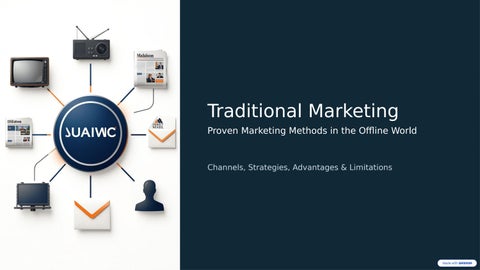
Traditional Marketing Proven Marketing Methods in the Offline World
Channels, Strategies, Advantages & Limitations
What Is Traditional Marketing? Definition: Traditional marketing refers to marketing methods that primarily use offline
Offline Channel
channels to promote products, services, or brands.
Response
•
Reaches audiences through physical or broadcast media
•
Often targets broad geographic or demographic groups
•
Creates strong local and mass-market awareness
•
Uses established offline communication channels
•
Measurement may be less immediate than digital campaigns
Brand Message Audience
Major Traditional Marketing Channels
Television Advertising
Radio Advertising
Newspapers & Magazines
Billboards & Outdoor Ads
Commercials and sponsored programming for broad reach.
Audio ads, sponsorships, and local promotions. Print ads, classifieds, and editorial placements. Large-format advertising in high-traffic locations.
Direct Mail
Telemarketing
Brochures, catalogs, flyers, postcards, and promotional letters.
Direct calls to potential or existing customers.
The Traditional Marketing Process Define Audience
Choose Channel
Geographic and demographic focus
Pick channels by audience and budget
Set Goal Awareness, leads, sales, retention The right channel depends on audience, location, objective, and budget. Steps at a glance: 1. Define the audience — geographic or demographic focus. 2. Set the goal — awareness, leads, sales, retention. 3. Choose the channel — TV, radio, print, outdoor, mail, phone. 4. Deliver the message — clear, memorable creative. 5. Measure response — inquiries, coupon redemptions, calls, footfall, surveys.
Deliver Message Craft and distribute campaign creative
Advantages & Limitations Advantages
Limitations
•
Broad audience reach
•
Higher production or placement costs
•
Strong local visibility
•
Less precise audience targeting
•
Familiar, trusted channels
•
Slower measurement and feedback
•
Physical materials can be memorable
•
Harder to change campaigns quickly
•
Effective for less-online audiences
•
•
Limited real-time interaction
Great for mass brand awareness
•
Attribution can be difficult
Traditional Marketing vs Digital Marketing Digital Traditional •
TV, radio, print, billboards
•
Broad targeting
•
Offline communication
•
Slower measurement
•
Physical presence
•
Slower campaign changes
•
Search, social, web, email
•
Granular targeting
•
Online, interactive
•
Real-time analytics
•
Interactive experiences
•
Fast campaign adjustments
The approaches complement each other — combine to meet audience and objective.
Final Takeaways
Know Audience
Choose Channel
Create Message
Measure Response
For Marketers • • • • •
Understand where your audience pays attention Select channels to match objectives Keep the message simple and memorable Track measurable responses where possible Consider combining offline and digital channels
"Effective marketing is not about choosing one channel. It is about choosing the right channel for the right audience and objective."
Thank You