Stories, Space, and Sankofa: Frameworks for Commemorating Racial Terror
Taubman College of Architecture & Urban Planning, University of Michigan, Ann Arbor
Chelsea Arenas
Amina Dunn
Ali Elatrache
Jordan Hunter
Faculty Advisor: Lauren Hood
Rubin Malik
Irene Nguyen
Xilong Wang
- In collaboration with the Lynching Sites Project of Memphis -
SENSITIVITY
STATEMENT
This report contains detailed descriptions of racial violence, including lynching, murder, and the mutilation of a human body. It also engages with the ongoing legacy of racial terror in the United States and its effects on Black communities. Readers who may find this content distressing are encouraged to approach it at their own pace. The graphic nature of some of this content is intentional. An honest account of what happened to Ell Persons requires naming it directly, and to do otherwise would reproduce the very erasure this project seeks to correct.
CONTENTS
LAND ACKNOWLEDGEMENT
The University of Michigan is located on the ancestral and contemporary lands of the Anishinaabe people, specifically the Bodéwadmik (Potawatomi), Ojibwe, and Odawa nations, who are the original caretakers of this territory. We acknowledge their enduring relationship to this land and their continued presence and sovereignty.
The Ell Persons lynching site and the broader city of Memphis, Tennessee sit on the ancestral homelands of the Chickasaw Nation, who stewarded this land for generations before displacement. We acknowledge the Chickasaw people’s deep and ongoing connection to this territory, and recognize that the violence this project seeks to memorialize occurred on land whose own history of dispossession and erasure predates the history of racial terror we are working to address.
We make these acknowledgements not as a formality, but as a reminder that the questions of memory, erasure, and whose history is made visible in public space that animate this capstone are not new questions. The land on which both this university and this project sit has its own history of dispossession that continues to the present day, and we carry that awareness into this work.
CHAPTER 1: OVERVIEW
1.1 PURPOSE OF THE PLAN
1.2 ROLE OF THE CAPSTONE
1.3 RESEARCH METHODS AND TEAM PROCESS
1.4 LYNCHING SITES PROJECT: LEADERSHIP AND ROLE
1.5 WOLF RIVER CONSERVANCY: REGIONAL GREENWAY AND PARTNERSHIP
1.6 FEDERAL AND NATIONAL CONTEXT
CHAPTER 2: ORIENTATION
2.1 CULTURAL LANDSCAPE AND SITE HISTORY
2.2 PHILOSOPHY AND THEORY OF MEMORIALIZATION
2.3 THEORETICAL FRAMEWORKS: POLITICS OF MEMORIALIZATION AND REMEMBRANCE
2.4 PRECEDENT FRAMEWORKS
2.5 GUIDING PRINCIPLES FOR MEMORIALIZATION
CHAPTER 3: REGIONAL AND SITE ANALYSIS
3.1 FRAMING LANDSCAPES OF TRAUMA
3.2 REGIONAL ANALYSIS
3.3 SITE CONSIDERATIONS
CHAPTER 4: OPPORTUNITY
4.1 STRATEGIES FOR PARTNERSHIPS AND FUNDING
4.2 RFP GUIDELINES FOR FUTURE COLLABORATIONS AND PARTNERSHIP DESIGN TEAMS
4.3 GUIDELINES FOR DESIGN TEAM
4.4 RECONCILIATION THROUGH FUTURE PROGRAMMING
CONCLUSION
EXECUTIVE
SUMMARY
On May 22, 1917, Ell Persons was abducted from a train, brutally murdered, and burned before a crowd of thousands in Memphis, Tennessee. His lynching was not an isolated act of violence, but a public and collective expression of racial terror that was tolerated and enabled by the state. In the century since, the absence of a formal memorial has allowed this violence to remain spatially and publicly unacknowledged. This report seeks to correct that absence by establishing a clear and actionable foundation for memorialization.
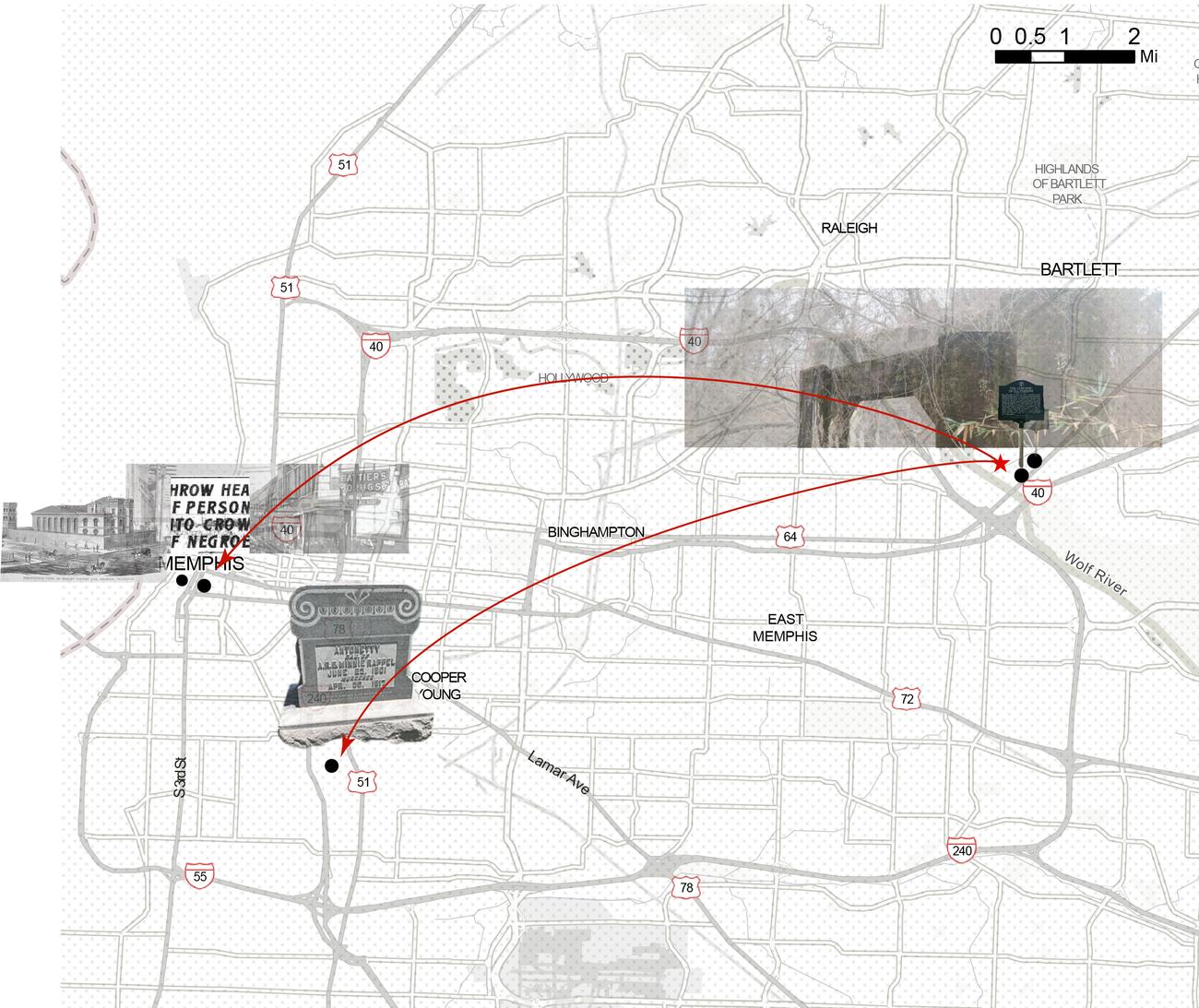
While this report focuses on the approximate site of Ell Persons’ lynching as a point of intervention, it recognizes that the history itself is not confined to a single location. Racial terror unfolded across a broader landscape that includes sites of abduction, transport, spectacle, and everyday life. As such, this project understands memory as spatially dispersed and continuously produced. The proposed memorial is therefore not conceived as an isolated object, but as part of a broader network of memory that extends beyond the immediate site.
This report was produced in collaboration with the Lynching Sites Project of Memphis (LSP), an all-volunteer organization that has led efforts to document and acknowledge histories of racial violence in Shelby County. It provides a set of research-grounded recommendations, including site and contextual analysis, Request for Proposals (RFP) guidelines, non-negotiable design principles, and partnership and funding strategies. These recommendations are intended to center Ell Persons, name the violence enacted against him, and ensure that any future memorial does not obscure or soften the historical record.
KEY CONDITIONS
Two concurrent developments make this moment particularly significant and create an opening that LSP is not fully equipped to navigate alone.
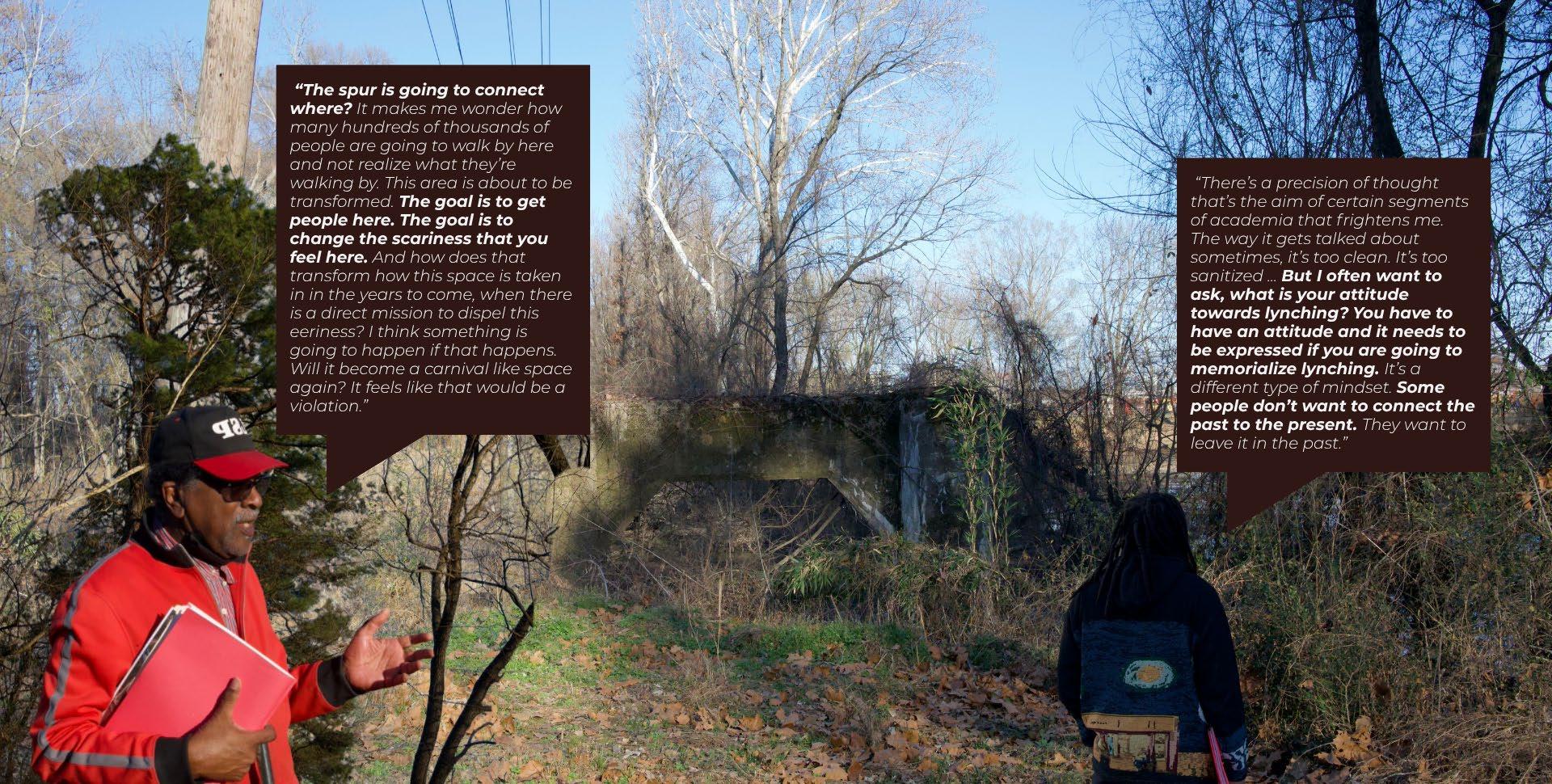
1. THE WOLF RIVER GREENWAY: The Wolf River Conservancy (WRC) is constructing a segment of the Wolf River Greenway adjacent to the site and has committed to building a spur trail that will provide direct public access for the first time. While this increases visibility, it also introduces risk. Without intentional intervention, increased access may result in passive or uninformed encounters with a landscape of racial violence.
2. THE NATIONAL PARK SERVICE SPECIAL RESOURCE STUDY: The National Park Service (NPS) is conducting a Special Resource Study on lynching sites in the Memphis area, authorized by Congress through the Consolidated Appropriations Act of 2023. The Ell Persons site is among those under evaluation for potential inclusion in the National Park System. This process presents a critical opportunity to establish national recognition, but also requires clear positioning, coordination, and advocacy.
METHODS
The capstone team employed a multi-method research approach including a site visit to the approximate location of the lynching; visits to four cultural institutions; engagement with guest speakers; and archival and secondary research on the Ell Persons lynching, racial violence in Memphis and Shelby County, and the broader literature on memorialization and spatial justice.
FINDINGS AND RECOMMENDATIONS
• ON HISTORY AND THEORY: The lynching of Ell Persons was a public, state-sanctioned exercise of racial terror. The dominant historical record has treated Persons as an object of the crowd’s violence rather than a person whose life and death demand acknowledgment. The memorial must correct this by centering Ell Persons, not the spectacle of his death.
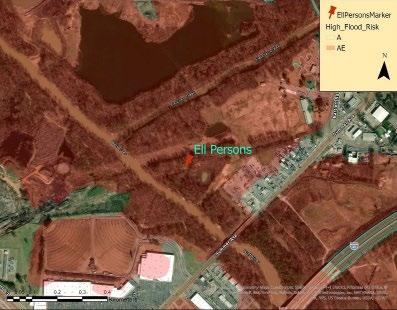
• ON SITE CONDITIONS: The site is located within a FEMA flood zone, remains physically inaccessible, and sits within a predominantly Black census tract with median household incomes below the regional average. Design interventions must respond to ecological constraints while advancing equity and accessibility.
• ON DESIGN: The RFP process should position LSP as a co-author and core decision-making partner. Design proposals must demonstrate historical and ethical grounding, a communitycentered engagement strategy, and a long-term stewardship plan.
• ON PARTNERSHIPS AND FUNDING: LSP should immediately pursue the National Civil Rights Museum as its primary institutional partner and fiscal sponsor. Primary funding opportunities include the Mellon Foundation’s Humanities in Place program, the Hyde Family Foundation, and the Kresge Foundation.
• ON MEMORANDA: Memoranda of Understanding should be used to formalize partnerships, protect LSP’s interpretive authority, and ensure accountability across institutions. These agreements should clearly define roles related to historical interpretation, design decision-making, stewardship, and long-term programming. MOUs are especially critical given LSP’s volunteer structure, allowing the organization to retain power in collaborations with larger institutions.
BUILT TOOLKIT
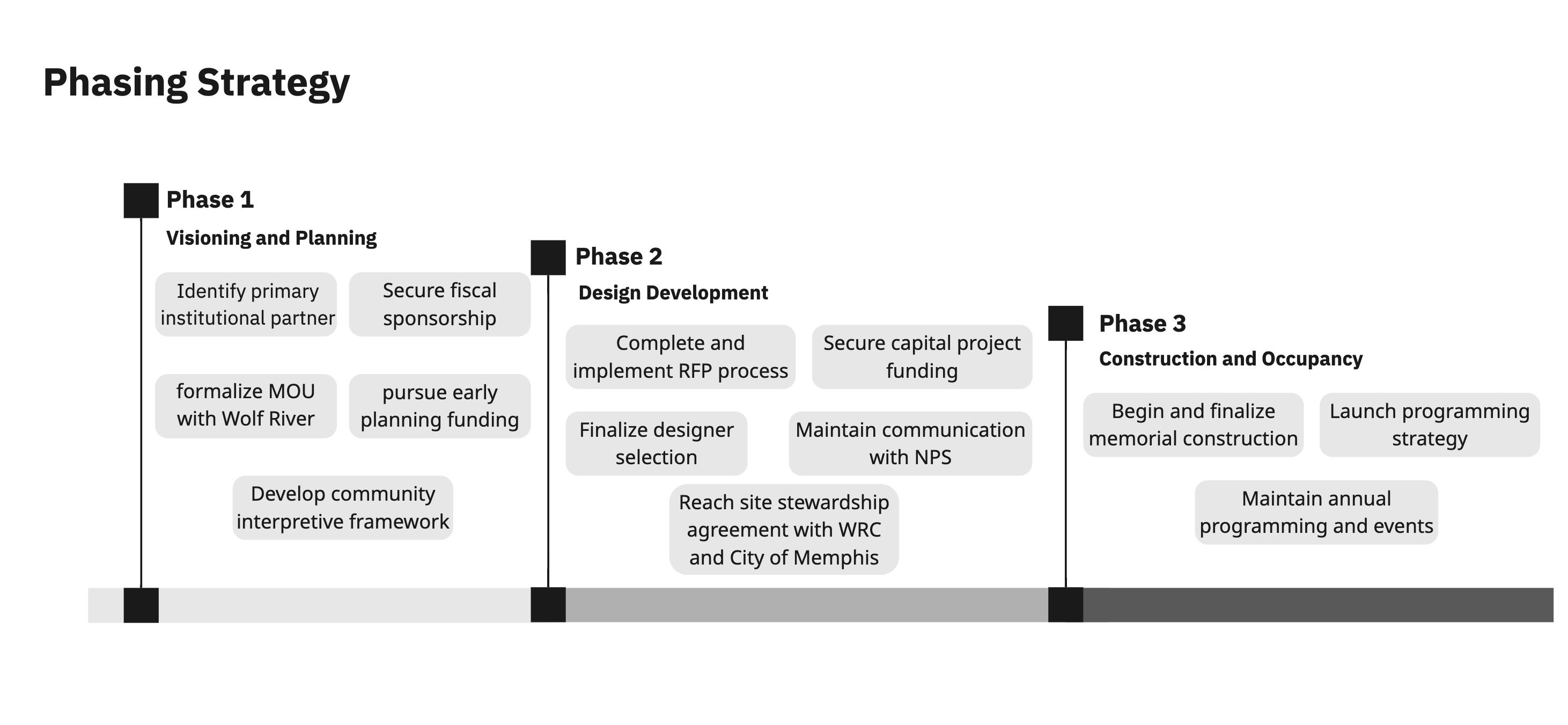
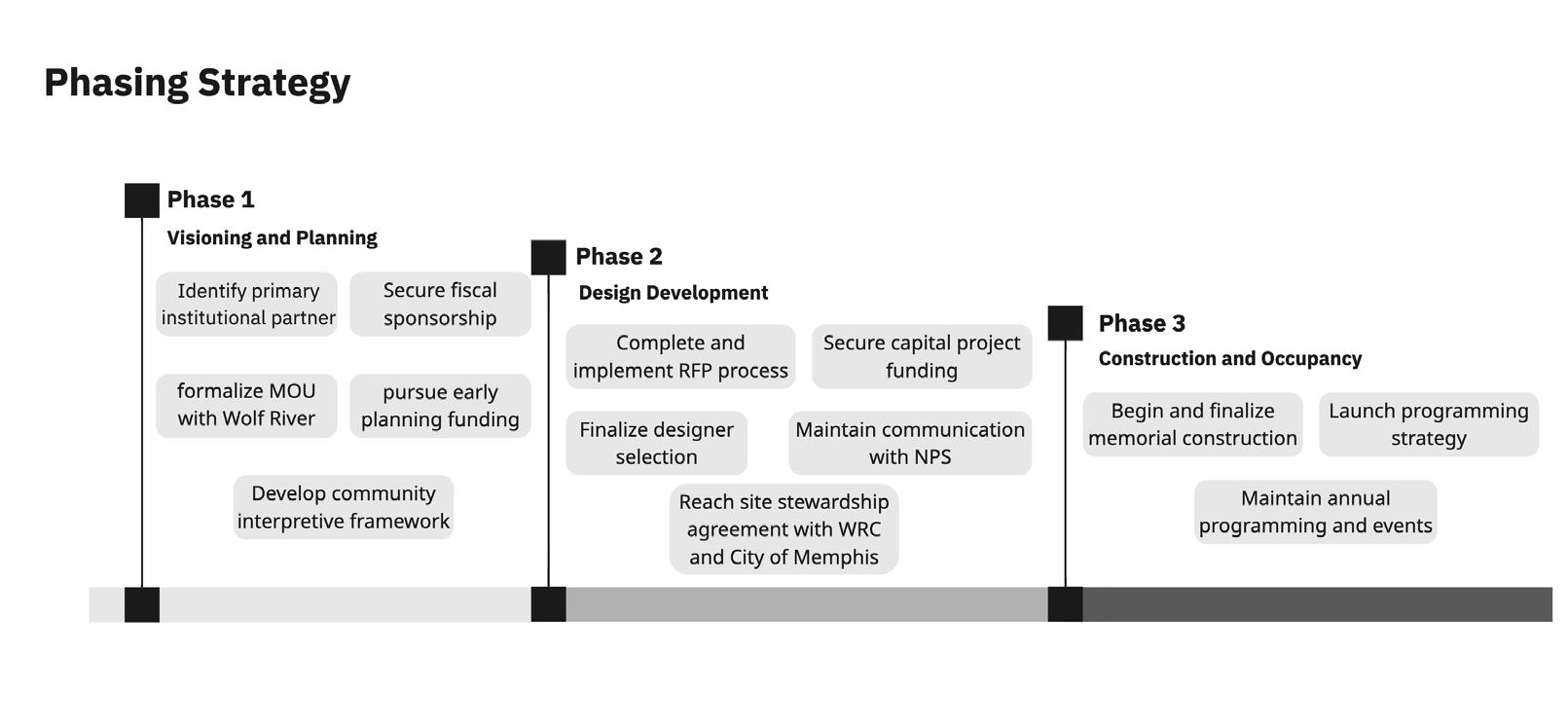
The project is organized into three phases drawn from MASS Design Group’s Purpose Built toolkit:
1. PHASE ONE: VISIONING AND PLANNING: Identify and engage a primary institutional partner, formalize partnerships, secure early planning funding, and develop a community interpretive framework. This is the current phase.
2. PHASE TWO: DESIGN DEVELOPMENT AND SITE PREPARATION: Complete the RFP process, select a designer, and reach agreement with WRC and the city of Memphis on site preparation. This phase is contingent on securing construction funding and NPS agreement.
3. PHASE THREE: CONSTRUCTION AND OCCUPANCY: Finalize construction, launch programming, and formalize a long-term stewardship agreement with WRC and the City of Memphis.
The NPS process should be maintained as a parallel track and not treated as a prerequisite for project advancement.
CONCLUSION
This report provides LSP with a planning foundation from which to advance the memorialization of the Ell Persons site. By establishing a clear interpretive vision, a structured partnership and funding strategy, and a phased implementation framework, LSP is better positioned to enter institutional conversations about the site’s future.
CHAPTER 1: OVERVIEW
This chapter establishes the foundational context for understanding the significance of the Ell Persons site and the conditions shaping its future. It outlines the purpose of the plan, the role of the capstone team, and the methods used to develop the report’s recommendations, while situating the project within its broader historical, institutional, and spatial frameworks. Readers should expect a clear understanding of the key actors involved, the governance and planning processes that influence the site, and the landscape in which it exists, recognizing that the history of racial terror extends beyond a single location. The chapter also introduces the theoretical grounding that informs the project’s approach, preparing for subsequent sections that translate these ideas into design, policy, and implementation strategies.
1.1 PURPOSE OF THE PLAN
1.1
PURPOSE OF THE PLAN
1.2 ROLE OF THE CAPSTONE
1.3 RESEARCH METHODS AND TEAM PROCESS
1. MONUMENT, MEMORY, AND MEANING MAKING EXERCISE
2. CULTURAL INSTITUTION VISITS
3. MEMPHIS SITE VISIT
4. GUEST SPEAKERS
5. CLIENT MEETINGS
6. THEORETICAL RESEARCH
7. THEORY OF CHANGE
1.4 LYNCHING SITES PROJECT: LEADERSHIP AND ROLE
1. MISSION, VISION, AND VALUES
2. GOALS IN TRUTH-TELLING AND COMMUNITY HEALING
3. EXISTING COMMEMORATIVE PRACTICES
4. STRENGTHENING LSP’S ROLE IN THE PROJECT
1.5 WOLF RIVER CONSERVANCY: REGIONAL GREENWAY AND PARTNERSHIP
1. THE WOLF RIVER GREENWAY VISION
2. ROLE OF THE WOLF RIVER CONSERVANCY
3. PLANNED SPUR TO THE ELL PERSONS SITE
1.6 FEDERAL AND NATIONAL CONTEXT
1. NATIONAL PARK SERVICE SPECIAL RESOURCE STUDY
2. LOCAL PLANNING AND POLICY CONTEXT
This plan provides that capacity, and will deliver a set of research-grounded recommendations –including site and contextual analysis, partnership and funding strategies, and nonnegotiable design principles for any future memorial – that center Ell Persons, name what was done to him, and establish a foundation for a memorial that does not soften or reframe the history it is meant to hold.
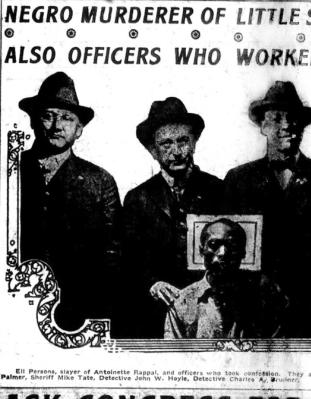
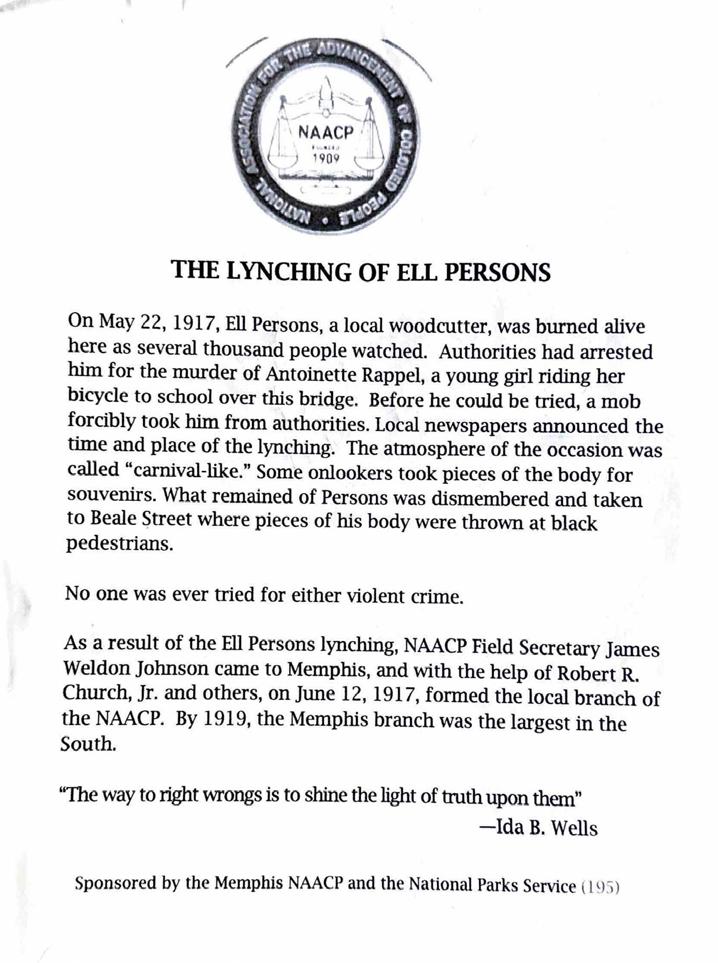
The Ell Persons lynching site on the Wolf River in Memphis, Tennessee is an extremely significant, but often overlooked, site of racial terror in the American South. On May 22, 1917, Ell Persons was lynched before a crowd of more than 3,000 people in what was described as a public spectacle.1 Persons had been accused of the rape and murder of Antoinette Rappel, and his subsequent lynching was advertised in advance by local newspapers and attended by families in an almost carnival-like setting. The historical record of this event is dominated by coverage of Rappel’s death. In contrast, Persons himself appears in that record largely as an object of the crowd’s violence rather than as a person whose life and death demand acknowledgment.
This plan is an attempt to correct that imbalance and to do so at a moment when conditions make meaningful action on this site more possible than they have been at any point prior. For one, WRC in Memphis is actively constructing a section of their Wolf River Greenway adjacent to the site and has committed to building a spur trail that will bring visitors directly to the site for the first time. Simultaneously, the National Park Service (NPS) is conducting work on lynching sites across Memphis, and the Lynching Sites Project (LSP) has been in active contact with NPS regarding the Ell Persons site.
These two developments present an opportunity that LSP is not fully equipped to navigate alone. As an all-volunteer organization, LSP has limited capacity to produce the research, planning, and documentation that the development of a memorial requires. This plan provides that capacity, and will deliver a set of researchgrounded recommendations—including site and contextual analysis, partnership and funding strategies, and non-negotiable design principles for any future memorial—that center Ell Persons, name what was done to him, and establish a foundation for a memorial that does not soften or reframe the history it is meant to hold. It is also intended to strengthen LSP’s position in the institutional conversations that will shape this site’s future, ensuring that the organization has the documentation and planning infrastructure to be a driving force in conversations about the site.2
1.2
ROLE OF THE CAPSTONE
The capstone studio’s role is to produce recommendations that strengthen LSP’s position in the decision-making processes that will shape the site’s future. This includes providing LSP with greater institutional leverage in conversations with partners like WRC, private funders, and NPS whose timelines and priorities do not always align with those of a grassroots memorialization effort. It also includes producing a set of non-negotiable design principles, or guidelines that any future designer or design team must follow, that preserve LSP’s interpretive vision through what will inevitably be a long development process with multiple stakeholders.
The capstone’s research process was designed to ensure that the team’s recommendations were grounded in both the physical conditions of the site and a rigorous understanding of the history of racial violence that surrounds it. To do so, the team combined site and institutional visits with archival, policy, and theoretical research, as well as a structured reflective exercise connecting personal experience to questions of memory and memorialization. The Orientation theme of this report contextualizes each of these methods within the broader research framework of this plan.
1.3.1 MONUMENTS, MEMORY, AND MEANING-MAKING EXERCISE
Each team member completed an exercise connecting a personally significant historical event to a physical site or commemorative absence, and examined the meanings that site produces in the present. The resulting essays informed the team’s collective understanding of how memory, place, and identity intersect. (See Section 2.2.3 for more details)
1.3.2 CULTURAL INSTITUTION VISITS
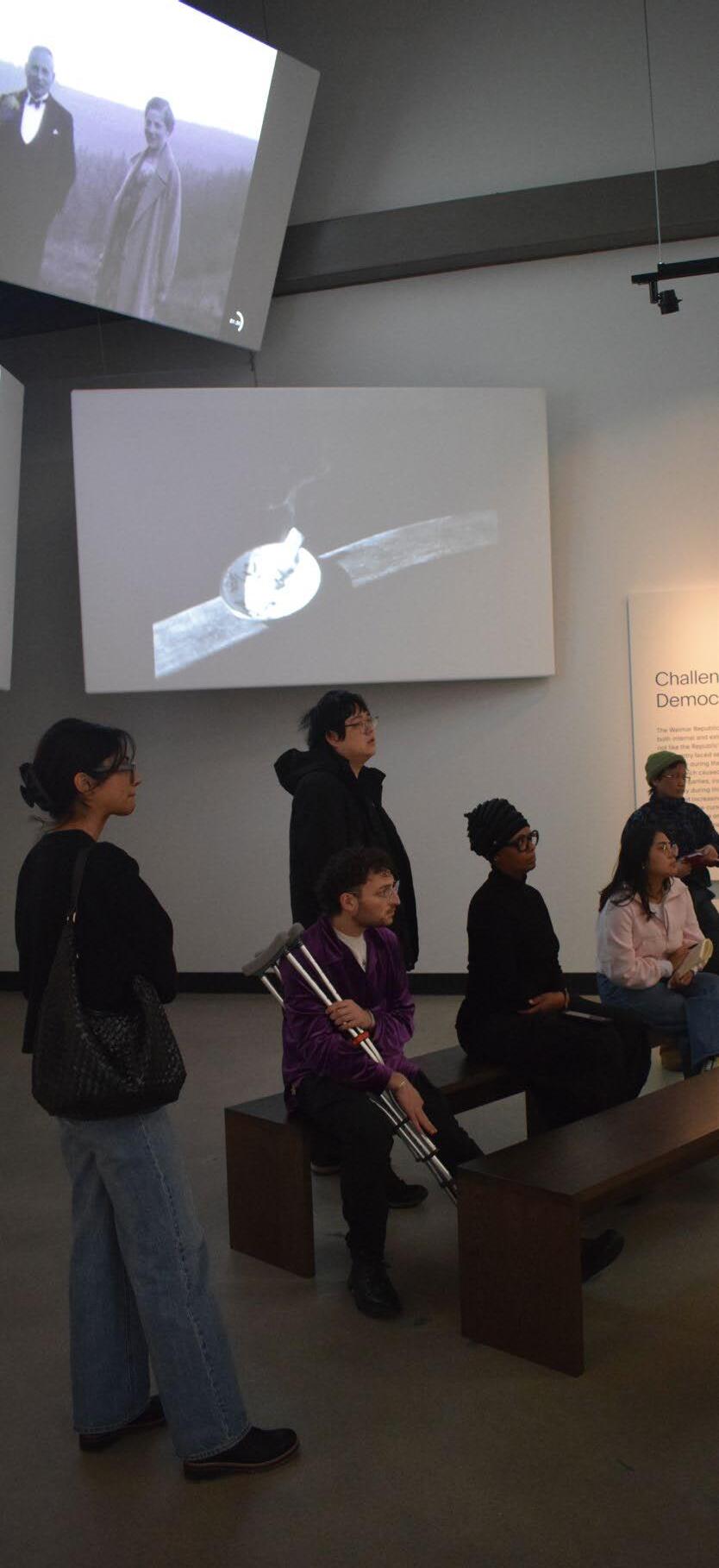
The team visited three cultural institutions, each of which raised questions about how institutions represent histories of violence and what the Ell Persons site can learn from each (See Section 2.4.2 for more details):
ZEKELMAN HOLOCAUST CENTER, BLOOMFIELD HILLS, MICHIGAN.
The guided experience raised questions about ownership over difficult histories, the responsibility to present full context, and how a memorial can focus on one community’s experience without implying a hierarchy of suffering.
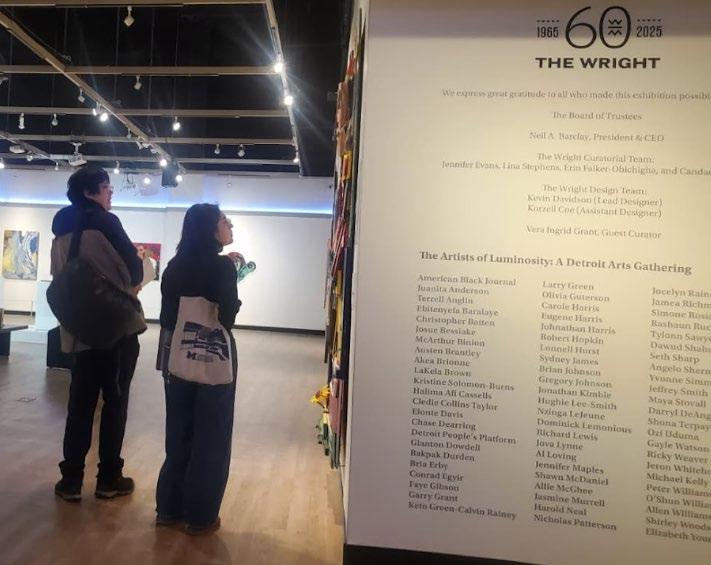
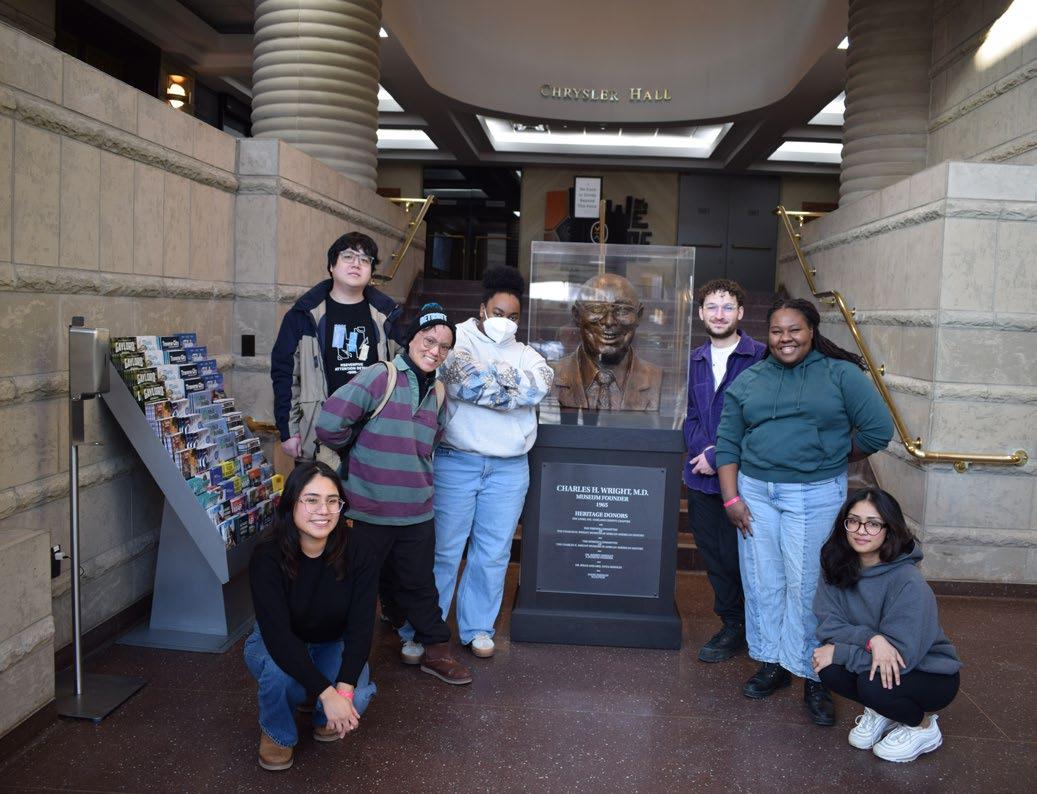
CHARLES H. WRIGHT MUSEUM OF AFRICAN AMERICAN HISTORY, DETROIT, MICHIGAN.
The visit prompted questions about the relationship between trauma, graphic depiction, and learning, and whether trauma as a design strategy produces understanding or simply discomfort.
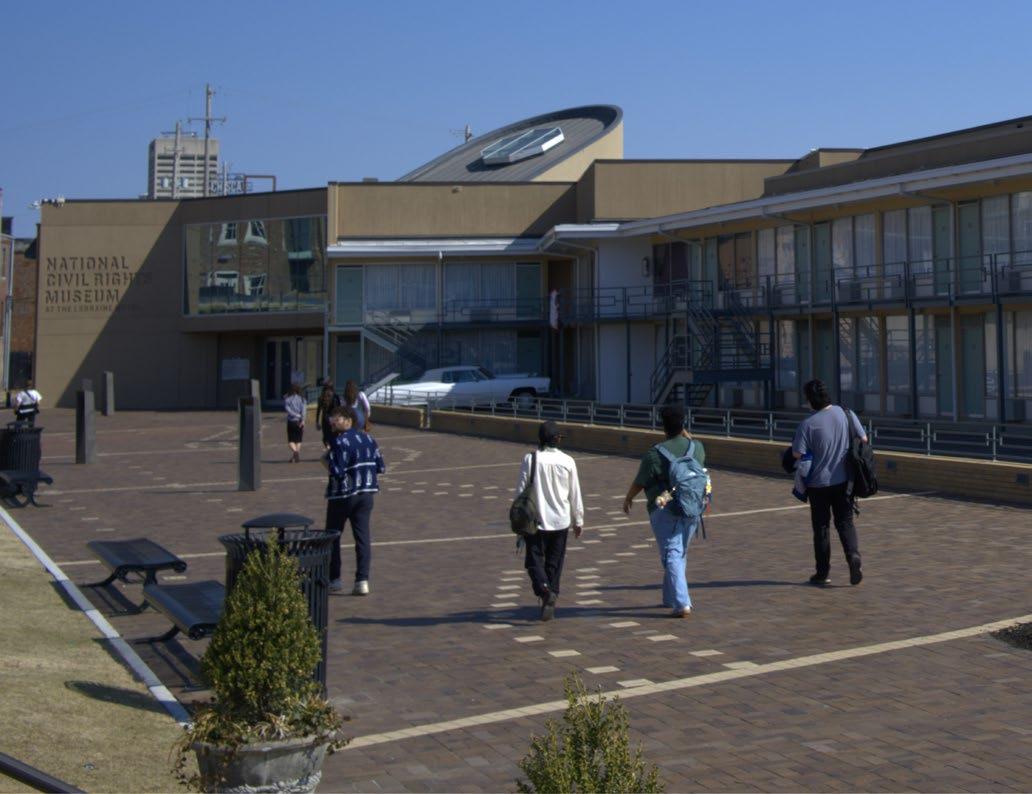
NATIONAL CIVIL RIGHTS MUSEUM, MEMPHIS, TENNESSEE.
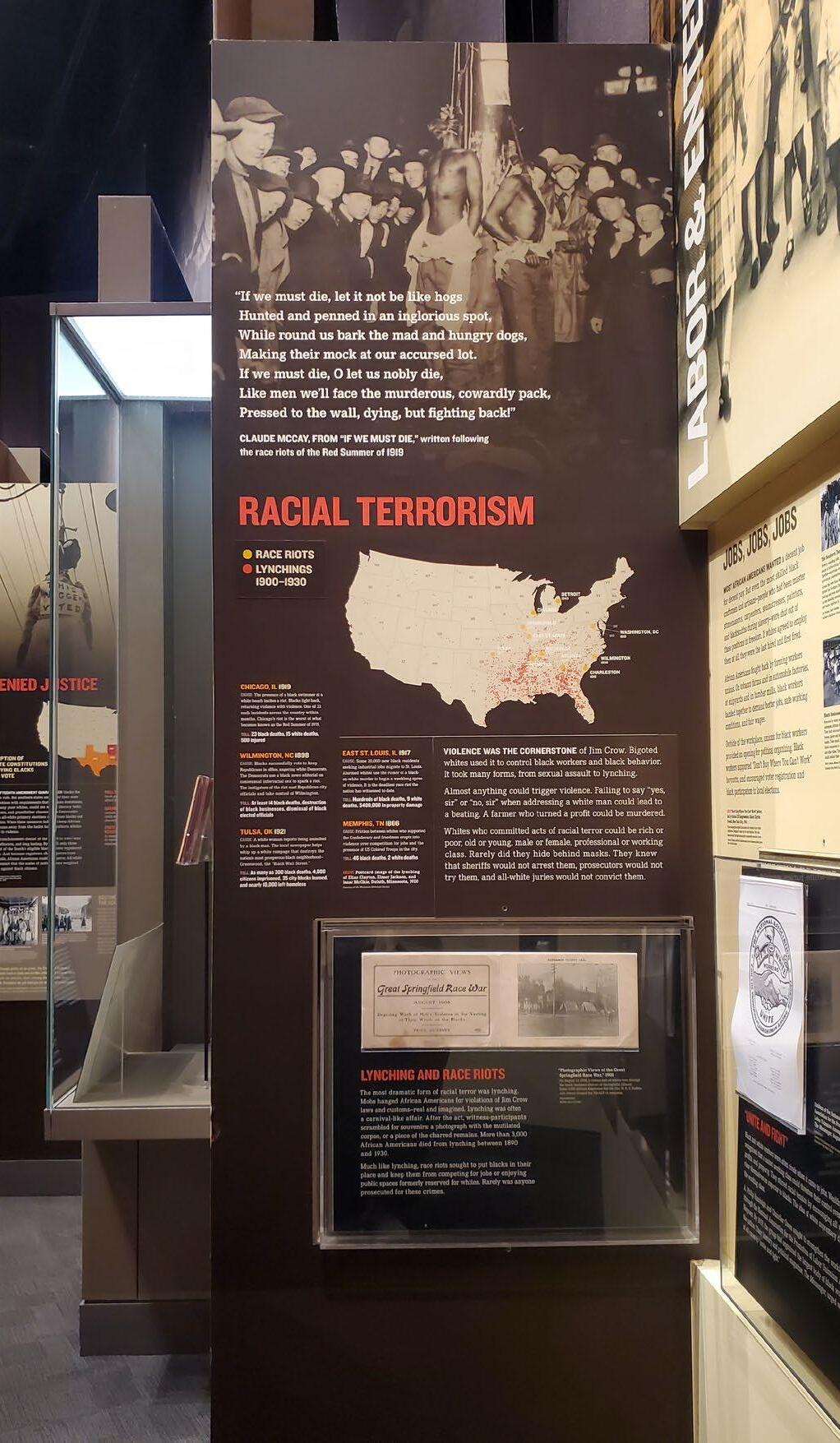
The most instructive model for the team, demonstrating how a site can hold the specificity of a local history while connecting it to a broader national narrative of racial injustice and resistance.
1.3.3 MEMPHIS SITE VISIT
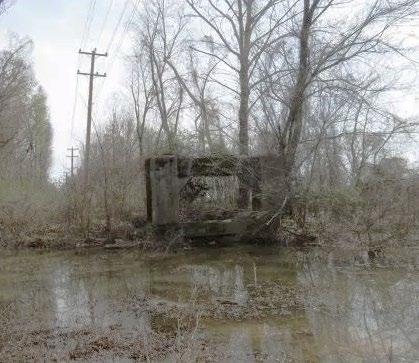
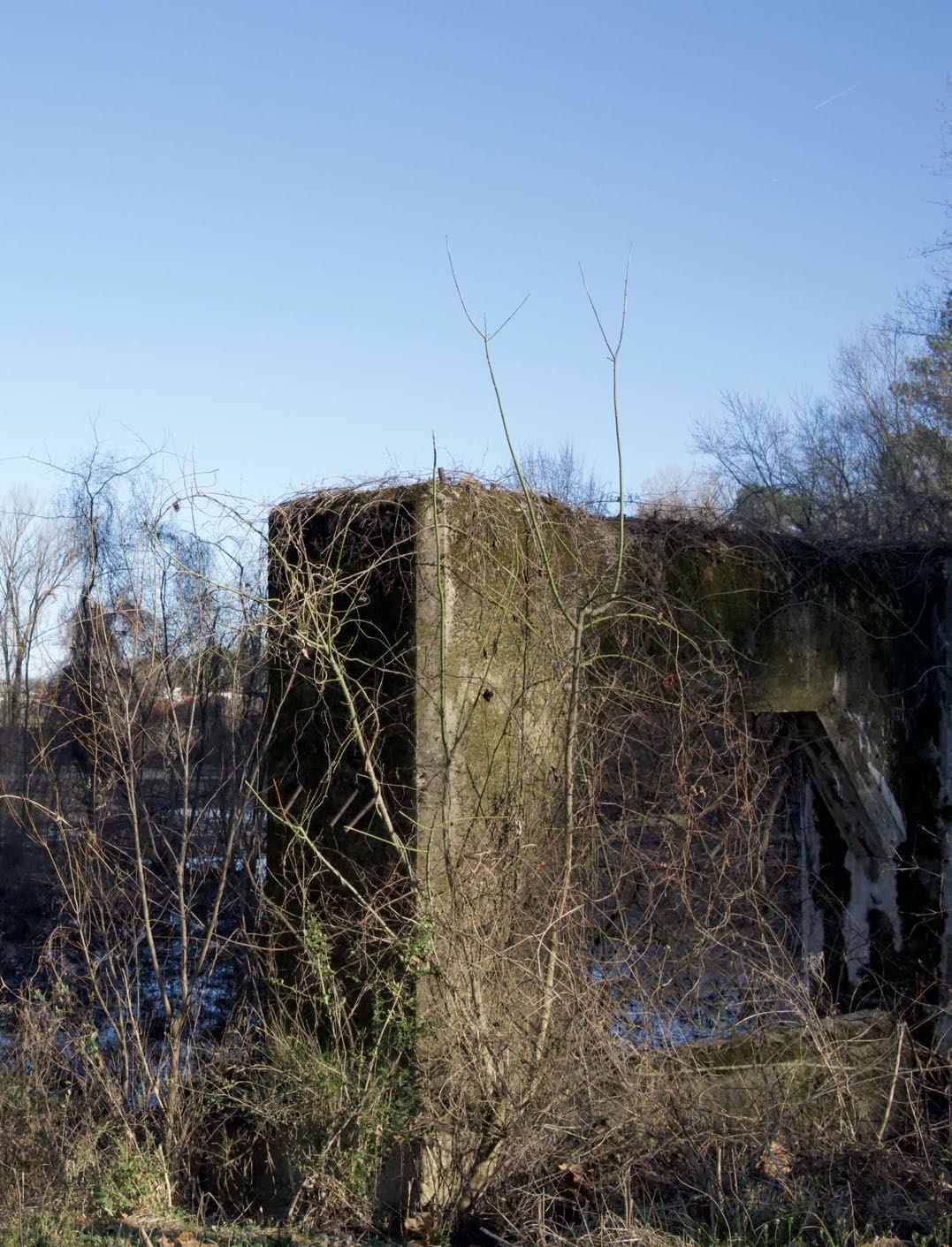
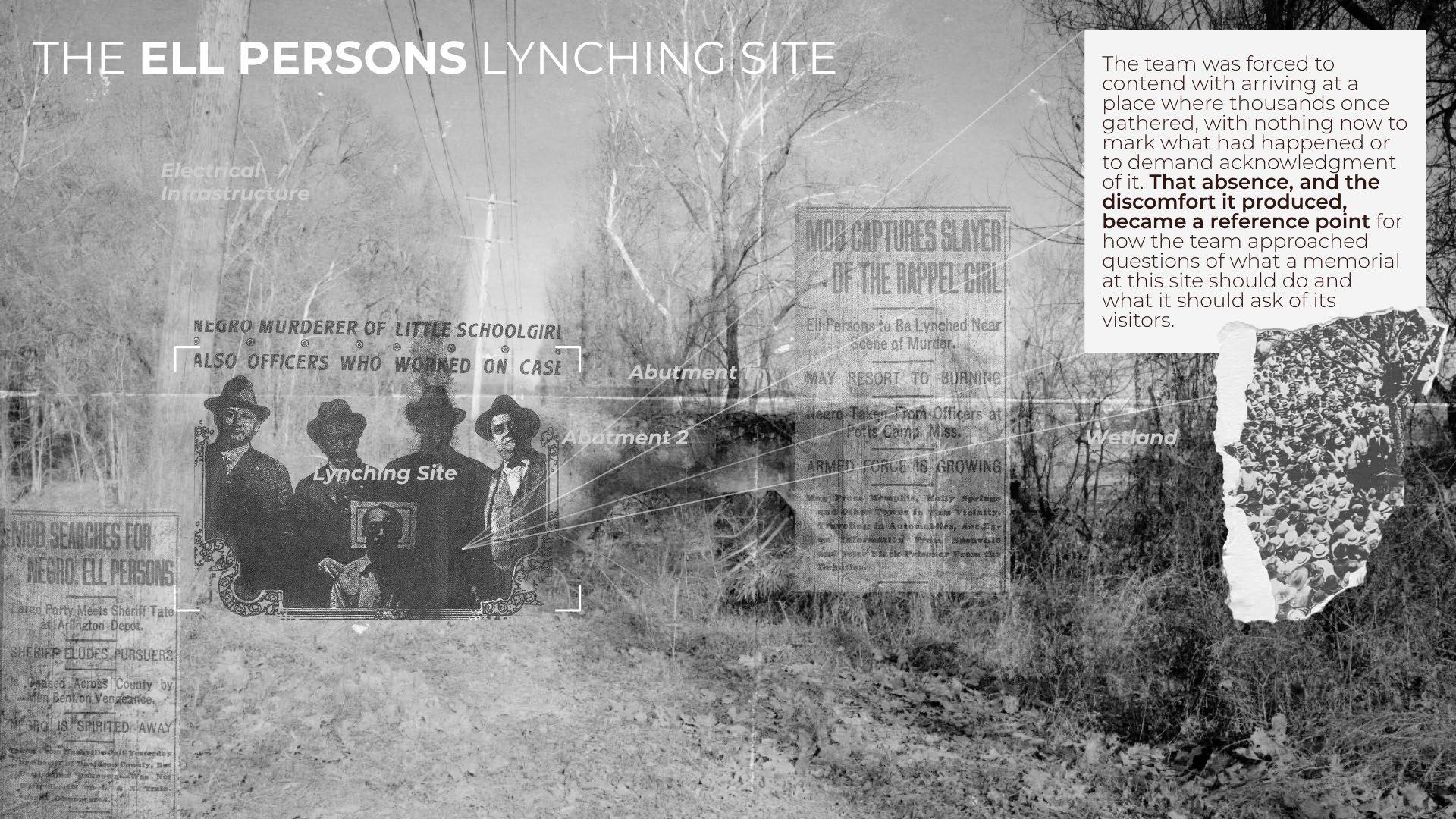
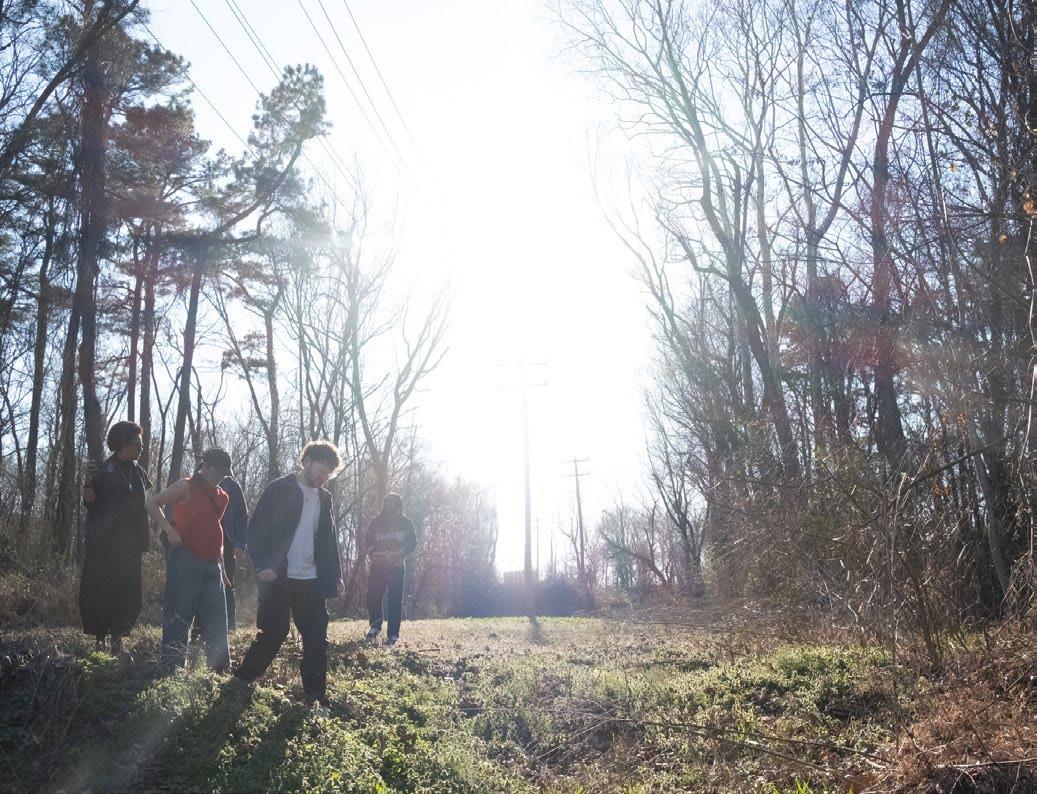
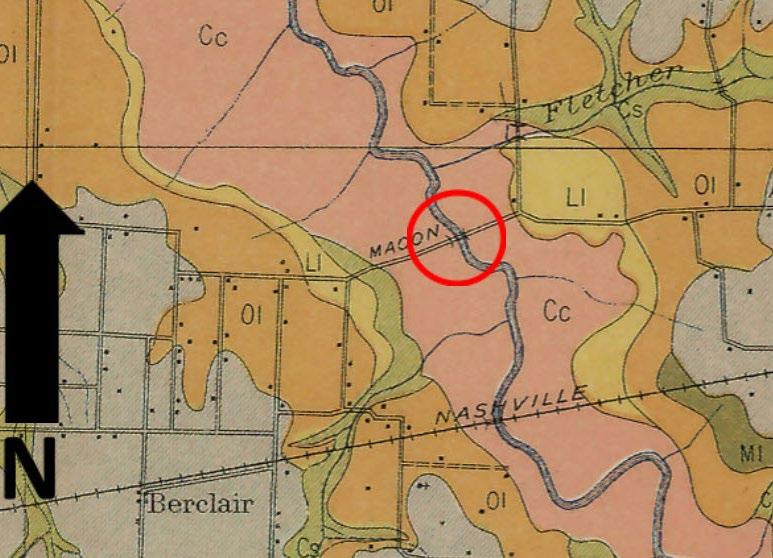
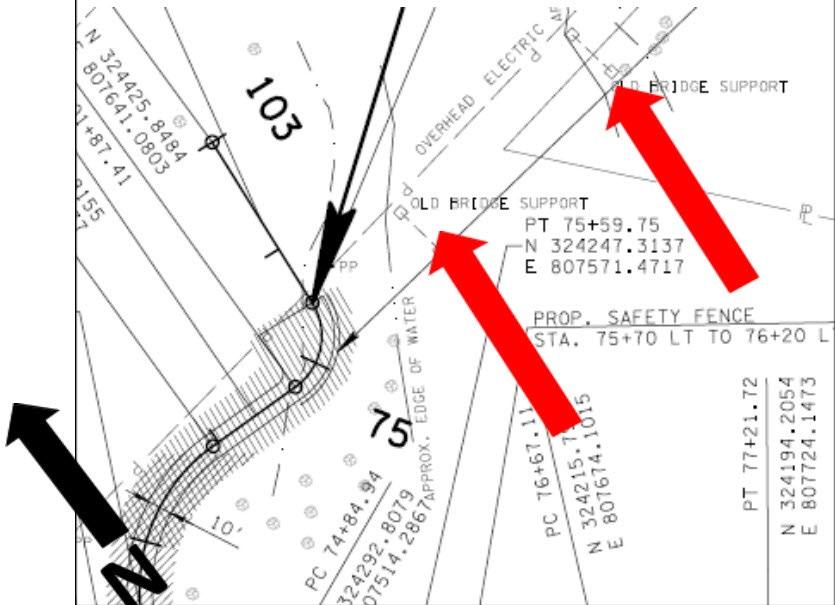
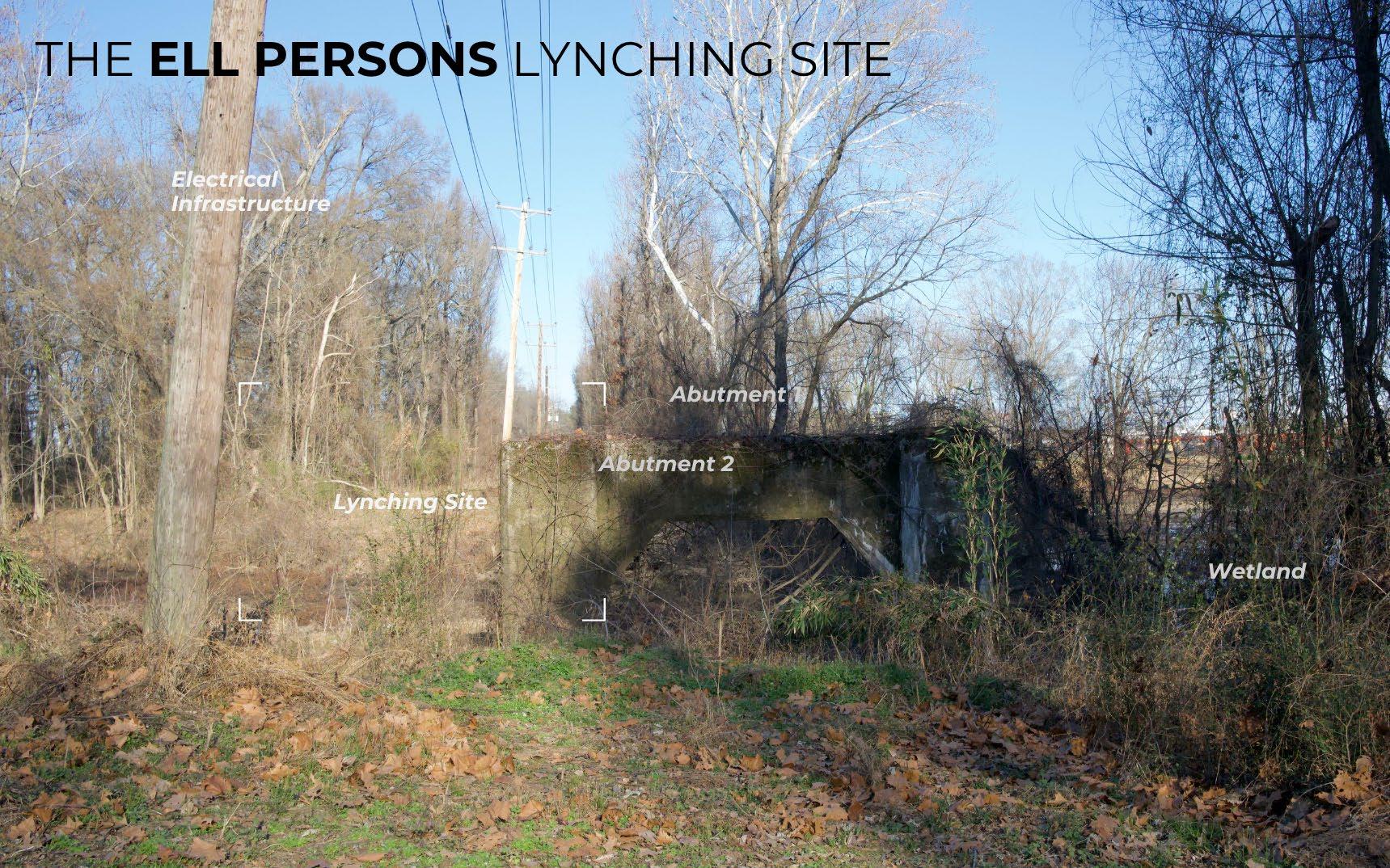
The team conducted a site visit to the area of the Ell Persons lynching on the Wolf River, including the bridge abutments of the old Macon Road Bridge, which is the closest physical anchor to the lynching site. The visit was disorienting in ways that became analytically important, and it directly shaped the team’s thinking about what a memorial at this site should ask of its visitors.
1.3.4 GUEST SPEAKERS
The team also engaged with several guest speakers whose expertise directly informed the capstone’s research and recommendations:
DR. DAMANI PARTRIDGE
Scholar and anthropologist whose work on memorialization informed the team’s understanding of how memory is constructed, contested, and made meaningful in public space.
CAROL COLLETTA
Urban practitioner whose extensive experience in Memphis nonprofits and urban revitalization informed the team’s understanding of the governance and funding structures that shape memorialization efforts in Memphis.
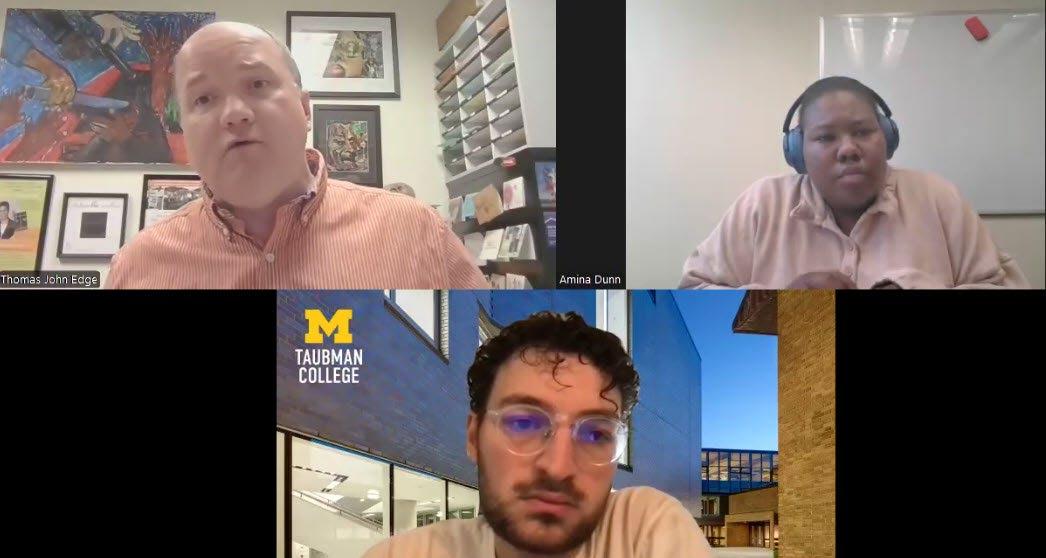
DR. THOMAS EDGE
Scholar and historian whose work on lynching history and memorialization offers clarity on how communities around the country have preserved the stories of lynching victims.
1.3.5
CLIENT MEETINGS
RANDELL GAMBLE AND DR. JASPER ST. BERNARD
LSP Board Members who accompanied the team during the site visit and spoke extensively about the history of the Ell Persons lynching and the ongoing considerations surrounding how the site should be memorialized.
ERIC HOUSTON
Executive Director of WRC who provided the team with detailed context surrounding the Wolf River Greenway and its ongoing construction near the Ell Persons site.
NATIONAL PARK SERVICE PUBLIC MEETINGS
NPS as a part of their special resource study conducted several meetings to introduce members of the Memphis public to the study and asked for community involvement in finding additional resources to further their work.
“ IT’S MORE THAN JUST REMEMBERING HIS DEATH TO ME. IT’S ABOUT HIS LIFE. A LOT OF THE TIME THE FOCUS IS HOW THEY WERE MURDERED, HOW THEY WERE KILLED. MY THING IS, HOW DID THEY LIVE? ”
Randall Gamble
LSP Co-founder
Capstone team at the Zekelman Holocaust Center, photo by Amina Dunn, 2026
Zoom Meeting with Dr. Thomas Edge with Capstone students, 2026
The team conducted archival and secondary research on the Ell Persons lynching, the history of racial violence in Memphis and Shelby County, and the broader literature on memorialization and spatial justice. Historical context for the site was drawn primarily from the work of LSP board member and historian Margaret Vandiver, as well as from site documentation produced by LSP. Theoretical grounding was drawn from the following texts:
1. Achille Mbembe, Necropolitics
2. Banu Bargu, Another Necropolitics
3. Orlando Patterson, Authority, Alienation, and Social Death
4. Michel-Rolph Trouillot, The Three Faces of Sans Souci
5. Omari Souza, Design Against Racism
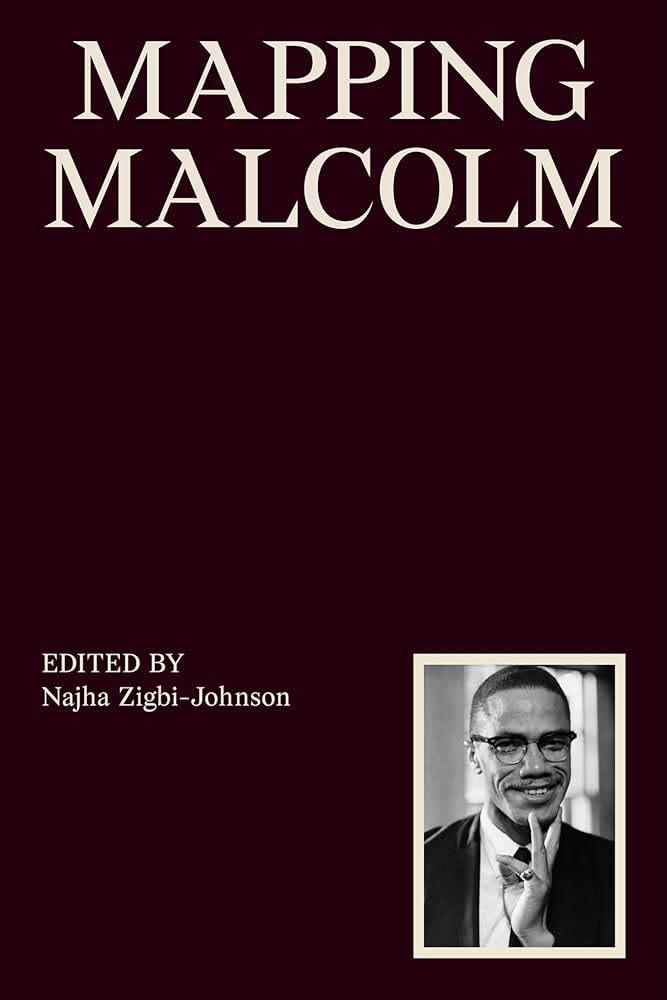
6. Edited by Najha Zigbi-Johnson, Mapping Malcolm
7. Lauren Hood, AfroUrbanism
Together, these texts provided a framework for understanding how racial terror is produced, how its history is silenced, and what it means to design in response to that silence.
1.3.7 THEORY OF CHANGE The
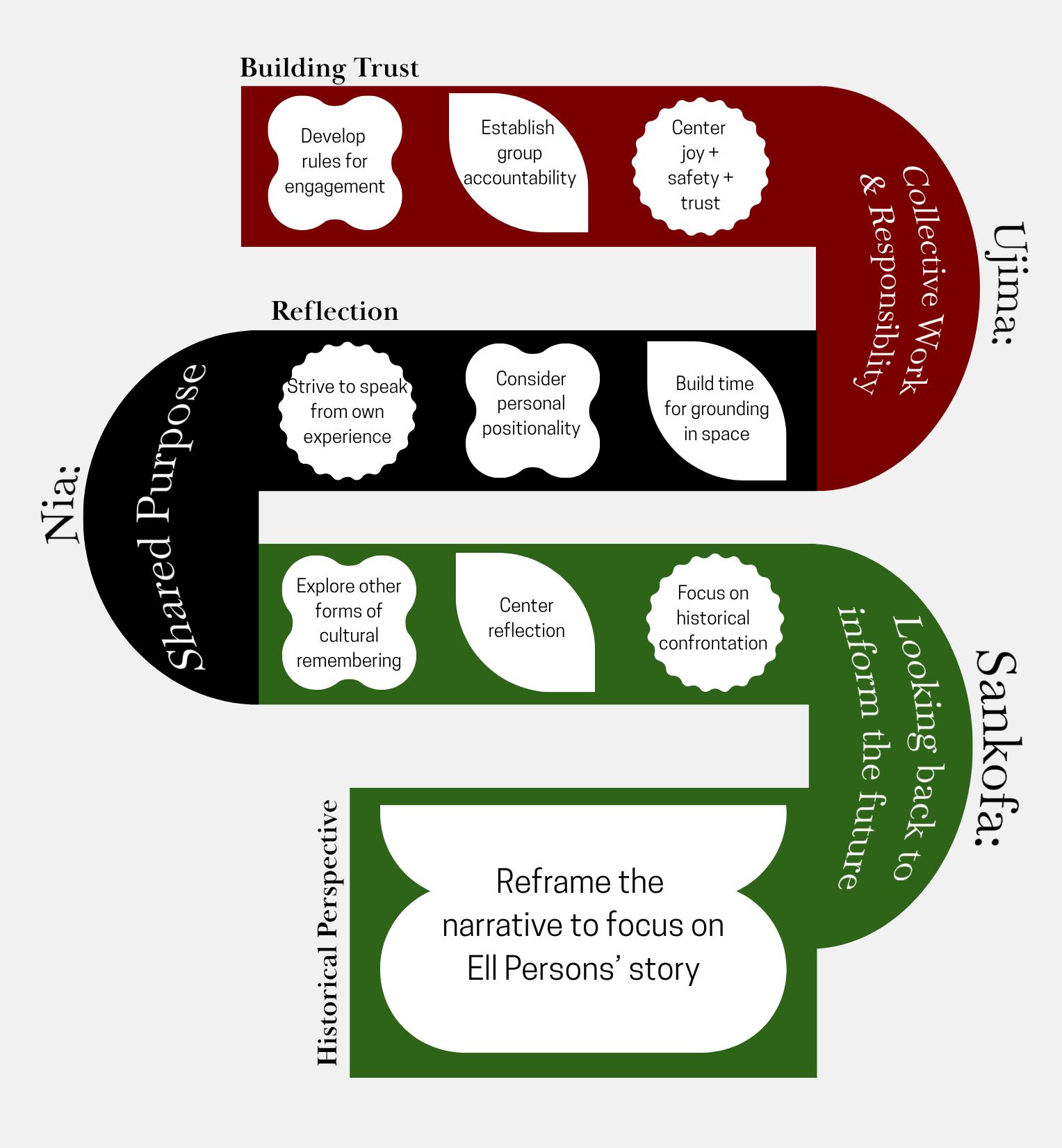
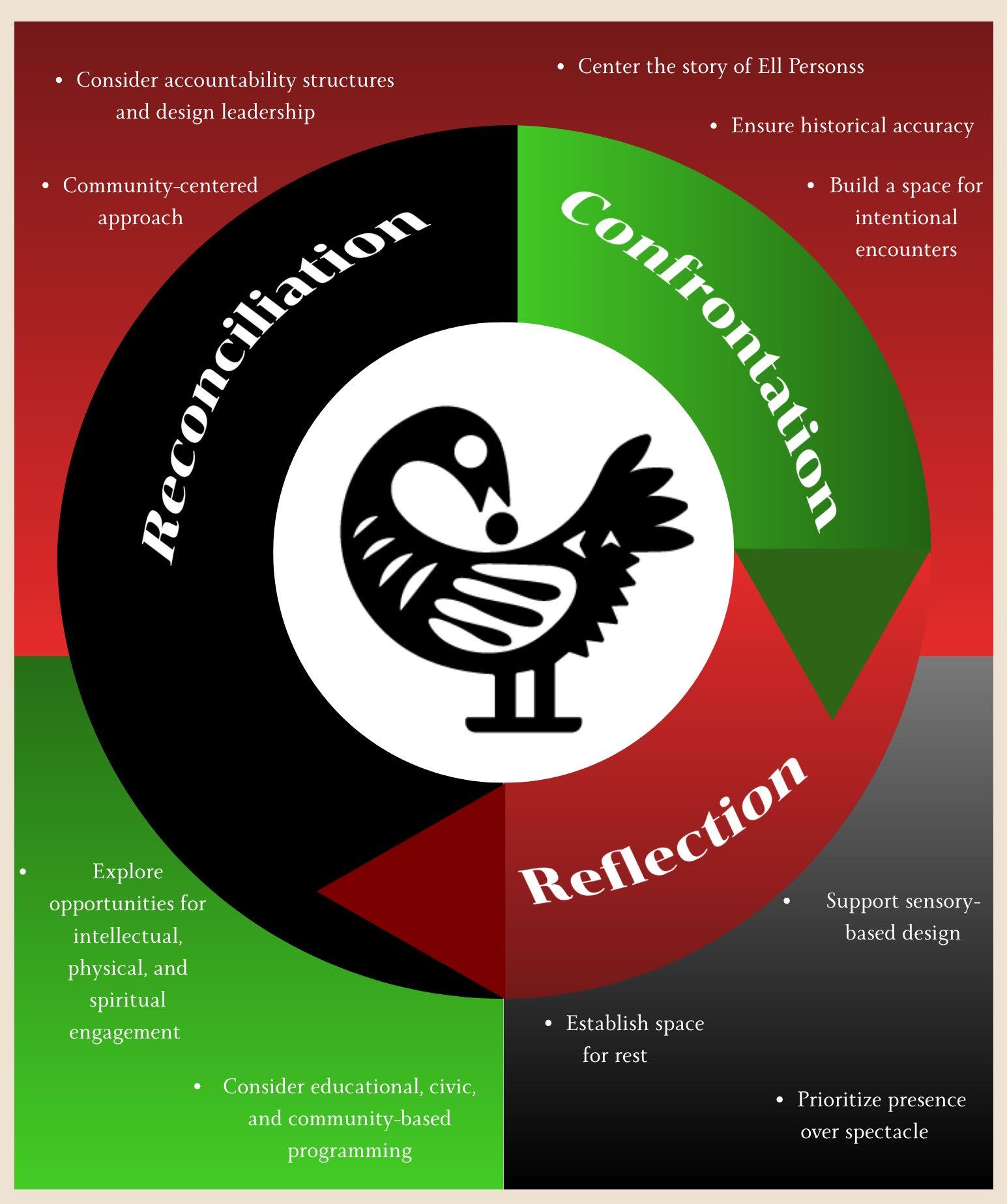
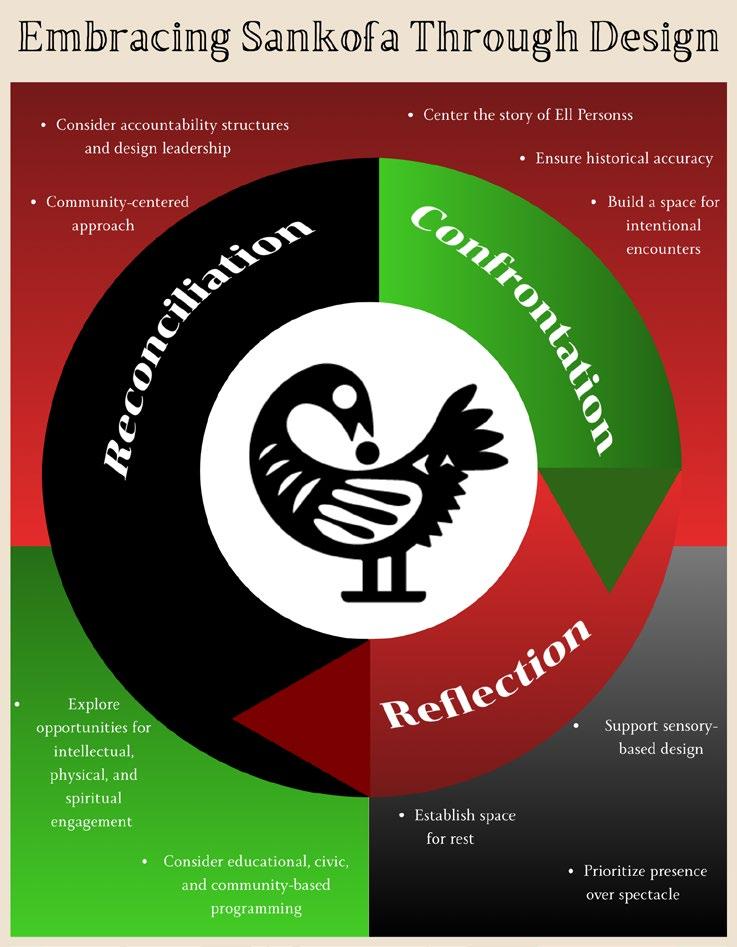
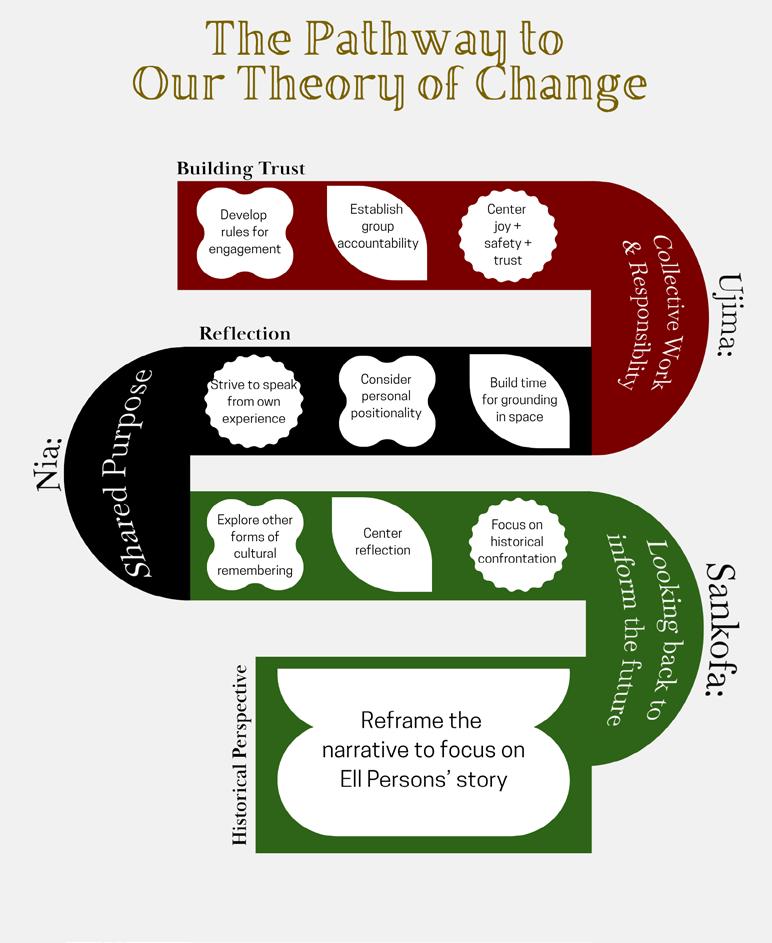
This project required our team to develop two theory of change frameworks. The first, depicted in Figure 1 and entitled “The Pathway to Our Theory of Change,” walks through the internally established framework of understanding to guide the team’s decision-making and ensure we share the appropriate mindset for processing the Ell Persons’s site. The second, entitled “Embracing Sankofa Through Design,” presents a framework for designers to plan memorials for sites of racial terror. Designers, while developing their work, should undergo a process of confronting the act of violence, reflecting on what they learn, and offering pathways for reconciliation for the audience through their design. Similarly, visitors to the memorials should also undergo the same process as they walk through the site.
1.4
LYNCHING SITES PROJECT: LEADERSHIP AND ROLE
“The Lynching Sites Project of Memphis (LSP) is part of a growing network of people who want the whole and accurate truth to be told about the history of Shelby County. We believe that we can heal and grow in understanding when we face openly the history of racial violence in our community.”3
LSP plays a critical role in confronting the history of racial terror in Shelby County through community-centered memorialization, truthtelling, and healing practices. Grounded in collaboration, faith, and historical accountability, LSP positions itself as a commemorative body and holder of knowledge, as well as a facilitator of dialogue and catalyst for social transformation.
1.4.1 MISSION, VISION, VALUES
At the core of LSP’s work is its mission:
To collaborate with others to cultivate courageous conversations and programs that uncover the whole truth of racial terror and violence and change the narrative in Shelby County, leading to understanding, compassion, and healing, while working toward racial equality and justice.
This mission is paired with a forward-looking vision:
To create a new legacy of racial equality and justice by turning the light of truth on lynchings in Shelby County, Tennessee.
1.4.2 LSP’S GOALS IN TRUTH-TELLING AND COMMUNITY HEALING
LSP operates as a community-centered initiative committed to truth-telling, remembrance, and racial healing. Grounded in principles of humility, prayer, and active listening, LSP prioritizes relational work as the foundation for engaging this difficult history.
Key Goals:
1. Identify lynching victims and mark historical sites.
2. Build strong community partnerships.
3. Encourage open, meaningful dialogue about race.
4. Ensure the organization’s long-term sustainability.
5. Develop outreach and awareness strategies.
LSP’s work is guided by a set of interrelated commitments:
1. Emphasize humility, listening, and relationship-building.
2. Collaborate with local groups, schools, and religious communities.
3. Preserve and share stories through records and media.
4. Support education, public resources, and interactive tools.
5. Host discussions, classes, arts initiatives, and interfaith services to deepen understanding.
Through these efforts, LSP frames truth-telling beyond a static act of historical recovery by centering an ongoing, participatory process rooted in community engagement and education.
Embracing Sankofa Through Design
Figure I.1, The Pathway to Our Theory of Change, created by Amina Dunn, 2026
Figure I.2., Embracing Sankofa Through Design, created by Amina Dunn, 2026
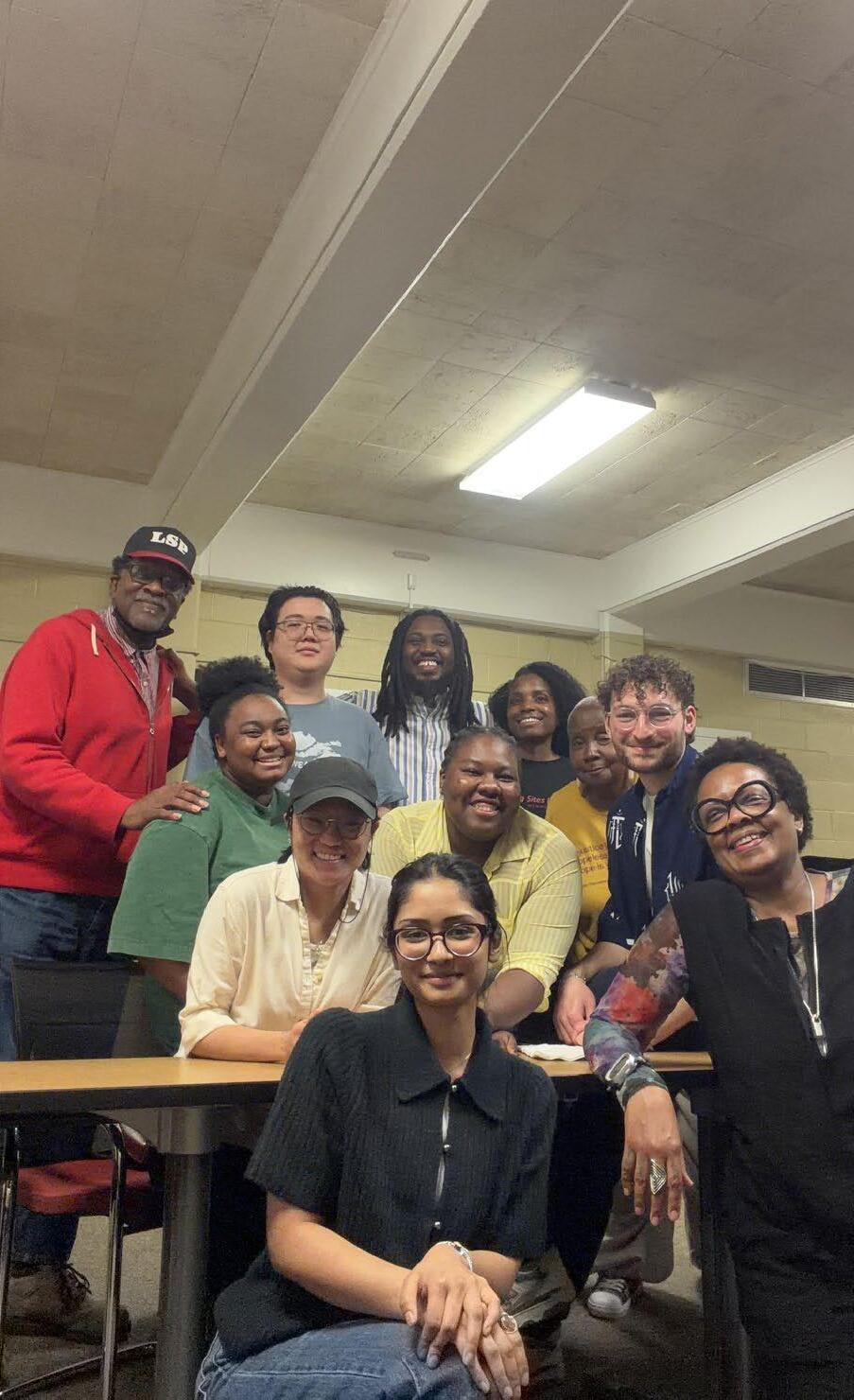
Capstone and LSP Team debrief at Rhodes College, 2026
LSP has already established a meaningful and multifaceted body of commemorative work that actively engages the community in remembrance, education, and healing. These practices demonstrate that LSP is committed to acknowledging the past, while carrying out forward-moving, impactful, and ongoing efforts to address it.
LSP’s existing initiatives integrate spiritual reflection, public history, and community dialogue in ways that make truth-telling both accessible and participatory:
1. Prayer gatherings and interfaith services serve as spaces for collective reflection, grounding the work in shared humanity and providing a foundation for healing across communities.
2. Soil collection ceremonies, conducted in partnership with the Equal Justice Initiative through the Community Remembrance Project, honor victims by physically and symbolically reclaiming sites of racial violence. These ceremonies connect local efforts to a broader national movement of memorialization.
3. Educational programming, including lectures, guided tours, and public history initiatives, brings historical knowledge into public spaces, ensuring that this history is actively engaged.
4. Digital storytelling and podcasts expand the reach of LSP’s work, making narratives and historical interpretation accessible to wider audiences beyond Memphis.
5. “Courageous Conversations” community meetings create structured spaces for dialogue about race, history, and justice. Within this framework, the Inner Work Group supports ongoing reflection and personal growth, helping participants understand the importance of sustained engagement and offering regular opportunities for involvement.
6. The Ell Persons Symposium (2022) invited the broader Memphis community to engage deeply with the life and 1917 lynching of Ell Persons, while also advocating for this history to be recognized within the NPS system. This event exemplifies how LSP connects local remembrance to larger efforts for national acknowledgment.
1.4.4 STRENGTHENING LSP’S ROLE IN THE PROJECT
LSP plays an essential role as both a knowledge keeper and a connector across communities. Strengthening its impact involves deepening its three existing tenets: Intergenerational, Interracial, and Interfaith Engagement. LSP’s approach emphasizes intersectional healing, recognizing that racial justice work must bridge differences in age, race, and faith traditions. By fostering dialogue across these lines, LSP creates spaces where collective memory can be shared, contested, and reimagined.
As a community partner, LSP can:
1. Facilitate courageous conversations that may not otherwise occur
2. Preserve narratives that are often excluded from official histories
3. Connect grassroots efforts with broader national initiatives like EJI and NAACP
4. Build long-term infrastructures for public memory and education
In this way, LSP demonstrates how small, communitybased organizations can have an outsized impact in shaping how histories of racial terror are remembered—and how communities move toward healing. 1.5
WOLF RIVER CONSERVANCY: REGIONAL GREENWAY AND PARTNERSHIP
Taken together, these practices show that LSP is already doing significant and substantive work. Their approach moves beyond symbolic remembrance by fostering ongoing community participation, education, and dialogue.
Wolf River Conservancy (WRC) is a nonprofit organization dedicated to protecting and enhancing the Wolf River and its surrounding watershed as a sustainable natural resource.
The Conservancy operates as a comprehensive land trust with a mission centered on conservation, recreation, and education. Through these focus areas, WRC works to preserve ecological health, improve air and water quality, and maintain habitats for both wildlife and human well-being. At the same time, the organization promotes responsible public access to nature and fosters environmental awareness through firsthand experiences and community engagement.
EJI’s Community Remembrance Project soil collection from over 700 racial terror lynching sites to memorialize victims, erect historical markers, and foster racial reconciliation.4
Wolf River in Memphis TN, from Wolf River Greenway Conservancy.5
Through partnerships with local governments, community groups, and environmental organizations, the Conservancy plays a significant role in conservation initiatives across the Memphis region. Its long-term vision emphasizes not only protecting land and waterways, but also ensuring open access to natural spaces within urban environments, positioning the river corridor as a site for recreation, reflection, and community connection.
1.5.1 THE WOLF RIVER GREENWAY VISION
The Wolf River Greenway is a regional multi-use trail system following the Wolf River through Memphis and surrounding communities. The project aims to connect neighborhoods, parks, and natural landscapes along the river while providing accessible recreational opportunities for residents and visitors. As one of the major green infrastructure initiatives in the Memphis region, the greenway promotes outdoor recreation, environmental conservation, and improved access to the river corridor.
The trail is intended to support walking, cycling, and other non-motorized forms of transportation. By linking multiple destinations along the river, the greenway helps strengthen the relationship between Memphis residents and the natural environment. In addition to recreation, the project contributes to broader regional goals related to environmental stewardship, public health, and sustainable mobility. Through these connections, the Wolf River Greenway functions not only as a recreational trail but also as an important landscape that integrates ecological conservation with community access.
1.5.2 ROLE OF THE WOLF RIVER CONSERVANCY
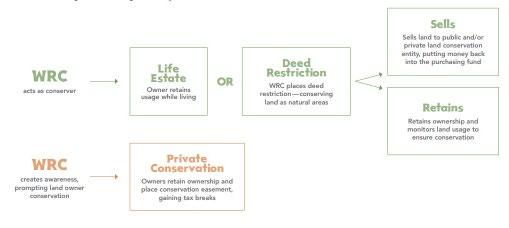
WRC is important to this project primarily as a land steward and greenway partner rather than as a lead organization for the memorialization of Ell Persons. According to its 2023–2026 Strategic Plan, the Conservancy focuses on conservation, recreation, and education, with particular emphasis on protecting land in the Wolf River watershed that has wetland value, aquifer recharge importance, and broader ecological significance.6 The plan also highlights land conservation strategies such as deed restrictions, conservation easements, life estates, and land acquisition, and states that the organization has already protected nearly 19,000 acres while continuing to prioritize additional critical properties.7 Of particular relevance to this study, the Conservancy seeks to protect urban land contiguous to the Greenway so that, over time, these lands can both preserve natural systems and support public access to trails and waterways.
HOW CONSERVATION WORKS
At the same time, the available materials do not show that the Conservancy has taken a direct leadership role in interpreting or memorializing historical sites or other sites of racial terror like that of Ell Persons. Its strategic plan frames its mission around watershed protection and open access to nature, recreation, and conservation education rather than racial history or memorial programming. As a result, the Conservancy’s connection to the Ell Persons site is indirect rather than programmatic. However, this does not diminish its importance. Through land stewardship and Greenway development, WRC significantly shapes the surrounding corridor through the Greenway accessibility, visibility, and long-term landscape conditions.
1.5.1 PLANNED SPUR TRAIL TO THE ELL PERSONS SITE
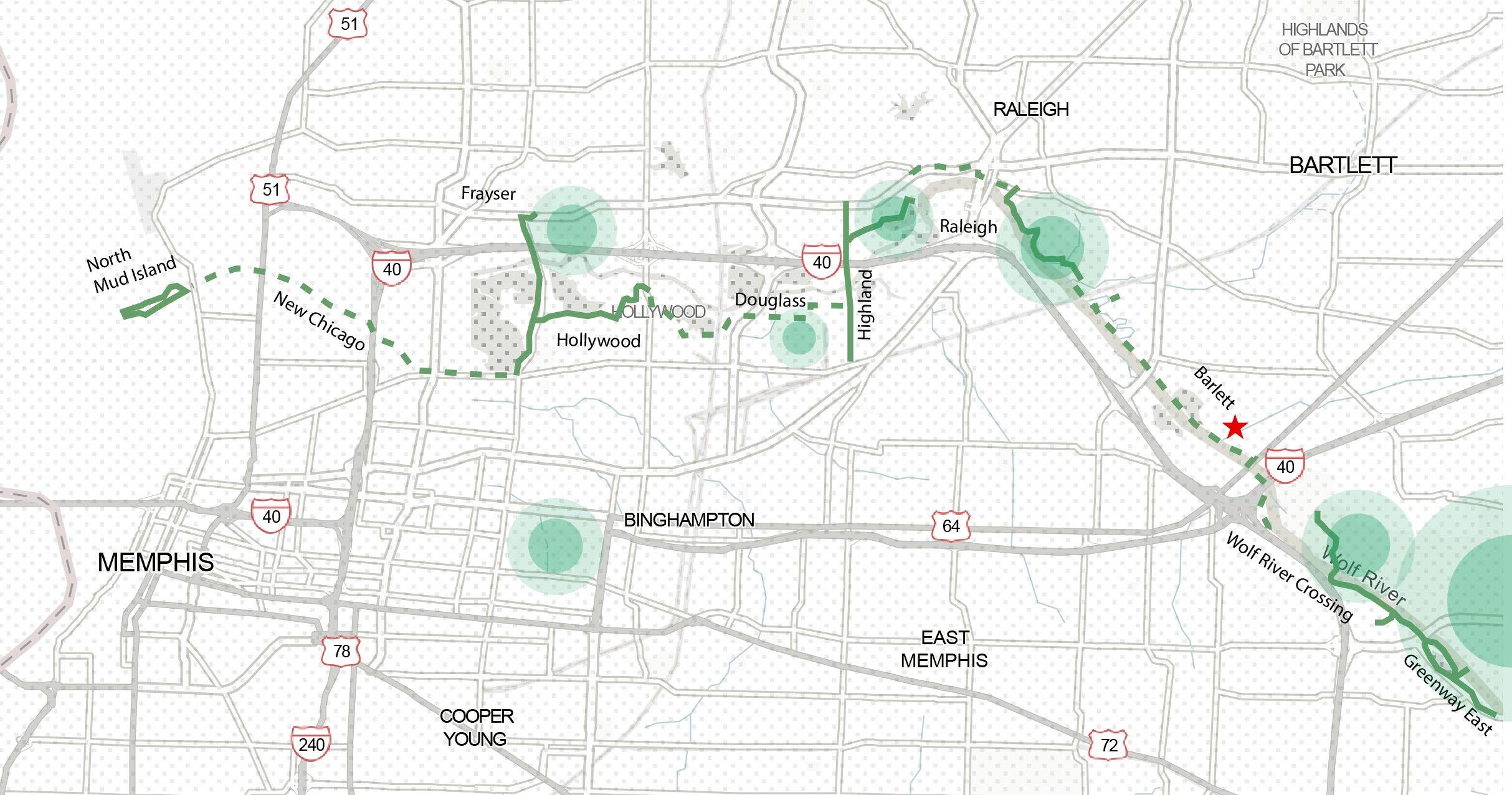
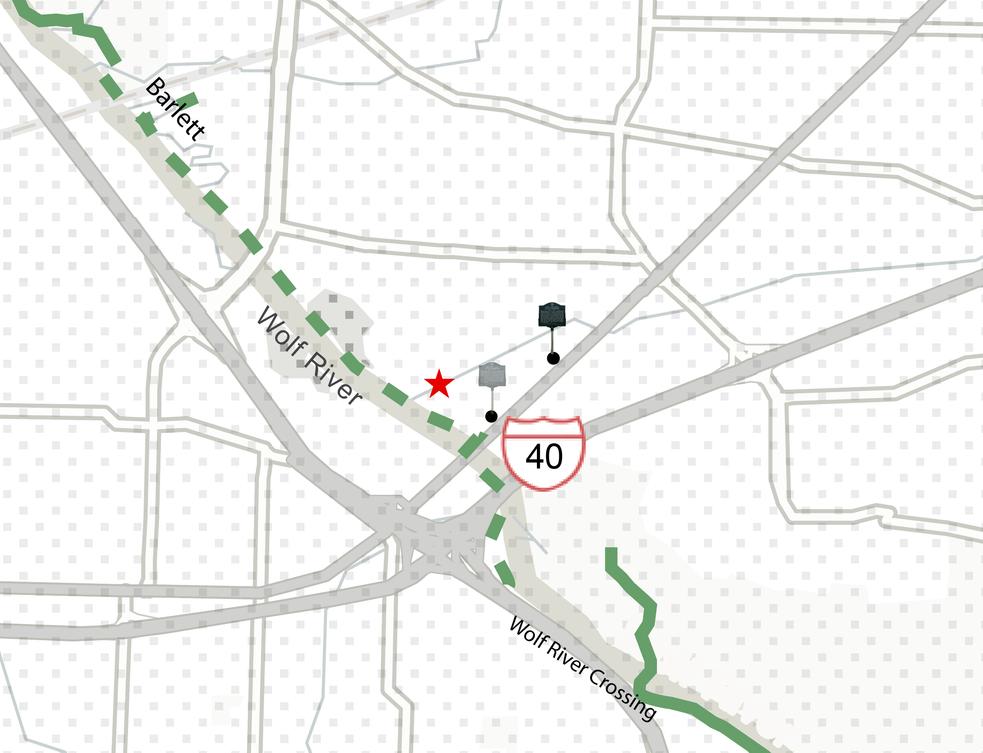
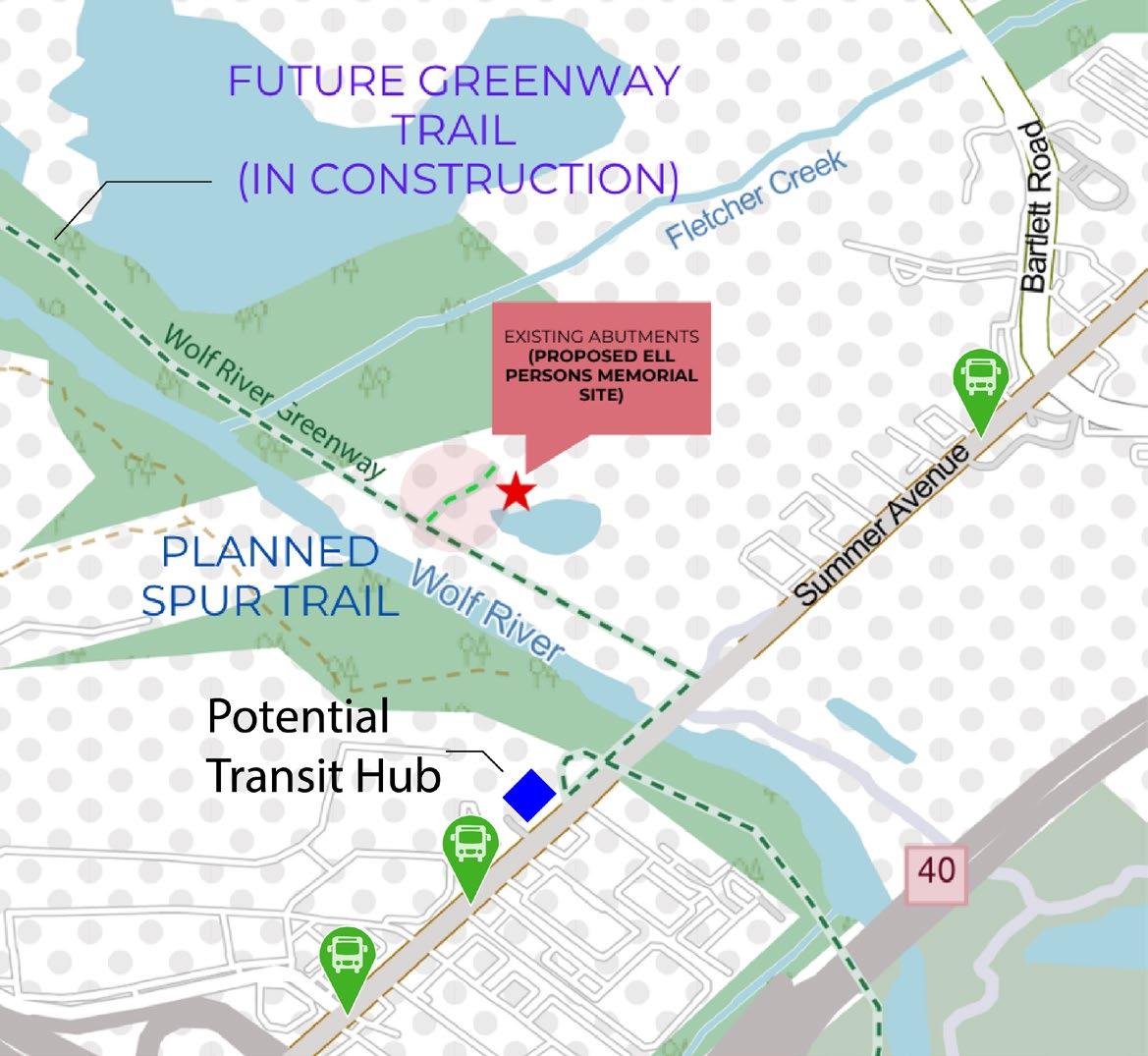
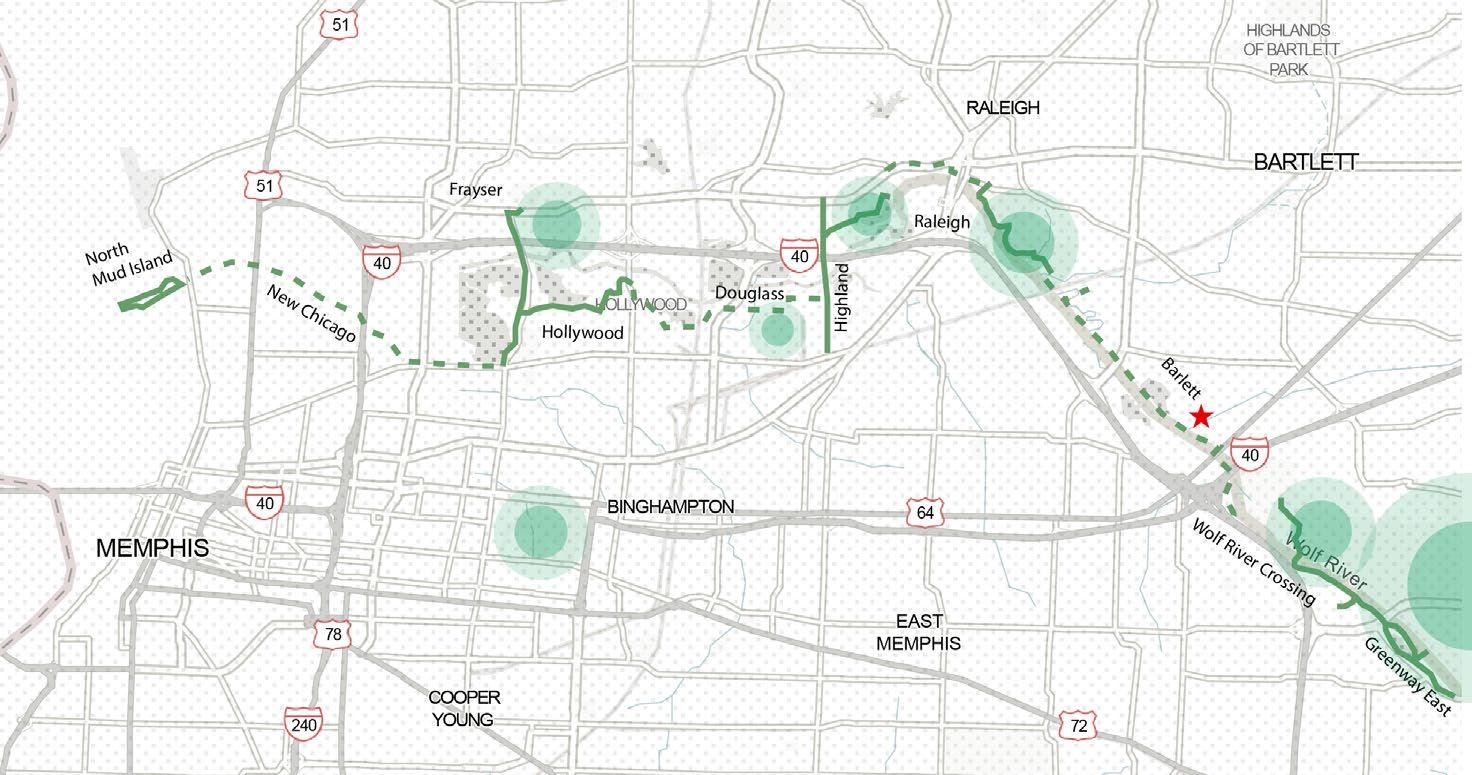
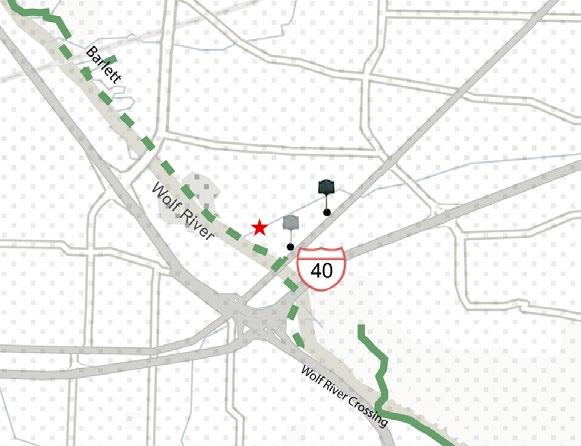
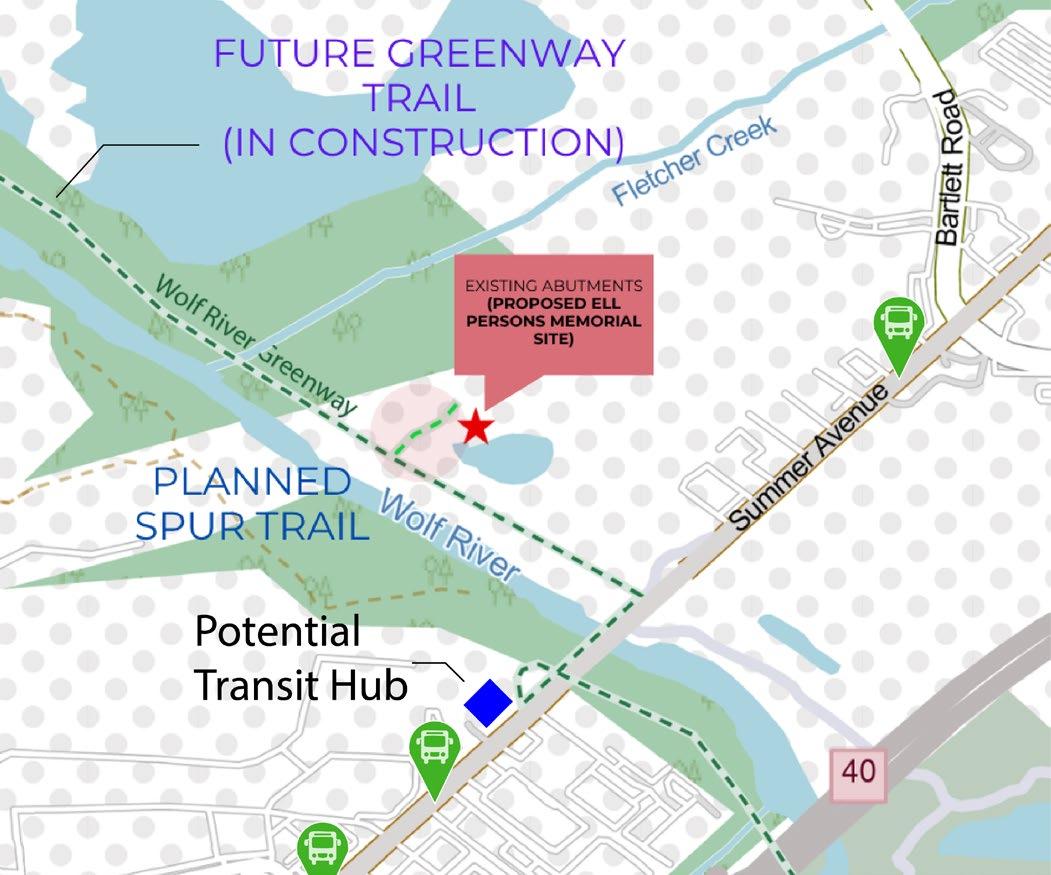
The Ell Persons lynching site is located adjacent to the Wolf River Greenway in the Bartlett neighborhood corridor. As part of the greenway development, a spur trail is planned to provide direct access from the main trail to the historical site. This connection will allow visitors traveling along the greenway to reach the site through the regional trail network.
A key strategic priority is the protection of urban lands contiguous to the Greenway, ensuring that these areas both preserve ecological systems and support longterm public access. This approach directly shapes the spatial and environmental context of sites along the corridor, including the Ell Persons lynching site.
The segment of the greenway near the Ell Persons site is currently under construction and is expected to open in 2027. Once completed, the spur trail will improve accessibility and visibility of the site by linking it to a widely used recreational corridor. This connection reflects the Strategic Plan’s emphasis on open access and interconnected landscapes, positioning the site within a broader system of public spaces. At the same time, it introduces important questions about how a site of racial violence is encountered within a recreational and ecological corridor. Through this linkage, the Ell Persons site becomes part of a landscape that merges environmental stewardship, mobility, and historical reflection, even as the responsibility for interpretation may lie beyond WRC’s primary mission.
Parks
In-Progress Greenway
Completed Greenway
Lynching “site” of Ell Persons
Figure D.1. Map of location of lynching site along broader Wolf River Greenway.
NATIONAL CONTEXT
The National Park Service (NPS) is currently conducting a Special Resource Study focused on lynching locations in the Memphis area.9 The study was authorized by the United States Congress through the Consolidated Appropriations Act of 2023 and aims to evaluate whether certain lynching sites should be considered for inclusion in the National Park System.
1.6.1 NATIONAL PARK SERVICE SPECIAL RESOURCE STUDY
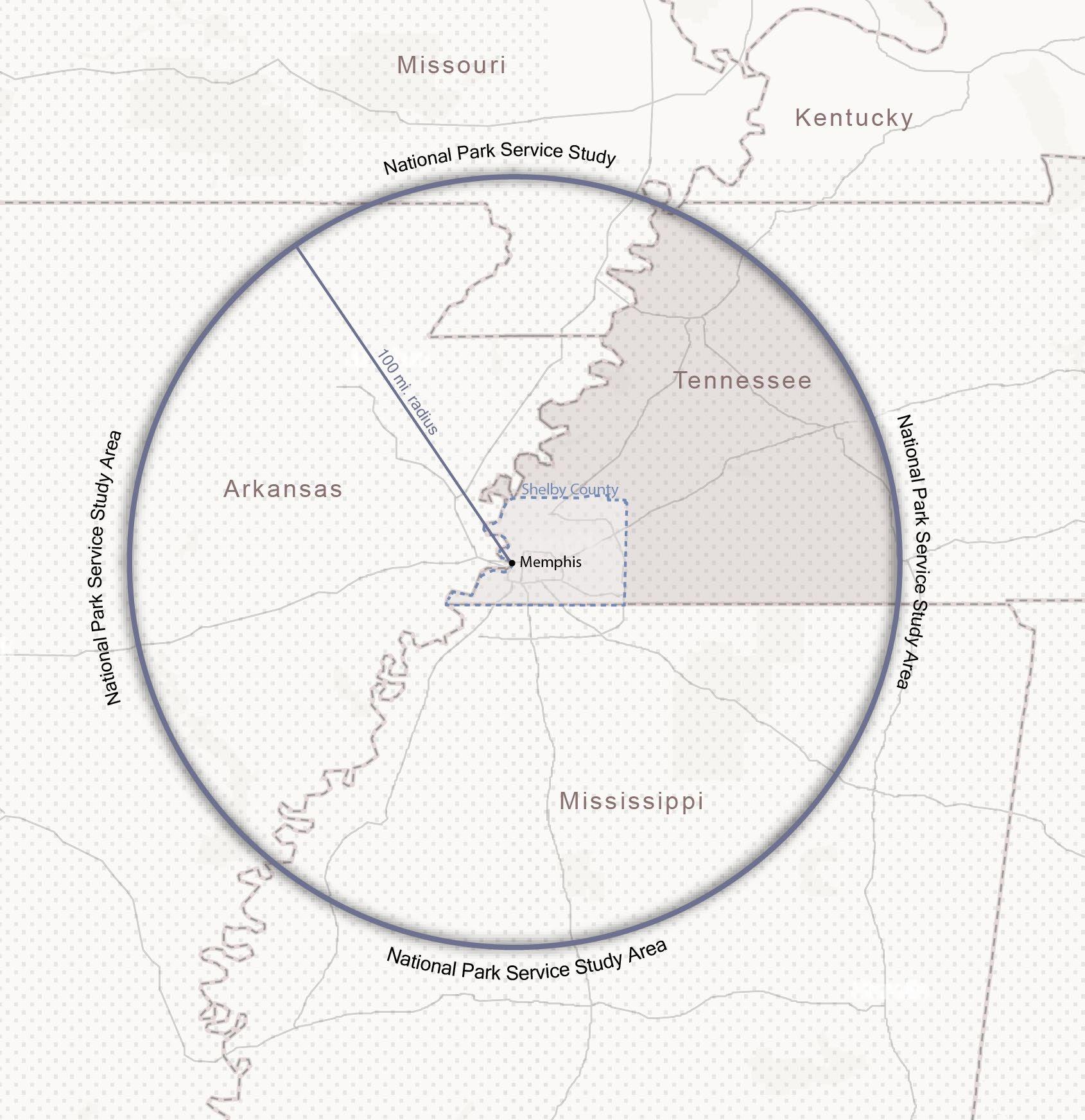
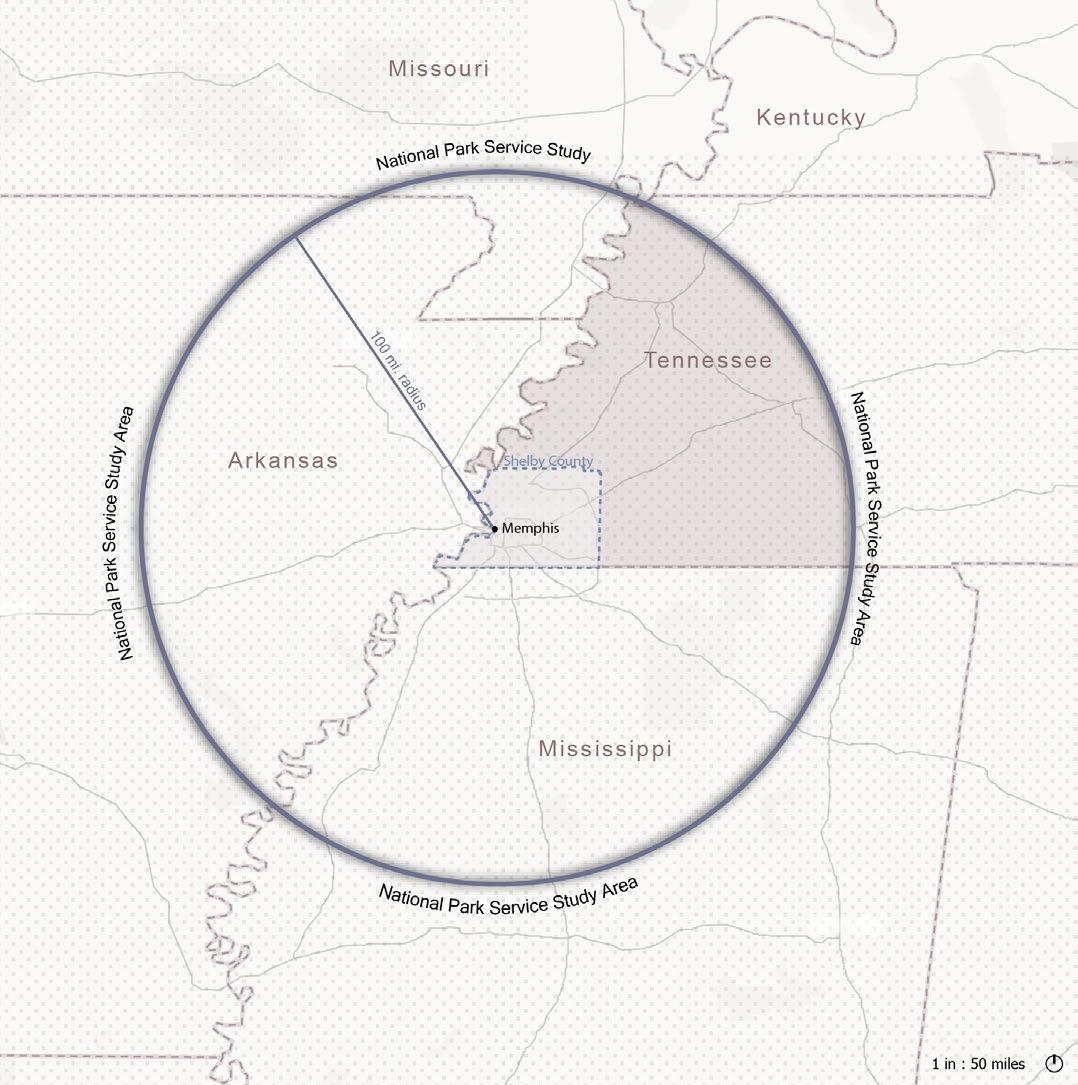
The study includes several lynching locations in Tennessee, including the 1917 lynching site of Ell Persons in Memphis. Additionally, the study area extends an approximately 100 mile radius from Memphis and may also include additional sites identified through historical research and public input.
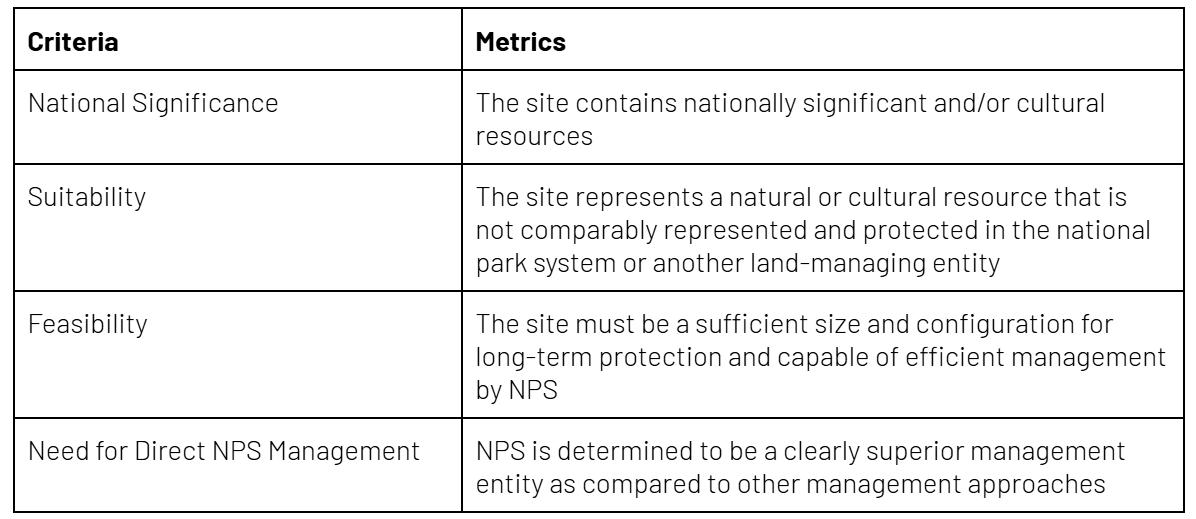
In evaluating these locations, NPS applies four criteria: national significance, suitability, feasibility, and the need for direct NPS management.10 The study process includes historical research, community engagement, and public input to better understand the historical importance of these sites and the potential role of federal involvement in their preservation. Once completed, the findings of the study will be submitted to Congress, which will determine whether any of the locations should become part of the National Park System.
1.6.2 LOCAL PLANNING AND POLICY CONTEXT
access within the surrounding area. As a result, local planning policies play an important role in shaping how the site is accessed, preserved, and interpreted. This is especially important because the site lies within the larger Wolf River corridor, where transportation planning, park and open-space planning, and watershed management overlap. The City of Memphis Park Services Master Plan places the Wolf River Greenway within the city’s broader park and open-space system and treats conservancy partnerships as part of long-term public stewardship.12 Memphis 3.0 provides a broader land-use framework that helps explain the area as a transition between the more auto-oriented Summer Avenue corridor and the open-space and natural-feature landscape of the Wolf River.13 At the same time, the regional pedestrian and bicycle planning framework emphasizes stronger connections to major spine facilities such as the Wolf River Greenway and better links between trails, walking routes, and transit access, which is directly relevant to the site’s current accessibility challenges.14 In addition, WRC’s financial statements note that WRC and the City of Memphis entered into a memorandum of understanding regarding the goals and objectives for developing the Wolf River Greenway trail (See Section 4.1.2 or Appendix B) The same note states that WRC intends to donate substantially completed trail segments to the City of Memphis, indicating that Greenway development is not limited to a broad planning vision but is also structured through a formal public-nonprofit implementation partnership.15 Together, these local policies and agreements show that the site is shaped by a broader framework of access, open-space planning, environmental sensitivity, and long-term civic stewardship.
Endnotes
1. The Lynching Sites Project of Memphis. “Ell Persons Lynching Site Pre-Reconnaissance Survey, Memphis, Tennessee.” The Lynching Sites Project of Memphis, 2020.
2. Ibid.
3. The Lynching Sites Project of Memphis. https://lynchingsitesmem.org/about.
4. (eji soil collection photo)
5. Wolf River Conservancy, Strategic Plan, 2023–2026 (Memphis, TN: Wolf River Conservancy, 2023).
6. Ibid.
7. Ibid.
8. Ibid.
9. National Park Service, “Memphis Area Lynching Locations Special Resource Study,” Planning, Environment, and Public Comment, accessed April 10, 2026, https://parkplanning.nps.gov/projectHome.cfm?projectID=124261.
10. Ibid.
11. Ibid.
12. City of Memphis Division of Parks and Neighborhoods, City of Memphis Park Services Master Plan 2020 (Memphis, TN: City of Memphis Division of Parks and Neighborhoods, 2020).
13. City of Memphis, Memphis 3.0: Future Land Use Plan [or Future Land Use Framework] (Memphis, TN: City of Memphis, 2019).
14. Memphis Metropolitan Planning Organization, Memphis Regional Pedestrian and Bicycle Greenprint Plan (Memphis, TN: Memphis Metropolitan Planning Organization, n.d.).
The Ell Persons lynching site is located within the planning jurisdiction of the City of Memphis and Shelby County. Local government agencies influence land use decisions, infrastructure development, environmental management, and public
15. Wolf River Conservancy, Inc., Financial Statements, December 31, 2019 and 2018 (Memphis, TN: Wolf River Conservancy, 2020), note G.
Figure D.2, National Parks Service Special Resource Study, Map of Study Area11
CHAPTER 2: ORIENTATION
2.1 CULTURAL LANDSCAPE AND SITE HISTORY
May 1st, 1866
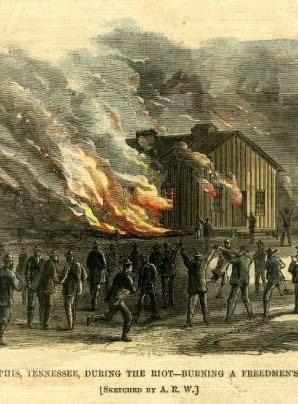
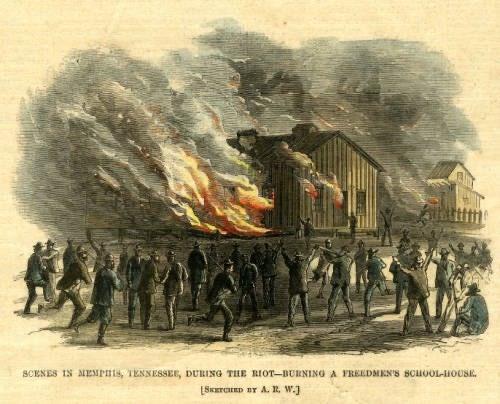
Memphis Massacre breaks out, resulting in the deaths of forty-six Black Memphians and the injury of seventy-five. Cornerstones of the Black community, including schools and churches, were set ablaze.17
This chapter provides an overview of the necessary context surrounding the site itself and its history; and the theoretical and practical frameworks that guided the team’s thinking around what the site could become. This chapter explores the broader history of racial terror lynching in the United States and situates the lynching of Ell Persons in the cultural landscape that brought it about. The team shares a philosophy of memorialization, derived from each individual team members’ work in engaging with their own histories, and ends the chapter with guiding principles for a memorial at the Ell Persons site.
2.1 CULTURAL LANDSCAPE AND SITE HISTORY
1. HISTORY OF LYNCHING IN THE US.
2. RESISTANCE AGAINST RACIAL HOSTILITY
3. SPATIAL ERASURE AND HISTORICAL DISPLACEMENT
4. NATIONAL SIGNIFICANCE AND FEDERAL RECOGNITION IN THE NATIONAL PARK SYSTEM
2.2 PHILOSOPHY AND THEORY OF MEMORIALIZATION
1. TRUTH WITHOUT SPECTACLE
2. REORIENTING THE TRAUMA OF LAND
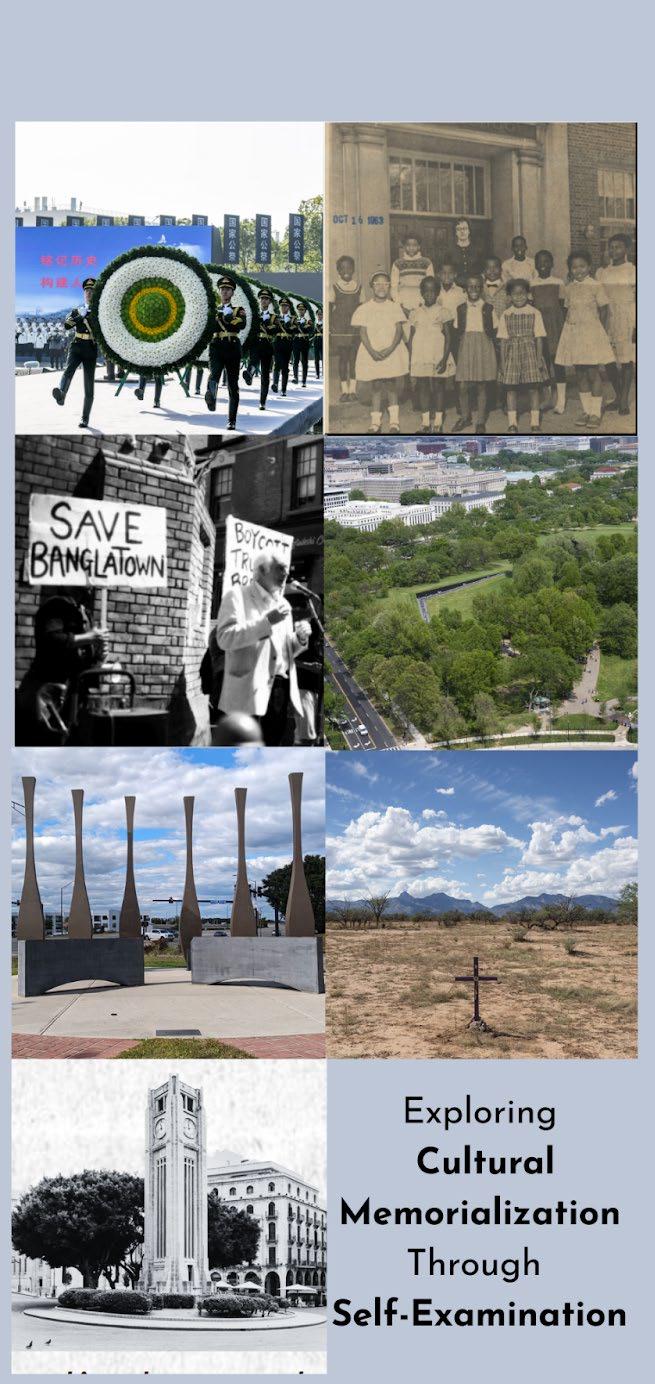
3. EXPLORING CULTURAL MEMORIALIZATION THROUGH SELF-EXAMINATION: MEMORIALS, MEMORY, AND MEANING MAKING EXERCISE
2.3 THEORETICAL FRAMEWORKS: POLITICS OF MEMORIALIZATION AND REMEMBRANCE
1. RECONFIGURING DESIGN PRACTICE: FROM NEUTRALITY TO RESTORATIVE ACTION
2. RECONFIGURING MEMORIALIZATION: FROM SITE TO SPATIAL NETWORK
3. AFROURBANIST PRACTICE
2.4 PRECEDENT FRAMEWORKS
1. CASE STUDIES
2. CULTURAL INSTITUTION VISITS
3. ELL PERSONS POTENTIAL MEMORIAL SITE VISIT
2.5 GUIDING PRINCIPLES FOR MEMORIALIZATION
March 9, 1892
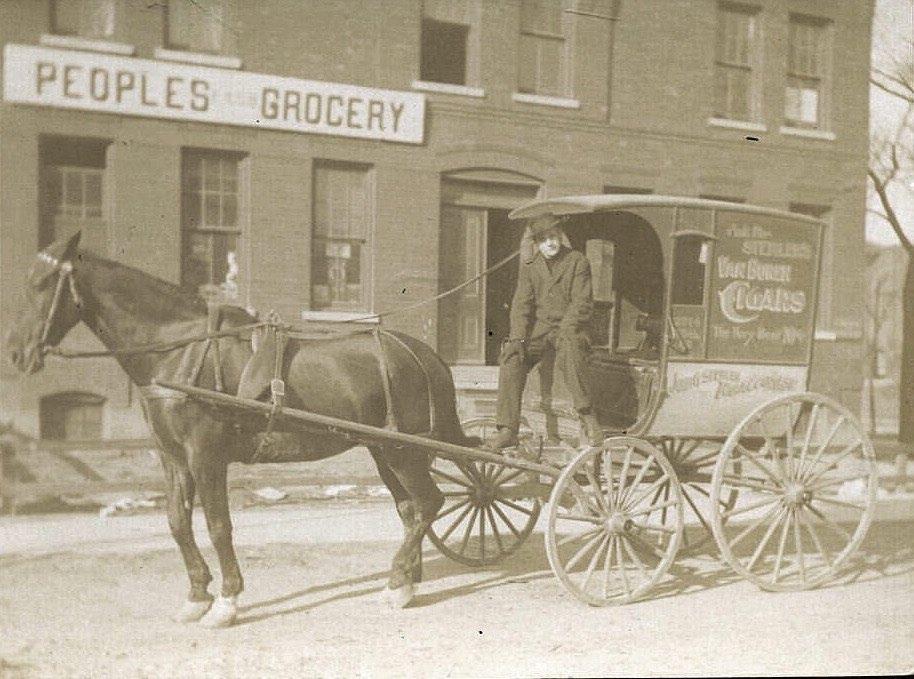
Threatened by the success of the People’s Grocer, owned and operated by Will Stewart, Tommie Moss, and Calvin McDowell, a rival White grocer sends a group of armed men into the store. The three men fight back and are subsequently arrested, dragged from the jail, and gunned down in the Chesapeake and Ohio rail yards.19
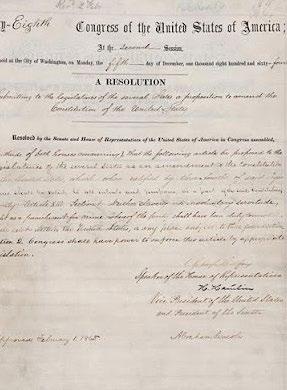
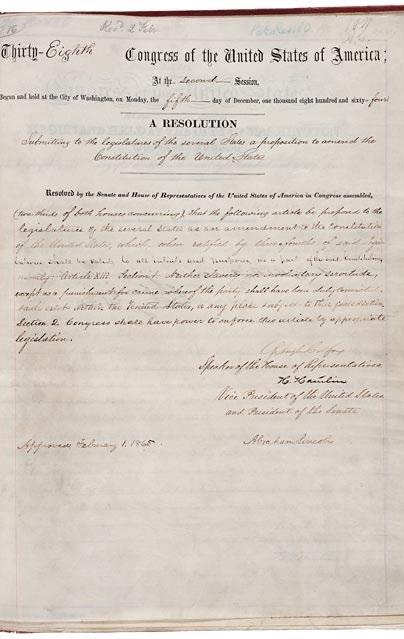
February 22, 1865 Tenneessee ratifies the 13th Amendment, legally abolishing slavery.16
According to the records of the NAACP, 4,473 lynchings occured in the United States from 1882 to 1968, though many argue that the number is inaccurate, given how many lynchings went unreported and unrecorded.
January 15, 1869
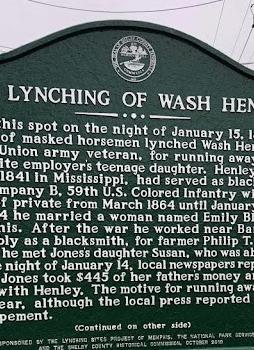
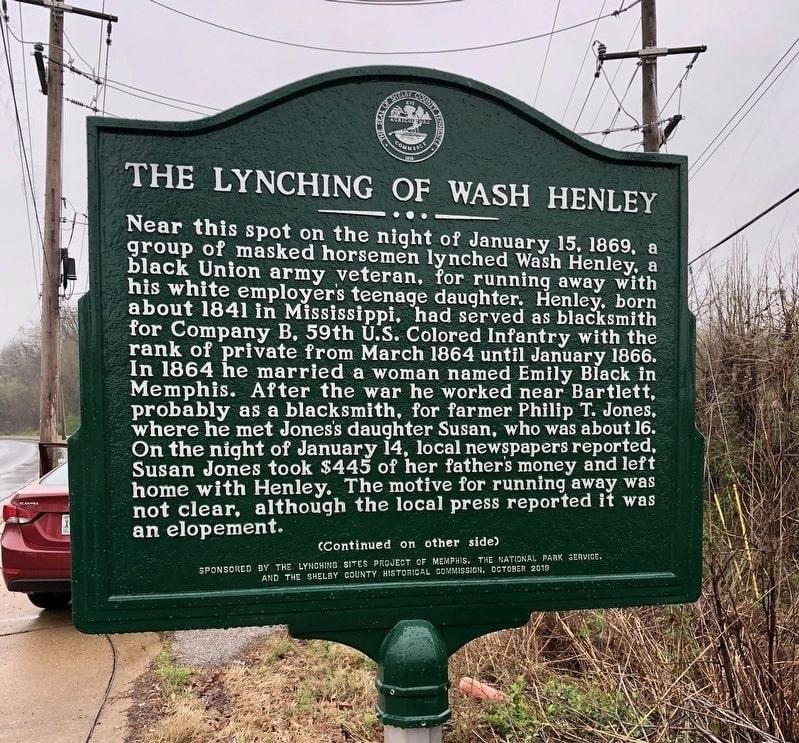
Wash Henley, a Black Union veteran, eloped with the daughter of a White farmer. He is lynched by a mob of about 25 people, captured while being escorted by friends of the farmer to the authorities.18
2.1.1 HISTORY OF LYNCHING IN THE US
Lynching as a general practice did not begin in years following the American Civil War (several White men were lynched prior to the Civil War) but in the Reconstruction Era and following decades, lynching emerges as a form of racial, pseudo-retaliatory terror against Black Americans. For the purposes of this report, the discussion of lynching refers specifically to racial terror lynchings, characterized by the murder of a Black American individual at the hands of a White mob acting with impunity. Racial terror lynchings are generally associated with the American South, though they occurred as far north as Michigan, and as far west as Oregon. In a 2017 report published by the Equal Justice Initiative, it was found that 4,084 lynchings occured in twelve southern states, including Tennessee.20 It is imperative to note that the aim possessed by the White mobs participating in racial terror lynchings was not solely to kill the victim—it was the terror of the entire local Black community. The violence of racial terror lynchings was meant to serve as a warning to Black community members of what could happen to them as well.
August 31, 1894
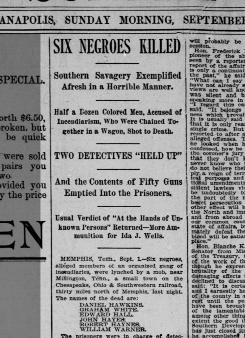
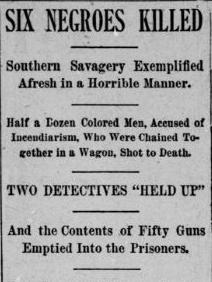
Six men known as the Millington Six (Warner Williams, Daniel Hawkins, Robert Haynes, Edward Hall, John Hayes, Graham White) are falsely accused of burning buildings and are shot to death by a mob of about 50 armed men while en route to Memphis.22
July 21, 1893
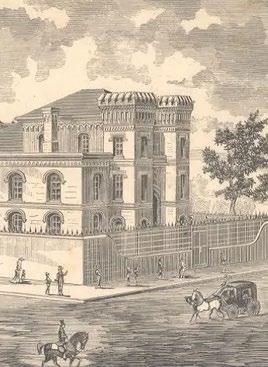
Arrested for fitting the description of a man who attempted to sexually assault two White women, Lee Walker is dragged out of the Shelby County Jail and lynched a block away.21
Lynching as a general practice did not begin in years following the American Civil War — several White men were lynched prior to the Civil War — but in the Reconstruction Era and the following decades, lynching emerges as a form of racial, pseudo-retaliatory terror against Black Americans.
May 22, 1917
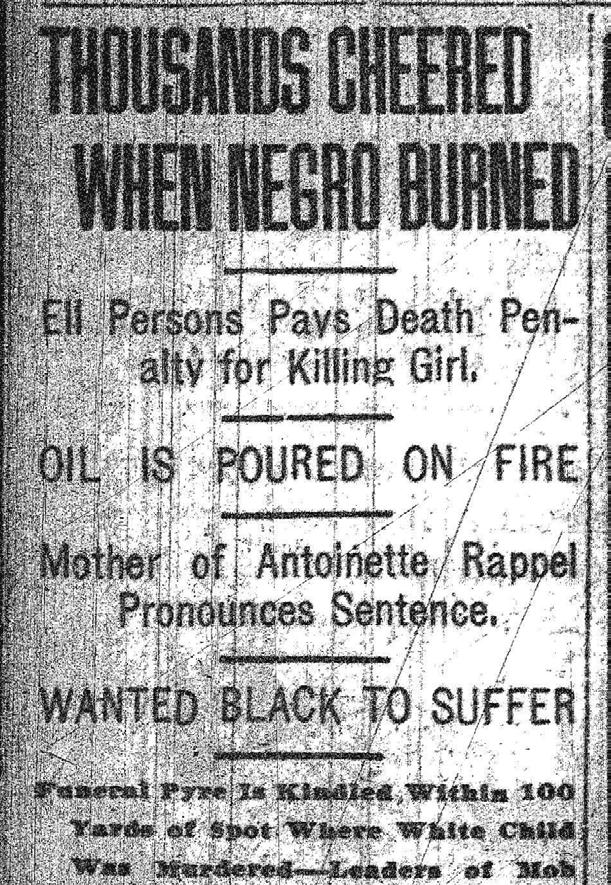
Ell Persons, accused of the sexual assault and murder of Antoinette Rappel, is lynched on the west side of the Macon Road Bridge, which crosses Wolf River.23
Lynching was not the only form of racial terror and violence enacted upon Black American residents of the state of Tennessee. On May 1st, 1866, a rebellion broke out in Memphis as a result of White police officers firing on a crowd of unarmed Black men, women and children. For the next three days, White mobs, which included police officers, firemen and civilians, committed large-scale acts of violence with the intent to “kill every Negro and drive the last one from the city.” The rebellion was a profound loss for the Black Memphian community: forty-six Black Memphians were killed and another seventy-five were injured; five women were raped; ninety-one houses, twelve schools, and four churches were burned down; and finally, many Black Memphians fled the city altogether. White rioters deliberately targeted Black people and institutions which they felt were the most visible manifestations of Black empowerment during the Reconstruction Era. Despite this fact, news sources, such as the Daily Avalanche, blamed Black Memphians for the violence. The same publication then went on to declare that in the wake of the riots, “[Memphians] may confidently expect a restoration of the old order of things. The negro population will now do their duty.... Negro men and negro women are suddenly looking for work on country farms.... Thank heaven, the white race are once more rulers in Memphis.”24
After the Memphis Massacre of 1866, a total of 235 lynchings are reported to have occurred in the state of Tennessee.25 Twenty of these lynchings occurred in Shelby County, which not only holds the distinction of being the county with the highest number of lynchings in the state, but also holds the distinction of being tied for the 18th highest number of lynching victims among a shortlist of 25 Southern counties. The lynching of Ell Persons was part of a continued history of racial terror produced by a specific set of political, social, and spatial conditions that determined whose life was expendable and whose death could be made into spectacle.
2.1.2 RESISTANCE AGAINST RACIAL HOSTILITY
Understanding why that resistance has always been necessary requires engaging with the frameworks that explain how racial terror was justified, sustained, and inscribed into the landscape itself.
Black Americans have a long history of fierce resistance to racial oppression. There are several notable instances in which kidnapped Africans during the slave trade would fight against European and American enslavers, attempting to take over slave ships.26 Those enslaved in the Americas would run away from their plantations, organize rebellions, encourage work slowdowns, and damage the machinery of their work. Similarly, Black Americans resisted against lynching using the tools they had available.
Through grassroots organizing, Black communities often launched campaigns to economically disempower members of lynch mobs.27 These communities boycotted businesses, refusing to work for, or purchase from the establishments, of anyone who attended a lynching. More radical individuals would set fire to some of these properties. Additionally, if a Black person was accused of a crime and arrested, Black men would organize themselves in front of jailhouses to guard prisoners against lynch mobs.28
Some of these anti-lynching campaigns grew into national movements. For example, The
National Afro-American Council formed in 1898 in response to the lynching of Frazier B. Baker, a Black postmaster that was murdered by a white mob in South Carolina.30 This organization would be the first African American organization to include both men and women in their membership. They advocated for anti-lynching law and raised money to fight the disenfranchisement of Black Americans.
Additionally, The National Association for the Advancement of Colored People (NAACP), the country’s oldest civil rights organization, was founded in a direct response to a race massacre in Illinois in 1908. At its inception, the NAACP became one of the first organizations to include White, Black, men, and women in its leadership. The membership of the NAACP soared after lynching became the primary focus of the organization in 1912. By 1919, there were 310 chapters nationwide with more than 91,000 members.31
Ensuring that lynchings were properly documented and not ignored was another strategy for resistance. Papers such as the NAACP’s The Crisis, edited by W.E.B. Du Bois, published stories of lynching, told
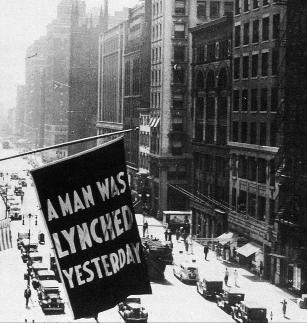
A flag stating “A Man Was Lynched Yesterday” flew outside the NAACP Headquarters in New York from 1920 to 1938.29
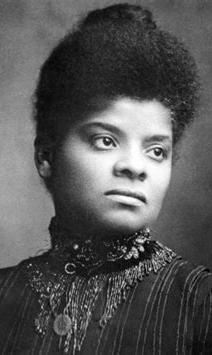
Ida B. Wells-Barnett, an anti-lynching activist, journalist, orator, teacher, and suffragette.32
people. She would eventually publish her findings in the newspaper she owned, Free Speech and Headlight, and in her two notable publications Southern Horrors: Lynch Law in All Its Phases and The Red Record: Lynchings in the United States. She wrote in The Red Record:
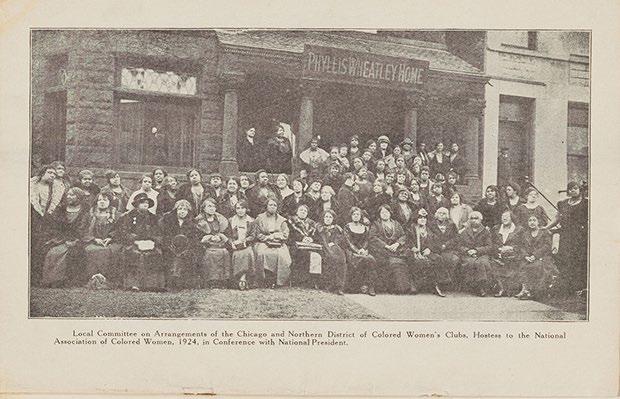
Ida B. Wells would go on to become one of the founding members of the National Association of Colored Women. Other notable founders of the organization include Harriet Tubman, Frances E. W. Harper, and Mary Church Terrell. Wells also helped establish the NAACP.38
the stories of victims, and sold papers in order to financially support anti-lynching campaigns.33 These documented crimes would motivate others to join the movement. For example, the lynching of Emmett Till and the publication of his murder in 1955 was a main driver of the civil rights movement that helped create the America we know today.34
Ida B. Wells-Barnett became one of the most prolific anti-lynching crusaders after her friend was lynched at the People’s Grocery in Memphis in 1892.35 Born into slavery in 1862 in Mississippi, Ida B. Wells dedicated her life to improving the lives of Black Americans. A journalist, orator, teacher, and suffragette, Wells investigated the common accusations of lynching—of mobs accusing Black men of raping white women—and concluded that lynchings were caused by a variety of reasons, but mostly due to the economic success of Black
“WHATEVER FAULTS AND FAILINGS OTHER NATIONS MAY HAVE IN THEIR DEALINGS WITH THEIR OWN SUBJECTS OR WITH OTHER PEOPLE NO OTHER CIVILIZED NATION STANDS CONDEMNED BEFORE THE WORLD WITH A SERIES OF CRIMES SO PECULIARLY NATIONAL. IT BECOMES A PAINFUL DUTY OF THE NEGRO TO REPRODUCE A RECORD WHICH SHOWS THAT A LARGE PORTION OF THE AMERICAN PEOPLE AVOW ANARCHY, CONDONE MURDER AND DEFY CONTEMPT OF CIVILIZATION.”36
Ida B. Wells
Additionally, anti-lynching campaigns extended beyond community organizing, with members actively working to influence U.S. politics. In the late 1890s, several anti-lynching organizations would protest in front of the White House. Ida B. Wells, Fredrick Douglass, and W.E.B. Du Bois would attend meetings with sitting presidents to encourage them to make anti-lynching reforms.39 In 1918, Missouri congressman Leonidas Dyer introduced an antilynching bill to the U.S House of Representatives.40 His work would not come into fruition until 2022 when President Joe Biden signed the Emmett Till Anti-Lynching Bill into law, officially making lynching as a federal hate crime offense.41
Black Americans are still resisting against racial violence today. The legacy of the anti-racism campaigns of the 19th and 20th centuries are present in movements such as Black Lives Matter, which shape U.S politics and influence civil rights development. Black American history has always been shaped by resistance.42 The tradition of resistance that defined the anti-lynching movement remains present in contemporary movements for racial justice today.
2.1.3
SPATIAL ERASURE AND HISTORICAL DISPLACEMENT
Understanding the Ell Persons site,its history, and the history of racial terror more generally requires engaging with two frameworks that help explain how that determination of life and death was made, how it has been sustained, and how the landscape of Memphis continues to reflect it. Achille Mbembe’s Necropolitics offers the most direct theoretical lens for understanding what happened at the Ell Persons site. Mbembe argues that sovereignty is not only the power to govern, but the power to dictate who lives and who must die, i.e. to expose certain populations to death as a function of political and racial order.43 The lynching of Ell Persons was precisely this kind of sovereign
act. The decision to abduct him from a train, burn him alive before a crowd of more than 3,000 people, dismember his charred body, and later dump his severed head over five miles away was a standard expression of the social order present at this time. Sheriff Mike G. Tate’s complicity, the coroner’s verdict of death by “unknown causes at the hands of unknown persons,” and the grand jury’s refusal to indict anyone all confirm that while this violence was technically illegal, it was operating within the state’s implicit authorization.44 The spectacle that was made out of this lynching—sandwiches sold to spectators, the families in attendance, and the newspapers that advertised it in advance— reflects what Mbembe describes as the public, performative dimension of necropower.
Necropower, in this sense, reflects the idea of death deployed not only to eliminate an individual, but to discipline, hold power over, and terrorize an entire community.45
Banu Bargu’s extension of necropolitics adds another layer to this analysis. Where Mbembe focuses on the power to kill, Bargu draws attention to the violence done to the dead body itself and how the mutilation, dismemberment, and public display of the corpse is a form of ongoing punishment directed not only at the deceased, but at the living community that claims him.46 The violence inflicted on Ell Persons did not end with his death. His body was dismembered, his heart was cut out, and his head was severed and taken to Memphis’s Black commercial district and hurled at a group of African Americans.47
Additionally, Benedict Anderson’s framework of Imagined Communities provides a theoretical framework for how lynchings were made possible and the mechanisms by which they have been obscured. The white mob that gathered at the Wolf River was not simply punishing one man for an alleged crime. It was enacting a collective assertion of who the nation was for—who counted as a citizen, whose death could be staged as entertainment, and who could be killed without legal consequence. The crowd of over 3,000 constituted, in Anderson’s terms, an imagined community performing its own identity through the spectacle of racial violence.
An image of the National Association of Colored Women, 1924.37
Anderson argues that nations, and nationstate building, is an imagined formation constructed through shared narratives that determine who belongs and who does not, and are sustained through a carefully managed practice of collective remembering and forgetting.48 Racial terror lynchings were part of this instrument of boundary-making.
The aftermath of the lynching demonstrates equally how that identity has been maintained through selective amnesia. Anderson observes that nations are constructed not only by what they remember, but also by what they are made to forget. This act of forgetting is, by and large, the product of institutional choices about which histories are preserved and which are allowed to disappear.49
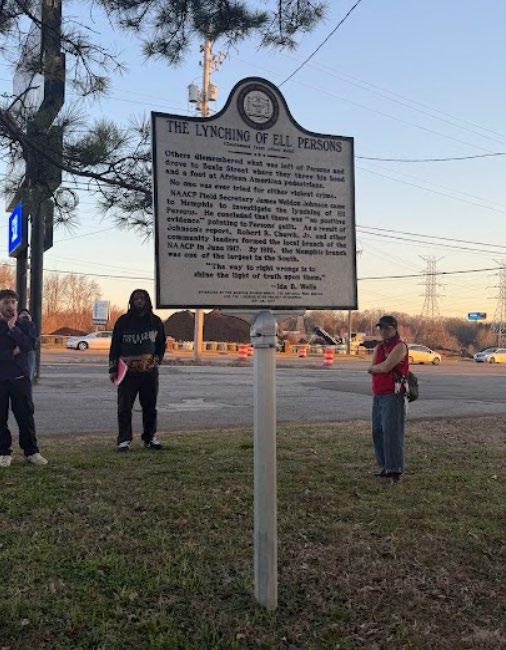
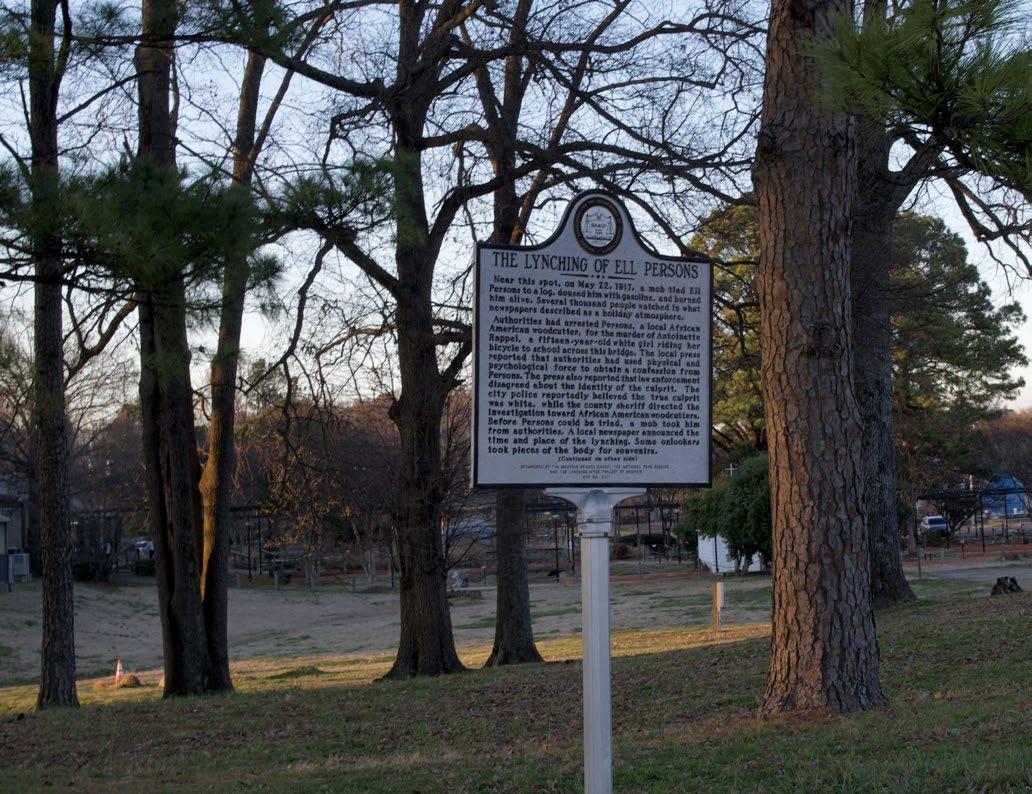
The historical record of the Ell Persons lynching reflects this dynamic directly. The surviving accounts are dominated by coverage of Antoinette Rappel’s death. Additionally, no monument was erected near the site for over a century. When a historical marker was finally placed, it was not located at the site of the lynching itself. Instead, the marker was placed over half a mile away. This was, in part, because of logistical difficulties with accessing the approximate location of the site, but also because the exact location of Ell Persons’ lynching remains unknown. (See Section 3.3.1) Symbolically, a marker that cannot be placed at the site it is meant to commemorate reproduces the very erasure it is meant to correct. While a historical marker does show that this history deserves acknowledgment, it is not the kind of acknowledgment that demands a deep reflection and encounter with the actual site. The site itself, or at least its approximate location, remains unmarked, and the spatial record of what happened there is absent.
2.1.4 NATIONAL SIGNIFICANCE AND FEDERAL RECOGNITION IN THE NATIONAL PARK SYSTEM
In 2023, the United States Congress passed Public Law No: 117-328, a Consolidated Appropriation Act. This seemingly innocuous annual spending bill provided resources for supporting Ukraine, several policy changes, and opened up resources for NPS to begin working on several projects. One of these projects included a special resource study (SRS) on lynchings in the vicinity of Memphis, Tennessee; documented in section 633 of the bill.
As evaluated by the SRS, a site must meet the following criteria to be recommended as an addition to the national park system:
The special resource study conducted by NPS is being used to analyse the locations of lynchings. As described by NPS, these are sites “... where lynching victims were incarcerated or kidnapped; where perpetrators and observers gathered, organized, and/ or watched; or where the corpse was mutilated, displayed, or recovered.”51 Although lynching was a widespread issue across the United States, the study restricts the exploration of this research to sites within 100 mile radius of Memphis, Tennessee. A total of eight sites have been identified so far for this study, one of which being the site of the Ell Persons lynching. For each of these eight sites, NPS will research if they are sites of national significance, whether NPS is the suitable manager of the site, the costs associated with NPS managing the site, and in what manner NPS should manage the site over other potential management partners.
The City of Memphis is home to several significant landmarks to the Black American community, including the National Civil Rights Museum at the Lorraine Motel and Beale Street. Yet, these monuments do not deeply discuss the history of lynching in this country, or in Memphis as it is not the aim of these landmarks to do so. Despite Memphis having such a deep and horrific history of lynching, there is currently no location in the region to discuss this legacy.
As discussed in section 2.1.2, the murder of Ell Persons was one of several lynchings that transformed the anti-lynching movement in the American South. Another lynching, the infamous People’s Grocery Lynchings in 1892, would lead Ida B. Wells to begin her crusade against lynching for which she is most well-known. Wells’ activist work would eventually help lead to the coalition building needed to establish the National Association for the Advancement of Colored People (NAACP) in 1909.
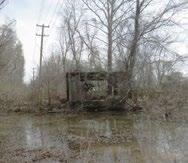
Macon Road bridge abutments at approximate location of Ell Persons lynching.
Lynching of Ell Persons Historical Marker placed off-site by parking lot of Putt-Putt Golf & Games on Summer Ave.
Figure I.4, Adapted from National Park Service Memphis Area Lynching Locations Special Resource Study website.50
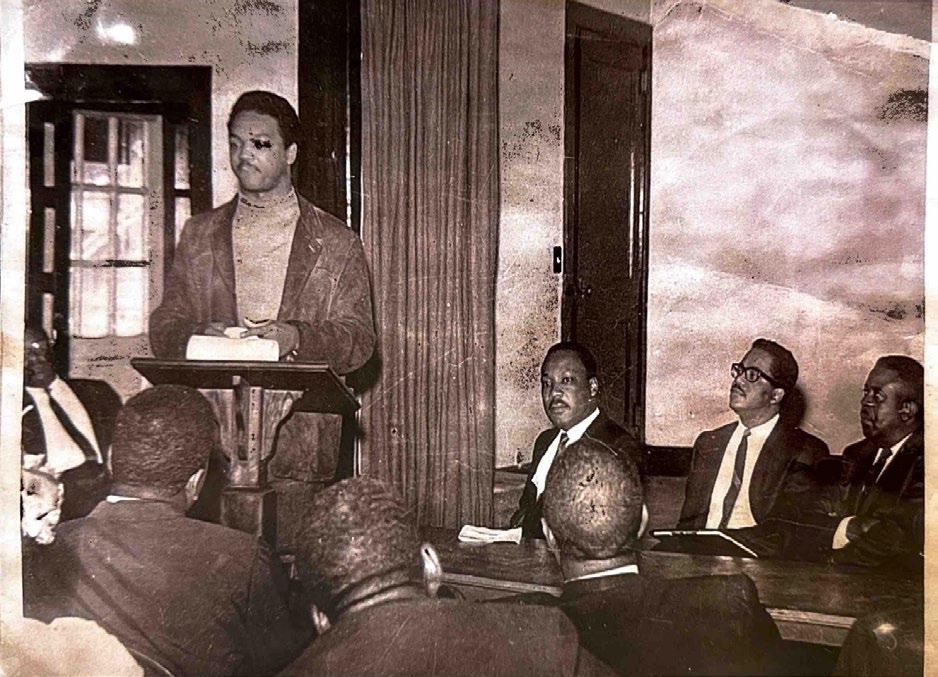
Twenty five years later, the news of Ell Persons’ lynching stirred national conversations. The Commercial Appeal, a local paper in Memphis since 1841, defended the lynching writing, “The lynching was in a spot ten miles from the city of Memphis. As lynchings go, it was orderly. There was no drunkenness, no shooting and no yelling.”52 Other nationwide newspapers would support this analysis of the event, while Jewish and Black-owned papers would condemn the murder. Persons’ lynching expanded this movement, leading local activists to establish a branch of the NAACP in Memphis, Tennessee. This branch would eventually become the largest in the Southern United States and a nexus for the organization’s work against racial violence.
Lynching sites continue to play an important role in American memory. The Equal Justice Initiative, a nonprofit law office founded by Bryan Stevenson, connects the history of the enslavement and lynching of Black Americans to past and current forms of disenfranchisement against Black Americans. The EJI’s Legacy Sites in Montgomery, AL, connect the history of racial injustice in America through a museum, an anti-lynching memorial, and a sculpture park. Here, the Equal Justice Initiative recognizes how these legacies continue to affect race relations in the present day, including affecting systems of mass incarceration, racial profiling, voter disenfranchisement, and other sociocultural issues.
NPS is still in the early stages of its study, gathering information and initiating public engagement. In February and March of 2026, the organization conducted four public meetings around the Memphis lynchings in several sites of the study service area. These conversations were situated as informational sessions to introduce the SRS to the public and encourage public engagement to help launch the study, including asking questions, sharing resources and knowledge, and establishing a communication pathway between the public and NPS. The agency estimates that the full SRS will be completed in late 2027. Following the study’s completion, NPS will submit their recommendations to Congress. Congress will then make the final decision on which lynching sites will become national park units. With the long timeline, many questions remain about how this process will unfold. Most importantly for LSP is one key question:
Should NPS recommend that Congress dedicate locallynching sites as national park units, what is the role of LSP in these sites’ development?
The story of Ell Persons is significant to the national landscape in a multitude of ways. It is a demonstration of racial dynamics between Black and White communities during the Reconstruction Era. It is a demonstration of how violence against Black Americans was often ignored, or even worse, encouraged for the sake of a misplaced sense of justice. But most importantly, the story of Ell Persons is a demonstration of how far we have progressed culturally in the United States in terms of race relations, and a reminder how far we still need to go in healing from the past.
There is no guarantee that NPS will recommend any of the lynching sites to be made into a national park unit. NPS will be evaluating the capacity of its own agency and the governing body of the park unit sites in order to make this determination. While LSP of Memphis does not have the authority to control any of these aspects, it is important for LSP to consider the possible role it may have in any potential development.
LSP makes for an optimal historical liaison consultant for the National Park project.
Once a site is adopted into the National Park System, the land can be managed in three potential ways:
1. 100% NPS Ownership:
In this configuration, NPS would be fully responsible for all functions of the park, including management of any physical sitemaintenance and visitor experience.
2. Jointly Managed Park:
In this configuration, NPS would share responsibility of the site with other authorized partners to manage the space.
3. National Park Management without ownership:
In this configuration, NPS would assist with the establishment of the legislated boundary of the site, but NPS would have no ownership over the property. If desired, by agreement the owners of the property could allow NPS to lease an office space so the agency could manage the site.
As such, LSP could support NPS in the development of a park unit in two primary ways:
1. Local Historic Expertise:
LSP is an important resource of Africandiasporic memory in the Memphis community. This intimate knowledge is necessary for the proper stewardship of the lynching sites. In preparation for its role as a potential local history resource, LSP should:
a. Make a list of all of the lynching sites it feels prepared to support;
b. Organize the archives for these sites;
c. Prepare 1-page memos on the most important historical aspects that should be included for each potential memorial site;
d. Provide a note for consideration for each site, highlighting the missing histories of the lynching victims and how their stories should be uplifted through the memorials.
2. Community Input:
As LSP is a volunteer-based, local organization, it can help support any community engagement that is necessary for the development of these lynching site memorial park units. Community feedback, particularly from Black Memphians, helps maintain the cultural sensitivity of the eventual memorials. In preparation for its potential community input role, LSP should:
a. Organize a group of volunteers who can attend NPS public engagement meetings. The group should be organized so that at least 3 to 4 volunteers can be available at any given meeting;
b. Educate the volunteers so they are prepared to respond to conversations about the historical integrity of the planned memorial, uplifting the stories of the lynching victims and thier families, supporting Black narratives, and creating spaces where people feel prepared to reflect on the history of lynching, as outlined by the rest of this report.
National Civil Rights Musuem placard, 2026
In 2025, President Donald Trump signed an executive order, “Restoring Truth and Sanity to American History.” This order was meant to force NPS and other agencies that own public monuments, memorials, statues, and properties to reconsider and change any narratives that may shed a negative light on American history and dismiss the achievements of American history.
2.2.1 TRUTH WITHOUT SPECTACLE
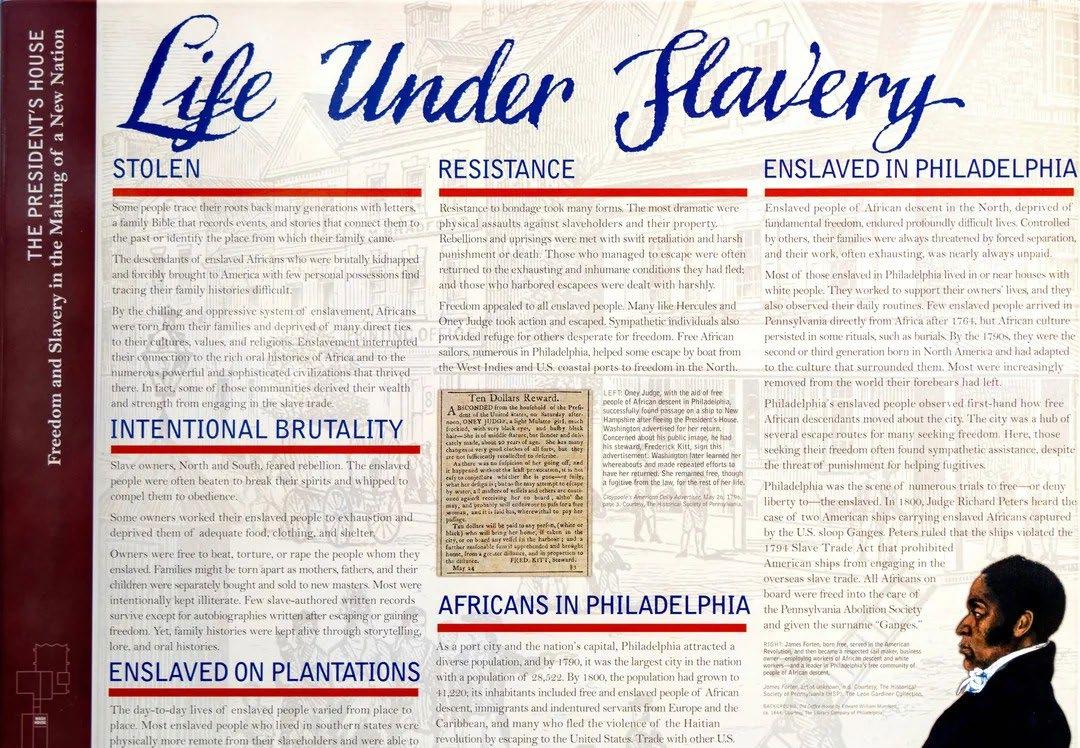
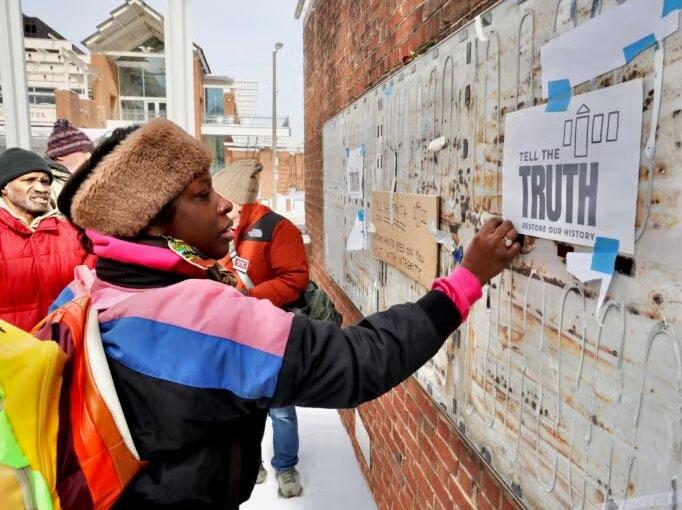
There are numerous sites central to African American history or dedicated to remembering this history that are currently managed by NPS. There has been much attention on the impact of the executive order on these sites, especially on the President’s House exhibit in Philadelphia, Pennsylvania. While the original exhibition panels still remain at the site, the Trump administration recently released images of the panels with alternative language that tamp down George Washington’s complicity in chattel slavery.54 In the case of any further political upheaval, LSP should be prepared to use its knowledge, archive, and community network to maintain the integrity of sites it is working to protect.
These policies and processes should garner LSP’s influence in the storytelling of the potential lynching site memorials managed by NPS. There is good reason for the organization to stay vigilant.
As a part of the team’s thinking around the memorialization of the Ell Persons lynching, it was necessary to consider the following: how Black stories are told through popular and mass media, and the ways in which these narratives deviate from collective Black memory. When Black stories appear in popular media, they are often produced for non-Black audiences and awarding bodies. This leads to Black stories that do not actually center Blackness and Black people in favor of choosing to focus on a White Savior protagonist, or to focus solely on the trauma and pain experienced by Black people. Film, in particular, is a field in which the former is most apparent, with films such as 42 (2013), The Help (2011), and Green Book (2018) all containing a “White Savior” character at the center of a story about Black people.
young Black women enrolled in college reported that they experienced racial trauma after viewing images of fatal and violent instances of police brutality56. Repeated exposure to such images can also increase suicidality among Black youth.57
Given these parameters, LSP should encourage NPS to take on a role of manager, but not ownership of the Ell Persons site.
This arrangement would allow for the site to be maintained and kept in good condition through NPS resources, but limit the involvement of the agency in other aspects of the site. Not allowing NPS to have complete control over the historical storytelling may protect the Ell Persons site from political interference. Other properties, such as the Emmett Till and Mamie Till-Mobley National Monument, are also managed under this arrangement.
Stories that fall into the latter category, with a focus on Black pain and trauma, are often cast as “Black trauma porn.” Some have argued that such stories, like Fruitvale Station (2013), 12 Years a Slave (2013), and Selma (2014), exist to provide catharsis for White and non-Black audiences through a “ritual expulsion of White guilt.”55 Others have argued that it is necessary for these stories to be told in this way, allowing those outside of the Black community to bear witness to Black pain and trauma as a means of empathy. However, this often becomes voyeuristic as a clear racial dynamic emerges: while Black people live with this pain constantly, White and non-Black audiences need only engage with it for as long as they sit through the film.
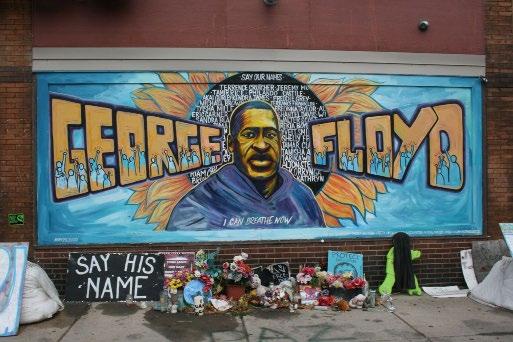
This tension between voyeurism and value extends beyond film to social media. During the Black Lives Matter protests in Summer 2020, social media streams across platforms were filled with the recordings of the murder of George Floyd, and of other victims of police brutality. While the intent of many who posted and shared these images was to call attention to what happened to the victims, this serves to instead further traumatize Black people who came across them. When surveyed, 13 of 15
This project is one part of a broader effort to seek empathy through truth as opposed to outright horror at the risk of re-traumatizing Black people. Those wishing to memorialize a history, especially when considering the creation of a monument, must ask themselves the following question: what is the balancing point?
Traditional monuments, especially those which are more explicit in their depiction of a traumatic event, risk re-enacting the original rupture. Conversely, when these monuments are too abstracted, they run the risk of being too vague for people to understand the horror of the event being memorialized, thus defeating the purpose of the monument to begin with.
George Floyd Memorial in Minneapolis, 2020. 58
Trump administration orders National Parks Service to remove “Freedom and Slavery” exhibit at the President’s House on Independence Mall in Philadelphia, 2026.53
The memories of many events of racial terror have diminished in the American imagination for many reasons, including the transformation of many of these sites into spaces for recreation. For example, although some plantations have become sites for education, others have become prominent wedding venues. Another example is the mountain “Six Grandfathers”—sacred to groups Indigenous to the American plains—which has been carved into Mount Rushmore. Despite these spaces being transformed for tourism, recreation, or education, the psychological ramifications of these sites still affect the descendants of these historical harms. There are several examples across communities.
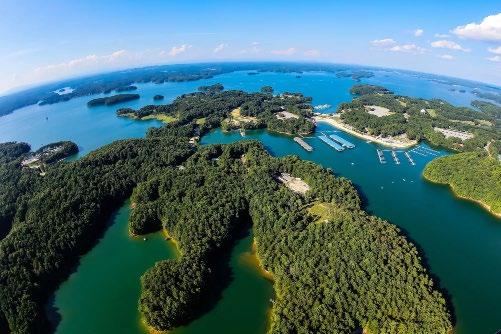
For example, Lake Lanier, a popular tourist destination in northern Georgia, is one of the deadliest lakes in the country. For Black Americans, this legacy makes sense. This history of trauma continues to haunt the lake. Urban legends of the lake, such as boat crashes caused by ghosts and the ringing of underwater church bells, have circulated online and among community members.59
While these spaces may not actually be haunted by ghosts, individuals are haunted by the memories of the land. To avoid these feelings, community elders often share the resounding advice to the younger generation who ask about visiting these locations, “Baby, we don’t go there.”62
Just as the creation of Lake Lanier did not wash away the burned remains of Oscarville, the denial of the histories of many sites of racial terror does not erase people’s memories of these events. This purposeful historical negligence is a representation of necropolitics in action; American culture forgets its culpability in harming some communities for the sake of maintaining its ethos of “freedom and justice for all.”
Lake Lanier was once the site of a thriving Black community, Oscarville, that was burned down in a large-scale racial massacre that forced all the Black residents out of the county.64 The area was flooded in the 1950s and transformed into the 38,000-acre lake that exists today.
Plantations also still have a ghostly hold over the imaginations of many African-Americans. For many Black Americans, these spaces stir up repulsive emotions and discomfort that feels ancestral.60 Similarly, for Indigenous communities, current sites of missions and former sites of boarding schools serve as reminders of the dislocation, disenfranchisement, and cultural devastation of native populations.61
2.2.3 EXPLORING CULTURAL MEMORIALIZATION THROUGH SELF-EXAMINATION
MEMORIALS, MEMORY, AND MEANING MAKING EXERCISE
As an initial investigation into the Ell Persons site, it was imperative for the team to do an exercise in self-reflection.
To do so, each member of the team investigated a moment in history significant to their own cultures and thought through how to best memorialize that event.
This, ultimately, was an exercise of relationality. If each team member took the initiative to explore their own legacies and analyzed how both our triumphs and traumas are remembered spatially, we would be better prepared to assist others who are working through this same dilemma.
The following case studies summarize the team’s discoveries through this introspective work. Here, we offer key details of the cultural events we felt drawn to and highlights of the lessons we learned through this exploration process:
To combat this cycle, those interested in properly preserving sites of racial terror must fully and honestly confront the stories of these spaces. This project aims to provide a framework for this engagement in order to construct a process for healing in places of trauma.
Crossing the Border: Monuments, Memorials, and Meaning-Making
Memorializing the 1898 Wilmington Massacre
Memory, Erasure, and Belonging in Beirut, Lebanon
Kerrytown - Ann Arbor, Michigan
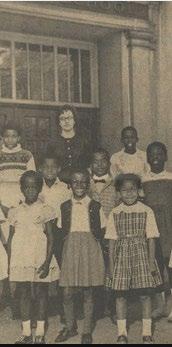
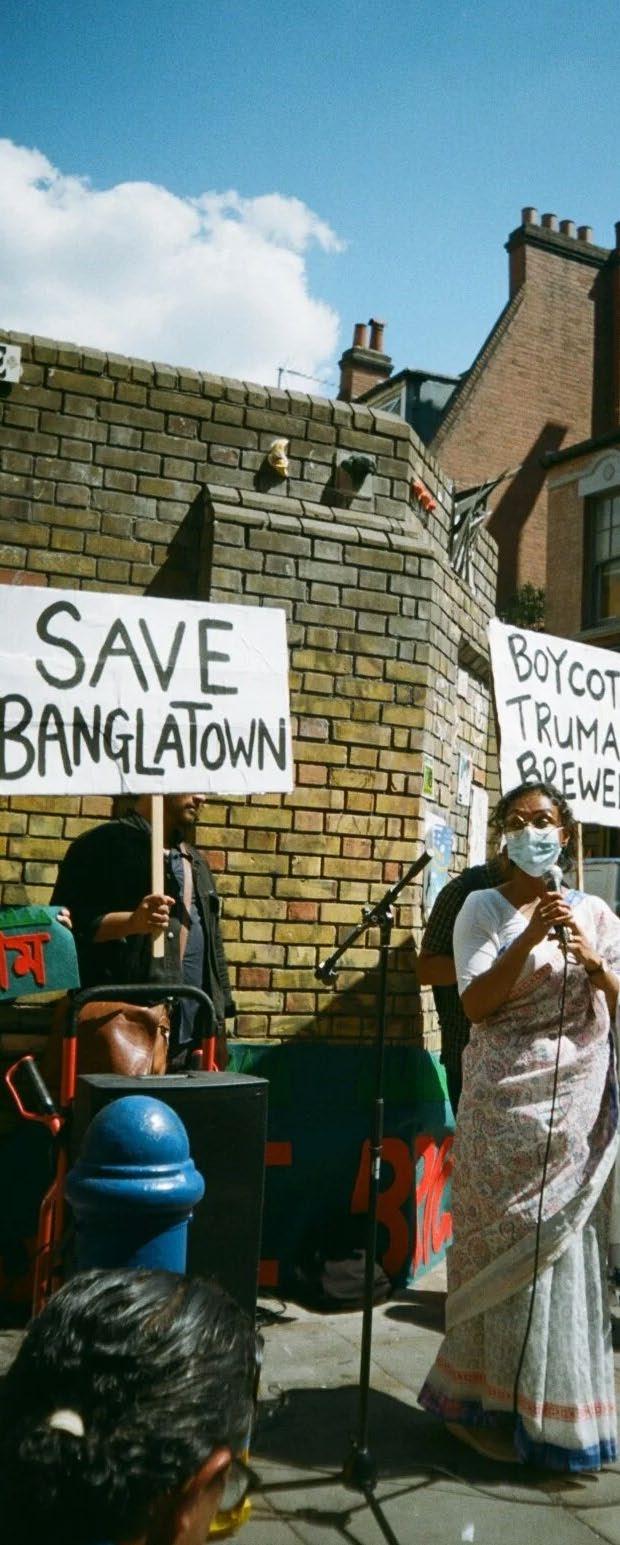
Built Through Survival: Banglatown as a Counter-Monument in the American City
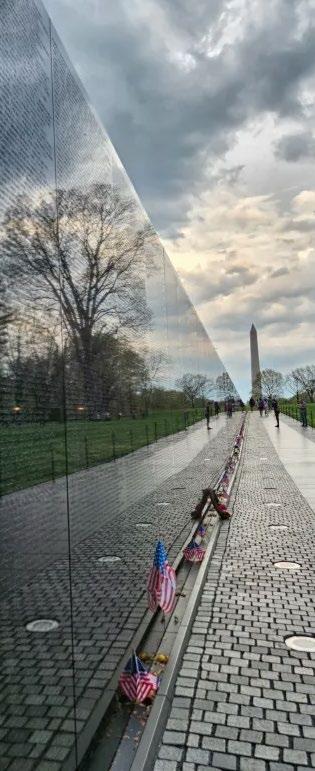
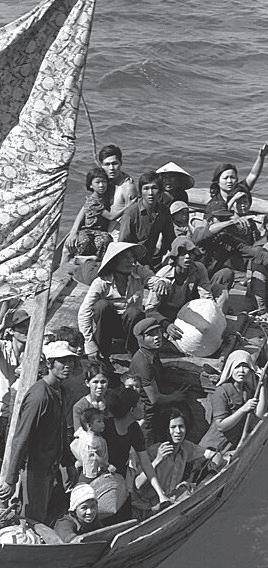
Negotiating Memory in Public Space: Countermonuments and the (Re)Memorialization of the Vietnam War
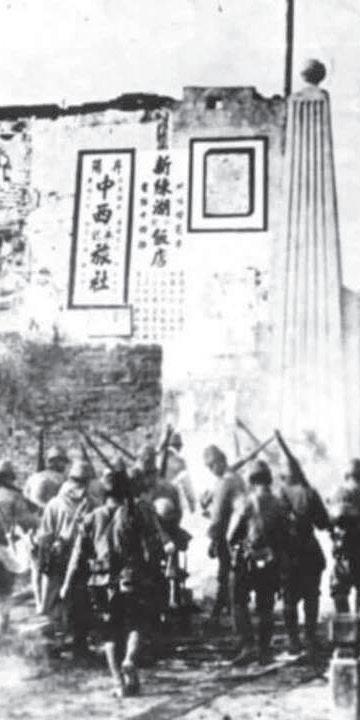
Nanjing Massacre: Memorial Hall of the Victims in Nanjing Massacre by Japanese Invaders
___ by Amina Dunn
by Ali Elatrache ___ by Jordan Hunter
by Rubin Malik
by Irene Nguyen
by Xilong Wang
Lake Lanier, From the World Atlas.63
___ by Chelsea Arenas
by Chelsea Arenas
The focus of my memorial project examines migration as a form of rupture. The project uses my parents’ journey across the border as the bridge to understand migration patterns from Latin America to the United States. While migration is frequently framed through narratives of opportunity and sacrifice, discussions about immigration often overlook the underlying colonial histories, economic policies, and racialized labor systems. The main focus of this essay is on Alvaro Enciso’s artist project, Where Dreams Die, in which Enciso and other volunteers place crosses at locations where migrant bodies have been recovered in the Sonoran Desert. The placement of crosses marking where migrants have died is an act of recognition for lives that are often erased from official narratives. This informal memorial challenges the dominant narratives surrounding migrations by making visible the human cost of border enforcement and the policies that push migrants into dangerous terrain and conditions. At the same time, they reveal the limits of remembrance, as many individuals remain unidentified and absent from historical records. Through this process, within the capstone and project, I’ve come to understand that memorials are not neutral but are shaped by power and determine whose lives are considered worthy of recognition.
Relevant awakenings:
1. Memorials are political and spatial; they shape which histories are visible and which are erased.
2. Migration, while a personal choice, is a structural condition produced by policy, economics, and colonial histories.
3. Informal memorials through art can act as powerful counternarratives, humanizing migrants and exposing the ongoing impacts of border enforcement policies.
4. There is a need to create a more collective and dignified form of memorialization that acknowledges both individual loss and the structural conditions that produce it.
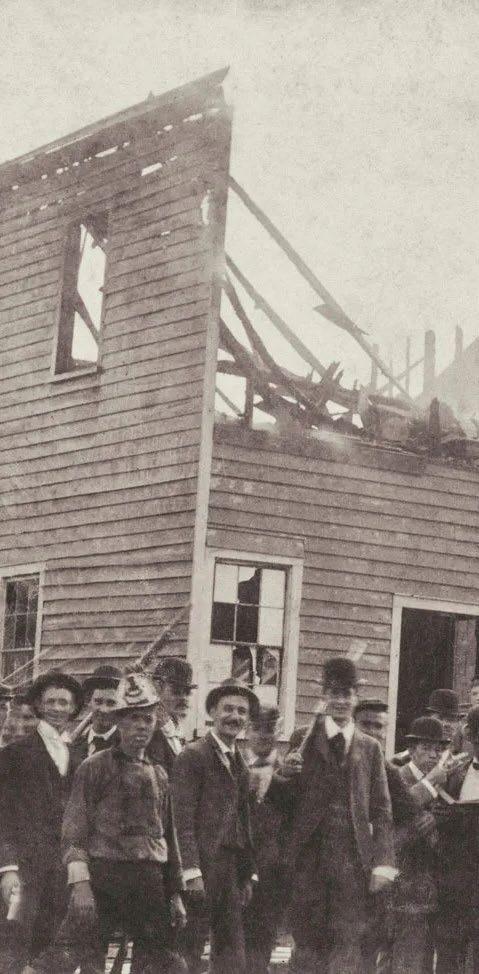
MEMORIALIZING THE 1898 WILMINGTON MASSACRE
by Amina Dunn
The Wilmington Massacre is considered the only successful coup d’état in the history of the United States. In 1898, a political campaign meant to oppress the Black citizens of Wilmington, North Carolina turned into a race riot that in just a few hours killed hundreds of Black people, displaced several thousands of those who survived, and disrupted politics in the city for the next century. The once biracially governed, Black majority city, quickly became a White majority utopia after the massacre. The City of Wilmington began acknowledging the horrors of the 1898 massacre in 1998 during the Centennial Commemoration of the events. Last year, the city commemorated the 130th anniversary of the massacre and coup. To acknowledge the events, the city held a number of events, including: The laying of wreath at 1898 Memorial Park; an exhibit of jars full of soil curated by descendants of the victims of the massacre and the Equal Justice Exhibit; a film screening; a tour of Pine Forest Cemetery, the resting place for unknown victims of the massacre; and a poetry and music event. The city also held events focused on guiding racial reconciliation within the city.
Relevant awakenings:
1. Acknowledgment of an incident is the first step. However, acts of remembrance must be dynamic. If we truly want to repair the scars on land, it is important that these journeys towards repair are not just passively memorialized but actively curated through programming.
2. Consider who the storytellers are for an event. If the purpose of a memorial is to create a site for racial reconciliation, consider building a diverse committee of decision-makers, including members of the community historically set in opposition to each other, supporters of the project, and funders
Max Herman, “Artist Remembers Migrants Who Died on Their Journey North.”65
Crispin Kerr-Dineen, A cross planted in the Sonoran Desert to honor the remains of a migrant. Crosses like this one are part of an art project called Donde Mueren Los Sueños, which translates in English to Where Dreams Die.66
City of Wilmington, NC, 1898 Memorial Park. 67 McCool/Alamy , The remains of the office of the Black-owned newspaper
The Daily Record after it was burned in the Wilmington coup and massacre, November 10, 1898.68
MEMORY, ERASURE, AND BELONGING IN BEIRUT, LEBANON
by Ali Elatrache
This essay examines how the Lebanese Civil War (1975–1990) and its aftermath have been memorialized—and deliberately unmemorialized— in the built environment of Beirut. Drawing on personal experience as a Lebanese person who survived the 2006 war, the essay analyzes the spatial contrast between Downtown Beirut—which was razed and rebuilt by the private development company Solidère into a polished, forward-facing city center—and the surrounding neighborhoods, where bullet holes and structural damage remain visible in everyday life. The essay argues that both conditions represent a failure of collective memory: one through erasure, and the other through daily re-traumatization, with neither producing the shared site of acknowledgment that meaningful memorialization requires.
Relevant awakenings:
1. The absence of a formal memorial does not mean the absence of memory. It means that memory is displaced onto those least able to escape it, typically the poorest and most marginalized communities.
2. Reconstruction framed as progress or “national renewal” can be a form of state-sanctioned erasure, prioritizing financial value and marketability over honest engagement with a violent past.
3. Remembrance is not distributed equally. In Beirut, memory follows lines of power and privilege.
4. Spaces that ask nothing of their visitors—that do not demand pause, reflection, or acknowledgment—risk becoming sites of collective amnesia rather than sites of reflection.
ANN ARBOR by Jordan Hunter
Kerrytown, a neighborhood just north of Ann Arbor’s downtown business district, was once the home of 80% of the city’s Black residents. In the 1960s, the City of Ann Arbor began the process of buying Black residents out of their homes in order to construct a bypass, and while the bypass was never built, Black families who had sold their homes found that they could not afford to move back in. Homes in the neighborhood were bought predominantly by younger White homeowners, and now are occupied predominantly by students at the University of Michigan. This paper examined the changing character of the Kerrytown neighborhood, and engaged with the question of who would be responsible for memorializing Kerrytown (and the bordering Water Hill neighborhoods). This paper also included a discussion of monuments and memorials for neighborhood gentrification in other cities, such as Philadelphia, Pennsylvania, and discussed whether or not those memorials could be suitable for the Kerrytown neighborhood.
Relevant awakenings:
1. Consider the conditions needed to form a personal connection with a particular history.
2. It is important for memorials to consider the shifting conditions of everyday life, especially in places like student neighborhoods where tenants change frequently.
3. Responsibility for the memorialization of history in the absence of the harmed group should be questioned.
KERRYTOWN,
Al-Abed Clock Tower, Beirut69
Clara May, “Rebuilding Downtown Beirut: Laying the Foundations for Division or Reconciliation?”70
Bricks line Detroit Street in Kerrytown, Ann Arbor.71
Ann Arbor District Library, K-6 Jones students in 1963.72
BUILT THROUGH SURVIVAL: BANGLATOWN AS A COUNTERMONUMENT IN POSTCOLONIAL LONDON
by Rubin Malik
Grounded in the afterlives of British colonialism and the rupture of the 1971 Bangladesh Liberation War, this analysis centers on Brick Lane as a spatial expression of cultural survival, political resistance, and diasporic identity within the former imperial core. Migration from Sylhet to East London was structurally tied to imperial labor networks and postwar economic demand, positioning Brick Lane as a site where Bangladeshi communities fought to establish permanence and belonging within the geography of the colonizer. Rather than state-sanctioned monuments, memory is produced through everyday spatial practices embedded in the built environment, where businesses, mosques, Bengali signage, and long-standing community networks operate as visible assertions of presence shaped through migration, labor, and collective action. This production of memory is inseparable from histories of violence and resistance, particularly the murder of Altab Ali and the subsequent anti-racist mobilizations that transformed the area into a site of political activism. In this context, Brick Lane functions as a counter-monument, revealing how diasporic communities construct meaning through continuity, visibility, and the ongoing action to remain in place.
Relevant awakenings:
1. An intentional planner understands memorialization as a living civic practice by creating spaces that sustain memory through continued community presence.
2. An intentional planner recognizes that government and planning institutions shape which histories are protected, funded, and made visible, and therefore has a responsibility to advocate for policies and public investments that support communities historically excluded from systems of power.
3. An intentional planner works in direct collaboration with community members and treats lived experience, cultural knowledge, and local relationships as essential to shaping meaningful and accountable public space.
4. An intentional planner approaches sites tied to violence and displacement with care, using design, landscape, and material choices to support reflection and dignity without reducing trauma to spectacle.
NEGOTIATING MEMORY IN
COUNTERMONUMENTS AND THE (RE)MEMORIALIZATION OF THE VIETNAM WAR by Irene
Nguyen
This paper argues that the act of memorialization is not fixed in a singular object, but rather a process influenced by cultural narratives and power structures. However, it is imperative we question these narratives and power structures that often center American perspectives while marginalizing those who challenge these positions. To address this imbalance, we introduce a critical repositioning, (re)memorialization—a framework that emphasizes the collaborative and cultural processes through which memory becomes materialized in memorials. Situating this study in the Vietnam Veterans Memorial, this approach analyzes memorials as evolving sites shaped by community input, the position of the artist, and wider historical contexts.The paper also highlights countermonuments as alternatives to traditional memorials, using abstraction and ambiguity to encourage reflection and multiple interpretations. The Vietnam Veterans Memorial illustrates how design, public debate, and stakeholder negotiation influence remembrance. Ultimately, the paper argues that the (re)memorialization frameworks provide a more critical lens to collaborate on the creation of more inclusive and dynamic spaces for engaging contested histories.
Relevant awakenings:
1. Memory in public space is shaped by power, often marginalizing non-dominant narratives.
2. (Re)memorialization reframes memorials as ongoing, collaborative processes rather than static objects.
3. Countermonuments enable more inclusive, reflective engagement with contested or traumatic histories.
4. The Vietnam Veterans Memorial demonstrates how design, politics, and public debate shape collective memory.
Vietnamese boat people, 35 refugees wait to be taken aboard the amphibious command ship USS BLUE RIDGE (LCC-19).76
Banglatown Protest in Brick Lane, London.73
“Bangla Town” sign written in Bengali, in Brick Lane, London, UK..74
Vietnam Veterans Memorial in Washington DC.75
MASSACRE: MEMORIAL HALL OF THE VICTIMS IN NANJING MASSACRE BY JAPANESE INVADERS
by Xilong Wang
This paper examines the Memorial Hall of the Victims in the Nanjing Massacre by Japanese Invaders as a site through which the memory of the Nanjing Massacre is publicly shaped and sustained. Although the massacre refers to a specific historical event in December 1937, the memorial presents Nanjing as more than a city-specific tragedy, turning it into a symbolic center for remembering a much broader history of wartime violence, suffering, and loss across China. The Hall emphasizes that memorial space is not neutral. Through austere concrete forms, underground galleries, narrow corridors, controlled lighting, sculptural installations, and the monumental figure of “300,000,” the site structures how visitors move through the space, what they focus on, and how they emotionally encounter the history being presented. At the same time, the memorial’s meaning is reinforced through state recognition, school curricula, National Memorial Day ceremonies, air-raid sirens, and public moments of silence, showing how education, ritual, and institutional support extend remembrance beyond the physical site. In this way, the memorial does more than preserve the past; it transforms historical violence into an enduring framework of national memory, civic ritual, and collective identity.
2.3 THEORETICAL FRAMEWORKS: POLITICS OF MEMORIALIZATION AND REMEMBRANCE
This section reframes the conversation around memorialization and remembrance by grounding the project in three theoretical frameworks:
1. Omari Souza's restorative design principles, which position design as a sociopolitical practice centered on healing, accountability, and transformation;
2. Najha Zigbi-Johnson's spatial network framework from Mapping Malcolm, which understands memorialization as a distributed condition embedded across landscapes rather than a singular object;
3. and Lauren Hood's AfroUrbanism, which integrates Black imagination with the tools of urban planning to center Afro-diasporic communities as equal contributors in shaping their own spaces.
mediates memory, and structures relationships between people and place.79 Within this framing, design carries ethical responsibility, particularly when operating within landscapes marked by racial violence, historical erasure, and ongoing inequity.
To preface, Souza situates restorative design within a broader critique of Eurocentric design traditions, which have historically contributed to cultural erasure and the imposition of universalized spatial logics.80 This critique makes notice of the necessity of grounding design in culturally situated knowledge, lived experience, and alternative epistemologies.
Relevant awakenings:
1. A memorial can turn one event into a symbolic center for remembering a much broader history of violence and loss.
2. Architecture is not neutral. Materials, lighting, circulation, and spatial descent can structure how visitors emotionally experience remembrance.
3. Institutional support, education, and annual ritual can stabilize memory and extend the power of a memorial beyond its physical site.
4. Memorials do not only preserve trauma; they can transform historical rupture into civic ritual and collective identity.
Together, these frameworks challenge dominant traditions of memorialization and establish an alternative politics of remembrance rooted in community authority, historical honesty, and spatial justice. The section closes with a set of guiding principles that translate this theoretical grounding into non-negotiable directives for the Ell Persons site.
2.3.1 RECONFIGURING DESIGN PRACTICE: FROM NEUTRALITY TO RESTORATIVE ACTION
FRAMEWORKS FROM DESIGN AGAINST RACISM BY OMARI SOUZA
The design approach for recommendations of this project is grounded in the principles of restorative and anti-racist design as articulated in Design Against Racism, Creating Work That Transforms Communities by Omari Souza. This framework rejects the premise that design is neutral or purely aesthetic, instead positioning it as a sociopolitical practice that shapes social order,
For this project, this entails drawing from AfroUrbanist approaches, Black public history, and community-based knowledge systems to inform both spatial form and programmatic strategy. It also requires resisting formal resolutions that impose order at the expense of historical complexity or ecological integrity.
China Holds National Commemoration for Nanjing Massacre Victims.77
Historical still image of Nanjing Massacre from video, “Nanjing Atrocities: Crimes of War” 78
Souza’s concept of restorative design provides a primary theoretical foundation for this project. Restorative design is defined as an approach that centers healing, inclusivity, and equity by addressing and repairing harms inflicted upon marginalized communities.81 It shifts the role of design away from the production of static objects or symbolic gestures and toward an ongoing process of accountability, relationship-building, and transformation. This orientation is especially critical in memorial landscapes, where dominant design traditions have often abstracted, aestheticized, or simplified histories of racial violence. In contrast, restorative design insists on confronting these histories directly while creating space for reflection, critical engagement, and future-oriented action.
This project adapts Souza’s framework through three interrelated principles: encounter, repair, and transform.82 These principles structure both the spatial and institutional logic of the proposal. Through the integration of encounter, repair, and transformation, the project advances a model of memorialization that confronts historical violence while establishing conditions for ongoing spatial repair and collective futurity.
Importantly, this framework extends beyond spatial design to address questions of governance, stewardship, and long-term control.
“RACISM WAS SYSTEMIZED THROUGH DESIGN DECISIONS. THAT MEANS IT CAN BE UNDONE BY THEM TOO.”
Omari Souza
If design is understood as a mechanism that shapes social order, then the ethical success of the project depends not only on what is built, but on who governs, maintains, and interprets the site over time.
Restorative design therefore necessitates institutional structures that ensure continued accountability to the communities and histories the site represents, resisting extractive or topdown models of development.
Figure I.6 Principles of Restorative Design, Design Against Racism, Souza
Figure I.5: Inviting Curiosity: a framework for meaningful experiences, Design Against Racism, Souza. 83
FRAMEWORKS FROM MAPPING MALCOLM,
EDITED BY NAJHA ZIGBI-JOHSON
While Design Against Racism establishes the ethical and procedural obligations of design, Mapping Malcolm edited by Najha Zigba-Johnson provides a spatial framework for understanding how memory is produced across landscapes, infrastructures, and networks of social life.
Within this framework, memorialization is not understood as the creation of a singular object or bounded site, but as a distributed spatial condition that is already embedded within the built environment. Memory is constituted through relationships between places, movements, and everyday practices, forming a networked landscape rather than a fixed point of commemoration.
This approach challenges traditional monumentality by reframing how time and history are spatialized. Rather than isolating the past as a discrete and completed moment, Mapping Malcolm articulates a temporal condition in which past and present remain coextensive. The persistence of historical violence and its ongoing material and spatial effects establishes a continuous relationship between prior and current conditions.88 As a result,
memorialization cannot be confined to marking a singular event or location. Instead, it must engage the ways in which history remains active within the present landscape, shaping spatial experience and social relations.
The built environment operates as an active carrier of memory. Streets, institutions, cultural sites, and everyday infrastructures function as embedded markers through which histories are continuously produced and encountered. These elements do not merely reference the past; they participate in its ongoing articulation. As demonstrated through the dispersed spatial presence of Malcolm X, memory is distributed across multiple geographies and, when understood collectively, forms a “diagram of reconstructive presence.”89 This project adopts this understanding by positioning the lynching site as one node within a broader spatial network. The memorial is therefore conceived not as a singular destination, but as a system of interconnected sites, routes, and landscapes that together produce a more expansive and legible spatial narrative.
This networked condition extends beyond formal mapping practices. Mapping Malcolm cautions against reductive cartographic representations that attempt to fix memory within static coordinates.90 Space is instead produced through the confluence of social, cultural, and environmental processes, requiring interpretive strategies that reflect multiplicity and relationality. In this project, mapping operates as a method of revealing connections, adjacencies, and absences rather than defining boundaries. The memorial system therefore incorporates layered and non-linear forms of interpretation that allow multiple narratives to coexist across space.
Movement is central to this spatial logic. The ability to move through space, to gather, and to form connections across distances has historically been integral to Black spatial practice. Mobility is not only a condition of movement, but a means through which space is produced and understood.91 Circulation systems within the memorial are therefore conceived as narrative structures that organize experience through pathways, sequences, and transitions. These routes reflect histories of
displacement, congregation, and continuity, transforming movement into a form of spatial storytelling. The landscape becomes legible through traversal, where meaning emerges through the relationship between sites rather than within any single location.
The framework further recognizes that spatial narratives operate across multiple scales simultaneously. From the scale of the body and immediate site to the city and broader translocal networks, memory is produced through layered geographies that cannot be reduced to a single spatial register.92 This multi-scalar condition informs a design approach that engages local specificity while situating the memorial within wider patterns of Black spatial life and historical connection. The project thus operates across interconnected scales, linking site-based interventions to broader spatial systems.
Temporality within this framework is similarly layered and non-linear. Memory is not confined to a retrospective function but is continuously rearticulated through present conditions and future possibilities. The persistence of figures such as Malcolm X across time demonstrates how memory operates as an ongoing spatial force, collapsing distinctions between past and present.93 In response, a memorial considering these conditions, should be structured to accommodate temporal layering, allowing for evolving interpretations, new narratives, and changing forms of engagement over time. The site functions not as a fixed representation of history, but as an adaptive spatial framework that remains responsive to ongoing social and cultural processes.
This temporal condition is further reinforced through intergenerational continuity. Spatial narratives extend across generations, creating relationships that persist beyond individual lifespans.94 Memory is therefore not only preserved but transmitted, reshaped, and reinterpreted through collective experience. The memorial framework supports this continuity by enabling multiple points of entry and engagement, ensuring that the landscape remains legible and meaningful across time.
Finally, this framework acknowledges that memory is produced through both material and immaterial practices. Infrastructures, routes, and physical markers operate alongside cultural practices, narratives, and forms of gathering to produce a comprehensive spatial condition. Creative and cultural production contributes to this process by generating new forms of representation that address absences within traditional archives.95 Through these layered practices, the memorial operates as a spatial archive that is continuously constructed and reconstructed through use, movement, and interpretation.
Together, these principles establish a framework in which memorialization is understood as a distributed, networked, and spatially embedded condition. By shifting the focus from object to system, from site to network, and from fixed representation to ongoing spatial production, the project advances an approach to memorialization that reflects the complexity of Black spatial histories and their continued presence within the contemporary landscape.
2.3.2 AFROURBANIST
Shifting paradigms around Black potentiality in urban space also requires shifting expectations of Black history, Black life, and Black future realities into a new Black imagination. Afrofuturism provides a critical lens that encourages artists to “grapple with race, identity, and power, envisioning futures where Black communities not only survive but thrive and lead.”96 This imaginative framework allows people to acknowledge Black experiences, promote agency, and explore imaginative futures, which can help urban planners encourage inclusive conversations around sustainable development.
The term “Afrofuturism” was originally coined by Mark Dery, in his 1993 essay, “Black to the Future.” In this essay, Dery questions why there are so few Black creators who utilize the genre of science fiction to tell their stories. Afrofuturist stories engage with a variety of principles, including resiliency, self-determination, circular temporality, liberation, and centering joy.97 In the way of other speculative fictitious work, Afrofuturism provides a limitless sandpit through which Black people can explore avenues to build a truly intersectional society. However, while Afrofuturism provides an artistic form of reimagining Black life, the material practicalities of the movement are minimal.
AfroUrbanism, a concept developed by Lauren Hood, an Associate Professor of Practice at the University of Michigan’s Taubman College for Architecture and Urban Planning, integrates the concepts developed through Afrofuturism with the tools of urban planning, producing a framework through which planners can apply Black imagination when developing Afro-diasporic communities. As urban planners, architects, and designers have the institutional power to change resource flows for communities, it is imperative that these “experts” understand the lived experience of those living within their communities, especially the lives of those most marginalized. AfroUrbanism is a framework through which urban practitioners can learn to understand the lived experiences of the Black community and incorporate this embodied knowledge into their work.
This central thesis of AfroUrbanism is supported by three main pillars:
1. Agency: Afro-diasporic individuals should believe that they can can control their own personal outcomes and shape their own life
2. Abundance: Afro-diasporic individuals should have the good things in life, such as love, wealth, joy, and health
3. Audacity: Afro-diasporic individuals should feel willing to take risks and be brave enough to live beyond limitations
AfroUrbanism provides a pathway for planners and developers to think beyond the historic and current traumas facing Black communities, including redlining, discriminatory housing policies, and disinvestment. Instead, the framework asks community leadership to involve the Black community in the cultural, spiritual, and economic envisioning of their neighborhood. Afrodiasporic individuals, in this way, do not act as consultants, but as equal contributors in building their community.
2.4 PRECEDENT FRAMEWORKS
Once established, the Ell Persons Memorial site will become part of a network of memorialzed lynching sites throughout the United States. Normally built through community action, these spaces often are built to reconcile the tragic stories of lynching victims. Similar to LSP’s goal for the Ell Persons’s site, many of these memorials aim to share the honest, unflinching narratives of lynching asa part of American history. The following case studies present a small fraction of these memorials:
2.4.1 CASE STUDIES
1. CHATTANOOGA, TENNESSEE: THE ED JOHNSON MEMORIAL
In the evening of March 19, 1906, a young Black man named Ed Johnson was lynched on the Walnut Street Bridge in Chattanooga, Tennessee. Similar to Ell Persons, Johnson was accused of attacking and sexually assaulting a young White woman named Nevada Taylor on her way home from work. Johnson was placed on trial, during which Taylor refused to swear on the record that Johnson had been the one to assault her. Johnson was convicted of the crime and his execution was scheduled for March 13, 1906, six days before he would be murdered. Local Black attorneys Noah Parden and Styles Hutchins took up the case and requested appeals from both the Hamilton County Trial Court and the Tennessee Supreme Court, and a petition for a writ of habeas corpus from the United States circuit court in Knoxville. While both of these appeals and the petition were all denied, Parden’s petition for a 10-day stay of execution was granted by Governor John I. Cox., and the execution date was moved back to March 20. The US Supreme Court ordered a second stay on March 19, but by then it was too late for Johnson.98
A group of White Chattanoogans, which included deputy sheriffs for Hamilton County, broke through three sets of doors to retrieve Johnson. The mob left a note to US Supreme Court Justice John Marshall Harlan meant to taunt him and the stay issued by the Supreme Court.99 This note, alongside the fact that Hamilton County Sheriff Joseph F. Smith did little to prevent or stop the lynching before it occurred, led to the first and only criminal trial that has ever been held by the US Supreme Court: United States v. Shipp (1906). Nine defendants, including Shipp and
his deputy sheriffs, were charged with contempt of court for their defiance of the Supreme Court’s stay of Johnson’s execution.100
In 2000, Ed Johnson’s conviction was overturned by Hamilton County Criminal Judge Doug Meyer on the grounds that Johnson did not receive a fair trial.102
The memorial, created by artist Jerome Meadows, has three life-sized statues of Ed Johnson and his attorneys Noah Parden and Styles Hutchins. The sculptures are surrounded by stone walls with plaques detailing the story. The memorial is connected to three other, more abstract sculptures, meant to represent Alfred Blount, Charles Brown, and Charles Williams, victims of the other three known lynchings that occured in Chattanooga. Ed Johnson Memorial, image by Jeff Adkins, 2022.101
Twenty one years later, a memorial to Ed Johnson was erected at the base of the Walnut Street Bridge. The maintenance of the Ed Johnson Memorial is overseen by the Friends of the Ed Johnson Memorial, who also participate in the Equal Justice Initiative’s Community Remembrance project, and in the organizing of the annual Ed Johnson Day of Remembrance.103 As a part of their work around educating the public about the Ed Johnson lynching, they provide a curriculum designed to help others work through the events of the Ed Johnson lynching from a social justice-based, analytical framework.104
2. MONTGOMERY, ALABAMA: THE NATIONAL MEMORIAL FOR PEACE AND JUSTICE
Just outside of Montgomery, Alabama, the Equal Justice Initiative operates the National Memorial for Peace and Justice, the first memorial in the nation dedicated to victims of racial terror lynchings. The memorial, opened in April 2018, functions as onethird of EJI’s three Legacy Sites, including the Legacy Museum and the Freedom Monument Sculpture Park on the Alabama River.105 Though completed in 2018, the memorial represents the culmination of years of research and investigation into lynchings throughout the American South that began in 2010.106 This research, in addition to contributing to the Memorial, is displayed in EJI’s 2015 report on lynching, which served as a foundational text for the team’s understanding of racial terror lynchings.
The National Memorial for Peace and Justice was designed by MASS Design Group in collaboration with EJI. The memorial is anchored by a pavilion containing over 800 rectangular corten steel pillars hanging from the roof. Each pillar represents a county in which a lynching is known to have taken place and is carved with the names of the documented victims (4,084 across all counties) and the dates of their murder. The steel monuments are initially at eye level, and as visitors walk through the memorial, the floor descends for visitors to look upward, invoking the feeling of spectatorship at a lynching.107 Beyond the carved names and dates, the monuments themselves are relatively plain, and serve as a stark contrast to the elaborate Confederate sculptures that come to mind when
Next to the pavilion, 805 identical markers lay facing the sky like coffins as they wait to be retrieved by the counties they are named for. This move is intended as both a work of healing, but also a shaming on behalf of the counties whose monuments remain at the Memorial for Peace and Justice in Montgomery.109
one typically thinks about the memorial culture of the American South.110
On the walls of the pavilion are reasons historically given for the lynching of Black Americans. Distribution of the monuments began in 2019, and counties hoping to retrieve their monument must go through a lengthy process of demonstrating their own commitment to honoring those killed by racial terror lynchings. Montgomery County, where the Memorial is located, was the first to claim their monument, and many others have begun the work to receive theirs in the past seven years.111
The aims of the National Memorial for Peace and Justice are multifaceted, but the most prominent among them is a change to the national narrative around lynching and the harm that it has caused to Black Americans. For this reason, the memorial does not acknowledge non-Black victims of lynching, instead choosing to “recognise a specific history and to emphasise specific legacies.”112 Bryan Stevenson, lawyer and EJI’s Executive Director, cites Germany’s Holocaust Memorial as a source of inspiration for the National Memorial for peace and justice.113 Both Memorials are meant to conjure a sense of shame that leads to remorse and regret, and those emotions can pave the way for redemption and reconciliation.
The team visited several cultural institutions to inform the research for this project: The Zekelman Holocaust Center in Bloomfield Hills, Michigan; the Charles H. Wright Museum of African American History in Detroit, Michigan; and the National Civil Rights Museum in Memphis, Tennessee. These visits were treated as opportunities to examine how institutions represent histories of violence and trauma, and what interpretive choices about narrative, tone, and visitor experience can produce, or undermine, with regards to genuine engagement with that history.
The Holocaust Center visit garnered significant reflection within the team. The team noted that the guided experience felt rushed and constrained, leaving limited space for the kind of sustained engagement that the history demands. Additionally, the visit raised questions that became directly relevant to the Ell Persons project:
1. How can institutions represent a history of violence without asserting a form of moral ownership over that history?
2. What is the responsibility of those who steward a history to present it with full context, including contexts that complicate their own narrative?
3. How can a memorial focus on the specificity of one community’s experience without implying a hierarchy of suffering, or that one community experienced a greater tragedy than any other?
The Wright Museum visit prompted a related set of questions, specifically on how histories of violence should be portrayed and the relationship between trauma, portraying graphic violence, and the effectiveness of doing so on learning. The visit pushed the team to consider how much a memorial needs to disturb its visitors in order to teach and whether trauma, as a design strategy, produces further understanding or simply discomfort.
The visit to the National Civil Rights Museum encouraged the team to think through succinct storytelling. The team responded to the multimedia exhibits that deconstructed the complex history of the civil rights movement through videos, pictures, archival materials, artistic sculptures, music, and other displays. The team also took note of how the museum directed the visitor experience, including directing moments of exhibit interaction or silence and reflection depending on the exhibit.
Capstone visit to Zekelman Holocaust Center, image by Amina Dunn, 2026
Capstone visit to the Charles Wright Museum, image by Lauren Hood, 2026
Capstone visit to the National Civil Rights Museum, image by Rubin Malik, 2026
National Memorial for Peace and Justice, Audra Melton.108
2.4.3 ELL PERSONS POTENTIAL MEMORIAL SITE VISIT
The capstone team conducted a site visit to the area of the Ell Persons lynching on the Wolf River. It is important to note that the precise location of the lynching is not known, and that the area of what used to be Macon Road was demolished and is now wooded. Aside from electrical line easements that line the site, what remains are the abutments of the old Macon Road Bridge near where Antoinette Rappel was murdered, which serve as the closest physical anchor to the lynching. The absence of a specific physical anchor related to Ell Persons was the first issue the studio team observed. In both the written narrative, and the physical remains near the site, the story of Ell Persons’ lynching and life has been veiled by that of Rappel’s murder. Visiting the abutments was disorienting in a way that became analytically important to the team’s work. Standing at a site where the physical evidence of violence has largely disappeared produced a particular kind of reckoning in that it carried an uncomfortable resemblance to spectatorship, as if going back in time and bearing witness to the lynching itself. The team was forced to contend with arriving at a place where thousands once gathered, with nothing now to mark what had happened or to demand acknowledgment of it. That absence, and the discomfort it produced, became a reference point for how the team approached questions of what a memorial at this site should do and what it should ask of its visitors.
This section establishes a framework to guide the design, interpretation, and stewardship of the Ell Persons memorial site, ensuring that all proposals remain accountable to its historical, cultural, and ethical weight. Memorializing racial terror demands clear principles. Unintentional design risks reproducing harm through spectacle, erasure, or the centering of dominant narratives. At this site, where history has largely been told through white perspectives that sensationalize the event while obscuring Ell Persons’ life and humanity, these principles work to re-center the victim, foreground historical truth, and prioritize presence, reflection, and cultural accountability. Rather than prescribing specific solutions, they define the conceptual ground for approaches that are community-led, historically rigorous, and resistant to simplification, ensuring the memorial holds space for ongoing engagement with a past needs to be reckoned with.
1
Vision for the Ell Persons Site
The Ell Persons site represents an opportunity to memorialize an act of racial terror from the perspective of its victim, not its perpetrators or its witnesses. The dominant historical narratives surrounding this event have been written largely from white perspectives by centering the death of Antoinette Rappel and treating the lynching as a sensational public event. The vision for this site is to disrupt that narrative. A memorial here should ask the public to confront this very specific, tragic event, and to sit with what that means.
2
Centering Ell Persons
Any design intervention at this site must keep Ell Persons at the center of its interpretive framework. This means resisting narratives that foreground the crowd, the accusation, or the spectacle of the event at the expense of the person who was killed. Ell Persons was a man who was accused without trial, tortured, and murdered before thousands of witnesses, and then largely erased from the historical record. The design should work against that erasure by making his name, his life, and the specific circumstances of what was done to him legible and unavoidable for anyone who visits the site.
3 4
Presence Over Spectacle
The history of this lynching is already marked by the legacy of it being a spectacle, particularly in considering the crowd, the carnival atmosphere, and the newspapers that advertised the event in advance. A memorial that reproduces that logic, even unintentionally, risks retraumatizing some visitors and descendants while presenting a voyeuristic experience to others. Designers should consider how the site can ask for presence and reflection rather than passive observation, and how it can create an encounter with history that feels consequential and specific rather than performative.
Historical Accuracy and Narrative Integrity
The interpretive content of the site must reflect the most accurate and complete account of what happened and acknowledge the racism of the legal system, the complicity of local government, and the broader patterns of racial terror that produced this event. This includes being honest about what is not known, including the exact location of the lynching, the full details of Ell Persons’ life, and the limits of the overall historical record. Acknowledging these gaps is itself an act of historical integrity, and designers should find ways to make that uncertainty present in the space.
Ell Persons Capstone Site Visit, image by Rubin Mailk, 2026
Ell Persons Capstone Site Visit, image by Rubin Mailk, 2026
The design of the memorial must be grounded in Afro-diasporic logic. The concept of Sankofa is one of these paradigms. An African word coming from the Akan tribe in Ghana, the literal translation of Sankofa is “it is not taboo to go back and retrieve what you have forgotten or lost.” The practice of Sankofa arrived in Afro-diasporic consciousness as an act of cultural preservation and a reminder to learn from the past. References to Sankofa are often identified at Black gravesites, in cultural practices, and in the naming of Black institutions. Designers should try to use the concept of Sankofa as a foundational framework, considering its legacy as an act of cultural remembrance and resistance against Eurocentric logics. The concept is often symbolized by a bird with its body and feet facing forward, but its head turned towards it back.
Leadership and Cultural Accountability
The design process must be led by, and be accountable to, the Black communities of Memphis whose history this site holds. This principle extends beyond consultation, meaning that the values, knowledge, and experiences of those communities should shape the interpretive and spatial decisions made about the site. Designers should approach this work with humility about their own positionality and a genuine commitment to serving the community rather than interpreting it for outside audiences.
Desired Visitor Experience
The design should create space for both the discomfort of confronting racial terror, and the reflection that can follow, rather than prematurely resolving that discomfort through providing impressions of consolation or uplift. The design of the site should be held in a way that is honest about what that process actually requires. More specifically, the design should:
Accessibility and Dignified Access
Accessibility and Dignified Access refer to the conditions of arrival and movement through the site. The planned spur trail from the Wolf River Greenway will be the sole means of access, and any design intervention must ensure that the site is navigable for visitors of all physical abilities. Specific requirements include:
“WE ARE SO BEHOLDEN TO THE NARRATIVE THAT WAS DRIVING LYNCHING THAT WE FIND OURSELVES CAPTURED BY IT EVEN WE ARE TRYING TO TELL THE STORY. WE SOMEHOW HAVE TO SEPARATE OUT THE FACT THAT THIS WAS PURELY A MYTH. IT WAS NOT REAL AND ELL PERSONS DIED BECAUSE OF THAT MYTH. WE HAVE TO UNDO THAT MYTH; IT CAN’T CONTINUE TO LET IT HAVE POWER.”
Dr.
Jasper St. Bernard
1. Ask something of its visitors: attention, reflection, and a willingness to sit with a history that has been made too easy to forget
2. Actively resist the logic of voyeurism, which is precisely what the crowd of 3,000+ participated in in 1917
3. Hold space for both discomfort and reflection without forcing resolution in either direction
Endnotes
16. N.A, The House Joint Resolution Proposing the 13th Amendment to the Constitution [Photograph]. Record Group 11. From https:// www.archives.gov/milestone-documents/13th-amendment
17. Harper’s Weekly. (1866). Scenes in Memphis, Tennessee, During the Riot [Photograph]. From https://digitalcommons.memphis.edu/ speccoll-mss-periodicalimagesofmemphis1/6/
18. Kopcial, Don. (2020). The Lynching of Wash Henley Historical Marker [Photograph]. From https://www.hmdb.org/m.asp?m=146805
19. N.A. People’s Grocery Storefront at the intersection of Mississippi Boulevard and Walker Avenue [Photograph]. From https://historic-memphis.com/biographies/peoples-grocery/peoples-grocery.html
20. Equal Justice Initiative, “Lynching in America: Confronting the Legacy of Racial Terror,” Lynching in America: Confronting the Legacy of Racial Terror, Equal Justice Initiative, 2017, https://lynchinginamerica.eji.org/report/.
21. Interfaith Prayer Service and Marker Dedication for Lee Walker. n.d. Lynching Sites Project of Memphis. https://lynchingsitesmem. org/news/interfaith-prayer-service-and-marker-dedication-lee-walker.
22. The Indianapolis journal. (Indianapolis [Ind.]), 02 Sept. 1894. Chronicling America: Historic American Newspapers. Lib. of Congress. <http://chroniclingamerica.loc.gov/lccn/sn82015679/1894-09-02/ed-1/seq-1/>
24. Kevin R. Hardwick, “‘Your Old Father Abe Lincoln Is Dead and Damned’: Black Soldiers and the Memphis Race Riot of 1866,” Journal of Social History 27, no. 1 (1993): 109–28, JSTOR.
25. Supra footnote 20.
26. BBC, “Resistance and Rebellion against the Trade in Enslaved People in the Caribbean.,” BBC Bitesize, 2026, https://www.bbc.co.uk/ bitesize/articles/z9v23qt.
27. Supra footnote 20.
28. Ibid.
29. National Museum of African American History and Culture, “Chapter 2: Creating Jim Crow,” Smithsonian, 2026, https://www.searchablemuseum.com/anti-lynching/.
30. “A Man Was Lynched Yesterday” Photo by MPI/Getty Images.
31. Supra footnote 20.
32. National Association for Advancement Colored People, “History of Lynching in America,” 2026, https://naacp.org/find-resources/ history-explained/history-lynching-america.; Equal Justice Initiative, “Lynching in America: Confronting the Legacy of Racial Terror,” Lynching in America: Confronting the Legacy of Racial Terror, Equal Justice Initiative, 2017, https://lynchinginamerica.eji.org/report/.
33. National Association for Advancement Colored People, “History of Lynching in America,” 2026, https://naacp.org/find-resources/ history-explained/history-lynching-america.
34. Photo, Ida B. Wells. From Chicago Tribune (https://www.chicagotribune.com/2025/02/22/letters-022225-ida-b-wells/) .
35. Supra footnote 20.
36. Barnett, Ida. The Red Record and Southern Horrors: Real American History. N.p.: CreateSpace Independent Publishing Platform, 2016.
37. Supra footnote 20.
38. From the Library of Congress. Linked here: https://www.loc.gov/exhibitions/join-in-voluntary-associations-in-america/about-thisexhibition/a-nation-of-joiners/lending-hands-joining-hands/national-association-of-colored-womens-clubs/.
39. Supra footnote 20.
40. Jamelle Bouie, “Opinion | This Is Why It Took More Than 100 Years to Get an Anti-Lynching Bill,” Opinion, The New York Times, April 1, 2022, https://www.nytimes.com/2022/04/01/opinion/anti-lynching-bill-biden.html.
41. Congress.gov. “H.R.55 - 117th Congress (2021-2022): Emmett Till Antilynching Act.” March 29, 2022. https://www.congress.gov/ bill/117th-congress/house-bill/55.
42. Supra footnote 22.
43. Mbembe, Achille. Necropolitics. Duke University Press, 2019. https://doi.org/10.1215/9781478007227
44. The Lynching Sites Project of Memphis. “Ell Persons Lynching Site Pre-Reconnaissance Survey, Memphis, Tennessee.” The Lynching Sites Project of Memphis, 2020. 14
45. Mbembe, Achille. Necropolitics. Duke University Press, 2019. https://doi.org/10.1215/9781478007227. 78-82
46. Bargu, Banu. “Another Necropolitics.” In Turkey’s Necropolitical Laboratory, by Banu Bargu. Edinburgh University Press, 2019. https:// doi.org/10.3366/edinburgh/9781474450263.003.0010.
1. Full ADA compliance across the trail, the spur, and the memorial site itself
2. Clear wayfinding from the greenway to the site
3. Seating and rest areas along the approach for visitors who need them
4. Signage and interpretive materials that are legible and accessible across languages and literacy levels
5. Content warnings at site entry points, as well as sensory considerations (noise, crowds, overwhelming imagery) for visitors with neurodivergence or other sensory needs
47. The Lynching Sites Project of Memphis. “Ell Persons Lynching Site Pre-Reconnaissance Survey, Memphis, Tennessee.” The Lynching Sites Project of Memphis, 2020. 13
48. Anderson, Benedict R. O’G. Imagined Communities: Reflections on the Origin and Spread of Nationalism. Revised edition. Verso, 2016.
49. Ibid.
50. National Park Service, “Memphis Area Lynching Locations Special Resource Study,” Planning, Environment, and Public Comment, United States Government, 2026, https://parkplanning.nps.gov/projectHome.cfm?projectID=124261.
51. Ibid.
52. Haley, Stephen. “The Last Lynching in Memphis.” Memphis Magazine, 1980 .
53. Photo from National Park Service. Credit: Emma Lee/WHYY; https://whyy.org/articles/philadelphia-presidents-house-slavery-exhibit-removal-trump-order/ .
54. Fallon Roth and Abraham Gutman, “Trump Administration’s Panels for Historical Site Altered Washington’s Role in Slavery,” The Seattle Times, April 8, 2026, https://www.seattletimes.com/nation-world/nation-politics/trump-administrations-panels-for-his-
torical-site-altered-washingtons-role-in-slavery/.; National Park Service, “Visiting the President’s House Site: From Enslavement to Emancipation - Independence National Historical Park (U.S. National Park Service),” United States Government, April 7, 2026, https://www.nps.gov/inde/planyourvisit/presidentshousesite.htm.
55. William Chavez, “‘Say His Name’: Candyman (2021) as a Critique of Black Trauma Porn,” in Culture Wars and Horror Movies: Social Fears and Ideology in Post-2010 Horror Cinema, ed. Noelia Gregorio-Fernández and Carmen M. Méndez-García (Springer Nature Switzerland, 2024), https://doi.org/10.1007/978-3-031-53836-0_7
56. Sherri Williams, “Stream of Sadness: Young Black Women’s Racial Trauma, Police Brutality and Social Media,” Feminist Media Studies 21, no. 8 (2021): 1270–84, https://doi.org/10.1080/14680777.2021.2006261.
57. Abiba Salahou, “3.3 When Viral Images of Anti-Black Violence Keep ‘Trending’: The Impact of Media-Induced Vicarious Trauma on Black Youth,” Journal of the American Academy of Child and Adolescent Psychiatry 62, no. 10 (2023): S6–S6, U-M Articles Search, https://doi.org/10.1016/j.jaac.2023.07.146
58. George Floyd Plaza, from Dr. Thomas Edge.
59. Jameelah Nasheed, “This Deadly Georgia Lake Holds Secrets About US History,” Teen Vogue, August 18, 2023, https://www.teenvogue.com/story/lake-lanier-deaths-history-black-town.
60. Faith Karimi, “Lake Lanier: A Georgia Lake’s Deadly History Has Some People Seeing Ghosts,” CNN, CNN, October 31, 2020, https:// www.cnn.com/2020/10/31/us/lake-lanier-urban-legends-trnd/index.html.
61. Sandra Jackson-Opoku, “‘We Don’t Go There’: The Plantation as a Site of Trauma, Memory, and Resistance | Solstice Literary Magazine,” Solstice Magazine, Solstice Literary Magazine, August 10, 2025, https://solsticelitmag.org/content/we-dont-go-there-theplantation-as-a-site-of-trauma-memory-and-resistance/.
62. Elizabeth Kryder-Reid, California Mission Landscapes: Race, Memory, and the Politics of Heritage (University of Minnesota Press, 2016), https://muse.jhu.edu/pub/23/monograph/book/49522.; Dr. Denise K. Lajimodiere, “Legacy of Trauma: The Impact of American Indian Boarding Schools…,” Native America | PBS, Public Broadcasting Service, October 20, 2023, https://www.pbs.org/ native-america/blog/legacy-of-trauma-the-impact-of-american-indian-boarding-schools-across-generations.; Jordan, “The Shadow of Assimilation: A Deep Dive into Native American Boarding School History and Impact,” Native American Museum, October 26, 2025, https://nativeamericanmuseum.info/native-american-boarding-school-history-and-impact/.)
63. Sandra Jackson-Opoku, “‘We Don’t Go There’: The Plantation as a Site of Trauma, Memory, and Resistance | Solstice Literary Magazine,” Solstice Magazine, Solstice Literary Magazine, August 10, 2025, https://solsticelitmag.org/content/we-dont-go-there-theplantation-as-a-site-of-trauma-memory-and-resistance/.
64. Lake Lanier, from The World Atlas.
65. Max Herman, “A cross is left for Eusebio Luna Mar, who was found deceased on Oct. 13, 2005, in the Altar Valley southwest of Tucson, Ariz.,” photograph, October 11, 2022, in Max Herman, “Artist Remembers Migrants Who Died on Their Journey North,” Borderless Magazine, October 27, 2022, https://borderlessmag.org/2022/10/27/artist-remembers-migrants-who-died-on-theirjourney-north/.
66. Kerr-Dineen, Crispin. A cross planted in the Sonoran Desert to honor the remains of a migrant. Crosses like this one are part of an art project called Donde Mueren Los Sueños, which translates in English to Where Dreams Die. n.d. Salon. https://www.salon. com/2024/10/04/here-lies-a-dream-in-the-sonoran-desert-where-migrants-risk-to-cross-into-the-us/.
67. City of Wilmington, NC, “1898 Memorial Park,” photograph, accessed May 7, 2026, https://www.wilmingtonnc.gov/Parks-Recreation/Parks-Trails/1898-Memorial-Park.
68. McCool/Alamy. The remains of the office of the Black-owned newspaper The Daily Record after it was burned in the Wilmington coup and massacre, November 10, 1898. n.d. Equal Justice Initiative. https://eji.org/news/wilmington-massacre-of-1898/.
69. JossK. Nejmeh square in downtown Beirut with the iconic clock tower, Beirut, Lebanon. n.d. Adobe Stock. https://stock.adobe.com/ images/nejmeh-square-in-downtown-beirut-with-the-iconic-clock-tower-beirut-lebanon/562850787.
70. Catay, “St Georges Hotel, Beirut,” photograph, Shutterstock, in Clara May, “Rebuilding Downtown Beirut: Laying the Foundations for Division or Reconciliation?,” ICSR, May 28, 2024, https://icsr.info/2024/05/28/rebuilding-downtown-beirut-laying-the-foundations-for-division-or-reconciliation/.
71. Jacob Hamilton, “Ann Arbor’s Brick Roads,” MLive, 2022, accessed May 7, 2026, https://www.mlive.com/galleries/34Q7BJ7CDRAJNC6VY5E7OQQ3E4/
72. K-6 Jones students in 1963. n.d. Ann Arbor District Library, Jones School. https://aadl.org/jonesschool.
73. AZEEMA, “Image Gallery: Banglatown Protest by Farihah Chowdhury,” in BANGLATOWN!, AZEEMA Magazine. https://www. azeemamag.com/stories/banglatown
74. Abu Ayyub. Brick Lane Banglatown. Photograph. September 5, 2024. Wikimedia Commons. https://commons.wikimedia.org/wiki/ File:Brick_Lane_Banglatown.jpg
75. Vietnam Veterans Memorial. n.d. National Parks with a T. https://nationalparkswitht.com/2023/10/03/vietnam-veterans-memorial/.
76. Eggman, Phil. 35 Vietnamese refugees wait to be taken aboard the amphibious command ship USS BLUE RIDGE (LCC-19). n.d. Wikipedia. https://en.wikipedia.org/wiki/Vietnamese_boat_people#/media/File:35_Vietnamese_boat_people_2.JPEG.
77. Xinhua. “China Holds National Commemoration for Nanjing Massacre Victims.” The State Council of the People’s Republic of China. December 13, 2023. https://english.www.gov.cn/news/202312/13/content_WS65794b02c6d0868f4e8e21fd.html
78. Facing History & Ourselves, “The Nanjing Atrocities: Crimes of War”, video, last updated October 30, 2014.
79. Omari Souza, Design Against Racism: Creating Work That Transforms Communities (New York: Princeton Architectural Press, 2025), 60.
80. Ibid., 26–27, 141–42.
81. Ibid., 14, 28.
82. Ibid., 21–23.
83. Ibid., 31, 39–40, 198.
84. Ibid.
85. Ibid.
86. Supra footnote 84.
87. Supra footnote 81.
88. Najha Zigbi-Johnson, ed., Mapping Malcolm (New York: Columbia Books on Architecture and the City, 2023), 15.
89. Ibid., 171.
90. Ibid., 33.
91. Ibid., 156.
92. Ibid., 154.
93. Ibid., 12.
94. Ibid., 107.
95. Ibid., 234.
96. Etienne C. Toussaint, “The Power of Afrofuturism to Imagine New Worlds,” Current Affairs, January 13, 2025, https://www.currentaffairs.org/news/afrofuturism.
97. Julian Chambliss, “Ask the Expert: MSU Professor Julian Chambliss on ‘What Is Afrofuturism?,’” Faculty, College of Arts & Letters, June 2, 2022, https://cal.msu.edu/news/ask-the-expert-msu-professor-julian-chambliss-on-what-is-afrofuturism/.; Etienne C. Toussaint, “The Power of Afrofuturism to Imagine New Worlds,” Current Affairs, January 13, 2025, https://www.currentaffairs.org/ news/afrofuturism.
98. C. Waldrep, Racial Violence on Trial: A Handbook with Cases, Laws, and Documents, On Trial (Bloomsbury Publishing, 2001).
99. Mark. Curriden and Leroy Phillips 1935-, Contempt of Court: The Turn-of-the-Century Lynching That Launched 100 Years of Federalism, in Contempt of Court: The Turn-of-the-Century Lynching That Launched 100 Years of Federalism, 1st Anchor Books ed. (Anchor Books, 2001)
100. United States v. Shipp, 214 U.S. 386 (U.S. Supreme Court May 24, 1909).
101. “Ed Johnson Memorial Chattanooga.Gov,” https://chattanooga.gov/things-to-do/arts-culture-creative-economy/public-art/ ed-johnson-memorial.
102. Ibid.
103. Friends of the Ed Johnson Memorial. “Committee,” Friends of the Ed Johnson Memorial, https://www.edjohnsonproject.com/committee.
104. Friends of the Ed Johnson Memorial. “THE CASE OF ED JOHNSON: A CURRICULUM,” THE CASE OF ED JOHNSON: A CURRICULUM, https://edjohnsoneducation.weebly.com/.
106. “What’s inside Montgomery’s National Peace and Slave Memorial Museum Opening April 26,” The Birmingham Times, April 19, 2018, https://www.birminghamtimes.com/2018/04/whats-inside-montgomerys-national-peace-museum-and-slave-memorial-opening-april-26/.
107. Marita Sturken, “Designing the Memory of Terror, Negotiating National Memory: The National September 11 Memorial and the National Memorial for Peace and Justice,” Memory Studies 16, no. 3 (2023): 636–45, https://doi.org/10.1177/17506980231162319.
108. Audra Melton, “The National Memorial for Peace and Justice, which opens this week, in Alabama, forces visitors to face the country’s history of racist terror.,” photograph, n.d., in Alexis Okeowo, “A Devastating, Overdue National Memorial to Lynching Victims,” The New Yorker, April 26, 2018, https://www.newyorker.com/news/news-desk/a-devastating-overdue-national-memorial-to-lynching-victims
109. Jenny Woodley, “‘Nothing Is Lost’: Mourning and Memory at the National Memorial for Peace and Justice,” Memory Studies 16, no. 5 (2023): 1054–70, https://doi.org/10.1177/17506980221114080 .
110. Ibid.
111. Kelly Christian, “Reckoning With Our History at the National Memorial for Peace and Justice,” The Order of the Good Death, February 27, 2019, https://www.orderofthegooddeath.com/article/reckoning-with-our-history-at-the-national-memorial-for-peace-and-justice/.
112. Ibid. p. 1056
113. Ibid.
CHAPTER 3: REGIONAL & SITE ANALYSIS
3.1 FRAMING LANDSCAPES OF TRAUMA AT ELL PERSONS SITE
The lynching of Ell Persons was not an isolated incident. Rather, it was part of a larger and deeply ingrained history of racial terror in the United States. Between the late 19th and early 20th centuries, lynching functioned as a means of racial control, reinforcing white supremacy in the aftermath of slavery. These acts were not isolated or hidden and were frequently showcased as public spectacles that transformed public spaces into sites of violence. Many of these sites remain unmarked, reflecting the broader pattern of the erasure of racial violence in the United States. Landscapes that hold these traumas have been reabsorbed into everyday use, living in a current reality of invisibility, often coexisting—whether intentionally or not—as spaces for recreation and environmental restoration.
The purpose of spatial analysis and mapping in this context is to examine how visibility, access, and circulation along the Wolf River corridor shape how the site is encountered, recognized, or overlooked as the greenway expands. The goal is to understand how the site currently operates in a state of quiet erasure, while being integrated into the landscape. In its current state, the site is still disconnected from collective memory.
3.1 FRAMING LANDSCAPES OF TRAUMA
1. HISTORICAL TO PRESENT-DAY SITE
3.2 REGIONAL ANALYSIS
1. DEMOGRAPHICS AND COMMUNITY
2. ENVIRONMENTAL CONDITIONS
3.3 SITE CONSIDERATIONS
1. SPATIAL ACCURACY AND SITE IDENTIFICATION
2. SITE ACCESSIBILITY
A. TRAIL CONNECTIVITY AND SITE ACCESS
B. TRANSPORTATION AND PEDESTRIAN ACCESS
Understanding the social, cultural, and political landscape that allowed for the lynching of Ell Persons in 1917 is influential in the site and spatial analysis of Wolf River, as his murder is deeply tied to the geography of the Wolf River. Currently, the expansion of the Wolf River Greenway creates a landscape in tension. Throughout the process of this project, the team’s conversations centered around creating a place of remembrance and respect; allowing visitors the opportunity to engage in this space with their own agency; and understanding the nuances of approaching spaces with complex histories.
This raises a central question that grounds this analysis:
How are sites with histories of violence held or lost within evolving public spaces?
“BUT I OFTEN WANT TO ASK, WHAT IS YOUR ATTITUDE TOWARDS LYNCHING? YOU HAVE TO HAVE AN ATTITUDE AND IT NEEDS TO BE EXPRESSED IF YOU ARE GOING TO MEMORIALIZE LYNCHING. IT’S A DIFFERENT TYPE OF MINDSET. SOME PEOPLE DON’T WANT TO CONNECT THE PAST TO THE PRESENT. THEY WANT TO LEAVE IT IN THE PAST.”
Dr. Jasper St. Bernard
The location of the Ell Persons lynching site has been reconstructed through historical accounts, maps, and archival research, though it remains an approximation. The site is identified at the north side of the west end of the former Macon Road bridge over the Wolf River, near present-day Summer Avenue.
Over the past century, the physical landscape has undergone significant transformation. The Wolf River has been channelized and relocated approximately 200 yards west of its original course, and both the Macon Road bridge and roadbed have disappeared.114 What remains today are only faint traces of this earlier infrastructure: two concrete bridge abutments standing in shallow water and an easement of powerlines that loosely marks the former alignment of the road. These residual elements serve as partial anchors to the past, but they do little to communicate the historical significance of the site to an unknowing visitor.
While the surrounding area has undergone extensive urban development, the site itself remains heavily wooded, remote, and largely inaccessible. This isolation has contributed to its continued invisibility, with little spatial or visual indication of its historical significance despite the presence of nearby markers.
The planned Wolf River Greenway spur introduces new access, connecting the site to a broader public network. This creates a critical shift—from a hidden landscape to one that is increasingly visible—raising questions about how histories of violence are acknowledged and engaged within spaces of recreation and everyday use.
3.2 REGIONAL CONSIDERATIONS
This regional analysis situates the Ell Persons site within its broader geographic, demographic, and environmental context. Located in the northeast quadrant of Memphis near the I-40 corridor and the Wolf River, the site occupies a space shaped by both infrastructural division and ecological systems. While geographically close to surrounding neighborhoods such as Berclair and Bartlett, it remains physically and perceptually disconnected due to the combined barriers of the interstate and river corridor.
The following sections examine two key dimensions of this context. First, the demographic profile of the surrounding census tract highlights the site’s location within a predominantly Black community with specific access needs tied to income, age, and mobility. Second, the environmental conditions of the Wolf River floodplain reveal constraints and opportunities that directly shape how the site can be accessed, designed, and experienced. Together, these factors frame the site not simply as an isolated location, but as one embedded within overlapping systems that influence its visibility, accessibility, and potential role as a space of memory.
CONSIDERATIONS:
3.2.1 DEMOGRAPHICS AND COMMUNITY
The census tract (206.10) in which the site is located is predominantly Black, with approximately 70% of residents identifying as Black and around 16% as White. The median household income falls below the regional middle-income range, indicating comparatively limited economic resources. The median age is 33.9, with 10.6% of residents aged 65 or older and 3.4% living with a disability.117 These demographics are important in shaping how the site may be accessed and experienced. As a memorial tied to racial violence, its location within a predominantly Black community raises questions of proximity, ownership, and relevance—particularly for residents whose histories and identities are most directly connected to its legacy. Ensuring access for both elders and younger generations is critical, not only in physical terms but also in supporting opportunities for intergenerational reflection and healing.
These conditions suggest that accessibility should be treated as a central planning concern. Lower income levels mean that access cannot rely on private vehicles or assume long travel distances. The presence of older adults and residents with disabilities points to the need for clear, direct, and physically accessible routes. At the same time, the site’s demographic context underscores the importance of designing for local use as much as for regional visitors. How the site is reached, interpreted, and maintained should reflect the needs and experiences of nearby residents, ensuring that it remains legible and meaningful within its immediate community.
Figure H.3. Detail of a Shelby County soil map, 1916. The approximate location of the Ell Persons Lynching Site is outlined in red. Courtesy of the Tennessee State Library and Archives.115
Figure H.4. Greenway spur to Ell Persons site construction drawings, courtesy of Wolf River Conservancy.116
Figure H.5 Present-Day site photo taken and parts labeled by capstone team
Figure D.1, Demographic Context (Census 201.10, Data compiled from the U.S Census Bureau, ACS 2024
The site is located within the Wolf River landscape and falls inside a FEMA AE flood zone, which indicates a high flood risk. These risks should be at the center of any discussion about future planning. The floodplain limits the kinds of permanent improvements that can realistically be introduced and suggests that future interventions will need to be carefully designed around the land’s existing hydrological conditions. Any paths, interpretive elements, gathering areas, or memorial structures would need to account for periodic inundation and avoid designs that assume a stable, dry, and fully controllable site. Future planning should therefore respond to the land as it is, rather than trying to force it into a conventional park or monument model. A stronger approach would recognize that the site’s environmental vulnerability is part of its spatial character and should inform how access, interpretation, and public use are imagined.
1. The site is represented through several different points:
a. actual lynching site
b. physical historical marker
c. Google Maps location
2. The site does not clearly announce itself in the landscape
3. There is no direct arrival point or strong moment of recognition
Following the brutal 1917 lynching of Ell Persons near the Wolf River in Memphis, members of the mob dismembered his body and transported his head and a foot to Beale Street. They threw these body parts at Af rican American pedestrians on the 3100 block of Beale Street a prominent Black neighborhood as an act of terror
CONSIDERATIONS:
Future planning should work with these environmental conditions. This may include designing elevated or flexible pathways, using materials that can withstand flooding, and allowing certain areas to remain seasonally inaccessible. The floodplain also suggests a need to reconsider traditional memorial approaches that rely on fixed monuments or formalized spaces. Instead, more adaptive, landscape-based strategies may be more appropriate.
Additionally, the environmental isolation of the site—while contributing to its erasure—also creates a space for quiet reflection that differs from more urban memorial settings. Balancing ecological conservation with meaningful access will be key. Any intervention must carefully navigate the tension between increasing visibility and maintaining the integrity of the landscape, ensuring that environmental vulnerability is understood not as a limitation, but as a defining characteristic of the site. 3.3 SITE CONSIDERATIONS
This condition shapes how people engage (or do not engage) with the space, determining how the site is encountered. As it stands:
1. The site is not legible within the broader landscape. It does not read as a place with historical significance.
2. There are no spatial or visual cues that invite pause, reflection, or engagement.
3. Movement through space bypasses the possibility of encounter.
3.3.1 SPATIAL ACCURACY AND SITE IDENTIFICATIONS
Before understanding the site as a system, it is important to understand how it is experienced. Currently, the site does not announce itself. Arriving at this site is not a direct act; there is no clear arrival, no moment that signals its significance. Movement through this space is quiet, indirect, and often unintentional.
The Ell Persons lynching site has long remained underdeveloped and difficult to access, and that condition has shaped how the site is understood today. Rather than being clearly defined as a single, publicly legible place, it is currently represented through several related but different points: the actual site of the lynching, the location of the physical historical marker, and the location shown on Google Maps. These do not fully match.
This condition is further complicated by issues of spatial accuracy. The Ell Persons lynching site is not represented by a single, clearly defined location, but rather by a set of related points: the approximate site of the lynching itself, the location of the historical marker, and the point identified through digital mapping platforms, such as Google Maps. These locations do not fully align. The historical marker is placed at a more visible roadside intersection, while the mapped location often reflects the nearest accessible point rather than the precise historical site. This discrepancy reflects the long-term absence of infrastructure connecting the site to the public realm, particularly following the removal of Macon Road and the bridge that once anchored its location.
At the same time, the lynching of Ell Persons was not confined to a single point in space. The events surrounding his death unfolded across multiple locations, including his arrest and detention in
Figure D.4, Map of Spatial Accuracy and Site Identitification
Memphis, the movement of crowds through the city, and the subsequent display of violence in Downtown Beale Street. Understanding the site as a singular geographic point therefore risks oversimplifying a broader spatial history of racial violence that extended across the city.
This raises a critical question: what does it mean to locate memory in a single place when that place is itself only an approximation? The site’s current condition shows how historical places can remain physically present but functionally disconnected from public life when the surrounding landscape is not developed to support interpretation or visitation. Because the area is set back from main roads and has limited direct access, the historical marker has effectively stood in for the site itself in the public imagination. In this way, the site exists in a condition of being both present and absent, physically there, but not fully encountered.
CONSIDERATIONS:
The mismatch between the historical site, marker, and mapped location suggests a need to rethink how spatial accuracy is communicated. Future interventions should acknowledge the site as both a specific location and part of a broader network of events. This may involve creating clearer physical and visual connections between the marker and the actual site, while also recognizing other related locations across Memphis.
Ultimately, the goal is to make the site more understandable—allowing visitors to grasp both its specific location and its broader spatial context within a history that extends beyond a single point on the map.
3.3.2 SITE ACCESSIBILITY
TRAIL CONNECTIVITY AND SITE ACCESS
The future Wolf River Greenway may be the single most important change affecting long-term access to the site. Running along the Wolf River and connecting to Summer Avenue, the greenway introduces a new structure of movement into an area that has historically lacked clear public access. At present, only one branch is planned to connect the greenway directly to the site itself. While that is a limited connection, it still carries major significance because it would transform the site from an isolated location into one that can be reached through a larger public trail system.
CONSIDERATIONS:
That connection also creates an opportunity to think more strategically about access design. The point where the trail meets Summer Avenue could become a key arrival space, especially if it is supported by signage, pedestrian improvements, and transit access. A bus stop placed near that junction would strengthen the relationship between trail access and public transportation, while clearer wayfinding could help visitors understand how the site relates both to the road network and to the river landscape.
Because only one branch currently links the site to the trail, the quality of that connection will matter a great deal. If designed well, it could do more than provide access. Gradual transitions, markers, or subtle spatial cues could prepare visitors for arrival and distinguish the memorial site from the broader recreational landscape. Without this, the site risks being experienced as just another point along the trail rather than a place of significance.
TRANSPORTATION AND PEDESTRIAN ACCESS
The site is located within the Wolf River landscape Although the site is located near Summer Avenue and is indirectly served by Memphis Area Transit Authority Route 53, current accessibility remains limited. The nearest bus stop, Virginia Run Cove and Summer Avenue, is about 500 meters away in straight-line distance, though the actual walking distance is closer to 800 meters because there is no direct route to the site.119
This problem becomes even clearer when considering the broader transportation environment:
1. The section of Summer Avenue near the site lacks dedicated bicycle infrastructure.
2. The walkability index is low at 8.8 out of 20.120
3. Pedestrian conditions do not support safe or intuitive access
Together, these conditions indicate that the area is not currently designed for easy pedestrian or bicycle access. For many visitors, especially those without access to a car, the site is difficult to approach comfortably or safely. This is important not only from a transportation standpoint but also from an equity standpoint. If the site is meant to function as a place of public memory, then access should not depend mainly on private vehicle ownership.These conditions suggest that the Greenway and Summer Avenue connection may become an important access point in the future, but at present the area remains poorly equipped for safe and convenient multimodal access.
CONSIDERATIONS: POTENTIAL MULTIMODAL ACCESS DEVELOPMENT
The transportation conditions described above suggest that future planning should focus not only on improving access to the site itself, but also on strengthening the larger point of connection between the site, Summer Avenue, and the future Wolf River Greenway. In this context, the junction between the Greenway and Summer Avenue has the potential to become an important access node within the corridor. Because this location could connect trail movement, roadway access, and possible transit improvements, it offers a logical place to consider more coordinated arrival and orientation strategies in the future.
This does not necessarily mean a fully developed transportation hub in the short term. A large-scale intervention would likely require coordination among multiple public agencies and exceed the immediate capacity of a smaller organization. However, as a longer-term planning direction, the area could support a more integrated multimodal access system that includes clearer wayfinding, safer pedestrian movement, bicycle parking or related cycling facilities, possible transit coordination, and limited parking. Within this framework, parking would remain necessary, but as one supporting element rather than the dominant form of access. Any future improvements should also respond carefully to the environmental constraints of the site, including its location within a FEMA AE flood zone, so that access is improved without creating unnecessary disruption to the surrounding landscape.
bus stops
Figure D.5, Map of Planned spur trail with transit connection opportunity
114. The Lynching Sites Project of Memphis. “Ell Persons Lynching Site Pre-Reconnaissance Survey, Memphis, Tennessee.”
The Lynching Sites Project of Memphis, 2020.
115. Ibid.
116. Ibid.
117. City of Memphis, “Shelby County Census Viewer,” MEMEGIS, accessed April 10, 2026, https://data.memphistn.gov/ apps/MEMEGIS::shelby-county-census-viewer/about.
118. Federal Emergency Management Agency, “National Flood Hazard Layer (NFHL) Data—County,” FEMA Map Service Center, Product ID NFHL_47157C, GIS dataset, latest study effective February 6, 2013, latest Letter of Map Revision effective September 4, 2025, accessed April 10, 2026, https://msc.fema.gov.
119. City of Memphis, “Bike Facilities Existing and Programmed,” MEMEGIS, accessed April 10, 2026, https://data.memphistn.gov/datasets/MEMEGIS::bike-facilities-existing-and-programmed-1/about.
120. U.S. Environmental Protection Agency, National Walkability Index: Methodology and User Guide, (Washington, DC: U.S. Environmental Protection Agency, June 2021), 4–5.
“SOCIETY MUST ACCEPT SOME THINGS AS REAL; BUT HE MUST ALWAYS KNOW THAT VISIBLE REALITY HIDES A DEEPER ONE, AND THAT ALL OUR ACTION AND ACHIEVEMENT REST ON THINGS UNSEEN.” James Baldwin
CHAPTER 4: OPPORTUNITIES
Chapter 4 outlines the opportunities available to LSP for moving the Ell Persons memorial from vision to reality. It presents a partnerships and funding strategy grounded in MASS Design Group’s Purpose Built toolkit, identifies the National Civil Rights Museum as the primary recommended institutional partner and fiscal sponsor, guidelines for a Request for Proposal (RFP), and maps specific funding opportunities to each phase of the project. A threephase implementation framework guides LSP from its current visioning work through design development and ultimately to construction and long-term occupancy. The chapter closes with a programming strategy centered on living memorialization, emphasizing youth stewardship, distributed memorial practice, and institutional partnerships that keep LSP at the center of the site’s ongoing interpretation and care.
4.1 STRATEGIES FOR PARTNERSHIPS AND FUNDING
4.1 STRATEGIES FOR PARTNERSHIPS AND FUNDING
1. PARTNERSHIP PRECEDENT: THE NATIONAL MEMORIAL FOR PEACE AND JUSTICE
2. FISCAL SPONSORSHIP AND INSTITUTIONAL PARTNERSHIP
3. FURTHER PARTNERSHIP OPPORTUNITIES
4. FUNDING OPPORTUNITIES
5. PHASING STRATEGY
4.2 RFP GUIDELINES FOR FUTURE COLLABORATIONS AND PARTNERSHIP DESIGN TEAMS
1. PRINCIPLES AND PARTNERSHIPS
2. POSITIONING LSP IN THE RFP PROCESS
3. EMBEDDING LSP IN RFP PROCESS
4. LEVERAGING PARTNERSHIP WITH INSTITUTIONAL VOICES
5. GUIDELINES FOR COLLABORATIVE PRACTICE
6. COMMUNITY-CENTERED DECISION MAKING
4.3 GUIDELINES FOR DESIGN TEAM
1. EXPECTATIONS FOR DESIGNERS
2. INTERPRETIVE AND SPATIAL CONSIDERATIONS
3. REVIEW
4. SUBMISSION REQUIREMENTS
4.4 RECONCILIATION THROUGH FUTURE PROGRAMMING
This section draws directly from MASS Design Group’s Purpose Built toolkit—a research-based framework developed to guide nonprofits through capital projects from initial visioning through long-term occupancy—to propose a process for how LSP can move this project forward. The section also identifies relevant funding opportunities and partnership structures, and proposes a model for how those components fit together across project phases.
Realizing a memorial at the Ell Persons site will require a coalition of institutional partners, a layered funding strategy, and a phased implementation framework that accounts for the site’s current conditions, LSP’s capacity, and a realistic timeline for developing key relationships.
4.1.1 PARTNERSHIP PRECEDENT: THE NATIONAL MEMORIAL FOR PEACE AND JUSTICE
The Equal Justice Initiative’s development of the National Memorial for Peace and Justice in Montgomery, Alabama offers the most instructive precedent for this project because it demonstrates what it looks like to build a memorial to racial terror that does not soften what it is memorializing. EJI spent years conducting research, engaging communities, and building institutional relationships before a single structure was erected. More than two years of active planning and construction, combined with over $20 million in fundraising from foundations, corporations, and individual donors, went into the creation of the memorial and the Legacy Museum.121 EJI’s funding was deliberately layered by drawing on diverse revenue streams rather than relying on any single source. The memorial’s design, which uses more than 800 Corten steel monuments engraved with the names of lynching victims organized by county, was developed with specific attention to how visitors should encounter the history by deeply confronting and reckoning with it.122
What the EJI precedent demonstrates most clearly is that a project of this nature requires institutional capacity that most grassroots organizations do not have on their own. EJI, a well-resourced legal nonprofit, still needed years of preparation before the memorial could be realized. LSP, as an allvolunteer organization, faces a steeper version of that same challenge. What follows is a framework for how LSP can begin to build that capacity by identifying partners who can carry the logistical and administrative weight of the project while LSP remains the interpretive and community authority at its center.
The Maryland Lynching Memorial Project (MLMP) achieved a significant milestone with the opening of Lynching in Maryland in October 2024. In 2022, the Lewis Museum was able to secure Federal funding for the project through the auspices of Maryland’s US Senator Chris Van Hollen.
The first and most urgent recommendation is that LSP needs a fiscal sponsor and primary institutional partner before any other major steps can be taken. In the language of MASS Design Group’s Purpose Built toolkit, this falls under the earliest stages of the Visioning phase. More specifically, the Visioning phase describes the process of assessing organizational readiness and identifying whether the organization has the staff and board capacity to manage a capital project.123 LSP, as it is currently structured, does not carry that capacity.
A fiscal sponsor is an organization with 501(c)(3) status that agrees to receive funds on behalf of a project or organization, enabling that project to access grants and philanthropic resources that it would not otherwise be eligible for.
For LSP, however, a primary partner should serve as more than just a fiscal sponsor. Given the scale of this project and LSP’s capacity constraints, the right partner is an institution that can take on a significant share of the administrative, logistical, and fundraising labor of the project while keeping LSP centered as the community authority on the history and its interpretation.
Through thorough research of organizations in Memphis, the team considered The National Civil Rights Museum (NCRM) as the most compelling institution to approach for this role. Located in Memphis at the site of the Lorraine Motel where Dr. Martin Luther King Jr. was assassinated, the NCRM occupies a unique position in the city’s civic landscape. It has established infrastructure, a national profile, existing relationships with major funders, and a demonstrated commitment to representing the history of racial terror in America. The Ell Persons lynching is not a history the NCRM currently addresses in depth, and this project could represent an opportunity for the museum to extend its interpretive work beyond its existing walls and into a site that directly concerns the history of Memphis.
LSP should approach the NCRM as early as possible, and the initial conversation does not need to be a formal pitch for fiscal sponsorship. A more appropriate entry point is a meeting framed around a shared mission and the question of what a deeper partnership could look like. From that conversation, the terms of any formal relationship—whether fiscal sponsorship, co-stewardship, or another partnership structure— can be developed together. The Purpose Built toolkit makes clear that organizational readiness, partnership structures, and decision-making systems need to be established before significant planning resources are invested, not after.124 Initiating this relationship early gives LSP the institutional footing it needs to pursue funding, formalize partnerships, and move into the planning phase from a position of organizational stability rather than improvisation.
4.1.3 FURTHER PARTNERSHIP OPPORTUNITIES
Beyond the NCRM, several additional partnerships should be pursued in parallel.
Wolf River Conservancy (WRC) ‘s commitment to constructing the spur trail to the site should be formalized through a written memorandum of understanding that clarifies each organization’s responsibilities, protects LSP’s influence over the site’s interpretation, and establishes the Conservancy as a named partner for future grant applications.
The Memphis River Parks Partnership offers a useful institutional model through their management of the Tom Lee Park redesign, which demonstrated how a coalition of civic and philanthropic partners can produce a major public space investment in Memphis. Both the organization and its former CEO Carol Coletta may be relevant partners given their expertise and existing relationships with government agencies and private funders.
Finally, the NPS designation process, while valuable, should be approached carefully. Federal partnership can bring resources and legitimacy, but the political constraints that accompany federal funding may pressure the project to soften the historical narrative the site demands. The critical interpretation the Ell Persons lynching requires should remain a non-negotiable condition of any federal partnership, regardless of what that process ultimately yields.
The Maryland Lynching Memorial Project at the Lewis Museum.125
National Civil Rights Museum (NCRM)
Lynching Sites Project of Memphis (LSP) +
Funding for the Ell Persons memorial should be understood as a layered strategy developed in stages. The Purpose Built toolkit recommends that organizations begin with preliminary cost estimates in the Visioning phase and refine their funding plan as the project develops through Planning, Design, and Construction.126 For LSP, this means building the funding strategy incrementally, with early grants focused on planning and relationship-building before larger capital requests become appropriate.
The Mellon Foundation is the most significant national funding opportunity for this project and should be a priority. Through its Humanities in Place program area, the foundation funds place keepers, artists, institutions, and storytellers working to illuminate historically overlooked sites and the communities and histories that surround them.127 The program supports innovative community-driven programming that explores and shares cultural heritage for broad public benefit, initiatives focused on often-overlooked communities and regions, and cultural heritage sites— including museums and public spaces—that promote greater access to and exchange of stories (Mellon Foundation, “Humanities in Place,” mellon.org). The Ell Persons site, and LSP’s broader work in Shelby County, falls directly within this scope. Critically, Mellon requires that grantees be 501(c)(3) public charities—which reinforces the urgency of securing a fiscal sponsor or formal institutional partner before a Mellon application can be seriously pursued. Mellon does not accept unsolicited proposals but does welcome letters of inquiry, meaning an early relationshipbuilding conversation is the right first step.
THE HYDE FAMILY FOUNDATION
At the local level, the Hyde Family Foundation is the most significant philanthropic institution in Memphis. The foundation has a demonstrated history of investment in public space, particularly as a major funder of the Memphis River Parks Partnership’s Tom Lee Park.128 Given Hyde’s existing relationships with other Memphis civic organizations, and LSP’s overall goal of NPS funding and designation, an initial conversation about planning support, rather than a full capital request, could be a more appropriate entry point. An early planning or community engagement grant from Hyde would serve two purposes:
1. Providing financial resources for the foundational work of coalitionbuilding and the continued work of community engagement.
2. Signaling to other large funders that the project has local institutional backing.
THE KRESGE FOUNDATION
The Kresge Foundation’s grantmaking in Memphis focuses on community development systems, people-centered neighborhood revitalization, organizational and leadership development, planning, and collaboration.129 A Kresge application would be strengthened by documented partnerships with organizations like WRC and the Memphis River Parks Partnership, since Kresge typically prioritizes projects that are already integrated into larger development frameworks such as the Wolf River Greenway.
As many monuments look back, A Monument to Listening celebrates Tom Lee’s heroic legacy by asking Memphians to look around (and listen).
Riverfront Development Corporation, now known as The Memphis River Parks Partnership, was awarded $1,400,000 in September 2021 through the Monuments Project, a Mellon Presidential Initiative. Construction on the monument began in late 2020 and was completed before the park’s reopening to the public in September 2023.130
“I want Tom Lee to be remembered as a human who saw other human lives as equally valuable, if not more valuable, than his own,” 131 on A Monument to Listening by Artist Theaster Gates
National Funding
Local / Community Funding
THE MELLON FOUNDATION
THE HYDE FAMILY FOUNDATION
THE KRESGE FOUNDATION
THE MELLON FOUNDATION
Figure F.2, Layered Funding Strategy
“Monument to Listening” at Tom Lee Park.132
The Purpose Built Toolkit framework describes capital projects as moving through five phases: Visioning, Planning, Design, Construction, and Occupancy.133 For the Ell Persons site, this phasing strategy mirrors this structure and is adapted to the specific conditions of LSP’s organizational capacity and the site’s current state of development.
PHASE ONE: VISIONING AND PLANNING
Phase One is where this report lives. Its work encompasses establishing the institutional partnership structure described above, identifying and approaching a fiscal sponsor, pursuing early planning funding, and conducting the community engagement process that will inform the memorial’s interpretive framework. The Purpose Built toolkit describes the Visioning phase as the moment when organizations align their mission with potential project ideas and assess whether they are ready to proceed, or what it would take to be ready.134
1. A primary institutional partner, such as the National Civil Rights Museum, formally identified and engaged
2. A memorandum of understanding with WRC that clarifies each organization’s responsibilities and establishes the Conservancy as a named partner
3. A community-developed interpretive framework that defines what the memorial is meant to communicate and to whom
4. A funding plan that maps grant applications to project phases
5. A documented record of informal memorialization activities and community engagement that can support future grant applications
PHASE TWO: DESIGN DEVELOPMENT AND SITE PREPARATION
Phase Two is contingent on securing construction funding and reaching a clear agreement with NPS about the nature and terms of their partnership. In Purpose Built terms, this phase corresponds to the Planning and Design phases in which a Design Brief is developed, the RFP process is completed, and the project team begins to take formal shape.135 LSP’s primary partner and fiscal sponsor conduct this phase. This phase includes:
1. Completing and implementing the formal RFP process, with LSP embedded as a core decision-making partner throughout
2. Secure capital project funding
3. Finalizing the selection of the memorial’s designer
4. Reaching agreement with WRC on any required environmental or site preparation work
PHASE THREE: CONSTRUCTION AND OCCUPANCY
Phase Three addresses final implementation and long-term stewardship. The Purpose Built toolkit’s Occupancy phase emphasizes that capital projects require ongoing evaluation, adaptation, and care after construction is complete and that organizations should plan for this from the beginning.136 A site accessible only by trail, without built-in foot traffic, will require active programming. Phase Three includes:
1. Finalizing construction of the memorial
2. Launching an active programming strategy in partnership with NCRM, local schools, and community organizations
3. Formalizing a stewardship agreement with WRC and the city of Memphis that clarifies ongoing responsibilities for physical maintenance of both the site and the spur trail
The NPS process runs on its own timeline and should be maintained as a parallel track rather than a prerequisite for any of the above. As noted previously, the critical interpretation that the Ell Persons lynching demands should remain a non-negotiable condition of any federal partnership that emerges from that process.
Figure F.2, Phasing Strategy
4.2.1 PRINCIPLES AND PARTNERSHIPS
A Request for Proposals (RFP) is a formal document used to solicit design teams, artists, and consultants for a project. It outlines the project’s scope, goals, values, and expectations, serving as both an invitation and a framework for how the work will be carried out. While often understood as an administrative tool, the RFP is also a critical mechanism for shaping decision-making, defining priorities, and establishing the ethical and cultural parameters of a project.
In the context of racial terror memorialization, the RFP carries added responsibility. It must do more than address a physical design. To produce an intentional and meaningful proposal, the guidelines of an RFP must articulate a process that is historically grounded, communitycentered, and ethically accountable. The way an RFP is written directly influences who participates, how proposals are evaluated, and whose knowledge is prioritized.
This section argues that LSP, as a small but deeply rooted community organization, should be embedded as a central partner in the RFP process. It outlines how LSP’s role as a community anchor and knowledge keeper can guide decision-making, and provides recommendations for structuring collaborations—particularly with larger institutional partners—in ways that are equitable, transparent, and aligned with the goals of truth-telling and community healing.
4.2.2 POSITIONING LSP IN THE RFP PROCESS
As a small, community-based organization, LSP operates with limited institutional capacity but holds significant authority as a knowledge keeper and community anchor in Memphis and Shelby County. Its long-standing relationships, commitment to truth-telling, and stewardship of lynching histories position it as an essential voice in any memorialization effort.
Rather than viewing LSP’s size as a limitation, this project should leverage its strengths: deep community trust, historical knowledge, and experience facilitating difficult conversations around racial violence. These qualities are critical to ensuring that memorialization efforts remain grounded in local context and accountable to those most affected. For this reason, LSP should not be positioned as an advisory body at the margins, but as a core partner in the RFP process and decision-making structure—particularly when collaborating with larger institutional entities such as universities, municipalities, or cultural organizations.
The following outlines how the RFP should account for LSP’s work:
1. Recognize LSP as a primary steward of local lynching histories
2. Elevate LSP as a decision-making partner, not solely a consultant
4.2.3 EMBEDDING LSP IN RFP PROCESS
Including LSP at the table from the outset ensures that the RFP reflects community priorities and ethical considerations. Their involvement should shape how the project is framed, how design teams are evaluated, and how decisions are made throughout the process.
LSP’s role may include co-developing the RFP language, defining selection criteria, and participating in the review of proposals. This helps ensure that submissions are assessed not only for design quality, but for cultural sensitivity, community engagement strategies, and alignment with LSP’s values. When multiple institutional partners are involved, LSP’s presence helps balance power dynamics and keeps the project grounded in its core mission of remembrance and healing.
The following outlines how LSP should be embedded in the RFP process:
1. Co-author or review RFP documents to ensure alignment with values
2. Help define evaluation criteria, especially around ethics and engagement
3. Participate in selection committees and proposal reviews
4. Advocate for community priorities in decision-making processes
5. Ensure historical accuracy and narrative integrity
4.2.4 LEVERAGING PARTNERSHIP WITH INSTITUTIONAL VOICES
Partnerships with larger institutions can provide critical resources, including funding, technical expertise, and implementation capacity. Institutional partners may also introduce potential imbalances in power, visibility, and decision-making authority. Structuring these partnerships intentionally is essential to maintaining the integrity of the project.
LSP’s role as a community anchor should be clearly defined and protected within these collaborations. Institutional partners should recognize LSP’s leadership in matters of history, memory, and community engagement, while contributing their own capacities in support of, rather than in place of, LSP’s mission.
To that end, institutional partnerships should be structured around the following principles:
1. Acknowledge differing capacities while valuing distinct forms of expertise
2. Ensure LSP has a defined and respected leadership role
3. Use institutional resources to support, not override, community priorities
4. Maintain transparency in roles, responsibilities, and decision-making structures
5. Commit to shared accountability across all partners
3. Leverage LSP’s relationships and trust within the community
4. Center LSP’s experience in truth-telling and racial healing practices
To support equitable and effective collaboration, partners should adopt clear guidelines that prioritize respect, transparency, and shared responsibility. These guidelines help prevent extractive or tokenizing practices and instead champion meaningful, long-term collaboration and trust-building.
Collaboration should be structured as an ongoing process rather than a one-time engagement, with mechanisms for accountability, communication, feedback, and adaptation over time.
The following takeaways from the team’s own experience in trust-building and collaboration inform these guidelines:
1. Engage LSP in early phases and continuously throughout the project
2. Establish clear roles, expectations, and decision-making processes
3. Prioritize listening and responsiveness to community input
4. Share authorship and credit in public-facing materials
5. Commit to long-term relationships beyond the project timeline
4.2.6 COMMUNITY-CENTERED DECISION MAKING
Embedding LSP in decision-making processes ensures that the project remains accountable to the communities it represents. This approach shifts the model from top-down design toward a more participatory and relational framework, where decisions are informed by lived experience and collective knowledge. By positioning LSP as both a guide and a partner, the project can better navigate the complexities of memorializing racial violence while fostering trust and legitimacy within the community.
4.3 GUIDELINES
This section establishes a framework to guide future design teams in developing proposals that are ethically grounded, historically accountable, and responsive to the spatial and cultural conditions of the site. The guidelines are intended for a broad range of practitioners, including multidisciplinary design firms, artists, architects, landscape architects, and community-based teams. Proposals should demonstrate an understanding of the site as a landscape of racial terror and should prioritize approaches that support restorative, community-centered, and long-term stewardship practices.
The Ell Persons site requires a design approach that moves beyond conventional memorialization toward a model of spatial practice grounded in accountability, care, and long-term stewardship. Design teams are expected to engage the site with rigor, humility, and a commitment to ethical responsibility, recognizing that the work produced here will shape how histories of racial violence are remembered, interpreted, and carried forward.
4.3.1 EXPECTATIONS FOR DESIGNERS
Design teams are expected to approach the project as both a spatial and ethical undertaking. Proposals should demonstrate the following:
Ethical Responsibility and Historical Grounding
1. A clear understanding of the Ell Persons lynching and its historical, social, and political context
2. A commitment to truthful representation that does not sanitize, obscure, or simplify the history of racial violence
3. Engagement with Black public history and scholarship relevant to lynching, racial terror, and memory
Centering Community Knowledge
1. Recognition of LSP as a primary knowledge-holder and partner in shaping narrative and interpretation
2. Inclusion of community-informed processes that prioritize lived experience and local knowledge
3. Strategies for sustained engagement rather than one-time consultation
Process-Oriented Design Approach
1. Demonstration of methods that prioritize collaboration, listening, and trust-building
2. Evidence of co-design or participatory practices where appropriate
3. Willingness to adapt design proposals based on community feedback and evolving project needs.
Interdisciplinary Collaboration
Long-Term Considerations
1. Integration of expertise across fields such as design, history, ecology, education, and cultural practice
2. Openness to collaboration with artists, educators, youth, and local organizations
1. Consideration of how the site will be maintained, interpreted, and governed over time
2. Awareness of how design decisions may shape future use, programming, and narrative control
CONSIDERATIONS
Design proposals should address both the physical and interpretive dimensions of the site. Submissions should include:
Spatial Approach
Experience and Atmosphere
1. A clear articulation of how the design responds to the site’s landscape, including its ecological conditions and relationship to the Wolf River corridor
2. Strategies that prioritize restraint and legibility over formal or monumental dominance
3. Consideration of circulation, access, and thresholds that shape how visitors encounter the site
1. A description of the intended visitor experience, including emotional, sensory, and reflective dimensions
2. Approaches that support contemplation, learning, and acknowledgment without creating spectacle
3. Recognition that discomfort and critical reflection may be appropriate responses to the site
4.3.3 REVIEW
Review panels should assess proposals based on the following criteria:
Practices to Avoid
1. Aestheticization or beautification of racial violence
2. Simplification or flattening of historical narratives
3. Design approaches that prioritize visual impact over ethical responsibility
4. Over-programming that diminishes the site’s capacity for reflection
5. Extractive engagement practices that treat community input as symbolic rather than substantive
6. Imposition of universal or culturally detached design languages
7. Monumental forms that dominate the landscape without engaging its history
8. Short-term design thinking that does not address long-term stewardship and governance
Historical and Ethical Alignment
1. Demonstrated understanding of the site’s history and significance
2. Clear commitment to anti-racist and restorative design principles
Interpretation and Storytelling
Programming and Use
1. Methods for conveying historical narratives that are accurate, layered, and grounded in Black historical perspectives
2. Inclusion of storytelling strategies that allow for multiple voices and evolving interpretation over time
3. Avoidance of single, static narratives in favor of approaches that support ongoing engagement
Community-Centered Approach
1. Depth and quality of proposed engagement strategies
2. Evidence of respect for community knowledge and leadership
Material and Formal Strategies
1. Consideration of how the site may support educational, civic, and community-based programming
2. Balance between active use and protected space for quiet reflection
3. Opportunities for youth engagement and intergenerational learning
Conceptual Clarity and Design Approach
1. Strength and coherence of the design concept
2. Alignment between stated intentions and proposed spatial strategies
Interpretive Depth
1. Ability to convey complex historical narratives without simplification
2. Inclusion of multiple perspectives and opportunities for evolving interpretation
1. Use of materials and forms that align with the ethical and historical weight of the site
2. Avoidance of overly polished, monumental, or aestheticized design expressions
Feasibility and Stewardship
1. Consideration of implementation, maintenance, and long-term care
2. Awareness of governance and funding implications
Interdisciplinary Strength
1. Composition of the design team and integration of relevant expertise
3. Consideration of durability, maintenance, and environmental impact
Responsiveness to Site Conditions
1. Sensitivity to ecological, spatial, and cultural characteristics of the site
To ensure consistency across proposals, submissions should include:
1. Project narrative and design intent
2. Site strategy and spatial diagrams
3. Approach to community engagement and co-design
4. Interpretation and storytelling strategy
5. Phasing and implementation considerations
6. Maintenance and stewardship plan
7. Team composition and relevant experience
RECONCILIATION THROUGH FUTURE PROGRAMMING
This section outlines how LSP can extend its existing work to ensure that memorialization remains active, relational, and sustained over time. The approach is grounded in direct engagement with LSP members, whose insights revealed critical risks associated with increased visibility, interpretation, and long-term stewardship of the site.
It is important to preface the engagement with LSP that drove the activation of the memorial. LSP members emphasized a central concern regarding the future of the site in relation to the planned Wolf River Greenway spur:
These reflections highlight two interconnected challenges that shape the approach to this project. As access to the site increases, so does the risk that visitors encounter it without context, intention, or understanding, raising concerns not about visibility itself but about passive consumption, where the site becomes a point of circulation rather than a place of acknowledgment. At the same time, LSP critiques the tendency within design and planning to neutralize difficult histories through overly sanitized or detached narratives. Together, these concerns ask whether the site can remain legible, ethically grounded, and resistant to spectacle while also requiring that memorialization take a clear ethical position, one that acknowledges the continuity between past and present rather than isolating racial violence as a distant historical artifact.
In response, this project translates these critiques into both the RFP framework and the long-term activation and programming strategy, ensuring that the concerns raised by LSP are embedded in how the site is designed, interpreted, and sustained over time.
The RFP guidelines require design teams to resist spectacle, avoid sanitized narratives, and foreground ethical engagement, positioning interpretation as an active and evolving process rather than a fixed outcome. At the same time, the programming strategy extends this approach beyond design by establishing ongoing, youth-centered forms of stewardship that continuously produce meaning at the site. Through recurring educational initiatives, public engagement, and intergenerational programming, the project ensures that increased access does not result in passive consumption, but instead fosters intentional, informed encounters that connect past and present. In this way, memorialization is not secured through a singular design intervention, but through a sustained system of practices that uphold the site’s gravity, legibility, and ethical integrity over time.
EXPANDING THE SCOPE OF MEMORIAL PRACTICE
A critical shift in contemporary memorial design is the movement from singular sites toward distributed systems of memory. The work of the Equal Justice Initiative provides a particularly relevant model. Through the National Memorial for Peace and Justice and its associated Community Remembrance Projects, EJI extends memorialization beyond a central monument into local landscapes across the United States. These projects include historical markers, soil collection ceremonies, and public programming led by community members and students.137
For LSP, this suggests an opportunity to move beyond the primary site along the Wolf River Greenway and instead construct a network of associated sites tied to Ell Persons’ life and death. This may include locations of arrest, detention, or community relevance, even where spatial certainty remains incomplete. Rather than resolving spatial ambiguity, LSP can leverage it to produce a multi-sited narrative, aligning with scholarship that understands racial violence as geographically dispersed rather than singularly contained.138
YOUTH AS STEWARDS OF MEMORY
Across leading precedents, youth engagement is not treated as supplementary outreach but as a core mechanism of memorial continuity. The National Civil Rights Museum demonstrates how sustained partnerships with schools can embed historical memory within educational infrastructure. Through workshops, student tours, and teacher training programs, the museum ensures that each generation actively interprets and recontextualizes civil rights history.139
Similarly, EJI’s Community Remembrance Projects engage high school and college students in archival research, narrative development, and public commemoration. Participants do not simply learn history; they produce it in public space, contributing to markers, ceremonies, and interpretive materials.140
LSP can build on these models by establishing a formalized youth stewardship program in partnership with local institutions such as Central High School. This program could include:
1. Annual student research cohorts investigating the history of Ell Persons and broader patterns of racial terror in Memphis
2. Youth-led interpretive walks along the greenway and beyond, positioning students as public historians
3. Collaborative exhibitions with museum partners, where student work is publicly displayed
Such a structure transforms youth from passive recipients of history into active agents in shaping how memory is constructed, communicated, and sustained.
INSTITUTIONAL PARTNERSHIPS AS INFRASTRUCTURAL SUPPORT
Sustained memorialization requires institutional frameworks that provide continuity beyond initial design and construction. The integration of museum partnerships is particularly critical in this regard. The National September 11 Memorial & Museum offers a model in which memorial space is directly linked to an educational institution that supports curriculum development, archival preservation, and long-term programming.141 Importantly, such partnerships should not displace community leadership. Instead, they should operate as supportive infrastructure, reinforcing LSP’s role as the primary steward of the site’s narrative and purpose.
For LSP, a strategic partnership with a local or national civil rights museum can serve multiple functions:
1. Providing archival and interpretive expertise
2. Hosting rotating exhibitions tied to the memorial site
3. Supporting grant acquisition and program funding
4. Establishing formal educational pipelines with regional schools
ADVANCING LSP’S ROLE AS A MODEL FOR REPARATIVE PRACTICE
By integrating distributed spatial strategies, youth stewardship, institutional partnerships, and ritualized engagement, LSP can position itself at the forefront of contemporary memorial practice. This approach aligns with broader shifts in planning and design that emphasize restorative and anti-racist frameworks, in which memory is actively mediated rather than passively preserved.
In advancing this work, LSP is not only commemorating a specific historical event but also establishing a replicable model for how communities can engage histories of racial violence through sustained, participatory, and intergenerational practices. Such a model is particularly significant given ongoing national efforts, including NPS’s evaluation of lynching sites for potential inclusion in the national park system. By demonstrating a robust framework for living memorialization, LSP can strengthen the case for recognition while ensuring that the site remains grounded in community-led stewardship.
Endnotes
121. "Narratives of Injustice: The Equal Justice Initiative, Led by Bryan Stevenson, Is Opening the National Memorial for Peace and Justice and the Legacy Museum." NYU School of Law. April 25th, 2018. https://www.law.nyu.edu/news/ideas/bryan-stevenson-national-memorial-for-peace-and-justice-legacy-museum-from-enslavement-to-mass-incarceration.
122. Ibid.
123. MASS Design Group, Purpose Built: Planning for Impact (Boston: MASS Design Group, 2016), sec. 1C, https://www.massdesigngroup.org/purposebuilt.
124. MASS Design Group, Purpose Built, secs. 1C and 2A.
125. The Maryland Lynching Memorial Project at the Lewis Museum. n.d. https://www.mdlynchingmemorial.org/exhibit.
126. MASS Design Group, Purpose Built, secs. 1C and 2C.
127. Mellon Foundation. "Humanities in Place." Accessed April 5, 2026. https://www.mellon.org/grant-programs/humanities-in-place.
128. Hyde Family Foundation. (n.d.). Neighborhoods and Public Spaces. https://www.hydefoundation.org/place
129. Kresge Foundation. (n.d.). Fresno, Memphis, and New Orleans. https://kresge.org/our-work/american-cities/fresno-memphis-new-orleans/
130. “A “Monument to Listening” Explores History by Asking for Dialogue.” Mellon.org, 2024, www.mellon.org/grant-story/introducing-a-monument-to-listening.
131. Ibid.,
132. Ibid.,
133. MASS Design Group, Purpose Built, Introduction.
134. MASS Design Group, Purpose Built, secs. 1A and 1C.
135. MASS Design Group, Purpose Built, secs. 2B and 3B.
136. MASS Design Group, Purpose Built, secs. 5A, 5B and 5C
138. Najha Zigbi-Johnson, ed., Mapping Malcolm (New York: Columbia University Press, 2020).
139. National Civil Rights Museum, “Educational Programs and Resources,” Memphis, TN, accessed 2026.
140. Equal Justice Initiative, Community Remembrance Project.
141. National September 11 Memorial & Museum, “Education Programs,” New York, NY, accessed 2026.
CONCLUSION
Lynching is an act of racial terror that rarely gets discussed in the broader American culture, much less memorialized. This ignorance is, and has always been, purposeful. It is neglect sparked by racism and violence and perpetuated by decades of historical omission. However, through tenacity of organizations such as LSP, the stories of these lynching victims can have a second life.
The purpose of this report is to provide LSP with the tools and resources needed to design and eventually develop a memorial for the Ell Persons site. The recommendations throughout this document are meant to center the human, Ell Persons, who was murdered in an act of inhumanity. The researchgrounded approach focuses on approaching memorial design through a historically-honest lens. Through these efforts, this report additionally offers a set of community-based, Afro-diasporic rooted guidelines on cultural preservation that can be replicated in other sites to commemorate the victims of these horrific acts.
We, as researchers, historians, and stewards of this history, may never be able to fully know the story of Ell Persons or other lynching victims. Still the effort to preserve these stories as much as possible and to be honest about the history of this country are acts in envisioning what racial reconciliation looks like in America. This will always be a purposeful venture.
“THE WAY TO RIGHT WRONGS IS TO TURN THE LIGHT OF TRUTH UPON THEM.”
IDA B. WELLS
Chelsea Arenas is a Master of Urban and Regional Planning student, focusing on Economic and Community Development at the University of Michigan. She holds a Bachelor of Arts in German Language and Literature and Studio Arts from Hunter College.
Amina Dunn is a dualdegree Master of Urban and Regional Planning and Master of Science student, focusing on Environmental Justice at the University of Michigan. She holds a Bachelor of Arts in Sociology and Theater Studies from Emory University.
Ali Elatrache is a Master of Urban and Regional Planning student, focusing on Physical Planning and Design paired with Social Justice at the University of Michigan. He holds a Bachelor of Arts in Anthropology and French from the University of Michigan.
Jordan Hunter is a Master of Urban and Regional Planning student at the University of Michigan, focusing on Community Development.They hold a Bachelor of Arts in Sociology from the University of Michigan
Irene Nguyen is a Master of Urban and Regional Planning student with a Graduate Certificate in Community Action and Social Research at the University of Michigan. They hold a Bachelor of Science in Architecture from the University of Houston.
Rubin Malik is a Master of Urban and Regional Planning student, focusing on Physical Planning and Design at the University of Michigan. She holds a Bachelor of Arts in Political Science and Urban Studies from Wayne State University.
Xilong Wang is a Master of Urban and Regional Planning student, focusing on Economic and Community Development at the University of Michigan. He holds a Bachelor of Arts in Urban Studies from the University of Illinois.
Professor Lauren Hood is a writer, city planner, community developer, professor at the University of Michigan, and founder of the Institute of AfroUrbanism (IAU)working at the intersection of African ancestry and civic change.
APPENDIX A: GLOSSERY
A.1: CONCEPTS & FRAMEWORKS
A.2: ORGANIZATIONAL DEFINITIONS
A.3: ABBREVIATIONS
APPENDIX B: GOVERNANCE & IMPLEMENTATION TOOLS
B.1: MEMORANDUM OF UNDERSTANDING
APPENDIX C: METHODOLOGY & ENGAGEMENT PROCESS
C.1: RESEARCH PROCESS
C.2: ENGAGEMENT PROCESS
C.3: DATA ANALYSIS
C.4: OUTPUTS
C.5 METHODOLOGICAL LIMITATIONS
APPENDIX D: SITE & SPATIAL ANALYSIS FIGURES
APPENDIX E: CASE STUDIES & PRECEDENTS
APPENDIX F: PARTNERSHIPS & FUNDING RESEARCH
APPENDIX G: PROGRAMMING & ACTIVATION FRAMEWORKS
APPENDIX H: ARCHIVAL MATERIALS
H.1: HISTORICAL ARTICLES
H.2: HISTORICAL PHOTOGRAPHS
H.3: ARCHIVAL MAPS
APPENDIX I: FIGURES & VISUAL REFERENCES
This appendix defines the key concepts, frameworks, organizational terms, and abbreviations referenced throughout the report. Definitions are organized into three categories: conceptual and theoretical frameworks that ground the memorial’s design philosophy, organizational and procedural terms relevant to implementation, and abbreviations for the institutions and partners involved in the project.
A.1 CONCEPT & FRAMEWORKS
SANKOFA Sections 1.3.7, 2.5.5
An Akan word from Ghana meaning “it is not taboo to go back and retrieve what you have forgotten or lost.” In this report, Sankofa serves as the foundational design philosophy for the memorial.
AFROURBANISM Section 2.3.3
A framework developed by Lauren Hood that integrates principles of Afrofuturism with the tools of urban planning and design. AfroUrbanism provides a structure through which planners, architects, and designers can incorporate the lived experience and cultural knowledge of Afrodiasporic communities into their work. It is grounded in three pillars: Agency, Abundance, and Audacity.
NECROPOLITICS Section 2.1.1
A theory by Achille Mbembe describing how sovereign power determines who lives and who must die. Used in this report to explain how Ell Persons’ lynching was not a random act of violence but a state-sanctioned exercise of racial domination.
NECROPOWER Section 2.1.1
An extension of necropolitics describing how death is used to terrorize an entire community. The public, performative nature of Ell Persons’ lynching is an expression of necropower directed at Black Memphians.
SPATIAL ERASURE Sections 2.1.1, 3.3.1
The process by which the physical and historical presence of marginalized communities or events is rendered invisible through systemic neglect. At the Ell Persons site, spatial erasure appears in the absence of a marker at the actual lynching location and the displacement of the historical marker.
LIVING MEMORIALIZATION Section 4.2
An approach that treats a memorial not as a fixed object but as an active space sustained through ongoing programming, community engagement, and evolving interpretation. Living memorialization requires stewardship structures and continuous renewal.
RESTORATIVE DESIGN Section 2.3.1
Articulated by Omari Souza in Design Against Racism, this approach centers healing, equity, and accountability by addressing harms to marginalized communities. It shifts design from symbolic gestures toward an ongoing process of relationship-building and transformation, organized around three principles: encounter, repair, and transform.
RACIAL
TERROR LYNCHING Section 2.1.1
As used in this report, it is defined as the murder of Black American individuals at the hands of White mobs acting with impunity, these killings were instruments of racial control intended to terrorize entire communities.
IMAGINED
COMMUNITIES Section 2.1.1
Benedict Anderson’s framework describing how nations construct shared identity through selective remembering and forgetting. This definition is used to explain how how the crowd at Ell Persons’ lynching performed a collective racial identity, Moreover, it explains how the subsequent erasure of the event from historical record reflects a deliberate act of national forgetting.
COUNTERMONUMENT Section 2.2.3
An alternative to traditional memorials that uses abstraction and ambiguity to encourage reflection and multiple interpretations rather than asserting a fixed narrative.
A.2 ORGANIZATIONAL DEFINITIONS
FISCAL SPONSORSHIP Section 4.1.2
A formal arrangement in which an established 501(c)(3) nonprofit receives charitable contributions on behalf of a project that does not yet hold its own tax-exempt status.
REQUEST FOR PROPOSALS (RFP) Sections 3.5, 3.6
A formal document used to solicit design teams and consultants for a project. The RFP is used as a tool to determine who participates, how proposals are evaluated, and whose knowledge is prioritized.
MEMORANDUM OF UNDERSTANDING
(MOU) Section 4.1.3
A non-binding written agreement outlining the terms of a collaborative relationship, including roles, responsibilities, and guiding principles. A draft MOU between LSP and WRC is included in Appendix B of the full report.
SPECIAL RESOURCE STUDY (SRS) Sections 1.6.1, 2.1.3
A formal NPS evaluation of whether a site is suitable for inclusion in the National Park System, applying four criteria: national significance, suitability, feasibility, and need for direct NPS management.
A.3 ABBREVIATIONS
LYNCHING SITES PROJECT (LSP)
The Lynching Sites Project of Memphis is an all-volunteer communitybaased organization committed to truth-telling, remembrance, and racial healing in Shelby County, Tennessee. LSP is the client for this capstone and the primary community authority of the Ell Persons memorial project.
NATIONAL CIVIL RIGHTS MUSEUM (NCRM)
The National Civil Rights Museum, located at the Lorraine Motel in Memphis.
WOLF RIVER CONSERVANCY (WRC)
A Memphis-based nonprofit protecting the Wolf River and constructing the Wolf River Greenway. WRC has committed to building a spur trail connecting the Greenway along the Ell Persons site.
NATIONAL PARK SERVICE (NPS)
Currently conducting a Special Resource Study to evaluate lynching sites near Memphis, Tennessee for possible inclusion in the National Park System authorized by Congress in 2023.
EQUAL JUSTICE INITIATIVE
(EJI)
A nonprofit law office in Montgomery, Alabama dedicated to providing legal representation for prisoners who have been wrongly convicted of crimes, those without effective representation, and those who have been denied a fair trial.
B. GOVERNANCE & IMPLEMTATION TOOLS
This appendix contains governance tools to support the implementation and stewardship of the memorial site, including a draft Memorandum of Understanding between LSP and the Wolf River Conservancy. The MOU is offered as a template that can be adapted for agreements with other partner organizations.
B.1 MEMORANDUM OF UNDERSTANDING
Ell Persons Memorial Site
Between:
The Lynching Sites Project of Memphis (LSP) and the Wolf River Conservancy (WRC)
With potential collaboration from:
The National Civil Rights Museum (NCRM) and other institutional partners
1. Purpose
This Memorandum of Understanding establishes a framework for collaboration between the Lynching Sites Project of Memphis and the Wolf River Conservancy in the planning, design, implementation, and long-term stewardship of the Ell Persons memorial site in Memphis, Tennessee.
The purpose of this agreement is to ensure that the memorialization of the Ell Persons lynching is carried out with historical accuracy, interpretive integrity, and sustained community engagement, while also coordinating the physical development and maintenance of the site and its connection to the Wolf River Greenway.
The National Park Service may become a partner through the Special Resource Study process currently underway. At present, NPS is not a formal party to this agreement. Any future collaboration with NPS shall be contingent upon alignment with the guiding principles outlined in this document, particularly with respect to historical interpretation and narrative integrity.
2. Guiding Principles
All parties agree that the memorialization of the Ell Persons site shall be guided by the following principles:
1. The narrative presented at the site shall directly confront the history of racial terror without distortion, minimization, or abstraction.
2. LSP shall serve as the primary authority on the historical interpretation and narrative content of the site.
3. The site shall be treated as a place of remembrance, mourning, and reflection.
4. The site shall remain publicly accessible and supported through ongoing programming and educational initiatives.
5. All decisions shall consider the long-term care, maintenance, and relevance of the site.
3. Roles and Responsibilities
3.1LynchingSitesProjectofMemphis(LSP)
LSP shall serve as the lead organization for historical interpretation and community engagement. Responsibilities include:
1. Developing and approving all interpretive content, including signage, narrative materials, and commemorative elements
2. Leading community engagement processes and incorporating public input into the memorial framework
3. Overseeing programming, including commemorative events, educational initiatives, and partnerships with local institutions
4. Participating as a core decision-making partner in all design and planning processes
3.2WolfRiverConservancy(WRC)
WRC shall serve as the lead organization for land stewardship and infrastructure related to the site. Responsibilities include:
1. Managing land access, environmental conditions, and ecological stewardship of the site
2. Designing, constructing, and maintaining the spur trail connection to the memorial site
3. Coordinating site preparation activities, including grading, accessibility improvements, and safety considerations
4. Supporting grant applications and funding efforts related to site development
3.3InstitutionalPartners(IncludingNCRM)
Institutional partners may provide administrative, financial, and programmatic support. Responsibilities may include:
1. Serving as a fiscal sponsor to enable access to grant funding
2. Supporting fundraising efforts and institutional partnerships
3. Collaborating on programming, exhibitions, and educational outreach
4. Providing technical expertise in museum practice, public history, and cultural interpretation
4. Design and Decision-Making
All parties agree that the design of the memorial site shall be conducted through a collaborative process that centers the interpretive authority of LSP:
1. LSP shall be included in all stages of the design process, including the development of the RFP, selection of design teams, and final design approval
2. Design proposals shall align with the guiding principles outlined in this agreement
3. No design decision that affects the interpretation of the site shall be finalized without the consent of LSP
5. Programming and Activation
The memorial site shall function as an active place of remembrance supported by ongoing programming:
1. LSP shall lead the development and coordination of programming
2. WRC and institutional partners shall support logistical and operational needs
3. Programming may include annual commemorations, youth engagement initiatives, educational partnerships, and public events
4. A long-term programming plan shall be developed prior to site completion
6. Maintenance and Stewardship
Stewardship responsibilities shall be shared across organizations:
1. WRC shall be responsible for physical maintenance of the site, including landscape care, trail upkeep, and safety
2. LSP shall be responsible for maintaining the integrity and relevance of interpretive content and programming
3. Institutional partners may support maintenance through funding, staffing, or technical assistance
7. Funding and Resource Development
All parties agree to pursue a coordinated and layered funding strategy:
1. Institutional partners may serve as fiscal sponsors to enable access to philanthropic funding
2. LSP and WRC shall collaborate on grant applications and fundraising efforts
3. Funding priorities shall include planning, design, construction, and long-term programming
8. Non-Negotiable Conditions
The following conditions shall guide all partnerships and funding relationships:
1. The historical narrative of the Ell Persons lynching shall not be altered, softened, or diluted
2. LSP shall retain authority over interpretive content
3. All external partnerships, including federal involvement, shall respect the guiding principles of this agreement
9. Term and Amendments
This Memorandum of Understanding shall remain in effect upon agreement by all parties and may be amended through mutual written consent.
C. METHODOLOGY & ENGAGEMENT PROCESS
10. Signatures
The undersigned acknowledge their commitment to the principles and responsibilities outlined in this agreement.
Lynching Sites Project of Memphis
Name:
Title:
Date: Wolf River Conservancy
Name:
Title:
Date:
National Civil Rights Museum (if applicable)
Name:
Title:
Date:
This appendix documents the research, engagement, and analysis methods used to develop the report. The capstone team used a mixed-method approach that combined historical research, site observation, institutional visits, stakeholder engagement, precedent review, policy review, and GIS-based spatial analysis.
C.1 Research Activities
C.1 RESEARCH PROCESS
Method Purpose
Historical and archival research
Exam ne the h story of E l Persons, racia terror lynch ng and Shelby County’s broader history of racial violence
Theoretical research Bui d a framework for memorializat on, racial terror spat al erasure restorative design AfroUrbanism, and Sankofa
Precedent rev ew
Policy and plann ng document rev ew
Compare relevant memoria s museums and community remembrance models
G S and spat al analysis
Understand local planning, Greenway development, NPS study process and implementation context
Site visit and field observat on
Internal reflection exerc se
Analyze s te cond tions, f ood r sk, demograph cs, transportation access, walkabil ty and trail connect vity Chapter 3
Observe the approximate s te area, ac cess barr ers, spatia legibility, and surrounding landscape conditions
Connect persona and cultural memory case studies to the team s memor alizat on framework
C.3 Data and Materials Reviewed
C.3 DATA ANALYSIS
C.2 ENGAGEMENT PROCESS
C.2 Engagement Activities
Engagement Activity Participants / Source Purpose
S
Client engagement
Lynching Sites Project of Memphis
Understand LSP’s goa s concerns historica knowledge, and desired role n memorializat on
te vis t discuss on LSP board members Randell Gamble and Dr Jasper St Bernard Ground the team’s understanding of the site and its historical context
Partner conversat on Wolf R ver Conservancy / Eric Houston
Guest speaker: Dr Damani Partridge Scholar and anthropologist
Understand the Wolf River Greenway p anned spur trail and future access condit ons
nform the team’s understanding of memory memor a ization, and publ c space
Guest speaker: Carol Colletta Memphis urban pract tioner nform partnership, funding and nonprof t implementation strategy
Guest speaker: Dr. Thomas Edge Historian and scholar
Cultural institution vis t Zekelman Holocaust Center
Cultural institution vis t Charles H Wright Museum of African American History
Cultural institution vis t National Civ l Rights Museum
Provide context on lynching h story and community-based memorialization.
Examine inst tutional interpretation of traumatic history
C.3 OUTPUTS
Material Type Examples / Use
Historical sources Ell Persons lynch ng documentation LSP materials lynching s te records, secondary historical sources
Theoretical texts
Works on necropolitics spatial erasure, AfroUrbanism, restorative design memor a ization, and public memory
Planning documents Memphis 3 0, park and open-space planning materials pedestr an and bicycle p anning documents, Wolf R ver Greenway materials
Federa process materia s National Park Serv ce Special Resource Study materia s and criter a
GIS datasets
Precedent materials
Census tract demographics, FEMA flood hazard data, MATA route and stop data, bike facility data walkability data, trail alignment data
Case studies of memorials, museums community remembrance projects, and public h story institut ons
C.4 Analytical Outputs
The methods above supported the fo low ng outputs in the report:
Output Description
Historical and theoret ca framework
Site condition ana ysis
GIS maps
Establ shes why the site should be understood through racial terror spat a erasure, restorative design, and living memorialization
Documents current physical environmenta , and access bility conditions around the Ell Persons site
This appendix also notes several limitations in the research process. First, the exact location of the Ell Persons lynching remains uncertain, which limits the ability to define the site through a single precise point. Second, current site access is limited, so field observation was shaped by the existing lack of formal public access. Third, several findings rely on publicly available datasets and planning documents, which may require future verification through additional fieldwork, community engagement, environmental review, engineering review, or legal review. Finally, this report provides planning recommendations and supporting research, but it does not replace future design, construction, environmental permitting, or formal partnership agreements.
FigureD.2: National Park Service Study Area Map
This figure illustrates the broader NPS study boundary surrounding Memphis and demonstrates the regional context of the proposed heritage recognition process.
D. SITE & SPATIAL ANALYSIS
This appendix presents site and spatial analysis supporting the planning recommendations developed in Chapter 3. It includes maps and dashboards documenting the demographic context of the surrounding census tract, FEMA flood hazard conditions, the future Wolf River Greenway and planned spur trail connection, and transportation and walkability conditions near the Ell Persons site.
FigureD.3Flood risk map at the Ell Persons Potential Memorial Site, data analysis from National Flood Hazard Layer (NHFL)
SPATIAL ACCURACY & SITE IDENTIFICATION
Spat
1
Figure D.4 Spatial Accuracy and Site Identifica tion
This map illustrates the multiple sites that the Ell Persons lynching event entails across the City of Memphis. This map also diagrams the multiple sites of historical markers that have been placed - further emphasizing the precariousness of the site’s visibility.
Figure D.1. Map of location of lynching site along broader Wolf River Greenway.
This map shows the relationship between the Ell Persons site, nearby MATA bus stops, current transit routes, the planned future trail, and surrounding walkability conditions along Summer Avenue. It is included to support the report’s discussion of limited site accessibility, showing that the area is close to existing transit service but still lacks direct pedestrian connections and dedicated bicycle infrastructure. The map also highlights the importance of the future trail corridor as a possible access route to the site.
Source: The map based on MATA route and stop data, Shelby County Walkability Index data, future trail alignment data, and Shelby County bike facilities data.
E. CASE STUDIES & PRECEDENTS
This appendix provides a brief description of key memorial precedents researched by the team.
NATIONAL MEMORIAL FOR PEACE AND JUSTICE
Montgomery, Alabama—Sections 2.4.1; 4.1.1
EJI’s 2018 memorial is the first in the U.S. dedicated to victims of racial terror lynchings, featuring 800+ Corten steel monuments organized by county. Its design conveys historical weight through spatial experience rather than graphic illustration.
ED JOHNSON MEMORIAL
Chattanooga, Tennessee—Section 2.4.1
A 2021 memorial at the Walnut Street Bridge honoring a Black man lynched in 1906 despite a U.S. Supreme Court stay of execution. Features life-sized sculptures of Johnson and his attorneys alongside narrative plaques, maintained by the Friends of the Ed Johnson Memorial who also organize an annual Day of Remembrance.
MEMORIAL TO ENSLAVED LABORERS
Charlottesville, Virginia
A 2021 memorial at the University of Virginia, its intentionally incomplete circular steel structure acknowledges that many enslaved laborers’ names remain unknown. Relevant to the Ell Persons project as a model for how memorial design can honestly hold historical absence and spatial uncertainty, mirroring the gaps in the record of Ell Persons’ life and the unknown exact location of his lynching.
PLACE, MEMORY, & CULTURE INCUBATOR
New York City
Place, Memory & Culture Incubator is led by Jermone Haferd at Spitzer School of Architecture, this practice focuses on memorializing Black historical sites embedded in urban fabric where history is distributed across a landscape rather than located at a single point. Relevant as a model for creating an engaging spatial memorial landscape.
EJI COMMUNITY REMEMBRANCE PROJECTS
Nationwide
EJI Community Remembrance Projects is a network of local projects engaging communities in soil collection ceremonies, historical marker installations, and public programming.
LSP already participates within this network through its soil collection work in Shelby County. Relevant both as a model for distributed memorialization and as a pathway for deepening LSP’s existing EJI partnership.
THE MARYLAND LYNCHING MEMORIAL PROJECT (MLMP)
Baltimore, Maryland - Section 4.1.2
The Maryland Lynching Memorial Project (MLMP) achieved a significant milestone with the opening of Lynching in Maryland in October 2024. In 2022, the Lewis Museum was able to secure Federal funding for the project through the auspices of Maryland’s US Senator Chris Van Hollen.
A MONUMENT TO LISTENING, INSTALLATION AT TOM LEE PARK BY ARTIST THEASTER GATES
Memphis, Tennesee - Section 4.1.4
As many monuments look back, A Monument to Listening celebrates Tom Lee’s heroic legacy by asking Memphians to look around (and listen). Riverfront Development Corporation, now known as The Memphis River Parks Partnership, was awarded $1,400,000 in September 2021 through the Monuments Project, a Mellon Presidential Initiative. Construction on the monument began in late 2020 and was completed before the park’s reopening to the public in September 2023.
Ed Johnson Memorial, image from Jeff Adkins, 2022
National Memorial for Peace and Justice, MASS Design Group
Figure D.5. Transportation and accessibility near the Ell Persons site.
The Maryland Lynching Memorial Project at the Lewis Museum.
“Monument to Listening” at Tom Lee Park.
EJI’s Community Remembrance Project soil collection from over 700 racial terror lynching sites to memorialize victims, erect historical markers, and foster racial reconciliation.
This appendix provides supplementary detail on the partnership and funding opportunities, as well as the phasing strategy, discussed in Section 4.1 of this report.
PRIMARY INSTITUTIONAL PARTNER
THE NATIONAL CIVIL RIGHTS MUSEUM SECTION 4.1.2
NCRM is recommended as the primary partner and fiscal sponsor.
NCRM has an established infrastructure, national profile, existing funder relationships, and a commitment to preserving and honoring racial terror history. The recommended entry point is an informal meeting framed around shared missions.
KEY FUNDING OPPORTUNITIES
THE MELLON FOUNDATION—HUMANITIES IN PLACE Section 4.1.4
The Mellon Foundation’s Humanities in Place program funds communitydriven programming at historically overlooked sites and cultural heritage institutions. This would require a 501(c)(3) status reinforcing the urgency of securing a fiscal sponsor first. The Mellon Foundation does not accept unsolicited proposals, a letter of inquiry will be the first step.
HYDE FAMILY FOUNDATION Section
4.1.4
Memphis’s most significant local funder, with a demonstrated history of investment in public space. An early planning or community engagement grant is the recommended entry point for LSP.
KRESGE FOUNDATION Section
4.1.4
Memphis is listed as a priority city for the Kresge Foundation. The foundation’s focus on community development, people-centered neighborhood revitalization, and collaborative planning makes LSP a prominent candidate. A Kresge application in partnerships with WRC and Memphis River Parks Partnership.
ADDITIONAL PARTNERS
WOLF RIVER CONSERVANCY SECTION 4.1.3
While WRC’s primary role is a land steward and Greenway partner, the team recommends formalizing the relationship through a written MOU that clarifies responsibilities, protects LSP’s interpretive authority, and positions the Conservancy as a named partner for the granny application.
MEMPHIS RIVER PARKS PARTNERSHIP Section 4.1.3
An institutional model for civic-philanthropic collaboration on major Memphis public space investments. Both the organization and former CEO Carol Coletta may be relevant partners.
NATIONAL PARK SERVICE Section 4.1.3
A Federal partnership can bring resources and legitimacy but carries political risk. The recommendation is for LSP to have NPS serve as manager of the Ell Persons site, limiting federal control over historical interpretation. Critical narrative must remain a non-negotiable condition of any federal partnership.
H.
ARCHIVAL MATERIALS
This appendix includes archival materials from the LSP Founder Readings document that either directly informed the report’s historical sections or provided additional background during the research process.
H.1 RESEARCH ARCHIVES
THE LAST LYNCHING
Author: Stephen Haley
This article gives a detailed account of the Ell Persons lynching and how the event was later remembered in local media. It is useful for understanding how the story was told publicly and how the lynching became part of Memphis’s historical memory.
HOW THE LEGACY OF ELL PERSONS LIVES ON
Author: Michele Whitney
This article focuses on Michele Whitney’s personal connection to Ell Persons and her family history. It shows that the legacy of the lynching is not only historical, but also personal and still meaningful to descendants and community members.
FigureF.1. Phasing Strategy
HOW THE LEGACY OF ELL PERSONS LIVES ON
Author: Michele Whitney
This article focuses on Michele Whitney’s personal connection to Ell Persons and her family history. It shows that the legacy of the lynching is not only historical, but also personal and still meaningful to descendants and community members.
THE LYNCHING OF ELL PERSONS
Author: Jennie D. Latta
This research narrative explains the events before and after the lynching, including the investigation, arrest, mob action, and legal failure. It provides important background for understanding why the site carries both historical and moral significance.
Figure H.1: August 31, 1894—Six men known as the Millington Six (Warner Williams, Daniel Hawkins, Robert Haynes, Edward Hall, John Hayes, Graham White) are falsely accused of burning buildings and are shot to death by a mob of about 50 armed men while en route to Memphis.
Figure H.2: May 22, 1917—Ell Persons, accused of the sexual assault and murder of Antoinette Rappel, is lynched on the west side of the Macon Road Bridge, which crosses Wolf River.
Figure H.3: February 22, 1865— Tenneessee ratifies the 13th Amendment, legally abolishing slavery.
Figure H.4: January 15, 1869— Wash Henley, a Black Union veteran, eloped with the daughter of a White farmer. He is lynched by a mob of about 25 people, captured while being escorted by friends of the farmer to the authorities.
H.3 HISTORICAL PHOTOGRAPHS
Figure H.5: May 1st, 1866—Memphis Massacre breaks out, resulting in the deaths of forty-six Black Memphians and the injury of seventy-five. Cornerstones of the Black community, including schools and churches, were set ablaze.
Figure H.6: March 9, 1892—Threatened by the success of the People’s Grocer, owned and operated by Will Stewart, Tommie Moss, and Calvin McDowell, a rival White grocer sends a group of armed men into the store. The three men fight back and are subsequently arrested, dragged from the jail, and gunned down in the Chesapeake and Ohio rail yards.
H.3 ARCHIVAL MAPS
FigureH.3.DetailofaShelbyCountysoilmap, 1916.TheapproximatelocationoftheEllPersons Lynching Site is outlined in red. Courtesy oftheTennesseeStateLibraryandArchives.
Figure H.7: NAACP Historical Marker on the Lynching of Ell Persons—This marker text briefly summarizes the lynching of Ell Persons and notes that no one was prosecuted. It also connects the event to the founding of the Memphis NAACP, showing how the lynching became part of a larger civil rights history.
Figure H.8: This photograph is included as part of the LSP Founder Readings materials. It provides visual context for the historical materials connected to Ell Persons and early civil rights memory.
Figure H.4. Greenway spur to Ell Persons site construction drawings, courtesy of Wolf River Conservancy.Theapproximatelocationofthe EllPersonsLynchingSiteisoutlinedinred.
This appendix compiles the figures, diagrams, and visual frameworks referenced throughout the report. It includes the project’s theory of change, the Sankofa design framework, organizational mission diagrams, the National Park Service study area, and visual frameworks supporting the design and phasing strategy for the memorial site.
Figure I.4: National Park Service Criteria for Historical Dedication
Adapted from National Park Service Memphis Area Lynching Locations Special Resource Study website.
Figure I.1: Theory of Change Framework
This figure outlines the project’s theory of change, demonstrating how trust-building, reflection, accountability, and historical reframing contribute to longterm memorial outcomes centered on Ell Persons’ story.
Figure I.2: Sankofa Design Framework
This figure applies Sankofa principles to memorial design through reconciliation, confrontation, and reflection.
Figure I.5: Inviting Curiosity: a framework for meaningful experiences, Design Against Racism, Souza
This figure presents a conceptual framework for designing meaningful visitor experiences through invitation, response, and reward.
Figure1.6 Principles of Restorative Design, Design AgainstRacism,Souza
Figure I.3: Conservation Pathways Diagram
This figure explains potential land conservation pathways involving WRC, private landowners, and deed restrictions.
Anderson, Benedict R. O’G. Imagined Communities: Reflections on the Origin and Spread of Nationalism. Revised ed. London: Verso, 2016.
Bargu, Banu. “Another Necropolitics.” In Turkey’s Necropolitical Laboratory. Edinburgh: Edinburgh University Press, 2019. https:// doi.org/10.3366/edinburgh/9781474450263.003.0010.
City of Memphis. Memphis 3.0: Future Land Use Plan. Memphis, TN: City of Memphis, 2019.
City of Memphis. “Shelby County Census Viewer.” MEMEGIS. Accessed April 10, 2026. https://data.memphistn.gov/apps/MEMEGIS::shelby-county-census-viewer/about.
City of Memphis Division of Parks and Neighborhoods. City of Memphis Park Services Master Plan 2020. Memphis, TN: City of Memphis Division of Parks and Neighborhoods, 2020.
Federal Emergency Management Agency. “National Flood Hazard Layer (NFHL) Data—County.” FEMA Map Service Center. Product ID NFHL_47157C. GIS dataset. Accessed April 10, 2026. https://msc.fema.gov.
Hyde Family Foundation. “Neighborhoods and Public Spaces.” Accessed 2026. https://www.hydefoundation.org/place.
Kresge Foundation. “Fresno, Memphis, and New Orleans.” Accessed 2026. https://kresge.org/our-work/american-cities/fresno-memphis-new-orleans/.
Lynching Sites Project of Memphis. “About.” Accessed April 10, 2026. https://lynchingsitesmem.org/about.
Lynching Sites Project of Memphis. Ell Persons Lynching Site Pre-Reconnaissance Survey, Memphis, Tennessee. Memphis, TN: Lynching Sites Project of Memphis, 2020.
Lynching Sites Project of Memphis. “Sites.” Accessed April 10, 2026. https://lynchingsitesmem.org/lynching/sites.
MASS Design Group. Purpose Built: Planning for Impact. Boston: MASS Design Group, 2016. https://www.massdesigngroup.org/ purposebuilt.
Mbembe, Achille. Necropolitics. Durham: Duke University Press, 2019. https://doi.org/10.1215/9781478007227.
Mellon Foundation. “Humanities in Place.” Accessed April 5, 2026. https://www.mellon.org/grant-programs/humanities-in-place. Memphis Metropolitan Planning Organization. Memphis Regional Pedestrian and Bicycle Greenprint Plan. Memphis, TN: Memphis Metropolitan Planning Organization, n.d.
National Civil Rights Museum. “Educational Programs and Resources.” Accessed 2026.
National September 11 Memorial & Museum. “Education Programs.” Accessed 2026.
NYU School of Law. “Narratives of Injustice: The Equal Justice Initiative, Led by Bryan Stevenson, Is Opening the National Memorial for Peace and Justice and the Legacy Museum.” April 25, 2018. https://www.law.nyu.edu/news/ideas/bryan-stevenson-national-memorial-for-peace-and-justice-legacy-museum-from-enslavement-to-mass-incarceration.
Souza, Omari. Design Against Racism: Creating Work That Transforms Communities. New York: Princeton Architectural Press, 2025.
Tennessee Department of Environment and Conservation, Division of Water Pollution Control. Wolf River Watershed (08010210) of the Mississippi River Basin: Watershed Water Quality Management Plan. Nashville: Tennessee Department of Environment and Conservation, 2005.
U.S. Environmental Protection Agency. National Walkability Index: Methodology and User Guide. Washington, DC: U.S. Environmental Protection Agency, June 2021.
Wolf River Conservancy. “Interactive Map.” Accessed April 10, 2026. https://www.wolfriver.org/map.
Wolf River Conservancy. Independent Auditor’s Report and Financial Statements. Memphis, TN: Wolf River Conservancy, n.d.
Wolf River Conservancy. Strategic Plan, 2023–2026. Memphis, TN: Wolf River Conservancy, 2023.
Zigbi-Johnson, Najha, ed. Mapping Malcolm. New York: Columbia Books on Architecture and the City, 2023.