Tasting Kitchen (TK), Asia’s epicurean lifestyle media group, leads the way to the world’s best in food and drink, art and design, and luxury travel adventures. Tasting Kitchen (TK) 是亚太地区最具前瞻性的奢华生活方式品牌 , 荟萃全球高品质的生活文化,艺术设计,以及舌尖上的梦幻美味。
Tasting Kitchen Limited • www.tasting-kitchen.com
SHANGHAI: Room H2, No 25, Lane 550 South Shaanxi Road, Shanghai • 上海市徐汇区陕西南路 550 弄嘉善老市 25 号 H2 室
HONG KONG: Units 1-2, 6/F., Oceanic Industrial Centre, 2 Lee Lok Street, Ap Lei Chau, Hong Kong • 香港鸭脷洲利乐街 2 号海湾工贸中心 6 楼 1 室
MACAU: Rua de S. Roque N15-B, San Heng BAC/V, Macau • 澳门圣䘵杞街 15B 新兴大厦地下 B 座
Mark Hammons
FOUNDER & PUBLISHER
创办人兼出版人 mark@tasting-kitchen.com
Joey Cheang DEPUTY PUBLISHER
副出版人兼主编 joey@tasting-kitchen.com
Lauriane Lemaire
MANAGING DIRECTOR
常务董事 lauriane@tasting-kitchen.com
Mamie Chen
Marilyn Burkley
Robert Burkley
Zita Wan
SENIOR EDITORS
资深编辑
Kate Nicholson
CONTRIBUTING EDITOR
ART AND DESIGN
特约编辑-艺术设计专栏
Regina Li
CHINESE EDITOR
中文编辑
David Hartung DIRECTOR OF PHOTOGRAPHY 摄影总监
J. Carl Kerkman, MFA IMAGE EDITOR
图像编辑
Jin Lao IMAGE TECHNICIAN 图像技术员
Vivian Pun DIGITAL CONTENT MANAGER 数字媒体经理
Victoria Lei PROJECT MANAGER 项目经理
ON THE COVER Photography by David Hartung
In a one-second exposure, TK Director of Photography David Hartung captures the movement of a train speeding through a tunnel during his ten-day trek along the Michinoku Coastal Trail in Japan’s Iwate Prefecture.
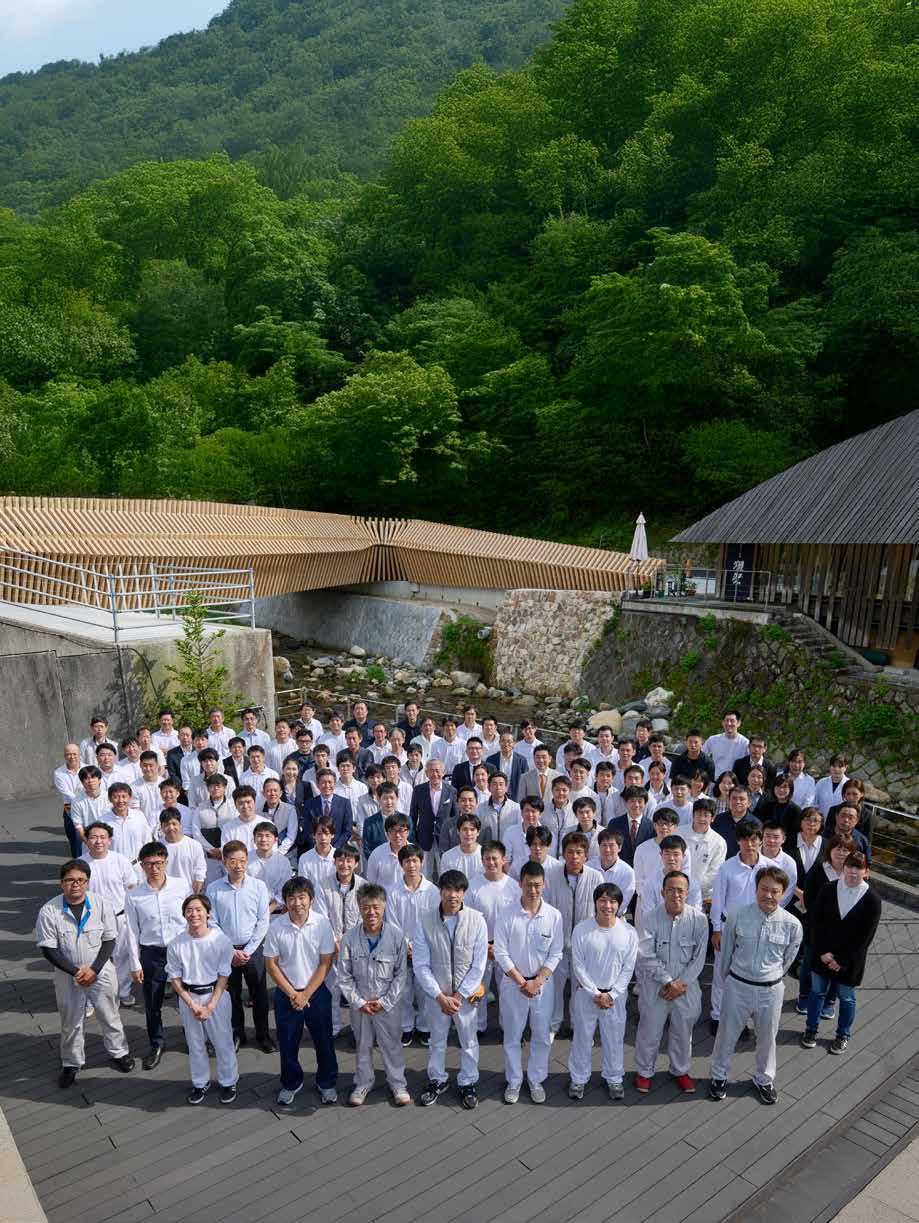
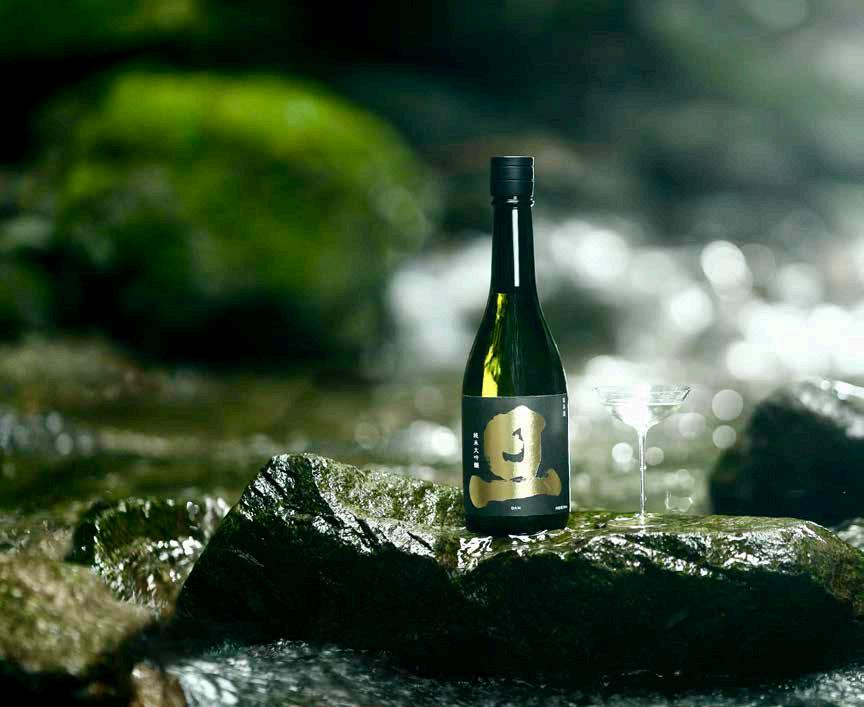
Here at DASSAI, the world ʼs largest brewing team of over 200 members crafts Sake every day.
Inc.
2167-4 Osogoe, Shuto-machi, Iwakuni-shi, Yamaguchi, 742-0422 Japan
DASSAI
WELCOME TO TK64, Where Currents Meet
This issue began with a walk.
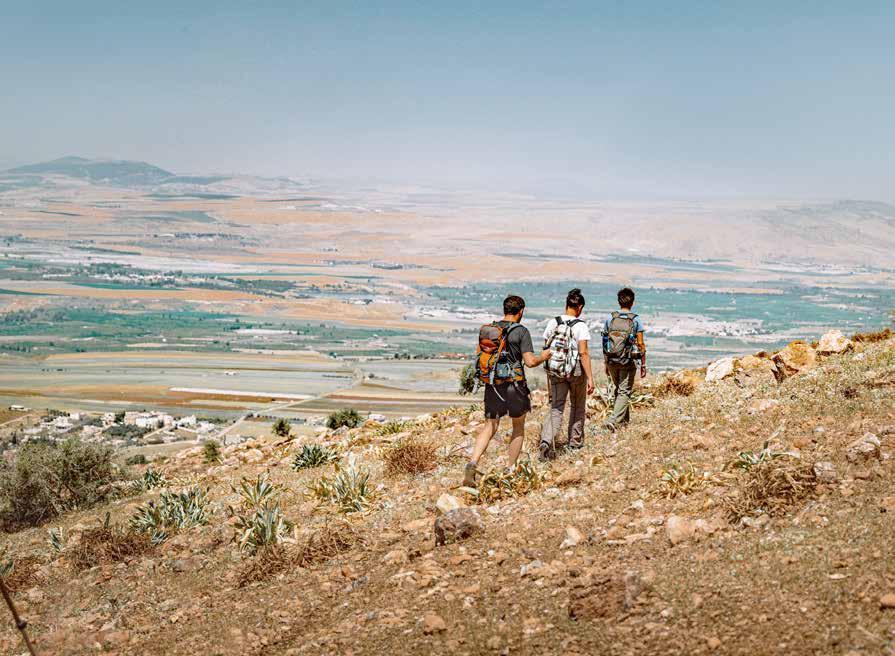
TK Director of Photography David Hartung spent ten days alone on Japan’s Michinoku Trail, following the northeastern coast of Honshu through fishing villages still rebuilding from the 2011 tsunami.
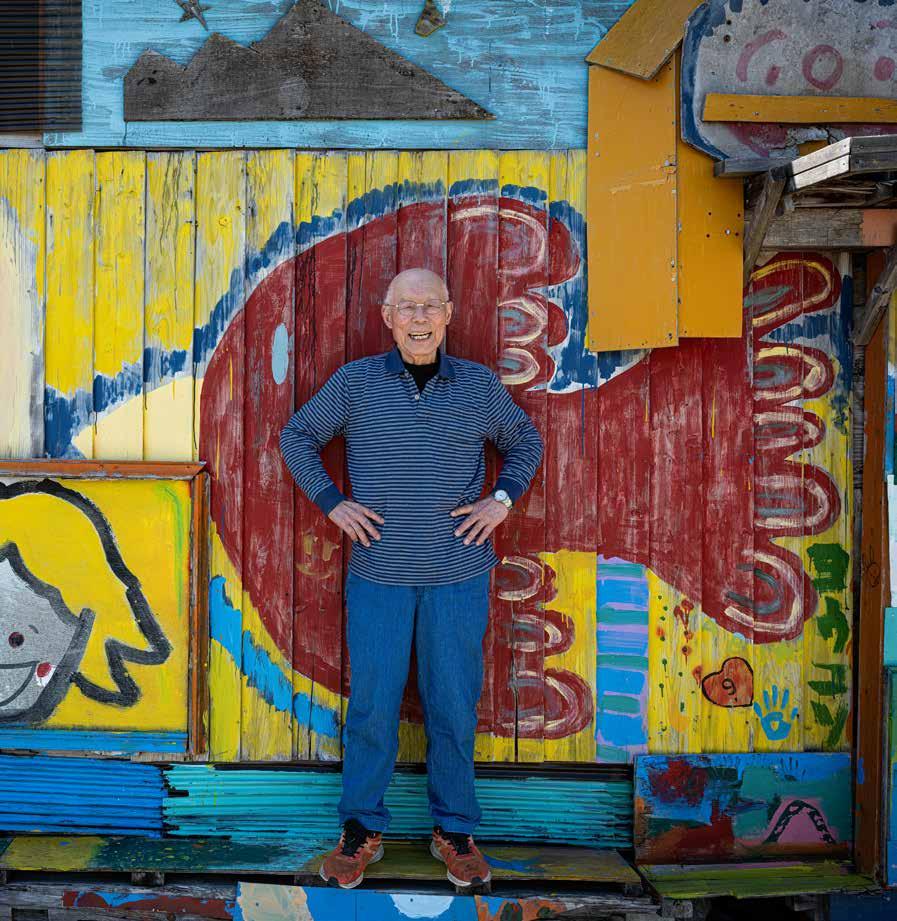
In the small community of Okirai, he met Waichi-san, a lifelong resident who watched the wave take his town, then built a gathering place from the debris it left behind. He named it Shiome – the junction where ocean currents converge – a spot where people from everywhere could meet and share their thoughts.
That word – that idea – became the theme of these pages.
Jay Khan, whose bar Coa topped Asia’s 50 Best Bars three years running, opened his first photography exhibition this spring. Here was a current that began on a TK assignment to Mexico in 2017, when David looked through Jay’s snapshots and told him he had a good eye.
In Macau, five chefs holding fourteen stars between them converged at a single table to mark a century of the Michelin star with one course for each of the five senses.
And Asia’s 50 Best Restaurants brought its ceremony to Hong Kong for the first time, crowning two visions of Chinese cuisine – The Chairman and Wing – that share one tower, twentysix floors apart.
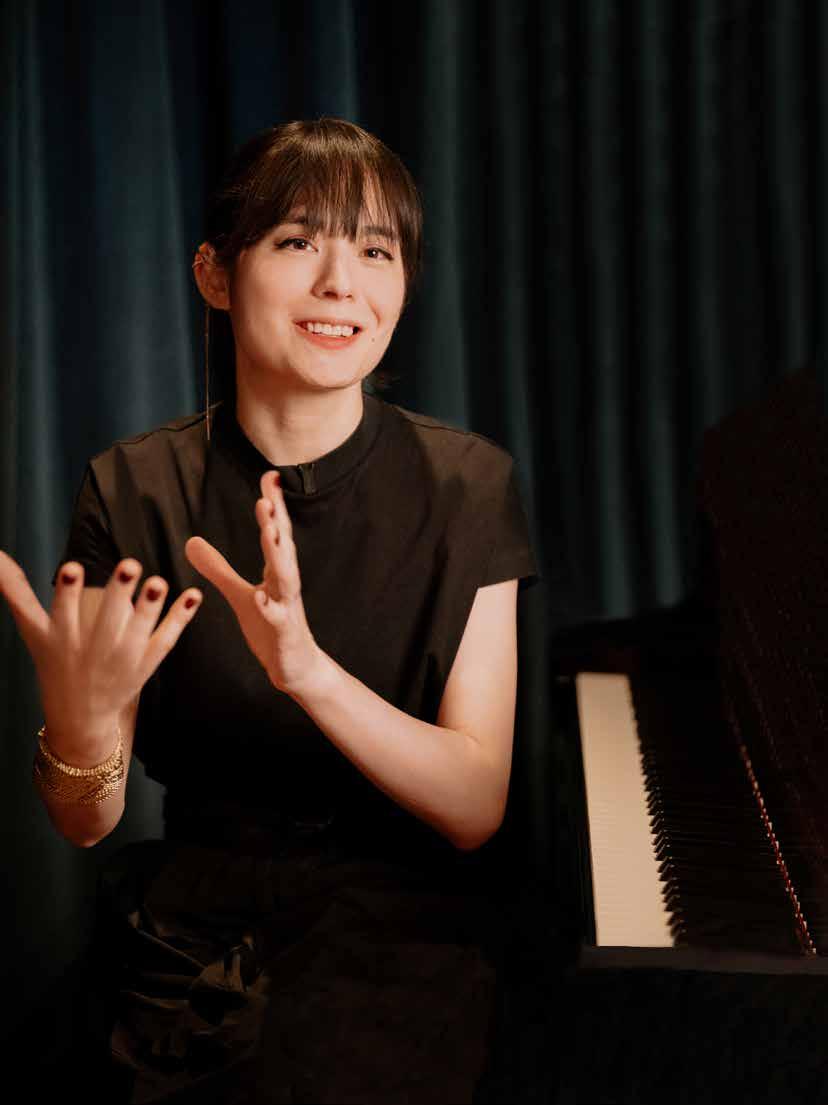
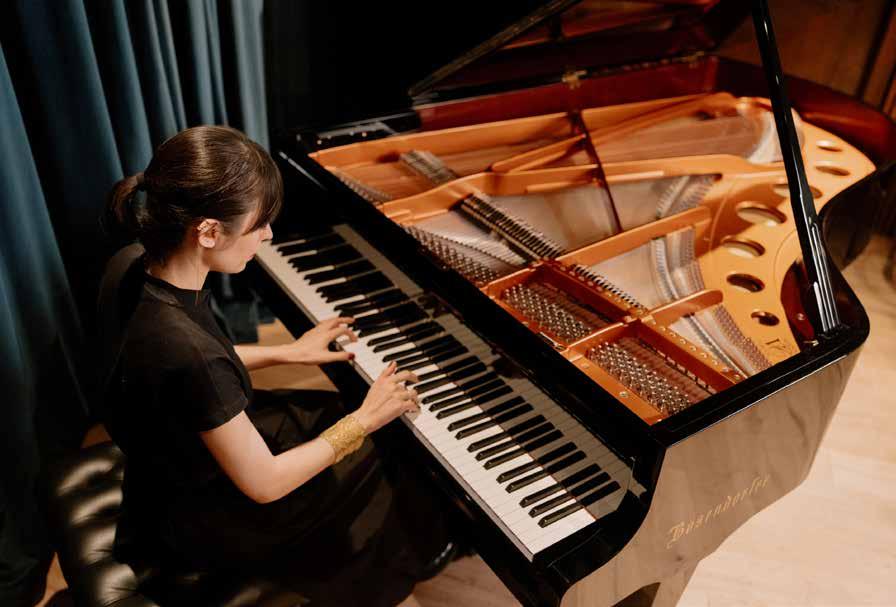
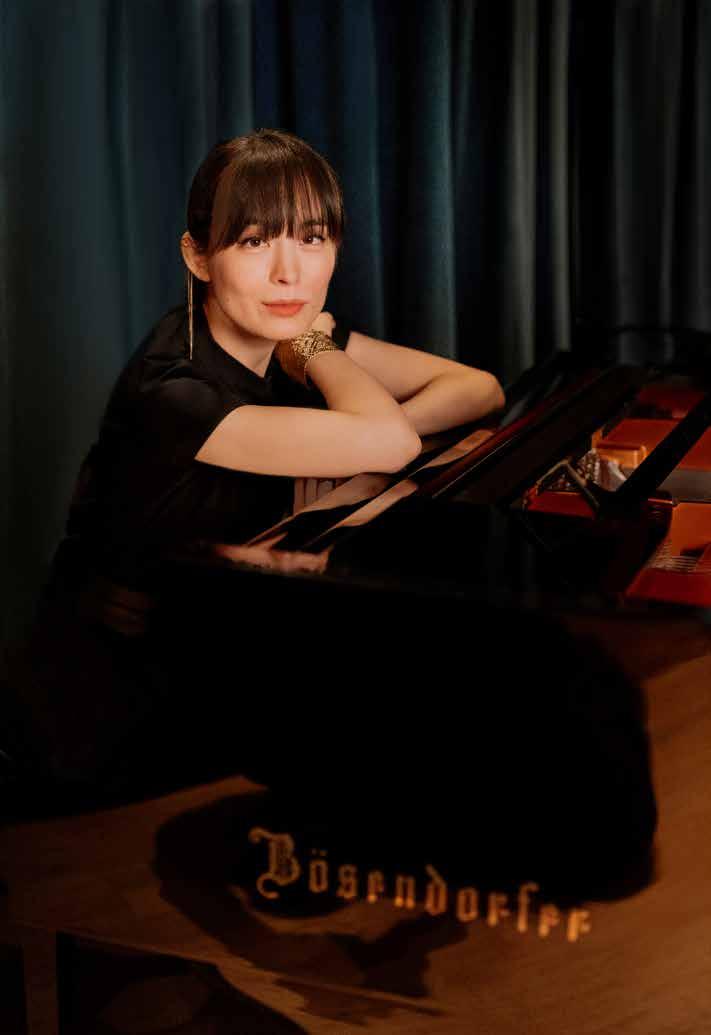
At Ocean Table, TK’s own performing arts gathering place, pianist Alice Sara Ott and cellist Kian Soltani traded the grandeur of a concert hall for the intimacy of a salon. When I asked for her thoughts on what she is reaching for, Alice said it’s about closing the distance between the audience, the stage, and the instrument.
Whatever current now carries you, smooth, rough, or uncharted, steer steady and hold tight.
欢迎阅读 TK 第 64 期《潮目》。
本期始于一场徒步之旅。
TK 摄影总监 David Hartung 独自踏 上日本陆奥潮风步道,徒步十天,沿本州 岛东北海岸前行,穿过一个个仍在 2011 年海啸后重建中的渔村。
110 Passing the Plate • 114 Cheese, Please • 116 In Full Bloom • 118 Sun-Drenched Plates • 124 Rituals Recomposed 130 Warm Desires • 132 Pond and Tower • 136 Escape to Serenity • 140 From Snow to Sake 146 MENA’s New Flavors • 152 Closing the Distance • 158 The Translator • 164 Gnome Sweet Home
敬畏之笔
power and awe
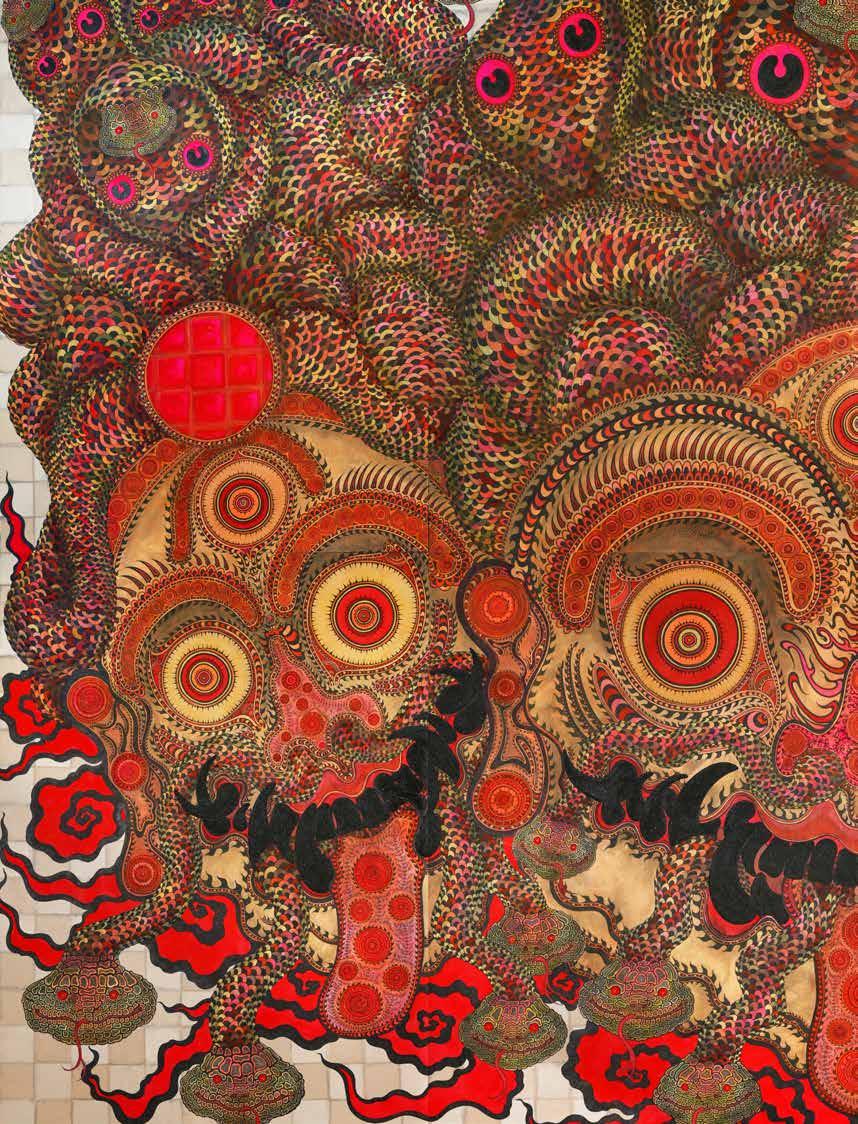
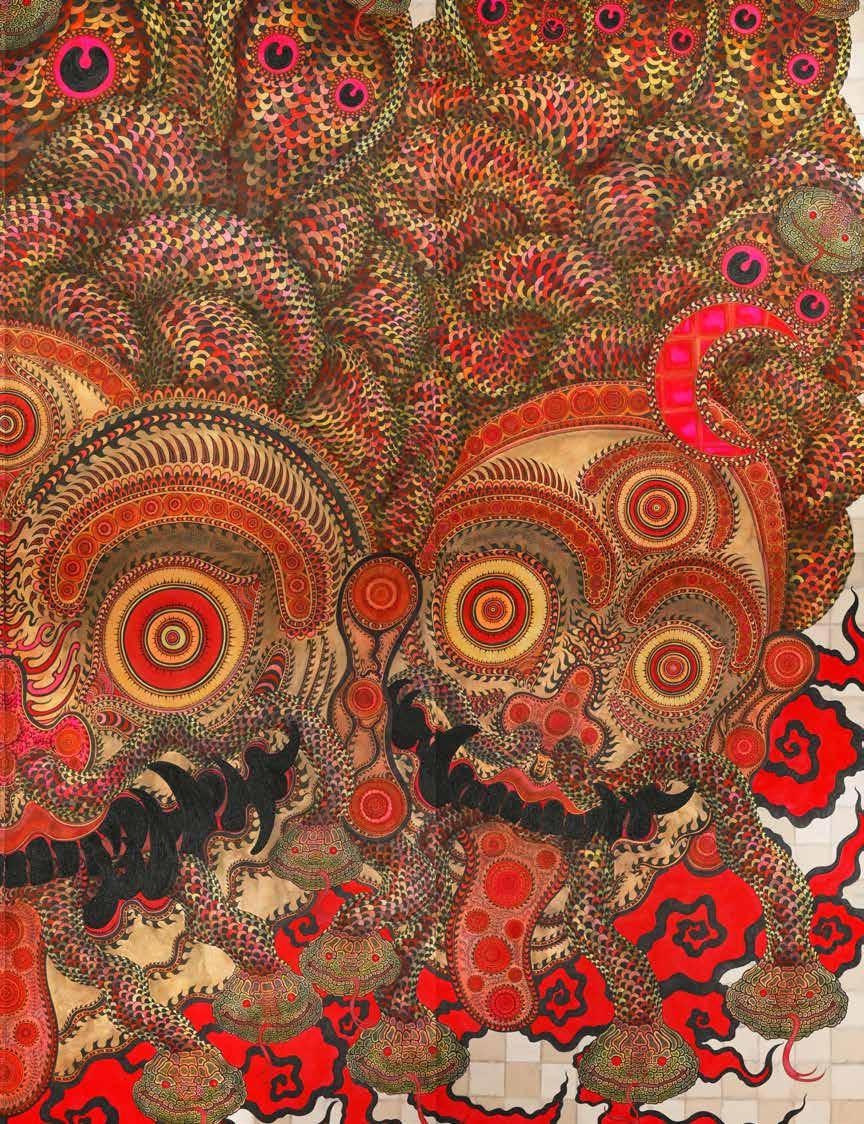
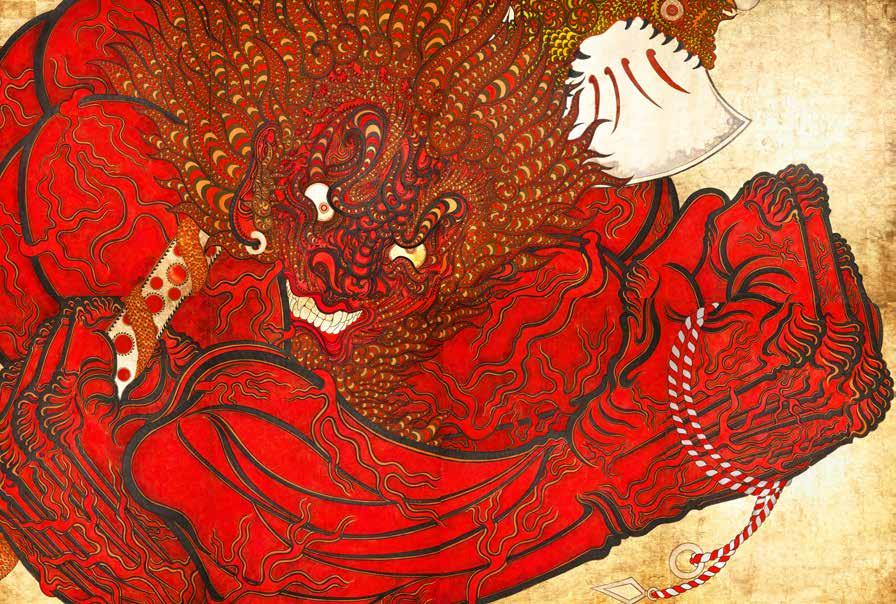
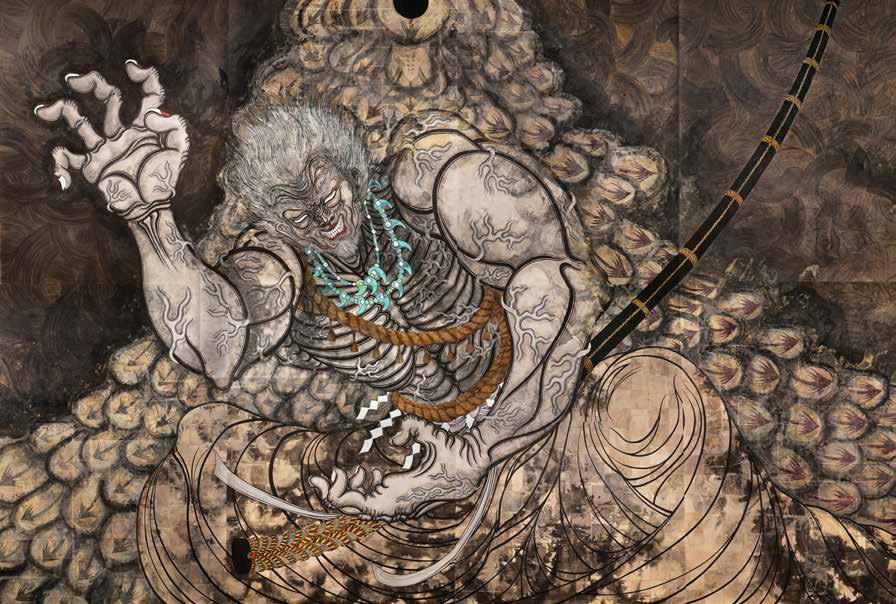
Blending mythological imagery with contemporary practice, Tomiyuki Kaneko’s monumental paintings reveal potent deities that inhabit the boundaries between worlds.
Gion Daimyoujin, 2024, mineral pigments, Japanese ink, transparent watercolor, pen, sacred water, foil on Japanese paper, 460 x 640 cm 《祇园大明神》,2024年,矿物颜料、日本墨、透明水彩、钢笔、圣水、箔于和纸,460 x 640 厘米
JAPANESE ARTIST Tomiyuki Kaneko has filled notebooks with drawings and writings since junior high school. “It’s an act of approaching my true self, of exploration,” he says, “and it grounds my creative work as a lifework.” Though these personal musings are central to his practice, his diverse influences include ukiyo-e Japanese prints of deities, the Rimpa school, and animations.
Indeed, Tomiyuki Kaneko’s art – from painted stones, papiermâché masks, and Daruma figures to immense canvases multiple meters tall – typically manifests as images of beings that inhabit the world’s liminal spaces. “I feel that every land, plant, and even stone is inhabited by one of the many millions of deities, and that they protect the environment in which we live,” he explains. “The power that ancient people revered continues to deeply influence us today and nurture our creativity.”
There’s no denying the otherworldliness of the three enormous paintings headlining his recent solo exhibition, Breath of Susanoo, held at Mizuma Art Gallery in Tokyo in April and May.
Previous Page: Sun and Moon Snakeheads Obanshin, 2026, mineral pigments, Japanese ink, transparent watercolor, acrylic, pen, Hita Tenryosui water on Japanese paper, 460 x 640 cm 《日月蛇头黄幡神》,2026年,矿物颜料、日本墨、透明水彩、丙烯、钢笔、日田天领水于和纸,460 x 640 厘米
《建速须佐之男》,2025年,矿物颜料、日本墨、透明水彩、丙烯、钢笔、日田天领水、贝壳粉、箔于和纸,460 x 640 厘米
“We feel a sense of overwhelming power, exhilaration, and awe in the face of huge things,” says Kaneko. Each canvas, measuring 4.6 by 6.4 meters, was made with an astonishing variety of materials, from Japanese ink to acrylic paint to Hita Tenryosui spring water, which, he says, he uses to “create a connection between the artwork and the local environment rooted in our sense of awe toward nature and the divine.”
In his work Takehaya Susanoo, the undrawn sword of Susanoo, the Shinto deity of storms, sea, and agriculture, symbolizes calm and control amid a tempestuous domain. The god’s nonaction is influenced by Kaneko’s aikido practice: “I believe that harmonizing with others is more fruitful for creativity than fighting and winning. The aikido concept of Takemusu Aiki translates to art as the moment when ideas flow one after another, or the state where the brush moves on its own without conscious thought. If I could master that kind of aiki, I might be able to create works that get closer to the essence of things.”
Further syncretions of Susanoo in Japanese religious history are represented in the other large-scale works of the trio, Gion Daimyoujin, depicting a wrathful deity, and Sun and Moon Snakeheads Obanshin, whose origins lie in an ancient Indian serpent god called Rahu. “Sometimes, when I sense something, I look up which deity or spirit might best express this feeling,” says Kaneko. “If my work isn’t guided by my own heart, I lose my balance. My ideal state is when I can pour my soul into painting exactly what I want to paint.”
Takehaya Susanoo, 2025, mineral pigments, Japanese ink, transparent watercolor, acrylic, pen, Hita Tenryosui water, shell powder, foil on Japanese paper, 460 x 640 cm
別具一格
Karimoku Case’s latest project at a Swedish vineyard, led by Norm Architects, turns an existing structure into an invitingly intimate reception space.
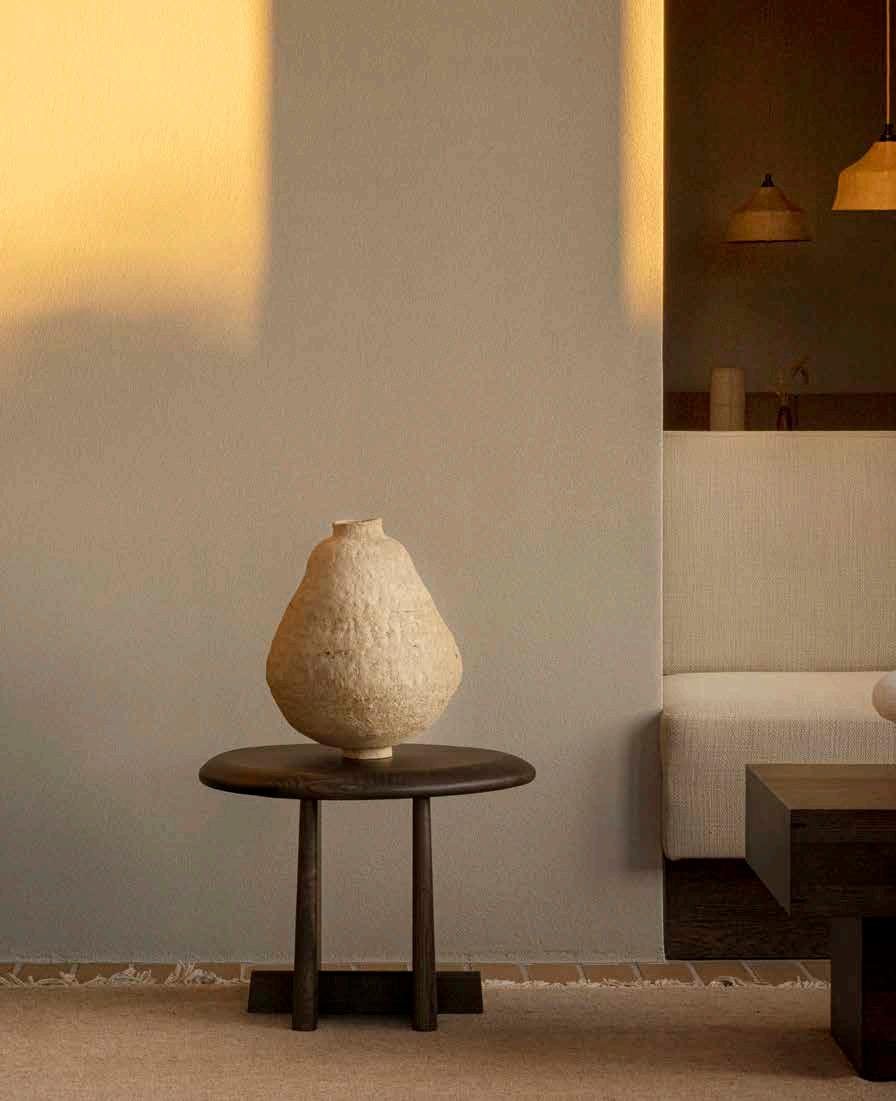
The solid wood N-ST04 side table, designed by Norm Architects for Vinhuset at Ästad Vingård, is reminiscent of a Japanese torii gate.
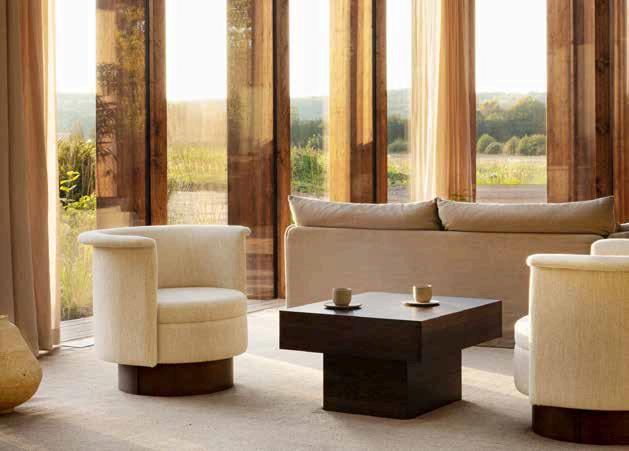
The N-CT02 coffee table in the center of the lounge was designed by Norm Architects for Restaurang ÄNG. 位于休息室中央的N-CT02咖啡桌,由Norm Architects为Restaurang ÄNG设计。
IN A UNIQUE APPROACH to product development, Karimoku Case, a contemporary lifestyle and furniture brand based in Japan, creates collections that emerge from what they call “Cases” – real-world design projects, led by international architects, that foster ongoing experimentation. These span luxury residences, restaurants, hotels, retail stores, and, most recently, Ästad Vingård, an estate vineyard with spa and hospitality facilities in the Swedish countryside.
Introduced in late 2025, the latest project at the vineyard, CASE 12, named Vinhuset, focused on the reworking of a former service building into a wellness and social destination. It follows two other projects at the same property led by Karimoku Case collaborator Norm Architects, a design studio based in Denmark: CASE 06, the Michelin-starred Restaurang ÄNG, and Sjöparken, a lakeside retreat with multiple guesthouses.
The interior of the Vinhuset revitalization, conceived as a living room-like setting, operates at a much more intimate scale than the building or even the wider property that envelopes it. The furniture, either selected from the existing Karimoku Case collection, designed by collaborative partners Keiji Ashizawa Design (KAD) and Norm Architects, or conceptualized specifically for the project, follows the same reasoning. “We sought to create pieces that supported dwelling rather than just seating,” notes Frederik Werner, design director at Karimoku Case and designer and partner at Norm Architects. It’s “furniture that makes you want to stay.”
最新完成的葡萄园项目 Vinhuset (案例 12)于 2025 年底登场,将原有 的服务建筑改造为一处兼具康体与社 交功能的场所。在此之前,Karimoku Case 的合作伙伴、丹麦设计工作室 Norm Architects 已于同一个地点完成另外两件作品:米 其林星级餐厅 Restaurang ÄNG(案例 06),以及 由多栋独立客舍组成的湖畔度假居所 Sjöparken。 Vinhuset 的室内设计以「客厅」为概念,营 造出比建筑本身甚至其周边环境更为私密的氛围。 家具的设计理念亦与之呼应,一部分选自由合作 伙伴芦沢启治建筑设计事务所与 Norm Architects 共同设计的现有系列,另一部分则为本案专属构思。 Karimoku Case 设计总监、Norm Architects 设计 师兼合伙人 Frederik Werner 表示:「我们追求的 是营造居家氛围的家具,而不仅仅是座椅。这样 的家具,会让人舍不得离开。」
N-ST04 边桌是 Norm Architects 为 Vinhuset
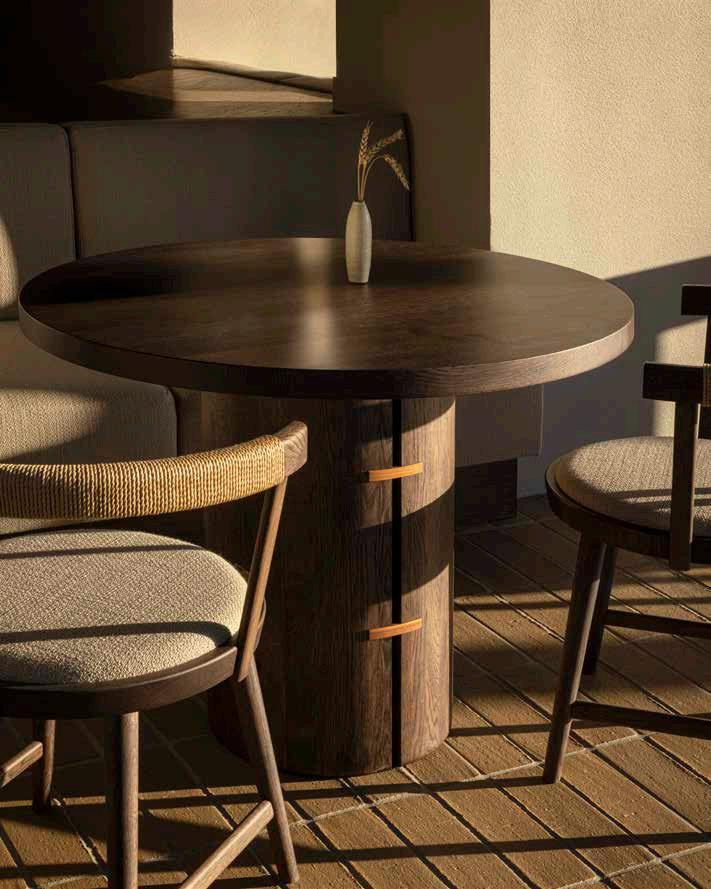
The dining table, a prototype model by Norm Architects for Vinhuset, shares subtle design DNA with N-CT02 coffee table and is paired with Karimoku Case’s N-DC06 dining chairs.
The N-ST04 Side Table is a Norm Architects-designed Vinhuset piece that made it into production. Crafted from deep-hued solid wood, the slightly angled legs support a pebble-like tabletop. When viewed head-on, the shape is reminiscent of Japanese torii gates. The edges of the side table, which form soft contours rather than harsh angles, diffuse the light in a way that emphasizes the natural origins of the material. The sense of roundness continues in the N-DC06 Dining Chair, also designed for CASE 12 and now in production. The solid wood chair’s deeply curved backrest is as supportive as it is sculptural, and the sabulous hues of its textile seat are echoed throughout the space, in the lighting fixtures, the planters, and the walls themselves. The hourglass shape of the chair encourages a leisurely approach, with trickling sand rather than ticking clocks marking the passage of time.
There’s a cohesive character to the furniture designed or selected for Vinhuset. “The red thread we wanted to carry forward was clarity of form, tactile materiality, restraint with warmth, and an honest dialogue with the surroundings,” Werner notes. “What we’re interested in is a shared sensibility that makes different pieces feel as though they belong to the space, the property, the area, and the craft traditions in general.” For Werner, this is most clearly reflected in Vinhuset’s seating family of dining and lounge chairs and barstools that collectively express the project’s ethos: “I think they strike an interesting balance between traditional Scandinavian design – placing it well within both Vinhuset itself and also the location of Ästad in general – and a layer of refined Japanese details and proportions.”
What makes the CASE 12 creations, as well as the wider evolving Karimoku Case collections, stand out in the luxury furniture sector is the rare, long-term, deeply iterative working relationship between designer and maker shaped over time through collaboration and exchange. “There’s a continuous back-and-forth around proportions, construction logic, and material behavior,” says Werner. “Karimoku Furniture’s craftspeople have the instinct and know-how for what will survive fabrication and what won’t. That feedback is invaluable and it genuinely shapes the design, not just the production.”
Kengo Kuma’s Faces Collection for Jaipur Rugs transmutes the renowned architect’s building facades into artisanal carpets inspired by traditional principles of Japanese design.
Kasane in Bluebell/Aqua Foam, the only green-hued rug in the collection, was displayed at the Crespi Bonsai Museum near Milan. 系列中唯一一款绿色调地毯 Kasane(蓝铃花/水波纹),曾在米 兰附近的克雷斯皮盆景博物馆展出。
Japanese architect Kengo Kuma
日本建筑师隈研吾
ARCHITECTURE OFTEN FOCUSES on facades, but in Japanese architect Kengo Kuma’s oeuvre, they remain subtle features gracefully integrated into the landscape. Like a face, a facade is nothing without the details that define it. And it is those often overlooked elements that matter implicitly to Kuma and that are highlighted in Faces, a collection of sixteen hand-tufted wool and regenerated viscose carpets he designed with Jaipur Rugs and exhibited at the Crespi Bonsai Museum during Salone del Mobile Milano in April.
The luxury rug maker, founded in 1978 by Nand Kishore Chaudhary, has collaborated with many leading creators, including artist Princess Pea (Natasha Preenja), designer Richard Hutten, sculptor Matteo Cibic, and publisher Bodour bint Sultan Al Qasimi, to alchemize their concepts into textiles. “With Faces, we’re not translating architecture into rugs,” says Jaipur Rugs Managing Director Yogesh Chaudhary. “We’re translating a way of seeing. Kengo Kuma’s work is deeply emotional yet restrained, and through our artisans, we’ve reinterpreted that sensitivity into something tactile, human, and lived-in.”
Each rug in the Faces Collection references a traditional Japanese architectural principle embodied in a Kumadesigned building, a “tactile memory” of a place or space, as he puts it. One example is Kasane, a carpet featuring layered architectural lines in gray, sand, and slate overlaying blocks of soft, foliage-like greens and earthy browns. It was inspired by the facade of the wing of France’s Musée Albert-Kahn that Kuma designed in 2022. The rug condenses a dramatic exterior and its surroundings into something quieter for the home. And because rugs come into direct contact with the body, incorporating elements from nature was essential for Kuma.
When working with Jaipur Rugs master artisans in Rajasthan, who employ centuries-old techniques, Kuma found that the pieces seemed to grow out of a living exchange rather than a static manufacturing process. It reminded him of craftspeople in Japanese villages of old who similarly achieved the sublime with just their hands and simple tools. These Rajasthani artisans are honored in the very name of the collaborative collection: “Faces” points not just to architectural features but to the many people involved in handcrafting each carpet.
At SoNoMa, design and seasonal cuisine converge to guide an intimate omakase experience.
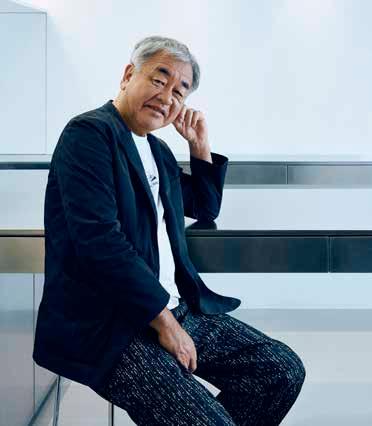
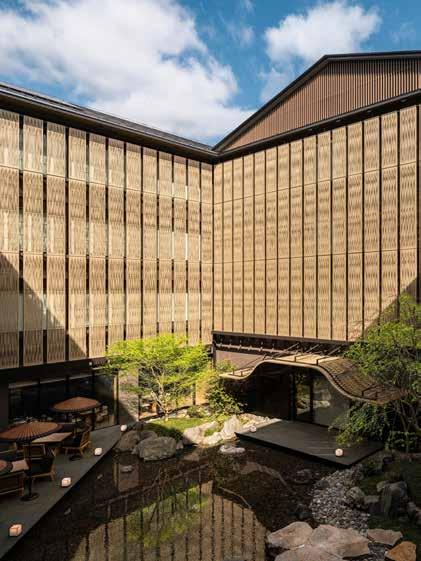
CAPELLA KYOTO, the luxury hotel that opened in March in the city’s Miyagawa-chō geisha district, was built on the grounds of a nineteenth-century elementary school and features an exterior designed by Japanese “starchitect” Kengo Kuma. Culinary headliner of the property is SoNoMa by SingleThread, a thirty-twoseat omakase-style restaurant helmed by Chef Keita Tominaga and developed in partnership with Kyle and Katina Connaughton of three-Michelin-star SingleThread in California’s Sonoma County.
BY KATE NICHOLSON
Guests can expect reflections of Kyoto’s Kansai region as well as Sonoma County’s Dry Creek Valley in both the design and the elevated amalgam of local seasonal fare. “The California influence comes through in the openness, warmth, and farm-driven spirit of the experience,” says Robert Cheng, founder and principal of Brewin Design Office, the studio that conceived Capella Kyoto’s interiors, “and the Japanese aspect is expressed through proportion, materiality,
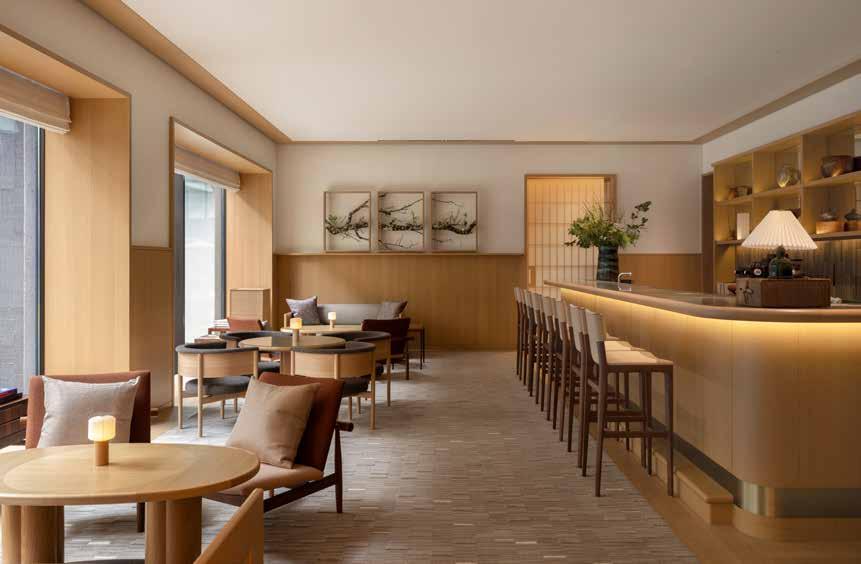
shadow, threshold, and the sense of ceremony around the meal.” The dining adventure moves from a salon-like lounge and bar full of locally sourced antiques and curios to a counter hidden behind a sliding screen. “The shift in mood is immediate,” says Cheng. “The counter itself is designed as an extension of the kitchen – open, precise, with everything visible and within reach. Lighting is low and layered, coming from multiple sources at human scale rather than from above, which gives the room a warmth that feels private and intimate.”
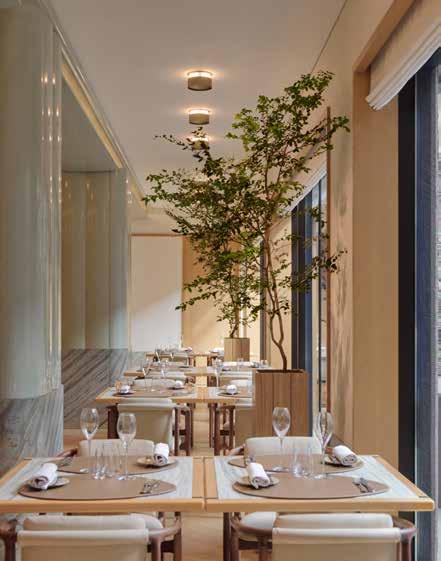
SoNoMa’s ambience is defined by restraint. Light-hued timbers, plaster, stone, and textiles set a quiet backdrop, and the furniture directs attention to the counter, the chefs, and the courtyard. Sharing the same philosophy are tableware and glassware crafted by Hasu Yoshitaka, Kojima Kenji and Kojima Yosuke, SUS Gallery, and Kimura Glass. Like the property’s all-day French brasserie, Lanterne, SoNoMa overlooks an inner courtyard. This was an important design consideration, because, says Cheng, SingleThread’s “philosophy revolves around seasonality and a connection to what’s growing and developing. Guests experience the light shifting through the evening and the plantings changing through the year.”
←
← ←
Capella Kyoto’s inner courtyard 京都嘉佩乐酒店的内部庭院
从一个摆满当地古董和珍奇物品的沙龙休息室 和酒吧开始,过渡到隐藏在滑动屏风后的吧台。 Robert 说:「氛围的转变是瞬间发生的。吧台 本身的设计理念是厨房的延伸 开放、精准, 所有物品清晰可见、触手可及。灯光低调而层 次分明,来自多个与人眼高度相宜的光源,而非 从上方直射,这赋予了房间私密而温馨的氛围。」
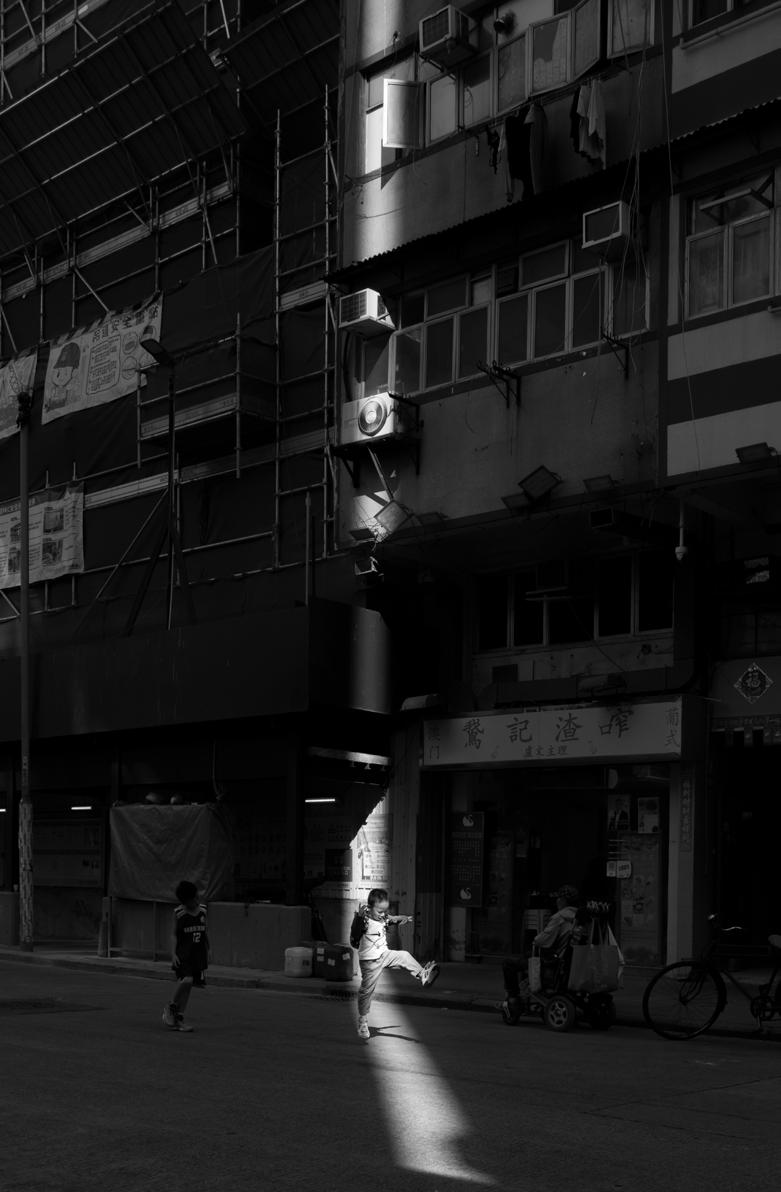
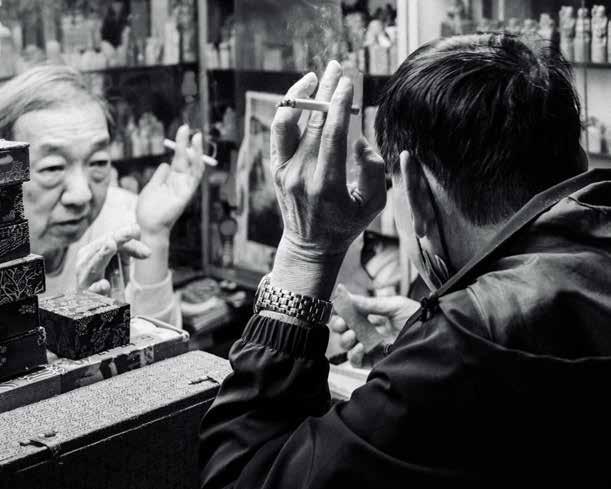
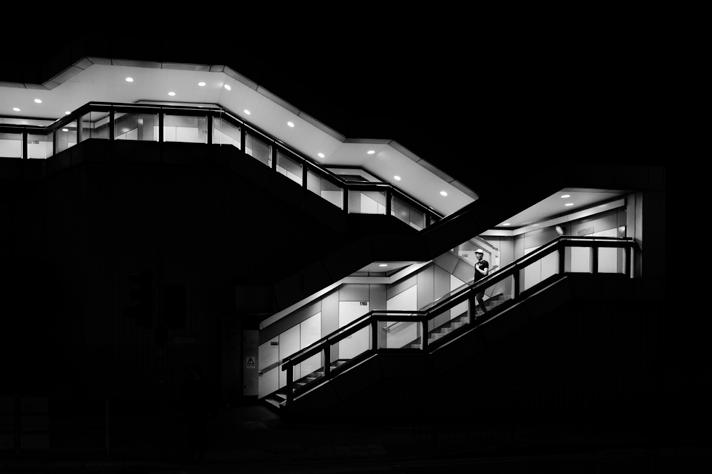
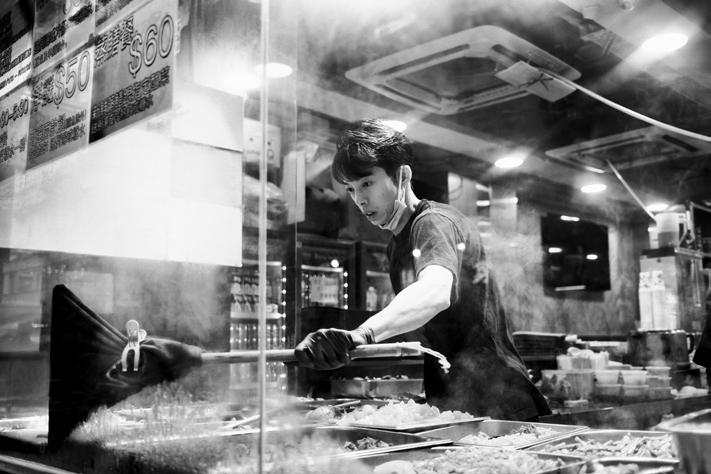
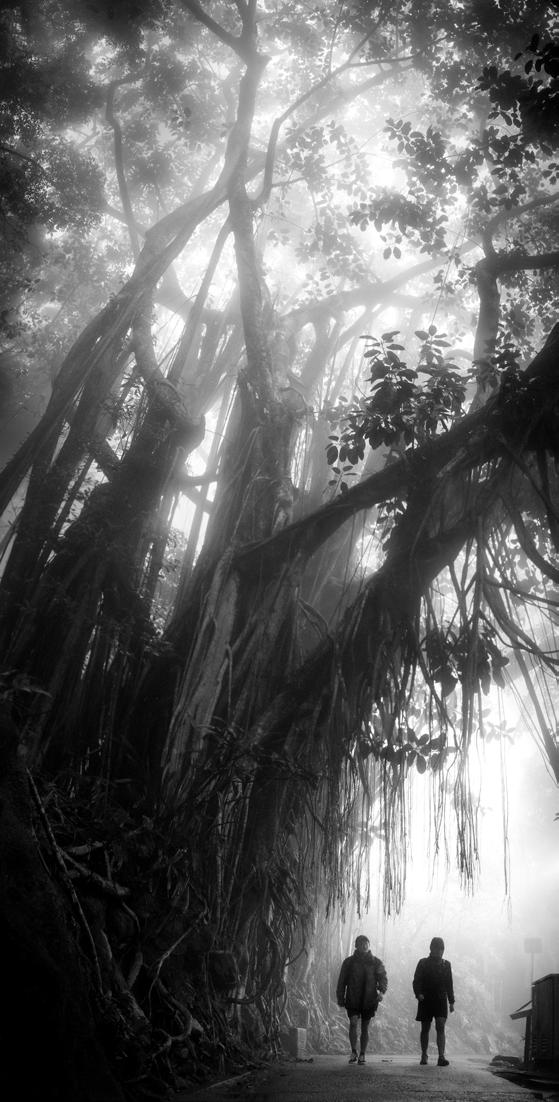
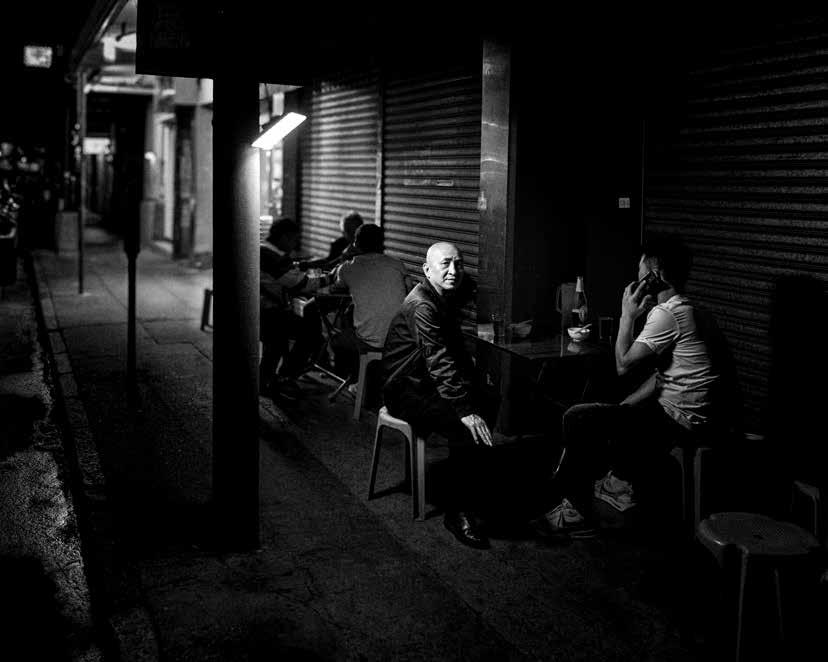
THIS SPRING, twenty-one black-and-white prints line the walls of Sin Sin Fine Art in Wong Chuk Hang, each photo capturing a quiet moment in the city. The exhibition, Pouring Shadow: Contrast and Balance, marks the first solo show of Jay Khan, founder of Coa and a man better known for what he shakes and pours into a glass than for framing images under glass. Coa, in fact, held first place on Asia’s 50 Best Bars list for three consecutive years from 2021.
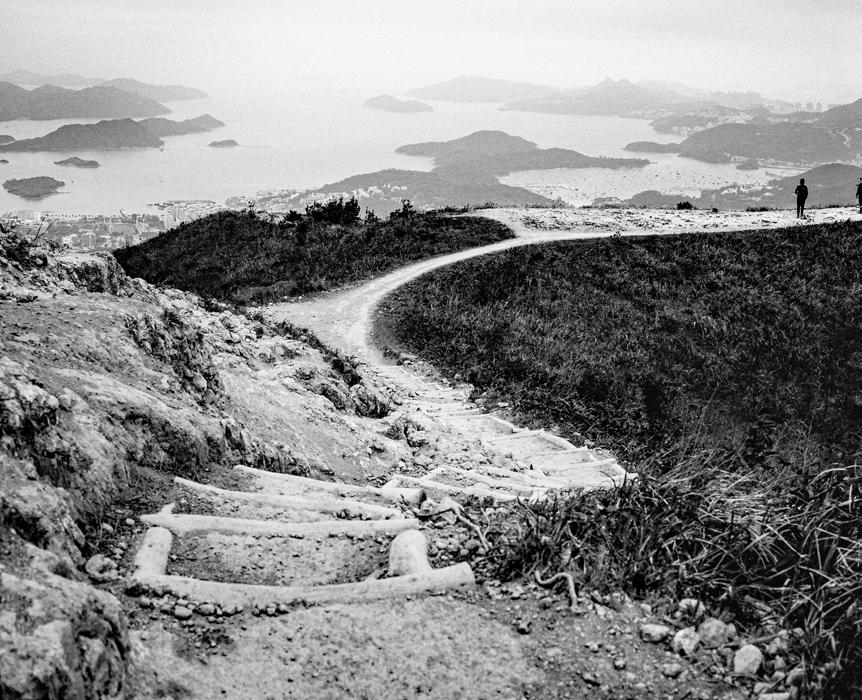
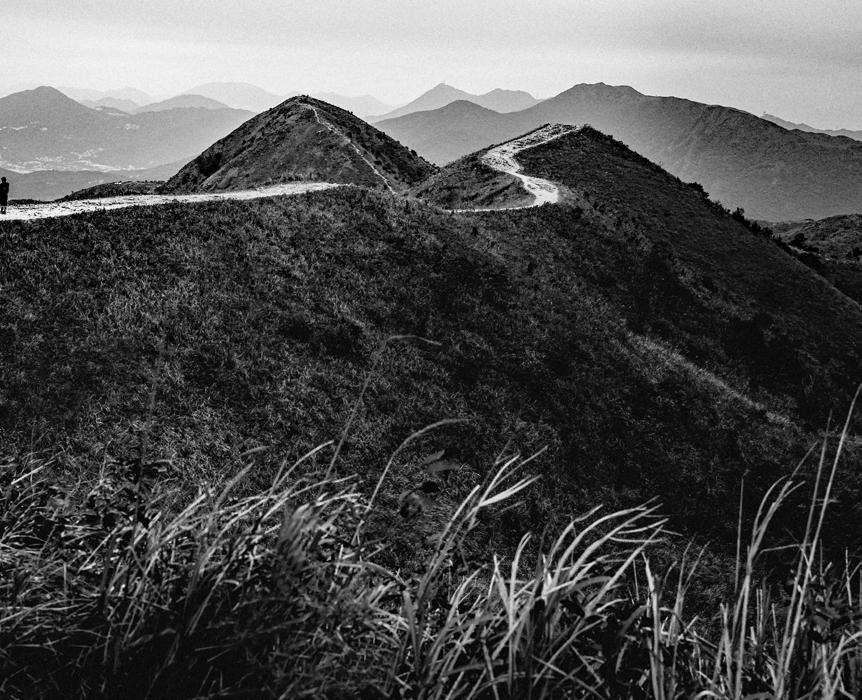
Khan’s romance with photography began with a journey in 2017, a TK-sponsored trip to Mexico, home of the agave spirits that Coa would build its identity around. He traveled alongside TK Director of Photography David Hartung, the award-winning pro who had been shooting Khan’s cocktails for years. The assignment’s brief was clear: distilleries, palenques, the world of mezcal up close and in a nutshell. For Khan, something else was going on. He had packed a small camera with no real intention of using it for anything beyond snapshots. “I didn’t take photography seriously back then,” he says. “I just followed the team and watched how they worked.” That in itself was new. It was the first time he had observed a professional photographer in the field day after day. At some point on the trip, Hartung looked through Khan’s photos and said simply, you have a good eye. The remark seemed insignificant at the time.
The turning point came during the pandemic. With bars closed and the city slowing down, Khan picked up the camera to give himself something to do. He was fascinated with street photography because it was right at hand – he could just walk out the door. He kept following the same route – and does so even now – from Jordan north through Sham Shui Po, past wet markets, aging buildings, and the rougher textures of an older Hong Kong, slowly working out what he was looking for.
今年春天,在黄竹坑 Sin Sin Fine Art 的白墙上, 挂起了一整面共二十一帧黑白照片,在这座向 来嘈杂的城市里框住一些安静的瞬间。展览名 为《酌:对比与平衡》,是 Jay Khan 第一次以摄 影师身份举办个展。在这之前,认识他的人,多 半是因为他从吧台递出来的那杯酒。他创办的 Coa,从 2021 年起连续三年蝉联「亚洲 50 最佳 酒吧」榜首。 Jay 与摄影结缘,要从 2017 年的一趟旅程 说起。那一年,他与 TK 飞了一趟墨西哥。而墨 西哥是龙舌兰的故乡,也是 Coa 的立身之本。同 行的是屡获殊荣、多年来一直为 Jay 的调酒掌镜 的 TK 摄影总监 David Hartung。他们的任务很 明确:把酒厂、蒸馏坊、整个梅斯卡尔烈酒的世 界拍下来。但这趟旅程,Jay 也悄悄带了一台小 相机,本来没打算认真拍摄。他说:「我那时候 没把摄影当回事,就只是跟着看,看 David 怎么 工作。」这对他来说也是新体验。这是他头一回 连着好几天,近距离观察一位专业摄影师如何 拍照。旅程的某一天,David 翻了翻他拍的照片, 淡淡对他说:「你拍照有眼光。」当下他没太放在 心上。
Part of what he found was his own limitations. Khan is colorblind, and when he tried to edit color photographs, adjusting the sliders for separating one hue from another felt almost random. Rather than fighting it, he switched to black and white and eventually to a camera with a built-in monochrome filter that removed color from the process entirely. The constraint turned out to be liberating. With color gone, the frame came down to the light, shadow, shapes, and figures inside it. It was a short step from there to Fan Ho, the late Hong Kong photographer whose dramatic studies of post-war street life remain the essential reference point for anyone shooting the city in black and white.
When comparing his two art forms, the overlap was hard to ignore. A cocktail and a photograph both depend on balance – what fills one part of the glass or the frame needs to complement what fills the other. Both also depend on contrast: in his drinks, savory against bright, smoke against citrus; in his images, dark against a single highlight. And both, he says, are minimalist through a creative process of instinct first and design second. “Balance, contrast, composition, restraint,” he says of the overlap. “The drink has to taste right. The frame has to look right. Both come down to leaving out everything that doesn’t belong.”
The patience is the same too: “I always go back to the same intersection, the same staircase, the same patch of afternoon light and wait for someone to walk into the frame and complete it.” The background is scouted, the light is studied, but the subject
is the one thing he cannot control. “For me, photography is a kind of meditation.”
Khan’s first exhibition actually came together quickly, slotting into Hong Kong Art Week on roughly a month’s notice. Swiftly after his debut, Khan returned to a gallery wall again, this time in a group exhibition at Affordable Art Fair in May. He talks about all of it with the same low-key tone he brings to his Coa awards: “I never thought I’d have a solo exhibition, just like I never thought we’d be topping Asia’s 50 Best even once, let alone three times. The focus is always on the execution. If the work is good, people will notice.”
It is, in its own way, the same approach that has carried him through twenty years behind a bar. Refine the craft, trust the work, and let the results do the talking. For a man who claims to be a minimalist, his life keeps adding up.
Khan’s photographic approach seeks out small, everyday moments that most people pass by without noticing.
Light, shadow, and geometry comprise Khan’s monochromatic visual language 光、影、几何,构成Jay的黑白视觉语言。
Khan walks the same route from Jordan to Sham Shui Po, looking for pieces of the real Hong Kong. 从佐敦走到深水埗,他一遍又一遍 走同一条路,找的是真正的香港。
japan wayfarer
In words and images, TK’s director of photography documents his exploration of Honshu’s northern coast along the Michinoku Trail.
WORDS AND PHOTOGRAPHY BY DAVID
HARTUNG
one-hundred-fifty-meterlong
A
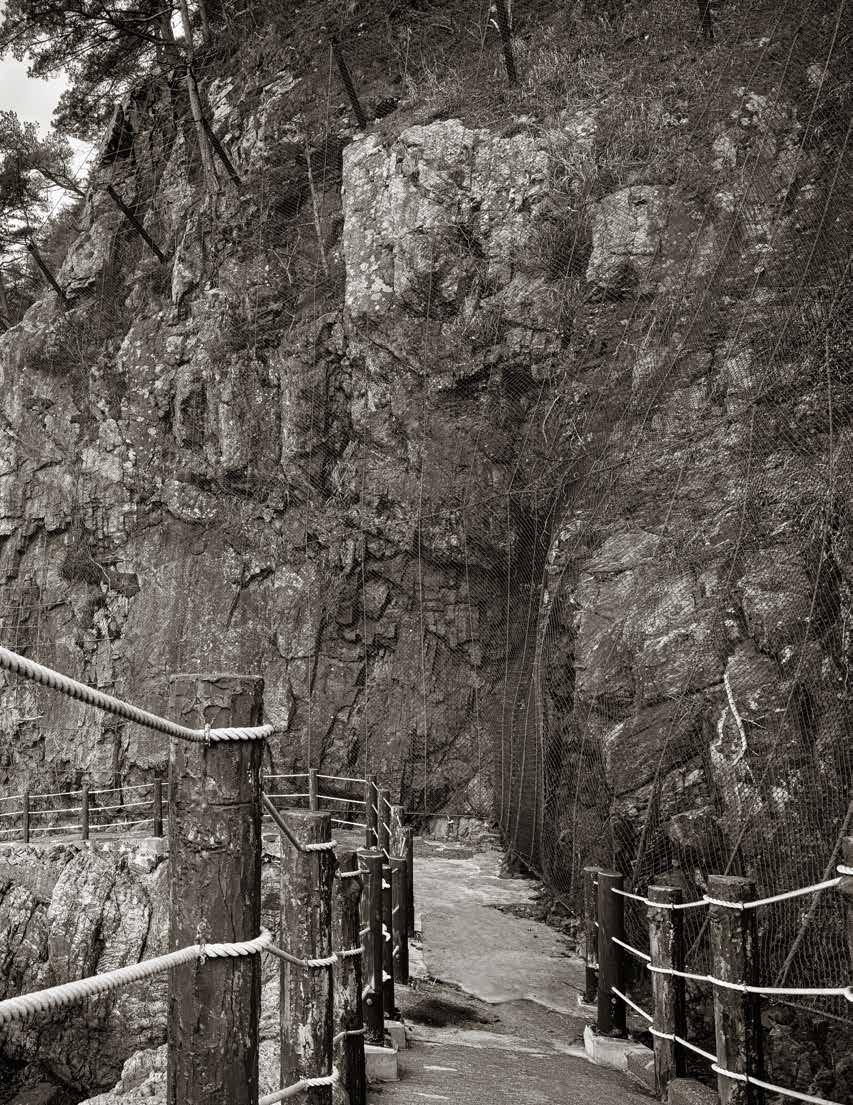
hand-carved tunnel connects Nedari Beach to a cliff-hugging trail.
Setting out alone on a ten-day
walking journey along the northeastern coast
A one-second exposure captures the movement of a train through one of the many tunnels between Shiraikaigan Station and Fudai Station. 一秒的曝光捕捉到列车驶过 白井海岸站与普代车站之 间其中一条隧道的瞬间。
of Japan’s Honshu island seemed like
a daunting undertaking. Navigating in a land with no knowledge of its language and only a peripheral understanding of the culture made me a bit nervous about accepting the assignment.
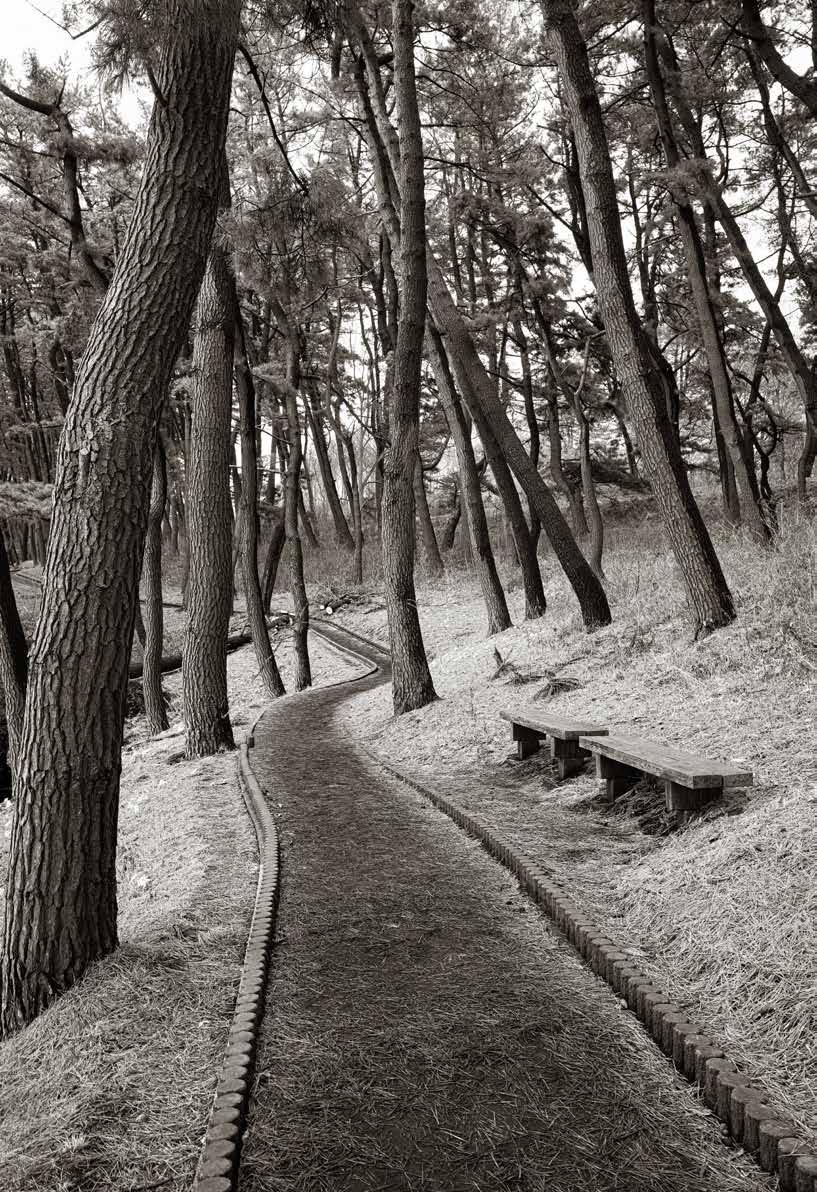
I was invited to Japan through a travel company called Walk Japan that has established walking tours all over the country. They presented me with a list of choices, and I opted for the ten-day Michinoku Trail, which runs from Hachinohe in Aomori Prefecture all along the Pacific Coast through Iwate Prefecture and down to Soma City in Fukushima Prefecture. The total distance of the trail is just over 1,000 kilometers, or 640 miles. I’d like to impress by saying I walked the entire route, but the truth is that I traveled only half of the route, which included 120 kilometers of walking but also some train journeys that bypassed certain areas. Each day of walking covered a variety of trail conditions. Some areas were well manicured and leisurely while others were steep uphill ascents on endless flights of stairs followed by steep descents on narrow steps leading into lush ravines. On some days, this process repeated itself until my legs felt like heavy bags of cement.
Since this was a self-guided tour created by Walk Japan, I was at first nervous about how I’d navigate my way along the Michinoku Trail. After landing in Tokyo and finding my hotel, I was presented with a guidebook created by Walk Japan that included detailed instructions on how to navigate the trail, along with precise distance measurements, trail conditions, and photos marking the way. This proved to be most helpful, especially in situations where there weren’t clear markers on the trail or when walking through villages and small towns.
In addition to providing an excellent guidebook, Walk Japan arranged all guesthouses and hotels along the route. In some cases, they also had transportation waiting for me at the end of a day’s walk or at the beginning of the next day’s, mainly in situations where the trail finished or began a significant distance from the hotel. Walk Japan also took care of my luggage, which would be picked up in the morning and sent ahead to my next night’s guesthouse. That meant I only had to carry what I needed during the day, which for me was heavy enough, considering all my camera gear.
The first challenge of my journey was just getting to the starting point. After I spent one night in Tokyo, my instructions from Walk Japan were to take a train to Hachinohe in Aomori Prefecture. This would be a three-hour journey aboard Japan’s famous Shinkansen railway. These trains, also known as bullet trains, travel at speeds from 260 to 320 km/h, or 162 to 200 mph. For those that have not traveled in Japan, its train and subway stations can be quite intimidating. The crowds and sheer number of tracks and platforms can be very confusing. I wasn’t even sure where I was supposed to go to buy my ticket. A friend of mine, who used to live in Japan, gave me some good advice: “Just look for the line with a lot of foreigners.” Sure enough, when I arrived at Tokyo Station, I immediately observed a line with foreigners and joined the queue. Within minutes, I was holding my ticket. Now, which platform do I go to?
As is often the case, I went in the wrong direction and had to seek the help of a station attendant who pointed me in the right direction. With a sigh of relief, I made it to the platform with a full two minutes to spare.
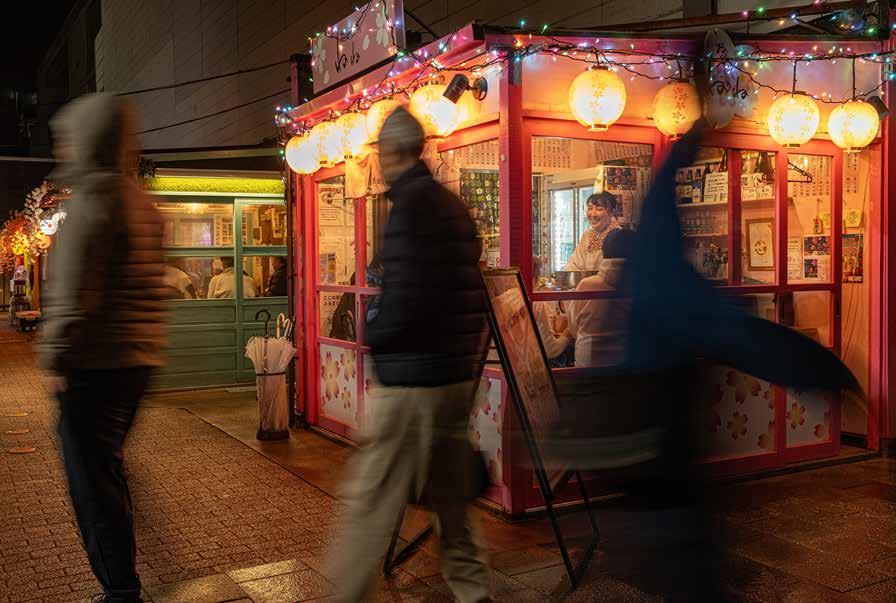
Upon arriving in Hachinohe I quickly checked into my hotel and then wandered around town. Not a whole lot happening in this northern little city, but I did find myself in a narrow walking street loaded with small izakaya restaurants. Each could seat between six and ten people, all sitting around an L-shaped counter/bar where customers could chat with each other and the restaurant proprietor. The atmosphere in each of the venues was lively and jovial as patrons ate delicious Aomori specialties and knocked back glasses of sake. As I stood outside a pinkcolored izakaya examining the menu, the young woman running the place beckoned me in. I was a bit nervous at first because I had no Japanese language skills and didn’t want to interrupt anyone’s good time. The tiny restaurant had everybody squeezed in together, and as I stepped in, I was greeted by welcoming smiles and hellos from the other guests. I was handed a menu and instructed to sit down. After placing my order of grilled mackerel, a tofu dish, and a seafood soup, I began trying to chat with some of the other guests. It was the usual conversation about where are you from, what are you doing here, etc. Some spoke a bit of English, but when that wasn’t possible Google Translate came to the rescue. It’s just a matter of time before we all have Babel Fish inserted in our ears.
A walking street in Hachinohe lined with small izakaya restaurants 八户市的一条步行街上,满是小巧的居酒屋。
Rising early
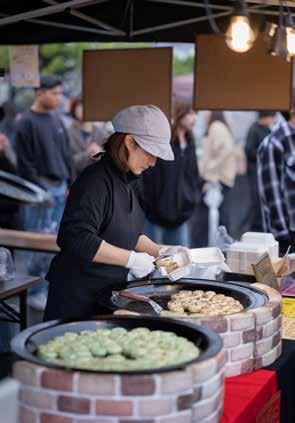
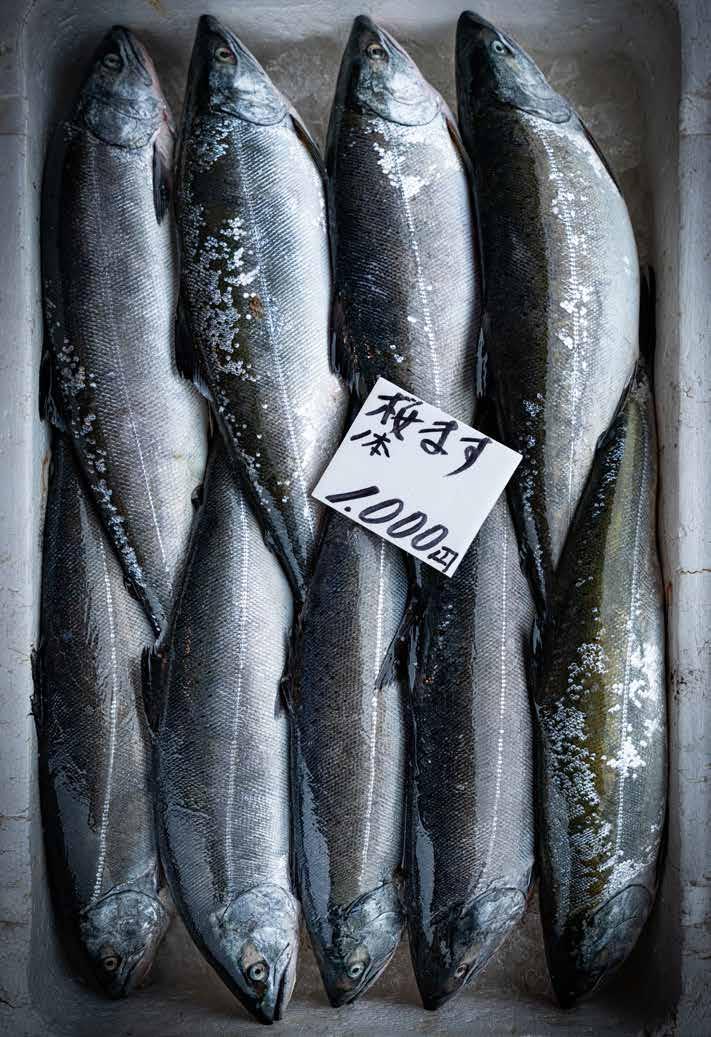
the next day, I headed straight for the Sunday morning market at the Tatehana Wharf. This market is famous as one of the largest in Japan and is held only on Sunday mornings from dawn to 9 a.m. Despite the rain, it was nice to wander from stall to stall and browse the variety of edible items available. From fish to fruit to dumplings to some amazingly good coffee, there was something for everyone. I even ran into some of the people I’d dined with the night before.
After leaving the market, I headed for the local station and boarded a train going just a few stops to Same Station, where I would begin my trek.
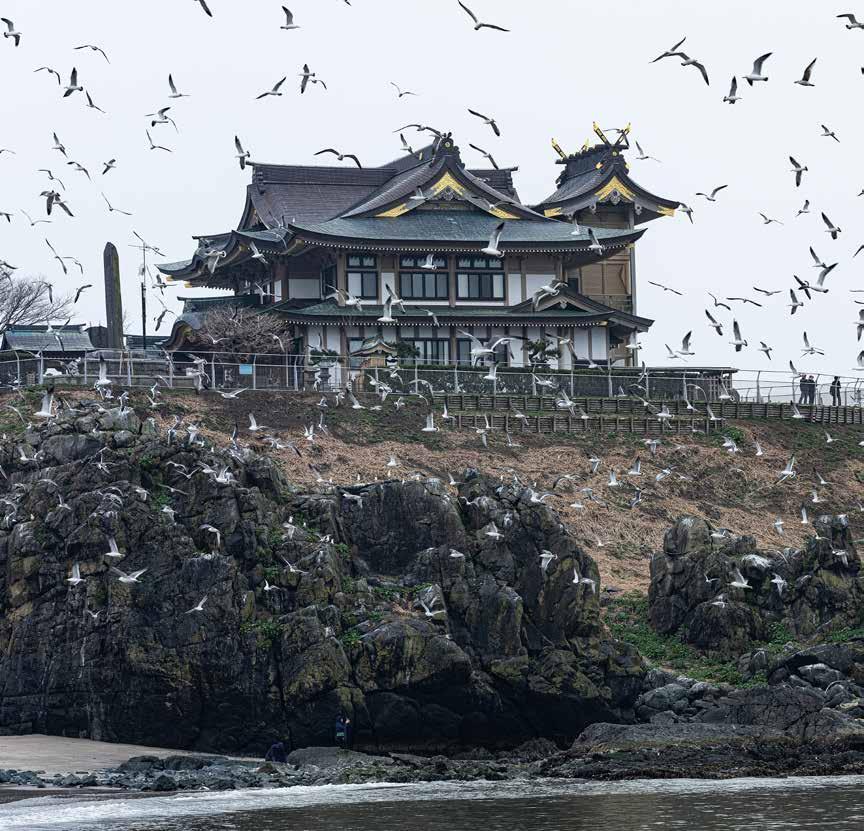
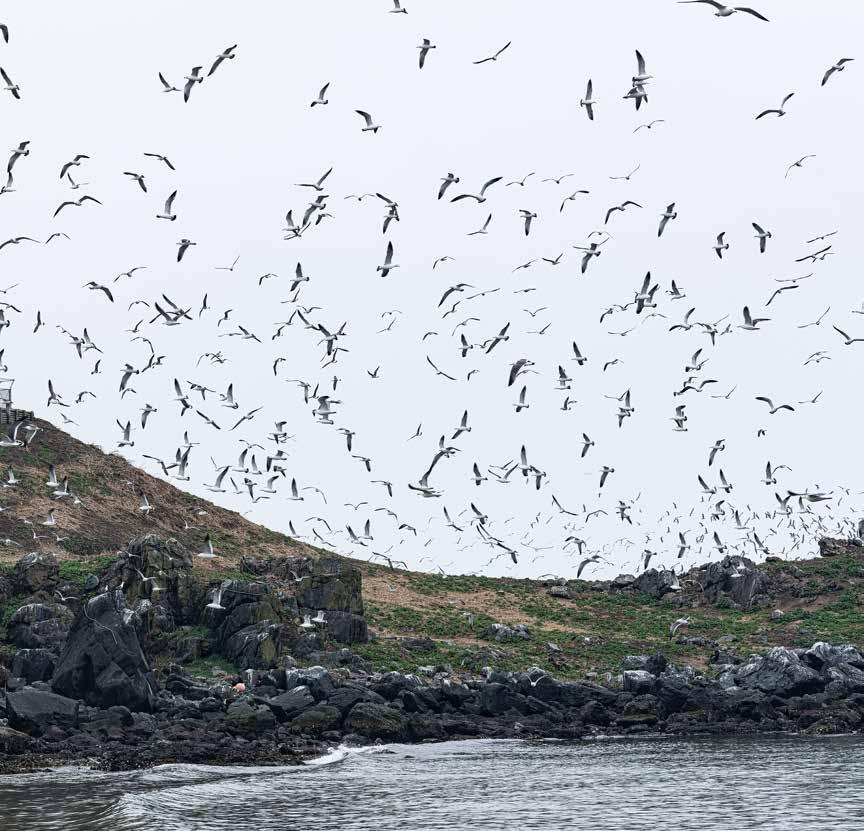
is the large Kabushima-jinja Shrine, which dates to the thirteenth century. The island that the shrine sits on is also the nesting grounds for thousands of black-tailed gulls. It’s quite a sight to see and hear when they all decide to take flight together. Somehow I managed not to be bombed.
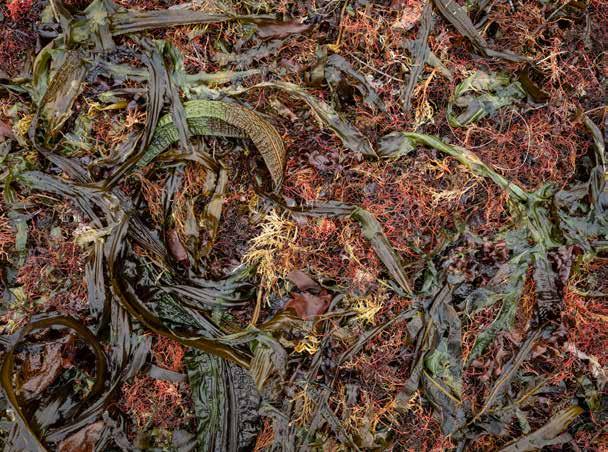
Seaweeds washed up on shore near Kabushima Shrine display a variety of colors and textures.
芜岛神社附近的海岸边上,海藻色彩斑斓,纹理各异。
I took a moment to walk along a rocky beach. With the tide out, the beach was covered in a blanket of multicolored seaweed. I felt like I was looking at nature’s version of a Jackson Pollock painting. I’d never seen anything quite like it. I could have spent hours photographing all the different compositions and textures, but daylight was burning and I had to get moving.
This section of Aomori’s southern flank is known as the Tanesashi Coast and is part of Sanriku Fukko National Park. The dramatic views of the coast changed from jagged volcanic rocks providing natural protective barriers to long sandy beaches to small fishing ports and even to beautiful natural grass lawns in the small city of Tanesashi.
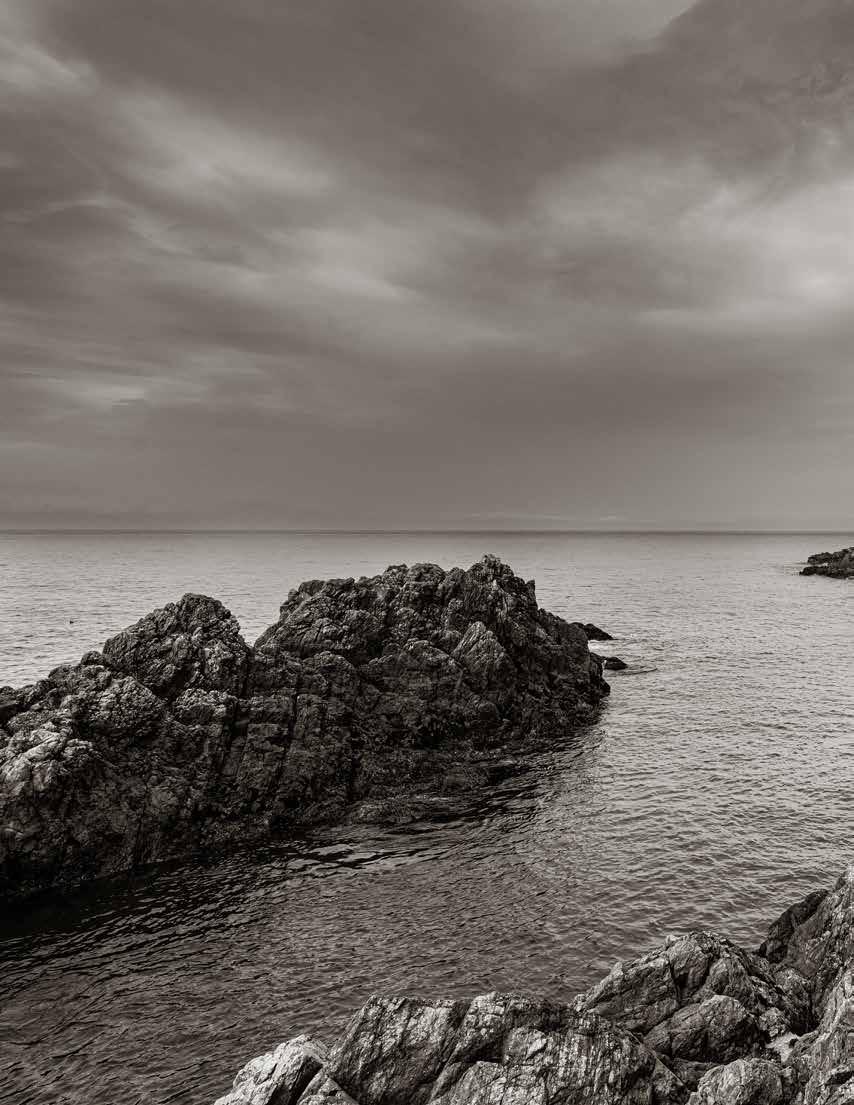
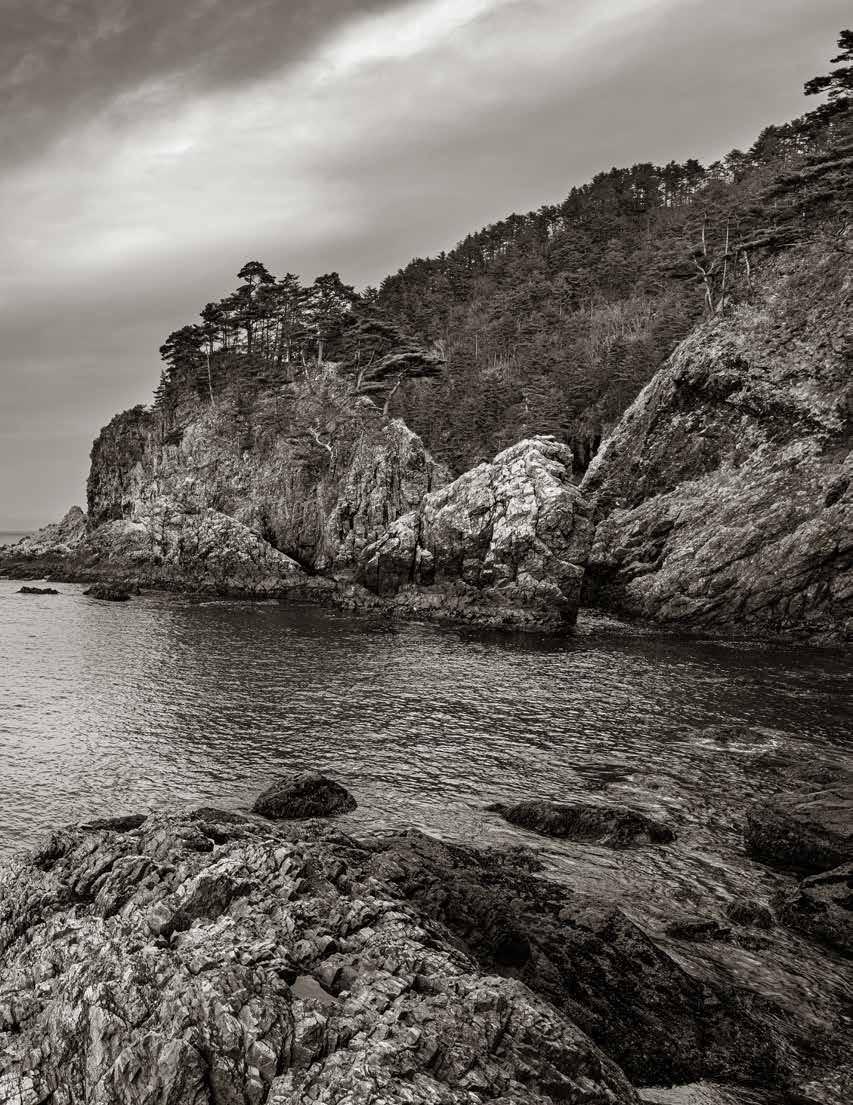
The rock formations were especially beautiful along the coast throughout my journey. The black jagged rocks, which ranged from lowlying bunkers to tall statue-like creations, some several hundred meters high, are volcanic and date back to the earth’s Cretaceous period some one hundred thirty million years ago. Amplifying the beauty was the sight of trees and vegetation growing on the rock formations. One could imagine, viewing these natural but seemingly impossible locations for trees to flourish, how people got the idea for creating bonsai gardens.
踏上步道后,我沿着岩石海滩走了一段。正 值退潮,海滩上铺满了色彩斑斓的海藻。我 感觉自己仿佛在欣赏大自然版的 Jackson Pollock 画作。我从未见过这样的景象。我 本可以花上几个小时拍摄各种不同的构图与 纹理,但白昼苦短,我必须继续前行。
for trail walkers was finding themselves face to face with a bear. Posted signs run all along the trail warning hikers to be on the lookout for the furry beasts. Every now and then I’d hear the sound of jingling bells that some hikers attach to their packs as alerts to the bears that a human is approaching. Though I didn’t have my own set of bells, I did quite like the sound of them through the forest. I’d have liked to have seen a bear, since most of my days on the trail were quite lonely. A chance encounter with a forest friend would have been welcome. I knew they were about, because I had to step around a large pile of excrement on the trail, which could only have come from a large critter. On my final day on the trail, I was walking along an area with the ocean on my left and high brush to the right when I heard some heavy rustling in the bushes. The sound was strong enough that I figured it was either a deer or possibly a bear. With my camera at the ready, I slowed my pace and followed the sound. As I reached an opening in the foliage, I spotted it. Much to my disappointment, it was an elderly Japanese man trampling through the brush. Not sure if the gentleman had lost the trail and was just pushing on or simply liked the idea of finding his own path. Whatever the explanation, he got my heart racing for no good reason.
The only real concern
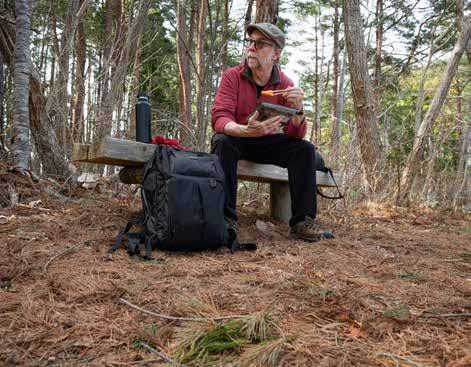
Prior to setting off on my day’s walk, I usually grabbed something for lunch at a local convenience store.
with me in the lobby of either a traditional Japanese guesthouse or a hotel. The gracious hosts would welcome me and guide me to my tatami room, all equipped with a futon, comfortable bedding, a hot pot for tea, a TV, and a yukata, which is a traditional Japanese type of kimono to be worn while in the guesthouse. Peeling off my sweaty hiking clothing, putting on the comfortable yukata, and heading off to the public bath was a highlight of every day. A good scrubbing followed by a nice long soak in a hot bath did wonders for my aching muscles and tired feet.
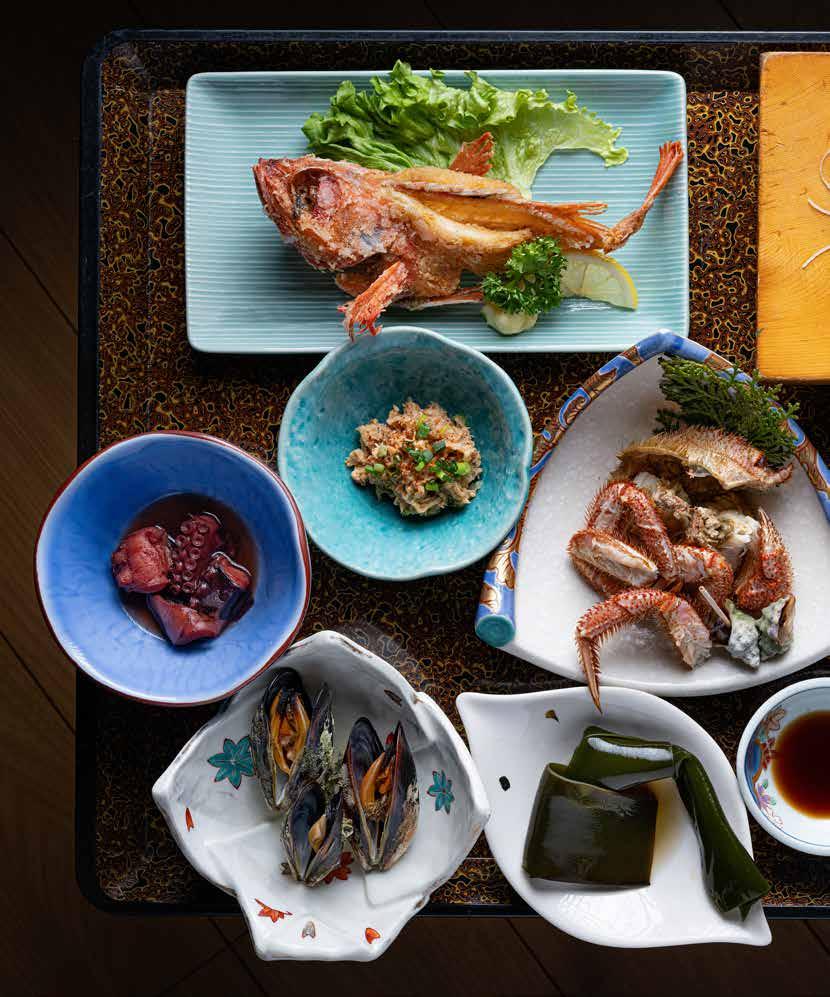
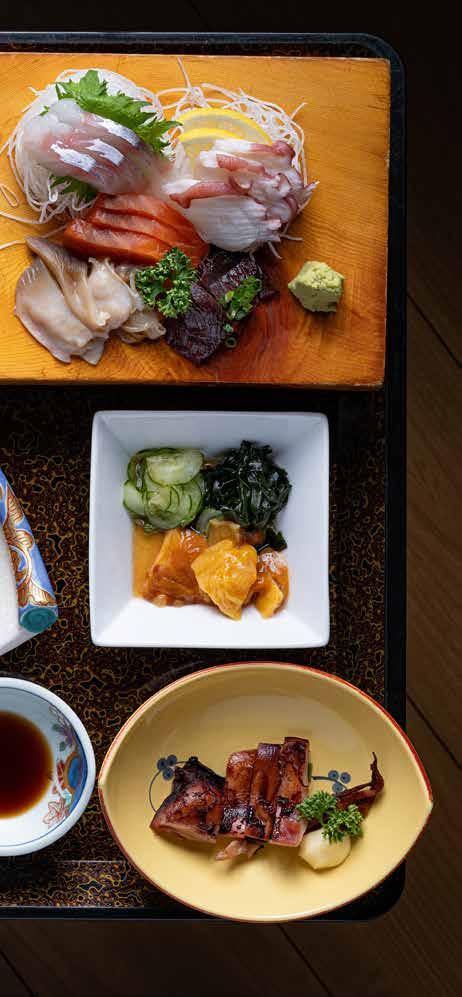
Then it was off to the dining room, where I was treated to a huge meal of local cuisine. At almost all the inns, the meals were served on a large tray full of small dishes. Many of the items I recognized, but others were new to both my eyes and my palate. Each had its own unique flavor and all were made from fresh local ingredients. I was able to enjoy a wide variety of foods ranging from grilled fish of several different species, sashimi, pickled vegetables, and miso soups served in many different ways to tempura, hairy crab, octopus, squid, and, of course, rice. Suffice it to say I didn’t starve during my trek.
A typical guesthouse meal of locally sourced ingredients from both land and sea.
典型的旅馆餐点,食材皆取自当地的陆地与海洋。
One of the most unusual things
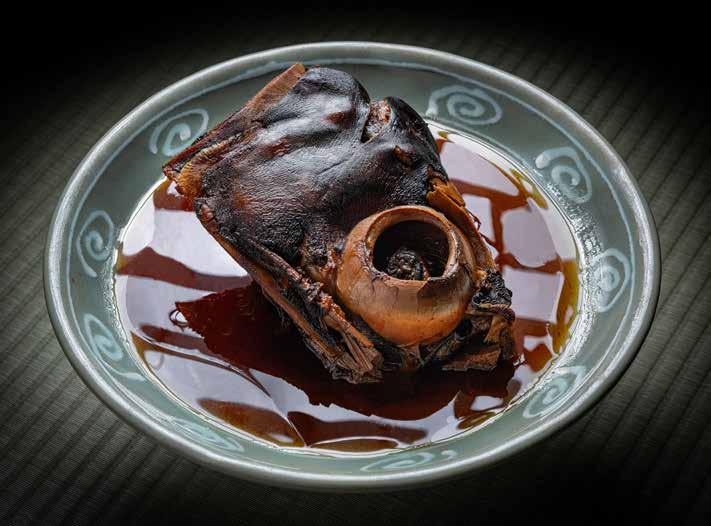
大船渡温泉酒店餐厅供应的慢炖剑鱼头,由志田豊繁烹制 他正站在自己的渔船上。
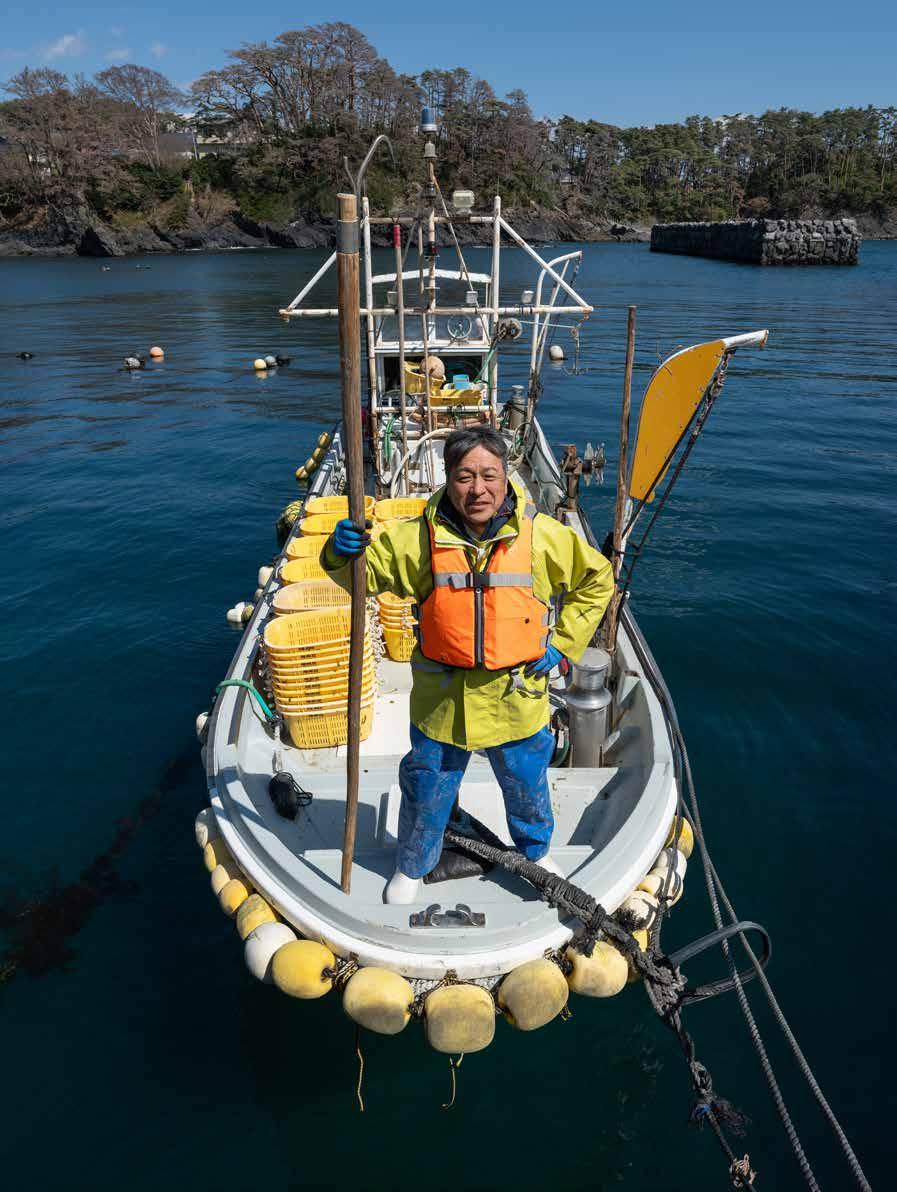
I’ve ever eaten was a slow-cooked swordfish head that was served to me at the restaurant in the Ofunato Onsen. The dish was created by the hotel’s owner, Toyoshige Shida, who used to work as a chef and is now a local businessman and fisherman. Toyoshige created the dish some thirty years ago when he returned to Ofunato after working as a chef in Tokyo. He got the idea from a local curry dish that used fish heads as the primary protein. As he tells the story, he was walking through the local fish market and observed that the heads of swordfish were being discarded because they were not considered a desirable part of the fish. He began experimenting with the seasoning and cooking process. After much trial and error, he arrived at cooking the head for three days, creating a dish that has received national acclaim. It’s shocking to see this big eyeball staring up from the plate, but one can’t resist the rich and hearty flavor.
A slow-cooked swordfish head served in the Ofunato Onsen hotel restaurant was prepared by Toyoshige Shida, seen here on his fishing boat.
On any given day,
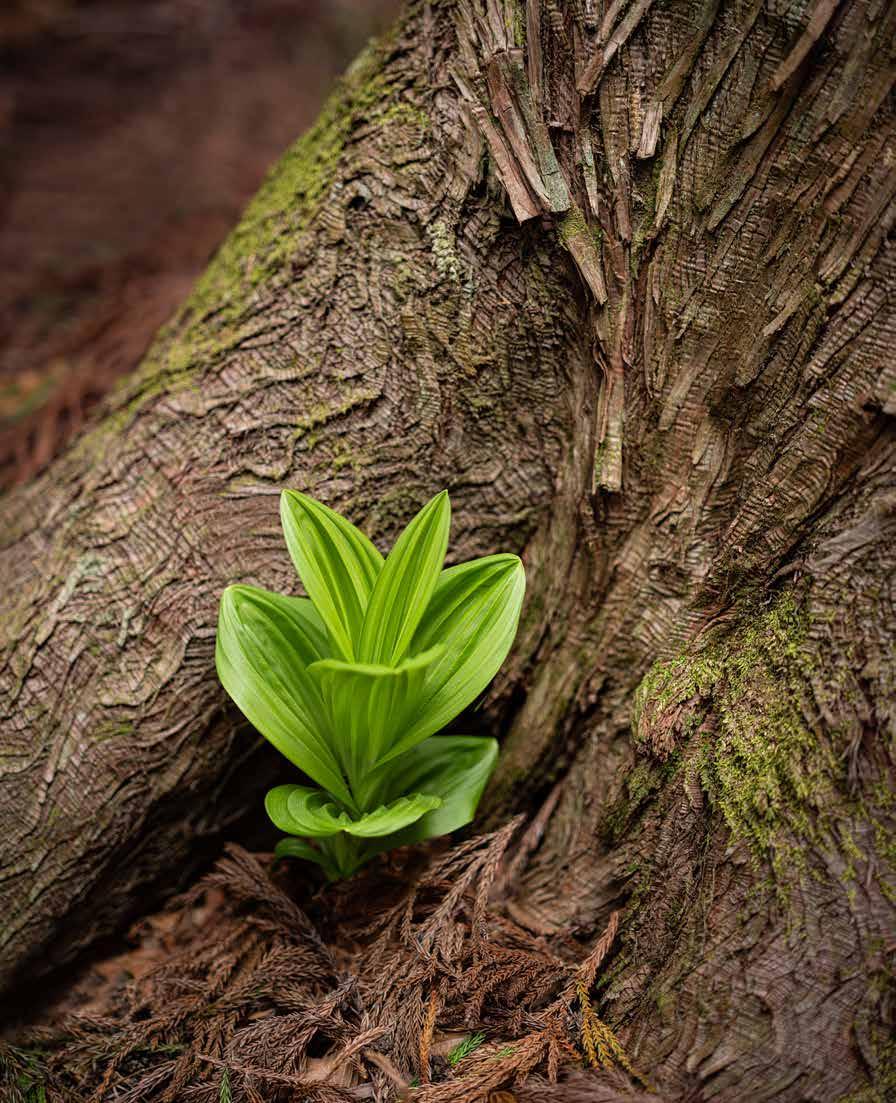
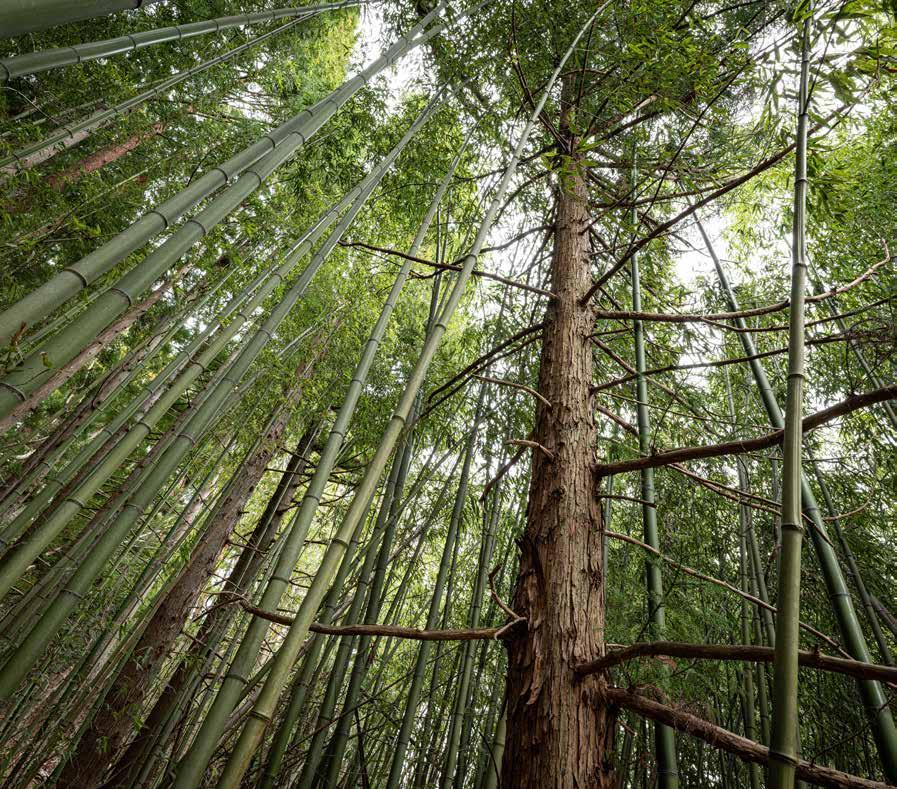
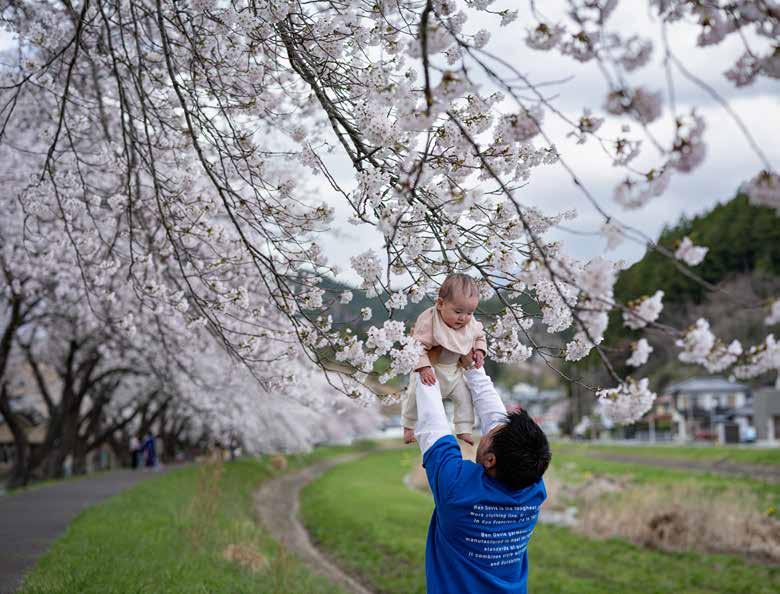
the trail might go from being next to the ocean along a path carved right out of a cliffside to climbing high above the sea into a forest of cedars or into a lush valley where young lily plants, known as kobaikeiso, decorated the path. I was often amazed at how the foliage would change so rapidly within a very short distance as I moved through various microclimates. At one point I found myself in a grove of tall bamboo that appeared to be sheltering a few cedars. Since I was walking in early spring, I was often in forests where the various types of blossoming deciduous trees had not yet bloomed. I could only imagine how beautiful those sections of the trail would be in the coming weeks. As I headed further and further south, however, I did manage to see a plethora of cherry blossoms in the Ofunato area.
Fudai was one of the only towns protected from the 2011 tsunami by a large seawall. Its example has led other communities along the coast to prepare for the next big one by building similar structures.
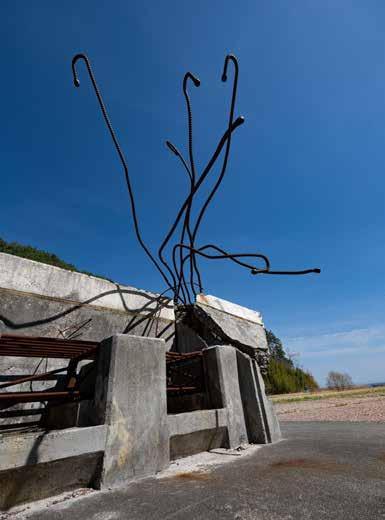
Twisted steel and broken concrete is all that remains of a memorial to the 2011 tsunami that destroyed many cities and villages along this section of the coast.
扭曲的钢筋与破碎的混凝土,是2011年海 啸仅存的见证。那场巨浪摧毁了沿海无数 城镇与村庄。
↓ Cherry blossoms in Ōfunato.
大船渡市的樱花。
It was in Ofunato that I met
Mayuko Sakamoto, a representative of the Michinoku Trail Club who took me around and introduced me to members of the community and those active in helping to rejuvenate the region’s economy as well as preserve the Trail. The 2011 tsunami devastated this region of Japan. Whole towns, cities, and ports, along with homes, were wiped out. The memory is still quite strong. Many of those who survived the earthquake and tsunami don’t hesitate to speak of the event. The survivors and those who came to help rebuild believe that the memory should not fade and that every day should be spent preparing for when the next wave reaches their shores. Memorials are visible up and down the coast, and photo albums in the guesthouses where I stayed contain images of the tsunami as it came ashore and of the wreckage it caused.
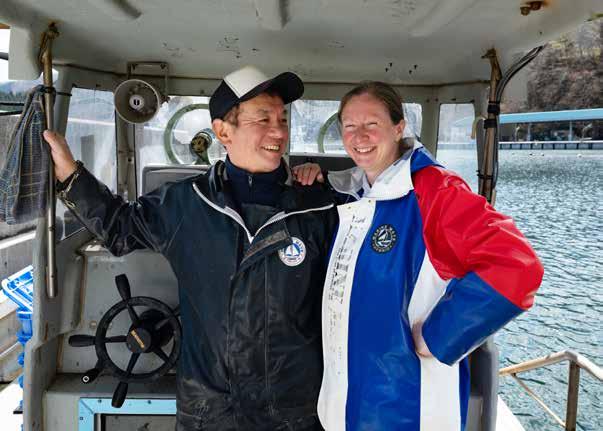
Our day was spent traveling from village to village and port to port. We first spent time with Jun and Isabelle Sasaki, husband-andwife scallop producers, who met when Isabelle, originally from France, came to the area as a volunteer following the 2011 tsunami. This joyful, loving couple were happy to tell me all about scallop farming, a twoyear process from capture of the microscopic spawn to full-grown shellfish. In recent years, they’ve had to deal with rising ocean temperature, which has wiped out entire scallop crops. Realizing they need other revenue streams, they’ve diversified to farming seaweed as well.
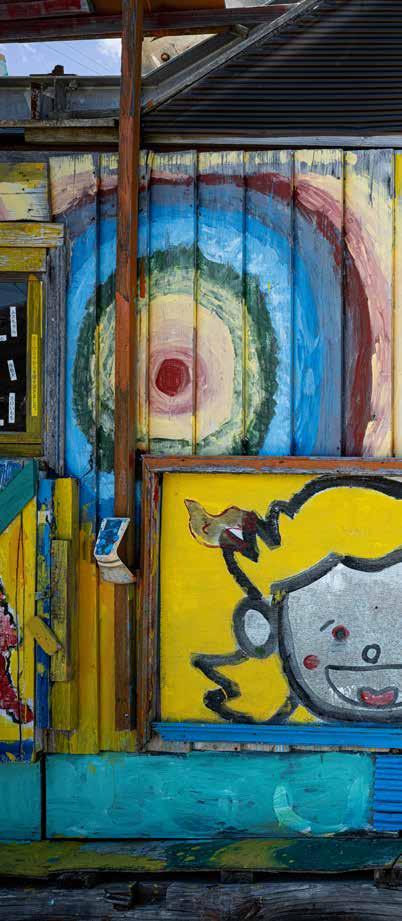
to the small coastal community of Okirai, outside of Ofunato city, and introduced me to Waichiryo Katayama, known affectionately as Waichi-san. As a life-long resident of Okirai, he saw his entire town destroyed by the 2011 earthquake and tsunami. During the reconstruction period, Waichi-san took it upon himself to build a makeshift museum out the debris left behind by the tsunami. His original structure had to be dismantled and relocated because it didn’t meet safety building codes, but the spirit of the building lives on with its shack-like construction, colorfully painted exterior walls, a swing, and other playful elements. The initial intent was for it to be a museum, but it morphed into a gathering place for volunteers and then for Michinoku Trail walkers. Waichi-san welcomes all visitors who come from across Japan as well as other countries. He named this spot Shiome, a term for a junction where ocean currents come together. The confluence of currents is exactly how he sees Shiome, a place where people from all over and from different walks of life can meet and learn about Okirai and share their own experiences.
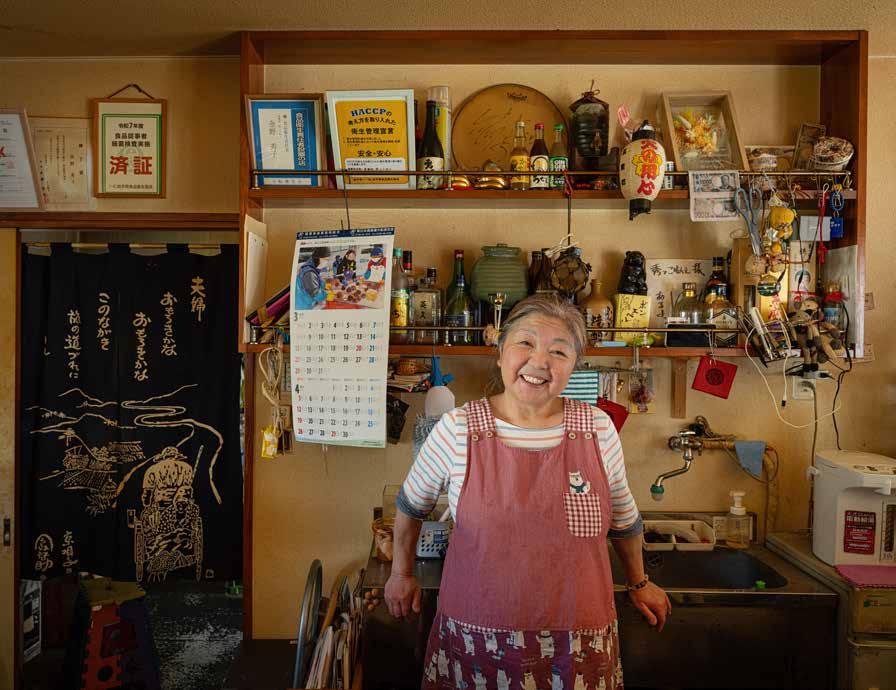
Shuko Kino presides in her izakaya, Shukko-ne, a popular spot where trail walkers gather to enjoy her wonderful meals. 金野秀子在居酒屋Shukko-ne掌勺,这里是徒步者们享用美味佳肴的热门去处。
so we headed over to a local izakaya called Shukko-ne owned by Shuko Kino. She opened her restaurant after the 2011 tsunami to create a gathering place for residents, volunteers, and workers. It’s now become a popular spot for Michinoku trail walkers to stop by for a delicious meal, some drink, and a warm environment.
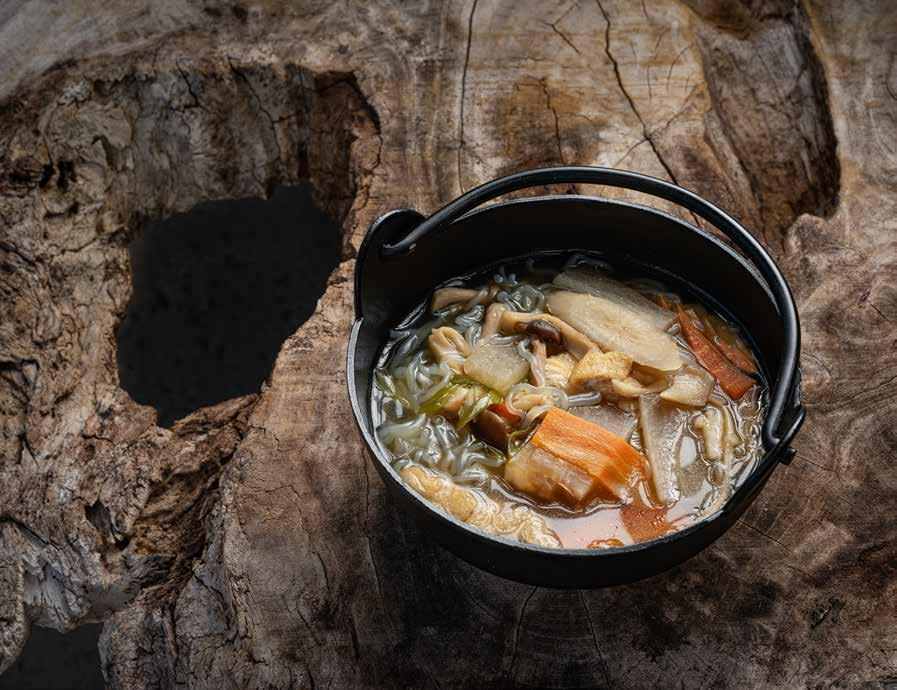
A nourishing pot of soup created by Shuko Kino 金野秀子熬制的暖心汤品
As I approached the entrance, Shuko came out and greeted us with a welcoming smile and guided us in. Within just a few minutes, our table was covered with a bounty of food items. The set she prepared is called Ojizuki, which in the local dialect means “comfortable.” It includes udon, mochi, rice, and several vegetable and pickled dishes. The soup was a hearty pot of hittsumi, which contains dumplings made from wheat dough, radish, carrot, and mushrooms, as well as shirataki noodles, fried tofu, and burdock. The mentsuyu soup base is made up of dashi, mirin, sake, and salt. The combination of all these ingredients warms the soul as it nourishes the body.
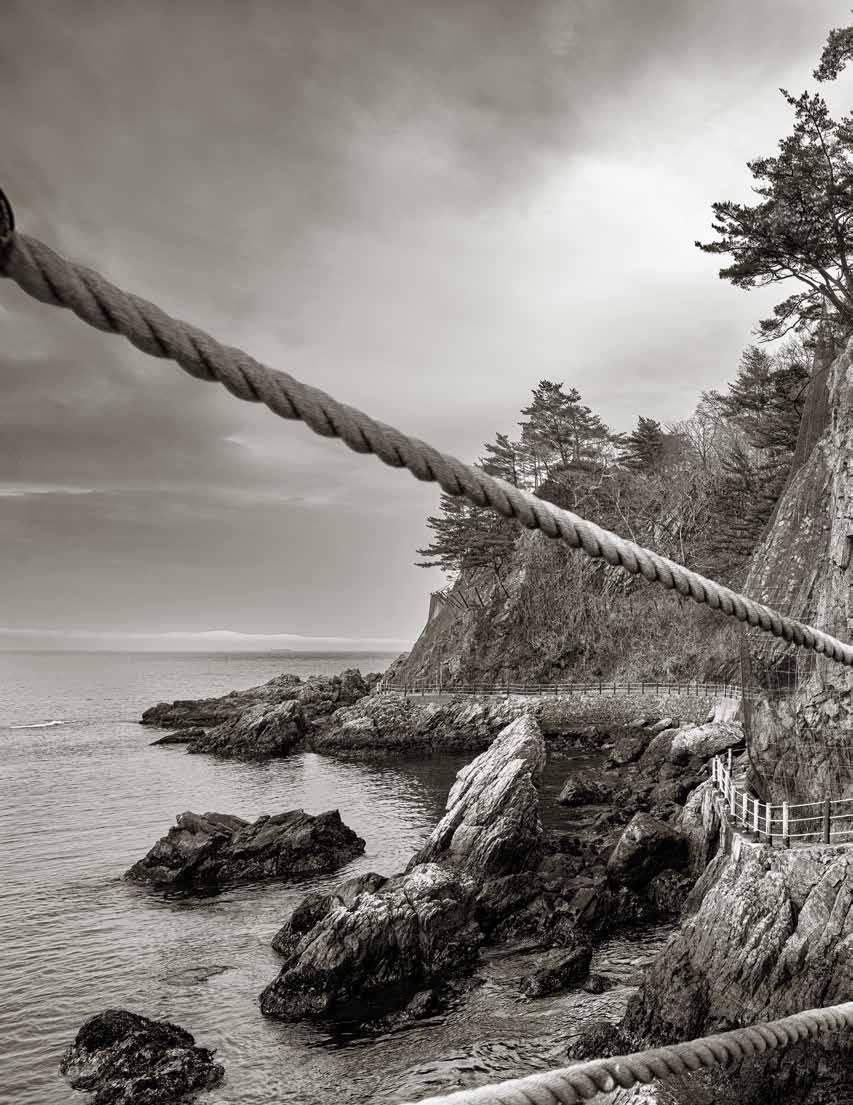
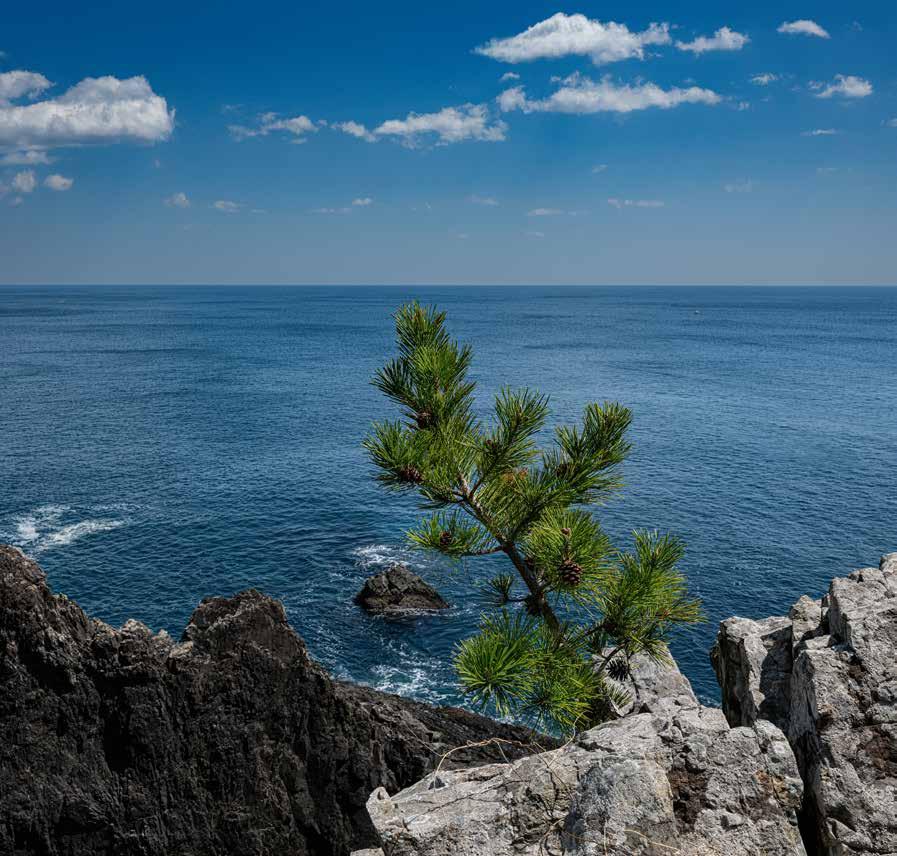
I walked along Goishi Coast on a beautiful sixkilometer trail around Suesaki Peninsula. The cliffside walk provides dramatic views of jagged rock formations sculpted by an unrelenting sea over millions of years.
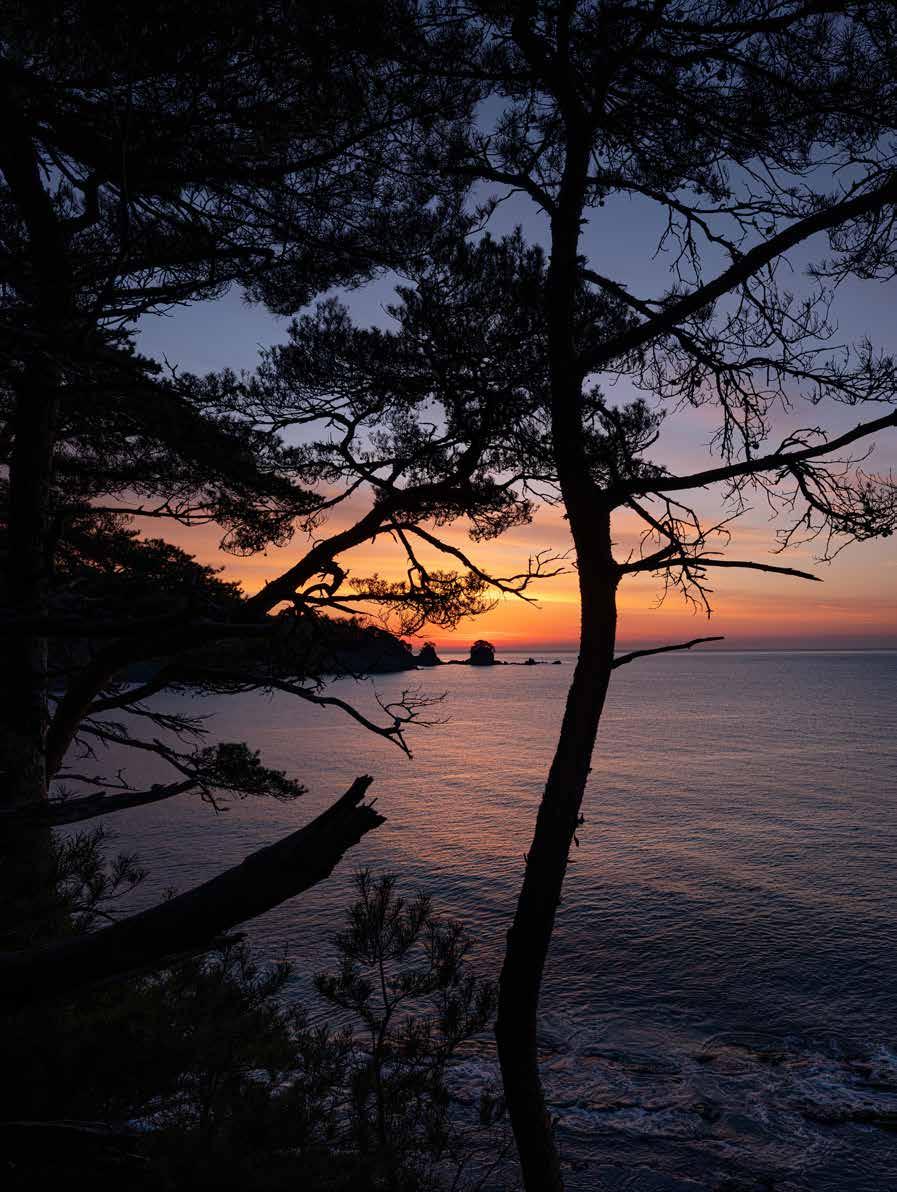
As I neared the end of my walk, I stepped out onto a point where I could capture a wide view of the coastline from north to south. As my eyes scanned the view, I became fixated on one little pine tree that found itself rooted in a crack on one of the jagged rock formations high above the sea. I’m always amazed when I see life take hold in such precarious and seemingly inhospitable locations. As I worked to make a photo of this lonely plant struggling to survive, I suddenly recalled one of my favorite lines by the actor Jeff Goldblum in the original Jurassic Park movie: “Life finds a way.”
When I prepared for this journey, I wasn’t sure what to expect. I anticipated it being a long lonely coastal walk where I could concentrate on my landscape photography and have little interaction with the population in this fairly remote area of Honshu. And while much of the walk was exactly that, I was touched by the warm hospitality of those I met along the way. The family who gave me an apple at a market when the seller only sold in lots of five. The construction crew along a remote road who cleared a path for me to get over a landslide. And the innkeepers who not only prepared my meals but made a diagram describing in English each tasty item on the plates. It was an experience I’ll carry with me for the rest of my life.
For more information on the various walking tours offered by Walk Japan, please visit walkjapan.com
如需了解更多 Walk Japan 提供 的各种徒步旅行路线信息,请访 问:walkjapan.com
WHEN STARS ALIGN
PHOTOGRAPHY BY
DAVID HARTUNG
AT GRAND LISBOA PALACE, SJM BROUGHT
TOGETHER FIVE RENOWNED CHEFS FOR THE MICHELIN GUIDE-CURATED SENSORY HARMONY
STAR DINNER, AN EXTRAORDINARY MULTISENSORY JOURNEY THAT ENGAGED ALL FIVE
SENSES OF SIGHT, SMELL, SOUND, TOUCH, TASTE.
On the evening of March 21, the kitchen at Grand Lisboa Palace was alive with focused energy. Five chefs, rarely seen together on the same continent, maneuvered around each other with the deft choreography of a dance troupe. At the pass, plates stood ready, each one representing not only a dish but a distinct perspective on what food can achieve.
The Sensory Harmony Star Dinner featured a menu organized around the five senses. Each course awakened a single sense, culminating in a final dessert designed to engage them all at once. Blending neuroscience and gastronomy, the meal explored how food interacts with consciousness.
The concept was designed to coincide with the eighteenth annual Michelin Guide Hong Kong & Macau ceremony two nights prior, celebrating the hundredth anniversary of the Michelin Star. A century after that red symbol first appeared, five chefs holding a collective fourteen stars gathered to expand its legacy. The menu was paired with global wines rated 90+ points by the Robert Parker (RP) system. Every pour was selected beyond simple flavor profiling, chosen specifically to heighten the targeted sense of each course.
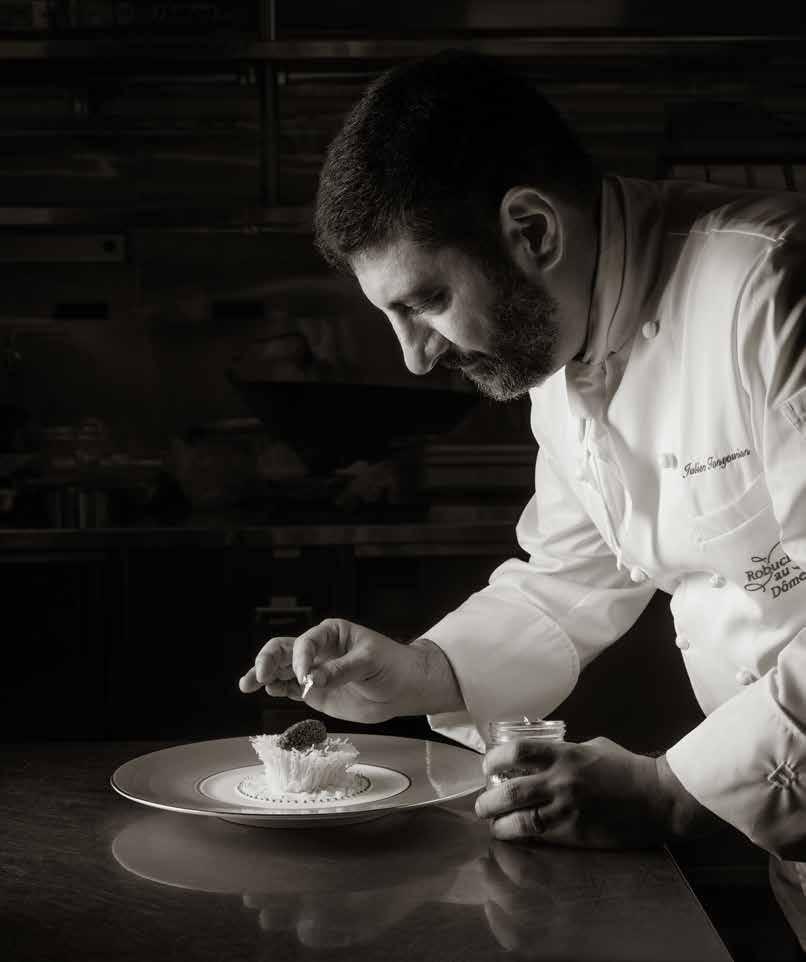
Executive Chef Julien Tongourian of three-Michelinstarred Robuchon au Dôme anchored the menu, creating both the opening course of visual precision and the closing
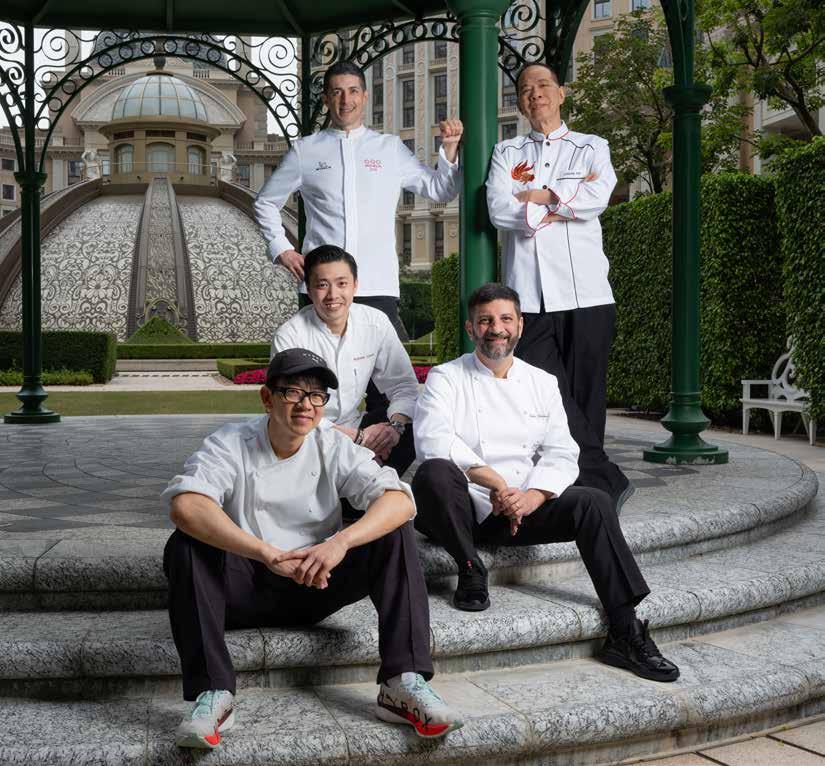
Michelangelo Mammoliti, Joseph Tse, Julien Tongourian, Jungsik Yim, Mathew Leong
course of sensory synthesis to finish. Between these bookends, the dinner traveled across distinct culinary landscapes. Executive Chef Joseph Tse of two-Michelin-starred The Eight brought five decades of Cantonese technique, Chef Mathew Leong translated his Nordic-Asian philosophy from three-Michelin-starred RE-NAA by Sven Erik Renaa in Norway, Chef Jungsik Yim introduced modern Korean techniques from three-Michelin-starred Jungsik New York, and Chef Michelangelo Mammoliti presented the Italian avant-garde cuisine of threeMichelin-starred La Rei Natura by Michelangelo Mammoliti in Italy.
As the evening progressed, the focus shifted from how five distinct culinary philosophies would coexist on a single menu to how a meal could fundamentally alter a diner’s perception of eating.
开场,并以感官的交融收尾。在这首尾呼应之 间,米其林二星 8 餐厅行政总厨谢锦松师傅展 现五十年粤菜功底;来自挪威米其林三星餐厅 RE-NAA by Sven Erik Renaa 主厨梁程前演绎 北欧与亚洲的融合哲学;纽约米其林三星餐厅 Jungsik New York 主厨 Jungsik Yim 注入现代韩 国烹饪技艺;意大利三星餐厅 La Rei Natura by Michelangelo Mammoliti 的主厨 Michelangelo Mammoliti 则呈现前卫意式料理。
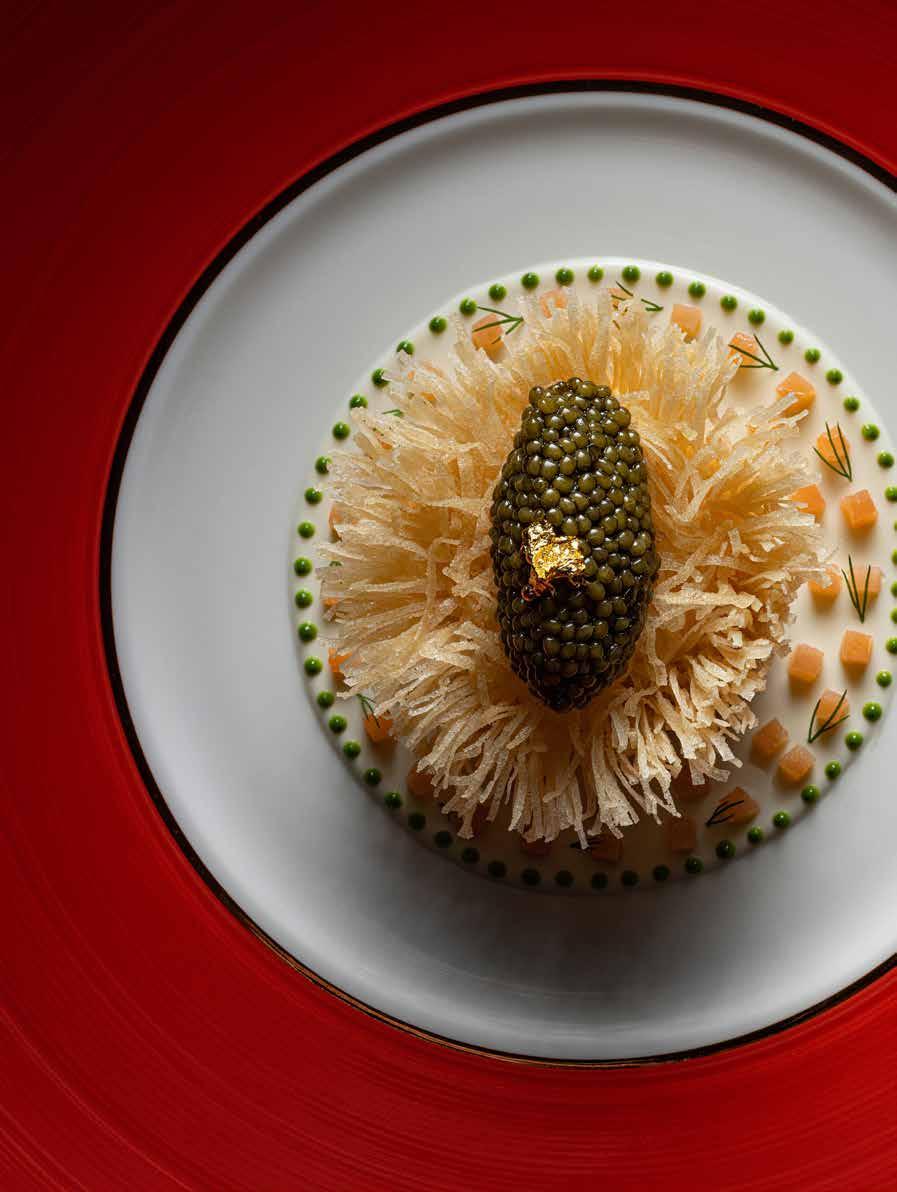
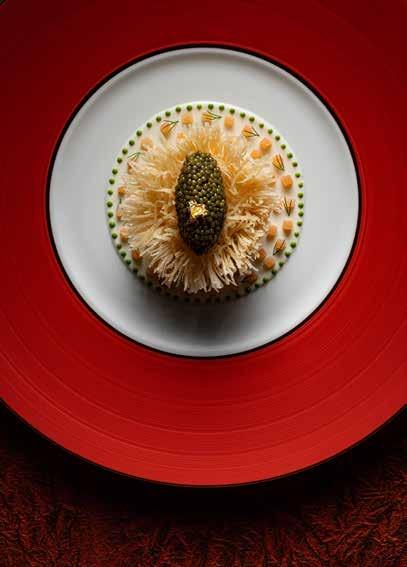
Crispy Soft-Boiled Egg with Imperial Caviar and Smoked Salmon 脆炸嫩煮蛋伴鱼子酱及烟熏三文鱼
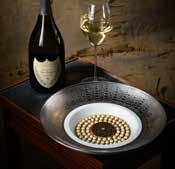
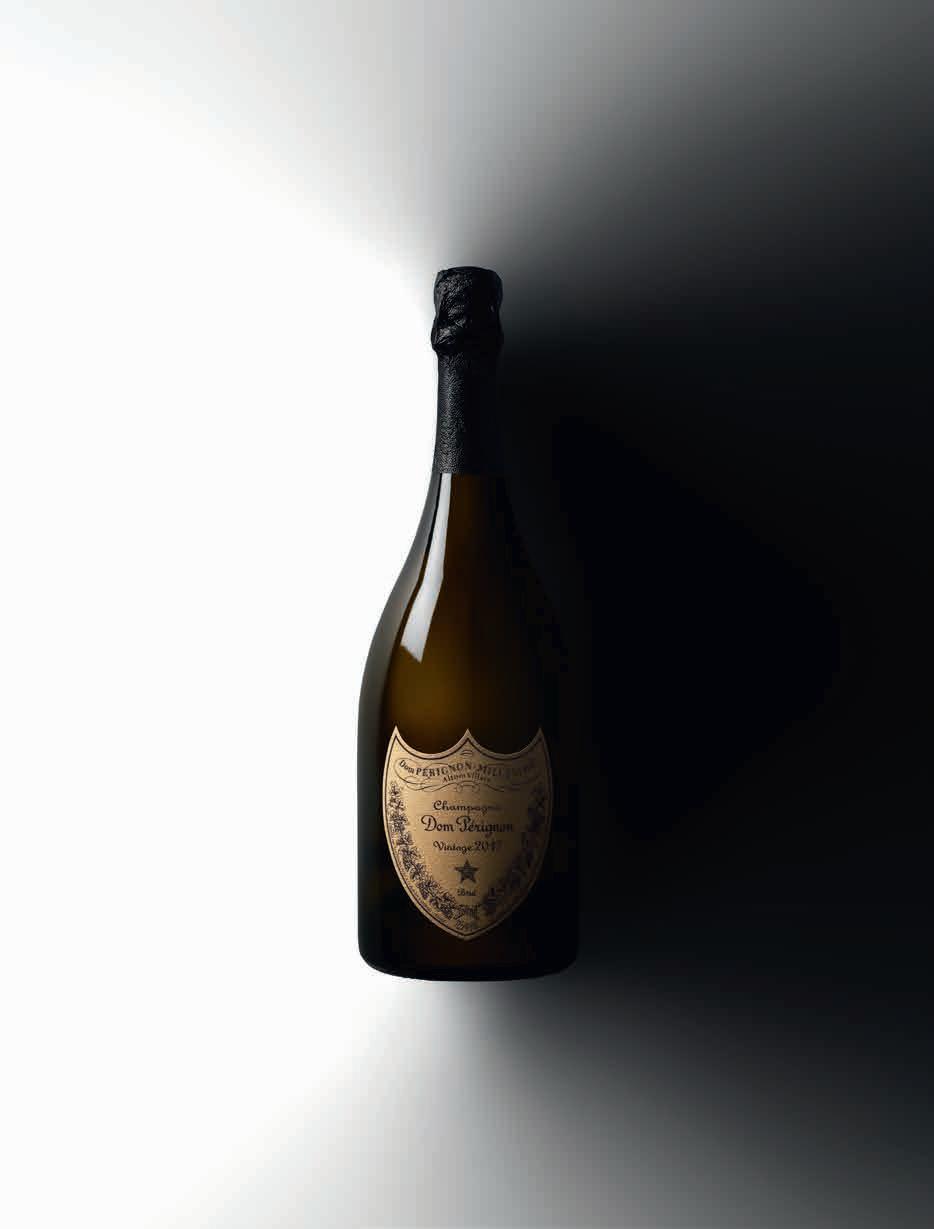
2015 Dom Pérignon, Champagne, France
OPENING A MILESTONE DINNER with a twentyfive-year-old recipe takes courage. For Executive Chef Tongourian, who has maintained three Michelin stars at Robuchon au Dôme for eighteen years in a row, it was a deliberate statement. The dish is quintessentially Joël Robuchon – just three elements, arranged with a jeweler’s precision.
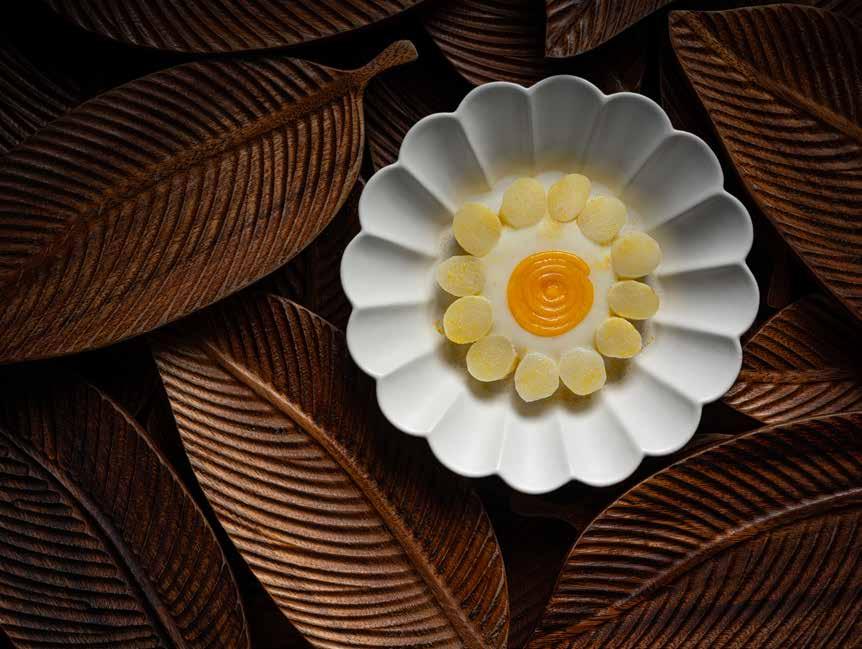
Before taste or aroma, there is sight. Composed like an eye, the plate features uniform cubes of smoked salmon encircled by delicate dots of parsley essence. For Tongourian, this opening course is intentional, designed to awaken the senses by ensuring the eyes feast first.
It is a lesson drawn directly from Robuchon himself: True mastery lies not in accumulation, but in stripping away the superfluous and leaving only the essential, the flavor. Paired with a 2015 Dom Pérignon, its vibrant citrus and brioche aromatics effortlessly slice through the richness of the caviar, beautifully establishing the discipline for the evening ahead.
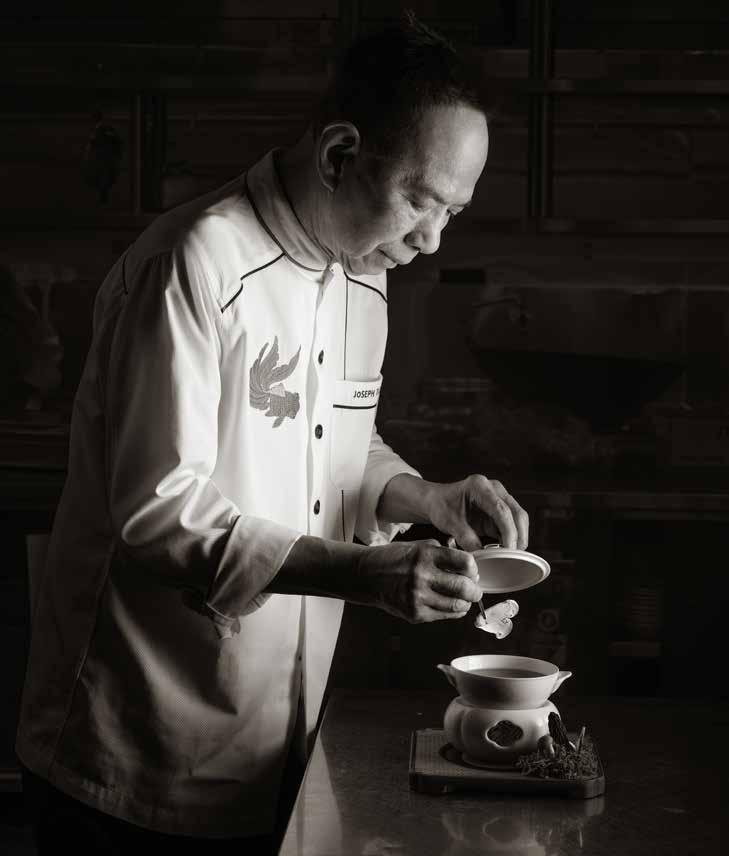
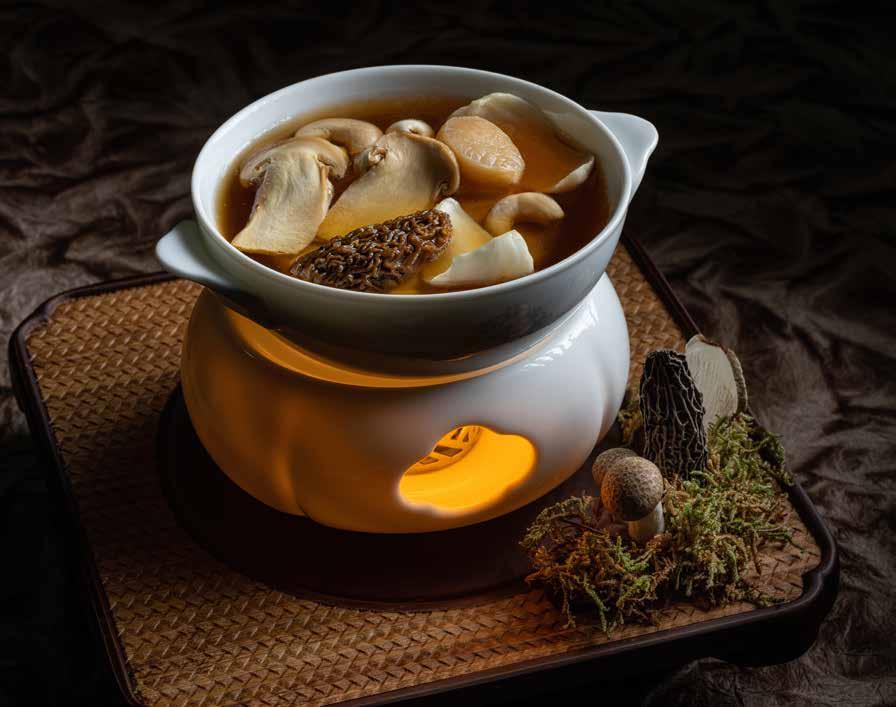
NEARLY FIVE DECADES into his career, Chef Tse treats aroma not as mere embellishment, but as the very soul of a dish. His double-boiled matsutake soup demonstrates Cantonese restraint at its most precise.
Mountain-sourced matsutake mushrooms are soaked at a low temperature to preserve their volatile compounds. Combined with Japanese kelp, dried cuttlefish flower, and dried scallop, the broth delivers layers of oceanic freshness, creating a quintessential Cantonese dialogue between mountain and sea.
Before tasting, Tse recommends: lift the lid, wait, inhale. Aroma is fleeting – once it has escaped, it cannot be recaptured. Paired with a 2022 Les Quatre Piliers ‘Bel Air,’ the dish becomes a lesson in presence – the radical act of arriving fully in a single moment.
品尝前,谢师傅建议宾客掀开盅盖,稍 作停顿。最纯粹的鲜香仅在开盖瞬间绽放,需 倾心捕捉。汤品搭配 2022 年份 Les Quatre Piliers “Bel Air,” 将焦点凝聚于当下,引领宾客 全心投入眼前的感官体验。
SMELL
CHEF JOSEPH TSE 谢锦松
THE EIGHT 8 餐厅
Matsutake Mushroom Soup Double Boiled with Conpoy
松茸炖柱脯汤
2022 Les Quatre Piliers “Bel Air,” Loire Valley, France
SOUND
CHEF MATHEW LEONG 梁程前
RE-NAA
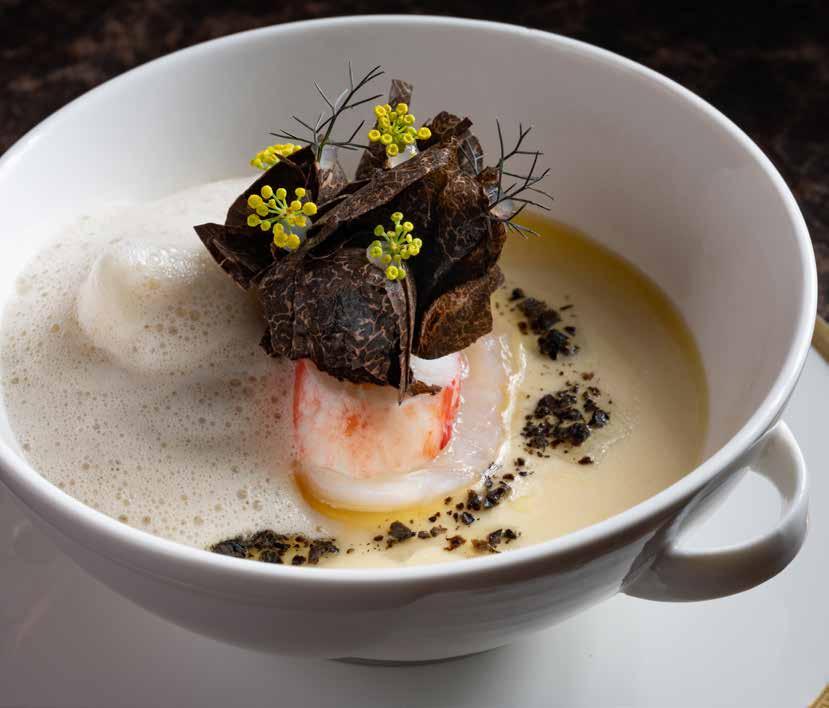
Wild Atlantic Cod with Celeriac Flan, King Crab and Truffle 野生大西洋鳕鱼伴芹菜根、帝王蟹和松露
2023 Niepoort “Coche” Branco, Douro, Portugal
DESPITE EVERY MEAL being suffused with it, sound usually gets forgotten at fine-dining tables. Chef Leong, who steered RE-NAA to three stars through Nordic-Asian harmony, builds his course around sound as texture in motion.
The dish draws from Norway’s fjord sound-scapes. Each element produces distinct audio: yielding cod, resistant king crab, trembling celeriac flan, truffle foam that dissolves before registering. Textural contrasts calibrated not just for flavor but for the sounds they create when chewed.
Leong’s instruction is simple: chew slowly, listen carefully, notice what each component says. The meal becomes music only when you choose to hear it. Paired with 2023 Niepoort “Coche” Branco’s mineral precision, the result is unexpectedly meditative.
IN A ROOM OF CRYSTAL and pressed linen, Chef Yim asks you to put down your fork. His gimbap – Korea’s beloved rice roll wrapped in dried seaweed – comes with disarming instructions: pick it up with your hands.
This is deliberate intimacy. Yim built his “New Korean” philosophy by reimagining traditional forms through contemporary discipline. He understands that touch, beyond mere physical sensation, is permission, a reminder that food is something we reach for and choose to bring close.
The gimbap delivers calibrated textural contrast: nori’s sharp crackle, seasoned rice’s glutinous give, filling that shifts between crisp and yielding with each bite. Every sensation considered with three-star precision. Paired with 2023 Alheit “Fire by Night” Chenin Blanc’s bright stone fruit and mineral freshness, this is simultaneously the simplest and most profound course of the evening.
2023 Alheit Vineyards “Fire by Night” Chenin Blanc, Western Cape, South Africa
TASTE
CHEF MICHELANGELO MAMMOLITI
LA REI NATURA BY MICHELANGELO MAMMOLITI
Wagyu Beef Braised Barolo Style | 巴罗洛风味 燉 和牛
2019 Gaja Barbaresco, Piedmont, Italy
FOR CHEF MAMMOLITI, taste – gusto – is inner life. It’s what happens when land speaks through food, and food speaks through the body. At La Rei Natura in Serralunga d’Alba, which attained three stars in 2026, this philosophy drives every plate.
Based on Mammoliti’s approach that draws from neurogastronomy, the study of how the brain creates the perception of flavor, each ingredient activates memory and emotion. His braised beef, served with vegetable risotto and finished with Barolo vinegar, radicchio, and date condiment, fully engages the four flavor pillars of sweet, salt, bitter, and umami.
As it braises for hours in Barolo, the Wagyu absorbs the wine’s dark complexity until meat and sauce boundaries dissolve. Radicchio and dates provide bittersweet counterpoint. Paired with 2019 Gaja Barbaresco, the course delivered extraordinary depth – landscape, philosophy, and lifetime’s work in a single bowl.
对主厨 Michelangelo 而言,味觉是内在 的生命。它是当土地透过食物说话、食物 透过身体说话时发生的一切。在 2026 年 获得三星的 La Rei Natura,这个哲学驱 动着每一道菜。
THAT EXECUTIVE CHEF TONGOURIAN handled both the opening and closing courses was entirely intentional. A dinner with this kind of architectural ambition requires a powerful frame – something to open the eyes, and something to close the circle.
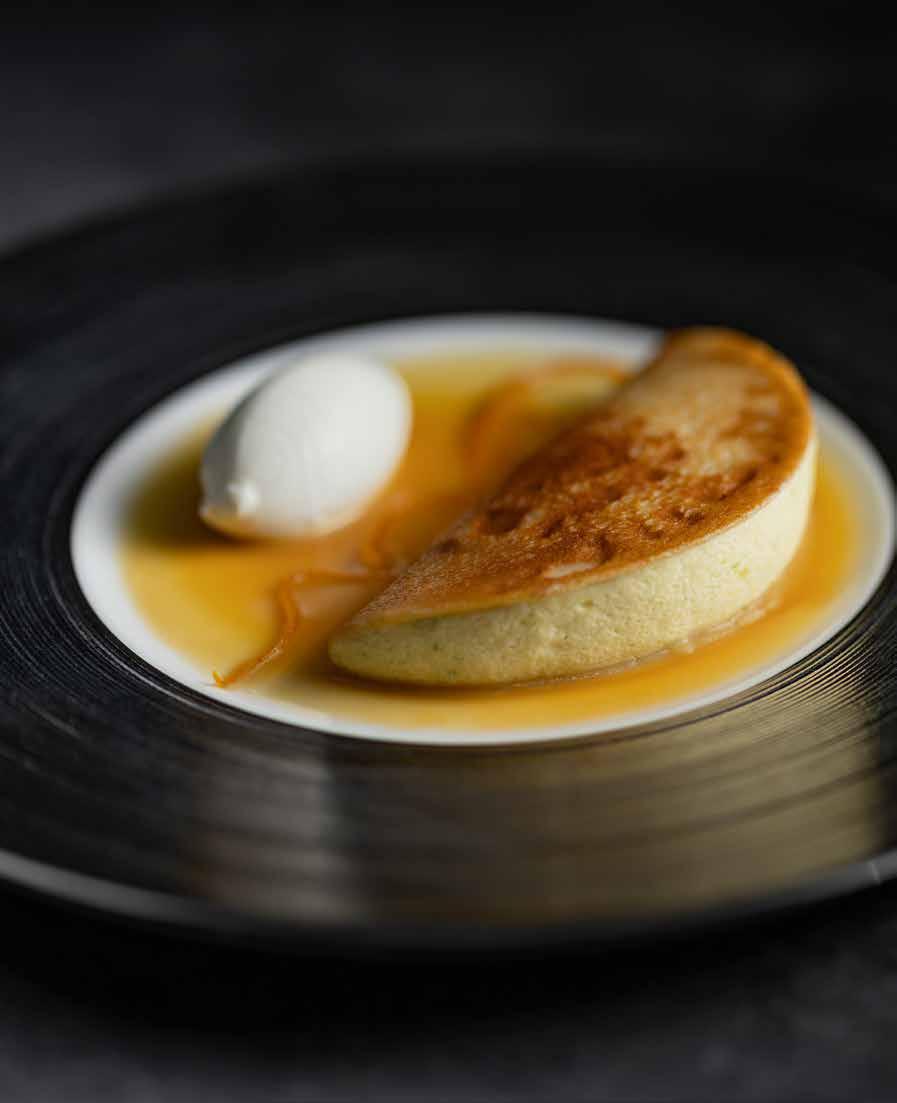
This dessert originates from Joël Robuchon’s iconic 1980s work at Jamin, his first three-Michelin-starred restaurant in Paris. Its preparation demands absolute precision: soufflé of an exact airiness, Suzette sauce on the knife-edge of caramelization and sorbet balanced sublimely.
Hot and cold, crisp and yielding, citrus and cream, these contrasts are not merely stimulating, they are the soul of the dish. Every sense awakened individually throughout the evening converges here in one transcendent savor. Paired with the ripe peach and vivid acidity of a 2014 Joh. Jos. Prüm “Bernkasteler Badstube” Riesling Auslese, it serves as both dessert and conclusion: the entire evening’s ultimate harmony.
Chinese cuisine soars in the rankings of Asia’s 50 Best Restaurants 2026.
HONG KONG 香港
Danny Yip 叶一南
FROM THE OUTSIDE, The Wellington in Hong Kong’s Central district appears to be just another sleek tower block in the city’s iconic skyline. But a closer look reveals it as arguably Asia’s most significant culinary address, housing as it does both The Chairman and Wing, the two entries that swept to the top of the list of Asia’s 50 Best Restaurants 2026.
Separated by twenty-six floors, the two establishments reflect the undeniable fact that Chinese cuisine has never been more visible or acclaimed on the global stage. They also demonstrate the thrilling breadth of Chinese gastronomy, with The Chairman looking to hallowed traditions and Wing viewing thousands of years of culinary history through the lenses of European technique and forward-thinking creativity.
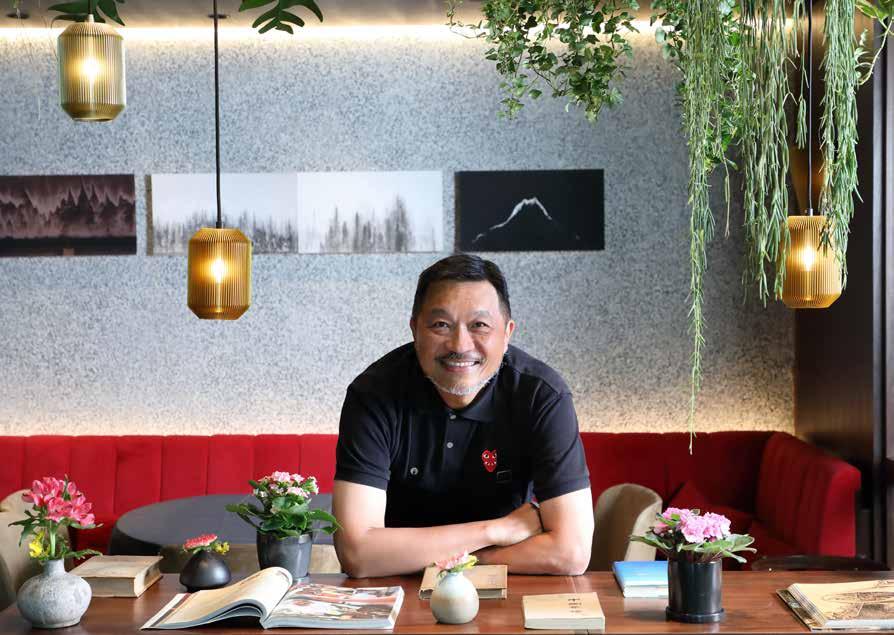
The Chairman has been here before, having taken the top spot in the difficult pandemic-era days of 2021. And so its return to the summit was welcomed more than ever by its charismatic founder, Danny Yip. His
singular take on Cantonese fine dining is based on a near-obsessive commitment to recovering forgotten luxury ingredients and honoring southern China’s age-old culinary legacy of seasonality, provenance, and patience. Whether gently steaming crab in aged Shaoxing wine or slow-cooking pork belly with preserved vegetables, The Chairman is defined by timelessness.
At the awards ceremony, held in Hong Kong for the first time, Yip was visibly moved by the accolade. “It means everything to us to win this award,” he said from the stage. “This is just the best – we’re in Hong Kong and we’re No. 1. I’m so happy.” Then he turned to congratulate Chef Vicky Cheng, his upstairs neighbor at The Wellington.
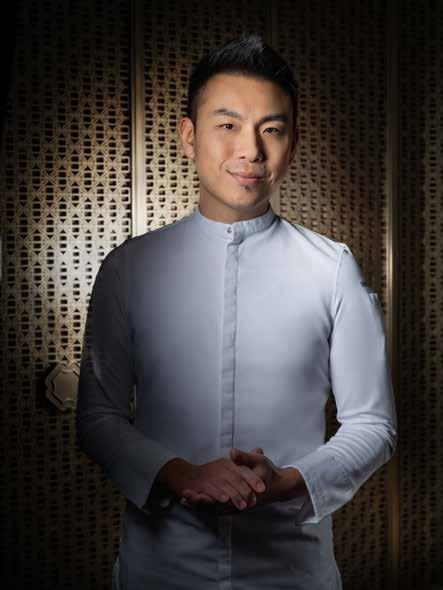
Tipped by many for the top spot, Wing ended up in second place. Cheng’s take on Chinese cuisine, while markedly different from The Chairman’s in methodology, is equally rigorous in ambition and utterly flawless in execution.
Whereas The Chairman draws inspiration largely from Guangdong province, Wing casts its net across China’s eight great culinary traditions: Cantonese, Sichuan, Hunan, Shandong, Jiangsu, Fujian, Anhui, and Zhejiang. The philosophy and precision of each is filtered through French technique, given that Cheng
trained in classical French cuisine in his native Toronto before going on to work at such renowned restaurants as Daniel Boulud’s then-three-Michelin-starred Daniel in Manhattan.
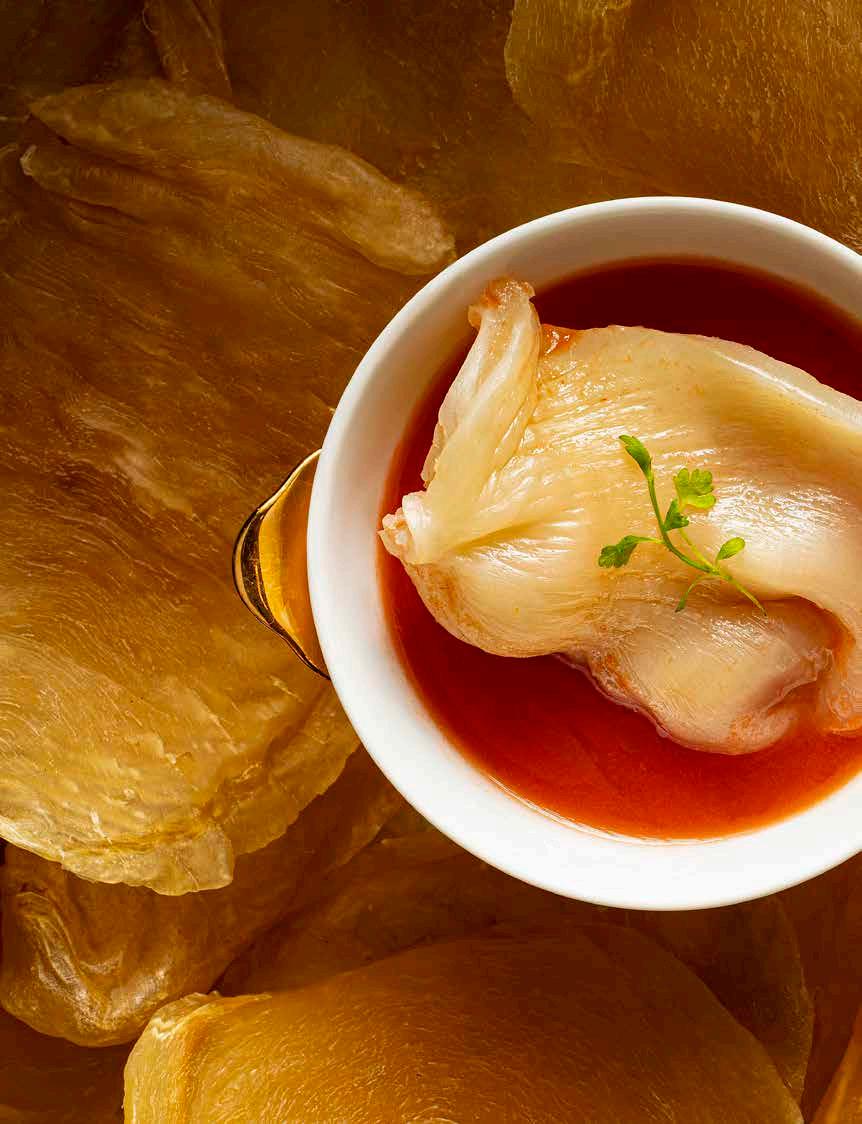
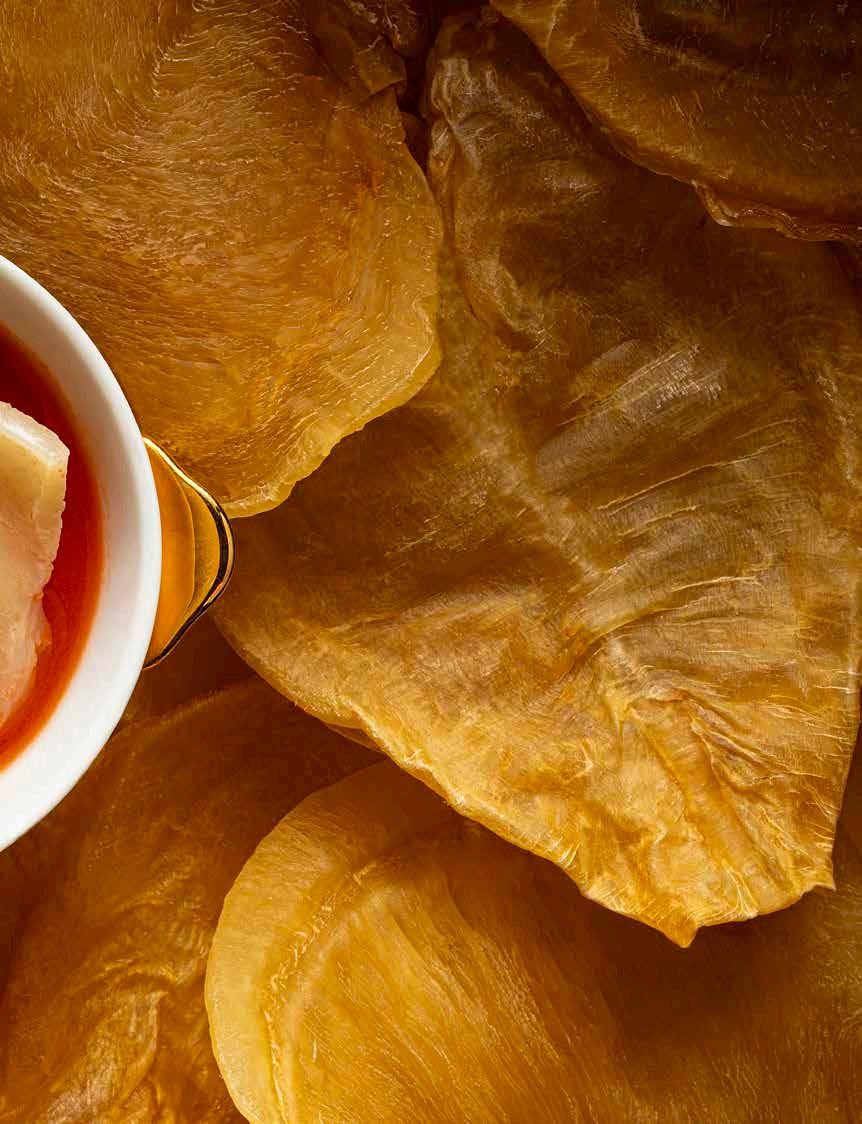
Wing’s constantly evolving menu wows diners with the world’s finest ingredients, Australian dried sea cucumber foremost among them. “It’s always been the case in Chinese cuisine that sea cucumber is braised in brown sauce,” notes Cheng, “but when we opened Wing, I had to tackle dried seafood differently. We learned to cook it the traditional way and then changed it through our own DNA .”
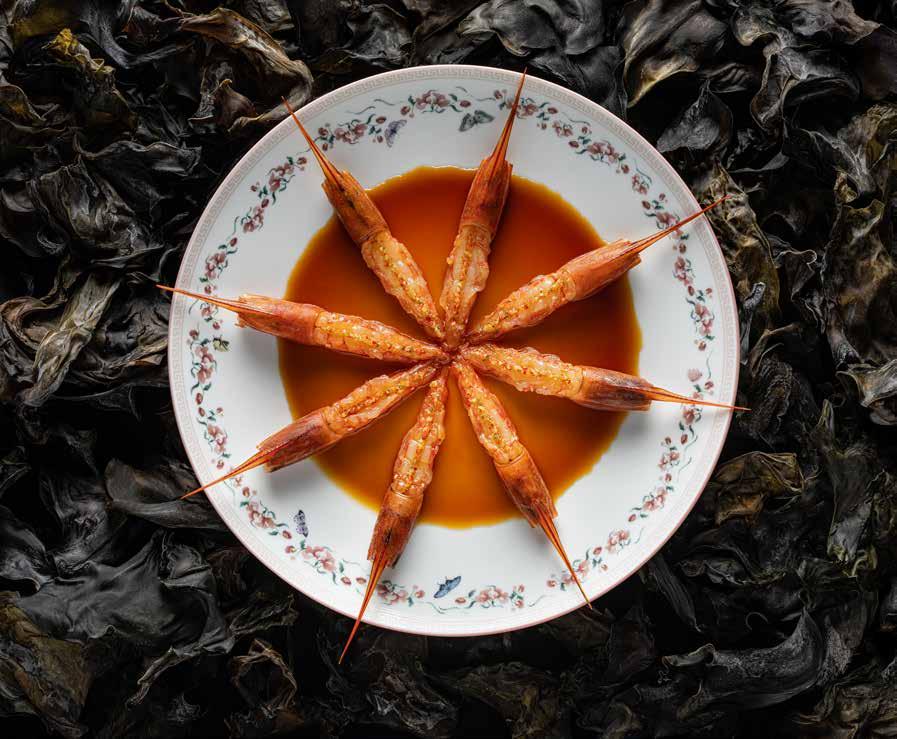
He admits that “insane” levels of preparation ensure that it’s crispy and never slimy, thanks to cooking it in stock for up to six hours and then spooning boiling oil over it. Stuffed with crab, lobster, squid, mushrooms, or local tiger prawn, it is finished with sauces of simply jaw-dropping depth of flavor.
CHINA’S REMARKABLE CULINARY ASCENT continued throughout the 50 Best listings. At No. 6, Meet the Bund in Shanghai – once again named The Best Restaurant in Mainland China – rose eight places from the previous year. At No. 7, Chef Tam’s Seasons at Macau’s Wynn Palace reminded the world how it has few equals in opulent Cantonese banquet cuisine, a mix of culinary theater, hospitality, and masterly technique.
Ling Long in Shanghai, at No. 9, shone with its décor featuring avant-garde Chinese art and Chef Jason Liu’s contemporary sensibility and devotion to delivering umami.
Rounding out the top ten and also taking the Highest New Entry Award was Ru Yuan, located in the picturesque ancient imperial city of Hangzhou, whose own rich culinary heritage has long been overshadowed by its more famous neighbors. Many see Ru Yuan as set to change that with its reinvigoration and occasional reinvention of old-school Hangzhou cuisine, rooted in the famously ingredient-rich lakes and mountains of Zhejiang province.
CENTURIES-OLD CHINESE vegetarian cooking founded on Buddhist temple traditions won No. 11 ranking for Fu He Hui in Shanghai, confirming the city’s status as one of Asia’s gastronomic capitals, with five restaurants among the 50 Best.
Beijing also climbed in recognition, with another plant-based restaurant, Lamdre, rising from No. 50 to No. 17. Named for the Buddhist concept of “the path and its fruit,” it reflects a quieter, more contemplative take on Chinese gastronomy.
THE STUNNING BREADTH of Asia’s food and dining scene was also writ large, with Bangkok leading the list with nine entries. Among them was Gaggan at No. 3, retaining its title of The Best Restaurant in Thailand, as well as Nusara, Sorn, and Sühring.
Tokyo featured seven restaurants in the rankings, and Seoul’s Mingles at No. 4 continued its reign as The Best Restaurant in South Korea. Singapore’s Odette, under Julien Royer, remained the Lion City’s finest at No. 19. Debuting on the list were Kasauli in the Indian Himalayas, Ubud in Bali, and Penang in Malaysia.
Individual accolades went to Odette’s Lesley Liu, winner of Asia’s Best Sommelier Award; food activist Peggy Chan, winner of the Champions of Change Award; and Bangkok’s Baan Tepa, helmed by Chef Chudaree ‘Tam’ Debhakam, winner of the Sustainable Restaurant Award.
Overall, the night indisputably belonged to Chinese cuisine and to Hong Kong, a city that has brought it to world recognition. The ranking results also proved that Chinese gastronomy – ancient and endlessly vast – has never been in better hands.
Asia’s Best Sommelier Award 2026, sponsored by VIK
SevenRooms Icon Award 2026
Asia’s Best Female Chef Award 2026
26 Eatanic Garden Seoul
27 Ms. Maria & Mr. Singh Bangkok
28 Maz Tokyo
29 102 House Shanghai
30 Naar Kasauli
31 Florilège Tokyo
32 Estro Hong Kong
33 Myoujyaku Tokyo
34 Crony Tokyo
35 Caprice Hong Kong
36 Le Du Bangkok
37 Narisawa Tokyo
38 Les Amis Singapore
39 Au Jardin Penang
40 Labyrinth Singapore
41 Mosu Seoul
42 August Jakarta
43 Bium Seoul
44 Locavore NXT Ubud
45 Nae:Um Singapore
46 Mono Hong Kong
47 Wana Yook Bangkok
48 La Bourriche 133 Shanghai
49 7th Door Seoul
50 JL Studio Taichung
Masque, Mumbai
Lesley Liu, Odette, Singapore
Zhang Yong
Cho Eun-hee, Onjium, Seoul
Asia’s Best Pastry Chef Award 2026, sponsored by Valrhona Ardika Dwitama, August, Jakarta
Sustainable Restaurant Award 2026
Baan Tepa, Bangkok
Champions of Change Award 2026 Peggy Chan
Inedit Damm Chefs’ Choice Award 2026 Thitid ‘Ton’ Tassanakajohn, Le Du, Bangkok
One To Watch Award 2026 San, Seoul
Highest New Entry Award 2026
Ru Yuan, Hangzhou
Highest Climber Award 2026, sponsored by Lee Kum Kee Lamdre, Beijing
Masaaki Miyakawa
精准、细腻、匠心
precision, finesse, artistry
Michelin-starred Sushi Kissho by Miyakawa brings to Galaxy Macau the exquisite Edomae-style sushi of one of the world’s most renowned masters.
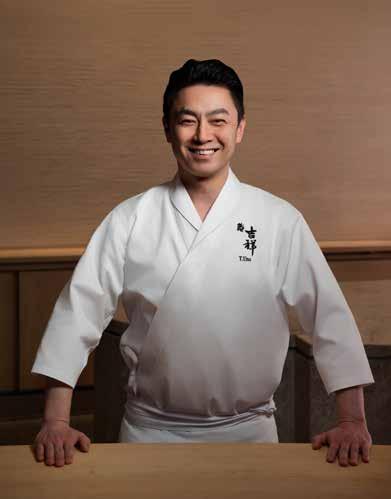
AS THE ONLY INTERNATIONAL RESTAURANT of Masaaki Miyakawa, famed chef of three-Michelin-star Sushi Miyakawa in Sapporo, Japan, Sushi Kissho offers an omakase experience rooted in rigorous tradition, a unique dining style in which guests trust the sushi master to create a personalized culinary adventure. Sushi Kissho by Miyakawa’s intimate setting embodies the wabi-sabi principle of finding beauty in natural simplicity. This ethos lies behind the choice of the interior’s natural materials, including unfinished Hinoki cypress wood, as well as the restaurant’s sophisticated, open, minimalist design, which puts the focus squarely on the dining experience and the interaction between the sushi master behind the counter and the guest before him.
The ten-seat counter is crafted from a three-century-old Kiso Hinoki cypress tree from Nagano Prefecture, deliberately left uncoated by its master craftsman, Mr. Tomita, who carefully preserved its character and marked it with his signature maple-leaf inlay. Reflecting Japan’s reverence for natural materials, this wood is considered sacred and historically was used in imperial residences and the iconic Ise Shrine. Augmenting the counter seating is an exclusive ten-seat private dining room.
The main dining room displays a striking collection of objets d’art, including antique Ikebana baskets from Kyoto and ceramic pieces crafted by the noted Miyagawa family, whose creative legacy reaches back to the early Edo period and whose works are found in museums around the world.
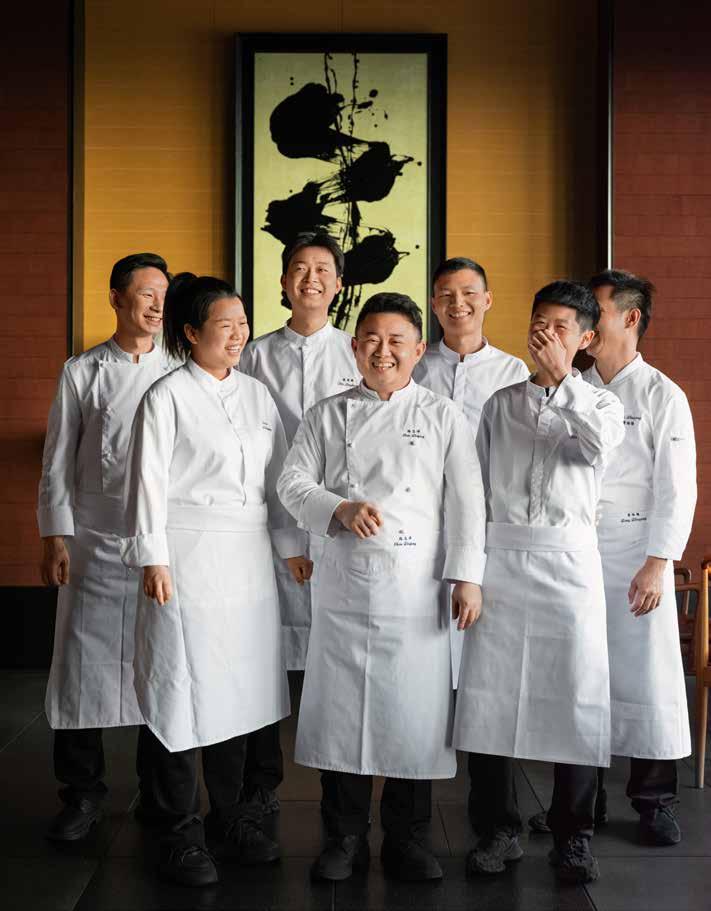
Within this refined ambience, Master Chef Masaaki Miyakawa directs an exceptional team led by Executive Chef Tetsuya Uno, a respected sushi master with thirty years’ experience. Supporting him are Sous Chef Soma Shibuya and Chef de Cuisine Mitsuteru Sasaki. All three trained intensively for years under Chef Miyakawa’s mentorship, gaining a deep understanding of his philosophy, techniques, discipline, and exacting standards.
Complementing this culinary expertise are Executive Manager Amy Jo and Manager Gavin Ho, who have served at a variety of Michelinstarred establishments and are highly accomplished at providing guests with discreet, attentive, customized service.
Miyakawa’s journey to becoming a globally celebrated sushi master is the stuff of legend. Although familiar with the secrets of sushi making from his youth, he originally studied French cooking at one of Sapporo’s most famous Michelin-starred restaurants before returning to his true passion. His unconventional career path through French cuisine has influenced his distinctive approach to flavor development and textural balance.
曾服务于多家米其林星级餐厅的总经 理 Amy Jo 及经理 Gavin Ho,凭借丰富经验, 以细致入微的贴心照料,确保服务如厨房 团队般精准讲究。
宫川主厨的厨艺历程,堪称传奇。尽 管他年少时便已熟悉寿司制作的奥秘,但他
The art of sushi transcends sustenance to become a celebration of the connections between nature, tradition, and the human spirit.
在这里,寿司的艺术超越了果 腹之需,升华为一曲颂扬自 然、传统与人文精神的颂歌。
Tetsuya Uno 宇野哲也
The restaurant’s imaginative, elevated omakase menus reflect this in their use of the world’s finest seasonal ingredients, including many sourced from legacy growers and family fishers in Japan.
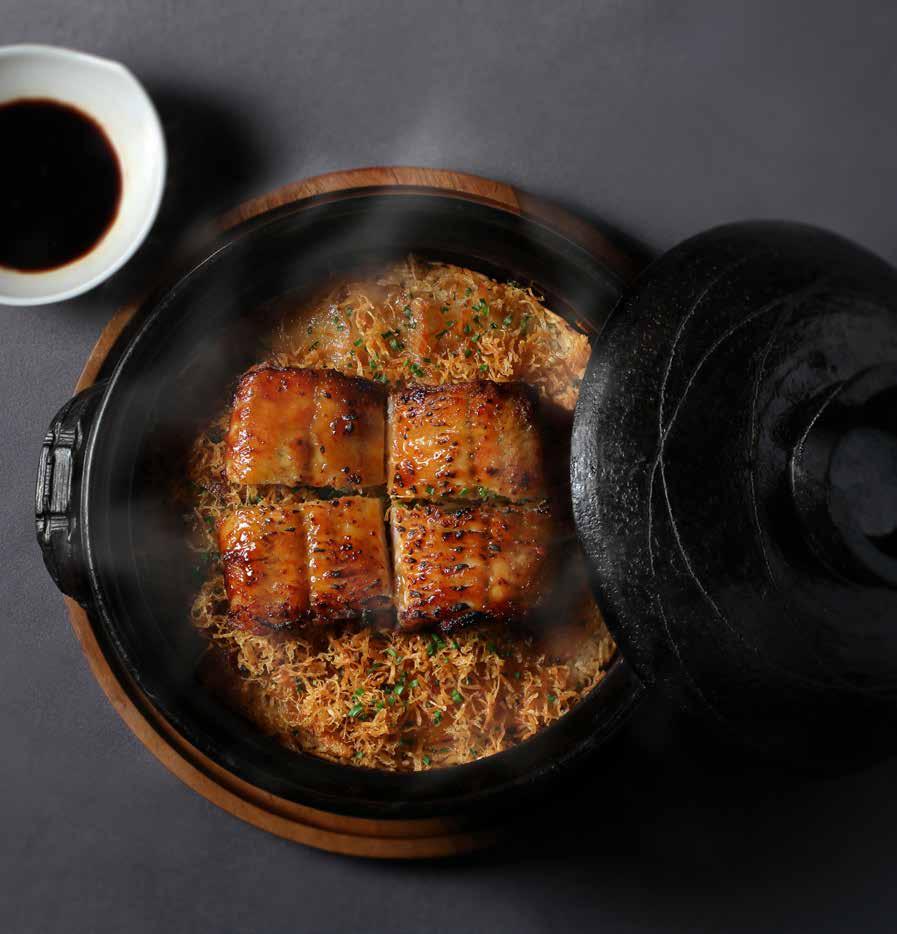
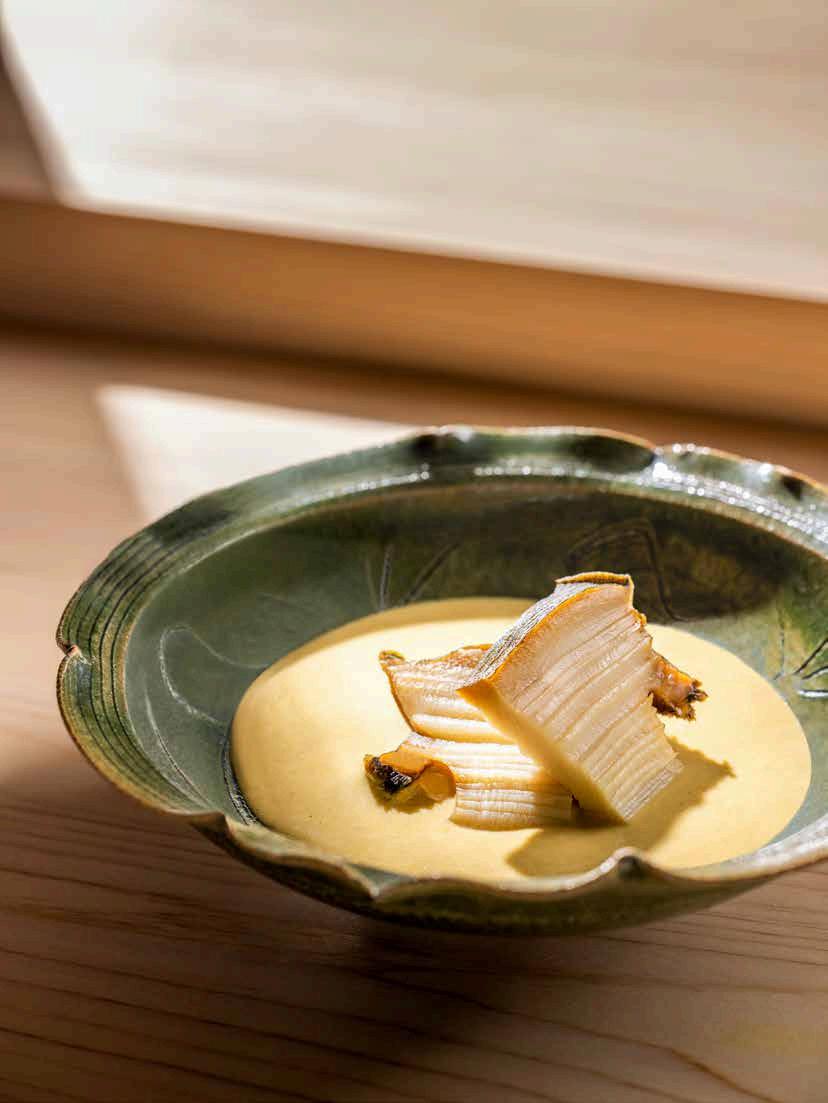
Signatures include sumptuous Shimane Black Abalone with Liver Sauce, a favorite from Miyakawa’s Sapporo restaurant. Black abalone from Shimane Prefecture, caught by the chef’s most trusted fisherman, is first fed with kombu to enlarge its liver and then slow-cooked for three hours with water, sake, and kombu. Served with a luscious sauce made from abalone broth and liver, it is an unforgettable delicacy that honors the essence of every ingredient.
Another standout is Kuruma-ebi, Japanese tiger prawns, which are gently simmered and then immediately shaped into sushi and served warm. Delicately half-raw, they retain all of their exquisite sweetness and aroma.
Chu-toro, often considered the perfect cut of tuna, is marinated in home-brewed soy sauce for up to five hours and deftly crafted into sushi bursting with rich, velvety umami – balanced, luxurious, and utterly satisfying.
Guests at the counter witness all of this sushi sorcery up close as chefs curate authentic, bespoke, interactive culinary journeys perfectly attuned to the preferences of each diner. Drawing on decades of training and finely honed techniques passed down through generations, they ensure that every delectable bite is crafted with zenlike attention to detail.
At Sushi Kissho by Miyakawa, the art of sushi transcends sustenance to become a celebration of the connections between nature, tradition, and the human spirit.
At Lakeview Palace, Chef Kevin Zhu masterfully blends two culinary traditions with his Modern Jiangnan Cuisine.
Executive
and Taro Purée 荔茸鲜虾文武鹅酿关东参
AT
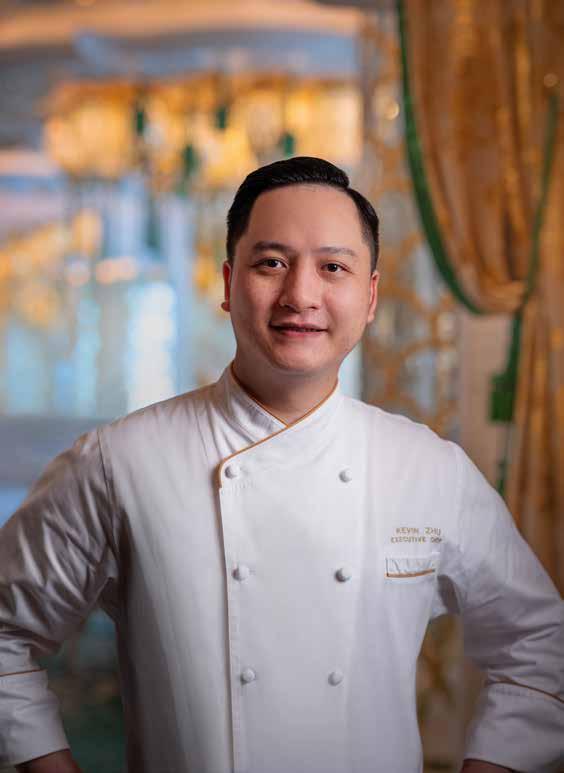
WYNN PALACE’S LAKEVIEW PALACE, Executive Chef Kevin Zhu has developed his signature Modern Jiangnan Cuisine by spending years mastering the Cantonese culinary legacy before immersing himself in Huaiyang food culture. As he puts it, “It’s not about competition but rather about taking the best from each and allowing them to complement one another.”
Both Cantonese and Huaiyang cuisines emphasize freshness and natural flavors, but they differ in their approaches to umami. Cantonese derives it directly from ingredients, while Huaiyang concentrates it in broths. The restaurant’s signature Double-boiled Three-layer Duck Supreme Soup in Lingnan Style exemplifies Zhu’s syncretism in one pot. The dish builds on the Huaiyang classic of domestic duck stuffed with wild duck and pigeon, and the broth incorporates the “three treasures of Lingnan,” dried tangerine peel, olive, and rice straw. It also showcases the remarkable “invisible” knife work of Huaiyang cuisine.
Similar to Cantonese cuisine, Huaiyang cuisine also features a rich dim sum culture, though its interpretations differ in style and presentation. Crystal Skin Dumplings with Min Dong Yellow Croaker requires expert removal of the fish skin in one deft motion before wrapping it around crystal dumpling skin – skin within skin – and the croaker, grouper, and water chestnut create layers of umami. Zhu’s River Shrimp Siu Mai with Lava Egg Yolk uses hand-peeled river shrimp instead of the usual tiger prawns, and a quail egg yolk nestled in the filling demands precise timing to achieve a perfect liquid center.
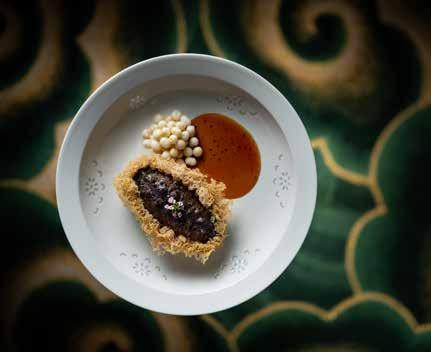
For Braised Kanto Sea Cucumber Stuffed with Shrimp, Goose and Taro Purée, inspired by Nanjing’s classic dish wen-wu duck, Chef Zhu prepares Magang goose two ways, one sweet and delicate, the other aromatic and robust. Hand-beaten shrimp paste is blended with the goose and stuffed into thick sea cucumber, coated in taro purée, slowly fried until crispy, and finished with black pepper sauce.
Chef Zhu is convinced that, with centuries of culinary heritage behind it, the story of Modern Jiangnan Cuisine has only just begun.
Braised Kanto Sea Cucumber Stuffed with Shrimp, Goose
Julien Tongourian
hallowed alliance
Robuchon au Dôme and Dom Pérignon, two renowned trailblazers in the world of gastronomy, discover their mutual affinities.
“M. JOËL ROBUCHON once considered a career in the church,” says Executive Chef Julien Tongourian of Macau’s three-Michelinstar Robuchon au Dôme in discussing his late mentor. “He was educated in a seminary and used to help the nuns in the kitchen. Then he realized that cooking was his true calling.” Tongourian is in conversation with Dom Pérignon Winemaker and Operational Project Manager Amine Ghanem.
“Dom Pérignon was a devoted Benedictine monk,” notes Ghanem. “But he was also the cellarer who was responsible for foodstuffs and wine. There are parallels between his life and that of M. Robuchon.”
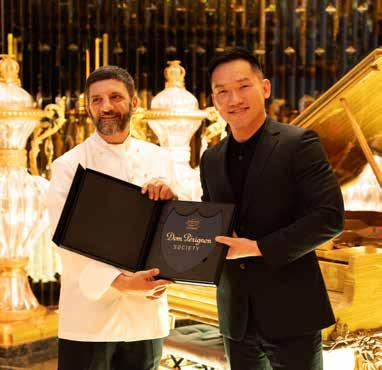
Ghanem has come to Robuchon au Dôme to welcome its acclaimed chef into the Dom Pérignon Society, an invitation-only circle of top global dining destinations. It was founded in 2019 by Chef de Cave Vincent Chaperon with the goal of achieving perfect harmony between food and wine.
Members, who include leading chefs and sommeliers from around the world, interact and share gastronomic philosophies. Ghanem compares the Society to Dom Pérignon’s viticultural ethos by which vineyard parcels are cultivated individually to express their unique characters. The combination of these distinct wines is what gives each Dom Pérignon vintage its energy and tension. “We want members to bring their own identities, charisma, and creativity to the Society – like the individual parcels do to the assemblage,” he explains. “It’s a collective – we don’t want to assimilate everyone.”
To celebrate his membership, Tongourian on April 24 hosted a six-course dinner titled HARMONY, pairing his magnificent French dishes with rare Dom Pérignon vintages from the restaurant’s cellar. “Wine is such an important part of both Robuchon au Dôme in Macau and Robuchon Hong Kong,” he said. “We both have
Amine 这次到访天巢法国餐 厅,正是为了欢迎这位备受赞誉的主厨加入 Dom Pérignon Society。该协会由酒窖大师 Vincent Chaperon 于 2019 年创立,由全球多家顶级食府组 成,并实行邀请制,旨在追求美食与美酒之间的完 美和谐。
协会成员包括来自世界各地的顶尖主厨与侍酒 师,彼此交流、分享美食哲学。Amine 将协会比作 Dom Pérignon 的葡萄种植理念:葡萄园中的每一
1996 Dom Pérignon P2. 鱼子酱帝王蟹塔伴海鲜冻与1996年 份Dom Pérignon P2完美互补。
Imperial Caviar and King Crab with Crustacean Jelly was complemented perfectly by
exceptional cellars. For me, it’s essential to have the best wines to go with his dishes. I love to present these superb Champagnes to my guests and see their delight when they taste them.”
Dom Pérignon has just released three special vintages, which Tongourian is excited to share with his guests in the future: Dom Pérignon Vintage 2017, Dom Pérignon Rosé Vintage 2010, and Dom Pérignon Vintage 2008 Plénitude 2. However, this dinner was designed to highlight the depth and character of mature Dom Pérignon vintages from the 1990s. Tongourian crafted a seafood-forward menu, occasionally using Champagne as an ingredient as well as an accompaniment. His Steamed Brittany Wild Turbot with Shellfish and Champagne Sauce was served with Dom Pérignon Vintage 1998 Plénitude 2. Imperial Caviar and King Crab with Crustacean Jelly was complemented perfectly by Dom Pérignon Vintage 1996 Plénitude 2.
The most senior wine, Dom Pérignon Vintage 1993 Œnothèque, matched beautifully with a Cocotte of Blue Lobster, Morel Mushroom, and Chervil, the mushroom lending a forest-floor note to mirror the maturity of the vintage. Tongourian selected Dom Pérignon Rosé Vintage 1996, a wine robust enough to enhance stronger flavors, to pair with his Limousin Veal Rack with Macaroni Pasta Stuffing and Baby Spinach. And the evening concluded with a refreshing dessert of Strawberry Gariguette, Rosé Champagne Jelly and Sorbet, served with Dom Pérignon Vintage 1995 Plénitude 2 Rosé.
“I feel the presence of M. Robuchon with me as I cook, and it feels like support,” said Tongourian.
“It’s the same for me,” said Ghanem.
“I feel Dom Pérignon is looking down on us as we continue his work, ensuring that his legacy will act as a sounding board for the future of gastronomy.”
Devin Pun, managing director of Moët Hennessy Diageo Hong Kong & Macau, welcomes Chef Tongourian into the Dom Pérignon Society. 酩悦轩尼诗帝亚吉欧港澳董事总经理Devin Pun, 欢迎Julien Tongourian主厨加入Dom Pérignon Society。
块土地都被单独培育,以展现其独特风土。正是这些各具特色的葡萄酒 之间相融合,为每一款 Dom Pérignon 年份酒赋予了活力与张力。他解释: 「我们希望每位成员都能带来自己的个性、魅力与创造力 正如每一块 葡萄田对混酿的贡献。这是一个集体,我们不希望所有人都被同化。」
为庆祝这项荣耀,Julien 于 4 月 24 日呈献了一场名为「HARMONY」 的六道菜晚宴,将他的法式佳肴与酒窖中珍藏的稀有 Dom Pérignon 年份 酒一一搭配。他说:「葡萄酒是澳门法国天巢餐厅和香港 L’Atelier de Joël Robuchon 不可或缺的一部分。我们都拥有非凡的酒窖。对我而言,为他 的佳肴配上最好的葡萄酒至关重要。我乐于将这些卓越的香槟呈现给宾 客,并看到他们品尝时眼中洋溢的喜悦。」
Dom Pérignon 刚推出了三个特殊年份香槟,Julien 很期待在未來与 宾客分享:Dom Pérignon 2017 年份香槟、Dom Pérignon 2010 年份粉红 香槟,以及 Dom Pérignon 2008 年份香槟 Plénitude 2。而这场晚宴旨在 展现 20 世纪 90 年代成熟的 Dom Pérignon 年份酒,以及这些香槟的深 度与个性。Julien 精心设计了一份以海鲜为主角的菜单,时而将香槟作为 食材,时而作为佐餐酒。他的「布列塔尼多宝鱼配贝类与香槟酱」搭配了 Dom Pérignon 1998 年份香槟 Plénitude 2,「鱼子酱帝王蟹塔伴海鲜冻」 则与 Dom Pérignon 1996 年份香槟 Plénitude 2 完美互补。
Chef Pichaya Soontornyanakij’s collaboration with MGallery Collection turns cocktailpaired bar bites into a conversation between kitchens, cultures, and craft.
FOR WORLD COCKTAIL MONTH 2026, MG allery Collection is extending its Art of Mixology beyond the glass, inviting Chef Pichaya “Pam” Soontornyanakij, founder of Bangkok’s Michelin-starred Potong, to create a menu of cocktail-paired bar bites for sixteen participating properties.
BY MAMIE CHEN
The initiative sits naturally within MGallery’s broader vision of the bar as a destination in its own right, where cocktails and cuisine combine to make the bar experience more distinctive and memorable for guests. Soontornyanakij began with five core bites to be served across all participating properties, bringing some of the precision and finesse of fine dining into the rhythm of the bar. From there, she developed regional variations shaped by local ingredients and culinary references. In Asia, those interpretations range from soy-lacquered beef rib in warm mantou to lemongrass maguro tartare on crispy rice to shrimp toast with sweet chili gel.
DAVID HARTUNG
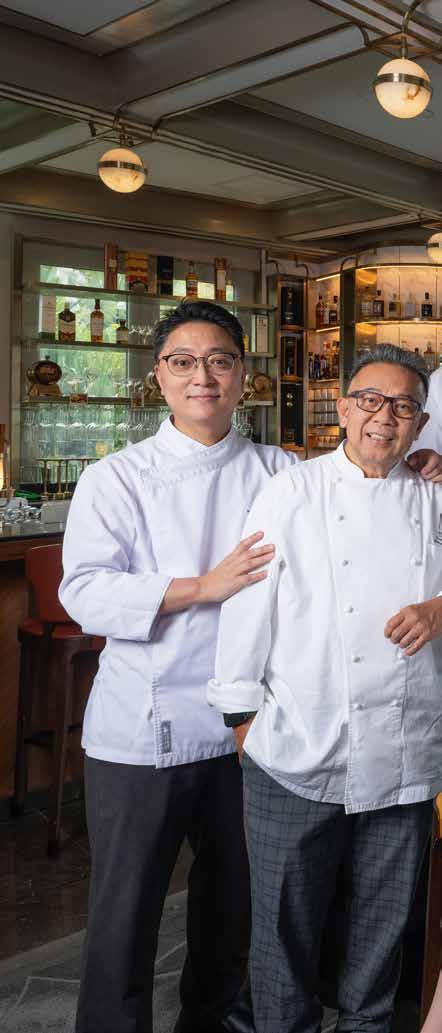
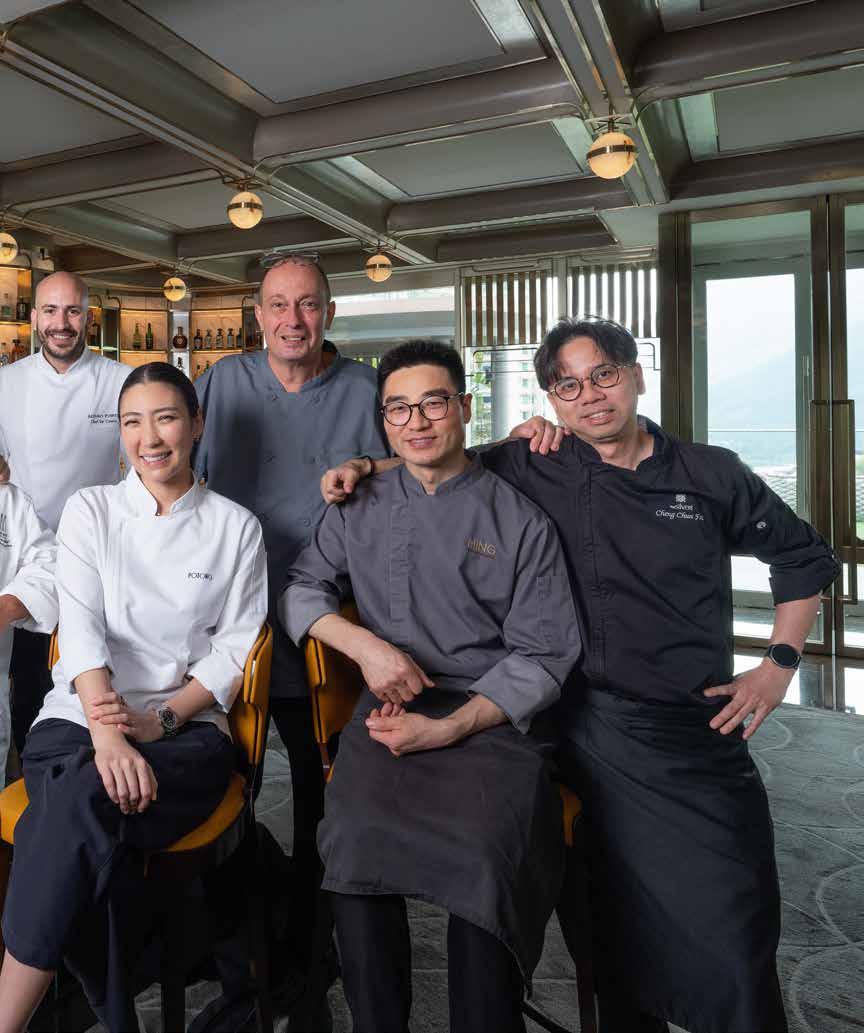
(from left to right) Gino Ryu, Hotel Naru Seoul; Jhamnong Kraitong, Hotel Sosei Sapporo; Álvaro de la Puerta, Avista Hideaway Patong Phuket; Pichaya “Pam” Soontornyanakij; Felix Bamert, V Villas Maldives at Mirihi; Henery Chun, Ming Hotel Nanjing; Cheng Chun Fai, The Silveri Hong Kong
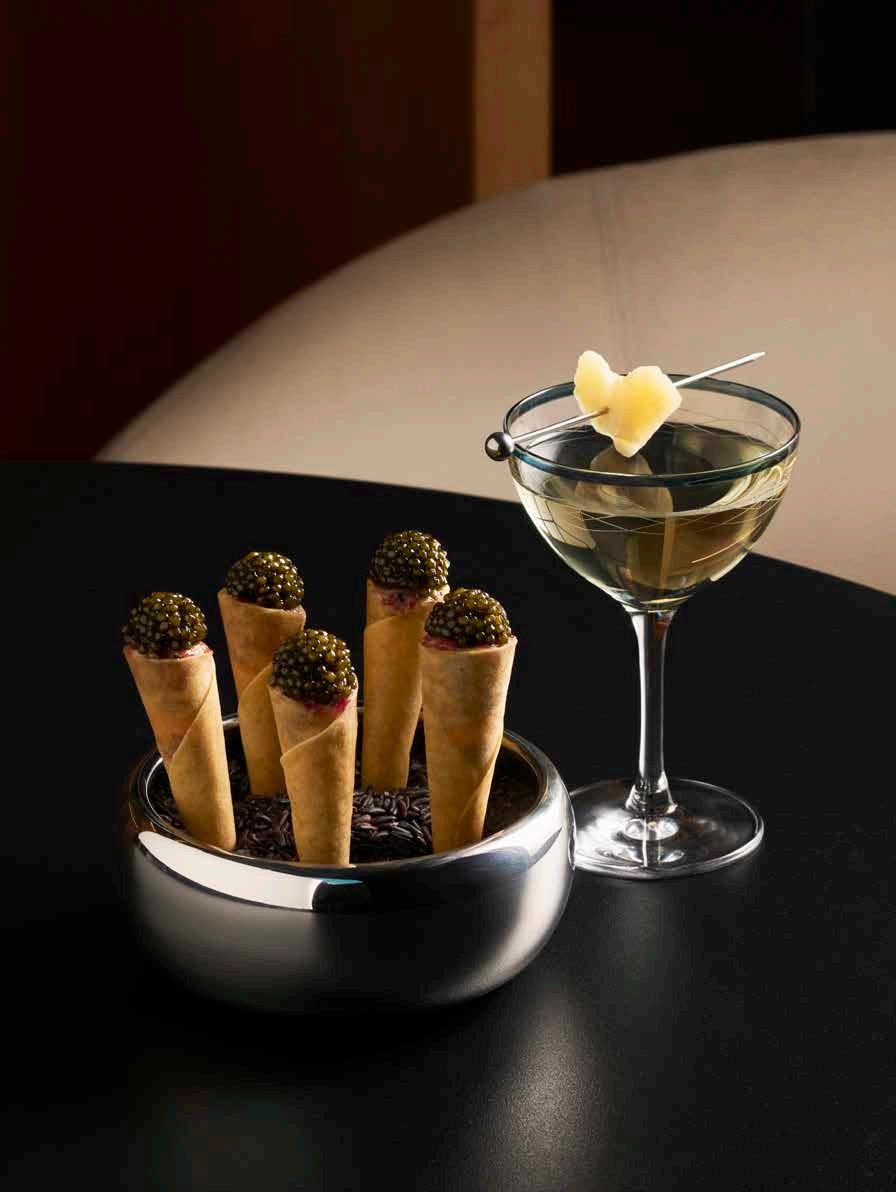
Caviar-Crowned Tartare, paired with Cocktail Prohibition Martini
Cocktail Prohibition Martini
Across properties, working with chefs became an exchange of techniques, ingredients, and local knowledge.
与各地的厨师合作,也是交流技法、食材与地方知识的机会。
For Soontornyanakij, the project had to offer more than a set of recipes. Her exacting standards shaped the approach from the start, with training central to how the dishes would be reproduced across kitchens. She wanted them to be prepared as taught, with recipes written “as precise as possible, down to the centimeter of the squid.” At the same time, she knew that consistency would require some adjustment from one market to the next. Ingredients, she notes, differ by region, so the task was not simply to replicate the recipes but to preserve the character of each dish across multiple kitchens. “We have to adapt in each location, and I think that’s part of the challenge and the charm of cooking.”
The result was a joint effort shaped as much by exchange as by execution. Working with chefs across the participating properties became a passing back and forth of techniques, ingredients, and local knowledge. “When chefs collaborate like this, it’s not just one-way,” Soontornyanakij says. “My team and I learn from them as well. Nowadays, it’s about learning.”
When British Cheddar and yogurt enter the picture, chicken tikka, naan, and lassi get intriguing twists from Manav Tuli, founder and chef of acclaimed Indian restaurant Leela. cheese, please
THE TIME-HONORED, naturally sustainable cheese-making traditions of England, Scotland, and Wales have produced hundreds of styles, each expressing the distinctive qualities of local milk, pastures, and aging methods. British cheeses, including such famous varieties as Cheddar, Stilton, Cheshire, Double Gloucester, and Red Leicester, are prized for unrivaled flavor and quality by top chefs worldwide.
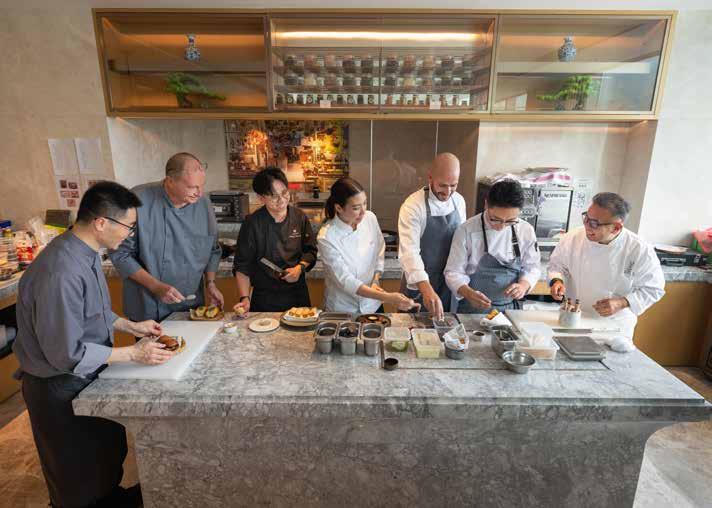
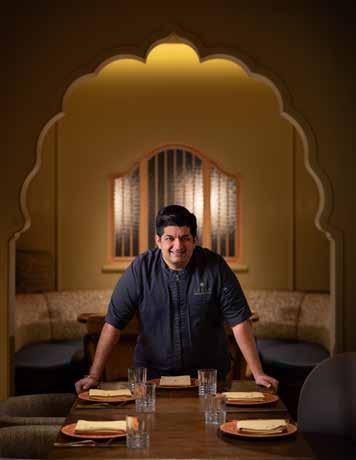
Chef Manav Tuli at Leela in Hong Kong, for example, has imaginatively starred British Cheddar in two new recipes created in partnership with the UK ’s Agriculture and Horticulture Development Board (AHDB).
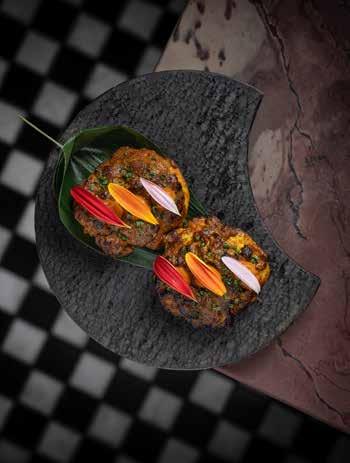
Meadow Valley Mature Cheese from Bridge Cheese enhances the complex flavors of Tuli’s Fresh Turmeric Chicken Tikka. “The special thing about this Meadow Valley variety,” says Tuli, “is that it already has a lot of character on its own. In combination with this recipe’s seasonings, it’s very special.”
The dish is inspired by murgh tikka Mirza Hasnoo, a historic
香港 Leela 餐厅的主厨 Manav Tuli 便别出心裁地在与英国农业与园 艺发展局(AHDB)的合作中,将英国 切达奶酪融入两款新菜式中。
Lucknow royal court delicacy. Tuli steeps the chicken in a brine and then coats it in a spiced marinade with the cheese. Finally, he bakes it in the tandoor to a charred tikka finish. Aromatics are pared to a single anchor of fresh turmeric for a spice profile that supports rather than competes with the cheese.
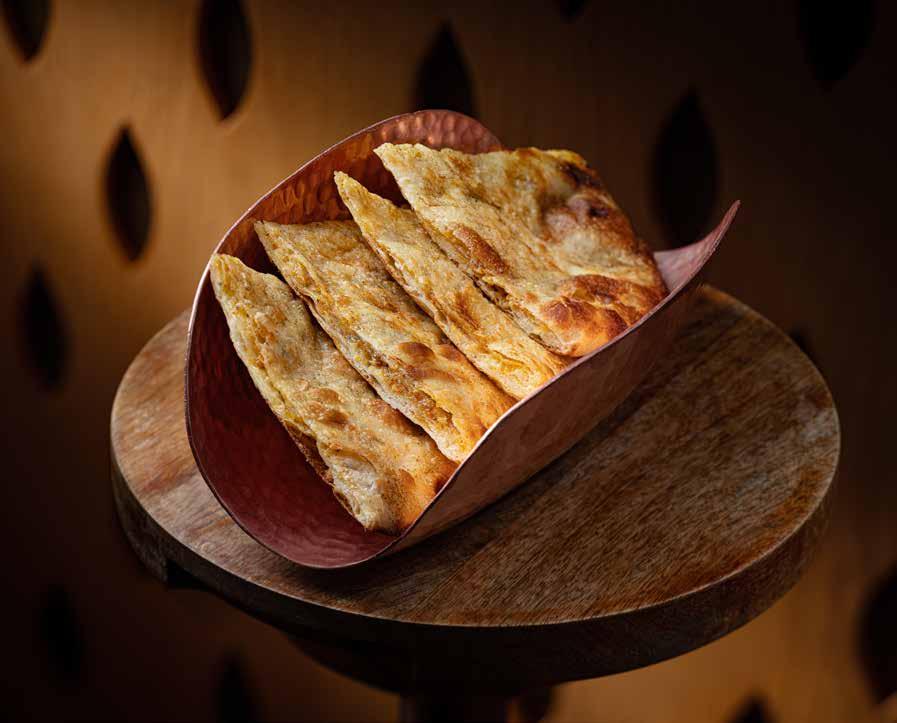
In his Smoked Chili Cheese Naan, Tuli takes full advantage of Wyke Farms Smoked Cheddar cheese, a variety he loves for the way its subtle smokiness complements the deliciously blistered charring of the naan. A supple dough, worked with yogurt, milk, and egg and balanced with salt and a touch of sugar, is portioned into balls. The cheese is tucked into the center of each piece, which is then pressed out by hand. Baked quickly in the tandoor, the soft, airy, chewy naan emerges with a heavenly molten core.
For a luscious refresher, it’s Tuli’s Mango and Coconut Lassi, starring Skyr Natural Yogurt from Graham’s The Family Dairy. The pureed fruits are blended with the yogurt, sugar, milk, and green cardamom powder and served delightfully chilled.
若想品尝一款清爽饮品,芒果椰子拉昔就 是不二之选。他将来自 Graham’s The Family Dairy 的 Skyr 天然酸奶与水果泥、糖、牛奶及绿 豆蔻粉混合,再冰爽上桌,令人回味无穷。
← ←
Manav Tuli
← Fresh Turmeric Chicken Tikka 姜黄烤鸡块
绽放之味
in full bloom
At Ami, Chef Nicolas Boutin lets each ingredient have its moment, whether in dishes refined over years or in those shaped by the season at hand.
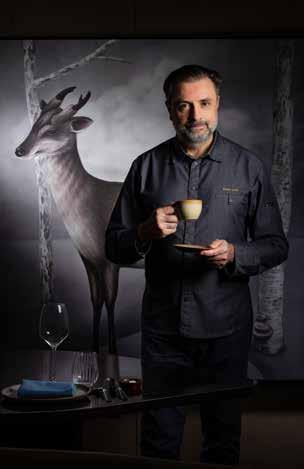
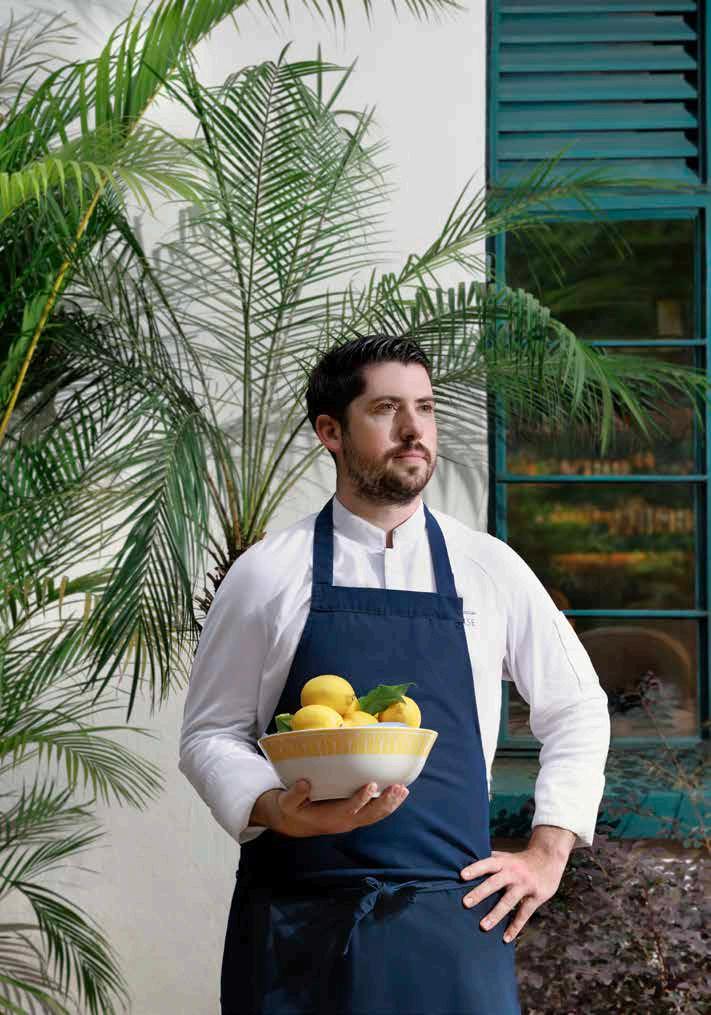
“IT’S COMPLICATED to keep things simple,” says Executive Chef Nicolas Boutin of Ami, the contemporary French restaurant in Central’s Alexandra House that marks its fifth anniversary this year. Boutin’s philosophy, uncluttered, unpretentious, and ingredient-led, runs through every dish, from the spring arrivals to the signatures he has fine-tuned since opening. It finds its second voice in the cellar of General Manager and Group Wine Director Sebastien Allano, whose pairings carry the same restraint from plate to glass.
BY ALICE LIANG
At heart, Allano’s approach mirrors Boutin’s. The cellar leans on traditional terroirs and well-executed classics, with a quieter shelf of niche growers for guests inclined to explore. “Pairing is something that evolves with time,” he says. “You always have to keep learning.” He and the chef taste widely together, even the wines they know won’t work, because the misses teach as much as the matches.
Boutin’s white asparagus comes from the Loire Valley near Richelieu, minutes from where he grew up. Cooked twice daily and never shocked in ice, the spears retain their unhurried earthiness. He slices them into petals around an egg slow-cooked at sixty degrees for three hours, then scatters capers, croutons, and a flurry of orange peel. Allano pours Domaine des Sables Verts
Nicolas 的白芦笋来自卢瓦尔河谷的黎塞留附 近,距他成长的故乡仅数步之遥。芦笋每日烹煮 两次,从不过冰水,因此保留了那份从容的泥土气 息。他将芦笋切成花瓣状,环绕着一颗以六十度慢 煮三小时的鸡蛋,再撒上酸豆、面包丁和一缕橙皮。
Sebastien 为之搭配的酒款是 Domaine des Sables
Saumur Blanc “Les Rouères” 2022, a chenin blanc whose stony acidity threads the egg’s richness and the asparagus’s vegetal bite.
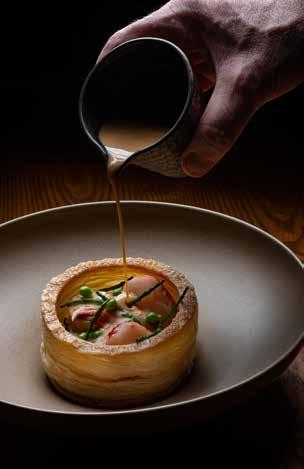
“I come in at seven in the morning to prepare the mise en place and try new dishes,” says Boutin, “as well as to work on the puff pastry.” Ami’s vol-au-vent, a signature since opening, reveals the chef at his most exacting. He has spent years refining the ring to arrive at table flaky and crisp rather than puffed and pale. Inside you can taste lobster, scallop, and a crustacean sauce framed by carrot puree, samphire, and petits pois. Allano pairs it with Domaine Cécile Tremblay Chambolle-Musigny “Les Cabottes” 2021, a pinot noir of restrained extraction whose tannins round against the sauce’s depth.
For dessert, the chocolate tart departs from convention. A dome rather than a disc, it layers salted caramelized apple, Valrhona Manjari 64% dark chocolate mousse, and a glass-thin opaline shard. “You’re in a restaurant. It should be delicate, but still better,” Boutin says. Allano reaches for D’Oliveiras Sercial Madeira 1989, whose lift cuts the cocoa’s weight without flattening the palate.
“Moins c’est plus,” Boutin concludes. “Make it clean as much as possible. That’s the work behind every plate.”
Nicolas 总结:「Moins c’est plus(少即是多)。尽 可能地做得简洁。这才是每一道菜背后的功夫。」
Nicolas Boutin ←
White asparagus 白芦笋
Vol-au-vent 海鲜酥皮盒
南法夏光 感官协奏
SUN-DRENCHED PLATES
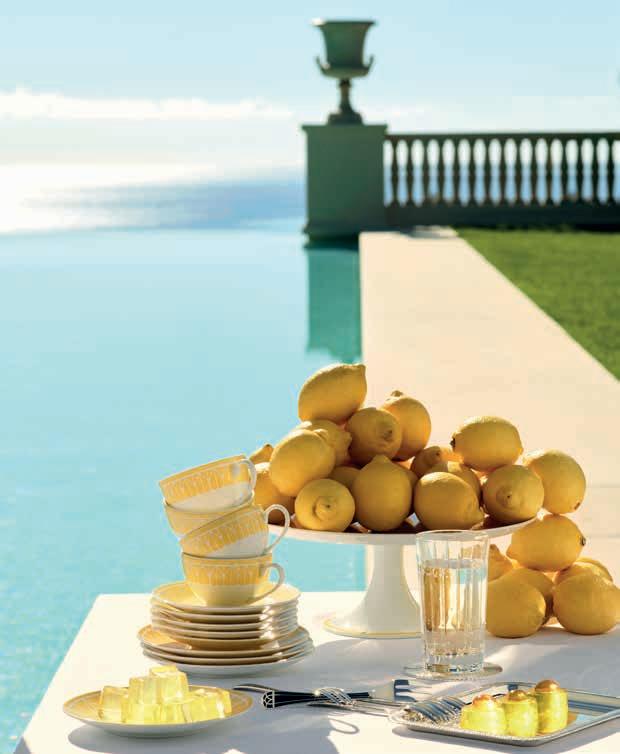
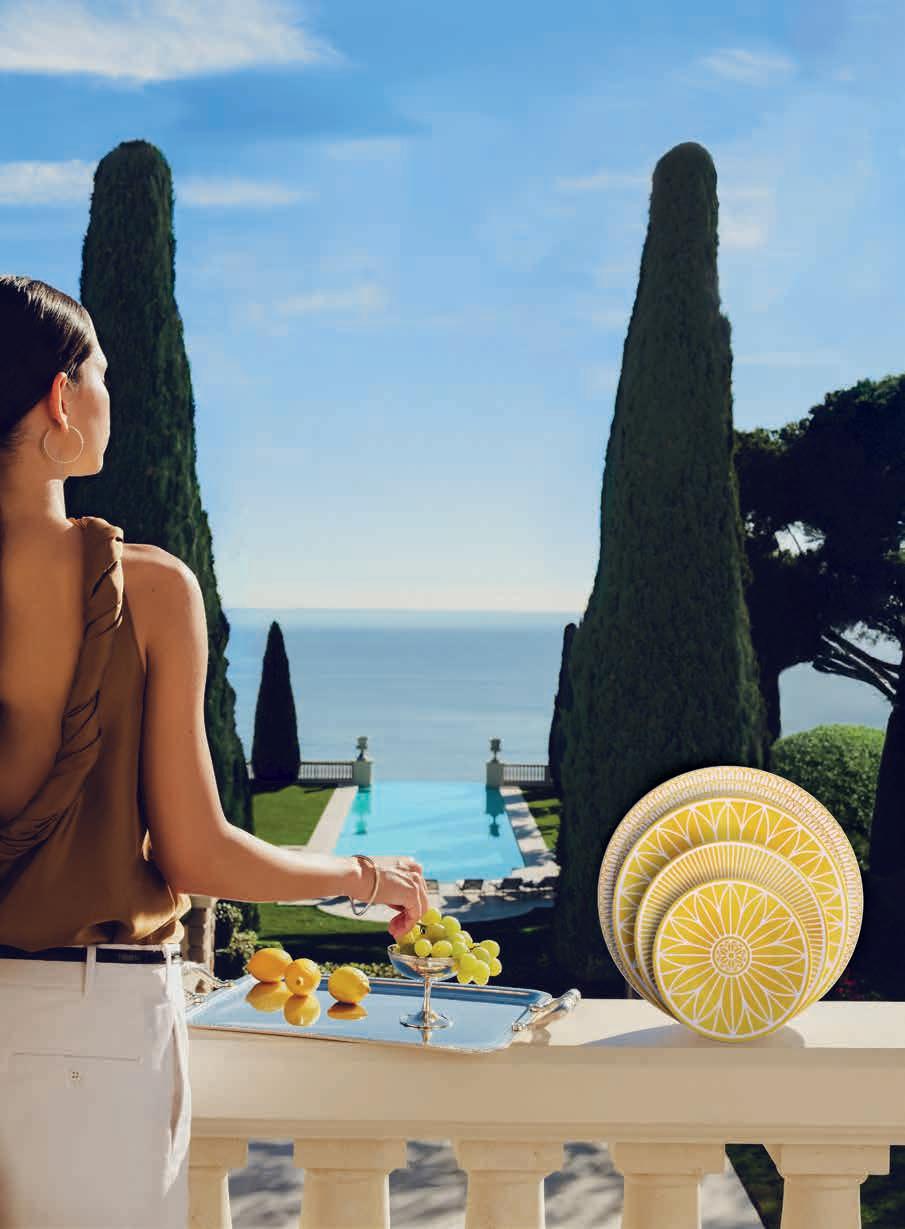
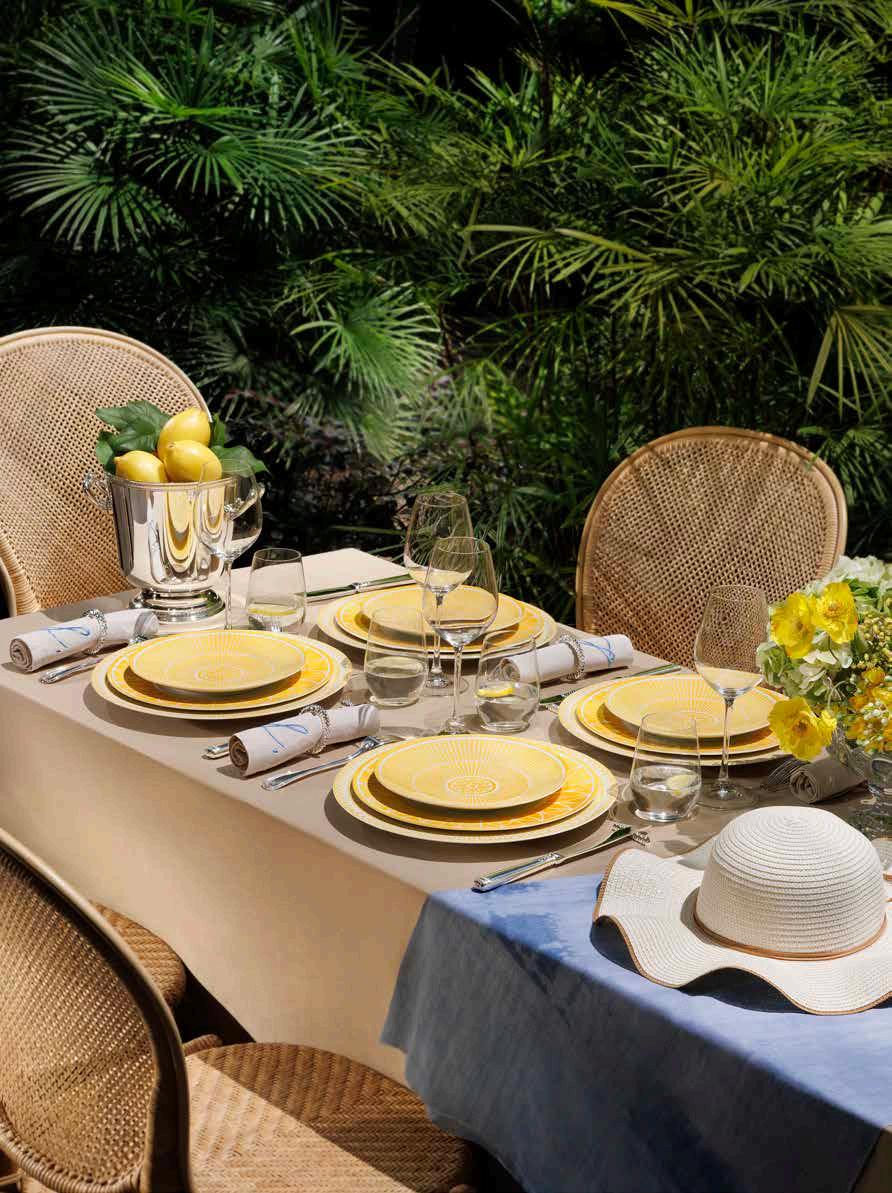
Christofle’s radiant Riviera Collection sets an inviting scene at La Terrace by Louise.
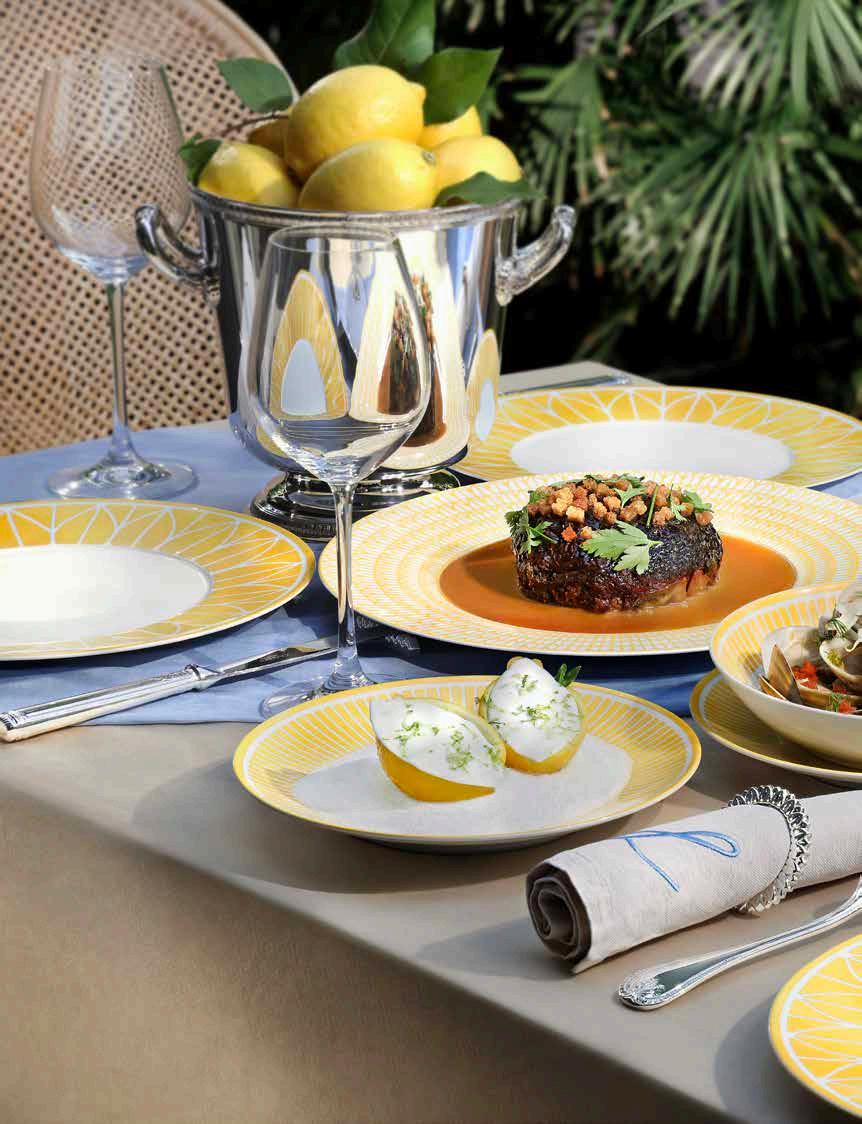
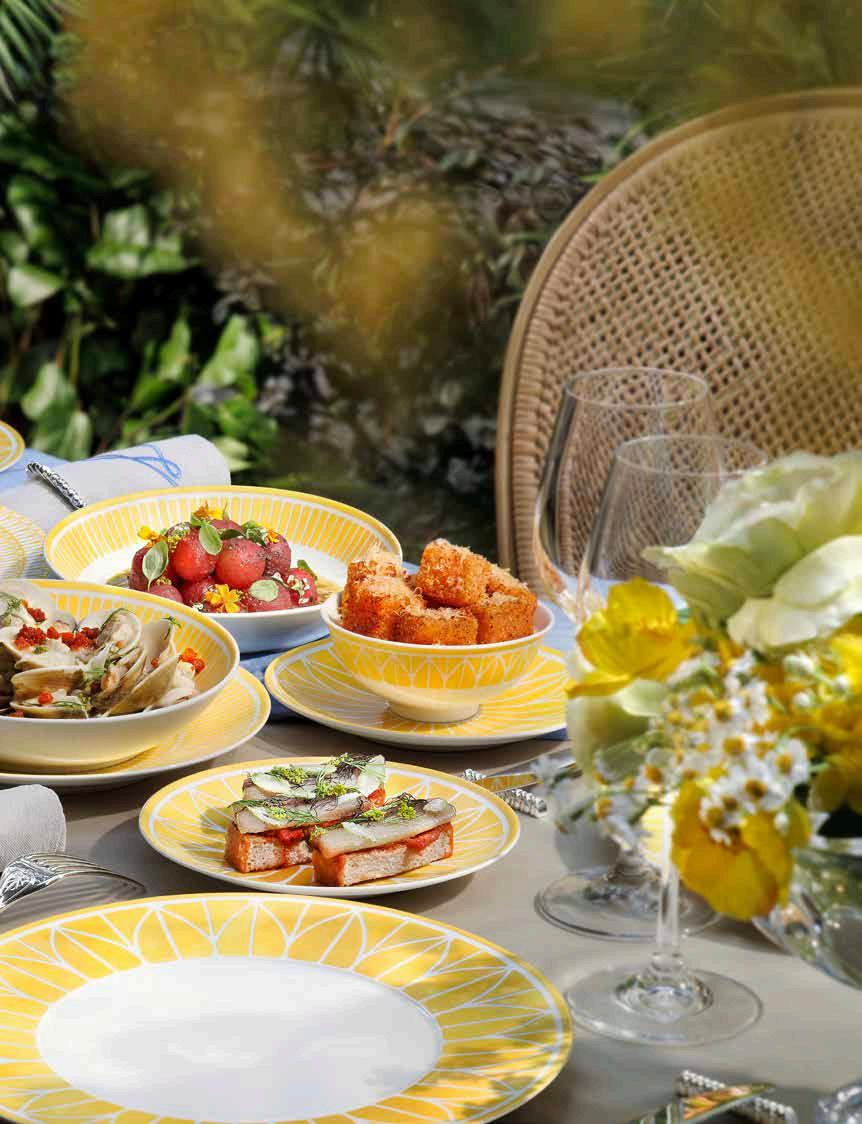
ON A BALMY AND BLUE-SKIED DAY in Hong Kong, a delightful feast unfolds in a secret garden – unpretentious, fresh, and flavorforward. The bright colors of this culinary spread – and the vibrant, effortlessly refined tableware the meal is served on – perfectly befit the sun-dappled surroundings of French restaurant La Terrace by Louise.
Nestled on the ground floor of a heritage-listed colonial house, La Terrace is a gently convivial concept that grounds the elegant, Michelin-starred fine dining of upstairs sister restaurant Louise with a chicly relaxed approach inspired by its leafy setting.
那是个温暖晴朗的夏日,一场令人愉悦的盛宴 在中国香港一座秘境花园中徐徐展开 朴实、 清新、风味至上。这场盛宴的明亮色彩,以及盛 放美食的那套充满活力、优雅而毫不费力的餐 具,与法国餐厅 La Terrace by Louise 洒满阳光 的环境完美相融。
BY NISSA MARION
• PHOTOGRAPHY BY SAMANTHA SIN
Today’s meal is as much visual feast as culinary experience. Just in time for the warmer months, Executive Chef Loïc Portalier has collaborated with French luxury brand Christofle, choosing pieces from its luminous yellow Malmaison Riviera porcelain collection to showcase some of the restaurant’s signature and summer-inspired dishes.
While Christofle’s nearly two-century tradition of craftsmanship is unmistakable in the Malmaison Riviera collection, its glowing hues and hand-painted motifs bring a fresh, lighthearted, modern twist. They offer a gentle nod to the Provençal kitchen, bustling with life and ever busy with Sunday family feasts.
“The Malmaison Riviera collection is classic in shape but contemporary in style,” notes Portalier. “That’s also how we approach our food at La Terrace – traditional favorites presented in a way that’s modern and easygoing. The idea behind this collaboration was to evoke that warm feeling you get when you come home for the weekend and your mother makes all of your favorite dishes. Everyone is around the table sharing, and it brings a smile to your face for the rest of the week.”
La Terrace 坐落于一栋被列为文化遗产的 殖民风格老宅地面层,氛围亲切温 馨。它将楼上米其林星级姐妹餐厅 Louise 的精致餐饮,与其绿意盎然 的环境融合,营造出一种时髦而从 容的气氛。
“The first thing that comes to mind when you see the Malmaison Riviera collection is lemons, sunshine, and the Mediterranean coastline.
看到马勒梅松海滨系列,首先在脑海中浮现 的就是柠檬、阳光,还有地中海海岸线。”
Loïc Portalier
When it comes to favorite dishes, the chef makes it hard to choose. For a start, smoked cured sardine and a rich romesco made with piquillo peppers are served on grilled sourdough toast on a small plate reminiscent of a freshly cut lemon. Next to them is a pretty bowl of deliciously seasoned, irresistible sago “arancini,” arousing suitable expectations for the rest of the menu.
“The first thing that comes to mind when you see the Malmaison Riviera collection is lemons, sunshine, and the Mediterranean coastline,” says Portalier. “These little plates are ideal for light bites – they perfectly match the refreshing flavors and colors.”
As if to underscore the point, the next dish is a visually stunning medley of vine-ripened datterino tomatoes, burrata, and vivid green basil oil served in a soup bowl with a cheery yellow rim. “The shape and size of a serving bowl is important,” says the chef. “This one holds the dressing perfectly and complements the colors in the dish without overpowering them.”
The menu’s main dish is Portalier’s Signature Roasted Chicken, a beloved mainstay at Louise. Cooked over a period of four days, it is magnificently presented on a generous oval platter that invites sharing. “This is my take on a classic French Sunday dish,” says Portalier, “and the Malmaison Riviera platter works beautifully – it looks full and welcoming on the table.”
The dessert, served on an exquisite yellow plate, epitomizes summer: Amalfi Lemon Givré, its lemon and basil sorbet encased in a lemon and topped with a leaf-shaped tuile. “It’s lovely with this plate – yellow on yellow, lemon on lemon. It captures the feeling of the Amalfi coast on a hot afternoon,” says Portalier. “I feel transported – like being on holiday.”
In its essence, French cuisine is social, and dining is an occasion to gather and share with family and friends. At La Terrace, Portalier leans into this gracious tradition by devising dishes that foster conviviality and serving them family-style, under verdant foliage and on alluring tableware that radiates warmth and Mediterranean hospitality. Chef Portalier and Christofle have indeed succeeded in creating a ravishing Riviera escape right in the heart of Hong Kong.
At The St. Regis Bar Macao, newly appointed Director of Food & Beverage Konstantin Nemolochnyi reframes the city’s drinking scene, letting the the bar’s enduring rituals speak for themselves.
THE FIRST COCKTAIL SPOT that Konstantin Nemolochnyi visited in Macao was The St. Regis Bar, and he arrived with no preconceptions. The ambience impressed him first, then the cocktails, then the realization that had he been brought in blindfolded, Macao would not have been his first guess.
That moment of disorientation has come to define his approach to the role. Nemolochnyi joined The St. Regis Macao early this year as director of food and beverage, overseeing the hotel’s dining portfolio across The Manor, The St. Regis Bar, and beyond. His career trajectory reads like a passport stamp collection – The St. Regis, The Ritz-Carlton, Raffles, and Fairmont properties across Europe, the Middle East, and Asia have all benefited from his leadership.
瑞吉酒吧是 Konstantin Nemolochnyi 在中国澳 门造访的第一间鸡尾酒吧,当时他对澳门还没 有什么想法。这里的氛围先打动了他,接着是杯 中的酒。然后一个念头浮上来:他要是蒙着眼 被带进来,绝对不会想到这是澳门。
BY ALICE LIANG • PHOTOGRAPHY BY DAVID HARTUNG
Macao, he observes, occupies a uniquely advantageous position in Asia’s cocktail landscape. While Singapore and Hong Kong command established respect on the regional map, Macao is rewriting its narrative in real time. Record tourist arrivals, the triumphant return of Asia’s 50 Best Bars ceremony to the territory, and a steady migration of elite bar talent from across the Pearl River Delta have fundamentally altered the equation. “Macao has one advantage – no one knows what to expect. And when you arrive without expectations, you tend to have the best time,” Nemolochnyi notes.
This philosophy of pleasant disorientation extends directly to his vision for The St. Regis Bar. His mission isn’t transformation but revelation – allowing the bar’s already sophisticated foundations to speak more clearly to a broader audience. The team he inherited embodies everything he values: technical mastery, cultural diversity, and an intuitive understanding of luxury hospitality’s unspoken rhythms.
Much of the bar’s current standing reflects years of meticulous cultivation. Head Mixologist Kevin Lai has spent the better part of a decade shaping its identity from behind the mahogany, and his dedication to craft excellence proved instrumental in securing The St. Regis Bar’s No. 22 ranking on Asia’s 50 Best Bars 2024. “The team is skilled, engaged, and from all over the world,” Nemolochnyi says.
Clockwise from top left: Terry, Gavin, Nick, Kevin
“I love that they’re not trying to be anyone else. They are who they are. That’s what excites people.
我喜欢他们不去模仿别人。
他们就是他们自己,这才动人。”
Konstantin Nemolochnyi
“You can see the synergy here. My job is to let more people discover it.”
Certain traditions remain inviolate, chief among them the St. Regis Bloody Mary – Maria do Leste – a daily ritual that transforms first-time visitors into devoted regulars. The presentation is theater and participation combined: premium spirit, house-made chorizo, and signature egg tart arrive separately, inviting each guest to become a brief collaborator in their own cocktail experience.
The principle governing every decision is refinement, though Nemolochnyi deploys the term in its most exacting sense of purity, precision, and the relentless pursuit of perfection. While much of the contemporary cocktail world chases novelty through molecular techniques, theatrical smoke, and centrifugal spectacle, his approach represents a deliberate return to fundamentals. “The timing, the temperature, the product itself are refined and redesigned – that intangible feel of delivering something simple in a very high-quality way.”
This philosophy manifests in every aspect of the bar’s operation. Each cocktail must satisfy three nonnegotiable criteria: simple in conception, exceptional in execution, and thoughtful in presentation. The supporting rituals handle the rest – afternoon tea service, evening sabrage ceremonies, and the iconic bar-side Bloody Mary preparation communicate the establishment’s values while providing the team with clear focal points for their expertise.
When pressed about his ultimate ambition for guest experience, Nemolochnyi’s response cuts through hospitality industry abstractions. “Excitement,” he states without hesitation. “Every journey to a bar carries emotional weight. First dates, celebrations, sometimes the most difficult days of someone’s life – a proper bar accommodates all of it. When someone steps through our doors, I want them to feel immediate confirmation: this is exactly right. The space, the drink, the entire atmosphere. They should want to settle in and remain.”
In May, the bar turned its attention to the people who make it run. To mark World Cocktail Day and the 220th anniversary of the word cocktail itself, Nemolochnyi invited four of his bartenders, Lai among them, to each reinterpret a beloved classic on their own terms. “I love that they’re not trying to be anyone else,” says Nemolochnyi. “They are who they are. That’s what excites people.”
World Cocktail Day specials. Created in tribute to 220 years of the cocktail.
「世界鸡尾酒日」特调。为纪念鸡尾酒诞生220周年而创作。
GOLDEN CRUST BY TERRY
An espresso martini inspired by a breakfast toast. Peanut-fat-washed Cognac, Elijah Craig bourbon, cold brew coffee, bread syrup, and clarified apple – creamy and round with a roasted finish.
A classic martini at its core. The St. Regis blend tea-infused gin meets Lagavulin 16 Year Old and dry vermouth in a glass that is smoky on the nose, bone-dry on the finish.
A nocturnal Manhattan. Cacao-infused bourbon, Amaro Montenegro, Fernet Hunter Cacao, and Mr Black Cold Brew Coffee Liqueur – herbal bitterness over chocolate.
一杯属于深夜的 Manhattan。可可波本威士忌、 蒙特内罗阿玛罗、Fernet Hunter 可可酒,以及 Mr Black 咖啡利口酒。草本的苦,落在巧克 力上。
EVER WONDERLAND BY NICK
A Jungle Bird recast as urban reverie. Butterfly pea rum, pineapple juice, banana juice, Suze, and Fernet Hunter, finished with orange blossom and a cloud of foam.
The charms of sake lie in finding the right temperature for the moment.
清酒侍酒师加热一壶清酒,小心地提高温度,以激发清酒更柔和、醇厚、鲜美的口感。
A sake sommelier gently warms a carafe of sake, carefully raising the temperature to coax out greater softness, depth, and umami.
A SINGLE SAKE can reveal entirely different qualities depending on temperature. Served chilled, it may feel crisp and precise. When warmed, the same sake opens up, allowing hidden layers of warmth, sweetness, and umami to slowly emerge.
Outside Japan, sake was often introduced through chilled, aromatic styles that began gaining popularity in the late 1990s. But historically in Japan and increasingly today among international sommeliers, temperature is understood as a key part of sake service, offering a way to draw out its character with greater nuance.
“Warm sake can speak to the very heart and soul of Japanese sake,” says Michael Tremblay, a sommelier honored with the title of Sake Samurai. “Warming sake can genuinely transform its personality, enhancing not only umami but also the perception of acidity and sweetness.”
The key is to understand which styles respond best to which temperatures. Aromatic ginjo-grade sakes shine when served cool, with their fragrance and freshness remaining clear. By contrast, mellower futsushu, as well as more robust styles, including junmai and honjozo, and seasonal releases like hiyaoroshi gain fullness and richness from gentle heating.
Traditionally released in autumn after maturing through the summer, hiyaoroshi develops a depth that unfolds across a range of temperatures.
At the table, this versatility becomes even more expressive. Tremblay likes to demonstrate sake’s range by serving the same bottle at varied temperatures across a meal. “A delicate sea bream carpaccio paired with a chilled pour is followed by a warm version alongside rich black cod or pork belly,” he says. “The contrast tends to stop guests in their tracks.”
BY ANNA PETEK
Sake leaves room for curiosity and exploration. Served at a different temperature, paired with another dish, or enjoyed at a later moment in the season, the same bottle may reveal yet another side of itself.
「温热的清酒,能够触动日本清酒的灵魂与核心。」 被授予「酒武士」荣誉的侍酒师 Michael Tremblay 说道。
A fifteen-minute bullet train ride separates two Four Seasons properties – and two philosophies.
BY MARK HAMMONS
AT FOUR SEASONS HOTEL KYOTO, Emba Kyoto Grill’s Josper ovens run at 300˚C. Chef de Cuisine Marco Fregnan adjusts the damper, watching cherrywood smoke kiss the day’s first Tokushima Wagyu. Through the window, light catches Shakusui-en, the same garden pond mentioned eight hundred years ago in The Tale of the Heike
Fregnan’s fire-grilling technique builds layers of flavor through a precise balance of high-heat searing and slower, controlled cooking. “The focus is on enhancing rather than overshadowing the inherent flavors of our ingredients,” he says. “The majority are sourced from trusted local partners.”
The name EMBA encodes the philosophy: 宴 (banquet), 炎 (flame), 缘 (connection). Fresh, local produce takes center stage, with techniques like charring and pickling unlocking fresh dimensions of taste and texture. Fregnan’s traditional seasonings, perfected in top Italian kitchens, merge with modern methods like pre-curing and deglazing to deliver bold, distinctive dishes.
The EMBA Signature Wagyu Burger: premium aged cheddar, Yamazaki whisky glaze, homemade onion jam, wasabi mayonnaise. The serious money goes to the Tokushima Awa
Raymond Wong Wai Man, Executive Chinese Chef of Four Seasons Hotel Osaka 大阪四季酒店中餐行政总厨
Kuroushi Tomahawk – 2.5 kilograms, dry-aged thirty days – or the Aichi Chita T-bone.
Steps away, Sushi Ginza Onodera opened in October. Chef Takuya Kubo has returned from New York after five consecutive Michelin-starred years. The seasonal omakase progresses through a series of nigiri – seasonal white fish, zuke-maguro, prawn, toro, sea urchin – and ends with Edomae tamagoyaki and matcha blancmange.
Everything at Four Seasons Kyoto orients toward the pond. The garden survived the centuries, as documented in the 1930s by Mirei Shigemori, whose surveys enabled its restoration. Now it anchors a hotel where preservation becomes philosophy.
EMBA 的特色和牛汉堡精选高品质熟成切达奶酪、山崎威士忌 酱、自制洋葱酱、芥末蛋黄酱。而真正奢华之选,当属重达 2.5 公斤、 干式熟成三十日的德岛阿波黑毛和牛战斧牛排,或者爱知知多 T 骨 牛排。
几步之遥,Sushi Ginza Onodera 餐厅于十月开业。主厨 Takuya
The fifteen minutes between Kyoto and Osaka is long enough to shift from pond to tower, from heritage to innovation.
穿梭京都与大阪之间 仅需十五分钟,足以
让人从古池庭园迈向 摩天高楼,从历史传 承步入创新前沿。
Osaka anchors itself to altitude. Thirty-seven floors up, Bar Bota’s circular counter commands views in every direction. On the same floor, Jiang Nan Chun serves Cantonese classics.The headline remains Sushi L’Abysse Osaka Yannick Alléno, where the French virtuoso – now with fifteen Michelin stars – has joined with Edomae master Yasuda Itaru to create the extraordinary: lettuce ravioli with almond cream, Wagyu tartare with ponzu jelly, land-and-sea consommé bridging French and Japanese traditions.
The fifteen minutes between Kyoto and Osaka is long enough to shift from pond to tower, from heritage to innovation, from watching seasons change across ancient water to watching a city raise itself against the horizon.
Hoshino Resorts KAI Akiu brings guests the Sendai region’s cultural riches amid the idyllic natural beauty of the Natori River valley.
←
Guests can relax at Hotel KAI Akiu’s open-air foot bath while taking in the natural beauty of Sendai.
界秋保酒店设有露天足浴池, 住客可以一边泡脚,一边观赏仙台自然风光。
↑
Each guest room features expansive windows framing poetic mountain vistas of Rairaikyo Gorge.
酒店房间皆设宽敞景观窗,可欣赏充满诗意的磊磊峡山色。
WHEN CHOOSING A PLACE TO STAY, today’s travelers are looking beyond a comfortable bed and a generous breakfast to those special resort hotels that also offer satisfying sources of inner nourishment.
It might be waking up to misty mountain views outside their windows or luxuriating in ancient hot springs favored by scholars and artists of old or experiencing the elegance of bygone eras at a traditional banquet.
Hoshino Resorts surpasses expectations by expertly curating the cultural treasures of Japan’s Sendai region and bringing them to life at KAI Akiu. The tranquil ambience that permeates the hotel from lobby to guest rooms is due to the careful work of Kooo Architects, which drew inspiration from the essence of KAI Akiu’s predecessor hotel and reinterpreted it with understated contemporary design.
Nature is gracefully invited indoors through guest-room picture windows that frame the mountain scenery like an ever-changing work of art. Each morning, guests arise to the unveiling of a new living landscape scroll.
Perhaps most delightful among the resort’s many amenities are the warming waters drawn from two sources of the renowned Akiu Onsen hot spring, whose history spans fourteen hundred years. These waters, of the colorless, odorless sodium-calcium chloride type, are known for exceptional heat retention and moisturizing effects.
Following local custom, guests may choose to visit the open-air
The “KAI Cultural Discovery” experience offers a tasting of Sendai's finest regional sakes.
参与「当地 乐」环节,品 饮仙台地酒。
Meticulously crafted kaiseki cuisine is presented with artistry and care.
精心设计的 会席料理。
In the comfort of a guest room, a quiet moment with a book and a cup of tea becomes a soul-nourishing retreat.
留在舒适的酒店房间,读一本 书、喝一杯茶,已能滋养心灵。
bath in the large communal area after dinner. Enveloped by the flowing waters, lulled by their gentle murmur, breathing in the therapeutic steam, guests carry out an age-old ritual of physical and mental purification in the embrace of mountain shadows.
It is said that Date Masamune, the famed Sengoku-period general and first daimyo of Sendai, repeatedly visited the spring to heal the weariness of years of battle. Sendai’s unique history and culture are deeply intertwined with this brilliant military leader, a cultured man who dedicated himself to revitalizing the traditions of the Tohoku region. In the city he governed, he promoted such refinements as the tea ceremony and the drama-dance form known as Noh, along with fine craftsmanship and culinary artistry. The “Date culture” that he defined harmonizes the spirit of the samurai with the sensibilities of the poet. Over four centuries, it has subtly woven itself into the fabric of contemporary Sendai life.
During KAI Akiu’s free “KAI Cultural Discovery” session, guests wear a jinbaori samurai campaign jacket to simulate participation in a victory banquet of the era as they savor local sake and learn traditional samurai etiquette. The story of the region’s terroir is told through the exceptional kaiseki cuisine of Chef Shunichi Kajikawa. Highlighting the natural flavors of Sendai’s abundant seasonal ingredients, including edamame, beef tongue, and taro, he presents them in creative diversity. For example, he slow-cooks thick cuts of beef tongue in red wine for serving with sake and also thinly slices it to complement the delicate flavors of sukiyaki.
Guests who take time to visit the hotel’s recommendations of such local attractions as historic Hoyo Sake Brewery and scenic spots like nearby Rairaikyo Gorge, Akiu Otaki Falls, and Akiu Shrine will come away from KAI Akiu with a deep sense of renewal as well as a lasting collection of Sendai memories.
Japan’s mountainous Yamanashi Prefecture has long supplied the pristine water essential in creating some of the country’s finest sakes.
WATER, WHICH ACCOUNTS for fully 80 percent of sake’s composition, is – even more so than rice and its fermentation products – the single most decisive factor in shaping the beverage’s flavor and quality. And Yamanashi Prefecture, near the geographic heart of Japan, is a realm of exceptional waters, a fabled terroir where some of Japan’s most distinguished sakes were destined to be born.
Yamanashi is embraced by a constellation of illustrious peaks, including, foremost among them, Mount Fuji, as well as the Japanese Southern Alps and the Yatsugatake Mountains, whose elevations of two thousand to three thousand meters cloak nearly 80 percent of the prefecture’s land area.
Snowmelt from high in the mountains descends slowly through strata of granite, basalt, and other ancient rock formations that serve as nature’s own filtration system. Subtly infused with trace minerals along its subterranean passage, it is transformed over the course of two decades into pristine groundwater. The abundance and
extraordinary purity of this resource are such that nearly 40 percent of Japan’s mineral water production originates here.
In the art of sake brewing, while rice and other raw ingredients may be procured from afar, water must be drawn locally. Across cultures and centuries, it has remained the immutable rule that regions blessed with superior water have given rise to flourishing traditions of fermentation. In these places, breweries, more than mere producers, have stood as pillars of their communities by driving employment and economic activity, shaping political and cultural life, and sustaining systems of belief. Even today, they remain vital custodians of culinary heritage and catalysts for tourism. Many breweries with histories spanning centuries have now passed into the care of new generations. Guided by younger leadership, they seek to harmonize tradition with innovation, ushering in a new era for sake. In this spirit, we turn to two of Yamanashi’s most highly storied and contrasting producers, Sasaichi and Shichiken, to survey both their history and their craft.
FOR THE JAPANESE, reverence for Mount Fuji is etched deep within the nation’s cultural psyche. Japan’s highest peak, it endures as an object of spiritual devotion. Fuji’s eruptions long thundered across the land, inspiring both dread and veneration. Shrines were erected and prayers intoned in hopes of appeasing divine wrath. Ever since its last outburst, the mountain has lain in repose.
No other brewery is as intimately entwined with Fuji’s spiritual and natural legacy as Sasaichi, located in Ōtsuki, a gateway town that flourished in the Edo period and through which pilgrims journeyed toward Fuji. As the mountain’s volcanic activity subsided, the ancient Kitaguchi Hongu Fuji Sengen Shrine assumed a new role as a place where visitors ritually purified body and spirit before embarking on the ascent.
Since its founding in 1661, Sasaichi has brewed omiki, sacred sake offered to the shrine, using groundwater drawn from Fuji’s slopes. Today, Rei Amano, the fifth-generation descendant of the brewery’s first head, spearheads “GI Yamanashi,” an initiative to elevate global recognition of sake crafted exclusively from the prefecture’s six certified water systems.
Drawing upon the Mt. Fuji/Misaka Water System, Sasaichi
meticulously crafts its principal product, Dan. “This flagship label is brewed in pursuit of the ultimate sake for the table,” says Amano. Dan’s exquisite equilibrium is achieved through a delicate, refined interplay of sweetness and acidity underpinned by depth and richness. The result lends itself to pairings that enhance the nuanced flavors and textures composed by leading chefs.
Dan’s ultra-soft brewing water is formed over decades of natural filtration as snowmelt from Mount Fuji flows through volcanic strata, emerging with crystal clarity and minimal mineral content. In former times, it was designated as gosen-sui, water reserved for the Emperor’s personal use.
The brewery’s exacting traditional yamahai process relies on naturally occurring lactic acid bacteria, yielding a sake of pronounced acidity and multilayered umami. The consummate skill of the master brewer is brought to bear in harmonizing such depth with the finesse expected of an ultra-premium daiginjo
Savoring Dan alongside exceptional cuisine not only enhances the pleasures of the table but also evokes Fuji’s qualities of purity, beauty, quiet majesty, and enduring strength.
MT. KAIKOMA-GATAKE, the highest peak of Yamanashi’s Southern Alps, has long been held sacred. In ancient times, it drew ascetic practitioners of Shugendō, and it is still venerated as a living sanctuary. At its foot flows the Ojiragawa River, a source of water renowned the world over. The path to it leads through the grounds of Kaikoma-gatake Shrine, gateway to the mountain.
Passing through the shrine and along the rocky banks of the Ojiragawa is Tsushima Kitahara, the thirteenth-generation head of Yamanashi Meijo Co. Ltd., known for its celebrated Shichiken sake. “As a child,” he says, “I was drawn to the beauty of this place. This water source inspired my ancestor to establish the brewery, and it remains an irreplaceable presence in my life.”
Captivated by the qualities of the water, his ancestor Ihei Kitahara founded Shichiken in 1750. In those days, breweries played a profound social role in the rice-farming community. The Kitahara family established a bank, provided employment during the offseason, and sustained the heritage of sake brewing. Emperor Meiji honored the family by choosing its residence as his lodging during a visit to Yamanashi in 1880. It was eventually designated a cultural asset, and today visitors view a remarkable collection of artifacts from the Meiji era, a time when Japan emerged from centuries of isolation and opened to the wider world.
Today, Tsushima Kitahara has undertaken sweeping reforms at the brewery. The traditional tōji brewing method, reliant on individual mastery, has been replaced with advanced, precision-controlled systems that eliminate variability and ensure consistently exceptional quality.
The brewery has also deepened its commitment to terroir and to revitalizing local agriculture and creating employment. Reinforcing the intimate bonds between land, water, and craft, it has ventured into rice cultivation to secure a stable supply of premium Yamanashi-grown sake rice.
“My guiding principles,” says Kitahara,
Kosaburō Kitahara, the 10th generation brewery owner 第十代酿酒匠人 北原库三郎
“are inheritance and innovation,” a philosophy shared by legendary chef Alain Ducasse. Through their mutual commitment to regional identity, sustainability, and the global dissemination of French gastronomy and Japanese sake, a collaborative sparkling sake was born.
“We have long employed traditional brewing techniques like kijōshu, which replaces water with sake to yield a rich, velvety sweetness,” notes Kitahara. “We also employ secondary fermentation in the bottle to create delicate effervescence and depth. For our collaboration with Alain Ducasse, we further age the sake in cherrywood casks, imparting subtle, complex notes of sweetness and bitterness.” The delicious result harmonizes seamlessly with Ducasse’s elevated cuisine.
In 2024, Shichiken and Ducasse Paris embarked on “Round the World,” a global tour spanning seven cities. The journey, through pairings with local ingredients from vegetables to seafood, illuminated the boundless potential of sake on the world stage. Says Kitahara, “We look to the Japanese artistic principle of shuhari to preserve tradition, to break from it, and to transcend it as we design the future of sake.”
Perched on the Giza Plateau, Khufu’s looks out over the pyramids, the only surviving wonder of the ancient world. Khufu’s
非凡热忱 见证殊荣
Cairo claims the crown as home to The Best Restaurant in the Middle East & North Africa 2026. mena’s
new flavors
CUISINES ACROSS THE MIDDLE EAST and North Africa – from Cairo to Dubai and Muscat to Marrakech – reflect millennia of extraordinary cultural exchange shaped by tradition, innovation, and a common culinary spirit defined by warm hospitality. The vast region continues to inspire diners, nowhere more so than at Middle East & North Africa’s (MENA’s) 50 Best Restaurants.
This year’s awards, marking their fifth edition, were held amid the stunning surroundings of Emirates Palace Mandarin Oriental, Abu Dhabi, where chefs, restaurateurs, critics, and sophisticated diners gathered to discover how Middle Eastern and North African cuisines continue to evolve and spark creativity.
The headline moment was the award of the title The Best Restaurant in the Middle East & North Africa 2026 to Khufu’s in Cairo. In a thrilling underscore of both the country’s ancient culture and its burgeoning dining reputation, the victory marked a milestone for North African cuisine as an Egyptian venue took the top spot for the first time.
Few dining destinations can boast as jaw-dropping a location as Khufu’s, namely, on the Giza plateau overlooking the majestic pyramids, the only remaining site among the seven ancient wonders of the world.
Expectations run high for Chef Mostafa Seif‘s menus to match the setting, and his contemporary interpretations of his homeland’s cooking do not disappoint. His New Egyptian Cuisine, combining local ingredients and historic recipes with modern techniques, stakes its claim as the region’s most compelling new culinary movement.
Beef Brisket with Muamar Rice from Khufu’s Khufu’s的牛腩配穆阿迈尔米饭
Local and global guests are wowed by exemplary Egyptian hospitality and ancient storytelling that proudly reflects the country’s history of more than five thousand years. Signatures include a reimagined take on Egypt’s national dish, koshary. This seemingly simple combination of
At Kinoya, Chef Neha Mishra channels her love for traditional Japanese ramen. 主厨 Neha Mishra 在 Kinoya 倾注了她对传统日本拉面的热爱。
rice, lentils, pasta, chickpeas, and tomato sauce is elevated with quail eggs and cherry tomatoes and finished with coriander and golden fried onions for textural contrast. Classic comfort food refined for the most discerning of palates.
Previously honored by The World’s 50 Best Restaurants with the Resy One To Watch Award 2025, Khufu’s has more than delivered on its initial promise. Responding to the acclaim, Chef Seif remarked, “Egypt is our home, the greatest country in the world. We’re just happy we’ve been able to get our cuisine out there. Thank you to 50 Best, to all the people who supported us, and to the team who helped us get there.”
Overall, MENA’s 50 Best Restaurants 2026, featuring winners from a total of fourteen cities ranging from Beirut to Doha, Riyadh to Amman, was emblematic of the region’s geographic and stylistic diversity.
The top tier of awards saw Dubai solidify its powerhouse dining reputation as Kinoya, reflecting Chef Neha Mishra’s love of traditional Japanese ramen, placed second, a remarkable rise given that she’d started out running a supper club from her home.
Taking third place – and enhancing the three-Michelin-star status it achieved last year – was Dubai’s progressive Indian restaurant Trèsind Studio, which just opened a branch in London’s Mayfair
King Oyster Noodles, Black Fungus XO, Morel Shoyu from Trèsind Studio Trèsind Studio
Sara Aqel, the winner of MENA’s Best Female Chef Award 2026 2026年「中东及北非最佳女厨师奖」得主Sara Aqel
district with an immersive degustation menu. Ranked No. 4, after three consecutive years in top place, was Orfali Bros in Dubai, run by Syrian brothers Mohammad, Wassim, and Omar Orfali. Their new cozily compact spot in Dubai, Three Bros, also made the list at No. 29, suggesting greater things to come for the affably ambitious trio. Rounding out the top five was the winner of the Highest New Entry Award 2026, Beihouse in Beirut. Here Chef Tarek Alameddine showcases creative dishes and stylish design that reinforce Lebanon’s enduring influence as one of the world’s favorite food scenes.
This year’s Individual Awards also highlighted players and movements that are helping to steer the region’s culinary evolution.
Two in particular prompted standing ovations at the awards ceremony theater: Recognized as a champion of culinary ethics, Sara Aqel of Dara Dining by Sara Aqel in Amman won MENA’s Best Female Chef Award 2026, and Salam Dakkak of Dubai’s Sufret Maryam and Bait Maryam received the SevenRooms Icon Award 2026. Chef Dakkak, who
Salam Dakkak, the winner of the SevenRooms Icon Award 2026 「SevenRooms标志人物奖」得主 Salam Dakkak
In Jordan, Muna Haddad leads Baraka Destinations, a social enterprise with purpose and community at its heart, earning her the Champions of Change Award 2026.
was born in Palestine and raised in Jordan, lived in the US and Saudi Arabia before moving to the UAE, where her comforting Levantine cuisine served in a home-like dining room never fails to delight diners.
The Champions of Change Award went to Muna Haddad, founder of Baraka Destinations, for her purpose-driven tourism and community-inspired hospitality initiatives in Jordan. La Grande Table Marocaine at Royal Mansour Marrakech won the Art of Hospitality Award 2026 for its famously warm Moroccan cordiality.
Helmed by rising star Lynn Hazim, Dubai’s Middle Child received the One To Watch Award 2026. And for achieving the highest environmental and social responsibility rating across the region, Farmers in Marrakech won the Sustainable Restaurant Award 2026.
Ultimately, the awards bolstered a growing conviction that Middle Eastern and North African cuisines are entering an exciting new phase, one that mixes tradition, experimentation, and broader geographic representation, shining a spotlight on a dining culture that is increasingly confident, diverse, and globally relevant.
今年的个人奖项亦表彰引领区域美食潮流的人物与力量。 其中两位得奖者获全场起立鼓掌:安曼 Dara Dining by Sara Aqel 餐厅的女主厨 Sara Aqel ,因倡导烹饪伦理而获 2026 年 「中东及北非最佳女厨师奖」;在迪拜打造了两间餐厅 Sufret Maryam 与 Bait Maryam 的主厨兼创始人 Salam Dakkak,则 获颁 2026 年「SevenRooms 标志人物奖」。Salam 出生于巴勒 斯坦,长于约旦,曾居住于美国与沙特阿拉伯,后来移居阿联 酋。她在温馨如家的环境中,烹制令人愉悦的黎凡特家常菜式。 「变革先锋奖」颁给了 Baraka Destinations 的创始人 Muna Haddad,以表彰她在约旦推动的目标导向旅游与以 社区为本的酒店服务理念。马拉喀什皇家曼苏尔酒店的 La Grande Table Marocaine 餐厅,以热情好客的摩洛哥待客之道, 获得 2026 年度「待客艺术奖」。
The German-Japanese pianist Alice Sara Ott has spent a decade bringing classical music to people who never thought it was for them.
ALICE SARA OTT is a Deutsche Grammophon artist with more than half a billion streams to her name, and one of the least conventional pianists of her generation. She performs barefoot, and she likes to set a famous work beside a forgotten one. She has just released the first recordings of piano works by the late Icelandic composer Jóhann Jóhannsson, and her album of nocturnes by John Field, a composer few concertgoers could previously name, was Apple Classical’s Album of the Year. She arrived in Hong Kong at the end of March after one of the best years of her career. The night before her recital at City Hall, she sat down at the Bösendorfer at Ocean Table for an interview and a salon performance, presented by Premiere Performances of Hong Kong in partnership with Tasting Kitchen (TK).
BY MARK HAMMONS
Alice Sara Ott 是德意志留声机公司(Deutsche Grammophon)的签约艺术家,在各大音乐平台 的累积播放次数已逾五亿,堪称同辈中最独树一 帜的钢琴家。她赤足演奏,喜爱将经典名作与被 人遗忘的曲目并陈。 她刚发行了已故冰岛作曲 家约翰 约翰森钢琴作品的首张录音, 而她录制的约翰 菲尔德夜曲专辑更 获选苹果古典音乐的「年度专辑」,这 位作曲家此前鲜少为听众所知。她在 自己职业生涯顶峰之后那一年的 3 月底来到了中 国香港。于香港大会堂举办独奏会的前一晚,她 来到 Ocean Table,在贝森朵夫钢琴旁参与了一 场由飞跃演奏香港(Premiere Performances)与 Tasting Kitchen(TK)协办的访谈与沙龙演出。
You’ve said your aim is to bring classical music to people who feel it isn’t for them. Where did that conviction come from?
I grew up inside a very traditional world, with so many rules and limitations, and most of them have nothing to do with what the music is actually for. Somewhere along the way a great many people were made to feel this art wasn’t meant for them – that you need the right background, or that you have to understand the codes before you’re allowed in. I’ve never accepted that. Music is there to be enjoyed, and I want as many people as possible to feel they’re allowed to enjoy it.
“Music is there to be enjoyed, and I want as many people as possible to feel they’re allowed to enjoy it.
音乐是用来享受的,我希望尽可能让 更多人知道自己拥有这个权利。”
Alice Sara Ott
On your recent records you keep returning to forgotten composers. When you say the word nocturne, everyone thinks of Chopin, but Field came first. Were you setting out to make a discovery?
It wasn’t planned. During the pandemic I wanted a playlist of nocturnes to match my mood, came across one of the very few recordings of Field’s, and realized I didn’t know any of them. That sensation, of hearing something for the very first time, almost never happens in classical music, where we grow up hearing the same pieces over and over. And this music felt strangely familiar, as if I’d heard it as a child. I got obsessed. But I never set out to find a forgotten composer. What I do hope is that his music finds its way into the standard repertoire, that schools and competitions take him up, so that one day he isn’t a rediscovery at all, just part of what everyone plays.
It became Apple Classical’s Album of the Year. How do people find him now?
Through streaming. If you walk into a shop and see Field next to Bach, you’ll reach for Bach, unless you’re a nerd. Buying an album is an active act; so is buying a ticket. Streaming lets people find this music on their own terms, often inside a playlist, without thinking about the composer. It tears down the walls. I wish I could tell John Field that one day people will forget him, but that later he’ll somehow have the Album of the Year.
There’s a counter-current, though. Vinyl is selling again, and people are returning to physical things. As an artist who reaches millions through streaming, what do you think about that?
When I signed with Deutsche Grammophon at nineteen, it was all about physical albums, and the way people listen has completely changed since. I love LPs, and I love that people are coming back to them. CDs, honestly, I find ugly: the jewel cases, the plastic. Unless you have a wonderful system at home the sound isn’t very good, and streaming actually sounds better. I wouldn’t mind if the CD didn’t survive the next decade or two. But a record you can hold in your hands is a different kind of pleasure, and I’m glad it’s returning.
我十九岁与德意志留声机公司签约时,一切都 围绕着实体唱片,如今人们的聆听方式已经彻底改 变。我热爱黑胶唱片,也乐见它们回归。老实说, 我觉得 CD 很丑:那种塑料盒、那种材质。除非你 有一套很棒的音响系统,否则音质并不好,而流媒 体的音质其实更佳。如果 CD 在未来一二十年内消 失,我也不会介意。但一张能捧在手中的唱片,是 一种完全不同的乐趣,我很高兴它又回来了。
You often perform barefoot. Is there a reason behind it?
I have to disappoint you – there’s no mystical vibration coming from the piano that I’m trying to connect with. I just don’t believe in dress codes. My mother is Japanese, so I never wore shoes at home, and I feel comfortable without them. You should be comfortable when you listen to music.
You’ve said you control every detail of a program. What are you trying to do when you put one together?
It’s very different from how I originally learned to program music. For almost a decade now I’ve tried to be in charge of every detail. With each program I ask myself the same questions: What makes this music unique? What do I want to translate to the audience? How can I build it so that they find a natural way in, not only into the music, but into my understanding of it? For one project I worked with an architect who created a whole digital world that we projected on a screen behind me.
If you could build the experience itself from scratch, the whole concert, what would it be?
The way I work now is already close to my ideal, but what I’d love to do next is a concert in augmented or virtual reality. I had a glimpse of what that could be when I saw Kagami – the word means mirror – an AR work my friend Todd Eckert made with Ryuichi Sakamoto in the year before he died. I put the goggles on in a warehouse in Pittsburgh, and a projection of Ryuichi appeared at a piano. You can see it isn’t real, of course, but after a few minutes my eyes adjusted, and I could walk around him and watch his fingers. At one point a tree grew out of the piano and turned into the universe. I caught myself crying at the end.
And now with AI music – does it worry you, where the recording world is heading?
We spend so much time in this field studying and protecting the past, which is a wonderful thing, but it can make us suspicious of anything new. Change is happening whether we want it or not, and I’d rather help shape it than pretend otherwise. There are dangers, of course. But in the end the only thing that separates us from AI is the human element. We shouldn’t compete to make a track that peaks in the algorithms; that’s a fight we’ll lose. What matters is artistic agency, being conscious of what you create. Human experience is something you can’t replace.
You have a German father and a Japanese mother, and Hong Kong is its own East-West mix. Do you feel a connection here?
Not really through my own background. I have a very ambiguous relationship with nationality. My whole life I’ve never quite felt that I belonged. I was born and raised in Munich and have never lived anywhere else, yet I’m asked almost every day where I’m “originally” from, and when I say Germany, people aren’t satisfied; they want some other origin. But there isn’t one. Munich is it. So I decided long ago that I don’t find my identity in nationality; that simply isn’t how I define it. It’s not what I look for when I travel, either. I look for a connection with people, and the ones I’ve met here are open and curious. The audiences are warm and devoted; I often ask them afterwards, on social media, what they felt, because I so rarely get to hear it.
And here, in a room like this, what do you hope happens tonight?
I’m a very aesthetic person, and I feel at home straight away in a beautiful, coherent space, and I love the intimacy here, that there’s hardly any distance to the first row. For me, it’s all about closing the gap between the audience, the stage, and the instrument. Music isn’t only something the performer makes; the audience is an active, essential part of it. We create and share this experience together.
The Persian-Austrian cellist Kian Soltani has built his art between two musical worlds – and on a 332-year-old instrument that, he says, can fall asleep and be woken.
KIAN SOLTANI is a Deutsche Grammophon artist and this season’s Portrait Artist at the Elbphilharmonie in Hamburg. He was born in Austria to Iranian parents, and grew up between two kinds of music: the Persian folk songs his family played for guests at home, and the European tradition he trained in. He plays the 1694 “London, ex-Boccherini” Stradivarius. The day before his recital debut at Hong Kong City Hall, he sat down at Ocean Table with the Korean pianist Jaehong Park for an interview and a private salon, presented by Premiere Performances of Hong Kong in partnership with Tasting Kitchen (TK). The program was distilled to two works: Reza Vali’s Persian Folk Songs and Rachmaninov’s Cello Sonata in G minor.
You grew up surrounded by music – your father on bassoon, your mother a harpist. When you think back to your childhood, what’s the soundtrack of your youth? It was a mixture. When guests came, my parents and their friends would make music at home – mostly Persian folk music, with percussion and Persian instruments. They wouldn’t bring out the bassoon and harp for that; it wouldn’t have fit. But the other half of the soundtrack, oddly enough, was Franz Schubert. He was the first composer I ever seriously played, and one my parents loved. My mother played him on the harp, my father plays a little pan flute, and they even made a record together – some of it was Schubert.
“When people are truly focused, I play better. They shouldn’t underestimate how much they give the musician.
当人们真正专注时,我也会演奏得更好。
他们不应该低估自己给予音乐家的感受。”
Kian Soltani
Tomorrow you open your City Hall recital with him – the Arpeggione Sonata. What is it about Schubert that you most appreciate?
He’s delicate, intimate, elegant – charming and modest, never pretentious. I want to bring that charming elegance of Vienna all the way to Hong Kong. There’s a word in German, gemütlich, that roughly means a calm, relaxed outlook on life – no hurry, no stress, take it easy. Schubert spent many years in Vienna, and I think the city is all over his music.
Today, though, you opened the salon with Reza Vali’s Persian Folk Songs, which he wrote for you. Vali notates the ornaments of Persian singing in great detail. How does that feel under the hands?
Completely different from classical music. Classical music doesn’t have many written ornaments; folk music lives on them, and Vali writes them down with real precision. The wonderful thing is that anybody can play the piece – you don’t have to be Persian, or know the tradition. It’s what Bartók did for Hungarian music: you don’t have to be Hungarian to play him now. Once music is written down, it becomes universal. I do also perform actual traditional Persian music with my father sometimes, alongside real masters from Iran – an oud player, a percussionist – and there I’m more of a mediator. I grew up in Europe, so I understand the European ear, but I have a foot in Persian culture as well. I want to be clear, though: I’m not a Persian-music expert. I’m a classical musician with Persian roots.
And you closed with the Rachmaninov. He titled it, very deliberately, “Sonata for Piano and Cello” – he meant the two instruments as equals.
Absolutely. In most cello sonatas the hierarchy is clear: the cello leads, the piano supports. But Rachmaninov wrote this one for himself, and very often it’s the piano that leads the drama, stating the themes first while the cello answers. So you have to be both a soloist and a chamber musician, and know at every moment which role you’re in – who’s asking the question, who’s answering. There are passages where the cello barely plays a melody at all, just two notes repeated in different registers, like a fragment, while the piano searches around it. And then a great melody arrives in the cello, and you don’t hold back. You give everything.
Your cello is 332 years old. You’ve said that after you began playing it intensively, it started to sound even better. How is that possible at that age?
People forget it wasn’t played the whole time. Some of these instruments sit in an attic for a hundred years, or get played only by amateurs – which is lovely, but not the same as a professional digging into it for hours every day. When I received it, around 2016, it hadn’t been played seriously for decades. Instruments go back to sleep if they aren’t challenged. It’s almost a living organism: When you start playing again with real intensity and ask it to resonate, it opens up. After a year or so, mine completely changed. It’s like an old car – if you don’t take it out for a drive once in a while, the motor dies.
Or a body.
Or a body, exactly. And it never stops changing. The bow matters, the strings matter, even the city – Hong Kong is humid, so it sounds different here than in Vienna. Every room is different, and from the rehearsal to the concert two hours later it changes again, because suddenly there are people in the hall and the humidity rises. You can never fully prepare for the moment. You have to listen and react – small adjustments, all the time.
You were principal cellist of Daniel Barenboim’s West-Eastern Divan Orchestra for seven summers. Where does that name come from?
It’s taken from a book of poems by Goethe – the Westöstlicher Divan. People assume “divan” means a couch, a seating arrangement, but that’s not what he meant. Goethe wrote those poems under the influence of the great poets of the Middle East, the Persian poets among them – Rumi, Hafez. So you have a German poet inspired by Persian poetry, and Barenboim takes that title for an orchestra that brings together musicians from countries in conflict with one another and puts them on the same stage. It was an extraordinary experience – on a human level, and musically too, working with Barenboim.
Before Barenboim there was Ivan Monighetti, with whom you studied for eleven years from the age of twelve –Rostropovich’s last pupil, two hours’ drive each way, every week. He had you play piano, recite poetry, sing, read, even compose. What was he teaching?
To be a complete musician, not just a technically impressive cellist. The singing was the worst – his assistant then was Sol Gabetta, herself one of the great cellists of our time, and I had to get down on one knee and sing a Mozart aria for her in front of the whole class. Traumatic. But I understand what he was doing: getting me out of my shell. His real lesson was that almost every important cello piece is for cello and piano, and you have to
understand what’s happening underneath. The cello part is only the tip of the iceberg – five, maybe ten percent. The other ninety is below the surface, and you have to know it so the tip makes sense. I taught in Vienna myself for a couple of years and tried to pass some of that on, though you can’t transmit all of it.
A salon like this – this close, no microphones – is a very different thing from the Elbphilharmonie. How does it change the way you play?
I love it. In a purist sense, this is the best way to experience classical music, and the cello was almost made for it. Centuries ago there were no steel strings – they’re loud – only gut strings and lighter bows, and none of it was about volume. It was about a beautiful sound. Playing in a big hall would have been almost unimaginable then. So a room like this goes back to the origins of what the music was for. On a big stage you have to become an opera singer: everything bigger, a little slower, so the sound reaches the last row. Here you don’t have to do anything except play in the most natural way you can. And the audience’s attention reaches me, too. When people are truly focused, I play better. They shouldn’t underestimate how much they give the musician.
When people step back out of Ocean Table this afternoon, what’s the one thing you’d want them to carry away?
I hope the evening paints a broad spectrum of sound. The Vali opens a completely different world, one no one here has heard before. And the Rachmaninov is a deep journey, with real highs and lows, that ends on an extremely optimistic, life-affirming note. I hope everyone goes home with a smile.
At Singapore’s Parkroyal Collection Marina Bay, a new tree house suite proves that family luxury can be both fantastical and firmly rooted in sustainability.
IN A CITY where stylish glass towers pierce the sky, Parkroyal Collection Marina Bay has conjured something that would make any design-conscious elf envious. The Gnome’s Treehouse Room transforms vertical space into narrative architecture, with elevated sleeping quarters wrapped in burnished wood and a sinuous slide that turns bedtime into adventure – an indoor playground in a fivestar hotel room.
The design team has threaded the needle between fantastical and sophisticated. Twinkling fairy lights and leafy murals transform floor-to-ceiling windows into portals to an enchanted forest that happens to overlook Singapore’s skyline. Mushroom-shaped cushions and gnome figurines populate cozy reading nooks, and a Nintendo Switch and curated board games ensure entertainment options for every temperament. Yet these playful touches never overwhelm the suite’s essential elegance – premium bedding anchors the parents’ quarters, and thoughtful scale separates family time from quiet moments.
The mythology runs deeper than décor. These gnomes serve as “guardians of the environment,” a clever narrative device that transforms the hotel’s eco-initiatives into fun. Young guests receive personalized Gnome’s Land tote bags and plush companions before choosing two experiences from four orchestrated options: crafting terrarium milk puddings with Peppermint’s culinary team, hunting for hidden miniature gnomes throughout the property, creating art in the Collection Club lounge, or exploring the hotel’s rooftop urban farm, where herbs and vegetables grow for the restaurants below.
While children navigate their fantasyland, parents might slip away to the St. Gregory spa, confident that their young explorers are thoroughly engaged. The property’s four restaurants – including farm-to-table Peppermint set amid the hotel’s herb garden – and two bars ensure elevated dining nearby. Come evening, families reconvene to admire Marina Bay views from the balcony or wander the lobby’s breathtaking indoor atrium forest.
At Singapore’s first “Garden-in-a-Hotel,” The Gnome’s Treehouse Room succeeds because it takes young guests seriously while amply providing for parents as well. The package includes daily breakfast for four, specialized children’s amenities, and those essential extras that distinguish luxury. In an era when family travel often means choosing between adult pleasures and children’s delights, this whimsical sanctuary suggests another path entirely – one where imagination, sustainability, and five-star comfort coexist in perfect balance.
5 California & Modern American Capella Kyoto,130 Komatsu-cho, Higashiyama-ku, Kyoto, Japan
Dinner: 18:00-21:00
Closed on Sunday and Monday q +81 75 541 8877
The St. Regis Bar 澳门瑞吉酒吧
5 Bar & Lounge
2/F, The St. Regis Macao, The Londoner Macao, Estrada do Istmo, s/n, Cotai, Macao
澳门路氹连贯公路澳门伦敦人澳门瑞吉酒
店二楼
12:00-01:00
q +853 8113 1300
A Smart casual
Ami
5 Contemporary French Shop 302, Alexandra House, 18 Chater Road, Central, Hong Kong
香港中环遮打道18号
历山大厦3楼302号舖
Lunch: 12:00–14:30
Dinner: 18:30 until late q +853 8865 1366
Sushi Kissho by Miyakawa
鮨吉祥 宫川
5 Japanese
2/F, Raffles at Galaxy Macau, Estrada da Baia de Nossa
Senhora da Esperanca, s/n, Cotai, Macau
澳门路氹望德圣母湾大马路澳门银河莱佛
士二楼
Thu to Tue: 18:00–22:30
q +853 8883 2221
A Smart casual; Children aged 12 and older are welcome
DAVID HARTUNG
Sora unfolds in layers, rising above Phnom Penh while remaining deeply connected to the rhythms of the city.
The Sky Deck opens the experience, expansive, open-air, and dramatically poised at the edge of the skyline. From golden hour through late evening, it is shaped by light and breeze, where Japanese technique meets Cambodian ingredients through the signature Build & Sip cocktail menu.
Further within, the Whisky Library o ers a more intimate retreat, calm and re ned. Developed in collaboration with Nikka Whisky, the selection highlights exclusive labels and rare nds within the collection.