TEXAS ASSOCIATION OF SCHOOL ADMINISTRATORS PROFESSIONAL JOURNAL
FALL 2026
INSIGHT
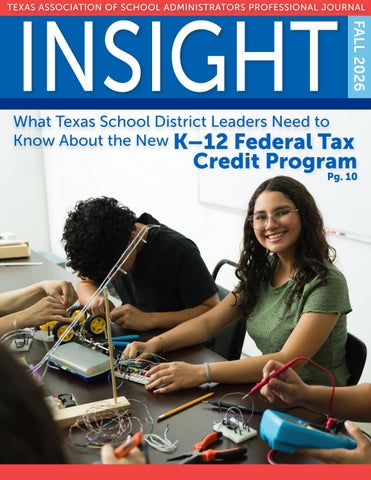
What Texas School District Leaders Need to Know About the New K–12 Federal Tax
Credit Program
Pg. 10
The TASB Risk Management Fund offers comprehensive coverage and no-cost services to help you manage risk — so you can focus on what matters.
That’s the Value of Fund Membership.
tasbrmf.org
FALL 2026
INSIGHT
Volume 42 No. 3 FEATURE ARTICLES & COLUMNS What Texas school district leaders need to 10 know about the new K-12 federal tax credit program by Brian Woods HIGHER EDUCATION Leading school improvement through inquiry by Michelle Abrego, Celia Scott and Jesus Abrego
14
TSPRA VOICE You don’t get to decide what the story is by Jennifer Hines
17
TECH TAKE Mental health in K-12: the great screen time debate by Justin A. Lascsak
20
LEADERSHIP PERSPECTIVE The Texas Promise: redefining accountability by Georgeanne Warnock
26
The community owns the Promise by Michelle Rinehart
FALL 2026
3
OFFICERS
Roosevelt Nivens, President, Lamar CISD Jeannie Meza-Chavez, President-Elect, San Elizario ISD Walter Jackson, Vice President, La Porte ISD
DEPARTMENTS
Chris Moran, Past President, San Angelo ISD
EXECUTIVE COMMITTEE
TASA Professional Learning Calendar
5
Theresa Capistran, Region 1, Point Isabel ISD
President’s Message
7
Michelle Cavazos, Region 2, Gregory-Portland ISD
Executive Director’s View
9
Jo Ann Bludau, Region 3, Hallettsville ISD Paula Patterson, Region 4, Crosby ISD Stacey Brister, Region 5, Little Cypress-Mauriceville CISD Jeff Pack, Region 6, Livingston ISD Carnelius Gilder, Region 7, West Sabine ISD
INSIGHT EDITORIAL STAFF
Bobby Rice, Region 8, Harts Bluff ISD Brad Owen, Region 9, Burkburnett ISD Kevin Brown
Georgeanne Warnock, Region 10, Terrell ISD
Deputy Executive Director, Member Engagement & Support
Charles Dupre
DesMontes Stewart, Region 11, Gainesville ISD
Director, Communications & Marketing
Amy Francisco
Executive Director
Coordinator, Graphics & Multimedia Editorial Director
Chris Skinner, Region 12, Teague ISD Mark Estrada, Region 13, Lockhart ISD
Marco A. De La Cueva
Bryan Allen, Region 14, Clyde CISD
Dacia Rivers
Aaron Hood, Region 15, Robert Lee ISD
INSIGHT is published quarterly by the Texas Association of School Administrators, 406 East 11th Street, Austin, Texas, 78701-2617. Subscription is included in TASA membership dues. © 2026 by TASA. All rights reserved.TASA members may reprint articles in limited quantities for in-house educational use. Articles in INSIGHT are expressions of the author or interviewee and do not necessarily represent the views or policies of TASA. Advertisements do not necessarily carry the endorsement of the Texas Association of School Administrators.
Greg Brown, Region 16, Perryton ISD Scott Harrell, Region 17, Sudan ISD Michael Valencia, Region 18, Forsan ISD Rosy Vega-Barrio, Region 19, Tornillo ISD John Chapman, Region 20, Comal ISD
AT-LARGE MEMBERS
About TASA
Michelle Barrow, Newton ISD King Davis, Killeen ISD
TASA’s mission is to promote, provide and develop leaders who create and sustain studentcentered schools and develop future-ready students.
Tory Hill, Channelview ISD
We envision innovative, future-focused leaders for every public school student.
Roland Hernandez, Legislative
Nicole Poenitzsch, Bellville ISD
COMMITTEE CHAIRS
Laurelyn Arterbury, Advocacy Michelle Rinehart, Professional Learning
EDITORIAL ADVISORY COMMITTEE
Walter Jackson, La Porte ISD, Chair Laurelyn Arterbury, Advocacy Roland Hernandez, Legislative Michelle Rinehart, Professional Learning Stacey Edmonson, Texas State University
4
INSIGHT
TASA Professional Learning Calendar For details on TASA professional development events, see https://tasanet.org/professional-learning.
Date
Event
Location
OCTOBER 6
N2 Learning Assistant Principal Leadership Academy, North Houston Cohort, Session 1
Cypress
6
N2 Learning Assistant Principal Leadership Academy, West Texas Cohort, Session 1
Clyde
7
N2 Learning Assistant Principal Leadership Academy, East Texas Cohort, Session 1
Tyler
8
N2 Learning Assistant Principal Leadership Academy, Northwest Dallas Cohort
Justin
8-11
txEDCON 2026 (TASA/TASB Convention)
Houston
15
N2 Learning Assistant Principal Leadership Academy, San Antonio Cohort, Session 1
San Antonio
20-21
N2 Learning Principals' Institute Session 2
Frisco
20-22
CMSi Curriculum Management Audit Training Level 1
Austin
27-29
Future-Ready Superintendents Leadership Network (FRSLN) Event 1
Texarkana
28
N2 Learning Assistant Principal Leadership Academy, Virtual Cohort, Session 1
Online
3
N2 Learning Assistant Principal Leadership Academy, North Houston Cohort, Session 2
Cypress
3
N2 Learning Assistant Principal Leadership Academy, West Texas Cohort, Session 2
Clyde
3-5
Small Schools Network Event 1
Henrietta
4
N2 Learning Assistant Principal Leadership Academy, East Texas Cohort, Session 2
Tyler
5
N2 Learning Assistant Principal Leadership Academy, Northwest Dallas Cohort, Session 2
Justin
11
N2 Learning Assistant Principal Leadership Academy, San Antonio Cohort, Session 2
San Antonio
18
N2 Learning Assistant Principal Leadership Academy, Virtual Cohort, Session 2
Online
1-2
N2 Learning Principals' Institute Session 3
Tomball
1-2
N2 Learning Executive Leadership Institute Session 2
Tomball
2-3
TASA First-Time Superintendents Academy Session 2
Round Rock
8
N2 Learning Assistant Principal Leadership Academy, North Houston Cohort, Session 3
Cypress
8-10
Future-Ready Superintendents Leadership Network (FRSLN) Event 2
Arlington
9
N2 Learning Assistant Principal Leadership Academy, East Texas Cohort, Session 3
Tyler
9
N2 Learning Assistant Principal Leadership Academy, San Antonio Cohort, Session 3
San Antonio
NOVEMBER
DECEMBER
FALL 2026
5
PROUD TEXAS to be founded and operated in
COMMERICAL PLAYGROUNDS & WATER PARKS
KRAFTSMAN 800.451.4869
kraftsmanplay.com
PLAYGROUNDS| SPLASH PADS | SHADE & SHELTERS TABLES & BENCHES | OUTDOOR FITNESS & SPORTS
KEEP YOUR EYES UP
T
here is an analogy I heard recently that has stayed with me. A turtle and a giraffe can occupy the same space and see two completely different worlds.
The turtle sees what is directly in front of it. Its perspective is close to the ground. The giraffe, standing in the very same place, can see above the trees and much farther into the distance. Neither perspective is necessarily dishonest. They are simply seeing from different vantage points.
Roosevelt Nivens
PRESIDENT’S MESSAGE Most educators did not enter this profession because we are indifferent to what people think. We want to do good work.
Upon hearing this, I immediately thought about leadership. If you have served in public education for any length of time, you know what it feels like to be criticized. Make a difficult decision, and someone will disagree with it. Announce a new initiative, and someone will question why you are doing it. Post good news about your district, and it sometimes takes only minutes for the comments to become a stage on everything someone believes is wrong with public education. And if we are not careful, we can begin leading from the comment section. I understand the temptation. We care deeply about the communities we serve. Most educators did not enter this profession because we are indifferent to what people think. We want to do good work. We want people to understand our intentions. And when our motives, decisions, or even our character are questioned, it can hurt. But leadership requires discernment. Not every criticism should be ignored. In fact, some of the most important growth in my leadership has come from people willing to tell me something I did not necessarily want to hear. We should listen. We should remain humble enough to ask whether there is truth in the criticism. We should correct course when necessary. But listening is different from surrendering our direction. There will always be people evaluating decisions from the ground immediately in front of them. They may see one classroom, one experience, one tax bill, one social media post, one decision, or one moment in time. As leaders, we are responsible for seeing those things and looking farther down the road. We have to see the child entering kindergarten today and the workforce that child will enter more than a decade from now.
FALL 2026
7
We have to think about the teacher standing in a classroom today and whether we are building a profession talented people will still choose tomorrow. We have to make decisions for students we may never meet and solve problems our communities may not fully experience for years. That is the giraffe’s responsibility. The danger comes when the voices closest to the ground convince us to lower our vision. I have watched good leaders become discouraged because a handful of comments made them question work that was producing meaningful results for thousands of children. I have watched leaders spend enormous amounts of energy responding to the loudest voices while the people quietly depending on them to lead received less of their attention. We cannot do that. A comment section is not a scientific sample of your community. The loudest voice is not automatically the most representative voice. And criticism is not always evidence that you are moving in the wrong direction. Sometimes leadership means having enough humility to listen and enough conviction to keep going. Texas public education needs leaders who can do both. So, when criticism comes this year, and it will, read it with discernment. Look for the truth in it. Learn what you can. Make adjustments when they are warranted. But do not allow someone else’s limited view to determine how far you are willing to see. There are children depending on us to keep looking beyond what is immediately in front of us. Keep your eyes up. Keep your vision long. And keep doing the work. Why … because our students deserve it and they deserve you!
Roosevelt Nivens TASA President Superintendent, Lamar CISD
8
INSIGHT
THE RULES HAVE CHANGED. IT'S TIME TO ADJUST THE GAME PLAN.
A
reporter recently asked a college football coach what he thought about the relatively new Name, Image and Likeness (NIL), which allows college athletes to earn money from endorsements, sponsorships and other uses of their personal brand. To paraphrase the coach without his “colorful” language: “It doesn’t matter what I think. These are the rules, and we have to adjust to them if we want to win. My job is to take full advantage of the new system, and win.”
Kevin Brown
EXECUTIVE DIRECTOR’S VIEW The rules of the game have changed, and if you want to win, you need to know the rules and take action.
Guess what? Federal school vouchers are coming to your community next year. The rules of the game have changed, and if you want to win, you need to know the rules and take action. This could mean significant new funding opportunities for every school district in Texas and for the students you serve. Nearly every citizen in your community will be able to get a $1,700 tax credit by donating to a Scholarship Granting Organization (SGO), which can be any 501(c)(3) organization that accepts the money and then grants it to students for educational expenses on a broad list of approved options. Like college football and NIL, it's kind of going to be the wild, wild West, and it is important for school district leaders to know how this works in order to best serve your community. You’ve got to act fast, because this all starts on January 1, 2027. The football coaches who have adjusted fastest to the changing rules of college football are winning today. Just ask Indiana football fans, whose program went from an unlikely contender to national champion under a coach who quickly figured out how to make the new landscape work to his team’s advantage. Don't miss "What Texas school district leaders need to know about the new K-12 federal tax credit program" on pages 10-12. In this article, Dr. Brian Woods, TASA's Deputy Executive Director of Advocacy, provides an extensive explanation about how the federal voucher funding works. This summer, TASA hosted two informational webinars for TASA members on the topic with the assistance of AASA and will continue to share information on it. The next opportunity will be during txEDCON 2026, the TASA/TASB Convention Oct. 8-11 in Houston, where Brian and Kelly Rasti from TASB will present a concurrent session called, "Federal Scholarship Tax Credit: What Texas School Leaders Need to Know." Like it or not, the rules have changed, and so must our game plan. The key to winning will be to educate yourself, your board and your community about the opportunities that exist for your students, and then take full advantage of them.
Kevin Brown TASA Executive Director
What Texas school district leaders need to know about the new K-12 federal tax credit program BY BRIAN WOODS A new federal tax-credit program could fundamentally change the way families access educational services—and create both significant opportunities and significant challenges for Texas public school districts. The Federal Tax Credit Scholarship Program, enacted as part of the One Big Beautiful Bill Act in July 2025, is scheduled to begin accepting donations for the 2027 tax year in January 2027. The program is permanent and uncapped, although each state’s governor must decide annually whether the state will participate. Gov. Greg Abbott has already opted Texas in for 2027. For Texas superintendents and school district leaders, the question is no longer simply whether this program will affect public education. The more important question is: How should districts respond?
UNDERSTANDING THE BASIC MECHANICS
TAX CREDIT FOR DONORS
Individuals making qualifying cash contributions to a Scholarship Granting Organization (SGO) can receive a nonrefundable federal tax credit of up to $1,700 annually, limited by federal tax liability. Treasury’s October 1 proposed regulations allow up to $3,400 for joint filers when each spouse makes qualifying contributions; unused credits generally can carry forward five years. Unlike a deduction, which reduces taxable income, a credit reduces federal tax owed dollar-for-dollar.
The October 1 guidance clarifies an especially important point for public school leaders: Students do not have to leave public school to benefit. Subject to federal rules, scholarships may cover qualifying K–12 expenses at public, private or religious schools. 10
INSIGHT
SCHOLARSHIP GRANTING ORGANIZATIONS (SGOS) SGOs are nonprofits providing scholarships to eligible students. Under proposed regulations, they generally must be 501(c)(3) public charities, keep scholarship contributions in separate accounts, verify student eligibility and qualifying expenses, prohibit donor earmarking for particular students, and meet federal reporting and audit requirements. SGOs generally must serve at least 10 students attending more than one school. SGOs—not donors—control scholarship funds.
ALLOWABLE EXPENSES
Donations can be used only for qualified K-12 education expenses, potentially including tuition, transportation, books and supplies, uniforms, tutoring, special-needs services, supplementary programs, dual enrollment, technology and internet access, and potentially more based on final rules.
For Texas public school students, eligible costs could include tutoring and supplemental instruction, certain special-needs services, books and instructional materials, computers and educational technology, transportation and dual enrollment. The program should therefore be viewed as more than a private school tuition initiative. Properly structured SGOs could create a new source of tax-incentivized private giving for students remaining in Texas public schools.
A WIDE REACH
Treasury estimates approximately 96% of K–12 students in participating states could qualify. Household income generally must be at or below 300% of area median gross income, adjusted for household size. Treasury’s October 1 proposed regulations include safe harbors and exclude certain noncash imputed income. Eligibility is not based on school district boundaries.
Why this matters to public school districts The program creates a new education marketplace in which families may be able to combine multiple sources of scholarship funding to purchase educational services. Consider a hypothetical family with two children attending a Texas public school.
One SGO might offer $1,600 for tutoring and $2,200 for after-school programming. A church-affiliated SGO might offer thousands more for summer and afterschool programs. A national organization might offer funding for STEM programs, while an employer-affiliated SGO might provide money for aerospace-related classes.
District leaders will need to think carefully about questions such as:
The result is a marketplace in which families could potentially assemble educational opportunities from multiple providers rather than relying exclusively on the comprehensive set of services provided by their local school district. That creates opportunities for districts, but it also raises fundamental questions about the future of public education.
•
Who is considered a public school student when students participate in multiple educational settings?
•
How much of a student's education must occur in the district?
•
How should districts account for student outcomes when students receive services from outside providers?
•
What happens to assessment and accountability requirements when students move between providers?
These are not merely compliance If students can move in and out of proquestions. They go to the heart of what grams based on scholarship availability, it means to operate a public education districts could face greater volatility in system. enrollment, staffing and programming. A successful microschool, specialized Should a district program or private provider could emerge near a district campus. Popular programs create or partner with could expand rapidly while others bean SGO? come difficult to sustain. For district leaders, this could make long-term budgeting and staffing more difficult. In other words, the traditional public school model may increasingly be competing in a marketplace rather than operating within a relatively stable system of public provision.
The accountability question The program also raises important questions about public accountability. School districts operate under extensive transparency requirements and are accountable to elected school boards, state requirements, federal requirements and the communities they serve. There are significant questions around whether similar transparency will exist when SGO dollars flow to private schools, vendors and other providers.
One of the most consequential choices facing Texas districts may be whether to establish an SGO or transform an existing nonprofit entity into one. A student-specific SGO could provide enhanced services—such as afterschool programs, arts, clubs, STEAM opportunities or transportation—to a targeted group of students based on need. A school or district SGO could provide an enhanced package of services to students across a campus or district. A community SGO could bring public and private schools together, allowing scholarship dollars to follow students across educational settings. Each approach has advantages and risks. A district-specific strategy could allow public schools to capture some of the new philanthropic resources while preserving access to enrichment opportunities. A communitywide
approach could provide families with greater flexibility but could also accelerate the unbundling of public education. District leaders should be particularly cautious about supplanting existing public funding. The objective should not be to use private scholarship dollars simply to replace services that the district previously funded with public dollars.
What should Texas superintendents do now? 1.
2.
3.
4.
5.
6.
Assess your community's philanthropic capacity. Do you have employers, foundations, alumni, businesses and individual donors who could support an SGO? Examine your existing foundation. Does your district already have a 501(c) (3) that could potentially become an SGO, or would a separate organization make more sense? Understand the operational requirements. Can your organization manage donor intake, accounting, eligibility, scholarship disbursement, technology, compliance and outcome reporting? Determine what you want to accomplish. An SGO should begin with a clear educational strategy—not simply the desire to capture new money. Consider partnerships. A district may be better positioned by partnering with other districts, community organizations or existing nonprofits rather than building an SGO independently. Protect the core mission of public education. Perhaps most importantly, leaders should ensure that participation in the new marketplace strengthens rather than inadvertently weakens the district's commitment to providing a comprehensive, equitable public education.
FALL 2026
11
Existing foundations may NOT provide a starting point An existing education foundation may offer a significant advantage, but becoming an SGO is not simply a matter of changing the foundation's name. Under federal law and Treasury’s proposed regulations, an SGO generally must spend at least 90% of applicable income on scholarships for qualifying students and meet additional operating and compliance requirements. If a foundation spends substantial funds in other ways, leaders should consult legal and tax advisers to determine whether its structure can meet SGO rules or a separate organization or partnership makes more sense. If standing up a new organization, leaders could consider beginning with a small founding board of community leaders committed to public education, defining a broad mission, establishing appropriate governance and legal structures, and obtaining nonprofit status. Districts should expect to need legal assistance. There is also an important timing consid-
972-361-6303
eration. IRS applications for 501(c) (3) status can take four to six months, while questions remained as of June 2026 about whether provisional status would be sufficient for an organization to be listed as an SGO for the 2027 tax year.
A strategic decision, not simply a funding opportunity The federal tax credit program will create a new source of educational funding, but its implications extend far beyond fundraising. For Texas school districts, the central strategic question is whether and how to participate in an emerging education marketplace while maintaining the principles that have traditionally defined public education: universal access, equity, transparency, accountability and a commitment to serving every student.
The federal program is scheduled to move from implementation to reality quickly. Treasury and the IRS released substantive proposed regulations on October 1, 2026, and companion temporary regulations establish key implementation procedures. Qualifying contributions begin January 1, 2027. Treasury states that taxpayers, states and SGOs may rely on the proposed regulations for qualifying contributions beginning in 2027 if the applicable proposed rules are followed consistently, while the rulemaking process continues. Texas superintendents and school boards should use the months ahead to understand the rules, assess their communities, evaluate their foundations and decide what role, if any, their districts want to play. The most important question is not simply how public schools can access the new money. It is how public school leaders can use this new environment to expand opportunities for students while protecting the public mission, equity and accountability that make public education unique.n
Some districts may determine that establishing an SGO is the right strategy. Others may decide to partner with an existing organization—or wait until the rules and marketplace become clearer. Brian Woods is TASA's Deputy Executive Either way, doing nothing should be a Director of Advocacy and the former deliberate decision, not an accidental superintendent of Northside ISD. one.
keith.alberts@tpspool.org
More Information
tpspool.org
HIGHER EDUCATION Leading school improvement through inquiry by Michelle Abrego, Celia Scott and Jesus Abrego
E
very superintendent faces complex problems, often without simple solutions. Whether the challenge involves teacher retention, chronic absenteeism, advanced coursework, leadership succession, or artificial intelligence, educational leaders make important decisions every day while balancing competing priorities and limited resources. The question is rarely whether a problem exists. The more difficult question is how to understand the problem well enough to make informed decisions that lead to meaningful improvement..
Improvement begins with understanding the problem Effective educational leaders resist the temptation to implement quick solutions before fully understanding the problem. Rather than beginning with predetermined answers, effective leaders take time to gather evidence, listen to multiple perspectives, examine current practices, and identify factors contributing to the challenge. This deliberate process of inquiry enables leaders to make informed decisions grounded in evidence (Bryk et al., 2015). By asking thoughtful questions and developing a deep understanding of the problem before acting, educational leaders are better positioned to implement meaningful improvements that positively impact students, staff, and their communities.
Inquiry in practice One place educational leaders learn and apply this leadership approach is through the Dissertation in Practice (DiP), a requirement in many Doctor of Education (EdD) programs. Rather than beginning with a question from the research literature, a Dissertation in Practice begins with a meaningful local problem identified by an educational leader. This local problem, termed a Problem of Practice, is a persistent challenge in a leader's own organization that can be supported by local evidence, such as student achievement data, attendance patterns, surveys, or other organizational information. Beginning with a local problem helps ensure the dissertation focuses on an issue leaders can influence and that the findings are directly relevant to their own organization. As a result, the purpose is not simply to study the problem but to generate information that can improve practice and support informed leadership decisions. While the Dissertation in Practice is one structured way to learn this leadership process, the approach extends well beyond any doctoral program. Every day, superintendents, principals, and other educational leaders use these same principles as they work to improve their schools. As educational leaders, they identify important local problems, gather evidence, listen to the people most affected, seek to understand the factors contributing to the challenge, and use what they learn to guide improvement. Whether the work is part of a doctoral program or part of everyday leadership, the goal remains the same: making better decisions that improve practice and strengthen outcomes for students.
14
INSIGHT
Challenges facing Texas From challenge to schools change This leadership approach is particularly valuable, as today's school leaders face increasingly complex challenges that rarely have simple solutions. Consider some of the issues currently occupying the attention of school leaders across Texas: • Teacher recruitment and retention • Chronic student absenteeism • Artificial intelligence and responsible implementation • Leadership succession • Student engagement and belonging • Limited school funding and rising employee health care costs (AASA & ASBO International, 2026; Blad, 2026; Dey & Edison, 2026) Effective leaders recognize that meaningful improvement begins with understanding the factors contributing to the problem before selecting a course of action. For example, a district experiencing teacher recruitment and retention challenges may initially identify compensation as the primary concern. However, a deeper investigation may reveal that inadequate mentorship, limited principal support, excessive workload, school culture, or a lack of professional growth opportunities are more significant contributors. Similarly, chronic student absenteeism may appear to be an attendance problem on the surface but may instead reflect underlying issues such as transportation barriers, family circumstances, mental health concerns, school climate, or low student engagement. In both cases, examining the contributing factors enables leaders to move beyond treating symptoms and toward developing targeted interventions that address the underlying causes of the problem.
The challenges facing Texas schools are not abstract or theoretical. They are the complex realities superintendents, principals, and teachers navigate every day. Whether improving student outcomes, strengthening the educator workforce, or responding to changing community needs, these challenges require thoughtful inquiry, rather than quick solutions. These are the very issues that often become Problems of Practice for doctoral students working in schools and districts, providing opportunities for leaders to investigate root causes, generate evidence, and design meaningful, sustainable improvements. In fact, principals, district administrators, and other practicing educational leaders enrolled in Tarleton State University's doctoral program have investigated many of these same challenges within their own schools and districts. Each study began with a local Problem of Practice identified by an educational leader and supported by evidence from that leader's own school, district, college, or organization. These studies have examined issues such as teacher retention, principal mentoring, participation in advanced mathematics, literacy interventions, artificial intelligence in education, student belonging, workforce readiness, and postsecondary success. Each project generated findings that educational leaders can use to improve practice and make informed decisions. Consider the experience of a campus principal and doctoral student who transformed a challenging school issue into an opportunity for meaningful improvement. During the months following the COVID-19 pandemic, she observed a noticeable increase in maladaptive student behaviors, including classroom disruptions, emotional dysregulation, and peer conflict. Rather than viewing these behaviors simply as discipline problems
requiring immediate intervention, she recognized them as symptoms of a more complex issue and sought to understand their underlying causes. By examining campus data, gathering input from teachers, students, and families, and reviewing current research, she identified unmet social-emotional needs, inconsistent classroom practices, and limited opportunities for relationship building as key contributing factors. Using these findings, she designed and implemented a schoolwide social-emotional learning (SEL) program tailored to her campus. Since implementation, the campus data indicates the school has documented improvements in student behavior, classroom climate, and office discipline referrals.
The leadership lesson A common lesson across these projects is that today's educational challenges are complex, and few have simple solutions. Rather than relying on assumptions, educational leaders gather local evidence, examine current practices, and use what they learn to make informed decisions. Whether the challenge involves teacher retention, student achievement, leadership development, workforce readiness, or student support services, the goal remains the same: to better understand the problem, improve practice, and strengthen outcomes for students. Perhaps the most important lesson is that meaningful improvement begins with asking good questions and gathering useful information. Regardless of the issue, effective leaders take time to understand the factors contributing to the problem. They listen to students, teachers, families, and community members, examine current practices, and use evidence to guide decisions. The Dissertation in Practice provides one structured way to develop these leadership skills, but the larger lesson extends beyond any doctoral program. Every
FALL 2026
15
superintendent already uses inquiry when making decisions. The difference is whether that inquiry is intentional, systematic, and grounded in local evidence. Effective leadership is not about having all the answers; it is about asking the right questions, using evidence to better understand local challenges, and making informed decisions that improve schools. The next time your district faces a complex challenge, resist the urge to ask, "How do we fix it?" Instead, ask, "What do we need to understand before we decide what to do?” n
References AASA, The School Superintendents Association, & ASBO International. (2026). Rising premiums, falling opportunities: The budgetary impact of health care costs on school districts. https:// www.aasa.org/docs/default-source/ resources/reports/rising-premiumshealth-care-costs-report.pdf Blad, E. (2026, July 21). Why superintendents' top concerns changed fast in 2026. Education Week. https:// www.edweek.org/leadership/ why-superintendents-top-concernschanged-fast-in-2026/2026/07 Bryk, A. S., Gomez, L. M., Grunow, A., & LeMahieu, P. G. (2015). Learning to improve: How America's schools can get better at getting better. Harvard Education Press.
DES I G N TO EM P OWER LE ARNERS
16
INSIGHT
Dey, S., & Edison, J. (2026, June 1). Texas schools say they still face budget difficulties despite $8.5 billion boost. Texas Tribune https:// www.texastribune.org/2026/06/01/ texas-school-funding-teacher-qualityspecial-education/
Michelle Abrego is an associate professor at the Fort Worth campus of Tarleton State University. Celia Scott is associate department head, EdD program coordinator and associate professor at the Fort Worth campus of Tarleton State University. Jesus Abrego is professor and department head of the Department of Educational Leadership & Technology on the Fort Worth campus of Tarleton State University.
TSPRA VOICE You don’t get to decide what the story is by Jennifer Hines
W
hen you're 23 years old, new to television news, and convinced you're going to be the next Katie Couric, you want the lead story. I was all three when I started my first reporting job in Abilene.
So, when Abilene ISD was considering closing neighborhood schools due to declining enrollment, I thought I’d hit the jackpot. A big school district decision, upset parents, and lots of controversy — this was television gold. But then the parents started talking. They weren’t talking about enrollment numbers, district facility and staff efficiency, or balancing budgets. They were talking about what those schools meant to their families and their neighborhoods. They talked about walking to school, generations of families attending the same campus, and the relationships built over decades. I’ll never forget one emotional parent who called the proposed closure a “travesty.” I quickly learned something that has stayed with me for 26 years: You don't get to decide what the story is. Your audience does. As a young reporter, I thought my job was to find the story. I eventually learned my job was to find the story that mattered to people. Another story from those first years taught me something else. I produced a sweeps piece comparing Waco ISD's new stadium and the potential impact of artificial turf on Abilene ISD's playoff opportunities. The story was later played at an Abilene ISD school board meeting as the Shotwell Stadium committee made its case for turf. The board ultimately approved it that night. The committee gave me a nice pen with my name engraved on it. Twenty-six years later, it still sits on my desk as a reminder that the stories we tell can make a difference. I don't claim a television story changed the outcome. But I learned that communications could do more than report a decision. It can help people see a decision from a different perspective. Today, I find myself asking the same questions, only now I’m on the other side of the table. As school communicators, we can become very good at communicating what we think people need to know. We have initiatives, programs, acronyms, data, and strategic plans. We can explain the “why” behind every decision because we've been living and breathing it for months. But parents are living a completely different story. They're thinking about whether their child is safe. Whether they're learning. Whether their teacher knows them and cares about them. Whether they're having a good experience at school. They're also thinking about drop-off and pickup, lunch money, permission slips, game times, and whether that science project is due tomorrow or Friday. They aren't necessarily thinking about our instructional framework. And that's where communication becomes much more than a press release, social post, or graphic.
FALL 2026
17
Communicators belong at the strategic table. Often, communicators are invited into the process well after the decisions have already been made. At that point, they aren't part of the strategy; they’re the person handed the strategy and asked to explain it. By then, it's too late to ask some of the most important questions. What will parents ask? What does this mean for teachers? When should staff hear this? What could people misunderstand? How could this be perceived? And, perhaps most importantly, what will the headline be? Those aren't questions that take us away from the work of educating students. They're questions that help us make sure the work is understood. I understand why communications can feel like a secondary function in a school district. Our core mission is to educate students. But communication affects whether people understand the decisions we make, trust the people making them, and support the work happening in our schools. These things may not show up on an accountability dashboard, but they absolutely affect how a district operates.
promise you aren’t connecting. And if I need a second cup of coffee and a Google search to understand your Facebook post, chances are your audience does, too. Not every Texas school district has a communications department. Sometimes communication is one person's responsibility added to an already full job description. Others may wonder why they need a communications professional at all because communication doesn't directly impact student outcomes. But that's exactly why your Communications person needs a seat at the leadership table. A communicator doesn't replace the curriculum expert, testing expert, finance expert, or operations expert. We bring something different to the table: the perspective of the person sitting on the other side of the decision. The best time to think about communications isn't when the decision is finished. It's while you're making it. Because your district is going to have a story. Every decision has one, every initiative has one, and every crisis certainly has one.
Sometimes, the difference is simply perspective. For example, take student discipline. A district could say, “One hundred students were assigned to the alternative school for vaping.” That's true. But so is, “Less than one-half of 1% of our students were assigned to our alternative school for vaping.”
You don't get to decide what the story is. But you can decide whether you've thought about how your audience will hear it before someone else does. n
Those statements create very different perceptions. That's not spinning the story; it’s giving context. Our job isn't to make the numbers look better; it's to make sure people understand what the numbers mean. At Tyler ISD, that's particularly important because our size can make raw numbers sound enormous compared with much smaller East Texas school districts. As I remind our local reporters, it's not apples to apples if you compare our numbers to surrounding school districts; you must look at the percentage. The same principle applies to the words we use.
Jennifer Hines is chief communications officer at Tyler ISD.
At Tyler ISD, we once considered launching an online learning option called B.L.A.D.E., Blended Learning And Digital Education. It sounded great internally and explained the model, but would a parent easily understand what the acronym B.L.A.D.E. was? Probably not. The name “Tyler Tech” immediately communicates something different. It sounds like technology, and, most importantly, it gives the audience a clue about what we're talking about. That's the communicator's job. We speak fluent alphabet soup in public education: PLC, MTSs, TEKS, CCMR, ARD, IEP — the list goes on. But our parents shouldn’t need an education degree or a decoder ring to understand what we’re telling them. You may be communicating, but I 18
INSIGHT
What Does it Mean to Be An American? Strengthen your Social Studies curriculum with FREE, tested K-12 Lessons on America’s founding documents, principles, & civic institutions. Ensure that your students become well-informed, responsible citizens who know what it means to be an American. AMERICAN HERITAGE EDUCATION FOUNDATION
A trusted non-partisan, non-profit educational organization for over 30 years!
WWW.AMERICANHERITAGE.ORG
Developed by Texas school leaders through TASA, "The Texas Promise" outlines a bold, shared vision for student success, strong leadership, and thriving public schools across Texas.
It’s an invitation. To lead. To innovate. To shape the future together.
Explore the vision. Join the conversation. tasanet.org/the-texas-promise
TECH TAKE Mental health in K-12: the great screen time debate by Justin A. Lascsak
S
creen time has become an embattled topic of conversation in 2026. Debating screen time in a general use context, without consideration of the content that is accessed, however, is a disservice to how screen time affects mental health. Additionally, public education has been caught in the crosshairs of the argument, primarily due to the mass adoption and integration of educational technology in the classroom, especially since the COVID-19 pandemic. Delineation of intentionally active versus passive use of digital media for activities is critical in the debate of how screen time may contribute to mental health issues.
Defining digital dementia Digital dementia, a term coined in 2012, broadly defines behavioral patterns manifested and associated with excessive screen time. Originally used to describe the cumulative effect of gaming, digital dementia has become widely associated as a descriptive expression for the resultant collection of behaviors from over exposure to digital media, particularly with younger people. The symptomatic behaviors include cognitive impairment or decline, impeded problem-solving skills, motor skill impairment, lower reading and language skills, short-term memory lapses, and spatial awareness issues. The overall reliance on connected technology for quick access to information can lead to a lack of memory retention, concentration, and attention. Prolonged use of digital devices often means less physical activity and human interaction (social-emotional development), both of which affect overall mental health. Additionally, blue light exposure from screens for over eight hours is disruptive to sleep quantity and quality. However, there are also indications that balanced use and moderation of digital media consumption can have a positive effect on cognitive and social outcomes for people.1 Dementia is a collection of symptoms that describe an overall mental decline, and technology use has become a risk factor of that syndrome, hence the derivative term digital dementia. A key element of digital dementia is the passive use of technology and digital media and how that may accelerate cognitive decline. The generation of adults who did not grow up in the current digitally saturated environment show impeded effects of digital dementia. The basic challenges for using and adapting to technology for everyday use can sometimes be frustrating, but it can also be a sign of mental exercise. Increased social access and support, such as engaging in and communicating regularly with friends and family through digital media platforms, can decrease isolation and loneliness thereby improving mental stimulation. The ability to offload some cognitive functions and the general reliance on digital platforms and tools can slow or bridge gaps in cognitive decline, aiding in maintaining personal independence.2 What can be concluded from these referenced studies is that young, developing brains are more susceptible to dementia-like behaviors due to overexposure and passive use of technology. Inversely, we see that older, developed brains may benefit from the added activities and stimuli provided by modern technology devices, thereby possibly reducing dementia-like symptoms. Digital dementia is not an officially diagnosable condition, but this objectively shows that moderation and intentionality with content are vital to digital media being beneficial, especially during youth development.3 How digital dementia for current and upcoming generations will be expressed in adulthood remains to be seen.
20
INSIGHT
The social media and AI chatbot effect A common argument surrounding the negative effects of screen time often seems to coalesce around the passive use of social media and, more recently, artificial intelligence (AI) chatbots. It is noteworthy that there has also been an increase in product liability lawsuits against digital service providers such as social media platforms. The early part of 2026 saw landmark lawsuits and trial verdicts against social media platforms, holding them responsible for the addictive nature of their services and contribution to mental health issues. Social media is the most common category of applications used by young people, and social media platforms are associated with both positive and negative effects. Positive interactions include increased engagement with family and friends, connecting with similar minded peer groups, and keeping in touch with local and world news. However, the potential negative effects and resultant harms of social media outweigh the list of positives. Social media is designed to keep users engaged, which can lead to excessive use of the platforms. The content and notifications can trigger dopamine (often referred to as the reward center in the brain), and overstimulation can lead to loss of self-control and develop into addiction. Overstimulation and overexposure can disrupt sleep patterns and quality, increase anxiousness — including the fear of missing out (FOMO) — and has shown an increased risk in the development of attention deficit hyperactivity disorder (ADHD) symptoms. Increased time on social media can lead to a decrease in human interaction time which can heighten isolation, loneliness, and depression.
in one’s personal appearance and/or livelihood. Cyberbullying is another common issue associated with social media platforms and contributes to lower self-esteem, self-harm, and suicidal thoughts. Finally, inappropriate content can be unintentionally or algorithmically accessed and/or intentionally shared which can cause content desensitization and further exasperate the negative effects of social media.4, 5 Anecdotal evidence suggests that people generally believe that AI chatbots assist and improve their communication and composition skills, along with being engaging enough to alleviate feelings of anxiety or loneliness. Companion model (sycophantic) AI is designed to be empathic, agreeable, and supportive of a user regardless of the conversational content, oftentimes without recognition of context. Sycophantic AI is where the risk factors become elevated, especially with younger people. Having little to no resistance or challenging one’s thoughts and feelings can inhibit social emotional growth. Peer comparison along with the developing brain’s proclivity for impulsive behavior, heightened risk taking, and formation of intense emotional attachments can be a driving force for adolescents to
turn to AI chatbots for validation and adulation. Escaping from reality may become increasingly dangerous as the chatbot continuously learns to placate the user including reinforcement of negative inputs. Documented cases and studies, along with filed lawsuits, have pointed out and alleged that sycophantic AI chatbots have led to social isolation, self-harm, and suicide. Additionally, AI chatbots do not recognize the existence of mental health issues that may be a factor of the inputs from a user, further exasperating the misguided encouragement or recommendations it offers to the user. Sycophantic AI chatbots have an overly agreeable design along with a general lack of contextual knowledge and guardrails, in the same ways human interaction would, which means they are poor replacements in support of mental health.6, 7
Benefits of EdTech Educational technology (EdTech) tools can be described as any digital-based platform that provides an educational purpose or need; therefore, EdTech tools are synonymous with screen time.
Additionally, content feeds can lead to feelings of inadequacy and dissatisfaction
FALL 2026
21
Several barriers to EdTech access — infrastructure, connectivity, devices, procurement, training, and support – should be considered and addressed to ensure successful implementation of EdTech tools. The SAMR (Substitution, Augmentation, Modification, Redefinition) model is a widely accepted framework for the thoughtful and purposeful integration of EdTech tools. A study examined how EdTech tools within the various stages of the SAMR model affected student performance and outcomes compared to students that used traditional, non-digital methods. Essentially, the study was a screen versus paper examination that showed that EdTech tools, at each level of the SAMR model, outperformed its non-digital (paper) counterpart in student academic achievement. The percentage of academic gains over a three-year period was significantly greater and higher overall when using EdTech tools whereas the traditional tools had minimal percentage gains in scores over the same period. Key factors noted were that teachers were adequately trained on the EdTech tools for pedagogical infusion and encouraged to progressively use each level of the SAMR model. The first two levels, Substitution and Augmentation, provide minimal changes to traditional methods but are fundamental for digital competencies, preparation, and capability for the upper two levels. Modification and Redefinition is where EdTech tools provide options that are not present or possible with traditional methods; additionally, the study showed significant academic improvements at these levels by promoting collaboration, creativity, and critical thinking. Students mentioned the convenience of using EdTech tools as well as increased engagement provided through digital media such as interactive and immersive technologies. Teachers noted that EdTech tools and the SAMR model increased student participation and motivation.8
22
INSIGHT
The 2025 Blaschke Report by CoSN (Consortium for School Networking) reflected several of the ideas and concerns previously mentioned in this article while consistently stating the need for balanced, thoughtful, intentional, and targeted screen time use, both in educational environments and at home. Digital devices are ubiquitous in society and children are already exposed to, and often grossly immersed in, digital media prior to their enrollment in K-12. Parents and guardians may have feelings of guilt related to the amount of time and content they allow, which further conflates the screen time debate. Educators must be cognizant of this and use EdTech tools to supplement their teaching to create a strong pedagogical and technological connection for childhood development and academic performance. EdTech tools are commonly vetted and/ or procured on behalf of teachers to have specific goals and measurable outcome targets to ensure consistency in the classroom. The business model of EdTech platforms relies heavily on academic growth results to keep K-12 schools as paying partners. Additionally, EdTech tools provide several advantages to students that are not available via traditional methods: a.) differentiation/personalization — platforms that adjust to an individual’s learning style and progress; b.) transformation — options only available via digital media such as virtualized exploration and field trips, programming and coding, 3D design and printing, esports, or generative AI; c.) accessibility and assistive technologies — commonly leveraged in special education, particularly with individualized education programs (IEPs) and 504 accommodations, to provide equitable educational opportunities; and d.) workforce readiness — the job market has evolved and increasingly requires computing skills, including jobs that would not exist without digital media and devices.9
Guidance and legal considerations The 87th Texas Legislature (2021), during the height of the COVID-19 pandemic, passed HB 3489 which required the TEA to develop digital device use (i.e., screen time) guidelines by the 2023-24 school year. The law required school districts to adopt a policy on the integration of digital devices within the school environment, in which a district could adopt the guidelines that were to be provided by TEA.10 Leveraging student mental and physical health, TEA released its guidance with a heavy lean toward intentionality surrounding screen time. The guidelines additionally recommended blocking access to social media platforms on the school network as well as banning cell phone use by students during instructional time.11 The 88th Texas Legislature (2023) further codified restrictive measures with student device use and access with the passage of HB 18, also known as the Securing Children Online through Parental Empowerment (SCOPE) Act. The bill was passed to protect minors under the age of 18 from certain online content while ensuring parents had greater control over what their children have access to. A key provision of this law, as it relates to mental health, is the duty to prevent harm. The SCOPE Act specifies that digital service providers must prevent a minor’s access to harmful material and information in several categories, most of which have a direct relation to mental health. School districts also got new legal requirements related to providing devices to students, primarily in the form of internet content filtering.12 The 89th Texas Legislature (2025) passed HB 1481, which prohibits students from using personal devices during instructional time at school.13 It seems likely that we will see more bills related to screen time and/or mental health in the upcoming Texas legislative session.
The federal government has recently joined the screen time debate, despite the stalling of key bills (such as KOSA, COPPA 2.0, and KOSMA) over the past couple of years. As of early 2026, many of these bills were on the move by being reintroduced, amended, and/or rewritten. URL links for each of the bills are included in the references section to see where each bill is currently at in Congress. A snapshot of federal bills, as of May 2026, that are relevant to the screen time and mental health conversation: • Children’s Online Privacy Protection Act (COPPA): originally passed in 1998, it was amended in 2025 for the first time since 2013. The 2025 amendment included stronger privacy protections and targeted advertising restrictions. COPPA is still applicable to children under the age of 13.1⁴ • COPPA 2.0: passed the Senate in March 2026 and sent to the House; would expand COPPA to children under the age of 17.1⁵ • Kids Online Safety Act (KOSA): originally passed the Senate by a vote of 91-3 in 2024, but stalled in the House (non-matching companion bill); reintroduced in the Senate during the current 119th U.S. Congress.1⁶ • Kids Internet and Digital Safety (KIDS) Act: House replacement for its KOSA companion bill.1⁷
“
The results from the SAT ® Suite
of Assessments serve as a key tool for establishing and measuring academic benchmarks, guiding both instructional planning and
”
student development.
Tracey Morman, Director of Counseling/College and Career Readiness, Amarillo ISD, Texas
• Kids Off Social Media Act (KOSMA): Initially stalled, but reintroduced and discussed during Senate hearings in early 2026.1⁸ The end of April saw some activity in Congress focused on AI chatbot companions and age-based verification. Nothing specific will be referenced here as there are several bills introduced that are still in the early stages of the process. However, the most notable bills that seem to be gaining traction are the GUARD Act and CHATBOT Act. Additionally, in May 2026, a new Surgeon General Advisory was released in relation to screen use. The information within the advisory shares a common theme with this article regarding harmfully passive and excessive screen time usage. The advisory offers recommendations that can be utilized by families, schools, health providers, legislators, and digital media platforms to combat the negative effects of screen time.1⁹
Conclusion Educational technology is a specific set of digital media tools, and the narrative must be shifted because not all screen time is the same. The screen time debate should center around intentionally active versus passive use of technology and digital media. The developing brains of youth may be more prone to the negative effects of prolonged passive digital media
Advance Student Success with the SAT Suite Tools to strengthen college and career readiness. Skills Insight™ Meaningful and actionable data Bluebook™ Secure, fully digital testing experience BigFuture® School Scores, career insights, and next-step guidance AP Potential™ Helps identify students ready for AP coursework Explore more details at sat.org/satsuite © 2026 College Board.
exposure. The balance between intentional and passive screen time for minors should be a focal point of concern for parents and guardians; meanwhile, educators should concentrate on intentional (guided, focused, and collaborative) use of technology, and the elimination of passive screen time, while in the classroom. Many states, including Texas, have passed bans on personal devices during the school day, thereby aiding in the removal of distractions and access to passive screen time use. Content filtering and monitoring school-issued devices further limits the ability of students to use technology in a non-educational manner while in class. Therefore, multiple controls against the unbridled use of technology in education are already in place. Further, allowing educators to use educational technology tools in K-12, without imposing superficial screen time limits, can be a positive part of a student's education as opposed to a negative weight on their mental health. n
References 1 Ali Z, Janarthanan J, Mohan P (September 23, 2024), “Understanding Digital Dementia and Cognitive Impact in the Current Era of the Internet: A Review.” Cureus 16(9): e70029. doi:10.7759/cureus.70029 2 Ferguson, Abbey (April 14, 2025), “Digital Dementia: Does Technology Use by ‘Digital Pioneers’ Correlate to Cognitive Decline?” https://news.web.baylor.edu/news/story/2025/digital-dementia-does-technology-use-digital-pioneers-correlate-cognitive-decline 3 Lockett, Eleesha (February 2, 2004), “Can Excessive Screen Time Cause ‘Digital Dementia’? https://www.healthline.com/health/ parenting/digital-dementia 4 Office of the Surgeon General (2023), “Social Media and Youth Mental Health.” https://www.hhs.gov/sites/default/files/sg-youthmental-health-social-media-advisory.pdf 5 Robinson, Lawrence (March 11, 2026), “Social Media and Mental Health: Are You Addicted to Social Media?” https://www. helpguide.org/mental-health/wellbeing/social-media-and-mental-health 6 Sanford, John (August 27, 2025), “Why AI companions and young people can make for a dangerous mix.” https://med.stanford. edu/news/insights/2025/08/ai-chatbots-kids-teens-artificial-intelligence.html 7 Sparks, Sarah D. (March 26, 2026), “AI Chatbots Tend Toward Flattery. Why That’s Bad for Students.” https://www.edweek.org/ technology/ai-chatbots-tend-toward-flattery-why-thats-bad-for-students/2026/03 8 Zhanat Umarova, Zhalgasbek Iztayev, Zhanar Kemelbekova, Sabira Akhmetova, Elmira Abdrashova, Saule Botayeva, and Zhansaya Ashirbekova, "The Impact of the SAMR Model with IT-Enhanced Tools on Student Performance" International Journal of Information and Education Technology, vol. 15, no. 4, pp. 760-766, 2025. 9 Sved, Cooper (2025), “Screens in Balance: Education, Technology, and Community Conversations. Consortium for School Networking” 10 https://statutes.capitol.texas.gov/?tab=1&code=ED&chapter=ED.38&artSec=38.023 11 https://tea.texas.gov/texas-schools/school-boards/hb-3489-guidance-updated.pdf 12 https://capitol.texas.gov/tlodocs/88R/billtext/html/HB00018F.htm 13 https://capitol.texas.gov/tlodocs/89R/billtext/html/HB01481F.htm 1⁴ https://www.ftc.gov/news-events/news/press-releases/2025/01/ftc-finalizes-changes-childrens-privacy-rule-limiting-companies-ability-monetize-kids-data 1⁵ https://www.congress.gov/bill/119th-congress/senate-bill/836/all-actions 24
INSIGHT
1⁶ https://www.congress.gov/bill/119th-congress/senate-bill/1748/all-actions 1⁷ https://www.congress.gov/bill/119th-congress/house-bill/7757/all-actions 18 https://www.congress.gov/bill/119th-congress/senate-bill/278/all-actions 1⁹ Office of the Surgeon General (2026), “Surgeon General’s Warning on the Harms of Screen Use.” https://www.hhs.gov/sites/ default/files/us-surgeon-generals-advisory-warning-on-the-harms-of-screen-use.pdf
Justin A. Lascsak is chair of the TETL Board of Directors.
FALL 2026
25
LEADERSHIP PERSPECTIVE The Texas Promise: redefining accountability by Georgeanne Warnock
A
ccountability is not simply a system imposed upon schools. It is also a reflection of what leaders choose to value.
For years, public education has operated within accountability systems dominated by easily quantified outcomes — test scores, ratings, graduation rates, and other important metrics. These measures matter, but they were never intended to tell the entire story of a student, a classroom, or a school community. Article 5 of The Texas Promise: A Vision for Public Education challenges us to build something broader: accountability systems grounded in shared leadership, holistic growth, and future readiness. That begins with a leadership choice. We can comply with required measures while also asking better questions. Are our students growing academically from where they began? Do they feel known, valued, and connected to their school? Are they learning to collaborate, communicate, solve problems, and persevere? Are they discovering their strengths and interests? When they leave us, are they prepared not simply to graduate, but to navigate college, a career, military service, citizenship, relationships, and life? Those outcomes may be more difficult to place on a dashboard, but that does not make them less important. Therefore, we must broaden our definition of accountability. Broadening accountability means broadening who helps define success. Article 5 calls for communities and educators to codesign fair and transparent accountability systems. That requires leaders to listen — to students, teachers, families, employers, and community members — and to build measures that reflect the aspirations a community holds for its children. This is not an argument for less accountability. It’s an argument for more meaningful accountability. It’s not about lowering expectations. It’s about raising them. Leadership means refusing to allow the measures we are given to become the limits of what we value. We can meet state expectations while simultaneously creating local systems that illuminate student growth, celebrate belonging, identify areas for improvement, and demonstrate whether our graduates are truly ready for what comes next. Ultimately, what we choose to measure communicates what we believe matters. Our responsibility as leaders is to ensure that the story we tell about our schools is as rich, complex, and full of possibility as the students we serve.
Georgeanne Warnock is the superintendent of Terrell ISD and was a member of the Visioning Refresh Writing Team that developed The Texas Promise, which you can learn more about at tasanet. org/the-texas-promise.
26
INSIGHT
The community owns the Promise by Michelle Rinehart
I
n rural Texas, we often talk about our schools as the center of our communities. Community members set their calendars around school events. School colors drive wardrobe decisions across town. Our schools help create a collective identity that runs deep. This strong connection between a community and its schools creates an even greater opportunity: to see the work of educating our children as something we all collectively own. For Texas schools to reach their next level of excellence, we must see student success as a shared community responsibility. Public education works best when we stop thinking of the school district as an organization that serves a community and start thinking of education as work the entire community owns. The Texas Promise offers this vision of public education as both locally led and collectively owned. Bringing that vision to life requires superintendents to lead not only within their organizations, but also as civic leaders who connect the people, institutions, resources, and aspirations of a community around its children. So, how do we build that shared ownership? First, treat external relationship-building as core superintendent work. Philanthropic organizations, employers, higher education, nonprofits, and other community institutions can bring resources and opportunities to students that districts could never provide alone. In Alpine, we coordinated philanthropic investments that renovated 60-year-old playgrounds, launched certified nursing preparation pathways, revitalized classrooms with modern furniture, and provided world-class professional learning for our staff. These investments reflect the power of aligning community resources around the needs of children. These partnerships don't just happen. Superintendents must deliberately spend time outside the organization to connect the needs of its children with the assets of the broader community. Second, map community assets beyond the school system. This summer, Alpine ISD launched Bucks at Work, partnering with local employers to provide paid internships for our high school students. By asking what learning opportunities already existed throughout Alpine—not simply what we could provide within our schools — we expanded the boundaries of our educational system and met important needs for our students and local employers. Finally, invite partners into problems, not just solutions. When our community set out to address its persistent status as a childcare desert, we brought community organizations together to solve the problem — not simply endorse a district-developed solution. The result was the Alpine Child Development Center, which created 70 new licensed childcare spots and is jointly funded by anchor institutions across our community. The shift is simple but powerful: Replace “Here is what the district needs from you,” with “Here is a challenge facing our children. What could we build together?” In rural Texas, the local district may operate our schools, but the community owns the promise we make to its children. When we invite our communities to share that ownership, we expand not only the resources available to our students, but our collective sense of responsibility for their future. That is how community partnership becomes more than support for our schools — it becomes a civic responsibility.
Michelle Rinehart is the superintendent of Alpine ISD, the chair of the TASA Professional Learning Committee, and was a member of the team that developed The Texas Promise, which you can learn more about at tasanet.org/the-texas-promise.
FALL 2026
27
TASA Corporate Partners TASA is grateful to our 2026–27 corporate partners for their support. Each level of the Corporate Partner Program is designed to offer our partners quality exposure to association members. Partners at the President’s Circle, Platinum, and Gold levels may customize special events and opportunities.
PRESIDENT’S CIRCLE BuyBoard Purchasing Cooperative Coryell Roofing & Construction, Inc. Curriculum Associates DLR Group Huckabee Imagine Learning lead4ward Lone Star Investment Pool Milliken & Company N2 Learning Onflo (formerly K12 Insight) PBK Stantec TASB Energy Cooperative TASB Risk Management Fund ThoughtExchange Trusted Capital Group (TCG), a HUB International Company VLK Architects WRA Architects PLATINUM Amira Learning Audio Enhancement Bailey Education Group, LLC CENTEGIX® ClassLink College Board EF Education First Houghton Mifflin Harcourt Lone Star Furnishings, LLC NWEA Performance Services PMY Scholastic Upward Communities GOLD Corgan E3 Entegral Solutions, Inc. Edmentum LPA, Inc. Pfluger Architects Savvas Learning Company Schneider Electric
Learn more about TASA’s Corporate Partner Program https://tasanet.org/partnerships/corporate-partners/
SILVER AlphaBEST Education BRW Architects Carnegie Learning Harris County Department of Education
INDECO NoRedInk Raise Your Hand Texas SFE – Southwest Foodservice Excellence Stephens Inc. Walsh Gallegos Kyle Robinson & De Los Santos P.C. Zearn BRONZE Abilene Christian University BTC Cardonex Claycomb Associates, Inc. Cory Hartsfield, P.C. GPD Group Hellas Construction Just Right Reader Lexia Linebarger Attorneys at Law Marsh Agency MJYC.tech Modern Classrooms Project PowerSchool Really Great Reading SchoolStatus Texas Political Subdivisions, JSIF