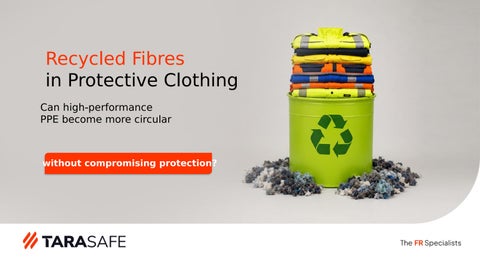
Recycled Fibres in Protective Clothing Can high-performance PPE become more circular
without compromising protection?
High-performance fibres like aramids & other FR materials retain significant value even after a garment reaches end-of-life. Recycling them can Reduce textile waste
Conserve critical resources
Lower carbon emissions
Reduce dependence on virgin fibres
Mechanical Recycling
Mechanical Recycling
Garments are sorted, deconstructed, shredded and blended with virgin fibres before being spun into new protective textiles.
Garments are sorted, deconstructed, shredded and blended with virgin fibres before being spun into new protective textiles.
Mechanical recycling is currently the more established route, while chemical recycling remains largely developmental for complex protective fibres.
Recycled fibres can help Reduce waste
Support circular manufacturing
Lower carbon impact
Strengthen resource security
Conserve raw materials
They can also help manufacturers meet growing sustainability and ESG expectations.
Recycling PPE isn't as simple as recycling conventional textiles.
Key challenges include Contamination from hazardous substances Reduced fibre length after shredding Multiple fibre compositions Colour consistency Maintaining FR, thermal and mechanical performance Meeting safety standards
Sustainability cannot come at the cost of protection.
As recycling technologies advance, recycled technical fibres are finding their way into
Arc-rated garments
Military uniforms & protective gloves
Firefighting gear
FR workwear
The future of PPE is moving towards
High performance
+
Circularity
+
Responsible resource use
PROTECT PERFORM RECYCLE REPEAT