t
r
a
d
i
c
i
o
taos news
n
e
s OCT. 1, 2026
A artes A
tradiciones special edition
R
T
S
h o n o ra r a n u e st ro s h É ro e s
t
r
a
d
i
c
i
o
n
e
s
contents
4 8 12 Angie Yazzie
Taos Pueblo potter extends the micaceous clay tradition
Woven at the Crossroads
Juanita Lucero
Couse-Sharp exhibition traces traditions along the northern frontier
Was the Taos Pueblo artist and the model the same woman?
rt in Taos has never belonged only to museums, galleries or history books. It lives in the hands of the people who make it, in families who pass knowledge from one generation to another and in traditions that change each time an artist makes them her own. That living connection runs through this year’s Tradiciones: Artes. Taos Pueblo potter Angie Yazzie learned to recognize and gather clay from her mother and grandmother. Today, her micaceous pottery carries both that inheritance and the story of her own journey as an artist. At the Couse-Sharp Historic Site, “Weaving the New World” follows threads that have crossed cultures and centuries. Pueblo, Diné, Hispanic and Mexican textile traditions met through trade, migration, colonization and artistic exchange, creating something distinctive to this place. Contemporary weavers continue that conversation today. Another story asks us to look more closely at an artist who nearly disappeared from the historical record. Taos Pueblo painter Juanita Lucero left behind a small body of known work and a tantalizing mystery: Was she the same Juanita Lucero who modeled for Catharine Carter Critcher and perhaps other members of the Taos Society of Artists? We may never know the complete answer, but asking the question helps restore an overlooked Native woman artist to the story of Taos art. Taken together, these stories remind us that tradition is not something fixed in the past. It is clay gathered from the earth, threads crossing on a loom and a nearly forgotten name rediscovered. It is what we inherit, what we create and what we leave for those who come next.
A
artes
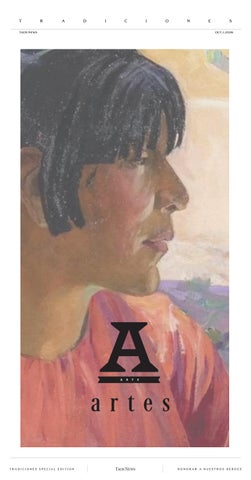
A WORK FROM THE COUSE-SHARP WEAVING EXHIBITION, PAGE 8
Ellen Miller-Goins, magazine editor
A
ROBIN MARTIN, OWNER
CHRIS WOOD, ADVERTISING DIRECTOR
SHANE ATKINSON, SALES MANAGER
SEAN LINTON, COLLECTIONS
CHRIS BAKER, PUBLISHER
MARY CHÁVEZ, BUSINESS MANAGER
ISABEL PEÑA MEDIA SPECIALIST
GEOFFREY PLANT, EDITOR
SHAWN ROBERTS, CIRCULATION DIRECTOR
MELISSA TYLER CLASSIFIEDS
ELLEN MILLER-GOINS, MAGAZINE EDITOR
LINDSEY RAE GJORDING, MEDIA SPECIALIST
HEATHER OWEN, DIGITAL EDITOR
PAUL GUTCHES, CREATIVE DIRECTOR
LYLE PADILLA ASSISTANT CIRCULATION MANAGER
TRADICIONES: ARTES
EMILY SENDER, COPY EDITOR
2
R
T
S
TAOS NEWS 226 ALBRIGHT ST. TAOS, NM 87571 575-758-2241 TAOSNEWS.COM
SARA KOLLIG, PRODUCTION MANAGER JASON RODRIGUEZ GRAPHIC DESIGN
TA O S N E W S / O C T. 1 , 2 0 2 6
Photo: Morgan Timms, Taos News
Awarded for Excellence. Inspired by You.
The Art Of
Wanda Lucero, Your Taos State Farm Agent
Working as your elected official for over 3 decades has been a privilege. I’m honored to represent your unique interests and needs year-in and year-out.
Like a good neighbor, State Farm is there.®
575-737-5433 wanda@wandalucero.com
Honored to be Taos’ Best Agency 16 Years Running
To our sponsors for making this year’s Tradiciones edition our biggest ever.
I always want to hear how I can help our communities. Call me at 575-770-3178.
taos community foundation
Roberto “Bobby” J. Gonzales State Senator, District 6 Democrat
Taos Community Foundation invites our community to express themselves through philanthropy towards the causes, nonprofits, and places they care about. Our vision is a community where everyone can thrive, and we invite you to join us as we practice the art of collective giving. Learn about our work by scanning the QR code and signing up for our e-newsletter! WWW.TAOSCF.ORG | 575-737-9300 | INFO@TAOSCF.ORG | 115 LA POSTA RD. STE A TAOS, NM 87571
TRADICIONES: ARTES
3
TA O S N E W S / O C T. 1 , 2 0 2 6
t
r
a
d
i
c
i
o
n
e
s
Here I am. This is who I am Taos Pueblo potter Angie Yazzie and the micaceous clay tradition she shares BY RICK ROMANCITO
FEW YEARS AGO, Angie Yazzie was having a hard time dealing with stress. As one of the premier micaceous clay potters in the world, the Taos Pueblo native was enjoying great popularity for her work, but nagging reminders of the struggles she endured getting to this point were always in the back of her mind. In the beginning, “I was going from gallery to gallery, trying to hustle my work and trying to get known, and get to know people in that way. I was very, very shy, so that took a lot of courage to do that.” She said it was like laying herself bare for all to judge. “I’d go in there naked pretty much, just saying here I am, this is who I am.” Yet, despite her honesty and humility, there were still “a lot of nos.” Even today, with all the awards and praise her work has been given, “You just have to look at it like it’s not a sure thing. That’s the business end of it. It has to be sometimes, but you know, I get a lot of yeses too. So, there’s that.” Eventually, she got to a point where she had to open herself to providence. “I had to make myself a piece for my own sanity,” she said. “I was like, things are so up and down for me — some sharp up, sharp down — good things, bad things, within a week, within days. I couldn’t function well. I couldn’t understand. Am I sad, am I happy? What am I today or tomorrow?” That was when she turned to a piece of the glittery micaceous clay that has been her favored medium all these years. “I made myself a piece that had sharp ups, cut into it, which I do a lot of … Some went straight down, like when I was angry or upset or whatever. And then I left the tips, the four directional tips of course, the directions to give me a place to come back to.” She called it her “Journey Pot” because it reflected “my journey.” And when she was done, she just put it on the counter in her studio and started looking at it, “and it was able to remind me of the high times, the good times that are on their way. I had to remember the good times that do come. And they are on their way, no matter what.”
A
ANGIE YAZZIE WITH 10 POINT PRAYER POT/COURTESY PHOTOS
SLIM JOURNEY POT
TRADICIONES: ARTES
4
TA O S N E W S / O C T. 1 , 2 0 2 6
Taos Pueblo A living Legacy
Unesc
orld W o
i te eS g a Herit
SINCE 1992
Taos Pueblo was designated a National Historic Landmark in 1965 and recognized as a UNESCO World Heritage Site in 1992, honoring its extraordinary historical and cultural significance and its enduring legacy as one of the world’s most important Native American communities—a testament to the diverse peoples, cultures and traditions that shape our shared history.
Taos Pueblo Hours: Sunday—Saturday 9am—4pm Winter hours are subject to change. Please see events calendar for any changes to schedule.
www.taospueblo.com
Taos Community Foundation invites our community to express themselves through philanthropy towards the causes, nonprofits, and places they care about. Our vision is a community where everyone can thrive, and we invite you to join us as we practice the art of collective giving. Learn about our work by scanning the QR code and signing up for our e-newsletter! WWW.TAOSCF.ORG | 575-737-9300 | INFO@TAOSCF.ORG | 115 LA POSTA RD. STE A TAOS, NM 87571
TRADICIONES: ARTES
5
TA O S N E W S / O C T. 1 , 2 0 2 6
t
r
a
d
he piece is a conventional style wood-fired micaceous clay pot that features incised design features. The design appears as steps leading the eye downward, but stopped and reversed into an upward almost flamelike shape. “Now, that piece is helping a lot of other people,” she said. Besides that initial piece she made for herself, Yazzie has made others. It has become one of her most popular designs. One piece, a large pot measuring 20 inches wide by 17 inches high, took a firstplace award. “People really connected with the story behind the Journey Pot.” When interviewed for this story, Yazzie and her son Eric Marcus had just returned from Indian Market, the huge exposition of Native American art that takes place each August in Santa Fe. “We work together,” she said, “we’re a team. It was great. We got three blue ribbons between the two of us and a best in division, so … we had a great time. A lot of new people, old friends. Networking is really important. There’s no jealousy, we all help each other. You know, we’re brothers and sisters, and in that way, that world. We make it a point to say hello to each other.” The year 2025 also brought another
T
i
c
i
blessing in the form of major professional recognition when the Art Institute of Chicago selected her “Ceremonial Bowl, 2024” for its collection. “I was blown away by that, and very honored, of course. They actually went through a gallery in Santa Fe, Andrew Fisher Fine Pottery. They’ve been carrying my pottery since the beginning, I guess.” The clay she uses, locally collected and infused with glittering chips of mica, has been used by Pueblo and Apache potters since before Spanish colonial New Mexico. When fired in a traditional wood pit, it becomes durable utilitarian ware. The first so-called “bean pots” were used for cooking stews and soups. Once the region drew the interest of tourists and art collectors in the 20th century, creative design elements began to appear, and the pottery became mostly stand-alone works of art. With such a long and honored tradition among her people, one most often passed down from grandmother to mother to daughter, Yazzie said she looks to the clay with more reverence than one might imagine. “The pottery saved me,” she said. “The clay has saved me in so many ways. And, I thank grandma for that. She was the one that trained me as a child to do this. She
o
n
e
s
trained me to go into the mountains and pick the right clay, hunt for the right pits, where the moisture is. She told me: ‘You see where the roots are coming right out at you? That’s where the clay is.’ All that time I was being trained and I didn’t even know it.” Born in 1965, Yazzie learned potterymaking from her mother, Mary Archuleta, and her maternal grandmother, Isabel Archuleta. Her folks ran a curio shop on the southeast side of Taos Pueblo. As a young girl of about 7 or 8, this was where it all began. Today, when Yazzie finds a good piece of clay in the ground, she said her first thoughts are: “I will take this and feed my family with it. It’s thanking our creator. Every society, everybody throughout the world, it’s universal, has a responsibility through the creator to take care of things. Clay is life-giving, it has a heartbeat, it tells a story. It’s powerful.” Rick Romancito retired from the Taos News in 2020 after 30 years as an award-winning journalist, arts editor and photographer. He is of Native American heritage and lives in Taos, where he also displays his own award-winning artwork in a local gallery. A
RIGHT: Angie Yazzie, 'Black Journey Bowl', 2026 BELOW: Angie Yazzie,
"Journey Platter", 2025, Tim Cook Collection (Apple CEO)
COURTESY PHOTOS
TRADICIONES: ARTES
6
TA O S N E W S / O C T. 1 , 2 0 2 6
TRADICIONES: ARTES
7
TA O S N E W S / O C T. 1 , 2 0 2 6
t
r
a
d
i
c
i
o
n
e
s
Woven
at the crossroads Couse-Sharp exhibition traces traditions along the northern frontier BY ELLEN MILLER-GOINS
A
DETAIL FROM A NEW MEXICAN COLCHA, EARLY 20TH CENTURY.
PHOTOS BY ELLEN MILLER GOINS
TRADICIONES: ARTES
8
blanket can tell a story long after the people who made, wore and traded it are gone. Look closely at an old Rio Grande blanket and its threads can lead south into Mexico, west into Diné country and back centuries to Pueblo weavers working on upright looms before Europeans arrived. A Saltillo diamond might turn up in a New Mexican textile. A blanket made on a Navajo loom might carry Hispanic colors and designs. In Taos, those traditions did not exist at a comfortable distance from one another. “All of these textiles would have been moving through Taos and Northern New Mexico,” Davison Koenig, executive director and curator of the Couse-Sharp Historic Site, said. “Navajo and Pueblo weavers would have seen the Saltillos coming up from the south; everyone was studying everyone else.” That exchange lies at the heart of “Weaving the New World: Hispanic Textiles and Their Influence on the Northern Frontier,” which opened at Couse-Sharp in December 2025. The original exhibition included a major display of Saltillo sarapes, but that portion has moved to another museum. The continuing show in the 1830s Luna Family Chapel now centers on Rio Grande weaving, with striking historic and contemporary examples as well as several textiles historically described as Navajo “slave blankets.” Couse-Sharp has extended the chapel exhibition through Nov. 21. “I’ve spent 50 years studying these textiles, and I still have more questions than answers,” guest curator Mark Winter said of his work studying Southwestern textiles. Rather than treating Pueblo, Diné, Hispanic and Mexican traditions as separate lines, the exhibition follows the ways they met through trade, migration, colonization and artistic exchange. “We want guests to come away understanding that nothing in the Hispanic textile world happened in a vacuum,” Koenig said. “Everything that happened here in the New World involved Indigenous input and iconography; everything was a melding of the cultures.” Before wool Indigenous peoples in the Southwest developed sophisticated textile traditions using cotton and other plant fibers long before Spanish settlement. Pueblo weavers worked on upright frame looms; Diné weavers later adopted related loom technology. Spanish colonists brought sheep, wool and European treadle looms. Northern New Mexico became a meeting place for those traditions. Textiles provided warmth, clothing, trade goods and income, while techniques, materials and designs moved between peoples. Saltillo sarapes from Mexico became especially influential. Rio Grande weavers absorbed and reworked their geometry, including central diamonds and patterned borders, creating a regional vocabulary rather than simply copying Mexican designs. By the late 19th century, Rio Grande weaving was changing again. Winter described the years from roughly 1880 to 1900 as a period of experimentation. Around 1900, Chimayó emerged as a distinctive weaving tradition. The larger lesson is visible throughout the chapel: Tradition survives not by remaining frozen, but because makers decide what to preserve, borrow and transform.
TA O S N E W S / O C T. 1 , 2 0 2 6
Honorar a Nuestros Héroes 2026
Ballet Taos Community Partner
Tradiciones Citizen of the Year and Nine Unsung Heroes
Powering meaningful change
HELP TAOS CELEBRATE ITS HEROES
For over 10 years, our Community Rewards® program has enriched the places we call home. Whether supporting community services, arts, education, environment and wildlife, or healthcare, together we can do great things! In 2025, the Nusenda Foundation granted $1 million to 108 programs.
This year we’ll honor nine Unsung Heroes and our Citizen of the Year with a special live event on taosnews.com and Facebook.com/taosnews
Now that’s The Power of WE®!
Wednesday, October 7 · 6:00 pm
Learn more at nusenda.org @NusendaCU |
Find the Tradiciones Heroes section in the Thursday, October 8th edition
Insured by NCUA | Equal Opportunity Lender
PROTECTING
MORE THAN POWER Every investment in wildfire mitigation helps protect homes,
essential services and the neighbors who are most vulnerable when emergencies strike—while helping preserve the natural beauty and character of the Taos community we all call home.
kitcarson.com THIS INSTITUTION IS AN EQUAL OPPORTUNITY PROVIDER AND EMPLOYER
TRADICIONES: ARTES
9
TA O S N E W S / O C T. 1 , 2 0 2 6
t
r
a
d
i
c
i
o
n
e
s
LEFT: Davison Koenig points to the features that characterize a Saltillo-style slave blanket. aBOVE: This 19th century Skein winder was used to take wool from either a ball or spinning wheel
and make a skein.
TRADICIONES: ARTES
10
TA O S N E W S / O C T. 1 , 2 0 2 6
FAMILY THREADS Artist Juanita Lavadie spent decades tracing Vallero star blankets woven by members of her Montoya family in El Valle, between Peñasco and Trampas in Taos County. Her research began with stories from family elders and helped connect previously anonymous textiles with individual weavers and family histories. “Originally these blankets were woven for family, not as market pieces,” Lavadie said. Many remained in family hands rather than museums or collections. Her oral-history work also corrected stories dealers and collectors had attached to some weavers, restoring family knowledge to the record. Her work is a reminder that a textile can move through markets and museums while its fullest meaning remains with people who remember who made it, why and for whom.
THE DARKER SIDE OF EXCHANGE Cultural exchange in the Southwest was not always voluntary. The chapel exhibition also confronts systems of servitude and enslavement that shaped textile production. Winter has spent decades examining textiles historically called Navajo “slave blankets,” pieces that may combine Diné weaving structures with Hispanic colors or design traditions. His interest began with an unusual Saltillostyle blanket he bought in 1977. He noticed sectional weaving lines associated with Navajo weaving and a continuous warp characteristic of a Navajo loom. His mentor, textile scholar Joe Ben Wheat, told him, “If ever there’s a Navajo slave blanket, this is it.” Some examples have documented histories; others remain speculative, a distinction Winter repeatedly emphasized. “It’s my decision, and that doesn’t make it true. It just means it’s my opinion,” he said of some attributions. One blanket displayed in the Luna Chapel is connected to a Diné woman who escaped Bosque Redondo while trying to return home, only to be captured again and forced to weave. The textiles are beautiful, but the history they carry can be painful.
STILL ON THE LOOM The exhibition also makes clear that Rio Grande weaving did not end with the historic pieces on the chapel walls. Chimayó artists Irvin and Lisa Trujillo brought that living tradition into the exhibition’s lecture series. Koenig said one aim was to show that weaving is not only craft, heritage and cultural knowledge, but fine art that must continue into another generation. Irvin, a seventh-generation Chimayó weaver, recalled his father Jake Trujillo’s insistence on making one-of-a-kind pieces rather than simply repeating a successful design. Irvin has carried that philosophy into work that can push familiar Chimayó and Vallero forms toward abstraction and asymmetry. Lisa studies photographs of historic textiles, trying to understand who made them and how techniques developed, then brings those discoveries back to the loom. Their daughter Emily, an eighth-generation weaver, has added her own contemporary sensibility. In that sense, the Trujillos are doing what the exhibition suggests weavers here have done for centuries: looking closely, learning from other makers and making something of their own. Winter calls himself a “material culturalist,” interested above all in what objects reveal about the people and cultures that produced them. “The textiles themselves,” he said, “tell their own story.” In the Luna Chapel, those stories remain woven into the cloth: commerce and artistry, family and displacement, continuity and change. The lines cross. The colors migrate. And Taos sits directly in the path.
SOURCES This story draws on materials from the CouseSharp Historic Site’s “Weaving the New World” exhibition and gallery guide; Couse-Sharp’s recorded 2026 lecture series, including Mark Winter’s talks on Saltillo sarapes, Rio Grande weaving, crosscultural influence on enslaved Navajo weavers, and Pueblo and Diné weaving traditions; Juanita Lavadie’s “Weaving in El Valle: Northern New Mexico Textile Traditions”; Irvin and Lisa Trujillo’s “Chimayo Weaving: The Artists’ Perspective”; and earlier Taos News reporting.
TOP: Saltillo-style Rio Grande blanket, ca. 1875 BOTTOM: Early New Mexican spinning wheel in foreground with a Rio Grande blanket, ca. 1850 on a 19th century Hispanic loom.
TRADICIONES: ARTES
11
TA O S N E W S / O C T. 1 , 2 0 2 6
t
r
a
d
i
c
i
o
n
e
s
Juanita Lucero mystery the
BY CINDY BROWN
Were the Taos Pueblo artist and the model the same woman?
I
N “IMAGE MAKERS FOR AMERICA: In Pursuit of a National Identity,” this year’s summer and fall show at the Couse-Sharp Historic Site, there is a portrait called “Taos Pueblo Woman” by Catharine Carter Critcher. The painting is on loan from the collection of Amanda and Eric Garland. The woman in the painting has been identified by the painting’s owner as Juanita Lucero, based on similarities to other well-known paintings of her in the collection of the Eiteljorg Museum of American Indians and Western Art in Indianapolis, including a 1924 painting called “Juanita Lucero and Her Children.” Lucero was thought to be a frequent model for Critcher, the only woman who was a full member of the Taos Society of Artists. Working during the same era, there was a Taos Pueblo painter named Juanita Lucero. Are the painter and the model the same person?
CATHARINE CARTER CRITCHER’S “TAOS PUEBLO WOMAN,” IDENTIFIED AS JUANITA LUCERO ON LOAN TO THE COUSE-SHARP HISTORIC SITE/COURTESY AMANDA AND ERIC GARLAND
WHAT CAN BE DOCUMENTED There is not much information available on the life of Juanita Lucero. Census data shows that a Juanita Remigio Lujan was born at Taos Pueblo, likely on Oct. 9, 1895, to Maria Ascencion Martinez Lujan and Remigio Lujan. She married Eliseo Lucero, and they had one child, Leandro Lucero. The couple also raised Isidro (Sonny) Mirabal, who was born in 1932. Also, about 1895, a Juanita L. Lucero was born at Taos Pueblo. She moved to Bernalillo by the time she was five years old and later married Atanacio Sandoval.
MODEL & PAINTER In the 1920s, Lucero was a model for Critcher and perhaps other Taos Society of Artists painters as well. It appears possible that Lucero took up painting herself because of her association with these painters, much like several other Taos Pueblo men who were models.
PAINTING BY JUANITA LUCERO, WATERCOLOR ON PAPER, 7.5 BY 4.75 INCHES / COURTESY DANIEL KASZA COLLECTION
TRADICIONES: ARTES
12
TA O S N E W S / O C T. 1 , 2 0 2 6
N
ative American art collector Daniel Kasza owns three paintings by Lucero. He said, “I have an affinity for Taos artists, having been visiting there since I was six years old. Works by Native women artists are special to me, as they are underrepresented in the genre of Indigenous painting, especially early artists. Taos, in particular, had some early women artists whose works I’ve long admired: Pop Chalee, Eva Mirabal, Tonita Lujan, Eloisa Bernal, Rita Martinez and Juanita Lucero. That is significantly larger representation of female artists than other tribes in the 1930s. I’ve been fortunate enough to have all but Tonita Lujan’s works in my collection.” Kasza said he believes Lucero was painting in the 1920s based on information he found through Browns Trading Company of Arizona when it had a Lucero painting for sale. “Presumably she began her career in painting after meeting Catharine Carter Critcher and was probably influenced by the many artists she had met and sat for, as well as her friendship with Catharine,” he explained. “Her works are scarce and I am fortunate to have three of them in my collection.” The Millicent Rogers Museum has one watercolor painting by Lucero. “It was purchased by the museum in 1991 from Jerry Weisberg,” MRM Curator Claire Motsinger said. The date of the piece is approximately 1940, and the title is ‘Taos Pueblo People going into Church Yard.’”
“TAOS PUEBLO PEOPLE GOING INTO CHURCH YARD,” WATERCOLOR BY JUANITA LUCERO, C. 1940/COURTESY MILLICENT ROGERS MUSEUM
HER STYLE Other Taos Pueblo models also became painters, and their work has been written about, including a story by David Witt, then curator at the Harwood Museum, for a 2003 exhibit called “Three Taos Pueblo Painters.” “Albert Lujan, Albert Looking Elk Martinez and Juan Mirabal are among the most important painters who emerged at Taos Pueblo from the early to mid-twentieth century,” Widd said. Albert Looking Elk Martinez was a model for Taos Society of Artists painters from the time he was 12, although it is not known whether the other two men posed for the artists. Witt identified articles that had been written about each of these painters and added, “They shared a break with previous tradition — creating art for the marketplace. For this, they were largely ignored by the art establishment, but their breakthrough was significant. No longer would representational painting of the Taos Pueblo be the exclusive domain of outsiders. Looking Elk, Lujan, Mirabal and a few others emerged as the carriers of older art traditions and the creators of new ones.” In contrast, not much has been written
about Lucero’s work. Kasza said, “Juanita was unique among the early women Taos Pueblo artists in that she was the only one not to paint in the traditional flat style that was prevalent in the early years of Native American painting. She painted in the style of her contemporary Taos Pueblo artists Albert Looking Elk, Albert Lujan and Juan Mirabal.”
UNANSWERED QUESTIONS The Lucero painting sold by Browns Trading Company is signed Juanita L. Lucero and dated 1931. One of Kasza’s paintings bears the same signature. Is the middle initial for Lujan, or does it indicate that perhaps the work was painted by another artist? Such mysteries are not unusual in the world of documenting art from the past. Marissa Hendriks, director of the Lunder Research Center at the CouseSharp Historic Site, said, “Some of the most critical work that we do here at
the Lunder Research Center is centered around the historical record — both what has been documented and what hasn’t. The silences in the archive can tell us nearly as much about a point in history as what was selected to be recorded. It prompts us to ask deeper questions about who was doing the documenting, to look critically at those narratives, and to acknowledge whose voices, identities and perspectives are missing from this record. It makes us grapple with difficult questions which often have no simple answer and to examine gaps which may never be filled.”
EXHIBITION INFORMATION The “Image Makers for America: In Pursuit of a National Identity” exhibit runs through Oct. 17 and is open Tuesday-Saturday from 1 to 5 p.m. at the Lunder Research Center, 138 Kit Carson Road; phone 575-751-0369 for more information.
AUTHOR’S NOTES
In the course of researching this story, I’ve reached out to friends at Taos Pueblo and have not been able to find any additional information on the life and art of Juanita Lucero. I hope that this story is only the beginning of understanding the life and legacy of Juanita Lucero and that friends and family members may be inspired to share more stories. If you have more information about Lucero, please contact the Couse-Sharp Historic Site. Many thanks to Daniel Kasza, Marissa Hendriks, Ilona Spruce and Hannah Rosenberg at the Couse-Sharp Historic Site, as well as Claire Motsinger at the Millicent Rogers Museum, for their contributions to this story.
PAINTING BY JUANITA LUCERO, OIL ON MASONITE, 6.5 BY 3.75 INCHES / COURTESY DANIEL KASZA COLLECTION
TRADICIONES: ARTES
13
TA O S N E W S / O C T. 1 , 2 0 2 6
A LIVING TRADITION
“Taos Pueblo represents a significant stage in the history of urban, community and cultural life and development in the region… continuously inhabited and the largest of the Pueblos that still exist.” — UNESCO
Taos Pueblo is a living community whose traditions, culture and connection to the land continue from generation to generation.
A UNESCO WORLD HERITAGE SITE 2026 Warchief Staff. Photo: Rick Romancito for the Taos News
TRADICIONES: ARTES
14
TA O S N E W S / O C T. 1 , 2 0 2 6