Volume 2, Issue 4
Owensboro’s only locally owned daily news.
Daviess County, Kentucky
FOURTH QUARTER 2026
Free Publication
Get daily news, sports, and features online. Visit OwensboroTimes.com, download our app, follow our social media, and subscribe to our email newsletter.
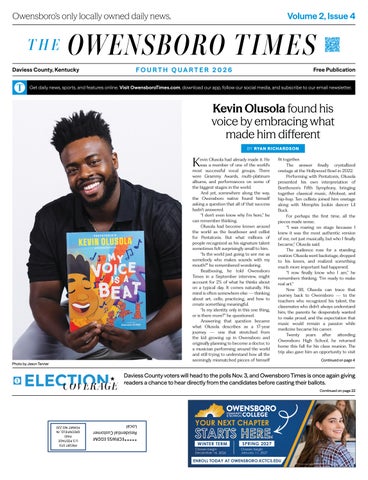
Kevin Olusola found his voice by embracing what made him different BY RYA N R ICHA R DSON
K
evin Olusola had already made it. He was a member of one of the world’s most successful vocal groups. There were Grammy Awards, multi-platinum albums, and performances on some of the biggest stages in the world. And yet, somewhere along the way, the Owensboro native found himself asking a question that all of that success hadn’t answered. “I don’t even know why I’m here,” he can remember thinking. Olusola had become known around the world as the beatboxer and cellist for Pentatonix. But what millions of people recognized as his signature talent sometimes felt surprisingly small to him. “Is the world just going to see me as somebody who makes sounds with my mouth?” he remembered wondering. Beatboxing, he told Owensboro Times in a September interview, might account for 2% of what he thinks about on a typical day. It comes naturally. His mind is often somewhere else — thinking about art, cello, practicing, and how to create something meaningful. “Is my identity only in this one thing, or is there more?” he questioned. Answering that question became what Olusola describes as a 17-year journey — one that stretched from the kid growing up in Owensboro and originally planning to become a doctor, to a musician performing around the world and still trying to understand how all the seemingly mismatched pieces of himself
Photo by Jason Tanner
fit together. The answer finally crystallized onstage at the Hollywood Bowl in 2022. Performing with Pentatonix, Olusola presented his own interpretation of Beethoven’s Fifth Symphony, bringing together classical music, Afrobeat, and hip-hop. Ten cellists joined him onstage along with Memphis Jookin dancer Lil Buck. For perhaps the first time, all the pieces made sense. “I was roaring on stage because I knew it was the most authentic version of me, not just musically, but who I finally became,” Olusola said. The audience rose for a standing ovation. Olusola went backstage, dropped to his knees, and realized something much more important had happened. “I now finally know who I am,” he remembers thinking. “I’m ready to make real art.” Now 38, Olusola can trace that journey back to Owensboro — to the teachers who recognized his talent, the classmates who didn’t always understand him, the parents he desperately wanted to make proud, and the expectation that music would remain a passion while medicine became his career. Twenty years after attending Owensboro High School, he returned home this fall for his class reunion. The trip also gave him an opportunity to visit Continued on page 4
Daviess County voters will head to the polls Nov. 3, and Owensboro Times is once again giving readers a chance to hear directly from the candidates before casting their ballots. Continued on page 22
*****ECRWSS EDDM Residential Customer Local
PRESRT STD U.S.POSTAGE PAID GREENFIELD, IN PERMIT NO.220
Page 2
Page 3
Page 4 Continued from page 1
local elementary schools and share his debut children’s book, My Voice Is a Beat, which was released earlier this month. Its message comes directly from the lesson Olusola said took him nearly four decades to understand about himself. “Your difference isn’t a defect,” he said. “It’s a dare.”
The kid who planned to become a doctor
Ask Olusola to describe the kid who grew up in Owensboro, and he laughs. “Oh my goodness, Kevin was a very nerdy kid who wanted to do well in school, who wanted to do well by his parents because I knew what they sacrificed for me to be able to have the opportunities that I had,” he said. His father, a doctor, came from Nigeria. His mother came from Grenada. Olusola envisioned following a much more conventional path than the one his life ultimately took. “I was a pre-med student who just wanted to be great at being a doctor, and I just loved music,” he said. “It was a passion of mine, not something I ever saw as a career.” Music, though, had been
F EATURE
part of his life since childhood. Olusola credits several Owensboro educators with recognizing his potential long before he did. Among them was the late Dr. Joan Mack, his Suzuki string teacher. Olusola’s sister wanted to take violin lessons, and his mother suggested he try cello. His first instrument wasn’t really a cello at all. “They gave me this box that had strings on it — which really weren’t strings,” he recalled. Mack began teaching him and told him he could stop whenever he wanted. “I didn’t stop,” Olusola said. The box eventually became a real cello. He progressed quickly and kept playing. “It’s been 32 years, and I still haven’t said no.” He also remembers the influence of his middle school band directors. At 12, Olusola was selected for a United States Wind Band program that took high school and college musicians on a three-week European tour. The directors worked with him throughout the summer before his chair audition. Olusola earned first chair on alto saxophone. “They really saw potential,” Olusola said. “I wouldn’t be who I am today without those music teachers.”
Feeling different
Not everyone understood the kid they saw. Olusola said the easy version of his story can make what followed sound almost inevitable: a talented child from Owensboro develops a rare combination of musical skills, joins Pentatonix, and eventually becomes a Grammy winner. What that version leaves out, he said, is “the struggle of feeling a lot of times misunderstood.” His family’s background was unfamiliar to some people around him. His last name stood out. So did the kid who seemed to beatbox constantly. “I got made fun of a ton for just kind of being me, for beatboxing all the time, my interesting last name, things of that nature,” he said. With time, his perspective on those experiences has changed. “I understand now, like, they were learning about me,” he said. “They had never met anybody like me. They had never met anybody like my family.” Returning for his 20-year reunion brought him face-toface with people who knew him during those years. Now, he said, they tell him they’re proud of him and respect the person he became.
Photo by Lydia Tanner
Olusola doesn’t speak bitterly about the experiences that were difficult at the time. Instead, he sees them as something he can use to reach children who feel misunderstood now. “That thing that you’re misunderstood for might be the actual thing that changes your world if you continue to focus on it,” he said. There was still another
expectation to overcome. For years, music wasn’t supposed to be the career. Medicine was.
‘Dad, I just performed with Stevie Wonder’ Even extraordinary success didn’t immediately put the question to rest. Olusola remembers
Page 5
F EAT U R E
sitting next to his father after Pentatonix won its second Grammy. The group had just performed with Stevie Wonder. His father turned to him. “Hey, congratulations on your Grammy,” Olusola remembers his dad saying. “Are you going back to medical school?” Olusola couldn’t believe it. “Dad, I just performed with Stevie Wonder.” His father laughed. The exchange was funny, but what it represented mattered deeply to Olusola. His parents had watched the child they expected to become a doctor take an entirely different path. By then, it was impossible to dismiss music as merely a passion. “I see that as a massive moment because not only am I getting career success, but finally, my parents are seeing what I’m doing as viable,” Olusola said. Their support helped quiet one question. The larger question — what kind of artist he actually wanted to be — took much longer to answer. His various interests didn’t fit neatly together. There was classical cello. Beatboxing. Hiphop. His faith. The music he made with Pentatonix and the art he wanted to make on his own. For years, Olusola questioned how those pieces belonged together. The Hollywood Bowl performance helped provide the answer, and the journey eventually led to his solo music project, Dawn of a Misfit. The title itself reflects the idea Olusola has increasingly embraced: The parts of himself that once seemed not to fit were precisely the things that made his voice his own. That realization eventually led him somewhere unexpected: a children’s book.
The message he wishes he had
After Dawn of a Misfit helped solidify his own identity, Olusola found himself thinking about how long it had taken him to get there. He wished someone had delivered the message earlier. “I wish I had this book growing up that crystallized all these thoughts because I think I would have felt less alone,” he said. “I would have felt less misunderstood.” My Voice Is a Beat follows a young boy named Kasey who hears rhythm in the world around him and discovers a gift for beatboxing. The character isn’t a literal version of young Kevin, but the feelings behind his story are familiar. Olusola wants children who feel weird, different, or misunderstood to see those qualities differently. “Don’t worry what other people are saying about you. Don’t worry that other people think you’re crazy. Don’t be worried that people think you’re weird,” he said. “You’re gonna change the world one day with everything that you have.” He distilled that idea into the phrase he repeated during his visit home: “Your difference isn’t a defect; it’s a dare.” For Olusola, the “dare” is to discover what makes a person different and figure out what to do with it. “As I believe, God has given something to you,” he said. “It’s a gift that you have to uncover with Him. And if you do that, you’re not only going to change your own life, but you’re going to change the life of others that need your specific gift.”
Bringing it home
The timing of Olusola’s return to Owensboro wasn’t originally connected to the book. His 20-year high school
reunion brought him back. Then Carolyn Greer, who is involved with the Owensboro Museum of Science and History, reached out about something unrelated. Olusola mentioned My Voice Is a Beat and asked whether there might be an opportunity to share it with students while he was home. Greer connected with OPS Fine Arts Coordinator Kara Smith, and the visit grew to include stops at several elementary schools and a public event at the museum. The trip also gave Olusola time to rediscover his hometown. Some things were different. The KY 54 corridor had grown dramatically. Restaurants had appeared in places he didn’t remember. The movie theater that had been on Frederica Street was gone. Other things remained exactly where he wanted them. Rally’s was among them. “I have been to Rally’s across the country,” he said. “No Rally’s fries hit like the ones in Owensboro, Kentucky.” So, he went twice. There was also a return to New China Buffet and a first visit to Gramps Coffee & Donuts, where the cronuts left an impression. “It was nice to try familiar places and go to new places and just expand what I know about my city,” he said. Despite the physical changes, the feeling hadn’t changed much. “The same values, the same feeling when I come back here — that remains the same,” Olusola said. “It just feels warm and like home.” That made Owensboro a particularly meaningful place to share the book. “I want them to feel like I see them, I feel them, I know them, because I am them,” Olusola said of the local students. “I grew up in this community.” He hopes a child sitting in
one of those audiences might see his story and imagine a larger version of his or her own. Olusola said he hopes they think, “Maybe one day I can do something like that. I can really achieve big things. I can see myself greater than any circumstance I’m in, and really shoot for the stars.”
Still the ‘funny nerd’
Ask what part of the kid version of himself remains most recognizable, and Olusola doesn’t hesitate. “Probably the funny nerd,” he said. His classmates noticed it, too. At the reunion, Olusola said people told him he hadn’t changed. He was still interested in unusual things. More importantly, they told him the fame, Grammys, multi-platinum albums, and arena tours hadn’t changed the person they remembered. Olusola appreciated hearing that. For years, he had wrestled with questions about who he was and where all the pieces fit. Now, the next accolade isn’t necessarily what he’s chasing. “A daily sense of authentic joy that comes from who I really am,” he said, “not based off of any standard except for my own.” It’s a lesson that took him from Owensboro to stages around the world and, eventually, back home. And now he’s hoping the next kid who feels a little different doesn’t need 37 years to figure it out. This story is part of a pair of profiles catching up with Owensboro native Kevin Olusola. In the November/ December issue of Owensboro Living, Olusola talks more about fatherhood, family, and how his definition of success has changed.
Editorial MANAGING EDITOR
Ryan Richardson WRITERS
Ava Hyland Max Rayman Phoenix Stevens PUBLISHERS
Jason Tanner Christy Chaney Do you have a story idea? We want to hear from you! Email your suggestion to info@owensborotimes.com.
Advertising ACCOUNT DIRECTORS
Brock Quinton Wendall Hallam Owensboro Times’ printed newspaper is a FREE publication because of community support. Thank you to the great group of businesses and organizations who advertise. For more information about advertising in our free newspaper or on owensborotimes.com, email brock.quinton@blackbox.media or wendall.hallam@blackbox.media.
Design & Photography STAFF PHOTOGRAPHER
Jamie Plain GRAPHIC DESIGNER
Andrea Roberson
Online Subscribe to our digital product at owensborotimes.com/subscribe. FOLLOW US ON SOCIAL MEDIA
Page 6
F EATURE
The Heart Behind the Hustle
Behind every successful business is someone whose passion, grit, and dedication keep things running — often without the spotlight. The Heart Behind the Hustle shines a light on those people, sharing the stories of the hard work and heart that drive our local businesses forward. Photo by Jamie Plain
Young quietly making her mark in Owensboro through work, service BY RYAN RICHA R DSON
L
ouise Murdock Young has built a career around getting people’s attention. She just doesn’t particularly want that attention directed at herself. For the past 12 years, Young has worked in marketing, social media, and public relations at Jagoe Homes. Outside of work, she is serving as president of the Women’s Guild of Owensboro, following in the footsteps of her mother and grandmother. Both roles can put her in the public eye, though Young would generally rather be somewhere behind it. “I enjoy being a background person,” she said. “I jump in when I need to.” That philosophy extends beyond work. Young said her late grandmother, Elizabeth “Betty” Jagoe — known as Liz to her grandchildren — taught her the value of being a “silent giver.” “You don’t really need to be loud about your giving,” Young said. “You just need to do it
and help out when you can. You don’t need to make a big deal about it.” It’s an approach Young has carried with her as she has built a career, started a family, and found a home in a city she initially wasn’t sure she wanted to call home.
Finding her place in Owensboro Young grew up in Atlanta and attended the University of Alabama, earning a degree in anthropology with a minor in psychology. After college, she returned to Atlanta and worked for a small marketing firm, but finding her footing professionally — and making enough to live comfortably in the city — proved difficult. Then her stepfather, Bill Jagoe, suggested she come to Owensboro and work for the family business. Young wasn’t immediately sold. Going from Atlanta to Owensboro felt like a significant change for someone in her early 20s. “I started coming up here and visiting, and I just saw more and more people just like me — young professionals just trying to make it in life,” she said. Young made the move at 23. Twelve years later, she has no plans to leave. “I think that I will live and die
here,” she said. Her first steps toward making Owensboro feel like home came through getting involved. Young joined the Greater Owensboro Chamber of Commerce’s Ambassadors and Chamber Young Professionals, organizations she credits with helping her meet people and become part of the community. That tendency to dive in has followed her ever since. “If I’m jumping in with something, I’m jumping in with both feet and just hitting it hard,” she said.
Building a career she never studied for Young’s path into marketing was hardly mapped out. Her college degrees had nothing to do with social media or public relations. Much of what she knows, she taught herself. She jokes that she was a “MySpace kid,” tinkering with code before she really understood what she was doing. As social media evolved, she evolved with it — spending hours on webinars, learning new platforms and adapting as the job changed. Her title at Jagoe Homes has remained social media and PR coordinator throughout her 12 years there, but Young said the actual job
Page 7
F E AT URE
has continually expanded. The constant change is part of what she enjoys. “My position kept getting added to,” she said. “They’d love one thing, and then another. So it’s just grown and grown and grown. It’s always new challenges.” Her career also gives her an opportunity to do something she values deeply: work alongside family. Young said she is loyal to both the company and the people who gave her an opportunity when she was still trying to figure out what came next after college. And while she hopes to continue growing professionally, she doesn’t seem overly concerned with plotting out exactly what the next title or position will be. “My time will come,” she said.
A family tradition of service Young’s involvement with the Women’s Guild came later, with some encouragement from her mother to join an organization that already had deep family ties. Her mother previously served as president, as did Young’s grandmother, who died in March. Young initially gravitated
toward a familiar role: helping behind the scenes with public relations and social media. She spent a few years as the Guild’s PR chair before then-President Emmy Woosley informed Young that she was going to become vice president and eventually president. Young was preparing to have a baby at the time. “I’m like, ‘OK, I’m having a baby this year, but whatever. I can definitely make it work,’” she said. Now, she’s carrying on a family legacy while helping lead an organization that raised $36,500 for women’s and children’s charities through its annual luncheon. Young said the position is somewhat outside her natural comfort zone, but she has found leading the group easier because of the women around her. “They are so intelligent, helpful, kind,” she said. “We’re just trying to get together and raise some money for charity.” For Young, the importance of contributing to the community goes beyond any one organization. It is tied to the place Owensboro has come to occupy in her own life. “I love being a part of watching this city grow,” she said.
“I can’t even imagine where it’s going to be in 10 years.”
From left: Melissa Jagoe, Ethel Jagoe, Alex Jagoe, and Louise Murdock Young at the 2022 Women’s Guild Luncheon. Photo provided
A life built here Owensboro eventually gave Young more than a career and a community. It’s also where she met her husband, Brad, although that introduction required some family assistance. During the COVID-19 pandemic, Young’s uncle Scott Jagoe happened to meet Brad at The Pub on Second. He invited Brad to a family dinner, where the two were introduced. Louise and Brad married in 2022. Their family now includes Young’s 13-year-old stepson, Brady, and their infant daughter, Beth. “We have an interesting mix,” she said, “but wouldn’t have it any other way.” Motherhood has also reinforced something Young said has changed as she has gotten older: her appreciation for keeping parts of life private. That might sound unusual coming from someone who has spent more than a decade working in social media. But Young has increasingly found value in putting the phone down, keeping some moments to herself and not feeling the need
to broadcast everything. “I like being more quietly myself,” she said. “It just makes me appreciate the smaller moments more when you put down your phone or put down the social media and just take it all in a little more.” It circles back to the lesson she learned from her grandmother: contribute where
you can, help when you can, and don’t worry too much about who notices. Young may make her living telling stories publicly, but the life she has built in Owensboro is rooted in what happens away from the spotlight. “I just want to share moments with people,” she said, “but not necessarily be loud about it.”
Page 8
F EATURE
Inclusive Cuts S brings accessible, sensory-friendly barber and salon services to Owensboro BY RYA N R IC H A R DSO N Photos by Jamie Plain
am Greer hears the concerns all the time from parents and caregivers of people with disabilities and sensory needs. Their child won’t sit still. The clippers are too loud. The lights are too bright. They might cry, kick, or move around the room before the haircut is finished. None of it fazes her. Sometimes Greer cuts hair on the floor. Sometimes she follows a client from the barber chair to the couch and back again. Sometimes half the lights stay off, the clippers stay put, and a favorite show plays on the TV instead. Whatever it takes. “I’ll cut them wherever,” Greer said. “For me, it’s just the comfortability of them.” That willingness to tailor the experience to the person — rather than expecting the person to adapt to a traditional barber shop — is at the heart of Inclusive Cuts, a new barber shop and salon on the Wendell Foster campus designed with physical and intellectual disabilities and sensory needs in mind, but open to everyone. Greer said she regularly meets parents who have been told their child moves too much or simply can’t get a haircut. Others have resorted to cutting their child’s hair at home because they worry about how their child will react in a public setting. “I cut hair for kids every day who people say aren’t able to be cut,” Greer said. “And it’s not that they’re not able to be cut. It’s they’re not comfortable with whoever was cutting their hair.”
An overlooked need Greer has been cutting hair for nearly 10 years and has worked with people with physical and intellectual disabilities
for about seven. She also has family members with intellectual disabilities, and seeing how they and others could be overlooked helped draw her to that clientele. “Not a lot of people have time for them. Not a lot of people have the patience for them,” Greer said. Today, she estimates 30% to 40% of her clientele has some type of physical or intellectual disability. Her relationship with Wendell Foster started after one of her existing clients brought some residents to Precision Studios, the barber shop and salon Greer owns with her wife, Ashley Greer, across the street from the Wendell Foster campus. Greer said some residents didn’t have consistent access to professional grooming services. After conversations with Wendell Foster staff, she began cutting residents’ hair on campus in July 2025. The original setup was inside a residential home where a shampoo sink was installed to allow Greer to operate a licensed barber shop. It wasn’t ideal, but it worked. Wendell Foster CEO Doug Hoyt said roughly 150 haircuts and other hair treatments were provided during the following year — enough to show there was a much larger need. Getting a haircut can seem like a routine task, Hoyt said he came to realize, but a traditional barber shop or salon can present challenges for someone who uses a wheelchair or has sensory issues related to bright lights, buzzing clippers, loud conversations, or other noise. Some Wendell Foster clients had even been traveling to Bowling Green for haircuts. As the organization prepared for a larger renovation of its day
training facilities, Hoyt and his team realized an underused room could provide a permanent solution. They brought Greer into the planning process, and she immediately saw the potential. By July 2026 — one year after Greer began cutting hair in the residential home — Inclusive Cuts opened.
Built to adapt The new space was designed from the beginning around accessibility. One barber station has a traditional chair, while another allows someone using a wheelchair to roll directly into place. The salon side similarly has a shampoo station that can accommodate someone in a wheelchair. The environment itself can also change from appointment to appointment. Greer asks questions before sensory services to learn what might make the experience easier. Can she use clippers? What about a blow dryer? Are there issues with bright lights? Is there a favorite show that might help? Sometimes she lets a client see and become familiar with her tools before she starts. “The more you kind of just show them, ‘Hey, this is safe. Hey, this is comfortable. Hey, I’m not going to hurt you,’ the more it’s almost just like, ‘Oh, OK. She’s not so bad,’” Greer said. And success doesn’t necessarily mean producing what Greer called an “Instagramworthy haircut.” Sometimes simply getting through a haircut comfortably is the victory. A few weeks ago, Greer said, a parent brought in a child who had struggled badly with previous attempts. She was told he would
Page 9
F EAT U R E
to barber services. Ashley is a cosmetologist with
about
nine
years
of
experience and provides hair and
falls off the parents’ shoulders, the weight falls off the kids’
room and eventually left with his
shoulders,” Greer said.
first successful haircut. “You can almost see when they walk into the room, nine times out of 10, the weight
Looking good — and feeling it Inclusive Cuts isn’t limited
appointment to remain personal.
Wendell Foster clients or people with disabilities. It’s a regular, paid barber
said that became an important
shop and salon open to the
part of the plan after Wendell
public.
Foster staff pointed out that
Sam moved her established
women faced many of the same
barber clientele from Precision
barriers.
Studios to Inclusive Cuts when
Some women, Sam said, had
the new shop opened, and she
been receiving buzz cuts rather
said more people with disabilities
than having access to the type of
are also finding the business
salon services they might prefer.
through therapists, behavioral
Ashley can now style their
services, and other organizations across the region.
get ready for special occasions.
Still, she thinks some people
The Greers have also helped
see the Wendell Foster campus
people prepare for Night to Shine,
and assume the shop isn’t for
the annual prom experience for
them.
people with disabilities.
the child moved around Greer’s
waiting area and allows each
Inclusive Cuts isn’t only for
nail services at the shop. Sam
hair, do their nails, or help them
scream, cry, and kick. Instead,
its emphasis on accessibility,
“I don’t care who you are,”
For Sam, those moments
Greer said. “I don’t care if you’re
illustrate why access to grooming
wanting to get your kid’s first
services can mean more than
haircut, or you’re somebody’s
simply getting someone’s hair
papaw looking to get just a basic
shorter.
haircut, or you want this extensive
“It’s such a heartwarming time to be able to just make them look in the mirror,” she said, “and
cleanup for your wedding. We’re here to do it all.” Inclusive
Cuts
operates
you can tell they feel confident in
by appointment, with someone
who they are.”
available
Monday
Saturday.
Appointments
Open to everyone Despite its location and
through are
booked through Booksy, which Greer said helps avoid a crowded
“It’s more of a personal oneon-one environment,” she said. “It allows me to tailor your service exactly to you.” For also
Hoyt, represents
the
shop
something
about Wendell Foster as the organization nears its 80th year: After decades of serving people with disabilities, there are still needs to recognize and new ways to meet them. “We
haven’t
stopped
learning. We haven’t stopped growing. We haven’t stopped figuring out ways to serve and support people with disabilities,” Hoyt said. Inclusive Cuts grew from one of those needs — something as ordinary as getting a haircut, but something that wasn’t ordinary at all for some families. Now, if the lights need to go down, they go down. If the clippers are too much, Greer finds another way. If someone can’t stay in the chair, she follows them. Even if that means finishing the haircut on the floor.
Page 10
Page 11
F EAT U R E
More than packages: Osborne built successful shipping business around service, family BY RYAN RIC H ARDS O N Photos by Jamie Plain
A
fter more than three decades in the shipping business, Pat Osborne can boil much of his philosophy down to a few words: Make it easy for people to do business with you. That has meant everything from putting a drive-through at Packages Plus to showing customers their shipping options on a monitor rather than simply telling them what to choose. It means helping someone repack a box that isn’t going to survive the trip or navigating a return for someone who isn’t comfortable doing it on their phone. But underneath those practical decisions is something Osborne considers even more important — being available when people need help. “We’re in the service business,” Osborne said. “You have to embrace the fact that you’re a public servant.” It’s an approach that has helped turn a struggling shipping franchise into a locally owned business that has been part of Owensboro for more than three decades. Along the way, Packages Plus has become one of the higher-volume independent shipping operations in the country, while Osborne has become a voice in an industry that looks dramatically different than it did when he bought the business in 1994. For Osborne, though, the story of Packages Plus isn’t simply one of packages, volume, or awards. It starts with family.
A decision bigger than business Osborne was 34 when he bought the store, but owning a shipping business wasn’t some lifelong ambition. He had been working as a corporate salesman for Modern Welding, covering a nine-state territory. He enjoyed the job, but he and his wife, Tish, were trying to start a family. When their daughter, Mallory, arrived, Osborne’s priorities changed. “I love my job. I love everybody here,” Osborne
recalled telling his boss. “I’m not going to watch my daughter grow up on the telephone. It’s not going to happen.” His closest customer was about five hours from Owensboro, he said, and he was routinely on the road six days a week. Osborne knew he couldn’t keep that schedule and be the father he wanted to be. When the company didn’t have a position that would substantially reduce his travel, he left. Mallory had arrived several weeks early, and Osborne stayed home with her for about nine months while considering what came next. Eventually, he heard that a local shipping store was for sale. The opportunity wasn’t entirely foreign. While attending the University of Kentucky, Osborne had worked at a Lexington mail-order company that shipped roughly 1,000 packages a day, primarily to police officers, firefighters, and EMTs. He had also worked nights loading UPS trucks while going to school full time. Owning a local business gave him a chance to use that experience while gaining something his corporate career couldn’t offer: time. “I got to see every dance recital and every soccer game and every softball game and track, cross country, swim team, dance,” Osborne said, beaming with pride. “I was there for it all. So that was more important to me than money.”
Building Packages Plus The business Osborne bought in 1994 had already operated for about a decade as a Mail Boxes Etc. franchise, but it wasn’t thriving. Osborne said the franchise’s pricing was based on larger metropolitan markets and didn’t work well in Owensboro. The previous owner gave him some unusual advice when he expressed interest in buying it: She would sell him the store, but
not if he intended to keep it as a franchise. Osborne listened. He went independent and changed the business model, but first he had to overcome the reputation the previous operation had developed. He said he had to “re-educate” the customer base. At the time, customers had plenty of alternatives, including UPS and FedEx counters, postal contract stations, and two post offices. Osborne chose to compete differently. Where the independent shipping industry traditionally relied on higher margins and lower volume, Osborne opted for lower margins and higher volume. It took roughly a year and a half, he said, for customers to understand that the business had changed. The strategy eventually worked well enough that, two years after buying the original location near Carter Road and West Parrish Avenue, Osborne opened a second store on 18th Street. For roughly 20 years, Packages Plus operated both locations. Osborne later consolidated operations at the
18th Street store after problems with the Parrish Avenue building made remaining there impractical. He worried longtime customers wouldn’t follow. When he eventually studied the numbers, he estimated about 80% had made the move. During the years Packages Plus operated two stores, Osborne said the locations combined for 28 appearances among UPS’ top 100 authorized shipping outlets by volume. The numbers matter as evidence that his approach worked. But Osborne’s explanation for that success usually comes back to service. One of his favorite examples is the drive-through. The original Parrish Avenue location already had one because the building had once housed a restaurant. When Osborne began considering the 18th Street location, adding a drivethrough was among his requests. It helps parents who don’t want to unload children from car seats, older customers who have difficulty getting out of their vehicles, and anyone carrying a
package in bad weather. “You’ve got to make it easy for people to do business with you,” Osborne said. “That’s what it’s all about.” The same idea carries inside. Customers can see monitors displaying shipping options rather than having an employee simply choose for them. If a package isn’t packed well enough, employees can help reinforce or repack it. Osborne’s years loading UPS trucks taught him that proper packing matters more than a “fragile” sticker. Workers were expected to move packages quickly, he said, leaving little time to inspect special handling labels. “Does it pack well?” Osborne said. “That’s your best defense against a mishap. Pack it to death.”
A voice in the industry The success of an independent store in a market the size of Owensboro has also brought Osborne attention within the shipping industry.
Page 12
He serves on national advisory councils for Retail Shipping Associates and PackageHub Business Centers, giving him a role in conversations about where the industry is headed. He has participated in testing new services and regularly shares his experiences with other independent store owners. Osborne isn’t shy about offering an opinion. When he was asked to serve on one council, he recalled being told, “Pat, I get the feeling that you’re not going to be a yes man.” “You got that right,” Osborne
F EATURE
replied. “I’m going to give you my opinion whether you like it or not.” He also teaches at national conferences, where other owners frequently ask how a store in Owensboro generates its volume. Osborne’s answer goes back to the decision he made when he took over the business. “The industry has always been high margin, low volume,” he said. “I flipped the switch when we started, and it worked. It worked in my market, and it can work in yours, too.” He is equally willing to tell other owners about what he considers his better ideas,
particularly the drive-through. His message is simple: Shipping may be the product, but service is the business.
An extended family Much about that business has changed since 1994. Online shopping has transformed how people ship and return merchandise. Packages Plus now handles large numbers of drop-offs and returns, along with other services Osborne has added over the years. He expects the industry to continue
changing as carriers and retailers look for more efficient ways to move packages. Osborne doesn’t pretend to know exactly what Packages Plus will look like five or 10 years from now. People have asked him numerous times when he plans to retire. After 32 years, stepping away isn’t a simple proposition. “It’s almost like my child,” he said. He wants to help pilot Packages Plus into its next phase, whatever that turns out to be. What he doesn’t expect to change is the philosophy behind it. That part predates Packages Plus. Osborne grew up around a family business in Hardin County, watching his grandfather, father, and uncles interact with customers. There was a clear expectation about how people were supposed to be treated. “If we didn’t just treat our customers like our family, then my papaw would light up the back of that earlobe,” Osborne laughed. When Osborne eventually found himself in charge of a business, he remembered it.
“I swore to myself if I ever got keys to the kingdom, that I would do it like my grandfather and my dad and my dad’s brothers, how they ran our family businesses,” he said. “If I can’t do it like that, then I’ll do something else.” Three decades later, he measures that philosophy in ways that have little to do with shipping volume. Customers know him. They know his employees. Some know Osborne well enough to notice if something about him looks different and ask whether he’s OK. “It’s awesome that people care,” Osborne said. And that’s why, for all the talk about shipping rates, drivethroughs, online returns, and an industry that continues to reinvent itself, Osborne has another, more personal standard for whether Packages Plus is doing its job. “If you walk in my door and you don’t feel like you came to a homecoming, then I failed you somehow,” he said. Customers, he said, have become his extended family. “And I treat them that way.”
N EWS
Page 13
Page 14
F EATURE
How Cheryl Purdy helped bring digital forensics to local criminal investigations BY PH O EN IX STEVEN S
W
hen Dr. Cheryl Purdy began
enforcement
working in digital forensics
Western Kentucky.
with the Daviess County Sheriff’s Office in 2011, computers were already an established source of digital evidence in criminal investigations. Cell phones were a different story. Phones
have
become
increasingly central to everyday life and, as a result, increasingly central to criminal investigations. Purdy
helped
develop
the
procedures and expertise that allowed local law enforcement to examine that evidence in-house. “When you talk about Dr. Purdy’s impact on digital forensics in this area, I don’t know that you could actually quantify the amount of good work she’s done,” Daviess
County
Sheriff
Brad
Youngman said. “She more or less is responsible for everything that we have going on, whether it’s the Sheriff’s Office or other law enforcement agencies in this area. To have this type of digital forensic investigative capability is unheard of.” Much of Purdy’s work has been used in cases involving child sexual abuse material (CSAM), but she said her work has also contributed
to
convictions
in
homicide, burglary, and assault
across
Evidence that can change a case The importance of Purdy’s work
becomes
clearer
when
investigators are dealing with a modern criminal case. A
cell
phone
forensic
examination
can
reveal
conversations, search
photographs,
histories,
information,
location
deleted
files,
and other evidence that isn’t necessarily visible to someone simply
scrolling
through
the
device. 6th Circuit Commonwealth’s Attorney Mike Van Meter said
More than 15 years later, procedures
she
helped
establish have grown into a digital
Photo by Jamie Plain
Purdy’s examinations have played an integral role in numerous prosecutions, including murder cases and cases involving child sexual abuse material. Van Meter said that before cell phone forensics became a regular part of criminal investigations, the information available from a phone was nowhere near as useful to prosecutors. “We’re able to take a download of a cell phone and find evidence of a crime,” Van Meter said. “That was unheard of when I started here in 1994.” Digital forensic investigations
cases. the
agencies
can also provide context that isn’t immediately apparent when going through a cell phone.
Van Meter said. “Yes, we can see it,
information raised concerns, but
evidence ultimately supported an
but we don’t know where it came
investigators didn’t have enough
arrest or ruled one out.
from. Cheryl helps us determine
evidence to know whether a crime
where it came from. From the
had actually occurred.
which
metadata, we can see when it was
Purdy examined both the
produced, when it was put on the
suspect’s phone and the alleged
phone, and when it was sent to
victim’s phone.
other people.”
There were also cases in Purdy’s
examinations
uncovered evidence that helped lead to convictions. Youngman
recalled
three
The examination showed that
consecutive cases in which Purdy
That information can help
while inappropriate conversations
testified at trial, with the three
prosecutors establish timelines,
had occurred, the evidence did
defendants ultimately receiving
identify
relationships
not support criminal conduct.
more than 150 years in prison
people,
and
how
Purdy’s work allowed investigators
combined.
evidence came to be on a device.
to reach that conclusion quickly
“There
between
determine
Youngman experienced that firsthand early in his career with Purdy.
cases
and with certainty. “It told us everything we needed to know,” Youngman said.
were
where
we
many,
many
found
what
we were looking for and more,” Youngman said. Her
practices
are
now
He recalled investigating a
The experience demonstrated
case involving allegations that a
to Youngman how cell phone
commonplace locally, but that
forensics could strengthen an
wasn’t the case when Purdy first
investigation
arrived at DCSO.
forensics operation that serves
“Say you find some child sex
local person had an inappropriate
Daviess County and other law
abuse material on a cell phone,”
relationship with a minor. The initial
—
whether
the
Page 15
F EAT U R E
“I knew it could be done,” Purdy said. “Nobody else believed
evidence was going to become
with DCSO and helped arrange an
examining cell phones for criminal
increasingly important.
agreement that allowed her to use
investigations,
the equipment while continuing
educator. She taught at Apollo
her work at OCTC.
High
that this could be done locally.
“When I first started this,
People would say, ‘We need big
there really weren’t very many
people like the Attorney General’s
phone examinations,” Purdy said.
Office or the [Regional Computer
“It was mostly computers. Now,
Forensics Laboratory]. We can’t
almost everything is on the phone.”
do this locally.’ I built this program locally, and I’m just proud of it.”
Building the capability locally were
largely
agencies that needed specialized examinations had limited options and could face lengthy backlogs when sending devices elsewhere. the
technology
was
changing, and Purdy recognized it. Phones
were
said,
a
large
percentage
of
criminal
prosecutions
involve
evidence
location data, photographs, text
centered on computers. Local
But
she
from a phone, whether it is GPS
At the time, digital forensics examinations
Today,
becoming
more powerful, carrying more
messages, emails, or other digital information. That shift created a new need: knowing not just how to collect information from a phone, but how to properly preserve, interpret, and present that information as evidence. Purdy’s work initially required bringing together several different pieces. The University of Louisville
The
arrangement
gave
Purdy something she hadn’t had when she first began her law enforcement training: the tools to go along with her knowledge. “There were a lot of moving parts at that time,” Purdy said. “All of these moving parts came together
into
something
that
resulted in a successful positive
to
School
Purdy before
Owensboro
Technical taught
was
an
moving
Community &
College, where computer
she
information
technology. Her
husband,
a
retired
Owensboro Police Department officer, was the coordinator of OCTC’s criminal justice program. When the college was considering dropping
its
digital
forensics
thing for our community.”
course because it was being
Sharing her knowledge
to take it over.
Purdy
retired
from
offered online, Purdy volunteered
the
Daviess County Sheriff’s Office this past spring, but she hasn’t totally left the world of digital forensics. In some ways, she has returned to where the journey
Taking her expertise beyond Owensboro In 2023, Purdy took her expertise police
overseas,
trainees
teaching
about
digital
forensics at the University of Akureyri in Iceland. Purdy brought roughly 15 cell phones with her, installed open-source forensic tools on computers, and taught multiple groups
how
to
acquire
and
examine data from phones. She also met the commander
She saw the course as a
of Iceland’s national police force
natural intersection between the
and toured the national police
two fields she knew best and was
academy in Reykjavik.
most passionate about. “I said, ‘No, no, no, don’t do that. Let me teach it,’” Purdy said. “This is a cross-curricular area.
“It was a once-in-a-lifetime thing,” Purdy said. Even though she has retired from DCSO, the phone on her
information and becoming more
had received a Department of
deeply integrated into people’s
Justice grant to establish satellite
lives. The growth of social media
forensic
meant anyone could message
Kentucky. The Owensboro Police
knowledge and insight on to
anyone.
Department was one of the sites,
others as an adjunct professor at
In April 2011, Purdy was
but the equipment had sat largely
Western Kentucky University, the
sworn in as a special deputy so
unused.
University of the Cumberlands,
she could attend digital forensics
and she’ll sit down with me and
and the University of Louisville.
training through the Kentucky
take all the time I need,” Van Meter
Department of Criminal Justice.
said. “She still has that passion.”
Accessibility to others was greater than ever before, for better and for worse, and Purdy recognized
that
cell
phone
laboratories
around
Retired OPD Chief Glenn Skeens learned about Purdy’s work
began: the classroom. Purdy
Long
now
before
passes
she
her
began
You know, criminal justice and IT together.” That decision eventually led her to the DCSO.
desk still rings every now and then with a question from someone who needs her expertise. “I can still pick up my phone and call her and ask her questions,
Page 16
Page 17
F EAT U R E
Inside the technology helping WKRBC turn donations into lifesaving blood products BY PH O EN IX STEVEN S Photo by Jamie Plain
D
espite a national blood shortage
“The patient will only receive the
that has blood centers across the
blood product that they need for their
country calling for donations, the Western
particular situation,” Ellis said. “So, you’re
Kentucky Regional Blood Center has
talking
on cards that would go back into the filing cabinet.” Ellis said the blood center eventually
BY THE NUMBERS
had to add space to the building just to
1978 — Year WKRBC was established
been able to meet local demand in part
individual
are
store testing files. That continued into
available to these 12 medical facilities in
2 — Locations: Owensboro and
because of its ability to process and test
the early 2000s, before automation
blood in-house.
western Kentucky.”
began transforming the process.
Hopkinsville
Once blood is donated, time matters. It has a shelf life of five days before it’s no longer good for use. By processing blood on-site, WKRBC saves roughly two days that would otherwise be spent transporting blood to an outside testing laboratory and waiting for results to be entered into the system. Vicki Ellis, who oversees donor recruitment and public relations at WKRBC, said the nonprofit community blood center receives just under 10,000 whole blood donations per year.
somewhere blood
around
products
30,000 that
Technology transformed the process The process of turning whole blood donations into usable blood products has never been more efficient for the blood center, Ellis said, largely because of advances in its in-house technology. When Ellis arrived at the blood center 30 years ago, the process was far less automated. “When I started at the blood center in ‘96, we had paper cards,” Ellis said. “We
“That’s when we’ve seen technology come into play,” Ellis said. “That’s where we’ve seen the automation of the samples into the machine, the little eye that reads
13 — Western Kentucky counties served
3 — Air Evac Lifeteam helicopters supplied
the barcodes and tests the sample, then
8 hours — Time in which WKRBC
creates the file of what the result is.”
can collect blood and release it to a
The blood center still manually labels some results, Ellis said, maintaining a human element in the process. Every donation that comes through the blood center is also processed and tested, regardless of how many times the person has donated.
hospital in an extreme emergency
262,598 — Whole blood donations collected from 2005-25
799,667 — Total blood productslood products produced from 2005-25, each representing the potential to help save a life
Those donations are separated into
did not have a data bank per se. Nothing
“It doesn’t matter if the person’s
three components during processing:
was kept on a computer. We did not
donated once or 25 times,” Ellis said.
114,519 — Blood products delivered
red blood cells, plasma, and platelets.
have all of the lab results. Everything was
“Every single time, they’re going to go
to Owensboro Health Regional Hospital
That means one donation can potentially
recorded by hand. All of the tests were by
through the questions, the screening,
help save three lives.
hand, and everything was documented
the physical. Their unit is going to go
over the past 15 years
Page 18
F EATURE
Photo by Jamie Plain
through all of the FDA- and
will dictate what testing has to
bus has five donation
state-required tests.”
happen. All of our technology
beds, compared with
fluctuates with what the FDA
four
says we have to do.”
vehicle.
The
blood
center
uses
different technologies to test for
atypical
hepatitis,
antibodies,
HTLV,
and
HIV,
Ellis said WKRBC’s existing
other
technology also allowed it to
potential concerns.
respond
One of those machines,
quickly
during
the
COVID-19 pandemic.
called Una, tests for infectious
“We were one of the first
diseases at the DNA and RNA
blood centers to deliver a COVID
levels. Ellis said it performs some
convalescent plasma to a hospital
of the most important testing
for the sickest patients,” Ellis said.
done
“They were actually extracting
in
the
blood
center’s
laboratory.
antibodies from people who had
“It’s looking for markers,
survived COVID and helping
antibodies, and antigens that
those who were suffering from it
your body will produce before
with that plasma.”
you’re testing positive for any of
WKRBC’s
these diseases,” Ellis said.
technology
extends beyond its laboratory.
on
the
older
Donors are key to success Once
donated
blood
enters
processing, Ellis said a team of more than 30
lab
assistants
separates it into its components.
Each
donation is handled no fewer than 33 times before it is ready to be sent to medical facilities.
technology, testing, and staff
eventually reaching a patient. For
required to turn a donation into
the WKRBC, keeping that entire
usable blood products, Ellis said
process under one roof means
The technology used by
The blood center operates two
“We all feel good about
the blood center changes over
Bloodmobiles, essentially mobile
what we do,” Ellis said of the
time as regulations and testing
blood
camaraderie
requirements evolve.
allow collections to take place
center. “We all know it’s our
throughout the region.
responsibility. In this building, we
Bloodmobile,
A blood donation may begin
all work together. We know what
with someone sitting in a chair
“We had to do a Zika screening.
known as the Bus and Us,
we do is important, and we know
or on a bed with a needle in their
Sometimes, we have to test for
remains in use. In 2020, WKRBC
that we have to put our petty
arm, but it does not end there.
Chagas disease or West Nile
invested $430,000 in a newer
stuff aside because there’s a
virus. So, different current events
Bloodmobile called the Spirit of
greater common goal for us.”
or different things that happen
Western Kentucky. The newer
“When Zika was a thing, we had an added test,” Ellis said.
donation
The
older
centers
that
But
of
even
the
with
blood
the
the process still depends on one thing the blood center cannot manufacture: donors.
less time waiting, more control over the supply, and the ability to make the most of every donation it receives. “Without
them,
there’s
nothing we can do,” Ellis said.
It moves through a network
“That’s the one thing that we have
of people, machines, laboratories,
to have to be successful: people
and
willing to donate blood.”
safety
checks
before
Page 19
Page 20
DINING
Forks Up!
Pizza Week celebrates creative kitchens and community favorites BY CHR ISTY CHA NEY Photos by Ryan Richardson
O
wensboro Times Pizza Week took
consecutive year with its Saturday Night
its second spin around the crust
Special. Owners Matt and Jessica Weafer
in September, serving up unexpected
built the entry around their family’s
flavors, repeat winners, and a chance
weekly pizza tradition, pairing pepperoni,
to celebrate the people who make our
black pepper, and Parmesan with sun-
meals.
dried tomato sauce, mozzarella, fresh
Held Sept. 11-19, the event featured 25 creations from 24 participating businesses. The Pillar of Fire entered
herbs, and Parmesan crema. “Classic done right is always a good choice,” Jessica said.
both the traditional pizza and outside-
Rosie Helen’s Treats & More placed
the-box categories, helping round out
second in the judges’ standings with
a lineup that challenged teams to put
Love at First Bite, while The Oven’s The
their own stamp on pizza.
Hot Mess finished third.
We were thrilled by the imagination
Customers
gave
Donatos
its
in those kitchens and the community
second
support that followed. Five awards
award for traditional pizza. Its Alfredo
recognized
the
judges’
consecutive “People’s
Slice”
favorite,
Meats Tomato combined marinara and
customers’ choices, and the top sellers
Alfredo sauces with garlic, cheeses, and
in each category.
a trio of meats.
Niko’s Bakery & Cafe earned “The
The outside-the-box community
Supreme” judges’ award for the second
honor went to first-time competitor
Page 21
DI N I N G
Rosie Helen’s. Owner Sebree Brown’s sweet potato cookie pizza paid tribute to her grandmother, bringing Southern sweet potato casserole flavors to a creation layered with apple butter, pumpkin-orange buttercream, and toasted marshmallows. The sales awards brought another
another’s work. The spirit of Pizza Week is to meet restaurants where they are. Asking a business to operate beyond its capabilities for one week a year does little to support the people we’re celebrating.
win for Niko’s, which earned the traditional
That includes selling pizza by the
“Dough Maker” honor despite operating
slice. For a restaurant that isn’t equipped
only at lunchtime during the event.
to offer individual slices, doing so means
Pinocchio’s Deli at the Opportunity Center of Owensboro took the outsidethe-box sales crown with Pinocchio’s Chicken, Bacon and Cheese Please! The team combined chicken, bacon, ranch, and
changing how food is held and served. Slices might entice more customers, but the added demands of safe food handling and the potential for waste can outweigh
cheese in Italian bread with a Parmesan
the benefits. Pizza Week should work for
crust. Run by individuals with disabilities
the businesses taking part.
under Opportunity Center staff supervision, Pinocchio’s developed the recipe together and spent time learning to prepare it before serving customers. The crew earned its win while participating Monday through Friday, without the opening weekend.
Instead, grab a friend — or five — and make a game of it. Share a pizza, compare favorites, and choose another place to try together. Pizza Week is about community, so celebrate it with yours.
“It was a team effort. We all did it
Thank you to every participating team
together,” said Tiffany Vinson, the center’s
and everyone who ordered, voted, and
training and employment specialist who
helped make the second year a celebration
runs Pinocchio’s Kitchen. That spirit deserves as much attention as the awards. Every entry represented people
developing
recipes,
preparing
ingredients, and filling orders. Participating businesses
also
exchanged
creations,
giving teams a chance to enjoy one
of Owensboro’s kitchens. Keep those discoveries on your dinner list long after the awards are handed out. We’ll be back next year, loving local, supporting small businesses, and taking a bite out of Owensboro!
Page 22
ELECTION
CHARLIE CASTLEN
WILLIAM ROD KUEGEL JR.
When rising property values generate additional revenue without a taxrate increase, should Fiscal Court generally use that revenue for services and investments or lower the tax rate to limit the increase for property owners? Why?
When rising property values generate additional revenue without a taxrate increase, should Fiscal Court generally use that revenue for services and investments or lower the tax rate to limit the increase for property owners? Why?
DAVIESS COUNTY J UD GE-EXECUTIVE R EPUBLICAN
2026 GENERAL ELECTION GUIDE
Daviess County voters will head to the polls Nov. 3, and Owensboro Times is once again giving readers a chance to hear directly from the candidates before casting their ballots. For this election guide, OT selected several races to highlight and invited every candidate seeking those offices to participate. Candidates for each office were given the same three questions for their respective races and asked to respond within the same overall word limit. The responses that follow are the candidates’ own words, edited only for grammar and OT style and, when necessary, trimmed for length. The goal is to give voters a chance to hear directly from the candidates about the issues they could face in office and the priorities they would bring to the position.
WHEN AND WHERE TO VOTE
Early voting will be available from 8 a.m. to 4 p.m. each day on Oct. 29-31 at the Owensboro Sportscenter, located at 1215 Hickman Avenue. Election Day is Nov. 3, with polls open from 6 a.m. to 6 p.m. Daviess County voters may cast their ballot at any of these 14 voting locations on Election Day: • Abundant Life Church — 6601 U.S. 231, Utica • Audubon Elementary School — 300 Worthington Road, Owensboro • Burns Middle School — 4610 Goetz Drive, Owensboro • Daviess County Middle School — 3901 Fairview Drive, Owensboro • Faith Community Center — 9515 KY 144, Philpot • H.L. Neblett Community Center — 801 West 5th Street, Owensboro • Owensboro Christian Church — 2818 New Hartford Road, Owensboro • Owensboro Sportscenter — 1215 Hickman Avenue, Owensboro • Saint Martin Parish Hall — 5856 KY 81, Owensboro • Saint Mary Magdalene Parish Hall — 7232 KY 56, Owensboro • Third Baptist Church — 527 Allen Street, Owensboro • Utica Baptist Church — 415 KY 1207, Utica • Whitesville Baptist Church — 10167 KY 54, Whitesville • Yellow Creek Baptist Church — 5741 KY 144, Owensboro • Additional election information, including voter information and sample ballots, is available through the Daviess County Clerk’s Office.
Each year, the state calculates what is called the compensating rate (the rate that generates the same revenue as the prior year) and the 4% rate (a rate that generates 4% more revenue than the prior year) and sends those to Daviess County Fiscal Court. DCFC can adopt either rate or a rate in between. Since I have been a member of DCFC, I have voted to lower taxes five times in 16 years — two of which, since I have been Judge-Executive, were the largest decreases in 50 years. Depending on the demands placed on DCFC and rising costs, there are certainly times when the rate can and should be lowered; however, we must match our revenues to the services our citizens have come to expect.
As residential and commercial development expands into previously rural parts of Daviess County, how should the county balance growth with infrastructure needs and the interests of existing residents?
Much of the growth in residential areas is being annexed into the city via their aggressive consensual annexation policy. DCFC has been responsive to the needs of our growing community with the new centrally located public safety facility and additional deputies for DCSO.
A full city-county merger has been discussed on and off for decades with very little traction. However, the city and county have successfully collaborated on shared services like 911 central dispatch. Do you believe the city and county should merge other services to save taxpayer money? If so, which specific areas would you explore?
I do not support a merger. Twentyplus years ago, the city and county studied a merger to identify departments where it made sense and cut costs. Ultimately, 911 dispatch was the only department merged. In every other case, as is true today, a merger does not result in a reduction of expenses. As an example, you can’t maintain all roads in the county with less employees currently, nor can you provide fire protection service with less firefighters than exist between both entities.
DAVIESS COUNTY JUDGE-EXEC UTIVE DEMOC RAT
Fiscal Court collects $9.4 million in property taxes as part of a $67.7 million general fund. Excellent public services and investments are an expectation all citizens share, but people also feel the financial pressures of property tax increases. As judge, I will seek input from our citizens to determine how to balance keeping tax rates as low as possible while still providing excellent services. We need to establish community priorities by involving and listening to all our citizens. The time has come to involve everyone in the decision-making process.
As residential and commercial development expands into previously rural parts of Daviess County, how should the county balance growth with infrastructure needs and the interests of existing residents?
We need to ensure new development and infrastructure bring smart growth that provides new jobs and opportunities, while at the same time respecting property owners and neighborhoods. Developers must be held accountable by government through a strong vetting process, increased public input and information sharing, and safeguards that protect existing and future residents. As judge, I pledge to make those decisions after gathering all the facts, hearing from citizens, and determining the best path for everyone.
A full city-county merger has been discussed on and off for decades with very little traction. However, the city and county have successfully collaborated on shared services like 911 central dispatch. Do you believe the city and county should merge other services to save taxpayer money? If so, which specific areas would you explore?
A few years ago, our community overwhelmingly decided, during a divisive campaign, that merging city and county governments was not what they wanted. As a cornerstone of my campaign, I have pledged to work closely with the mayor to ensure we are doing everything we can to save taxpayers’ money, increase our economic opportunities, improve safety, and find ways to improve services. Before declaring which areas to address, we need to determine priorities based on community needs and wants.
Page 23
E L ECT I O N
LARRY CONDER
BRUCE KUNZE
JOE HAGAN
SAGAN STORM
C E N TRA L DAVIES S COUNTY CO MMIS S IO NER RE PU BL ICA N
CENTR AL DAVIESS COUNTY COM M ISSIONER WR ITE-IN
EAST DAVIESS COUNTY COM M ISSIONER R EP UBLICAN
EAST DAVIESS COUNTY COMMISSIONER DEMOCRAT
What countywide issue should Fiscal Court make a higher priority, and how would you address it?
What countywide issue should Fiscal Court make a higher priority, and how would you address it?
What countywide issue should Fiscal Court make a higher priority, and how would you address it?
What countywide issue should Fiscal Court make a higher priority, and how would you address it?
My priority is making sure Daviess County is prepared for the future while taking care of the basic responsibilities of county government. We need stronger economic and population growth, but growth needs to be responsible. The new Public Safety Facility is a good example of planning for a real need, as fire and medical calls have increased and we work to improve emergency response throughout the county. As we consider future development, including issues surrounding solar farms or possible data centers, we need to protect our farmland, water, and environment while also respecting private property rights. I believe in asking questions, listening to those affected, and looking at all sides before making a decision.
With major county investments including the Detention Center expansion and new Public Safety Facility, what criteria should Fiscal Court use when deciding whether to take on additional debt or commit significant funding to future projects? I have always said we must put needs before wants. The Detention Center renovation is a constitutional responsibility of the county. When considering any major project or additional debt, we should ask: Is it necessary? Can we afford it? What will it cost long-term? Are other funding sources available? And what are we giving up to do it?
As Daviess County grows, how should Fiscal Court prioritize infrastructure and county services for residents outside city limits? For residents outside the city limits, our responsibility is pretty basic: maintain safe roads and bridges, address drainage, provide dependable emergency services, and plan ahead as areas develop. My approach is simple: take care of what we have, address the greatest needs first, spend taxpayers’ money carefully, and make decisions that serve all of Daviess County.
I would like to see Fiscal Court put a greater emphasis on utilizing the dollars that are set aside for economic development. We need to more actively pursue new businesses that pay good wages, but just as importantly, we need to move more Daviess County workers into higher-paying jobs.
With major county investments including the Detention Center expansion and new Public Safety Facility, what criteria should Fiscal Court use when deciding whether to take on additional debt or commit significant funding to future projects? Daviess Fiscal Court intends to use approximately $16 million of reserve funds toward a projected cost of $60 million for the jail renovation and addition. Are the plans the best way to address the needs of the jail? Is using $16 million of reserves the best use of taxpayer dollars? With regard to the public safety facility, which is projected to cost $15-$18 million, would using an additional $6-8 million of county reserves be the best use of those tax dollars? So the real question in paying for any project is how much cash reserve should the county have, and is a mix of cash and borrowed money the best way to pay for these projects?
As Daviess County grows, how should Fiscal Court prioritize infrastructure and county services for residents outside city limits? Fiscal Court needs to prioritize infrastructure projects based on current needs and future growth. For example, the state recently replaced the bridge on U.S. 431 at Panther Creek even though the bridge had been extensively renovated a few years ago. However, the new bridge is much wider and more easily accommodates wide farm equipment. In addition, as the rural county experiences more homes being built, and the need for safe transportation and access to emergency services increases, a new interchange on I-165 in southern Daviess County should be actively pursued.
As you may or may not know, my platform is centered on responsible growth, real-world leadership, strong infrastructure and public safety, fiscal accountability, protection of property rights and agriculture, and transparent, fact-based decision-making. I believe Daviess County can continue to grow while protecting the character and qualities of life that make our community special. Infrastructure must remain a top priority. Including roads, drainage, and planning for economic growth. A longterm plan of prioritized infrastructure improvements based on safety, need, growth patterns, and available funding — rather than reacting by project as we are notified. The only path to economic growth is through maintaining the infrastructure we have and planning ahead for what is to come.
With major county investments including the Detention Center expansion and new Public Safety Facility, what criteria should Fiscal Court use when deciding whether to take on additional debt or commit significant funding to future projects? Each major investment must be evaluated on necessity, public benefit, overall costs, and impact to taxpayers. Public safety and essential services MUST come first. However, looking at what projects can be phased over time and is outside funding available. Finally, determining whether taking on debt today limits our ability to respond to future needs must be evaluated.
As Daviess County grows, how should Fiscal Court prioritize infrastructure and county services for residents outside city limits? Growth outside of the city limits requires intentionality and strong planning. Drainage has been an ongoing issue in Daviess County and must be addressed. Roads, fire protection, law enforcement, and essential services must be evaluated as well. The sheriff’s office is at least 8 deputies short at this moment. In order to grow, and as we grow, we must protect existing infrastructure, existing neighborhoods, agriculture, and property rights. We must protect what makes Daviess County home.
One countywide issue worth prioritizing is keeping our community involved and working together, even when we disagree. The community often feels left out of county decisions while officials appear to press their own ideas rather than listening to the people they represent. When that happens, people disengage, making it even harder for the community to come together and solve problems. I support regular community meetings, open conversations, and opportunities for every person to share ideas and concerns. The goal isn’t for everyone to agree but to listen and work together.
With major county investments including the Detention Center expansion and new Public Safety Facility, what criteria should Fiscal Court use when deciding whether to take on additional debt or commit significant funding to future projects? I believe the Fiscal Court should only take on debt when the long-term public benefit is clear, the costs are transparent, and the community has had a meaningful voice in the decision. The first criteria to consider any significantly funded project should always be community consultation.
As Daviess County grows, how should Fiscal Court prioritize infrastructure and county services for residents outside city limits? As Daviess County grows, I think we must prioritize infrastructure and services based on the people first. That means focusing on projects and services that provide the greatest benefit to the greatest number of residents, ensuring taxpayer dollars are used where they can make the biggest difference. The best decisions come from listening, identifying real community needs, and spending responsibly. By putting people first, we can make sure county investments benefit everyone and remain financially sustainable.
Page 24
ELECTION
RACHEL PENCE FOSTER
WILLIAM T. POGUE JR. DAVIESS COUNTY PVA D EM OCR AT
D CPS SCHOOL BOARD, D ISTR ICT 2
DCPS SC HOOL BOARD, DISTRICT 2
Property values have risen significantly in recent years. How would you ensure assessments keep pace with the market while remaining fair and consistent for property owners across Daviess County?
Property values have risen significantly in recent years. How would you ensure assessments keep pace with the market while remaining fair and consistent for property owners across Daviess County?
What is the biggest area in which the district needs to improve student outcomes, and what should the school board do to address it?
What is the biggest area in which the district needs to improve student outcomes, and what should the school board do to address it?
As your current PVA, I have put in place programs and assessment techniques to ensure fair and equitable assessments. My office can pull data in a specific neighborhood/area that breaks down the sale price to a price per SQ FT. We then use the median value to assess that specific neighborhood. Of course, the data that the program generates is only as good as the data that is entered. I have well-trained, long-time employees that ensure the data entered is correct. The PVA cannot simply value property however they see fit; they must strictly adhere to rigid statutory and constitutional mandates monitored by the state. To frame it accurately, a PVA must operate within the strict Department of Revenue requirements.
Utilizing my over 27 years experience licensed in real estate, each assessment will be carefully reviewed for accuracy, fairness and a true representation of fair market value. Knowing the community, neighborhoods, and the real estate market of Daviess County, a fresh pair of experienced eyes can make the world of difference.
DAVIES S CO U NTY PVA RE PU BL ICAN
The PVA determines property assessments but does not set property tax rates. What should the office do to help residents understand how their assessment is determined and how it affects their property tax bill? When I took office in 2013, the first thing I did was make the PVA website free and more user-friendly. There are several help tools (sales search, tax calculator & FAQ) and, of course, ways to contact me or any of the PVA deputies. There is also a customer service e-mail for questions and corrections.
What is one specific change you would make to how the PVA’s office currently operates, and why? If elected to continue to serve the people of Daviess County, I will continue to educate the public about the PVA office. I plan to host at least two public information workshops every year to bring even more transparency to the PVA office, explain state valuation mandates, and help eligible residents sign up for the Homestead Exemption/ Disability Exemption.
The PVA determines property assessments but does not set property tax rates. What should the office do to help residents understand how their assessment is determined and how it affects their property tax bill? I would like to offer semi-annual “town hall” meetings across the community (Whitesville, Knottsville, Curdsville, etc.) explaining the process, including the homestead and disability exemptions for those who qualify, and again with “mobile appeal clinics” during reassessment time for those who have trouble traveling to the courthouse. In addition, the PVA office will always be open for business, making it userfriendly for the taxpayers to walk in and address their issue or concern.
What is one specific change you would make to how the PVA’s office currently operates, and why? A big complaint I hear is property information that is listed (data, specs, amenities) is incorrect with the PVA office. I will utilize the real estate community (agents, brokers, MLS, etc.) to get the most up-to-date and accurate information possible. A true and accurate assessment means the taxpayer isn’t paying more than their fair share on their property assessment.
TOM PAYNE
Our greatest challenge is always improving student achievement. As indicated in the DCPS 2025 assessment results, we must ensure ALL students develop reading and math skills. Achievement gaps must be closed, especially with our students with disabilities and any student needing extra help. As a board, we need to establish measurable goals and then monitor those goals. We have to make sure our teachers have what they need to help ALL students, and this includes not only the best instructional practices but top-quality professional development.
When considering future property tax rates, what circumstances would justify asking taxpayers for additional revenue, and what circumstances would lead you to support a lower rate? I would support additional taxes ONLY if it meant retaining quality teachers, strengthening instructional programs, or making sure students are safe. I would never consider an increase until I had looked at expenditures and all our funding sources. If property assessments and SEEK funding did generate sufficient funding to guarantee we met our educational needs, I would support lower taxes. Taxpayers deserve transparency, accountability, and above all, that their taxes are producing the desired results.
How should the district balance student discipline and school safety with efforts to keep students in the classroom and engaged in their education? Every student and staff person has a right to feel and be safe. Discipline must be fair and consistent, and serious threats or violence must be dealt with immediately. Every discipline must be looked at through the lens of what’s appropriate in relation to the offense. Special needs students must be held accountable and at the same time be offered the protection allowed by law. Every decision and every vote I’ve cast has rested on these pillars.
ALEX KING
Our greatest opportunity is improving academic growth for every student. To do that, we need to look beyond districtwide averages and understand how students are actually progressing within each school, ensuring students who need additional support receive it while continuing to challenge those who are ready for more. The board should regularly examine outcomes, identify what is producing measurable results, and direct resources accordingly. Just as importantly, we need to listen to teachers. They know what is working in their classrooms and where barriers are keeping students from reaching their potential.
When considering future property tax rates, what circumstances would justify asking taxpayers for additional revenue, and what circumstances would lead you to support a lower rate?
Before asking taxpayers for more, I believe the district should first demonstrate that we are using the resources we already have as efficiently and effectively as possible. That means closely examining spending, programs, and priorities and asking whether each is delivering meaningful value for students. Additional revenue should require a clearly demonstrated, essential need that cannot responsibly be met with existing resources. If we can meet our obligations, maintain responsible reserves, and provide an excellent education at a lower rate, I would support lowering it.
How should the district balance student discipline and school safety with efforts to keep students in the classroom and engaged in their education?
Every student deserves the opportunity to learn, and every teacher deserves a classroom where they can teach. Expectations and consequences should be clear, consistent, and fair, with teachers and administrators supported in addressing disruptive behavior. When appropriate, consequences should be paired with interventions that address repeated behavior, involve families, and help students successfully return to learning. Keeping students engaged matters, but it cannot come at the expense of the safety, learning, or wellbeing of other students and staff.
Page 25
E L ECT I O N
ANDY GAMBLIN
TYLER SAGARDOY OPS SCHOOL BOAR D
JEREMY LUCKETT
OPS SCHOOL BOARD
ASHLEY KIRTLEY JOHNSON
What is the biggest area in which the district needs to improve student outcomes, and what should the school board do to address it?
What is the biggest area in which the district needs to improve student outcomes, and what should the school board do to address it?
What is the biggest area in which the district needs to improve student outcomes, and what should the school board do to address it?
I feel that we need to get back to the basics — reading, writing, and arithmetic. I also feel that we need prayer back in our school. We need to back away from the laptops. We need to have a balance.
Chronic absenteeism. It’s a loselose: kids can’t learn what they miss, and the district loses state money. Onequarter of OPS students miss 10% or more of the school year, which tracks the state average. Daviess County is closer to 20%. I’d rather borrow what’s working five miles away than reinvent it. The board should set a target, ask our administrators what DCPS does differently, and fund the pieces that translate. Outreach should start the week a student begins missing days, and the board should publish progress.
There is always room for improvement, and we continue to analyze the data to decide where best to prioritize resources. The most important thing a school board does to influence this is select a superintendent, and we have a superintendent extremely focused on always improving student achievement. The job of the school board is to hold her accountable for results through her evaluation and by setting a vision of what we want graduates of OPS to look like.
What is the biggest area in which the district needs to improve student outcomes, and what should the school board do to address it?
O PS S CHO O L BOARD
When considering future property tax rates, what circumstances would justify asking taxpayers for additional revenue, and what circumstances would lead you to support a lower rate? When we are looking at raising taxes, we need to look at the situation. If something needs to be done, we need to be very conservative on how we spend the money. We need to reach out to the city and see if they could help the school.
How should the district balance student discipline and school safety with efforts to keep students in the classroom and engaged in their education? I feel that our school board needs to hold our children accountable. We need to have three strikes, and the student will be gone from school. I also feel that we need to have some kind of dress code.
When considering future property tax rates, what circumstances would justify asking taxpayers for additional revenue, and what circumstances would lead you to support a lower rate? The rate is the tip of OPS’s budget iceberg. It’s what you see on your bill, but it raises 25% of what it costs to run our schools. The rest comes from Frankfort and Washington, and those funds haven’t kept up. Since 2008, Kentucky’s spending per student has fallen 21% in real terms, and costs the state used to carry (like transportation) are now the district’s responsibility. That money comes out of classrooms. I’d ask taxpayers for more only for documented needs that protect education quality or safety. I’d support a lower rate when reserves are healthy or revenue outpaces needs.
How should the district balance student discipline and school safety with efforts to keep students in the classroom and engaged in their education? Safety comes first, and teachers need to know the district backs them. That starts with clear expectations enforced consistently across all schools. But a suspension is also a lost learning day, so for lower-level behavior, the district should address the cause and keep students engaged: counselors, inschool interventions, early contact with parents. Adequate counselor staffing prevents problems before they become safety issues.
When considering future property tax rates, what circumstances would justify asking taxpayers for additional revenue, and what circumstances would lead you to support a lower rate? Costs for districts rise every year because of inflation and the need to give teachers raises. However, it is important to be fiscally responsible and considerate of the burden on the taxpayers, which is what I have done and will continue to do. A balanced approach considering the rise in property values and how keeping the rate the same, or decreasing the rate if possible, is the responsible choice to me.
How should the district balance student discipline and school safety with efforts to keep students in the classroom and engaged in their education? School safety is one of the most important aspects of our job, and I take that very seriously. This responsibility is to the whole student body, which means taking threats very seriously. The district utilizes resources like Emerson Academy and even sometimes services at home to try to balance our responsibility to the individual student as well as the school population. Engaging students in learning that keeps them motivated is critical to their future success. We can successfully focus on both at the same time.
OPS SCHOOL BOARD
OPS’s biggest need is to improve academic outcomes for all students. As a school board member, I champion academic success by funding a school budget that fully supports our teachers, provides high-quality curriculum, and ensures our classrooms are safe, modern, and well-maintained.
When considering future property tax rates, what circumstances would justify asking taxpayers for additional revenue, and what circumstances would lead you to support a lower rate? During my first term on the school board, I voted three times for a tax rate reduction and once for a rate increase. Before each vote, I spent months meeting with the superintendent and the finance director to review the OPS budget, ask questions about moneysaving measures, and analyze the funds we expected to receive from the state and federal governments (note that the state decreased OPS funding this year). Because of these cuts, essential funding must come from local tax dollars to support our budget. Moving forward, I will continue to advocate for cost-saving measures to lean the district’s budget, listen to the opinions of my constituents, and vote for the precise tax rate necessary to sustain our schools.
How should the district balance student discipline and school safety with efforts to keep students in the classroom and engaged in their education? Safety is paramount in all OPS schools. Reducing disciplinary issues begins in elementary school, where clear behavioral expectations are posted on the walls, students are rewarded for good behavior, and social, emotional, and mental health needs are fully supported. When students reach middle and high school, the Strive program and Emerson Academy keep them in the classroom and learning. I will continue to support these successful programs that help reduce disciplinary issues, promote learning, and ensure school safety.
Page 26
JOHN ROSS MARTIN
ELECTION
OW E NS BO RO CI TY CO MMIS S ION
TYLER GOAD
OWENSBORO CITY COM M ISSION
JEFF SANFORD OWENSBORO CITY COM M ISSION
OWENSBORO CITY COMMISSION
When should the City of Owensboro use public funds or incentives to support private development, and what should taxpayers receive in return?
When should the City of Owensboro use public funds or incentives to support private development, and what should taxpayers receive in return?
When should the City of Owensboro use public funds or incentives to support private development, and what should taxpayers receive in return?
When should the City of Owensboro use public funds or incentives to support private development, and what should taxpayers receive in return?
Public incentives should be used when they create a clear, lasting benefit for the people of Owensboro — not simply because a project asks for help. If taxpayers invest in private development, they deserve measurable results in return: jobs, new economic activity, stronger infrastructure, redevelopment of neglected property, and long-term growth in our tax base. Public dollars belong to the people, and every investment should come with transparency, accountability, and clear expectations.
What city service or program deserves more funding, and what area, if any, should receive less? I would invest more in economic development. Owensboro’s future depends on creating opportunities for local businesses to grow, attracting new employers, and turning good ideas into real investment here at home. To make room for those priorities, I would look for savings in administrative and regulatory functions by reducing unnecessary bureaucracy, modernizing processes, and holding government to clear timelines and measurable service standards. Government should help move our community forward — not make progress harder than it needs to be.
As Owensboro pursues new development, how should the city balance economic growth with the effects that development can have on surrounding neighborhoods and existing residents? Growth should strengthen Owensboro without leaving neighborhoods or longtime residents behind. New development can create jobs and opportunity, but we must also consider traffic, infrastructure, drainage, surrounding property owners, and the character of our neighborhoods. Residents deserve a voice early in the process. We can welcome investment and new ideas while protecting what makes Owensboro feel like home.
Owensboro should use incentives to support private development if it does not harm the city, and produces a benefit to the city and/or its people in the form of an expanded tax base. Having more businesses and more workers and their families come to Owensboro means there are more taxpayers. More taxpayers means an ability to lower taxes on all, especially if those taxpayers are larger corporations or have higher-paying jobs, which is why I am specifically targeting these two groups for Owensboro’s economic growth.
What city service or program deserves more funding, and what area, if any, should receive less? Public Works should receive more city funds to keep working on the streets and sidewalks that we all use. We need to harness the funding power of our representatives in Washington, D.C. too: I would like to work to file for Federal funds to renovate lower English Park, solve some of the flooding issues there, and connect it to the downtown area.
As Owensboro pursues new development, how should the city balance economic growth with the effects that development can have on surrounding neighborhoods and existing residents? The city can balance economic growth with its residents by communicating and compromising. Our neighborhood alliances bring muchneeded perspective to city leaders and should be relied upon to serve as an authentic voice for their neighborhoods. City plans should have alternate plans built into them, should permissions or support not be in place for various aspects. Not everything will result in a popular decision, but communication and resultant compromise can satisfy at least some of the key concerns in a situation.
Public funds should be used if there is a financial return to the taxpayers. I ran successfully in the last election pointing out our need for an industrial site for the maximum amount of employment. That has been accomplished with the help of additional state funds to build out the infrastructure. This is a longterm investment for employment opportunities of the future for goodpaying jobs. Also, we corrected the debacle of losing Churchhill Downs to the county. We have local investors, along with city and state monies, bringing family entertainment to the mall and South Fredrica (Maui’s Indoor Theme Park). The west side of Owensboro is also seeing growth, which balances the city.
What city service or program deserves more funding, and what area, if any, should receive less? Funding is a balancing act for all departments and is very important. My number one responsibility is public safety. We have increased pay in all departments to stay competitive in the marketplace. The police department was given a pretty good increase to help with recruiting new officers and taking care of existing officers. The fire department also saw increases and new facilities, so they have the latest technology for their safety as well as the public’s.
As Owensboro pursues new development, how should the city balance economic growth with the effects that development can have on surrounding neighborhoods and existing residents? As the city grows as we currently are, we will need common sense regulation to protect our neighborhoods. We already have regulations, but as technology and industry change, we will have to implement common sense policy. The city is limited on space, so some industry will border the county, so we will have to work together with our county elected officials for common ground on reasonable restrictions.
BOB GLENN
The city routinely invests in projects to expand local career opportunities, using incentives to remain competitive with regional peers like Henderson, Madisonville, and Paducah. These investments have driven the transformation of the Owensboro Riverfront, Gateway Commons, and South Frederica’s redevelopment (Kentucky Sound Stage and Maui Family Entertainment Center and two new restaurants).
What city service or program deserves more funding, and what area, if any, should receive less? Public Safety remains my top priority, requiring robust funding for OPD, OFD, and 911 Dispatch to support citizens facing the “worst day of their lives.” Over the past four years, we upgraded training facilities for OPD and OFD, supported development of an OPD Police Academy so recruits can stay closer to home, and raised pay rates to improve recruiting and retention. We replaced/upgraded Fire Stations 2 (East Parrish) and 3 (Cravens), and Station 1 (9th Street) is next. Every city department deserves added funding as resources allow because, in my view, they serve our city well.
As Owensboro pursues new development, how should the city balance economic growth with the effects that development can have on surrounding neighborhoods and existing residents? Mid-America Air Park demonstrates that industrial growth can be absorbed without placing undue stress on nearby neighborhoods, a model the new Massie Development Park will share thanks to its highway and bypass access. As major expansions like Unifirst, R&L Carriers, and Mizkan America proceed, the city needs to ensure street, sewer, electric, and water infrastructure keeps pace while actively gathering citizen input before project approvals.
Page 27
E L ECT I O N
CURTIS MAGLINGER
PAMELA L. SMITH-WRIGHT
STEVE JOHNSON
SHARON GAIL NESMITH
When should the City of Owensboro use public funds or incentives to support private development, and what should taxpayers receive in return?
When should the City of Owensboro use public funds or incentives to support private development, and what should taxpayers receive in return?
When should the City of Owensboro use public funds or incentives to support private development, and what should taxpayers receive in return?
When should the City of Owensboro use public funds or incentives to support private development, and what should taxpayers receive in return?
We need to be open to our city helping with private projects if it can show a return by providing jobs, filling a need for our community, and/or putting a vacant property back in use. A developer should invest their own money, and taxpayers should see the benefits they have been promised.
I think the tax payers are due a clear answer as to what the company’s plans are as for as employment, what they plan to do for the city itself, such as donating to schools or the city’s infrastructure.
What city service or program deserves more funding, and what area, if any, should receive less?
I think our transportation system needs to invest in small vans to help transport people back and forth to work after the regular buses have finished their routes for the day, along with more support of the arts and some of our nonprofit organizations.
Owensboro should use incentives while working to leverage outside money — state, federal, or private capital — rather than shift the burden onto local taxpayers first. That’s the model behind my career: public dollars for larger outside investment. In return, taxpayers should get measurable commitments — job numbers, wage floors, and timelines — with a contractual provision requiring money or benefits already paid out to be returned if a developer doesn’t deliver. Incentives are a tool to bring new money in, not a blank check.
Public dollars encourage developers to venture into areas where investment is needed, and ROI is often expected to produce slower returns. Incentives are not always dollars directly to developers. They can include infrastructure, such as street and utility additions, to expedite investments in needed housing or existing business expansion to add employment opportunities. Growth increases both property and occupational tax revenues, creating an ongoing revenue stream for the long term. Citizens should see project completion dates delivered with oversight for legitimate delays and actions taken first to work with developers when project timelines are not met. For excessive delays, taxpayer incentives should reflect changes in the original agreement since projections are based on income from the development to replace the incentives provided.
OW E NS BO RO CI TY CO MMIS S ION
I would prioritize more funding toward public safety, roads, sidewalks and drainage because these are services our citizens depend on every day.
As Owensboro pursues new development, how should the city balance economic growth with the effects that development can have on surrounding neighborhoods and existing residents?
We need to make sure new development will bring smart growth by providing jobs and opportunities, while being mindful of surrounding neighborhoods and residents. Our city needs to listen to residents while making sure developers understand our citizens’ concerns about safety, infrastructure, and environmental needs.
OWENSBORO CITY COM M ISSION
What city service or program deserves more funding, and what area, if any, should receive less?
As Owensboro pursues new development, how should the city balance economic growth with the effects that development can have on surrounding neighborhoods and existing residents? I think the city should be very careful when infringing on citizens’ property. Some people have invested their life savings to own property they thought would be theirs, without one day someone deciding to put a hazardous factory, business, or whatever next door. City officials must be transparent in all aspects of city dealings.
OWENSBORO CITY COM M ISSION
What city service or program deserves more funding, and what area, if any, should receive less? Public safety and core infrastructure — roads, sidewalks, water, sewer — deserve first call on new funding, since growth is exerted on both. I’d first look for efficiencies in administrative overhead and duplicated services before cutting anything resident-facing, and I’d keep pushing outside grants and directed funding first, the way I have throughout my career, so local dollars stretch further rather than funding everything with local tax dollars.
As Owensboro pursues new development, how should the city balance economic growth with the effects that development can have on surrounding neighborhoods and existing residents? Growth must be planned, not just permitted. Infrastructure — roads, sidewalks, utilities, drainage — should be correctly sized and then funded before development begins. The alternative — approving development and hoping infrastructure catches up. This leads to things like flooded streets after storms, intersections that become dangerous once traffic increases, or new neighborhoods with no sidewalks connecting them to anything. Real coordination between the city and Daviess County Fiscal Court, and genuine input from the neighborhoods affected, not just the developers proposing the project. Owensboro can keep growing while still protecting the character and quality of life residents already have.
OWENSBORO CITY COMMISSION
What city service or program deserves more funding, and what area, if any, should receive less? Each city service or project is initiated based on the five elements of the city’s mission statement: public safety, efficiency and effectiveness of services, promote economic development, enhance neighborhood quality and values, and provide appropriate community facilities. Decisions to add, improve, or delete services or programs should be based on effectiveness, the availability of options if change is needed, and input from the citizens impacted by any changes. Our city transit system and relocating the hub for shorter, focused routes, along with changes in operation hours, is an example of an improvement needed.
As Owensboro pursues new development, how should the city balance economic growth with the effects that development can have on surrounding neighborhoods and existing residents? Growth should add, maintain, or improve opportunities for individuals and families to have access to economic strength, educational and cultural opportunities, and ensure core values of public safety, neighborhood, and environmental values are priorities.
Page 28
ELECTION
NICK PAYNE
6TH DISTRICT J UDGE, DIVIS IO N 1
LELAH ROGERS
6TH D ISTR ICT J UD GE, D IVISION 1
BRIAN L. QUATTROCCHI 6TH D ISTR ICT JUDGE, D IVISION 2
6TH DISTRICT JUDGE, DIVISION 2
What experience has best prepared you to serve as a District Court judge, and how would that experience shape your approach to the bench?
What experience has best prepared you to serve as a District Court judge, and how would that experience shape your approach to the bench?
What experience has best prepared you to serve as a District Court judge, and how would that experience shape your approach to the bench?
What experience has best prepared you to serve as a District Court judge, and how would that experience shape your approach to the bench?
Twenty-seven years of public service, with 20 of those practicing law, have given me an informed perspective on the people and issues that come before District Court. Before taking the bench on July 1, 2025, I practiced at Kentucky Legal Aid, served as a public defender, and spent 17 years at the Commonwealth’s Attorney’s Office prosecuting felonies and holding offenders accountable. Prior to law, I spent nine years in social work, working with individuals and families struggling with addiction, mental illness, and poverty. I’ve helped people, defended them, prosecuted them, and now judge their cases, where I apply the law as written while considering the individual circumstances of each case.
I have practiced as an attorney in every kind of case and field of law in District and Family Court. I have also served for years on The H.L. Neblett Community Center and OASIS nonprofit boards, and I volunteer regularly with other nonprofits. These experiences shape my approach to the bench and demonstrate that as a judge, I will work relentlessly for everyone. The collected experiences have prepared me to better understand people and address the legal issues with wisdom and fairness.
Life and professional experience have both prepared me to serve. I was born and raised in Daviess County and have worked since I was 16 to get where I am today. Being a husband and father in a blended family of eight has also taught me patience, responsibility, and the importance of listening to different perspectives. Professionally, I have served as a defense attorney, judicial clerk, and for the last 25 years as a prosecutor in Daviess County courts. Those different perspectives have given me courtroom experience, sound judgment, and the humility to listen carefully, consider each case individually, and apply the law fairly to everyone.
What is the biggest challenge facing District Court in Daviess County, and what can a judge appropriately do to address it? District Court handles a large caseload involving people experiencing stressful circumstances and unfamiliarity with the system. A judge must keep cases moving efficiently while still giving each matter the attention and explanation it deserves. My experience managing a demanding caseload has strengthened my ability to multitask, communicate, prioritize, and relate to people. I would use that experience to make court efficient, respectful, and fair.
Within the discretion allowed by law, how should a District Court judge balance accountability with opportunities for treatment or rehabilitation? Accountability and rehabilitation are not opposing concepts. Accountability may mean treatment, probation, restitution, incarceration, or a combination of those options. I have working familiarity with the treatment options and specialty courts available to District Court and understand how those resources can be used within the law. District Court is often the first court intervention in drug and juvenile cases, and a judge who combines compassion with accountability can make a positive difference not only for the individual, but for the entire community.
I have practiced for 20 years in Juvenile, District, and Circuit Courts in Daviess, Ohio, Hancock, Butler, Breckinridge, Bullitt, and Warren Counties, representing thousands of clients. That experience gives me insight others may not have. I recognize signs of abuse, neglect, and substance abuse. I understand the people and agencies that come before the Court. My relationships with treatment and service providers help connect people with resources. Most importantly, everyone who enters a courtroom deserves to be heard — victims, defendants, families, and juveniles.
What is the biggest challenge facing District Court in Daviess County, and what can a judge appropriately do to address it? From my experience in District Court, I believe one of our biggest challenges is accountability — not simply holding people accountable but helping them understand and accept responsibility. Parents have a responsibility to guide and raise their children. Children must learn that choices have consequences. Adults must take responsibility for their actions, and our community and systems must do their part to protect and support women and children. Accountability means taking responsibility rather than shifting blame, while recognizing that it can create an opportunity to make better choices. Early intervention, whether it be for juveniles or adults, is the key to giving people their best chance at success. But we cannot get there without accountability.
Within the discretion allowed by law, how should a District Court judge balance accountability with opportunities for treatment or rehabilitation? Treatment and rehabilitation cannot exist without accountability. I have always told my clients that if they cannot own what they have done, they lose the power to change it. In District Court, many victims want accountability while also hoping those responsible receive help for addiction or other issues. Sometimes jail is necessary; other times treatment, community service, or intervention may be appropriate.
What is the biggest challenge facing District Court in Daviess County, and what can a judge appropriately do to address it? The biggest challenge is the volume of repeat offenders cycling through District Court, driven by substance use and untreated mental health. A judge cannot completely solve those problems, but a judge can hold offenders accountable, protect victims, apply the law consistently, ensure due process, move cases efficiently, and use lawfully available treatment and community resources where they genuinely reduce reoffending, decided case by case.
Within the discretion allowed by law, how should a District Court judge balance accountability with opportunities for treatment or rehabilitation? Accountability and rehabilitation are not mutually exclusive. Seventeen years as a prosecutor taught me what accountability looks like. My years as a social worker taught me when treatment can work. Within the law, I hold people responsible for their conduct while considering whether treatment or supervision will reduce the likelihood of future offenses. My experience allows me to differentiate between offenders who truly need and want help from those who need consequences.
PHILLIP J. PAGE
What is the biggest challenge facing District Court in Daviess County, and what can a judge appropriately do to address it? The growing sentiment that offenders will not be held accountable and victims are not heard. A judge can address these by giving decisions based on the evidence as presented and the law as written, and be ready to explain why and how they came to the decision they reached. The judge needs to take the time to explain how they came to their conclusion and show it was well reasoned and not arbitrary.
Within the discretion allowed by law, how should a District Court judge balance accountability with opportunities for treatment or rehabilitation? First, the defendant shall be held accountable. Secondly, where and when it is appropriate, the defendant should receive an opportunity for treatment or rehabilitation. Once justice is dealt, if the defendant is to successfully rejoin and become a law-abiding and contributing member of society, they will need to rehabilitate their behavior and align with society’s laws. Whether it’s a traffic ticket or substance abuse, the defendant must change their behavior(s) to avoid reoffending.
Page 29
E L ECT I O N
GARY M. BOSWELL
VICKI QUISENBERRY KY SENATE, D ISTR ICT 8 D EM OCR AT
KY HOUSE, D ISTRICT 7 R EP UBLICAN
KY HOUSE, DISTRICT 7 DEMOCRAT
Kentucky has invested significant state funding in local projects in recent years. What should be the next major priority for state funding in your district, and why?
Kentucky has invested significant state funding in local projects in recent years. What should be the next major priority for state funding in your district, and why?
Kentucky has invested significant state funding in local projects in recent years. What should be the next major priority for state funding in your district, and why?
Kentucky has invested significant state funding in local projects in recent years. What should be the next major priority for state funding in your district, and why?
I helped secure more than $21 million in state funding for our airport, emergency operations facility, utilities, and other local projects. A new homeless shelter should be next. St. Benedict’s Shelter is a blessing, but bed space is limited. I want state, city, county, and private partners to work together on a facility with adequate sleeping space. It is hard to find and keep a job without a dependable place to lay your head.
Looming healthcare and education cuts from the Big Ugly are projected to hit our area hard. These attacks on two major pillars of our infrastructure are estimated to remove tens of millions of dollars from our local economy and reduce access to employment, healthcare, and education. Adjusted for inflation, total SEEK funding for public schools is down 25% from 2008 levels, forcing school boards to raise local taxes. Healthcare and public education employ more people than any other industries in Senate District 8. The Kentucky state legislators in our area must be willing to support these sectors with appropriate state funding.
Infrastructure for drainage, water, sewer, roads, bridges, and energy. We have done pretty well with broadband expansion, but we have an aging infrastructure that needs maintenance and replacement. We continue to struggle with drainage, especially with Panther Creek.
The KY supermajority stockpiled money in the reserve fund to trigger a reduction in the state income tax rate. After passing a “bare-bones” budget which included a pay raise for themselves, they used those reserve funds for capital projects in this election year. The priority for funding should be driven by what data shows we need to focus on. We have a shortage of housing by 4,000 units in Daviess County, public education is underfunded by 25%, and we need more childcare options. Local school boards may not need to raise local taxes if the state legislature adequately funds them.
K Y S E NATE , DISTRI CT 8 RE PU BL ICAN
What change to state law or policy would have the greatest positive impact on residents of your district, and why? Tax reform and growth. I support continuing toward 0% state individual income tax so residents keep more of what they earn. We can make up the difference with tourism sales tax dollars. Mark Calitri and Visit Owensboro are making great strides in that direction locally. I will re-introduce Senate Bill 41, requiring voter approval of certain local property tax increases. Separately, I am developing a proposal limiting property assessment increases unless the property sells or transfers. I will continue fighting for taxpayers.
What should the General Assembly do to address the cost of living for local families, and what tradeoffs would your approach require? Lawmakers should protect reliable coal and natural gas generation and embrace an all-of-the-above energy approach. We must scrutinize utility costs and protect ratepayers. Families need affordable power without sacrificing dependability. I have backed measures to improve affordability through the Public Service Commission and strengthen our grid. Affordable housing also deserves attention. Based on my real estate experience, I believe part of the solution could be 50-year and interest-only mortgages for home buyers. The lower payments would help buyers get into a home, and inflation/appreciation would allow them to build equity in the property until they could afford to pay more toward the principal, or refinance.
What change to state law or policy would have the greatest positive impact on residents of your district, and why? Kentucky is one of five states without income-based property tax assistance. As property assessments increase, current legislators are allowing working Kentuckians and seniors to be pushed out of their homes while data centers worth billions get a 50-year sales tax exemption on equipment. We need to balance the state’s tax policy to benefit everyday Kentuckians and repeal the 50-year data center sales tax exemption.
What should the General Assembly do to address the cost of living for local families, and what tradeoffs would your approach require? Senate District 8 needs more affordable housing. We are currently 4,000+ units short of meeting housing needs in the tri-county district. The median home price in Daviess County is now approximately three times the median household income. Increased costs due to federal tariffs on imported building supplies and increased transportation costs due to the Iran war are further squeezing builders, driving up costs. The state must work with developers on ways to build more affordable housing and make access to rehabilitation loans/grants available to homeowners.
SUZANNE MILES
What change to state law or policy would have the greatest positive impact on residents of your district, and why? We need to look at property tax structure and other tax structures to work toward modernization of our tax codes to prevent unfair taxes. Also, we need to look at building and zoning codes for affordable housing. We have a housing shortage and need to create policies that help people find their first home or forever home with less red tape
What should the General Assembly do to address the cost of living for local families, and what tradeoffs would your approach require? Currently, we have created a plan with guardrails to lower the state income tax to zero. This will enable people to keep more of their income in their pockets and send less to government. I’ve been a member of that general assembly to work toward responsibly providing the funding for education, public safety and services, and reducing your state income tax.
LAURIE C. CAMPBELL
What change to state law or policy would have the greatest positive impact on residents of your district, and why? Fair tax systems and wages would have the greatest impact. The state income tax is more fair than sales taxes. I would advocate for sales tax exemptions for items that help working families, such as diapers and hygiene items. Sales tax savings have been given to data centers buying equipment and to people buying gold bars, and not on things everyday people need to survive. Workers should be paid a livable wage and should not have to work two-three jobs to make ends meet.
What should the General Assembly do to address the cost of living for local families, and what tradeoffs would your approach require? As federal funding cuts continue, the KY General Assembly can ease cuts by increasing housing assistance to prevent homelessness, temporarily suspend sales tax on gasoline as war continues to inflate gas prices, provide additional utility assistance, and expand the Child Care Assistance Program to offset childcare costs. The tradeoff is keeping the state income tax at 3.5% to fund programs, which helps struggling families.
Page 30
ELECTION
D.J. JOHNSON
RHONDALYN RANDOLPH KY HOUSE, D ISTR ICT 13 D EM OCR AT
KY HOUSE, D ISTRICT 14 R EP UBLICAN
KY HOUSE, DISTRICT 14 DEMOC RAT
Kentucky has invested significant state funding in local projects in recent years. What should be the next major priority for state funding in your district, and why?
Kentucky has invested significant state funding in local projects in recent years. What should be the next major priority for state funding in your district, and why?
Kentucky has invested significant state funding in local projects in recent years. What should be the next major priority for state funding in your district, and why?
Kentucky has invested significant state funding in local projects in recent years. What should be the next major priority for state funding in your district, and why?
K Y HO U S E , DISTRI CT 13 RE PU BL ICAN
My approach is simple: listen to the people of this district. The best ideas don’t come from Frankfort; they come from home. Local residents and local officials brought me the second Family Court Judgeship and the Healthforce Kentucky training center, and we delivered them. My future priorities will be based on input from Daviess County residents, while also ensuring ongoing projects continue to receive the support they need to succeed.
What change to state law or policy would have the greatest positive impact on residents of your district, and why? Two things. First, we will fix how our schools are funded. The SEEK formula is outdated and overly complicated, and our school leaders spend too much time guessing. We will simplify it in 2027 and give our schools a clear, stable outlook they can confidently count on. Second, we will protect Medicaid for the Kentuckians who truly need it by rooting out the fraud and waste that drain it. I believe every dollar should reach the people it was meant to help.
What should the General Assembly do to address the cost of living for local families, and what tradeoffs would your approach require? It comes down to three things: taxes, energy, and jobs. We’ve already acted, capping the cost of insulin for Kentucky families. I will keep working to lower personal taxes, and I’ll be straight about the tradeoff: it takes a leaner state government. I will demand our agencies cut waste so taxes come down without cutting services. We will keep Kentucky on our most affordable energy sources, coal and natural gas, and keep passing policies that bring real jobs and real pay home.
Modernizing and expanding the Owensboro-Daviess County airport to increase regional capacity to support business recruitment and regional commerce. Investment in outdated infrastructure projects will increase competitiveness in recruiting business. Accessibility through securing an I-165 interchange between U.S. 60 and Hartford exit will increase safety and accessibility. The projected renovations to the Turley Building and the Kentucky Small Business Development Center strategically place businesses to have support from business coaches, technical assistance, and capital access programs.
WES PATE
Infrastructure is one of the most important investments Kentucky can make in the 14th District. Strong roads, reliable water and electric systems, and expanded fiber optic internet help attract employers, create high-paying jobs, and support economic growth. Improved transportation infrastructure also helps our farmers move crops more efficiently from the field to market.
What change to state law or policy would have the greatest positive impact on residents of your district, and why?
The change to the income tax reductions and a reinvestment into targeted public investments will show priority of community growth through family supports. A rush to zero in income tax without a plan to replace the income lost by the reduction is irresponsible and not forward-thinking. The burden will ultimately be placed on working families through consumption taxes, which will further burden families in this struggling economy.
I believe property owners should not face an excessive tax burden on property they already own. While eliminating property taxes entirely would be difficult because many essential services, including public schools, depend on that revenue, I would like to see Kentucky pursue significant property tax relief. The state should explore alternative funding sources, including revenue generated by Kentucky’s growing gaming industry. Similar to how the Kentucky Lottery supports education, gaming revenue could help offset reliance on property taxes. While this is a complex issue, it is a conversation worth having.
What should the General Assembly do to address the cost of living for local families, and what tradeoffs would your approach require?
What should the General Assembly do to address the cost of living for local families, and what tradeoffs would your approach require?
What change to state law or policy would have the greatest positive impact on residents of your district, and why?
The General Assembly should prioritize families by investing in fully funding public schools, healthcare, and childcare costs. The tradeoff is ceasing the race to zero with the income tax. The income tax is the largest source of revenue for Kentucky at 32%. This money is used to support vital projects and community investments that we need. Putting an emphasis on supporting working families and our senior population through increasing childcare assistance eligibility, fully funding public education, and investing in Medicaid ensures families have access to valuable programs like the Michelle P. Waiver Program and Homecare Programs that help families with disabilities stay in their homes.
I also support a “Build Here, Buy Here” and “Grow Here, Buy Here” approach to economic development. Kentucky should encourage the production and purchase of more locally made goods while reducing our dependence on products imported from outside the state or country. Expanding local manufacturing and agriculture would create jobs, strengthen our economy, keep more dollars within Kentucky communities, and help lower costs associated with transportation and supply chain challenges. This investment in Kentucky workers and businesses would benefit both consumers and local economies.
DONNA HAYNES
Kentucky funding should focus on affordable SAFE housing all across the commonwealth in both rural and urban areas. With continued increases in food, utilities, and gas prices, choices are getting harder to make. Safe housing shouldn’t be one.
What change to state law or policy would have the greatest positive impact on residents of your district, and why? State law should protect against gouging of prices of items from the raising of the price in tanks at the service station the minute oil prices go up to food prices as soon as there’s a weather change.
What should the General Assembly do to address the cost of living for local families, and what tradeoffs would your approach require? The General Assembly should focus on the people who elected them to work for the people of Kentucky and address the greed that’s prevalent in every aspect of their lives and make Kentucky the state it can be. United we stand.
Page 31
E L ECT I O N
DAVIESS COUNTY CANDIDATES
William “Bill” Whitsell Whitesville City Commission
Mike Hardesty Livermore City Council
Greg Beyke Whitesville City Commission
Jesse C. Johnson Livermore City Council
James M. Morgan DCPS School Board, District 1
Jackie Bickett Whitesville City Commission
Jacquita Kendall Livermore City Council
Christopher T. Castlen West Daviess County Commissioner Republican
Clarence Julian Merritt Whitesville City Commission
Larry Leach Livermore City Council
Bradley R. Youngman Daviess County Sheriff Republican Art Maglinger Daviess County Jailer Republican Jeffrey Jones Daviess County Coroner Republican John Burlew Daviess County Attorney Republican Leslie A. Mccarty Daviess County Clerk Republican Dan Bennett East Daviess County Constable Republican Steve Nave Central Daviess County Constable Republican Scotty Smith West Daviess County Constable Republican Anthony Cobb East Daviess County Justice of the Peace Republican Chris Saalwaechter Central Daviess County Justice of the Peace Democrat Cathy Kramer West Daviess County Justice of the Peace Republican Pamela A. Morris Whitesville Mayor Shannon Meyer 6th District Judge, Division 3 Bryce Caldwell 6th Circuit Judge, Division 1 Mark Irby Daviess County Soil and Water Conservation District Supervisor Dustin Warren Daviess County Soil and Water Conservation District Supervisor Jeffrey Maitland Rice Daviess County Soil and Water Conservation District Supervisor David Kyle Rice Daviess County Soil and Water Conservation District Supervisor
MCLEAN COUNTY CANDIDATES Harrison Quinn Taylor McLean County Attorney Republican Donna Dant McLean County Attorney Democrat Kelvin Q. Kassinger McLean County Sheriff Write-In Kenneth Frizzell McLean County Sheriff Republican Brad Baird Calhoun City Council Nancy Dant Calhoun City Council Kenny Neal Calhoun City Council Tyler B. Yandall Calhoun City Council David Bruce Cabbage Calhoun Mayor Matt Huff Calhoun School Board, 3rd District Bobby Glenn Stevens Calhoun School Board, 3rd District Matthew Turner Calhoun Soil And Water Conservation District Supervisor Russ Vickers Calhoun Soil And Water Conservation District Supervisor David Wright Calhoun Soil And Water Conservation District Supervisor Stacy L. Ashby Island City Commission Pamela Eastwood Island City Commission Douglas Edwards Island City Commission Tori Hill Island City Commission Joseph Hamilton Island Mayor
Sharon Neil Boyken Livermore Mayor Thomas Kassinger Livermore Mayor Todd A. Zuehl Livermore Mayor Amanda Gish Sacramento City Council Isaac Smith Sacramento City Council John Miller Sacramento Mayor Curtis Dame McLean County Judge-Executive Republican Chris Ellis McLean County Jailer Republican Dale W. Ayer McLean County PVA Democrat Collin Eaton McLean County Clerk Republican Lee M. Muster McLean County Coroner Republican Keith Wayne Stratton McLean County Northwest Magistrate/Justice of the Peace Democrat Josephy Lowery McLean County Southwest Magistrate/Justice of the Peace Republican Clay Troutman McLean County Northeast Magistrate/Justice of the Peace Republican Robert Bishop McLean County Southeast Magistrate/Justice of the Peace Democrat Troy Slinker McLean County Southwest Constable Republican Mark Badertscher McLean County Northwest Constable Republican Randy Phillip Sosh McLean County Southeast Constable Democrat
Joseph “Buddy” Mattingly Whitesville City Commission
Tristan Buckman Livermore City Council
John M. Howard McLean County School Board, 2nd District
Maranda J. Ward Whitesville City Commission
Gibson Dame Livermore City Council
Eric Stovall 45th District Judge
Jim Gooch Ky House, District 12 Republican
HANCOCK COUNTY CANDIDATES Billy Burton Hancock County Sheriff Republican Aaron Emmick Hancock County Sheriff Democrat Steve Jackson Hancock County Jailer Republican Jonathan Rice Hancock County Jailer Democrat Austin Gray Hancock County Clerk Republican Jake Powers Hancock County Clerk Democrat Brandon Boone Hancock County Constable, 2nd District Republican Josh L. Estes Hancock County Constable, 2nd District Democrat Gordon Kent Gaynor Hancock County Soil and Water Conservation District Supervisor Coty Johnson Hancock County Soil and Water Conservation District Supervisor Steve Ogle Hancock County Soil and Water Conservation District Supervisor Danny Doyle Hawesville City Commission Chase Herndon Hawesville City Commission
Paul L. Madden Jr. Hancock County Attorney Democrat Karen M. Robertson Hancock County PVA Republican D.A. Gibson Hancock County Coroner Republican Gary Baker Magistrate/Justice of the Peace, 4th District Republican John Mark Gray Magistrate/Justice of the Peace, 3rd District Republican Kasey Emmick Magistrate/Justice of the Peace, 2nd District Democrat Brent Wigginton Magistrate/Justice of the Peace, 1st District Republican W. Lloyd Basham Hancock County Constable, 4th District Democrat Brandon D. Bozarth Hancock County Constable, 3rd District Democrat Vanessa Adkins Cox Hancock County School Board, 1st District Brooke Payne Hancock County School Board, 1st District Robbie McCormick Hawesville Mayor Gregory Vincent 38th District Judge, Division 1 Daniel Boling 38th District Judge, Division 2
U.S. REPRESENTATIVE
Tracy O. Johnson Hawesville City Commission
2ND DISTRICT (DAVIESS, HANCOC K , MCLEAN + SEVERAL OTHERS)
Kevin Linn Hawesville City Commission
S. Brett Guthrie Republican
Jordan Nugent Hawesville City Commission
Megan Wingfield Democrat
Tyler O’Bryan Hawesville City Commission
Thomas A. Loecken Independent
Mary Meyers Hawkins Lewisport City Commission Marsha Johnson Lewisport City Commission Josh Roberts Lewisport City Commission Kelly Vanover Lewisport City Commission Johnny “Chic” Roberts Hancock County Judge-Executive Republican
U.S. SENATOR
(STATEWIDE ELECTION)
Andy Barr Republican Charles Booker Democrat Thomas Michael Murphy Write-in Christopher Campbell Kentucky
Page 32
SPONSORED CONTENT
AGRIC ULTURE
P R ES E NTE D BY
Photo provided
Poole named Kentucky Farm Bureau Farm Woman of the Year Jennifer
Poole,
generation
Daviess
County
something
helps
operate
overnight.”
farmer a
who
a
first-
diverse family farm while
turkeys,” Poole said. “It wasn’t
Her
that own
happened
responsibilities
advocating for agriculture in the
have evolved with the farm.
community, has been named the
Poole previously worked full time
2026 Kentucky Farm Bureau
in the turkey barns, handling
Farm Woman of the Year.
daily
mortality,
preventative
Poole and her husband, Wes,
maintenance and other duties.
built their operation from the
Today, she handles payroll, bills
ground up. What began with a
and other paperwork, runs parts
few cows and acres of tobacco
and fills in wherever needed while
has grown to include six turkey
raising the couple’s four children.
houses, about 100 cattle, roughly
“I wear a lot of different hats
1,500 acres of corn and soybeans,
and basically do whatever we’re
hay production and direct-to-
short on on the farm,” she said.
consumer sales.
Poole also serves on several
“We’re very diverse,” Poole said. “Lots going on all the time.” The couple eventually grew
agriculture-related boards and participates
in
agricultural
education efforts in local schools.
While the
recognition
is
meaningful, Poole said she is most proud of what she and Wes have created for their children. Farm
life
teaches
them
responsibility and patience, she said, because the results of their work aren’t immediate. “Farming
is
not
instant,”
Poole said. “You have to wait all season for your crop to come in. You have to wait all year for your calves to be born.” After years spent building the
operation, she
provides
their
hopes
children
it an
opportunity they can eventually carry forward. “I’m very proud of how much
their tobacco operation to about
This was her third attempt
we’ve grown and how much hard
60 acres before changing course
at the statewide Farm Woman of
work is starting to pay off,” Poole
as that market declined.
the Year award after finishing as
said, “and what we’re going to
runner-up last year.
leave to our kids.”
“We
traded
tobacco
for
From mums to farmland: Hardy builds agricultural future before leaving his teens
Photo by Megan Bittle Photography
At 19, Colton Hardy has already accomplished one of his longtime goals: owning a farm. The sixth-generation farmer from western Daviess County grew up working alongside his father. But while attending Apollo High School, Hardy began building an agricultural operation of his own. It started with mums. A family friend gave Hardy the opportunity to take over a fundraiser, and he began growing roughly 1,200 to 1,300 mums during his sophomore year. The operation has since grown to about 3,800. During his junior year, Hardy began raising about 5 acres of dark tobacco with his father after his grandfather retired from tobacco production. Then, at 18, Hardy purchased
an 80-acre row crop farm, with income from his mums and tobacco helping make the purchase possible. “I wanted to farm,” Hardy said. “That was my dream, and I found a way to make it happen.” Hardy’s efforts also earned him the 2026 Kentucky FFA State Star Farmer Award, an honor he had hoped to achieve since watching other FFA members receive it at state convention. “It meant the world to me,” he said. Yet Hardy said building his operation has taught him that farming requires much more than knowing how to grow a crop. Among his biggest lessons have been managing finances, operating and equipment loans, mortgages, marketing and recordkeeping.
“Going into freshman year of high school, I look back, I didn’t know a thing,” Hardy said. “I knew everything about planting corn, planting beans, cutting tobacco, even growing flowers, but I knew nothing about operating loans, liens,
equipment
loans,
your
mortgage stuff.” Now an agricultural business major at Murray State University, Hardy hopes eventually to rent his grandfather’s ground when he retires and farm alongside his father. He could also work in agricultural retail or continue expanding the mum business that helped him get started. “There’s no guarantee on the future,” Hardy said. “But I’m very, very happy with where I’m at right now, and I hope to expand my operation in the future.”
AG R I C U LTU RE
Page 33
S PO NSORED CON TENT
Four generations, one farm: Fischer family carries agricultural legacy forward Fischer CrossCreek Farms traces its roots back more than 90 years, when Jerry Fischer’s grandfather purchased the family farm. Today, Jerry farms alongside his brother and two sons, representing the third and fourth generations of an operation that has continually adapted to changing markets. That history was recognized this year when Fischer CrossCreek Farms was named Daviess County Farm Bureau’s Legacy Farm recipient.
The honor carries particular meaning for Jerry because of his father, Sylvester Fischer, who died four years ago after spending his life farming and decades involved with Farm Bureau. “He wasn’t much on awards, but he’d be proud of it,” Jerry said. The operation has changed considerably over the generations. Jerry’s grandfather primarily raised livestock before Sylvester moved into grain and tobacco. Tobacco remained an important part of the operation for decades, but the Fischers
stopped raising it in 2019 as labor costs and other factors made it less feasible. Today, they primarily grow corn and soybeans. The economics of farming have changed, too. Jerry estimated that when he began farming in 1987, he might spend $100 to $150 per acre to put out a crop. Today, he said that can approach $800 to $1,000. Technology has helped the family become more efficient. Jerry’s sons studied agriculture and business in college and brought knowledge of finance, bookkeeping and agricultural technology back to the operation. Jerry said his father was known for sticking with the things he believed were worthwhile. Sylvester served on the Farm Bureau board for roughly 40 years and worked at the National Farm
Photo by Ryan Richardson
Kuegel takes on leadership role while building future in farming Joshua on
his
and
started
Kuegel
family’s
grew up
dairy
farm
operating farm
Daviess County Farm Bureau’s Young
Farmer
September
program
and
in
represents
equipment as a child. Today,
District 2 on Kentucky Farm
the fourth-generation Daviess
Bureau’s State Young Farmer
County farmer is working full
Advisory Committee.
time in agriculture while taking
Those positions have given
on leadership roles representing
him a broader look at challenges
other young farmers.
facing his generation.
“I always knew I wanted to
“We
as
young
farmers,
do something with ag,” Kuegel
we face every issue that every
said. “This is definitely where I
farmer faces, plus some,” he
want to be and what I want to
said.
be doing.” Kuegel became chair of
Kuegel
pointed
to
rising input costs, expensive
equipment and the availability and price of farmland. Young farmers trying to establish themselves are often competing for ground with operations built over generations. Those realities influence how he approaches his own future. Rather than focusing solely on farming more acres, Kuegel wants to make the family’s existing operation as productive and profitable as possible. He is particularly interested in expanding its alfalfa and mixed-grass hay production. “I don’t think it’s necessarily as important how much ground you run or what crops you’re growing,” he said. “It’s about how well you do it and how profitable you can make the acreage.” Kuegel has also diversified through Kuegel’s Creamery, the mobile ice cream business he launched earlier this year as a connection to his family’s dairy history. He said the business has stayed busy, though balancing it with full-time farming and Farm Bureau responsibilities has required careful time management. Looking ahead, Kuegel hopes to grow the operation when opportunities make sense. More than anything, though, he wants to continue doing it alongside his family. “I love being able to farm with my family,” he said, “and I hope that we’re able to continue to do that as long as possible.”
Photo provided
Machinery Show for more than 50 years. Jerry and his sons have continued both connections. Whether Jerry’s four young grandsons eventually become the fifth generation remains to be seen. For now, Jerry is working to make sure the opportunity remains.
He said he has asked his sons several times whether they are sure they want to continue farming, knowing the challenges that come with it. “They keep coming in every day,” he said. “So I’m doing my best to keep it going.”
Wimsatt explores future in agriculture through IFAL experience at UK Emily Wimsatt has long known agriculture would likely be part of her future. A summer leadership experience helped the Daviess County High School senior see just how many forms that future could take. Wimsatt attended the four-day Institute for Future Agricultural Leaders, or IFAL, at the University of Kentucky with sponsorship from Daviess County Farm Bureau. Agriculture was already familiar to Wimsatt, who grew up on a farm and around family members with careers in the industry. After taking her first agriculture class in eighth grade, she joined FFA in high school. IFAL also had a family connection: Wimsatt’s father and sister attended the program when they were in high school. During the conference, Wimsatt stayed in UK dorms, visited the university’s horticulture and sheep farms, toured campus and participated in leadership activities. Students were also divided into groups and assigned agricultural issues to research before participating in a discussion meeting at the end of the conference.
Photo provided
Wimsatt said the farm visits exposed her to areas of agriculture she hadn’t experienced before and introduced her to potential careers. “Being able to see the farms at UK exposed me to many different career options and parts of agriculture I had never seen before,” she said. The experience also helped as Wimsatt considers what comes after high school. “I always knew I wanted to pursue agriculture as a career, but I wasn’t sure exactly what I wanted to study,” she said. “Attending IFAL helped me explore different options and showed me just how much opportunity there is in the agriculture industry.” Wimsatt has not decided where she will attend college but plans to pursue a degree in either agribusiness or agronomy.
Page 34
NEWS
Nearly 5 years of traffic citations show enforcement patterns; Owensboro Police Department explains approach BY PH O EN IX STEVEN S
Photo by Lauren Howe
M
ore than one in five traffic citations issued by the
Owensboro Police Department over nearly five years came from Second Street, according to an Owensboro Times analysis that found
citations
concentrated
on a handful of roadways and intersections. The analysis examined 16,494 traffic
citations
issued
from
January 2022 through August 2026. Second Street accounted for roughly 3,600 citations, with nearly half recorded at or near the intersection of East Second and Bolivar streets alone. OPD
officials
said
the
numbers
reflect
how
the
department’s small traffic unit operates
and
enforcement
how it targets based
data,
citizen
traffic
conditions,
on
crash
complaints, and
officer
observations. 442 in 2024, and 635 in 2025.
Where tickets are being written
Another
Second Street was by far the most frequently listed roadway in the citation data. Other heavily cited
roads
included
Fourth
Street, Frederica Street, Parrish Avenue,
Fifth
Street,
KY
54,
Tamarack Road, Triplett Street, Byers Avenue, and 18th Street. Some showed
individual
locations
an
sharper
even
383
were
recorded
through Aug. 2026.
concentration. At East Second and Bolivar
OPD
officials
said
Second Street’s prominence is intentional, pointing to downtown development and the number of pedestrians in the area. “There’s a lot of pedestrian traffic,”
OPD
Major
Tristan
Russellberg said. “The city, over the last 10-15 years, has invested a lot in that downtown area. We want to encourage people to come into our city and utilize that area.”
streets, OT identified nearly 1,800
Russellberg noted Smothers
citations over the period. Citation
Park, restaurants, special events,
activity at that location also
and
increased considerably over time,
have increased pedestrian and
from 132 in 2022, 192 in 2023,
vehicle traffic downtown. He said
other
attractions
that
increased speed enforcement was part of the broader effort
example,
analysis may show a history of
oversees the traffic unit, said that
to improve safety as downtown developed and speed limits were lowered.
collisions
that
traffic officers generally do not
warrants additional enforcement.
have the same responsibilities as
Why certain officers account for most tickets The data also showed certain officers frequently appearing at particular locations. OPD officials said that can result from a combination of traffic assignments and patrol officers becoming familiar with problems in the areas they regularly cover. Officers may identify an intersection where motorists frequently run a stop sign, for
while or
complaints
Officer John Doucet, one of OPD’s two full-time traffic officers,
issued
roughly
one-
third of the citations analyzed, including nearly all of the ones at East Second and Bolivar streets. Traffic enforcement is his primary responsibility, Russellberg said. “[Doucet’s] sole responsibility in
this
department
is
traffic
enforcement,” Russellberg said. “Whereas
patrol
Sgt.
department
officers
may
spend 50%-70% of their shift
Derek
Griffith,
who
patrol officers, who may spend much of a shift responding to calls for service. However, they may assist patrol during emergencies or when officers are backed up.
When enforcement is concentrated OT’s
analysis
also
found
repeated periods of time in which officers issued numerous citations from the same location within a relatively short period.
answering calls for service, Officer
For the analysis, OT defined
Doucet is assigned to our traffic
a
division. That is his responsibility.”
session” as at least five citations
“concentrated
enforcement
Page 35
N EWS
issued by the same officer at the same recorded location, with no more than 30 minutes between successive citations and the entire sequence lasting no more than three hours. That definition was created by OT for the analysis and is not an OPD designation. Using that measure, OT identified 347 such periods involving 2,245 citations, or about 14% of all citations analyzed over the span of nearly five years. East Second and Bolivar accounted for 112 of the identified periods. Other recurring locations included the 500 and 1300 blocks of East Second Street, Hayden Road and Aldi Way, and the 1300 block of East Fourth Street. OPD officials said targeted enforcement can result from several factors rather than a single formula. Griffith said the traffic unit uses software to monitor collisions, particularly injury crashes and those where driver behavior appears to be a significant factor. He also noted that citizen complaints, patrol concerns, construction, traffic patterns, and officer observations also influence where enforcement occurs. Griffith said he reviews enforcement and collision information at least weekly. “Are we seeing a reduction in collisions? Are we seeing people doing what they’re supposed to be doing because they’re used to us being there?” Griffith said regarding what influences how OPD chooses to maintain or alter its level of enforcement in a specific area. Even when enforcement is reduced at a particular location, Griffith said officers may periodically return to maintain visibility rather than abandoning the area altogether. “I don’t necessarily say that anything ever really stops,” Griffith said. “[Enforcement] may drop down a little bit, but we’ll look at the data that comes from it.” OPD’s written policy similarly assigns the Traffic Unit responsibility for reviewing accident reports for problem areas, investigating traffic complaints, and conducting traffic safety and accidentreduction programs.
Speeding, seat belts among common violations The citation records OT obtained contained more than 29,000 individual violations because motorists can receive multiple charges on a single citation. Speeding was the largest broad category after the numerous speedspecific offenses were combined. Failure to wear a seat belt appeared as a violation more than 3,100 times. Other frequently listed violations included no registration plates, failure to produce proof of insurance, no registration receipt, disregarding a stop sign, driving without an operator’s license, and operating on a suspended or revoked license.
The data also showed an increase in speeding enforcement beginning in 2024. Citation
activity
was
heavily
concentrated
during
daytime
hours,
particularly in the afternoon. The 3 p.m. hour accounted for nearly 1,900 citations, followed by the 2 and 4 p.m. hours. Another smaller peak occurred around 7 and 8 a.m.
How a federal grant increases traffic enforcement Some OPD traffic enforcement is conducted
through
federal
overtime
funding. OPD officials said the department receives National Highway Traffic Safety Administration funding passed through the state. The grant pays officers’ salaries while they work designated traffic-enforcement overtime. An officer working such an assignment is dedicated to traffic enforcement for that period, which can last from 30 minutes to six hours, Griffith said. The grant’s broader goal is reducing injury crashes. “The grant’s sole purpose is traffic enforcement,” Griffith said. “That is their job for the duration of time that they’re here that day. Whatever they choose to do, they’re dedicated to the purpose of that grant for traffic enforcement reasons, and then we get reimbursed from the state.”
Citations don’t tell the entire story The records analyzed by OT represent citations specifically rather than every traffic stop conducted by OPD. That distinction matters because officers can issue warnings instead of citations. “It’s
completely
their
discretion,”
Russellberg said regarding whether officers ultimately issue citations or not. “In fact, we encourage them to write warnings if that’s what they feel like they need to do.” OPD officials said the department tracks written warnings and considers them when analyzing traffic enforcement. Griffith said the reason for a stop is more important for his analysis than whether it ultimately resulted in a warning or citation. “The data I’m looking for is the purpose of the stop and what led to it, not necessarily the outcome,” he said. OPD’s policy gives officers discretion to issue written or verbal warnings when they determine a warning is appropriate. The citation records show where and how often officers issued tickets, but they do not by themselves establish whether that enforcement reduced crashes at the locations receiving the most attention. OPD officials said they evaluate enforcement using collision trends, complaints, and other information. “At the end of the day, it’s about public safety,” Russellberg said. “We want to reduce collisions. We want our community members to be safe.”
Page 36
NEWS
OWB now offers daily nonstop flights to Washington, Chicago BY RYA N R IC H A R DSO N
Owensboro
travelers
now
have daily nonstop flights to
current daily schedule was: •Owensboro to
Washington, D.C., and Chicago,
Washington Dulles
giving local passengers direct
• 8:45 a.m. departure,
access to two major destinations
11:40 a.m. arrival
and
• 5:15 p.m. departure,
connections
throughout
United Airlines’ domestic and international network. The service
new at
United
Express
Owensboro-Daviess
8:10 p.m. arrival
•Washington Dulles to Owensboro • 12:35 p.m. departure,
County Regional Airport began
1:40 p.m. arrival
this month. OWB now has one
• 10:10 p.m. departure,
daily round-trip flight to both
11:15 p.m. arrival
Washington Dulles International
•Owensboro to Chicago O’Hare
Airport
• 2:25 p.m. departure,
and
Chicago
O’Hare
International Airport.
4:15 p.m. arrival
The flights operate as United
•Chicago O’Hare to Owensboro
Express service through SkyWest
• 9:30 p.m. departure,
Airlines,
11:05 p.m. arrival
which
was
selected
earlier this year as the airport’s new Essential Air Service carrier. As of the article deadline, the
Flight schedules are subject to change. Travelers should visit United Airlines’ website for the
latest flight times, fares, and booking information. Airport Board Chair Doug Hoyt said the schedule would give local travelers two destinations that were useful on their own while also providing access to United’s broader domestic and international network. “I think both of them individually are a destination, but yet they both have great connectivity, both domestic and international,” Hoyt said. Washington, D.C., offered
opportunities for both business and leisure travel, Hoyt said, while Chicago had long been a popular destination for Owensboro travelers. More importantly for travelers headed elsewhere, both Dulles and O’Hare serve as major United hubs. “You can fly virtually anywhere in the world out of Owensboro, Kentucky,” Hoyt said. The United Express arrangement also changes the experience for passengers connecting to other flights
compared with OWB’s previous Contour Airlines service. Although SkyWest operates the
aircraft,
through
passengers
United.
Hoyt
book said
travelers therefore deal directly with United for customer service throughout
their
itinerary,
including ticketing or baggage issues. Travelers who participate in United’s MileagePlus frequent flyer program can also earn miles on flights from Owensboro.
N E WS
Page 37
Page 38
SPORTS
Redfern finds his stride after unlikely start in cross country BY MA X R AY MA N Photo by Jamie Plain
A
s Daviess County senior Judson Redfern approached the final kilometer of the opening meet of the 2026 season, he noticed the runners at the front of the pack beginning to fade. He had a split-second decision to make: risk taking the lead or continue conserving his energy. “I didn’t really want to front run because front running takes a toll and it is really hard to win from the lead,” Redfern said. “But I decided to go for it and see what would happen.” The gamble paid off. Redfern pulled away from the field and beat second-place finisher Landon Hartman by more than 11 seconds to claim the top time at the KY/IN Border Clash. What those watching might not have realized was that Redfern was only beginning his third season in the sport. In that short span, he had already trimmed nearly five minutes from his personal-best 5K time.
Finding his sport Three years ago, Redfern began his sophomore year at Grace Christian Academy with
cross country nowhere near his radar. A basketball player at the time, Redfern and a friend agreed to try each other’s sports. Initially, Redfern wasn’t fully bought into cross country. He acknowledged that he and his friend sometimes ate wings at the back of the trails instead of practicing. When he did run, he largely saw it as an opportunity to improve his conditioning and stay in shape for basketball. By the end of the school year, he decided to transfer, eventually landing at Daviess County. “I would rather have a bigger crowd and a lot more people. I also just wanted to be a big fish in a big pond,” Redfern said. “My mom, uncle, and aunt all went to Daviess County. My mom was a state champion swimmer,, and I just wanted to do it here.” Swimming never clicked for Redfern. He quit after one summer because his heart wasn’t in it, and he later hung up his basketball shoes after his sophomore year. When Redfern arrived at Daviess County as a junior, he decided to fully commit to cross country. His arrival also coincided with a fresh
Page 39
S P O RTS
start for the program. James Loi had taken over the boys’ team, while Les Orlow was named head coach of the girls’ team. Longtime Owensboro coach Bob O’Brien also joined the staff as an assistant and was named Daviess County’s new track coach. “I have some friends at Owensboro, and they told me about these people because they had been the coaches there previously, I believe,” Redfern said. “They’re like, ‘They are such good people.’ I couldn’t pass up that opportunity. With a new coaching staff, you don’t get a fresher start than that.” Shortly after Redfern joined the team, O’Brien told Loi that he believed Redfern could become the boys’ team’s No. 1 runner. “I was like, ‘really?’” Loi said. “We looked at him, and we were like, OK, he has the physique for it.” Then Loi saw what Redfern had written in the team’s goal journals. “These journals, he wrote
his goals, and when I was reading it, I noticed he was hungry,” Loi said. “More hungry than other kids. He definitely went after it this year.” As a sophomore, Redfern’s personal best in the 5K was around 21 minutes. By the end of his junior season, he had cut that time to 16:40. Shortly after meeting the coaching staff and acclimating himself to his new team, O’Brien told Loi that Redfern was the boys’ team’s future number one runner. Redfern attributes the dramatic improvement to finally buying into the sport — and realizing just how much of running was mental. During a 5K time trial, Redfern set a simple goal: stay with teammate Jonah. “Jonah is going to make varsity, and I want to make varsity,” Redfern recalled thinking. He ended up finishing third. “I realized it was all mental; if you really want it, you can go get it,” Redfern said. “I am the
type of person where the way I feel is if I wanted to, I would, and I can. More than half of it is mental, and a little bit of it is just skill.” As his junior season progressed, Redfern’s competitive drive grew with it. During mile repeats at practice, he caught Austin Spurrier, then the team’s No. 1 runner, for the first time. It was a breakthrough moment for Redfern, who had previously struggled to catch teammates during the workout. “First time I ever caught him, I was like, ‘oh, he bleeds like me. I can do this. I really want this,’” Redfern said. “... I had never caught anybody, and then I finally caught up to Austin, and I was like, ‘oh, I need that.’” The results soon followed. Redfern earned a top-50 finish at Rumble Through the Jungle while posting Daviess County’s top time, then finished third at the City-County Championship as a junior. “At City County, I was really fighting for that,” Redfern said.
“I planned to chill easy and ease into it, and I ended up coming in third. I was overjoyed because the people who beat me were seniors who went DI. Like, I can do this. I live for this.”
Proving himself as a senior Colleges have begun reaching out to Redfern, though he has remained quiet about the details. Entering his senior season, he was in no hurry to make a decision, instead viewing the year as another opportunity to prove himself. “I want to use this season to prove myself, but also if I don’t get what I want, I’ll walk on anywhere and take someone’s spot,” Redfern said. Through the team’s first three meets, Redfern backed up that confidence. He won both the KY/IN Border Clash and Mustang Stampede before placing fourth at Rumble Through the Jungle, where he set another personal best at 16:16.8. For the coaching staff, the
transformation from a runner who
initially
country
as
viewed
cross
conditioning
for
basketball to one of the area’s top
competitors
has
been
remarkable. “He is just a great kid and is very driven,” O’Brien said.
“Sometimes
you
can
be coaching, and you want it more than the kids, but not in this situation. He wants to be successful, and you can see it. He works hard.” Redfern
still
has
goals
ahead of him — both for his final season at Daviess County and for wherever running takes him next. But after cutting nearly five minutes from his 5K time in less than three years, he has learned not to put many limits on what those goals can be. For
now,
his
approach
remains the same one that pushed him to take the lead in the final kilometer of the Border Clash. “The next race is the best one,” Redfern said.
Page 40
SPORTS
The Pickle Plex gives Owensboro-area pickleball community a permanent home BY AVA H YLAN D Photos by Jamie Plain
O
wensboro’s
growing
pickleball
community
finally
has
a
facility
built
specifically for the sport.
than three years ago to pursue an
expansion
of
the
city’s
pickleball facilities. Guy Durham spearheaded the effort, with
The Pickle Plex at Ben
River City Pickleball forming
Hawes Park opened this month
committees to work with the
with 18 dedicated courts, giving
city on fundraising, design, and
players a permanent home for
planning.
everything from casual games and
beginner
to
leagues
instruction
and
regional
tournaments. The
“It’s really been a total team effort to get this where it is today,” Shown said. The city of Owensboro and
a
River City Pickleball partnered
significant step in the local
complex
on the project, with the city
growth of pickleball. The four
contributing funding and the
courts
which
club taking responsibility for
became an early hub for the sport
a portion of the cost through
after opening in June 2020, were
fundraising, sponsorships, and
converted from a former tennis
member contributions.
at
York
marks
Park,
court. Many of the pickleball
For Owensboro Parks and
courts added elsewhere across
Recreation, the project was a
Daviess County have similarly
response to a sport that has
been
rapidly expanded both nationally
created
by
renovating
existing tennis courts.
and locally.
The Pickle Plex is different.
Amanda
Rogers,
who
It was designed from the ground
recently reitred as the director
up for pickleball, with 16 courts
of the parks department, said
arranged in four pods plus two
the city had already seen the
championship
demand firsthand at York Park.
courts,
LED
lighting, shaded gathering areas,
“The courts were packed
and infrastructure capable of
and highly utilized,” Rogers said.
hosting large events.
“It became clear that we needed
For River City Pickleball,
more courts to accommodate
which has grown to more than
the growth of the sport and the
400 members, the opening of
number of people playing in our
the
community.”
complex
represents the
culmination of more than three years of planning, fundraising, and work with the city.
A home built for pickleball
Shown,
Pickleball’s broad age range
president of River City Pickleball,
also made the sport a natural
said club members voted more
fit for the Parks Department,
John
“Bubba”
Rogers said.
pods of four courts, along with
The additional courts will
“It’s a sport that can be
two championship courts. Shown
also allow River City Pickleball to
played by all ages,” she said. “A
said the layout allows the club
expand its programming.
lot of people who may transition
to organize courts according to
out of tennis can play pickleball.
different levels of play, including
opportunities for players ranging
The movement is a little less
beginner,
from elementary school children
strenuous than tennis, so it’s a
advanced groups.
intermediate,,
and
The
club
offers
to seniors, with members as remain
old as 85. Pickleball is also
designated for general public
beginning to make its way into
The city considered existing
use, while the championship
Kentucky schools.
city-owned property, available
courts provide space for larger
Rogers said the sport is a trial
acreage,
costs,
events and competitions. The
sport this year, with the intent of
and the potential effect on
complex itself is a public city
becoming an official high school
surrounding residents and park
facility, and Shown emphasized
athletic sport in Kentucky next
amenities
that it is not a private club.
year. River City Pickleball plans
sport that puts less strain on the body.”
construction
when
selecting
a
Four
courts
will
location. Ben Hawes ultimately
“This facility is a city park
to work with area schools as
provided enough space while
in conjunction with us that is
they consider adding teams,
allowing the city to make use of
free to the public,” he said. “We
including providing support with
property it already owned.
want everybody to know they are
coaching and education about
welcome here.”
the sport.
The Pickle Plex includes four
Page 41
S P O RTS
events.
Shown said the new complex
including leagues, tournaments,
about 400 players from five or
new facility will make it easier for
gives local schools a place to
and introductory classes. Some
River City Pickleball has also
six states. River City Pickleball
people to give the sport a try.
practice and compete, and the
introductory opportunities will
provided court time for groups
hosts a spring tournament and
“I want to see more citizens
club may eventually approach the
be offered free of charge, while
including Kentucky Elite Special
a fall tournament each year,
feel comfortable getting out
Kentucky High School Athletic
other programs will carry a fee.
Olympics
men’s
but the new complex provides
and trying the sport, with a nice
Pickleball
recovery group, and city and
significantly more room for those
complex, solid lighting and easy
membership will remain available
county firefighters. Shown said
events and opens the door to
parking access,” Rogers said.
for those who want to participate
having more courts will allow
larger competitions in the future.
“Those are all things that make
in club programming, with annual
those opportunities to expand.
Association about hosting a state championship at Ben Hawes.
Built for the community
River
City
athletes,
a
The larger facility also makes
membership costing $30.
it possible to invite players from
athletics
The Pickle Plex is designed
and tournaments, the complex
to support both everyday play
surrounding
is intended to provide more
and larger community events.
including Evansville, Newburgh,
Beyond
school
opportunities for the general
The courts are lit with LED
communities,
and Henderson, for regular play
lighting, allowing play from 7 a.m.
and events.
Rogers said the city wants
to 10 p.m. seven days a week.
For
the facility to become a place
Six shaded structures provide
component is one of the sport’s
where
additional
most important benefits.
public.
different
generations
space
around
the
Shown,
that
social
can gather, whether they are
courts, while the surrounding
“It’s not just for the physical
experienced players or people
Ben Hawes amenities add to the
activity it gives you,” Shown said.
picking up a paddle for the first
site’s potential as a recreation
“It’s good for the mental aspect
time.
destination.
of it and the camaraderie of pickleball.”
“I really hope this location
Ben Hawes includes an 18-
can be a multigenerational space
hole championship golf course
where people of all ages come
and a nine-hole course, along
together to play a sport they
with a large playground about
love,” Rogers said. “I want to see
100 yards from the pickleball
As of this article’s deadline,
it become a hub for the sport in
courts, three picnic shelters, and
the River City Open, scheduled
our community and a home for
renovated restrooms.
for Oct. 23-25, was set to become
A food truck circle near
pickleball in our community.” Pickleball
the complex’s main gathering
of
the
area provides space for vendors
programming at the complex,
during tournaments and other
River will
handle
City much
Ready for bigger events
the first major tournament held at The Pickle Plex. Shown said the regional tournament
typically
draws
Both the city and River
a location more desirable and
City Pickleball see the facility
encourage people to come out
as an opportunity to create a
and play.”
permanent home for a sport that
For a pickleball community
continues to attract new players.
that first found a dedicated
For
residents,
Owensboro
now
it
means a
courts at York Park and has since
recreation space where they
spread to courts throughout
can play casually, compete in
the county, The Pickle Plex
tournaments,
represents the next step in that
join
has
local hub on converted tennis
organized
programs, or simply try pickleball
growth:
for the first time.
designed and built specifically
Rogers said she hopes the
a
permanent
for the sport.
home
Page 42
Illustration by Jamie Plain
Shop local, celebrate community this holiday season The holiday season is a time for giving, gathering, and celebrating the people and places that make our community special. One of the simplest ways to spread that spirit is by shopping local. From unique gifts and holiday decorations to clothing, home goods, and more, Owensboro’s locally owned businesses offer plenty of opportunities to find something special for everyone on your list. When you shop local, you’re doing more than making a purchase. You’re supporting your neighbors, helping local businesses thrive, creating jobs, and keeping more dollars circulating in our community. As you check names off your holiday shopping list, consider exploring the shops and boutiques right here in Owensboro. You might discover a new favorite store, find the perfect gift, or simply enjoy a more personal shopping experience. This holiday season, give a gift that gives back. Shop local.
Because One Crazy Christmas Open House is not Enough. October 31: Open House Part 1 - Sneak Peek November 7: Open House Part 2 Our Famous Bow Bar November 14: Open House Part 3 Simply Southern Special Guest November 21: Personalized Ornament Bar November 27: Black Friday November 28: Shop Small
Follow us on Facebook or Instagram for more information!
Night Sale: November 5th 10AM-7PM (270) 684-5237 • muddsfurniture.com
Fresh • Local • Made From Scratch Catering from the Cottage
Corporate Catering • Boxed Lunches Holiday Parties • Family Gatherings
Thanksgiving Made Easy
Complete Meal Bundles • Homemade Sides • Fresh-Baked Pies & Desserts
Holiday Cookie Walk December 10-23 | 10 AM-5 PM Fill your box and pay by the pound!
Order online at www.cottagefarmstand.com
Sparkle & Shine Event November 19-21, 2026
Shop, Sparkle, Win Shop Event Savings • Prize Wheel • Goodie Bags (while supplies last) Earn Sparkle Tickets for a chance to win Prizes
How to earn tickets:
RSVP to event • Create wishlist with us • Make a qualifying purchase
270.685.2444 Call to place pie orders!
Anniversary Sale: Nov 5-7th Black Friday & Small Business Saturday: Nov. 27th & 28th Holiday Open House: Dec 5th (270) 686-0001 • lancecojewelers.com
Christmas Open House: Dec 12th & 13th Santa: Sat 12pm-1pm & Sun 1pm-3pm
Make sure to get your apples, jams, jellies, cider and pies for the Holidays!
Page 43
Page 44
SPONSORED CONTENT
OH Orthopedics & Sports Medicine helps dancer return to lead role after devastating knee injury
F
or Kate, dancing the lead in The Nutcracker was a dream she had carried since she was 4 years old. A devastating knee injury threatened to take that opportunity away. But with surgery, rehabilitation, and a coordinated care plan through Owensboro Health, Kate made it back to the stage and into the spotlight sooner than she once thought possible. Kate was participating in a field day at school when she collided with another student during a pick-up soccer game. Their feet became tangled, then she fell and heard a snap in her knee. She initially tried to keep playing. After falling a second time and hearing another snap, she knew something was wrong. “I literally just started crying,” Kate said. “Not because it hurt so bad, but because I knew I would
be out of dance.” An MRI confirmed the severity of the injury: Kate had torn her ACL and suffered three tears in her meniscus. Her focus quickly shifted from what she had lost to what she might still be able to accomplish. One goal stood above the rest. “I was just like, ‘I am going to make it and be in The Nutcracker,’” Kate said. “I could get a terrible part; I don’t care. I just want to be in The Nutcracker.” Dr. Alex Brown, an orthopedic sports medicine specialist with Owensboro Health, understood what returning meant to her. Dr. Brown said he initially expected to be treating a soccer player with a knee injury. He soon realized he was treating a dancer who happened to get hurt playing soccer and that distinction mattered. After discussing the injury,
expectations, and the demands Kate would eventually place on her knee, Dr. Brown recommended ACL reconstruction. Surgery was successful, but it was only the beginning. Rather than focusing on a specific date for Kate’s return, Dr. Brown and her rehabilitation team developed a progression based on strength, range of motion, and functional milestones. Dr. Brown said recovery from an ACL injury is different for every patient, and returning safely to a demanding activity such as dance requires balancing ambition with the body’s healing process. For Kate, that meant physical therapy two to three times a week during the summer, including traditional and aquatic therapy, along with additional work on her own and with her school athletic trainer. It also meant staying connected to dance even when she couldn’t fully participate. Kate returned to the studio and sometimes performed her physical therapy exercises in the corner while her classmates rehearsed. Dr. Brown encouraged her to remain involved, even if that meant doing little more than crunches, planks, or other exercises while watching practice. Progress wasn’t always linear.
“There are always good days and bad days,” Kate said. Some days, she would stare at her knee in the studio mirror, frustrated that it wouldn’t straighten the way she wanted. There were moments when the pain and limitations left her wanting to leave and cry. But the next day could be better. “I would just always think, ‘It’s not going to be bad forever,’” she said. Gradually, Kate regained strength and movement. Dr. Brown worked with her physical therapist to establish what she could safely do at each stage, while some elements of her dancing and choreography were modified to protect her recovering knee. Then came a moment Kate hadn’t expected. When roles were announced for The Nutcracker, she hoped simply to be included. Instead, she was selected to dance the lead role of Marie. Dr. Brown continued evaluating her progress as rehearsals advanced, including discussing and even watching some of the movements she
HEALTH
would be expected to perform. By the time the production arrived, Kate had progressed enough to take the stage. And when she did, many of the people who had helped her get there were in the audience. Kate remembers seeing Dr. Brown, another physician, her physical therapist, and her school athletic trainer. “Everyone was there to watch, and that’s the most support I’ve ever felt in my life,” she said. For Dr. Brown, watching Kate perform brought both pride and the nervousness that can come with seeing a patient return to a demanding activity after surgery. But as the performance ended, he found himself standing and applauding. Kate’s recovery also showed her what had been available close to home. Her sister had previously suffered a similar injury, requiring repeated trips to Nashville for care. Kate’s surgery, rehabilitation, and follow-up care were all available in Owensboro. Today, Kate can look back at a time when she needed help simply getting out of bed and compare it with the moment she stepped onto a stage as the lead in The Nutcracker. Her experience is also influencing what comes next. Kate plans to pursue nursing at the University of Kentucky, an interest that began years ago while volunteering at Owensboro Health. She hopes to continue dancing in some capacity during college and, eventually, could see herself returning home. For now, she carries with her a different appreciation for what it means to help someone get back up because she knows what it feels like to need that help herself. To watch Kate’s story, visit OwensboroHealth.org/Kate.
Page 45
Page 46
SPONSORED CONTENT
HEALTH
Mental Health Matters Welcome to Mental Health Matters, where we share information about mental health topics and RiverValley Behavioral Health Photos provided by RiverValley Behavioral Health
Recovery 360: Care that continues beyond treatment
When someone reaches out for help with substance use, their immediate need may be a safe place to get through a crisis. Later, they may need residential treatment, a stable place to live, or support returning to work and family life. Recovery does not happen in a single setting, and it does not end when a person leaves treatment. RiverValley Behavioral Health’s newly launched Recovery 360 program connects those stages through one coordinated approach. From crisis response to residential treatment, recovery housing, outpatient care, and
aftercare, the program is designed to help people find the right support as their needs change. “People should not have to start over every time they take a new step in recovery,” said Michelle Nobles, Vice President of Outpatient and Crisis Services at RiverValley Behavioral Health. “Recovery 360 helps us stay connected with each person, understand what they need now and help them prepare for what comes next.” For some, the first step is immediate help. The 988 Suicide & Crisis Lifeline offers aroundthe-clock support by phone, text,
RiverValley secures approximately $2.1 million in federal funding to strengthen behavioral health care
or chat. RiverValley’s Mobile Crisis Team can respond in person when additional support is needed, while the Phoenix Center provides short-term residential crisis stabilization. An assessment then helps identify each person’s needs and the level of care that fits. Care navigation connects them with treatment and other resources. That first connection matters, Nobles said, because people do not always know what kind of help to ask for. “Reaching out during a crisis can be difficult enough without having to figure out the whole system on your own,” she said. “We
want people to know there is a place to begin, and that our team can help them find a path forward.” For people who need residential treatment, Recovery 360 offers several options. The Amethyst Center in Owensboro serves women, including pregnant women and new mothers with their infants. The Onyx Center in Owensboro and Emerald Lodge in Hawesville provide residential treatment for men. Across these settings, care may include individual and group therapy, peer support, case management, relapse prevention, medication assisted treatment, and support for mental health needs alongside substance use treatment. The next step may look different for every person. Some return home and participate in intensive outpatient services, receiving therapy and recovery support while continuing with daily responsibilities. Others need more time in a supportive living environment. Jade House provides transitional recovery housing for men, while Pearl House offers housing for women. Both are intended to help residents build stability and independence as they reconnect with their communities. That transition can involve much more than maintaining recovery. A person may be rebuilding relationships, looking for work, securing housing, or learning how to manage everyday responsibilities with a new support system. Recovery 360 brings those needs into the conversation instead of treating them as separate from a person’s health. “Leaving residential treatment
is a major milestone, but it is also the beginning of another important stage,” Nobles said. “Having support while someone settles back into community life can make those next steps feel more manageable.” The program’s Living in Recovery stage provides continued individual and group therapy, peer support, recovery planning, case management, and relapse prevention. With a full year of aftercare, people can stay connected to encouragement and practical help as they work toward their own goals. Throughout Recovery 360, the focus is on the whole person. Mental and physical health, relationships, housing, employment, and independence can all affect a person’s ability to build a healthier, more stable future. A coordinated team helps address those needs throughout the journey, while recognizing that progress may include setbacks and changes in direction. “Recovery is personal. Success may mean something different to each person we serve,” Nobles said. “Our role is to listen, respond and keep showing up with the right support as they build the life they want.” By linking crisis care with treatment and support in the community, Recovery 360 offers more than a series of services. It offers a way to keep moving forward, with people and resources to turn to at every stage. For more information about recovery services, visit RVBH online at rvbh.com/recovery or call 270-689-6879.
RiverValley Behavioral Health has secured approximately $2.1 million in funding from the Substance Abuse and Mental Health Services Administration (SAMHSA), including a national award that will help people stay connected to care after a behavioral health crisis. A portion of the funding was awarded directly to RiverValley, while another portion will be received through its partnership with the Commonwealth of Kentucky. The awards come as Gov. Andy Beshear’s
administration announced nearly $17 million in SAMHSA grants for behavioral health initiatives across the state. Those initiatives include improvements to 988 crisis services, youth mental health care, mobile crisis response, support for pregnant and postpartum women experiencing addiction, and school crisis preparedness. One of RiverValley’s awards is a three-year, $750,000 grant to establish the Western Kentucky 988 Crisis Follow-Up and Care Continuum Model. RiverValley’s project was one of just 30 selected
nationwide for 988 crisis followup services. The grant will provide $250,000 annually for three years. It will support the development of post-crisis services and create three new Crisis FollowUp Specialist positions. Heather Henderson, RiverValley’s Senior Director of Crisis Services, will serve as project director and lead the development and implementation of the grantfunded work. “For someone experiencing a crisis, reaching out is a significant
H E A LT H
Page 47
S PO NS O RE D CONTENT
first step,” Henderson said. “The support they receive in that moment matters, and so does what happens afterward. This project gives us an opportunity to strengthen that connection and help people continue moving toward care and stability.” The 988 Suicide & Crisis Lifeline offers immediate support to people experiencing emotional distress, a mental health crisis, or thoughts of suicide. People can call or text 988, or chat online, at any time. RiverValley responds to 988 calls in its seven-county Kentucky region and serves as the statewide responder for Kentucky’s 988 texts and chats. A conversation with a crisis specialist can help someone feel heard, address an immediate concern, and identify a next
step. But a person’s needs may continue after that conversation ends. They may need help connecting with treatment, understanding available services, or finding community resources that support their well-being. RiverValley’s new follow-up model is intended to help bridge that period between immediate crisis support and ongoing care. “People do not always have the energy or resources to navigate the next steps on their own after a crisis,” Henderson said. “Our goal is to make it easier for them to stay connected to appropriate support and to know that someone is there to help them move forward.” The project will build on RiverValley’s existing crisis services and its relationships
with community partners. As the model is developed, RiverValley will share more about how follow-up services will work and who will be eligible. The new specialist positions will give the organization dedicated staff to help carry out the project over its three-year grant period. “This recognition belongs to a team that understands both the urgency of crisis care and the importance of continued support,” Henderson said. “We are excited to work together, learn from this project and strengthen the connections people rely on during some of the hardest moments in their lives.” RiverValley’s approximately $2.1 million in total SAMHSA funding represents a broader investment in behavioral health
services and partnerships. The organization will provide additional details about its other funded work as those projects move into implementation. For anyone who needs
immediate emotional or mental health support, the 988 Suicide & Crisis Lifeline is available 24 hours a day by calling or texting 988, or chatting online at 988lifeline.org.
Kentucky Opioid Symposium brings nearly 700 people to Owensboro Nearly 700 people attended the Kentucky Opioid Symposium in Owensboro on October 5-6, bringing statewide attention to efforts to prevent substance use, reduce overdose deaths and support recovery. The gathering also brought visitors and event-related spending into the community, benefiting local hotels, restaurants, and other businesses. The symposium came to Owensboro through a partnership among the Kentucky Opioid Abatement Advisory Commission, Visit Owensboro, and RiverValley Behavioral Health (RVBH). Held at the Owensboro Convention Center, the two-day event brought together people working in prevention, treatment, recovery, healthcare, education, public safety, government, and
the justice system, along with community members affected by substance use. For RVBH, bringing the event to Western Kentucky meant more than hosting a large conference. It gave local and regional partners access to statewide conversations, education, and resources close to home. It also created opportunities for people who approach the opioid crisis from different perspectives to learn from one another and find ways to work together. “This symposium gives us an opportunity to bring together the people who are doing this work every day and create stronger connections between local, regional and state resources,” said Brooke Arnold, Director of the RiverValley Regional Prevention Center. “Our focus
is on making sure communities have access to information, training, and partnerships that can help protect children and support families.” The need for that work remains clear. According to Kentucky’s 2025 Drug Overdose Fatality Report, 1,110 Kentucky residents died from a drug overdose in 2025. That was a 22.9% decline from the revised 2024 total, but it still represents more than three lives lost each day. Fentanyl was identified in 45.4% of the overdose deaths examined through toxicology in 2025. The state notes that its 2025 death data are provisional and may change. Those figures show both progress and the need to keep educating communities. Prevention education can help
people understand the risks of opioid use, recognize when someone may need support, and learn where to turn for care. Harm reduction education offers practical ways to prevent a death, including recognizing an overdose and knowing how to use naloxone, a medication that can reverse an opioid overdose. It can also help connect people with treatment and recovery services without judgment. Across the two days, attendees explored approaches to prevention, treatment and recovery, and connected with others doing similar work throughout Kentucky. Those conversations matter because the effects of substance use reach into families, schools, workplaces, and neighborhoods. A stronger response depends on people knowing what resources are available, where gaps remain and whom they can call when someone needs help. The symposium’s benefits also reached beyond the conference rooms. Attendees traveling to Owensboro needed places to stay, meals, and opportunities to gather, directing spending to businesses that employ local residents. The event brought activity to downtown Owensboro, creating opportunities for local businesses while showcasing Owensboro. Visit Owensboro played a key role in securing the event, working alongside the commission and RVBH through months of planning.
Their partnership connected the symposium’s statewide purpose with an opportunity for the local community: bringing people together to address the opioid crisis while supporting Owensboro’s hospitality and tourism economy. RVBH carried that welcome into the evening of October 5 with a free reception at the Bluegrass Music Hall of Fame & Museum. Following the first day of the symposium, attendees and community members gathered for live music by Owensboro’s Blue Bridge Boys and Galactic Foghorn, an exhibit featuring local artists and local farm products. The reception gave visitors a chance to experience some of Owensboro’s culture while continuing conversations begun during the day. “We were incredibly proud to welcome professionals and leaders from across Kentucky and introduce them to the meaningful work taking place in Western Kentucky,” Arnold said. “The reception gave attendees an opportunity to connect beyond the formal sessions, build relationships and exchange ideas.” The symposium has ended, but the work continues. RVBH hopes the education shared and relationships built in Owensboro will help communities strengthen prevention, expand access to harm reduction, and connect more people with treatment and recovery support.
Page 48
HEADLINES
Top stories you may have missed Missed a headline or two? Here’s your quick catch-up on the stories Owensboro’s been talking about. For daily updates, follow us online or subscribe to our free email newsletter. COMMUNITY
NEWS
Owensboro musicians sign publishing deal with UMPG Nashville
Owensboro natives Mitchell Douglas and Hagan Edge of Sons of Habit signed a publishing deal with Universal Music Publishing Group Nashville. The milestone came shortly after the rising band made its debut on the Grand Ole Opry stage.
Mary Carrico breaks ground on nearly $1M expansion
Mary Carrico Catholic School broke ground on a nearly $1 million expansion as enrollment continues to grow. The project will add four early-learning classrooms, a secure entrance, new offices, and other improvements ahead of the 2027-28 school year. VIDEO
New $7M Senior Community Center opens
Owensboro-Daviess County’s new $7 million Senior Community Center is now open, offering seniors a modern, one-level facility with fitness and recreation areas, classrooms, kitchens, multipurpose rooms, and gathering spaces designed for expanded programs and activities.
Officials detail deadly shooting, abduction and pursuit
Authorities detailed a series of events that began with concerns about an Owensboro man and ended hours later with an Ohio County woman abducted and killed, her mother wounded, and the suspect fatally shot after exchanging gunfire with deputies.
SPORTS
‘Pie in the sky’ dream becomes historic World Series run
Former Texas Gas property faces 2029 deadline
What started with one girl wanting to play softball on TV grew into a local Little League program and a historic run, as Daviess County became the first Kentucky team to reach the Little League Softball World Series championship game.
Owners of the long-vacant former Texas Gas property have until September 2029 to develop, sell, or demolish the site. If no action is taken, the City of Owensboro could require demolition and reimpose previously assessed fines.
Roberts earns trip to Augusta National after winning regional competition
Daviess County advances plans for Public Safety Facility
Daviess County is moving forward with a roughly $20 million Public Safety Facility that will consolidate several emergency operations. The state allocated nearly $9.8 million toward the project, which will include backup 911 dispatch, emergency management, fire, and sheriff’s operations.
Owensboro Health to move cancer services to hospital Owensboro Health plans to move medical oncology, hematology, infusion, and patient resource services to Owensboro Health Regional Hospital by early summer 2027. Radiation oncology will remain at Mitchell Memorial Cancer Center on Breckenridge Street.
Cathedral Preschool to close after search for new location falls short
Cathedral Preschool will close after St. Stephen Cathedral leaders determined the program could not remain at its current site and were unable to find a feasible alternative. Families are being directed to Owensboro Catholic’s new Early Learning Campus.
Daviess County eighth-grader Ayla Roberts earned a trip to Augusta National after winning the girls 12-13 division at the Drive, Chip & Putt regional championship. She’ll compete in the national finals ahead of the 2027 Masters FOOD
Baskin-Robbins returning to Owensboro at Gateway Commons
Baskin-Robbins is returning to Owensboro as part of a new combined Dunkin’ and Baskin-Robbins planned for Gateway Commons. The drive-thru restaurant is tentatively expected to open in 2028 and will become Owensboro’s second Dunkin’ location.
Currito targets mid-2027 opening in Owensboro
Currito is targeting a mid-2027 opening at Gateway Commons, where preliminary site work has begun. The fastcasual restaurant will occupy part of a four-unit development and offer customizable bowls, salads, wraps, and smoothies with globally inspired flavors.
Page 49
Page 50
Page 51
E V EN TS
What’s going on?
Owensboro’s can’t-miss events this season!
Photos by Ryan Richardson
energetic exploration of rhythm and sound.
Nov. 13-15
13th Annual Kraftucky Arts & Crafts Expo
OWENSBORO CONVENTION CENTER
This event showcases handcrafted goods including woodcrafts, holiday décor, quilts, jewelry, paintings, candles, pottery, embroidery, and specialty foods. The expanded show offers plenty of opportunities to find unique gifts and start holiday shopping.
Oct. 29
Trail of Treats
DOWNTOWN OWENSBORO
The City of Owensboro’s 35th annual Trail of Treats brings Halloween fun downtown once again. Families can enjoy trick-or-treating, character appearances, special photo opportunities, and surprise guests during the free, familyfriendly celebration.
Oct. 30
Fall Fright Night at The Village YELLOW CREEK PARK
Families can enjoy a Fright Night Trail, hayrides, a hay maze, food trucks, crafts, face painting, treats, an animated movie, and more. Kids ages 13 and younger can also participate in a costume contest.
Oct. 30
The Dolly Show RIVERPARK CENTER
Dolly Parton tribute artist Kelly O’Brien takes the stage in a theatrical concert featuring hits
such as “Jolene,” “9 to 5” and “I Will Always Love You,” along with comedy, costumes, and plenty of rhinestone-studded glamour.
Nov. 14
Nov. 7-Dec. 31
Honor local veterans during the annual parade through downtown. The route begins at Clay and 2nd streets, travels west on 2nd Street and north on Daviess Street, and passes the Shelton Memorial and Gold Star Monument.
Holiday Forest Festival of Trees
OWENSBORO MUSEUM OF FINE ART
This festive exhibit features about 20 community-sponsored and decorated trees, plus children’s art projects. The museum is free and open to all, creating a colorful, familyfriendly display that helps inaugurate Owensboro’s holiday season.
Nov. 12
STOMP
RIVERPARK CENTER
Celebrating its 30th anniversary, the internationally acclaimed production turns everyday household and industrial objects into musical instruments. The wordless performance combines percussion, movement, dance, and visual comedy for an
Veterans Day Parade
DOWNTOWN OWENSBORO
Nov. 19
The Rock Orchestra by Candlelight RIVERPARK CENTER
Fourteen classical musicians perform rock and metal favorites in a candlelit setting, blending orchestral arrangements with powerful vocals and distortion. The 90-minute show features music from Metallica, AC/DC, Linkin Park, Guns N’ Roses, Evanescence, and more.
Nov. 27-Dec. 31
Christmas at
Panther Creek
PANTHER CREEK PARK
Celebrate the holiday season with a drive-through display featuring tens of thousands of festive lights throughout the park. The annual attraction offers families a chance to enjoy a Christmas tradition from the comfort of their vehicles. Admission is $5 per vehicle.
Dec. 4-13
The Lion, The Witch, and The Wardrobe THEATRE WORKSHOP OF OWENSBORO
Step into the magical world of Narnia as TWO presents the beloved C.S. Lewis story adapted for the stage by Joseph Robinette. Lisa Mingus-Tullis and Dr. Shellie Howard direct the family-friendly production.
Dec. 5-6
ODT’s “The German American Bank Nutcracker” RIVERPARK CENTER
Owensboro Dance Theatre brings the holiday classic to life with more than 200 cast members, professional guest artists, colorful costumes, and elaborate scenery. The familyfriendly production follows a magical journey through the Land of Sweets.
Dec. 6
Owensboro Choral Society’s “Messiah” THIRD BAPTIST CHURCH
George Frideric Handel’s beloved oratorio returns as one of Owensboro’s longest-running holiday traditions. Presented
locally nearly every year since 1941, the performance also benefits the Goodfellows Club and its work supporting children in need.
Dec. 12
Owensboro Symphony’s “Home for the Holidays” RIVERPARK CENTER
Vocalist and U.S. Army Band member Colin Eaton joins Troy Quinn and the Owensboro Symphony for a festive evening featuring holiday favorites, along with performances by the Symphony Chorus, Youth Orchestra, and surprise guests.
Dec. 18
A Celtic Christmas RIVERPARK CENTER
World-class Irish dancers and musicians blend traditional tunes, Christmas carols, folk mash-ups, tap battles, and storytelling. The cast includes former world Irish dance champions and performers from “Riverdance” and “Lord of the Dance.”
Dec. 20
Harlem Globetrotters Rivalry Tour OWENSBORO CONVENTION CENTER
The Harlem Globetrotters bring their high-flying basketball, comedy, and crowd interaction to Owensboro as they face the Washington Generals and other rivals. The experience also features a new pregame party with surprises for fans.
Page 52
EVENTS
City of Owensboro’s Hometown Christmas Events Nov. 20
Nov. 28-Dec. 26
SMOTHERS PARK
OWENSBORO CONVENTION CENTER PIER
Tree Lighting Ceremony
Energy on Ice
Kick off the Hometown Christmas season with music and a special ceremony culminating in the lighting of the Smothers Park Christmas tree, officially ushering in the holidays in downtown Owensboro.
Take a spin on the outdoor skating rink overlooking the Ohio River during the holiday season. Admission is $5 and includes skate rental, offering an affordable winter activity for families and friends downtown.
Nov. 20-Jan. 1
Dec. 11-12
SMOTHERS PARK
DOWNTOWN OWENSBORO
Dancing Lights Thousands of colorful lights illuminate Smothers Park and the riverfront throughout the holiday season. Every 15 minutes, the synchronized display comes to life as the lights “dance” along to a different classic Christmas song.
Nov. 21
Owensboro-Daviess County Christmas Parade 2ND STREET
One of Owensboro’s signature holiday traditions fills downtown with decorated floats, marching bands, community groups, and plenty of Christmas spirit as the annual parade makes its way along 2nd Street.
Holiday in the Park | Photo by Ryan Richardson
Hot Chocolate Hop Warm up while exploring downtown as participating businesses serve their own takes on hot chocolate. Visitors can stop in at local shops and restaurants throughout the event to sample different seasonal creations.
TBD
Holiday in the Park LEGION PARK
Stroll or drive through a festive display featuring thousands of lights spread across dozens of holiday structures. The longtime seasonal attraction illuminates Legion Park nightly and is free for families to enjoy throughout the Christmas season.
If you’d like to see your event listed in the next Owensboro Times print issue, email us at info@owensborotimes.com.
Page 53
Page 54
Page 55
Page 56