THE VOICE
of Tanglin Trust School Vol 45 / 2026

Editor Lilian Wu, Marketing & Communications
Design
Mark Lee and Matthew Durant, Marketing & Communications
Photography
• Marketing & Communications
• Contributors from across the school
“The Voice” herein refers to “The Voice of Tanglin Trust School”
Thank you to everyone who contributed to this issue.
95 Portsdown Road, Singapore 139299 Tel: 6778 0771
Email: communications@tts.edu.sg Website: tts.edu.sg


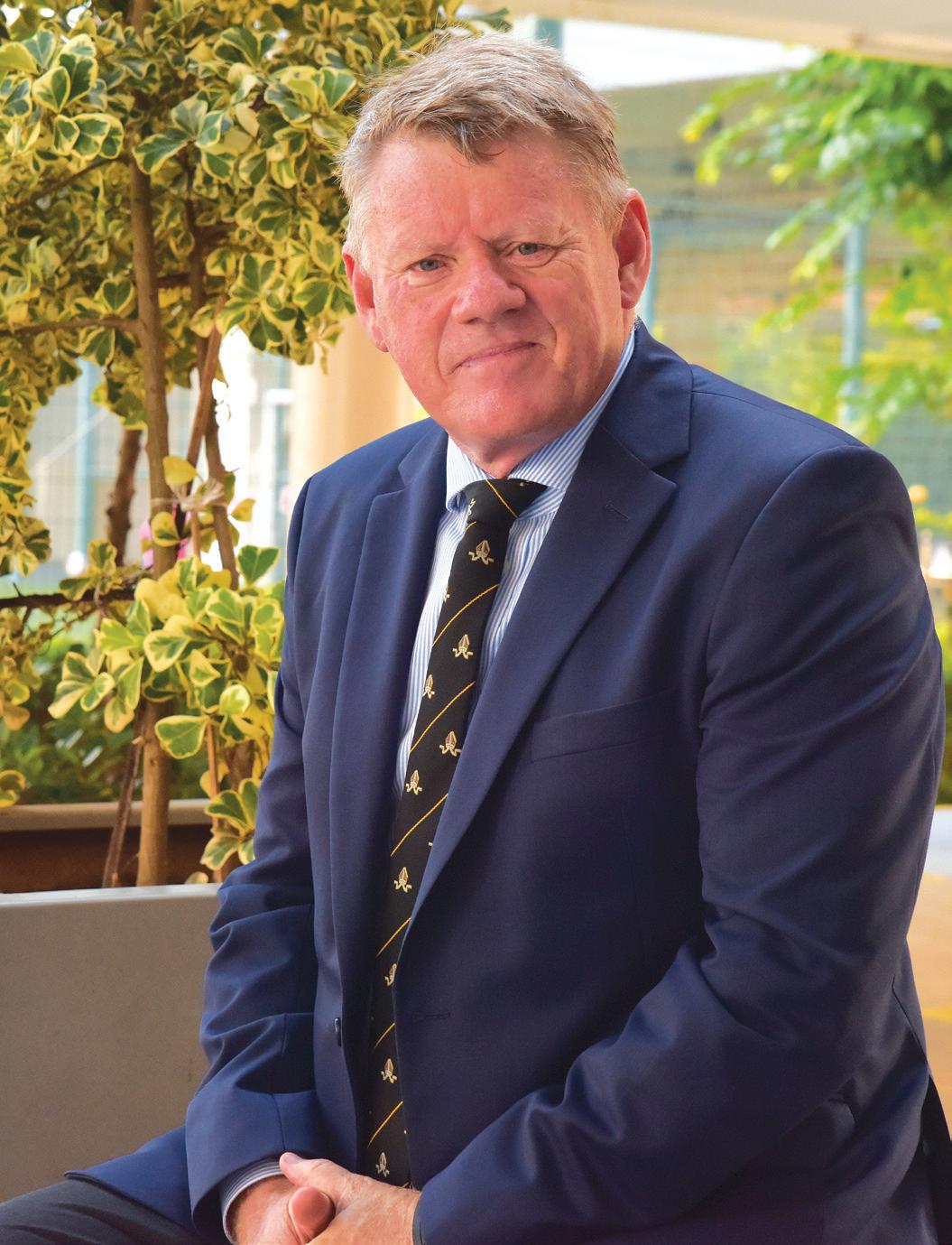
by Craig Considine, CEO
At Tanglin, we often speak about preparing young people for the future—but the question is no longer whether the future will be different. It is how quickly it is changing, and how thoughtfully we respond.
This issue of The Voice explores what it truly means to be future ready. Not as a slogan or a single initiative, but as a mindset woven through everything we do: our curriculum, our co-curricular programme, our pastoral care, and - most importantly - our relationships with young people.
A future-ready education is not about predicting specific careers or technologies. It is about developing confident, curious, and principled learners who can think critically, adapt with resilience, and act with compassion in an increasingly complex world. It means equipping students with deep knowledge, strong values, and the courage to engage with uncertainty rather than shy away from it.
It is therefore fitting that much of this edition celebrates the arts. At Tanglin, the arts are not an enrichment on the margins; they are central to how young people learn to observe closely, express ideas with clarity, collaborate meaningfully, and engage with the world imaginatively and thoughtfully. Whether through visual art, music, drama or design, the arts help our students make sense of complexity, develop their voice, and build confidence in who they
are and what they have to say—qualities that matter deeply in any future they will face.
Across this issue, you will see how this philosophy comes to life. From our youngest learners discovering curiosity and creativity through hands-on experiences, to Junior School students developing confidence and agency, and Senior School students refining their thinking, perspective and independence—each stage of a Tanglin education is deliberately designed to build capability for life beyond the classroom.
You will also read about the people who make this possible. Our staff bring expertise, creativity and care to their roles every day.
Our students demonstrate remarkable energy, empathy and ambition. Our parents and alumni continue to strengthen Tanglin as a community grounded in shared purpose. Together, these relationships form the foundation on which future readiness is built.
As we look ahead, Tanglin remains committed to balancing tradition with innovation, academic excellence with wellbeing, and ambition with humility. Preparing students for the future is not about chasing every new idea, but about holding fast to what matters most: developing young people who are ready to contribute positively to the world they will inherit.
Thanks to the editors and contributors who offer these insights, inspiration, and pride in what we are building together.
From standout achievements to memorable moments, here’s a look back at what’s been happening at Tanglin over the past few months.
Three cheers for Tanglin! We are extremely proud to announce that the 2025 British Schools Overseas (BSO) inspection graded us Outstanding, the highest possible rating.
Tanglin is the only international school in Singapore to undergo this UK government inspection. The quality of education, students’ development, welfare, and school leadership were all rated outstanding. Inspectors highlighted exceptional attainment and progress in English, Mathematics, Science, and across creative and practical subjects, with results at IGCSE, A level and IB Diploma significantly above UK and global averages. They also praised Tanglin’s highly cohesive community, where students, staff and parents celebrate achievement, prioritise wellbeing and provide outstanding care, enabling students to thrive and display exemplary behaviour.
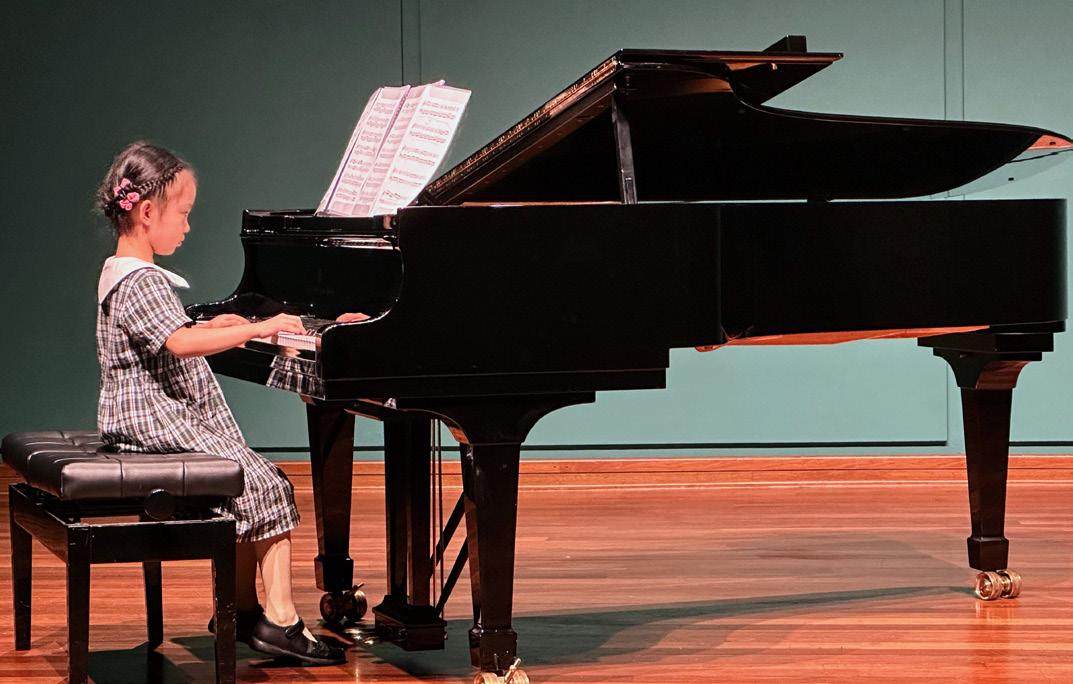


Infant student Jovienne marked Tanglin Trust School’s 100th anniversary by completing an original composition in Year 1 as a tribute to the school she loves. Her creative process was fun and focused: she first hand-wrote her musical ideas before meticulously transcribing them into MuseScore. She imagined a bold, trumpet-like opening to reflect a century of resilience and achievement, followed by a dramatic Mozartian middle section— capturing the grand transformation the school has navigated throughout its history and the unwavering persistence that defines its legacy today. When invited to perform at the Centenary Infant Showcase Concert, Jovienne felt the most meaningful way to celebrate was to contribute her own notes. The piece typically lasts between three to four minutes, depending on her mood and the level of improvisation she feels inspired to weave into the performance. Her Centenary Fantasie stands as a moving reminder of how Tanglin’s youngest voices are already creatively contributing to the school’s 100-year harmony.
We are delighted to share that Year 2’s Leo P has been selected for the Singapore Golf Association’s Futures Squad, a national-level junior development programme. Leo’s consistent results throughout 2025 and multiple wins in the Singapore Junior Development Tour have earned him a spot in the Under-12 age squad, a remarkable achievement for a 7-year-old. Leo is proudly following in the footsteps of his older brother, Aden, who was selected for the Under-16 High-Performance Junior Development Squad.
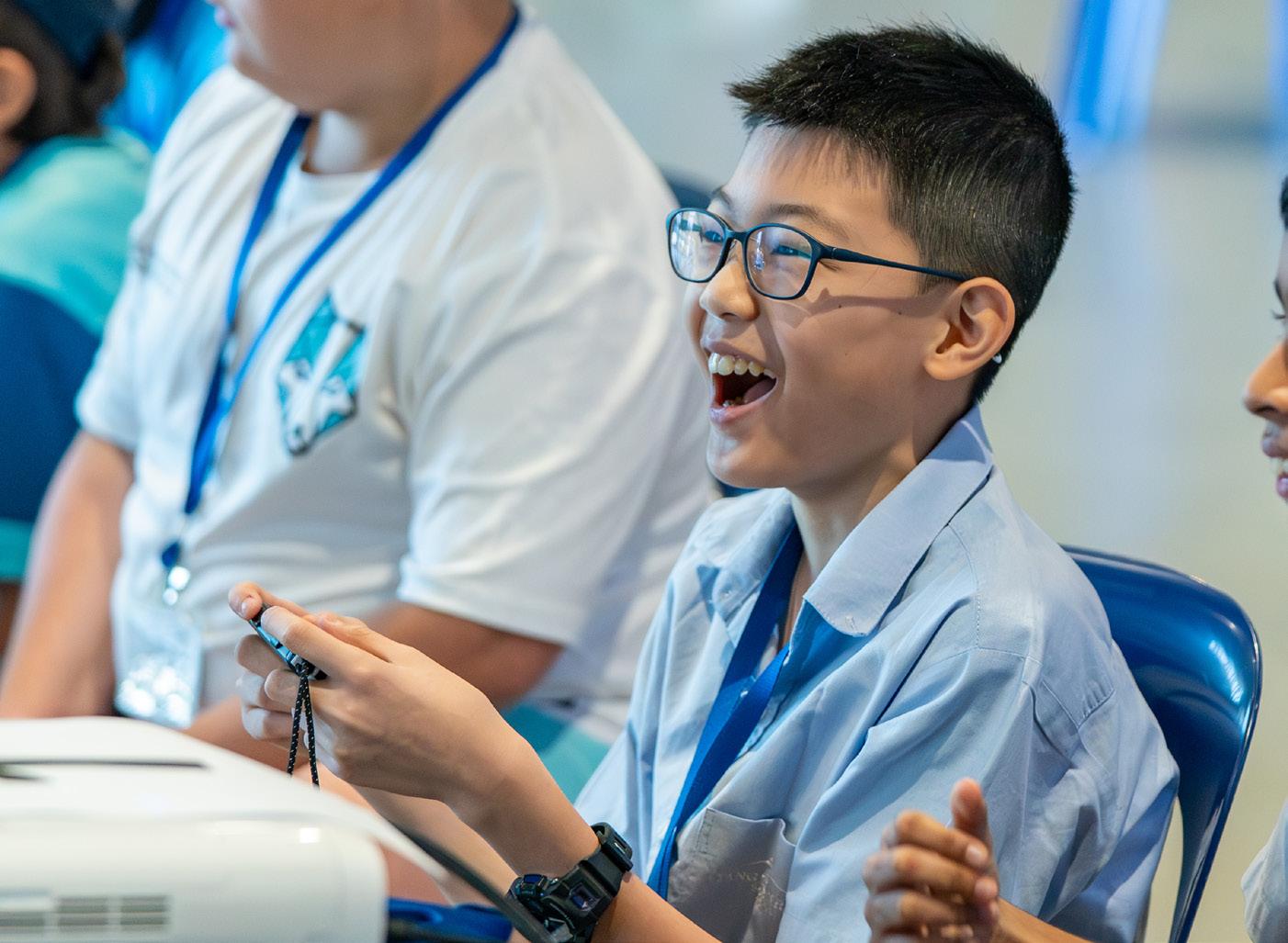
Tanglin proudly hosted the inaugural Ready Up Rumble Esports Competition, marking a first for the school and a global first for its multi-disciplinary gaming format. Teams tackled a range of games that tested gameplay skills, engineering, strategy, and teamwork. Six international schools took part, with the variety of challenges keeping competitors engaged and on their toes throughout the event. Tanglin’s events delivered outstanding performances, securing first and third place on the podium. A fantastic display of skill, strategy, and online sportsmanship all round. The event was made possible with the support of Tanglin Trust School Foundation.
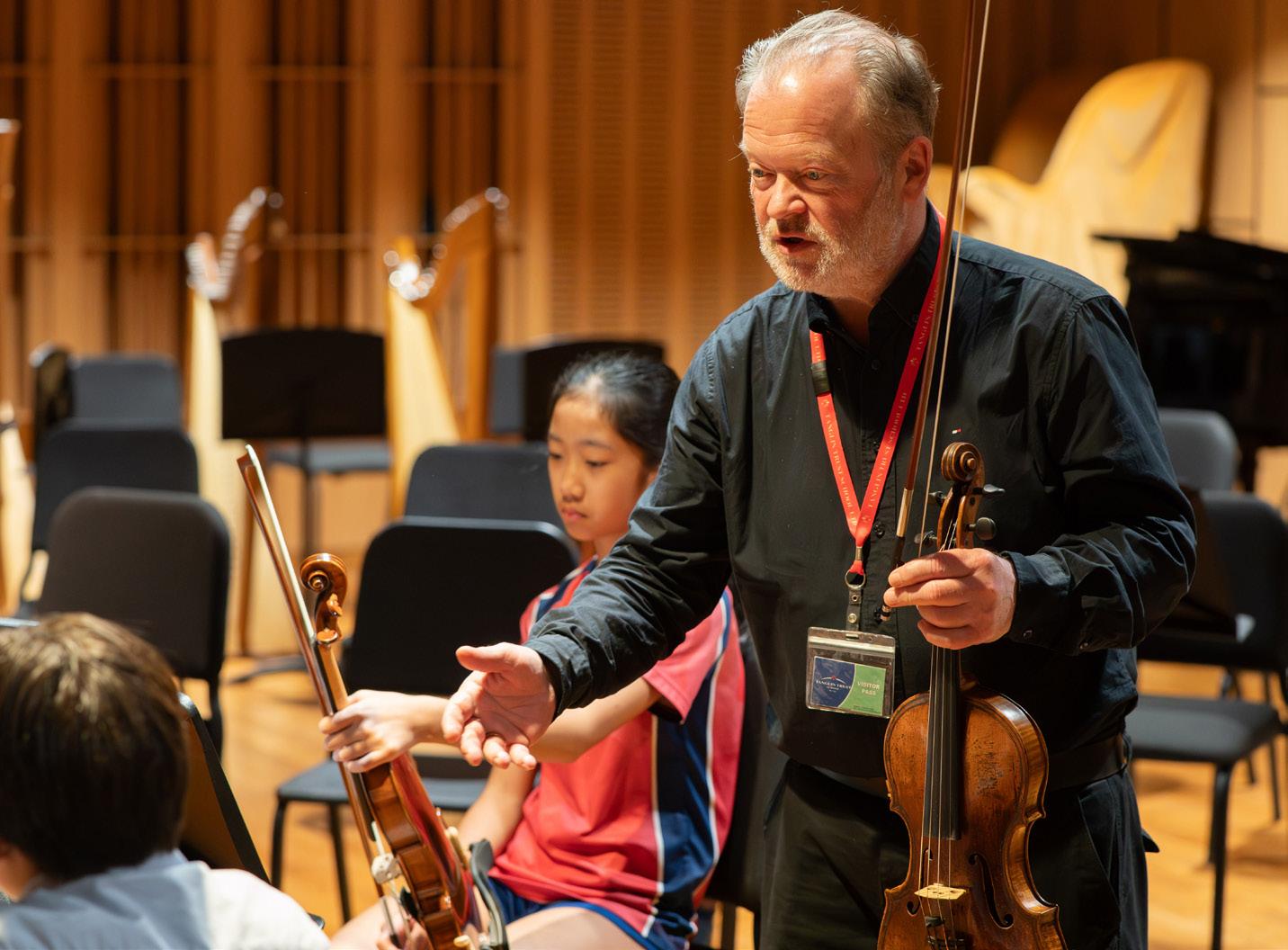
The internationally renowned Brodsky String Quartet recently visited Tanglin for a truly inspiring morning of music-making and masterclass mentoring. It began with a short performance by the Quartet, immediately captivating our students with their trademark energy, nuance, and musical storytelling. Seeing musicians of such calibre perform up-close was an unforgettable experience and set the tone perfectly for the sessions that followed. The Brodsky Quartet worked with four of our most advanced string chamber groups and challenged them to move far beyond simply playing the notes on the page. The sessions were both enlightening and demanding. The Quartet’s insightful feedback pushed each group to refine their interpretation, sharpen their ensemble awareness, and elevate their musical expression. It was remarkable to witness the progress made in such a short space of time; each ensemble demonstrated new-found confidence and cohesion by the end of the morning. The visit concluded with an informal showcase of the works explored during the masterclasses, a wonderful opportunity to hear the immediate impact of the Quartet’s guidance. It was a truly special visit that will resonate with our young musicians and onlookers for years to come.
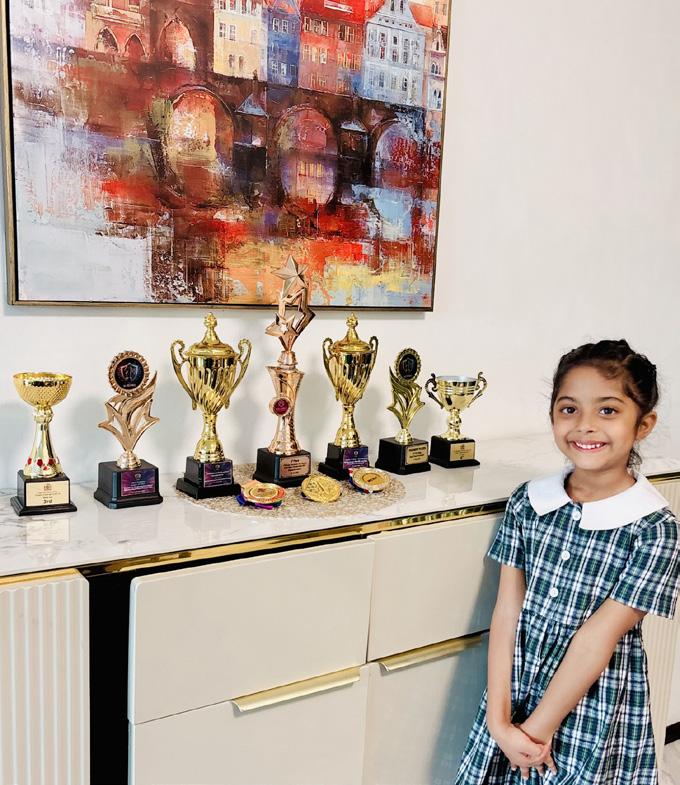
Year 2’s Kiara S G started playing chess in 2025 and has made significant progress since then. At just 6 years of age, Kiara already has 15 trophies and medals to her name, demonstrating impressive development, dedication, and passion for chess. Some of her recent achievements include 2nd Place Medal in the Under-8 Girls category at the 10th Johor International Chess Tournament 2025 and 8th Place Trophy in the Under-7 Girls category at the Singapore National Age Group (NAG) Chess Tournament 2025. These milestones have greatly motivated Kiara and further strengthened her discipline and focus. She especially enjoys the ‘standard’ format and has inspired many of her friends to learn this game. Her dream is to become a chess champion like Judit Polgar.
Tanglin wouldn’t be what it is today without the dedication of those who support it and the commitment of its community. Here are some of their Tanglin stories.
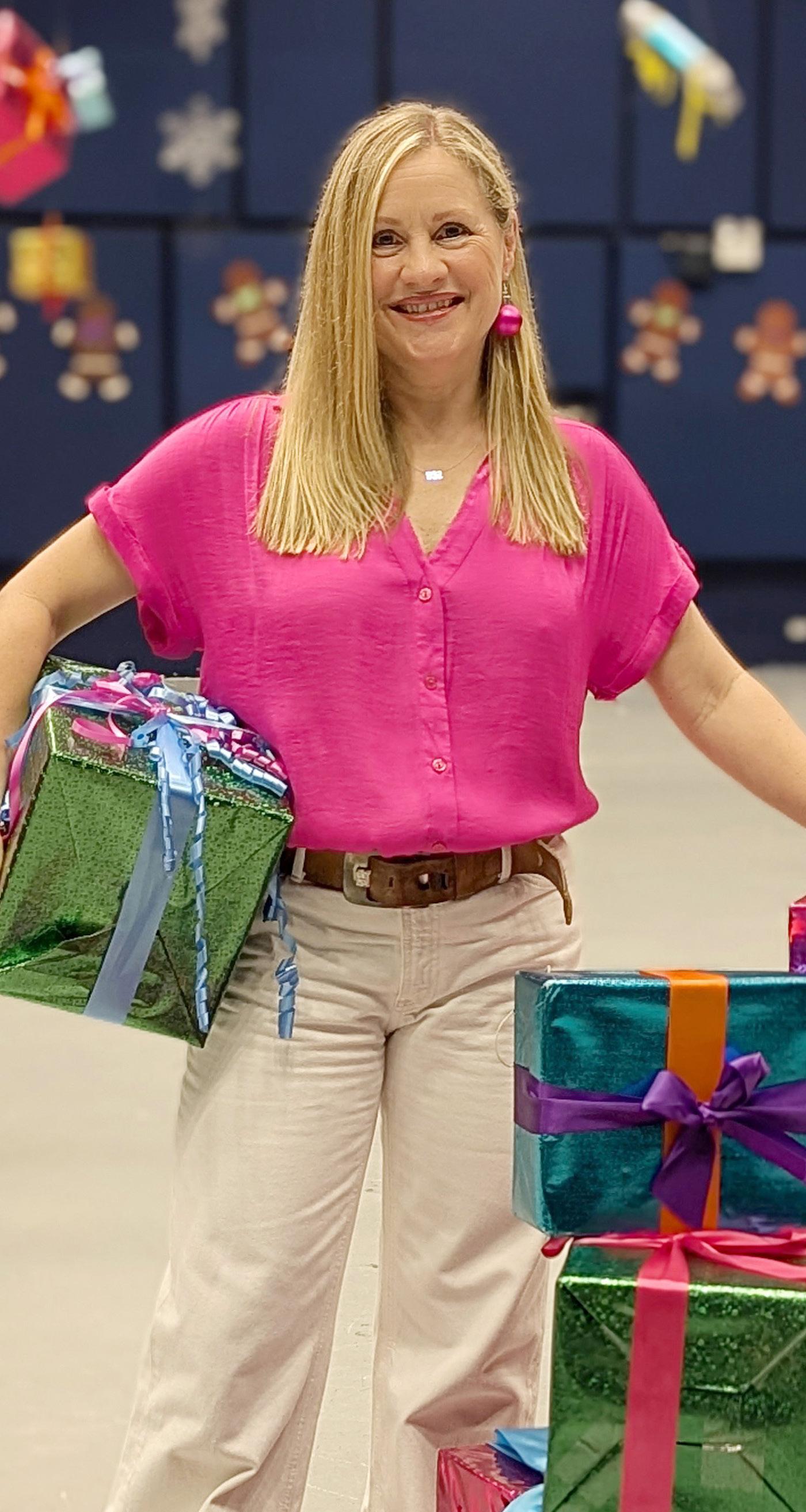
I began my career as a fashion designer in London and in 2002, an opportunity to work with exciting brands in Hong Kong marked the start of our Asian adventure. We moved from Hong Kong to Singapore in 2008, and my eldest daughter joined Nursery at Tanglin. My son followed a few years later and is now in Year 13, while my daughter is studying at a university in the UK. Both thoroughly thrived in the Tanglin environment and loved their time here.
When we first joined Tanglin, we were struck by the friendly and vibrant atmosphere in Nursery. I was keen to help and soon got to know members of the PTA. Before long, I was designing posters for school events and developing products such as the House wristbands. We organised and set up the Summer Fetes, Curry Quiz Nights, Junior Discos and many more events! I recently returned to my fashion roots creating sustainable, products including reusable masks, Christmas stockings, bespoke hand sewn greetings cards and upcycled denim bags. I also repurpose old Tanglin uniforms into cushions covers, bags, bookmarks and keyrings, which make great Leavers’ gifts and Centenary keepsakes.
One of my main roles as a parent volunteer has been decorating the Berrick Hall for the wonderful Christmas Fair, something I’ve loved for the past 15 years. The festive décor has given me some of my most memorable moments and has been a true highlight in my time as a volunteer. It always makes me feel festive in Singapore’s warm climate! This was my last year setting up the décor, and I know I’ll truly miss it. I’ve also enjoyed working with the fantastic volunteers to create the various decorations, Santa’s Grotto, $10 Shop, and the Tea Shoppe. After so many years of doing this, I’ve even been affectionately nicknamed ‘Mrs Christmas’!
Projects like this allowed me to stay connected to my children’s school lives whilst also building wonderful friendships with other parents, volunteers, and the incredible staff. I’m especially proud of my contributions to the Christmas Fair. Seeing the children and parents enjoy the fair makes all the hard work worthwhile.
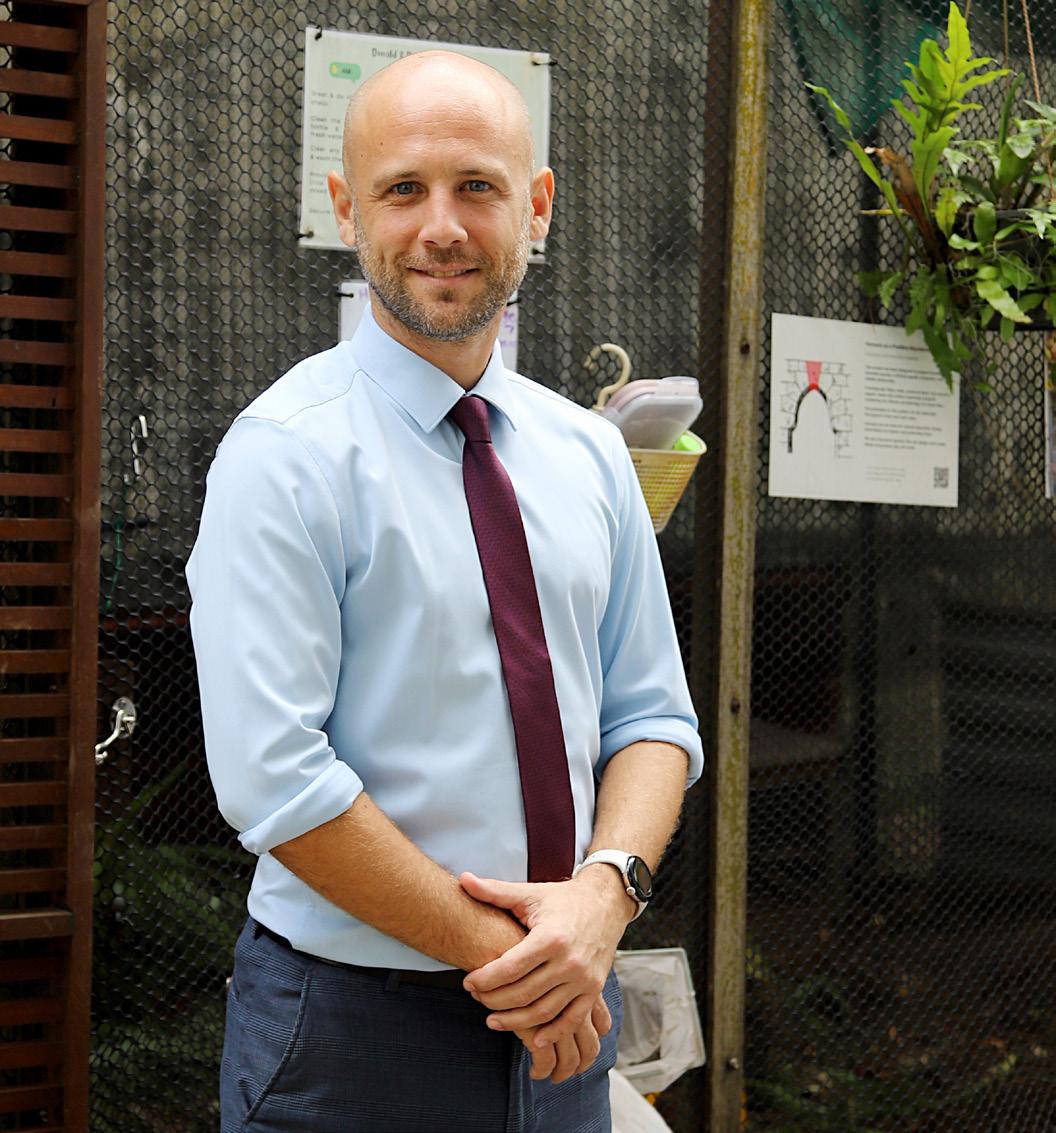
I joined Tanglin in 2021 — you could say I am a Covid baby! I came from Kyiv, where I was a Junior School teacher and Head of Key Stage 2. Before that, I worked in Thailand, Tanzania and the UK. This is my fifth year at Tanglin. I had always wanted to work here because I’d heard it was the best school in the world, and I can confidently say I’m very happy with that choice. I became a teacher because I love working with young children; their curiosity and energy continually inspire me. I remain motivated because I truly feel I am making a difference by helping to shape the future leaders of tomorrow.
As Future Ready Lead, I work across four key areas: Sustainability, STEAM, Enterprise and Service. My aim is to embed these into the curriculum in meaningful, hands-on ways by creating those special ‘WOW’ moments that truly bring learning to life. Ultimately, everything I do is designed to help students grow into future leaders who make excellent personal and social decisions, shaped in part by the experiences, values and opportunities they encounter at school.
One of my greatest passions is coaching the Tanglin girls’ football teams. I coach the Year 6 and U12 squads this year, taking them to matches and tournaments across Singapore and neighbouring countries. Last year, we achieved outstanding success by winning FOBISIA gold in Thailand and the Singapore Schools football competition. Our new girls’ football academy at Tanglin has enormous potential, and I absolutely love coaching these talented teams.
I joined Tanglin in August 2010 as a Chinese teacher in Senior School. Although it has been 15 years, I’m still inspired by the rich diversity that Tanglin and Singapore, both cultural melting pots, have to offer. Before joining Tanglin, I worked at a couple of
international schools in Shanghai, teaching Chinese to students from Year 1 through to Year 13.
Growing up in Shanghai, one of the most culturally diverse cities in China, I had always wanted to live abroad and explore different cultures. For me, learning and teaching languages is a natural way of building bridges between people. Over the years, this has helped me meet people from all walks of life and some have become very dear friends.
As the Head of Languages and Classics at Tanglin, I lead a diverse and dynamic team dedicated to fostering a love of languages, cultures, and classical learning. My role involves shaping curriculum direction, supporting and mentoring colleagues, and ensuring that our programmes remain rigorous, inclusive, and forward-looking while staying true to Tanglin’s academic ethos. Languages and Classics open doors to different worlds; whether exploring ancient civilisations or engaging with contemporary cultures through modern languages. Students learn to see beyond their own perspectives and deepen their cultural awareness and understanding of past and present societies.
What I love most about my role is bringing languages to life for students and watching them gain confidence as communicators, develop cultural curiosity, shape their identities through learning languages, and make meaningful connections between languages, literature, and the wider world. I’m also proud to be part of a faculty where colleagues share ideas, innovate in the classroom, and support one another.
Beyond the classroom, I enjoy making music in my free time. I learned the piano as a child and once played a piano concerto at the Shanghai Concert Hall. Nowadays, I’ve taken up the violin and although I’m still at a foundational level, I find great joy in learning a new piece each time.

I joined Tanglin in 2014 after working as a Film and Media teacher in London for a number of years. Before that, I taught in South Korea, worked at the British Film Institute and completed my first Master’s in Visual Anthropology.
I’m originally from Australia and lived in Canada, London, and Northern Ireland before moving to Singapore with my family 10 years ago. While in London, I worked with the ABRSM and the Royal Academy of Music, where I developed a passion for supporting students on their musical journeys. In 2016, a friend (and future colleague) encouraged me to join the music department at Tanglin, and it turned out to be the right move!
My wife (who is also a Tanglin teacher) and I always knew that we wanted to work internationally, with Asia as our first choice. Having visited Singapore several times and fallen in love with the country, it was an easy decision. We were also drawn to Tanglin’s strong sense of community and stellar reputation as a place to work. Today, we are proud parents of two Tanglin children.
While teaching here, I became an Assistant Head of Year and enjoyed the pastoral side of the role. Working closely with the Counselling team also inspired me to become a Counsellor myself. In 2019, I began a Master’s in Counselling and completed my internship at Tanglin while continuing to teach. After qualifying, I left to work as a full-time Counsellor at another international school in Singapore, before returning to Tanglin as a Counsellor in 2022.
As a Counsellor, no two days are the same. Students face many different challenges, and we support them by providing a safe space to talk and be heard. We also work with parents, teachers, and pastoral staff to help students navigate school life and take part in activities, taking a holistic approach to their wellbeing. For example, we are introducing a programme in Junior School to help parents, teachers, and students use a shared language and resources to manage ‘Big Feelings’. We ran a ParentWise workshop, trained all Junior School staff, and provided every class with a ‘Big Feelings Box’ toolkit, something we are very excited about! I especially love working with our close-knit Counselling team and feel lucky to be part of a school that places such a strong emphasis on student and staff wellbeing.
I enjoy being outdoors, going for long walks, and immersing myself in nature. I love spending time with my family, travelling to explore different cultures, and trying a wide variety of cuisines both in Singapore and abroad.
When I later moved from the music department to Co-curriculum, I was excited by the opportunity to contribute to an area that reaches every student at Tanglin. My current role focuses on coordinating and developing Tanglin’s Co-curricular programme, working closely with colleagues across the whole school community to make sure that every activity runs smoothly and safely. A lot of what I do happens in the background as it involves scheduling, communicating with parents, tracking student participation, and continuously reviewing the quality and balance of the activities we offer. Alongside this, I support sporting events, musical rehearsals and performances, attend parent workshops, and celebrate students’ achievements at assemblies, making each day both exciting and rewarding.
Tanglin’s Co-curricular programme stands out for its breadth and intention. We offer a huge variety of activities across creative, sporting, academic enrichment, and service areas, all led by passionate staff who share their interests and expertise (often beyond their usual subject area), bringing authenticity and enthusiasm to the programme. This allows our students to explore who they are outside the classroom, build friendships, try something new or refining existing skills. The Co-curricular programme is valued as an integral part of school life, alongside the academic and pastoral pillars of a Tanglin education.
Outside of school, my three children keep me busy! We enjoy exploring Singapore and spending time in the beautiful parks and green spaces around us. Living here has reinforced my belief in the value of curiosity and community, both at home and at work.
Learning comes alive through hands-on experiences. This past term, our students had the opportunity to learn directly from experts, but what did they discover?
By Libby Henderson, Head of Infant Art and Design
t Tanglin, we believe that children learn best through rich, hands-on experiences. One particularly powerful way to deepen learning is by inviting professional artists into the classroom. When children work alongside practising artists, they gain insight into the real creative process, exploring new materials, developing practical skills and discovering how ideas grow into finished works of art.
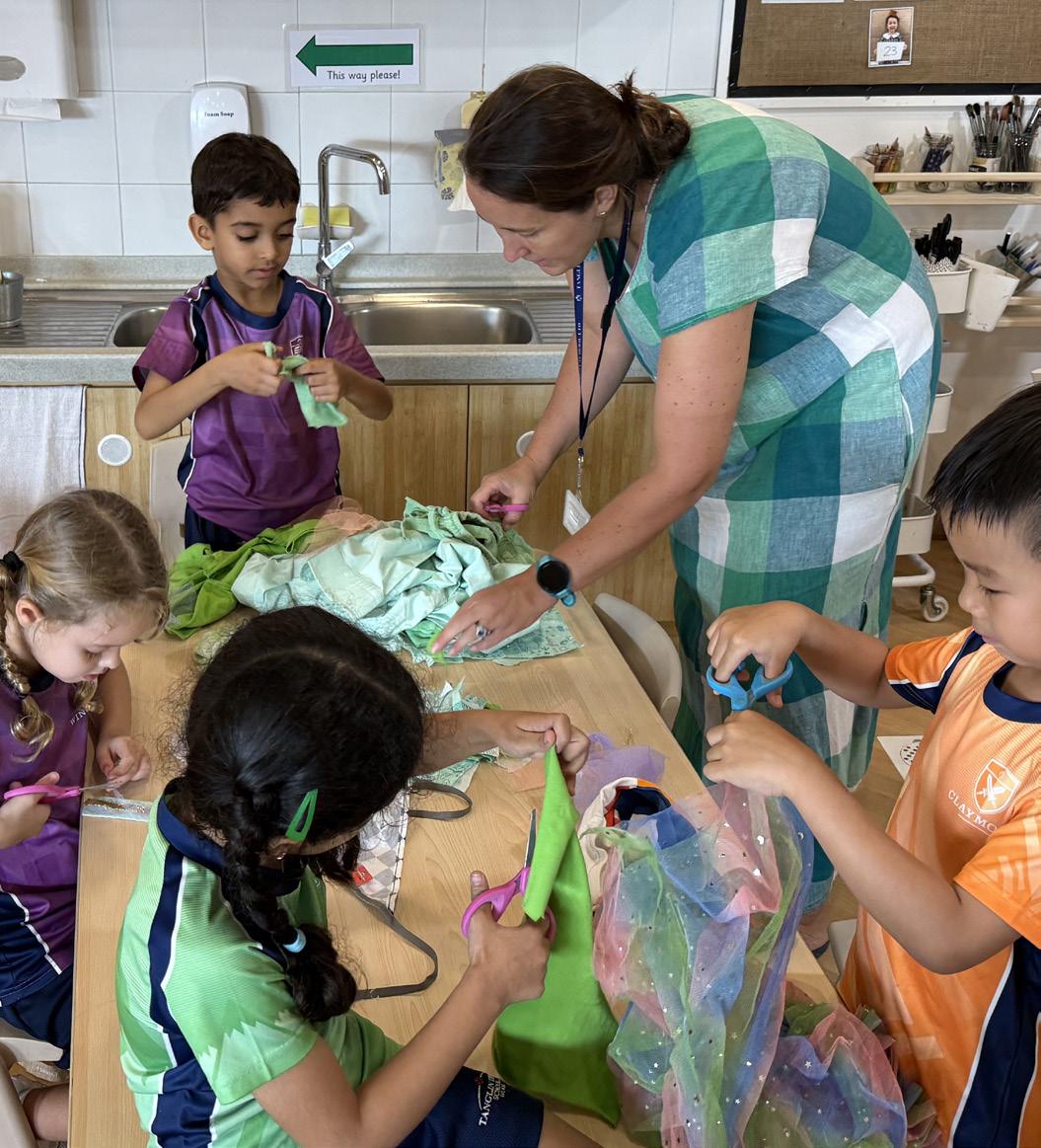
Recently, the children in Jellyfish Class had the exciting opportunity to collaborate with visiting artist Sarah Vaulkhard, also known as Sizzle, on a large-scale jellyfish themed art project. Across several sessions, the children explored drawing, collage, textiles and sewing, gradually contributing to a collaborative artwork that will be displayed in the Infant School.
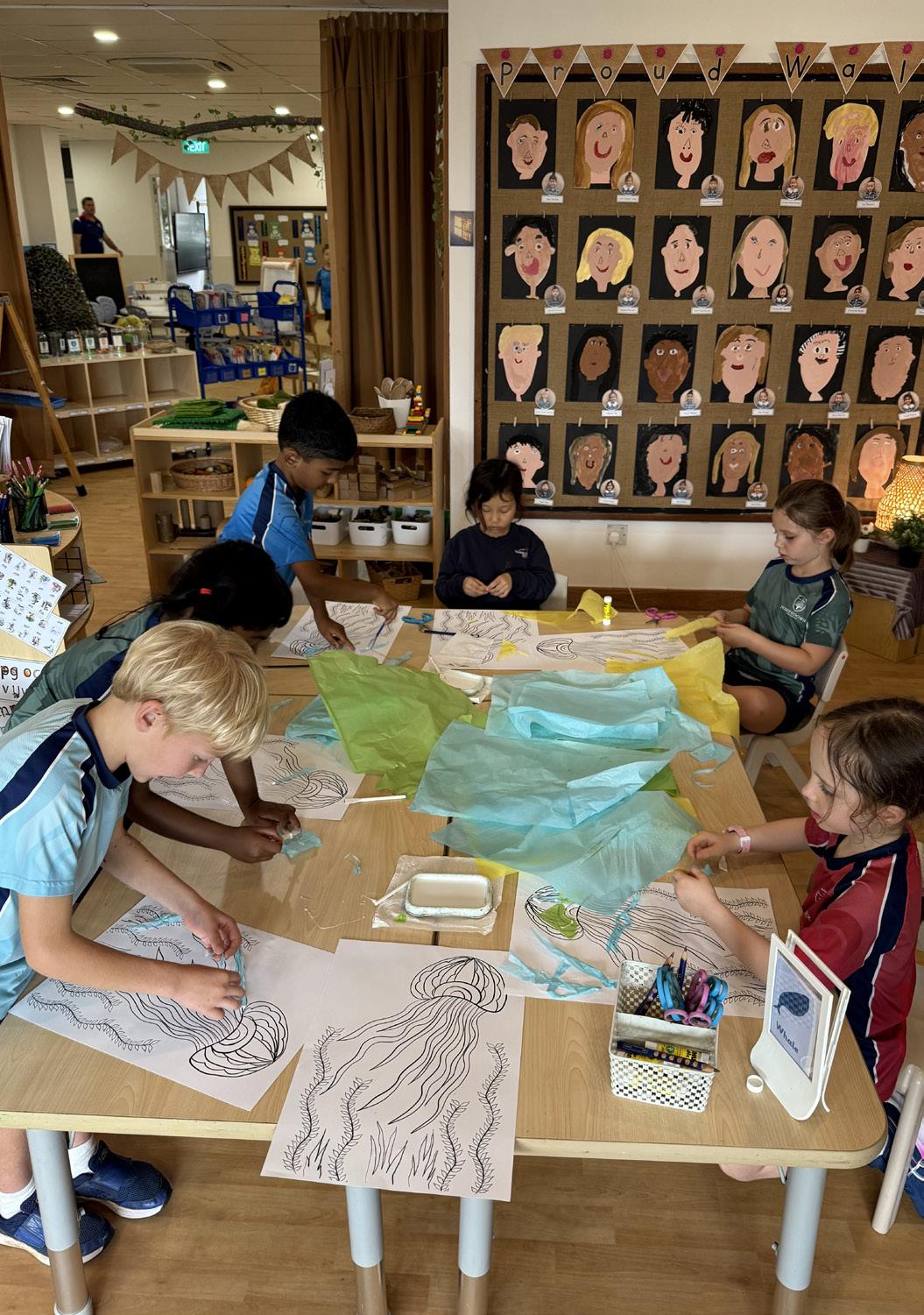
The project began with an introduction to the theme, where the children experimented with drawing jellyfish, closely observing their shapes, movement and flowing tentacles. This initial stage helped the children build confidence in expressing their ideas visually and introduced them to the process artists often follow when beginning a new piece of work.
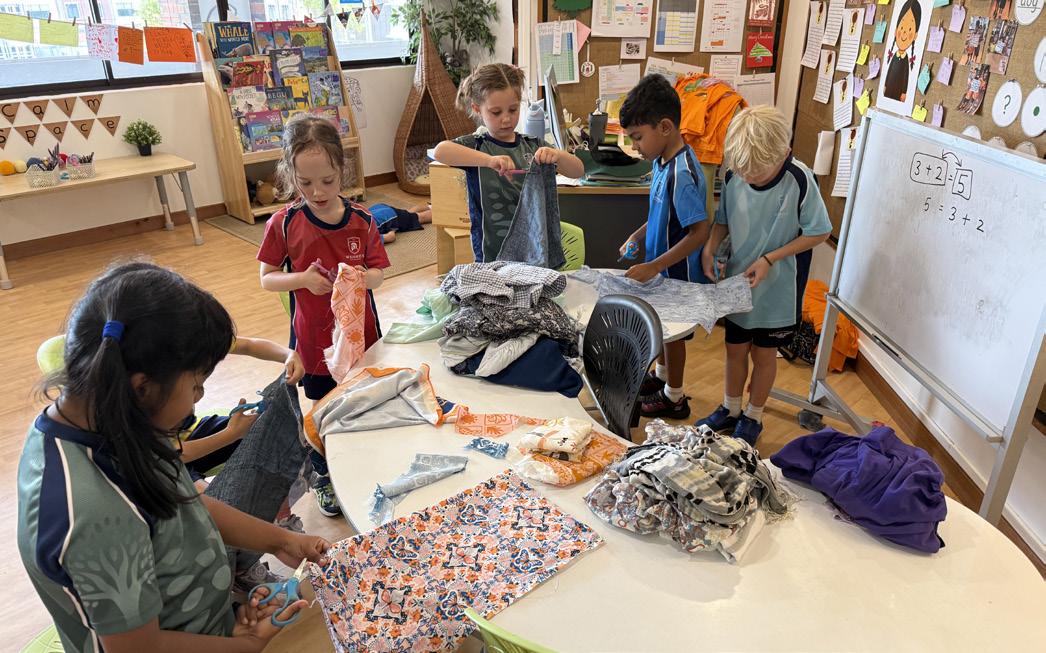
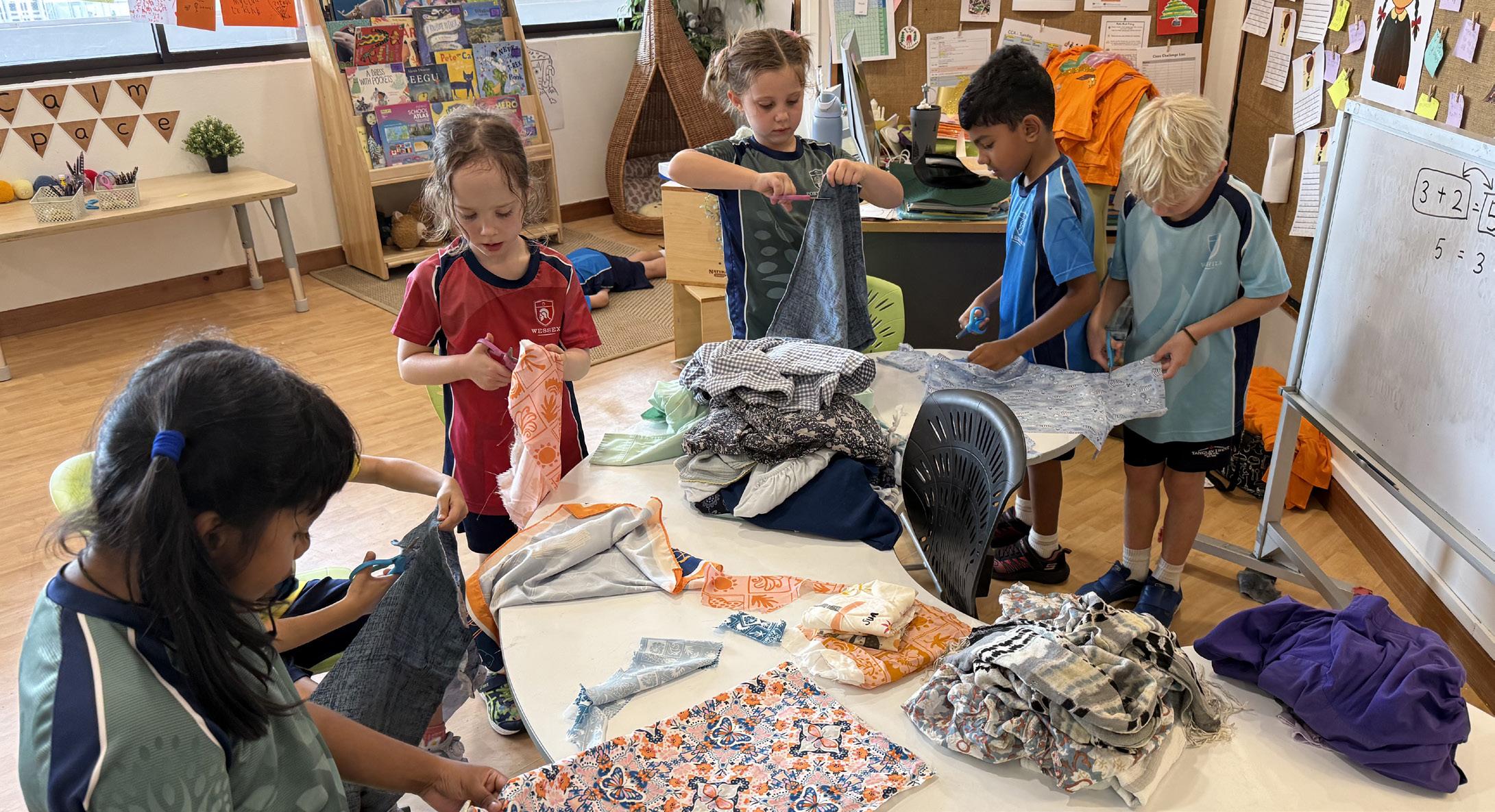
They then explored collage techniques, using colourful tissue paper to create delicate jellyfish forms. This allowed them to experiment with layering, texture and colour while strengthening fine motor skills. As the project developed, the children worked with recycled clothing and fabric, sorting materials by colour, tone and pattern. These fabrics, many of which were brought in from home, were cut and prepared for use in a large collaborative jellyfish
collage. Through this process, the children began to think about composition and how different materials can work together within a piece of art. “Sustainability is something Tanglin places great emphasis on,” explained Sarah. “Using recycled fabrics allowed us to demonstrate that items which may no longer be wearable can still have value and be transformed into something new. By repurposing these materials within the artwork, the children could see first-hand how creativity can give objects a second life.”
One of the most memorable parts of the project was the opportunity for the children to use a sewing machine. Over two sessions, Sarah guided the class in stitching the outline of a jellyfish, introducing them to a real artistic tool that many had never encountered before. For Sarah, the enthusiasm of the children was one of the highlights of the experience.
“What I enjoy most is their complete enthusiasm and willingness to take part,” she said. “Young children approach art with a natural sense of curiosity and imagination, and they are rarely inhibited by the fear of ‘getting it wrong.’ Because of this, their creativity can be incredibly bold and inventive.”
During the project, the children were introduced to new artistic vocabulary and concepts, including collage, transparency and tone. They explored how lighter colours can suggest light while darker tones create depth, and how repeating patterns and shapes can suggest movement, particularly important when representing flowing water and jellyfish. Alongside these creative ideas, the children also developed practical skills such as cutting and tearing fabric, threading needles and sewing. For many, this was their first experience working with textiles.
“Working with textiles introduces children to a completely different artistic discipline,” Sarah explained. “It allows them to think
beyond drawing or painting and explore how materials can be manipulated, layered and constructed. It was wonderful to see how empowering this was for them.” Sarah was also impressed by the children’s determination and collaboration during the sessions. “I was particularly surprised by how quickly some of the children picked up practical skills such as threading a needle or sewing. What was even more delightful was how naturally they began to help one another. Once a child had mastered a skill, they were often eager to support their friends.”
Collaborative projects like this allow children to experience art as a shared creative journey. They learn not only from the artist guiding the project but also from one another, exchanging ideas and working together to build something larger than any individual contribution. “Art can be particularly empowering for children,” Sarah said. “Because there is rarely a single ‘correct’ answer in art, it allows children the freedom to express themselves and explore ideas without fear of failure.”
When the finished artwork is revealed, the children will be able to recognise the elements they helped to create, an especially meaningful moment. “The final piece will hang in the Infant School for many years to come,” Sarah said. “It will be wonderful for them to know that they contributed to something lasting.” Perhaps most importantly, experiences like this help children begin to see the world through a more creative lens. As Sarah encouraged young artists, “Look around you, inspiration is everywhere. It might be the design on a cereal packet at breakfast, the cover of a book you are reading, the print on a piece of clothing, or even a sticker given to you by a friend. When you start to notice these details, you realise that creativity exists all around us.” The Jellyfish Class embraced every stage of this project with enthusiasm, imagination and curiosity. We are incredibly grateful to Sarah Vaulkhard (Sizzle) for the time, care and expertise she dedicated to supporting the children and enriching their creative learning. A big thank you also goes to the Tanglin Trust School Foundation for funding this project. Once finished, the artwork will be hung on Level 3 of the Infant School, together with other collaborative artworks that will be commissioned to commemorate the new class names given to the Year 3 classes.
By Peter Hinckley, Head of Junior Art and Design JUNIOR
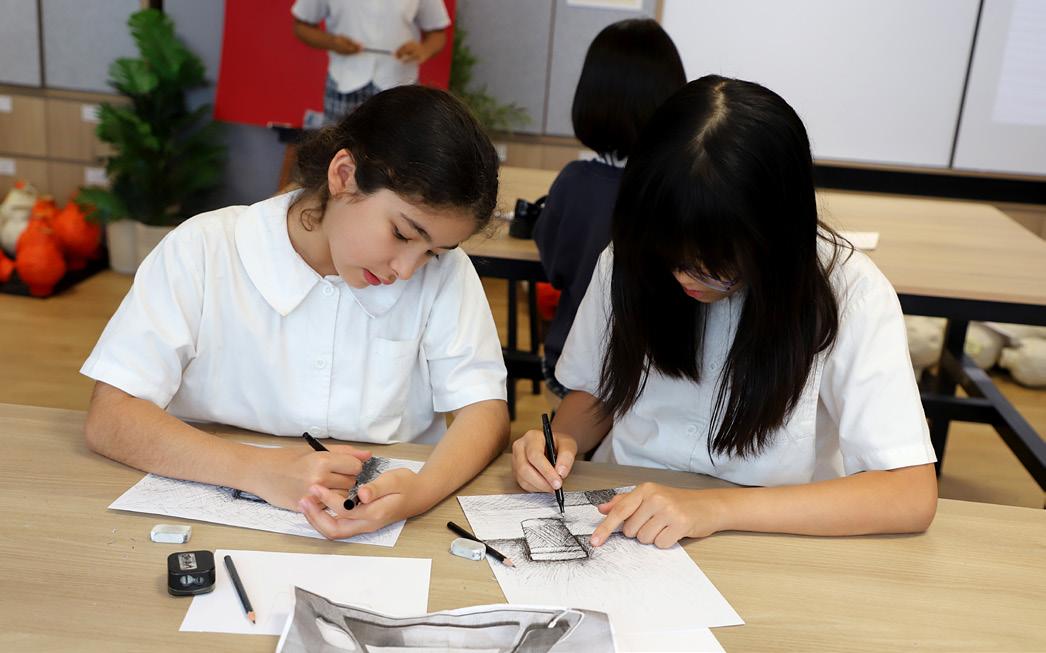
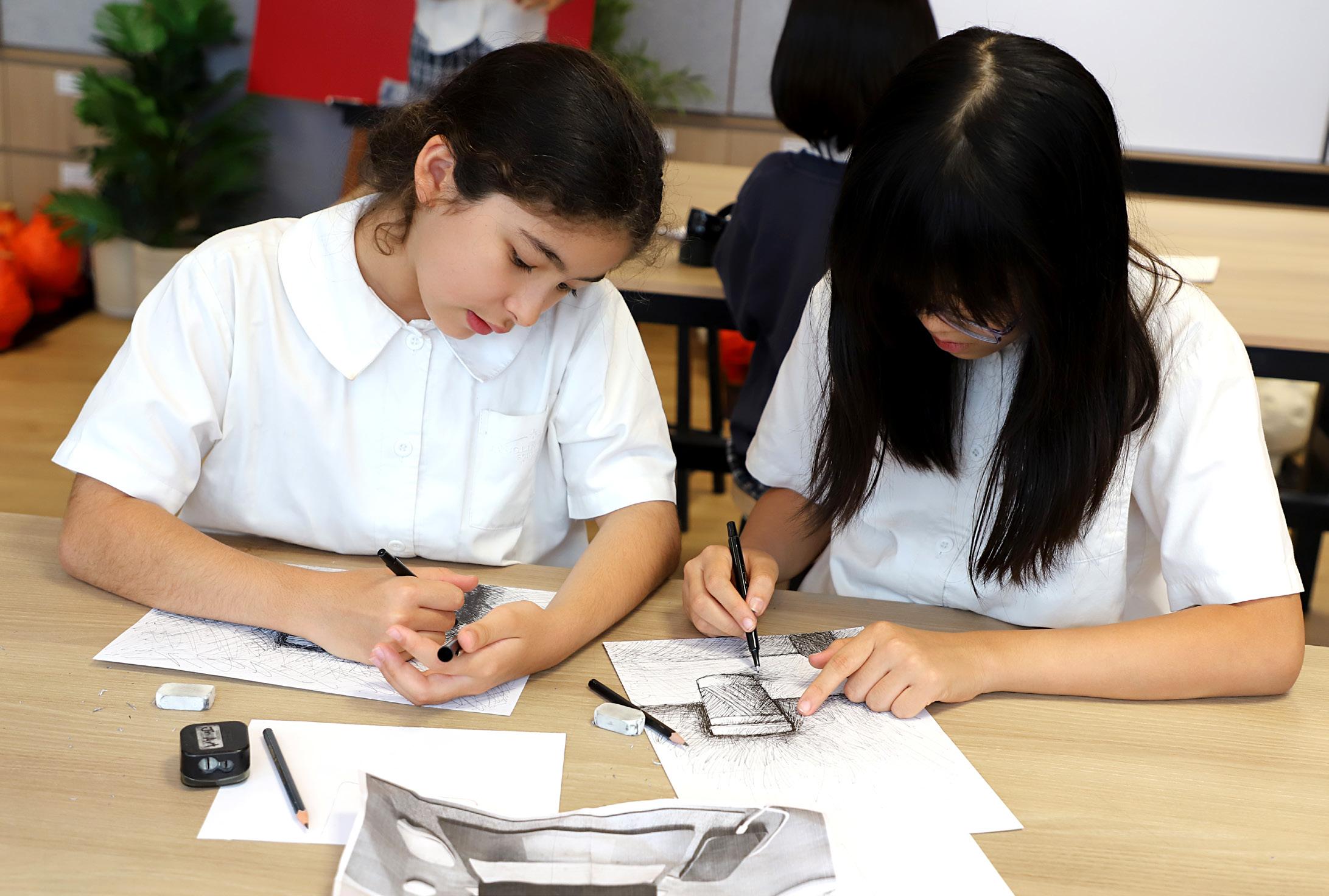
f you visit the Junior Art Studio at the Junior Arts Centre on a Thursday afternoon, you will find the room buzzing with excitement, enthusiasm and creative focus as students experiment with pencil, ink and charcoal. Around the art tables, they lean closely over their work, confidently applying new techniques to their drawing paper. Our new Academy: Art recently welcomed its first cohort of 25 students from Years 5 and 6. The programme forms part of the wider Academy: Arts initiative, which supports students who show particular enthusiasm and aptitude in Dance, Drama and Art.
Academy: Art was created for students who show a deeper interest in art and have demonstrated advanced artistic skills, and who would benefit from dedicated time to further explore and develop their techniques. The aim is simple: to provide a calm studio environment where, for two hours each week, students can nurture their creativity and technical skills through observation, practice and experimentation, while continuing to enjoy the process of making art. As Head of Junior Art, it has been rewarding to see the students happily settle into the creative rhythm of the studio, sharing ideas and approaching their work with growing confidence. Over the weeks, it has been wonderful to watch them begin to think like artists, working both independently and collaboratively within a shared creative space. The sessions take place in a dedicated Junior Art room designed with younger
artists in mind. The studio is bright and open, filled with natural light, and large tables give students plenty of space to spread out their sketchbooks and materials. The room is also equipped with excellent new technology, including a ceiling camera linked directly to a projection wall, allowing our Academy artists to clearly see demonstrations of artistic techniques and methods.
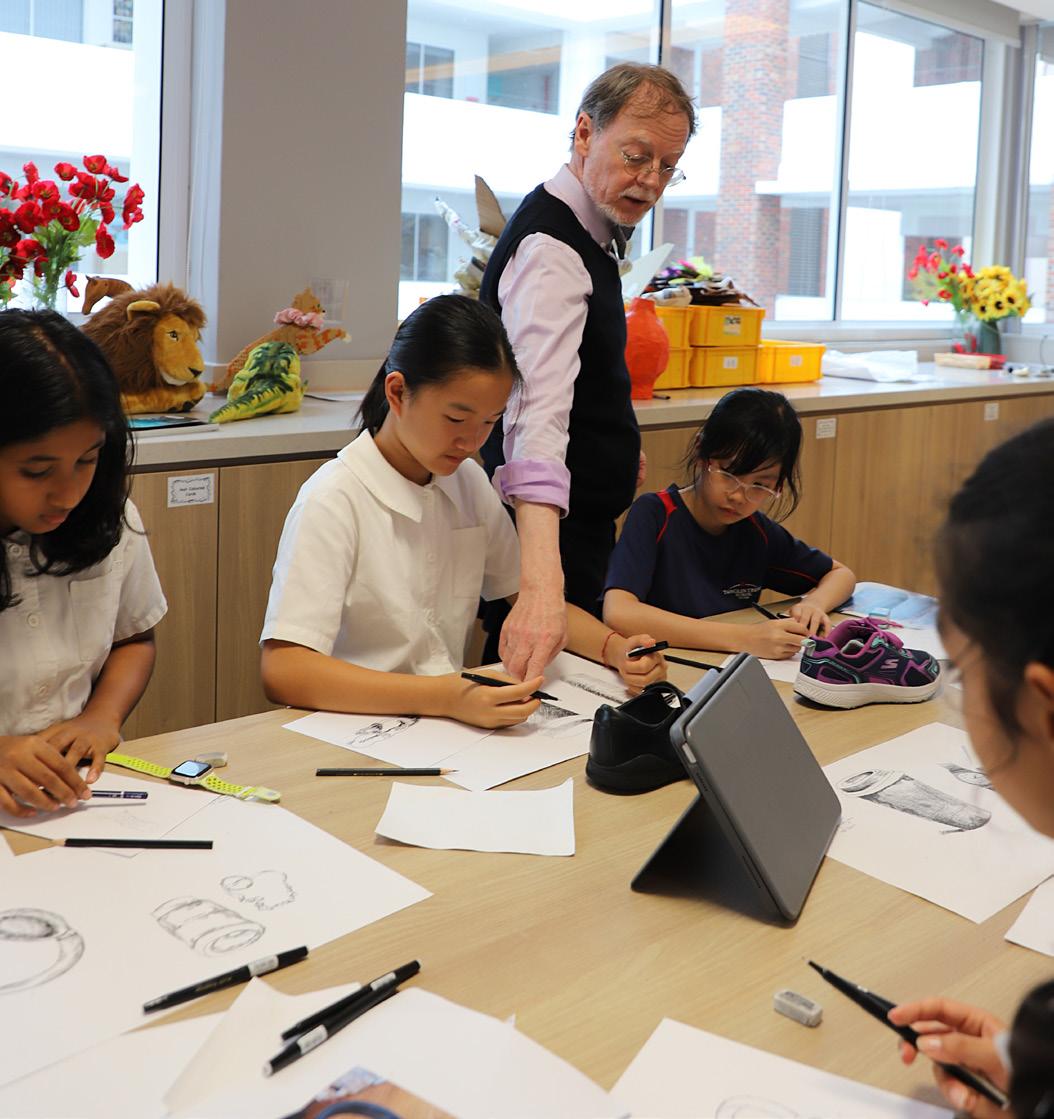
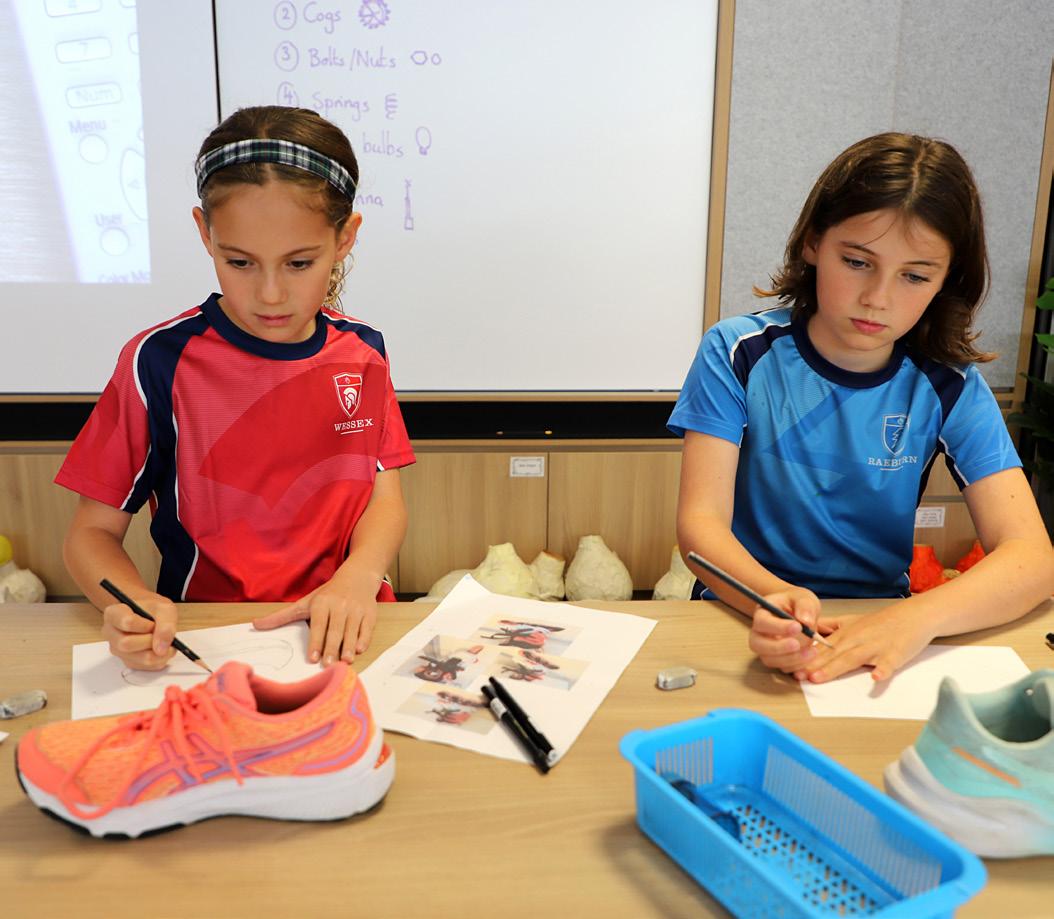
This term, the focus has been on pen and ink drawing. Using dip pens, fineliners, sketching pencils and charcoal, students have explored how simple materials and linework can be powerful tools for visual expression. They have discovered how small changes in pressure, direction and repetition can transform a line, creating texture, shadow and tonal variation. Students were introduced to techniques such as hatching, cross-hatching and stippling. At first, these marks may seem repetitive, but gradually they build subtle variations in tone and depth. It is always exciting to witness the moment when a drawing begins to suggest form and volume. To inspire their work, students studied drawings by the contemporary British artist Ian Murphy, known for his expressive pen-andink sketches of urban architecture. As part of the Academy: Art programme, the students also took part in a workshop with him, gaining valuable insight into his creative process.
This term’s theme, ‘Community and Commuting’, connects naturally with this style of drawing. We regularly travel through our local community and neighbourhood in some way, whether by walking, cycling, bus, car or MRT. These everyday journeys can
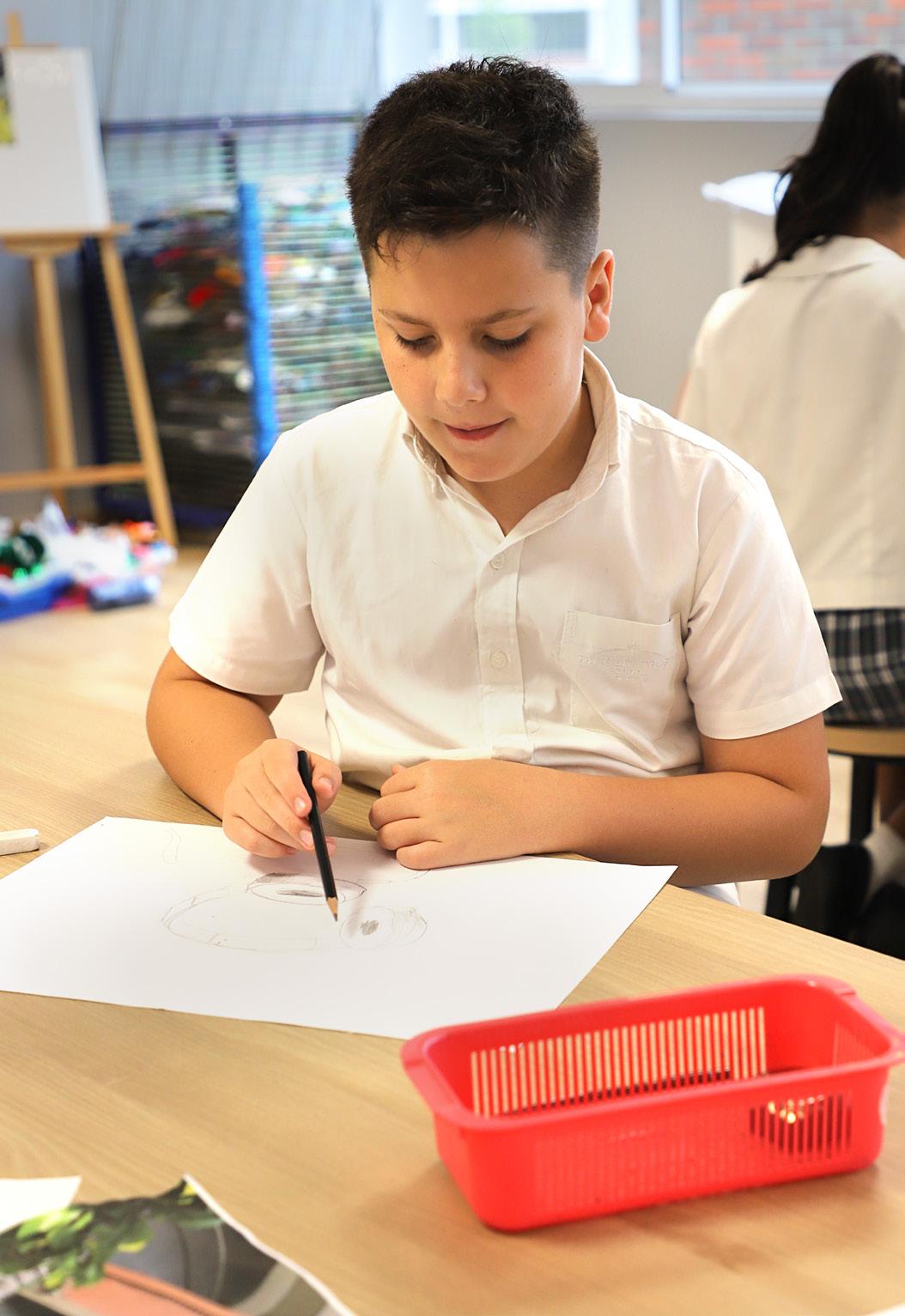
provide a surprising amount of inspiration. The students have also begun noticing details they had previously walked past through observing the architecture around Tanglin: the intricate patterns and shapes of windows, or the lattice-like linework of exterior building structures. Alongside this, the children are exploring how to draw in proportion using one- and two-point perspective.
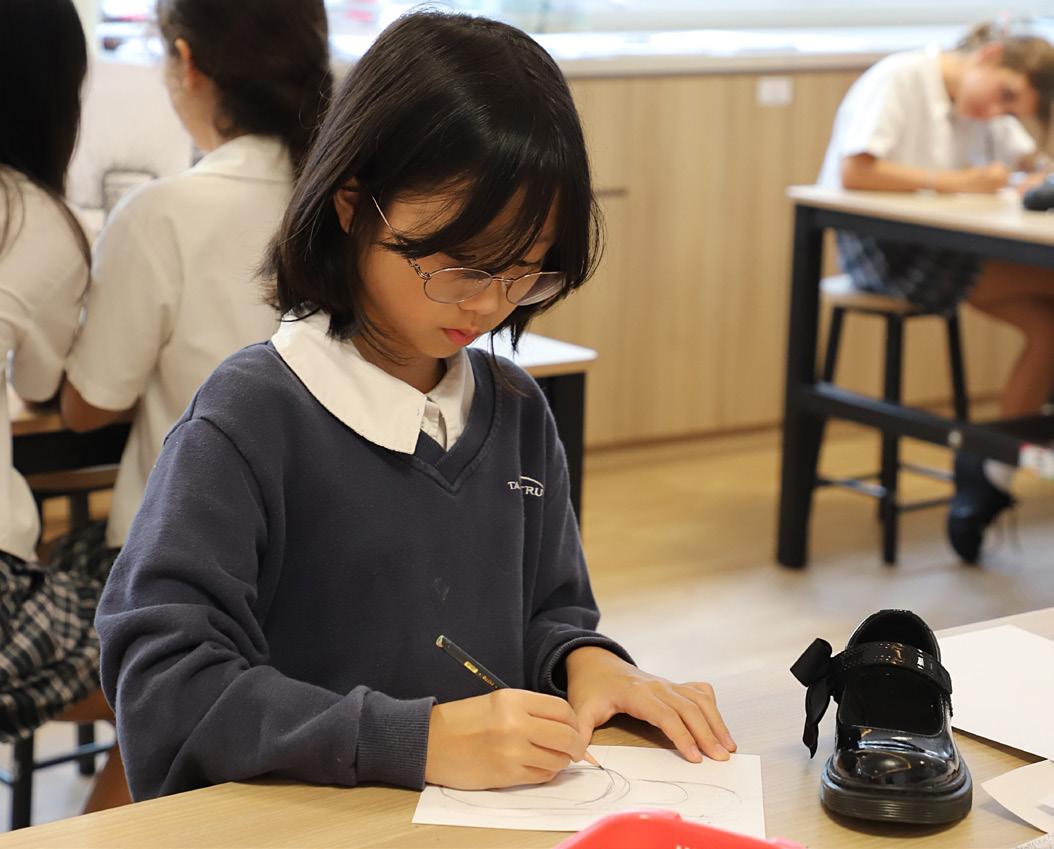
A closer look at the everyday items we use as commuters - shoes, coffee cups, water bottles, keys, bags, headphones and earbuds, books and umbrellas - provided an excellent opportunity for students to explore still-life observation drawing. Using crosshatching techniques and tonal variation with charcoal, they began to build depth and texture in their work. This approach was inspired by the beautiful penwork of Ian Murphy, known for his expressive linework and restrained colour palette on a textured background. Taking inspiration from this style, the children created their own textured paper canvases by applying glue and white tissue paper to the surface before drawing with fineliner pens. As the weeks progress, the children are confidently developing and refining their drawing skills, while observing the world around them with increasing attention. From taking in the curves of an MRT station entrance, the geometric patterns of building windows to the lines, shapes and textures of everyday objects.
Academy: Art is an exciting programme that provides a dynamic foundation for our Junior students to build skills, experiment with techniques, gain confidence, and begin to see the world around them through the eyes of an artist. As part of the wider creative initiative that includes dance and drama, the programme helps students develop resilience, creativity, and a love for the arts. Together, these areas give students the chance to express themselves, try new things, and grow in a supportive environment.
By Elizabeth Anstiss, Head of Senior Art and Design
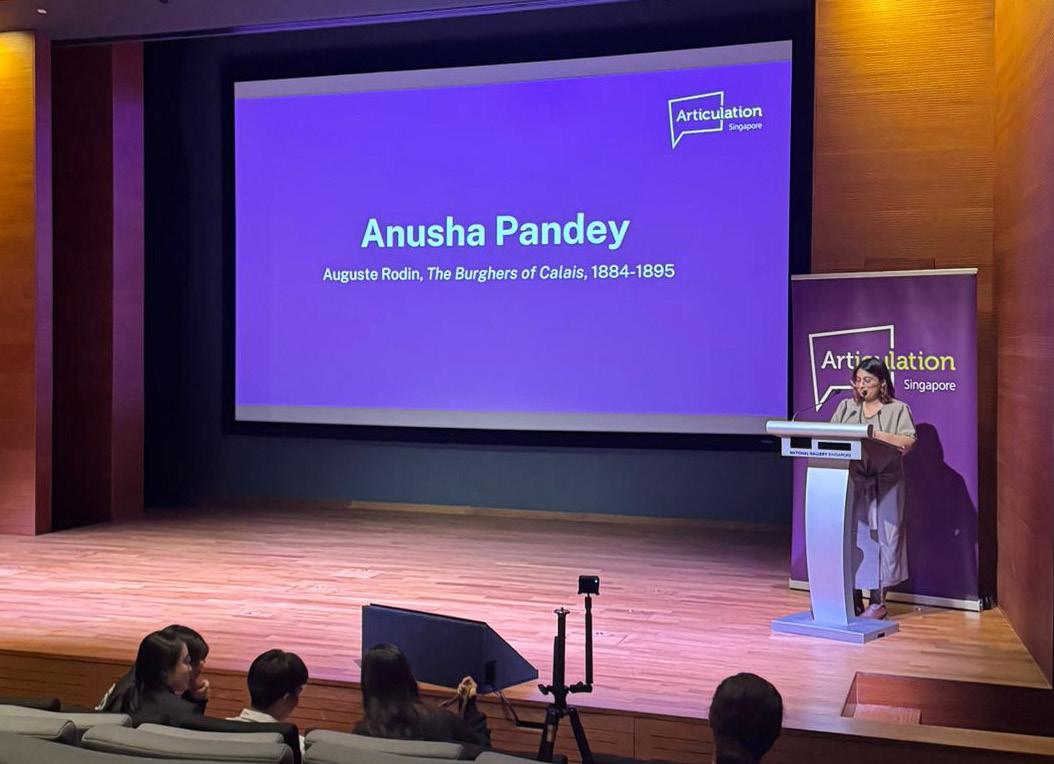
cademic enrichment in Art education plays a vital role in shaping students into thoughtful, articulate, and culturally aware individuals. While studio-based lessons provide essential technical foundations, enrichment opportunities extend learning beyond the syllabus, challenging students to think critically, communicate confidently, and engage meaningfully with the wider artistic community. One outstanding example of such enrichment is the Articulation Prize Singapore, a national platform that exemplifies how Art education can move from the studio into the public sphere. Tanglin has been part of this initiative since it began in Singapore and was fundamental in its foundations.
Preparing for the Articulation Prize requires students to investigate historical context, artistic intention, materials, and thematic significance. They must evaluate different viewpoints and form their own reasoned interpretations.
At its core, Art education is not just about ’making’. It is about learning to observe closely, interpret meaning, and respond to the world visually and intellectually. Academic enrichment programmes deepen this process by encouraging students to research artists, analyse artworks, and present informed perspectives. The
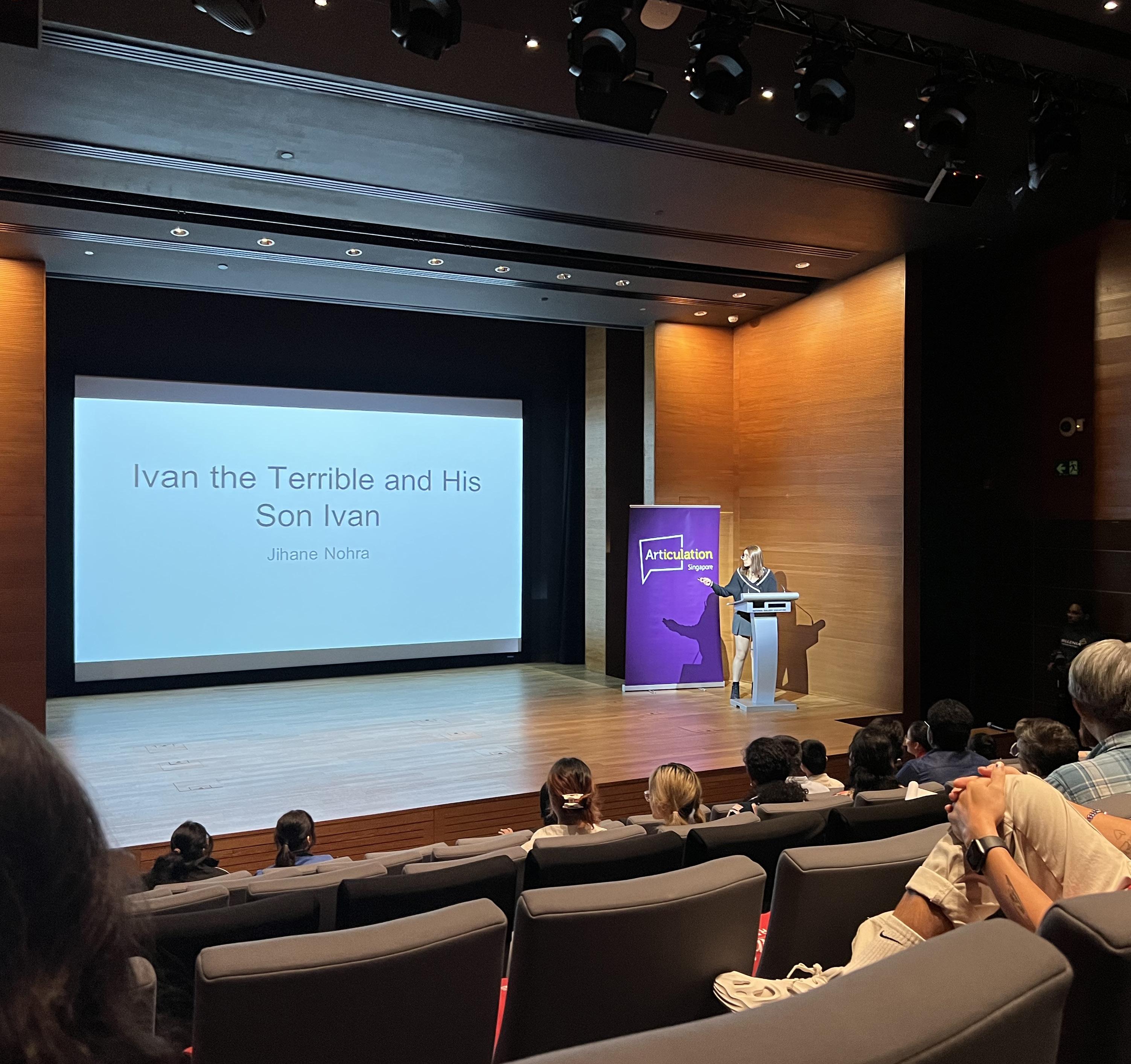
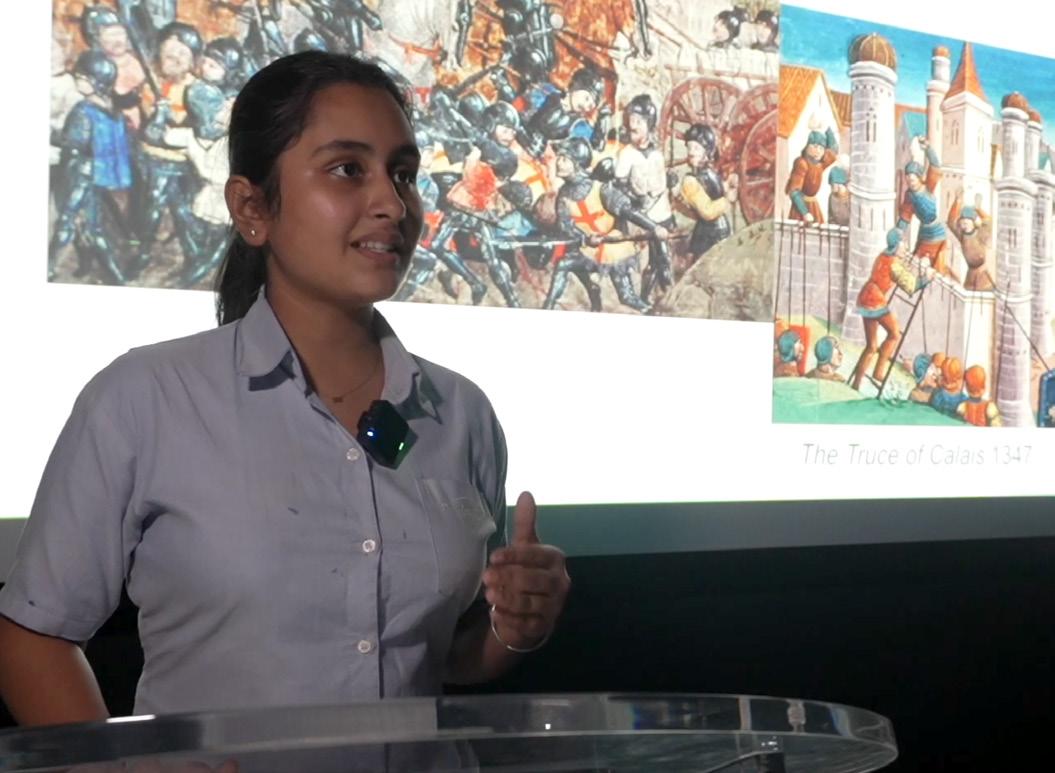
Articulation Prize Singapore embodies this approach by inviting students to deliver a ten-minute presentation on an artwork of their choice. In doing so, participants move beyond passive appreciation and become active interpreters of visual culture.
One of the most significant skills developed through such programmes is critical thinking. Preparing for the Articulation Prize requires students to investigate historical context, artistic intention, materials, and thematic significance. They must evaluate different viewpoints and form their own reasoned interpretations. This nurtures analytical abilities that are transferable across subjects. From literature to history and even the sciences; evidence-based reasoning is essential. Equally important is the development of communication skills. Public speaking can be daunting, yet it is an invaluable life skill. Through the process of presenting
integrate it thoughtfully into their work. I believe this is a crucial skill to master, especially in today’s information-rich world. Beyond individual development, academic enrichment in Art fosters collaboration and cross-school engagement. The Articulation Prize Singapore brings together students from a wide range of internation and local schools across the nation. Such cross-school platforms also promote a sense of community within the arts. Entering the alumni of Articulation encourages friendships and professional connections that are invaluable when
constructing connections later in life. Many of our students have gone on to gain internships from the gallery.
Most importantly for me, enrichment initiatives signal that Art is an academic discipline worthy of serious study. By placing emphasis on research, presentation, and intellectual rigour, programmes like the Articulation Prize reinforce the idea that Art education develops scholars as well as practitioners. This helps dispel misconceptions that Art is purely recreational, highlighting instead its role in cultivating cultural literacy and informed citizenship.
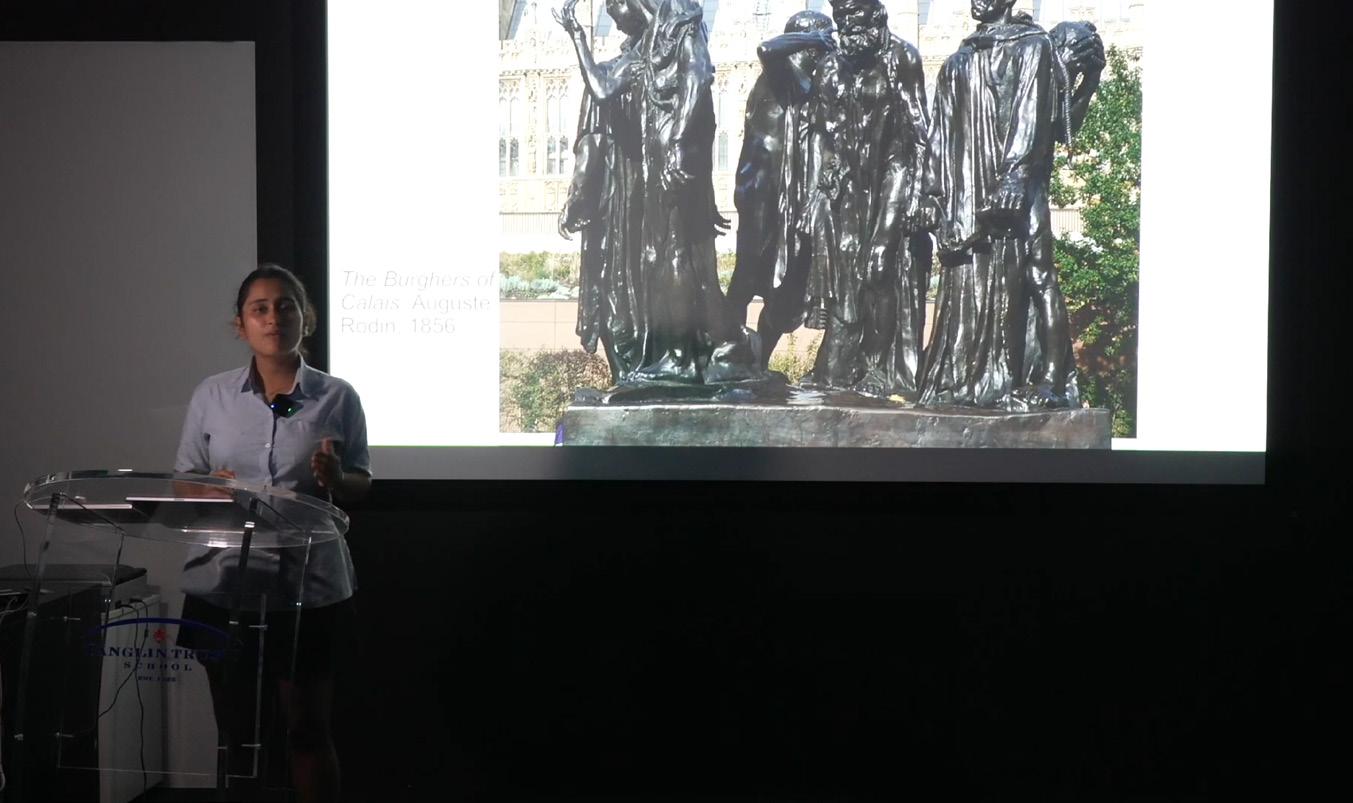
their ideas, students learn to structure arguments clearly and persuasively. They practise clarity of expression, vocal projection, and audience engagement. These competencies build confidence that extends far beyond the Art room. Whether delivering a presentation in another subject or speaking in future professional settings, students benefit from the assurance gained through such experiences.
Research skills are another key area of growth. To deliver a compelling presentation, students must consult credible sources, synthesise information, and reference material accurately. This process strengthens academic discipline and integrity. Our students have learned how to discern reliable information and
In an increasingly complex and visual world, the ability to interpret images, articulate ideas, and engage critically with culture is indispensable. Academic enrichment in Art education provides the platform for students to refine these abilities.
The Articulation Prize Singapore brings together students from a wide range of internation and local schools across the nation. Such cross-school platforms also promote a sense of community within the arts.
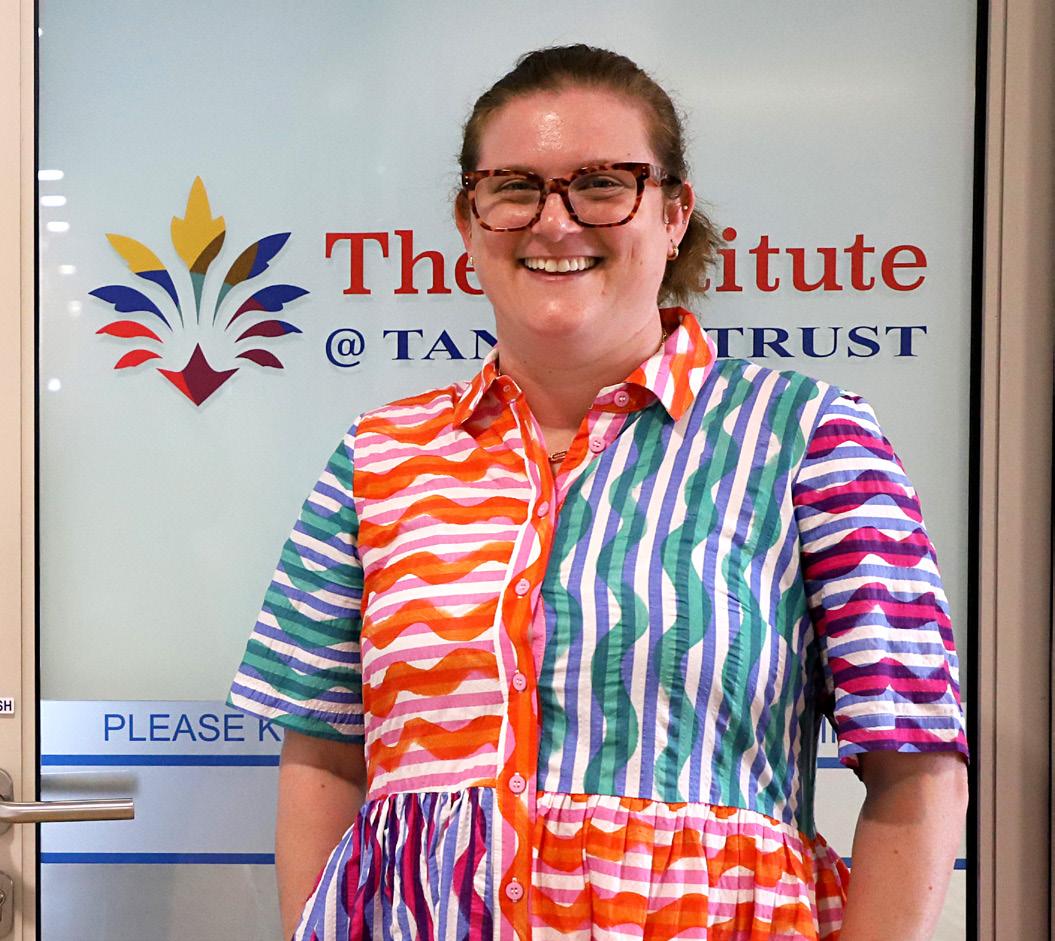
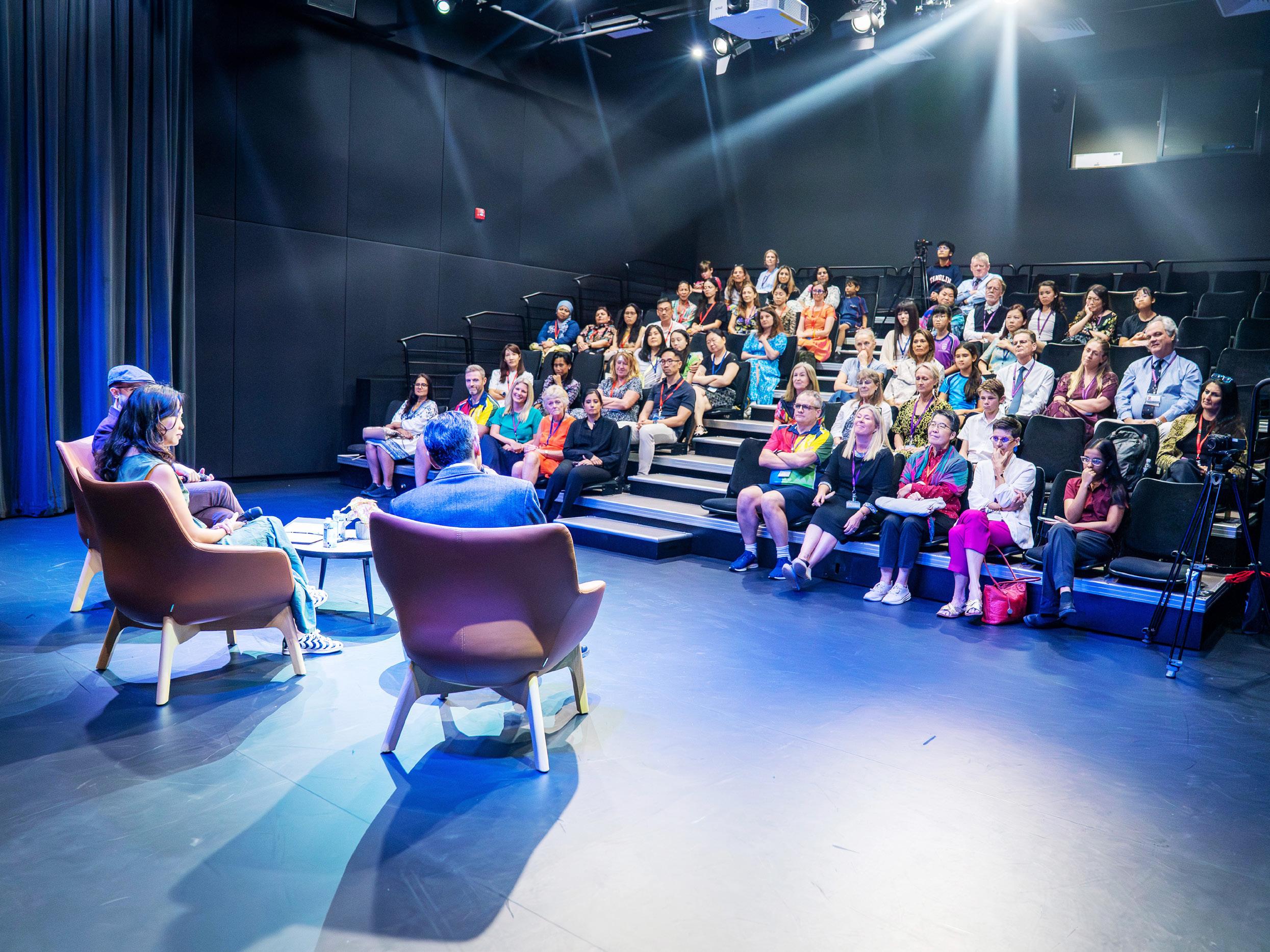
The Institute at Tanglin has been running programmes since 2022, and the impact is clear. Students, staff, and parents have benefited from opportunities to engage with global thought leaders, undertake meaningful research, develop real world skills through programmes designed and delivered with external partners, and step beyond their comfort zones. This year, the Institute takes its next step forward with the appointment of Dr. Sophie Hidden as its very first Institute Fellow. What does this new role involve and what does her vision for the Institute look like?
Tell us about your Fellowship. What prompted Tanglin to introduce the Institute Fellowship role, and how did you become involved?
I have always been interested in the work that The Institute does, particularly its potential to extend learning beyond the traditional classroom for students, teachers and even parents. Back when I was the Head of Science and Design Technology at Senior School, my role was largely centred on academic and faculty management. While the Science CCA provision is strong, there is still room to expand enrichment opportunities. A turning point came when I accompanied Craig (CEO) and Sohini (Director of Scholarship, Inquiry and Partnerships) to the Rolls Royce factory in Seletar to develop a Physics and Design Technology programme for
Sixth Form students. This experience highlighted the impact of meaningful partnerships in enriching learning and made it clear that a dedicated role was needed to bridge academic expertise with external opportunities.
The Fellowship role was created with this vision in mind, providing the time, focus and clear objectives needed to expand such initiatives across The Institute. While I continue to teach Science, the Fellowship enables me to act as a bridge between the classroom and wider educational projects by setting up the Institute Research Programme to highlight the importance of research and ensuring that our outreach, research and enrichment opportunities are purposeful, coherent, and aligned with both Tanglin’s ethos and the needs of our students.
How are you uniquely qualified to take on this role?
Before pursuing my PhD, I worked at Smith & Nephew’s Group Research Centre in York, where I experienced firsthand the bridge between academia and industry. I also mentored BMedSci students, supporting them in their undergraduate projects at the University of Birmingham. I received great feedback from the students, who appreciated how I made complex topics accessible, fun, and interesting. Teaching therefore felt like a natural next step as I enjoy making Science easy to understand and showing students how learning about themselves and the world around them can help them make informed decisions. With experience in both research and teaching, I’m well-placed to contribute meaningfully to this role.
In what ways do you see your role shaping student learning, agency, or future readiness?
I see my role as extending the already significant impact of the Institute, which develops students’ research skills while helping them recognise how these skills apply across a wide range of careers, not just within STEM or Business (our Entrepreneurship programme) but other areas as well. By positioning the programme as a ‘super-curricular’ pathway, I encourage students to step outside their comfort zones by supporting student-led initiatives such as mini conferences. For example, I recently met with a student who wanted to establish their own engineering CCA. In

doing so, I aim to strengthen student learning, agency, and the future-ready skills they need beyond school.
We also plan to engage students in the Infant and Junior Schools at a grassroots level. By encouraging participation from a young age, we hope more students will feel confident to apply for the Institute Research Programme when they are ready. This is about nurturing motivation and confidence, especially in students who may not see themselves as academically gifted. I remember feeling
self-conscious as an undergraduate in university. Whilst being surrounded by academically gifted students, I had to work hard to keep the pace of my peers. Although a challenge, I learned the value of perseverance and hard work. Ultimately, I want students to understand that success is rarely a straight line. By bringing in external experts to share their own journeys, we can challenge narrow definitions of success and show students that there are many meaningful and fulfilling paths they can pursue.
How can the wider Tanglin community engage with and contribute to the Institute via your role?
The wider Tanglin community can engage with the Institute by sharing their expertise, participating in events, and supporting students through talks, mentorship, or workshops. We already benefit from a highly supportive community, and to ensure this remains sustainable beyond my tenure or Sohini’s, I am developing a database of contacts and outreach. More importantly, we aim to build long-term relationships and a broad, reliable pool of contributors who can support the Institute in meaningful and ongoing ways. In addition, I would like to strengthen our links with local schools through participation in local competitions. Last year, we took a small group of students to a competition hosted by National Junior College, and we continue to build relationships with those organising local competitions. Notably, we remain the only international school to participate in NXplorers.
What would success look like at the end of your Fellowship?
A key aim is for the Tanglin community to clearly recognise the value of the skills students develop through the Institute Research
Programme and build a culture of research. We want to engage ambitious, curious students who are eager to explore a wide range of ideas and grow into well-rounded individuals. Gippsland, in particular, has significant potential to foster a strong research culture, given its unique setting for fieldwork and study. Looking ahead, we could even develop a Tanglin journal to showcase articles and research findings produced by our own students at both of our campuses at Gippsland and in Singapore.
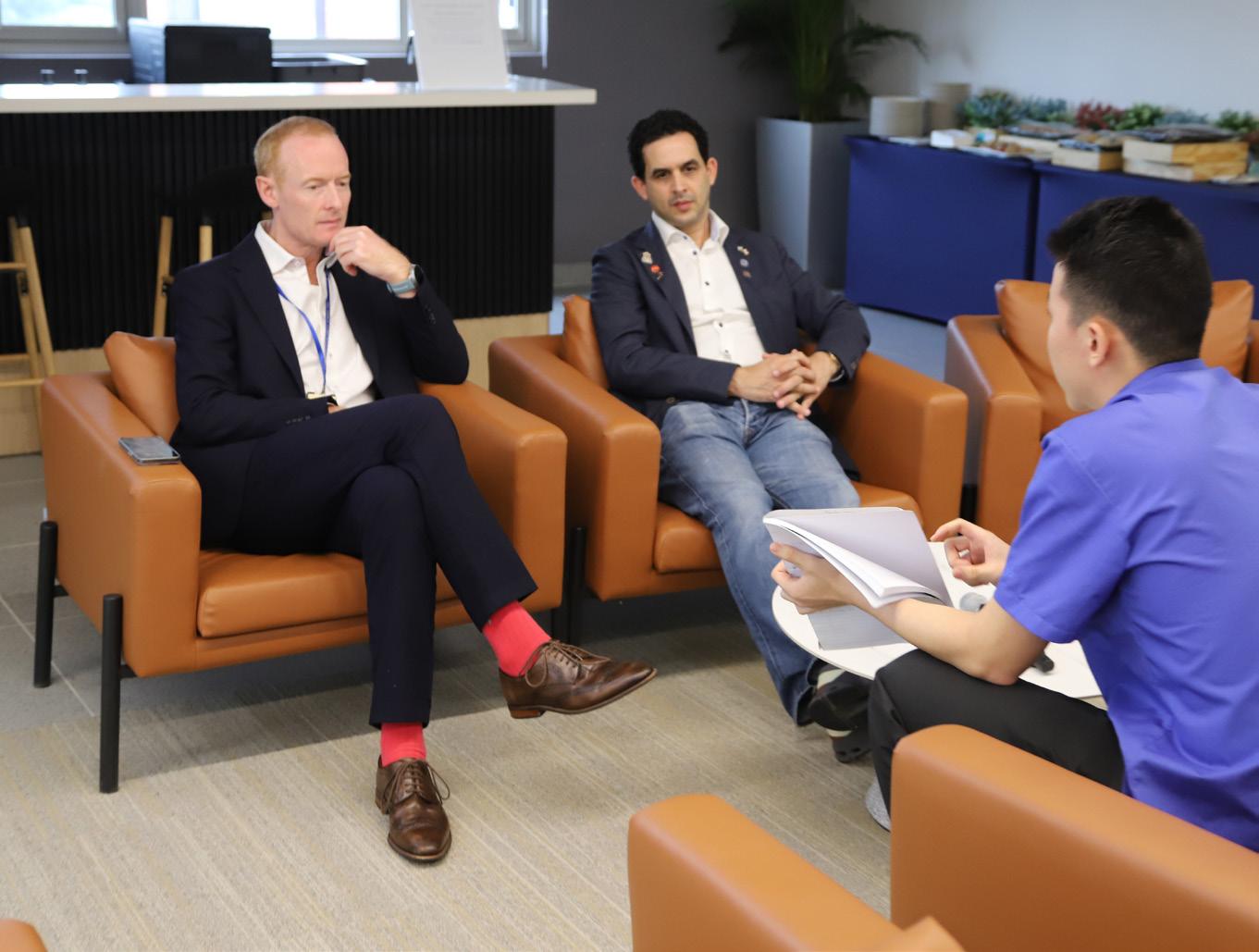
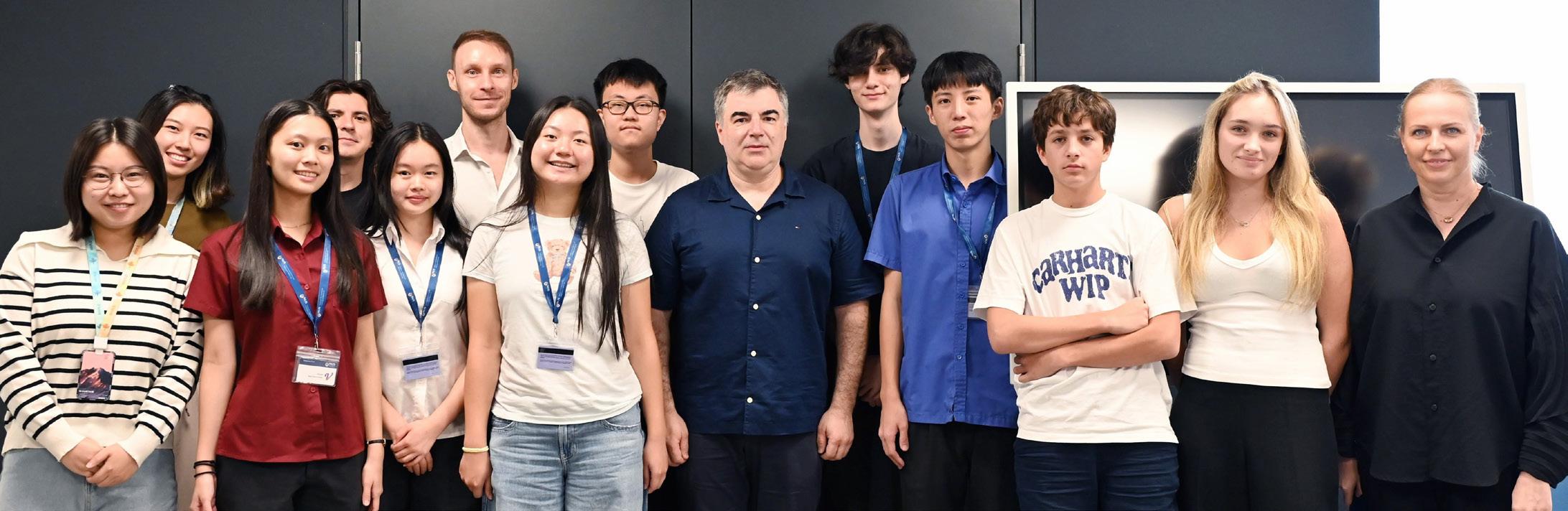
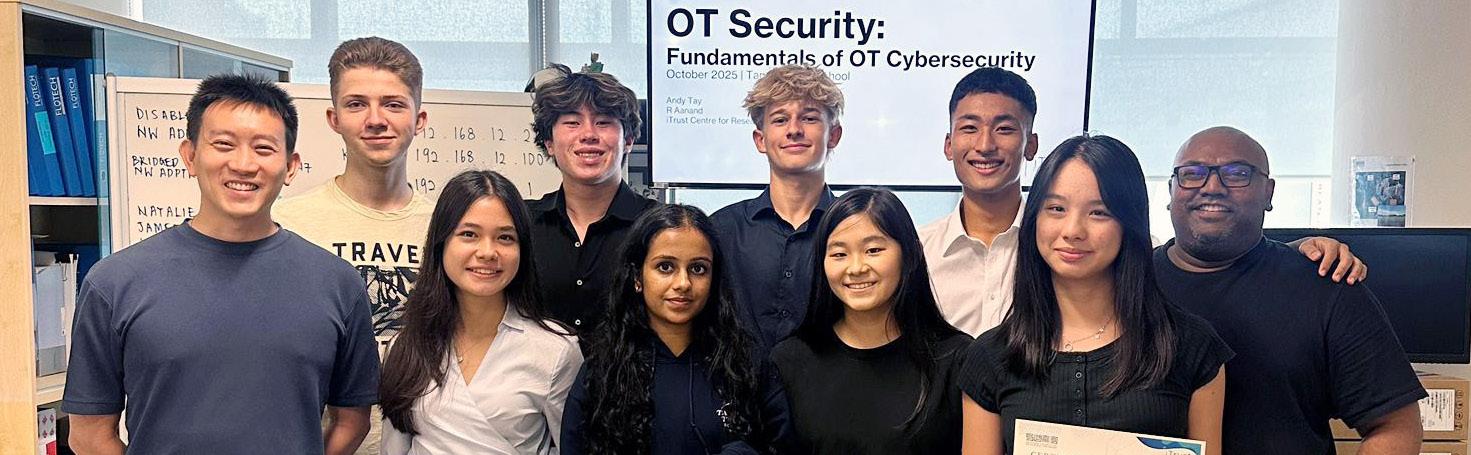
We host distinguished thinkers and practitioners to expand and challenge our perspectives across disciplines, and to catalyse learning beyond the classroom on topics shaping the future of work, education, and our wider environment.
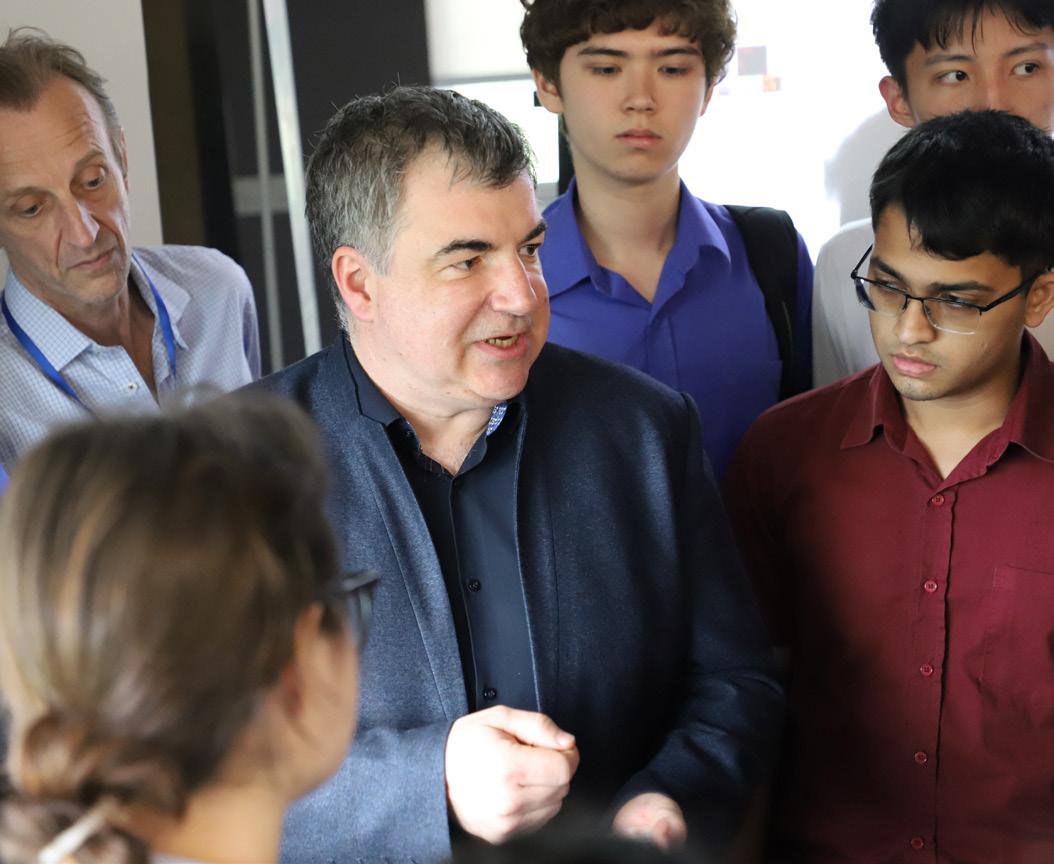
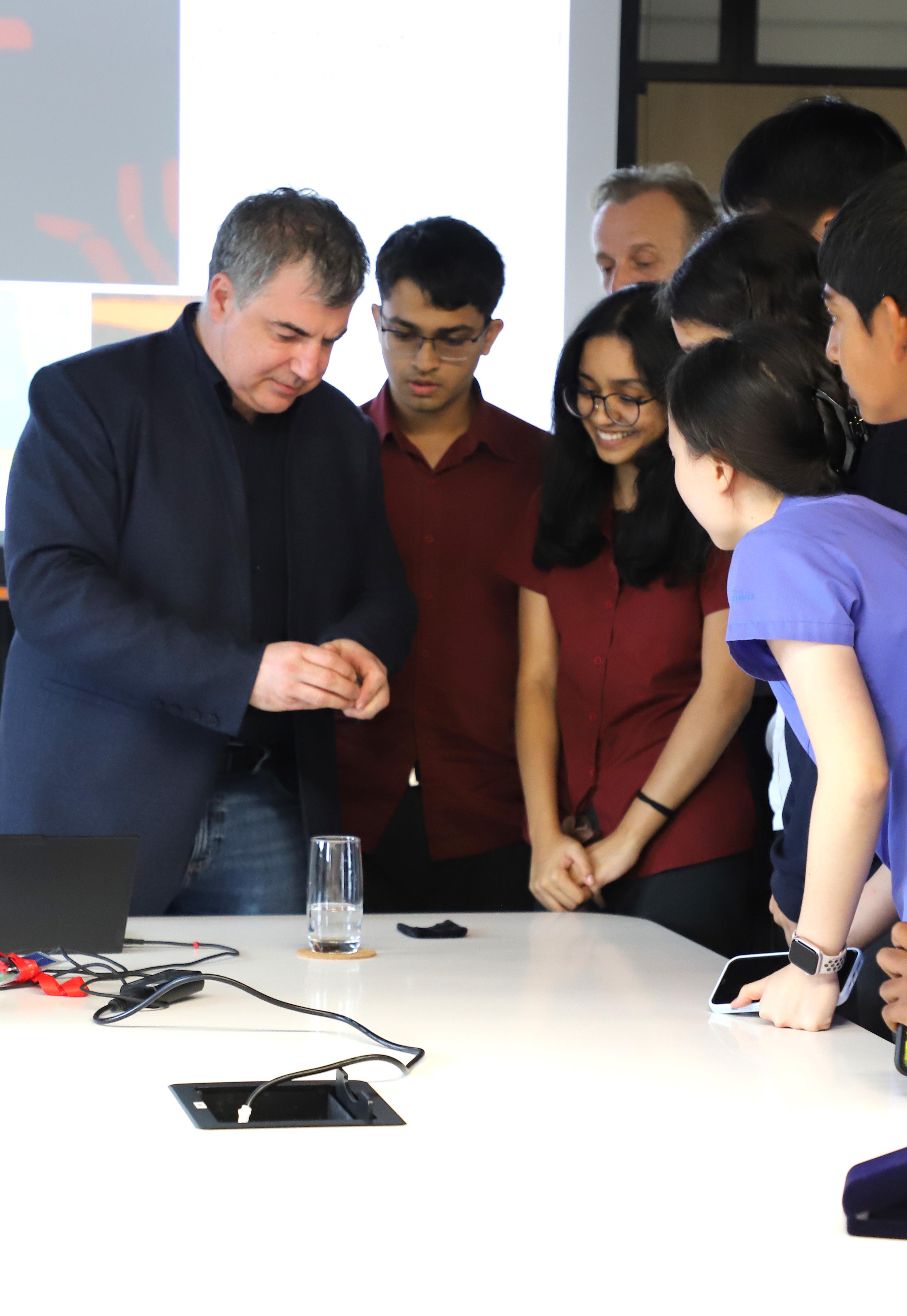
The Institute was honoured to welcome Nobel Laureate Professor Sir Konstantin for an inspiring and thought-provoking discussion that bridged cutting-edge physics with creativity and curiosity.
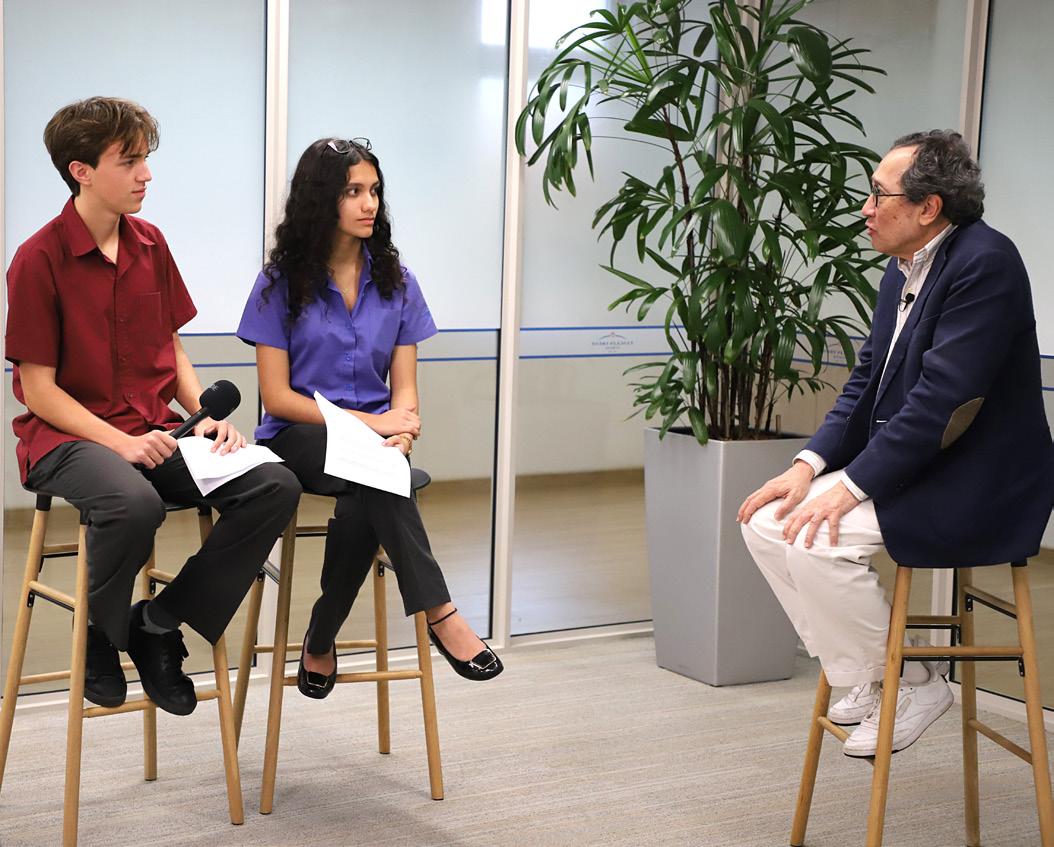
In a characteristically sharp and deeply engaging talk, Ambassador Bilahari Kausikan brought his trademark clarity and wit to the complexities of diplomacy, statecraft, and strategic clarity.
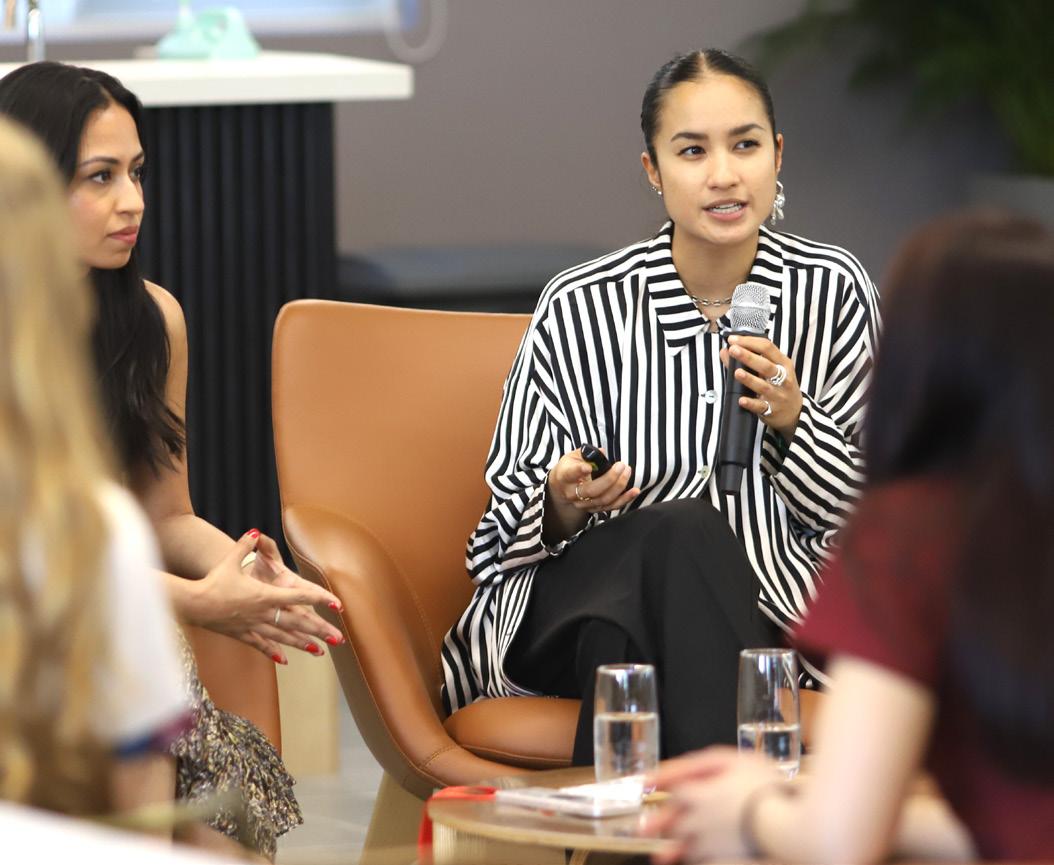
Petra Sekhar, Head of Marketing at Vogue Singapore and former Programme Director of the Vogue Foundation, and Natasha Damodaran, Publisher of Vogue Singapore gave a fantastic introduction to the challenging and innovative world of fashion.
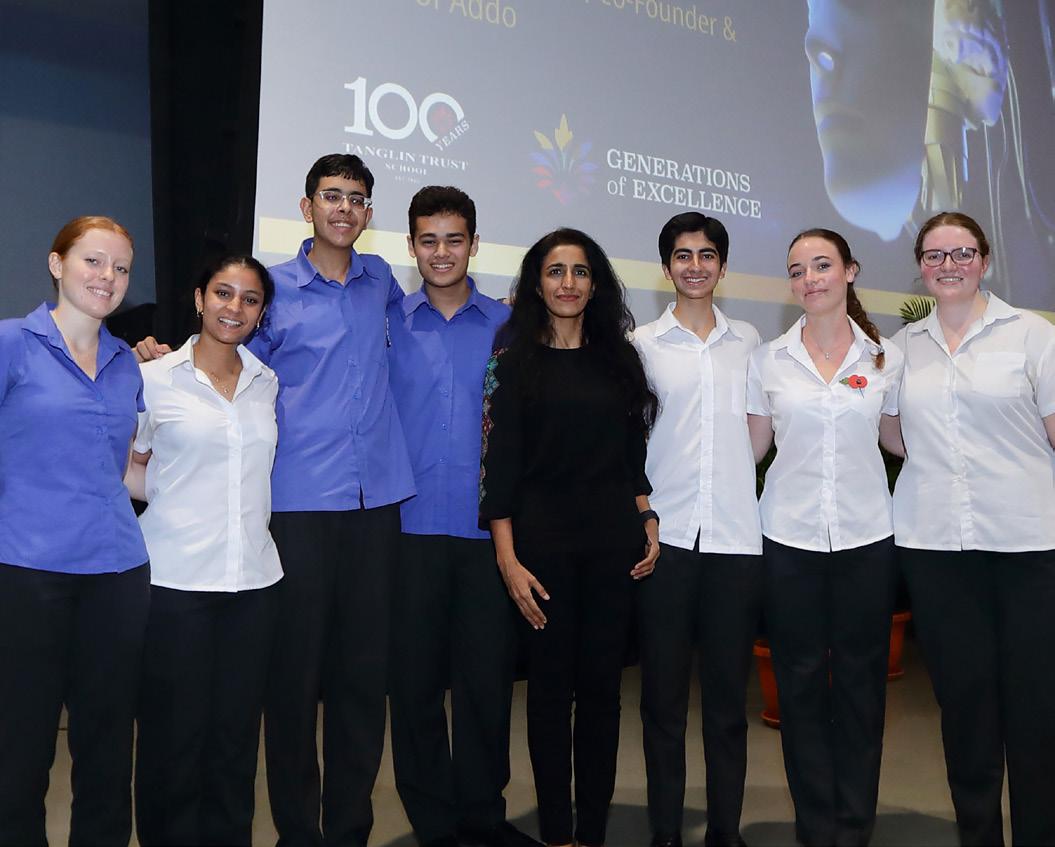
Dr Ayesha Khanna, AI expert, Forbes-recognised entrepreneur and Founder of Addo AI, shared compelling insights into how AI is transforming and streamlining the way we live, work and learn.
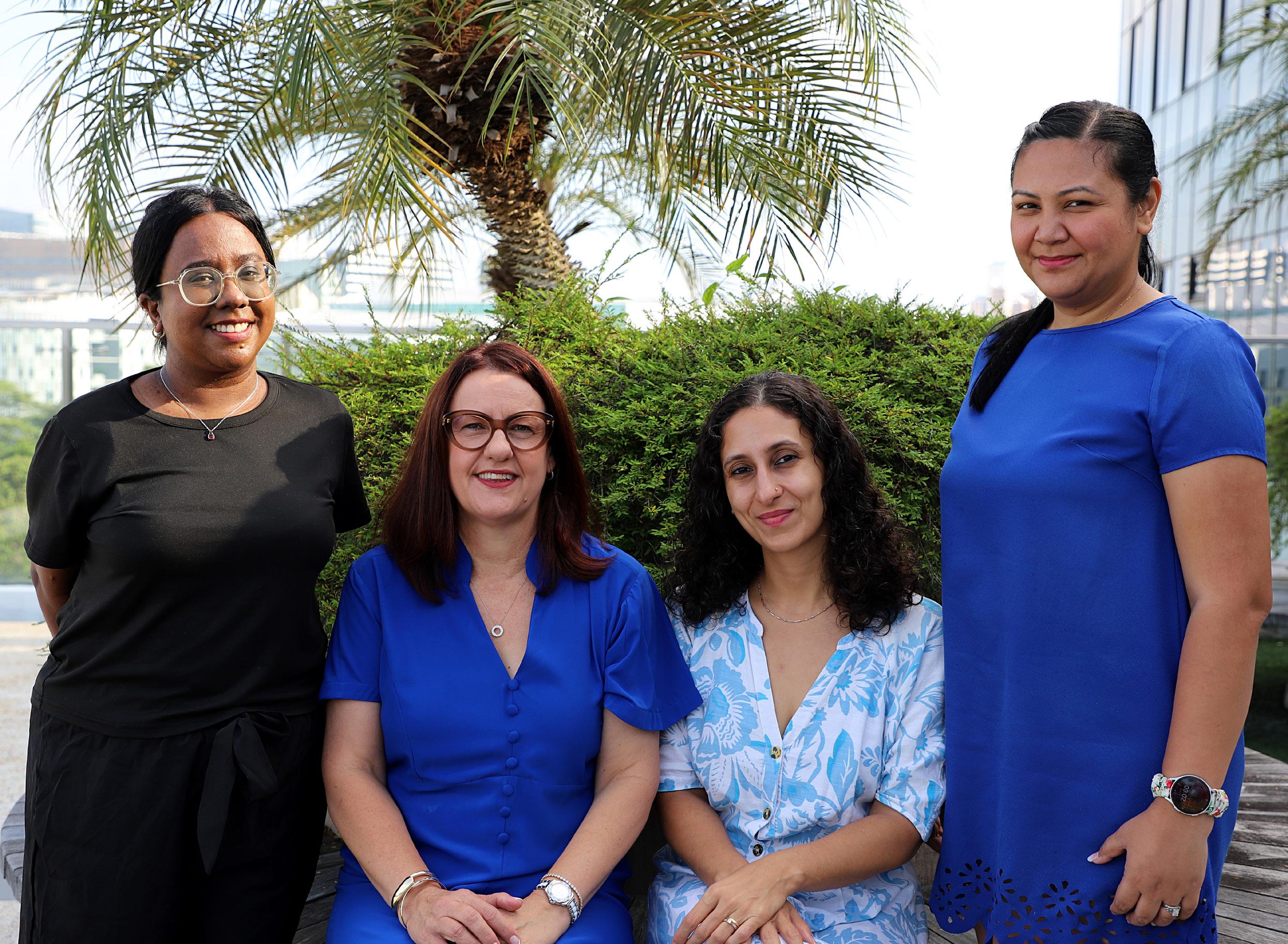

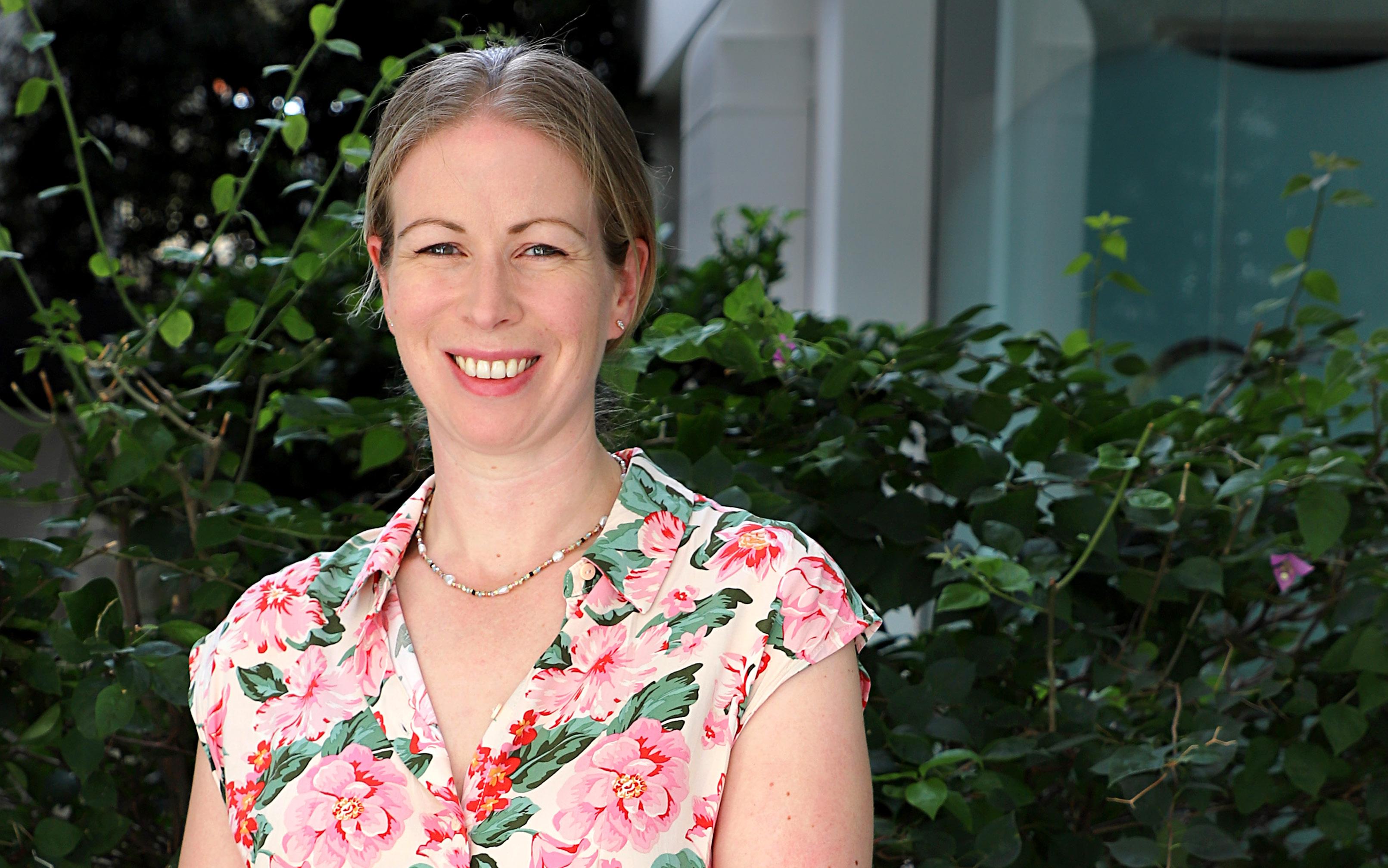
Tracey Grobbelaar is Tanglin’s new Director of Business Development and Head of Foundation. What’s her Tanglin story and what does her role entail? We catch up with her to find out more.
Tell us about yourself. What did you do before joining Tanglin?
I was born in South Africa and immigrated to Australia in1999. I have lived in Melbourne for the past 27 years. I commenced my career at Ernst and Young in Treasury Management. I have spent most of my career working in independent schools, primarily in Australia, in senior leadership roles overseeing advancement, finance, governance, risk and major capital projects. Most recently I was Director of Business Services and Company Secretary at Siena College, an independent Catholic girls’ school in Melbourne.
What I have always loved about working in schools is that every decision ultimately connects back to young people. Whether you are working on a masterplan, a budget or development, the purpose is the same: creating the best possible opportunities and environment for students to flourish. I have had the opportunity to work closely with Boards, Principals, donors and leadership teams, which has strengthened my leadership approach and strategic perspective. These experiences have shaped how I think about sustainability, stewardship and long-term planning, ensuring decisions support both the immediate needs of the organisation and its future growth.
What drew you to Tanglin and what excites you most about stepping into your new role?
Tanglin has an extraordinary reputation, not just academically, but as a community. From my first conversations, I sensed a strong alignment between ambition and values. What truly drew me here was the combination of heritage and momentum. Tanglin has a proud history, yet it is clearly entering an exciting phase of growth and development. Being part of that next chapter, particularly at a time of campus development and strategic investment, is both a privilege and a challenge I am genuinely excited about.
What do you think makes you uniquely qualified for this role?
I bring a combination of strategic, operational and relational experience. I understand how schools function at a governance level, how major projects are funded and delivered, and how important it is that philanthropy is carefully aligned with long-term strategy. Equally, I believe strongly in relationships. Philanthropy is built on trust. My approach is grounded in transparency, careful stewardship and ensuring that donors feel genuinely connected to the impact of their giving. Having worked through complex capital projects and periods of growth, I understand the importance of establishing strong foundations early so that initiatives can scale effectively and deliver lasting impact.
How do you see the Foundation supporting Tanglin’s long-term vision and values?
The Foundation has the ability to unlock opportunities that extend beyond the core operating model of the school. It can support scholarships, new facilities and programmes that might otherwise take much longer to realise. Importantly, the Foundation is not just about fundraising. It is about participation and belonging. When parents, alumni and friends contribute, they are investing in something they value and believe in. That shared investment strengthens community and reinforces Tanglin’s values of integrity, respect and excellence.
In your first year, what will your key priorities be?
My first year will focus on listening carefully to our community, bringing clarity to priorities and strengthening the foundations already in place. A great deal has been achieved over the past four years, and the next step is to build on that momentum as Tanglin continues to grow.
My focus will be to ensure we have:
A clear and credible development strategy aligned with the school’s future growth
Strong stewardship practices so donors feel valued, recognised and informed
Transparent reporting to Governors and the wider community
Measurable goals around participation, retention and engagement.
Sustainable growth requires strong foundations. When systems are clear and relationships are strong, the Foundation can continue to expand its impact and support opportunities for our students and community.
How do you ensure that the impact of giving is visible, measurable and clearly communicated?
It is important that our community can see both the outcomes and the impact of giving. We will continue to share updates on participation, support and key milestones, while also highlighting the stories behind them. When philanthropy supports a student’s journey or helps create new opportunities for learning, that impact should be visible and celebrated with the community. Clear communication builds trust. Trust builds participation.
If you could leave one lasting contribution to Tanglin, what would you hope it to be?
My hope is to help foster a culture where giving feels both natural and meaningful, and where alumni, parents and friends feel proud to play a part in shaping the school’s future. Over time, if philanthropy becomes something our community sees as a shared opportunity to support the next generation of students, then it will create a legacy that benefits the School for many years to come.
Ultimately, my aim is simple: to help ensure that Tanglin continues to provide exceptional opportunities for generations of students to come.
Anna Maxwell is Tanglin’s newest face, joining the school as our Educational Psychologist. What does her role involve, and how does she support our students? We caught up with her to learn more about the vital work she does across the school community.
Tell us about yourself. What did you do before Tanglin and why did you join the school?
I studied undergraduate Psychology at University College London, then a Master’s from King’s College London. After a few years of working in schools in London boroughs of Kingston and Richmond, I completed my Doctorate in Educational, Child and Community Psychology at the University of Exeter. I worked firstly as an Educational Psychologist at Surrey County Council, supporting a wide range of children, schools and families, and then as Senior Educational Psychologist, leading a team of Educational Psychologists, Trainee Psychologists and Assistant Psychologists. We supported over 300 schools, and this exposure has given me a unique insight into how schools support their students. My work in the UK focused on consultation, assessment, training, and guiding
schools to create inclusive environments for children with diverse learning needs.
Living and working abroad has always been something I’ve wanted to do, and an experience I want my children to have growing up. When I first trained as a psychologist, I didn’t think my job would ever take me overseas; in the UK, most Educational Psychologists work within the local government. When the role came up at Tanglin, with its strong commitment to student wellbeing, inclusion and evidence-based practice, I was excited by the chance to contribute to a school community that prioritises both academic excellence and wellbeing. The international school setting offers an opportunity to work with students and families from a wide range of cultural and educational backgrounds and to work within a school that values the whole child. Singapore offers an amazing base for family life and travel.
What is the role of an Educational Psychologist in a school setting, and what does a typical day look like for you?
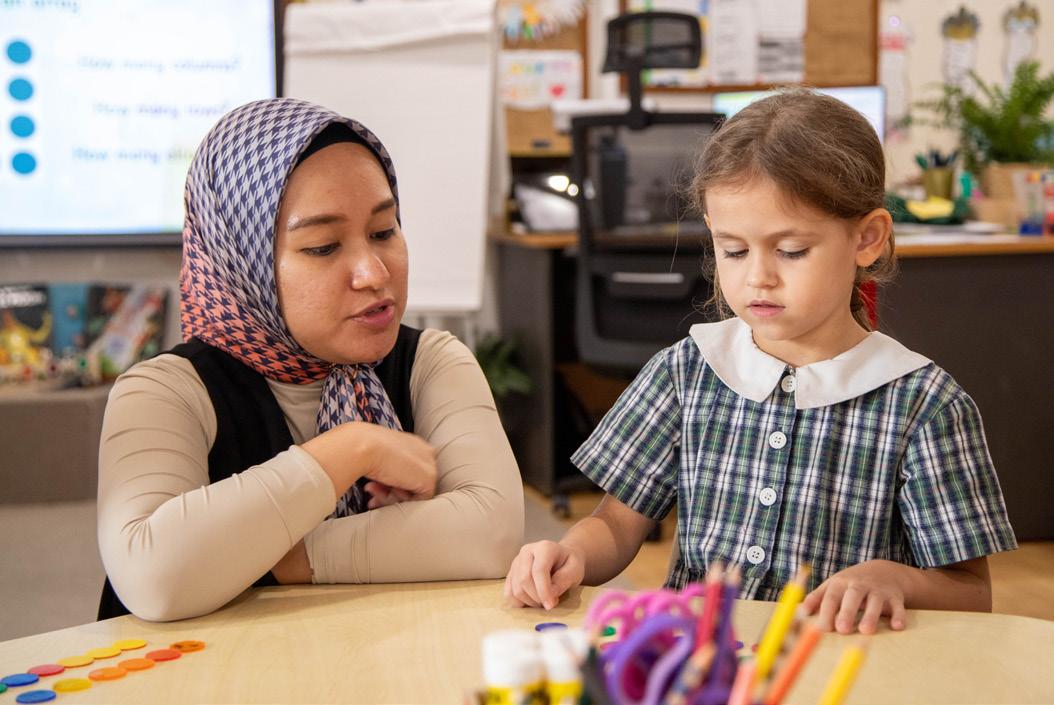
I work across the three schools here at Tanglin. In a school setting an Educational Psychologist works to understand how children learn, behave and develop, and how the school environment can best support them. My role involves working individually with pupils, supporting staff or thinking more holistically about support across the school with an aim of improving outcomes for all students. A typical day might include a mix of meeting with staff and families to explore concerns, carrying out observations to better understand a child’s strengths and needs or collaborating with pastoral teams, learning support and counsellors. I also take individual referrals where staff and families would like to better understand a student’s profile and identify supportive strategies. No two days are ever the same, but the common thread is helping to understand why a student might be experiencing a challenge, and what we can do to support them.
How does your work differ from that of teachers, learning support staff or counsellors?
Teachers, learning support staff and counsellors are vital in the support that is offered to all students at Tanglin. The recent BSO inspection identified the excellent teaching practices and praised
the support and wellbeing services available to students. Teachers are responsible for the everyday curriculum and classroom learning. If a student finds something difficult, teachers are usually the first to notice and implement classroom-based strategies to help. The Learning Support teams build on this work by providing targeted interventions and in-class strategies, they might work individually with students to identify exactly which part of
learning they are finding difficult, or where to target a particular intervention. School counsellors focus primarily on emotional wellbeing and provide a safe space for students. They help students develop coping strategies which can improve learning and wellbeing. As an Educational Psychologist, my role is to understand underlying reasons for learning or behaviour through investigating things like cognitive processes, environmental influences, motivation and emotional needs. As a qualified psychologist, I can assess how a student thinks, learns and processes information, hopefully broadening how that child is understood. I also work more systemically, supporting teachers, and leaders to design environments and approaches that help all students thrive.
The magic happens when we all work together. Teachers and learning support staff addressing what a student finds difficult, counsellors addressing how a pupil is coping emotionally and educational psychology investigating why those difficulties are occurring and what interventions are most likely to help. The school places huge value in working together and sharing practice.
There are misconceptions around the Educational Psychology role, often beginning with an assumption that Educational Psychologists will always carry out cognitive, or standardised, assessments. Standardised assessments are one of many tools a psychologist might use and whilst they can be useful, there is also the need to consider a student holistically and in context, taking into consideration their developmental history, how they engage with the world around them, and how they experience learning and social interactions. As such, most of my impact supporting a student happens through consultation with parents, problem solving, supporting teachers or shaping whole-school approaches. Indeed, another misconception can be that I only work with children when in fact much of my work is actually with adults supporting the adaptation of the environment around the child.
Sometimes it can be hoped that Educational Psychologists will ‘fix’ a problem but often it isn’t always this simple. Psychology, for me, has been about holding optimism for positive change. Sometimes making these changes can be hard and there isn’t a quick fix. I hope through my involvement students find themselves better understood and supported by the adults who spend the most time with them and therefore experience the world as a better place.
What advice do you often give parents who are worried about their child’s learning and overall wellbeing?
As parents, we will all experience worries about our children as they grow and develop, and this is normal. However, sometimes these worries get bigger or remain constant over time. My advice would always be that you know your child better than anyone else and trusting your instincts as a parent is important. Working together with school is crucial so raising your concerns with your child’s class teacher is a good first step. This opens the conversation for acknowledgement, reassurance, and support.
I feel privileged to work in a school that values inclusion and wellbeing as much as academic success and I am really looking forward to getting to know the Tanglin community better. My door is always open.
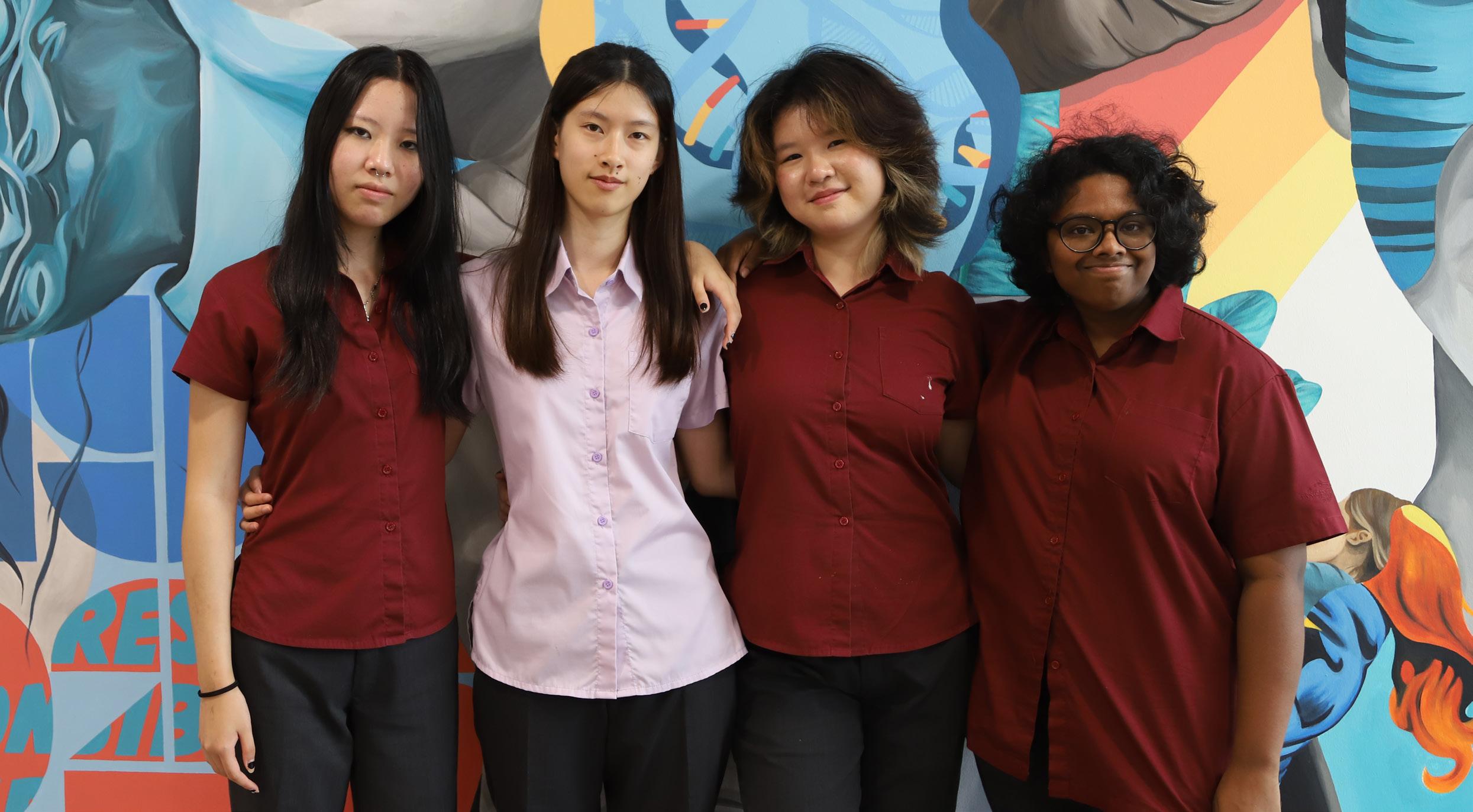
At Tanglin, students are encouraged to step beyond their comfort zones and turn ideas into action. The Tanglin Arts Competition is a shining example of this spirit. We caught up with the student organisers - Year 12’s Anishaa, Ellie, Keren, and Nicoleto learn more about the inspiration behind the event and what it means to them.
Who is involved, and what roles does each person take on?
This year’s Tanglin Arts Competition is led by Anishaa, Ellie, Keren, and Nicole. We discuss and collaborate on most things we encounter, but we have divided our work into four main parts, where Anishaa is in charge of graphic design, Ellie is in charge of communication with Tanglin staff, Keren is in charge of organisation, and Nicole is in charge of communication with students.
How did you divide roles and responsibilities within the team?
Since Anishaa and Nicole are art students, Anishaa and Nicole focused more on art related responsibilities. Ellie and Keren focused more on non-art related responsibilities. For example, Anishaa and Nicole contacted the art department regarding the exhibition while Ellie and Keren contacted the Sixth Form leadership team about the budget.
What inspired you to organise the Tanglin Art Competition?
We were inspired by last year’s Centenary Arts Competition and decided to take initiative by carrying on their legacy of encouraging creativity and artistic expression of students across a range of year groups.
How did you decide on the theme and format of the competition?
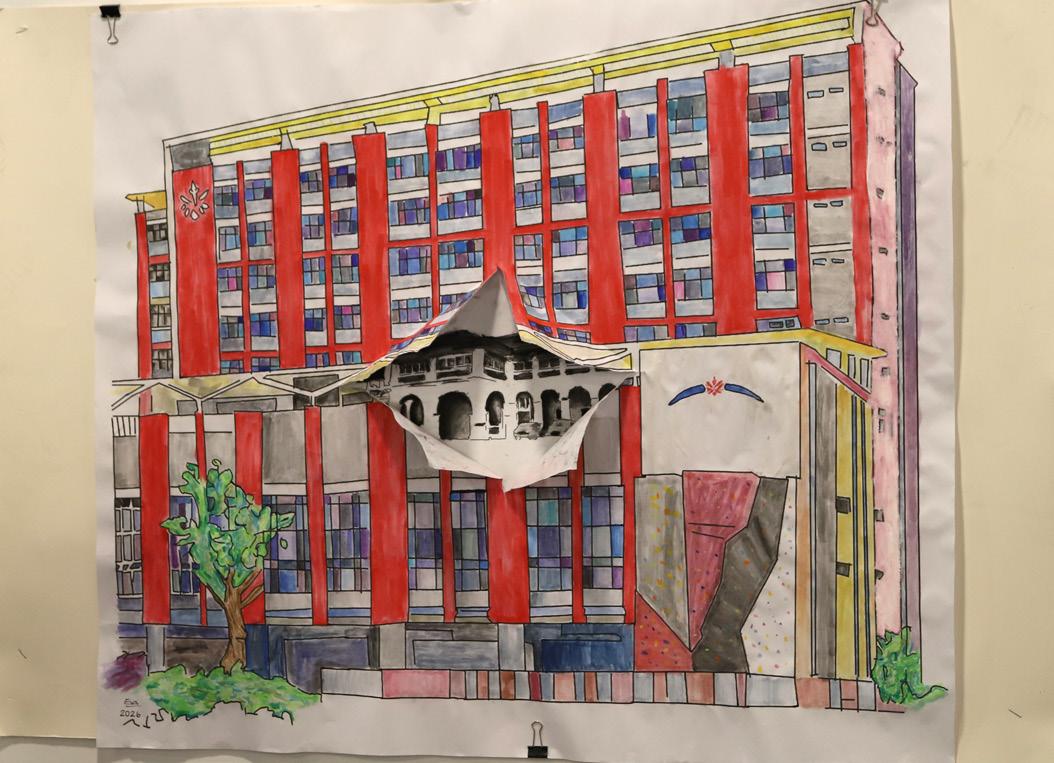
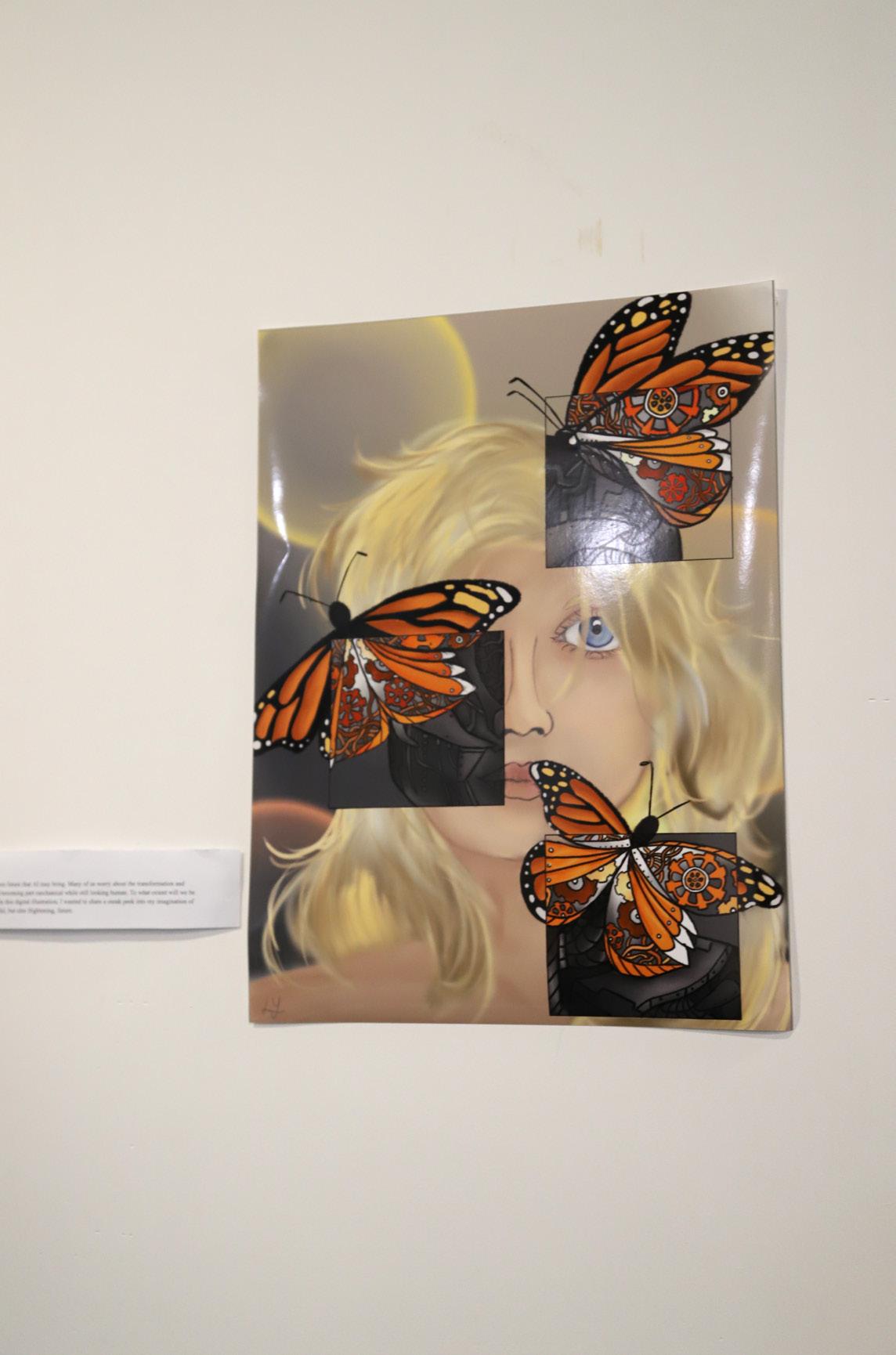
We wanted to make the theme relevant to the current Tanglin. Tanglin has recently celebrated 100 years and is entering a new century of its history. A new century comes with a transformation and new changes from the previous century, hence, the theme ‘Transformation and Change’.
What were your biggest challenges in organising the competition, and how did you overcome them?
One of the biggest challenges was coordinating different opinions of the staff members who supported us throughout the process. This required clear communication and several meetings to ensure everyone was aligned. Logistics also proved demanding. As Tanglin
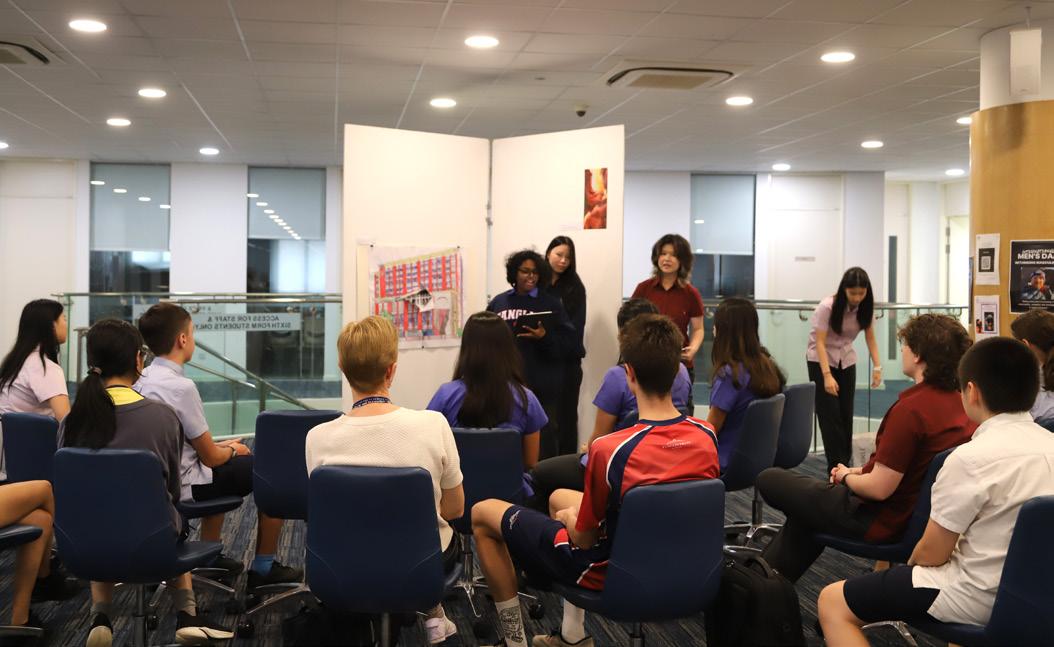
is a busy school, securing a place for the exhibition and managing the admin tasks was not straightforward. However, after multiple meetings and careful planning with various staff members, we were able to find an appropriate venue in the end.
What surprised you most about the artworks that were submitted?
Other than the evident time and effort students have put into their artwork submissions, we were pleasantly surprised at the diverse set of interpretations of the theme ‘Transformation and Change’, giving us a glimpse of each student’s personal journey.

What have you learned from running this competition?
What was your original goal, and did it change along the way?
Our original aim for the competition was to encourage more students to participate in creativity and the arts across Tanglin. We had hoped to include Junior students as last year’s competition was limited to Senior and Sixth Form students. However, due to the Juniors’ schedules being different from ours, this proved challenging. As a result, we decided to focus this year’s competition on Senior and Sixth Form students.
We have learned that organising a school event requires lots of thinking, planning, and communication. We needed to think about how we wanted this competition to be like. We needed to plan the logistics of the competition. We needed to communicate with staff members as well as students to make this competition happen. On top of that, we have also learned that collaboration is the key to success. All of us played a key role in running this competition, and this competition would not have been possible without our collaboration.
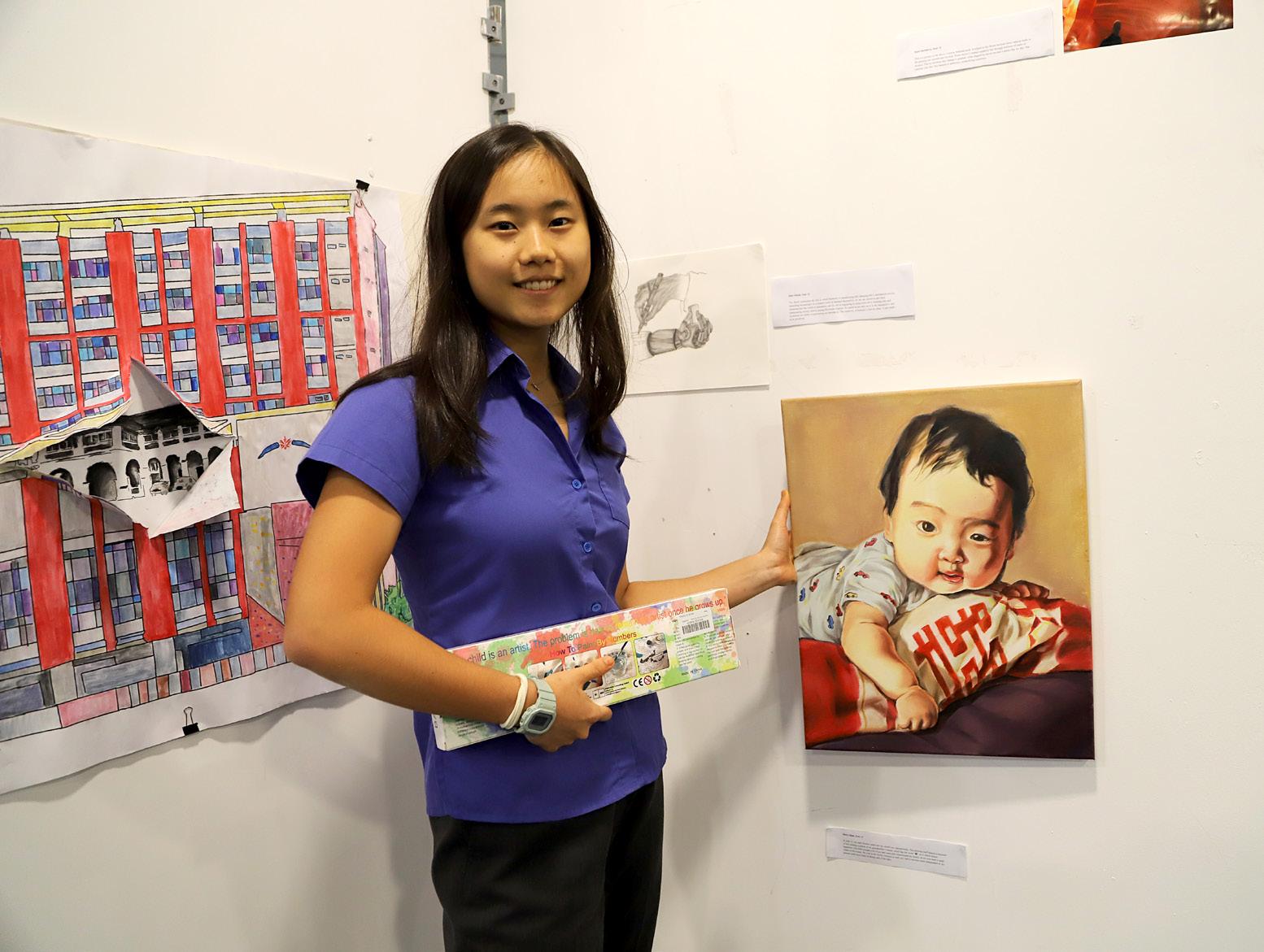
Well done, team! The art competition received 38 submissions, with 20 artworks shortlisted and displayed at an exhibition in the Sixth Form’s SFC English Area from 9–20 March. From these, the team selected six winners across the Middle School and Upper School/Sixth Form categories. Congratulations to Isha G (Year 12), Betty Z (Year 13), Sana S (Year 11), Annaliese P (Year 7), Eva P (Year 9), and Lauren Y (Year 8).
Students thrive in clubs, and so do parents! Rachel McLean, who has been volunteering with Friends of Tanglin for six years, shares how she set up and revived clubs to bring parents together and strengthen community connections.

In recent years, digitalisation has changed the way we connect, with more online communication and fewer face-to-face interactions. At Tanglin, parent involvement remains a priority. In fact, opportunities for parents to connect have grown both on and beyond the campus.
From the Banyan Café and co-working space in the Centenary Building to ParentWise sessions and parent clubs, it’s easier than ever to build friendships and feel part of the community. Parent clubs, in particular, are hugely popular, with several set up or revived by Rachel McLean, a parent volunteer with Friends of Tanglin. We sat down for a coffee chat with her to find out more.
What’s your Tanglin story?
My family and I moved from the UK, and joined Tanglin six years ago, with my son starting Year 6 and my daughter in Nursery. We chose Tanglin because it has a friendly vibe, fantastic Learning Support provision for dyslexia, and a British-based learning system. We thought we’d return to the UK after a couple of years, but we have ended up staying for six years! Both of my children have thrived at Tanglin, and my son is in his final two years with A Levels.
What first inspired you to start a club?
I was blown away by how inclusive the school was and how much there was to get involved in. In our first week, I attended an introductory session about Singapore hosted by Friends of Tanglin, and we were asked a question: what would we like to do while we were here? I wanted to do lots of things, but I didn’t know anyone
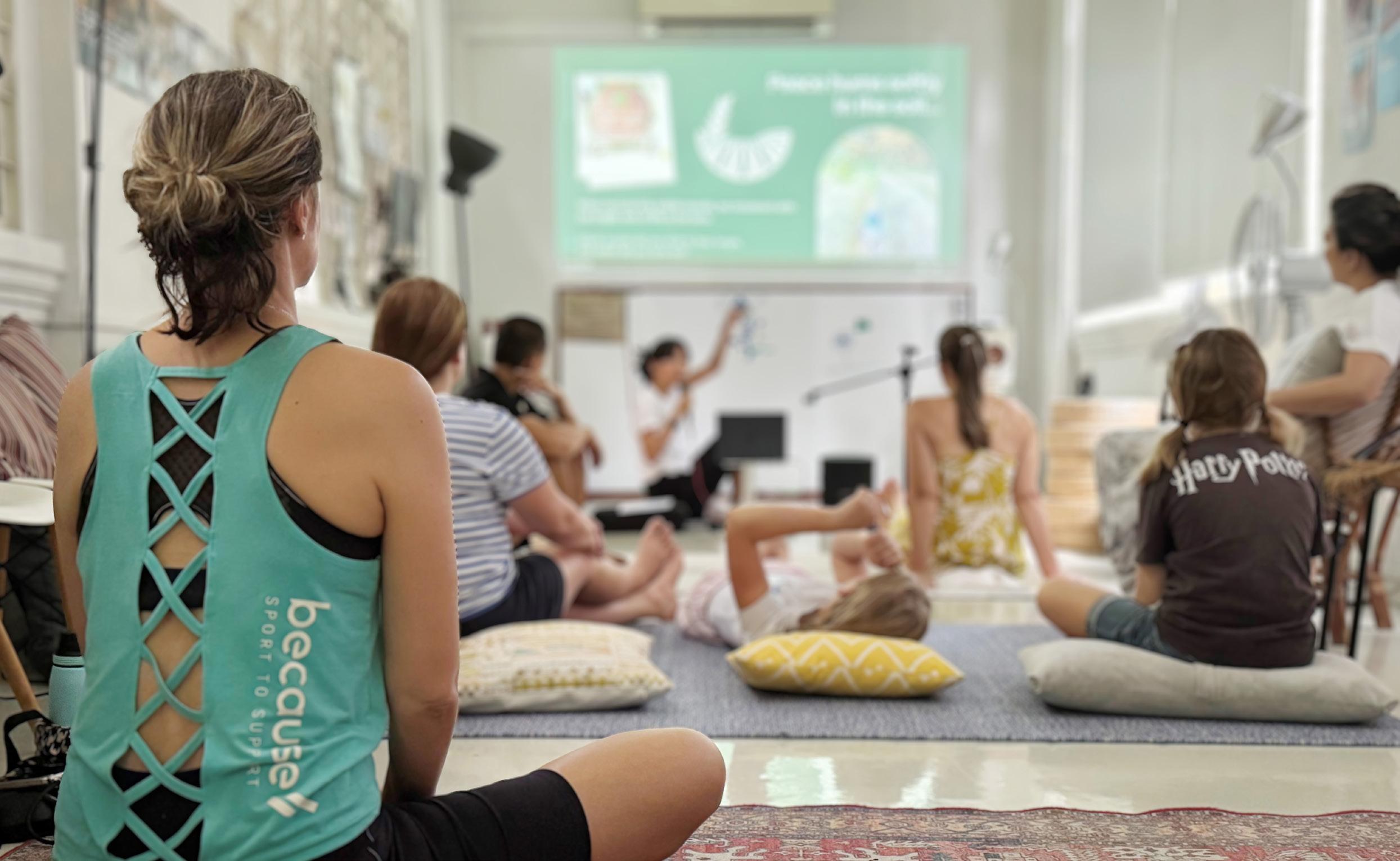
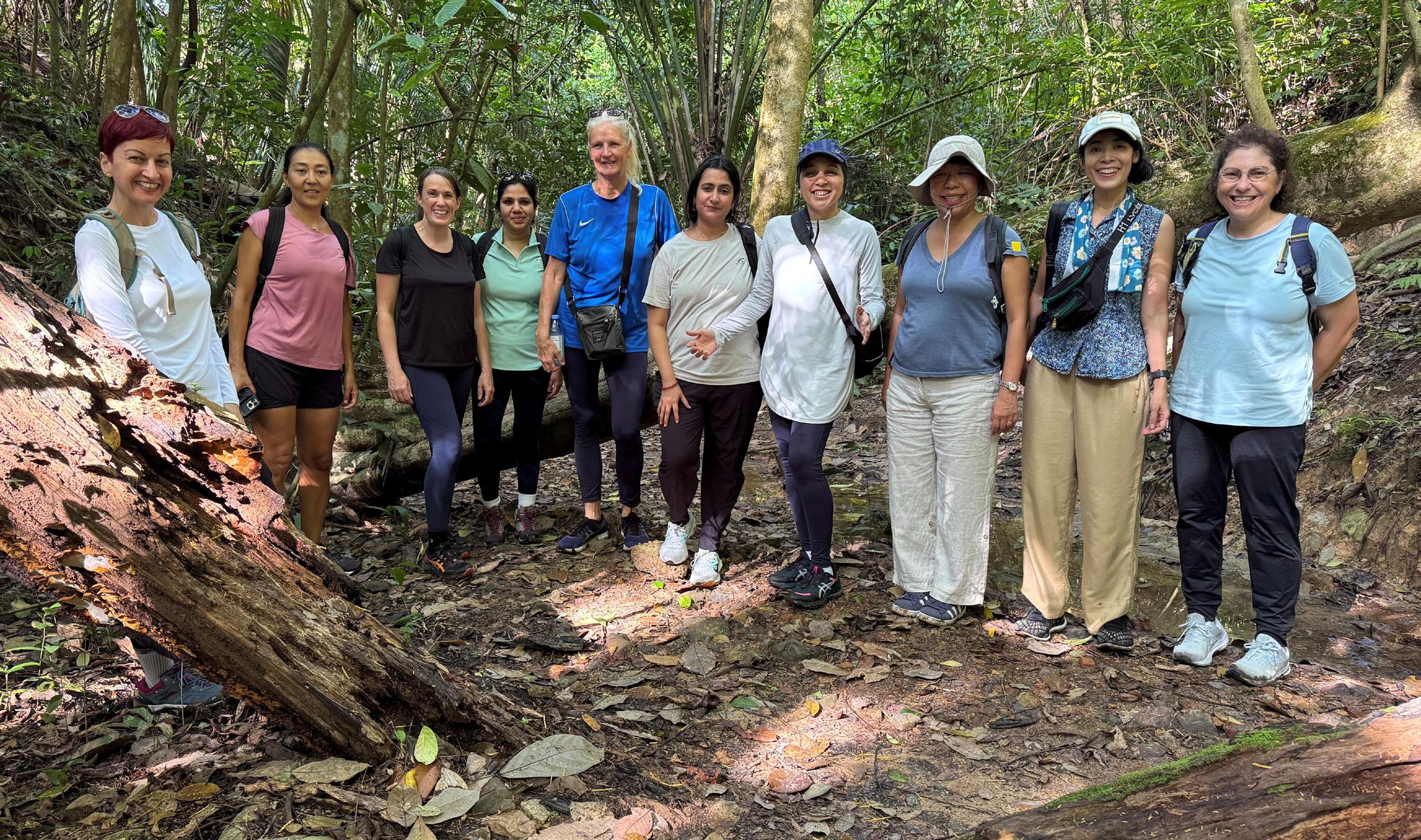
yet, so I suggested forming a book club to the ladies sitting around me so that we could form friendships. As we chatted, one of the ladies mentioned she was from India and had been trekking in the Himalayas, and that she was looking forward to exploring Singapore’s nature. That sounded like a fabulous idea, so we switched from the book club idea and started a walking group instead. From that week on, we have explored a new place every week. Whenever I met someone new, I’d invite them to join the walking group. Today, it has grown to over 200 members! I try to organise the walks on different days each week, giving everyone a chance to join and meet new people. We walk under the shade of the trees in the jungle spaces and always have fun adventures.
Last year, my friend Iona Baker, who used to run the coffee group, left Tanglin. When I returned in August, I noticed the group had grown, with more people joining the chat. As no one was running it, I decided to step in and take over. I asked the group if they’d like to explore more of Singapore, and from then on, we regularly meet in independent coffee shops to support coffee enthusiasts and widen our knowledge of Singapore’s cultural locales, like Paruu in Pearl’s Hill Terrace, Twenty Eight Cafe in Bencoolen, King’s Cart in Joo Chiat, Bees Knees at the Botanic Gardens, Baker’s Bench in Outram Park and Toby’s Estate in Robertson’s Quay. We’d share ideas on where to meet next. Maral Milne has been really helpful in conducting pre-visits and bookings to make sure the venues can accommodate us. Last time, there was a group of 24 parents, so that can be a little daunting for some cafes!
I do something similar with my walking groups as well. After our walks, we stop at a coffee shop, hawker, or restaurant as it gives everyone a chance to continue conversations, refuel, and rehydrate. Even after 2-3 hours of chatting on the walks, the get-together is a lovely way to celebrate and unite after a shared morning of nature, exercise, and talking therapy.
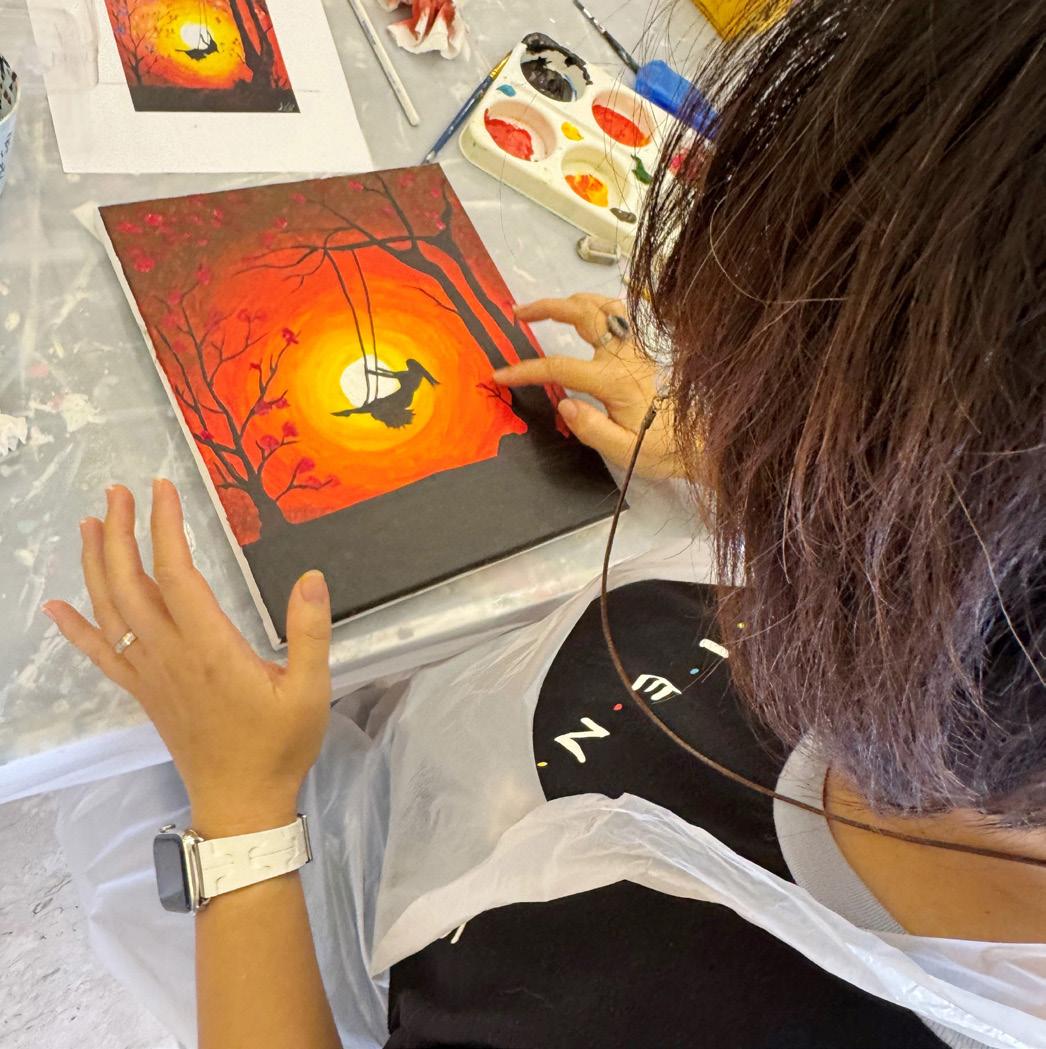
More recently, I started The Curiosity Club. The idea to start this club actually sprang up during one of my walks with the walking group. I work with a local arts community group called ‘Stranger Conversations’, and I saw an opportunity to create connections between local providers of fun, exciting activities and the parents at Tanglin. The parents love it because it gives them the chance to
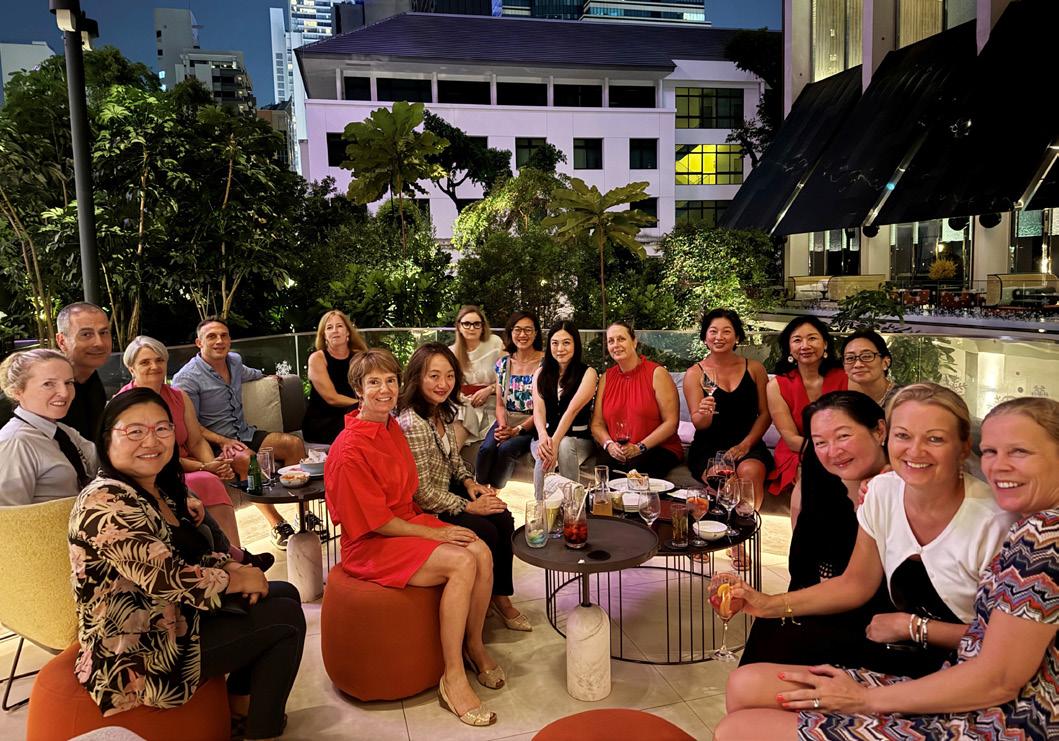
try new experiences beyond their usual expat circles and meet new people along the way. We also showcase Tanglin parents who run their own workshops or events, like Smita Sonthalia, who hosted an art workshop especially for The Curiosity Club. Smita inspired us to unleash our inner artist and paint masterpieces that surpassed expectations.
The thing about these clubs is that they aren’t exclusive to Tanglin parents. Wider inclusivity is important because when conversations stay within small circles, they can quickly become limited to school talk. By meeting people beyond Tanglin, including those without children or with children at other schools, new ideas emerge and lead to exciting new possibilities.
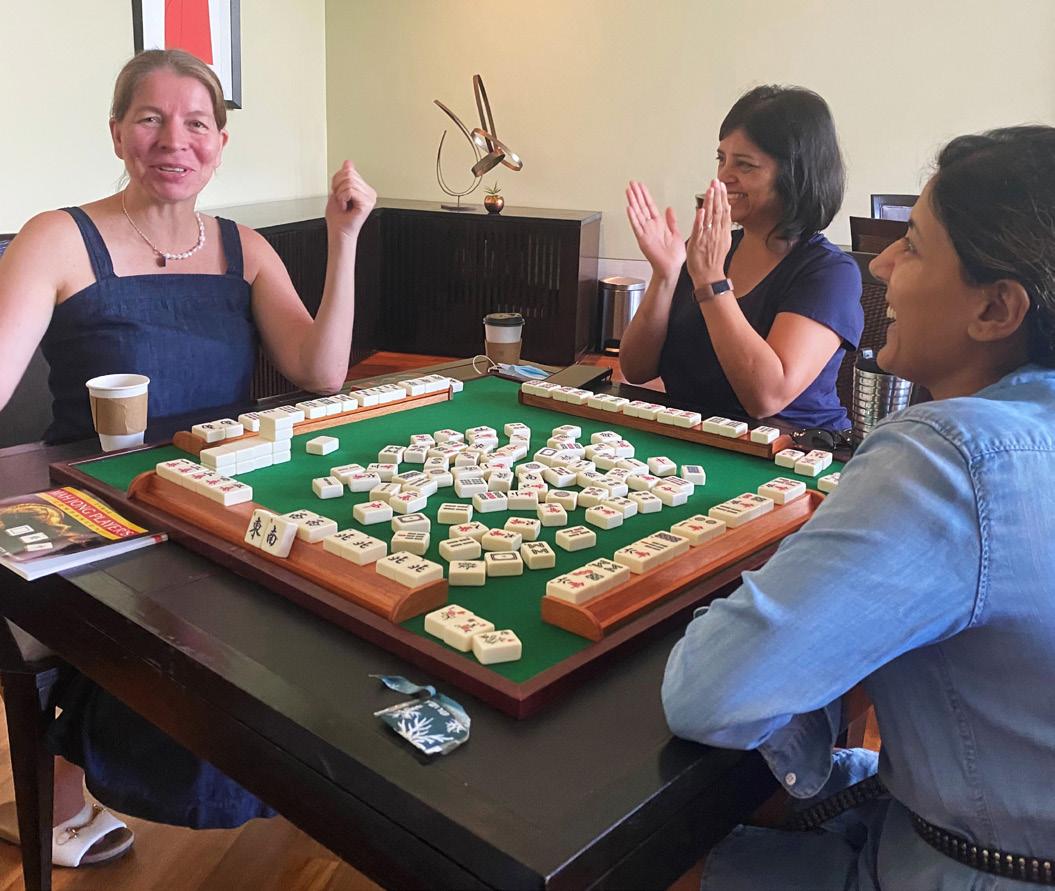
The Mahjong Club, for example, grew out of a conversation during one of our Curiosity Club sessions. My husband wanted to learn how to play, so I put the idea out there to see if anyone else would like to learn with us. We thought it would be a fun thing to learn as a family and something special we could take with us from our time in Singapore. The club has already attracted over 60 Tanglin parents. We held an introductory session on 3 February for 24 parents who were new to mahjong. I’m currently working with Rachael Ngo, Elisa Wamberg, Emma Lane, Hannah Richardson, and Garima Poply to plan regular social mahjong meetups. There is even talk of a mahjong retreat in Malaysia once we become more established. I’m also a member of the book club and really appreciate the effort that Sarah Gore and Sarah Huddleston make in organising the meetups. Although the evening gatherings aren’t easy for me to attend, I always read
the books and enjoy talking to other parents who have read them too when we meet on a walk or over a coffee. The choices are fantastic! Superb page-turners that are addictive to read, spanning a whole range of styles, genres, and international settings. Another passion of mine is volunteering at the Tea Shop at the school fairs. My daughter also likes to be involved and play shop, whilst sampling one or two of the cake delights. There are so many ways that you can participate in school life. Jenny Aylen, Darren Welldon, and the team at Friends of Tanglin organise such wonderful events that it’s easy and exciting to be included as part of the events team, even if you only have a little time to spare. This involvement brings energy to the Tanglin community and creates a supportive environment for everyone. When children see their parents taking part in school life, it sets a positive example for them.
Since that first meet-up at the school six years ago, I set myself the goal of walking in nature each week and, through the walking group, I always have friends to walk alongside, which makes the adventure more enjoyable. The Curiosity Club, Coffee Group, and Mahjong Club have grown from other interests of mine. My aim is simply to encourage people to feel more connected to each other and to Singapore. It can feel daunting when you arrive in a new country and at a new school, without knowing a soul. The clubs give us a chance to make friends. Through knowing other parents and sharing ideas, new opportunities are revealed.
Camee Gergely has this to say about her experience, “Being new to the school, the parent social clubs, organised by long-standing parents like Rachel, have been a fantastic way to feel part of the Tanglin community. Rachel is incredibly welcoming, supportive, and a real wealth of knowledge. After a career break, I realised I couldn’t sit at home quietly and wanted to get more involved, so a few of us who were new to the school put our hands up to be class reps. Most recently, I’ve also joined the ‘Lost and Found’ volunteers, which I also enjoy. Both my daughter, who is in Year 12, and I now feel settled and well-integrated into the Tanglin community.”
Another Tanglin parent, Grainne Ashton, added, “When I first arrived in Singapore, and my child started at Tanglin, the access to walking and social groups was a lifesaver. Coming in with an older child in 6th Form, I didn’t have the kids’ parties or school gate socialising, so it was a way to make friends through organised social activities and fun events.”
School opportunities that open up from growing Tanglin connections can include joining other parents to volunteer for a few hours at events such as the Christmas Fair, Movie Night, or festive celebrations like Diwali. Others feel more comfortable initiating projects. One such example is Shelly Kelly. She said, “From meeting people through the social groups, I have made friends, and that helped me feel more confident to take on other roles, one of which was a social night at the Ministry of Sound for the Curiosity Club. It was a wonderful night and really fun to go together.” Reflecting on her experience of the walking, coffee, and curiosity clubs, she added, “I’ve gained a lot from the social clubs. I’ve made close friends with whom I can share thoughts about life in Singapore and Tanglin experiences, as well as share new and exciting adventures.”
The parent clubs also provide a safe and supportive space where parents facing challenges can connect with others who have had similar experiences. With parents from so many different backgrounds, it’s a great chance to learn from one another and strengthen our community.
Visit https://linktr.ee/friendsoftanglin to learn more about the social clubs offered at Tanglin.
To volunteer for roles that can help you grow your connection to the school and meet other likeminded parents, simply email Friends of Tanglin at friendsoftanglin@tts.edu.sg.
How does Tanglin nurture future-ready learners with the skills, mindsets, and values to thrive in an ever-changing world? Let’s take a closer look at what Infant, Junior, and Senior School are doing.
What defines a future-ready learner? The Tanglin Learner Profile highlights the key traits we nurture in our students as well as in our teachers, parents, and leaders: Risk takers, Resilient Inquirers, Knowledgeable, Thinkers, Communicators, Open minded, Balanced, Reflective, Principled, Caring
These traits prepare individuals for the future, equipping them to adapt and thrive in an ever-changing global economy. In education, this means less about learning specific facts and more about building strong thinking and learning habits that prepare students not just for the next stage of school but for life beyond it. Here’s how Tanglin nurtures them across its schools.
solving from an early age. Emma explains, “With information now at our fingertips, memorising facts is no longer enough. What matters is knowing how to use that information by collaborating, developing ideas and solving problems. New environments push children to adapt, take appropriate risks and grow in confidence.”
Vanessa McCormack (Forest School Leader) and Emma Lambourne (Head
of Science and STEAM)
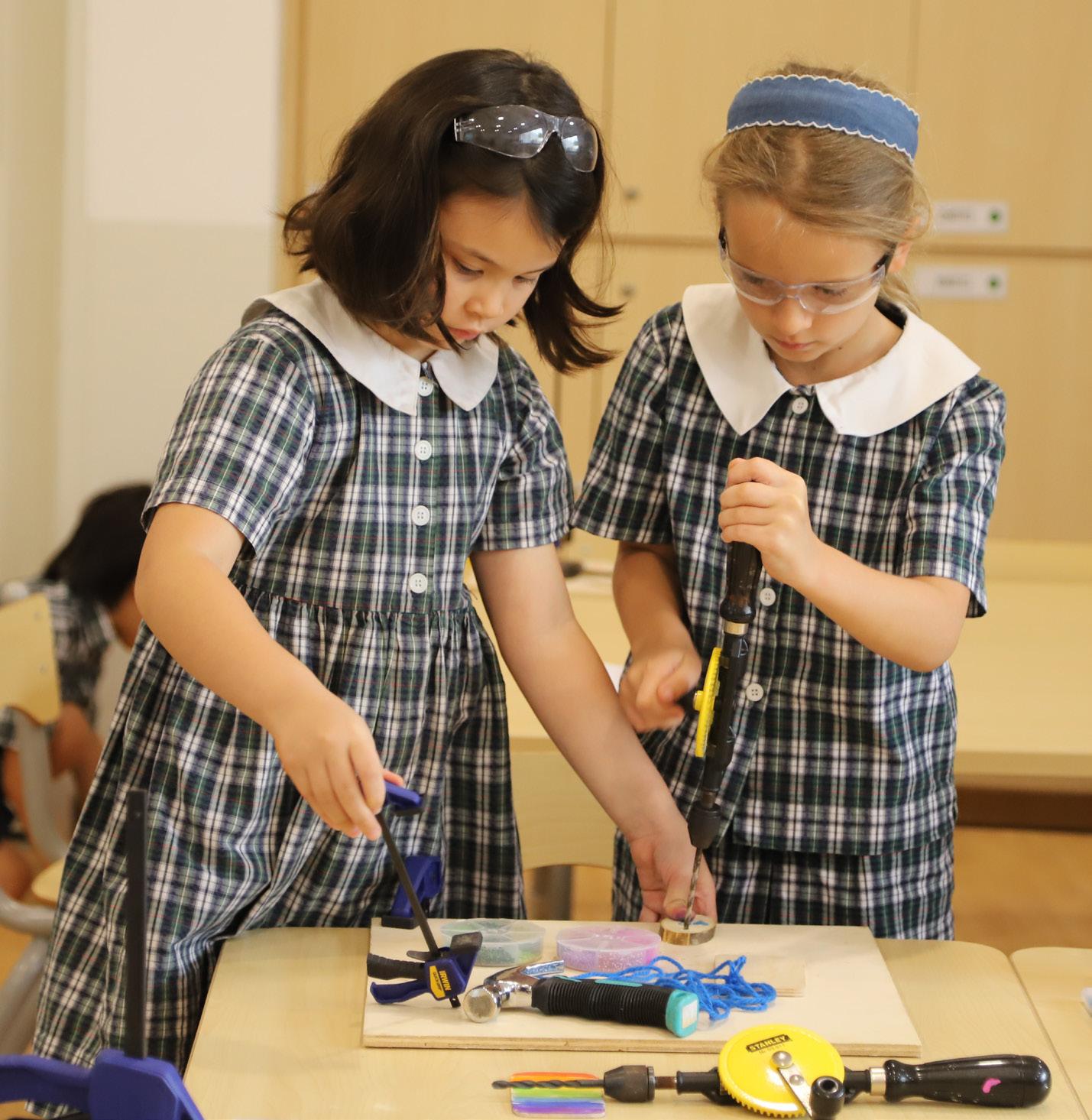
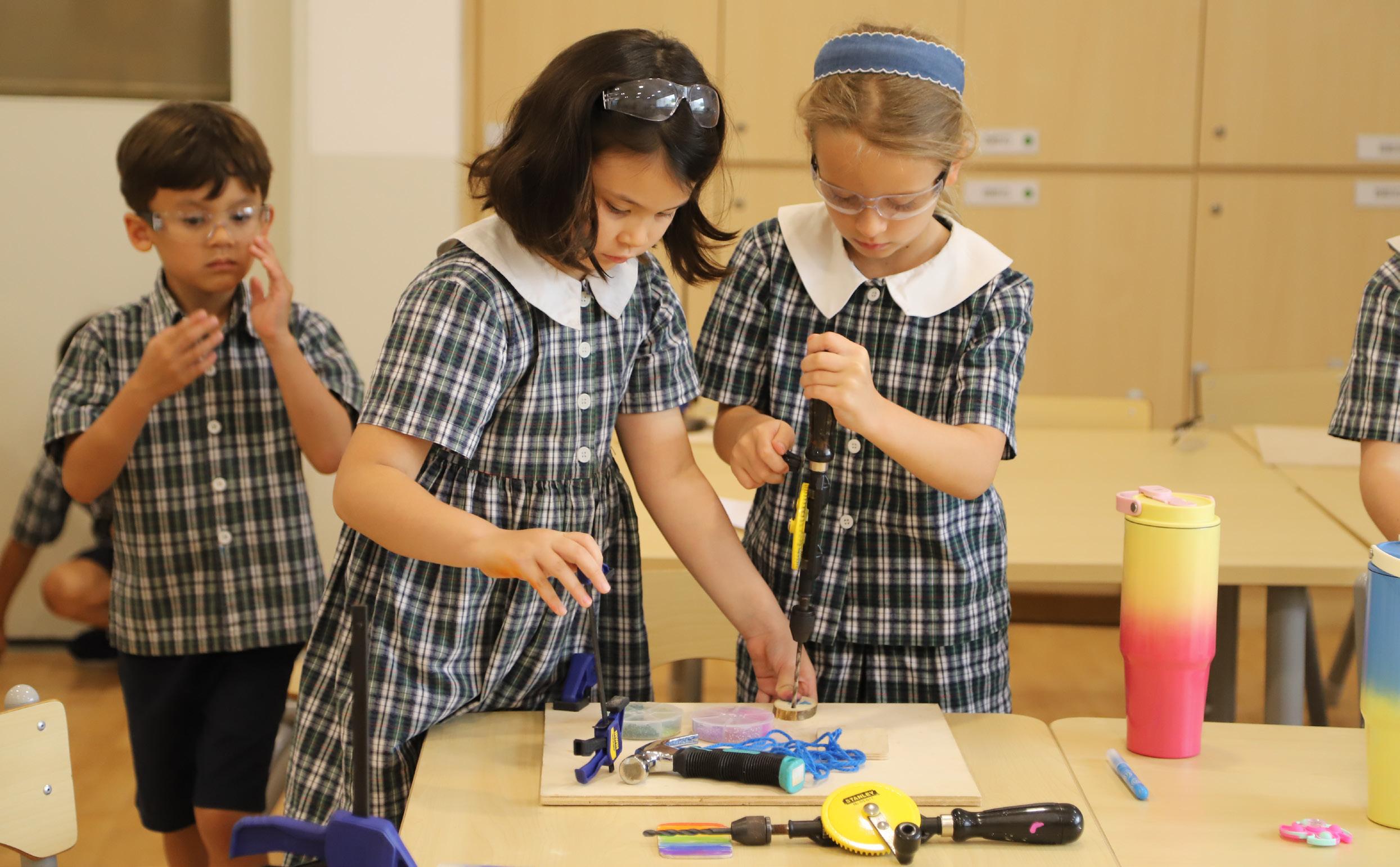
In the Infant School, children begin building the habits and skills that will prepare them for an ever-changing world. Learning spaces like the Forest School nurture curiosity, resilience and problem-
Whether it’s staying warm outdoors in the UK, managing the tropical heat in Singapore or overcoming a fear of insects, these real experiences challenge children to adjust and persevere. However, children don’t always have consistent opportunities to develop these skills. By immersing them in environments such as the Forest School, it provides the supportive yet challenging setting they need to build independence, adaptability and lasting resilience. As children gradually immerse themselves in the environment, their natural curiosity begins to spark and flourish, often replacing initial worries like getting dirty with a sense of exploration and discovery. Vanessa shared how this begins in Nursery, “One of the first things we do is encourage children to get their hands dirty. We show them that it’s okay, muddy hands can simply be washed clean. It helps to break down the barriers that can form when children grow up in a very clean,
controlled environment. Adults play a crucial role in this, especially in Nursery and Reception. When children see us fully participating, unconcerned about mud, wet hands or dirty shoes, it reassures them. By modelling confidence and enthusiasm, we help them feel safe enough to explore, take risks and step beyond their comfort zones.”
And who better to reinforce that message than parents themselves? Throughout the year, Vanessa and her team host parent tours to share the philosophy behind embracing mess as part of learning. They also contribute articles to the school’s newsletter and magazine, helping the wider Tanglin community understand the value of these experiences.
Even as the Infant children transition year groups, Forest School sessions remain purposeful and exploratory; they are not simply given a worksheet or a set of questions to complete. Emma elaborated, “All the activities that Vanessa and her team plan are
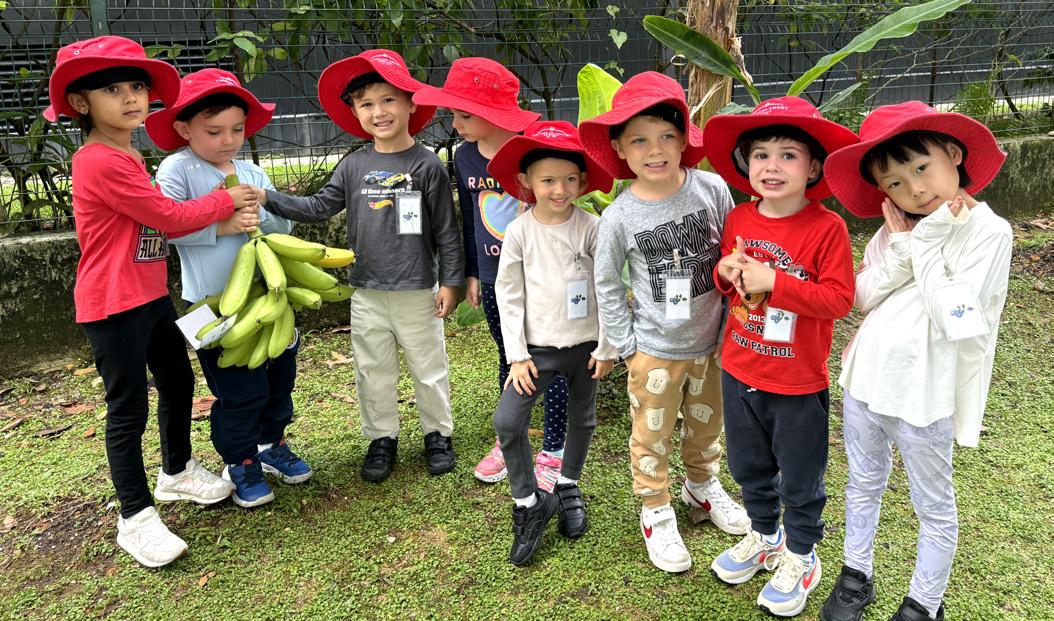
designed with the Science, Geography, and Life Skills curriculum as well as sustainability in mind. In Year 1 and 2, we focus on exploring specific concepts. For example, when learning about forces and motion, the classroom can feel limiting due to space constraints. Taking the learning outdoors offers far greater freedom. The children build ramps to investigate how objects move, experimenting with ways to make them travel faster or slower by changing different variables. This naturally led them to think about factors such as angle and slope. The questions emerge from their own observations. We provide prompts, but the direction of the learning is guided by their curiosity. Through this process, they engage in key elements of scientific inquiry: predicting, observing, classifying and explaining. It’s a rich, hands-on approach that enables them to discover concepts for themselves, rather than simply being told the answers.”
The newly installed pond in the Forest School offers another opportunity for meaningful learning. Vanessa shared how the Infant children worked together to look after the tadpoles, helping them understand the importance of caring for living things. They also learn about sustainability in simple, practical ways. For example, the children recycle used coffee pods and use small hammers to flatten them before recycling. Through these handson activities, they begin to see how small actions can make a difference. Beyond the outdoor experiences of the Forest School, Infant children also benefit from dedicated STEAM spaces such as Griff’s Imaginarium. Here, they take on age-appropriate challenges in robotics and programming, applying problem-solving skills and learning to collaborate effectively as a team. In the long term, it is this ability to make meaningful connections that leaves a lasting impact. From a STEAM perspective, these experiences extend far beyond the early years, continuing to shape and enrich their learning well into Junior School and beyond.
But what happens next? As children grow beyond being curious explorers, how does Junior School build on that foundation and help them refine their thinking, deepen their understanding, and apply their skills with greater independence and purpose? Joseph Gale, who is the Future Ready Lead at Junior School, shares more with us.
What does it really mean to prepare children for the future? In the Junior School, this question sits at the heart of my role as Future Ready Lead. Being “future ready” is not an extra subject or a oneoff initiative. It is a thread woven through learning, co-curricular life and pastoral development from Years 3 to 6, ensuring that students develop the skills, understanding and mindsets they will need in a rapidly changing world. Our approach brings together four key strands: Service, Sustainability, STEAM and Enterprise. Through service, every year group is linked to meaningful causes and real experiences. Year 3 students take part in Chores for Change supporting Conservation International, Year 4 work with Food from the Heart, Year 5 build connections with residents at St John’s home for elderly persons, and Year 6 mentor younger students while supporting the Singapore Disability Council. Service becomes part of how students understand empathy, responsibility and leadership. Through sustainability, students learn about their impact on the world around them. ECO Club initiatives, Eco Bricks, beach cleanups, the Ocean Ambassadors programme, and projects exploring deforestation, pollution and sustainable buildings help children see how their learning connects to real environmental challenges. Our Legacy Leaders even work alongside Sixth Form students to promote sustainable change across the school. Through STEAM, students apply their knowledge creatively. They design bridges, build robot hands, create kinetic sculptures, model Ancient Greek architecture using CAD, code games, design rockets and construct 3D mountain models with integrated circuits. Technology is used purposefully to deepen understanding and inspire innovation. Through enterprise, children begin to understand how ideas become reality. From budgeting and advertising to accounting,

market research and product design CCAs, students explore money, marketing and innovation in practical, age-appropriate ways. What makes Future Ready distinctive is that these experiences are not isolated events. They are mapped carefully across year groups and integrated into topics and lessons, outdoor education and cocurricular opportunities.
Ultimately, Future Ready is about more than preparing students for the next stage of school. It is about helping them become curious
thinkers, compassionate citizens, creative problem-solvers and confident learners—children who are ready to contribute positively to the world they will inherit.
With a strong foundation now in place, how do Junior School students continue to sharpen their skills by developing the confidence, adaptability and critical thinking needed to become truly future-ready individuals in an increasingly interconnected global world? Àlex Bosch, Senior School’s Assistant Head (Academic), tells us more.
In the Senior School, a student’s experience broadens considerably. They experience more subjects, greater independence and increased agency. Students encounter a wide range of disciplines, some familiar and others entirely new. They discover interests, find inspiration and, over time, grow into young adults with opinions, perspective and a developing sense of self. Many achieve outstanding examination results that open doors to exciting tertiary institutions and beyond. Measured by these metrics, Tanglin is an extremely successful school. And yet, an important question remains: do examination results alone prepare students for their future?
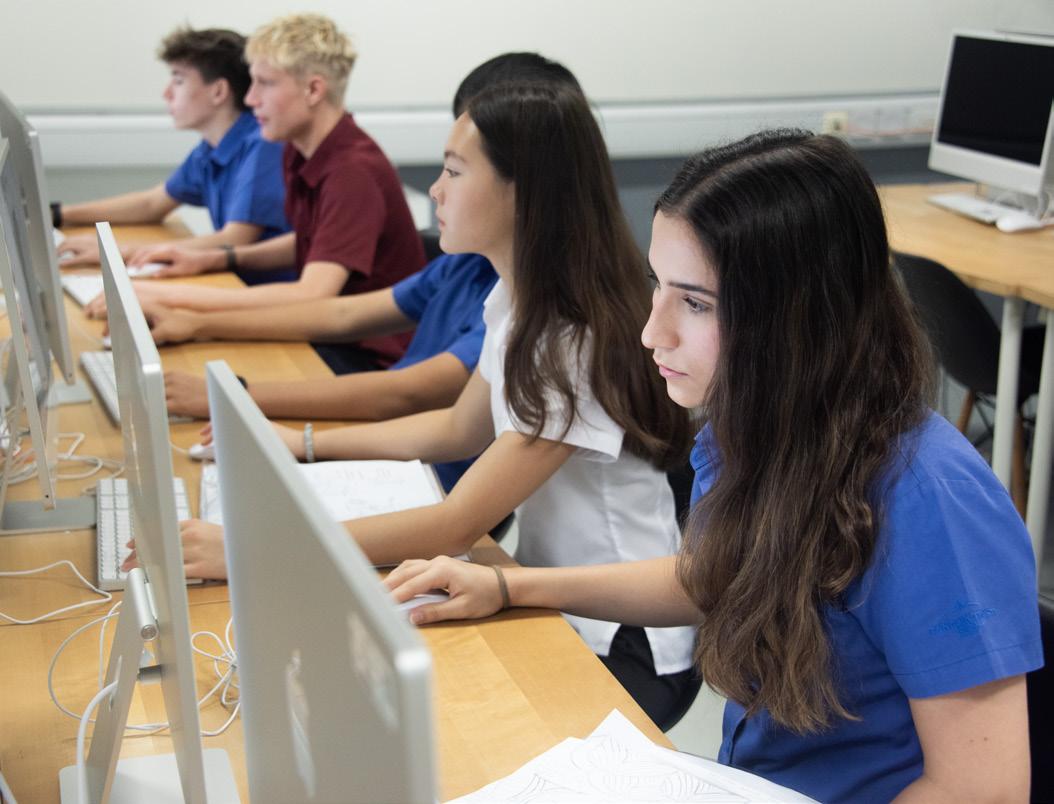
The phrase “we are preparing students for jobs that don’t yet exist” is well-worn in education. The longer one has worked in this field, the more often one has heard it repeated. While there is some truth in the sentiment, it has also become a convenient refrain for many self-professed gurus, often followed by claims of innovation that do not always live up to their promise. The introduction of Excel, for example, was once framed as revolutionary. With hindsight, its impact to learning was perhaps not quite as earthshattering as originally suggested. What feels different now is pace. Artificial intelligence is developing rapidly, and alongside ongoing global instability, it has made the notion of “the future” even harder to define. What is clear, however, is that AI and world events are very real concerns for parents. They are visible, immediate and unavoidable. Quite rightly, families expect the institutions they trust with what matters most to them to have a clear plan: not only to respond to these realities, but to prepare their children to navigate them confidently.
We know that success in external qualifications continues to matter and that it opens doors. But in a fast-changing and uncertain
world, academic results alone are not enough. The more pressing question is how we prepare students to think, adapt and thrive when the path ahead is not clearly mapped out. At Tanglin, we do this by placing ‘Future Ready’ at the centre of everything we do. It is the thread that binds together our core principles of ‘Personal Best’, ‘Inspired Learners’ and ‘Flourishing Individuals’. It is the point at which academic excellence and innovation, exceptional pastoral care and our long-held ambitions for our students converge.
Our understanding of the future is grounded not in predictions about specific jobs, but in a clear view of the skills, habits and dispositions that enable young people to succeed. We consider what universities, employers and wider society value, and we deliberately create opportunities for students to develop and demonstrate these qualities throughout their school experience. This means valuing deep and secure knowledge, while ensuring students can apply what they know flexibly in new and unfamiliar contexts. It means equipping them to use AI thoughtfully and effectively, as a tool that enhances learning rather than replaces thinking. It involves supporting students to understand how learning happens, to sustain focus and to manage distraction in an increasingly noisy world. We ask them to accept uncertainty as an inherent part of learning, to embrace challenge and to recognise that growth rarely comes without difficulty. We encourage them to seek feedback relentlessly, to fail well, and to understand the formative value of mistakes. We also nurture curiosity, helping students pursue their interests with purpose and reflect honestly on what they know, and what they have yet to master.
The idea of ‘the future’ is often associated with particular disciplines. As students progress through the school, we want them to continue embedding technology meaningfully in their learning.
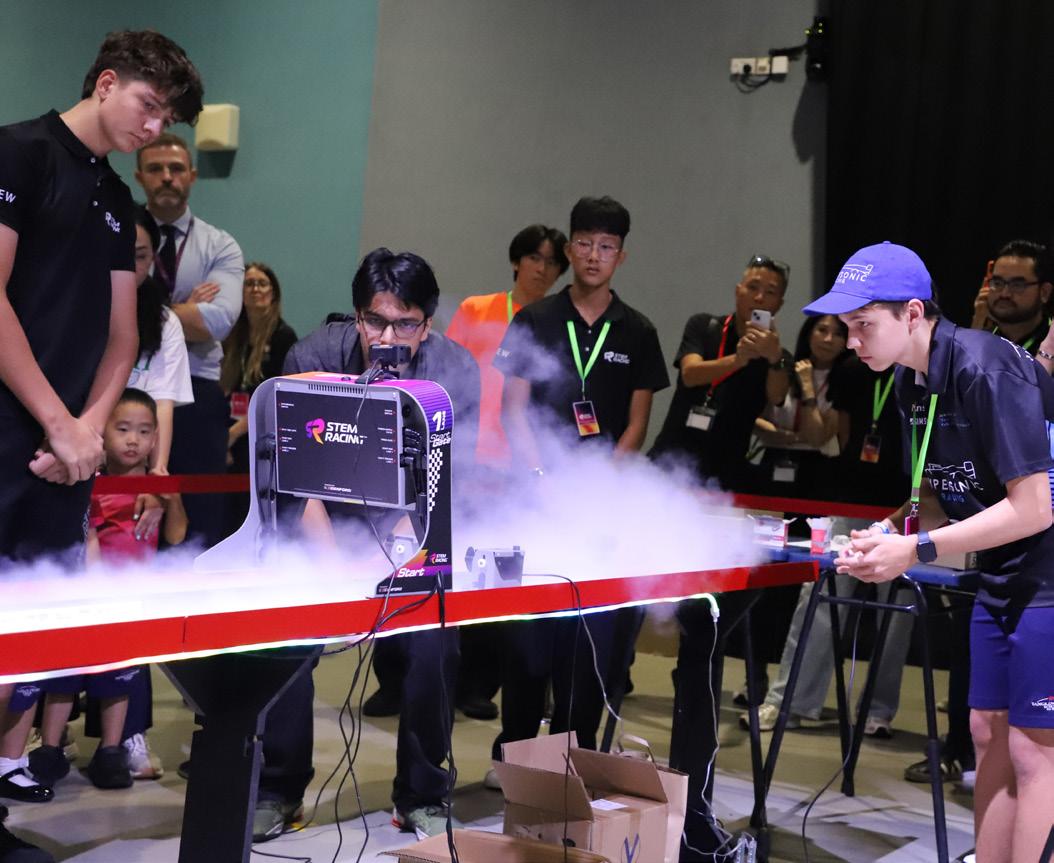
We invest in STEAM pathways, explore robotics and environmental sciences, and teach students how AI can support efficiency, creativity and deeper understanding. However, we have no doubt that there is no such thing as being ‘future ready’ without history, without languages, or without the arts. A truly future-focused education is broad and balanced. It is one in which students learn to collaborate, to show resilience and integrity, and to act with kindness and humility. It is one that develops grit, nurtures a sense of community and helps young people understand their place in the world, as well as their responsibility to others. Preparing students for the future is not about predicting it. It is about giving them the confidence, skills and values to meet it, whatever shape it takes.
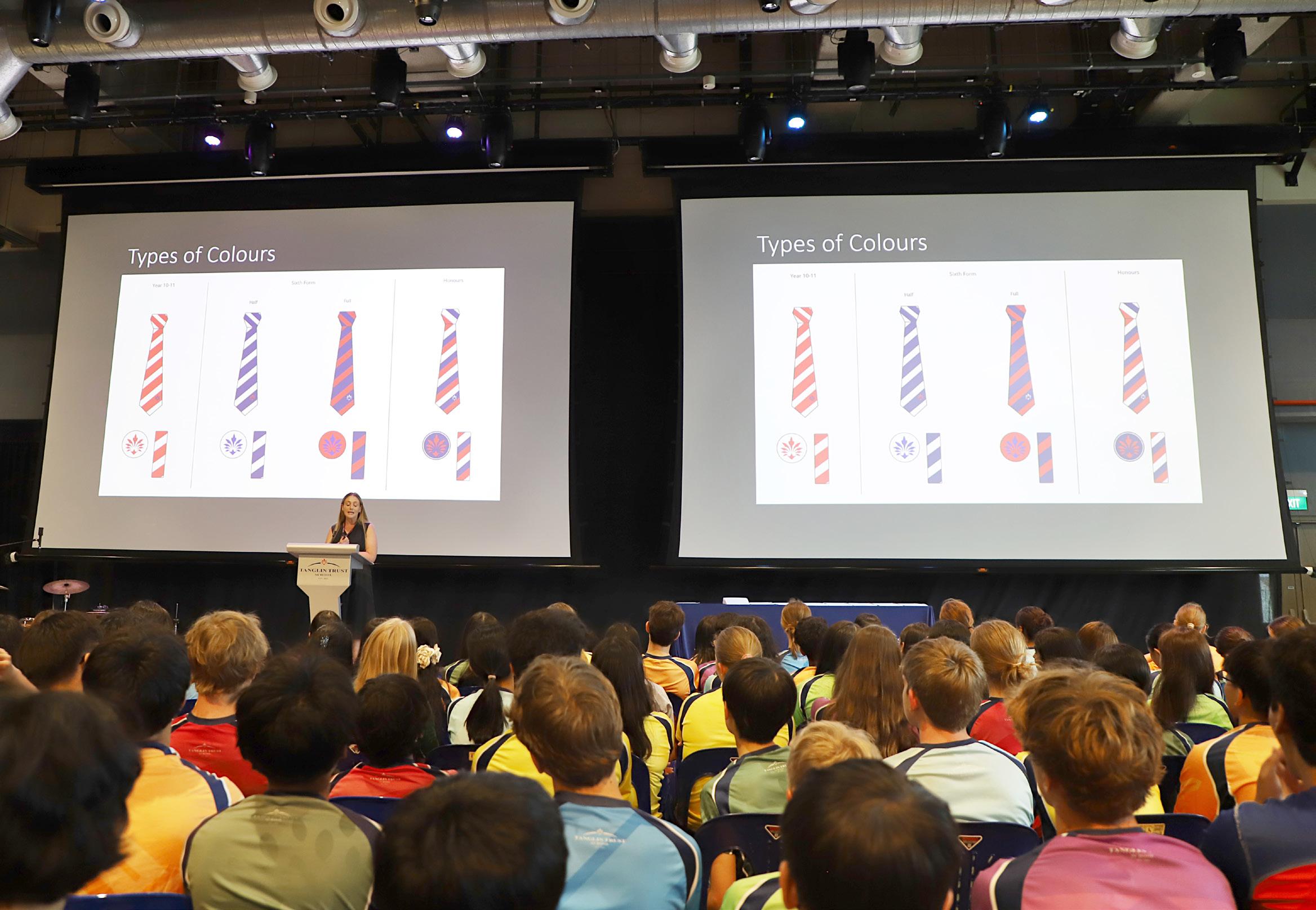
You may have heard the term ‘Colours’ used to celebrate Senior students’ achievements in their co-curricular activities. Sophie Hawkins, Deputy Head (Co-Curriculum), explains what it means.
As I write at the end of term, a big focus of our final week of school before the break is to celebrate the achievements of our students within the Co-Curriculum. Notably, marking and sharing their contributions to the life of their school beyond the classroom. The hallmark of a good school is the energy and enthusiasm with which students want to shape their school with their talents and ideas; Tanglin has that in spades! As such, it was brilliant to be able to celebrate the achievements of those students in what we have termed the ‘Reflections and Awards’ Assembly at the end of term.
100 students from Years 10 to 13 received either Upper School Colours, Half Colours, Full Colours or Honours in this assembly at the end of Term 2 in Senior School. Upper School Colours are
awarded for outstanding commitment to sport, music or drama in the Upper School and in sport, that is for students in the ‘first’ team. These awards are personally confirmed by the Directors of Sport, Music and Drama.
School Colours are awarded in the Sixth Form only. Students are awarded either half or full colours.
Half Colours reflect being an important member of a club, society, team, ensemble or production. In sport, this would mean playing at least six fixtures for the first team or non-first team players who represent the school in at least 12 fixtures. In music and drama, half colours are awarded for being an important member of at least two ensembles or a production.
Full colours are for students who play a central role in a club or society or take a central role in concerts or productions. These students are positive and proactive members of the school

community and excellent role models for other students. In music and drama, they must have been in at least three ensembles and all relevant concerts or two productions during their time in the Sixth Form. In sport, full colours are given to acknowledge the
Finally, Honours are our most prestigious and therefore rarely awarded awards. They are not reserved for Sixth Formers but everyone who is awarded Honours must meet the criteria for Full Colours and also satisfy at least one of the following:
• In sport, students must represent their national team at Under 16 or above.
• In music or drama, students must meet the criteria for full colours and perform in a national level ensemble (National Youth Orchestra or National Youth Theatre etc).
• In clubs and societies, students must fulfil the criteria for full colours and participate in a national level activity.
It goes without saying that all recipients of all of our awards uphold Tanglin’s core values in everything they do. They demonstrate respect because they are leaders and have the qualities of role models. They exhibit responsibility through their unwavering commitment to weekly activities and events, even when they are busy or tired. And their purpose is evidenced by their consistently high standard of performance and achievement. I encourage you to keep an eye out for students who are visibly wearing their Colours on their uniforms or wearing their pins. Please do ask them what they have done and congratulate them on their achievements.

Want to know more? Scan the QR code to watch a video featuring students who have previously received their Colours.
At Tanglin, we provide both the opportunities and the safe spaces for students to thrive academically and beyond the classroom through co-curricular activities. These students demonstrate just how much they can achieve when given the confidence and support to step forward.
What’s your Tanglin story?
I joined Tanglin in nursery in 2016, which means I have been here for 9 ½ years. Before that, I lived in Australia for five to six months after I was born, before my family moved to Singapore. I attended Blue House Preschool until I was three years old, then moved to Tanglin.
What motivates you to take on so many activities, and how do you manage your time?
Swimming was my first sport, starting around 2015, and it has stayed with me ever since. My love for the water kept me going, and regular Saturday training became part of my routine. I began learning the cello in Year 3 and later joined my first orchestra, Sostenuto Strings. The feeling of playing with others encouraged me to progress to more advanced ensembles such as String Camerata and String Sinfonietta. I now play in the Tanglin Symphony Orchestra at Grade 6. I also started badminton in Year 4. What began as trying a new sport soon became something I enjoyed, and by Year 7, I was competing in inter-school matches across Singapore. Playing with others has helped me improve, learn from different players, and develop good time management skills. Alongside my activities, I also have academic commitments such as tests and assessments, which require time for revision.
To manage everything, I prioritise carefully. With two sports and one instrument, my time management is working well, and I always think carefully before taking on anything new.
Any challenges?
As I progressed in swimming, training became harder and more tiring. Some sessions pushed me to my limits, but I kept going and completed the sets. Even when I struggled at first, I improved over time and swam faster.
How have teachers, coaches, or peers at Tanglin supported or influenced your journey?
They often shared the pros and cons of each journey, which really helped me make better decisions. They also guided me on how to improve, what to do next, and what to avoid.
What’s your advice to students who want to get involved but feel overwhelmed?
I would advise them to prioritise activities and create space for what they enjoy most. If they don’t like one activity as much as another, then just move it down the priority list and make changes such as replacing training sessions.

What’s your Tanglin story?
I joined Tanglin in Nursery. I loved swimming, did gymnastics at a young age and just generally enjoyed PE in Infant School. My passion for Touch started when I was eight years old and started playing at the Tanglin Rugby Club. I later joined the Merlions and picked up football in Year 6.
What motivates you to take on so many activities, and how do you manage your time?
I think what motivates me the most is the strong friendships I make in those sports and learning that with time, commitment and an attitude towards training, you can get things done if you put your mind to it. I also make the most of my morning training and currently train every morning and afternoon throughout the week. But people always tell me that resting now and then is very important.
Any challenges?
If I’ve faced any challenges, it’s having a mental block around racing. I don’t naturally enjoy competition, yet I put a lot of pressure on myself to perform well. What helped was realising how hard I was being on myself and trying to change that mindset. Over time and with practice, I began to see racing as something fun and to remember that there will always be opportunities. You just have to put in the effort to make them happen.
How have teachers, coaches, or peers at Tanglin supported or influenced your journey?
In my early years at Tanglin, the Junior PE team made a really big impact by ensuring everyone had plenty of amazing opportunities. I also benefited a lot from the support of my Merlions coaches, teammates, and the Tanglin Touch community. It helped me develop both my sporting and personal skills through experiences like trips to Brisbane and captaining the U13 Harrow 7s football
team in Bangkok during an earthquake. Over time, I’ve grown stronger in touch and was proud to be selected as the youngest player trialing for the TRC Amazons U19 team. Above all, my family and friends have been my greatest source of support.
What’s your advice to students who want to get involved but feel overwhelmed?
In my opinion, it doesn’t matter what you’re good at. What matters is loving what you do, seizing every opportunity, and giving it your best. When you enjoy an activity, you’re motivated to keep going. That’s when you improve and open the door to even more opportunities.
What’s your Tanglin story?
II was born in Singapore and have been at Tanglin for 12 years, joining in Year 1. I joined the Tanglin swim team in Year 7 and was promoted to Junior team captain at Year 9. Piano was my first music instrument, and I later learned the cello at Tanglin in Year 4, thanks to the Strings Programme run by Tanglin’s Music department. At same time, I achieved Taekwondo Black Belt Grade 4 after 10 years of training. Finally, I joined DoE in Year 10, enjoying every expedition and activity.
What motivates you to take on so many activities, and how do you manage your time?
I started music at age 4, swimming at age 5 and taekwondo at age 6, so all of them have been a big part of my life. For me, these activities are a way to relax after a long day of school or studying. I enjoy trying new things because they teach me new skills and help me meet new people. Since I genuinely enjoy all the activities I take part in, they never feel like a burden; in fact, I often feel more productive afterwards. Writing down my activities and deadlines on my iPad calendar helps me manage my time and stay organised. This way, I can manage my activities and academic studies, pushing myself to achieve high score in all aspects.
Any challenges?
Once, before a SEASAC swimming competition, I injured my foot during taekwondo training. Despite this, I still decided to fly to Thailand to compete. The injury meant that I couldn’t swim as well as I wanted to due to the pain. I communicated this to the coach, and we created a plan to prioritise certain races and others to withdraw. I chose to prioritise the team relays over my individual events, as even though I was injured, I wanted to contribute to the team. By resting properly and carefully selecting my events, I was able to contribute to the Tanglin team’s silver medal in the relay. This made us all extremely happy. This experience taught me the importance of planning and understanding when to prioritise the team over individual ambitions.
How have teachers, coaches, or peers at Tanglin supported or influenced your journey?
My swimming coach Mr Hurley has supported me tremendously. With a busy schedule, I’m not always able to attend every training session but he understands this and never sees it as a lack of commitment. Instead, he adapts the sessions I do attend to align with my goals and maximise my progress. During my GCSE exam period, he even allowed me to train at different times so I could balance swimming with revision. That flexibility helped me maintain both my performance and my focus during a demanding time. My teammates have also played a big role in my development. We foster a culture of healthy competition that pushes each of us to improve, while maintaining a strong sense of
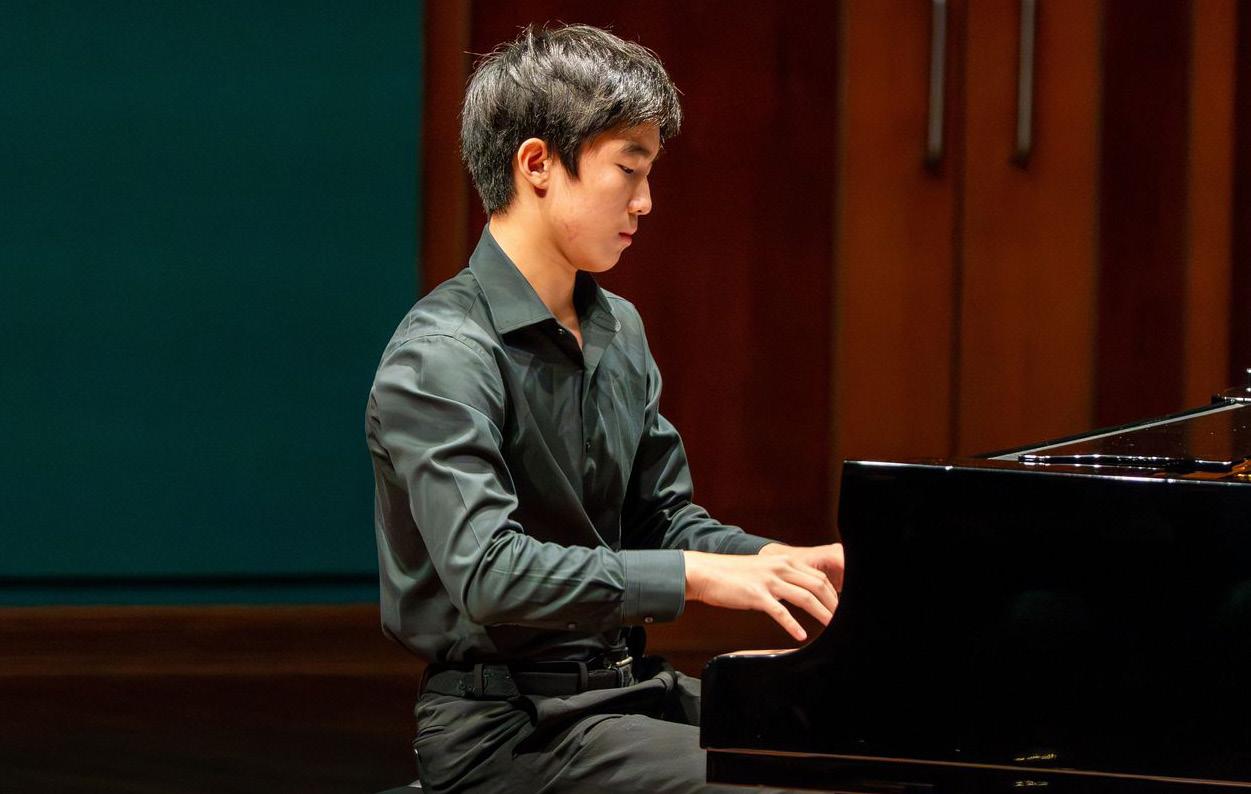
mutual encouragement and support. It’s this balance of challenge and camaraderie that makes me genuinely look forward to training and continues to drive my progress.
As for music, I would never have had the opportunity to take up the cello if it hadn’t been for the Year 4 Strings Programme, where we were each introduced to a string instrument. After the programme, a few students were invited to continue learning their instrument with the school. I was fortunate to be one of them and haven’t stopped playing since. Furthermore, Tanglin’s Music Scholarship Programme has motivated me to refine my musicianship while providing invaluable performance opportunities, both of which I am very grateful for. In addition, Mr Rob Hall has expanded the school’s musical horizons by introducing initiatives such as music tours to Spain and opportunities for students to perform with the adult symphony orchestra. These experiences have greatly deepened my passion for music and allowed me to experience new things.
What’s your advice to students who want to get involved but feel overwhelmed?
I would recommend planning your time carefully by noting all your activities, study sessions, and personal time. You may realise that you actually have more free time than you think. Many people also underestimate the time they spend on social media or other distractions, so monitoring these can free up significant time. If an activity leaves you feeling tired or stressed, it probably isn’t the right fit for you because it shouldn’t feel exhausting if you genuinely enjoy something. However, it’s important to remember that, at the end of the day, you are still a student and should prioritise studies over activities. My advice would be to find an efficient revision strategy that can save you study time while giving you more time to get involved in activities.
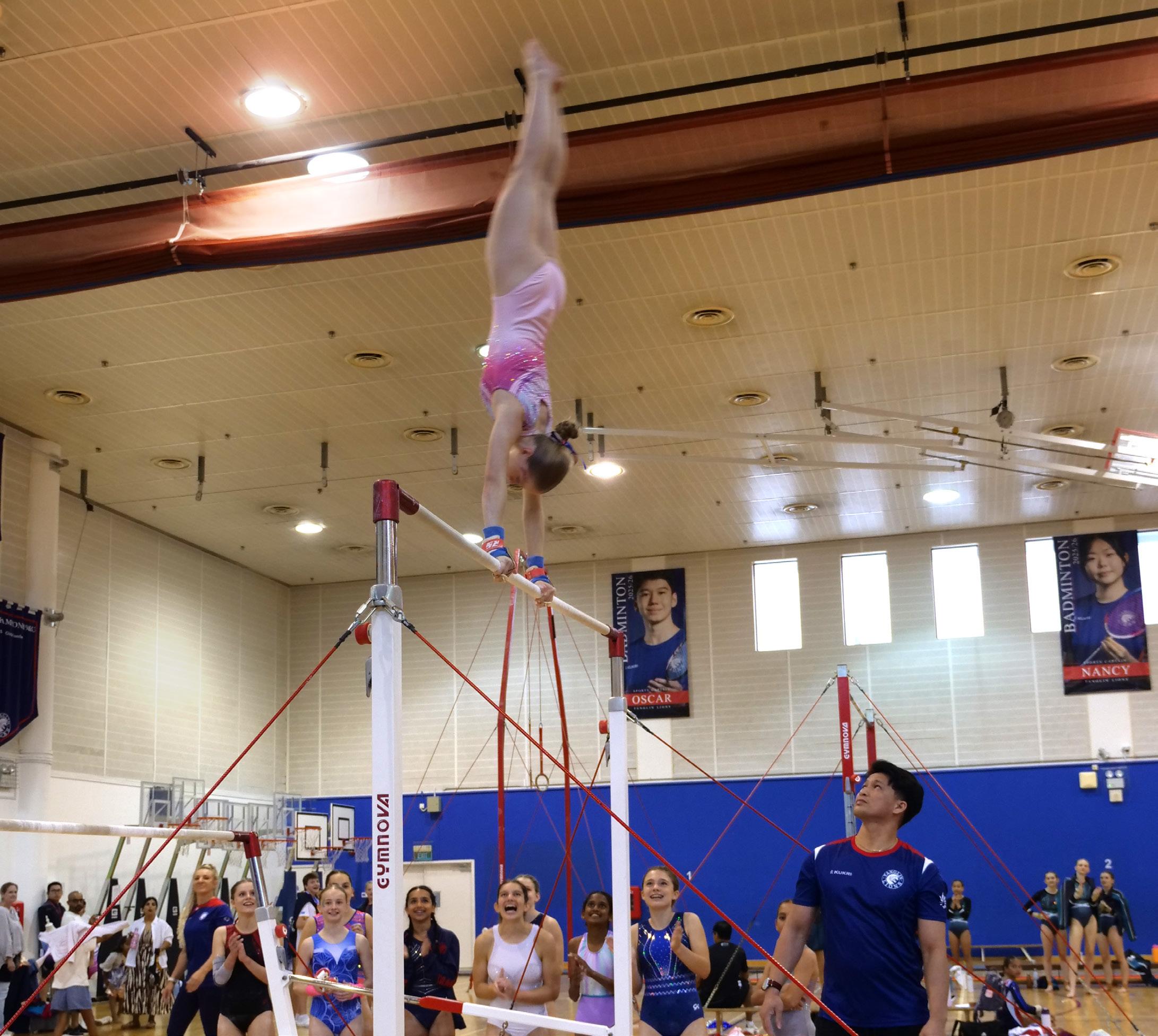
What’s your Tanglin story?
I joined Tanglin in Reception after living in America for five years, before moving to Singapore. I have now lived in Singapore for ten years. I have always enjoyed playing sports and spending time with my friends.
What motivates you to take on so many activities, and how do you manage your time?
I take on a lot because I genuinely enjoy everything I do. Sport, drama, and the Duke of Edinburgh Award are experiences I share with my friends, so I am never alone, which makes them even more enjoyable. I choose to take part in sports and drama not because I am forced to, but because I love expressing myself and putting myself out there.
Any challenges?
One challenge I face in sport is injury. In 2024, I suffered an injury and a minor recurring back issue. I have learned that injuries are a time to step back and recover, even though they are often the toughest moments for athletes, as all we want to do is train
and compete in the sports we love. However, our bodies are not machines that can work continuously; we need time to rest, or we risk hurting ourselves more. I overcome this challenge by talking to my coaches, family, and friends, who act as a safety net and support me when I need it most.
How have teachers, coaches, or peers at Tanglin supported or influenced your journey?
My coaches have supported me through my highs and lows, helping me grow by pushing me to do my best. My friends also support me, whether joining me in productions or checking in on me. I sometimes take on too much because I love sport and drama, but I’ve learned to take a break and reset to avoid burning out.
What’s your advice to students who want to get involved but feel overwhelmed?
If I could give one piece of advice, it would be to focus on what you can control. You cannot fix everything happening around you, and that’s okay. I know it can be difficult, but prioritising your own wellbeing makes a world of difference!
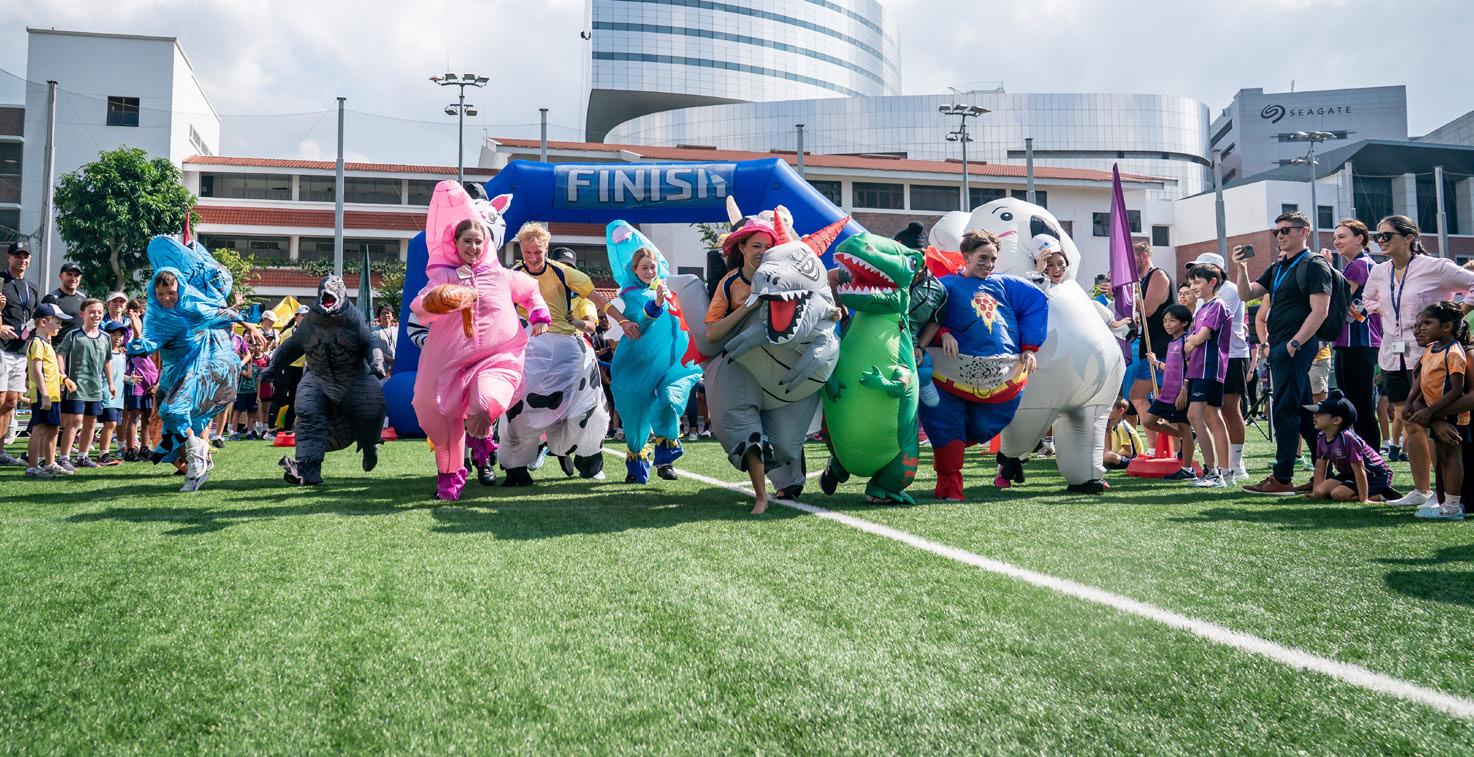
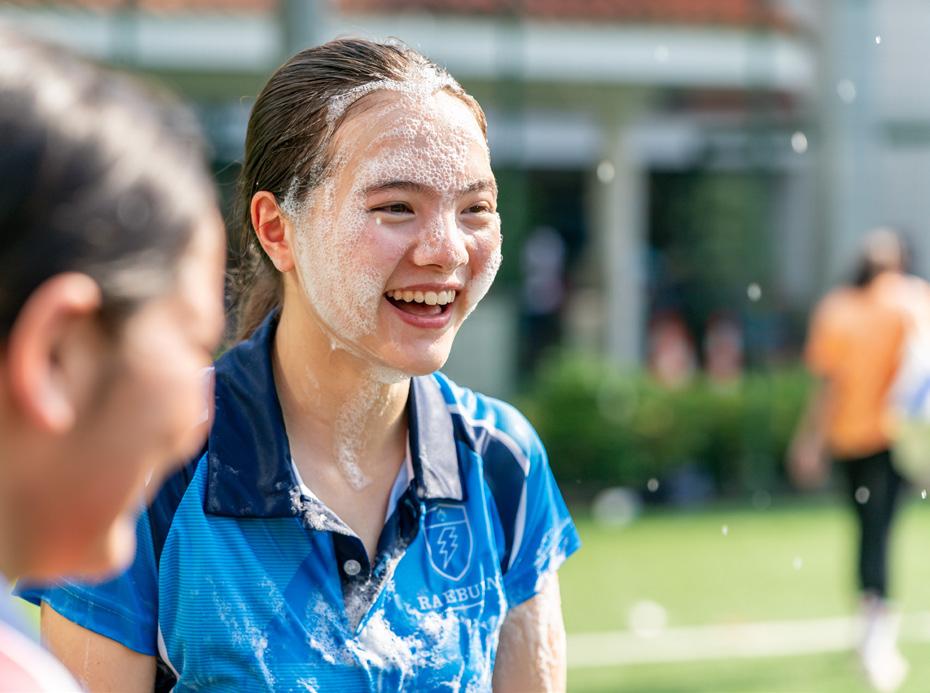

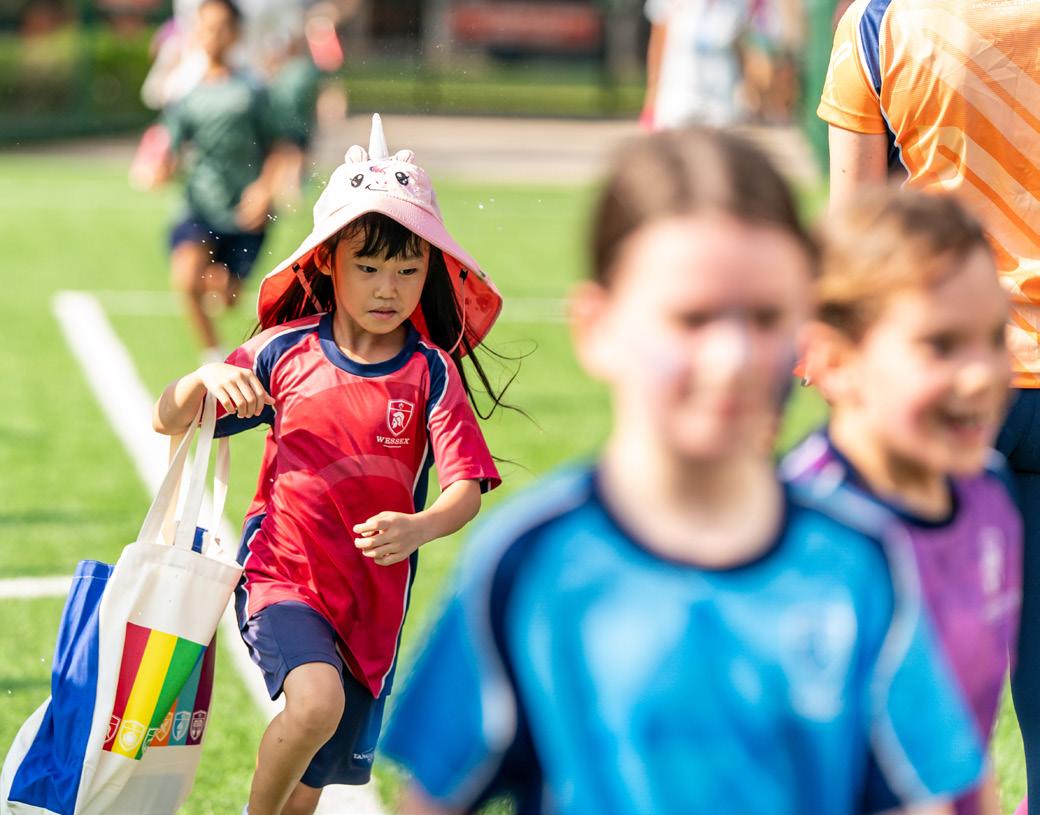
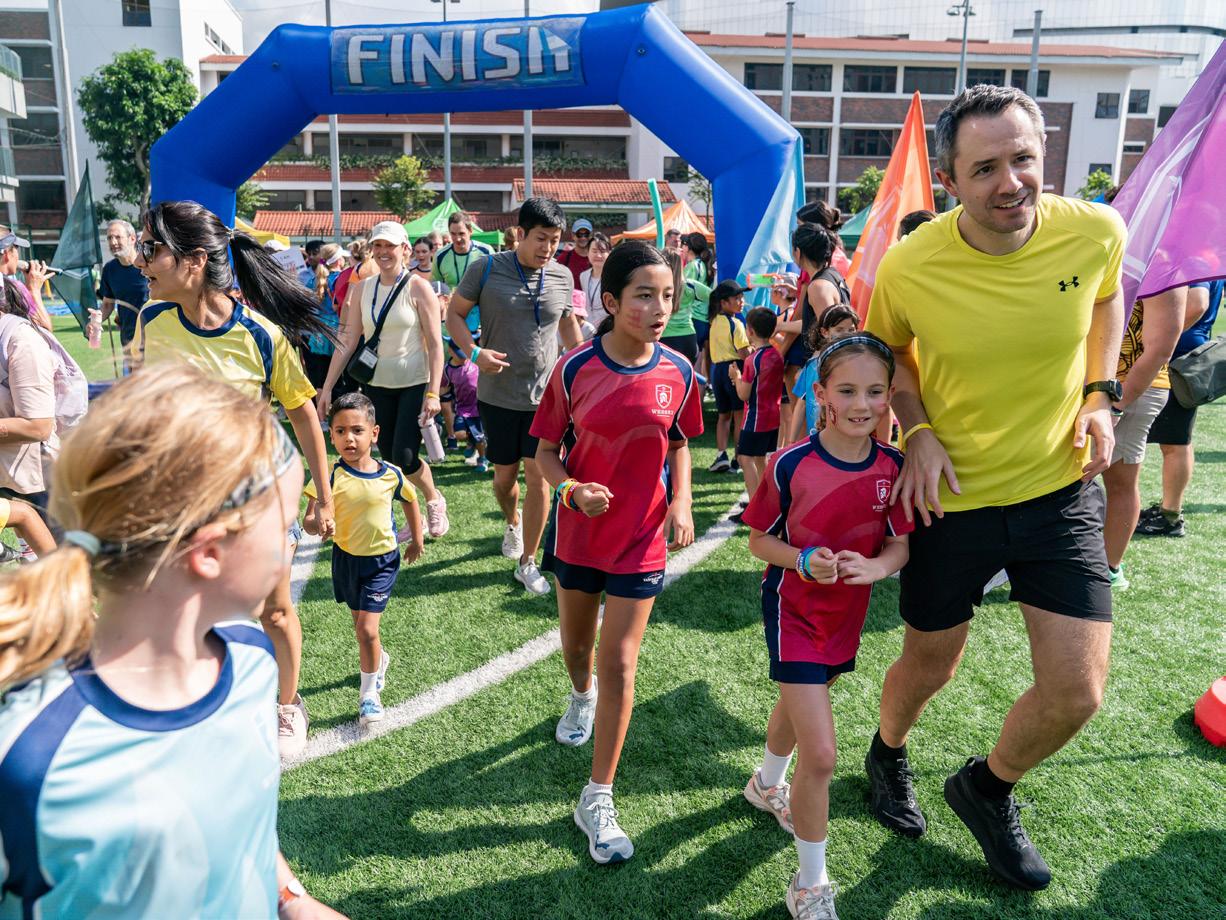
What an incredible House Fun Run! With amazing energy from start to finish, the Tanglin community came together to raise over $11,000 for Arc Children’s Centre, a fantastic achievement for a great cause. A huge thank you to all our volunteers and House Captains who brought the spirit, fun and enthusiasm that made the event so special. The cheering was nonstop; voices may be hoarse, but it was absolutely worth it! It was inspiring to see so many runners out in full force, proudly dressed in their House colours, giving it their all. What a brilliant display of community, generosity and House pride. Thank you to all those who took part and see you next year!
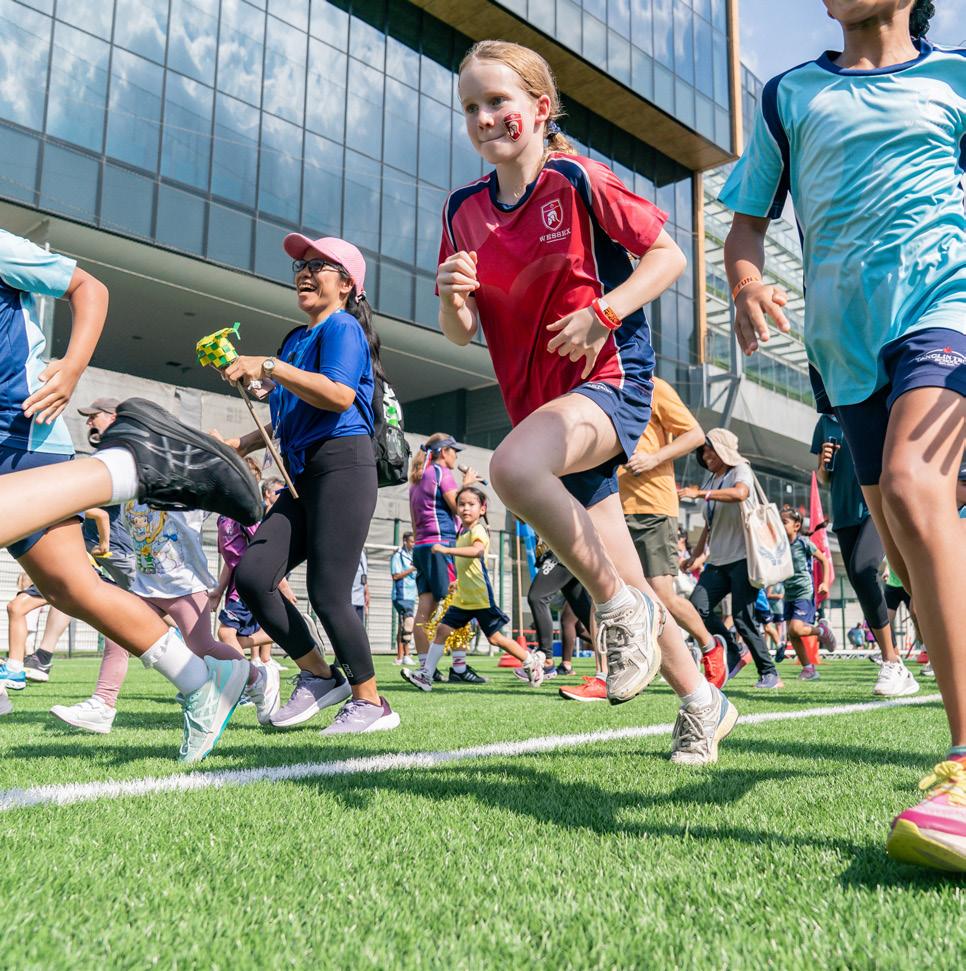
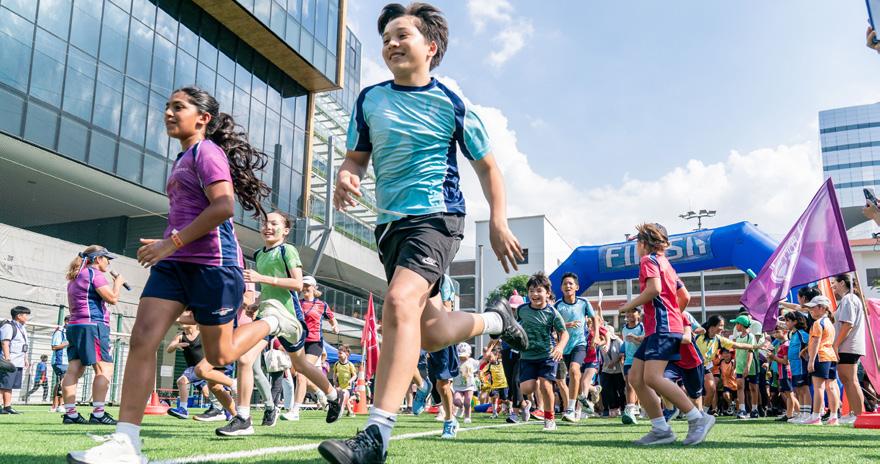

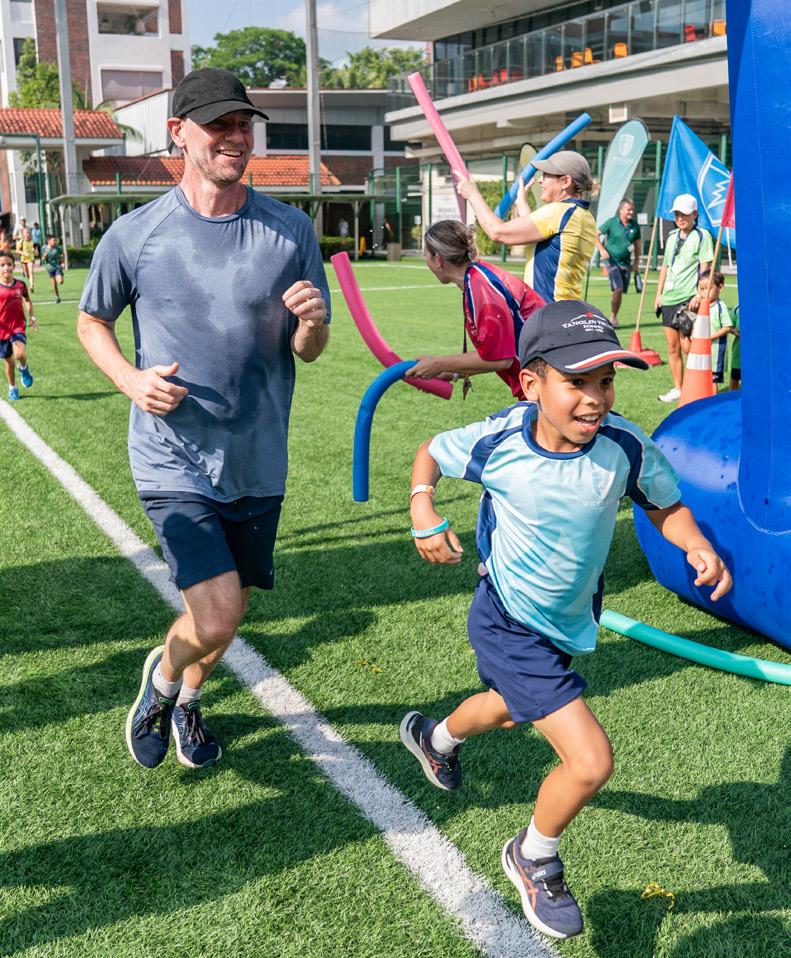

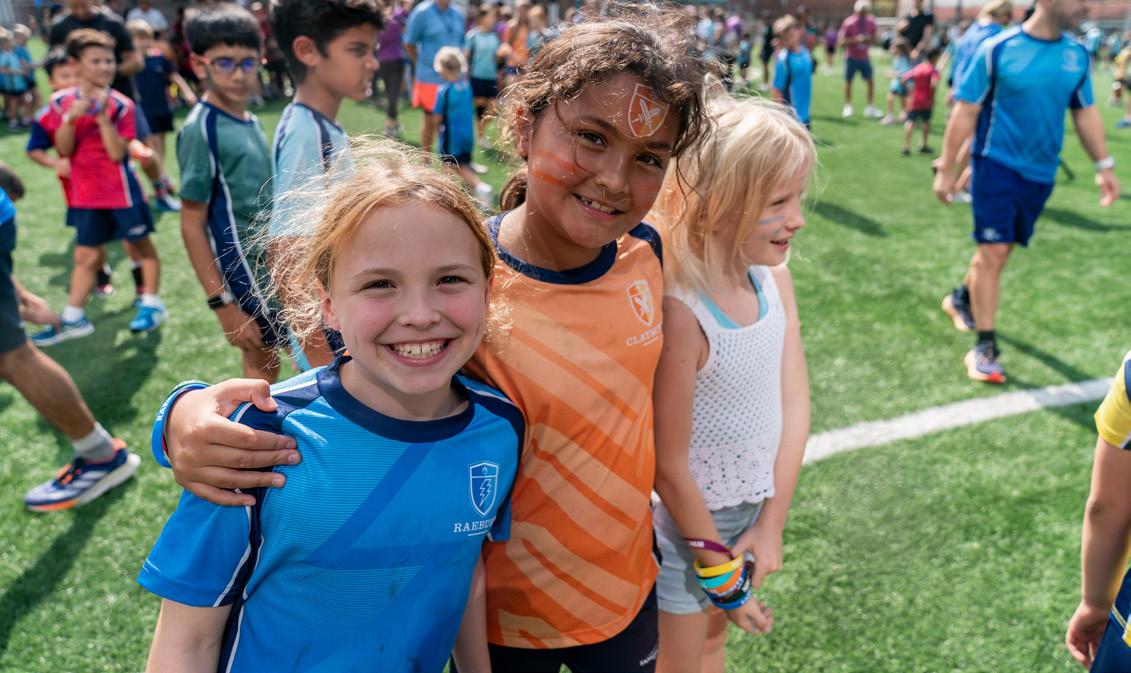
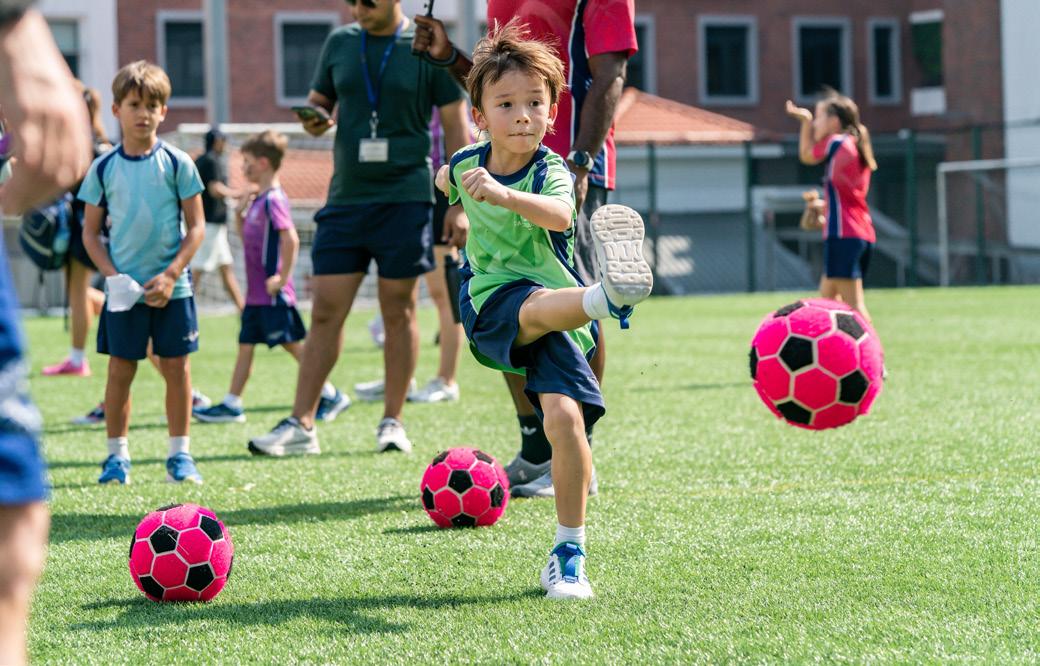
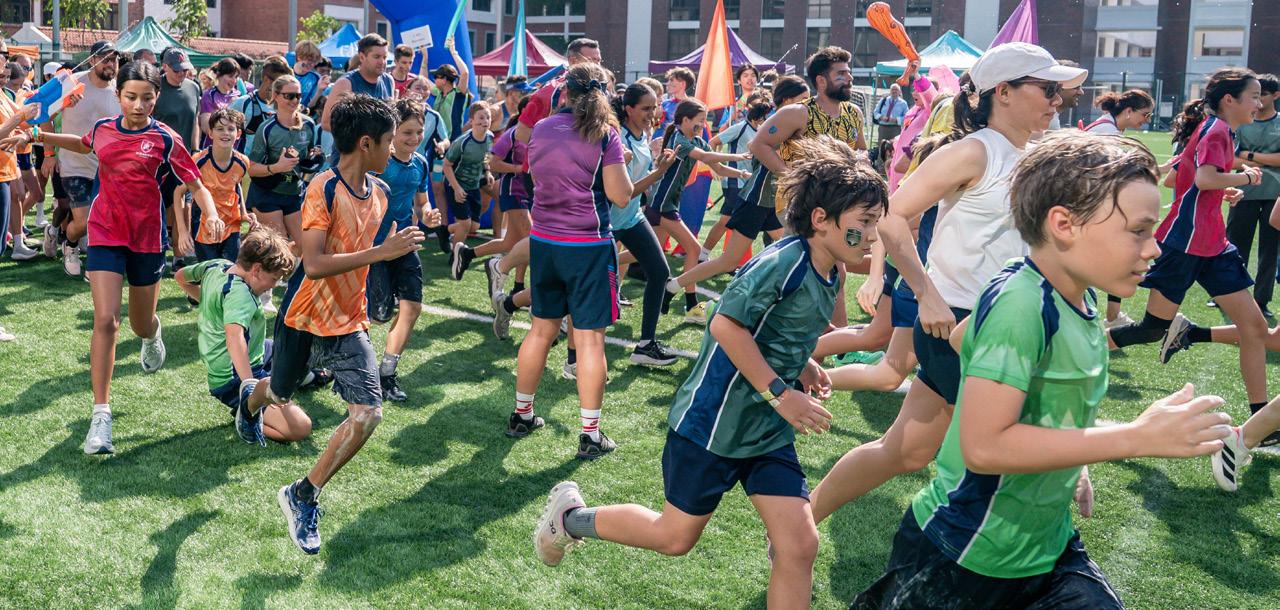
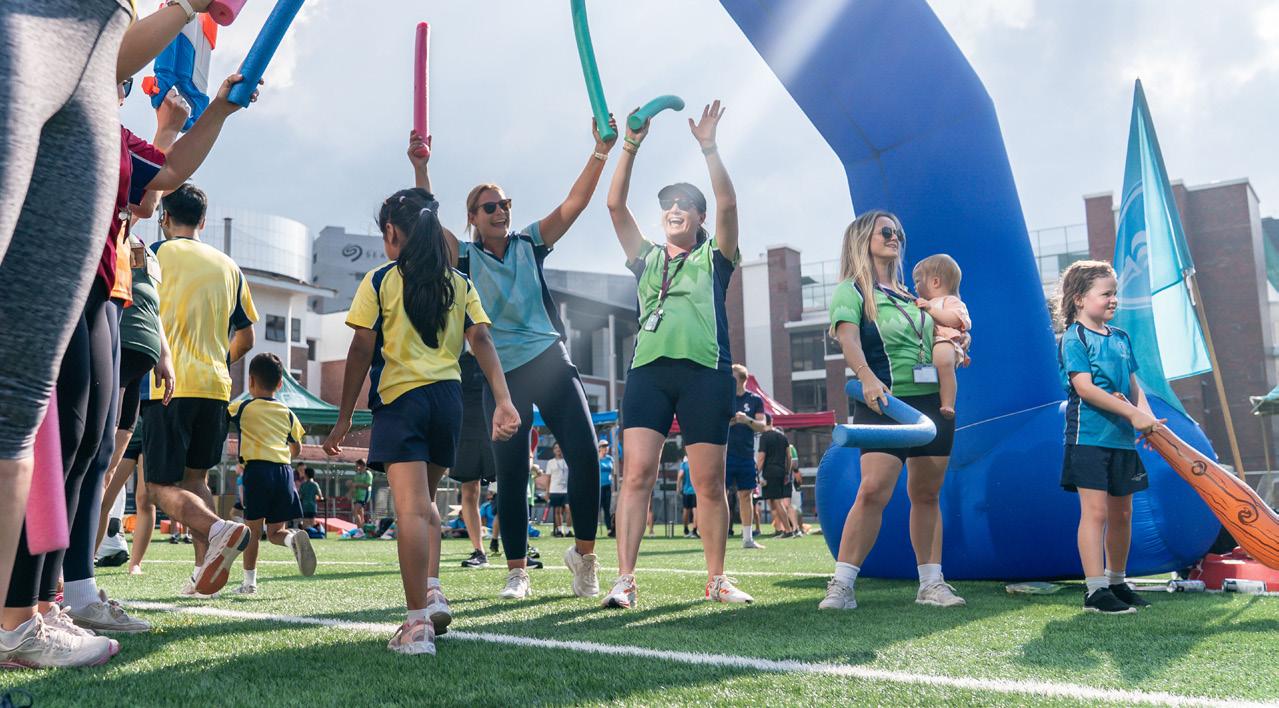

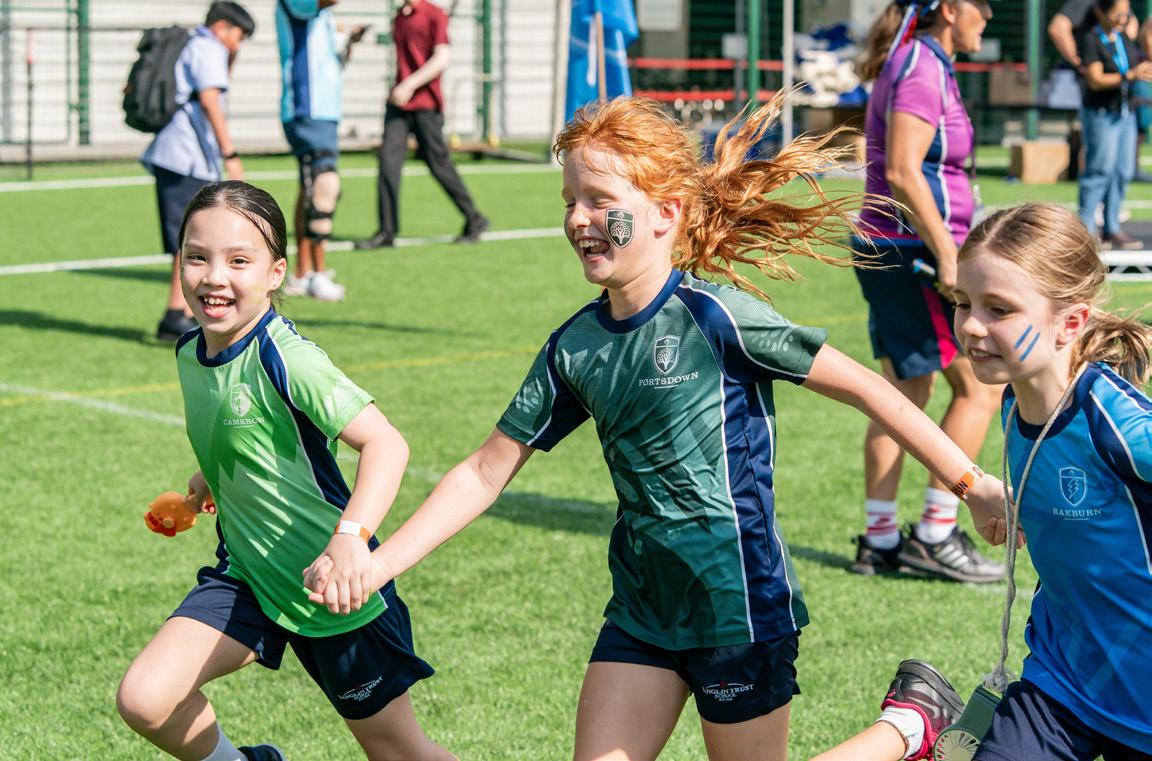
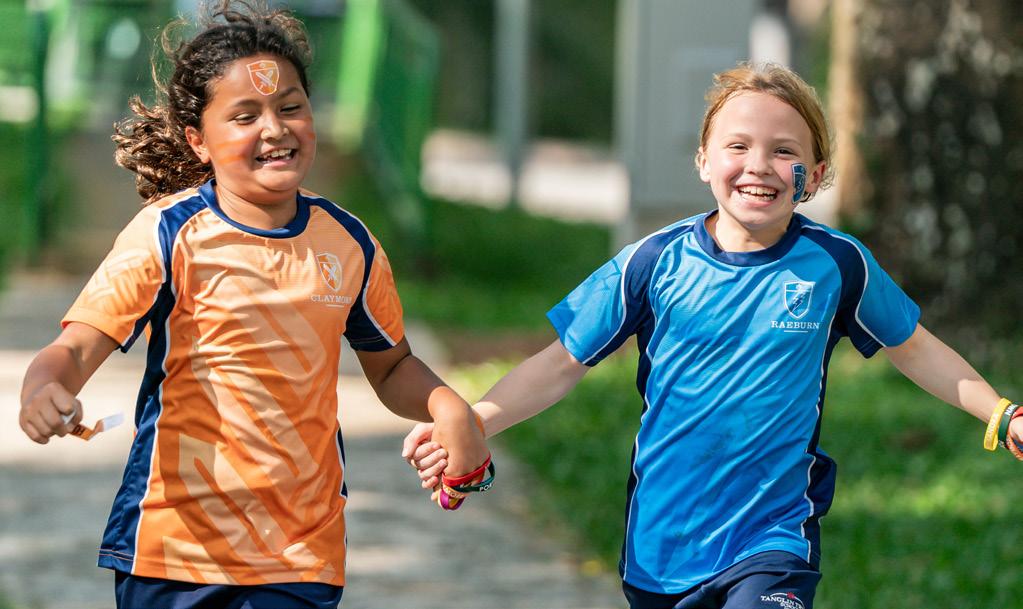
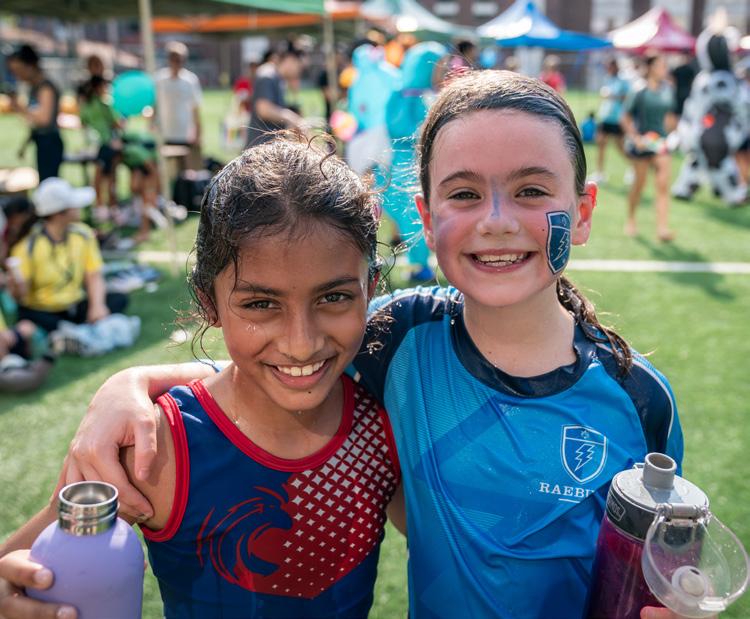
Tanglin’s long and rich history is shaped by a dedicated group of staff who have served the school for 15 years or more. To recognise their commitment, the Tanglin Alumni team hosted a special gathering in their honour. Jaaziel Job, Alumni Executive, shares more.
In January 2026, we were thrilled to host our second Tanglin 15 Club event to honour Tanglin staff who have served for 15 or more years, including both former and current staff. To date, over 150 people in Tanglin’s 100-year history are part of this club!
Without our strong and dedicated staff body, Tanglin wouldn’t be where we are today. Amongst the 80 members who attended, we pleased to have in attendance staff members who have served and are still serving Tanglin for over 4 decades!
Held at The Institute, the event provided a wonderful opportunity for our dedicated colleagues to come together in a relaxed and celebratory setting. It was a truly special occasion, filled with appreciation and pride, as we recognised the lasting contributions of those who have shaped Tanglin’s 100-year legacy.
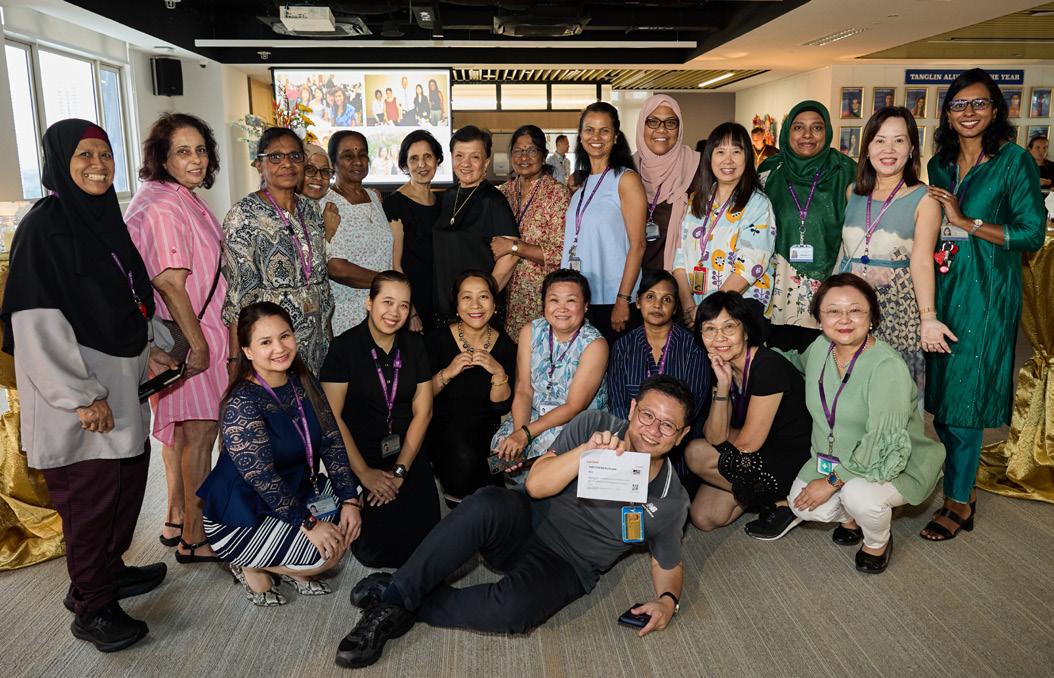

Want to read the
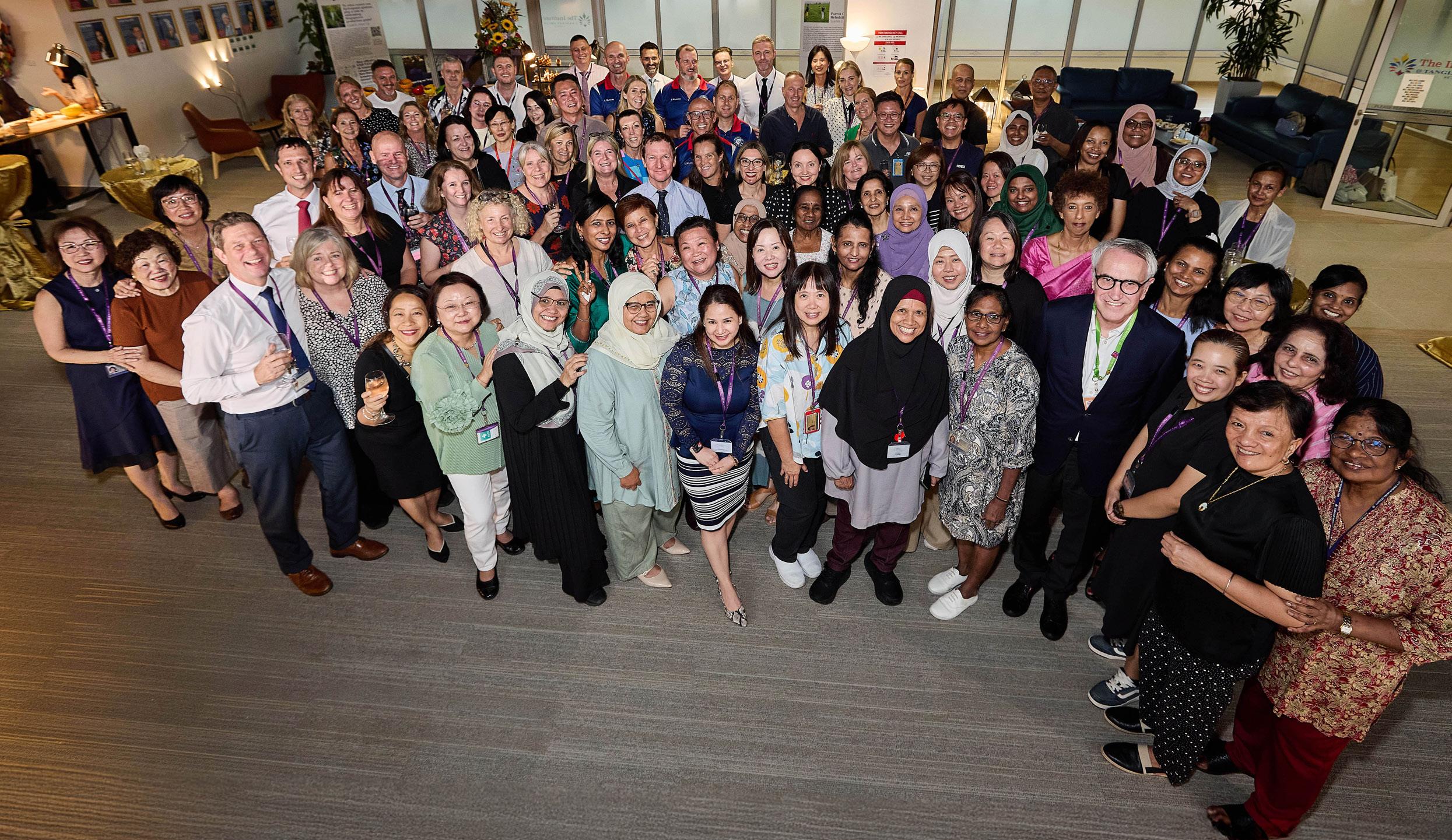
Even after graduation or moving on from Tanglin, our Alumni stay connected through events in both London and Singapore. Jaaziel Job, Alumni Executive, fills us in.

After a successful Centenary celebration with alumni and past parents in London, we were uncertain if we would get a huge turnout for our alumni reunion in 2025. After all, many alumni flew from across the UK and beyond to join us in 2024, why would they do that again?
As it turned out, we couldn’t be more wrong. The Tanglin Alumni London Event in November 2025 was an overwhelming success, with over 450 Tanglin Alumni and Staff Alumni from all around the world reuniting at The Fable in central London. Seeing a little piece of Singapore come alive in London was truly wonderful and is true testament to the Tanglin spirit and legacy.


It was a particularly special evening for our recent graduates, the Class of 2025, who had the opportunity to reconnect with many of their friends and Head of Year, Anna Brutti, through this event. It is never an easy transition, from being part of such a close-knit community like Tanglin, to being thrown out into the “wild” so to speak. As a department, we hope to bring a sense of comfort, as they navigate this period of change, being away from Singapore and their friends and families.
This year, we launched our first ever ‘University Coffee Chats’ with Tanglin Alumni in LSE and King’s College. These sessions
were initiated as part of our wider effort to bridge the connection between Tanglin and our alumni community, creating meaningful touchpoints beyond social events after they’ve left school. We hope to expand this initiative to other universities in the coming years via the launch of our University Chapters and Groups.
February 2026 saw our first offsite Singapore Alumni Reunion since 2019. We were thrilled to host over 70 alumni at our Cocktails in the City event at BeGIN Bar along Boat Quay. Given the diversity of our local chapter, we were elated to see how everyone connected and got along. We were equally pleased to know that we had a few alumni come in from around the region just for this event.
It was a real pleasure to see so many familiar and new faces come together to reconnect, share stories, and celebrate the bond that continues to unite the Tanglin community.


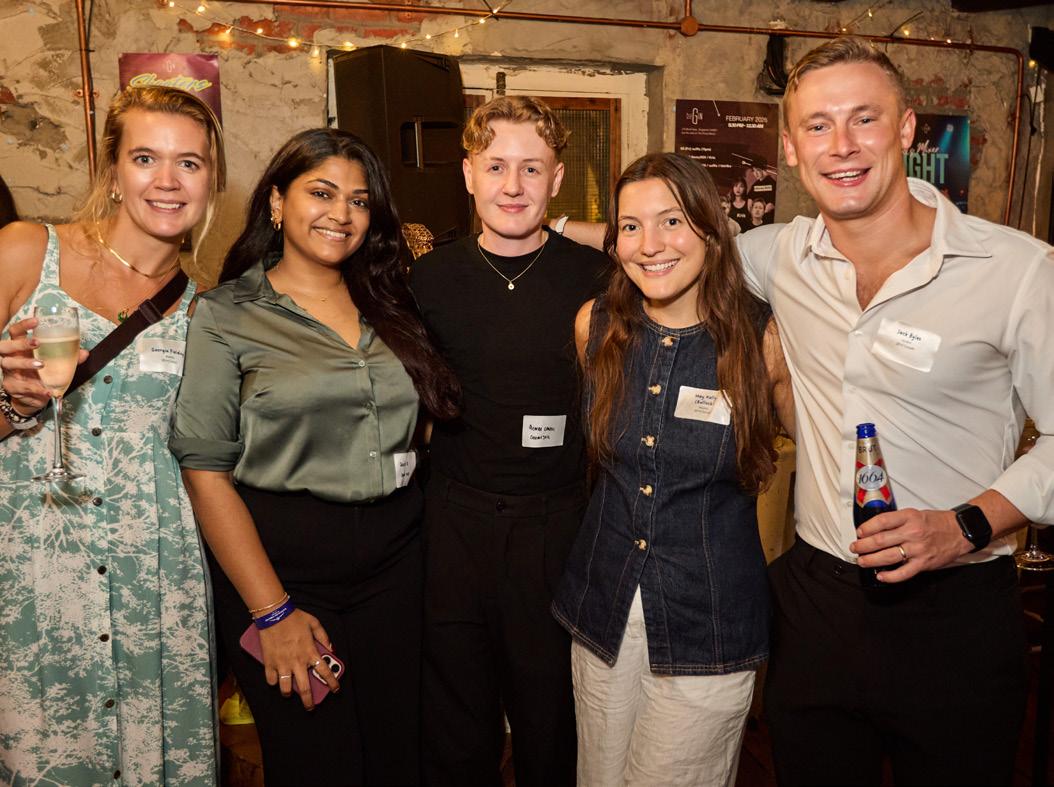
Our alumni are making their mark across the world in a wide range of fields, and David Ooi (2008 cohort) is no exception. Today, he is a co-owner of Singapore Submission Grappling, a martial arts studio based at Fusionopolis. He also serves as a Brazilian jiu-jitsu (BJJ) coach, a discipline recently introduced into the Year 2 PE curriculum. We caught up with him to learn more about his Tanglin story.

“16 September 1993 was my first day at Winchester,” David recalled fondly as he sat down with us to reflect on his time at Tanglin. “I remember crying on my first day and having a staring contest with a girl who would later be in one of my classes at Tanglin.”
Despite that slightly bumpy start to his story, it marked the beginning of a memorable journey at Tanglin, where David remained throughout his school years, graduating from Year 13 in 2008. He admitted that his memories of the early days are a little fuzzy, but he clearly remembered the Curran Hall opening when he was in Year 2 (which is also the hall where he is currently teaching the Year 2s) and his Sixth Form cohort of around 40 to 50 students—a small group by any measure. “Everyone knew everyone,” he reminisced, “and I made some really wonderful lifelong friendships. In fact, the best man at my wedding was actually someone I met at Tanglin!”
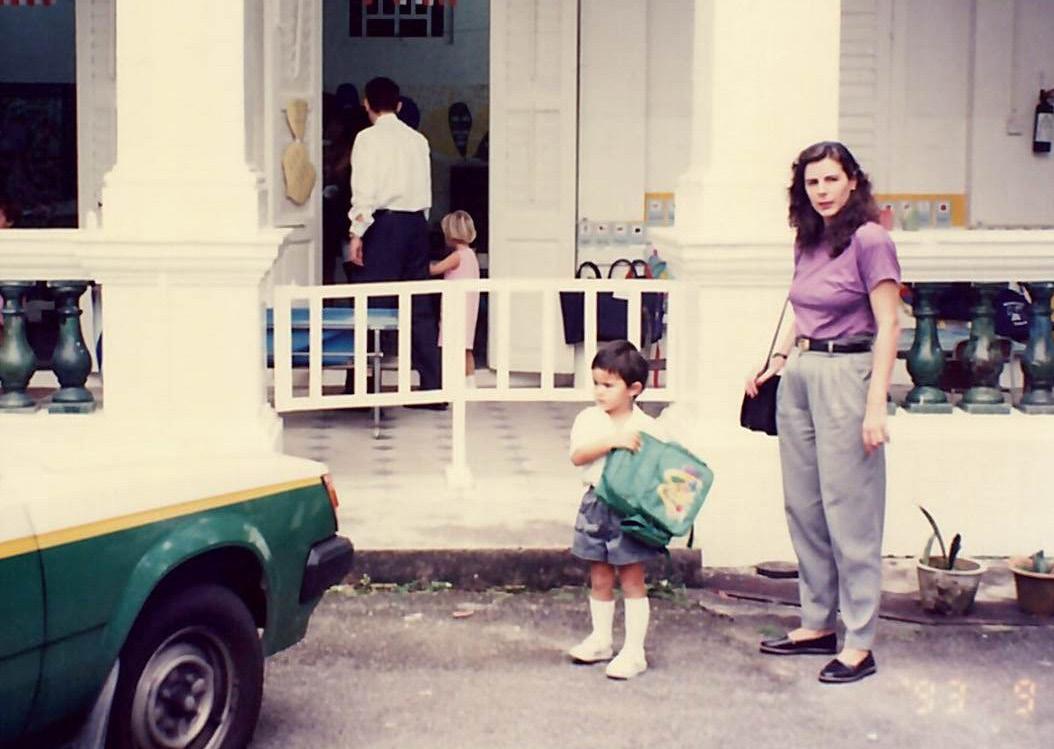
Being part of a small cohort allowed David to spend more time with his teachers, a benefit he particularly valued while studying his A-level subjects. As one of only two students taking A-level Further Maths, the extra guidance (especially from Mr James McKellar) proved especially helpful. But academic support wasn’t the only form of guidance he received at Tanglin. David recalled a time when Miss Keri Bacon, a teacher in Year 3, noticed he might have ADHD, an observation that prompted his parents to take him for a proper assessment. “I don’t think I would have done as well academically if my teacher hadn’t recognised the challenges I was facing and provided the support I needed. Tanglin may be known for its excellent academic results, but it also gave me the supportive structure I needed to truly thrive from Junior to Senior School.”
After graduating from Tanglin, David completed his National Service in the army and went on to work in military logistics, where he eventually joined the organising committee for the 2010 Youth Olympic Games. He recalled it as a fun experience, but what stood out most was the chance to connect and communicate with people from all over the world. David said, “Tanglin is a British international school, and being exposed to such a diverse range of nationalities taught me how to communicate effectively with people from all over the world. That ability really helped me stand out among my peers during the Youth Olympic Games and has proven valuable on many occasions since!”
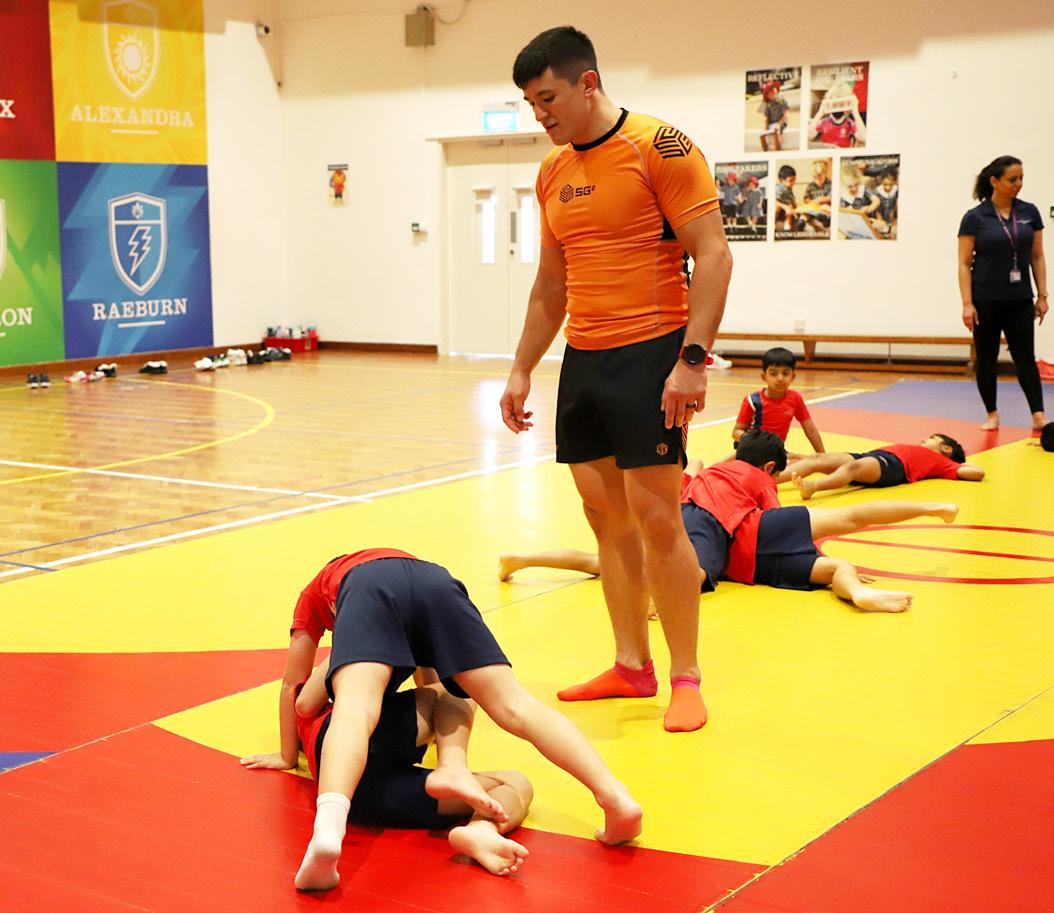
Following his time in military logistics, David’s journey took him to the University of Warwick, where he studied Maths. He then worked in the corporate world for a few years before he realised that he wanted to do something that help people live a healthier life and fix injuries, so he decided to pursue a degree in physiotherapy. Now that we know what David has been up to since graduating from Tanglin, how did he end up being a BJJ coach at Tanglin?
David explained, “I started judo as a child, and during my final week of Sixth Form, my old judo coach ran a self-defence session that included BJJ. After graduation, I went back to train in BJJ with my coach, in between my stints at the army. I’ve tried Muay Thai and boxing, but at the end of the day. BJJ is the one I enjoy the most. Things came to a tipping point a few years ago where I realised that I had enough experience and credibility to be able to make a living off it.”
This realisation eventually led David to set up a martial arts studio at one-north, an area he knew well, having essentially grown up there so it felt like home to him. His studio runs a children’s programme, and Lewis Patience, one of the Infant PE specialists, regularly brought his daughter to classes. The two soon got chatting, and the conversation quickly turned to how David could offer BJJ as a co-curricular activity. One thing led to another, and David went on to meet Head of Infant PE, Joe Moriarty, to explore the idea further. It soon became clear that they shared the same pedagogical philosophy. David has always believed in exposing young children to a wide range of physical activities, helping to nurture well-rounded, resilient athletes over time. Given this strong alignment with the Infant PE curriculum, the partnership quickly fell into place.
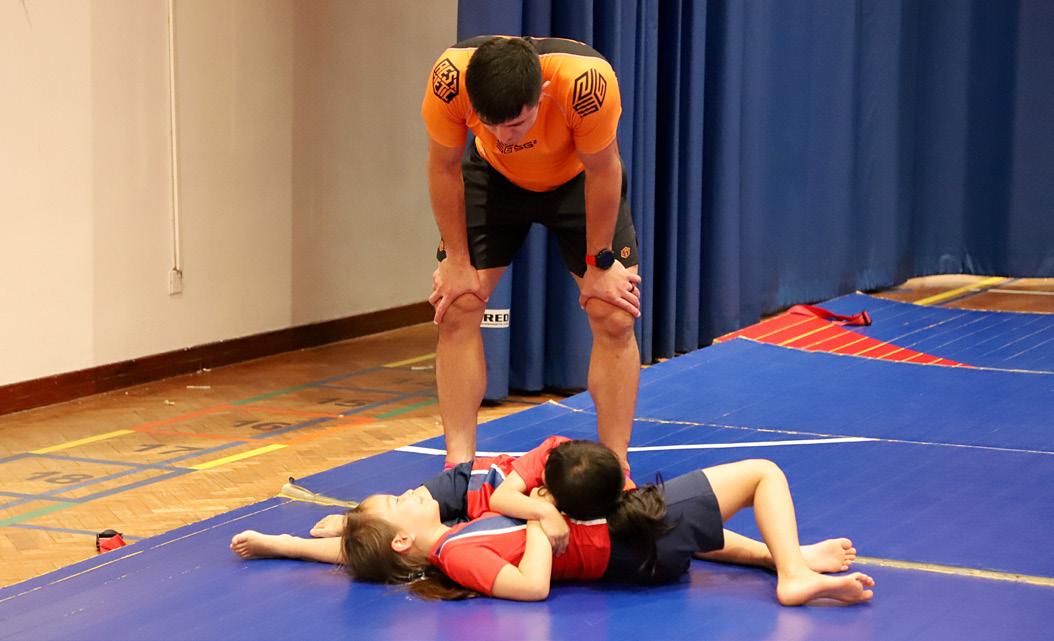
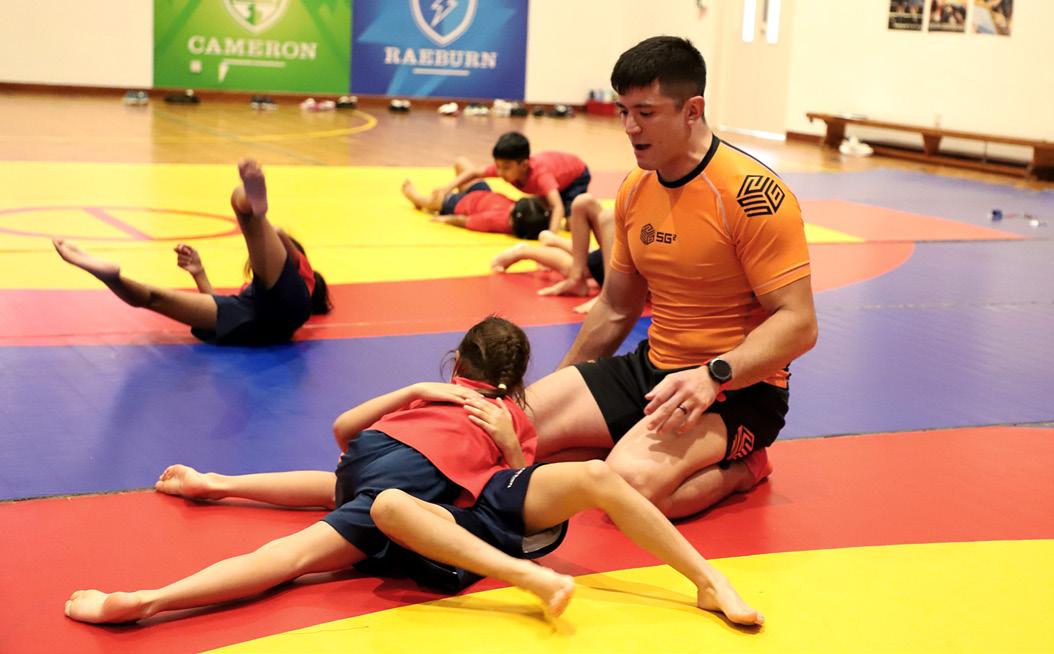
Lewis couldn’t have agreed more. After watching David coach his daughter, he was impressed by how engaging and enjoyable the sessions were and decided to bring David in to enhance the Infant curriculum. He said, “We have been delighted to welcome David and BJJ into our curriculum lessons. This provides valuable rolling, tumbling, and turning skills as well as many others, and aligns well with our Athletics Skills Model which we utilise for curriculum planning and mapping. Children have thoroughly enjoyed the new addition and have been excelling on the mat. BJJ is one of the fastest growing sports in the world and is now a bold and exciting part of the curriculum offer at Tanglin.”
So, what was it like teaching the Year 2 children? David was impressed, to say the least. “They are some of the best-behaved children I’ve worked with. They come in excited, especially when it is their first time trying BJJ, and they enjoy the lessons so much that when I tell them their four-week block is coming to an end, they are genuinely disappointed.”
Sounds like fun! Does David plan to expand his BJJ offering to the Junior and Senior Schools? He smiled, “We’ll see how it goes, but this is sure to plant a seed for even better things to come!”
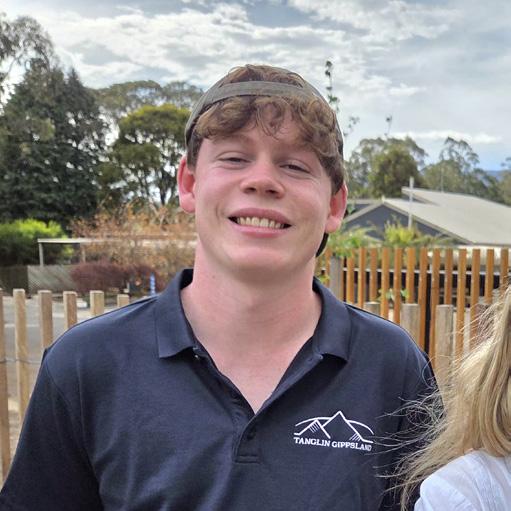
What’s your Tanglin story?
Internships give Tanglin alumni the chance to gain real-world experience, but what is it like to work outdoors at Tanglin’s Gippsland campus in Australia? We spoke to two alumni who recently interned there to hear about their experience.
I moved to Tanglin from the German school in 2015 when I was in Year 7, staying all the way through until my A Levels, eventually graduating in 2022. Following this, I studied Geography at the University of Sheffield.
How did you land the internship at Gippsland and what motivated you to choose that experience instead of Tanglin in Singapore?
I saw the internship at Gippsland being advertised on the Tanglin Alumni Instagram page and applied for it straight away. After being invited to an interview with Mark Cutchie, Head of Campus, I was eventually told that I had been selected to go to Australia. I was mostly drawn to the outdoor aspect of the programme. As a keen hiker who at the time had limited camping experience, the opportunity to gain more skills in this in an amazing location like Gippsland was appealing to me.
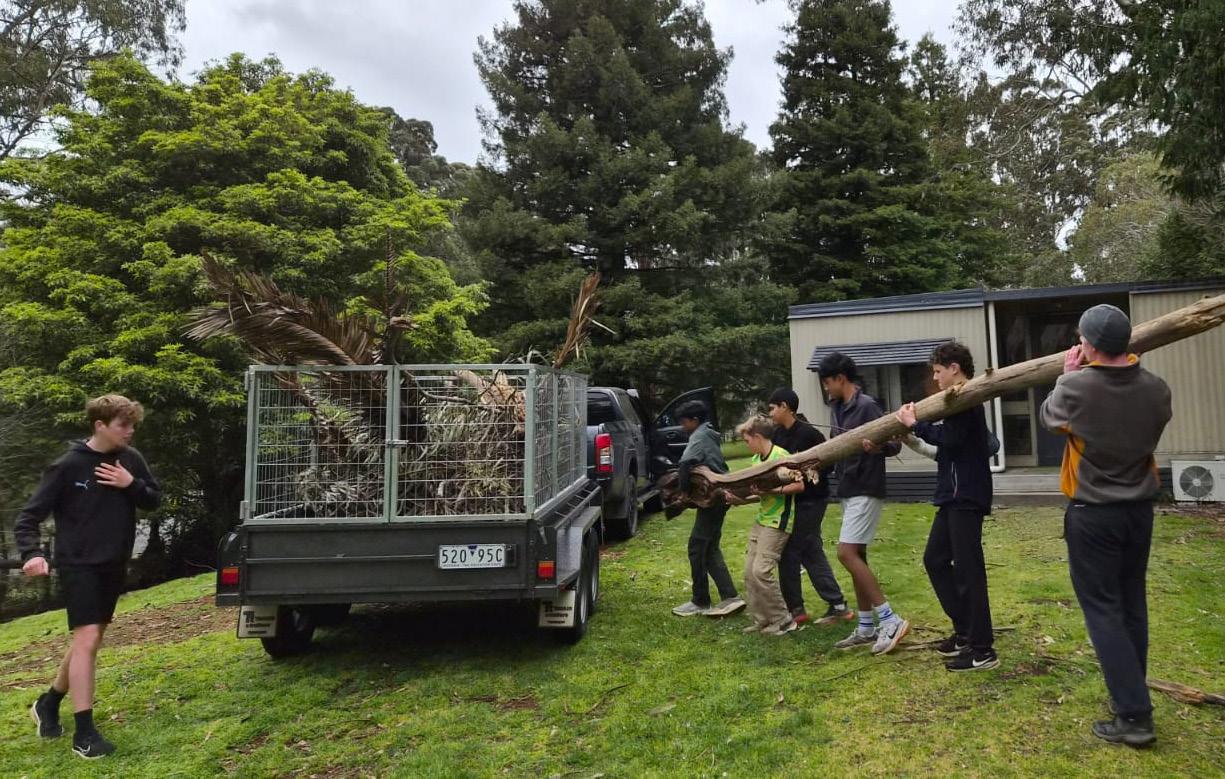
What were some memorable moments during the internship?
My memorable moments include some of the starry night skies I witnessed whilst on hiking trips and roasting marshmallows around the campfires. I also really enjoyed going for cold dips and wild swimming in the Thomson and Mitchell Rivers, especially when all the staff did them together.
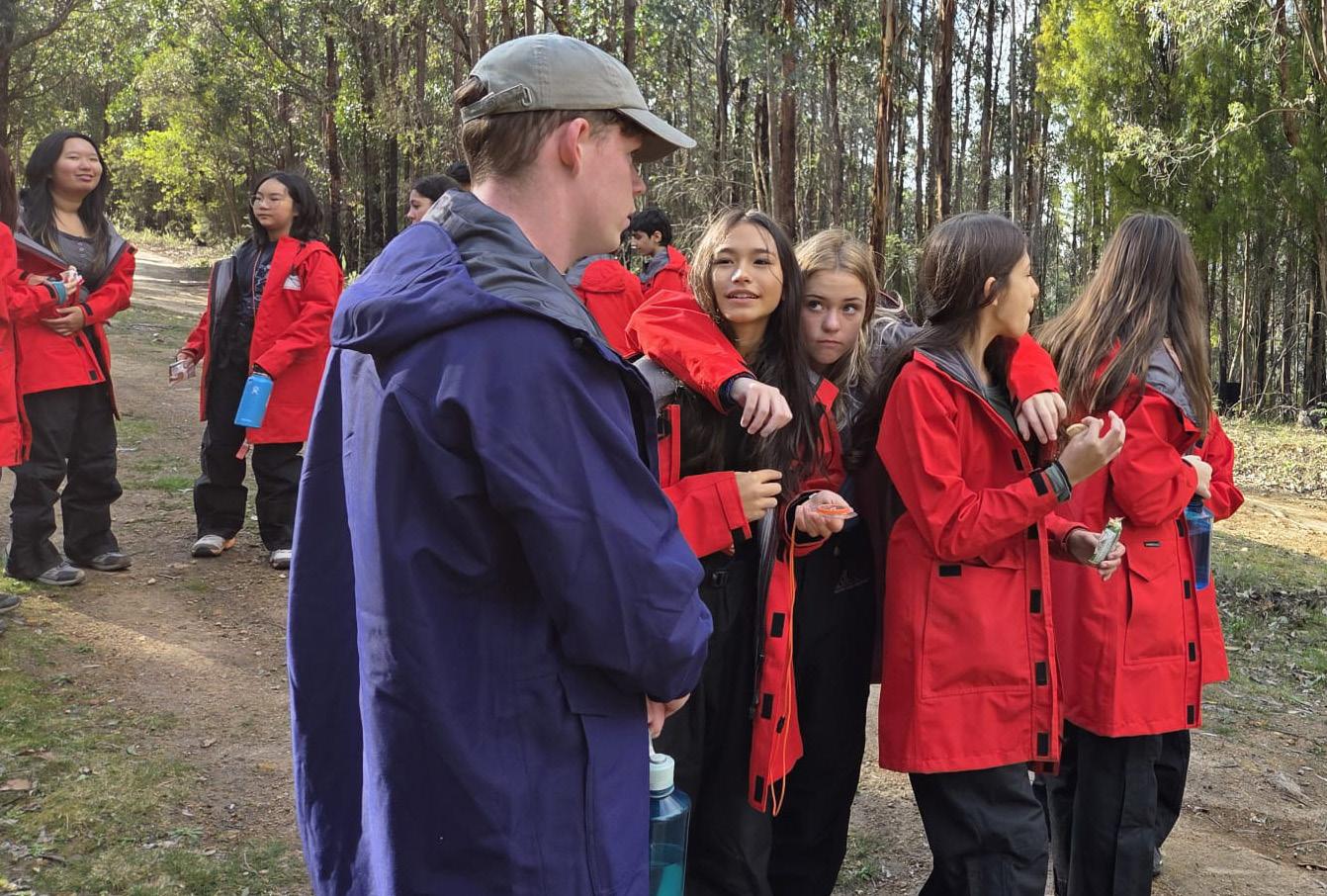
What was the biggest challenge you faced during the internship, and how did you handle it?
The biggest challenge for me was living in such a remote area as the distance and time difference to all my friends back in the UK was difficult at times. However, this was made easier by everyone in the team being so friendly and almost acting as a second family. There was also a good degree of freedom to drive into nearby Traralgon or head into Melbourne on days off, I even managed to catch a few rugby and cricket games there.
Was there a moment when you realised you were truly working independently or outside your comfort zone?
I felt like there was a lot of trust in me to work independently once given a task. One time where I felt truly independent was when I was solely responsible for a small group of students on one of the shorter hiking trips. However, I never felt outside of my comfort zone when doing things like this as it was always made sure that I felt prepared and was aware that support was not completely out of reach.
What did you discover or learn through this experience that you don’t think you could have learned in the classroom at Tanglin?
One thing I learned a lot about was aboriginal culture and how it interacts with local nature and wildlife, which I found fascinating. Whilst this can be taught in a classroom, it is rarely taught outside of Australia, and I think seeing these natural environments in person allows for a much deeper understanding.
Imogen Bowyer 2021 cohort
What’s your Tanglin story?
I graduated from Tanglin in 2021 and went on to study Art History at the University of St Andrews, graduating last summer. The international friendships I formed at Tanglin left me open to building a life beyond the UK and in Australia in particular, as I’d spent a year studying abroad in Melbourne.
During my final year at university, when “next steps” suddenly became urgent, I felt uncertain, not in a paralysing way, but in a way that pushed me to apply widely and somewhat boldly. Two of the most far-fetched applications I submitted were for a research internship at the White House Historical Association in Washington DC, and the Tanglin Gippsland internship. Ironically, those were the two experiences that ended up shaping my graduate year. My openness to pursue those opportunities - and the organisation, thoroughness, and resilience required to navigate the applications and logistics of working abroad - come directly from Tanglin. The school instilled in me a strong sense of responsibility and duty that I carry into everything I do. I’m now in Melbourne working at the American Chamber of Commerce in Australia. Whilst there’s still uncertainty around visas and career direction, I feel grounded by those same values and confident navigating whatever my next steps may be.
How did you land the internship at Gippsland and what motivated you to choose that experience instead of Tanglin in Singapore?
I saw the role advertised on my Instagram feed; a lot of opportunities come from keeping your eyes open in unexpected places! I applied almost on a whim. At the time, I assumed I would follow the traditional UK graduate route and join a scheme in London. But the Gippsland role caught my attention because it offered a return to Australia - somewhere I’d been missing since my year abroad - and the chance to do something completely different.
Gippsland appealed more than Singapore because it felt like a once-in-a-lifetime departure from the kinds of roles I’d been pursuing. Outdoor education was so far removed from art history research or corporate pathways, and that was precisely the draw. I also wanted to test whether teaching might suit me as a career. Three months living and working alongside thirteen-year-olds felt like a pretty definitive test!
What were some memorable moments during the internship?
What stays with me most aren’t dramatic highlights, but quieter moments: the stillness of camp at sunrise, coming up with excuses to drive around campus on the old Ute with my fellow intern, or listening to Mrs Tabensky read The Hatchet before lights out. That said, skit night with both cohorts was a highlight. It was really lovely to see how quickly students formed close bonds and felt comfortable enough to be silly and perform in front of a big group. I also loved guessing which moments would be parodied and how the students would take aim at all the different staff members.
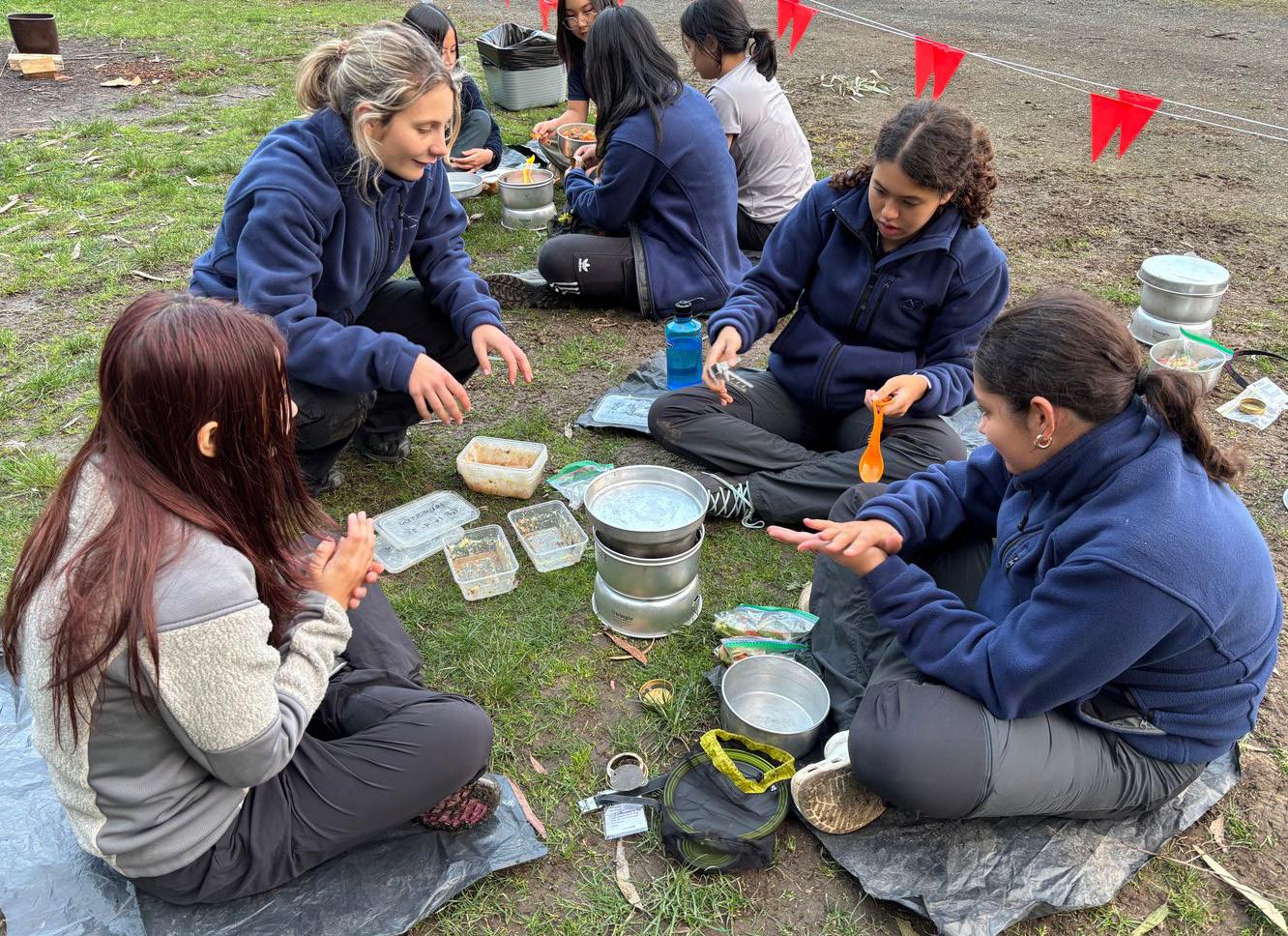
What was the biggest challenge you faced during the internship, and how did you handle it?
I went into the role with very little experience in the outdoors and a relatively anxious personality. Not knowing exactly what lay ahead of each day, and the physical remoteness of campus pushed me outside of my comfort zone. But, over time, I found that that openendedness forced me to be present in the moment. Instead of worrying about deadlines or overanalysing conversations, my focus narrowed to the practical, immediate tasks and decisions directly in front of me.
Was there a moment when you realised you were truly working independently or outside your comfort zone?
On the first full day of a four-day hiking expedition, I fell into a river while chasing after a bag of clothes that had rolled in—fully dressed in several layers, which was not my strongest decisionmaking moment. To be clear, students are never put in situations like that, but as a staff member in a remote environment, you’re responsible for your own judgement, and mine had taken the day off.
I managed to scramble out quickly but then came the key decision: with all my clothes soaked and poor weather ahead, I had to decide whether it was safe to continue further into the bush. Walking on would mean losing road access, so if I couldn’t warm up properly, we would have to hike back out. Assessing my own condition and making that call was a moment of real responsibility, where I was not just looking after myself, but recognising how my choices would affect the group.
What did you discover or learn through this experience that you don’t think you could have learned in the classroom at Tanglin?
Through this internship, I learned three key things:
• Confidence in my physical and mental resilience.
• Stronger interpersonal and communication skills from living and working closely with others.
• A real understanding of collective responsibility, how individual decisions directly affect a group in direct and material ways.
Those are lessons that are hard to replicate in a classroom, and ones that Year 9 students are fortunate to begin learning at the age of 13 rather than 22.
Graduation may mark the end of a chapter at Tanglin, but the connection and support continue through initiatives such as the Tanglin Trust School Foundation Alumni Grant. This unique programme provides funding to Tanglin alumni to engage actively with their communities and create meaningful, lasting impact through exceptional initiatives related to Creativity, Action and Service (CAS), inspiring current students to follow in their footsteps. Here are some of their stories.
Sports Management Volunteer Programme, St Lucia
I spent five weeks in St Lucia on a Sports Management Internship with United Through Sport (UTS), aiming to make a positive impact through sport. UTS is a global charity that empowers underserved youth through sport-based education, health programmes, and life skills development. In St Lucia, my project advanced their targeted initiatives to counter unemployment, gang activity, and childhood obesity in the communities most in need. During my time in St Lucia, I was fully embedded within the UTS Caribbean team and the local community. My role was to help deliver a wide range of initiatives, both on and off the field. A typical week included handson coaching and management, such as open-water swimming lessons, rugby training, and activities with pre-schoolers. Alongside these experiences came essential administrative work: I developed a player registration system for rugby on the island, wrote blog posts to document progress, and built social media channels to increase the programme’s visibility, reach, and leave a lasting impact long after my departure.

When I was still studying at the University of Bristol, I travelled to Bangkok for an elective in paediatric surgery and liver transplantation at Ramathibodi Hospital, Mahidol University. It was a unique opportunity to see one of Southeast Asia’s busiest paediatric liver transplant centres in action. I expected to learn about surgical technique and patient care, and I certainly did, but what surprised me most was how much I learned about healthcare systems, resource allocation, and how children’s surgery can be sustained in very different contexts. From the moment I arrived, I was immersed in the clinical and academic life of Ramathibodi. Each day began with ward rounds in the paediatric surgical unit, where cases ranged from neonates with complex congenital anomalies to children recovering from transplant. I attended outpatient clinics, sat in on teaching sessions, and spent hours in the operating theatres, observing procedures that I had only read about before. The focus on biliary atresia was particularly eye-opening. I saw children who had undergone Kasai portoenterostomies at a very young age, some successful, others sadly progressing to liver failure and requiring transplantation. The complexity of their journeys emphasised how early diagnosis, timing, and surgical expertise are all critical in shaping outcomes.
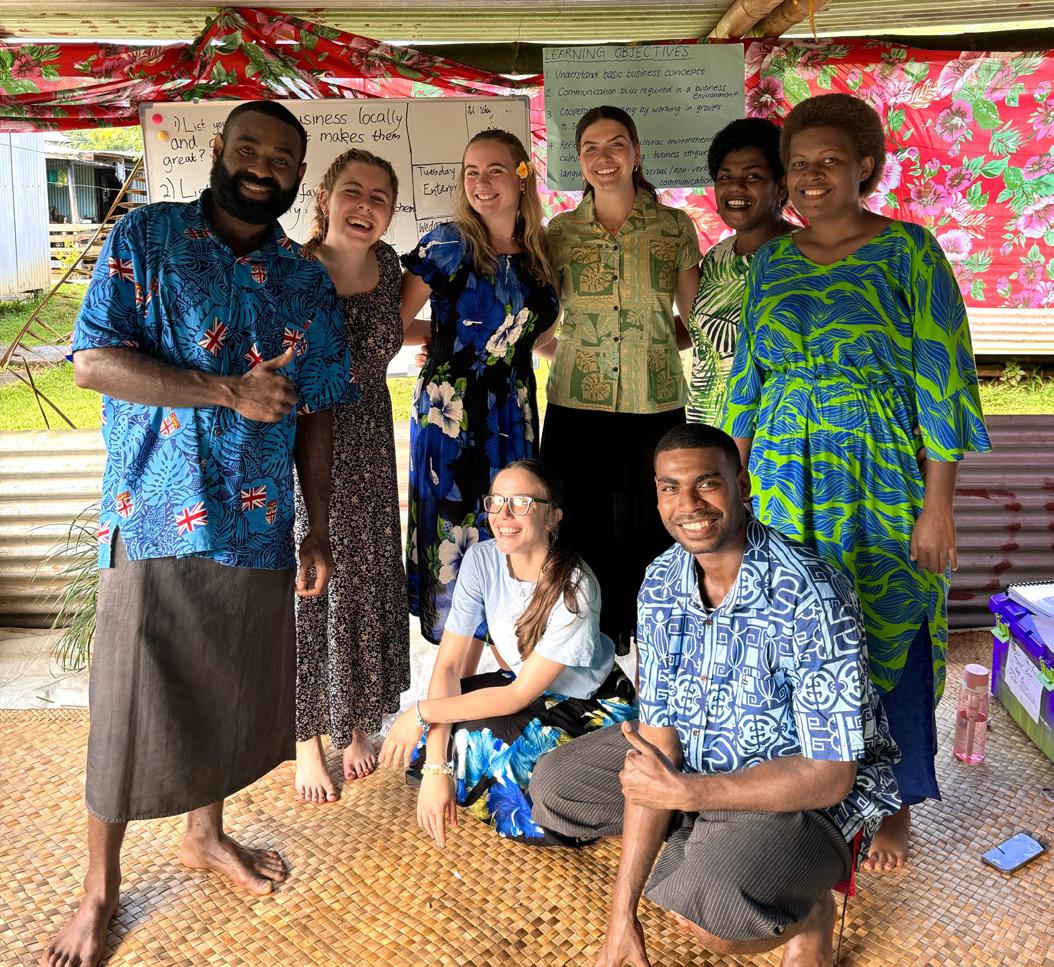
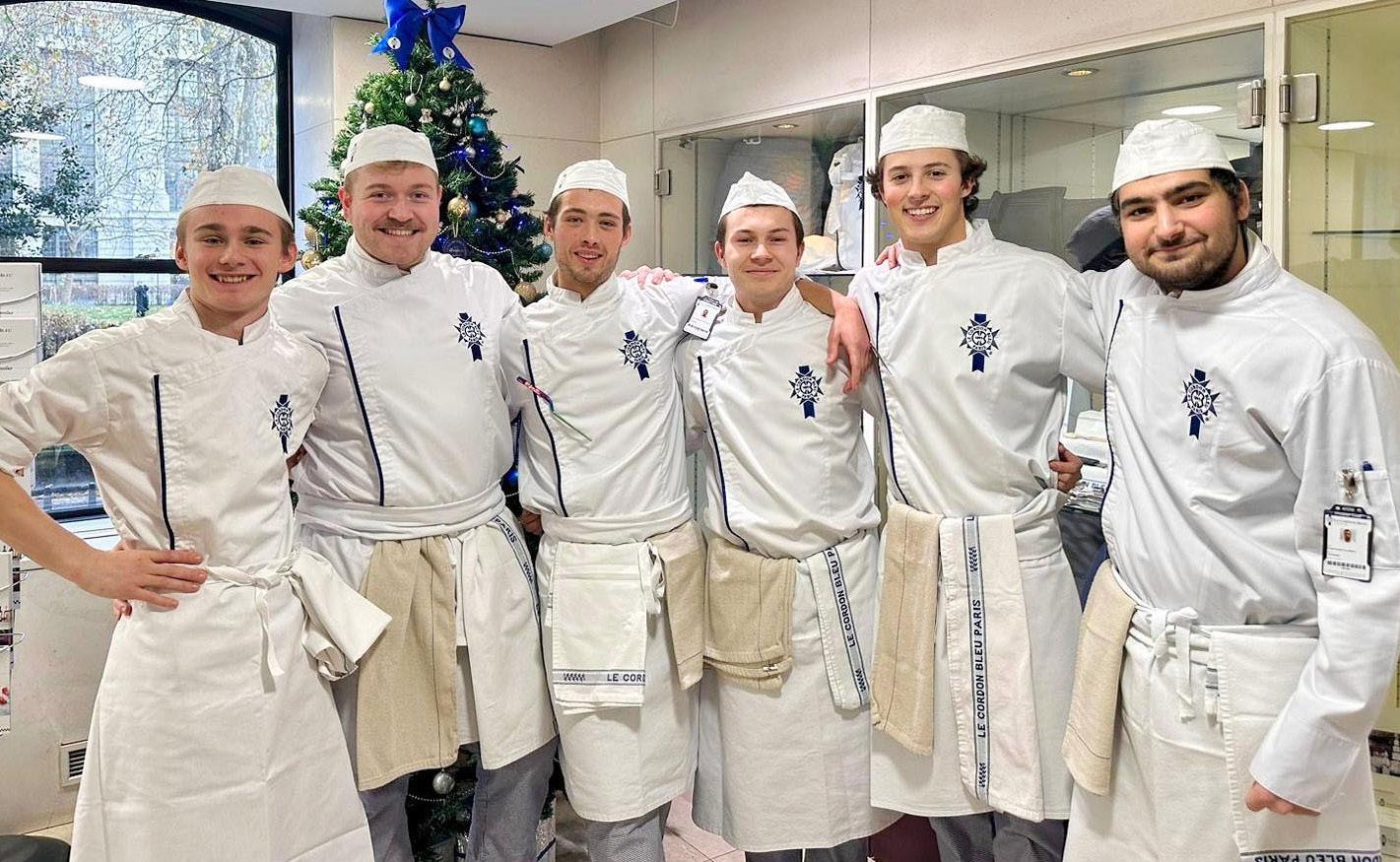
Oliver Ogden (2019 cohort)
Basic Cuisine Certification Le Cordon Bleu (London)
I received the Tanglin Foundation Alumni Grant in September 2023 to spend three months at Le Cordon Bleu London completing the Basic Cuisine certification. During this course, I was able to learn about the foundations of French cooking and how to go about preparing restaurant-level dishes in a cooking environment like that of a top-quality restaurant. The course covered a wide spectrum of essential skills that prepared me for working in the industry. This included knife techniques, classical vegetable cuts, fish filleting, and basic butchery of various types of meat. I also learned the fundamentals of the five mother sauces, worked with basic doughs such as pasta and puff pastry, and explored various cooking methods including braising, pan-frying, and roasting. I had an amazing time during the course and came away loving cooking even more! Being a part of such an intense course pushed me in a way that is very different to university, and it was refreshing to be able to put a hobby first after studying engineering for four years.
Since my first year at the University of Leeds, I have aspired to volunteer with Think Pacific in Fiji. In July 2024, upon completing my International Business degree, the Tanglin Foundation Alumni Grant made this a reality. The Youth Empowerment Project immersed me in traditional Fijian village life for a month, addressing local and global issues through morning workshops that fostered cross-cultural collaboration, and afternoon cultural courses that further enriched my understanding of Fijian customs. I chose Think Pacific because of their strong partnership with the Fijian government, aligning their projects with the Fijian National Development Plan and the UN Sustainable Development Goals, ensuring a long-term positive impact. Describing the experience is challenging because it profoundly changed my perspective. It was exactly what I needed, teaching me so much about myself and others through cross-cultural interactions. As a third culture kid, finding a singular home has always been difficult, but I now have a permanent home in the village of Nasau in Fiji.
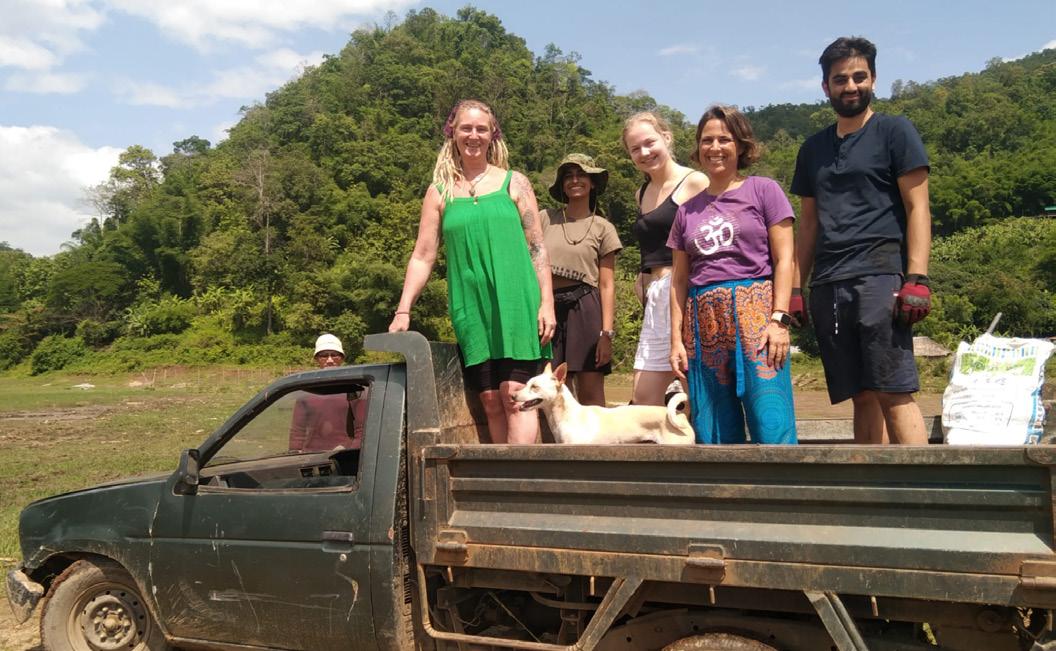
Deanna Kotecha (2019 Cohort)
Elephant Sanctuary, Chiang Mai
I received the Tanglin Foundation Alumni Grant to volunteer at an elephant sanctuary in Chiang Mai, Northern Thailand for one week. The sanctuary, known as the Elephant Nature Park, is a renowned rescue and rehabilitation centre for elephants across Thailand. Whilst building on my knowledge of elephant conservation, I also had the opportunity to provide hands-on support for the elephants. This included preparing their food, cleaning up their faeces, gathering wood to make fire (to keep them warm at night) and feeding them! Part of my education was learning about the important bond between the elephants and the elephant caretakers. All the elephants had been rescued from abusive environments where they faced physical and mental abuse. I learned it’s important for the elephant caretakers to form bonds with the elephants based on love. I observed that the elephant caretakers rarely touch the elephants and communicate with them in Thai instead. This crucial bond allows the elephants to trust in humans again, despite being traumatised by humans in the past.
Inspired by these stories and keen to embark on a similar journey?
If you are a Tanglin alumnus/alumna and would like to find out more about the Tanglin Trust School Foundation Alumni Grant, visit https://alumni.tts.edu.sg/pages/alumni-grant for further information.
Once again, the moment has arrived for our Year 13 students to graduate—on 18 June, to be exact. But how did this milestone tradition begin, and how has it evolved over the years?
Our former Head of Sixth Form, Andy Goodliffe, explored its origins in 100 Tanglin Tales. Let’s revisit his reflections below.
ike many remarkable traditions at Tanglin, the Year 13 Graduation Parade was like a bolt out of the blue. One moment it didn’t exist, and the next - thanks to someone’s creative vision — it came into existence and became part of Tanglin’s tradition. It may have just passed its 10th anniversary, but the Graduation Parade has come a long way since its inception.
Year 13 students used to graduate in the formal attire of their choice until the introduction of graduation gowns in 2013—which for some reason, were in a purpley blue and pale blue colour scheme that was never associated with the school! The idea back then was to get the students to do a full lap around the school’s central area, weaving through the walkways past Infant, Junior, and Senior Schools while the entire school community lined the paths to cheer them on. This culminating walk around the school would ultimately end at the Berrick Performance Hall where their parents waited for the commencement of the graduation ceremony. Over the years, the original concept has seen many embellishments and enhancements. The purple and lilac gowns made way for smart new Tanglin gowns in a stylish blue with red trim while the walk transformed into a carnival-like parade accompanied by a marching band and Griff the Lion leading the way—much to the delight of everyone!
Even the final destination has been changed; the Class of 2023 became the first cohort to conclude their parade in the salubrious surroundings of the MediaCorp Theatre because attendance has now outgrown our own Berrick Performance Hall. It is truly a sight to witness 18-year-olds giving 3-year-olds a high-five (they must have thought the older students looked like celebrity giants in fancy dresses!). Seeing Infant School teachers proudly cheer on the young adults they remember helping to toilet train, now bound for the wider world, adds to the community magic. Deborah Pearce (Head of Enhanced Provision), Katie Sansom (Head of Mathematics, EYFS),
and Delphine Hastwell (Head of Music) exemplify this perfectly. Here is what they have to say, “One of the pleasures of our jobs has been watching the growth of our students from Nursery to Year 13. It is always a very poignant moment for us, as Infant teachers, when our former students walk past the playground on Graduation Day, where their Tanglin journey first began. To see the flash of recognition as they remember us, as their first teachers and their early days at school can often draw a joyful tear from both sides of the fence.
On a personal note, the fact that our own children have been part of that parade makes it even more emotionally significant”. There is magic behind the scenes too. As the Year 13 students assemble in the Sixth Form common room, their form tutors undertake one last job of pastoral care beside the racks of graduation gowns. From straightening crooked attires to soothing a stray strand of hair, these tutors make sure their students look their best for the big day ahead. Tears, hugs, and numerous photos abound during this magical hour of collective preparation for the upcoming event. The excited buzz in the air, as we usher the student leadership team to the forefront of the parade, marks one of the day’s highlights. The rest of the students pick their partners for the two-abreast stroll down the walkways lined by jubilant onlookers. Then the band fires up, Griff leaps into his first pose, the walk to their multitude of bright futures begins and off they go! We factor in a 15-minute cooling down period before entering the formal ceremony, as it is one of the hotter walks the students will make. The cooldown also allows the students to calm down as the walk is often an electrifying experience. Every bead of sweat is worth it, and the memory of this walk will last a lifetime for anyone involved.
Want to delve deeper into Tanglin’s rich history? Pick up your own copy of 100 Tanglin Tales from the School Shop at the Centenary Building or order online via https://shop.tts.edu.sg.
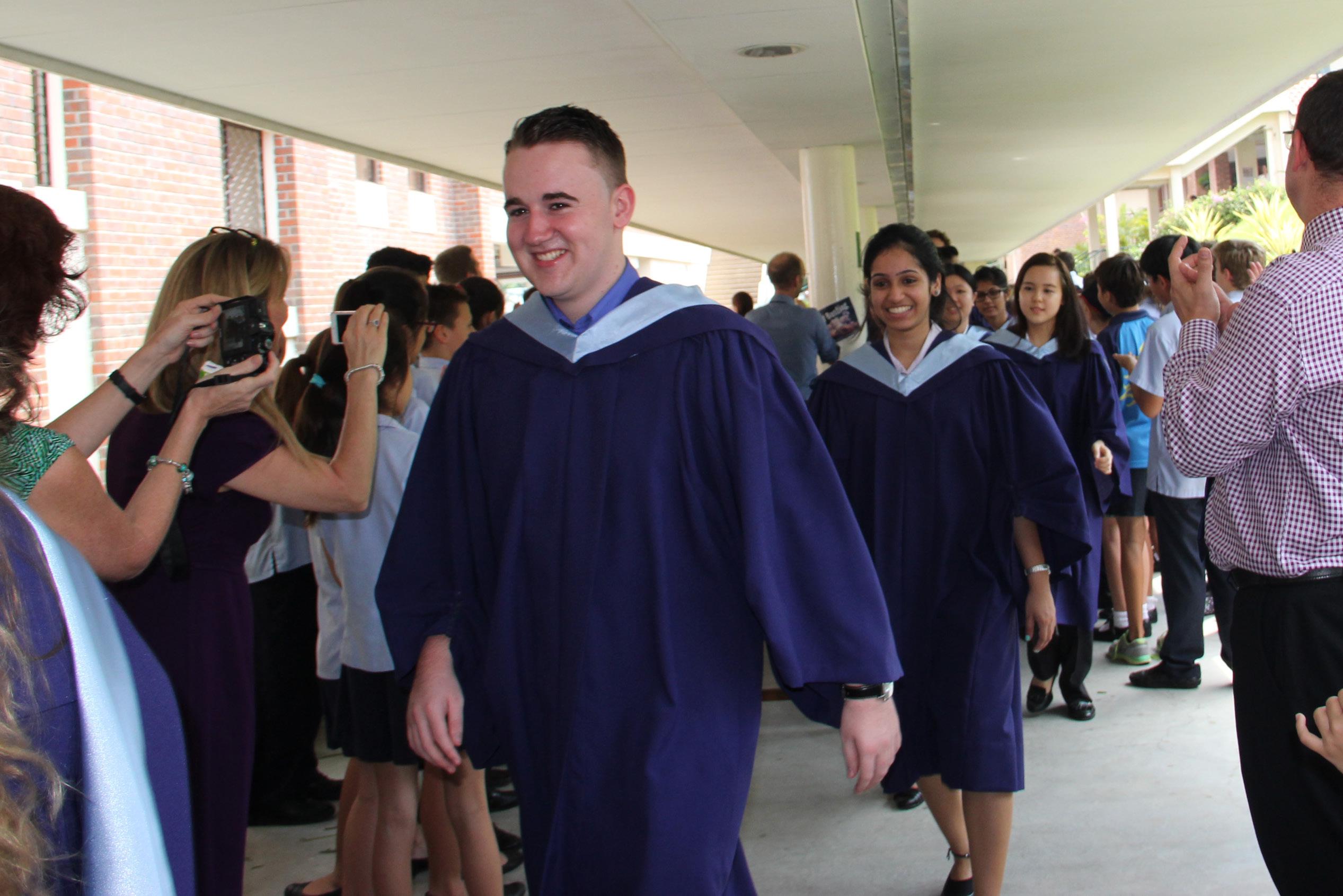
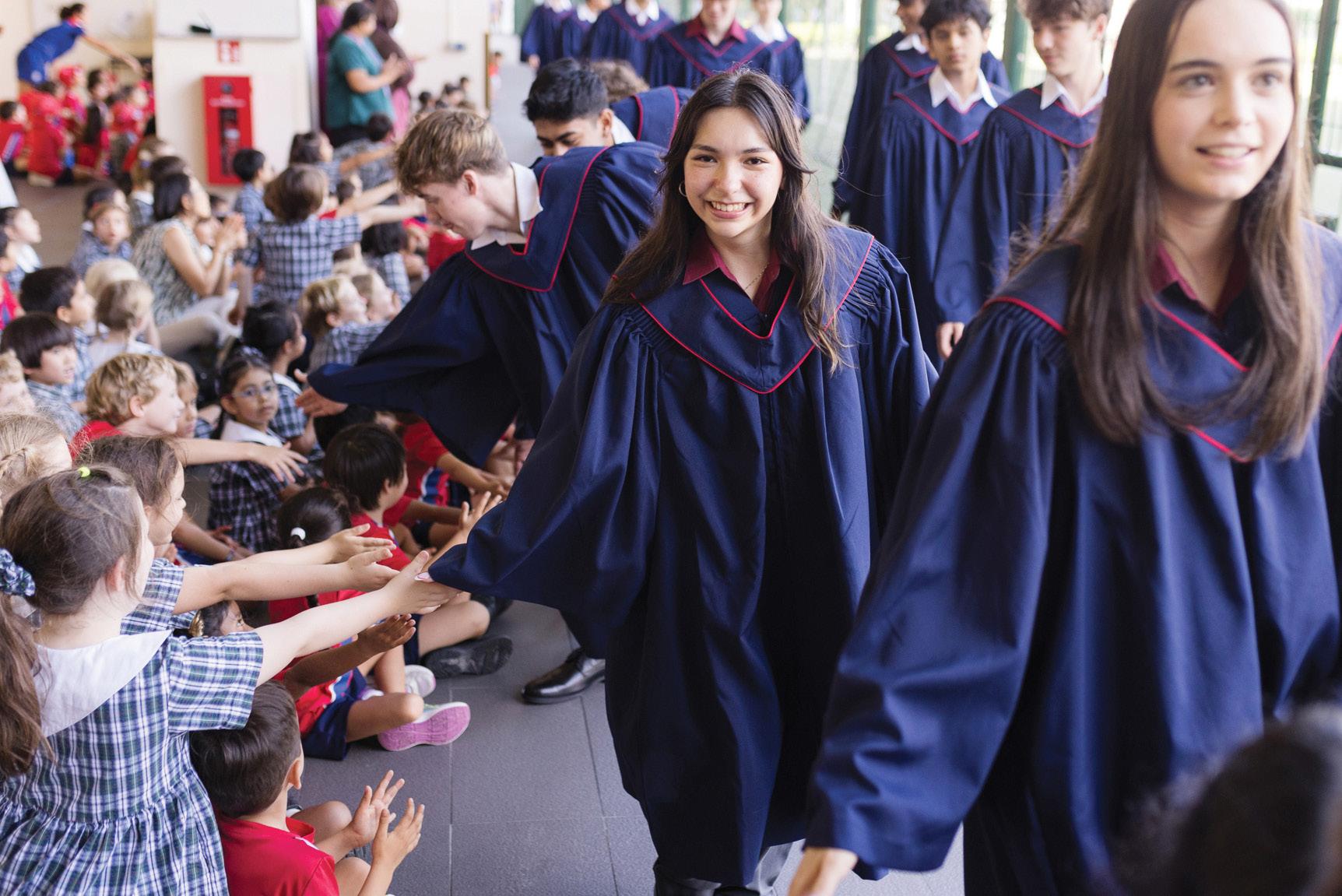
Tanglin recently celebrated its Centenary, and while not all our staff have been here that long, many have spent a significant number of years with the school. What memories have they collected along the way, and how do they remember Tanglin as it once was? To find out, Sixth Form students who have been at Tanglin since Nursery spoke with nine Infant TLAs. Here are some snippets of what they shared during the interviews.

I’ve been in Reception for a long time… 38 years. I was in Alexandra Park in Winchester for about six years and then we moved over to the [new] Infant School building. It was quite sad to leave that place because it’s so family oriented. It was really beautiful and we had our own outdoor play area. I really love that place and I enjoyed working there.
Mrs Maniam (Joined in 1988)
When I came to Tanglin, it was just two Infant buildings and one Junior. And most of the staff here was female. The teachers were also female, and we only had the gardener who was male and the carpenter was male. Playtime was so different. We had a small playground with no grass or anything, just trees and stones. I really enjoyed the playground because it was so calm, cool, and it was cozy.
Mrs Yadav (Joined in 1983)
I still remember my first day at Tanglin very clearly. I was very nervous because everything was new to me. The school was smaller then, but it still felt big to me on that first day. Everyone was very kind and welcomed me to help me feel more at ease. I remember being observant and taking notes of how certain things were done in Tanglin that were different from my previous school. I also remember pushing myself to adapt and learn quickly…at the end of the day, I began to feel more comfortable and confident.
Ms Daisy (Joined in 1989)
The first time I came [to Tanglin] was a bit scary. I was teaching [previously] and coming in to an international school was quite different for me, more challenging. But after seeing the children and getting on with it, I was okay. I started in the South Wing and all along I have been [with] Year 2 for the past 30 years.
Mrs Singam (Joined in 1995)
Mrs Kala (Joined in 1976)
I started in Winchester in 1976 and that was when my dad worked in the British Army and he worked with Christine Croft in the library. Mrs Croft asked my dad if any of his daughters would like to join Winchester to be a teaching assistant. So I was one of the lucky ones who came in to join Winchester.
Ms Lina (Joined in 1985)
I’ve been at Tanglin for 40 years. [I spent] 15 years in Winchester Nursery and then I transferred here for 25 years...in Year 2. Now, things are very fast. Last time, it was very manual driven. A lot of things now when you click, you can see anything and you can do whatever you want, you search for.
Ms Wong (Joined 1985)
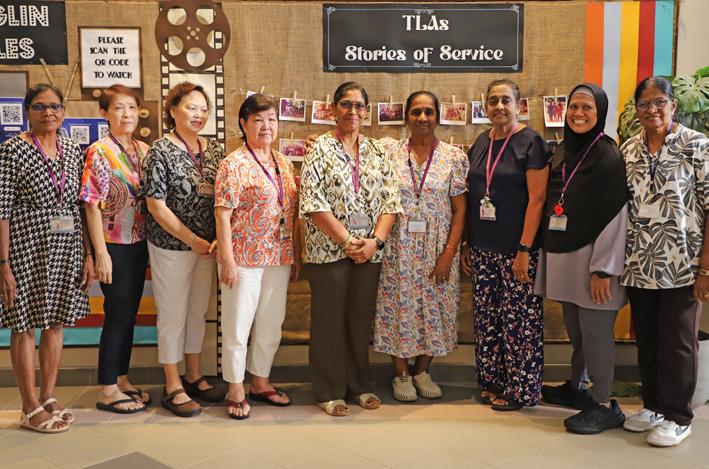


I started with Winchester in ’94 and I came here [in Tanglin] in ’96. All this time, I’ve been with nursery because I love little children…just making them more confident because [initially] they’re really nervous. Sometimes they look for mommy, and they cry, and after that, they’ll be more confident, just really enjoying themselves. But the environment has changed a lot now.
I first joined in 1985. We had beautiful trees and hut, and there were no tall buildings at all. I was working at level two…no high buildings at all. I remember we didn’t have technology at all. We had a cooking class also and it was quite fun with the children who were aged five and six years old.
Mrs Valli (Joined in 1994)
Ms Kang (Joined in 1982)
I came in from Weyhill and was their first TLA. My favourite [Tanglin tradition] was the Christmas concert. All the teachers and children were so helpful when you dress [them] up. Behind the stage, [I would whisper], “you remember to say this?” The children will go out and then the parents watching…it was so good. I really never forget.
Isn’t it interesting to hear from our longtime TLAs about their time here at Tanglin? They even contributed old photos from the good old days, which are currently on display outside Curran Hall at the Infant School. They will later be moved to the Centenary Exhibition in the Centenary Building but be sure to drop by Curran Hall and take a look in our Infant classrooms, children were captivated as they watched the clips and reflected on just how much our remarkable school has evolved over time.!
In the meantime, if you want to watch the interviews in full, be sure to scan the QR codes below or buy the 100 Tanglin Tales at https://shop.tts.edu.sg to read other historically rich stories about our school.



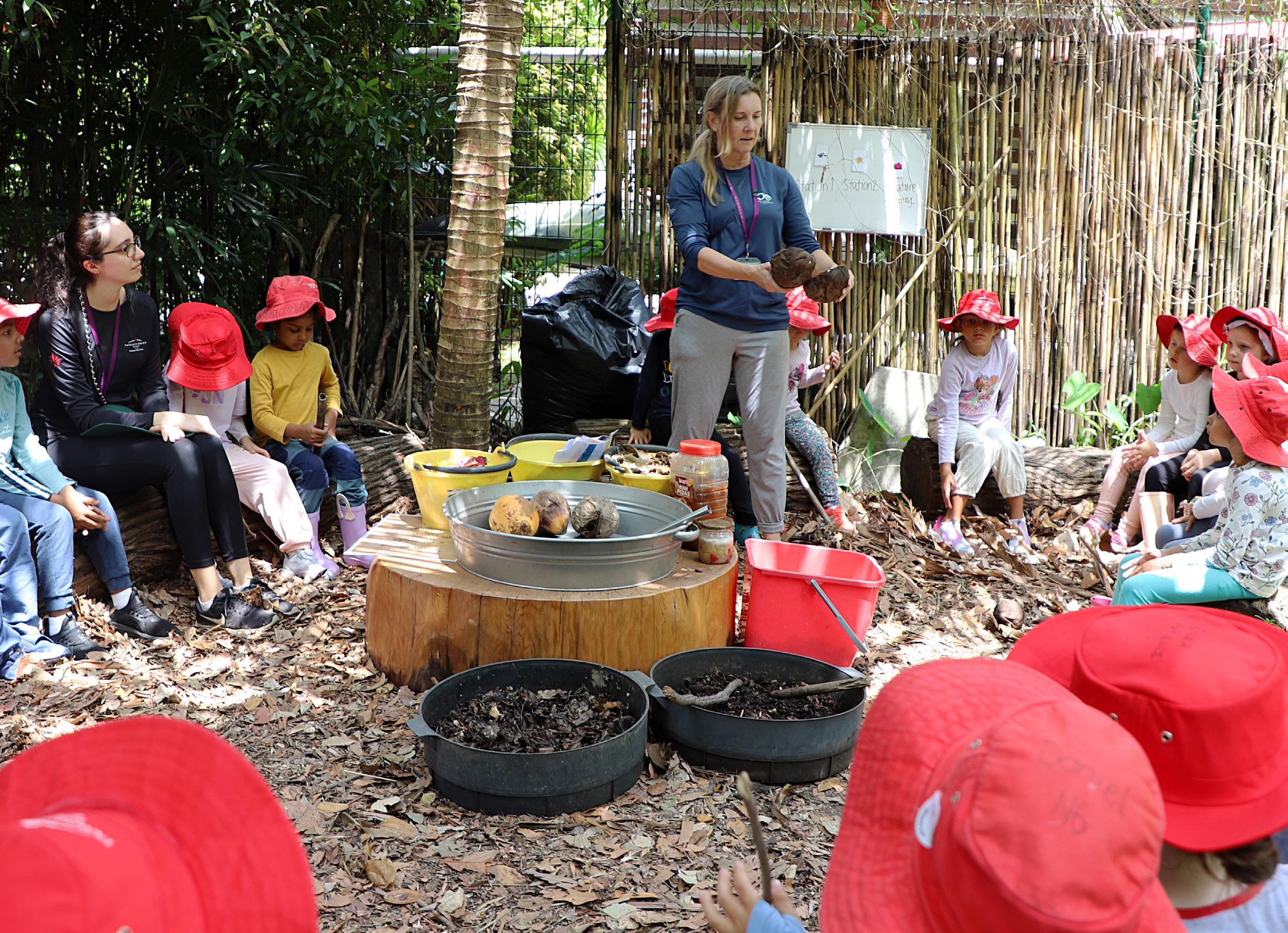

What have Tanglin students been doing to drive sustainability initiatives? Libby P, Lead Student for Sustainability, shares more.
Over the past academic year, our Sustainability Action Group has grown immensely. It brings together students from the Year 7–11 vertical team, Year 12 students from the Metanoia team and others who are keen to be involved in our environmental initiatives.
Some of these initiatives included Tanglin’s third Thrift, hosted by the Metanoia Team in Senior School. The event encouraged students to bring in preloved clothing and accessories to be sold and given a second life. All proceeds were donated to The Nature Society Singapore. The event was a great success and will continue as an annual fixture. Ms Carla Randall (Assistant Head of Year 12) also led me and four fellow Year 13 students studying
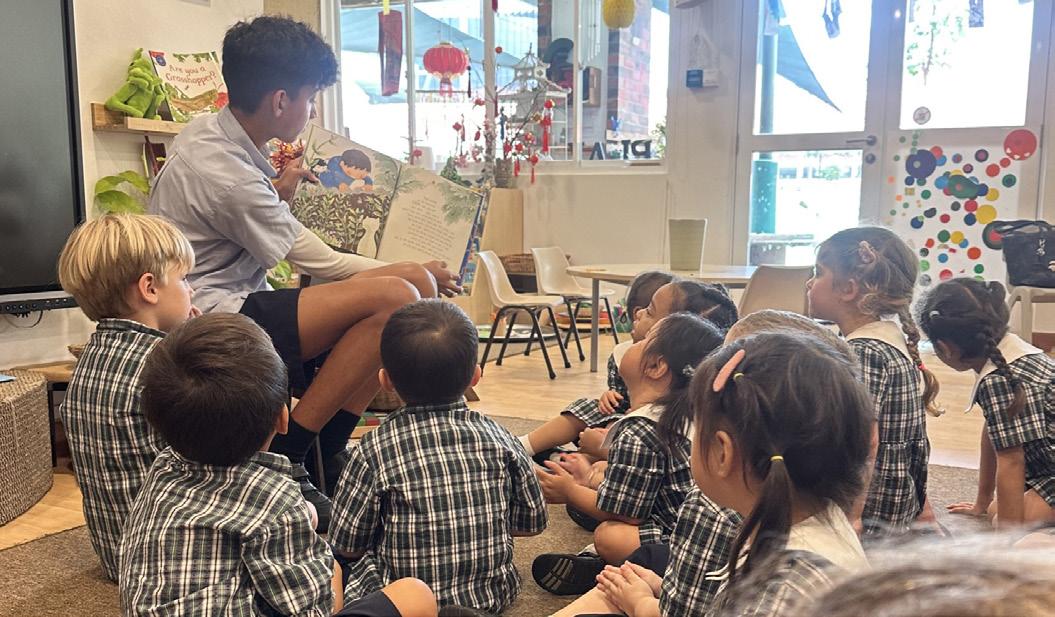
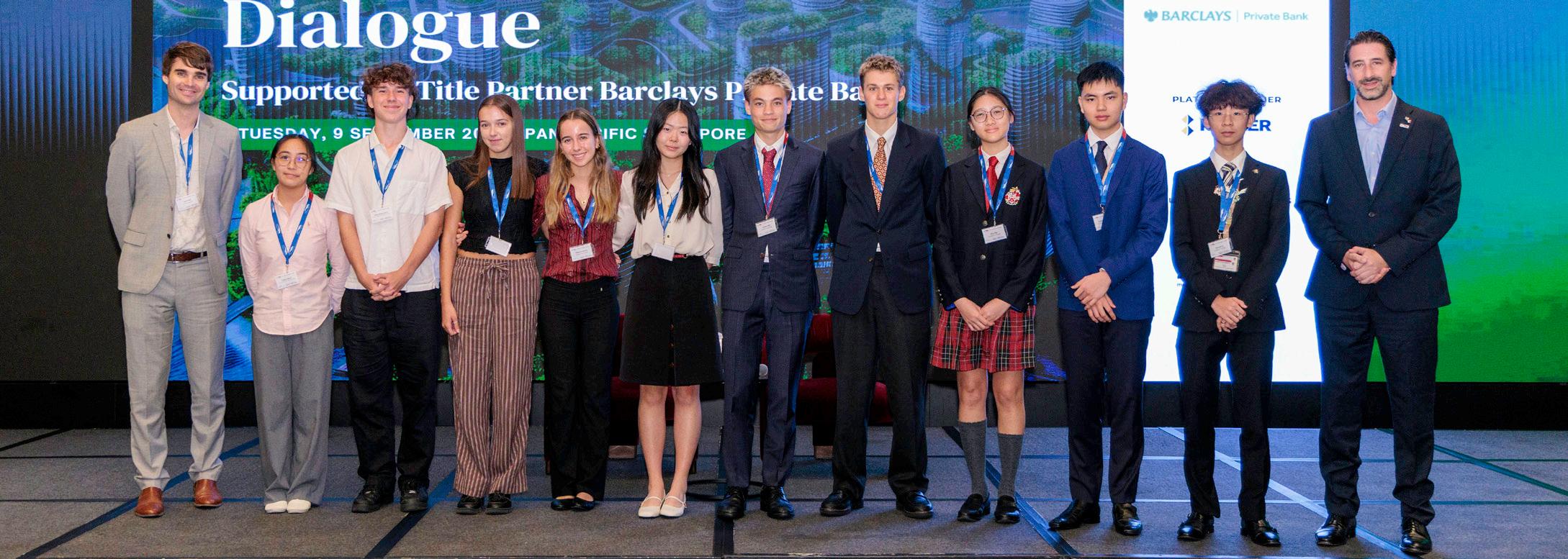
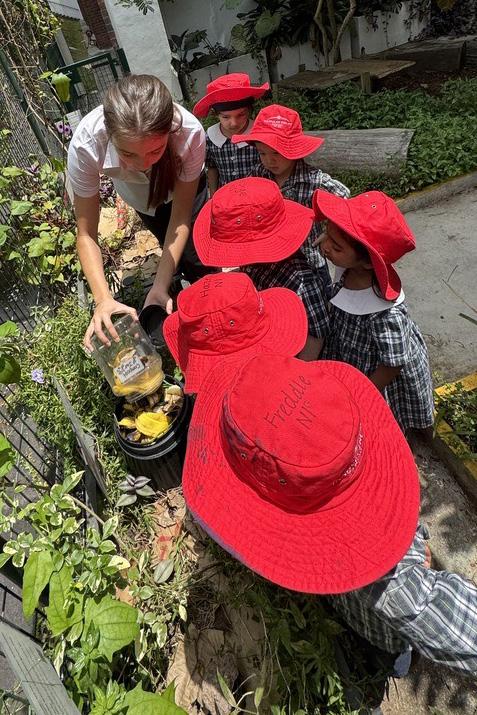
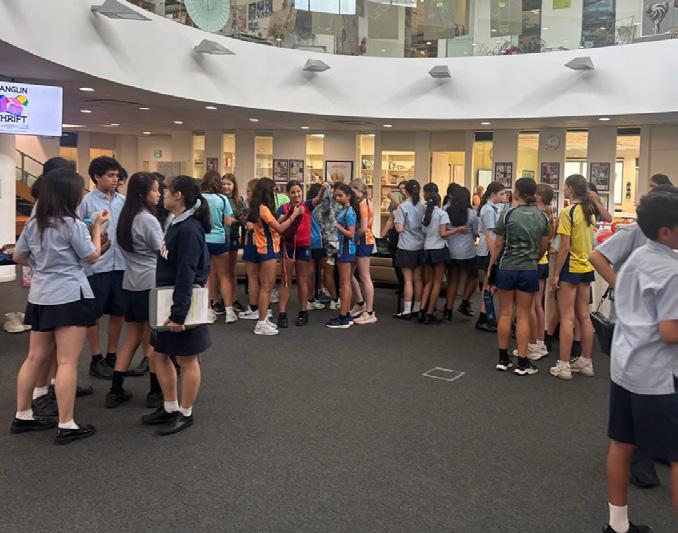
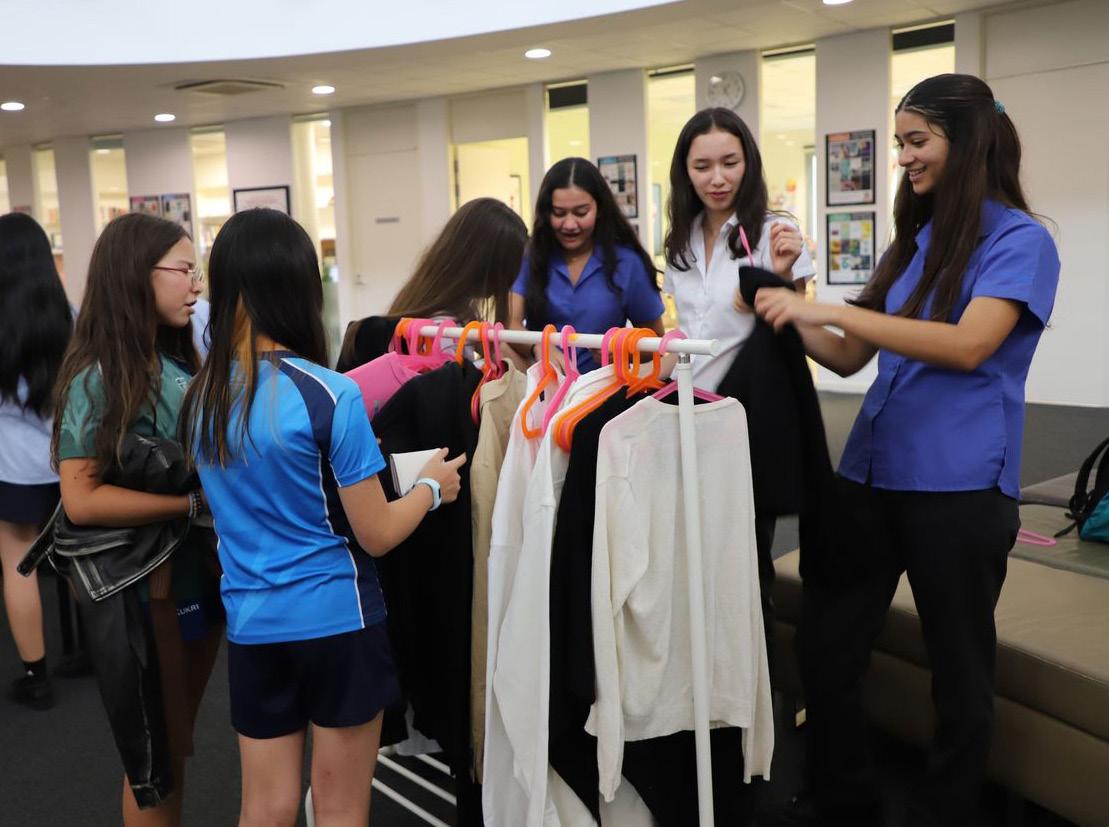
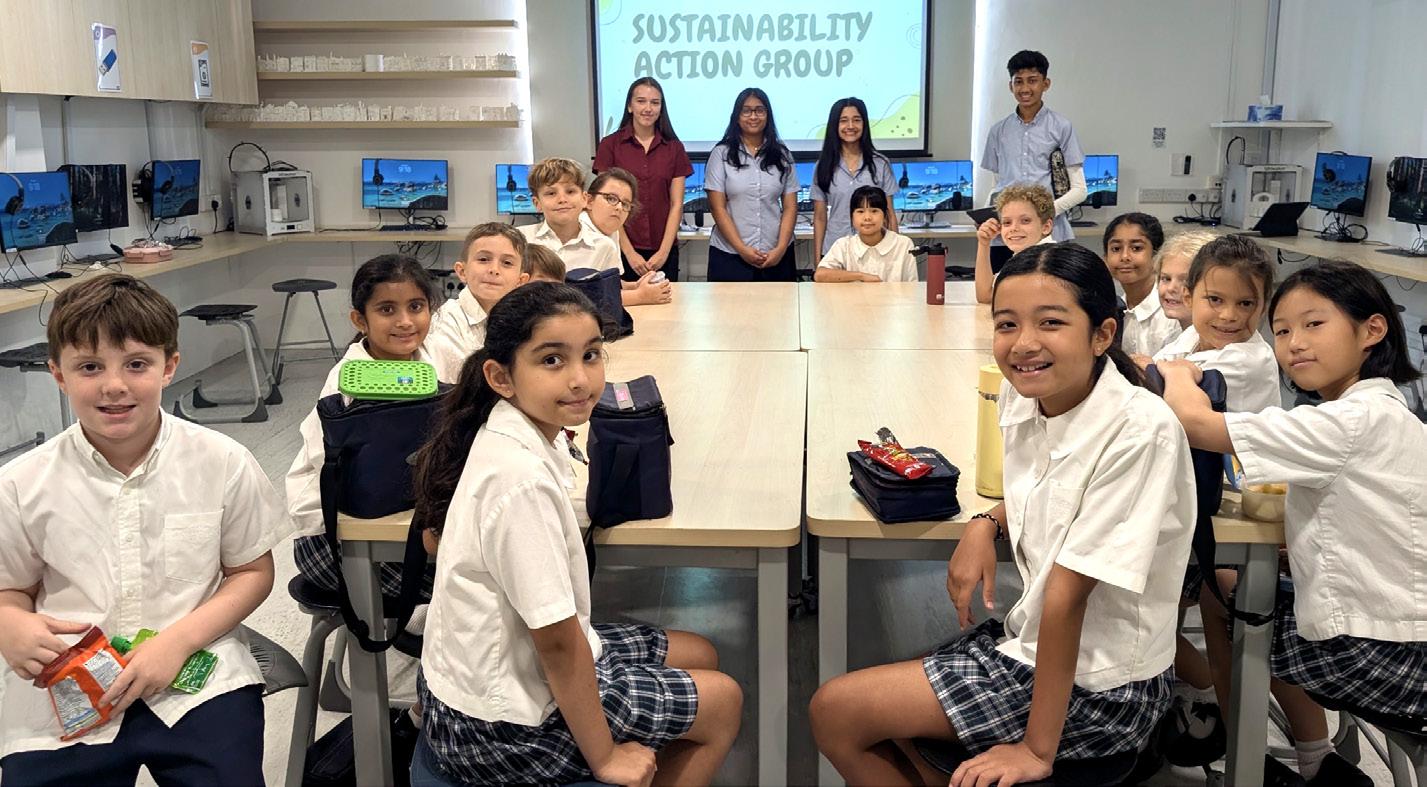
Environmental Systems & Societies to attend the Sustainability Dialogue, hosted by the British Chamber of Commerce. The event offered valuable insights into the practical steps businesses are taking to become more environmentally responsible.
During the annual House Day, the Sustainability Team ran an art activity where students were asked to bring in recyclable materials from home. These materials were distributed to teams, who then worked with their House mates to design ornaments or decorations. Winners were chosen in three categories: Best Collaboration, Best Use of Materials, and Best Involvement of their House. The activity provided a fun and meaningful way to weave sustainability into school events while promoting recycling and teamwork.
Another key focus this year was a wholeschool collaboration encouraging students to share ideas and inspiring the next generation of environmental leaders in the Infant and Junior School. Working with the Eco Club and Legacy Leaders, I delivered presentations and created
digital posters to raise awareness of the E-Waste Drive in partnership with Alba, which were displayed around the school. I plan to extend this approach to the rest of my vertical team, highlighting the textile recycling bin in collaboration with Green Square. This initiative aims to showcase the importance of diverting textiles from Singapore’s Semakau landfill and giving them a second life through reuse.
My vertical team has begun collaborating with the Infant School by attending Year 1’s Forest School introductory session on composting. It was a great experience working with the children, listening to what they already know, and getting involved alongside them. The team also delivered a presentation to Reception on the importance of composting and why we do it, while planning further collaboration with Nursery children.
Overall, it has been a productive period, and we look forward to building on this momentum through further initiatives that promote sustainable practices at Tanglin.
Teachers are usually a student’s first point of support, but behind the scenes, Tanglin’s Counselling team provides vital additional support. Claire Holmes, Head of School Counselling, explains more.
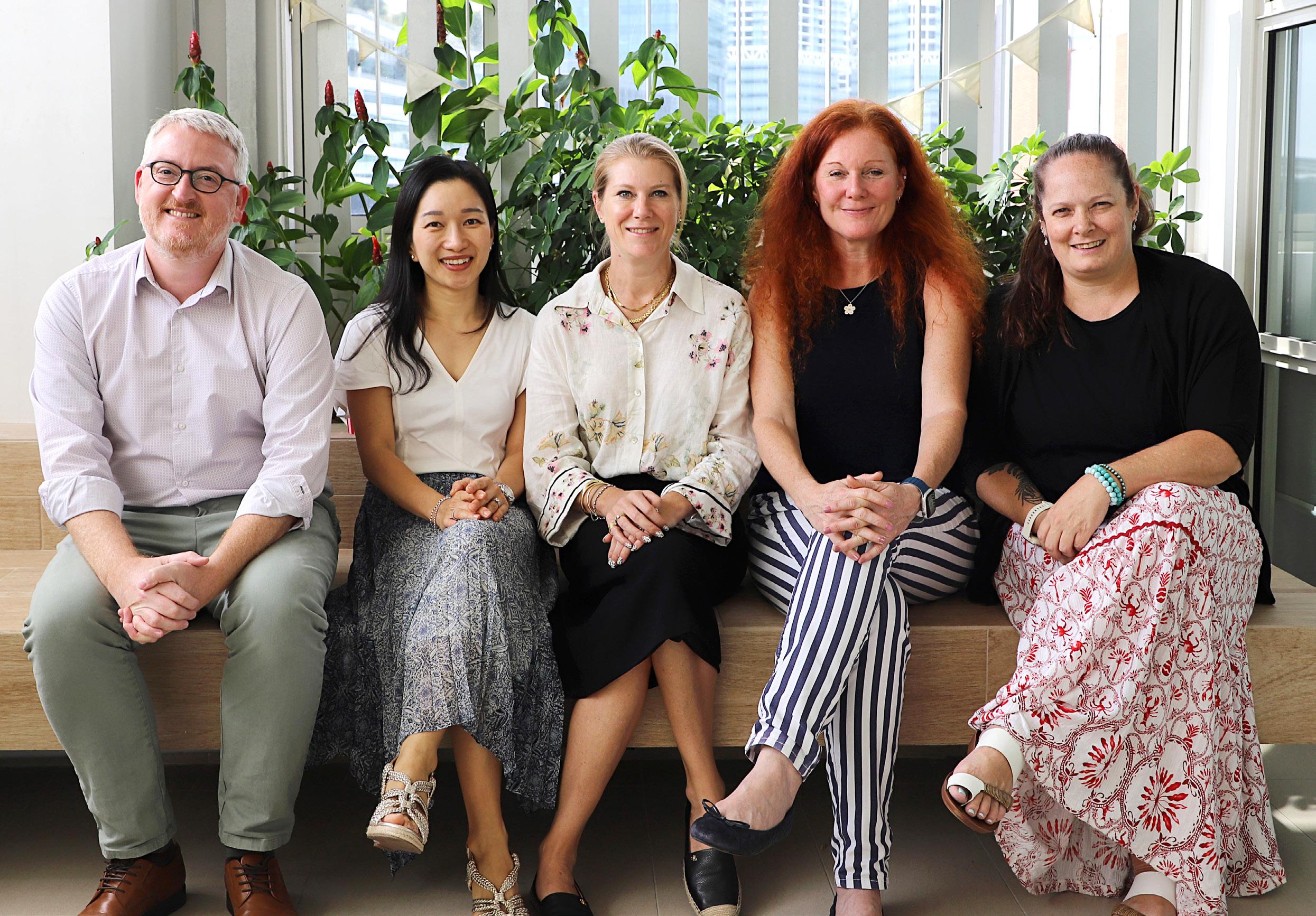
Tell us about the counselling team. During my time at Tanglin, our counselling team has grown from two of us to the current team of five we are today: Kevin Dunk, Natasha McCarroll, Pippa Gresham, Seunghee Chung, and myself. We are a passionate and deeply committed department who genuinely love what we do and remain mindful of the privilege it is to support our school community. Spending even a short time with any member of the team quickly reveals the care and dedication that underpin our work. Our department sits at the heart of student wellbeing, supporting students’ emotional, social, and psychological development from Nursery through to Sixth Form. Each school counsellor is a point of contact for several year groups, typically across two sections of the school, allowing for strong relationships and continuity of care. Our approach is trauma-informed and strength-based. We do not offer advice; instead, we empower students to access their inner wisdom and innate capacity for healing. Our work is eclectic and responsive, drawing on a range of therapeutic approaches, using the best-fit modality for each child. We are all trained in expressive therapy and place strong emphasis on understanding the nervous system and emotional regulation, helping students develop coping strategies that allow them to thrive.
What does a typical week look like for the counselling team that most people wouldn’t expect?
What often surprises people is how little of our time is spent solely in oneto-one counselling sessions. While we meet with students daily, our work is highly collaborative. We liaise closely with Designated Safeguarding Leads, learning support teams, our educational psychologist, social worker, nursing teams, teachers, tutors, and external professionals. We attend pastoral meetings, engage in crisis response planning, staff consultations, speak with parents, plan and deliver workshops, and maintain ongoing case documentation. Alongside this is significant behind-the-scenes work, anticipating pressure points in the school calendar and preparing resources for students, parents, and staff. Much of our work is proactive, relational, and preventative, requiring us to stay attuned to the wider school environment, not just the counselling room.
What success stories might never show up in reports or data, but matter deeply?
Some of our most meaningful successes are invisible; a student who starts to smile again, a child who learns to name their feelings, a teenager who quietly asks for help, a staff member who feels more confident supporting a student, or a parent who feels less alone after a difficult conversation. These moments may not translate into data, but they matter deeply. Often, success looks like something not happening; a crisis that never escalates, a student who remains engaged with school, or a relationship that slowly repairs. These are the stories we, as school counsellors, remember and celebrate.
How do you support staff who are managing students with complex emotional needs?
Teachers and pastoral leaders are often the first to notice when a student is struggling. We provide consultation, guidance, and reassurance, helping staff understand what may be happening beneath the surface, particularly from a nervous system and regulation perspective, and offering practical strategies that support both learning and wellbeing. Support may be formal, such as workshops or meetings, or informal through brief check-ins and shared reflection. We are strong advocates for staff wellbeing and offer activities and workshops throughout the year, as well as signposting external sources of support.
What proactive or preventative work does the counselling team do that often goes unnoticed?
Much of our preventative work happens quietly; informal check-ins, small group support, and wellbeing initiatives, often
following initial concerns. We aim to notice needs early and put support in place before difficulties escalate. A key focus of our work is supporting transitions, through a Third Culture Kid lens. We meet with all arriving or leaving students across the whole school, helping them feel prepared, seen, and emotionally supported. We make a conscious effort to be visible. By spending time in classrooms, assemblies, accompanying year groups on school trips, and by informal unit drop-ins, we build familiarity, trust, and connection. This helps students feel safe in seeking help early, that itself is a powerful prevention.
How does the counselling team look after their own wellbeing while supporting others?
We are incredibly proud of our Counselling & Wellbeing Centre, which boosts our wellbeing every day. Designed to feel calm, welcoming, and restorative, it supports students, and us, to feel grounded and safe. A great strength of our department is how connected we are as a team. We check in daily, reflect together, prioritise clinical supervision, and support one another through challenges. We practise what we preach by paying attention to our own mental health, maintaining healthy boundaries, and valuing self-care. We all enjoy travel, being active, intentional downtime, and time spent in nature.
If the wider school community understood one thing about your work, what would it be?
Counselling is not just for crises. We are here for everyday worries, emotional development, friendships, confidence, and life transitions. When counselling is seen as a normal and supportive part of school life, everyone benefits.
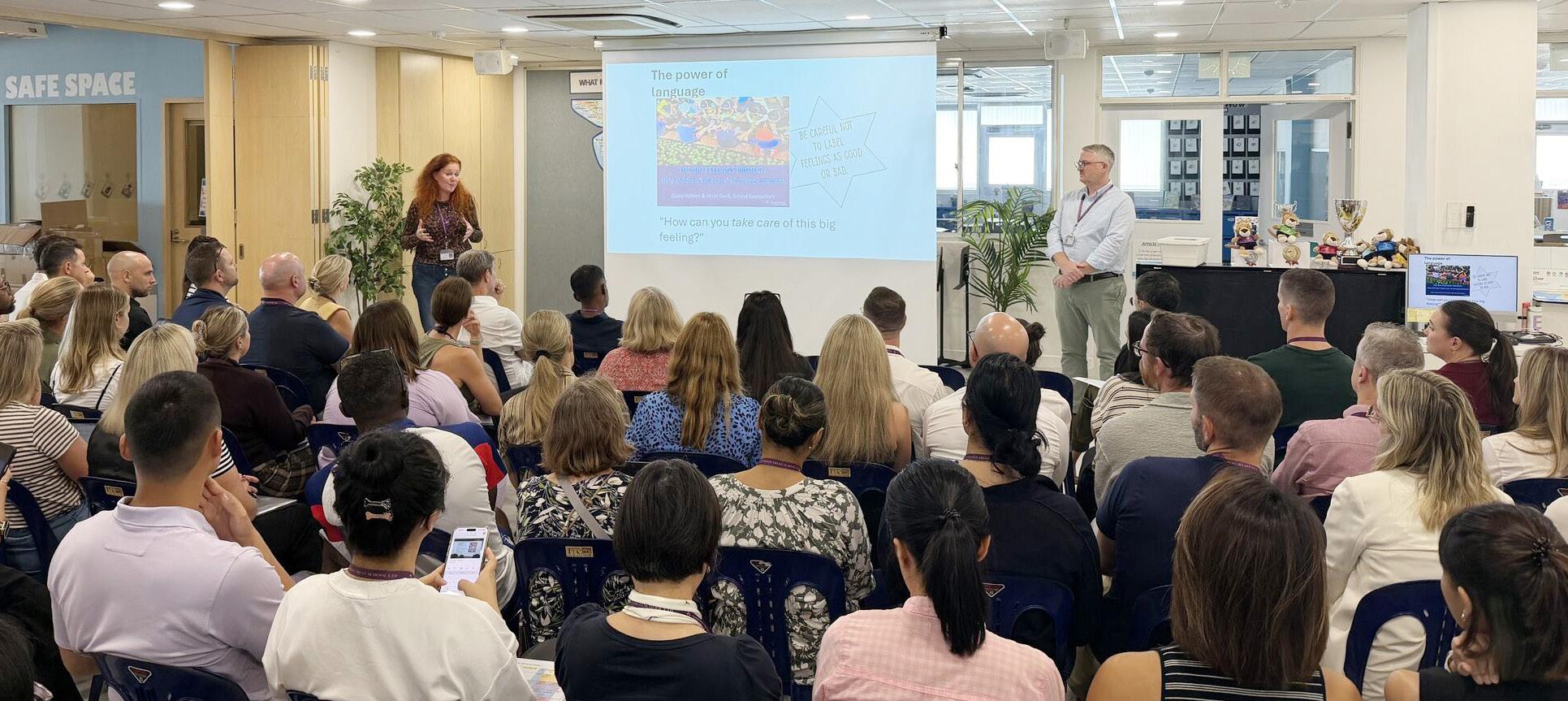
For many families, the Admissions Team is their very first introduction to Tanglin. From the initial enquiry to the first day of school, the team works to ensure that every family feels welcomed, supported and confident as they begin their Tanglin journey. Pooja Khetan, Head of Admissions, shares more with us.
Can you describe what the admissions team does?
Who’s who and who does what?
Tanglin’s admissions team is a family’s first point of contact with the school, so our role goes far beyond just processing applications. We guide families through every stage of the admissions journey— from initial enquiries and school visits to assessments, offers, and enrolment. The 10-member team works extremely closely during this journey, beginning with the Admissions Ambassadors (Michelle, Mina and Talei) who handle all tours and answer all the queries a prospective family can possibly throw our way. Once an application is submitted, our Admissions Officers (Ishana, Penny and Sarah) guide the family all the way with assessments
and interviews until an outcome is received. Along the way, our two Admissions Support Officers (Diane and Parul) support and facilitate all pre-application and pre-enrolment related queries. Lastly, Titin Kelana, our seasoned Admissions Manager of 15+ years, along with myself, works in conjunction with the various Heads of School to make admissions decisions in line with the school’s vision and strategy. Collectively, we ensure each application is handled carefully, consistently, and with a strong understanding of Tanglin’s values and mission of making a positive contribution to the school.
How do you ensure every family feels welcomed from the moment they enquire about Tanglin?
We believe that feeling welcomed begins with a friendly, personalised and transparent approach. You will find that almost all members on the team are either Tanglin parents themselves or have been working at Tanglin for many years. From the first enquiry, we aim to respond promptly, personally, and thoughtfully, using our own experience and insight while taking time to understand each family’s background, priorities, and expectations for their child. Many of our families are new to Singapore and come from different backgrounds or schooling environments, so we also recognise the importance of providing comfort, clarity, and courtesy at every step. Whether it’s through a warm and informative email exchange, a personalised family tour, or guidance on Tanglin and its plethora of options to navigate, we focus on building genuine relationships and enabling families to make the right educational choice for their child while in Singapore.
What are some things families might be surprised to learn about the admissions process at Tanglin?
Families are often surprised by how individualised the process is. While we are a large school with over 2800 students, we take great care to look at each child’s profile as an individual across a broad set of selection criteria. Another surprise can be how closely the admissions team works with academic and pastoral teams to ensure the best possible fit for each student—academically, socially, and emotionally. The process is not just about entry or filling spaces but about setting students up for a successful and positive start at Tanglin and to transition smoothly into the existing cohort and then, life beyond Tanglin. Lastly, despite being in the admissions team where we are expected to mainly interact with new joiners, many
The most rewarding part has to be seeing students thrive… meeting families… forming a connection with them and then seeing their children settled, confident, and enjoying school life.
are surprised with the amount of care and attention we provide families during and at the end of their time at Tanglin. From giving guidance on immigration, medical or other matters related to school life, to assisting transitions to schools back in their home country, we endeavour to answer as many questions as possible.
What’s the most rewarding part of being part of Tanglin’s Admissions team?
The most rewarding part has to be seeing students thrive after joining the school. Meeting families at the enquiry stage, forming a connection with them and then later seeing their children settled, confident, and enjoying school life is incredibly fulfilling. Hearing the news that some of them have excelled in an academic or co-curricular pursuit, won awards or secured a place in their dream university or programme is always a highlight! We also value the long-term relationships we build given our 100-year-old history. Many families have children who progress all the way from Nursery through to Sixth
Form (15 years!) or remain connected with the admissions team for years especially as siblings join the school, alumni return after a stint abroad or children of alumni join us as the second, third or fourth generation of Tangin students! When they return, they always have wonderful and kind words to share of their time at Tanglin, its staff and the community overall. In fact, I am a Tanglin alumna, and all three of my children are now at Tanglin. Personally, I find it incredibly rewarding to give back to a community that played such an important role in my formative years, while also having the opportunity, however small, to help shape its future for my children.
How does the admissions team collaborate with other departments across the school?
Collaboration is central and at the heart of what we do. We work extremely closely with Heads of Schools, Heads of Years, pastoral heads, learning support teams, Friends of Tanglin, co-curricular department, marketing, the Foundation, Community Relations, operations, finance, (phew! to name a few!) to ensure that students and families experience a smooth and well-informed admissions and onboarding journey. This teamwork helps us give families accurate guidance and support students effectively as they transition into a new school community and often, a new country.
Is there a moment or success story that has stayed with you?
There are countless moments, but particularly memorable are cases where a child joins Tanglin after a challenging educational experience elsewhere and goes on to flourish within the Tanglin community. Seeing a student grow in confidence, make friends, and rediscover a love of learning reminds us why our role matters. We also truly cherish moments such as receiving a thank-you message from a family who felt truly supported during a major academic or life transition and are always quick and proud to share such incidences during our team meetings.
How do you see the admission process evolving in the coming years?
I expect the admissions process to become even more familyfocused while getting more technologically streamlined, making it easier for families around the world to know more about Tanglin and touch base. At the same time, the human element remains essential to what we do. As international education continues to evolve, our focus will be on understanding each child’s needs, maintaining strong personal relationships, and ensuring that Tanglin continues to welcome families who will thrive within our diverse and values-driven community.
Lab work
in Science and Design
& Technology relies on a dedicated team of lab technicians who work behind the scenes to keep everything running smoothly. Who are they, and what do they do?
Norazila
Bte Md Arrif, Lead Technical Science Executive, breaks down the science behind every practical lesson at Tanglin.
Tell us about your team, who’s who and what are your main responsibilities?
Our technical team supports the wider Science Faculty, which includes both Science and Design & Technology (DT) technicians. While each technician has their own area of expertise, we work closely together across departments and collaborate with teachers to support teaching and learning.
Science technicians support biology, chemistry, physics and environmental science practical, while DT technicians support Design & Technology practical lessons, including preparation and in-class support. As a team, we work in partnership with teaching staff to plan, prepare and deliver practical activities. We prepare, maintain and organise laboratories and studios to ensure students experience safe, well-prepared and engaging lessons.
What’s a typical day like?
There isn’t really a “typical” day, as priorities can change quickly. Most days begin with checking lesson schedules and communicating with teachers about upcoming practical work and any specific learning needs. This may include testing, maintaining and servicing machines, checking tools, setting up equipment, preparing solutions, or adapting activities for different classes. Throughout the day, we respond to lesson changes, troubleshoot issues during practical, manage stock, and reset labs and studios for the next group of students. Much of our work happens behind the scenes in close coordination with teachers to ensure lessons run safely and smoothly.
What is the most challenging part of your job, and how does your team tackle it?
One of the most challenging aspects of the role is balancing safety, time pressure and changing lesson needs. Practical lessons often run on tight schedules, and things do not always go as planned. We manage this by communicating clearly as a team and with teaching staff, supporting one another and staying calm under pressure. At times, challenges need to be tackled together as a wider teaching and technical team. Science and DT technicians share expertise and work closely with teachers to adapt activities quickly while maintaining safety and effective practice.
How do you handle unexpected situations in the lab?
Safety is always the priority. When something unexpected happens, such as equipment failure, a spill or a last-minute change to a lesson, we assess the situation, manage any immediate risks, and communicate clearly with teaching staff. Remaining calm is important, as students often take their cues from the adults around them. Clear communication and steady actions help prevent panic and allow learning to continue safely where possible.
Can you share an example of a project or experiment where your work made a big difference to students’ learning?
In many cases, practical activities need to be adapted so students can focus on understanding the subject rather than struggling with the setup. By working closely with teachers to pre-test and refine experiments, we help ensure activities work reliably and safely. Where off-the-shelf equipment does not fully meet learning needs, Science and DT technicians collaborate with teachers to design and modify resources. This helps create experiments and activities that are safer, more reliable and better aligned with learning objectives, allowing students to spend more time analysing results, asking questions and engaging meaningfully with the task.
Are there any hidden skills or knowledge students might not realise lab technicians need?
Many students do not realise how much planning, organisation and problem-solving is involved in a Science or DT technician’s role. Strong technical and scientific knowledge is important, but so is the ability to anticipate issues and work closely with teachers to translate learning objectives into practical experiences. The role often involves engineering thinking, risk assessment and adapting equipment or procedures to suit different learning needs. Good communication skills and attention to detail are also essential, particularly in busy lab and studio environments.
What advice would you give to students who are curious about pursuing a career in science or laboratory-related roles?
Be open to exploring different pathways. Careers in science and technical fields are very diverse and often combine science, technology, design, problem-solving and teamwork. Develop curiosity, resilience and the ability to work well with others. In real lab environments, learning happens through collaboration with peers, teachers and technical staff. Most importantly, understand that learning in science, design and technology is not just about getting the “right” answer, but about learning from things that do not go as expected.

100 Tanglin Tales, written by staff, Alumni, students, and parents is a beautiful, limited edition coffee table book that celebrates the vibrant history of Tanglin Trust School.
100 Tanglin Tales is available to buy from the School Shop. The book retails at $50 and makes the perfect gift for anyone in the Tanglin community.
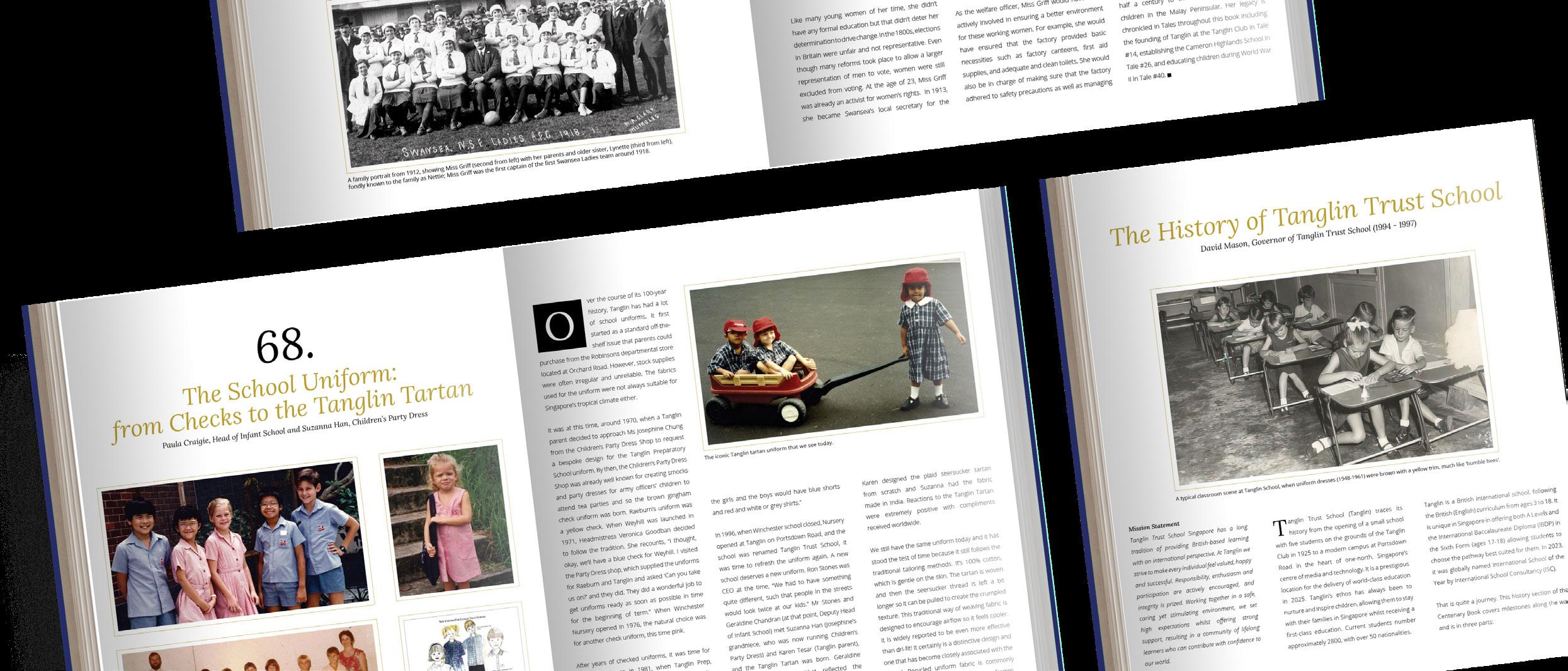
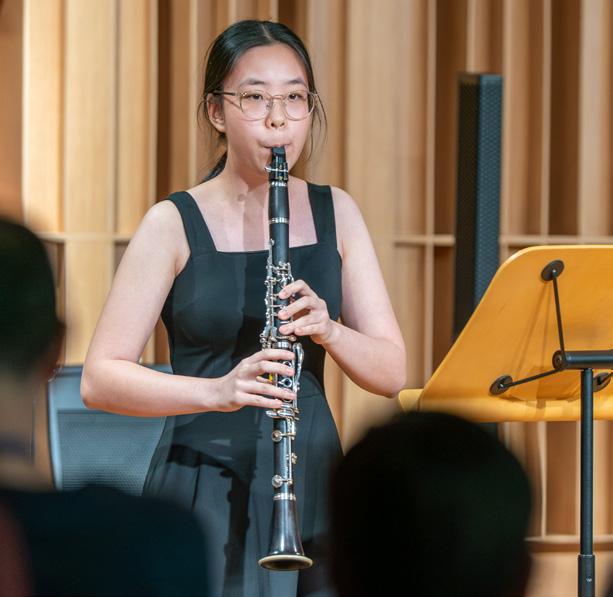
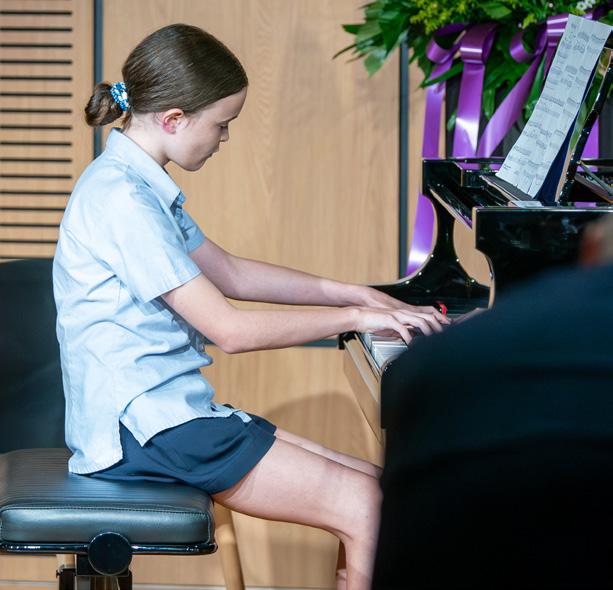
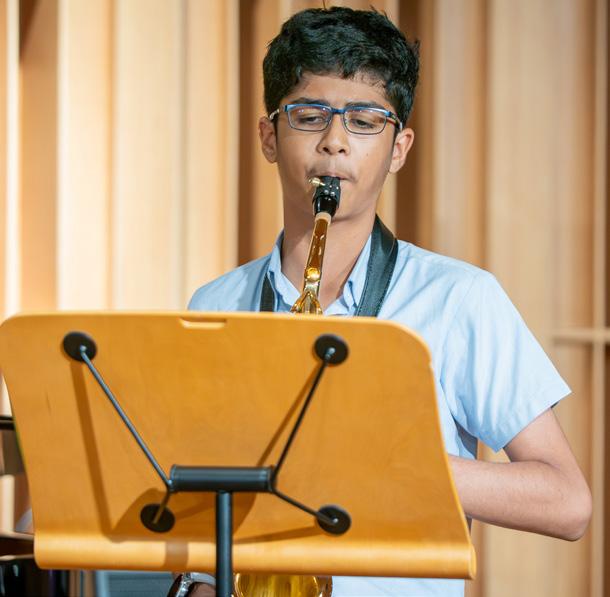
Congratulations to all students who took part in this year’s Musician of the Year competition! Paresa T (Year 5) was awarded Intermediate Musician of the Year, while Finn C (Year 13 and a Centenary Music Scholar) clinched the Advanced category title. Well done to everyone involved!