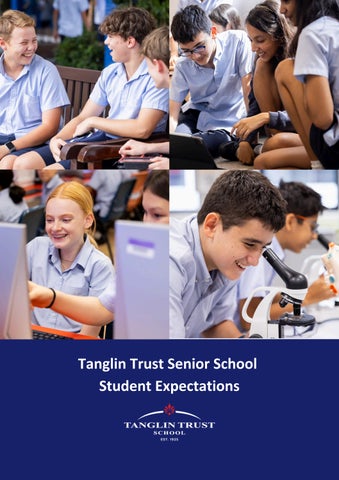
Tanglin Trust Senior School Student Expectations
Senior School - Student Expectations Table of Contents Content
Page
Introduction to the Student Expectations Handbook
4
Introduction to uniform in the Senior School
5
Uniform in the Middle School
6
Uniform in the Upper School
7
Uniform in the Sixth Form
8
School shoes in the Senior School
9
House and sports kit in the Senior School
10
Non-uniform day expectations
11
Introduction to Attendance and Punctuality in the Senior School
12
Morning registration and tutor time
13
Morning registration - Notification of Absence Form
14
New Leave Request Form
15
2
Senior School - Student Expectations Table of Contents Content
Page
Temporary Guardianship Form
16
Punctuality to lessons
17
Co-Curriculum (CCA) programme
18
Introduction to Conduct in the Senior School
19
Classroom conduct and preparedness
20
Using devices - iPads and laptops
21
Using devices - mobile phones and headphones
22
Student lockers
23
Using the lifts
24
Behaviour around and outside of school
25
Communication in-person and online
26
Food in ther Senior School
27
Food in the Senior School
28
3
At Tanglin, our commitment to Respect, Responsibility, and Purpose extends beyond the classroom and into every aspect of school life, including how our students present themselves and how they conduct themselves each day. Clear expectations around behaviour and uniform help to create a learning environment in which every student can thrive. They are a practical expression of respect - for themselves, for one another, and for the wider community - and they encourage students to take responsibility for the choices they make. Just as importantly, they foster a sense of purpose: the understanding that every individual contributes to the collective experience of our school.
When our students arrive ready to learn, dressed with care and carrying themselves with dignity, they are not only preparing for the day ahead but also building the habits and values that will stay with them long after their time at Tanglin. These standards are not restrictions, but foundations - helping to instil pride, discipline, and self-respect in ways that echo across all areas of their learning and growth. With your support in reinforcing these expectations at home, we can together ensure that our students walk confidently into every opportunity, secure in who they are, and mindful of the respect, responsibility, and purpose that guide them.
Richard Sellers Deputy Head (Pastoral) and Director of Pastoral Care
Rebecca George Assistant Head (Pastoral)
4
UNIFORM IN THE SENIOR SCHOOL Our school uniform is an important part of life at Tanglin. It reflects our shared values of Respect, Responsibility, and Purpose, and helps to create a strong sense of identity and belonging among our students. Wearing the uniform with pride shows respect for the school community, encourages responsibility in how students present themselves, and fosters a purposeful environment in which everyone can focus on learning and growth.
We expect all students to follow the uniform policy consistently, and we ask for your support in reinforcing these expectations at home. By working together, we ensure that Tanglin students present themselves with confidence, feel part of a united community, and are ready to embrace every opportunity that school life offers.
5
UNIFORM IN THE MIDDLE SCHOOL Light blue school shirt Dark blue school shorts or trousers No black shorts/trousers No chinos
Navy Tanglin School jumper No non-Tanglin jumpers No Tanglin team or trips hoodies
Ankle length socks Colour: Black, blue, white or flesh colour No knee length socks
All leather black shoes No fabric shoes No trainers and no boots Laces must be black
One single small stud in each ear No hoops or dangly earrings No nose piercing
One thin necklace with small pendant No rings No bracelets or anklets
No make-up or nail varnish No eyelash extensions
Natural hair colour No extreme colour hair, including peroxide No coloured tips, streaks, or colour underneath No extreme haircuts
6
UNIFORM IN THE UPPER SCHOOL Light blue school shirt Dark blue school shorts or trousers No black shorts/trousers No chinos
Navy Tanglin School jumper No non-Tanglin jumpers No Tanglin team or trips hoodies
Ankle length socks Colour: Black, blue, white or flesh colour No knee length socks
All leather black shoes No fabric shoes No trainers and no boots Laces must be black
One single small stud in each ear No hoops or dangly earrings No nose piercing
One thin necklace with small pendant No rings No bracelets or anklets
No make-up or nail varnish No eyelash extensions
Natural hair colour No extreme colour hair, including peroxide No coloured tips, streaks, or colour underneath No extreme haircuts
7
UNIFORM IN THE SIXTH FORM Sixth Form school shirt Dark grey shorts or trousers No black shorts/trousers No chinos
Navy Tanglin School jumper No non-Tanglin jumpers No Tanglin team or trips hoodies
Ankle length socks Colour: Black, blue, white or flesh colour No knee length socks
All leather black shoes No fabric shoes No trainers and no boots Laces must be black
One single small stud in each earlobe No hoops or dangly earrings No nose piercing
One thin necklace with small pendant No rings No bracelets or anklets
Discreet make up No eyelash extensions
Clear or nautral nail varnish No coloured nail varnish No nail extensions
Natural hair colour No extreme colour hair, including peroxide No coloured tips, streaks, or colour underneath No extreme haircuts
Boys are to be clean shaven or nearly trimmed No tattoos
8
SCHOOL SHOES & MEDICAL EXEMPTIONS All students are expected to wear school shoes throughout the school day – trainers are not permitted. School shoes must be plain black leather and should not include a mix of leather and fabric. Ankle boots are not allowed, even when worn with school trousers. If shoes have laces, these must also be black to match the shoes. To maintain a smart appearance, school shoes should always be kept neat and clean.
For students who require orthopedic insoles, these must be placed inside their standard school shoes. If an alternative type of footwear is medically needed, a recent doctor’s note will be required, and the school may request updated medical documentation at a later date. Any approved alternative footwear must be entirely black to remain in line with the school’s uniform policy.
9
House Kit and Sports Kit House Kit On House Days, all students (Year 7 - Year 13) are expected to be wearing House kit. House Days are not non-uniform days.
PE kit On days that students have PE lessons, they are to change into: Full House kit - top and shorts. PE trousers can be purchased from the school shop. Shorts must be off an acceptable length and not too short. Trainers Hair must be tied back No jewellery (must be locked in locker prior to the PE lesson) Students will have time at the start and end of each lesson to change into and out of PE kit. Those students with PE Period 1 will be expected to arrive to school in their school uniform and not PE kit.
Sports kit On days when students have their Sports lesson, students can wear their PE kit (as listed above) for the entire day.
GCSE PE Students only For Upper School students, those taking GCSE PE may wear their GCSE sports tops instead of their House top. GCSE students must get changed into their kit at the start and end of their practical lessons. For their theory lesson, they must be in school uniform.
10
Non-uniform Days
On designated non-uniform days, students are welcome to express their personal style while remembering that school remains a learning environment. Clothing choices must be appropriate for a school setting, ensuring both comfort and respect for others in the community. Students may be asked to change or adjust their clothing if it does not meet the following guidelines.
Clothing Tops must fully cover the chest area and have straps wider than spaghetti straps. Midriffs and backs must remain covered when standing or sitting. Shorts and skirts must be of an appropriate length, allowing students to sit, bend, and move comfortably without revealing undergarments. Clothing must not display offensive or inappropriate images or language. Expensive jewellery should not be worn. The school accepts no responsibility for lost or stolen items.
Footwear For health and safety reasons, closed-toe shoes must be worn on non-uniform days. This is particularly important for lessons such as Science, Lifeskills, Design & Technology, and Art & Design. Students who have these lessons scheduled must ensure their footwear meets this requirement.
11
ATTENDANCE AND PUNCTUALITY IN THE SENIOR SCHOOL Excellent attendance and punctuality are vital for maximising learning and reflect the school’s core values of Respect, Responsibility, and Purpose. Being present in lessons ensures that students have full access to the curriculum, take part in class discussions, and benefit from the guidance of their teachers. Consistent attendance supports not only academic achievement but also the development of social skills, resilience, and a strong sense of responsibility.
Equally important is punctuality to lessons. Arriving promptly maximises learning time, prevents disruption to others, and allows students to engage fully from the start of each lesson. A punctual start to the day and to every class helps establish positive routines that are vital for long-term success in education and beyond.
As a school, we recognise that there may be occasions when students need to miss part of, or a full, school day due to unavoidable circumstances. However, we ask that, wherever possible, medical and other appointments are scheduled outside of school hours to avoid disruption to learning.
12
Morning registration - Period 1 Being on time to school and period 1 provides a purposeful start to the day, helping students feel settled, supported, and ready to learn. Equally, prompt attendance to Period 1 is a vital safeguarding measure, allowing the school to confirm which students are on site and to follow up quickly on any absences. Consistent attendance at tutor time is therefore essential for both student wellbeing and safety.
Students need to be at Period 1 for 8.15am
Those students who have morning CCAs need to make their way to Period 1 promptly
After 8.15am, students will need to sign with the relevant office: Middle School and Upper School - Front Office Sixth Form - Sixth Form Office
Parents will receive an automated message if their child is not on time to Period 1 and fails to sign in with the relevant office
13
Notification of Absence Form If you know that your child will be late to Period 1 or absent for the school day, you will need to inform the school in advance using the Notification of Absence Form. The link can be found on the Parent Portal. Notification of Absence Form
Once the form has been submitted it will alert your child’s tutor, Assistant Head of Year and Head of Year. It will also alert Front Office or the Sixth Form Office, who will pre-populate the registers with the correct code to represent the reason for the absence.
14
New Leave Request Form If you need to request a planned period of absence for your child, we kindly ask that you submit a formal request in advance. All absence requests must be made through the designated form, which can be accessed via the Parent Portal. This ensures that the school is informed in a timely manner and that any necessary arrangements can be made to support your child’s learning during their absence. Leave Request Form
Please note that absence requests are subject to review in line with school policies and applicable attendance regulations. Families are encouraged to submit requests as early as possible to allow for appropriate consideration. 15
Temporary Guardianship Tanglin Trust School requests that a Temporary Guardianship Form is submitted when both parents are out of the country. This helps school to contact a trusted adult should there be a concern or emergency. Letter of Temporary Guardianship
16
Punctuality to lessons Being punctual to lessons is essential for maximising learning and maintaining a calm, respectful environment. Arriving on time ensures students are ready to begin straight away, avoiding disruption to both their own learning and that of others. Even small delays quickly add up: just one minute of lateness each day amounts to more than three full days of lost learning over the course of a school year. Punctuality also establishes good habits of responsibility and self-discipline, preparing students for the expectations of further education and employment. By being on time to every lesson, students make the most of their education and show respect for both their peers and teachers.
Students need to be prompt to lessons
Staff will record minutes late for those students who do not arrive to lessons promptly
The Pastoral Team will follow with those students who have been reported as being late three times or more in one week
17
CCAs - Wednesday Period 5 AAt Tanglin, the Co-Curriculum is a core component of our holistic educational philosophy, enabling students from Infant through to Senior School to explore diverse interests, build resilience and grow in areas beyond the classroom. Participation not only fosters teamwork, creativity and leadership, but also helps students to develop the confidence, well-being and sense of belonging that support their academic and personal success. We believe that a rich co-curricular programme equips every child with skills and experiences that will serve them well in their future endeavours. The ballot process This is run by the Co-Curriculum Team and is the process of allocating students activities after they have indicated their top four choices. It is crucial that students all indicate four options because everyone will be one of their top four choices. If students do not allocate four options and do not get one of their chosen options, they will be randomly selected an activity. Expectations We expect students to attend their Wednesday P5 activity 'plus one' other which takes place outside of timetabled time, usually before or after school and likely in Sport, Music or Drama. This will be monitored by Form Tutors. Students must take their co-curricular commitments as seriously as their academic lessons; this means attending reliably and promptly.
18
CONDUCT IN THE SENIOR SCHOOL In Senior School, we believe that high standards of behaviour and conduct are essential to creating a safe, respectful, and supportive learning environment. Students are expected to demonstrate courtesy, responsibility, and integrity at all times - whether in lessons, during Co-Curricular Activities (CCAs), when moving around the school, during breaks and lunchtimes, or while using shared spaces such as toilets. Respect for staff, peers, and the school environment is non-negotiable, and students are encouraged to take pride in their actions, ensuring they contribute positively to our community. These expectations extend beyond the school grounds. Students are representatives of the school whenever they are in uniform or engaged in online activity. This means behaving responsibly and respectfully in public, as well as maintaining kindness, safety, and integrity in digital interactions. By upholding these standards consistently, we reinforce the values of our school, protect the wellbeing of our community, and prepare students to be responsible citizens who act with dignity and respect in all areas of their lives.
19
Classroom conduct & preparedness Students are expected to maintain high standards of behaviour in all lessons. Respectful, focused conduct allows teachers to deliver high-quality instruction and ensures that all students can learn without disruption. Poor behaviour in lessons affects not only the learning of the individual but also the progress and engagement of the whole class. Consistent, positive behaviour is therefore essential in creating an environment where every student can succeed. Equally, students must be fully prepared for all lessons. This includes bringing the correct equipment, having their device fully charged, and ensuring that any required materials are ready for use. A lack of preparation can interrupt the flow of learning, limit a student’s ability to participate effectively, and cause unnecessary delays for the whole class. Students are expected to use the toilets and fill their water bottles before lessons begin. Leaving lessons to refill bottles or use the toilet disrupts teaching and learning, and it is important that students remain focused and fully engaged for the duration of class. Being organised and ready to learn is a vital part of showing respect for the teacher, classmates, and the learning process itself.
20
Using devices - iPads & laptops Student devices are an essential learning tool that support access to resources, research, collaboration, and creativity in the classroom. When used appropriately, devices enhance teaching and learning by allowing students to engage with digital platforms, develop independent study skills, and build confidence in managing technology responsibly. In lessons: Devices may only be used when directed by a teacher. Devices must remain closed until students are instructed to open them. Devices need to be fully charged. In lessons: Students are not permitted to use social media or be gaming on their devices; only school-approved sites and platforms that are educational and directly relevant to lessons are allowed. Around school: Devices must not be used in corridors, the canteen, walkways, or on the school bus. Middle School: Students may use their devices in the Library during break and lunchtimes for the purpose of completing schoolwork only. Upper School: Students may use their devices in The Hive, including the Silent Zone, during break and lunchtimes for schoolwork. Sixth Form: Devices may be used in the Common Room and in the Level 4 Horseshoe area for independent study and school-related tasks. It is important that students learn to use their devices purposefully, following school expectations and teacher guidance. This ensures that technology supports learning rather than distracts from it, helps students to develop good digital habits, and prepares them for further education and the modern workplace where responsible use of technology is a vital skill. Not following the school rules regarding devices may result in the device being confiscated until 4pm. These guidelines ensure that devices are used responsibly and purposefully, while maintaining a balance between learning, wellbeing, and social interaction.
21
Using devices - mobile phones and headphones The Senior school operates a phone-free policy from the moment students arrive on campus until the end of the school day (4:00 pm) to ensure focus, safety, and a positive learning environment. All students must put their phones and headphones in their bags before entering the school campus. Phones must remain in lockers for the entire day. If a student needs to contact home during the school day, they can go to the Front Office to use a phone. Headphones must remain in lockers unless a teacher specifically asks students to bring them for a lesson. Headphones must not be worn around the neck or used while moving around the school campus. Sixth Form students may use their phones and headphones only in the Sixth Form Common Room and Library. Any use of mobile phones which cause disruption, or contributes to inappropriate behaviour, will result in the privilege being revoked. Phones and headphones are not permitted in any other part of the school, including Café M or the Piazza, and must remain in bags at all times. Not following the school rules regarding mobile phones and headphones will result in the phone and/or headphones being confiscated until 4pm. This policy supports a focused learning environment, encourages positive social interaction, and ensures student safety throughout the school day. Parents can help students use devices responsibly by: Setting clear boundaries for study and screen time. Monitoring online activity to ensure safety and respect. Encouraging a healthy balance between screen use and offline activities. Modeling responsible device use and reinforcing school expectations, including bringing fully charged devices and using them only for schoolwork during lessons. Working together helps students develop good digital habits, stay focused on learning, and maintain wellbeing.
22
Student lockers & personal belongings Each student will be allocated a locker for the safe storage of bags and personal belongings. Students are strongly encouraged to purchase a lock for their locker, preferably a combination lock. While the school takes every precaution, there have been occasional incidents of items going missing. Students are responsible for looking after their personal belongings, making a secure lock essential. Students should not bring valuable items to school or leave them in their lockers Middle School: Students are not permitted to carry their bags around during the school day. All bags must be stored securely in lockers during Periods 1 to 6. Upper School: Students are not permitted to carry their bags around during the school day. All bags must be stored securely in lockers during Period 1 to 6. Sixth Form: Students may carry their bags around the school as appropriate. This policy ensures the safety of student belongings, helps maintain an organised school environment, and encourages responsibility for personal property.
23
Using the lifts School lifts are reserved for students with a genuine medical need. Students may only use the lifts if they have been issued a Lift Pass by the School Nurse. Lift Passes are issued on a weekly basis and must be worn with the designated coloured lanyard for that week. The change of lanyard colour each week ensures that all passes are current and genuine.
The only exception to this rule applies to the Centenary Building. Students are encouraged to use the stairs wherever possible. However, if access to higher levels is required, they may use the lifts to travel upwards only. Students are not permitted to use the lifts to travel downwards in the Centenary Building and must instead use the stairs closest to the Infant School building.
24
Student conduct around and outside of school At Tanglin, we expect all students to be mindful of how their behaviour affects both themselves and those around them. Respectful, considerate behaviour helps to create a safe, welcoming, and positive environment for everyone in our community. Students are reminded to think carefully about their actions in all areas of the school, including: As they move around campus When using school facilities, such as changing facilities, sports factilities When using the lift in The Centenary Building By considering their behaviour in these areas, students play an important role in upholding the values of respect, responsibility, and care that underpin life at Tanglin. As members of the Tanglin community, students represent not only themselves but also their school both in and out of Tanglin school uniform. The way students conduct themselves in public leaves a lasting impression on others. At external events where students are representing the school On public transport At MRT stations, especially One-North Respectful, considerate behaviour outside of school not only helps to strengthen our reputation and shows pride in being part of Tanglin, but reflects the students own personal values regarding their behaviour.
25
Student communication - In person & Online How we communicate with others at Tanglin is an important part of building a positive, respectful community. Every interaction - whether face-to-face or online - should reflect our shared values of respect, responsibility and purpose. We expect all students to communicate in ways that are: Polite – showing courtesy to others at all times. Kind – choosing words and actions that support and encourage. Respectful – recognising and valuing differences. Tanglin has a zero tolerance policy towards derogatory language or imagery. Derogatory language or images are any words, actions, or visuals that disrespect, insult, stereotype, or target a person or group. This includes: Offensive jokes, slurs, or comments about race, religion, gender, sexuality, appearance, or ability. Sharing, posting, or creating harmful memes, videos, or images. Online harassment or targeted swearing. Disrespectful language and imagery are harmful. They can: Damage trust and relationships. Negatively impact mental health and wellbeing. Create an unsafe or unwelcoming environment. Our zero tolerance policy exists to protect everyone’s right to: Learn in a safe and supportive setting. Feel valued and respected. Belong to a community where positive communication is the norm. By thinking carefully about how we communicate - in person and online - we each help to uphold Tanglin’s values and contribute to a culture of respect and care.
26
FOOD IN THE SENIOR SCHOOL At Tanglin, we believe that being well-nourished is an essential part of every student’s wellbeing and success. Eating regularly and making healthy choices throughout the day supports concentration, energy levels, and overall physical and mental health. A balanced diet during the school day helps students to: Stay focused and engaged in lessons. Maintain steady energy for both academic and co-curricular activities. Support growth, development, and long-term wellbeing. Approach challenges with a clear mind and positive outlook. We want every student to feel prepared to learn and take part fully in school life. The food options available in Senior School - whether provided by Sodexo, purchased at Café M, or brought from home - are designed to give students the nourishment they need to thrive throughout the day.
27
Food in the Senior School At Tanglin, we encourage healthy, responsible, and respectful choices around food. Food is provided on campus through Chartwells, who offer a wide range of hot meals, as well as “Grab and Go” style items available at break and lunchtimes. Bringing Food from home Students are welcome to bring snacks or a packed lunch from home. Food brought from home should be stored in lockers until break or lunchtime. Sixth Form students Sixth Formers may also purchase food from Café M, located on-site. Year 13 students have the privilege of going off campus at lunchtimes to purchase food. This privilege will be granted to Year 12 students at a later stage in the academic year. Food deliveries External food deliveries (e.g., Deliveroo, Food Panda, GrabFood) are not permitted for any students. Chewing gum Chewing gum is not permitted anywhere on campus. Shared responsibilities during break and lunchtimes: Students are expected to eat only in designated areas. All rubbish, packaging, and leftover food must be disposed of properly. Consideration should be shown to others by keeping eating spaces clean and welcoming. By following these expectations, students contribute to a healthy, respectful environment where food is enjoyed safely and responsibly.
28
Tanglin Trust School 95 Portsdown Road Singapore 139299 Tel: (65) 67780771 Fax: (65) 67775862 Tanglin Trust School Foundation Limited UEN: 201212078W Tanglin Trust School Ltd 196100114C Reg. period: 7 June 2017 to 6 June 2023