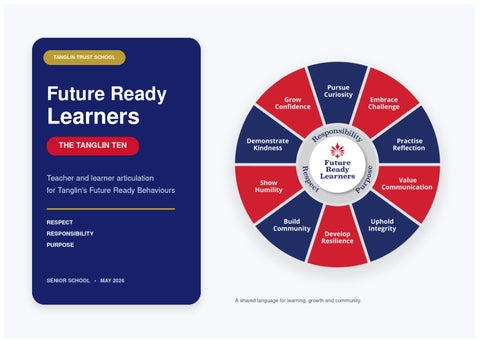
About this framework The Future Ready Behaviours describe the ten dispositions we want every member of the Tanglin community — students and staff alike — to develop and embody. They are anchored in the school’s core values of Respect, Responsibility and Purpose, and informed by leading international research on the competencies young people will need to thrive in the decades ahead, including frameworks from the OECD, UNESCO, the European Commission, the National Research Council and the World Economic Forum. For each behaviour we describe what it looks like for Future-Ready Teachers and Future-Ready Learners — two columns that together form a shared language for how the adults and students at Tanglin work and learn. The framework is also closely aligned with the Great Teaching Toolkit’s A Model for Great Teaching, which underpins the school’s approach to professional learning; specific elements of the Toolkit are referenced in the footnotes where the wording of a behaviour draws on it directly. The Tanglin Ten
Pursue Curiosity
Practise Reflection
Embrace Challenge
Develop Resilience
Demonstrate Kindness
Uphold Integrity
Grow Confidence
Build Community
Value Communication
Show Humility
THE TANGLIN TEN • FUTURE READY BEHAVIOURS • 1
THE TANGLIN TEN • SENIOR SCHOOL
Pursue Curiosity CORE VALUES
PC1: Model a passionate curiosity for learning and subject disciplines to create space for students to share their own interests, nurturing their intrinsic love of learning. Offer challenge beyond the curriculum to deepen and extend that curiosity.
PC1: Pursue interests within and beyond the classroom, finding intrinsic joy in exploring ideas not tied to exams. Follow academic passions, understanding that the most meaningful learning transforms thinking and perspectives, leading to personal growth.
PC2: Teach with strong subject knowledge, deliberate sequencing of ideas, and a clear sense of how today's learning depends on and prepares for what comes next. Remain open to questioning, and design learning that sparks curiosity, anticipates misconceptions, and strengthens understanding.
PC2: Approach learning with curiosity and a willingness to question. Engage with challenge, review misunderstandings, and develop strong understanding by thinking carefully, making connections, and reflecting on feedback.
PC3: Design tasks that invite original ideas, multiple solutions and the generation - not just the consumption - of knowledge.
PC3: Generate original ideas and solutions, treating creativity as a discipline: drafting, refining, combining and improving rather than waiting for inspiration.
PC4: Explicitly teach analytical, evaluative and creative thinking - how to break problems down, weigh evidence, construct reasoned arguments and reach defensible conclusions in every subject. Explicitly teach active questioning and a critical mindset, including evaluating for misinformation.
PC4: Think analytically and evaluatively across every subject - break complex problems down, weigh evidence, construct reasoned arguments and reach conclusions they can defend. Adopt a critical mindset, actively questioning and searching for truth amid misinformation. Value creative thinking in all academic domains.
PC5: Build students' fluency with digital tools, data and AI as both objects of inquiry and aids to learning, helping them use, question and ethically apply emerging technologies.
PC5: Engage thoughtfully with digital tools, data and AI: striving to understand how they work, when they help, when they mislead, and the ethical responsibilities that come with using them.
THE TANGLIN TEN • FUTURE READY BEHAVIOURS • 2
THE TANGLIN TEN • SENIOR SCHOOL
Embrace Challenge CORE VALUES
EC1: Hold high expectations for students' personal growth as well as their learning, encouraging them to take on new roles and experiences that build resilience, adaptability, and confidence.
EC1: Take risks, such as forming new friendships, speaking up in unfamiliar situations, or stepping into leadership roles, understanding that embracing challenge in any form builds confidence, character, and resilience. Proactively seek challenge in all areas of school life, including trying new things, knowing that personal growth happens when things feel difficult.
EC2: Set high expectations - through "high challenge and high trust" and help students understand that meaningful learning happens when the level of challenge is right, modelling this in the classroom by embracing challenge themselves.1
EC2: Approach learning with a willingness to enter the struggle zone, understanding that meaningful learning is desirably difficult.
EC3: Activating hard thinking: lead students toward independence through the judicious use of scaffolding, explanation, questioning, and interaction and encourage students to practise until fluent, review to prevent forgetting. Use questions and dialogue to elicit thinking from every student, evidence learning, and adjust teaching in the moment.2
EC3: Recognise that learning and memory only develop through sustained hard thinking, and that mastery and fluency occurs through consistent practice and review.3
EC4: Design opportunities for students - across academic, pastoral and co-curricular domains - to transfer their learning and problem-solving skills to unfamiliar situations as a deliberately sought form of difficulty.
EC4: Embrace challenge by transferring their learning and problemsolving skills to unfamiliar, complex situations, and between topics and subjects.
1 Robert Coe, C. J. Rauch, Stuart Kime, and Dan Singleton, Great Teaching Toolkit: Evidence Review
(Evidence Based Education, 2020), 6, https://www.greatteaching.com. 2 Coe et al., Great Teaching Toolkit, "Activating hard thinking."
3 Coe et al., Great Teaching Toolkit, "Activating hard thinking."
THE TANGLIN TEN • FUTURE READY BEHAVIOURS • 3
THE TANGLIN TEN • SENIOR SCHOOL
Demonstrate Kindness CORE VALUES
DK1: Establish a culture of empathy, fairness, and care through their language, actions, and expectations, creating environments where students feel supported, respected, and confident to take risks in their learning.
DK1: Act with empathy, respect, and care in their daily interactions, supporting others and making choices that positively impact individuals and the wider community. Reserve judgement, so that risks in learning or contributions from others are supported.
DK2: Model genuine kindness in every interaction with students especially in moments of difficulty or vulnerability - ensuring that relationships are built on trust, warmth, and unconditional positive regard.
DK2: Demonstrate emotional intelligence by recognising and responding thoughtfully to others' feelings, especially during moments of conflict, vulnerability, or difficulty.
DK3: Model upstander behaviour by responding promptly and visibly to unkindness or exclusion, and explicitly teach students how to recognise these moments and act - whether by stepping in or seeking help.
DK3: Take responsibility for the wellbeing of those around them and choose to be an upstander, stepping in or seeking help when they witness unkindness or exclusion.
DK4: Proactively teach emotional intelligence and empathy by creating structured opportunities for students to practise kindness, including through service, not only towards others but also towards themselves.
DK4: Practise self-compassion alongside kindness to others, treating themselves with the same understanding and care they would offer a friend, particularly in times of failure, stress, or uncertainty.
THE TANGLIN TEN • FUTURE READY BEHAVIOURS • 4
THE TANGLIN TEN • SENIOR SCHOOL
Grow Confidence CORE VALUES
GC1: Model confidence by taking thoughtful intellectual and professional risks, openly acknowledging uncertainty, and showing that growth begins with stepping into the unfamiliar.
GC1: Approach new experiences with a willingness to step beyond their comfort zone, recognising that confidence develops through finding the courage to take small, intentional risks.
GC2: Create classroom environments where students feel empowered to share ideas, ask challenging questions, and explore new perspectives without fear of judgement.
GC2: Share ideas, ask questions, and engage with unfamiliar perspectives, even when they feel unsure. Help to create an environment "where it is okay to have a go."4
GC3: Teach students to recognise moments that call for principled action - such as speaking up, challenging unfairness, or advocating for themselves or others - and provide opportunities to practise these behaviours.
GC3: Speak up for themselves and others: be an upstander, challenge unfairness, and make choices that reflect their values.
GC4: Reinforce that confidence grows through action, encouraging students to act with integrity and purpose even when outcomes are uncertain.
GC4: Understand that confidence grows by moving forward despite uncertainty, developing self-belief through everyday moments and when principled action is needed.
4 Coe et al., Great Teaching Toolkit, 23.
THE TANGLIN TEN • FUTURE READY BEHAVIOURS • 5
THE TANGLIN TEN • SENIOR SCHOOL
Value Communication CORE VALUES
VC1: Model thoughtful, empathetic communication by actively listening, choosing language with care, and showing the value of pausing before responding. Demonstrate to students that communication is intentional and respectful.
VC1: Seek to communicate with clarity, consideration, kindness and balance, understanding that words, tone, and body language have power and impact on other people. Always seek to understand before seeking to be understood, and know that others' perspectives are just as valid as our own.
VC2: Create classroom routines that encourage students to articulate ideas clearly, ask considered questions, and respond respectfully to others, building a culture of thoughtful communication.
VC2: Collaborate effectively with others by contributing ideas, responding constructively, and helping create a positive, inclusive environment where everyone feels heard.
VC3: Explicitly teach and model effective communication across written, verbal, digital, and interpersonal contexts, helping students understand that how they communicate matters as much as what they say. Emphasise clarity, kindness, digital etiquette, and the lasting impact of their online choices.
VC3: Practise effective communication across a range of contexts and through a range of forms. Apply equal care to all forms of communication, including online, using clarity, kindness, and digital responsibility to ensure online interactions are thoughtful and respectful.
THE TANGLIN TEN • FUTURE READY BEHAVIOURS • 6
THE TANGLIN TEN • SENIOR SCHOOL
Practise Reflection CORE VALUES
PR1: Regularly reflect on the wellbeing and social dynamics of tutor groups and classes, noticing patterns and adapting pastoral approaches to better support students.
PR1: Regularly pause to reflect on the impact of their own actions on themselves and others. Consider what is working, what could change, and where support might be needed.
PR2: Create structured moments for students to reflect on their emotional wellbeing, relationships, and personal growth through tutor time, guided activities, or one-to-one conversations.
PR2: Act on pastoral feedback with the same openness shown in academic learning, recognising that personal growth happens through friendships, teams, community and service, and through acknowledging our mistakes and being accountable for them.
PR3: Teach responsively by using MIGs and other student data to guide next steps, offering "actionable feedback" so students understand how to improve and where their learning is heading. Explicitly teach students how to respond effectively to the feedback they offer.5
PR3: Use reflection in their learning to choose effective learning strategies. Understand that feedback is essential for improvement and respond actively and positively to guidance from teachers, coaches, and peers, seeking clarification when needed.
PR4: Demonstrate what effective learning looks like through modelling and worked examples to make thinking visible (Explaining), retrieval and spacing to embed learning (Embedding), and self-regulation strategies that put students in charge of their own learning (Activating).6
PR4: Recognise when to apply specific learning strategies across subjects and understand how memory, practice, and the forgetting curve shape long-term learning.
PR5: Teach forward-looking reflection alongside review - explicitly helping students anticipate consequences, weigh likely outcomes before they act, and recognise how today's choices and habits shape the future selves they are becoming.
PR5: Use reflection to look forward as well as back, pausing before key choices to anticipate consequences and weigh likely outcomes, and recognising that today's actions, habits and effort shape the future selves they are becoming.
PR6: Model an open and reflective approach to professional learning by utilising the student surveys and self-reflection and peer surveys tools within the Great Teaching Toolkit. 5 Coe et al., Great Teaching Toolkit, 31. 6 Coe et al., Great Teaching Toolkit, "Activating hard thinking."
THE TANGLIN TEN • FUTURE READY BEHAVIOURS • 7
THE TANGLIN TEN • SENIOR SCHOOL
Develop Resilience CORE VALUES
DR1: Model motivation and perseverance by sharing their own approaches to goal setting, overcoming setbacks, and finding meaning in challenges, building motivation through students' growing sense of "competence, autonomy and relatedness."7
DR1: Set personal goals and take ownership of the steps needed to achieve them, even when progress is slow. Develop healthy routines that support physical and mental wellbeing, recognising that caring for themselves is essential.
DR2: Encourage students to persist when learning feels difficult, acting as a mentor who builds their self-belief, helping students attribute "their success and failure to things they can change" (effort, strategy, supportseeking) rather than fixed ability. Create a calm, purposeful classroom that minimises distractions and explicitly teach the habits that support focus, organisation, and independent work.8
DR2: Hold themselves to high personal standards, knowing that selfdiscipline and ongoing commitment are needed to meet them. Avoid distractions and create an environment that supports focus, understanding that effective study habits are developed through practice and effort. Learn from struggle by pausing, reflecting, seeking support where needed, and trying again with greater insight and understanding.
DR3: Help students develop emotional resilience by talking through how to regulate emotions, recover from difficulty with insight, and treat setbacks as useful information rather than a verdict on their worth. Model adaptability themselves - revising expectations or changing course when circumstances change - so students see it practised by the adults around them, not only described.
DR3: Recognise their emotional responses and build a personal toolkit to help regulate them. Treat setbacks as useful information rather than a reflection of worth, staying adaptable and willing to revise expectations or a different path when circumstances change.
DR4: Foster a pastoral culture where vulnerability is safe and valued, and celebrate effort, recovery, and growth, reinforcing that resilience is built through experience, not innate ability.
DR4: Persist through challenge by learning from setbacks, managing emotions, and showing adaptability when things don't go to plan. Understand that effort, reflection, and support from others help growth.
DR5: Recognise when students' resilience is affected by external factors, such as family, social, or wellbeing concerns, and respond with understanding, appropriate support, and timely referral.
7 Coe et al., Great Teaching Toolkit, 23. 8 Coe et al., Great Teaching Toolkit, 25.
THE TANGLIN TEN • FUTURE READY BEHAVIOURS • 8
THE TANGLIN TEN • SENIOR SCHOOL
Uphold Integrity CORE VALUES
UI1: Model integrity consistently in all professional interactions by being honest, following through on commitments, and showing that doing the right thing matters even when it is difficult. Create spaces that guide students to make principled choices grounded in respect for themselves and others.
UI1: Endeavour to act with integrity in all situations, through honesty, upholding commitments and acting responsibly even when it is difficult. Take responsibility for mistakes, acknowledging them, learning from them, and repairing relationships where needed, so that actions reflect values rather than avoiding consequences.
UI2: Proactively teach students that academic integrity is essential to genuine learning, helping them understand that real growth comes from activity hard thinking. Provide clear tools and strategies that enable students to uphold integrity in their work, including explicit teaching of appropriate uses of digital tools to develop learning, rather than outsource thinking.
UI2: Uphold academic integrity by recognising it as a personal moral responsibility and know that learning does not happen without individual hard thinking. Respect others' intellectual property and understand what constitutes acceptable practice, confidently using strategies and tools including digital tools - that help ensure work is honest and original.
UI3: Set high expectations for personal conduct within co-curricular life, especially through notions of sportsmanship, fairness, and equanimity.
UI3: Show integrity in co-curricular life by respecting rules, accepting decisions from umpires and referees, and responding with calmness and fairness, even when situations feel challenging.
UI4: Model the upholding of our core values of respect, responsibility and purpose.
UI4: Uphold our core values of respect, responsibility and purpose.
THE TANGLIN TEN • FUTURE READY BEHAVIOURS • 9
THE TANGLIN TEN • SENIOR SCHOOL
Build Community CORE VALUES
BC1: Intentionally create inclusive, respectful classrooms where relationships are prioritised, diversity is valued, and every student feels seen, heard, and safe. Build strong, trusting relationships by investing time in understanding each student's context, interests, and needs, fostering a pastoral culture where everyone feels they belong and matter.
BC1: Invest in friendships and community relationships with care and intentionality, taking an active role in shaping the communities they belong to by showing up for others, checking in, and being a reliable, supportive presence. Value diversity and different perspectives, contribute to group success, and take responsibility for creating a safe, inclusive environment where everyone feels they belong. Act as an ally and upstander, helping to resolve tensions and supporting others.
BC2: Model and create opportunities for collaboration and actively strengthen connections between students based on "respect, trust, cooperation and care."9
BC2: Willingly collaborate with peers, understanding that all views are valid, even when they are not aligned with their own. Know that teamwork is an important aspect of building the school community.
BC3: Help students see themselves as members of communities at many scales - class, school, local, national, global, digital and planetary and understand how their choices ripple beyond the immediate.
BC3: Recognise that they belong to communities at many scales - class, school, local, global, digital and planetary - and act with awareness that what they do matters beyond their immediate circle.
BC4: Embed global citizenship and sustainability in everyday teaching: explore real-world issues, engage with cultures and contexts beyond Singapore, and connect curriculum to the social and environmental challenges students will inherit.
BC4: Take an active interest in the wider world and develop cultural intelligence: engage with global and environmental issues, and the lives of people beyond their own context, looking for ways to contribute through service, advocacy, thoughtful participation or making sustainable choices in everyday life.
BC5: Model thoughtful participation in digital communities, helping students understand the responsibilities, etiquette and opportunities of belonging to online networks.
BC5: Develop awareness of the appropriate responsibilities, etiquette and opportunities to participate in digital communities both thoughtfully and meaningfully.
9 Coe et al., Great Teaching Toolkit, 23.
THE TANGLIN TEN • FUTURE READY BEHAVIOURS • 10
THE TANGLIN TEN • SENIOR SCHOOL
Show Humility CORE VALUES
SH1: Model humility in pastoral relationships by being willing to say, "I got that wrong," "I don't have all the answers," or "Thank you for telling me that," showing students that adults continue to grow, learn, and take responsibility too.
SH1: Demonstrate humility by admitting when they are wrong, apologising sincerely when they have caused hurt, and listening to understand rather than to defend themselves.
SH2: Foster a classroom culture where curiosity, reflection, and learning from others are encouraged. Welcome feedback openly, acknowledge when you don't have all the answers, and demonstrate that growth is a shared journey.
SH2: Recognise their strengths and limitations, accept feedback openly, and acknowledge the contributions of others, understanding that learning is shared and ongoing. Embrace mistakes as opportunities to improve, recognising that uncertainty is a natural part of learning.
SH3: Ensure students engage with others' viewpoints respectfully and with open-mindedness, creating learning opportunities that expose them to diverse cultures, perspectives, and ideas.
SH3: Engage with others' perspectives respectfully and with an open mind, knowing that different viewpoints hold value. Seek mentorship, support, and wisdom from others, recognising that learning from those around them is a sign of strength.
SH4: In competitive contexts, model the value of participation, reflection and respect, ensuring we contribute to a warm, inclusive community through learning from defeat, celebrating success graciously and uplift others.
SH4: Accept and learn from defeat, celebrate success graciously, uplift others and contribute to a warm, inclusive community.
THE TANGLIN TEN • FUTURE READY BEHAVIOURS • 11
THE TANGLIN TEN • SENIOR SCHOOL
Methodology & References Methodology note This framework draws on the five international references listed below and on the Great Teaching Toolkit. Initial mapping, synthesis and drafting were supported by an AI assistant (Claude, by Anthropic); all framework claims have been verified against the cited sources, and the final wording, structure and judgements are the school’s. Design of this document has also been supported by an AI assistant (ChatGPT).
References Coe, R., Rauch, C. J., Kime, S. and Singleton, D. (2020) Great Teaching Toolkit: Evidence Review. Evidence Based Education. Available at: https://www.greatteaching.com. Council of the European Union (2018) "Council Recommendation of 22 May 2018 on key competences for lifelong learning", Official Journal of the European Union, C 189, pp. 1-13. International Commission on the Futures of Education (2021) Reimagining Our Futures Together: A New Social Contract for Education. Paris: UNESCO. National Research Council (2012) Education for Life and Work: Developing Transferable Knowledge and Skills in the 21st Century. Edited by J.W. Pellegrino and M.L. Hilton. Washington, DC: National Academies Press. Organisation for Economic Co-operation and Development (2019) OECD Learning Compass 2030: A Series of Concept Notes. Paris: OECD Publishing. World Economic Forum (2025) The Future of Jobs Report 2025. Geneva: World Economic Forum.
THE TANGLIN TEN • FUTURE READY BEHAVIOURS • 12