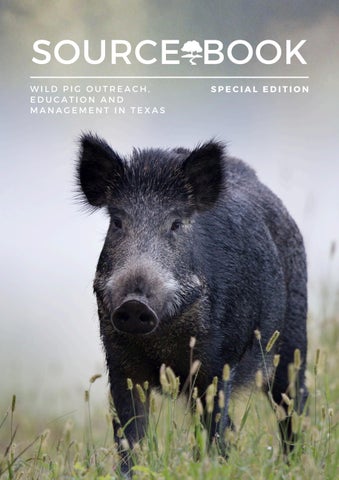
SOURCE BOOK WILD PIG OUTREACH, EDUCATION AND MANAGEMENT IN TEXAS
SPECIAL EDITION
WHERE CONSERVATION AND APPLIED RESEARCH MEET
Each season, the Texas A&M Natural Resources Institute (NRI) publishes a digital collection of recently published peerreviewed scientific publications, research reports, and sciencebased resources developed to support improvements in conservation, natural resource management, and private land stewardship. In this special wild pig outreach edition, we gather together key resources about the ecology and management of invasive wild pigs in Texas. Providing education
to
landowners
about
effective
removal
and
management strategies is crucial to successfully reducing wild pig populations and their impacts on wildlife habitat and agricultural lands. Through outreach and Extension resources, the program has equipped countless Texas landowners and stakeholders with the information they need to effectively manage one of the greatest invasive species in the country.
wildpigs.nri.tamu.edu
ABOUT THE SPECIAL EDITION SOURCEBOOK
2
TABLE OF CONTENTS KEY PROGRAMS Priority watershed education outreach
page 4
County programming
page 5
KEY RESOURCES Extension resources page Blog articles
page 6 pages 7, 8
Webinars and other videos
page 9
Private land stewardship lessons
page 10
KEY EXTENSION PUBLICATIONS Feral hogs negatively affect native plant communities
page 11
Feral hog laws and regulations in Texas
page 12
Feral hogs impact ground-nesting birds
page 13
Feral hog population growth, density and harvest in Texas
page 14
Placing and baiting feral hog traps
page 15
Reducing non-target species interference while trapping wild pigs
page 16
Snaring feral hogs
page 17
Using fences to exclude feral hogs from wildlife feeding stations
page 18
Wild pigs and ticks: implications for livestock production, human and animal health
page 19
Wild pigs negatively impact water quality: implications for land and watershed management
page 20
Disease concerns associated with feral pigs
page 21
Managing feral pigs on small acreage properties and metropolitan areas
page 22
An update on feral pig laws and regulations in Texas
page 23
3
KEY PROGRAMS
PRIORITY WATERSHED EDUCATION OUTREACH In an effort to improve water quality through educational training and outreach materials, NRI’s Wild Pig Outreach Program targets priority watersheds in collaboration with the Texas State Soil and Water Conservation Board (TSSWCB). While additional educational trainings and outreach materials are also provided throughout Texas in non-priority watersheds, preference will be given to the following areas: Priority Areas for Watershed Protection Plans (WPPs) and Total Maximum Daily Load (TMDL) Program Implementation Projects: WPPs Arroyo Colorado Geronimo Creek Plum Creek (Segment 1810) Lampasas River Leon River Mill Creek Double Bayou Navasota River Attoyac Bayou Lavon Lake
TMDLs Copano Bay, Mission and Aransas Rivers (bacteria)
Grant Information Funding for the Texas A&M Natural Resources Institute Wild Pig Outreach Program was provided through a Clean Water 319(h) non-point source grant from the Texas State Soil and Water Conservation Board and the U.S. Environmental Protection Agency. Additional funding was financed through funds from and in cooperation with the San Antonio River Authority. Any opinions, findings, conclusions or recommendations expressed in the content of this website are those of the author(s) and do not necessarily reflect the views of the funding agencies.
4
KEY PROGRAMS
WILD PIG COUNTY PROGRAMMING
AgriLife Extension has an extensive county network, and through County Extension Agents, we offer wild pig educational opportunities across Texas in support of county programs, watershed coordinators, volunteer organizations, and the general public. Trainings can be tailored to the specific needs/concerns of the audience, but are typically offered as either 1-3hour programs or one-day workshops. Programs can be conducted on-site as a demonstration or an outdoor field day, or held at an indoor venue in a classroom-style format. Workshops often involve both a classroom and an outdoor demonstration component. Each hour of educational training (both programming and workshops) can qualify the participant to receive continuing education units (CEUs), depending on the training topic and event. Educational programming is a great way for landowners to gain insight into a variety of wild pig-related topics while also receiving continuing education credits. Topics vary depending on the specific needs of the audience. Examples of the kinds of programs offered include: Program Menu Wild Pig Biology, Impacts and Damage to Watersheds Wild Pig Control Techniques Wild Pig Behavioral Drivers Wild Pig Disease Concerns Wild Pig Trapping: Methods and Emerging Technologies Exclusion Fencing as a Tool for Wild Pig Management Ecology and Management of Wild Pigs Urban Wild Pigs: Biology, Impacts and Control Techniques for Small Tract Landowners Laws and Regulations for Wild Pig Control and Transport Development of an Oral Toxicant for Wild Pigs Wild Pig Trapping Demonstration (Outdoor) Wild Pig Snaring Demonstration (Outdoor)
5
KEY RESOURCES
EXTENSION RESOURCES
ACCESS THE RESOURCES PAGE AT
The Feral Pig Extension Resources page provides a comprehensive collection of educational materials, research findings, and management resources developed by NRI— available at a single link. Quickly access our library of YouTube videos, Extension publications in both English and Spanish, and our wild pig and NRI social media channels.
bit.ly/m/feralpigextension
6
KEY RESOURCES
BLOG ARTICLES
Activity Patterns and Behavioral Modifications of Feral Swine in North America and Eurasian Boar in Europe: As growing populations of wild pigs encroach upon an expanding humanwildland interface, there is increased potential for these animals to interact with humans. The success of control efforts often depends on an understanding of their activity patterns and behavioral modifications in response to environmental and human pressure. A wild pig interview with students: In this interview, conducted by a high school and college student, we answered questions that encapsulated the wild pig problem and thoughtfully considered the future of wild pig management. Maintaining the Beauty of the Land: Mitigating the Scars Left Behind by Wild Pigs: Our partners at Long Acres Ranch write about the strategies they have implemented, including the trials and errors of trapping, to heal land that has been devastated by invasive wild pigs. Wild Pig and Human Interactions: This article explores research conducted on human-wild pig interactions, to separate the facts from more sensationalized reports of wild pigs being aggressive towards humans and companion animals.
ACCESS ALL OUR ARTICLES ON MEDIUM medium.com/@tamu-nri
The Effects of Abatement Efforts on Wild Pig Behavior: This article discusses various effects abatement techniques can have on wild pig behavior, and recommends strategies that can help to minimize behaviors including trap aversion and escape when enacting control efforts.
7
KEY RESOURCES
BLOG ARTICLES
Are Wild Pigs Safe to Eat?: What happens when a landowner’s management practices bring them to ask, "Are wild pigs safe to eat?" An Evaluation of Contraceptive Viability in Wild Pig Management: This article highlights research that has been conducted on wildlife fertility control, and discusses the challenges that can potentially limit the success of birth control within free-ranging populations of wild pigs. A Strategic Approach to Wild Pig Management: Research conducted on successful wild pig abatement efforts found that the order in which management strategies are implemented can significantly impact their success. This article details considerations for when and how to enact control measures for wild pigs. Why feral pig management is essential for new landowners: As Texas rapidly urbanizes, there is an urgent need for modernized feral pig management strategies. Using exclusion fencing to prevent feral hog access at feeding stations: The success of rapidly growing populations of wild pigs comes at the expense of native wildlife. They often compete with white-tailed deer and exotic livestock species at feeders. This article details the installation of exclusion fences to prevent feral pigs from accessing feed intended for other species.
8
KEY RESOURCES
Wild Pig Management Video Series: Exclusion Fencing for Feral Hogs Around Wildlife Feeders Loading Wild Pigs for Transport How to Build a Figure-C Feral Hog Trap Low Cost DIY Bait Barrel for Wild Pigs Conducting Wild Pig Stream Surveys Are Wild Pigs Safe To Eat Wild Pig Backstraps the Quick Way Wild Pig Biology and Behavior Wild Pigs and Water Sources Wild Pigs and Riparian Habitats Wild Pig Damage in Texas Wild Pig Distribution and Impacts in Texas Wild Pig Hunting VS Strategic Shooting Wild Pig Hunting VS Strategic Shooting II Wild Pig Regulations, Laws and Control in Texas Feral Hog Biology Basics Feral Hogs Impacts on Agriculture and Wildlife in Texas Strategic Shooting of Feral Hogs for Population Control Understanding Wild Pig Wallowing Behavior Private Lands Stewardship Webinar – Wild Pigs Negatively Impact Water Quality Tackling Feral Hogs in Fragmented Landscapes
WEBINARS & VIDEOS
ACCESS ALL OUR VIDEOS ON YOUTUBE Texas A&M Wildlife and Fisheries Extension Texas A&M Natural Resources Institute
9
KEY RESOURCES
PRIVATE LAND STEWARDSHIP LESSONS NRI launched a series of virtual Private Land Stewardship (PLS) lessons to support the Institute’s efforts in promoting private land stewardship. The following lessons focus on wild pig ecology, life history, management strategies, and other topics of interest.
How to Use the Wild Pig Reporting Tool—Learn how to use our innovate method of reporting wild pig sightings and damages in real-time, from anywhere in the world. The Differences Between Wild Pigs and Javelinas—Javelinas are a native species that often get mistaken for invasive wild pigs. Learn how to tell the two species apart using taxonomy, distribution, and anatomy. Wild Pig Biological and Behavioral Drivers—This course provides practical considerations for selecting management strategies for wild pigs based on some of their behavioral and biological drivers. Field to Table Safety Precautions for Wild Pigs—Learn how to minimize risks associated with wild pig management as well as field and food safety when processing or consuming wild pigs. Exclusion Fencing for Wild Pig Management—This course covers an overview of research-based information on the efficacy and strategy involved in using exclusion fencing. Interspecific Competition Between Invasive Wild Pigs and White-Tailed Deer—This course covers an overview of researchbased information of the potential impacts that wild pigs have on white-tailed deer through interspecific competition.
ACCESS ALL PLS LESSONS AT NRI.TAMU.EDU/LEARNING
CITATION Texas A&M Natural Resources Institute. (Year). Private Land Stewardship Education (Name of Lesson). (Lesson Code). Retrieved from https://nri.tamu.edu/learning/ .
10
KEY EXTENSION PUBLICATIONS
FERAL HOGS NEGATIVELY AFFECT NATIVE PLANT COMMUNITIES INTRODUCTION Landowners face many challenges as they manage their land for agricultural uses and wildlife habitat. Droughts, flooding, and invasive species are major hindrances that landowners must account for to maximize productivity on their property. One invasive species in particular, feral hogs (Sus scrofa), are a significant economic burden to landowners due to their destructive feeding and wallowing habits that cause damage to pastures and crops (Figure 1). Also, feral hogs compete with wildlife species for available resources which can take an economic toll on landowners who manage their land for wildlife.
SUMMARY
AUTHORS: JARED B. TIMMONS BLAKE ALLDREDGE WILLIAM E. ROGERS JAMES C. CATHEY CITATION Timmons, J.B., B. Alldredge, W.E. Rogers, and J.C. Cathey. 2012. Feral Hogs Negatively Affect Native Plant Communities. Texas A&M AgriLife Extension, IRNR-PU-031.
This publication presents research conducted in the Big Thicket National Preserve to determine the effects of wild pigs on native plant communities, as well as management recommendations to reduce the impact of wild pigs on these communities.
ACCESS THE PUBLICATION
11
KEY EXTENSION PUBLICATIONS
FERAL HOG LAWS AND REGULATIONS IN TEXAS INTRODUCTION Landowners in the Plum Creek Watershed of Hays, Caldwell, and Travis counties are frustrated with the destructive habits of feral hogs. Landowners want to know who owns feral hogs and when that person or agency will get rid of them. In the end, they may be surprised by the answer. Landowners own the feral hogs that occupy their property! Feral hogs originated from domestic sources and were first introduced into the U.S. by early explorers and settlers as a food source. Subsequent escapes from holding pens or intentional releases resulted in a free-ranging population currently estimated to be between 1.9 and 3.4 million in Texas alone. Feral hogs are not a game or non-game species in Texas. Instead, feral hogs are considered exotic livestock as described in Texas Parks and Wildlife Code Section 1.101(4) and Texas Agriculture Code 161.001(a) [4]. Because of this distinction, they fall under the ownership of the landowner and not the citizens of the state according to the Texas Agriculture Code Section 161.002.
AUTHORS: JARED TIMMONS JAMES C. CATHEY NIKKI DICTSON MARK MCFARLAND
SUMMARY This publication clarifies the legal control options and hunting license requirements for wild pigs in the state of Texas.
CITATION Timmons, J., J.C. Cathey, N. Dictson, and M. McFarland. 2012. Feral Hog Laws and Regulations. Texas A&M University AgriLife Extension, IRNR-PU-005.
ACCESS THE PUBLICATION
12
KEY EXTENSION PUBLICATIONS
FERAL HOGS IMPACT GROUND-NESTING BIRDS INTRODUCTION Landowners in the Plum Creek Watershed of Hays, Caldwell, and Travis counties are aware of the damage that feral hogs can cause to crops and pastures. Many also realize that feral hogs compete with native wildlife for food sources. Typically, feral hogs are not thought of as predators, but they fill that role as well. Feral hogs are opportunistic omnivores, meaning they eat whatever plant and animal matter is available. Eggs of ground-nesting birds like northern bobwhite and wild turkey are on their menu.
SUMMARY
AUTHORS: JARED TIMMONS JAMES C. CATHEY DALE ROLLINS NIKKI DICTSON MARK MCFARLAND
This publication discusses the results of two research studies on the effect of wild pigs on the nest success of ground-nesting birds like northern bobwhite (Colinus virginianus) and wild turkeys (Meleagris gallopavo).
CITATION Timmons, J. J.C. Cathey, D. Rollins, N. Dictson, and M. McFarland. 2011. Feral Hogs Impact Ground-nesting Birds. Texas A&M University AgriLife Extension, IRNR-PU-029.
ACCESS THE PUBLICATION
13
KEY EXTENSION PUBLICATIONS
FERAL HOG POPULATION GROWTH, DENSITY AND HARVEST IN TEXAS INTRODUCTION
AUTHORS: JARED B. TIMMONS BILLY HIGGINBOTHAM ROEL LOPEZ JAMES C. CATHEY JANELL MELLISH JONATHAN GRIFFIN AARON SUMRALL KEVIN SKOW CITATION Timmons, J.B., B. Higginbotham, R. Lopez, J.C. Cathey, J. Mellish, J. Griffin, A. Sumrall, and K. Skow. 2012. Feral Hog Population Growth, Density and Harvest in Texas. Texas A&M University AgriLife Extension, IRNR-PU-025.
Domestic pigs were introduced to North America into what is now the United States in the 1500s. They were beneficial to early explorers and settlers because of their importance as a reliable meat source and their hardiness in adverse environments. Domestic pigs were either held in pens or allowed to freerange to forage. Pigs escaping from these practices lead to the initial establishment of wild populations and more recent translocations for hunting purposes led to further establishment of wild populations, which today threaten agricultural production, native wildlife, and water quality. As feral hog populations continue to spread, agricultural and environmental damage has increased (Figure 1). Feral hogs cause at least $52 million in agriculture losses each year in Texas. This free-ranging, non-native, invasive species exhibits the highest reproductive capability of any hoofed animal, which makes population reduction difficult.
SUMMARY This publication provides information on the density and growth estimate of Texas wild pig populations. The population model used estimates that population reduction measures need to increase dramatically; up to 66% of the population will need to be removed annually for 5 years or more to stabilize population growth numbers.
ACCESS THE PUBLICATION
14
KEY EXTENSION PUBLICATIONS
PLACING AND BAITING FERAL HOG TRAPS INTRODUCTION The increasing numbers of feral hogs in Texas are harming water quality, landscapes, gardens, native plant and animal communities, and agricultural production in many areas of the state. Two keys to success in managing feral hogs are trap placement and pre-baiting. The landowner or manager must thoroughly understand the foraging behaviors and travel patterns of feral hogs. Control efforts will be more effective if local conditions and feral hog behavior are properly interpreted.
SUMMARY This publication explains how to increase your chances of capturing wild pigs by placing and baiting traps properly, and includes a wild pig bait recipe.
AUTHORS: CHANCEY LEWIS MATT BERG NIKKI NICTSON JIM GALLAGHER MARK MCFARLAND JAMES C. CATHEY CITATION Lewis, C., M. Berg, N. Dictson, J. Gallagher, M. McFarland, and J.C. Cathey. 2022. Placing and Baiting Feral Hog Traps. Texas A&M University AgriLife Extension, IRNR-PU-060.
ACCESS THE PUBLICATION
15
KEY EXTENSION PUBLICATIONS
REDUCING NON-TARGET SPECIES INTERFERENCE WHILE TRAPPING WILD PIGS INTRODUCTION
AUTHORS: JOSH HELCEL MARK TYSON JAMES CASH JAMES C. CATHEY CITATION Helcel, J., M. Tyson, J. Cash, and J.C. Cathey. 2017. Reducing Non-target Species Interference While Trapping Wild Pigs. Texas A&M University AgriLife Extension, IRNR-PU-009.
ACCESS THE PUBLICATION
Expanding populations of invasive wild pigs (Sus scrofa) in the U.S. adversely affect water quality, agricultural production, livestock, and native wildlife and their habitats (Seward et al. 2004). Domestic swine were introduced to North America in the early 1500s. Pigs that escaped or those unrecovered from free-range farming practices established feral populations. Additionally, Eurasian wild boar released in the early 1900s for hunting purposes further contributed to established populations in the U.S. The marked increase in wild pig abundance and distribution over the last 30 years is due in part to the adaptability and high reproductive success of these animals, but is also related to indiscriminate and sometimes illegal stocking. These actions led to the widespread populations observed today (Wood and Barrett 1979, Whitaker 1988). Perhaps seen as benign at one time, the introduction of this exotic species now causes concern. Wild pig populations currently number in the millions and can be found in 39 U.S. states, and agricultural and other associated damages are estimated to exceed $1.5 billion annually (Pimental 2007). Legal control efforts include non-lethal means such as exclusion and electrified fencing (Reidy 2007), and lethal means such as trapping, snaring, shooting, aerial gunning, and the use of trained dogs (Sweeney et al. 2003). In the U.S., it is currently illegal to use toxicants to reduce wild pig numbers; however, there is ongoing research to understand its use and delivery. Introduction continues; see full publication.
16
KEY EXTENSION PUBLICATIONS
SNARING FERAL HOGS INTRODUCTION Feral hog populations across Texas are damaging water quality, wildlife habitat, home landscapes, and agricultural production. To manage these animals effectively, landowners and managers must deploy a diverse set of approaches. In situations where capturing a small number of animals inexpensively and with little maintenance is desirable, snares can be a key component of a larger control strategy.
SUMMARY
AUTHORS: CHANCEY LEWIS MATT BERG NIKKI DICTSON JIM GALLAGHER MARK MCFARLAND JAMES C. CATHEY
This publication lists the advantages and disadvantages of using snares to capture wild pigs; it includes discussions on snare design, preparation, snare sets, and methods to avoid capturing non-target snimals.
CITATION Lewis, C., M. Berg, N. Dictson, J. Gallagher, M. McFarland, and J.C. Cathey. 2022. Snaring Feral Hogs. Texas A&M University AgriLife Extension, IRNR-PU-069.
ACCESS THE PUBLICATION
17
KEY EXTENSION PUBLICATIONS
USING FENCES TO EXCLUDE FERAL HOGS FROM WILDLIFE FEEDING STATIONS INTRODUCTION
AUTHORS: JARED TIMMONS JUSTIN RATTAN TYLER CAMPBELL DAVID LONG BILLY HIGGINBOTHAM DUANE CAMPION MARK MCFARLAND NIKKI DICTSON JAMES C. CATHEY CITATION Timmons, J., J. Rattan, T. Campbell, D. Long, B. Higginbotham, D. Campion, M. McFarland, N. Dictson, and J.C. Cathey. 2022. Using Fences to Exclude Feral Hogs from Wildlife Feeding Stations. Texas A&M University AgriLife Extension, IRNR-PU-072.
Research conducted in the South Texas Brush country has found that exclosure fences are an effective way to keep feral hogs from eating corn and supplemental feeds that are intended for other animals. These fences protect corn and protein pellets from feral hogs and though labor intensive, they will pay for themselves in feed savings. (Fig. 1A) Wildlife managers and hunters manage many properties for whitetailed deer. They use corn as feed and as bait to attract them into hunting areas. They also provide supplemental feed such as protein pellets in order to increase antler scores, body weights, survival and fawn production. Hunters and land managers put out thousands of tons of corn each year and though most of this corn is intended for deer, feral hogs consume a substantial portion of it (Fig. 1B). Hogs also are detrimental to other game species such as groundnesting birds like quail and wild turkey.
SUMMARY Wild pigs will consume a substantial portion of feed placed by hunters and land managers if it is not protected. This publication explains current research findings and details how to build fences that will exclude wild pigs, but still allow deer and other wildlife to access feeding stations.
ACCESS THE PUBLICATION
18
KEY EXTENSION PUBLICATIONS
WILD PIGS AND TICKS: IMPLICATIONS FOR LIVESTOCK PRODUCTION, HUMAN AND ANIMAL HEALTH INTRODUCTION
AUTHORS: JOSH HELCEL PETE TEEL MARK TYSON JAMES CASH TERRY HENSLEY JAMES C. CATHEY
CITATION Helcel, J. P. Teel, M. Tyson, J. Cash, T. Hensley, and J.C. Cathey. 2016. Wild Pigs and Ticks: Implications for Livestock Production, Human and Animal Health. Texas A&M University AgriLife Extension, IRNR-PU-074.
Agricultural damage, habitat degradation, water quality issues, and potential for infectious and vector-borne disease transmissions associated with wild pigs (Sus scrofa) concern natural resource managers and agricultural producers in TX and the U.S. The problems we face today date back to early translocations of this animal. Domestic swine were introduced to North America in the 1500s as a reliable food source, and husbandry practices allowed pigs to range freely for forage, leading to the eventual establishment of feral populations (Wood and Barrett 1979). Intentional releases of Eurasian wild boar during the 20th century were done for recreational purposes, and these actions also contributed to feral populations in the U.S. (Wood and Barrett 1979). In Texas, Eurasian wild boar were occasionally released on hunting preserves in Aransas, Bexar, and Calhoun counties from 1930 to 1940. Some of these animals escaped and interbred with wild pigs originating from domestic stock (Whitaker 1988). Today, wild pigs can be found in most regions of the U.S. and occupy 39 of 50 states (Fogerty 2007), as a result of intentional (illegal) and accidental releases. In Texas, an estimated 2.6 million wild pigs can be found in all 10 ecological zones (Rollins et al. 2007) and 234 of 254 counties in Texas (Timmons et al. 2012). A number of factors including high reproductive capacity, life expectancy, intelligence, and adaptability contributed to the continued population growth of wild pigs in TX and in the U.S. (Mungall and Sheffield 1994). Introduction continues; see full publication.
ACCESS THE PUBLICATION
19
KEY EXTENSION PUBLICATIONS
WILD PIGS NEGATIVELY IMPACT WATER QUALITY: IMPLICATIONS FOR LAND AND WATERSHED MANAGEMENT INTRODUCTION Growing populations of wild pigs (Sus scrofa) pose a challenge to both landowners and wildlife managers by threatening crop and livestock production, as well as native wildlife and their habitat. While these concerns are commonly known, the impacts of wild pigs on water quality are less apparent.
AUTHORS: JOSH HELCEL FORREST COBB JAMES C. CATHEY CITATION Helcel, J., F. Cobb, and J.C. Cathey. 2018. Wild Pigs Negatively Impact Water Quality: Implications for Land and Watershed Management. Texas A&M University AgriLife Extension, IRNR-PU-011.
Introduced to North America in the 1500s as a reliable food source by early European settlers, free-ranging domestic pigs established initial feral populations. Later, the Eurasian wild boar was released primarily onto hunting preserves in the early 1900s, but they escaped to hybridize with free-ranging pig populations. Intentional (illegal) and accidental releases since have further contributed to wide-ranging and growing wild pig populations. In Texas, these animals are classified as free-ranging exotic livestock and regulatory authority falls primarily under the jurisdiction of the Texas Animal Health Commission, who established rules regarding their transportation and release. Today, wild pigs occur in 3 varieties: feral hogs (those originating of domestic stock), Eurasian boar, and domestic-Eurasian hybrids. Introduction continues; see full publication.
ACCESS THE PUBLICATION
20
KEY EXTENSION PUBLICATIONS
DISEASE CONCERNS ASSOCIATED WITH FERAL PIGS INTRODUCTION
AUTHORS: JOSH HELCEL JAMES LONG JAMES C. CATHEY
CITATION Helcel, J., J. Long, and J. Cathey. 2024. Disease concerns associated with feral pigs. ENRI-006. Texas A&M Natural Resources Institute, Texas A&M AgriLife Extension, College Station, Texas, USA. https://nri.tamu.edu/publications/extension -publications/2024/disease-concernsassociated-with-feral-pigs/.
Negative impacts associated with feral pigs (Sus scrofa) extend to agricultural production, water quality, habitat, native species, the humanwildland interface and beyond. Their populations continue to expand across North America and occur today on every continent except Antarctica. Further, they transmit diseases to livestock, native and exotic wildlife species, companion animals and even humans. Feral pigs harbor at least 65 bacterial, viral or parasitic infectious agents and threaten agricultural production, agricultural supply chains, and public health. In this publication, we address disease concerns endemic to feral populations and domestic pig herds throughout North America and abroad. We also provide management implications and safety precautions to help minimize the risk of disease transmission when handling or processing feral pigs or when using outdoor areas where feral pigs may be present.
ACCESS THE PUBLICATION
21
KEY EXTENSION PUBLICATIONS
MANAGING FERAL PIGS ON SMALL ACREAGE PROPERTIES AND METROPOLITAN AREAS INTRODUCTION One of the many challenges facing new and established Texas landowners is the battle against feral pigs (Sus scrofa; hereafter feral pigs), given the damage they cause. They are known by many names, such as feral pigs, wild pigs, wild hogs, wild boars, and razorbacks, and are recognized as a highly adaptable, invasive exotic species. Feral pig is a term used to describe three groups in North America: 1) feral pigs (those originating from domestic swine), 2) Eurasian boar (those imported from Europe), and 3) hybrids of the two. Domestic swine were introduced to North America by Spanish explorer Hernando de Soto in 1539, and later introductions were made in Mexico by Hernando Cortez in 1600.
AUTHORS: JAMES LONG JAMES C. CATHEY LARRY REDMON ROEL LOPEZ
CITATION Long, J., J. Cathey, L. Redmon, and R. Lopez. 2025. Managing feral pigs on small acreage properties and metropolitan areas. Texas A&M Natural Resources Institute, College Station, Texas, USA. https://nri.tamu.edu/publications/extension -publications/2025/managing-feral-pigson-small-acreage-properties-andmetropolitan-areas/.
Since then, feral pig populations have grown; exact numbers are hard to determine, but research puts their current population in the millions. Because of their invasive characteristics and rapid population growth, they can cause damage to agricultural production, affect water quality, and compete with native animals and livestock. In 2024, agricultural losses from feral pig activity exceeded $670 million, and landowners across Texas are spending more than $130 million on control costs. Introduction continues; see full publication.
ACCESS THE PUBLICATION
22
KEY EXTENSION PUBLICATIONS
AN UPDATE ON FERAL PIG LAWS AND REGULATIONS IN TEXAS INTRODUCTION Feral pigs are widely considered one of the most invasive species that Texans battle across the state. They are opportunistic omnivores, meaning they consume both plant and animal matter, and can thrive in a wide array of habitats. Early Spanish explorers brought domestic pigs to America aboard their ships as a food source in the 1500’s. Since that time, and with more Europeans settling in the New World, pig escapes from holding pens and intentional releases have created the original populations that landowners are battling today. Today, the estimated population of feral pigs in Texas is more than 3 million. Female feral swine have been documented to breed and conceive at 6 months of age. With a gestation period of 115 days, they can rapidly increase the population, causing more damage to the landscape. AUTHORS: RYLAND WIEDING JAMES LONG BRITTANY WEGNER TY WERDEL JAMES C. CATHEY CITATION Wieding, R., J. Long, B. Wegner, T. Werdel, and J. Cathey. 2026. An update on feral pig laws and regulations in Texas. Texas A&M Natural Resources Institute, College Station, Texas, USA. https://nri.tamu.edu/publications/extension -publications/2026/an-update-on-feral-piglaws-and-regulations-in-texas/.
Feral pigs are considered exotic livestock, and according to the Agriculture code 161.002, if exotic livestock are trapped or controlled, cared for, or marked or branded, that person assumes the role of caretaker and owner of the exotic livestock. In this scenario, feral pigs that are trapped, placed in a pen, and cared for are the person's responsibility, and the person must manage them accordingly. Because of this distinction, landowners can manage feral pigs on their properties through reduction practices or sale.
ACCESS THE PUBLICATION
23
SOURCE BOOK WILD PIG OUTREACH, EDUCATION AND MANAGEMENT IN TEXAS
SPECIAL EDITION
TAMU-NRI.MEDIUM.COM
nri.tamu.edu @tamu_nri