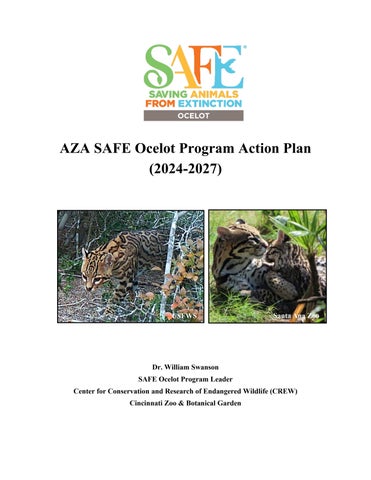
AZA SAFE Ocelot Program Action Plan (2024-2027)
USFWS
Santa Ana Zoo
Dr. William Swanson SAFE Ocelot Program Leader Center for Conservation and Research of Endangered Wildlife (CREW) Cincinnati Zoo & Botanical Garden
Table of Contents Conservation Target
3
Conservation Status of Texas Ocelots
3
Recovery Program
4
SAFE Program Vision and Plan Goal
6
Program Operational Structure
6
Objectives and Actions
8
Recommended Program Plan Reviewers
15
Building on AZA Commitments
15
Status of taxon within AZA community
15
AZA conservation and stakeholder engagement activities
17
AZA public awareness activities
18
Program Summary Table
18
References
21
CZBG 2
Conservation Target Ocelots (Leopardus pardalis) are one of six cat species included within the Leopardus genus, based on taxonomy and genetic analyses. On the subspecies level, multiple classification revisions have occurred over time, with taxonomists initially describing 11 subspecies that were reduced to 4 to 5 subspecies following phylogenetic studies. Most recently, ocelots were suggested to comprise one northern and one southern subspecies (L. p. pardalis, southwestern US, Mexico, Central America; L. p. mitis, South America) through a synthesis of taxonomic, genetic and ecological data (Kitchener et al., 2017). The name “Texas ocelot” is a common, colloquial term for the small subpopulation of L. p. pardalis that inhabits southern Texas. The Texas ocelot is the target population for proposed conservation activities described in this SAFE Ocelot Program Action Plan.
Conservation Status of Texas Ocelots On a species level, ocelots (Leopardus pardalis) are listed as Least Concern on the Red List by the International Union for Conservation of Nature (IUCN; Paviolo et al., 2015). The species has a broad range extending from the southern United States southward through Central and South America, terminating in northern Argentina and Uruguay. Although some regional populations are declining, fairly robust ocelot numbers exist within tropical rain forest and other habitat types in Latin America. Ocelots remain listed on Appendix I of the Convention of International Trade in Endangered Species (CITES), reflecting the drastic reduction in ocelot populations that occurred throughout their natural range due to the fur and pet trade peaking in the 1960’s and 1970’s. Similarly, ocelots in the United States have been listed as Endangered by the USFWS and Texas Parks and Wildlife Department. Within the US, ocelots historically existed across the breadth of Texas, extending from the southern Texas- Mexico border northward into Oklahoma and Arkansas and eastward into Louisiana, with a separate subpopulation stretching into southern Arizona from Sonora (Haines et al., 2005). Over the past 200 years, Texas ocelots have experienced pronounced declines, primarily due to habitat loss and fragmentation, with the only extant breeding populations (<120 cats) barely surviving, with declining genetic diversity, in disjunct thornscrub habitat in southern Texas. The Texas population no longer has any physical connectivity or genetic exchange with ocelots found in northern Mexico. The Texas ocelot is the most endangered wild felid species in the US. 3
Haines et al., 2005
Historic and Current Range of Texas Ocelots Recovery Program The initial recovery plan for the Texas ocelot was published by the USFWS in 1990, shortly after the species was listed as endangered in 1982 and confirmed as an extant wild population in southern Texas through ecological research in the early 1980’s (Tewes and Everett, 1986; USFWS, 1990). The primary focus of the first recovery plan was preservation of ocelot habitat and initiation of broader ecological studies but with no provisions for ex situ breeding or management. Continued declines in population numbers over subsequent decades led to the first revision of the recovery plan in 2016, with a primary focus still on ecological research and habitat preservation, but also addressing the importance of habitat restoration and connectivity as well as the possible roles of ex situ breeding and management (3.1.6), semen banking and assisted reproduction (3.1.5), and the reintroduction of ocelots into
4
their historical range in Texas (3.3/3.4; USFWS, 2016). The 2016 Recovery Plan also emphasized development and implementation of education and outreach programs to raise conservation awareness and concern about Texas ocelots (4.3). These latter revisions created the opportunity for the zoo conservation, research and education community to take a more active role in Texas ocelot recovery. Under the 2016 USFWS Recovery Plan, the downlisting criteria require, in part, for the Texas population to grow to at least 200 ocelots, with most existing in a single metapopulation or dispersed between two interconnected subpopulations. During the past three years, a Texas Ocelot Recovery Project has been developed through multi-institutional collaboration involving the Cincinnati Zoo’s Center for Conservation and Research of Endangered Wildlife (CREW), AZA’s Ocelot SSP, East Foundation, Texas A&M University- Kingsville, Texas A&M Natural Resources Institute, Duquesne University, US Fish and Wildlife Service and Texas Parks and Wildlife Department. More detailed information about the Texas Ocelot Recovery Project is available through their dedicated website (https://recovertexasocelots.org/manual-for-breeding-and-reintroduction) and a recent overview of the recovery project has been published in the IUCN Cat Specialist Group journal, Cat News (Swanson et al, 2025). The key focus of this collaboration is to establish new wild ocelot populations on historical, but currently unoccupied, ocelot habitat located on vast ranchlands in southern Texas. Using assisted reproduction and natural breeding, the goal is to produce ocelot kittens comprising at least 75% northern ocelot ancestry (i.e., L. p. pardalis) with remaining genetic variation derived from the more diverse ocelot population in AZA zoos. For ocelot breeding and rewilding, an Ocelot Conservation Facility began construction in early 2025 on Texas A&M University – Kingsville property with full funding ($20 million) provided by an anonymous private donor. The Ocelot Conservation Facility will include a veterinary science building, breeding facility (for up to 8 ocelot pairs) and a rewilding facility. Offspring born at the breeding facility (with at least 75% northern ocelot ancestry) would transfer with their dams to the rewilding facility followed by soft release as young adults onto the East Foundation’s San Antonio Viejo ranch. After acclimation, ocelots would be reintroduced into the wild onto this expansive property (150,000 acres) selected specifically for its habitat suitability (Martinez et al., 2024). A Programmatic Safe Harbor agreement was recently established between the East Foundation and USFWS to permit ocelot reintroduction onto this ranchland. Initial financial support for this long-term recovery program has been obtained 5
through a five-year contract ($12.1 million) to Texas A&M University – Kingsville from the US Fish and Wildlife Service, supported by Customs and Border Control Protection funding. Subcontracts have been awarded to the East Foundation and CREW to support ex situ propagation and management in the Ocelot Conservation Facility and in AZA-affiliated zoos.
Ocelot Conservation Facility (Texas A&M University-Kingsville) SAFE Program Vision The vision of the SAFE Ocelot program is for wild populations of Texas ocelots to thrive and expand their distribution and numbers within their historical natural range in Texas over the next 50 years and benefit from increased awareness and conservation support from people living in local Texas communities. SAFE Program Plan Goal The two main goals of the SAFE Ocelot Program Plan are to 1) provide our field partners in Texas with the necessary resources (ocelot source breeding population, husbandry, reproductive and population management knowledge and expertise, funding) to propagate, rewild and reintroduce ocelots into historically occupied natural habitat on Texas ranchlands and 2) help educate Texans in local communities about the Texas ocelot recovery program to raise awareness and engender support for continued ocelot conservation.
Program Operational Structure Collaborating institutions participating in Ocelot SAFE include a diversity of organizations within the zoological field in the US and Brazil as well as others involved in agricultural research, federal and state wildlife regulatory oversight, and university-based ecological and 6
genetic studies. The Cincinnati Zoo & Botanical Garden has been an active participant in ocelot breeding through the Ocelot SSP and ocelot conservation research through the Zoo’s Center for Conservation and Research of Endangered Wildlife for the past 25-30 years. The other seven Program Partner zoos also actively participate as breeding institutions within the Ocelot SSP and have collaborated with CREW on ocelot assisted reproduction procedures at their institutions. Two major Field Partners are the East Foundation (www.eastfoundation.net ), an Agricultural Research Organization based in San Antonio, Texas, that investigates the compatibility of agricultural practices, including cattle ranching, with wildlife conservation while promoting responsible land stewardship, and the Caesar Kleberg Wildlife Research Institute (www.ckwri.tamuk.edu ) at Texas A&M University in Kingsville, Texas, that conducts broadbased ecological research with ocelots and other native Texas wildlife species. Our Brazilian Field Partner, the Associação Mata Ciliar, leads research, education, rescue/rehabilitation and habitat restoration programs for ocelots and other wildlife in Brazil and is a key partner in our efforts to import new founders for US zoos and introduce greater genetic diversity into the Texas ocelot recovery population. Role
Representative
Institution
Title
Email Address
Cincinnati Zoo & Botanical Garden Cincinnati Zoo & Botanical Garden Oklahoma City Zoo & Botanical Garden Audubon Zoo
Director of Animal Research Senior Zoo Keeper
william.swanson@cincinnatizoo.org
Curator of Carnivores
tboyd@okczoo.org
Curator of Primates, Louisiana Swamp and Jungle Jaguars Director of Mammals
lwilson@auduboninstitute.org
Program leader/ Program partner
Dr. William Swanson
SSP coordinator/Vice program leader Steering committee/ Program partner
Laura Carpenter
Steering committee/ Program partner
Liz Wilson
Steering committee/ Program partner Steering committee/ Program partner Program partner
Rachel Malstaff
San Antonio Zoo
Dr. Nick Kapustin
Greenville Zoo
Zoo Veterinarian
nkapustin@greenvillesc.gov
Scotty Stainback
Caldwell Zoo
sstainback@caldwellzoo.org
Program partner
John Register
Houston Zoo
Curator of Mammals Curator, Hoofstock
Tyler Boyd
7
laura.carpenter@cincinnatizoo.org
rachel.malstaff@sazoo.org
jregister@houstonzoo.org
Program partner
and Carnivores Registrar
Jessica Mandelson Valeria Hernandez
Salisbury Zoo
Husbandry advisor
Ken Kaemmerer
Pittsburgh Zoo (retired)
Genetics advisor
Dr. Jan Janecka
Duquesne University
AZA SAFE liaison Field Partners
Katherine Hess
Zoo America
Dr. Ashley Reeves Lindsay Martinez
East Foundation
Dr. Lisanne Petracca
Texas A&M University Kingsville
Brittany Wegner
Dr. Grant Harris
Texas A&M Natural Resource Institute Associação Mata Ciliar (Brazil) USFWS
Laura de la Garza
USFWS
Daniel Kunz
Texas Parks and Wildlife Department
Education liaison
Dr, Cristina Harumi Adania
Houston Zoo
East Foundation
jmandelson@salisbury.md
Teens Program Coordinator Former Curator of Mammals Associate Professor, Biological Sciences Curator of Animal Care
vahernandez@houstonzoo.org
Research Veterinarian Research Program Coordinator Assistant Professor, Carnivore Ecology Public Outreach/ Media Relations Fauna Coordinator
areeves@eastfoundation.net
Chief, Biological Sciences Regional Office Ocelot Species Lead/Wildlife Biologist Technical Guidance Biologist
grant harris@fws.gov
kkaem55@gmail.com
janeckaj@duq.edu
kaahess@hersheypa.com
lmartinez@eastfoundation.net
lisanne.petracca@tamuk.edu
brittany.wegner@ag.tamu.edu
cristina.adania@mataciliar.org.br
laura_delagarza@fws.gov
daniel.kunz@tpwd.texas.gov
SAFE Objectives and Actions The primary objectives of SAFE Ocelot are directed to Ocelot Propagation and Education/Awareness in support of the Texas Ocelot Recovery Project. 8
Objective 1. Ocelot Propagation Ocelot propagation is a key component of the SAFE Ocelot action plan to produce ocelot kittens under human care for rewilding and subsequent reintroduction onto Texas ranchlands, in accordance with the USFWS Ocelot Recovery Plan (2016) sections for ex situ breeding (3.1.6), semen banking and assisted reproduction (3.1.5) and reintroduction (3.3/3.4). 1.1: Identification of a source population for the Ocelot Conservation Facility Ocelots destined for reintroduction must comprise a minimum of 75% northern ocelot ancestry with the remaining gene diversity derived from outbred zoo populations. These ocelots will be produced from natural breeding between wild and zoo-derived ocelots as well as assisted reproduction using freshly-collected or frozen-thawed semen from wild males. Zoo-based ocelots, until recently, were maintained as two separate, equally-sized populations comprising Generic ocelots (i.e., with unknown origins of primary founder stock in 1960’s – 1970’s) and Brazilian ocelots (i.e., with known founders imported to US in 1990’s – 2000’s) but were recently merged to improve sustainability. This combined ocelot population in zoos is managed based on pedigree analysis but this approach is compromised primarily by the unknown origins and interrelatedness of Generic ocelot founders. It is unknown if most Generic founders originated from North/Central America (i.e., northern ocelot subspecies) or South America (i.e., southern ocelot subspecies) and their degree of genetic relatedness to Texas ocelots. To compare the genetic heterozygosity and degree of inbreeding of zoo-housed and wild Texas ocelots and select the optimal zoo-based ocelots for the source breeding population, blood samples collected from representative individuals in both zoo and wild populations will be assessed using whole genome sequencing (WGS) by geneticists at Texas A&M University – Kingsville and Duquesne University. In collaboration with the AZA’s Population Management Center (PMC), single nucleotide polymorphisms (SNPs) identified from WGS will be used to estimate molecularly derived kinships between sampled animals. This information will be used to select ocelots for transfer to the Ocelot Conservation Facility and for future propagation. Most blood samples were previously collected by CREW scientists working in zoos and by Field Partners studying wild ocelots. Funding for genetic analyses is provided by the USFWS contract to Texas A&M University - Kingsville.
9
1.2: Importation of new founders for the breeding population Additional ocelots are needed within the North American zoo population to improve demographic and genetic sustainability, based on the most recent pedigree-based population analysis by the PMC. Because of known inbreeding of wild Texas ocelots, introgression with genetically-diverse zoo-based ocelots also will be essential for increasing the heterozygosity of the reintroduced Texas ocelot population and possibly improving their adaptability to wild habitats. The Ocelot SSP and SAFE Ocelot will continue communicating with colleagues in European zoos and Latin American countries (e.g., Mexico, Trinidad, Colombia, Brazil) to identify available ocelots from at least three sources for possible importation to the US. The Ocelot SSP and SAFE Ocelot will help to coordinate permit applications through contacts at USFWS and arrange animal shipment with importing AZA zoos and/or the Ocelot Conservation Facility. Importation of a minimum of six (3.3) founders is expected over the next three years, with expenses covered by the importing AZA zoos and/or the Ocelot Conservation Facility. Ongoing efforts are focused on importation of six ocelots from Brazil with assistance of Field Partner Associação Mata Ciliar, in consultation with the Instituto Brasileiro do Meio Ambiente e dos Recursos Naturais Renováveis (IBAMA), the Brazilian wildlife regulatory authority. Three AZA institutions in the southwestern US have agreed to receive the imported ocelots and provide funding to cover transportation costs from Brazil. 1.3: Propagation of ocelot pairs in zoos and the Ocelot Conservation Facility. The Ocelot SSP will continue working with the PMC to produce a breeding and transfer plan for AZA-affiliated zoos every two to three years – with interim recommendations as needed. Similarly, Ocelot SAFE and East Foundation will request support from PMC to make annual recommendations for natural breeding and assisted reproduction in the Ocelot Conservation Facility. Additional advice from PMC will be required for future management of ocelots in zoos and the Ocelot Conservation Facility as a meta-population, with individuals routinely transferred in both directions based on genetic and logistical needs. Future genetic analyses of offspring may be conducted within the same time span to identify specific alleles passed onto kittens and further inform these breeding decisions. Ocelot SAFE is working with USFWS to issue an ESA permit that will allow ocelots with wild Texas ancestry to be transferred
10
between the OCF and AZA zoos and managed within zoos as part of the Ocelot SSP without further restrictions. 1.4: Assisted reproduction of ocelots in zoos and the Ocelot Conservation Facility Assisted reproduction (semen collection and freezing, artificial insemination (AI), in vitro fertilization (IVF), embryo freezing and embryo transfer (ET)) offers distinct advantages to the recovery program, allowing gene flow between zoo and wild populations and potentially accelerating production of releasable offspring (with >75% northern ocelot ancestry). To date, assisted reproduction in ocelots has resulted in 14 pregnancies (9 by AI, 5 by IVF/ET), including 8 pregnancies produced following either AI with frozen semen or ET with frozen embryos. CREW and East Foundation scientists will conduct assisted reproductive procedures with ocelots as needed in AZA zoos and the Ocelot Conservation Facility, based on breeding recommendations or emerging genetic/demographic priorities. For the next three years, expenses will be covered by the USFWS subcontract to CREW and East Foundation through Texas A&M University - Kingsville. 1.5: Design and construction of the Ocelot Conservation Facility The Ocelot Conservation Facility is pivotal to the Texas ocelot recovery program for enabling propagation of ocelots under human care and their subsequent rewilding for future reintroduction onto Texas ranchlands. Working with CLK Architects, the East Foundation, Texas A&M University – Kingsville and CREW have provided input and advice over the past couple of years on design aspects for the entire complex, comprised of the veterinary science building, breeding facility and rewilding facility. As construction begins in early 2025, additional input will be necessary for clarification and modification of design elements before the Facility is completed in late 2026. Design and construction costs are covered by a private anonymous donor in Texas. 1.6: Assistance with animal care at breeding facility Once the veterinary science building and breeding facility are completed in late 2026, animal keeper staff will be needed to care for resident ocelots and their offspring. The East Foundation expects to employ at least two full-time cat keepers. Over the next three years, involvement of other experienced keepers from Program Partner zoos on a rotational basis (1-3 11
month terms) would be desirable to access their expertise in ocelot husbandry but also to promote their career growth and give Program Partners another avenue to provide in kind support. The Ocelot SSP and SAFE Ocelot, in collaboration with Field Partners, have helped to create an instructional manual to provide guidance for ocelot husbandry, propagation and reintroduction (https://recovertexasocelots.org/manual-for-breeding-and-reintroduction ). 1.7: Habitat enhancement at ocelot breeding zoos Most ocelot breeding recommendations in zoos are not successful for producing healthy kittens, in part because some zoos do not have suitable infrastructure for breeding their ocelot pairs or allowing for natural birth and maternal care. Alterations in zoo ocelot habitats, including structural modifications of public-facing and off-exhibit enclosures, and provision of nest boxes and remote camera monitoring could improve reproductive outcomes. To meet this need over the next three years, SAFE Ocelot and the Ocelot SSP will review habitat enhancement proposals from zoos with ocelot breeding recommendations and provide USFWS subcontract funding (total, $250K; up to $20-30K/institution) to approved projects. Objective 2. Awareness/Education The second major objective of the SAFE Ocelot action plan focuses on raising awareness about ocelots in human communities in Texas and surrounding states and educating people about this endangered species and ongoing recovery efforts, in accordance with the USFWS Ocelot Recovery Plan (2016) section on conservation awareness (4.3). 2.1: Assessment of ocelot awareness/attitudes/education needs Many Texans are unaware that ocelots are native to Texas and are critically endangered in the wild. Awareness and education of local Texas communities are essential to meet broader recovery goals over the next several decades. To address this deficit, the SAFE Ocelot education liaison will contact educational staff at zoos in Texas and other southwestern states for input on ocelot awareness and educational needs at their individual institutions. Virtual meetings will be coordinated by the education liaison with Program Partners, Field Partners, and various other stakeholders to gather information of how educators can work together to create and share resources and consistent messaging. Quarterly meetings may be helpful in promting consistent communication for resource sharing and SAFE Ocelot Education updates. 12
Surveys of zoo visitors in Texas and other AZA institutions housing ocelots may be implemented to further assess and define the depth of ocelot knowledge and attitudes towards ocelots from local communities. Surveys may be initially based on the template used by the Cincinnati Zoo and Gladys Porter Zoo (GPZ) in 2018 at the GPZ-hosted Ocelot Conservation Festival in Brownsville, TX. Costs to complete surveys would be covered by educational programs at participating zoos and Ocelot SAFE. Online tools such as Survey Monkey can be used to survey zoo visitors, school partners and community members more easily. Surveys can be conducted during ocelot awareness/education events and/or regular zoo hours at the various institutions who currently have ocelots under their care. Surveys can be also conducted by Field Partners who educate students during school field trips. This would allow for a better understanding of the general knowledge of ocelots and ocelot conservation in Texas for people living near ocelot habitat and across the country. Analyzing survey data then will allow for creation of effective education strategies and implementation based on the different needs of various communities. Additional data from Field Partners or an independent contracted surveyor may be gathered to assess depth of knowledge and attitudes towards ocelots from ranchers, additional land owners and other stakeholders in South Texas. 2.2: Awareness outreach to local communities Based on input from zoo educators, awareness and educational strategies will need to be developed to engage zoo visitors and the public at large, including land owners and hunters living within the recovery area. A bilingual approach (English, Spanish) will be essential, given the demographics of the regional human population. The SAFE Ocelot education liaison will work with educators employed by Program Partners and Field Partners to identify the most appropriate awareness/educational outreach strategies, including expanding social media presence. One priority should include engaging with other regional zoos, such as the Dallas Zoo and Gladys Porter Zoo, that have extensive experience in addressing ocelot awareness and education challenges within the state and along the Texas-Mexico border. Eventually expanding these efforts beyond zoos would be desirable to involve primary/secondary schools, universities, other NGOs and political leaders, as was proposed in the most recent USFWS recovery plan
13
(4.3.1). Ocelot SAFE currently is seeking to engage an expert on human/wildlife conflict mitigation to provide advice on these outreach efforts. 2.3: Education messaging by zoos and field partners To ensure uniformity across zoos and regions, educational messaging should be consistent and standardized (in both English and Spanish) to some degree with input from the zoo and Field Partner educators. Creation and printing of standardized educational materials (bilingual flyers, pamphlets, posters, etc.) would be useful for distribution to zoos and field partners. Printing and distribution expenses would be covered by funding from Program Partners and/or financial support from the SAFE Ocelot dedicated account. With most information sharing now being performed online, creative platforms such as Canva and Google Drive may be used to create and share educational resources amongst Program Partners. A SAFE Ocelot gmail account may be created as a resource hub to facilitate accessing resources and communicating with SAFE educators. Education resources may be shared via social media, emails, and zoo member and staff newsletters to spread important SAFE or ocelot conservation updates and events. Resources can include lesson plans, conservation messaging, and scientific reports from partners. Existing educational resources that are being used by Program Partners may also be shared with SAFE Ocelot educators. For example, for the past 15 years, the East Foundation has offered education programs and hosted field days for local schools. East Foundation’s ‘Behind the Gates’ program allows students to learn through interactive lessons and activities about what happens behind the gates of a working cattle ranch, that also is inhabited by a resident ocelot population. The lessons, which are hands-on and TEKS (Texas state standards) aligned, could potentially be used as a reference and model for other Program and Field Partners seeking to incorporate similar lessons into their own programs. 2.4: Education and fund-raising events The Gladys Porter Zoo, working with Friends of LANWR, Defenders of Wildlife and USFWS, has hosted an annual ocelot conservation festival for more than 20 years to highlight the Texas ocelot, and several other AZA zoos have held awareness and fundraising events for ocelots at well. Similar programs can be developed for most zoos within the southwest region.
14
A specific date also could be selected for Texas Ocelot Conservation Day after consultation with all regional zoos. The SAFE Ocelot educational liaison will work with zoos and field partners to gauge interest and provide guidance in hosting future events and selecting an appropriate annual “day” to highlight ocelot conservation efforts. To support education activities and other SAFE Ocelot needs, an AZA dedicated fund now is being established at a Program Partner zoo to receive funding from ocelot conservation events, Program Partners’ annual contributions and other donors. 2.5: Texas Ocelot Recovery Project website As part of the Texas Ocelot Recovery Project, a website (www.recovertexasocelots.org) was established by Texas A&M NRI to provide background information on ocelots and the recovery plan, program documents and other resources, and periodic news updates. Future posts to the website will include updates from SAFE Ocelot and its Program Partners on zoo-based activities that support ocelot recovery efforts. The SAFE Ocelot education liaison will work with Texas A&M NRI and zoos to produce appropriate content for uploading to the website. Other forms of social media engagement (e.g., Facebook, Instagram, etc.) will grow through this central hub, linking to active social media platforms of Program/Field Partners and other ocelotholding AZA institutions. Recommended Program Plan Reviewers Proposed reviewers for the Program Plan should include the Steering Committees for SAFE Ocelot, Ocelot SSP and Felid Taxon Advisory Group, and SAFE Ocelot advisors and Field Partners. Review by the AZA’s Animal Management Committee, Conservation Education Committee and Wildlife Conservation Committee also may be warranted. Building on AZA Commitments Status of taxon within AZA community Ocelots were first exhibited in North American zoos over 100 years ago and the population has been continually monitored within zoos since 1994 with publication of the first regional studbook. The Ocelot SSP was established in 2001, with Ken Kaemmerer at the Dallas Zoo serving as the first SSP coordinator. The current managed population consists of 54 (25.29) ocelots maintained by 28 AZA-accredited institutions and 5 non-AZA zoos, with 14 15
ocelot-holding institutions found in historical ocelot range states in the southwestern U.S., including 9 zoos and aquaria in Texas. The Ocelot SSP historically has managed two separate populations comprising generic (intermixed subspecific) ocelots (L. pardalis) and a genetically-defined Brazilian ocelot subspecies (L. p. mitis). To improve demographic and genetic sustainability, these two zoo-based ocelot populations are now being merged and will serve as the source breeding population for the Ocelot Conservation Facility being constructed in southern Texas. Southwestern Zoos & Aquariums Housing Ocelots Institutions in Texas Abilene Zoo
Other Southwestern States
Gladys Porter Zoo
Albuquerque BioPark
Houston Zoo*
Alexandria Zoological Park
Caldwell Zoo*
Texas State Aquarium
Arizona Sonora Desert Museum
Dallas World Aquarium
Texas Zoo
Audubon Zoo*
Aquarium & Rainforest at Moody Gardens
Oklahoma City Zoo & Botanical
Fort Worth Zoo
Garden*
Other North American Zoos & Aquariums Housing Ocelots Buffalo Zoo Cincinnati Zoo & Botanical Garden*
International Exotic
San Francisco Zoological
Animal Sanctuary
Gardens
Los Angeles Zoo
Salisbury Zoological Park
Cleveland Metroparks Zoo
Mesker Park Zoo
Santa Ana Zoo
Connecticut’s Beardsley
North Carolina
Tigers for Tomorrow
Zoo
Zoological Park
16
Elmwood Park Zoo Greenville Zoo* Hutchinson Zoo
Omaha’s Henry
Zoo America
Doorly Zoo Orange County Zoo Pittsburgh Zoo & Aquarium
*Program Partners
AZA conservation and stakeholder engagement activities The Ocelot SSP, established in 2001 and originally based at the Dallas Zoo, emphasized ocelot conservation activities in two geographic regions: Brazil, as the focus of the Brazilian Ocelot Consortium, and Texas, as the home of America’s last resident wild ocelot population. The Ocelot SSP actively engaged with the USFWS ocelot recovery efforts in Texas, with the SSP coordinator, Ken Kaemmerer, serving on the 2016 USFWS-led recovery team. The Ocelot SSP and Dallas Zoo Conservation Education and Science Department also emphasized research and educational efforts with Texas ocelots, including conducting dietary studies with wild ocelots and creating a bilingual educational website and related CD for regional distribution. Other AZA zoos have taken leadership roles in ocelot conservation, including the Cincinnati Zoo & Botanical Garden as the home institution of the two most recent Ocelot SSP coordinators and the Safe Ocelot program leader, and for CREW, the conservation research facility that has conducted reproductive research with ocelots for the past 25 years. All eight current Program Partner zoos have collaborated with CREW in reproductive studies over past years to help develop effective methods for semen collection/freezing and artificial insemination in ocelots as well as helping to breed ocelots based on SSP recommendations. Two of these zoos (Cincinnati, Oklahoma City) also were participants in the Brazilian Ocelot Consortium.
17
AZA public awareness activities The Gladys Porter Zoo in Brownsville TX has hosted an annual Ocelot Conservation Festival for over 20 years, working with Friends of Laguna Atascosa National Wildlife Refuge (LANWR), Defenders of Wildlife and the USFWS to educate the local populace about ocelots living in close proximity in southern Texas. Other AZA institutions and former Sustainability Partners, including the Cincinnati & Botanical Garden, Naples Zoo and Texas Zoo, supported the festival each year by providing an ocelot ambassador to participate in various educational activities at the Gladys Porter Zoo and other nearby institutions. In the past ten years, several AZA-accredited zoos, including the Houston Zoo, El Paso Zoo, Audubon Zoo and Cincinnati Zoo also have conducted fund-raising and awareness events (such as Cinco de Gato and Ocelotapalooza) in their local communities, raising thousands of dollars to help support conservation activities at LANWR. All previous funds raised during these events were donated to Friends of LANWR to augment federal funding, but future funding also will be directed to support the education initiatives of the SAFE Ocelot program.
Program Summary Table Objective 1. Ocelot Propagation Action
Metrics
1.1 – Identificatio n of source population for Texas breeding facility
- analyze pedigree of AZA population - assess ocelot SNPs for integration into pedigrees - identify possible sources of new founders - arrange importation
1.2 – Importation of new founders for breeding population
Expected outcome -pedigree analysis completed -SNP analysis data integrated with pedigrees to select ocelots for breeding program 3 sources of new founders identified Permits issued and 6 ocelot founders imported to US 18
Timeline
Responsible party
Budget
20242025
AZA – PMC Texas A&M University/ Duquesne University
Task 1. USFWS contract to Texas A&M Kingsville
20242027
Ocelot SSP/ AZA Zoos
AZA Zoos/ East Foundation
1.3 – Breeding of ocelot pairs in zoos 1.4 – Assisted reproductio n of zoohoused ocelots 1.5 Creation of Ocelot Conservatio n Facility
of selected cats - pairing of ocelots for natural breeding - production of ocelots with AI or IVF/ET using frozen Texas ocelot semen - design of veterinary research building, breeding facility and rewilding facility construction of veterinary science building, breeding and rewilding facility
1.6 Assistance with animal care at breeding facility
- transfer of live ocelots into OCF from zoos and/or wild - identify zoo keepers for full-time and temporary employment
1.7 – Habitat
- modify zoo habitats
>10 breeding pairs established in zoo population >10 assisted reproductive procedures conducted in zoos >1 pregnancies produced Completion of detailed blue prints for OCF
20242027
Ocelot SSP/ PMC/ AZA zoos and Field Partners
PMC/ Zoos
20242027
East Foundation/ CREW/ PMC
Task 5. USFWS subcontract to East Foundation and CREW
2024
CLK Architects/East Foundation/ Texas A&M/CREW
Completion of the 3 main structural elements of the OCF
20242026
CLK Architects/East Foundation/ Texas A&M/CREW
Private donor/ Task 1. USFWS subcontract to East Foundation and CREW Private donor
>4 female ocelots from zoos and >2 males from wild transferred to OCF 2 zoo keepers hired to care for OCF ocelots 4 temporary keepers employed on loan from Program Partners >8 ocelot habitats in zoos
20252027
East Foundation/AZA Zoos/Ocelot SSP
Task 1. USFWS subcontract to East Foundation & AZA zoos
20242027
Zoos/SSP/CREW
Task 2. USFWS
19
enhancemen t at ocelot zoos
to increase breeding success
modified for breeding
subcontract to CREW
Objective 2. Awareness/Education Action
Metrics
2.1 – Assessment of awareness/ education needs
- contact educators at ocelot zoos/NGOs for input - survey zoo visitors for awareness and attitudes about ocelots - develop bilingual strategies to interact with zoo visitors/public about ocelots - create standardized bilingual materials for zoos and NGOs
2.2 – Awareness outreach to local communities
2.3 – Education messaging by zoos and field partners
2.4 – Education/ fund-raising events
- print bilingual flyers, pamphlets, posters with ocelot messaging - host annual ocelot conservation events at zoos - establish AZA
Expected Timeline Responsible outcomes party >10 zoo 2025 Education educators 2026 liaison/ Zoo education staff/ involved with SAFE Texas A&M Surveys NRI/ East conducted at Foundation >10 southwestern zoos
Budget AZA zoos
Strategies developed for bilingual interactions
20252026
Education liaison/ Zoo education staff/ Texas A&M NRI/ East Foundation
AZA zoos
Bilingual curricula/ materials created
20252026
Education liaison/ Zoo education staff/ Texas A&M NRI/ East Foundation
AZA zoos
Printed content created and distributed to zoos
20252027
Education AZA zoos liaison/ Zoo education staff/ Texas A&M NRI/ East Foundation/ Zoos
Ocelot 2025conservation 2027 events conducted at >5 zoos each year 20
Education liaison/ Zoo education staff/ East Foundation/ Zoos
AZA zoos
dedicated account
2.5 – Texas Ocelot Recovery Project website
- post updates online and develop social media engagement
AZA dedicated account created at Program Partner zoo >5 updates on zoo activities posted online each year Link created to social media accounts at all Program Partner zoos
20242027
Texas A&M NRI/ Education liaison/ Zoo education staff/ East Foundation/ Zoos
Texas A&M NRI/ AZA zoos
References Haines, A., Tewes M., Laack L., Grant W. & Young J. 2005. Evaluating recovery strategies for an ocelot (Leopardus pardalis) population in the United States. Biological Conservation. 126. 512-522. 10.1016/j.biocon.2005.06.032. Kitchener A. C., Breitenmoser-Würsten Ch., Eizirik E., Gentry A., Werdelin L., Wilting A., Yamaguchi N., Abramov A. V., Christiansen P., Driscoll C., Duckworth J. W., Johnson W., Luo S.-J., Meijaard E., O’Donoghue P., Sanderson J., Seymour K., Bruford M., Groves C., Hoffmann M., Nowell K., Timmons Z. & Tobe S. 2017. A revised taxonomy of the Felidae. The final report of the Cat Classification Task Force of the IUCN/ SSC Cat Specialist Group. Cat News Special Issue 11, 80 pp Martinez, L. A., Lombardi, J. V., Powers, G., Anderson, A. D., Campbell, T., & Lopez, R. R. 2024. Assessing ecological and socio-political factors in site selection for ocelot reintroduction in Texas. Conservation Science and Practice, 6(4), e13113. Paviolo, A., Crawshaw, P., Caso, A., de Oliveira, T., Lopez-Gonzalez, C.A., Kelly, M., De Angelo, C. & Payan, E. 2015. Leopardus pardalis (errata version published in 2016). The IUCN Red List of Threatened Species 2015: https://dx.doi.org/10.2305/IUCN.UK.20154.RLTS.T11509A50653476.en. Accessed on 30 August 2024. 21
Swanson, W. F., Carpenter, L., Lombardi, J.V., Petracca, L., DeYoung, R.W., Bostwick, T.A., Reeves A., & Martinez, L.A. 2025. Ex-situ propagation, wilding and reintroduction of ocelots for recovery of imperiled in-situ populations in South Texas, USA. Cat News 84, 36-40. Tewes, M.E., and D.D. Everett. 1986. Status and distribution of the endangered ocelot and jaguarundi in Texas. Pages 147-158 in S.D. Miller and D.D. Everett, editors. Cats of the world: biology, conservation, and management. National Wildlife Federation, Washington, D.C., USA. U.S. Fish and Wildlife Service. 1990. Listed Cats of Texas and Arizona Recovery Plan (With Emphasis on the Ocelot). U.S. Fish and Wildlife Service, Albuquerque, New Mexico. 131 pp. U.S. Fish and Wildlife Service. 2016. Recovery Plan for the Ocelot (Leopardus pardalis), First Revision. U.S. Fish and Wildlife Service, Southwest Region, Albuquerque, New Mexico. 217 pp.
TAMUK
22