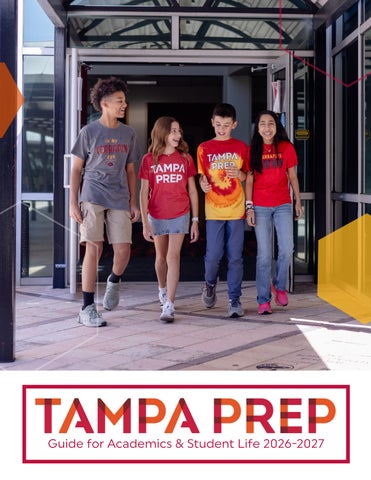
Guide for Academics & Student Life 2026-2027
a place to
THINK CREATE BE YOURSELF ASPIRE TO EXCELLENCE GO BEYOND
Where a rigorous grounding in skills and knowledge is just the beginning – where teachers and students share inquiry, reflection and analysis on the path to personal understanding.
a place to
a place to
Where people celebrate the imagination in geometric proofs and formal essays, on canvas, computer and stage, in poetry readings and morning assemblies.
Where people respect differences and can find their place in a diverse community.
a place to
a place to
Where students develop winning attitudes in academics, athletics and arts.
Where Florida Keys, North Carolina mountains, museums, concert halls and community service become classrooms that foster deeper understandings of one’s self, others and the world.
MORE THAN JUST A COLLEGE PREPARATORY SCHOOL…
A PREPARATION FOR LIFE WITH A HIGHER PURPOSE THAN SELF
2026-2027
GUIDE FOR ACADEMICS AND STUDENT LIFE Tampa Preparatory School 727 WEST CASS STREET TAMPA, FLORIDA 33606
www.tampaprep.org TEL 813.251.8481 • FAX 813.254.2106 CEEB SCHOOL CODE 101729
THE SCHOOL’S PHILOSOPHY Founded in 1974, Tampa Preparatory School is a private, independent, coeducational college preparatory school enrolling more than 700 students. It exists to provide students in grades six through 12 with rigorous intellectual training and to instill values of fairness, decency, honor, diligence and academic curiosity with an orderly, encouraging and kind environment. The size of Tampa Prep allows for the development of close, personal relationships. The School is a diverse community of people, including the highest caliber of faculty members who are committed to helping students achieve great personal growth and academic success. Faculty members have enthusiasm for their fields of expertise and an abiding interest in educating young people. The opportunity for students and teachers to know and respect one another as individuals is one of the greatest strengths of independent education. Classes are taught as seminars, labs and lectures in which students form and express ideas rather than merely receive and dispense information. Classes are frequently taught using the Harkness Method, to encourage maximum participation. The School stresses the development of self-confidence, a sense of worth & responsibility and the importance of a sense of humor and having fun in the pursuit of achieving goals. This approach provides a successful learning environment for the growth of academic excellence and encourages students to develop life-long habits of intellectual curiosity through the discovery of new interests. In an age that demands instant answers, liberal education cannot demonstrate immediate results but can stress the values and standards that provide structure for a purposeful life. The School’s goals are to develop the academic, intellectual, moral, emotional and physical potential of each individual student and to prepare each student to live a creative, productive, humane and compassionate life. Tampa Preparatory School is accredited by the Southern Association of Colleges and Schools and the Florida Council of Independent Schools. Additionally, the School is a member of the National Association of Independent Schools, the College Board, the Secondary School Admissions Test Board, the National Association of College Admissions Counseling, the Southern Association of College Admissions Counseling, and the Educational Records Bureau.
GUIDE FOR ACADEMICS AND STUDENT LIFE | 1
HONOR CODE: A COMMITMENT TO HONOR AS A MEMBER OF THE TAMPA PREP COMMUNITY, I AM RESPONSIBLE FOR UPHOLDING AND PROMOTING HONESTY, TRUST, RESPECT AND FAIRNESS IN ALL VENUES OF SCHOOL LIFE. I PLEDGE TO MAINTAIN PERSONAL AND ACADEMIC INTEGRITY AND SUPPORT IT IN OTHERS. I SOLEMNLY PROMISE TO UPHOLD MY COMMITMENT TO HONOR THIS CODE.
CORE VALUES CURIOSITY • HONESTY • KINDNESS RESPECT • RESPONSIBILITY
2 | GUIDE FOR ACADEMICS AND STUDENT LIFE
TABLE OF CONTENTS About our School. . . . . . . . . . . . . . . . . . . . . . . . . . . . . . . . . . . . . . . . . . . . . . . . . . . . . . . . . . . . . . . . . . . . . . . . . . . . . . . . . . . . . . . . . . . . . . . . . . . 1 Honor Code and Core Values. . . . . . . . . . . . . . . . . . . . . . . . . . . . . . . . . . . . . . . . . . . . . . . . . . . . . . . . . . . . . . . . . . . . . . . . . . . . . . . . . . . . . . . 2 Purpose of This Guide. . . . . . . . . . . . . . . . . . . . . . . . . . . . . . . . . . . . . . . . . . . . . . . . . . . . . . . . . . . . . . . . . . . . . . . . . . . . . . . . . . . . . . . . . . . . . . 6 Non-Discrimination Policy. . . . . . . . . . . . . . . . . . . . . . . . . . . . . . . . . . . . . . . . . . . . . . . . . . . . . . . . . . . . . . . . . . . . . . . . . . . . . . . . . . . . . . . . . . 6 Where Students Go With Questions. . . . . . . . . . . . . . . . . . . . . . . . . . . . . . . . . . . . . . . . . . . . . . . . . . . . . . . . . . . . . . . . . . . . . . . . . . . . . . . . 7 Faculty and Staff. . . . . . . . . . . . . . . . . . . . . . . . . . . . . . . . . . . . . . . . . . . . . . . . . . . . . . . . . . . . . . . . . . . . . . . . . . . . . . . . . . . . . . . . . . . . . . . . . . . .8 Academic Information and Policies . . . . . . . . . . . . . . . . . . . . . . . . . . . . . . . . . . . . . . . . . . . . . . . . . . . . . . . . . . . . . . . . . . . . . . . . . . . . . . . 13 Honors Attitude. . . . . . . . . . . . . . . . . . . . . . . . . . . . . . . . . . . . . . . . . . . . . . . . . . . . . . . . . . . . . . . . . . . . . . . . . . . . . . . . . . . . . . . . . . . . . . . . . 13 Academic Integrity. . . . . . . . . . . . . . . . . . . . . . . . . . . . . . . . . . . . . . . . . . . . . . . . . . . . . . . . . . . . . . . . . . . . . . . . . . . . . . . . . . . . . . . . . . . . . . 13 Tampa Prep Grading Overview . . . . . . . . . . . . . . . . . . . . . . . . . . . . . . . . . . . . . . . . . . . . . . . . . . . . . . . . . . . . . . . . . . . . . . . . . . . . . . . . . 14 Upper School Add/Drop Policy . . . . . . . . . . . . . . . . . . . . . . . . . . . . . . . . . . . . . . . . . . . . . . . . . . . . . . . . . . . . . . . . . . . . . . . . . . . . . . . . . 15 Other Academic Policies. . . . . . . . . . . . . . . . . . . . . . . . . . . . . . . . . . . . . . . . . . . . . . . . . . . . . . . . . . . . . . . . . . . . . . . . . . . . . . . . . . . . . . . . 15 Policy For English As A Second Language (ESL) Students. . . . . . . . . . . . . . . . . . . . . . . . . . . . . . . . . . . . . . . . . . . . . . . . . . . . . . 18 Academic Probation . . . . . . . . . . . . . . . . . . . . . . . . . . . . . . . . . . . . . . . . . . . . . . . . . . . . . . . . . . . . . . . . . . . . . . . . . . . . . . . . . . . . . . . . . . . . 18 Academic Policy for Suspended Students. . . . . . . . . . . . . . . . . . . . . . . . . . . . . . . . . . . . . . . . . . . . . . . . . . . . . . . . . . . . . . . . . . . . . . 19 Academic Levels of Courses . . . . . . . . . . . . . . . . . . . . . . . . . . . . . . . . . . . . . . . . . . . . . . . . . . . . . . . . . . . . . . . . . . . . . . . . . . . . . . . . . . . . 19 AP Student Qualifications. . . . . . . . . . . . . . . . . . . . . . . . . . . . . . . . . . . . . . . . . . . . . . . . . . . . . . . . . . . . . . . . . . . . . . . . . . . . . . . . . . . . . . . 19 AP Exam Policy. . . . . . . . . . . . . . . . . . . . . . . . . . . . . . . . . . . . . . . . . . . . . . . . . . . . . . . . . . . . . . . . . . . . . . . . . . . . . . . . . . . . . . . . . . . . . . . . . . 20 Opportunities for Accelerated Study . . . . . . . . . . . . . . . . . . . . . . . . . . . . . . . . . . . . . . . . . . . . . . . . . . . . . . . . . . . . . . . . . . . . . . . . . . . 20 Arts, Biomedical, Global Studies, and Stem Concentrations. . . . . . . . . . . . . . . . . . . . . . . . . . . . . . . . . . . . . . . . . . . . . . . . . . . . 21 Honor Societies . . . . . . . . . . . . . . . . . . . . . . . . . . . . . . . . . . . . . . . . . . . . . . . . . . . . . . . . . . . . . . . . . . . . . . . . . . . . . . . . . . . . . . . . . . . . . . . . . 24 Registration for Classes. . . . . . . . . . . . . . . . . . . . . . . . . . . . . . . . . . . . . . . . . . . . . . . . . . . . . . . . . . . . . . . . . . . . . . . . . . . . . . . . . . . . . . . . . 25 Tampa Prep Graduation Requirements . . . . . . . . . . . . . . . . . . . . . . . . . . . . . . . . . . . . . . . . . . . . . . . . . . . . . . . . . . . . . . . . . . . . . . . . 25 Student Support & Accessibility Policy. . . . . . . . . . . . . . . . . . . . . . . . . . . . . . . . . . . . . . . . . . . . . . . . . . . . . . . . . . . . . . . . . . . . . . . . . . . . 26 Academic Support Philosophy: Embracing Diverse Learners. . . . . . . . . . . . . . . . . . . . . . . . . . . . . . . . . . . . . . . . . . . . . . . . . . . 26 Accommodations for Students with Disabilities . . . . . . . . . . . . . . . . . . . . . . . . . . . . . . . . . . . . . . . . . . . . . . . . . . . . . . . . . . . . . . . . 26 Process for Requesting Accommodations and Documentation. . . . . . . . . . . . . . . . . . . . . . . . . . . . . . . . . . . . . . . . . . . . . . . . 26 Release for Communications with Professionals. . . . . . . . . . . . . . . . . . . . . . . . . . . . . . . . . . . . . . . . . . . . . . . . . . . . . . . . . . . . . . . . 26 Limitations. . . . . . . . . . . . . . . . . . . . . . . . . . . . . . . . . . . . . . . . . . . . . . . . . . . . . . . . . . . . . . . . . . . . . . . . . . . . . . . . . . . . . . . . . . . . . . . . . . . . . . 27 Commonly Asked Questions. . . . . . . . . . . . . . . . . . . . . . . . . . . . . . . . . . . . . . . . . . . . . . . . . . . . . . . . . . . . . . . . . . . . . . . . . . . . . . . . . . . . 27 Experiential Learning and Extended Trips . . . . . . . . . . . . . . . . . . . . . . . . . . . . . . . . . . . . . . . . . . . . . . . . . . . . . . . . . . . . . . . . . . . . . . . . 27 Field Trip Standards. . . . . . . . . . . . . . . . . . . . . . . . . . . . . . . . . . . . . . . . . . . . . . . . . . . . . . . . . . . . . . . . . . . . . . . . . . . . . . . . . . . . . . . . . . . . . 27 Senior Internships. . . . . . . . . . . . . . . . . . . . . . . . . . . . . . . . . . . . . . . . . . . . . . . . . . . . . . . . . . . . . . . . . . . . . . . . . . . . . . . . . . . . . . . . . . . . . . . 28 International Students . . . . . . . . . . . . . . . . . . . . . . . . . . . . . . . . . . . . . . . . . . . . . . . . . . . . . . . . . . . . . . . . . . . . . . . . . . . . . . . . . . . . . . . . . . 28 Attendance Policies . . . . . . . . . . . . . . . . . . . . . . . . . . . . . . . . . . . . . . . . . . . . . . . . . . . . . . . . . . . . . . . . . . . . . . . . . . . . . . . . . . . . . . . . . . . . . . . 28 Response for Repeated Absences from School. . . . . . . . . . . . . . . . . . . . . . . . . . . . . . . . . . . . . . . . . . . . . . . . . . . . . . . . . . . . . . . . . 29 Long-Term Medical Leave. . . . . . . . . . . . . . . . . . . . . . . . . . . . . . . . . . . . . . . . . . . . . . . . . . . . . . . . . . . . . . . . . . . . . . . . . . . . . . . . . . . . . . . 30 Tardiness. . . . . . . . . . . . . . . . . . . . . . . . . . . . . . . . . . . . . . . . . . . . . . . . . . . . . . . . . . . . . . . . . . . . . . . . . . . . . . . . . . . . . . . . . . . . . . . . . . . . . . . . 30 Leaving the School Campus. . . . . . . . . . . . . . . . . . . . . . . . . . . . . . . . . . . . . . . . . . . . . . . . . . . . . . . . . . . . . . . . . . . . . . . . . . . . . . . . . . . . . 31 Athletics and Activities. . . . . . . . . . . . . . . . . . . . . . . . . . . . . . . . . . . . . . . . . . . . . . . . . . . . . . . . . . . . . . . . . . . . . . . . . . . . . . . . . . . . . . . . . . . . 31 Athletic and Activity Eligibility. . . . . . . . . . . . . . . . . . . . . . . . . . . . . . . . . . . . . . . . . . . . . . . . . . . . . . . . . . . . . . . . . . . . . . . . . . . . . . . . . . 31 Participation in Non-Academic Events. . . . . . . . . . . . . . . . . . . . . . . . . . . . . . . . . . . . . . . . . . . . . . . . . . . . . . . . . . . . . . . . . . . . . . . . . . 31 Student Organizations. . . . . . . . . . . . . . . . . . . . . . . . . . . . . . . . . . . . . . . . . . . . . . . . . . . . . . . . . . . . . . . . . . . . . . . . . . . . . . . . . . . . . . . . . . 31 Student Fundraising. . . . . . . . . . . . . . . . . . . . . . . . . . . . . . . . . . . . . . . . . . . . . . . . . . . . . . . . . . . . . . . . . . . . . . . . . . . . . . . . . . . . . . . . . . . . . 32 College Guidelines . . . . . . . . . . . . . . . . . . . . . . . . . . . . . . . . . . . . . . . . . . . . . . . . . . . . . . . . . . . . . . . . . . . . . . . . . . . . . . . . . . . . . . . . . . . . . . . . 32 College Counseling . . . . . . . . . . . . . . . . . . . . . . . . . . . . . . . . . . . . . . . . . . . . . . . . . . . . . . . . . . . . . . . . . . . . . . . . . . . . . . . . . . . . . . . . . . . . . 32 GUIDE FOR ACADEMICS AND STUDENT LIFE | 3
TABLE OF CONTENTS College Admissions . . . . . . . . . . . . . . . . . . . . . . . . . . . . . . . . . . . . . . . . . . . . . . . . . . . . . . . . . . . . . . . . . . . . . . . . . . . . . . . . . . . . . . . . . . . . . 32 College Visits. . . . . . . . . . . . . . . . . . . . . . . . . . . . . . . . . . . . . . . . . . . . . . . . . . . . . . . . . . . . . . . . . . . . . . . . . . . . . . . . . . . . . . . . . . . . . . . . . . . . 32 Policy For Reporting Information to Colleges. . . . . . . . . . . . . . . . . . . . . . . . . . . . . . . . . . . . . . . . . . . . . . . . . . . . . . . . . . . . . . . . . . . 32 Course Minimums for Florida's State Schools. . . . . . . . . . . . . . . . . . . . . . . . . . . . . . . . . . . . . . . . . . . . . . . . . . . . . . . . . . . . . . . . . . . 33 Student Records and Transcripts. . . . . . . . . . . . . . . . . . . . . . . . . . . . . . . . . . . . . . . . . . . . . . . . . . . . . . . . . . . . . . . . . . . . . . . . . . . . . . . . 33 Florida's Bright Futures Scholarship Program. . . . . . . . . . . . . . . . . . . . . . . . . . . . . . . . . . . . . . . . . . . . . . . . . . . . . . . . . . . . . . . . . . . 33 Character Expectations and Development . . . . . . . . . . . . . . . . . . . . . . . . . . . . . . . . . . . . . . . . . . . . . . . . . . . . . . . . . . . . . . . . . . . . . . . 33 Tampa Prep Core Values. . . . . . . . . . . . . . . . . . . . . . . . . . . . . . . . . . . . . . . . . . . . . . . . . . . . . . . . . . . . . . . . . . . . . . . . . . . . . . . . . . . . . . . . 33 Community Service. . . . . . . . . . . . . . . . . . . . . . . . . . . . . . . . . . . . . . . . . . . . . . . . . . . . . . . . . . . . . . . . . . . . . . . . . . . . . . . . . . . . . . . . . . . . . 33 Student Government . . . . . . . . . . . . . . . . . . . . . . . . . . . . . . . . . . . . . . . . . . . . . . . . . . . . . . . . . . . . . . . . . . . . . . . . . . . . . . . . . . . . . . . . . . . 34 Guiding Students. . . . . . . . . . . . . . . . . . . . . . . . . . . . . . . . . . . . . . . . . . . . . . . . . . . . . . . . . . . . . . . . . . . . . . . . . . . . . . . . . . . . . . . . . . . . . . . . . . 34 Advising. . . . . . . . . . . . . . . . . . . . . . . . . . . . . . . . . . . . . . . . . . . . . . . . . . . . . . . . . . . . . . . . . . . . . . . . . . . . . . . . . . . . . . . . . . . . . . . . . . . . . . . . . 34 Weekly Meetings - Advising and Class Seminar. . . . . . . . . . . . . . . . . . . . . . . . . . . . . . . . . . . . . . . . . . . . . . . . . . . . . . . . . . . . . . . . . 34 Counseling. . . . . . . . . . . . . . . . . . . . . . . . . . . . . . . . . . . . . . . . . . . . . . . . . . . . . . . . . . . . . . . . . . . . . . . . . . . . . . . . . . . . . . . . . . . . . . . . . . . . . . 34 MyTampaPrep. . . . . . . . . . . . . . . . . . . . . . . . . . . . . . . . . . . . . . . . . . . . . . . . . . . . . . . . . . . . . . . . . . . . . . . . . . . . . . . . . . . . . . . . . . . . . . . . . . . 35 Course Selection Assistance. . . . . . . . . . . . . . . . . . . . . . . . . . . . . . . . . . . . . . . . . . . . . . . . . . . . . . . . . . . . . . . . . . . . . . . . . . . . . . . . . . . . 35 Student Conduct And Discipline . . . . . . . . . . . . . . . . . . . . . . . . . . . . . . . . . . . . . . . . . . . . . . . . . . . . . . . . . . . . . . . . . . . . . . . . . . . . . . . . . . 35 General Disciplinary Guidelines. . . . . . . . . . . . . . . . . . . . . . . . . . . . . . . . . . . . . . . . . . . . . . . . . . . . . . . . . . . . . . . . . . . . . . . . . . . . . . . . . 35 General Disciplinary Guidelines. . . . . . . . . . . . . . . . . . . . . . . . . . . . . . . . . . . . . . . . . . . . . . . . . . . . . . . . . . . . . . . . . . . . . . . . . . . 35 Types of Infractions. . . . . . . . . . . . . . . . . . . . . . . . . . . . . . . . . . . . . . . . . . . . . . . . . . . . . . . . . . . . . . . . . . . . . . . . . . . . . . . . . . . . . . . 35 Disciplinary Consequences . . . . . . . . . . . . . . . . . . . . . . . . . . . . . . . . . . . . . . . . . . . . . . . . . . . . . . . . . . . . . . . . . . . . . . . . . . . . . . . 36 Concern for Students. . . . . . . . . . . . . . . . . . . . . . . . . . . . . . . . . . . . . . . . . . . . . . . . . . . . . . . . . . . . . . . . . . . . . . . . . . . . . . . . . . . . . 37 Conduct Review Board . . . . . . . . . . . . . . . . . . . . . . . . . . . . . . . . . . . . . . . . . . . . . . . . . . . . . . . . . . . . . . . . . . . . . . . . . . . . . . . . . . . 37 Conduct Policies. . . . . . . . . . . . . . . . . . . . . . . . . . . . . . . . . . . . . . . . . . . . . . . . . . . . . . . . . . . . . . . . . . . . . . . . . . . . . . . . . . . . . . . . . . . . . . . . 37 Animal Policy. . . . . . . . . . . . . . . . . . . . . . . . . . . . . . . . . . . . . . . . . . . . . . . . . . . . . . . . . . . . . . . . . . . . . . . . . . . . . . . . . . . . . . . . . . . . . . 37 Book Bags. . . . . . . . . . . . . . . . . . . . . . . . . . . . . . . . . . . . . . . . . . . . . . . . . . . . . . . . . . . . . . . . . . . . . . . . . . . . . . . . . . . . . . . . . . . . . . . . . 37 Cleanliness and Litter. . . . . . . . . . . . . . . . . . . . . . . . . . . . . . . . . . . . . . . . . . . . . . . . . . . . . . . . . . . . . . . . . . . . . . . . . . . . . . . . . . . . . 37 Criminal Activity . . . . . . . . . . . . . . . . . . . . . . . . . . . . . . . . . . . . . . . . . . . . . . . . . . . . . . . . . . . . . . . . . . . . . . . . . . . . . . . . . . . . . . . . . . 38 Dress Code. . . . . . . . . . . . . . . . . . . . . . . . . . . . . . . . . . . . . . . . . . . . . . . . . . . . . . . . . . . . . . . . . . . . . . . . . . . . . . . . . . . . . . . . . . . . . . . . 38 Drugs, Alcohol and Tobacco Policy . . . . . . . . . . . . . . . . . . . . . . . . . . . . . . . . . . . . . . . . . . . . . . . . . . . . . . . . . . . . . . . . . . . . . . . 39 Eating in the Buildings. . . . . . . . . . . . . . . . . . . . . . . . . . . . . . . . . . . . . . . . . . . . . . . . . . . . . . . . . . . . . . . . . . . . . . . . . . . . . . . . . . . . 40 Elevator Use. . . . . . . . . . . . . . . . . . . . . . . . . . . . . . . . . . . . . . . . . . . . . . . . . . . . . . . . . . . . . . . . . . . . . . . . . . . . . . . . . . . . . . . . . . . . . . . 40 Fights or Horseplay. . . . . . . . . . . . . . . . . . . . . . . . . . . . . . . . . . . . . . . . . . . . . . . . . . . . . . . . . . . . . . . . . . . . . . . . . . . . . . . . . . . . . . . 40 General Conduct . . . . . . . . . . . . . . . . . . . . . . . . . . . . . . . . . . . . . . . . . . . . . . . . . . . . . . . . . . . . . . . . . . . . . . . . . . . . . . . . . . . . . . . . . 40 Harassment/Bullying . . . . . . . . . . . . . . . . . . . . . . . . . . . . . . . . . . . . . . . . . . . . . . . . . . . . . . . . . . . . . . . . . . . . . . . . . . . . . . . . . . . . . 40 Hazing . . . . . . . . . . . . . . . . . . . . . . . . . . . . . . . . . . . . . . . . . . . . . . . . . . . . . . . . . . . . . . . . . . . . . . . . . . . . . . . . . . . . . . . . . . . . . . . . . . . . 40 Identification Cards. . . . . . . . . . . . . . . . . . . . . . . . . . . . . . . . . . . . . . . . . . . . . . . . . . . . . . . . . . . . . . . . . . . . . . . . . . . . . . . . . . . . . . . 41 Illness . . . . . . . . . . . . . . . . . . . . . . . . . . . . . . . . . . . . . . . . . . . . . . . . . . . . . . . . . . . . . . . . . . . . . . . . . . . . . . . . . . . . . . . . . . . . . . . . . . . . . 41 Laptop and Mobile Device Security. . . . . . . . . . . . . . . . . . . . . . . . . . . . . . . . . . . . . . . . . . . . . . . . . . . . . . . . . . . . . . . . . . . . . . . 41 Laser Pointers. . . . . . . . . . . . . . . . . . . . . . . . . . . . . . . . . . . . . . . . . . . . . . . . . . . . . . . . . . . . . . . . . . . . . . . . . . . . . . . . . . . . . . . . . . . . . 41 Lockers. . . . . . . . . . . . . . . . . . . . . . . . . . . . . . . . . . . . . . . . . . . . . . . . . . . . . . . . . . . . . . . . . . . . . . . . . . . . . . . . . . . . . . . . . . . . . . . . . . . . 41 Off Campus Behaviors. . . . . . . . . . . . . . . . . . . . . . . . . . . . . . . . . . . . . . . . . . . . . . . . . . . . . . . . . . . . . . . . . . . . . . . . . . . . . . . . . . . . 41 Posting Signs. . . . . . . . . . . . . . . . . . . . . . . . . . . . . . . . . . . . . . . . . . . . . . . . . . . . . . . . . . . . . . . . . . . . . . . . . . . . . . . . . . . . . . . . . . . . . . 41 Public Displays of Affection. . . . . . . . . . . . . . . . . . . . . . . . . . . . . . . . . . . . . . . . . . . . . . . . . . . . . . . . . . . . . . . . . . . . . . . . . . . . . . . 42 Student/Adult Interactions and Communication. . . . . . . . . . . . . . . . . . . . . . . . . . . . . . . . . . . . . . . . . . . . . . . . . . . . . . . . . 42 Weapons and Threats. . . . . . . . . . . . . . . . . . . . . . . . . . . . . . . . . . . . . . . . . . . . . . . . . . . . . . . . . . . . . . . . . . . . . . . . . . . . . . . . . . . . . 42 4 | GUIDE FOR ACADEMICS AND STUDENT LIFE
TABLE OF CONTENTS Technology Policies. . . . . . . . . . . . . . . . . . . . . . . . . . . . . . . . . . . . . . . . . . . . . . . . . . . . . . . . . . . . . . . . . . . . . . . . . . . . . . . . . . . . . . . . . . . . . . . . 42 Technology Mission Statement. . . . . . . . . . . . . . . . . . . . . . . . . . . . . . . . . . . . . . . . . . . . . . . . . . . . . . . . . . . . . . . . . . . . . . . . . . . . . . . . . 42 Technology Acceptable Use Policy. . . . . . . . . . . . . . . . . . . . . . . . . . . . . . . . . . . . . . . . . . . . . . . . . . . . . . . . . . . . . . . . . . . . . . . . . . . . . . 42 Technology, Electronic Devices, and Computer Systems Usage Policy. . . . . . . . . . . . . . . . . . . . . . . . . . . . . . . . . . . . . . . . . 43 Artificial Intelligence Policy . . . . . . . . . . . . . . . . . . . . . . . . . . . . . . . . . . . . . . . . . . . . . . . . . . . . . . . . . . . . . . . . . . . . . . . . . . . . . . . . . . . . . 46 Parking And Transportation . . . . . . . . . . . . . . . . . . . . . . . . . . . . . . . . . . . . . . . . . . . . . . . . . . . . . . . . . . . . . . . . . . . . . . . . . . . . . . . . . . . . . . . 46 Automobiles and Parking. . . . . . . . . . . . . . . . . . . . . . . . . . . . . . . . . . . . . . . . . . . . . . . . . . . . . . . . . . . . . . . . . . . . . . . . . . . . . . . . . . . . . . . 46 Transportation to and from School-Sponsored Events. . . . . . . . . . . . . . . . . . . . . . . . . . . . . . . . . . . . . . . . . . . . . . . . . . . . . . . . . 47 Other Information. . . . . . . . . . . . . . . . . . . . . . . . . . . . . . . . . . . . . . . . . . . . . . . . . . . . . . . . . . . . . . . . . . . . . . . . . . . . . . . . . . . . . . . . . . . . . . . . . 47 Child Abuse Reporting. . . . . . . . . . . . . . . . . . . . . . . . . . . . . . . . . . . . . . . . . . . . . . . . . . . . . . . . . . . . . . . . . . . . . . . . . . . . . . . . . . . . . . . . . . 47 Child Safety From Sexual Offenders and Predators . . . . . . . . . . . . . . . . . . . . . . . . . . . . . . . . . . . . . . . . . . . . . . . . . . . . . . . . . . . . 47 Communications from School . . . . . . . . . . . . . . . . . . . . . . . . . . . . . . . . . . . . . . . . . . . . . . . . . . . . . . . . . . . . . . . . . . . . . . . . . . . . . . . . . . 47 Evacuation . . . . . . . . . . . . . . . . . . . . . . . . . . . . . . . . . . . . . . . . . . . . . . . . . . . . . . . . . . . . . . . . . . . . . . . . . . . . . . . . . . . . . . . . . . . . . . . . . . . . . . 48 Faxing and Email. . . . . . . . . . . . . . . . . . . . . . . . . . . . . . . . . . . . . . . . . . . . . . . . . . . . . . . . . . . . . . . . . . . . . . . . . . . . . . . . . . . . . . . . . . . . . . . . 48 Health Information Sharing. . . . . . . . . . . . . . . . . . . . . . . . . . . . . . . . . . . . . . . . . . . . . . . . . . . . . . . . . . . . . . . . . . . . . . . . . . . . . . . . . . . . . 48 Inspection Policy. . . . . . . . . . . . . . . . . . . . . . . . . . . . . . . . . . . . . . . . . . . . . . . . . . . . . . . . . . . . . . . . . . . . . . . . . . . . . . . . . . . . . . . . . . . . . . . . 48 Interpretation, Modification, Amendment. . . . . . . . . . . . . . . . . . . . . . . . . . . . . . . . . . . . . . . . . . . . . . . . . . . . . . . . . . . . . . . . . . . . . . 48 Investigations . . . . . . . . . . . . . . . . . . . . . . . . . . . . . . . . . . . . . . . . . . . . . . . . . . . . . . . . . . . . . . . . . . . . . . . . . . . . . . . . . . . . . . . . . . . . . . . . . . . 48 Lunch Service . . . . . . . . . . . . . . . . . . . . . . . . . . . . . . . . . . . . . . . . . . . . . . . . . . . . . . . . . . . . . . . . . . . . . . . . . . . . . . . . . . . . . . . . . . . . . . . . . . . 48 Parent/Family Cooperation. . . . . . . . . . . . . . . . . . . . . . . . . . . . . . . . . . . . . . . . . . . . . . . . . . . . . . . . . . . . . . . . . . . . . . . . . . . . . . . . . . . . . 48 Payment of Tuition and Fees. . . . . . . . . . . . . . . . . . . . . . . . . . . . . . . . . . . . . . . . . . . . . . . . . . . . . . . . . . . . . . . . . . . . . . . . . . . . . . . . . . . . 49 Re-Enrollment Considerations. . . . . . . . . . . . . . . . . . . . . . . . . . . . . . . . . . . . . . . . . . . . . . . . . . . . . . . . . . . . . . . . . . . . . . . . . . . . . . . . . . 49 Student Records and Information . . . . . . . . . . . . . . . . . . . . . . . . . . . . . . . . . . . . . . . . . . . . . . . . . . . . . . . . . . . . . . . . . . . . . . . . . . . . . . 49 Library Policies . . . . . . . . . . . . . . . . . . . . . . . . . . . . . . . . . . . . . . . . . . . . . . . . . . . . . . . . . . . . . . . . . . . . . . . . . . . . . . . . . . . . . . . . . . . . . . . . . . . . 49 Peifer Library. . . . . . . . . . . . . . . . . . . . . . . . . . . . . . . . . . . . . . . . . . . . . . . . . . . . . . . . . . . . . . . . . . . . . . . . . . . . . . . . . . . . . . . . . . . . . . . . . . . . 49 Challenged Book and Other Library Material Policy. . . . . . . . . . . . . . . . . . . . . . . . . . . . . . . . . . . . . . . . . . . . . . . . . . . . . . . . . . . . 49 Appendix. . . . . . . . . . . . . . . . . . . . . . . . . . . . . . . . . . . . . . . . . . . . . . . . . . . . . . . . . . . . . . . . . . . . . . . . . . . . . . . . . . . . . . . . . . . . . . . . . . . . . . . . . . 51 Daily Schedule. . . . . . . . . . . . . . . . . . . . . . . . . . . . . . . . . . . . . . . . . . . . . . . . . . . . . . . . . . . . . . . . . . . . . . . . . . . . . . . . . . . . . . . . . . . . . . . . . . . 51 Middle School Three-Year Plan Sheet. . . . . . . . . . . . . . . . . . . . . . . . . . . . . . . . . . . . . . . . . . . . . . . . . . . . . . . . . . . . . . . . . . . . . . . . . . . 52 Upper School Four-Year Plan Sheet. . . . . . . . . . . . . . . . . . . . . . . . . . . . . . . . . . . . . . . . . . . . . . . . . . . . . . . . . . . . . . . . . . . . . . . . . . . . . 53 Upper School Science Courses. . . . . . . . . . . . . . . . . . . . . . . . . . . . . . . . . . . . . . . . . . . . . . . . . . . . . . . . . . . . . . . . . . . . . . . . . . . . . . . . . . 54 Typical Course Progression in World & Classical Languages . . . . . . . . . . . . . . . . . . . . . . . . . . . . . . . . . . . . . . . . . . . . . . . . . . . . 55 Typical Course Progression in Mathematics . . . . . . . . . . . . . . . . . . . . . . . . . . . . . . . . . . . . . . . . . . . . . . . . . . . . . . . . . . . . . . . . . . . . 56 Planned Absence Form . . . . . . . . . . . . . . . . . . . . . . . . . . . . . . . . . . . . . . . . . . . . . . . . . . . . . . . . . . . . . . . . . . . . . . . . . . . . . . . . . . . . . . . . . 57 College Visit Absence Form . . . . . . . . . . . . . . . . . . . . . . . . . . . . . . . . . . . . . . . . . . . . . . . . . . . . . . . . . . . . . . . . . . . . . . . . . . . . . . . . . . . . 58 AI Usage Chart . . . . . . . . . . . . . . . . . . . . . . . . . . . . . . . . . . . . . . . . . . . . . . . . . . . . . . . . . . . . . . . . . . . . . . . . . . . . . . . . . . . . . . . . . . . . . . . . . . 59
GUIDE FOR ACADEMICS AND STUDENT LIFE | 5
PURPOSE OF THIS GUIDE The purpose of this Guide is to serve as a reference for a wide variety of student information. A primary purpose is to share the School’s Mission, Philosophy, Honor Code and Core Values. These serve as the guiding principles for everything else shared in the Guide. Guidelines are shared for acceptable student conduct in a variety of specific situations in which students need to know what is expected of them. A later section informs students of what likely will happen if they violate rules or the concepts established under the School’s Honor Code. The Guide also contains reference sections about the teaching faculty and where to go for help. The second half of the Guide contains a wealth of information about academic offerings, graduation requirements, course selection planning, and additional information. Some of the guiding principles in this Guide also govern expectations of parents and guardians within our community. Therefore, parents and students are responsible for knowing its contents. Because it is impossible to consider every possible situation, especially in an ever-changing environment, we want to stress that none of the stated rules or procedures precludes the School from taking disciplinary action if students are involved in activities, on or off campus, that the School considers detrimental to other students or contrary to the general expectations of the School community. The Administration, in consultation with the Head of School, has the right to make final decisions in all matters involving student and parent rules. The School reserves the right to interpret the content of this Guide, including the rules and regulations governing the academic and non-academic conduct of students. This Guide is not a contract, nor is it intended to be so construed. Our School reserves the right to modify and/or amend the content of this Guide at any time during the year. Please consult the most updated version of the Guide on the School website at www.tampaprep.org.
NON-DISCRIMINATION POLICY Tampa Prep is an inclusive and open-minded environment that does not discriminate according to race, color, national origin, religion, gender, sexual orientation, gender identity or matters of individual choice. Tampa Prep does not engage in personnel practices prohibited by federal law. This policy extends to all activities and aspects of the School and specifically to the practices of faculty and staff hiring and management, in student admissions, student evaluation, discipline and student life. Tampa Prep will encourage and promote non-discrimination among all of its faculty, staff, students and parents. Discriminatory actions contrary to this policy, which adversely affect the environment, image, or student life of the school by any member of the faculty or staff, will be considered grounds for dismissal. Discriminatory actions contrary to this policy by a student, whether or not such action takes place on school grounds, will be considered a disciplinary problem and will be subject to such disciplinary actions as determined by the Head of School. (On January 19, 2017 the Board of Trustees voted to adopt this amendment of existing School Policy which was previously adopted by the Board of Trustees on May 23, 2007.)
6 | GUIDE FOR ACADEMICS AND STUDENT LIFE
WHERE STUDENTS GO WITH QUESTIONS DESCRIPTION
UPPER SCHOOL
MIDDLE SCHOOL
Absence, Tardy, Leaving Early & Illness
Health Coordinator health@tampaprep.org
Health Coordinator health@tampaprep.org
Academics
See your Grade-Level Dean (9) Mrs. Jisha (10) Mrs. Emrich (11) Ms. Osborn (12) Mrs. Wieloszynski
Mr. Fenlon
Academic Concentrations
Arts - Mr. Hoy Biomedical - Ms. Emrich Global Studies - Mr. Carreno STEM - Mrs. Beekman
n/a
Academic Support & Accommodations
Ms. Velez & Ms. Wiley
Ms. Velez & Ms. Wiley
Athletics
Mr. Lavoie
Mr. Lavoie
Clubs & Student Organizations
Mr. Axford
Mrs. Faunce
Campus Store
Mrs. Faunce
Mrs. Faunce
College Counseling
Mr. Wagstaff
Mr. Wagstaff
Discipline
Mr. Axford
Ms. Grosso
Dress Code
Mr. Axford
Ms. Grosso
Educational Concerns
Advisors
Advisors
General Questions
Mrs. Cafaro
Mrs. Faunce
Library
Ms. Rendina
Ms. Rendina
Locker Assignments
Mrs. Cafaro
Mrs. Faunce
Lost & Found
Jewelry - Front Desk Receptionist Technology - Ms. Lassacher Other - Bins in Lobby & Gym
Jewelry - Front Desk Receptionist Technology - Ms. Lassacher Other - Bins in Lobby & Gym
Parking Decals
Mrs. Cafaro
Schedule Adjustments
Mrs. Jisha
Senior Internships
Mrs. Cafaro & Mrs. Wieloszynski
Social & Emotional Support
Mrs. Cole
Mrs. Cole
Student Records/Transcripts
College Requests -Mr. Wagstaff All Other Requests - Mrs. Jisha
Mrs. Faunce
Technology
iPad - Ms. Lassacher Lost & Found - Ms. Lassacher MyTampaPrep - Ms. Attaway
iPad - Ms. Lassacher Lost & Found - Ms. Lassacher MyTampaPrep - Ms. Attaway
Textbooks
Individual Classroom Teacher
Individual Classroom Teacher
Mr. Fenlon
GUIDE FOR ACADEMICS AND STUDENT LIFE | 7
FAC U LT Y A N D S TA F F MORCIA ANDERSON Bus Driver
WESLEY M. BURNS Bus Fleet Manager
LUZ AGUIRRE AYALA World and Classical Languages The University of Texas Rio Grande Valley, B.A.
ANDREA CAFARO Upper School Assistant Concordia University Nebraska, B.A. Northern Arizona University, M.A.
VICTORIA ATTAWAY Data Systems Manager University of Mississippi, Bachelor of Accountancy University of Mississippi, M.S. DAN AXFORD Dean of Students Central Michigan University, B.F.A. MICHELLE AYRES Health Coordinator JAEDEN AYALA Mathematics University of South Florida, B.S. University of South Florida, M.A. MATTHEW BABER History and the Social Sciences University of South Florida, B.A., M.A. MICHELLE T. BAHTIC English University of South Florida, B.A., M.A. BRANDY BARQUIN Front Desk Associate Webber International University, B.S Webber International University, MBA SUZANNE L. BEEKMAN Science STEM: Engineering Concentration Coordinator University of South Florida, B.S., M.A. University of Tampa, M.S. MARYEM BENDAOUD Development Coordinator Florida Atlantic University, B.A. University of South Florida, M.M. GILAD BEN-ZVI Arts University of South Florida, B.A. ROBERT W. BRADSHAW Faculty Advisor - Senior Class Projects Yale University, B.A. Temple University, J.D. TAYLOR BRUMFIELD Assistant to the Director of Admissions Louisiana State University, B.A.
8 | GUIDE FOR ACADEMICS AND STUDENT LIFE
COURTNEY CALLAHAN English The University of Tampa, B.S. The University of Tampa, M.Ed. STEPHANIE A. CARDILLO English Florida State University, B.S. VIKTORYIA CARDENAS World and Classical Languages Universidad Internacional De Las Americas, B.E. Bryn Mawr College, M.A. MARGARET CARRAWAY '11 History and the Social Sciences Wofford College, B.A. Johns Hopkins University, M.S. SANTIAGO L. CARREÑO World and Classical Languages History and the Social Sciences Global Studies Concentration Coordinator University of Morelos (Mexico), B.A. VIRGINIA R. CHAPMAN Science Gettysburg College, B.A. University of Tampa, M.Ed. MICHAEL P. CIRCLE Facilities Director CAITLIN CLAY Arts University of South Florida, B.A. MICHELE COLE School Counselor Cornerstone University, B.A. Liberty University, M.A. NICK COMELLA Assistant Director of Admissions University of Wisconsin-Milwaukee, B.S. SAMANTHA M. COOK History and the Social Sciences Florida State University, B.S.
FAC ULT Y A ND STAF F SUSANA F. COONER Assistant to the Head of School International Student Support University of South Florida, B.A.
TOM FORTI Head of the Upper School University of Massachusetts, B.A. New York University, M.A.
MAKAYLA DALPHONSE History and the Social Sciences Plymouth State University, B.S University of North Florida, M.Ed.
JULIA FREEMAN Director of Marketing and Communications University of South Florida, B.A.
PAUL DAVIES Mathematics University of Bristol, PGCE University of Exeter, BSc.
FRANK J. FREN Building Engineer MERY GARCIA Custodian
LAURA DAVIS Mathematics Campbell University, B.S.
KRISTEN GREEN Middle and Upper School Dance University of South Florida, B.S.
MARTHA M. DEAMBROSE Arts University of Tampa, B.A.
KERRI-ANN GROSSO Middle School Dean of Students Assistant Middle School Head Science The College of William and Mary, B.S. Texas A&M University, M.S.
JOHN N. DETRINGO, III Mathematics Math Department Chair SUNY At Potsdam, B.S., B.A. RYAN DEMARCO History and the Social Sciences Birmingham-Southern College, B.A University of Edinburgh, UK, M.Sc. Gettysburg College, M.A. AGYEI DOMFEH Mathematics London South Bank University, B.S. Norfolk State University, M.A. KRISTEN L. EMRICH Science 10th Grade Dean STEM: Biomedical Sciences Concentration Coordinator University of Tampa, B.S University of South Florida, M.S. AMANDA FAUNCE Assistant to the Associate Head of School/ Head of the Middle School JOSEPH R. FENLON Associate Head of School Head of the Middle School University of Wisconsin at Lacrosse, B.S. University of Tampa, M.Ed. NATALIA FERNANDEZ '17 English University of South Florida, B.A. Converse University, M.F.A.
KRISTIN GROSSO Assistant Director of College Counseling State University of Cortland, B.S. The College of New Rochelle, M.S. AMANDA HELIP-WOOLEY Science Science Department Chair University of Florida, B.S. Tulane University, Ph.D. ADRIAN J. HENDRIX Mathematics Indiana University, B.S. TAMRA D. HONEGGER Director of Admissions Middle School Admissions Director of Financial Aid Director of Summer Programs Eastern Illinois University, B.S. ZACH HOUGHTON Physical Education Wayne State University, B.S., M.A. ANDREW D. HOY Arts Concentration Coordinator University of South Florida, B.M., M.A. SAMEER HUSSAIN Mathematics and Social Sciences University of South Florida, B.S.
GUIDE FOR ACADEMICS AND STUDENT LIFE | 9
FAC U LT Y A N D S TA F F MARGEAUX IMPÉRIALE Director of the Annual Terrapin Fund University of Tampa, B.A. KEVIN IP English Flagler College, B.A. University of South Florida, M.F.A. CHRISTINE D. JISHA Upper School Academic Dean 9th Grade Dean Skidmore College, B.A. University of Virginia, M.Ed. LARISSA JOHNSON Business Office Associate Hillsborough Community College, A.A. PEYTON L. JONES '02 History and the Social Sciences History and the Social Sciences Department Chair University of Florida, B.A. University of South Florida, M.L.A Tulane University, Ph.D. JAKE KAVANAGH Arts Arts Department Chair DePaul University, B.F.A. University of Idaho, M.F.A. JOHN E. KELLY, IV Building Engineer Indiana University of Pennsylvania, B.S. MEGAN KOENIG Mathematics University of Tampa, B.S. SUZANNE LASSACHER '85 Student Technology Support Coordinator Science, Arts Florida State University, B.A. Montana State University, M.S. KELSIE LALIBERTE Athletic Trainer Physical Education University of Central Florida, B.S University of South Florida, M.S. CHRISTOPHER LAVOIE Director of Athletics University of Vermont, B.S. Southern New Hampshire, M.S. CHAD M. LEWIS Director of Technology Ohio State University, B.A. Western Governors University, M.B.A. 10 | GUIDE FOR ACADEMICS AND STUDENT LIFE
STEFANIE LEWIS Director of Finance and Operations David Myers University, B.S University of the Southwest, M.B.A. VICTORIA G. LEWIS Technology Integration Specialist Karelian State Pedagogical University (Russia) B.A., M.Ed Western Governors University, M.Ed. SARAH R. LONETTO English Florida State University, B.A, M.S. STEPHANIE LUKASIK '16 Associate Director of Events & Engagement Florida Gulf Coast University, B.S. University of Central Florida, Rosen College of Hospitality Mgmt, M.S. DAVID R. MANN Arts New York University, B.F.A. The Old Globe Theatre/University of San Diego, M.F.A. DARCIE MANNING Science Syracuse University, B.S. University of Southern Maine, M.A. RALPH MARTELLY Security KEVIN W. MCENDREE Technology Support Hillsborough Community College, A.S. ADONIS MCQUEEN Science Florida A&M University, B.S. Florida A&M University, M.S. University of South Florida, Ph.D. JAYDA MILLER History and the Social Sciences Florida A&M University, B.S. University of Florida, M.Ed ERIN Y. MONA English English Department Chair University of North Florida, B.A. NOËL H. MONEA-DEJONGE English Calvin College, B.A.
FAC ULT Y A ND STAF F GABRIEL MONTENEGRO World and Classical Languages The University of Southern Mississippi, B.S. The University of Southern Mississippi, M.B.A., M.A.
HEIDI SABEAN World and Classical Languages World and Classical Languages Department Chair University of New Hampshire, B.S., M.A.
DONALD D. MORRISON '86 Dean of Faculty History and the Social Sciences Haverford College, B.A. University of Victoria (Canada), M.A. Columbia University, Teachers College, M.Ed.
NABIL SALAH Accountant Casablanca University, B.A. Kennesaw State University, M.S.
LATONIGI C. NEMBHARD Daytime Security TONYA OSBORN Science 11th Grade Dean Hanover College, B.A. ANTONIO. PEREZ Bus Driver and Security JOHN H. PHELPS, JR. Daytime Security Leary Institute, A.A. KEVIN M. PLUMMER Head of School Colby College, B.A. Columbia University, Teachers College, M.A. JARRAD POND Science University of Central Florida B.S. University of Central Florida, Ph.D. K. K. QUAH Science Arts University of Wisconsin, B.S. American Graduate School of International Management, M.B.A.
KIMBERLY J. SANFORD History and the Social Sciences University of South Florida, B.S. RANDY SAWYER Mathematics University of Colorado, B.S. University of Phoenix, M.Ed TIMOTHY SCHULTZ Assistant Athletic Director/Sports Information University of Pittsburgh, B.A. Ohio University, M.S. CODY SCULLY Mathematics Millersville University B.S JOHN S. SEARY World and Classical Languages Sigety Family Academic Chair University of South Florida, B.A. BRYSON SEWELL World and Classical Languages University of Missouri, B.A. University of Minnesota, M.A. Princeton University, Ph.D. BRENDA SEWELL World and Classical Languages History and Social Sciences University of Missouri, B.J.
BRUNO A. QUATTRONE Physical Education Ithaca College, B.S.
ANDREA R. SEYMORE Facilities Coordinator University of Tampa, B.A.
JOSHUA RASKOPF History and the Social Sciences University of South Florida, B.A. University of South Florida, M.A.T.
DOUGLAS A. SMITH History and the Social Sciences University of Maryland, B.A. Cleveland-Marshall College of Law, J.D.
DIANA L. RENDINA Media Specialist Arts University of South Florida, B.A., M.A.
SHANICE SMITH Director Of Human Resources University of Maine at Presque Isle, B.L.S.
LAZARO RODRIGUEZ Custodian
ERIC D. SNOW Assistant Athletic Director University of Tampa, B.S.
GUIDE FOR ACADEMICS AND STUDENT LIFE | 11
FAC U LT Y A N D S TA F F TORI STONE College Counseling Office Coordinator Samford University, B.A. MYCHAEL SUMBY '06 Assistant Director of Admissions Florida State University, B.S. University of Tampa, M.Ed. LEANNA P. TAYLOR ‘95 Physical Education University of Tampa, B.S. MAGGIE THOMAS Director of Donor Engagement Wellesley College, B.A. GREGORY THOMPSON World and Classical Languages Lock Haven University of Pennsylvania, B.A. CRISTIAN TORRES Arts University of Puerto Rico, B.A. Ana G. Méndez University, M.Ed ELHADJI Y. TOURE Network Manager Hillsborough Community College, A.S. University of South Florida, B.S. GEORGIANNA TROWBRIDGE-SEARY Science University of South Florida, B.S., M.A.T. ALLY TWAROG Graphic Designer University of Illinois, B.F.A., B.F.A. Concordia University of Chicago, M.A. VERONICA URSO Assistant Director of College Counseling University of Tampa, B.A. University of Tampa, M.A. ANGELINA VELEZ Academic Support Counselor St. Petersburg College, B.S. University of Tampa, M.Ed CLAUDIA VALLEJO Custodian SANDRA VALLEJO Custodian CHRIS VAN DYCK English Dartmouth College, B.A. The University of Groningen, M.A.
12 | GUIDE FOR ACADEMICS AND STUDENT LIFE
KEVYN VAZQUEZ Security DIDIER VELEZ Custodian SARA J. WAGNER Physical Education Science Athletic Trainer University of South Florida, B.S., M.S. MICHAEL WAGSTAFF Director of College Counseling New England College, B.A. CHELSEA WIELOSZYNSKI English Arts 12th Grade Dean Florida State University, B.A. Vanderbilt University, M.Ed JESS WILEY Academic Support Whitman College, B.A. University of Pennsylvania, M.S.Ed.
ACA D EM I C I NFORM AT I ON A ND P O LICIES Tampa Prep has always offered a demanding college preparatory curriculum that has encouraged its students to perform well in the most competitive of college environments. The School realizes, however, that education goes well beyond a simple preparation for college and incorporates the education of the whole child—encouraging each to discover, develop and maximize his or her inner strengths and capacities. Tampa Prep’s curriculum allows opportunity for individual growth, independent research and some subject specialization. To ensure that it does this most effectively, the School’s curriculum, using as its minimum standards the guidelines published by the Florida Council of Independent Schools, is reviewed annually by the Curriculum Committee, Academic Leadership Committee and Head of School, and is updated according to current needs. Changes in the curriculum will be reflected in the Course Description section of this handbook. Tampa Prep strongly believes in the sanctity and standards of its most important community values and norms. Among these values and norms are: Academic Honesty and Integrity, Artistic Integrity, Athletic Integrity, an appreciation for diversity and acceptance, a community free from harassment, a drug and alcohol-free campus and adherence to the policies and procedures of Tampa Preparatory School. In 2009, the following Honor Code was developed and adopted: THE HONOR CODE: A COMMITMENT TO HONOR As a member of the Tampa Prep Community, I am responsible for upholding and promoting honesty, trust, respect and fairness in all venues of school life. I pledge to maintain personal and academic integrity and support it in others. I solemnly promise to uphold my commitment to honor this code.
HONORS ATTITUDE Tampa Prep encourages each student to develop an “honors attitude” which is reflected in all areas— academic, social, physical, and moral. The School strongly believes that an honors attitude is important for all students, regardless of their level of aptitude. Students who aspire to an “honors attitude” may look to the following as a model:
in all assignments, even those which may be of less personal interest.
Seriousness of purpose. A student with an honors attitude tries to produce the best work that he or she can. When confused about an academic matter, or when missing a class, a student with an honors attitude takes responsibility for successfully learning or producing the required material.
ACADEMIC INTEGRITY Education presupposes a context in which honesty is a cardinal virtue. Truthfulness, respect of work and integrity are fundamental expectations for academic integrity and to the Honor Code. Departure from this standard constitutes a violation of the School Honor Code and causes the student to be liable for major disciplinary action.
Class contributions. A student with an honors attitude contributes to a positive learning environment through class discussion, attentive listening, well-planned oral reports, cooperative group work, and thorough preparation for class. Effective management of course requirements. A student with an honors attitude manages time wisely to keep track of and meet deadlines and produces his or her best work by devoting sufficient time to homework and study. Emotional maturity. As appropriate to the grade level, a student with an honors attitude discusses controversial or challenging ideas with emotional maturity. Such a student also strives for excellence
Academic integrity. A student with an honors attitude takes responsibility for his or her learning, completes in-class and out-of-class assignments according to the Honor Code and works cooperatively and respectfully with teachers and other students.
All homework, tests, quizzes, examinations and papers are written under the Honor Code. EXAMPLES OF ACADEMIC DISHONESTY
Actions that fall below the expectations of trust, honesty, respect and fairness, as established by the Honor Code, will also constitute a violation of the Honor Code and result in disciplinary action. Examples include, but are not limited to: • Lying. • Using Artificial Intelligence (AI) without the teacher's permission or outside of the teacher/school's restrictions. • Using notes, calculator memory, or other GUIDE FOR ACADEMICS AND STUDENT LIFE | 13
AC A D E M IC I N F ORM AT I ON A ND P OL I C I ES unauthorized aids in a quiz, test, examination or paper, or copying from or being influenced by another student’s work. • Giving unauthorized aid to another student: allowing another student to copy or use one’s test, paper, project or notebook, or giving answers to tests or quizzes. • Using a cell phone or any unauthorized electronic device during a quiz or examination. • Obtaining help on homework or on take-home tests that is beyond the limit specified by the teacher. • Plagiarizing: presenting work as one’s own, in part or full from some other source (be it published work, a parent, another student’s work, an Internet site, Artificial Intelligence (AI), Spark Notes, work previously submitted by a student for another class or assignment, or any similar aid). • Using Meta Glasses, Smart Watches, or any other technological devices that provide unauthorized assistance are forbidden. AVOIDING PLAGIARISM
In most written work, one can avoid the charge of plagiarism or unauthorized aid by acknowledging sources in the following ways: • Formal footnoting – many guides are available; consult your M.L.A. handbook section 1.6; • Formal or informal bibliography – listing at the end of the paper any sources you have consulted while writing; • Internal citation – giving credit in your text to the original source for a direct quotation or paraphrase (restating the text in another form or in other words); • Checking with your class teacher when in doubt. • Formal citation of AI sourced information with the explicit permission from the teacher. DISCIPLINARY ACTION FOR ACADEMIC DISHONESTY
Upper School: All academic honesty violations will be reported to and addressed by the Dean of Students and/or Administration directly. Middle School: All academic honesty violations will be reported to and addressed by the Head of Middle School and/or the Assistant Head of Middle School/Dean of Students. Major violations, as determined by the administration, will be referred to the Conduct Review Board for assessment and recommendation. In all cases (minor and major violations), disciplinary action will be determined by the severity of the infraction, the student’s prior record of similar violations, and the student’s cooperation and honesty in the investigatory process. Penalties for Honor Code violations may include one or more of the following: • An “F” on the test, quiz, examination or paper in which the violation occurred. • Lowering of the student’s final grade. 14 | GUIDE FOR ACADEMICS AND STUDENT LIFE
• • •
Failure in the course involved. Suspension from School. Expulsion from School.
Students who are suspended for Honor Code violations will be required to make up all academic work missed while on suspension.
TAMPA PREP GRADING OVERVIEW Grades and comments are issued to parents four times a year, at the middle and end of each semester. Parents are encouraged to discuss their student’s progress with the student’s advisor. Should further concern arise, appointments should be made with the Assistants to the Head of Middle School or Upper School. In addition, teachers and advisors are encouraged to communicate with parents regarding overall school performance. TAMPA PREP UNWEIGHTED GRADE SCALE LETTER POINTS GPA
LETTER POINTS GPA
A+ 97-100 4.33 C+ A 93-96 4.00 C A90-92 3.67 CB+ 87-89 3.33 D+ B 83-86 3.00 D B80-82 2.67 D F
77-79 73-76 70-72 67-69 63-66 60-62 <60
2.33 2.00 1.67 1.33 1.00 0.67 0.00
CLASS RANK
Because of the highly academic nature of the School, Tampa Prep does not rank students numerically. Instead, the School reports individual grade point averages to colleges. HEAD'S LIST
Those students who have a semester unweighted average of A- (3.67) or higher (no rounding) attain the Head’s List. In the Middle School, PE class are not included in calculations for Head’s List candidacy. HONORS LIST
Those students who have a semester unweighted average of B (3.0) or higher (no rounding) attain the Honors List. In the Middle School, PE classes are not included in calculations for Honors List candidacy. CREDITS
A passing average at the end of each semester earns a student one-half credit for each semester of a year-long course and one-half credit for a one semester course. No fractional credit is awarded for partial completion of courses. GRADE POINT AVERAGE (GPA)
The unweighted and weighted cumulative Grade Point Average (GPA) is calculated using semester grades beginning with the freshman year and includes only courses taken in grades 9 through 12. In order to determine a weighted GPA, the following points are
ACA D EM I C I NFORM AT I ON A ND P O LICIES added to the unweighted GPA of these classes: • Honors (H) courses: 0.5 points • Advanced Honors (ADV) courses: 0.75 points • Advanced Placement (AP) courses: 1.0 points
UPPER SCHOOL ADD/DROP POLICY When adding or dropping a course or changing sections, students must complete an Add/Drop Form and return it to the Upper School Academic Dean. Forms can be found in the Upper School Academic Deans' office and in the Appendix. a. Signatures are always required from the teacher, student, parent/legal guardian, advisor and Head of the Upper School. Seniors must also obtain the College Counselor's signature. b. If a student participates in a Concentration, the Concentration Coordinator's signature is required. c. Changing teachers of the same course also requires the Dean of Faculty’s signature. d. Switching from one level of a discipline to another level of the same discipline (for example, Spanish 2 to Spanish 1) also requires the signature of the Dean of Faculty. DEADLINES FOR DROPPING CLASSES
Classes may be dropped without penalty within five school days after the School posts mid-semester grade updates. Transcripts of classes dropped after these dates and through either November 15 or April 15 will indicate that the student has “withdrawn passing” or “withdrawn failing.” Classes may not be dropped after either November 15 in the first semester or April 15 in the second semester. Seniors who drop classes are responsible for notifying the colleges to which they have applied if those colleges already possess the seniors’ transcripts. DEADLINE FOR ADDING CLASSES
No class, other than a class comparable to one in a student’s current schedule, may be added after its sixth meeting. TRANSFER DEADLINES AND GRADE TRANSFER POLICIES BETWEEN COMPARABLE CLASSES
Students may transfer from one level of a comparable class to another (i.e. classes with decidedly similar content but taught at different academic levels, such as AP US History and US History Honors, or Algebra 2 Advanced Honors and Algebra 2 Honors) up to and including the 12th meeting day of the new class. In this scenario, students will begin the new course without a grade. If students choose to transfer after the 12th meeting date up to the end of the fifth week of classes, then students' grades would transfer with them. In both scenarios, teachers are permitted to have students make up work for the class that has been added. After the fifth
week of classes, students may not transfer between comparable classes. If students wish to change from one comparable yearlong class to another after the first semester, they should speak with their advisor and the appropriate Grade-Level Dean before second semester classes begin. Should questions about comparable classes arise, the Head of the Upper School/Middle School will determine whether one course is comparable to another. MAKE-UP WORK
Any student switching into a class already in progress may be asked to make up all significant work (i.e., required reading, tests, papers, projects, labs, reports, etc.) assigned before his or her transfer. This work should be completed according to a calendar agreed upon by the student and teacher. In certain situations, the Head of the Upper School/Middle School may mitigate the amount of work to be made up.
OTHER ACADEMIC POLICIES POLICY FOR MAJOR ASSIGNMENTS
1. Schedule with the Head of the Upper School/ Middle School. To distribute student work loads & school resources as effectively as possible, the Head of the Middle School coordinates and approves all Middle School major assignment due dates and the Head of the Upper School coordinates and approves all Upper School major assignment due dates. 2. Identify as “major.” “Major assignments” are those that require substantial extra and extended time and independent work. 3. Collect at 8:50 a.m. To discourage students from missing school to complete homework, all major assignments are due at 8:50am unless an alternative time is granted by the teacher. 4. Grade reduction if late. If a student is absent on the due date of a major paper, project, or report, he or she must communicate with the instructor. Instructors will provide guidance on late work in their syllabi. NUMBER AND VARIETY OF TESTS
To help students perform well academically, teachers should do their best to schedule tests so that students have no more than two tests in one day. Students who are unable to rearrange the dates of more than two tests in a day should see the Head of the Middle School (MS) or the Head of the Upper School (US). To help students maintain academic integrity, teachers of multiple sections of the same course are encouraged to vary their tests and quizzes when all sections do not take the test on the same day.
GUIDE FOR ACADEMICS AND STUDENT LIFE | 15
AC A D E M IC I N F ORM AT I ON A ND P OL I C I ES TESTS AND MAJOR ASSIGNMENTS BEFORE EXAMS
To ensure quality evaluation and optimum benefit for exam preparation, all major assignments must be due no later than one week before the start of exams. Unless pre-approved by the Head of the Upper School/Middle School, feedback and grades for all but the smallest quizzes and homework assignments must be collected from and returned to students at least five school days before exams begin. EXAMS
With some exceptions, Tampa Prep classes include exams. These are weighted 15% of the semester’s total grade. Upper school course 90 minute exams are administered over a 2 hour and 15 minute period. Middle School exam times are subject to vary, exam information will be sent out prior to exam date. Arts performances are considered exams. Seniors who have 10 or more unexcused absences from any class during the second semester will be required to take the second semester final examination and be required to attend all meetings for that class prior to the final exam. EXEMPTION FROM EXAMS
Because each Tampa Prep academic discipline offers cumulative semester exams and/or projects each year, and because exams serve as a valuable preparation for college assessments, all students except second semester seniors who are not failing a class, are required to take the exam for each class in which they are enrolled. Students in an AP class who sit for the AP exam and are passing the course at the end of the academic year are not required to take a final spring exam or complete a spring project for their AP class. ARTS EXAMS
Arts major performances are considered exams. All Arts faculty will notify their students of these dates during the first month of classes. INCLUDING OTHER ASSESSMENTS AS PART OF AN EXAM
Other culminating requirements such as class presentations, term papers, oral examinations and projects may be considered a portion of a course’s examination grade. Whether simply a 90-minute final or a multi-faceted assessment that incorporates a final with other culminating assignments, the total exam grade equals 15% of the student's semester grade. COMPLETING FINAL PROJECTS AND EXAMS
If a student does not complete a final project or take a final exam, s/he will receive an Incomplete for that course until either the project has been completed or the exam has been taken. OPEN BOOK EXAMS
16 | GUIDE FOR ACADEMICS AND STUDENT LIFE
Open book exams may be given if 1) logistically their administration site can be isolated from other exam sites, and 2) the Head of the Upper School/Middle School approves the teacher’s request to give such an exam. REPEATED COURSES
Students may repeat a class in Tampa Prep’s Summer School or during the next school year. Upon completion of the repeated course, the grade of the first class is deleted from the student’s official school transcript and replaced with the new grade if higher. If not higher, then the original grade will remain. Please note: Tampa Prep grades will not be replaced with grades earned at any other academic institution. Students may only repeat a class at Tampa Prep during the following periods: 1) During the summer after the class was first completed; 2) During the subsequent school year; 3) During the second summer after the course was first completed. Upon completion of the repeated course, the grade of the first class is deleted from the student’s official school transcript and replaced with the new grade if higher. If not higher, then the original grade will remain. Courses with grades of Bor higher may not be replaced. Please note: Tampa Prep grades will not be replaced with grades earned at any other academic institution. EXTRA HELP
With minor exceptions, faculty members are available in their classroom for extra help from 3:30-4:15 p.m. each day and at other times during the day as designated by the teacher. Students may be required by faculty to attend these sessions. In addition, faculty may make some time available each week in the classroom for review and for working individually with students. Students who have teachers who coach need to make special arrangements for extra help sessions. Coaches try to ensure that they are available at least one afternoon per week and other mutually agreed upon times. Advanced students will volunteer as peer tutors for other students during the school day. Students are encouraged to sign up for appointments using the online format or through the Peer Tutoring Advisor. Students must seek help from their teachers before seeking peer tutors. The Writing Center, staffed by students recommended by their teachers, is located in room 2105. Students are encouraged to sign up for appointments using the online format. In addition to the appointment calendar, staffers will be in room 2105 from 3:30-4:15 daily. STUDY HALLS
Most students choose to attend Study Hall for one of their scheduled periods. The purpose of this is to allow
ACA D EM I C I NFORM AT I ON A ND P O LICIES time during the class day for students to complete a portion of their homework or to seek assistance from a teacher. Unless otherwise designated, all Study Halls meet in the Peifer Library, Middle School meets in the Middle School Hub during 7th Period. Students are expected to be on time, and tardies and absences will be recorded like other classes. The Study Hall monitor will take attendance, maintain a productive study environment, and address any student issues. Guidelines: • Students should come to Study Hall prepared with sufficient work to occupy them for the entire period and should not be excused from the room to retrieve additional materials. • Phones and other electronic devices should be used for academic purposes. Under no circumstances should a student talk on their phone in the library. • A student is permitted to listen to music if he or she is wearing headphones at a volume that cannot be heard by other students. • Leaving the library to see a faculty or staff member (to take a test, see the Health Coordinator, etc.) requires a note from the faculty member (notes furnished upon return to the library are acceptable.) Juniors & Seniors who did not receive any grade below a C- in the previous set of quarterly grades, and who are in good standing with their current academics, discipline, and attendance are excused from study hall. They must remain on campus in designated academic locations, including the Courtyard, Plummer Hall, study areas on each Upper School floor, or with a teacher in a classroom. It is not appropriate for students to sit in hallways, elevator vestibules, or in office areas, reception, or the health desk without explicit permission from administrative staff members. • All students who are exempt from Study Hall must check in with the Health Coordinator if their Study Hall occurs at 8:50 a.m. (the beginning of the class day) or 1:30 p.m. (the first period after lunch). TESTS AND WORK MISSED DUE TO ABSENCE
All missed or due quizzes, tests, labs, and assignments must be completed and turned in on the day the student returns to school, even if that student’s class does not meet that day or if that student arrives at school after that class has met. Teachers may penalize assignments received beyond their due dates according to individual teachers’ policies. Under extenuating circumstances such as prolonged absences or religious holidays (see below), students must complete and turn in assignments within five school days of returning to school. No work should be accepted for credit beyond that time unless approved by the Head of the Upper School/Middle School. Refer to “Policy for Major Assignments” as well. PHYSICAL EDUCATION PARTICIPATION POLICY
Physical Education Department curriculum. As such, the following policy ensures that those students who cannot physically participate in class due to injury or illness are able to continue their engagement with the learning process. If a student is physically unable to participate in class due to injury or illness, the School asks the student and his/her family to adhere to the following guidelines to help ensure that the educational experience remains positive and productive: 1. A non-parent, physician's note must be turned in to the school's Health Coordinator outlining the student's physical restrictions. Teachers are generally not health care professionals who are qualified to diagnose injuries and illness. As such, we need to rely on the guidance of a qualified doctor, physician's assistant or athletic trainer. a. The note from the qualified health-care professional must be turned in as quickly as possible after the injury/illness occurs. b. A student will not be allowed to return to participation until a non-parent, physician's note is turned in to the school's Health Coordinator stating that the student can resume physical activities. c. If the physical restrictions are to exist for an extended period of time, a conversation with the class instructor, the Dean of Students and the Head of the Upper School/Middle School will be initiated to determine if the student will be able to meet the expectations of the class. If the student is unable to meet the expectations of the class, a schedule change will likely be required. 2. The student must make every effort to participate in class activities in some manner. Whenever possible, the School expects the student to meet basic expectations for the class and to stay engaged in the learning environment. This includes dressing out for class and participating in any way that is possible given the illness/injury constraints. For example, students may be asked to complete the following activities while injured/ill: officiate contests, keep score, engage in alternative exercises (appropriate to the injury/illness), write research papers and other assignments that the instructor feels reasonable. Students who fail to meet these requirements will have participation points deducted from their grade. TUTORING
Tutoring may be appropriate when students need special, continuing, individualized assistance, but it should be considered only after the teacher has provided extensive extra help. Teachers should consult with the Academic Support Counselors and Head of the Upper School/Middle School before pursuing tutoring options or recommendations. Tampa Prep faculty may not tutor or give private athletic coaching to Tampa Prep students for pay.
Participation is a key component of Tampa Prep's GUIDE FOR ACADEMICS AND STUDENT LIFE | 17
AC A D E M IC I N F ORM AT I ON A ND P OL I C I ES INCOMPLETE GRADES
If a student has not completed all work for a grading period, his or her teacher comment may include an expected date of completion. If more make-up time is needed, the teacher should arrange a make-up schedule with the advisor and Head of the Upper School/Middle School. RELIGIOUS HOLIDAYS
Religious holidays are not formally recognized on the Tampa Prep calendar. In setting the academic calendar for each year, conflicts with these holidays may occur. In consideration of their significance for many students, tests and work missed due to absences for major religious holidays falls under this policy. Students who plan to miss three or more classes due to a religious holiday must submit an Planned Absence Form in advance of the date. See Attendance Policies for more details on completing an Planned Absence Form. In addition, they must notify their teachers in advance of the upcoming absence. Students who miss school for a religious holiday will not be required to turn in any assignments or take any assessments on the day of the holiday or the day following the religious holiday. Furthermore, they will be allowed five school days after returning from a religious holiday to complete and turn in all missed assignments and assessments. HOMEWORK OVER THANKSGIVING/SPRING BREAK
No homework is to be assigned over Thanksgiving or Spring Break. No assignments can be due on the day of return from either Break. No major projects can be due during the first week back from Spring Break. CALCULATOR POLICY
Scientific calculators may be used throughout the Science and Mathematics curriculum at the discretion of the instructor. A calculator application on the iPad may often be appropriate. However, in testing situations students will be required to bring their own TI-35 scientific calculator. In advanced classes, a TI-84 graphing calculator may be required. Use of more advanced calculators such as the TI-89 and TI-92 are prohibited.
POLICY FOR ENGLISH AS A SECOND LANGUAGE (ESL) STUDENTS 1. As individual teachers deem appropriate, they may be flexible with the assessment of assignments for ESL students as a way to facilitate these students’ efforts to master material. 2. Ultimately, however, Tampa Prep’s ESL students are to be held to the same academic standard on their transcripts as all other Tampa Prep students. For instance, on the transcript a teacher’s “B” should represent the same level of academic 18 | GUIDE FOR ACADEMICS AND STUDENT LIFE
3.
accomplishment for ESL and native-English speaking students alike. Tampa Prep’s teachers are not required to provide any more out-of-class help to ESL students than they would to native-English speaking students.
ACADEMIC PROBATION Any student who earns two D’s or one F, or worse, in any semester will be placed on Academic Probation for the next semester. Each student on Academic Probation may meet within two weeks of the release of grades with his or her grade level dean to discuss definite actions to help the student improve his or her academic performance (unless a parent/teacher conference was previously held). These actions may include, but are not restricted to, extra help, tutoring, diagnostic testing, counseling, removing school privileges, and suspending school activities (clubs, arts, sports). A letter will be sent home informing each student and parent(s) of the student’s probationary status. Each student’s progress will be monitored closely by the Head of the Upper School/Middle School and the Advisor. At other intervals during the semester, the student will meet with the Head of the Upper School/ Middle School, Dean of Faculty, Upper School Academic Dean, or the Advisor, and as needed, specific teachers. The results of these meetings will be communicated to parents. The number of follow-up meetings will be determined by the Head of the Upper School/Middle School and Advisor. Students on Academic Probation who earn improved grades (no more than one D) for the next semester will be removed from Academic Probation. Any student remaining on probation for the next semester may be subject to separation from the school. The Head of School or Head of the Upper School/Middle School will inform the parent(s) and the student of the School’s final decision. NOTE: 1. The determination of Academic Probation status relies only on semester grades, not cumulative grades. 2. Tampa Prep Summer School grades may be used to replace grades. The new grade following Summer School) may remove the student from Academic Probation. APAC COMPOSITION
The Academic Probation Advisory Committee comprised of the student’s: 1. Grade-Level Dean 2. Advisor 3. School Counselor (as needed) and
is
ACA D EM I C I NFORM AT I ON A ND P O LICIES 4.
Teachers
ACADEMIC POLICY FOR SUSPENDED STUDENTS 1. Suspended students must make up all academic work missed while serving the suspension; 2. Teachers must give that work full academic credit; 3. All suspensions will be reported to colleges during the admission process. ACADEMIC LEVELS OF COURSES HONORS COURSES
Most classes at Tampa Prep are taught at an honors level appropriate to the grade or level of the course. ADVANCED HONORS COURSES
Courses designated as “Advanced Honors” classes require academic dedication beyond those necessary for success at the Honors level. Adv. Honors Algebra 2 Adv. Honors Biology 2 Adv. Honors Calculus Adv. Honors Calculus 3 with Analytical Geometry Adv. Honors Chemistry Adv. Honors College-Level Anatomy and Physiology Adv. Honors French 4 Adc. Honors Latin 4 Adv. Honors Spanish 3 Adv. Honors Spanish 4 Advanced Art Studies 2D Advanced Art Studies 3D Advanced Art Studies Theatre Advanced Dance Advanced Filmmaking Advanced Psychological Research Advanced Technical Theatre ADVANCED PLACEMENT COURSES
Tampa Prep offers a wide selection of Advanced Placement courses for students who wish to engage in college-level study while still in high school. These courses demand time, study, and specialized abilities above the normal rigors of the School’s other classes. Therefore, students wishing to enroll in more than three AP courses for any one year must obtain permission from the Head of the Upper School. AP 2D Art and Design AP 3D Art and Design AP African American Studies AP Biology AP Business Principles and Personal Finance AP Calculus AB AP Calculus BC AP Chemistry AP Comparative Government and Politics AP Dawing AP English Language and COmposition
AP English Literature and Composition AP Environmental Science AP European History AP French Language and Culture AP Latin AP Macroeconomics AP Microeconomics AP Music Theory AP Physics 1 AP Physics C AP Precalculus AP Psychology AP Seminar AP Spanish Language and Culture AP Spanish LIterature and CUlture AP Statistics AP United States Government and Politics AP United States History AP World History: Modern Admission to AP classes requires the permission of the courses’ instructors, who base their decisions on teacher recommendations and past academic performances in the relevant discipline. The Head of the Upper School has the final say in all AP placements.
AP STUDENT QUALIFICATIONS Strong candidates for AP courses typically possess the following qualities: Intellectual interest. Strong AP candidates display an intellectual curiosity and motivation for the subject matter of the course beyond merely meeting grade requirements. Strong skills. Strong AP candidates should demonstrate advanced skills in reading, writing, vocabulary, or computation. AP courses focus on subject matter and higher level skills.. Developed capacity for abstract thinking. Strong AP candidates should be able to move beyond the literal or concrete level of thinking and reading to cope with abstraction, implication, discovery, metaphor, irony, and similar secondary levels of meaning. Strong AP candidates should be able to analyze coherently and to draw supportable conclusions from facts and data. AP teachers require prospective students to indicate written interest in taking future AP courses. While teachers may use slightly different methods for determining an AP class roster, using the parameters listed above, these teachers generally consult with colleagues, refer to student transcripts and may even speak with students before making decisions on course suitability. GUIDE FOR ACADEMICS AND STUDENT LIFE | 19
AC A D E M IC I N F ORM AT I ON A ND P OL I C I ES Faculty have the prerogative to admit students selectively into AP classes based on both prior academic and standardized test performance as well as an “honors attitude.”
AP EXAM POLICY All AP students enrolled in an AP course are required to take the AP Exam. If you do not take the exam you will lose the AP status on your Tampa Prep transcript. This will affect your GPA, and if you are a senior in an AP class you will have to reach out to the college that you will be attending and explain the situation because your transcript would have AP on it when you apply to the college, but it will not be there when the final transcript is sent to the college upon graduation. Colleges do have the right to rescind acceptances. If a student is taking an AP exam, he or she may be excused from classes on the half-day prior to the exam with parent/guardian permission. Arrangements to make up missed work must be made in advance with the teachers whose classes are missed. Students who take an exam in the morning are expected to attend afternoon classes. Any absence after an AP exam will be considered unexcused. Students who are taking an AP exam but are not enrolled in that exam’s AP class must take the final exam for their non-AP course. Students in an AP class who sit for the AP exam and are passing the course at the end of the academic year are not required to take a final spring exam or complete a spring project for their AP class.
OPPORTUNITIES FOR ACCELERATED STUDY CRITERIA TO ADVANCE IN MIDDLE SCHOOL MATHEMATICS
A student who would like to accelerate in mathematics in the Middle School must: achieve an ERB Percentile of 90% in Quantitative Reasoning and Mathematics 1 & 2 using the Independent Norms; maintain a mathematics average of A+ during the current year, receive the recommendation of the instructor and satisfactorily complete the appropriate placement test. Any decision for acceleration is made with the counsel of all current teachers. MIDDLE SCHOOL MATHEMATICS REQUIREMENTS
Middle School students must have a B average for the second semester in Algebra 1 in order to advance to Geometry. In addition, any Algebra 1 student who intends to accelerate his or her mathematics during the summer must have an A average for the second semester. DOUBLED MATHEMATICS COURSES
Students should seek the counsel of their instructor to take any mathematics courses concurrently. Students 20 | GUIDE FOR ACADEMICS AND STUDENT LIFE
with an A- average in Algebra 1 may enroll in Geometry and Advanced Algebra 2 concurrently, subject to the approval of the Algebra 1 instructor. If either course’s average drops below a B by the end of the semester, the student will be counseled by the Head of the Upper School/Middle School, instructor and Department Chair about the possibility of continuing the course. Students wishing to accelerate in mathematics during Summer School should seek the counsel of their instructor. ADDITIONAL WORLD AND CLASSICAL LANGUAGE REQUIREMENTS
All Middle School students must have a B- average or higher for the second semester of their level 1B language course in order to advance to level 2. In addition, level 1 students who wish to accelerate over the summer by taking a level 2 course for the first time must have an Aor higher in their level 1B course for the second semester. TAMPA PREP SUMMER SCHOOL
Upper School students wishing to accelerate their studies may choose from an assortment of academic courses in Tampa Prep’s credit-granting Summer School. Offered courses depend on student interest & staffing (Consult the Summer Programs brochure or the Director of Summer Programs for more details). Such courses appear on the Tampa Prep transcript and count toward the student’s GPA and graduation requirements. INDEPENDENT STUDY
On a limited basis, students may design an independent study program with a faculty sponsor. All requests for independent study must be approved by the Curriculum Committee in a timely manner. Petitions should be given to the Dean of Faculty and should include 1) specific objectives; 2) methods and criteria for assessment of learning; 3) meeting times; 4) a week-by-week syllabus; and 5) as appropriate, a reading list. ONLINE COURSEWORK
Tampa Prep will approve a student’s enrollment in an online class through Florida Virtual or another online school in the following circumstances: 1) enrollment in Driver’s Education courses, 2) enrollment in a course not offered at Tampa Prep strictly for enrichment purposes and not for academic credit or advancement and 3) enrollment in a course with expressed permission from the Head of the Middle School or Head of the Upper School. Online coursework is not added to the Tampa Prep transcript and is not calculated into a student’s GPA. Questions regarding online courses can be directed to the Head of the Middle School (Middle School) or the Academic Dean (Upper School).
ACA D EM I C I NFORM AT I ON A ND P O LICIES ARTS, BIOMEDICAL, GLOBAL STUDIES, AND STEM CONCENTRATIONS Tampa Prep offers four dedicated programs for rising tenth grade students: an Arts Concentration for those who want to specialize in an artistic discipline, a Biomedical Sciences Concentration for students who are interested in a variety of medical professions, a Global Studies Concentration for those who are passionate about international issues, and a STEM: Engineering Concentration for those who relish the study of science, technology, engineering and mathematics. Each of these programs requires students to select classes from a body of relevant coursework that lie at the heart of each focus. In addition, students must participate in one of several extracurricular activities that complement each program. Participants must also attend a manageable selection of related events. The underlying goal of each Concentration is to equip graduating students with a range of experiences that prepares them for further opportunities in these fields, while also completing Tampa Prep’s graduation requirements. Students who successfully complete all requirements for a Concentration will be recognized at graduation. Applications and deadlines for each of the concentrations are located on the Parent Resource Center page on Tampa Prep's website. General questions should be directed to the Dean of Faculty. Below, please find the details of each Concentration. ARTS CONCENTRATION
The Arts Concentration Mission is to provide students with a rigorous, arts-focused curriculum that will engage, inspire, and celebrate creativity, emphasizing commitment and discipline while encouraging a lifelong appreciation of the arts. In support of Tampa Prep’s Mission Statement, the Arts Concentration is designed to present a unique opportunity for Upper School students to earn an Arts Concentration Scholar certificate and diploma by completing a prescribed curriculum and additional requirements during high school. While participating students are required to take a minimum of three years of art classes, they are encouraged to take art classes during all four high school years. Because Arts Concentration students will often forego study halls, they should carefully manage additional after-school activities to perform well academically. Students involved in intensive after-school, year-round athletic, or other extracurricular commitments must carefully consider their ability and desire to dedicate further time and energy toward the Arts Concentration. Rising 10th-grade students must apply to join the concentration at the end of their 9th-grade year.
Summary of requirements Students select from one of five art disciplines for an Arts Concentration. The criteria for each Arts Discipline is outlined below. INSTRUMENTAL MUSIC
Prerequisite • An audition is required. Auditions will be scheduled individually by the Instrumental Music Instructor after applications are received. Commitment • Complete A.P. Music Theory or Piano Lab, or Guitar Lab, or Digital Music Class. Advanced Musicianship • Fulfill All-State Band audition requirements involving scales, etudes, and sight reading or participate as artists in the Tampa Bay area by performing approved public recitals, concerts, etc. • Perform a Senior Recital/Concert Leadership • Become a Tri-M Music Honors Society member. • Participate in one year of solo and ensemble competition OR organize and market a Tampa Prep Music Event. Arts Advocacy • Attend two Tampa Prep performing arts events outside of one’s discipline per year, and write a 100-word reflection about each event (6 reflections due over three years) Grade Point Average • Students must maintain a minimum 3.0 GPA in their Concentration courses. FILM AND VIDEO CRITERIA
Prerequisite - Literacy • Complete at least three years of courses: Introduction to Video, Creative Video, Advanced Film Studies, Filmmaking 1, Filmmaking 2, Digital Film Production, or Advanced Filmmaking. Advanced Arts Discipline • Complete three years of film classes. • Participate in approved scholastic art competitions each year. Leadership/Community Service • Produce a short film and submit it to an outside Film Festival in Tampa. Advocacy • Attend an off-campus film festival, and write a 100-word reflection of the experience. Grade Point Average • Students must maintain a minimum 3.0 GPA in their Concentration courses. FINE ARTS CRITERIA Commitment
• Complete three years of fine arts studio classes. Literacy • Complete A.P. Studio Art: 2-D, A.P. Studio Art: 3-D, GUIDE FOR ACADEMICS AND STUDENT LIFE | 21
AC A D E M IC I N F ORM AT I ON A ND P OL I C I ES or A.P. Art History Advanced Arts Discipline • Participate in a gallery show each year • Produce a culminating show during the 12th grade • Participate in approved scholastic art competitions each year • Participate in a fine art critique every semester Leadership/Community Service • Become a National Arts Honor Society member. Advocacy • Attend one off-campus fine arts event per semester, and write a 100-word reflection about each event Grade Point Average • Students must maintain a minimum 3.0 GPA in their Concentration courses. THEATRE CRITERIA
Prerequisite • An audition is required. Auditions will be scheduled individually by the Theatre Instructor after applications are received. • Based on the audition, students will be placed into one of the following courses: Acting, Musical Theatre, or Advanced Musical Theatre. Commitment • Complete at least three years of theatre classes, tech included Advanced Arts Discipline • Either attend or be involved in every Mainstage (Tampa Prep production) show, including Middle School shows. Arts Advocacy/Community Service • Attend two off-campus theatre events (play or musical) per semester. Some outings will be organized through the school, while others require students to attend independently. Write a 100-word reflection about the event (6 reflections due over three years). Grade Point Average • Students must maintain a minimum 3.0 GPA in their Concentration courses.
• Participate in the Music Performance Assessment choral competition. • Perform a Senior Recital. • Leadership/Community Service. • Become a Tri-M Music Honors Society member. Leadership/Community Service • Become a Tri-M Music Honors Society member. • Bring arts as a service to the community. Participate as artists in the Tampa Bay area by performing external recitals, concerts and other performances. Arts Advocacy • Attend two Tampa Prep performing arts events outside one’s discipline per year and write a 100-word reflection about the event. Grade Point Average • Students must maintain a minimum 3.0 GPA in their Concentration courses. GLOBAL STUDIES CONCENTRATION
Summary of requirements 1. Application and acceptance into the Concentration 2. Completion of the core curriculum 3. Completion of two additional Global Studies credits 4. Regular participation in an approved club 5. Attendance of at least one Model United Nations conference before graduation 6. Attendance of all planned on-campus Global Studies events and one off-campus Global Studies event per semester 7. Hosting of an international student 8. Participation in at least one approved study/travel abroad program 9. Completion of an approved culminating research project 10. Maintain a minimum overall unweighted 3.0 GPA in Global Studies Courses (pertains to the Class of 2017 and beyond) 1.
VOCAL ARTS CRITERIA
Prerequisite • An audition is required. Auditions will be scheduled individually by the Instrumental Music Instructor after applications are received. Commitment • Complete three years of choral classes (either Acapella or Chamber Chorus). Music Literacy • Complete AP Music Theory. Advanced Musicianship • Participate in three years of solo and ensemble competitions. • Fulfill All-State Chorus audition requirements.
22 | GUIDE FOR ACADEMICS AND STUDENT LIFE
2.
Application • Rising tenth grade students must submit an application by a pre-determined deadline to the Global Studies Committee, stating their desire to participate in the Concentration and agreeing to the terms of the program Participating students must complete the following core curriculum by graduation • History ▫ World History 1 or Big History ▫ World History 2, Topics in Global History, or AP World History ▫ US History or AP US History ▫ Civics or AP Government • English ▫ English 9 ▫ English 10 ▫ English 11 ▫ English 12
ACA D EM I C I NFORM AT I ON A ND P O LICIES
3.
4.
5. 6.
7.
8.
9.
• Languages ▫ Four-year minimum ▫ Can be three years in one language and one in a second language, or four in the same language Participating students must complete at least two credits of these courses by the end of twelfth grade: • Economics (1.0) • AP Economics (1.0) • AP European History (1.0) • Estudios Latinoamericanos (0.5) • Latin American Studies (0.5) • World Religions (0.5) • Contemporary Issues (0.5) • Cultural Anthropology (0.5) • Thinking About Art (0.5) • Other courses approved by the Global Studies Committee Students must be a regular, yearly participant in one of the following activities: • International Club • Environment Club • STAND • Model United Nations (M.U.N.) • A Tampa Prep foreign language club • Any additional club approved by the Global Studies Committee Students must attend at least one Model United Nations conference before graduation Students must attend all planned on-campus Global Studies events and one off-campus Global Studies event per semester • There will be a variety of offerings each semester • After each event students must submit an artifact from the event (if off-campus) and a written reflection of the event to the Global Studies Committee within five days of attending the event Students must host an international student at least once during their Global Studies Concentration (by the end of twelfth grade) • May be housing a Tampa Prep international student for a semester or a year (Host families will be provided with a monthly stipend to defer costs of hosting a student) • May be a shorter-term hosting arrangement of a Tampa Prep program Students must participate in at least one approved study/travel abroad program during their Global Studies Concentration (by the end of twelfth grade) • Program must be a minimum ten days in length and cultural in focus ▫ Any exceptions must be approved by the Global Studies Committee Students must complete a culminating Global Research Project that is approved by the Global Studies Committee • Students must present their research in a public forum
10. Students are encouraged to pursue a global studies oriented Senior Internship *All exceptions to these requirements must be approved by the Global Studies Committee STEM: BIOMEDICAL SCIENCES CONCENTRATION
The Biomedical Sciences Concentration provides students interested in biology, medicine, and related life science fields with an introduction to human systems, health, and diseases. In addition, students will gain hands-on experience with molecular biology techniques and complete advanced biology course work. Completion of the concentration requirements will result in the addition of “STEM: Biomedical Sciences Concentration” to the student’s transcript. 1.
Application • Rising 10th grade students must submit an application stating their desire to participate in the concentration and agreeing to the terms of the program • Applicants must obtain a teacher recommendation indicating that they demonstrate: ▫ a high level of success and responsibility in prior science and math classes ▫ a strong interest in biology, medicine, and/or related fields ▫ an honors attitude 2. Participating students must complete the following core curriculum by graduation: • Math ▫ Honors Algebra 1 ▫ Honors Geometry ▫ Honors Algebra 2 or Advanced Honors Algebra 2 ▫ Honors Precalculus or Advanced Honors Precalculus or AP Statistics • Science (at least four credits) ▫ Honors Biology ▫ at least one of: Honors Chemistry, Advanced Honors Chemistry, or AP Chemistry ▫ at least one of: AP Chemistry, Honors Physics, Advanced Honors Physics, or AP Physics ▫ AP Biology OR College Level Anatomy and Physiology • Biomedical Sciences (one semester each) ▫ Honors Human Medical Disorders* ▫ Introduce students to human body systems, medicine, and research processes while exploring the pathophysiology of disease ▫ Honors Biotechnology and Human Genetics* ▫ Project-based course to explore real-world problems and get hands-on experience with biotechnology techniques * Starting with the class of 2026, students will be required to take Human Medical Disorders and GUIDE FOR ACADEMICS AND STUDENT LIFE | 23
AC A D E M IC I N F ORM AT I ON A ND P OL I C I ES Biotechnology electives during their 10th-grade year. 3.
Additional Requirements • Maintain a minimum overall unweighted 3.0 GPA in science and BMS courses • Starting with the class of 2026, students will be required to maintain an overall B average in each STEM course • Regular, active participation in Medical Explorers club or another approved club • Attend all scheduled on-campus BMS events and at least one off-campus event per semester • After each event, submit an artifact from the event (e.g. picture) and a written reflection of the event • Pursue a biomedical sciences-related Senior Internship • Complete an independent research project (completed in the Biotechnology course) *All exceptions to these requirements must be approved by the Biomedical Sciences Committee. STEM: ENGINEERING CONCENTRATION
Summary of requirements 1. Application and acceptance into the STEM Concentration 2. Completion of the core curriculum 3. Regular participation in an approved activity 4. Attendance of all planned on-campus STEM events each semester and one off-campus STEM event per semester 5. Completion and presentation of an approved culminating research project 6. Undertake a STEM-oriented Senior Internship 7. Students must maintain an overall B average in each STEM course. 1.
2.
Application • Rising tenth grade students must submit an application to the STEM Committee, stating their desire to participate in the Concentration and agreeing to the terms of the program • Applicants must at least be entering into Advanced Algebra 2 in tenth grade • Applicants must have demonstrated a high level of success and responsibility in prior math and science classes Participating students must complete the following core curriculum by graduation • Math ▫ Honors Geometry ▫ Honors Advanced Algebra 2 ▫ AP Precalculus ▫ Honors Calculus or AP Calculus AB • Science (at least four credits) ▫ Honors Biology ▫ Honors Chemistry, Advanced Chemistry or AP
24 | GUIDE FOR ACADEMICS AND STUDENT LIFE
Chemistry ▫ Honors Physics or AP Physics ▫ At least one AP science course • Engineering and Technology ▫ Honors Introduction to Engineering Design ▫ Honors Principles of Engineering ▫ Honors Aerospace Engineering OR Computer Science and Software Engineering 3. Students must be a regular, yearly participant in one of the following activities • Environment Club • Math Club/Mu Alpha Theta • National Science Honor Society • Robotics Club • Science Olympiad • Virtual Reality Development Club • Makers Club (makerspace) • Other Club that must be approved by the STEM Committee 4. Students must attend all planned on-campus STEM events and at least one off-campus event per semester • After each event students must submit a picture from the event along with a written reflection to the STEM Committee 5. Students must complete a culminating STEM Research Project as part of the Engineering Design and Development course • Students must present their research in a public forum 6. Students must pursue a STEM-oriented Senior Internship *All exceptions to these requirements must be approved by the STEM Committee
HONOR SOCIETIES CUM LAUDE
The Cum Laude Society was founded in 1906. Its purpose is to promote learning and scholarship in secondary schools. The presence of a Cum Laude chapter at Tampa Prep is an indication that superior scholastic achievement is valued by the School. Students are inducted to the Society through the following parameters. According to the Society’s guidelines, junior membership cannot constitute more than 10% of the eleventh grade class. Inductees are chosen based on a student’s cumulative weighted GPA. If several students with identical cumulative weighted GPAs drive this group to exceed 10% of the Junior class, then the final selections from the identical cumulative weighted GPA group are determined by a student’s junior year weighted GPA. Juniors must have attended Tampa Prep for at least the entire tenth and eleventh grade. According to the Society’s guidelines, senior induction may not constitute more than 20% of the twelfth grade class, including those students inducted
ACA D EM I C I NFORM AT I ON A ND P O LICIES as juniors. Qualified seniors are awarded membership upon consideration of a student’s cumulative weighted GPA. If several students with identical cumulative weighted GPA’s drive this group to exceed 20% of the Senior class, then the final selections from the identical cumulative weighted GPA group are determined by a student’s Senior year weighted GPA. Seniors must have attended Tampa Prep for at least the entire eleventh and twelfth grade. NATIONAL JUNIOR HONOR SOCIETY
The National Junior Honor Society recognizes students who reflect outstanding accomplishments in the areas of scholarship, character, leadership, citizenship, and service. Eligible candidates are seventh or eighth grade students, who have attended Tampa Prep for at least two full semesters and attained a cumulative grade point average of 3.0. The Faculty Council reviews teacher recommendations and invites qualifying candidates to join the National Junior Honor Society. The Induction Ceremony takes place in May.
REGISTRATION FOR CLASSES MIDDLE SCHOOL
1.
2.
Review Middle School course requirements and options. Complete your course registration on MyTampaPrep.
UPPER SCHOOL
1. 2. 3.
4.
5.
6. 7. 8.
Review graduation requirements for Tampa Prep. Review Florida Scholars Program requirements. Review Florida state college admissions requirements. With your Faculty Advisor, complete and/or revise your Four-Year Plan. Include courses you have completed, refresh your memory regarding courses you intend to take, and monitor your progress toward graduation and scholar requirements. Important advice for ALL grades: Keep in mind that selective colleges and universities expect you to challenge yourself with a demanding academic schedule in secondary school. Tampa Prep advises you to plan a high school career that challenges you according to your own abilities. Select your courses according to your Four-Year Plan. The School reserves the right to add or delete courses without notice due to such matters as class enrollments. Consult with your college counselor. Ask your parents to review your choices and to sign your registration form. Then, return your registration form to the designated administrator. The Head of the Upper School and the Upper School Academic Dean register all students new to the Upper School.
TAMPA PREP GRADUATION REQUIREMENTS All students must satisfactorily complete 22.5 high school credits to graduate. Students entering as sophomores
must earn a minimum of 15 Tampa Prep credits to graduate, those entering juniors 10 Tampa Prep credits, and those entering seniors 5 Tampa Prep credits. DEPARTMENT
SPECIFIC COURSE REQUIREMENTS CREDITS
English
English 9, English 10, English 11 and English 12 or AP English
4
Mathematics One full year beyond Algebra 2
4*
Science
3**
Three years of core natural science (Biology, Chemistry, Physics, or an AP Science)
History
One semester of Big History,
3 full year of World History, full year of U.S. History, one semester of Civics or a full year of AP Government and Politics (in grades 11 or 12)
Languages Through the 3rd level of French, Spanish, or Latin
3*
Arts
Choose from Dance, Digital Arts Music, Studio Arts and Theatre Arts
2***
Physical Ed.
Physical Education, Health, one other semester course
1.5
9th Grade Transitions Student’s Choice
0.5 1.5
Other
TOTAL 22.5 *Beginning with the class of 2028 and beyond Students in a Tampa Prep Eighth Grade Class who have taken Honors Algebra 1, Honors Geometry, Honors French 1, Honors Latin 1, or Honors Spanish 1 will be given the opportunity to have these classes/grades placed on their Tampa Prep Upper School transcript and count towards a student's GPA after a successful competency and/or mastery test, as well as a discussion with the Department Chair, Academic Dean and/or College Office. Should a student/family not want to have these classes on the Upper School transcript they should speak with their Advisor, the Department Chair, the Academic Dean and/or the College Office to help with the decision. These classes listed above will continue to be recognized for course placement, count towards department requirements, but not count towards the 22.5 credits required to graduate. No matter what decision is made, ALL students will still need to fulfill the 22.5 credits required in the Upper School to graduate from Tampa Prep. New students arriving at Tampa Prep for the ninth grade will be given the opportunity to have their eighth grade grades in Algebra 1, Geometry, French 1, Latin 1, or Spanish 1 to be sent to the colleges they apply to when it is time. These grades will remain on their middle school transcript and GUIDE FOR ACADEMICS AND STUDENT LIFE | 25
STUDENT SUPPORT & ACCESSIBILITY POLICY not placed on the Tampa Prep transcript. Both transcripts will be sent to the colleges to where a student applies. Colleges recalculate a student's GPA using both transcripts. Incoming students must be successful in the Tampa Prep competency and/or mastery placement tests in Math and Language for this opportunity to occur. Should an incoming student/family not want to have these classes/transcript sent to colleges, they should speak with the Academic Dean and/or the College Office to help with the decision. The classes listed above will continue to be recognized for course placement, count towards department requirements, but not count towards the 22.5 credits required to graduate. No matter what decision is made, ALL students will still need to fulfill the 22.5 credits required in the Upper School to graduate from Tampa Prep. A conversation is always needed with one's Advisor, Class Dean, Academic Dean and/or the College Office when selecting classes for the following year. **Gradutaing classes prior to 2026 must complete Biology, year-long Chemistry or Physics, and one other Science credit.
2.
3.
***All students must complete at least one Arts credit in STEM related Arts classes.
STUDENT SUPPORT & ACCESSIBILITY POLICY ACADEMIC SUPPORT PHILOSOPHY: EMBRACING DIVERSE LEARNERS Tampa Prep celebrates the unique strengths and learning styles of every student. We foster an inclusive environment where all learners feel valued and have the opportunity to thrive. Our teaching philosophy centers on understanding and addressing these diverse needs through thoughtful lesson design and assessment.Students with diverse learning styles may excel within our rigorous college preparatory program. With appropriate documentation, the School provides reasonable accommodations to support their academic success. We work collaboratively with families to ensure every student can reach their full potential. PROCESS FOR REQUESTING ACCOMMODATIONS AND DOCUMENTATION Parents/guardians seeking accommodations for their student should submit a formal request to the Upper School/Middle School Academic Support Counselor. Each request will be reviewed individually by the student’s team (Academic Support Counselor, Division Leadership, Grade Level Dean, Counselor, and/or advisor), adhering to the following process: 1. The Academic Support Counselor will meet with
26 | GUIDE FOR ACADEMICS AND STUDENT LIFE
4.
5.
the parents/guardians to discuss the request and gather relevant information. The School will advise the parents/guardians of the required documentation, which typically includes: • A clear statement of the student's diagnosis from a qualified professional. • Information about the professional’s credentials, license, or certification, and area of specialization • A description of how the condition impacts the student's academic functioning and participation in school activities. • Specific recommendations for accommodations, with a rationale for how they address the student's functional limitations. • The anticipated duration of the need for accommodations. • For diverse learning styles, a comprehensive psycho-educational evaluation is required. • Information that is current (generally within the past three years) or updated as needed to reflect the student's current needs Upon receipt of the request and supporting documentation, the student’s team, including relevant school personnel and the Academic Support Counselor, will meet with the parents/ guardians and the student to: • Clarify any questions or concerns. • Discuss the feasibility and appropriateness of the requested accommodations. • Explore alternative accommodations if the requested accommodations cannot be fully implemented. • Determine the roles and responsibilities of the School, parents/guardians, and students in implementing the approved accommodations. The Academic Support Counselor will review the documentation and communicate approved accommodations to the student's teachers and administrators, parents/guardians, and the student. A record of the accommodations will be maintained in the student's confidential file. Requests for changes to accommodations may be initiated by the student, parents/guardians, teachers, the Academic Support Counselor, or a consulting psychologist.Teachers who identify a student who may benefit from additional support may consult with the Academic Support Counselor to implement temporary, provisional accommodations.
RELEASE FOR COMMUNICATIONS WITH PROFESSIONALS In some cases, the documentation provided may require clarification or further information. Parents/ guardians will be asked to sign a Release of Information form, allowing the School to communicate with the relevant medical or educational professionals. Any costs
E X P E RI E NT I A L L EA RNI NG A ND EXT END E D TR IPS associated with obtaining this additional information will be the responsibility of the parents/guardians.
LIMITATIONS The School’s resources may not always be sufficient to provide every requested accommodation. In these situations, the School will engage in an interactive process with the student and family to explore alternative solutions and determine a reasonable sharing of responsibility for implementing accommodations. In some situations, parents/guardians may be asked to provide or contribute to the cost of specialized equipment, staff training, or other related resources. The School may also approve an accommodation with the understanding that the primary responsibility for its implementation rests with the parents/guardians, such as when medical procedures beyond the scope of the School's personnel are required. COMMONLY ASKED QUESTIONS How do we start the process for receiving accommodations at Tampa Prep? Contact and submit documentation to the Upper/ Middle School Academic Support Counselors. If my child has accommodations at Tampa Prep, does that mean they automatically have accommodations for the PSAT, SAT, and AP Tests? No. Students seeking accommodations for College Board exams must apply separately to the College Board's SSD program. Information about this application process is available from the Academic Support Counselor. Tampa Prep also accepts documentation of accommodations approved by the College Board Services for Students with Disabilities (SSD) for PSAT, SAT, and AP exams. Does Tampa Prep accept a student’s IEP or 504 Plan for receiving accommodations? While Individualized Education Programs (IEPs) and 504 Plans from previous schools provide valuable information, they may not, on their own, provide the comprehensive documentation required to determine accommodations at Tampa Prep. Please see the requirements for documentation above in “Process for Requesting Accommodations and Documentation.” What are the responsibilities of students with accommodations? Students with accommodations share the responsibility for their successful implementation. This includes: • Communicating their accommodation needs to teachers in a timely and proactive manner. • Collaborating with teachers to arrange for accommodations, such as scheduling extended time for tests or quizzes. • Discussing any potential conflicts between accommodations and other academic or extracurricular commitments with the relevant faculty in advance.
• Adhering to all arrangements for accommodations, including punctuality and attendance. • Maintaining academic integrity when using accommodations, especially during testing or other situations where unauthorized assistance could be a concern. • Following all school policies and procedures before, during, and after the use of accommodations.
What are some of the standard accommodations granted at Tampa Prep? Tampa Prep considers the following accommodations, among others, to be reasonable, depending on the individual student's needs and documented functional limitations: • Extended time for assessments • Use of compatible assistive technology based on need • Access to class notes • Clarification of instructions • Preferential seating • Reduced-distraction testing environments This list is not exhaustive. Tampa Prep is committed to considering any reasonable accommodation that addresses a student's documented needs and promotes their access to the educational program.
EXPERIENTIAL LEARNING AND EXTENDED TRIPS All grades at Tampa Prep extend education beyond the traditional classroom. The goal is to deepen the student’s appreciation for, and understanding of, academic studies and to foster a deeper understanding of the self, the world, and other people. Individual classes may use guest speakers, take local field trips, role-play mock trials, or otherwise incorporate non-traditional ways of learning. The following programs, regardless of the student’s particular classes, occur school-wide each year.
FIELD TRIP STANDARDS Day and overnight field trips are part of the educational process. It must be stressed, however, that only those students who, in the administration’s sole discretion, have demonstrated good conduct at school and school-sponsored events will be permitted to attend. Proper behavior during the trip continues to be of utmost importance. Parents of any student who fail to follow the given guidelines will be notified. In severe cases, the parent will be requested to come and/or provide transportation home for the student. A condition of a student’s or parent’s participation in any field trip is the execution of the School’s standard Participation Release. For any students whose parents have not executed the release, the student will not be allowed to participate in GUIDE FOR ACADEMICS AND STUDENT LIFE | 27
AT TE NDA N C E P OL I C I E S the field trip. Parents who are interested in volunteering to assist on field trips must have been cleared through the School’s criminal background process. This process is for the protection of all students and is not intended to hinder volunteerism or embarrass any family. We hope that families understand our concern for student safety and will willingly cooperate in this process. MIDDLE SCHOOL
Sixth graders do two days of experimental education in Central Florida. Seventh graders culminate their study of life science in the Florida Keys. Eighth graders visit Boston, Massachusetts to further enhance their study of American History and American Literature. UPPER SCHOOL
At the beginning of the academic year, freshmen, sophomore and senior classes engage in a variety of school-related activities. These on and off-campus experiences are designed to re-engage students in school activities and experiential learning. Juniors spend four days and three nights camping and hiking in Pisgah National Forest in western North Carolina. The Junior Pisgah Trip is a Tampa Prep graduation requirement. Please note the Junior Trip to Pisgah National Forest is required of all juniors. Juniors who are unable to attend must write a research paper (details upon request) to be submitted before students are allowed to begin classes for their senior year.
SENIOR INTERNSHIPS All students spend the last few weeks of their senior year participating in this Program. Seniors are required to complete the Senior Internship program as a graduation requirement. All seniors prepare during class seminars and receive a Senior Internship Handbook, which includes the following rules: • Full Program participation is a minimum of seventy (70) hours, typically during the last few weeks of school. Partial participation, to be approved on a case by-case basis, includes time spent in class. • Participants may conclude their non-AP courses prior to beginning their internship. All coursework for these classes must be completed before the internship begins. Participants can expect these courses to conclude with some kind of final assessment to be decided by the course’s teacher. Possible examples include: a unit test, a small project or report, a short paper, a lesson taught to a class, etc. • Participants must continue to fulfill any remaining school obligations and to schedule their internships around these obligations. Seniors may be required to return for AP review sessions on a class-by-class basis. 28 | GUIDE FOR ACADEMICS AND STUDENT LIFE
• Arrangements will be made for any participants that lose their Senior Internship privledge due to attendance issues or having a D or below in any course. Participants must attend such classes for the remainder of the course and take their final exams or complete their final project(s) with the rest of the Upper School students. • Senior Internships will not count towards volunteer/ service hours
INTERNATIONAL STUDENTS With its rich mosaic of students, Tampa Preparatory School celebrates diversity of all forms and strives to be a place of compassion, understanding, empathy and learning. We celebrate the individual differences of our students, faculty and staff and honor the human dignity and worth of each member of our community. Like many of our peer NAIS schools, Tampa Preparatory School provides international students and families with a number of unique opportunities: attendance at a first-rate college preparatory school; participation in championship interscholastic athletics, exploring a stellar fine arts program and an array of social events; education in self-discipline, personal organization and self-reliance; and lastly, the opportunity to build enduring friendships with American students and teachers, as well as with students from around the world. A unique emphasis is put on providing a supportive atmosphere that allows international students to confidently gain the skills, abilities and habits necessary to be successful in an American college preparatory school.
SEMESTER PROGRAMS AND SCHOOL YEAR ABROAD If you are interested in Year-Long or Semester Programs please contact the Head of the Upper School or the Associate Head of School.
ATTENDANCE POLICIES Perhaps the most important determinant of high academic performance is contact between the student and teacher. Class time is essential for students to participate in class activities, ask questions, interact with the teacher and process information. When a student is absent from a class, there is a direct cost to both the student and teacher, as well as indirect costs to other students in the class. While there will likely be occasions during a year when a student must miss class, these should be rare and confined to unavoidable situations such as illness, serious injury, religious observance or major family event (weddings, funerals, etc.) Tampa Prep does not differentiate between excused or unexcused absences. Any time away from class has a negative impact, and as such, if a student is not present at school, they will be marked absent. Study halls, advising
AT T ENDA NC E P O LICIES periods, community time, class, division, or full school assemblies, and middle school athletics are considered important parts of the school day and will be treated the same as academic classes under the absence policy. If a pattern of absence develops, the School will investigate why the student is missing. It is essential that families communicate openly and regularly with the School if a student needs to miss class for any reason. We want to support students and families while balancing the clear expectation that each student must attend school regularly. • On the day a student is absent, parents are asked to notify the Health Coordinator (813-251-8481 ext. 4031 or health@tampaprep.org) by the time classes begin at 8:50 a.m. • For any planned absences (such as school-sponsored events, religious observances or major family events) that require a student to miss three or more classes, a Planned Absence Form must be submitted. This form requires the student to obtain signatures from teachers of any missed classes, the Middle and Upper School Administration, and a parent. It is the responsibility of the student to see each teacher for information on assignments prior to the day of the absence. The Planned Absence Form should be turned in to the Health Coordinator at least one day before any absence. • The College Visit Absence form is limited to Junior and Senior Students. Excused college visit absences are limited to three (3) per academic year for juniors and five (5) per academic year for seniors. Only the day of the visit will be excused; travel days are not excused and will be recorded as regular absences. Proof of visit is required and must be submitted to the Health Desk to confirm excused status. Acceptable documentation includes a confirmation email, registration screenshot, or an email from the admissions office. • Students are required to make up all work they miss during an absence. The amount of time allowed for make-up work will be decided by each instructor, but may not exceed five days. Work not made up within the time specified will receive a zero. It is the student's responsibility to see each teacher following an absence. For pre-arranged absences (athletic events, field trips, college visits, etc.), it is the responsibility of the student to see each teacher for information on assignments prior to the day of the absence. NOTE: If a student is absent for a portion of the school day, they may be required to make up any tests missed and turn in any work that is due by 4:15 p.m. that same day. Any major research project must be given to the assigning teacher by 8:50 a.m. on the day it is due, whether or not the student is present or the class is held.
• If a student is absent for more than two periods during any portion of the academic day, they may not participate in any after-school activities, including athletic and social activities, without permission from the Middle or Upper School Dean of Students. • Parents are expected to make every effort to schedule medical, dental and other appointments so that they do not conflict with class time. If this is impossible, a note from the medical professional is required on the student's return to school. • For extensive illness involving several days of absence, parents are asked to keep regular communication with the school including medical documentation as absences extend. • Whenever a student feels ill and wants to leave school before the end of the day, they must visit the Health Coordinator before contacting the parents. • If a student comes to school and then needs to miss any part of the school day, a parent must communicate via an email, note or phone call (813-251-8481 ext. 4031 or health@tampaprep.org) before the student is permitted to leave campus. The student must sign out with the Health Coordinator then sign back in upon return to campus. • If a student is truant from school, there will be disciplinary consequences including the possibility of suspension from school for a period of time.
RESPONSE FOR REPEATED ABSENCES FROM SCHOOL • If a student misses a class six times in a semester, an email will be sent to the student and parents from MyTampaPrep indicating that they have missed the class six times. The School's attendance policy will be attached. It is the expectation of the School that the student and family will take every possible measure to address the attendance issues. • If a student misses a class ten times in a semester, the Grade-Level Dean will call home and discuss the situation with the family. The attendance policy will be discussed and other consequences may be imposed, such as a restriction from extracurricular activities or the assignment of one or more disciplinary actions. • If a student misses a class fifteen times in a semester, the parents will be asked to come to school for a conference with the advisor, Grade-Level Dean and/ or Head of the Upper School/Middle School. In this meeting possible consequences will be discussed and a plan will be made to help the student going forward. • If a student misses class twenty times in a semester, they will be brought up for Academic Review. The Dean of Students or the Head of the Upper School/ Middle School will communicate with the family and discuss possible alterations to the schedule or other alternatives. If a student has twenty or more absences in multiple classes, the School reserves the right to dismiss the student. GUIDE FOR ACADEMICS AND STUDENT LIFE | 29
AT TE NDA N C E P OL I C I E S • If a student misses class thirty times in a semester, they will not receive credit for the class. • If a student has chronic attendance issues, the School reserves the right to withhold or not renew the enrollment contract for the following year. • The expectation for second semester seniors is that they attend all classes leading up to the internship experience. Second semester seniors with excessive absences or tardiness, may lose senior privledges and may be required to attend classes and complete the semester exam/project in place of the internship program. The Upper School administration will speak directly with students at risk of these consequences.
LONG-TERM MEDICAL LEAVE In some circumstances, it is necessary for a student to miss an extended period of time due to a medical condition. If this situation arises, the School asks parents to keep open lines of communication regarding their child's health and ability to complete work. We will make every effort to help the student keep up with his/her studies. During an absence, students and families must make arrangements for the completion of required coursework with the Grade-Level Dean. Students are eligible for academic credit when they have completed all of the required assignments in each class. If a student misses more than twenty classes in a particular course, he or she will be ineligible to receive a letter grade. In such cases, the student may receive credit for the course by successfully completing all assignments and passing the final exam. When a student requires a leave that exceeds fifty percent of the semester, the Head of the Upper School/ Middle School, Dean of Students, and Grade-Level Dean will convene to determine whether it is appropriate for the student to remain enrolled in the School. Although the student and parent will share in the discussions about educational options as the student moves forward, the approval of an extended medical leave is at the discretion of the Head of the Upper School/ Middle School. It is unlikely that students will be able to earn academic credit if they miss more than half of the classes in a semester.
TARDINESS Class time is an essential part of the educational experience. Students who arrive late to class negatively affect the learning environment both for the student who misses class time and for the other students in the class. It is the student’s responsibility to communicate with the teacher to make up any work missed while they are out of class. Students who accumulate excessive tardies will face a disciplinary response as described below. Tardies will be entered by either the Health Coordinator 30 | GUIDE FOR ACADEMICS AND STUDENT LIFE
or the responsible teacher during each period of the academic day. The Dean of Students will track whether a tardy is excused or not. Tardies will be excused under the following circumstances:. • If a student arrives to school with a note from a non-parent doctor indicating that the student was at an appointment. Prescriptions or copies of prescriptions will not be accepted as proof of a medical appointment. • If a student arrives to class with a note from another faculty member indicating that the student was finishing an assignment, talking to the teacher, or otherwise detained. • If a student arrives after 8:50 a.m. but traffic has delayed a significant portion of the student body. The Dean of Students and Health Coordinator will determine, based on traffic reports and in coordination with our security team, what time separates an unexcused from an excused tardy. Students who are late to school under any circumstance must check in with the Health Coordinator to get a tardy slip. All students who arrive late to school must check in with the teachers of the classes that they missed that day in order to make arrangements for any missed work. (See “Tests and Work Missed Due to Absence” in Academic Information and Policies section.) Tardies will be tracked cumulatively each semester. The system builds in a cushion for students who are late infrequently. It is possible for the alarm clock to not go off, and a student will not be punished for a random tardy. However, if a pattern of tardiness emerges, the following disciplinary responses from the School will be enforced. • If a student reaches a sixth unexcused tardy (overall, not per class) in a semester, the student will either serve a 30-minute detention within one week or lose their study hall exemption (11th and 12th grades only). • If a student reaches a total of ten unexcused tardies in a semester, the student will serve a 30-minute detention within one week and lose their study hall exemption. In addition, the Grade-Level Dean will call the student's parents to discuss the infractions. • If a student reaches a total of fifteen unexcused tardies in a semester, the student will serve a 90-minute detention within one week. In addition, the Grade-Level Dean will call the student's parents to discuss the infractions. • If a student continues to accumulate tardies, a parent conference with the Dean of Students and/ or the Upper School/Middle School Head will be required. At this meeting, the administration will issue additional consequences.
AT H L ET I C S A ND AC TIVITIES
LEAVING THE SCHOOL CAMPUS All Upper and Middle School students leaving early must sign-out at the Health Coordinator's desk. Upon signing out, students will be given a pass to submit to security allowing them to leave campus. Students are only permitted to sign out with parental permission in the form of a note, email or phone call. Middle School students must be met at the front circle by the parent for pick-up. Ongoing absences must be approved by the Upper School/Middle School Head. Students are expected to try to make medical appointments that do not interfere with school activities or classes. Due to the limited time for lunch and the traffic congestion at that time of day, students may not leave campus unless given permission by the Upper School/Middle School Head. Students are only permitted to sign out with parental permission, with the following guidelines: • Permission is granted in a note, email, or phone call. • Ongoing absences (ex: a weekly, standing appointment) must be approvd by the Upper School/Middle School Head. A doctor’s note or other appropriate documentation must be submitted with the request. • If a student leaves campus without permission, that student is subject to being sent for testing under the School’s Drug and Alcohol Policy.
ATHLETICS AND ACTIVITIES ATHLETIC AND ACTIVITY ELIGIBILITY Students are expected to meet all athletic and activity responsibilities unless excused by a doctor. Tardiness or absence from an athletic or activity responsibility will be treated in the same manner as that for classes. In order to be eligible for athletics, students must maintain a 2.00 cumulative unweighted GPA on a 4.00 scale. Freshman and sophomore students may be eligible on a semester basis without a 2.00 cumulative unweighted GPA. Additionally, students have to arrive at school by 8:50 a.m. in order to participate in any school activities. See the Head of the Upper School or the Athletic Director for details. ATHLETICS
Fall Bowling (B,G) V Diving (B,G) V Rowing (B,G) Club, MS Swimming (B,G) V, MS Winter Basketball (B,G) V, JV, MS Bowling (B,G) MS
Cross-Country (B,G) V, MS Golf (B,G) V Soccer (B) MS Volleyball (G) V, JV, MS Soccer (B,G) V, JV (G) MS
Spring Baseball (B) V, JV, MS Rowing (B,G) V, JV, MS Swimming (B,G) MS Track & Field (B,G) V, MS
Lacrosse (B) V, MS Pickleball (B,G) MS Tennis (B,G) V, MS Flag Football (G) V, JV
PARTICIPATION IN NON-ACADEMIC EVENTS Students must meet all academic and school requirements on the day of an athletic event or activity in order to participate in that event or activity. In order to participate in a game or activity on a given day, a participant must arrive at school by 8:50 a.m. and meet all appointments on the day of the game, unless specifically excused in advance or excused by a non-parent doctor’s note. The same policy will apply to any person participating or performing in any special events, such as a play or concert. Any special circumstances will be handled by the Dean of Students in advance of the absence. Students participating in athletics or non-academic events are expected to turn in all assignments on time.
STUDENT ORGANIZATIONS A number of student organizations are active at Tampa Prep. These activities open new areas of interest, permit a different kind of valuable association with classmates and faculty, provide opportunities for students to develop leadership and help give a total sense of school community. A full listing of current clubs and organizations is available on the school website. Student leadership development is a hallmark of involvement in clubs and interest groups. In order to support the growth of our club system and our young leaders, students may only serve in an elected or appointed officer position/executive board for up to two clubs at a time. Students are expressly prohibited from holding more than one of the following positions at the same time: Student Council President; Key Club President; Editor of the Yearbook; or any other leadership combinations that might represent a conflict of interest or overburden a student as determined by the Dean of Students and/or Head of the Upper School. All clubs must be sanctioned by the Dean of Students (or designee) and/or the Head of the Middle School who will help select appropriate faculty advisors. Any special activity or program which will use school facilities must be cleared and scheduled in advance with the appropriate faculty. Any fundraising requests must be approved by the Dean of Students and/or the Head of the Middle School.
STUDENT FUNDRAISING GUIDE FOR ACADEMICS AND STUDENT LIFE | 31
CO LLEGE G U I D E L I N E S From time to time, students may wish to engage in fundraising activities, either to benefit Tampa Prep and its students or for the benefit of a cause outside the School community. Proposed student projects will be evaluated for learning potential. Projects that encourage students to take responsibility, work with a group, promote school spirit, learn valuable business lessons and further the School’s mission are preferred. Students are encouraged to seek out opportunities for service, using their time and energy, rather than raising money or conducting drives to bring in items that cost money. Fundraising projects should be at a level appropriate for students and their limited financial resources. Prior to initiating any fundraising activity, the guidelines below are to be followed: 1.
2. 3. 4.
In order to provide appropriate guidance, each student project must be adopted by a recognized entity within the School and must have a faculty sponsor. All proposed fundraising projects must be submitted to the Dean of Students for approval before initiating the project. Use of any Tampa Prep logos, graphics or other branding must be approved by the Director of Marketing & Communications. Proposals for fundraisers involving privileges that break from school regulations (such as Pajama Day or Tampa sports team day) must be approved by the Dean of Students or the Head of the Middle School.
COLLEGE GUIDELINES COLLEGE COUNSELING The college counseling office strives to be a resource to students and families providing programming and information sessions for both the middle and upper schools. Formal college counseling activities and more structured college counseling will begin in grade 9, becoming more directed as students progress through their high school years. College counselors, along with advisors encourage their advisees to strive for good academic, extra-curricular, and community service credentials as well as to seek out leadership opportunities. COLLEGE ADMISSIONS College Counseling at Tampa Prep is an individualized and student-centered program. Our students have been admitted to many different types of colleges and universities in all parts of the country as well as internationally. The School believes the college process should be a positive experience where students are encouraged to be independent and self-reliant in their college search. 32 | GUIDE FOR ACADEMICS AND STUDENT LIFE
The college counselors work one-on-one with students to select colleges and/or universities that are best suited for their individual needs and desires. Students are mentored throughout their four years at Tampa Prep by faculty, advisors, college counselors, coaches and Grade-Level Deans. Each student is advised throughout the Upper School to pursue a course of study that emphasizes his or her particular interests, talents and strengths. Furthermore, they are encouraged to become involved in the life of our school community in areas that reflect their unique set of skills and talents. For more information about the college counseling process, please refer to the College Counseling Guide found online on the School's website.
COLLEGE VISITS College visits are considered to be an important part of the college admissions process and are given high priority. It is necessary, however, to balance these visits against the academic responsibilities of each student. Therefore, our policy is: 1. Excused college visit absences are limited to three (3) per academic year for juniors and six (6) per academic year for seniors. 2. All other absences will be recorded as regular absences. 3. Proof of visit is required and must be submitted to the Health Desk to confirm excused status. Acceptable documentation includes a confirmation email, registration screenshot, or an email from the admissions office. 4. All class assignments should be picked up by the student prior to leaving. The instructor will give the student instructions as to when these assignments are due. POLICY FOR REPORTING INFORMATION TO COLLEGES Tampa Preparatory School is a member of the National Association of College Admission Counseling (NACAC) and as such supports NACAC’s “Code of Ethics and Professional Practice.” Accordingly, Tampa Prep College Counseling will provide information requested by any college to which a student applies. We will submit a student’s current academic transcript including grades earned through June of junior year and their senior class schedule. Any changes made to a senior's academic record after January 1 must be reported to the colleges to which the student has applied. In terms of reporting discipline history to colleges, students with any history of discipline infractions must meet with their college counselor when answering the discipline related questions on their college application. In the case where a disciplinary action has occurred either during the decision process or after the college decision has been made, the student must meet with their respective
CHARACTER EXPECTATIONS AND DEVELOPMENT college counselor and may be expected to inform their respective colleges. Tampa Prep may report any other change in a student’s status between the time of application and graduation. This includes, but is not restricted to, a change to a senior’s schedule, withdrawal from a Concentration, a drop in grades, an honor violation, harm to self or other, and alcohol and/or drug use. (Behavior detrimental to the Tampa Prep community.) Tampa Prep is a two semester school and the grades a student receives at the end of each semester are the only grades that go on the students transcript. The Mid Semester report card/grades that students receive on My Tampa Prep are not "official" grades. They are a checkpoint for students and families to have an understanding of where the student is academically. These Mid Semester report cards/grades do not go on the students transcript. Should a college ask for a student's mid semester grades we will share a grade report with them, but not on a transcript. We will also let the college know that these grades are a checkpoint/ snapshot of where the student is at that point, but grades will not be official and on the transcript until the end of each semester. We do not give out these grade reports to students or families. They can view grades on My Tampa Prep.
COURSE MINIMUMS FOR FLORIDA'S STATE SCHOOLS All Tampa Prep students meet Florida State Schools guidelines by completing the Tampa Prep graduation requirements. Tampa Prep and all Florida public universities add GPA points for Honors and AP courses. Private and out-of-state colleges and universities should be contacted for their GPA policies. STUDENT RECORDS AND TRANSCRIPTS Requests for student records and transcripts should be made online. Please consult the school's website. Tampa Prep reserves the right to withhold all student transcripts and records for non-payment of tuition or fees. FLORIDA'S BRIGHT FUTURES SCHOLARSHIP PROGRAM The Florida Bright Futures Scholarship information is accessible at www.floridastudentfinancialaid.org/ ssfad/bf/. (All students should independently research the requirements for these scholarships.) Students are responsible for keeping track of community service hours and entering them into SCOIR. Every Tampa Prep student will complete their Bright Futures application with the assistance of college counseling during the fall of their senior year. See page 37 "Community Service" section for community service and Florida Bright
Futures Scholarship Program regulations. See page 34-35 "Community Service" section for community service and Florida Bright Futures Scholarship Program regulations.
CHARACTER EXPECTATIONS AND DEVELOPMENT TAMPA PREP CORE VALUES In support of the Tampa Prep mission, our character education program has elected to highlight the following character attributes. We encourage the following values to be manifested in our attitudes and behavior towards ourselves, others and the community in which we live. Curiosity. Members of the Tampa Prep community have a deep and persistent desire to acquire knowledge. We are inquisitive and have a strong desire to learn. We are empowered to ask questions and to explore all of the possible answers to our queries. Honesty. Members of the Tampa Prep community tell the truth and act with integrity and honor. We do not mislead, cheat or steal. Kindness. Members of the Tampa Prep community exhibit caring and compassionate behavior in all aspects of daily life. We are not mean. We do not harass, nor act in a cruel manner. By our positive example, we discourage unkind behavior in others. Respect. Members of the Tampa Prep community affirm the intrinsic dignity of all people. We act with tolerance, courtesy, and thoughtful regard for all persons, for property, for the environment, and for ourselves. Responsibility. Members of the Tampa Prep community are reliable and hold themselves and others accountable for their actions. We do not make excuses, blame others, or take unwarranted credit.
COMMUNITY SERVICE As evidenced by Tampa Prep's motto, "A Higher Purpose Than Self", the School deeply values community service. Although Tampa Prep does not maintain a community service requirement, most students participate actively in the community service program (hours start in Upper School). Key Club serves as the umbrella organization for community service, and several different clubs are active at school. Through the variety of service-oriented clubs, students are encouraged to volunteer both on campus and in the community. As a Middle School, monthly Terrapin Days give students GUIDE FOR ACADEMICS AND STUDENT LIFE | 33
GUIDING STUDENTS in grades 6 - 8 the opportunity to volunteer in the community. Past activities have included playground beautification at Rosa Valdez Day Care Center, making gift bags and cards for St. Joseph's Children's Hospital, as well as volunteering at Metropolitan Ministries, Ronald McDonald House and more. Students in the middle school do not get service hours toward Bright Futures. As an Upper School, Tampa Prep commits one day a year, called Terrapin Day, to participate in community service projects in and around Tampa. To be considered for Florida Bright Future, service hours may include, but are not limited to, a business or governmental internship, work for a nonprofit community service organization, or activities on behalf of a candidate for public office. New this year, a paid work experience will be an added option for students to qualify. Students still may not receive academic credit for the work performed. The hours must be documented in writing, and signed by the student, the student's parent or guardian, and a representative of the organization. Additionally, the student can identify if they choose to do so, a social or civic issue or professional area, develop a plan for personal involvement in addressing the issue or learning about the area, and through papers or other presentations, evaluate and reflect upon the experience. Beginning with the class of 2024 and beyond, all students need to enter service information into their SCOIR accounts, plus fill out a volunteer/service form. This form can be found in the college office and returned to the college office upon completing the form. Ninth graders will receive their account in the second semester. New students in the tenth grade and above will receive a SCOIR account at the beginning of the year. Students should also keep track of their own community service hours. Senior Internships will not count towards volunteer/service hours. Questions can be directed to Tampa Prep College Counseling office.
STUDENT GOVERNMENT In the spring, elections are held for class representatives to the Student Council. The President of the Student Council is a rising senior elected by the student body at large. The ninth grade class will elect its four representatives in the fall. In order to be eligible to run for or hold office, a student must have a cumulative grade point average of C- or better and must have never been subject to major school discipline. The Student Council organizes student events, promotes school spirit, works with the Tampa Prep Parents Alliance, and acts as student advisors to the administration.
GUIDING STUDENTS ADVISING
34 | GUIDE FOR ACADEMICS AND STUDENT LIFE
One of the most important facets of Tampa Prep is its comprehensive advising program. Many parents cite it as influential in their enrollment decisions, and come to depend on it to keep them informed of both existing and possible or anticipated problems. The goal of Advising is to create a safe space for community. The advisor’s job is a complex one that requires considerable commitment and conscientiousness. He or she provides a reliable, communicative link between the advisee and his or her parents/guardians and teachers, particularly for students with a grade of C or below in a course. In addition, the advisor functions as the advisee’s advocate, and monitors and promotes the advisee’s academic and personal growth. Teachers and advisors are particularly sensitive to the academic and social adjustments involved in being an Tampa Prep student. They communicate early and frequently when concerns arise about these matters. An open, communicative relationship between parents/ guardians and advisors is important. Teachers and advisors are not trained psychologists and are not expected to offer counsel or advice on family or other personal matters. More in-depth matters are referred either to the Head of the Upper School, Head of the Middle School or the School Counselor.
WEEKLY MEETINGS - ADVISING AND SEMINAR Once each week in both the Middle School and Upper School, advisors meet with their advisees in assigned locations to address a wide variety of student-related concerns or issues. While the tenor of these gatherings may vary according to grade level, advisors use this time for positive interactions with their students. These meetings are viewed as opportunities for interactions outside the traditional classroom where advisors help students uncover solutions to their concerns, or discuss matters of importance to the community. In the Upper School there is a weekly seminar. Each grade level meets separately, sometimes as a whole class and sometimes in smaller groupings. These sessions are used to help share information, provide academic support, and supplement character education. A partial list of topics covered includes driving safety, financial literacy, time management, and the transition to college.
COUNSELING The School Counselor is on campus full time. In addition to meeting with individual students about specific concerns, she also is considered a resource for the School community. The School Counselor also creates special programs for students, teachers and parents. Students and parents should be aware that conversations with the School Counselor may be privileged and
ST UD ENT COND UC T A ND D I SCIPLIN E confidential, unless the nature of the communication reveals the immediate risk of harm to the student or others, or a violation of the child abuse laws.
MYTAMPAPREP MyTampaPrep is a secure online web portal through which families and advisors can view student grade reports, attendance, class schedules, homework assignments, as well as access an online parent directory. One of the great benefits of MyTampaPrep is the communication it fosters between parents and children. Parents who have questions about particular assignments or grades are encouraged to speak with their child before contacting the School. If a grade appears on a MyTampaPrep report, chances are the student already has the graded quiz, test, essay, project, etc. in his or her possession. Conversing with the student should encourage him/her to strategize and to move forward. If further information is still desired, parents should communicate with either the advisor or the teacher. Please note that the final grade calculation on the MyTampaPrep report may not seem logical for some classes. In all likelihood this is because grades are being calculated using an alternative grading system, for example weighting." One should refer to the course syllabus for more information on the grade calculation policies for a particular class.
COURSE SELECTION ASSISTANCE In the Middle School administrators, in collaboration with grade-level advisors are responsible for course selection in the Middle School (6, 7, and 8th grade). In the Upper School the Dean of Academics, in collaboration with grade level advisors, College Counselors, and College Counselors help students select their classes for the following year. In doing this, they ensure that course selections 1) are appropriate to the student's abilities, and 2) will continue the student's progress toward fulfillment of Tampa Prep’s graduation requirements. Students submit course requests through MyTampaPrep. Students or parents may not request specific teachers.
STUDENT CONDUCT AND DISCIPLINE GENERAL DISCIPLINARY GUIDELINES When a student deviates from the norms of acceptable behaviors, our community is concerned. Character education is reflected in our conduct, policies and guidelines and students should expect some sort of disciplinary action when outside our community norms. The administration will determine the appropriate disciplinary consequences for each particular situation. For many types of major disciplinary matters in the Upper School, the Conduct Review Board provides advice to
the Administration. The level of disciplinary response for any violation of School rules will depend on a variety of circumstances, including but not limited to: • Whether any person was harmed; • Whether there was property damage or other loss of property; • The level of any class or School disruption caused by the student’s behavior; • The number, if any, of prior infractions of School rules and regulations; • Whether the student has been previously disciplined; • Whether there were illegal substances (for example, drugs, alcohol, cigarettes, etc.); • Whether the student had been previously warned about the same or similar conduct; • Whether there was a weapon or other dangerous item involved; • Whether the conduct is of the kind also prohibited by criminal law; and/or • Whether the student was honest and cooperative in connection with the investigation of the behavior.
TYPES OF INFRACTIONS Minor Infractions. Dress code, littering, minor profanity, general incivility, missed commitments, and other similar behaviors will result in the imposition of one or more detentions, as determined at the discretion of the administration. Major Infractions. Tampa Prep has several major school rules that are essential to maintaining a healthy academic and social environment. The following are examples of behaviors that are forbidden at school, at any school-sponsored event, or on the Tampa Prep campus, and are grounds for disciplinary action, which may include expulsion. In addition, some behaviors may have occurred away from school but may impact the individual’s ability to continue at school, or may impact other students’ or employees’ ability to be comfortable at school. This list does not include a listing of all actions that may result in serious disciplinary action and/or expulsion. The administration always retains the right to assess any individual circumstance and determine the appropriate disciplinary action. The following are always prohibited on campus: • Smoking, vaping or possession of any nicotine or tobacco product or paraphernalia • Infliction of bodily harm • Consensual or non-consensual sexual activity • Harassment, bullying, hazing, threats, intimidation, disrespect, defiance, incivility • Possession of any type of weapon or fireworks • Damaging the school property or property of others • Irresponsible use of an automobile or riding on/in a vehicle in an unsafe way • Theft • Violation of the School’s Drug and Alcohol policy GUIDE FOR ACADEMICS AND STUDENT LIFE | 35
S TU D E N T CO N D UC T AN D D I SC I P L I NE • Violation of the School’s Technology and Computer policy • Leaving school property/event without permission • Repeated minor infractions
DISCIPLINARY CONSEQUENCES The range of possible disciplinary consequences includes one or more of the following: DETENTION
Detention is for students who have violated the School’s rules. Detention is a thirty-minute period during which students remain quietly seated. Detentions are held after school, from 3:35-4:05pm, Monday through Friday, in an assigned proctor’s classroom. A School faculty or staff member may submit a detention to the Dean of Students after speaking to a student about the violation of School rules. The detention is entered in MyTampaPrep, which sends a notification to the student, the student’s advisor, and the student’s parents. It is the responsibility of the student to be aware of any conduct violations that result in a detention. Students have one week to serve the detention without facing additional consequences. The time spent serving the deterntion is intended to afford the student a chance to reflect upon the consequences of their action and to serve as a full consequence for minor infractions. Conversation, games, phone use, or sleep are not permitted during a these consequences. Speaking with a faculty member or Dean of Students is permitted during the detention. In addition, the Dean of Students holds a 90-minute detention period each week from 3:35pm-5:05pm in the Dean of Students’ office. Students are assigned this consequence by the Dean of Students when deemed an appropriate consequence to a conduct violation. Students have one week to serve the 90-minute detention, and serving it on time takes precedence over all other school commitments. All above detention expectations apply during a 90-minute detention. Additionally, Middle School detentions are held in Hub 2 on the second floor during lunch. Failure to complete the detention in the required time will result in additional consequences, including the loss of privileges, which might include study hall exemption, the forfeiture of club leadership positions, participating in senior activities, or others as determined by the Dean of Students and/or Head of the Middle School or Head of the Upper School. Once a student reaches four detentions in one semester, parents and the advisor will be notified and a meeting will be required to discuss positive steps to help the 36 | GUIDE FOR ACADEMICS AND STUDENT LIFE
student improve. Additional consequences for a student who accrues more detentions beyond four per semester may include, but is not limited to, a Conduct Review Board meeting for additional sanctions, disciplinary warning status, suspension, or other steps as approved by the School administration. DISCIPLINARY WARNING STATUS
Students who have serious or repeat infractions will be placed on disciplinary warning status, which means that further infractions may result in probation, suspension, or expulsion. The administration will determine the term of the Disciplinary Warning Status. A student on Disciplinary Warning Status may not be eligible to participate in School-sponsored activities. PROBATION
A student on probation is in jeopardy of being expelled if found guilty of a major offense. Students on probation may lose privileges (such as participating in extracurricular activities, holding office, participating in student council, off-campus lunch, etc.). IN-SCHOOL SUSPENSION
Students on In School Suspension are required to be on campus at a designated area but are not allowed to attend class or events. Students still have the responsibility to complete and timely submit all class work and to arrange to make up examinations. OUT-OF-SCHOOL SUSPENSION
Students are banned from all School activities, including classes, and are to remain at home. Students still have the responsibility to complete and timely submit all class work and to arrange to make up examinations. Suspension becomes a permanent part of a student’s record. EXPULSION
Students may be expelled for serious first offenses; repeat infractions (even if not related); conduct resulting in harm, damage, or disruption to self, others, or the educational environment; parent or family member causing disruption to the School or the School’s educational mission; non-payment of tuition or fees; not meeting academic requirements; or not meeting attendance requirements. If a student is expelled, he or she will have the option to petition the Head of School and the Board of Trustees for re-entry the next school year. The student must remain out of school for one year. Students are prohibited from campus until the end of the year or for six months, whichever is longer. Students returning from expulsion will remain on probation for the duration of their enrollment at Tampa Prep. In order to maintain common trust and to provide an environment of mutual respect, tolerance, and sensitivity, it is important that every member of the community recognizes guidelines for appropriate behavior. Honest
ST UD ENT COND UC T A ND D I SCIPLIN E communication, courteous and respectful interactions with all members of the community, and responsible actions are behaviors valued at Tampa Preparatory School. Inappropriate behavior, either verbal or physical, that disregards the self-esteem of others is unacceptable, including unwelcome physical advances, unwarranted verbal remarks, profanity, and derogatory or discriminatory comments. Providing a safe and secure environment for all our students and our staff is a primary goal of the School. No set of policies and procedures, however, can or should replace trust, goodwill, and the judgments of reasonable people. It is expected that parents will notify the School if they have reasonable cause to believe that a student has been the victim of discrimination or sexual harassment. Upper School students who are suspected of breaking a major school rule will be called before the Dean of Students who will gather all relevant information, including a statement from the student, if he or she so desires. If it is determined that there has been a violation, the student will usually appear before the Conduct Review Board; however, the school reserves the right to resolve disciplinary matters in whatever manner it deems appropriate. The Conduct Review Board may then recommend to the Head of School and to the Head of the Upper School/Middle School the appropriate disciplinary action to be taken. The parents of the student will be notified. Since violation of the Honor Code or the breaking of a major school rule is a very serious offense, there is no warning for the first offense. Each case is treated individually and the penalty is assessed according to the circumstances of the individual case. Out of respect for the privacy and the sensitivity of some of the issues that accompany student conduct and discipline, the School may not publicly discuss or share the discipline decisions of the school. There may be times when a matter needs to be discussed. At those times, the information may be presented in conceptual terms to preserve the privacy of the student(s) involved.
CONCERN FOR STUDENTS The School continues to be concerned about the development of the whole child, and offers educational programs, discussion opportunities, and access to counseling in order to encourage wise behavior choices, provide a basis for decision-making and serve as a forum for the possible consequences of irresponsible behavior. While the School holds all students accountable for any and all actions that occur during the school day or during a school-sponsored activity or event, the School cannot be responsible for students 24 hours a day and relies on parents to set appropriate guidelines and codes of
behavior for their children. The School does reserve the right to discipline the students for off campus activities. Parents are expected to monitor parties and the other activities in which they allow their children to participate. A positive and constructive working relationship between the School, the student and/or the student’s parents/guardian is essential to the accomplishment of the School’s mission. The School accordingly reserves the right to terminate or not renew a student’s enrollment contract if the School reasonably concludes that the actions of a student or a parent or guardian make such a positive and constructive relationship impossible, or otherwise seriously interfere with the School’s accomplishment of its purposes. There will be no response from Tampa Preparatory School to unsigned letters or anonymous phone calls.
CONDUCT REVIEW BOARD The Conduct Review Board, comprised of students, faculty, and administrators, advises the administration regarding Upper School disciplinary matters. The Board meets as necessary to respond to student infractions of major disciplinary violations. In the administration’s discretion, certain matters may not be referred to the Conduct Review Board. Family members or other outside parties are not permitted to attend meetings of the CRB.
CONDUCT POLICIES ANIMAL POLICY Due to concerns about the health, safety, and welfare of people in the School community, no animals are allowed on School property or at School-related events without the express, written permission of the Head of School. This means that animals may not be brought onto School property for any reason (even if the animal remains in a vehicle or on a leash), including drop off, pick up, parties, games, and activities, and may not be brought to School-related events on or off campus. BOOK BAGS Fire Department regulations require that hallways be clear. Book bags left in the hall may be picked up. To prevent theft, we strongly advise all students to either place their valuables in their locked locker or simply leave them at home. CLEANLINESS AND LITTER All students are expected to respect the school campus. Receptacles are provided in hallways, classrooms and the patio areas for disposal of litter and trash. Please help keep your campus clean by using the marked receptacles and cleaning your place at the lunch tables. CRIMINAL ACTIVITY
GUIDE FOR ACADEMICS AND STUDENT LIFE | 37
S TU D E N T CO N D UC T AN D D I SC I P L I NE A student engaging in conduct that is defined under law as a serious misdemeanor or felony (whether charged by law enforcement or not) is susceptible to expulsion. Violations of law that occur off-campus during the school day will be subject to review under school rules. Violations of law that occur after the school day may also be subject to review under school rules. In the case of offenses that occur at the end of the school year, the school may require punishments to be served during the summer. Transcripts and other reports pertaining to the student’s academic standing will be withheld until the completion of the assigned punishment. All decisions involving suspension or expulsion are subject to the final approval of the Head of School and the Head of the Upper School/Middle School.
DRESS CODE & PERSONAL APPEARANCE With respect to our mission and our value of self-expression, it is important to set standards in order to ensure safety and fairness for all students and build a spirited, school-centric culture at Tampa Prep. All students are expected to arrive at school dressed with the intention to learn and support the Tampa Prep community. Students must remain dressed in this manner throughout the day. Parents are expected to partner with the School to make sure their students follow our guidelines. Student clothing choices may vary depending on their school-based obligations from day to day. Dress expectations fall into two categories: Everyday School Dress and Formal School Dress. EVERYDAY SCHOOL DRESS Primary Tops: • Collared shirts, business casual tops, sweaters, and Tampa Prep-branded long- or short-sleeved shirts. (Tampa Prep-branded shirts must be obtained from the school store, our partner, Sideline Store, or a Tampa Prep sports team or an officially recognized school club with a school-approved logo.) Examples: button-downs, polos, and henleys. All tops must have some form of sleeve, hemmed edges, and cover the torso completely without gaps. • Shoulders must be covered at all times. • Necklines must not fall lower than the mid-sternum, consistent with the bottom button of a polo shirt. Additional Tops: • Only if a primary top from the dress code is worn may an additional top be added. Additional tops include Tampa Prep branded, college branded, pro-sport branded sweatshirts, branded apparel (i.e. Hollister, Abercrombie, Adidas), quarter-zips, sweaters, fleeces, jackets. Bottoms: 38 | GUIDE FOR ACADEMICS AND STUDENT LIFE
• Tailored pants and shorts, jeans, skirts, and dresses. (All shorts and skirts must be a minimum of 15” waist to hem. Footwear: • Shoes must be worn at all times. For safety purposes, closed-toed shoes (with no openings/ holes) must be worn in the science labs. EVERYDAY ATTIRE REQUIREMENTS • All clothing must cover a person from their shoulders to at least their mid-thigh. • All clothing should be clean, in good repair (no holes, tears, patches, frays, modifications, or cutoffs), and sensible for the activities of the day. • Student-athletes are permitted to wear their official team warmup tops on game days. However, their bottoms must always align with the standard daily dress code expectations. FORMAL SCHOOL DRESS • Dresses, jumpsuits, blazers, dress pants, skirts, button-down shirts, dress shoes, and ties. (All bottoms must reach the mid-thigh while standing) ▫ Examples of formal dress events include: Convocation, class presentation, Admissions event, Grandparents’ Day, or Awards Day. The School will communicate in advance with students when attire beyond everyday dress is required or when special spirit dress days are permitted. • Shoes must be worn at all times. For safety purposes, closed-toed shoes (with no openings/ holes) must be worn in the science labs. ATTIRE AND APPEARANCE RESTRICTIONS: • Bottoms that are not permitted include gym shorts, exercise shorts, sweatpants, joggers, leggings, yoga pants, flare pants (excluding jeans), swimwear, and pajamas. • Sleeveless garments, see-through or mesh garments, tops that hang off the shoulder, clothing that exposes the midchest or midriff area, pajama tops, or clothing that exposes undergarments. • All undergarments, including short-liners, should not be visible. • No slides, slippers, flip-flops, or crocs. • Facial hair (including but not limited to: beards, mustaches, long sideburns, goatees) is not permitted. • No visible tattoos are permitted. • The only piercings permitted are earrings, a small stud, or a small nose ring. • Hats or hoods are not allowed inside the building during the school day • No extreme hairstyles or unnatural colors are allowed. What does it mean to arrive at school with intention? We
ST UD ENT COND UC T A ND D I SCIPLIN E are a community of learners. Tampa Prep understands that clothing choice is a personal matter and, thus, creates room for student choice. As a community rooted in the Tampa Prep tradition, we encourage students to choose clothing that is respectful to themselves and others and conducive to learning. In the end, be present, be prepared. We understand that clothing choice can be complex, as is the confidence and esteem of each of our students. Thus, if a student appears out of step with the dress code, the school will seek to educate, not shame, the student and will address the issue in a discreet and dignified manner. In that event, the following can be expected:
1. If a teacher feels a student’s clothing is at odds with the above expectations, the teacher may discreetly and appropriately address the student (i.e. at the end of the class period), and/or communicate directly with the administration to address the concern. 2. The student may receive notification through mytampaprep that a dress code concern has been reported. 3. The student may go to the Dean of Students’ office to discuss the report, or the Dean may find the student. In the event the Dean is unavailable, the student should go to the main office to speak with the Head of the Upper School. 4. The administrator will review the concern with the student and determine if their clothing is at odds with the stated expectations. 5. If the clothing is found to be inappropriate, depending on whether a concern has previously been reported, the student may be directed to refrain from wearing this piece of clothing again, may be asked to change, may be sent home, and/or their parents may be contacted. 6. The final decision regarding appropriate/ inappropriate clothing rests with the administration 7. The Dean of Students or Division Head may initiate this review process. 8. Repeated offenses will result in communication with the parent/guardian and the potential for additional consequences issued by the Upper School Dean of Students or Head of the Middle School.
DRUGS, ALCOHOL AND TOBACCO POLICY GENERAL
Our students are prohibited from possessing, using, selling or purchasing any alcoholic beverages or other mind-altering substances on or near School property or at School-related activities. Off-premises possession, use, sale or purchase of mind-altering substances and off-premise alcohol abuse is also prohibited. Possession and or use of tobacco products is also expressly prohibited on campus or at any School-sponsored event. Possession of drug paraphernalia is also prohibited.
SMOKING/VAPING/TOBACCO PRODUCTS
School policy expressly forbids students from smoking, vaping, or using tobacco products, as well as possessing such products, at any time in or on School property, buses or other School vehicles, adjacent properties, or School-sponsored trips. All cigarettes (including electronic), vaping devices, smokeless tobacco, lighters, matches, etc. or other devices similar to cigarettes, lighters, matches, etc. brought on campus by students will be confiscated. Discipline will be imposed based on the circumstances existing at the time and may include suspension, probation, or expulsion. TESTING
Students may be required to submit to urinalysis drug screens, blood alcohol tests, breathalyzer tests and medical examinations under the following circumstances: (a) when a student is suspected of attending School or School-related activities with intoxicants or mind-altering substances in his or her system; (b) when a student suffers an injury or is involved in an accident while at School; (c) on a periodic or random basis, including but not limited to, in connection with the student’s participation in extracurricular activities; or (d) when a student is placed under disciplinary contract and such screenings or examinations are terms of the contract. The presence of 0.02% alcohol or the presence of any other intoxicants or mind-altering substances in the body is a violation of this policy. Refusal of a student (by the student or the student’s parent) to undergo testing or to cooperate fully with any of these tests (including signing consent forms or providing testing results promptly to the school) is also a violation of our policy and will result in expulsion. This policy does not prohibit the proper use of medication under the direction of a physician. However, the misuse or abuse of such drugs is prohibited. Students who are taking prescription or nonprescription drugs, which could affect their ability to function in a safe and efficient manner, must notify an administrator in the School Office of this fact when they report to School. CONSEQUENCES
In addition to determining the appropriate disciplinary action pursuant to the School’s Disciplinary Rules, the School reserves the right to impose the following additional or different requirements as appropriate for the circumstances: determination of possible legal action; required professional counseling approved by the administration; removal from all elected or appointed positions of leadership in the School; required random and/or regularly scheduled drug and/or alcohol testing at a School-approved local clinic or doctor’s office for a time period and at intervals to be determined by the School’s administration. Refusal of a student (directly or through a parent/guardian) to undergo testing or to GUIDE FOR ACADEMICS AND STUDENT LIFE | 39
S TU D E N T CO N D UC T AN D D I SC I P L I NE cooperate fully with any of these tests will be considered a positive result and will result in automatic expulsion (and will not be referred to the Conduct Review Board). SELF-REPORTING AND SEEKING ASSISTANCE
If a student and/or the student’s family recognizes an ongoing problem with alcohol, tobacco, or drugs and (1) initiates a meeting with a school counselor prior to an observable infraction, (2) volunteers to undergo professional evaluation chosen by an agency approved by the School, and (3) agrees to undergo treatment, if recommended, the School will do all that is reasonable and appropriate to help such a student and his/her family.
EATING IN THE BUILDINGS Proper hydration, hygeine and nutrition are important components for academic success and student wellness. Students are permitted to eat in the building with permission. When a student has finished eating, they should clean their area thoroughly, and dispose of their trash and recycling properly. ELEVATOR USE Students are prohibited from using the school elevators at all times. Ill or injured students may receive special permission from the Health Coordinator to use the elevators for a designated period of time. All students who need to use the elevator for more than one day are required to provide a non-parent doctor's note to the Health Coordinator. Students who use the elevator without permission may face disciplinary consequences. FIGHTS OR HORSEPLAY Fights and physical horseplay of any kind are prohibited and may lead to disciplinary consequences for all of the individuals. GENERAL CONDUCT Students and parents should be considerate and show respect toward other students, faculty, all guests and visitors. Students should respect School property and the personal property of other people. Students and parents, whether as participants or spectators, are required to show good sportsmanship and courtesy at all School-sponsored events (on and off campus). Any person showing unsportsmanlike conduct may be asked to leave the event and may not be allowed to attend future events. HARASSMENT/BULLYING The School is dedicated to fostering an environment that promotes kindness, acceptance, and embraces differences among individuals. Therefore, the School will not tolerate any type of harassment or bullying. Harassment includes, but is not limited to, slurs, jokes, and other verbal, graphic, or offensive conduct relating 40 | GUIDE FOR ACADEMICS AND STUDENT LIFE
to gender, race, religion, color, sex, sexual orientation, national origin, citizenship or disability. Harassment also includes unwanted, offensive sexual conduct. Bullying includes, but is not limited to, physical or verbal aggression (hitting, kicking, taunting, teasing, threatening, ridiculing, etc.), relational aggression (harming or threatening to harm relationships or acceptance, friendship, or group inclusion), emotional aggression (teasing, threatening, intimidating others). The School also prohibits cyber-bullying (creating websites, instant messaging, email, using camera phones, or other forms of technology to engage in harassment or bullying). Any of these types of offensive conduct, whether on or off campus, on a school bus, or at a School-related event, can create an uncomfortable School environment. All concerns relating to harassment or bullying should be reported immediately to School officials. We also expect that anyone, whether student, faculty, staff or family member who witness, or has knowledge of an incident of bullying or harassment, will report the incident to administration immediately. When the School administration becomes aware of harassment or bullying, the situation will be promptly investigated. Any student found to have violated this policy will be subject to disciplinary action, including dismissal from school for serious violations. No adverse action will be taken against any person who makes a good faith report of harassment or bullying. Retaliation in any form against anyone for making a good faith complaint under this policy or for participating in an investigation is strictly prohibited. Any retaliation should also be reported pursuant to this policy and is itself a cause for disciplinary action.
HAZING Although we encourage students to participate in School-related athletics, clubs, associations, organizations and other groups, the School prohibits all forms of hazing. Hazing refers to any activity expected of a student to join or to continue membership or participation in any group where the activity produces or could be expected to produce mental, emotional or physical discomfort, humiliation, embarrassment, harassment, or ridicule to the student, regardless of the student’s willingness to participate. Hazing activities include, but are not limited to, acts of personal servitude (i.e., forced labor or service), sleep deprivation, restrictions on personal hygiene, yelling, swearing, insulting or demeaning verbal abuse, being forced to wear embarrassing or humiliating attire, consumption of vile or other non-food substances, consumption of alcohol, smearing of skin with vile substances, brandings, writing or marking on one’s skin or clothes, physical beatings, paddling or other physical abuse, performing sexual simulation or sexual acts, stunts or dares that could result in physical injury or harm to a person’s mental, emotional or social well-being, any act in violation of the law or School policy, and any other activity that could fall within the definition of hazing. If you are not sure if an activity is hazing, then you need to contact School officials and ask.
ST UD ENT COND UC T A ND D I SCIPLIN E A student violates this policy whenever he or she engages, assists, or attempts to engage or assist in the planning or committing of any hazing activity, whether on or off School property. Each student is also responsible for immediately reporting any hazing activity or plans for any hazing activity to School officials. The failure to make such a report is also a violation of this policy. When the School administration becomes aware of any actual or planned hazing activity, the situation will be promptly investigated. Any student found to have violated this policy will be subject to disciplinary action, including dismissal from the School for serious violations. No adverse action will be taken against any person who makes a good faith report of hazing activity.
IDENTIFICATION CARDS In order to protect the safety of all who attend the School, identification cards have become a fact of life. It is expected that all students will carry their Tampa Prep ID card whenever they are on campus. Students may be asked to produce their card by School personnel for a variety of reasons, such as but not limited to: campus security checks, athletic and other school-sponsored events, and book checkout. ILLNESS Prior to the beginning of School, a physical examination must be completed or transferred for each student entering the School. Immunization or a certificate of waiver is required for all students. Immunizations must be kept current, and a Certificate of Immunization, signed by a physician, or an immunization waiver must be kept on file in the School office. Students may not attend School without an appropriate immunization record. The Health Coordinator is available to students daily. If a student is not feeling well, he or she should inform the classroom teacher and ask to be excused to go to the Health Coordinator's office. Students will be released for medical reasons only with permission from the parent/ guardian or from the person designated on the student's emergency card. Many students must have medication available at School for certain illnesses and conditions. School personnel cannot administer medication, including pain relievers, without explicit written parental/guardian permission. A permission form completed by the parent/guardian is required in the event a student must receive medicine at School. The medicine, in its original container, labeled with the student's name, name of medicine, dose and time to be given, doctor's name (if prescribed) and possible side effects, must be given to the Health Coordinator together with the signed permission form. Parents are not to give medication to students to administer to themselves. Students who are absent from School for the following reasons require a physician's statement confirming the student's ability to return to School and any necessary limitations or restriction:
• Measles, mumps, chicken pox, ringworm, scarlet fever • Strep infection, mononucleosis, hepatitis, pink eye • Students who may not participate in sports or gym classes following an extended illness, surgery or concussion
LAPTOP AND MOBILE DEVICE SECURITY Students may choose to have an assigned locker capable of holding their iPads as well as books. iPads should not be left anywhere on campus unattended; the aforementioned locker option should be used. The School does not assume or accept any responsibility for loss or damage to iPads. LASER POINTERS Laser pointers are prohibited on School grounds at all times. LOCKERS Students are assigned a locker in Middle School and may be assigned a locker in Upper School. Students are expected to use either a lock provided by the School or to provide their own lock to secure their possessions. When not in use, lockers should be kept locked. Students may not move to any other locker other than the one that has been assigned to them. Students may not write on lockers or affix any stickers to lockers. Lockers are School property and are loaned to students. The School reserves the right to enter and search lockers. The School assumes no financial responsibility for items taken from lockers. OFF CAMPUS BEHAVIORS As stated elsewhere in this Guide, the School does not wish to unnecessarily involve itself in a student’s off campus behaviors. However, the School reserves the right to take action to the extent that off campus behaviors impact the individual’s ability to continue at school or impact other students’ or employees’ ability to be comfortable at school. We expect students to avoid all types of behaviors, including behaviors that may be harmful to one’s body, self-esteem, or health. As examples, off campus Internet activity, criminal activity, sexual activity, use of drugs, alcohol, or tobacco, may result in a student receiving disciplinary action, up to and including dismissal from school. POSTING SIGNS Signs posted by students around campus may be attached only using blue masking tape (available at the division offices or Dean of Students office). Students must remove all signs immediately after the announced event is completed. Any damage to School property will be repaired and billed to a student’s account. All postings should maintain decency, common sense and good taste, or they will be removed. GUIDE FOR ACADEMICS AND STUDENT LIFE | 41
TECHN O LO GY P OL I C I E S reported under this policy.
PUBLIC DISPLAYS OF AFFECTION In keeping with the School’s emphasis on modesty and decency, public displays of affection (i.e. kissing, extended embraces, etc.) between students are not permitted on campus. In addition, any type of sexual conduct anywhere on campus, on School buses, or at a School-sponsored event is prohibited. Any unwanted or offensive sexual conduct occurring on School property or at a School event must be immediately reported in accordance with the Harassment and Bullying Policy. STUDENT/ADULT INTERACTIONS AND COMMUNICATION Our students and adults (teachers, administrators, staff members, parents, and visitors) are expected to interact with each other in a professional and respectful manner. Although our adults can and should be friendly with the students, becoming too friendly with each other sometimes results in confusion and anxiety. If a student or the student’s parents become aware of any adult’s communications or actions toward one or more students that seems unusual, overly friendly, or otherwise inappropriate, such information should immediately be reported to the School Counselor or the appropriate Head of the Upper School/Middle School. Some examples of behaviors that should not occur and which should be reported include school employees: • Calling students at home for a non-school matter • Touching students or their clothing in non-professional ways or inappropriate places, or touching a student with aggression or in frustration • Making comments that are too personal (about a student’s clothing, hair, personal habits, etc.) • Sending emails, texts, or writing notes to students of a personal nature • Flirting or asking a student on a date • Visiting students to “hang out” in their hotel rooms when on field trips or sporting events or when the student’s parents are not at home • Asking or permitting students to sit on a teacher’s lap • Telling secrets or telling the student not to tell something that’s a secret • Swearing, making inappropriate sexual, racial or ethnic comments • Inviting students to visit the adult’s social networking profile or become a “friend” on a social network • Telling off-color jokes • Dating or engaging in consensual relationships with students Similarly, we expect that our parents will not take it upon themselves to address a situation with a student relating to a disagreement with the student or the student’s parents. Loud, angry, or aggressive language or actions will not be tolerated. Any such interaction should be 42 | GUIDE FOR ACADEMICS AND STUDENT LIFE
WEAPONS AND THREATS The School takes a zero tolerance position on threats and weapons, even when students make comments in jest, on email, or away from School toward or about another student, employee, or the School. Students are prohibited from bringing any type of weapon to School or School-sponsored events, including knives, guns, fireworks, etc. Any such item may be confiscated and, if appropriate, turned over to law enforcement. Any pictorial depictions of weapons or verbal or written comments that the administration determines in its discretion appear to be threatening in nature will result in disciplinary consequences.
TECHNOLOGY POLICIES TECHNOLOGY MISSION STATEMENT Tampa Preparatory School provides access to technology and training for students and faculty alike in order to provide the most appropriate tools available to support higher level learning and instruction. Technology is viewed as an important enhancement to the rigorous academic curriculum taught at the School. We believe that technological skills are valuable as they pertain to sound pedagogy, not as an end in themselves. To this end, the school is committed to making available proven technologies and training to the students, faculty, staff and administration, and to provide opportunities for growth on a continuing basis. TECHNOLOGY ACCEPTABLE USE POLICY Tampa Preparatory School has ample technological resources including computer labs, desktop computers, laptops, interactive displays and digital research tools. It is assumed that everyone at Tampa Preparatory School (that is students, faculty, staff, administrators and parents) will use computers in an ethical, responsible manner. All computers are to be used for academic purposes first and foremost. There may be times when students are allowed to use technology for recreational use, but students should not visit sites that have objectionable content or use technology to view objectionable material. Students should not attempt to bypass the technological blocks that have been placed on the network to filter content that the School has classified as objectionable. All computers and technological resources are to be handled with care and consideration and be used for academic purposes. While the School does not actively pursue or routinely view personal social networking sites, when objectionable or disrespectful material is brought to the attention of the School or School personnel, or experiences are placed on a site, the school reserves the right to examine the content and address the conduct if it creates a hostile or disrespectful environment. The School also reserves
T EC H NOLOGY P OLICIES the right to address the student who placed the content on the site. The School does encourage parents to routinely view their child’s social media accounts to ensure that information and content shared does not place a student at risk.
TECHNOLOGY, ELECTRONIC DEVICES, AND COMPUTER SYSTEMS USAGE POLICY All persons using the School’s computers, the School’s network, or personal computers on School property or over the School’s systems are required to abide by the following rules. This policy also applies to the use of any personal electronic devices (computers, laptops, iPads, cameras, video cameras, phones, etc.) on School property or at a School-related event. Failure to abide by these rules will result in appropriate disciplinary action determined by the School administration. All computers should be used in a responsible, ethical and legal manner and in compliance with the Honor Code. Violations of the following guidelines may result in the revocation of access privileges and possible disciplinary responses, including expulsion for serious offenses. Internet Access: Tampa Preparatory School provides wireless connectivity for students. Students are allowed to use personal digital communication devices between classes and in the classroom at the classroom instructor’s discretion. Users of the Tampa Preparatory School network are expected to act as responsible digital citizens and conduct themselves in compliance with the School's Honor Code. Furthermore, accessing or passing on any material that is pornographic, violent in nature, or otherwise harassing is totally unacceptable and will be dealt with immediately by the appropriate administrator. Students are expected to abide by the same policy whether using personal or School-provided devices, and whether on a cellular or School-provided network. In addition, the creation or utilization of personal Wi-Fi Hotspots while on campus is strictly forbidden. Internet Safety: Students should never give out personal information (address, telephone number, name of School, address of School, date of birth, Social Security Number, credit card number, etc.) over the Internet. Students also should not meet with someone that they have contacted on-line without prior parental approval. Safety is the responsibility of the parent and student. The School is not liable in any way for irresponsible acts on the part of the student. Pirated Software: The term “pirated software” refers to the use and transfer of stolen software. Commercial software is copyrighted, and each purchaser must abide by the licensing agreement published with the software. There is no justification for the use of illegally obtained software. The School will not, in any
way, be held responsible for a student’s own software brought to School for personal use. In addition, usage of peer-to-peer file sharing software or bit torrent trackers while on campus is prohibited.
Network Access/Passwords: Accessing the accounts and files of others is prohibited. Attempting to impair the network or to bypass restrictions set by the network administrator is prohibited. Obtaining another’s password or rights to another’s directory or email on the network is a violation of School rules as well as a form of theft. Taking advantage of a student who inadvertently leaves a computer or iPad without logging out is not appropriate. Using someone else’s password or posting a message using another’s log-in name is a form of dishonesty, just as is plagiarism or lying, and will be treated as an Honor Code violation. Guard your password, as you will be responsible for any activity done on the School’s system under your password. School’s Right To Inspect: The School reserves the right to inspect user directories for inappropriate files, to remove them if found and to take other appropriate action if deemed necessary, including notification of parents. The School also reserves the right to inspect any personal electronic devices brought onto campus. Do not assume that any messages or material on your computer or the School’s systems are private. Email, Video Conferencing, Chat Rooms, Instant Messaging, and Social Networking Sites: Email cannot be used to harass or threaten others. The School reserves the right to randomly check email or text messages. Email messages must not include personal attacks and should follow the normal rules of appropriate public language. They should not contain any language or content that the author would not be willing to share from the podium at a School meeting. For all school related video conferencing, all students must use a tampaprep.org Zoom account. Zoom accounts must be created with Sign in with SSO using their Tampa Prep provided email address. While the School does not actively pursue or routinely view personal social networking sites, when objectionable or disrespectful material is brought to the attention of the School or School personnel or experiences are placed on a site, the School reserves the right to examine the content and address the conduct if it creates a hostile or disrespectful environment. Any person who believes that he or she has been harassed or threatened by any of these methods of communications should immediately report the concern in accordance with the School’s No Harassment/No Bullying policy. Students should not be “friends” with any faculty member on any of these social networking sites. Any violation of GUIDE FOR ACADEMICS AND STUDENT LIFE | 43
TECHN O LO GY P OL I C I E S this prohibition must be reported to the Administration immediately. Postings on social networking or other Internet sites of students engaging in inappropriate behavior (such as drinking, smoking, sexual actions, etc.) is prohibited. Students are expected to cooperate in investigations by providing access to such sites.
Viruses: Every effort is made by the School to keep our system virus-free. Even with the best techniques, however, computer viruses can be transmitted to and from any computer, including those in the computer center. The School is not responsible for the transmission of any virus or for damage suffered from a virus. Computer Care: Members of the School community will not abuse, tamper with, or willfully damage any computer equipment, use the computer for other than appropriate work, or bring food or drink into any computer area. Any intentional acts of vandalism will result in discipline, and students will be held responsible for replacement or repairs. Reporting Requirements/Discipline: Any student who accesses inappropriate material on the Internet, receives harassing, threatening, or inappropriate materials via email, cell phone or on the Internet, must immediately report the concern to the teacher who is supervising the activity or to School officials so that the situation can be investigated and addressed appropriately. Students who violate any aspect of this Computer and Systems Usage Policy will be subject to appropriate discipline. PERSONAL ELECTRONIC DEVICES
The use of any and all electronic devices while on School grounds or in attendance at School-sponsored events is bound by the School’s rules for Honor Code and Student Conduct and Discipline, including the Technology, Electronic Devices, and Computer Systems Usage Policy. Accessing inappropriate content on the Internet or on any device is strictly prohibited. The use of personal or School-provided electronic communication devices, including cellular phones, is permitted before and after school, during lunch and between classes. The use of any electronic device within the classroom is permitted at the discretion of the classroom teacher, Study Hall proctor, or Dean of Students. Any usage of electronic devices that causes a disturbance to the educational process is forbidden and may cause the student to face disciplinary action from either the Head of the Upper School/Middle School or the Dean of Students. Starting with the 2024-25 school year, the Tampa Prep middle school will be cell phone-free. Middle school students at Tampa Prep will not use mobile phones during the school day between the hours of 8:30am and 3:30pm. We expect that cell phones that are brought to 44 | GUIDE FOR ACADEMICS AND STUDENT LIFE
school will be placed in a student’s locker and silenced or powered down. With students not using their cell phones during and between classes, we hope to see more social interaction, more friendship, more play, more belonging, and most importantly, more learning. As stated in our Inspection Policy, the School reserves the right to inspect any item or place on School campus or School-sponsored events, which includes the right to inspect a student’s electronic device and to take disciplinary action for any information or materials found on such devices.
Parents who need to contact a child in an emergency should call the school, not the student. Urgent messages will be relayed appropriately, while normal telephone messages for students will be announced via the intercom at lunch and after school. A student phone is available at the Health Coordinator's desk. It is available for use during breaks and lunch, as well as before and after school hours. This telephone is to be used for school business only and is limited to placing calls within the Tampa Bay calling area. Use of imaging devices, such as camera phones, iPads, video camera’s, etc., is prohibited in gym locker rooms and School restrooms. In addition, students may not use such devices in classes without the express permission of the teacher. Any videos or photos permitted to be taken during class may not be placed on the Internet. CARE OF THE IPAD
Students are responsible for the care and safekeeping of their iPads and related peripheral devices (styli, keyboards, headphones, etc.) Student iPads are the property and responsibility of the student and his or her family. Insurance against damage, theft or other loss is highly recommended. The School will not be responsible for repairing or replacing broken or stolen iPads. Families are responsible for furnishing the student with a protective case for the iPad, and students must keep the iPad in this protective case at all times. All iPads and related accessories should be clearly labeled. Not having an iPad or not having a working iPad does not excuse the student from participating in class or completing assignments. If students leave their iPad at home, they are still responsible for getting coursework completed on time. Coursework not completed due to not having an iPad will be subject to the same consequences as other incomplete work. Upon receipt of a parental signature, a loaner iPad will be made available for students while their iPad is being repaired or replaced. The iPad will only be loaned out
T EC H NOLOGY P OLICIES for one week and the student is responsible for any damage/theft/loss incurred. Students will be able to access documents stored in Google Drive, iCloud or other "cloud"-based applications, as well as having access to their apps. Other than iBooks, student ebooks may not be accessible to the student, depending on the type of electronic resource.
onto their iPads. Students are required to bring the iPad to school every day. Students should save all work to their Google Drive and iCloud for backup. The School does not take responsibility for any loss of student data. Students should assume that none of their data is private or confidential. Any communication or data may be reviewed by School administration.
Screens should be kept clean with a soft cloth such as those used for cleaning eyeglasses. Do not set iPads near food, liquid or sources of heat. Keep iPads away from extreme heat. iPads should not be left at school overnight and should be secured in the student's locker at all times when not in use.
iPad Appropriate Use: Activities not directly related to teacher-directed classroom activities are considered inappropriate use. These activities include but are not limited to: texting, social networking, FaceTime, etc., and are not permitted during class time. Students must bring the iPad to all classes unless specifically instructed not to do so. iPads must be fully charged by students at home each evening. iPads that have been "jailbroken" are not permitted on the School network. Changing another person's passcode or any unauthorized access to another's iTunes account will be treated as hacking and handled in accordance with the School's Honor Code.
If carrying an iPad in a backpack, take care that it is placed flat against other items and that the cover of the iPad case is closed over the screen with no pencils or pens pressed against the screen.
iPad Security and Identification: iPads must be secured in the student’s locker when not in the student's possession and should be taken home at night and fully charged. iPads should not be stored in vehicles and should never be left in view inside a vehicle. Students should set up the automatic passcode lock on their iPads. Students should share the passcode with their parents and no one else, unless required to do so by School personnel. The iPad should be clearly named with the student's name. The iPad is the sole responsibility of the student and under no circumstances should the iPad be left unsupervised. Students should never loan their iPad to another student for any reason. Any iPad left unattended is at risk of being stolen or damaged. If an iPad is found it will be taken to the Student Technology Support Coordinator. iPad Content Management: Apps and iPad updates should be downloaded while off campus or before/after school hours. Students are prohibited from downloading movies, music or other bandwidth intensive resources while on campus, unless explicitly directed by a faculty member. Inappropriate media may not be stored on the iPad at any time. Inappropriate media includes but is not limited to: pornographic materials, inappropriate language, and references to tobacco, alcohol, drugs or firearms. Students will not be permitted to print from the iPads. Assignments will be distributed and collected via the iPad using Google Drive and the PowerSchool Learning Management System. If printing is necessary, students may use the computer labs to print from the desktop computers.
iPad Device Backup: Students should conduct regular backups of their iPads using iCloud or via iTunes while connected to a home computer. The Find My iPhone app is highly recommended for students to download
Students may record audio or use the camera to record in a classroom or school outing only with prior consent of the teacher, coach or other faculty member. Students are at all times responsible for ensuring that all individuals or groups are aware and agree to the recording or photo. Students must not share any audio, video or photographic likeness without the express consent from all parties involved. Bathrooms and locker rooms are considered private areas. Recording equipment is not to be used in these areas at any time. As long as the above conditions are met, still shot photos of materials on classroom boards are permitted unless explicitly prohibited by the teacher. Use of the iPad falls within the guidelines of the Tampa Preparatory School Honor Code. The iPad is a learning tool intended for academic use during the School day and is subject to inspection at any time. Students are limited to using their iPad while on the School Wi-Fi network. Students may choose to bring styluses, Bluetooth keyboards, headphones and other accessories if they wish. These devices are the sole responsibility of the student. Tampa Prep will not be responsible for lost, stolen, or damaged devices. All accessories should be clearly labeled with the student's name.
Apps and e-books: At the beginning of the school year, core cross-curricular apps will be distributed to students via their School-provided Gmail accounts. These apps are only to be installed on the students' personal iPads. Students will be given instructions for accessing e-books in teacher syllabi at the beginning of the School year when they go to class. Student iPad support will be available on the third floor. Students should contact the Student Technology Support Coordinator for help. GUIDE FOR ACADEMICS AND STUDENT LIFE | 45
PARKING AND TRANSPORTATION POLICY Monitoring: Students should expect that any information created, transmitted, downloaded, received, reviewed, viewed, typed, forwarded, or stored in iPad devices may be accessed by Tampa Prep at any time without prior notice. Students should have no expectation of privacy or confidentiality in such data, messages, or information (whether or not password-protected), or that deleted messages are necessarily removed from the system. Tampa Prep's monitoring policy may include, but is not limited to, physical inspection of iPad devices; review of content passing through the School's network, data lines, and other systems; review of personal email (including personal web-based password-protected email) and text messages accessed using iPad devices and/or School data connections; key loggers and other input monitoring mechanisms; and use of screen monitoring software, hardware, and video drives.
ARTIFICIAL INTELLIGENCE POLICY At Tampa Preparatory School, we have utilized Google Workspace for Education for over 13 years. This suite of productivity tools—including Gmail, Calendar, Docs, and Slides—is used by tens of millions of students and teachers globally. Students use Google Workspace for Education and additional Google services, such as Gemini, to complete assignments, communicate with teachers, and develop 21st-century digital citizenship skills. These services are supported by enterprise-grade data protection and help ensure compliance with governmental and industry regulations. This policy will be regularly reviewed to ensure it aligns with research, technological advancements, and educational goals and is subject to change. UPPER SCHOOL GENERATIVE AI POLICY
Student use of generative AI is at the discretion of the individual teacher. In adherence to the Tampa Prep Honor Code, using AI tools should enhance learning and critical thinking rather than bypass the process of intellectual engagement. Students must critically evaluate AI-generated information and not blindly accept it as accurate. The goal is to ensure that AI use supports, rather than substitutes, genuine academic effort and integrity. MIDDLE SCHOOL GENERATIVE AI POLICY
Generative AI usage is only permitted with explicit permission from the instructor of the course. Use without instructor permission is a violation of Tampa Prep’s Honor Code. Presenting AI-generated content as original work is considered plagiarism. This policy will be regularly reviewed to ensure it aligns with research, technological advancements, and educational goals and is subject to change. UNACCEPTABLE USES OF GENERATIVE AI
46 | GUIDE FOR ACADEMICS AND STUDENT LIFE
• Students may not use generative AI to do their work. This means a student can't turn in AI-generated content as one’s own without clearly stating how it was used, just as one would cite a book or website. • Student use of generative AI to complete assignments, assessments, or projects in a manner that circumvents personal effort, understanding, or original thought is prohibited. • Presenting AI-generated content as original work is considered plagiarism.
PARKING AND TRANSPORTATION AUTOMOBILES AND PARKING The School does not encourage the use of automobiles. Students are reminded that driving to and parking at school is a privilege. Students who do drive to school must obtain parking permits from the Upper School Assistant and park in the Cass Street and Cypress Street parking lots. All non-seniors will park in Cypress Street Lot located between the School and Julian B. Lane Riverfront Park. The School will not be responsible for parking tickets, towing fees, or damage to vehicles. The student parking spaces closest to the school are designated for senior parking on a first-come, first-served basis. Visitors’ parking is available by the baseball field. Students and parents must complete the parking permission form on MyTampaPrep and obtain a parking permit from the Upper School Assistant's office at a cost of $25. All students driving vehicles to school must display a current parking decal by hanging it on the rear-view mirror. If an occasion should arise where a student is using a vehicle other than the one normally driven to school that displays the student’s decal, a temporary parking permit may be issued for the day only. Students will not be permitted to go to their vehicles during the day unless they have explicit permission from an Upper School administrator. The administrator will inform the Health Coordinator, who will issue a pass and inform security to escort the student to and from their vehicle. Students will not be permitted to leave the school campus before they leave for the final time that day unless the student properly signs out and obtains a note from the Health Coordinator. Parking violations are given to students for the following reasons: 1. Non-seniors parking in a senior space 2. Parking in spaces marked “Handicapped,” “Visitor,” “Faculty,” or “Buses”
OT H ER I NFOR MATIO N 3. 4. 5.
Parking in fire lanes Parking on the grass or sprinkler system Failure to obtain a parking permit for the current school year 6. Any observance of reckless or discourteous driving (this may also result in the suspension of parking privileges) The parking areas are patrolled by Tampa Prep Security who will issue parking citations ($25 fine for each violation).
TRANSPORTATION TO AND FROM SCHOOL-SPONSORED EVENTS The School will provide transportation for all students participating in normally scheduled extracurricular events, such as athletic contests and drama and music competitions. This transportation will originate and terminate at the School. Students are strongly encouraged to use school transportation for school-sponsored events. Exceptions to this will be discussed with program directors.
OTHER INFORMATION CHILD ABUSE REPORTING School teachers and other personnel are mandatory reporters under the Florida child abuse reporting laws. Please understand that we must take our obligations seriously. If we assess that a situation requires it, we will make a report to child abuse authorities of situations that we reasonably suspect constitute abuse, neglect, or abandonment. Depending on the circumstances, we may not be able to communicate with parents about the report until authorized by child abuse authorities to do so. We ask for your understanding while we do our best to protect the children under our care. CHILD SAFETY FROM SEXUAL OFFENDERS AND PREDATORS According to the National Center for Missing and Exploited Children (NCMEC), sexual perpetrators are commonly people the parents/guardians or children know. These people may be in a position of trust or responsibility to a child and family. Because of our concern for student safety, all employees, and those parents who volunteer for overnight field trips, are screened through the School’s criminal background process. To keep their children safe, parents should talk openly to their children about safety issues. Parents should know their children’s friends and be clear with their children about the places and homes that their children visit. Children should be taught that they have the right to say no to any unwelcome, uncomfortable, or confusing touching or actions by others. They should also be taught to get out of those situations as quickly as possible.
Parents should regularly visit the public registry to check out individuals for prior criminal records and sex offenses. Information concerning registered sex offenders and predators in Florida may be obtained by visiting http://www.fdle.state.fl.us, the Florida Department of Law Enforcement Sexual Offenders database. Information may also be obtained by contacting the FDLE’s toll-free telephone number: 1-888-FL-PREDATOR (1-888-357-7332). To view a map of registered sex offenders living within a five-mile radius of any given address, parents should visit http:// www.familywatchdog.us. To learn about additional child safety tips and links to child and Internet safety sites and searches, parents should visit the Florida Attorney General website at http://myfloridalegal.com.
COMMUNICATIONS FROM SCHOOL Tampa Prep sends important information about events, activities and policies via email. If we do not have your current email address on file, please update your profile in your MyTampaPrep account. Many email providers filter bulk messages as spam or junk, so verify that your settings allow all mail from tampaprep.org. If you are not receiving emails, please make sure your email address is accurate in your MyTampaPrep profile. Need assistance? Contact mtpinfo@tampaprep.org. Information from the School Via the Marketing & Communications Office, the School provides various methods for obtaining information, updated resources, calendar events, student and faculty accomplishments and more. • Thursday Newsletter. Every Thursday the Marketing & Communications Office publishes an e-newsletter delivered via email. This e-newsletter is full of information about school events, programs and student, team, faculty and alumni successes. The newsletter is divided by grade and topic for convenience. • Head's Message. The Head of School often sends emails to the community regarding current events or traditions. • Media and News. The main way for parents to see photos and videos of happenings and accomplishments at school is via the School's social media platforms or through School news on the website. tampaprep.org/discover/media School social media accounts include Facebook, Twitter, Instagram and YouTube. • Event Live Streaming. Many events during the year are live streamed so family and friends can enjoy them without coming to campus. Visit our website for events and event info. • TAMPAPREP.ORG. Our website is a marketing tool for prospective families in the decision-making process to learn about our programs, culture, and GUIDE FOR ACADEMICS AND STUDENT LIFE | 47
OTHE R INF ORM AT I ON
•
constituents. School Blog. Members of the Tampa Prep community (teachers, staff, parents, or students) write about important educational issues or campus events.
EVACUATION A map can be found in each room showing the quickest and safest route for leaving the building. Please familiarize yourself with these maps. Students should move quickly and quietly to a designated area. Movement and noise during fire drills should be kept to a minimum. Talking is prohibited. FAXING AND EMAIL Parents and students are discouraged from faxing or emailing schoolwork to Tampa Prep unless specifically instructed by a teacher. We are unable to guarantee the timeliness of receipt of such communications by the teachers. Any assignments that are faxed or emailed are considered submitted when they are received by the teacher making the assignment. Student use of School email is tied to the Honor Code and all students are expected to conduct themselves in compliance with the Honor Code guidelines. Students in grades 6-8 are restricted from sending or receiving emails from outside of the School community, while students in grades 9-12 have full email functionality. If a student’s instructor gives permission, the student may choose to submit assignments digitally via Google Drive or Gmail.
HEALTH INFORMATION SHARING Parents and students agree, as a condition of continued enrollment, to consent to the release of any of the student’s health-related information, including information relating to drug treatment, testing, medical and mental health records, to employees or agents of the School, as determined by the Head of School or his or her designee, to meet the medical or safety needs of the student and the community or the legal responsibilities of the School. The School will maintain appropriate administrative, technical, and physical safeguards to protect the security of all health-related information within its care or custody. While it is the obligation of the School to safeguard student medical information, we must also balance matters of privacy and confidentiality with safeguarding the interests and well being of our students and our community. Thus, parents/guardians and students consent to allow employees and agents of the School, who have a need to know, to receive and/or share medical and/or psychological information necessary to serve the best interests of the student and/or community. In the event of a disclosure required 48 | GUIDE FOR ACADEMICS AND STUDENT LIFE
by law, every effort will be made to notify the student and/or parents/guardians in advance.
INSPECTION POLICY The School reserves the right to inspect and conduct a search of any place or item on the School campus or at a School-related event including, but not limited to, a student’s locker, book bag, backpack, vehicle, computer, or personal electronic devices. Inspections and searches may be conducted on a routine or random basis, or as deemed necessary. Furthermore, the School has the right to seize and permanently retain property disclosed by an inspection or search that is considered potentially harmful, dangerous, illegal, or inappropriate, the possession of which is a violation of the School’s rules, community standards, and/or local and state law. INTERPRETATION, MODIFICATION, AMENDMENT The School reserves the right to interpret the contents of this Guide, including the rules and regulations governing academic and non-academic conduct of students. The School reserves the right to modify and/or amend the contents of this Guide at any time during the year. Parents and students should check the School’s intranet periodically to ensure that they are aware of the most recent version of the Guide policies. INVESTIGATIONS Students are expected to cooperate in investigations. Students are expected to be honest, but honesty is not necessarily a mitigating factor and students’ own statements may be used against them. Failure to cooperate with an investigation may be cause for disciplinary action. If a student refuses to participate or cooperate at any stage of an investigation, or is unable to do so for whatever reason, including without limitation, pending criminal charges, the School reserves the right to take action, including proceeding without a statement from the student, or to require the student to withdraw from School. LUNCH SERVICE Details for the daily Tampa Prep lunch service can be found on the Parent Portal via the School's website. PARENT/FAMILY COOPERATION The School believes that a positive and constructive working relationship between the School and parent is essential to the fulfillment of the School’s educational purpose and responsibilities to its students. If the parent’s or other family member’s behavior, communications, or interactions on or off campus (including during school-sponsored events) is disruptive, intimidating, or overly aggressive, or reflects a loss of confidence or serious disagreement with the School’s policies,
L I BRA RY P OLICIES methods of instruction, or discipline, or otherwise seriously interferes with the School’s safety procedures, responsibilities, or accomplishment of its educational purpose or program, the School reserves the right to dismiss the family from the community. In addition, the School reserves the right to place restrictions on parents’ or other family members’ involvement or activity at school, on school property, or at school-related events if the parent or other family member engages in behavior or has a status (such as a criminal conviction) that would reasonably suggest that such restrictions may be appropriate for the community.
PAYMENT OF TUITION AND FEES The School strives to provide the highest quality education while maintaining affordable fees. We depend on the timely payment of tuition and registration fees to cover our obligations. Enrolling your child requires a financial commitment much like any other major purchase. Please make School tuition a budget priority. Failure to make tuition/fee payments by the contractual dates may result in a child being removed from School or not being allowed to take examinations. Transcripts and student records cannot be forwarded to another school if there is an outstanding balance in his/her account, or if there are other outstanding debts. RE-ENROLLMENT CONSIDERATIONS Students are expected to maintain satisfactory academic grades and conduct on semester report cards. Students with less than satisfactory grades, a pattern of behavioral difficulties, excessive absenteeism or tardiness, delinquent accounts, or whose family members have been uncooperative may not be invited back for another academic year. REQUEST FOR STUDENT RECORDS Requests for student records and transcripts must be directed to the College Counseling Assistant for Upper School and Assistant to the Head of Middle School for Middle School. The School reserves the right to withhold student transcripts and records for non-payment of tuition or fees. The School makes reasonable efforts to ensure that both natural parents (or legal guardians) receive substantially the same information (transcripts, records, appointments, etc.). The School must rely upon the correctness and completeness of parental information when the student is enrolled. In situations of divorced or separated parents, if one parent believes that the other parent is not entitled to receive certain information, the parent wishing to restrict information provided by the School must provide the School with a court order that is still in effect that specifically restricts the other parent from receiving such information.
LIBRARY POLICIES PEIFER LIBRARY The Peifer Library, located on the third floor, under the dome, contains books and student-accessible computers equipped with various software applications, and access to the Internet. Tampa Prep students will receive orientation to the library from Media Specialist. The library is open from 8:30 a.m. to 4:30 p.m. on most school days. Students, faculty and staff may check out physical books from the library. Students and faculty may also check out eBooks and audiobooks from our digital platform, Sora. Laptops may also be checked out by Upper School students and returned the same day by 4:00 p.m. If laptops are not returned by 4:00 p.m. on the day of checkout, students will lose laptop checkout privileges for the rest of the school year. Students may use the library for reading, research, and may check out five volumes at a time for a period of three weeks. Abuse of Library books and Library materials or other misconduct will result in the loss of Library privileges. All overdue or lost book charges must be paid to the library by the end of the school year. Students are responsible for good behavior on School Computer networks just as they are in a classroom or School hallway. Communications on the network are often public in nature. General school rules for behavior and communications apply. Students are responsible for knowing school computer use guidelines.
CHALLENGED BOOK AND OTHER LIBRARY MATERIAL POLICY Any library book or other library material that is challenged as to its appropriateness for Tampa Prep will be handled in the following manner: 1. When a parent, teacher, student, community member, etc., brings in a complaint about a book or other library material and asks for its removal, they must first meet with the Head of School. This meeting includes a discussion of the Library Collection Development Policy (which can be found on our library website at https://sites. google.com/tampaprep.org/librar yresources/ policies-procedures) as well as a discussion of the reconsideration process. 2. After meeting with the Head of School, if the challenger wishes to continue, they must submit a Request for Reconsideration in writing. The Challenger may only challenge one library material at a time. This request must include: • Specific information, such as quotes, passages, and page numbers, as to why the challenger objects to making this material available to Tampa Prep students • Explain if the challenger has read the material GUIDE FOR ACADEMICS AND STUDENT LIFE | 49
LIBRA RY POL I C I E S in its entirety. If not, explain how much of the material the challenger has read • Explain if the challenger has looked at any professional reviews of the resource 3. The materials shall remain in use and will not be removed from the library or circulation until the reconsideration committee makes its recommendation. 4. The Teacher Librarian (and Department Head(s), when appropriate) will compile professional reviews of the resource. 5. Each member of the Challenged Book and Other Library Materials Committee (consisting of the Library Media Specialist, the Head of School, the English Department Head, select middle and upper school faculty members, the student council president and the Division Head for the book level) will receive a copy of the Request for Reconsideration about the challenged book or material, as well as copies of pertinent reviews of the material. Each member of the committee will acquire the material in question, either through purchase or the public library. The committee will meet and make a decision on the book or material within 30-45 days. a. Members of the committee must: i. Read the item in its entirety. ii. Read pertaining reviews. iii. Weigh the merits of the material against its perceived faults as a whole. iv. Look at curriculum support provided by the material. v. Meet as a group and discuss the material. vi. Create a written report of their decision. 6. The Head of School will send a letter to the challenger with the final decision. 7. If the challenged library resource is retained, the school will not convene a reconsideration committee relative to the same complaint for a period of five years. 8. A decision to sustain a challenge shall not be interpreted as a judgment of irresponsibility on the part of the professionals involved in the original selection or use of the material.
50 | GUIDE FOR ACADEMICS AND STUDENT LIFE
A PPEN DIX
GUIDE FOR ACADEMICS AND STUDENT LIFE | 51
AP PE NDIX
MIDDLE SCHOOL THREE-YEAR PLAN SHEET Sixth graders take a set curriculum consisting of six classes (English, Prima Lingua, History, Mathematics, Science, and an Elective) plus sports or PE. Seventh and Eighth graders take a set curriculum consisting of six classes (English, Foreign language, History, Mathematics, Science, and an Elective) plus sports or PE. Those students who have shown the proficiency to accelerate in mathematics and foreign language will be afforded the opportunity to accelerate on a case by case basis.
SUBJECT / CREDITS
GRADE 6
ENGLISH English 6 English 7 English 8
MATHEMATICS
Mathematics Pre-Algebra Algebra Concepts Algebra 1
SCIENCE Earth Life Physical
HISTORY
World Geography & History Civics American History
WORLD & CLASSICAL LANGUAGES Prima Lingua Intro to French French 1 Intro to Latin Latin 1 Intro to Spanish Spanish 1
6TH GRADE WHEEL Art, Band, Chorus, Robotics
ELECTIVE GRADES 7 & 8 Art (2D & 3D) Design Thinking Discovery Lab Contemporary Instrumental Ensemble Dance Styles: Dance for Film and Social Media Theater Arts Technical Theater Film Studies Chorus Intro to Python Intermediate Python Processing Arduino C
52 | GUIDE FOR ACADEMICS AND STUDENT LIFE
GRADE 7
GRADE 8
A PPEN DIX
UPPER SCHOOL FOUR-YEAR PLAN SHEET All Tampa Prep students typically have six classes within the seven period academic schedule. Many students fill that 7th period with a study hall. Should a student want to take 6.5 or 7 classes during the year they must speak with their advisor, class dean, academic dean and/or the college office. List all courses below that you already have received credit for or those you likely will receive credit for. Fill in the courses you plan to take during your remaining year(s) at Tampa Pep. Be sure your plan fulfills the Tampa Preps graduation requirements (see page 25), and consider the impact your courses will have on your college application process.
SUBJECT / CREDITS ENGLISH English 9-11; English 12 or AP English
GRADE 9
GRADE 10
GRADE 11
GRADE 12
4
MATHEMATICS 4 One Full year beyond Algebra 2 SCIENCE 3* Three years of core natural science (biology, chemistry, physics, or an AP Science) HISTORY 3 One semester of Foundations of Historical Thinking: A Big History Approach, full year of Topics in Global History or AP World History, full year of U.S. History or AP U.S. History, one semester of Government & Civics or a full year of AP Government & Politics (in grades 11 or 12) LANGUAGES 3 Levels 1-3 of French,Spanish, or Latin ARTS 2** Choose from Dance, Digital Arts, Music, Studio Arts & Theater Arts PHYSICAL EDUCATION 1.5 Physical Education, Health & one other semester course OTHER 2 9th Grade Transitions (0.5) Student’s Choice (1.5)
TOTAL CREDITS REQUIRED 22.5 *Graduating classes prior to 2026 must complete Biology, year-long Chemistry or Physics, and one other Science credit. ** All students must complete at least one Arts credit in non-cross-listed Arts classes.
GUIDE FOR ACADEMICS AND STUDENT LIFE | 53
AP PE NDIX
54 | GUIDE FOR ACADEMICS AND STUDENT LIFE
A PPEN DIX
GUIDE FOR ACADEMICS AND STUDENT LIFE | 55
AP PE NDIX
56 | GUIDE FOR ACADEMICS AND STUDENT LIFE
A PPEN DIX
GUIDE FOR ACADEMICS AND STUDENT LIFE | 57
AP PE NDIX
COLLEGE VISIT ABSENCE FORM It has been requested by the parent/guardian of _____________________________________________________ (print student’s name) requests that the student be excused from school on the following date(s) for official college visitation appointments:
COLLEGE/UNIVERSITY
DATE
COLLEGE/UNIVERSITY
DATE
COLLEGE/UNIVERSITY
DATE
POLICY & GUIDELINES Please Read Carefully: • Annual Limits: Up to three (3) days per academic year for juniors, and up to six (6) days per academic year for seniors (including travel time) will be recorded as excused. • Regular Absences: Any absences exceeding these limits, or visits without proper documentation, will be recorded as regular absences. • Submission Deadline: This form must be completed and submitted at least 48 hours prior to the first date of absence.
REQUIRED PROOF OF VISIT To confirm the “Excused” status of these absences, proof of visit and travel days must be submitted to the Health Desk upon return. Acceptable documentation includes: • [ ] An official confirmation email from the college admissions office. • [ ] A screenshot of your tour/event registration. • [ ] An email or signed letter from an admissions representative. Note: Travel and visit verification are mandatory for the absences to be officially recorded as excused.
By signing below, the parent/guardian and student acknowledge that they understand the attendance policy and the documentation requirements. PARENT/GUARDIAN SIGNATURE
DATE
COLLEGE COUNSELING SIGNATURE
DATE
HEAD OF UPPER SCHOOL SIGNATURE
DATE
7 2 7 W E S T C A S S S T R E E T, TA M PA , F L 3 3 6 0 6 | T E L . 8 1 3 - 2 5 1 - 8 4 8 1 | FA X 8 1 3 - 2 5 4 - 2 1 0 9 | TA M PA P R E P. O R G
58 | GUIDE FOR ACADEMICS AND STUDENT LIFE
A PPEN DIX
GUIDE FOR ACADEMICS AND STUDENT LIFE | 59
AP PE NDIX
60 | GUIDE FOR ACADEMICS AND STUDENT LIFE
A PPEN DIX
#INSPIRENEXT GUIDE FOR ACADEMICS AND STUDENT LIFE | 61
727 W. Cass Street I Tampa, FL 33606