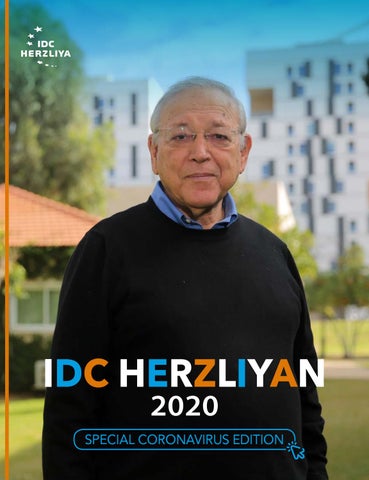
IDC HERZLIYAN 2020
SPECIAL CORONAVIRUS EDITION
CONTENTS
4
Prof. Uriel Reichman Shares how IDC Herzliya Rose to the Challenge
The Drahi Innovation Building – Breaking the Silos
8
16
IDC Herzliya Navigates through the Coronavirus with Innovation and Ingenuity
IDC HERZLIYAN SPECIAL CORONAVIRUS EDITION
12
RRIS Social and Cultural Outreach
Managing Editors: Anna Menzies Hecht / anna.menzies@idc.ac.il Tamara Mizroch / tamara.mizroch@idc.ac.il Copy Editor: Miriam Bulwar David-Hay / miriambdh@gmail.com Graphic Designer: Guy Tamir / guy@2plustudio.com Writer: Ariel Rodal-Spieler / arielrodal@gmail.com Cover Photographer: Ofer Vaknin Photographers: Amit Geron, Gadi Dagon, Kfir Bolotin, Herschel Gutman, Alon Gilboa, Iya Volkova, Eli Dassa, Tommy Harpaz
42
21 AFIDC
22
Sammy Ofer School of Communications
Harry Radzyner Law School
30
46
34
50
36
52
Arison School of Business
Tiomkin School of Economics
26
Dr. Miriam and Sheldon G. Adelson School of Entrepreneurship
Lauder School of Government, Diplomacy & Strategy
Baruch Ivcher School of Psychology
School of Sustainability
Efi Arazi School of Computer Science
Prof. Uriel Reichman, President and Founder of IDC Herzliya, shares how IDC continues to lead the way academically and socially during the pandemic In March this year, we found ourselves, like much of the world, suddenly in the midst of a major, developing drama. We were operating amid great uncertainty. I made a special announcement regarding the coronavirus crisis and IDC Herzliya’s preparedness for online classes and remote learning. Within a short few days, we went from frontal to online teaching. IDC Herzliya management prepared intensely during this short period for the transition to online classes and remote learning, and provided students with academic and personal consultations. It was decided to begin the second semester several weeks later than originally scheduled, deferring it to straight after the Pesach holiday, to enable those students who needed to return to their home countries to do so and to allow the immediate crisis to pass. In accordance with the government guidelines on the coronavirus, IDC Herzliya immediately started preparing for a new academic routine for the second semester: It was decided that classes and lectures, as well as various student services, would continue to be provided online, supported by a specially established technical support system. Enrollment for 2020-2021 would continue as usual and staff and support services were primed to make the process easy for incoming students. We held dedicated online information sessions and were in personal contact with numerous students by phone, email and online.
4 | Special Coronavirus Edition 2020
IDC HERZLIYA RISES TO THE CHALLENGE 5
I D C H E R Z L I YA W I L L A LW AY S CONTINUE TO LOOK FORWARD, NOT BACK.”
6 | Special Coronavirus Edition 2020
IDC HERZLIYA
I strongly believe that in every crisis there is also hidden opportunity. I have no doubt that if we are adaptable and demonstrate creativity, we will also learn and grow from the current predicament. Even though this particular crisis is new to us, we have already known many crises and challenges. States of emergency are not something new in Israel. We have on our side our resilience as a society and as a community, and we have already proved our ability to present a united front, strengthen one another, and meet difficult challenges. IDC Herzliya has taken every possible measure to maintain the safety of our students, while working for our continuing renowned academic excellence and to ensure the viability of our institution. Mainly, we have been praying for normalcy and to be able to go back to studying in the classrooms on our gorgeous campus. We have much to look forward to in the near future, with the building of a third dormitory building well underway, supported by Shari Arison, and the construction of the new Drahi Innovation Building, supported by the Patrick and Lina Drahi Foundation, together with Joey Low. On the academic front, we are delighted to announce that, in addition to the Ph.D. in Law already being offered by IDC in the current academic year, we have been granted the authority to award two further doctorates: a Ph.D. in Psychology from the Baruch Ivcher School of Psychology, and a Ph.D. in Computer Science from the Efi Arazi School of Computer Science. These mark a significant milestone in the history of IDC. IDC Herzliya will always continue to look forward, not back. 7
IDC HERZLIYA NAVIGATES THROUGH THE CORONAVIRUS WITH INNOVATION AND INGENUITY Mike Ray Chief Information Officer Prof. Uriel Reichman President and Founder of IDC Herzliya
Avi Nissim Vice President for Logistics
8 | Special Coronavirus Edition 2020
Golan Zrihan Vice President for Finance
As soon as the coronavirus pandemic hit Israel, IDC Herzliya went into emergency mode. Senior management meetings were held daily to deal with the new reality. Initially, these crisis meetings took place in person, but once social distancing regulations came into force, they were held via Zoom video conferencing.
Prof. Rafi Melnick IDC Provost
Dr. Ayelet Ben Ezer CEO and Vice President of IDC Herzliya
The crisis management talks revolved primarily around how to keep students and staff safe, while continuing to offer the high level of teaching and learning that IDC is known for. In addition, discussions were held on ensuring IDC’s ongoing financial viability during these unprecedented times.
I strongly believe that in every crisis there is also hidden opportunity. I have no doubt that if we are adaptable and demonstrate creativity, we will also learn and grow from the current predicament.” – Prof. Uriel Reichman, President and Founder of IDC Herzliya
Jonathan Davis Vice President for External Relations and Head of the Raphael Recanati International School
As in much of the world, the way IDC worked changed overnight. Adhering to the new and regularly changing recommendations from the Health Ministry, IDC moved classes online. At the same time, it maintained open, clear channels of communication with students, parents, faculty and administrative staff, contacting students and parents daily via email, phone and social media, as well as adding updates on the IDC website. Prof. Uriel Reichman, President and Founder of IDC Herzliya, issued a special reassuring announcement. “I strongly believe that in every crisis there is also hidden opportunity. I have no doubt that if we are adaptable and demonstrate creativity, we will also learn and grow from the current predicament,” he said. “IDC Herzliya has done everything possible to maintain the safety of our students, while continuing to prepare for continued academic excellence and ensure the viability of our institution.”
Shiri Avzuk Chief Marketing and Communications Officer
9
With regard to IDC’s financial viability, IDC Herzliya has never and does not rely on support or bailouts from the government, and therefore all efforts revolved around being able to see the crisis through without assistance. Within days, senior management devised a solid financial plan to survive the crisis. The message was loud and clear. It was business as usual at IDC Herzliya. This was made known in The Jerusalem Post in an article headed “Coronavirus Not Stopping Academics in Israel.” It was obvious that IDC Herzliya needed to go fully online, and fast. A concerted effort was made by a core group of staff and students to put IDC’s 1,500 courses online very quickly. Prof. Arik Shamir, Dean of the Efi Arazi School of Computer Science, and a group of 150 computer science students volunteered to assist IDC’s professors and the Computer and Information Systems Department to make the transition as smoothly and as quickly as possible. Shamir and the students helped the technicians in their work and taught the teaching staff how to operate the system. The transition to online learning launched with the Hebrew track on March 29, quickly followed by the Raphael Recanati International School, which began straight after Pesach.
10 | Special Coronavirus Edition 2020
At the RRIS, communication with students and parents immediately became more frequent. Some students needed to quarantine in the dormitories and this needed to be managed, while IDC reassured anxious parents around the globe. The school published regular status updates and posted Ten Tips for Coping with the Corona Crisis on the IDC website and via social media to assist students. RRIS counsellors and staff made themselves even more available than usual for support. The RRIS Campus Life Department set up Zoom sessions to connect with international students and share stories of life in lockdown, and students joined in from around the world, including from the United States, Spain, Russia, Sudan, Kazakhstan, Zambia and Taiwan. The RRIS continued its planned B.A. and M.A. Information Sessions for prospective students interested in enrolling for the 2020-2021 academic year, moving those sessions online. An impressive 131 prospective students attended the first session. As well as holding online lectures for current students, which were successfully conducted via Zoom and were recorded for students to view afterwards, various IDC facilities quickly began operating online, including the Marc Rich Library, the Lea and Naftali Ben-Yehuda Accessibility and Study Skills Center, and the Dean of Student Affairs.
The IDC Student Union provided regular updates on changes to learning arrangements, as well as general support for students via its COVID-19 hotline which included counselling services. The IDC Alumni Association was active on Facebook connecting Alumni with each other and resources during this difficult time. IDC’s annual Holocaust Memorial Day ceremony was held online with the participation of some of the students who took part in the IDC delegation to Poland last November. Memorial Day for Israel’s Fallen Soldiers and Victims of Terrorism was also held online. IDC’s Executive Education Center and External Studies Program, which initiates and organizes international training programs for Israeli organizations, executives and senior professionals, began issuing a daily newsletter containing informative analyses, motivational TED Talks, and engaging learning materials, both to distract and to inform. To help students and alumni stay up to date, the Career Center began offering online consultations and tips on how to use the time at home to build career trajectories and prepare for online job interviews. An online lecture by Jonathan Cohen, an IDC graduate and product manager at Google, showed students what leading companies such as Google, Facebook and Amazon look for in applicants’ resumes. Karin Kaufman, director of the Career Center, discussed how the situation had created new needs and roles within organizations in an article in Calcalist titled “Do You Have What It Takes to Be a Zoom Advisor?”
Students displayed their best sides during the lockdown, with many heartwarming examples of community outreach by students, including Ben Segal and Lior Avisar from the Baruch Ivcher School of Psychology, together with fellow student Maya Klien from the Harry Radzyner Law School, who worked with Taglit-Birthright Israel to create the Door 2 Dor project (Dor in Hebrew means “generation”). Alumni in the United States and Israel attended online Zoom talks and events, including a personal meeting with Prof. Reichman, President and Founder of IDC Herzliya, in which he updated them on how IDC was handling the crisis. Prof. Reichman gave a poignant Passover greeting to the IDC community, standing alone on campus. On a separate occasion, Reichman shared his personal and moving story on the significance of Memorial Day for Fallen Soldiers and Victims of Terrorism.
Prof. Uriel Reichman holds a
Throughout the pandemic, IDC’s academics provided thoughtful, real-time discussions about the evolving situation and their analyses and predictions for the near and longerterm future.
Zoom conference with U.S. alumni 11
THE DRAHI INNOVATION BUILDING
BREAKING THE SILOS Prof. Uriel Reichman discusses the Drahi Innovation Building
12 | Special Coronavirus Edition 2020
Despite the challenges of coronavirus, the Drahi Innovation Building, encapsulating the entrepreneurial spirit of IDC Herzliya remains set for completion in 2022.
Patrick Drahi
The Drahi Innovation Building is set to become IDC Herzliya’s epicenter for higher learning and research collaboration. Made possible by the generosity of the Patrick and Lina Drahi Foundation and businessman Joey Low, the building will contain state-of-the-art labs in a unique space designed by architect David Robins to encourage collaborative endeavors, and will bring together researchers from all of IDC’s schools, faculty and students, and enable them to engage with representatives from business, technology and industry.
The Drahi Innovation Building, an interdisciplinary technological and scientific research center, will soon be the core of our university.” – Prof. Uriel Reichman, President and Founder of IDC Herzliya
“In the entrepreneurial spirit of IDC, we are embarking on a major change that will enable us to prepare for future challenges and bring about better understanding, better research and better education,” says Prof. Uriel Reichman, IDC’s Founder and President. “As we said 26 years ago when we founded IDC, knowledge should not be stored in disciplinary silos. From the beginning, we introduced a unique interdisciplinary model of education. Today, that is even more important. The Drahi Innovation Building, an interdisciplinary technological and scientific research center, will soon be the core of our university. By bringing together researchers and experts from diverse fields of knowledge, unique creativity is likely to be generated.”
13
The Drahi Innovation Building will give students an incredible opportunity to be actively involved in significant research early on in their academic careers.” – Prof. Noam Lemelshtrich Latar, Founding Dean of the Sammy Ofer School of Communications and Head of the IDC Innovation Center
The Drahi building will serve as a home for cuttingedge research on health, business, sustainability, government and security, as well as new learning technologies. Undergraduate and graduate students from multiple disciplines will undertake innovative programs featuring virtual and augmented reality, human-computer interaction, digital fabrication and 3D printing, as well as engineering, computer science, biology, and neuroscience. The center will house many of IDC’s existing labs, enabling each to focus on its own specific research while also working with other labs on collaborative projects. It will initiate research to respond to social and economic challenges, help plan a redesign of the social sciences faculties, and stimulate student entrepreneurship and innovative responses to industrial and societal needs. As part of its mission to foster collaboration between industry and academia, it will hold targeted executive education courses and seminars for industry and business leaders. The center will also provide technological guidance and mentoring to IDC students’ start-ups, and will serve as an incubator for start-ups specializing in HCI, AI and Big Data innovations, with applications in areas including fintech, disaster management, and counter-terrorism. 14 | Special Coronavirus Edition 2020
Joey Low
“The Drahi Innovation Building represents the center of new academia, and what is in fact a trans-disciplinary approach, which is even more far-reaching than an interdisciplinary one,” says Dr. Jonathan Giron, the center’s Chief Operating Officer and an IDC psychology graduate with a Ph.D. in biology and neuroscience.
Patrick Drahi, founder and Chairman of the Altice media group and founder of i24News, graduated in engineering from the Ecole Polytechnique in Paris and in 2016 inaugurated its Innovation and Entrepreneurship Center. The Patrick and Lina Drahi Foundation supports organizations in the fields of science, education, music, the arts, innovation, and entrepreneurship. “We are thrilled to support IDC’s new innovation center in what is set to become the living core of the campus,” says Drahi. “It is the perfect project for our family, as it brings together education, entrepreneurship, innovation and collaboration. It reminds us of our first Innovation and Entrepreneurship Center, at the Ecole Polytechnique in Paris.”
“It is the perfect project for our family, as it brings together education, entrepreneurship, innovation and collaboration.” – Patrick Drahi
Joey Low, the founder of Star Farm Ventures and a longstanding friend and supporter of IDC, says his “passion for start-ups” prompted him to help establish the building. “When Prof. Reichman asked me to be involved, what really spoke to me was the whole concept of innovation and the fact that new start-ups will be coming out of this – that is what I’m investing in,” he says. Prof. Noam Lemelshtrich Latar, Founding Dean of the Sammy Ofer School of Communications and Head of the new Innovation Center, says, “The design of the building allows for joint innovative research on various issues that face Israeli and global society due to the digital revolution, which affects every part of human life. The Drahi Innovation Building will give students an incredible opportunity to be actively involved in significant research early on in their academic careers. They will have real opportunities to be heard, to take a real part in their professors’ papers. This is something not seen in other universities.”
Architect Robins, whose company robinsalliance also designed the Adelson School of Entrepreneurship building along with architect Dan Price, praises IDC’s support for innovative architecture and its interdisciplinary ethos. “The goal (for the Drahi building) was to create architecture that would not be a regular faculty building, but a place to promote interdisciplinary work and create a synergy between these different departments, who are all doing groundbreaking research,” he says. “The center of the building is a hub, a shared workspace, around which are open-plan office spaces, workshops, and labs. The outer ring consists of semi-public and private spaces that will serve as meeting rooms.” The dramatic building will make good use of Israel’s naturally abundant sunlight while keeping energy costs down with strategically placed louvers. – Ariel Rodal Spieler
15
RRIS SOCIAL AND CULTURAL OUTREACH 16 | Special Coronavirus Edition 2020
From the onset of the coronavirus crisis, the Raphael Recanati International School immediately increased communication with students and parents, and began publishing regular status updates and tips for coping with the coronavirus crisis to assist students. RRIS counselors and staff made themselves even more available than usual for support. Jonathan Davis, Head of the RRIS and IDC’s Vice President for External Relations, also released notices during March and April to inform IDC friends and supporters on the steps being taken to cope with the evolving situation. “We are doing all in our power to assist our international students to navigate the challenges of the coronavirus pandemic. We invite you to join us in preparing for a happy post-coronavirus era, but until then, we will do all in our power to continue to achieve our common goals, in the Herzliyan spirit in which we believe,” Davis said. RRIS staff put together a Facebook video welcoming students to the spring semester.
We are doing all in our power to assist our international students to navigate the challenges of the coronavirus pandemic.” – Jonathan Davis, Head of the RRIS and IDC’s Vice President for External Relations
17
INFORMATION SESSIONS GO ONLINE Information Sessions for prospective undergraduate and graduate degree students interested in the 2020-2021 academic year were moved online. An impressive 131 prospective students attended the first session, and 30 of them immediately signed up for the year.
RRIS CAMPUS LIFE BRINGS STUDENTS TOGETHER The RRIS Campus Life Department set up Zoom sessions to connect with international students and enable them to share stories of life in lockdown. In the first session, students joined in from around the world, including from the United States, Spain, Russia, Sudan, Kazakhstan, Zambia and Taiwan. An online event was held for Memorial Day with a panel of lone soldier IDC students together with Jonathan Davis. A special RRIS Independence Day Mix Tape put together by staff and students was released to entertain students spending Independence Day in lockdown.
PASSOVER WISHES FROM AFAR Wishes for a happy and safe Passover were offered via a Facebook video by Jonathan Davis and by the RRIS staff. RRIS staff members also distributed 120 hot meals for international students in the IDC dormitories and around Herzliya.
Join Now >
RRIS staff prepare meals for distribution to international students. From left: RRIS staff Sylvia Kassoff, Karen Yoseph, Sarit Ben-Or, Shelly Levy with Carine Katz, Director of the RRIS
18 | Special Coronavirus Edition 2020
FROM CHINA TO IDC WITH LOVE IN OPERATION SHALOM Chinese businessman Benjamin Peng, who graduated with a Global MBA in Innovation and Entrepreneurship from IDC in 2019, works to promote and support Israel in his home country. With the onset of the coronavirus crisis, he launched a special operation, Operation Shalom, to arrange for a donation of 2,000 face masks to be sent to Israel directly for IDC Herzliya students. Second-year Business and Economics student Farrah Zhao was instrumental in helping to bring the masks to campus. Peng also helped arrange a substantial donation to establish two new RRIS scholarships at IDC, which will be awarded annually in the fields of Counter-Terrorism or Computer Science, with preference to be given to commanders from Unit 669, the Israel Defense Forces’ elite airborne search-andrescue force, or to officers from other elite combat units. The candidates will be selected based on their needs, merits, values, and contributions to Israel. The scholarships will be run out of a fund named the ShaRon Scholarship Fund in honor of donor Shan Sha and the late Prime Minister Ariel Sharon, whom the donor admired.
19
JEWISH LIFE ON CAMPUS Rabbi Josh and Margot Botwinick, the Orthodox Union’s Jewish Learning Initiative on Campus educators, helped IDC students prepare for and enjoy Passover, some of whom were doing so by themselves for the first time. The couple offered ideas for Pesach meals with a basic recipes video on Facebook and created a Pesach Guide with useful information and links.
Holocaust survivor Dr. Sergey Kovarski-Korablikov at the RRIS Zikaron Basalon event
HOLOCAUST MEMORIAL DAY HELD ONLINE Holocaust Memorial Day commemorations were held online, and not only proved to be meaningful experiences, but brought in many more participants from all over the world than would have been able to attend in person. On the eve of Yom HaShoah, the RRIS was privileged to host Holocaust survivor Dr. Sergey Kovarski-Korablikov for an RRIS Zikaron Basalon (“Memory in the Living Room”) event, held via Zoom. Originally from Lithuania, KovarskiKorablikov shared the inspiring story of his survival in the ghetto and his aliyah. His grandson Gal Korablikov, a firstyear Economics and Business student, was also on the call, making it additionally special.
20 | Special Coronavirus Edition 2020
They held a Zoom musical Kabbalat Shabbat and delivered soup to students in quarantine, as well as answering questions about Jewish law during these challenging times. Online Facebook presentations were held on the weekly Torah portion as well as on the topics of the Holocaust and Memorial Day for Israel’s Fallen Soldiers and Victims of Terrorism. An online event was held on Facebook for Memorial Day called “Stories from the Shetach,” which explored the lives of six soldiers and victims of terror through personal stories. Together with students, OU-JLIC delivered flowers and Israeli flags to homes of the elderly to celebrate Independence Day instead of the usual in home visits. the Botiniwick family also released a fun video on Facebook in celebration of the day.
AFIDC
AMERICAN FRIENDS OF IDC SHOW STRENGTHENED SUPPORT As the representative of IDC Herzliya in the United States, the American Friends of IDC office worked hard to maintain normalcy during the pandemic. The entire staff moved to working from home, offering support to IDC in Israel and to IDC’s friends, supporters, alumni, students and parents in the U.S. Some positive aspects emerged from the crisis. AFIDC was able to provide more online and remote content than ever. Professors and prominent alumni in the U.S. offered several Zoom sessions each week, on subjects including Economics, Communications, Counter-Terrorism, Entrepreneurship, and Psychology. AFIDC also continued to maintain its donor base, essential as IDC is not a government-funded institution and has always depended on the generosity of donors, now more then ever. These efforts ensure that students from lower socio-economic backgrounds will always be able to study at IDC, and assist IDC in continuing to provide the outstanding academic and extracurricular experiences it is known for. With much of AFIDC’s focus on enabling North American students to study at IDC through the Raphael Recanati International School, this work was quickly moved online and AFIDC worked closely with Israel to offer online information sessions for prospective students. “These efforts were so successful that, despite the pandemic, the number of students applying from North America to study at IDC increased by 20 percent,” said Leslie Skyba, AFIDC’s Executive Director. “AFIDC remains here for IDC and we hope we can soon resume our activities in person in the U.S. and under the eucalyptus trees on the beautiful campus in Israel.”
The AFIDC team from left: Amy Gross Nachon, Director of Advancement (top left), Natalie Golan-Aubrey, Director of Recruitment and Marketing for North America (top right), Michal Yonati Fraiman, Director of West Coast Operations and National Director of Alumni Affairs (center left), Leslie Skyba, Executive Director (center right) and Rina Haller, Advancement and Recruitment Associate (bottom)
21
1
SAMMY OFER SCHOOL OF COMMUNICATIONS A training hub for content marketing, media and journalism
Prof. Noam Lemelshtrich Latar, Dean
22 | Special Coronavirus Edition 2020
Sammy Ofer z”l
Equipped with state-of-the-art recording studios, computer labs, visual content incubators, editing rooms and even a radio station, the Sammy Ofer School of Communications trains and equips Israeli and international students for the changing world of global media and communications. “We have made every effort to create a cutting-edge supportive learning environment, and this is especially true during these challenging times,” says Prof. Noam Lemelshtrich Latar, Founding Dean of the Sammy Ofer School. At the outset of the coronavirus pandemic in Israel live session was held for students with Lemelshtrich Latar and with Dr. Tal Azran, Head of the school’s International Communication program.
NoCamels (Asper Institute for New Media Diplomacy) Daniel Pearl International Journalism Institute Milab Marketing Lab The Content Hub Research Center for Internet Psychology Radio Station 106.2 FM Museum of Communications Awareness Communication Center Virtual Reality Lab for Conflict Research
We have made every effort to create a cutting-edge supportive learning environment, and this is especially true during these challenging times.” – Prof. Noam Lemelshtrich Latar, Dean of the Sammy Ofer School 23
Milab’s innovative face shield kit
MILAB PRODUCES INNOVATIVE FACE SHIELDS FOR MEIR HOSPITAL
NOCAMELS BRINGS ISRAELI INNOVATIONS TO THE WORLD
Milab, the Media Innovation Lab in the Sammy Ofer School of Communications, is known for its innovative and multidisciplinary approaches to complex challenges, with its focus on the human interaction with technology. During the coronavirus crisis, the lab was among a group of innovators in an Israeli “makers” community that was working on manufacturing face shields for essential workers, using raw materials and 3D printing. As a result, an ER staff member from Meir Hospital in Kfar Saba contacted the lab and asked for its help to produce much-needed face shields for ER staff. Milab received special permission to use IDC’s facilities and began producing the innovative shields, which are designed to be worn as another layer of protection in addition to medical gear. The achievement was highlighted in an article in the NoCamels news website headed “Israeli DIY Coronavirus Face Shield Offers Extra Protection in Pandemic.”
NoCamels.com, the leading news website based at the Sammy Ofer School of Communications, which covers new technologies and innovations from Israel for a global audience, was launched by The Asper Foundation in 2010 and since then has published almost 10,000 articles and recorded more than 10 million visits.
24 | Special Coronavirus Edition 2020
During the coronavirus crisis, NoCamels published daily news articles and features highlighting developments and insights into the pandemic from Israel, including: “Israeli Scientist Nabs U.S. Patent for Coronavirus Vaccines Design,” “Mobileye CEO: Coronovirus Exit Strategy Could End Crisis in Months,” and “Israeli Startup Raises $5M for Facial Recognition Tech That Can Identify Masked Faces.” The Asper Foundation dedicated the Asper Institute for New Media Diplomacy at the Sammy Ofer School in 2007. The institute is headed by Prof. Noam Lemelshtrich, founding dean of the Sammy Ofer School of Communications and journalist and lecturer Anouk Lorie. NoCamels.com is also supported by the Patrick and Lina Drahi Foundation.
PUBLIC DIPLOMACY PROGRAM REORGANIZES CURRICULUM “During a pandemic, diplomacy and international cooperation are critical tools. To find solutions fast, countries must learn from one another’s experiences, and cooperation is essential to ensure crucial supplies of protective equipment,” says Dr. Moran Yarchi, Head of the Public Diplomacy program. The program, run jointly by the Sammy Ofer School of Communications and the Lauder School of Government, Diplomacy & Strategy, together with the Abba Eban Institute for International Diplomacy and ACT-IL, is designed for exceptional students from all IDC schools in their final year of undergraduate studies. Each year, about 20 leading honors students take part in the program, which utilizes interdisciplinary content to provide students with a deep understanding of the current disciplinary landscape, and teaches them to deal with a variety of challenges in diplomacy and advocacy. During the coronavirus crisis, a seminar was held with students around the world, discussing how different sectors, including governments, civilian society, academia, business and the media, were dealing with the pandemic.
Eitan Charnoff at work at an MDA testing center
ALUMNUS GOES TO FRONT LINES OF VIRUS BATTLE Eitan Charnoff, who graduated from the Sammy Ofer School of Communications in 2012 and who has been a volunteer medic with Magen David Adom for many years, was among those who went to the front lines of the coronavirus battle. Charnoff and other MDA staff and volunteers went into the homes of suspected coronavirus patients to take samples for testing, as well as volunteering in MDA’s drive-through testing center.
Milab, the Media Innovation Lab
25
2
DR. MIRIAM AND SHELDON G. ADELSON SCHOOL OF ENTREPRENEURSHIP Building a new generation of entrepreneurs
Prof. Yair Tauman,
Sheldon and Dr. Miriam
Dean
Adelson
26 | Special Coronavirus Edition 2020
Zell Entrepreneurship Program IDC Beyond CO-OP Start-Up Experience Course UpStart Venture Creation Program Leumi Innovation Project EXTRA-ACADEMIC PROGRAMS • IDC Entrepreneurship Club • Princeton Start-Up Immersion Program Israel • Global Masters in Finance • National University of Singapore Entrepreneurship • Israel Summer Business Academy • Israel-Canada exchange programs at McGill and Laurier Universities
The Adelson School of Entrepreneurship takes pride in emphasizing creativity, flexibility, tenacity, optimism, a proactive approach, and the ability to seek out opportunities amid challenges. Thus, when the coronavirus crisis began, the school responded in line with its core values, adapting quickly to the new situation and launching new projects to empower students and staff. The Directors of all the B.A. tracks – Dr. Yossi Maaravi, Vice Dean of the Adelson School of Entrepreneurship, Dr. Gali Einav, Head of the International B.A. and Upstart program, and Dr. Gail Gilboa Freedman, Head of the double major at the Tiomkin School of Economics – each held Zoom meetings with students both to provide them with messages and guidelines and to motivate them to see the crisis as an opportunity for personal and professional growth. Staff met (online) with class representatives to answer questions and deal with challenges. The school also created a syllabus for a new course, “Being an Autodidact in the Digital 21st Century,” aimed at enabling students to learn independently throughout their lives. 27
NEW PROJECTS EMPOWER STUDENTS AND STAFF Demonstrating its optimistic and proactive values, the Adelson School of Entrepreneurship initiated a number of new projects during the crisis. It created an important resource for entrepreneurship students and entrepreneurs by collecting and listing nearly 200 online resources, including blogs, podcasts, newsletters, courses, documentaries, and websites, all of them free, professional and relevant. It collected the information in an easily searchable smart table that can be updated as needed by Adelson School staff and students. The school also accelerated a project begun before the pandemic, creating the ASE Entrepreneurship Glossary, a listing of up to 400 entrepreneurship terms all students are required to know before the end of their first year. Initially planned for later this year, the work was completed and published within a few days after the school recruited students to participate in and manage the project. The glossary can be updated by students. IDC Hub, the Adelson School’s extracurricular activity platform, offers workshops, lectures, meetings and activities, as well as a mentoring program that assists students with their ventures and ideas. During the coronavirus crisis, it began to offer services online, including 96 mentoring sessions. The mentoring is led by Prof. Shlomo Kalish, Founder and Managing Partner at Jerusalem Global Ventures and the school’s Entrepreneur-in-Residence, and mentors include school faculty members and selected business leaders. The IDC Entrepreneurship Club, run by students, also moved most of its 14 programs online and continued to function fully during the crisis.
28 | Special Coronavirus Edition 2020
Students from the IDC Entrepreneurship Club
With many top speakers finding themselves available due to the cancellations of events, the Adelson School Master Class series, initiated and hosted by Dr. Yossi Maaravi, Vice Dean, Adelson School of Entrepreneurship, found an opportunity. Hundreds of students, alumni, staff, guest lecturers, IDC friends and donors, and businesspeople were able to participate in master classes by prominent figures, which included question-and-answer sessions. The first master class featured leading Israeli comedian Adir Miller, while over subsequent weeks prominent speakers were: Saul Singer, author of the book “StartUp Nation: The Story of Israel’s Economic Miracle”; Benjy Singer, General Manager at WeWork Israel; Shai Wininger, founder of Fiverr and co-founder and President of Lemonade, and Avigdor Willenz, a serial tech investor and a founder of Galileo Technology, Annapurna Labs and Habana Labs. Adelson School students also created and launched numerous entrepreneurial projects, including several not-for-profit ventures aimed at helping various sectors of Israeli society cope with the coronavirus crisis. These include Sitter Seeker, an app that connects volunteer babysitters with medical staff who need care for their children while they work; IDC School, a Facebook group for Hebrew speakers in which Israeli university students volunteer to help children with their school work, and Jobs in Corona Time, a Facebook group assisting Israelis to find jobs during the crisis, which was joined by more than 9,000 people in just three weeks.
Sam Zell
ZELL ENTREPRENEURSHIP PROGRAM FOCUSES ON STRENGTHS Planning for Zell Sprint Week, the annual week-long hackathon developed and led by Zell alumni and entrepreneurs-in-residence Liraz Sharabani and Yoav Artzi, was already well underway when the lockdown came into force. In line with the Zell philosophy, “When faced with a setback, adapt,” the organizers decided neither to postpone nor to cancel, but to go ahead with Zell Sprint Week remotely. Faculty, mentors and student teams worked together online, and the student teams presented their pitches and took questions from investors via video conferencing. The program even held its first-ever investor panel remotely. Despite the challenges involved, the remote Zell Sprint Week proved to be a clear success.
The Zell students of 2019-2020
29
3
ARISON SCHOOL OF BUSINESS Equipping students in an era of digital transformation
Prof. Dov Pekelman, Dean
30 | Special Coronavirus Edition 2020
Ted Arison z”l
At the outset of the coronavirus pandemic in Israel, the Arison School of Business held several live sessions online to inform prospective students about the degrees on offer. One session was with Dr. Danna Tevet, Head of hybrid teaching at the school, about the B.A. in Business Administration. “At the Arison School of Business, we are constantly developing and evolving courses that will build resilience so that young people can face the business world from a position of strength. It is vital that this includes both technical prowess and emotional resilience,” says Prof. Dov Pekelman, Dean of the Arison School. A live session was held about the one year MBA and Global MBA.
At the Arison School of Business, we are constantly developing and evolving courses that will build resilience so that young people can face the business world from a position of strength. It is vital that this includes both technical prowess and emotional resilience.” – Prof. Dov Pekelman, Dean of the Arison School
31
JULIS-RABINOWITZ ACADEMIC CHAIR IN DATA SCIENCE Dr. Shai Fine, the Julis-Rabinowitz Academic Chair in Data Science, launched a project on influence detection in social networks. “We launched an activity aiming to detect leader and follower relations over social networks,” he says. Shai says that while previous studies have looked into the subject, his team’s focus is different in that it is concentrating on influences when it comes to specific, transient topics over a short period of time. “Applications range from marketing and advertisements to policy and homeland security,” he says. In collaboration with the Chaim Sheba Medical Center, Fine and his team have also been studying how to provide better prognosis models for hospitalized COVID-19 patients. Working in a secure environment to ensure patient privacy is maintained, the team has been assessing patients’ health records with the goal of gaining the ability to accurately predict the course of their disease.
Dr. Shai Fine
HEALTHCARE INNOVATION MBA STUDENTS WHIP UP NEEDED SYSTEM FOR HOSPITAL In just a few days, a team of students from IDC’s unique MBA in Healthcare Innovation created a computerized system to manage coronavirus patients in different departments at Israel’s largest hospital, the Chaim Sheba Medical Center at Tel Hashomer. Student Dr. Moshe Ashkenazi, a pediatrician and member of the Sheba management team in charge of its coronavirus response, said numerous coronavirus patients had arrived at the hospital at the same time, and this required quickly setting up a computerized system to manage resources, plan equipment allocations, and keep track of the patients’ situations. Working together via Zoom, fellow MBA in Healthcare Innovation students Tal Nevo, also of Sheba, Dganit Ben Yacov, of the City of Raanana, and Natali Gotlieb, of Teva Pharmaceuticals, were able to build a working system in just 72 hours. Within a week, supported by Prof. Aviv Barzilai of Sheba, the hospital’s ARC Innovation Center, and a team of programmers from Intel Mobileye who worked voluntarily, the system was fully up and running and ready for use by the hospital’s management team. The unprecedented MBA in Healthcare Innovation, launched in the 2018-2019 academic year in a joint venture by the Arison School of Business with the Chaim Sheba Medical Center, is proving to be a great success. Initiated and led by Prof. Varda Liberman, the one-year program is designed for professionals, aiming to provide future leaders of the healthcare industry with the tools and skills necessary to address the challenges and complexities of modern healthcare.
32 | Special Coronavirus Edition 2020
STUDENTS LAUNCH MASS FUNDRAISING CAMPAIGN TO BUY MASKS
Prof. Varda Liberman
In cooperation with the ZAKA emergency response organization, Yishai Belga and Ben Dagan, two international IDC students from the Arison School’s double major B.A. in Business and Entrepreneurship, contributed to the fight against the coronavirus by launching a mass fundraising campaign to purchase N-95 surgical face masks for hospitals and nursing homes. Such masks were in seriously short supply but were much needed by hospital medical staff, nursing home residents and nursing home caregivers. Belga and Dagan’s campaign raised funds to purchase over 2,000 of the masks.
Medical staff at Meir Hospital show their appreciation after receiving masks as a result of the IDC-ZAKA campaign
33
4
TIOMKIN SCHOOL OF ECONOMICS Preparing the global financial leaders of tomorrow
Prof. Zvi Eckstein, Dean
Judy and Avi Tiomkin
Teachin moved all classes con In each class, related to the effects. The A team dedicat the economic lockdown and on policies to most Israelis.” – Prof. Zvi Eckstein,
Dean, Tiomkin Scho
34 | Special Coronavirus Edition 2020
ng at the Tiomkin School d smoothly to Zoom and ntinued as scheduled. , we discussed topics e pandemic and its Aaron Institute research ted itself to analyzing c consequences of the d advised the government o ease the harsh impact on ”
ool of Economics
At the outset of the coronavirus pandemic, the Tiomkin School of Economics quickly moved its operations online and held lectures and webinars, including by Dr. Yael Hadass, IDC’s Academic Head of Economics and head of the double major degree in Business Administration and Economics at the RRIS, who addressed IDC alumni on “The Coronavirus Crisis and the History of Global Economic Crises: Their Causes, Coping with Them, and How They Emerge.” Hadass also held a live online information session about the school’s B.A. in Business and Economics.
TIOMKIN SCHOOL DEAN AND IDC PROVOST URGE ACTION TO BOLSTER THE ECONOMY In an article published in Haaretz titled “To Cope With Coronavirus, First Keep the Business Sector Afloat, Say Top Economists,” Prof. Zvi Eckstein, Dean of the Tiomkin School of Economics, and IDC Provost Prof. Rafi Melnick said Israel’s government needed to act to ensure the pandemic did not push the economy into a recession. Eckstein, who was Deputy Governor of the Bank of Israel during the 2008-2009 global financial crisis, said, “You have to plan for the worstcase scenario. In the previous crisis, anyone who operated on the assumption that everything would be fine got it wrong.” He said the economy would only begin to recover once an effective treatment or vaccine was found, and that in the meantime there would be “one or two quarters of declining gross domestic product” and a significant rise in unemployment. Melnick said, “What’s needed in terms of policy is a very clear message from the government – accompanied by actions, not only explanations – that it will do everything needed to make sure that healthy businesses don’t fail.” Although such measures would involve large increases in government spending at a time of reduced tax revenues, thus leading to a larger budget deficit, both economists said the actions needed to be taken. Melnick said Israel was in a relatively “good situation” because it had a low public debt level and large foreign currency reserves. “I don’t think an increase in the deficit will endanger Israel’s macroeconomic stability,” he said. “Quite to the contrary, it would stop the situation from snowballing.” 35
5
LAUDER SCHOOL OF GOVERNMENT, DIPLOMACY & STRATEGY Preparing students for leadership positions in a complex world
Prof. Assaf Moghadam, Dean
36 | Special Coronavirus Edition 2020
Amb. Ronald S. Lauder
The Lauder School of Government, Diplomacy & Strategy continued working at full throttle during the lockdown, even launching new programs and publications. Faculty members held online information sessions and published thoughtful analyses, and students initiated several innovative ventures.” – Prof. Assaf Moghadam, Dean, Lauder School of Government, Diplomacy & Strategy 37
In partnership with Germany’s Konrad-AdenauerStiftung, the Lauder School launched the new Program on Democratic Resilience and Renewal. Directed by Dr. Amichai Magen, Head of the Lauder School’s M.A. in Diplomacy and Conflict Studies, the new program aims to support innovative research and publications, with the emphasis on collaborative interdisciplinary work among scholars and public outreach activities. This year, it will focus on issues of democratic fragility and resilience, including authoritarian and populist challenges, new technologies, and the impact of the pandemic on politics.
The school also published a two-volume book, “How Do Leaders Make Decisions?: Evidence from the East and West,” written by students and edited by Prof. Alex Mintz, Director of the Lauder School’s Computerized Decision Making Lab, and Prof. Dmitry Adamsky, Head of the B.A. Honors Track in Strategy and Decision Making. Adamsky was also named as one of the winners of a prestigious 2020 Book Award from the International Studies Association, the largest scholarly association of international relations scholars. He received the award in the category of Religion and International Relations for his 2019 book, “Russian Nuclear Orthodoxy: Religion, Politics and Strategy.” Lauder School faculty were active in publishing articles during the crisis. Lauder School Dean Prof. Assaf Moghadam and alumnus Michel Wyss co-wrote “The Political Power of Proxies: Why Non-State Actors Use Local Surrogates,” published in the International Security journal. Other Lauder School faculty members appeared in Hebrew publications. Prof. Liav Orgad wrote in Hebrew on the ynet news site how the pandemic was exposing the flaws within the European Union. Prof. Liza Saban, Deputy Dean of the Lauder School, was interviewed as part of a feature article in Hebrew on Ynet on the governmental financial compensation needed during the lockdown.
38 | Special Coronavirus Edition 2020
Prof. Karine Nahon, Associate Professor of Information Science in both the Lauder School and the Sammy Ofer School of Communications, wrote of the threats to Israeli democracy during the pandemic in an article in Hebrew on the Shomrim Center for Media and Democracy websit. Dr. Lesley Terris, Head of the Lauder School’s International Program in Government, held a live information session for students about the B.A. in Government for prospective students. A live session was also held with Dr. Eitan Azani, Head of the B.A. and M.A. specialization in Counter-Terrorism and Homeland Security, and Dr. Amichai Magen, Head of the M.A. in Diplomacy and Conflict Studies. Lauder School students showed their initiative in several ways. Hili Shapiro, a student in the Rabin Leadership Program, partnered with the Israel Space Agency’s Horizon Community to launch a Facebook page containing educational content on space and science for children stuck at home. She also created a list of courses and online educational material on science and space for the elderly interested in gaining knowledge while confined to their homes. The Ofek Forum, a unique group of IDC students serving as officers in special IDF units, continued to meet online and held a Zoom session with Prof. Omer Moav, of the Tiomkin School of Economics, to discuss economic policy during the crisis.
The Ofek Forum holds a Zoom session with Prof. Omer Moav
IPS ANALYZES SECURITY IMPLICATIONS
Prof. Boaz Ganor
ICT DISCUSSES ISIS AND THE CRISIS “The International Institute for Counter-Terrorism at IDC is adapting to the new reality,” says Stevie Weinberg, ICT’s Deputy Executive Director. “We are working diligently with the staff of the Lauder School to transition to online teaching and are working on several online simulations and research to better understand the impact of COVID-19 on terrorism as well as on regional and international security. We also continue to provide our students and interns with the bestremote working experience.” Prof. Boaz Ganor, Founder and Executive Director of ICT and the Ronald S. Lauder Chair for Counter-Terrorism, discussed the common denominators between global terrorism and the pandemic and the fight against each in an interview with ICT researcher Etai Handman.
IDC’s Institute for Policy and Strategy released regular analyses of the evolving situation in its online newsletter, Insights from the Institute for Policy and Strategy, under the guidance of Maj. Gen. (Ret.) Amos Gilead. These included: “Is Israel Prepared to Emerge from the Coronavirus Crisis?” a discussion by the IPS team of governmental actions, challenges, and failures; “Iran: A Strategic Challenge in the Coronavirus Era,” by IPS Senior Research Fellow and military intelligence and Middle East expert Col. (Res.) Udi Evental; “Russia in the Coronavirus Age: Between Opportunities and a Glass Ceiling,” by IPS Senior Research Fellow and CIS expert Ksenia Svetlova; “Preliminary Insights and Recommendations for a New Government in Israel,” by the IPS team, and “Israel and the Palestinian Authority in the Face of the Coronavirus Crisis,” by Michael Milstein, Head of the Palestinian Studies Forum at the Moshe Dayan Center for Middle Eastern and African Studies at Tel Aviv University. Evental also analyzed the potential impact of the crisis on regional stability in a special IPS Spotlight feature on the IDC website titled “Coronavirus in the Middle East: Regimes’ Stability, Oil, Religion, and Politics.” In another IPS Spotlight feature, “U.S., Iran and the Coronavirus: Risk or Opportunity for Israel,” military and political experts analyzed the effects of the crisis on U.S.-Iran relations and various possible scenarios for Israel.
Dr. Michael Barak, a Senior Researcher at ICT, spoke to The Jerusalem Post on “Does ISIS See the Coronavirus as an Opportunity?” He said the Islamic jihadi group openly considered the virus a chance to strike blows against Western countries while they were preoccupied with safety measures and containment.
Maj. Gen. (Ret.) Amos Gilead 39
ABBA EBAN INSTITUTE: DIPLOMATIC OPPORTUNITIES IN THE TIME OF CORONA As the world leader in innovative diplomacy, the Abba Eban Institute for International Diplomacy saw the pandemic not merely as an obstacle and a challenge, but as an opportunity to forge new paths in diplomacy in Israel and around the world. The institute’s team quickly adjusted its operations to meet the changing needs of the diplomatic world and to launch new operations. “We understand that this unique period can also serve as an opportunity to do even better,” says Amb. Ron Prosor, Chairman of the Abba Eban Institute. “We took our capabilities and our knowledge and harnessed them for the benefit of Israel, in line with our organizational vision, in every branch of our work, with every capacity we have, and in every field that we operate in.” Even before the pandemic began, the institute marked a major achievement in innovative diplomacy in leading a campaign across Europe to have Lebanon-based group Hezbollah designated a terrorist organization. Basing the campaign on in-depth research and using innovative methodologies, the institute held meetings with European decision-makers and created a wave of public discussion and calls for action.
The campaign proved successful, with the German parliament, the Bundestag, passing a motion to designate Hezbollah as a terrorist organization at the end of 2019, and the German government issuing a full executive ban against Hezbollah this year. During the coronavirus lockdown, the Diplomatic Counter-Terrorism Program continued working to expose Hezbollah as the real virus infecting Lebanon and causing its bankruptcy, with a series of media publications and conferences detailing Hezbollah’s destructive actions and outlining ways for the international community to bail Lebanon out while ensuring Hezbollah is sidelined. The Diplomacy 2030 Program launched the DiploMarket, a unique online platform that harnesses the Abba Eban Institute’s years of research and experience to provide tools, knowledge, and connections to navigate the international system at a time of weakened global diplomacy. Yaniv Cohen, Executive Director of the Abba Eban Institute, was interviewed on how Israel’s Foreign Ministry should be working to improve the country’s international standing during the crisis in an article in The Jerusalem Post titled “Coronavirus Crisis – A Diplomatic Opportunity Israel Shouldn’t Miss.” The Abba Eban Institute’s online magazine, The Arena, in collaboration with the institute’s new Israel-Asia Policy Program, published a series of features (in Hebrew) titled “Back to the Future: Asian View.” The series offered in-depth looks into Asian societies, cultures, politics, diplomacy and international affairs as those countries began getting back on their feet after being the first to be struck by the coronavirus.
Amb. Ron Prosor holds a lecture for his M.A. students on 40 | Special Coronavirus Edition 2020
“Israel’s Challenges at the U.N.”
ARGOV FELLOWS SHARE EXPERIENCES
An image from Act-IL’s online event, “Understanding the Anti-Israel Boycott Movement”
ACT-IL FIGHTS ANTI-SEMITIC AND ANTI-ISRAEL MESSAGES Act-IL, the pro-Israel social activist platform run jointly by IDC and the Israeli American Council, doubled its online presence and engagement in response to a clear growing trend of online antiSemitism blaming the coronavirus on Israel and on Jews, including accusations that Israelis were intentionally spreading the virus to Palestinians and images depicting the virus personified as Jews. Act-IL mobilized activists and communities both to combat such messages and to emphasize the positive contributions Israel offers to the world.
The Argov Fellows Program in Leadership and Diplomacy began activities online with a live 2021 Application Question and Answer Session at which three Fellows shared their experiences and impressions of the program with prospective newcomers. Many students also produced and sent in videos that were posted on the Argov Fellows Program Facebook page, highlighting what they enjoyed about the program and why others should join. Founded in 2006 by businessman Gideon Argov to build on the legacy of his late father, former Israeli Ambassador Shlomo Argov z”l, the Argov Fellows Program is an integral part of the Lauder School. Conducted entirely in English, the year-long program prepares up to 24 outstanding final-year IDC students for future leadership positions in Israel and the Jewish world, focusing specifically on issues in Jewish professional leadership and Jewish communities.
As the world’s biggest pro-Israel crowd-sourcing activist organization, Act-IL has some 26,000 activists on all online platforms, who work to detect and combat anti-Semitic and anti-Israel campaigns, including those of the BDS movement, which with the onset of the pandemic moved its events online. In response, Act-IL held an online event called “Understanding the Anti-Israel Boycott Movement.” 41
6
HARRY RADZYNER LAW SCHOOL At the forefront of legal education, academic research and service to society
Prof. Amnon Lehavi, Dean
42 | Special Coronavirus Edition 2020
Dr. Harry L. Radzyner
Established in 1994, the Harry Radzyner Law School has always been ready to meet the challenges of a rapidly changing world, and remains at the forefront of legal education, academic research, and service to society. In 2019, the school launched its first Ph.D. in Law, with a cohort of top-level students with exciting research agendas. “Israel had been in a constant state of emergency since its establishment in 1948, and this has always had major implications for lawmaking, the use of executive power and the role of judicial oversight,” says Prof. Amnon Lehavi, Dean of the Harry Radzyner Law School. “But the type of emergency we are used to – national defense – is very different from the one we are currently facing. This pandemic is a civilian crisis of unprecedented dimensions, and it has some interesting legal implications that we aim to research, teach and debate.”
IDC Legal Clinics Zvi Meitar Institute for Legal Implications of Emerging Technologies Gazit Globe Real Estate Institute Aura Institute for Law, Social Entrepreneurship and Urban Renewal
This pandemic is a civilian crisis of unprecedented dimensions, and it has some interesting legal implications that we aim to research, teach and debate.” – Prof. Amnon Lehavi, Dean of the Harry Radzyner Law School
43
ZVI MEITAR INSTITUTE URGES REASSESSMENT OF NEEDED TECHNOLOGIES The coronavirus crisis offers an opportunity to reassess needed technologies, Prof. Dov Greenbaum, Director of the Zvi Meitar Institute for Legal Implications of Emerging Technologies, wrote in “The Coronavirus Can Push Technology Forward” in the Calacalist. “Emerging technologies that have been languishing for years for lack of strong impetus to push their adoption are seeing a strong resurgence,” he said. “Hopefully, attempts by higher educational institutions to minimize the pandemic’s impact on academics through online learning will lead to the increased ‘Netflixication’ of learning, where students can pick and choose courses that they are interested in, and learn them on demand, from anywhere.”
Greenbaum was also quoted in The Jerusalem Post in “Coronavirus: How We Travel, Work, Eat and Interact May Change Forever.” Speaking of innovations such as distance learning and remote medical consultations, he said, “This is a great time to try out things that we may not have tried in other situations.” Greenbaum also wrote about the coronavirus in Calcalist in “In These Trying Times, Piracy Can Be Used for Good,” “Contagion in the Age of Coronavirus,”“Zoom Seders May Bring Unwanted Guests to Your Passover Dinner Table,”“The War on Coronavirus Brings With it a Dangerous Fog,” and “Forcing Crowds Away from Stadiums, COVID-19 Gives E-Sports a Chance to Shine.”
A healthcare unit for coronavirus patients
44 | Special Coronavirus Edition 2020
The Door to Dor (Generation in Hebrew) project marks gaining 1,000 volunteers. It went on to sign up 6,500
VOLUNTEERS
IDC STUDENTS WORK TO ASSIST ELDERLY IN LOCKDOWN IDC HERZLIYA EMPOWERS 1,000 VOLUNTEERS TO BRING FOOD TO THE ELDERLY IDC students Ben Segal and Lior Avisar from the Baruch Ivcher School of Psychology, together with fellow student Maya Klien from the Harry Radzyner Law School, worked with Taglit-Birthright Israel to create the Door to Dor project, which connects volunteers with elderly people and others confined to their homes around Israel.
The volunteers deliver groceries, medicines and postal packages to the doors of those who have requested assistance, and in many cases remain in touch with them and return, often more than once, to check on their welfare. The project thus brings the volunteers closer to their communities while making life easier for people unable to go out during the coronavirus crisis. Around 6,500 people signed up to the project as volunteers, including many IDC students.
45
7
BARUCH IVCHER SCHOOL OF PSYCHOLOGY Changing the world through science
Prof. Daniel Levy, Dean
46 | Special Coronavirus Edition 2020
Baruch Ivcher
At the Baruch Ivcher School of Psychology, our students not only made the transition to online learning, but began to offer online support to older adults confined to their homes, and online psychological treatment to children and adults. We also didn’t neglect our scientific aspirations, and converted many of our lab experiments to online versions.” – Prof. Daniel Levy, Dean of the Baruch Ivcher School of Psychology
47
The Baruch Ivcher School of Psychology, which equips students for careers in psychology, held a live session for students with Prof. Daniel Levy, Dean of the school, on how the study of psychology can change their lives. “This is a practical degree, but also a chance to learn deep truths about yourself,” Levy told the students. Levy also held an inspiring TED Talk on “Reinventing Ourselves Throughout Our Lives,” which circulated to thousands of viewers. “The day after the coronavirus crisis, we’re going to wake up in a different world. Many of us, especially older people, will need to change, grow, and develop, but it’s not always easy to do so. Steady growth in human life expectancy and constantly changing technologies challenge us to find new ways to have rich and meaningful lives,” he said. Levy also discussed changes in people’s sleep and dream patterns during the crisis in an article in Hebrew in the Marker titled “My Dreams Are Back, and I Remember Everything.” Many people were having clearer and more realistic dreams, he said. “A lot of us have changed our schedules and we are getting more sleep. More hours of sleep mean more sleep cycles including REM, the stage with the most realistic dreams. These days there is a high chance that more of us will be in this state immediately before waking up, so we will be remembering more of our dreams.”
A live session was held with Dr. Dana Pereg, Head of the M.A. in Organizational Behavior and Development. Prof. Gurit Birnbaum, from the school’s Sexuality and Close Relationships lab, told Haaretz she believed the epidemic could have a positive effect on some people’s sex lives. “The outbreak of the coronavirus heightens our awareness of being transient beings and intensifies anxiety about death,” she said in an article headed “Sex and the Locked-Down City: Intimacy in the Age of Coronavirus.” Guy Hochman, head of the school’s M.A. program in Behavioral Economics, discussed the phenomenon known as “impact bias” in The Jerusalem Post in “Coronavirus: How We Travel, Work, Eat and Interact May Change Forever.” “Many times people refrain from major changes in their lives because they are afraid, and don’t think they can deal with it well. But in times of crisis, like now, when we have no choice, we suddenly do things we were afraid of in the past and realize that it is not that bad,” he said.
DURING THIS TIME THE BARUCH IVCHER SCHOOL OF PSYCHOLOGY WAS GRANTED THE AUTHORITY TO AWARD A PH.D. IN PSYCHOLOGY. 48 | Special Coronavirus Edition 2020
49
8
SCHOOL OF SUSTAINABILITY Preparing students to tackle global climate challenges
Prof. Yoav Yair, Dean
50 | Special Coronavirus Edition 2020
One of the few positive effects of the coronavirus crisis was a significant drop in global air pollution levels as lockdowns took hold around the world. “The effects on the earth were felt almost immediately,” says Prof. Yoav Yair, Dean of the School of Sustainability. “The air quality in many of the world’s largest cities has improved significantly bringing humanity to a crossroads. We must learn a lesson from this plague, adopt the 17 United Nations Sustainable Development Goals and change the balance between humanity and the planet.” Yair also held a live session for potential students about the B.A. in Government and Sustainability and to mark 50 years of International Earth Day on April 22nd. With climate change an issue of critical importance for the world, both in itself and also because it will cause major food and water shortages that in turn will lead to geopolitical instability and international crises, the School of Sustainability works to raise awareness that humanity must choose a path based on sustainable values and concepts, a change that will require determination and innovation. This forms the core of the school’s mission. First-year students in the Sustainability-Government double major track initiated a special live broadcast on Earth Day, featuring two original short videos. The first was a collaboration by the students, led by Mor Segev, with the Secret Tel Aviv and No Plastic Israel media teams. The second was the initiative of Yonatan Diller, who took footage he had filmed himself and collected from friends who had traveled around the world, and edited the clips into a complete video.
51
9
EFI ARAZI SCHOOL OF COMPUTER SCIENCE Combining deep theoretical studies with up-to-date knowledge
Prof. Arik Shamir, Dean
52 | Special Coronavirus Edition 2020
Efi Arazi z”l
COMPUTER SCIENCE VOLUNTEERS MAKE THE DIFFERENCE FOR ONLINE LEARNING AT IDC HERZLIYA Prof. Arik Shamir, Dean of the Efi Arazi School of Computer Science, and a group of 150 computer science students volunteered to assist IDC’s professors and the Computer and Information Systems Department to put IDC’s hundreds of courses online, and to do so as smoothly and as quickly as possible. Shamir and the students helped the technicians prepare the transition and taught the teaching staff how to operate the system. A live session was held by Prof. Elette Boyle, Head of the international B.A. and B.Sc. Computer Science program. Prof. Arik Shamir delivered an online Introduction to Computer Graphics course and released a video about Artificial Intelligence and Art.
DURING THIS TIME THE EFI ARAZI SCHOOL OF COMPUTER SCIENCE WAS GRANTED THE AUTHORITY TO AWARD A PH.D. IN COMPUTER SCIENCE.
53
ONLINE INFO SESSIONS
RAPHAEL RECANATI INTERNATIONAL SCHOOL
at IDC HERZLIYA
With the heads of program
UNDERGRADUATE
GRADUATE
BA Entrepreneurship (double major with Business or Computer Science):
MA Government
Sunday, May 31, 19:00 BSc Computer Science:
Sunday, June 7, 20:00 One Year MBA & GMBA Tuesday, June 9, 19:00
Sunday, May 31, 20:30
MA Organizational Behavior & Development
BA Business & Economics (double major):
Tuesday, June 9, 20:30
Monday, June 1, 19:00 BA Business Administration: Monday, June 1, 20:30 BA Government: Wednesday, April 22, 19:00
MBA in Healthcare Innovation Wednesday, June 10, 19:00 MA Behavioral Economics Wednesday, June 10, 20:30 MA Financial Economics
Wednesday, June 17, 20:00
BA Sustainability & Government (double major): Tuesday, June 2, 20:30 BA Psychology: Wednesday, June 3, 19:00 BA Communications:
* All times are according to Israel time * Registration can be for more than one program
Wednesday, June 3, 20:30
LIVE IN ISRAEL, STUDY IN ENGLISH RSVP:
+972 9 960 2700 Undergraduate: rris.registrar@idc.ac.il Graduate: rris.master@idc.ac.il
www.rris.idc.ac.il