OUR VOICE October 2026
Written by Newcomers, for Newcomers
Issue 3
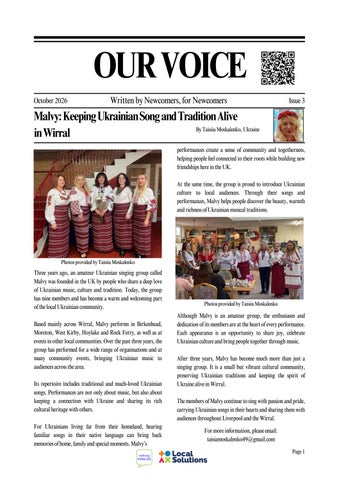
Malvy: Keeping Ukrainian Song and Tradition Alive By Taisiia Moskalenko, Ukraine in Wirral performances create a sense of community and togetherness, helping people feel connected to their roots while building new friendships here in the UK. At the same time, the group is proud to introduce Ukrainian culture to local audiences. Through their songs and performances, Malvy helps people discover the beauty, warmth and richness of Ukrainian musical traditions.
Photos provided by Taisiia Moskalenko
Three years ago, an amateur Ukrainian singing group called Malvy was founded in the UK by people who share a deep love of Ukrainian music, culture and tradition. Today, the group has nine members and has become a warm and welcoming part of the local Ukrainian community. Based mainly across Wirral, Malvy performs in Birkenhead, Moreton, West Kirby, Hoylake and Rock Ferry, as well as at events in other local communities. Over the past three years, the group has performed for a wide range of organisations and at many community events, bringing Ukrainian music to audiences across the area. Its repertoire includes traditional and much-loved Ukrainian songs. Performances are not only about music, but also about keeping a connection with Ukraine and sharing its rich cultural heritage with others. For Ukrainians living far from their homeland, hearing familiar songs in their native language can bring back memories of home, family and special moments. Malvy’s
Photos provided by Taisiia Moskalenko
Although Malvy is an amateur group, the enthusiasm and dedication of its members are at the heart of every performance. Each appearance is an opportunity to share joy, celebrate Ukrainian culture and bring people together through music. After three years, Malvy has become much more than just a singing group. It is a small but vibrant cultural community, preserving Ukrainian traditions and keeping the spirit of Ukraine alive in Wirral. The members of Malvy continue to sing with passion and pride, carrying Ukrainian songs in their hearts and sharing them with audiences throughout Liverpool and the Wirral. For more information, please email: taisiamoskalenko49@gmail.com Page 1
🩺 Our Research Voice at Brownlow Health October 2026
Our Voice
Issue 3
📱 Interested in taking part in research studies?
📧
Email our Brownlow Health Research Team Brownlow.ResearchTeam@livgp.nhs.uk or Scan QR Code to register your interest and hear about opportunities to participate.
Picture provided by Brownlow Health
Every treatment, medicine, and healthcare service we use today exists because people took part in research. Research helps us learn what works, what can be improved, and how healthcare can better meet the needs of our communities. At Brownlow Health, research is about listening to people. By sharing experiences and opinions, patients help shape future healthcare services and improve care for everyone. Why Does Research Matter?
Another way to get involved: Become a Research Champion If you would like to do more, why not become a Research Champion? Research Champions help raise awareness of research in their communities. They share information, encourage people to take part, and help ensure that different people in our community are heard. By helping others understand research, champions play an important role in making healthcare more inclusive, accessible, and relevant to everyone.
📱 Interested in becoming a Research Champion?
Research helps us make healthcare better, understand what people need while remaining fair for everyone. Simply put, research gives everyone the opportunity to help make healthcare better for future generations.
📧
Email us at Brownlow.ResearchTeam@livgp.nhs.uk or Scan QR Code to find out more and join our Research Champion network.
How Can You Get Involved? Getting involved in research is completely voluntary and you do not need any special knowledge or experience. There are many ways to take part, including: Completing a survey Joining a focus group or interview Sharing your experiences of healthcare Taking part in a research study
Your voice matters. You can take part in research and/or become a research champion. Together, we can help make healthcare better for everyone.
Page 2
October 2026
Our Voice
Issue 3
Learning, Nature and Friendship at Brownlow Health’s By Ali Onder Dilegelen , Turkey Community Garden Princes Park Community Garden, Brownlow Health: “Last week, we hosted a free community gardening event at the Refugee Hub garden at our Princes Park site, organised by Talking English CIC. We welcomed asylum seekers, refugees, newcomers and members of the local community for a morning of outdoor activities and social connection.
skills but also to build stronger friendships and understand one another better. Over time, these small moments have helped us feel more confident and more connected as a group.
Attendees spent time planting, drawing and talking together, using the garden as a shared space to build confidence and friendships. The event aimed to support wellbeing while encouraging creativity, language learning and connection through nature. The Community Garden event formed part of Talking English’s wider work to support integration, wellbeing and participation across Liverpool’s diverse communities.” Source: https://princespark.brownlowhealth.nhs.uk/news/princespark-community-garden/
Artful English with Adele
The garden itself adds a special atmosphere to everything we do. Being surrounded by nature, fresh air, and the smell of soil creates a peaceful feeling that helps us unwind. It’s a place where stress fades away, replaced by a sense of calm and comfort. Spending time together in such a natural setting feels refreshing and grounding. As I mentioned, being with the group is fantastic - we talk, laugh, share ideas, and enjoy each moment. These simple experiences make our visits meaningful and give us something positive to carry into the rest of the week.
Garden day at Brownlow Princess Park community garden
Ali Onder Dilegelen: Every two weeks, we go to the garden with Yvonne, our English teacher and our friends. It has become a lovely part of our routine, something we genuinely look forward to. While we’re there, we learn English in a calm, open environment, which makes the lessons feel more relaxed and enjoyable. We practise speaking, listen to each other carefully, and offer support whenever someone needs help with a word or sentence. It gives us the chance not only to improve our language Ali working in the garden Page 3
September 2026
Our Voice
Our Family Journey with The Millie Menu
Issue 3
By Millie Menu
Photos provided by The Millie Menu
Our menu includes dishes such as samosas, pakoras, spring rolls, biryani, butter chicken, naan and vegetarian dishes, as well as desserts. For us, The Millie Menu is not just a business. It is a piece of our family, our traditions and our love of cooking that we can share with other people. Every event gives us another opportunity to make people happy through food.
The Millie Menu, at Brownlow Health, Community Garden
Starting The Millie Menu Catering Co. has been a very special journey for our family. We started our small catering business in January 2026 in Liverpool, with the hope of sharing our family recipes and love of food with others.
We are still a small and new business, but we are proud of how far we have come since January. We hope to continue growing, meeting new people and bringing our family recipes to many more events across Liverpool.
The business was started by my husband, my mum and me. Cooking has always been something that brings our family together, so turning that passion into a business felt like a natural step for us. We provide catering for events, parties and charity occasions. Most of our customers so far have been charities, which has made the experience even more meaningful. Being able to provide food for people and be part of events that support good causes has made us feel proud of what we are building together.
Photos provided by The Millie Menu INSTAGRAM: themilliemenu
Page 4
September 2026
Our Voice
Issue 3
The Hidden History of Liverpool’s Baltic Triangle By Patricia Wormald, Chile
This specific trade was vital to the British economy. Timber functioned as the physical backbone of the nation, providing essential scaffolding, railway sleepers, and naval repairs. Economically, it created a highly profitable dual trade route: British vessels exported regional coal and Cheshire salt to northern Europe, returning with essential timber. Beyond its massive economic significance, the Baltic Triangle possessed a deeply dramatic and moving human element. It was a bustling, transient multicultural hub populated by thousands of Scandinavian sailors and migrant workers.
Photograph provided by Elise Rose Photography
Today, Liverpool’s Baltic Triangle is highly famous for its vibrant creativity, but its historical roots lie deep in a gritty, industrial past. During the nineteenth century, this strategic zone became an absolutely crucial economic engine for the entire British Empire, driven entirely by the massive importation of Scandinavian and Baltic timber. Great Britain faced a severe domestic wood shortage just as the Industrial Revolution triggered an unprecedented construction boom. Liverpool required vast structural materials to expand its iconic docks, massive factories, and endless rows of Victorian terrace houses.
These individuals endured grueling, dangerous working conditions in chaotic yards and rough docks. Living far from home, they faced intense isolation, poverty, and disease in crowded boarding houses. Clear traces of their community still stand today, including the beautiful Gustav Adolf Scandinavian Church, which offered spiritual refuge, and the historic Baltic Fleet Pub. Together, these enduring landmarks remind modern visitors that behind Liverpool’s industrial success was a profound story of immense human sacrifice, raw endurance, and unique cultural fusion. This historical narrative perfectly highlights the true soul of Liverpool.
To meet this urgent demand, local timber merchants imported massive quantities of premium pine and Baltic oak. Heavy cargo ships did not transport finished goods; instead, they carried raw logs and standardised planks. These raw materials were processed locally in the area’s densely packed timber yards, sawmills, and tar distilleries, generating thousands of demanding, low-paid jobs for local labourers and skilled shipwrights. Photograph: https://www.balticfleet.co.uk/gallery
Page 5
September 2026
Our Voice
Issue 3
Everton Football Club: From 1878 to Today By Fozi Shahin, Ukraine
Winners of the Liverpool District Cup 1887
Everton Football Club is one of the oldest and most historic football clubs in England. Its story began in 1878, when the club was founded as St Domingo FC. In 1879, it changed its name to Everton Football Club. From its early beginnings, Everton became an important part of the development of English football and was one of the founding members of the Football League in 1888. One of the most interesting parts of Everton’s history is its connection with Anfield. Everton played at Anfield from 1884 and won its first league championship there in the 1890–91 season. However, disagreements over the ground eventually led Everton to leave in 1892. The club then moved to Goodison Park, which became its home for more than 130 years. Goodison Park became one of the most famous stadiums in English football and witnessed many of the greatest moments in Everton’s history. Everton enjoyed several successful periods throughout the twentieth century. The club won league championships and FA Cups and became one of England’s most respected teams. The 1960s were particularly successful, with Everton winning the league title in 1962–63 and the FA Cup in 1966. Another golden period came in the 1980s under manager Howard Kendall. Everton won the FA Cup in 1984, the league title in 1984–85, and the European Cup Winners’ Cup in 1985. They won another league championship in 1986–87. In 1992, Everton became one of the founding members of the
Premier League. The club has experienced both successful and difficult periods since then, but it has remained in England’s top division. Famous players such as Wayne Rooney, Tim Cahill, Leighton Baines and Romelu Lukaku have represented the club, while managers such as David Moyes helped Everton compete at the highest level. Everton also has one of the most famous local rivalries in football: the Merseyside Derby against Liverpool FC. Although the rivalry is fierce on the pitch, both clubs are deeply connected to the city of Liverpool and its communities. In 2025, Everton played its final competitive matches at Goodison Park and began a new chapter at its modern waterfront stadium at Bramley-Moore Dock, now known as Hill Dickinson Stadium. The move marked the end of more than 130 years at Goodison Park and the beginning of a new era for the club. Today, Everton remains one of England’s most historic football clubs, with nine league titles, five FA Cups and one European Cup Winners’ Cup. Its famous motto, “Nil Satis Nisi Optimum” — “Nothing but the best is good enough”, reflects the ambition and pride that have been part of Everton’s identity throughout its long history. From its origins in 1878 to its new home in 2026, Everton’s story is one of tradition, success, struggle and renewal. It is not only a football club but also an important part of the history and identity of the city of Liverpool. Page 6
October 2026
Our Voice
Issue 3
Reflections on History and Freedom - From Liverpool’s By Moata Korma, Ethiopia Minton Tiles to Ethiopia’s Future As I walked through the hall, my thoughts turned naturally to my homeland, Ethiopia—a nation long defined by its resolute independence and its enduring defence of liberty. Today, Ethiopia stands at a critical threshold of structural, cultural, and institutional renewal. Across the nation, there is a palpable momentum towards forging a future grounded in unity, shared historical consciousness, and collective progress.
Photographs taken by Elise Rose Photography
I found myself standing within the breathtaking grandeur of Liverpool’s St George’s Hall. Beside her, my gaze was immediately drawn to the resplendent Minton Tiled Floor—a magnificent triumph of Victorian artistry, composed of more than thirty thousand intricately arranged tiles. The sheer beauty of the craftsmanship is undeniable. Yet, beneath this historic splendour lies a profound paradox that demands deep and honest contemplation. Liverpool’s architectural magnificence and historic prosperity were inextricably tied to the transatlantic slave trade. The city’s rise to global prominence was shaped by commerce, but also by the suffering of countless enslaved individuals whose coerced labour underpinned its immense wealth. And yet, this very same city became a stage upon which moral courage was fiercely enacted. Here, dedicated abolitionists— driven by conscience and an unwavering belief in human dignity—challenged the brutality of slavery with clarity and conviction. "The Minton tiles stand as a vivid reminder that human beings can create extraordinary beauty, but history insists that such beauty must never be separated from the human cost at which it was built.
Photographs taken by Elise Rose Photography
In my opinion, for these new beginnings to truly endure, Ethiopia must embrace its history not as a distant archive, but as a vital guide for tomorrow. True nation-building requires us to document, examine, and openly discuss our past celebrating our monumental triumphs while confronting our internal struggles with honesty and clarity. Just as Liverpool preserves its heritage to illuminate the complex moral battles that shaped its modern identity, Ethiopia must commit to cultivating a deep culture of historical education and truth-telling. We must invest in safeguarding our diverse narratives, teaching younger generations about the historic figures who championed justice, and exploring how past choices continue to shape our present realities. Sustainable national advancement cannot be achieved through economic reform alone; it demands a cultural foundation. By placing authentic history and critical inquiry at the centre of our modern national efforts, Ethiopia can steer its current initiatives towards a future defined by justice, enlightenment, and genuine prosperity for all Page 7
October 2026
Our Voice
My Place of Strength - Khortytsia No matter where I am or where I go, I always return to one place in my mind - my place of strength, my beloved Khortytsia.
Issue 3
By Nataliia Kyrylova, Ukraine
The tree was struck by lightning, which burned away most of its trunk. Later, someone began lighting fires inside what was left of it, and very little of the original trunk remained. One day, local people decided to try to help the tree recover. Not knowing whether it would actually work, they filled its trunk with concrete. The oak survived. For me, it became a true symbol of strength. Whenever I came to the oak, I genuinely felt recharged with strength. I would look at this tree and think: if it could survive so many challenges and still stand and become so magnificent, then I could get through my own challenges too. I always felt full of energy when walking along the Dnipro River or disappearing deeper into the forest, wandering between the trees. And wherever I am now, I always return to my place of strength. But I also find new favourite places wherever I am.
Photograph provided by Nataliia Kyrylova, Ukraine
Khortytsia is an island in the very heart of Zaporizhzhia, a city in the south of Ukraine. It is a nature reserve, a unique natural landscape and the cradle of the Cossacks. In 2007, the film Taras Bulba, directed by Vladimir Bortko, was filmed here, at the site of the Zaporizhzhian Sich. When you come to the island, you are never truly alone. You will always be greeted by lively red squirrels, curious lizards and wonderfully chatty birds. Sometimes, on the narrow paths, you might even come across the shed skin of a snake. Yes, there are snakes on the island! But if you know where they are most commonly found, it is easy enough to avoid those areas.
Here in Liverpool, one of those places for me is Calderstones Park and its Allerton Oak. This oak reminds me of our Zaporizhzhian oak and gives me a very special feeling - as if, for a moment, I am home again. I also love Otterspool Promenade. I believe it is important for all of us to have such a place - somewhere we can go to pause, breathe and recharge. A place that reminds us who we are and where we are going. What about you, dear reader? Do you have a place of strength somewhere you return to when you need to restore your energy?
The island is home not only to abundant wildlife, but also to many rare plants listed in Ukraine’s Red Book. I could spend hours walking around the island without ever getting tired, enjoying its beauty, silence, freshness and incredible energy. One of my favourite places was the “Concrete Oak”. And the name is quite literal - its trunk is actually filled with concrete.
Photograph provided by Nataliia Kyrylova, Ukraine Page 8
October 2026
Our Voice
Issue 3
The Heart of Turkish Food and Culture By Ali Onder Dilegelen , Turkey
Turkish food and culture are warm, colourful, and full of history. In Turkey, people enjoy spending time together, especially during meals. Eating is not only about food; it is also about connection. Families often sit around a large table, talk about their day, and share different dishes. This creates a strong sense of togetherness and comfort.
One of the most famous dishes is kebab. There are many varieties, such as Adana, Urfa, and döner. Each type has its own flavour, but all are made with fresh meat and traditional spices. Another well-known dish is mantı, small dumplings served with yoghurt, garlic, and a little butter sauce. It is a warm and satisfying meal loved by many. Börek is also very popular. It is a thin pastry filled with cheese, meat, or vegetables, and people often enjoy it for breakfast or as a light snack.
Tea, known as çay, is an essential part of daily life. It is served in small, tulip-shaped glasses and is usually strong and hot. People drink tea in the morning, during work breaks, and whenever guests visit. Offering tea is a sign of hospitality and respect. In many homes, the sound of a boiling kettle can be heard throughout the day, showing how central tea is to Turkish culture.
Turkish culture also values community and kindness. Neighbours often help one another, and families remain close even when children grow up. Traditions are passed from parents to children, and many celebrations include music, dance, and delicious food.
Photograph provided by Ali Onder Dilegelen, Turkey
During holidays such as Bayram, people visit relatives, share meals, and show respect to elders. These moments strengthen relationships and keep cultural values alive. Another important part of Turkish culture is storytelling. People enjoy listening to stories about history, heroes, and everyday life. These stories help younger generations understand their roots and learn important lessons about respect, courage, and family. Turkish food and culture are full of warmth, flavour, and strong human connection. They show the importance of family, hospitality, and tradition in everyday life, making Turkey a place where people feel welcome and at home.
Photographs from Canva Page 9
October 2026
Our Voice
How to Learn English Effectively Learning English is not easy, but it is possible if you study in the right way. Many people think they need to be very intelligent to learn English. I do not agree. I believe that success comes from practice, patience, and consistency. The following tips are based not only on general advice but also on my own experience as an English learner. First, make English a part of your daily life. Read articles, short stories, or anything that interests you. When you read, write down every new word that you do not understand. Then translate those words into your own language. You can use Google Translate, online dictionaries, or ChatGPT. Comparing different sources can help you understand the correct meaning of each word. After that, make your own sentences using the new vocabulary. This is one of the best ways to remember words because you learn how to use them in real situations. When you have finished learning the vocabulary, read the same text again. You will notice that understanding the words makes it much easier to understand the whole text.
Issue 3
By Zabihullah Sayedi, Afghanistan
I also recommend reviewing new vocabulary aloud. One useful method is to cover the translation with your hand and try to remember the meaning by looking only at the English word. Then do the opposite: cover the English word, look at the translation, and say the English word aloud. Repeat this several times until the vocabulary becomes part of your longterm memory. Another important tip is to speak as much as possible. Do not worry about making mistakes. They are a natural part of learning. If you can, find someone who speaks English fluently and practise with them regularly. It does not matter what you talk about. The important thing is to keep speaking. Try to become part of the community where English is spoken. Make new friends and ask them to speak English with you. Real conversations will improve your confidence and help you use new vocabulary more naturally. Set yourself a simple daily goal. For example, learn at least five new words every day. Small steps every day will lead to great progress over time. Watching English-language films and TV shows is another excellent way to improve. Listen carefully to the conversations. Whenever you hear a new word or expression, write it down in a notebook, find its meaning, and later try to use it in your own sentences. Finally, be patient and never give up. Learning a language takes time, but every day of practice brings you closer to your goal. English is more than just a school subject. It is a key that opens the door to education, better job opportunities, travel, and communication with people from all over the world. Remember, success in learning English is not about being perfect. It is about practising every day and never stopping.
Photos provided by Zabihullah Sayedi Page 11
October 2026
Our Voice
Better Late than Never Recently, I came across the song “Don’t look back in anger” from the classic band Oasis. Apart from its catchy melody, I was mesmerised by one of its lines – “ 'Cause you said the brains I had went to my head”. In this line, it used “the brains I had”as a metaphor for the intelligence or smartness a man possessed – which is the good attribute. While in parallel, it also used a phrase “went to my head” to represent someone who was too proud or overconfident about something. This is a phrase that has negative implications. Both head and brain are part of human body which come in harmony naturally. But when they were put into two separate phrases and generated a polar effect, this “harmony” set off a deeper extent of contrast that made the lyrics so impressive.
Issue 3 By Sam Yue, Hong Kong
the phrase must only convey in negative tone. It may induce misunderstandings or embarrassment if we project the meaning directly from one language to another. Much as I hate to admit, the said embarrassment once happened to me – I was waiting to cross a road in front of a traffic light. On the side of the road stood an old lady and a teenager. Not until the signal turned green did the boy dash across the road. The old lady, who seemed a bit grumpy, murmured: “I didn’t know what was inside his mind, it was so dangerous. He might trip or something.” I tried to pacify her and took the opportunity to showcase the idiom I had often used in my culture. “Yes, why such a rush? Better late than never!” I echoed. As soon as I said it, instead of the smiling face that I expected, the old lady looked daggers at me. I was toast!
From this example, we can see that a clever utilisation of phrases and idioms can create some miraculous effects in writing. That’s why loads of them are used in everyday English communication, and the case is the same in my mother language as well. Sometimes, when I compare different phrases between English and Chinese, I am really surprised that some of them are uncannily similar. Such as, “Dig one’s own grave”, “Once bitten, twice shy”, “Born with a silver spoon in one’s mouth”, “Money makes the mare go”, “Blow one’s own trumpet” …… and lots more. We have almost the identical expression in our language. Maybe people will wonder how these coincidences could occur? Were these all happening by accident, or was someone a copycat? Well, I have no clue. But it seemed that those phrases were proof in themselves intended – Great minds think alike! … Aha! Knowing the usage of similar phrases in our own culture will help us to have a better grasp of the English one. However, it is also a double-edged sword for a foreign learner to assume that those “mirror phrases” will always work the same. Here is a counterexample:
Pictures created with AI
I didn’t even know what I had done wrong until I learnt that the actual meaning of the phrase “Better late than never” and my understanding of it was poles apart. In my language, we use this expression to warn someone not to risk themselves for saving time; while in the UK, it is a saying to comfort someone that something has finally arrived or achieved, although it is a bit late. Oops! It was meant innocently, but I completely misunderstood the idiom. I screwed it up! Life isn’t all roses! At last, I figured out the real meaning of this phrase, to say the least. Better late than never, isn’t it
We have the exact idiom “Water off duck’s back” in my language. The meaning is the same; the allusion may be different though. In English, this phrase can be employed on both positive and negative connotation. However, in Chinese,
Page 12
October 2026
Our Voice
Issue 3
Unlocking Your Personality Type - The Power of the By Kennis Fung, Hong Kong ‘Analysts’ Continuing our journey... Welcome back! In Issue 2, we unlocked the four core building blocks of personality (E/I, S/N, T/F, J/P). Now that you have found your four letters from the test above, let's officially begin exploring our first family! In this issue, we focus on the strategic problem-solvers: The "Analysts" (NT types: INTJ, INTP, ENTJ, and ENTP).
Picture provided by Kennis Fung
STEP 1: QUICK SELF-ASSESSMENT Discover Your 4 Letters in 4 Steps! (Read each pair and pick A or B before reading) 1. Energy Source: A. Socialising with neighbours or in Liverpool community groups (Select E) B. Quiet time alone resting or reading at home (Select I) 2. Information Gathering: A. Practical facts, daily instructions, and immediate tools (Select S) B. The big picture, future possibilities, and creative ideas (Select N) 3. Decision Making: A. Logical steps, objective facts and pros/cons (Select T) B. Personal values, empathy and how choices affect others (Select F) 4. Lifestyle: A. Clear routines, step-by-step plans and exact schedules (Select J) B. Flexibility, adapting as things happen, and open options (Select P) Your Result: Combine your four chosen letters (e.g., I-N-T-J or E-S-F-P) to get your preliminary code! Keep your result in mind as you read the article below. *This is an informal self-estimation activity based on Isabel Briggs Myers’ framework to encourage self-reflection. It does not replace the official MBTI® assessment.*
Who Are The Analysts? Did your test result contain both N (Intuition) and T (Thinking)? If so, you naturally look at the big picture and make decisions using objective logic. Research shows that NT types value reason, competence, and innovation above all else2. INTJ (The Architect) & INTP (The Logician): You love independent thinking. In some traditional cultures, questioning long-standing rules is discouraged. However, in UK workplaces, independent problem-solving and critical thinking are highly respected and sought after. ENTJ (The Commander) & ENTP (The Debater): You excel at seeing the big picture and taking bold, structured action when organising your new life. Overcoming Migration Stress With Logic Moving to UK brings complex challenges—navigating visa processes, housing applications, and job searches. For refugees and immigrants, emotional stress can feel overwhelming. This is where your NT traits become your shield. Psychological studies on migration highlight that using "problem-focused coping"—focusing on logical steps rather than fear—significantly reduces anxiety during cultural transition3. Instead of feeling paralysed by a new system, NT types naturally analyse how the UK system works and create a clear step-by-step plan. You don't need to change who you are; simply apply your sharp mind to your new Liverpool environment! Did your test reveal an Analyst code? If not, don't worry! In our next issue, we will explore the warmest and most empathetic family of all: The "Diplomats" (NF types) and see how compassion builds strong support networks in Liverpool. See you next quarter! References: 1. MBTI® Legal Disclaimer: Myers-Briggs Type Indicator, MBTI, and the MBTI logo are registered trademarks of The Myers & Briggs Company in the United States and other countries. This series is an educational introduction by a certified administrator. 2. Myers & Briggs Foundation (2019): MBTI® Basics: The 4 Temperaments. 3. Berry, J. W. (2005): Acculturation: Living successfully in two cultures. International Journal of Intercultural Relation
Page 13
October 2026
Our Voice
Issue 3
Learning English What is an idiom? An idiom is a phrase where the words together have a different meaning from their literal meaning. For example, “It’s raining cats and dogs” does not mean that cats and dogs are falling from the sky! It means it is raining very heavily. Idioms are very common in everyday English. Learning them can help you understand conversations, films, TV and British culture.
⭐ 10 Useful English Idioms 1.It’s raining cats and dogs 🌧️ Meaning: It is raining very heavily.“Take an umbrella – it’s raining cats and dogs!” 2.Piece of cake 🍰 Meaning: Something is very easy. “The test was a piece of cake.” 3.Break the ice 🧊 Meaning: Start a conversation and help people feel relaxed. “I told a joke to break the ice.” 4.Under the weather 🌦️ Meaning: Feeling unwell. “I’m feeling under the weather today.” 5.Once in a blue moon 🌙. Meaning: Something that happens very rarely.“I eat fast food once in a blue moon.” 6.Spill the beans 🫘 Meaning: Tell a secret or give away information.“Come on, spill the beans! What happened?” 7.Pull someone’s leg 🦵Meaning: Joke with or tease someone.“Don’t worry! I’m only pulling your leg.” 8.Get the ball rolling ⚽ Meaning: Start something. “Let’s get the ball rolling and begin the meeting.” 9.Call it a day 📅 Meaning: Stop working for the day. “We’ve done enough. Let’s call it a day.” 10.Hit the nail on the head 🔨 Meaning: Say or do something exactly right.“You hit the nail on the head – that’s exactly the problem.” 💡 Remember Don’t try to understand an idiom word for word. Learn the whole phrase and its meaning. Can you think of an idiom from your language that has a similar meaning to an English idiom?
Autumn Word Search Can you find the autumn words hidden in the puzzle? LEAVES ACORN PUMPKIN TREES APPLES WIND BASKET BOOTS HARVEST SCARECROW MUSHROOMS CRANBERRIES
G
C
R
A
N
B
E
R
R
I
E
S
C
N
L
F
W
I
N
D
L
K
U
U
J
B
R
R
I
W
A
O
F
P
R
S
F
A
R
B
O
O
T
S
L
U
I
C
V
S
Y
H
T
L
D
N
A
M
C
A
B
K
J
U
A
C
O
R
N
P
K
R
T
E
B
A
N
R
H
V
G
K
O
E
R
T
D
P
S
K
V
I
N
I
T
C
E
H
A
P
D
S
E
E
T
N
E
R
E
A
E
L
E
A
V
E
S
R
I
O
S
R
C
E
N
F
O
V
L
T
K
W
H
M
U
S
H
R
O
O
M
S
T
E
Page 14
September 2026
Our Voice
Services in Liverpool
🌐
✉️
Issue 3
(Listed in alphabetical order, no priority is implied)
📞
✉️
📞
✉️
📞
✉️
New Start 0151 708 7103
📞
✉️ info@newstarthomes.org.uk
📞
✉️
📞
✉️ info@solaarts.org
4WINGS NORTHWEST CIC https://4wings.co.uk info@4wings.co.uk
Merseyside Polonia 0151 237 2674 info@merseysidepolonia.com
🌐 ✉️
Merseyside Refugee Support Network 0151 709 7557 | info@mrsnliverpool.org.uk
Al-Ghazali Multicultural Centre https://alghazalicentre.co.uk/ info@alghazalicentre.co.uk
📞
✉️
Asylum Link Merseyside 0151 709 1713 | info@asylumlink.org.uk
🌐
Bridge2 (Liverpool) https://bridge2.co.uk
📞
British Red Cross 0151 702 5067 |
✉️ enquiries@bridge2.co.uk
✉️ enquiry@redcross.org.uk
🌐 📞
Citizens Advice Liverpool https://www.citizensadviceliverpool.org.uk 0808 278 7840
🌐 📞
Granby Adult Learning Centre https://liverpool.gov.uk 0151 233 2400
🌐 📞
Granby Toxteth Development Trust https://www,gtdt.co.uk 0151 734 4925
📞
✉️
City of Liverpool FC Community 0151 432 5675 | Ifcfoundation@liverpoolfc.com
✉️
Joseph Lappin Partnership thejosephlappincentre@gmail.com
📞
✉️
Kuumba Imani Millennium Centre 0151 708 5278 | info@kuumbaimani.org.uk
🌐
Live Well https://www.thelivewelldirectory.com
📞 ✉️
Merseyside Law Centre 0151 709 0504 enquiries@merseysidelawcentre.co.uk
Merseyside Society for Deaf People 0151 228 0888 | reception@msdp.org.uk
Refugee Women Connect 0151 305 1070 info@refugeewomenconnect.org.uk SOLA Arts 0151 726 8440 |
🌐 ✉️
Talking English CIC www.talkingenglishcic.org Instagram: @talkingenglishcic Talkingenglishcic@gmail.com
🌐
The Florrie https://www.theflorrie.org
📞 0151 728 2323
🌐 📞
The Whitechapel Centre Langsdale Street, L3 8DT 0151 207 7617 (24 hrs)
🌐 📞
Toxteth Women's Centre https://www.toxtethwomenscentre.co.uk 07927 811238
🌐 ✉️
Transform Lives Company https://www.transform-lives.org teamtlc@transform-lives.org Women's Health Information & Support Centre (WHISC) 0151 707 1826 | women@whisc.org.uk
📞
✉️
Page 15
October 2026
Our Voice
About ‘OUR VOICE’ Talking English CIC is committed to supporting refugees, asylum seekers, and newcomers in Liverpool through a range of English language lessons. Our focus includes practical English and conversation, walk-and-talk sessions, artful English, and community garden activities. Learning English is about more than just acquiring a language; it builds confidence, fosters friendships, and promotes community integration. Our community newspaper, ‘Our Voice,’ offers learners an opportunity to practice their English, share their experiences, and celebrate Liverpool's welcoming spirit.
Issue 3
Food & Support in Our Community New Beginnings - improving Lives CIC 63 Rocky Lane, Liverpool, L6 4BB St Bride’s Church Liverpool - Micah Liverpool Foodbank Percy Street, L8 7LT Foodcycle Liverpool Dingle 400 Mill Street, Dingle, Liverpool, L8 4RF Foodcycle Liverpool Tuebrook & Old Swan The Old Library, Green Lane, Liverpool, L13 7EB Liverpool Six Community Centre 99 Queens Road, Liverpool, L6 2NF The Florrie Mill Street, Liverpool South Liverpool Foodbank - Bridge Chapel Centre Heath Road, Liverpool, L19 4XR
We would like to express our heartfelt gratitude to our learners, team members, contributors, funders, and partners for making this edition a reality. If you wish to share a story or highlight your organisation in our upcoming issue, please do not hesitate to get in touch. Yvonne x www.talkingenglishcic.org talkingenglishcic@gmail.com
Yvonne and learners visiting the Minton Tiles at St George’s Hall
Page 16