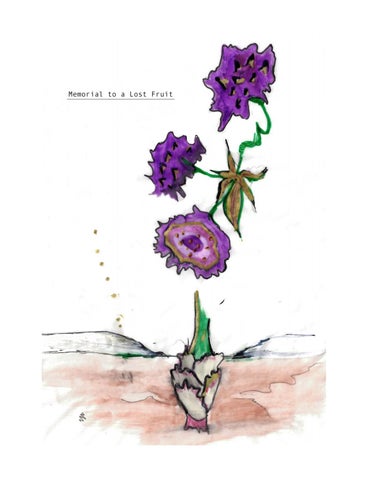
Memorial to a Lost Fruit
Dear Reader,
I am writing this to you to remind you of your errors. Remember the purple? Probably not, as you have likely gone forward with your life and phased it out of your routine. I don’t blame you. The market of perishable fruits is merciless when it comes to fruits that actually perish. There is no mourning period carved out of the laissez-faire economics. What is the logic of mourning? As you may recall, it was the only truly Arctic fruit that ever colored Planet Earth. And boy was it delicious. You may remember the jingle “the fruit that doesn’t spoil, because it’s cold and royal” blaring on your screens during commercial breaks of the ten o’clock news... (I digress, my references are as out of touch as I am.) You may ask why I left the Environmental Protection Agency with three of my colleagues to write and illustrate this for you. One of the reasons was that it was a tactical response to the political climate in the United States and a fear of the EPA being inevitably defunded. (The Trump Administration has also taken it upon itself to delete our scientific data from the EPA’s website.) I, as well as my colleagues, did not feel secure in our status as U.S. government employees or in our belonging to any entity as tenuous as “a country.” But there was something more transcendant about this project. It was out of our profound attachment to the purple. Not only as a rare fruit that thrived in the frost but as a true and honest reflection of where our civilization is headed. Nothing has felt more immediate to me than this project.
Reader, the headlines have been calling us crazy for abandoning our work. They are allowed to! It does take some chutzpah to put everything on the line to memorialize a fruit that has already, within five years, snuck into the periphery of our collective conscience. In our own community we have also been called foolish for abandoning our scholarly work to enshrine the purple and preserve its seeds within the depths of these pages. But without our keen and practiced knowledge of glacial movement, the Arctic region and its physical makeup, we would never have been able to complete this. Here is the story of the purple and its illustrious history leading to its downfall. The importance of its backstory is essential to understanding the motivations we in the science community have felt for a long time about educating the masses about this. Remember, reader, this story is more about you than it is about the purple.
Once upon a time, the Arctic region bore a fruit called “the purple.�
The purple’s ability to withstand the cold and flourish under the frost was second-nature to those who consumed it. It flowered seasonally and was pollinated by roaring wind gusts.
And thickcoated fruit flies..
It was even used as a garnish for raw fish.
The harvest season fell in the dead of winter (when the fruits were ripest). The frost only strengthened the roots and stems. After the annual January harvests, everyone enjoyed “the purple� feast under the Northern Lights.
But over time, the hunter-gatherer societies transitioned into more domestic agrarian societies.
The domain of the purple was now stationary rather than mobile. New forms of harvesting the purple were put in place. These purple orchards grew and called for an architecture and environment that supported the purple’s proliferation. This was first seen in heavily insulated cabins, but later materialized as the growth of villages. The purple turned into an industry (but an insular one... never escaping the bounds of the Arctic Circle and Northern Tundra).
It remained a fruit of the Arctic tundra up until the early 19th century. Many failed attempts to spread this fruit around the world occured between the years 30,000 B.C. and 1860.
Word eventually spread, and it soon became a race between imperial powers to lay claim to the purple.
In 1600, a series of ships, all named “Arctic Expedition”, came barreling through the Arctic Waterways. It was a bit of a race. The British and French led the only successful journeys that made it to the tundra.
Fruits, nuts and spices were traded all with the hopes of bringing “the purple” back to their homes.
The fruits all spoiled in the process, causing a vile stench to circulate the ships.
They had to be tossed off.
But most of the trips found the Arctic waters too icy to bear and turned right around as soon as they reached just south of Greenland. Time and time again, sailors (who were also searching for the Northwest Passage) would fill up barrels upon barrels of this fruit trusting their luck that a single purple would make it through the journey safely. They came up with jingles and chants that they would sing in particularly desparate times.
Our anchor we’ll weigh, And our sails we will set. We may shiver our toes off But have no regrets Goodbye, fare-ye-well, Goodbye, fare-ye-well, Hurrah, my boys, we’re purple bound. We’re purple bound, Oh joyful sound! Goodbye, fare-ye-well, Goodbye, fare-ye-well. Come rally the capstan, And run quick around. Hurrah, my boys, we’re purple bound. To the ice caps we go! We’d have you know Goodbye, fare-ye-well, Goodbye, fare-ye-well. And over the water Through tides thick and thin, Hurrah, my boys, we’re purple bound. Heave with a will, And heave long and strong, Goodbye, fare-ye-well, Goodbye, fare-ye-well. Sing a good chorus For ‘tis a good song. Hurrah, my boys, we’re purple bound. Hurrah! that good run Brought the anchor a-weigh, Goodbye, fare-ye-well, Goodbye, fare-ye-well. She’s up to the hawse, Sing before we belay. Hurrah, my boys, we’re purple bound. ‘We’re purple bound,’ You’ve heard us say, Goodbye, fare-ye-well, Goodbye, fare-ye-well. Hook on the cat fall then, And rut her away. Hurrah, my boys, we’re purple bound.
Tom Daugherty, an Englishman, was the first to ever bring the purple back to Europe in 1774. He volunteered to leave the British Navy during the American Revolution to undertake this journey. Royal Britain was losing to the American rebels and was in the midst of an identity crisis. King George III sent many empty barrels on a single boat of five crew members to sea to be filled with purples. As predicted, they all spoiled except for one. They managed to make it to the English coastline with this one purple and were valorized for it by all of England. There is a memorial built for Tom in the middle of Norfolk, England, where he docked his ship.
Daugherty expedition
Norfolk, England, 1774
But when they tried to plant the seeds, the purple would not grow due to the temperate climate.
4,000 miles wasted.
Throughout the pre-industrial era, “the purple” gained more and more cultural prestige through various artistic images of it (both written and visual)... but nobody got it quite right.
The only guidance these visual artists had was a compilation of written and verbal accounts of this fruit told by sailors and travelers. It was a challenge that was taken on with determination. There was a design competition in 1850 put on by the National Gallery in London to see who could design the most imaginative depiction of “the purple.” Famous artists from various movements (such as impressionism and realism) attempted to paint the thing they could not taste nor could see. They naturally gravitated to what they knew — their depictions of “the purple” seemed to resemble existing fruits.
But the truest accounts of the purple came from secondary letters and from various written accounts of it. At the research station there is a collection of some of these letters, which I sift through on slow days. Some of them are grand declarations of exuberant discovery and others simply meander daily life with the purple. These writings gave people an outlet to imagine a lifestyle that included this fruit and added to its cryptic allure. One could say this accelerated the desire to contain it on distant soil.
“Ode to Purple� by 19th century poet Maria RobinsSomerville is my personal favorite. She was also one of the first women to visit the Arctic alongside her spouse, researcher Alfred Wegener.
It was not until 1860, when refrigeration technology was spreading throughout the United States and Europe, that the arctic climate could be truly mimicked. This marked the turning point in purple history.
19th century
1920s
1930s
1940s
1950s
1960s
1970s
In 1926, the first General Electric refrigerator was mass produced. This coincided with the importation and regular shipping of the purple from the Arctic. It was a happy marriage between a new technology and a rich product. Both the purple and the first refrigerator were marketed as high-class products. It was not until the 1950s that this changed and the purple became more commonplace.
After the refrigerator changed the landscape of domesticity, it took on a more industrial role. Commercial refrigerators/cold storage facilities were an integral part of the movement to nourish a growing American population and contain this frigid fruit.
These refrigeration facilities appeared in New York City’s Meatpacking Distrct. Newly refrigerated ships arrived at New York Harbor and quickly rushed “the purple” to these facilities.
... which brings me to Royal Purple, the largest purple corporation in the world. By the time this company began to sell purples en masse, the refrigerator had undergone enough iterations to become a household and industrial staple. This was the early ‘60s and the television was gaining more and more influence. Royal Purple capitalized on both of these burgeoning technologies. They had a commercial which I can still remember to this day.
[Through icy waters, in a continent far away comes a fruit that defies our culinary imagination]
[and when it is refrigerated it never spoils!]
[one bite and you feel like nobility]
[it’s the purple, a rich burst of flavor, chilling the senses and sedating the soul]
[(opens refrigerator)]
[the fruit that doesn’t spoil because it’s cold and royal]
The cold storage facilities of The Royal Purple went on seemingly for miles. They were designed to store as many purples as possible.
Cold storage facilities also found themselves within supermarkets. There was a special place for the purple within the refrigerated aisle, separate from the other fruits.
There was also a special place for it within pop culture.
Americans thrived off of this fruit for decades. A bite into it was a reminder that being the leader of the refrigeration industry, the United States was also the leader of the purple industry. It even slipped its way into the traditional thanksgiving feast around 1980.
Meanwhile, a growing body of scientific research on the purple and the fauna and flora of the tundra region sprung up. The research facility I worked at was in Northeast Greenland (a relatively uninhabited area). It operates as a chemistry lab and environmental research facility (connected to U.S. scientific research institutions).
My desk! I enjoyed the mountain views as I examined the purple under my microscope and wrote scholarly papers.
Northeast Greenland Research Center, 2001
Some of the first investigations to ever take place here were conprehensive cellular studies and evaluations of the purple.
[The outer shell of the purple is made of thick, fibrous skin. It was classified as “impermeable� during a procedure in 2001. This classification justifies the fact that the juicy grape-like interior maintains its cold refreshed temperature and consistency. The grape-like interior forms are sensitive and burst upon immediate consumption. This provides a contrast to the richer, denser exterior. The purple color is a product of years of evolution. Its richness attracts animals and people to it and allows it to stand out in the arctic frost.]
Though 2001 may seem like a strangely late time to be making these discoveries, it was not until then that the Northeast Greenland Research Facility was running like a well-oiled machine. It took many years and much funding and negotiation between the United States and the Arctic Council to institutionalize this research center...
...which is why it was so deeply disheartening to rapidly change our research from dynamic discovery-making to preservation. It was during the turn of the century that global warming became apparent within the arctic region. Like the true improvisers we are, we adapted to this sudden change.
And the change came fast. Along with working to maintain the arctic crop and studying the dwindling permafrost, scientists got to the root of global warming itself. It was discovered that refrigerators were some of the main contributors to climate change, as they emitted an ozone-shattering chemical called “chloro-flouro-carbon.�
As “Royal Purple� took over the entire American purple industry, the product turned into an industrial mega-fruit. The effort to maintain its production disregarded its repurcussions. In turn, the purple crops depleted and experienced much stress. The purple color dulled. The permafrost layer and glaciers that provided its frozen habitat began to melt and crumble.
The overall warming of the planet pushed the native purple seed farther and farther north until it only existed within the Arctic Circle. Tundra towns developed rapidly in the ‘80s but were vacated as their only economic resource left. This coincided with the rapid price surge in commercially sold purples, and later, the elimination of the purple from supermarkets altogether. By 2010, the purple stopped being shipped to the United States and was left to the Arctic to run its final course.
Reader, I hope this story has reminded you of how closely linked the fate of the purple is to the fate of our own society. Though it has left the planet we cannot let it leave our memories. We hear many idioms in our culture that link fruit to human expression and passion. Some are more specific than others: “the fruits of our labor,” “comparing apples and oranges,” “life is peaches and cream,” and so on. These are pillars of our culture and we do not always realize the transience of the subject matter. But their transience is emblematic of our own fallibility. The refrigerator was not made with the intention of emitting chemicals that tamper with the atmospheric ozone layer but this happened when we tried to preserve too much too fast. And if we don’t learn from these mistakes we will just continue to keep making them.