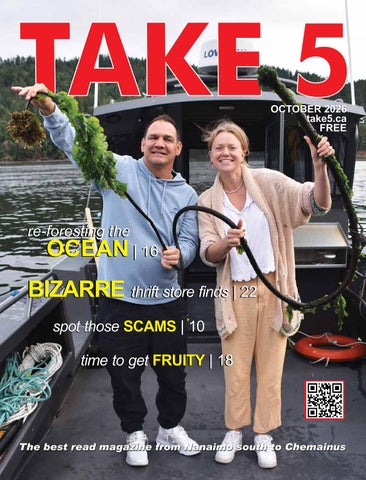
TAKE 5
take5.ca
3
5
Letters Wake Up Saltair Taxpayers I don’t know if anyone has noticed, but our fantastic water now tastes and smells like it’s coming from a swamp. In 1997, the Health Authority stated that all open water sources contain a possible carcinogen when the water is treated with chlorine. They therefore mandated that all open water sources (our Stocking Lake) be passed through a filtration treatment plant before being used as a potable water source. I don’t have the time here to go into all the logistics, but we are now using a blended system consisting of a fluctuating ratio of about 25 per cent well water and 75 per cent water from Stocking Lake. This allows for a dilution of the carcinogenic numbers so they fall below acceptable standards. At prior meetings, the residents stated that they wanted a stand-alone treatment system and not wells or aquifers. Fast forward, and we are now dealing with foul-tasting water, with a hardness increase that is going to cost you. Hot water tanks, dishwashers, and anything else that uses water will be affected. Expect to replace them sooner and more often. I got a quote to install a filter system and water softener for my house (approx. $4,800). When the chemicals used to soften the water get in your septic system, expect to replace that too. The CVRD has stated that we will be on 100 per cent well water for the winter (What will that taste like, and what will its hardness be?) They are apparently now in the process of building a pipeline from the Town of Ladysmith (TOL) to our system. We will then be able to purchase water from TOL to blend with our well water in the summer months when our wells can’t handle the load. We know that the TOL filter system doesn’t have the capacity to supply us with all the water we need if the wells should run dry. Are we going to have harsher water restrictions than we had with the Lake? The CVRD has not been transparent in its dealings with La-
6
take5.ca
OCT 2026
dysmith. We have not been told how much this treated water is going to cost us, how much this pipeline is going to cost, and how much we will have to pay when TOL needs to repair or upgrade their system. We have not been told if Ladysmith will be required to pay us for the water that they will be taking from our lease on Stocking Lake for filtering and selling back to us and the people living in the Diamond area. TOL will also be filtering this water for their own use, so this is a big win for them. These games the CVRD has been playing have been going on since 2019. Their bad decisions and foot-dragging have raised the cost of our stand-alone treatment plant from $5 million to $11 million to $17 million. They have set Saltair back 100 years when it comes to water. We had a $3.9 million grant for a treatment plant. How much of this is even left after searching for wells and a botched contract for a system in 2022? We will never have the best-tasting water ever again. Wake up and start complaining. Insist that we be kept abreast of the costs that we will be paying. Insist that they reduce the hardness before it gets to our houses. Insist that they do something about the taste. In order to avoid gastric upset, I am now buying water for drinking and washing fruit and vegetables just like in a third world country. Let’s hope that our Regional Director works with CVRD to come up with a viable solution to these problems. We were led to believe that we would get to vote on how we would proceed. Instead, Regional Directors voted and decided our fate. Send your complaints to utilities@cvrd.bc.ca or to vanessa. Thompson@cvrd.bc.ca - Peter Milne Send your letters to editor@take5.ca Please note that letters may be edited for space and legality and do not necessarily represent the opinion of TAKE 5 or its affiliates.
TAKE 5
take5.ca
7
8
take5.ca
OCT 2026
TAKE 5
take5.ca
9
Candidate Meet Changed The Ladysmith Residents Association (LRA) Municipal Candidate Meet & Greet, originally scheduled for October 6, will now take place on Monday, October 5, 6:30-8:30 p.m. at the Eagles Hall in Ladysmith. This is an opportunity for Ladysmith residents to meet local municipal candidates one-on-one, ask questions, and hear directly from those seeking to represent our community at Council.
Restoring History: Third Award for Boat Work BY ANGUS MATTHEWS, MARITIME MUSEUM OF BC The skilled volunteer team at Ladysmith Maritime Society (LMS) has done it again. For the third time in three years, a vessel restored by Robert Law-
Rainbow skiff-gig. Photo: MMBC
son and the Ladysmith Maritime Society volunteers has won awards at the Victoria Classic Boat Festival. In 2024, it was worldwide recognition for the refit of the classic sailing yacht Dorothy, built in Victoria in 1897. In 2025, Dorothy’s skiff restoration won the award for best dinghy at the Classic Boat Festival. This year, on Labour Day weekend, the extraordinary Rainbow Skiff-Gig earned the top award in the category. The festival also honoured Robert Lawson with a special award in recognition of his lifetime of work as a maritime historian and boatwright.
The restoration of these iconic vessels is evidence of the dedication, skilled work and the importance of LMS in the maritime heritage community on our coast. It also underscores the LMS Car Shop’s essential role in restoring and maintaining these significant examples of our maritime heritage. These projects result from a fruitful collaboration between Ladysmith Maritime Society and the Maritime Museum of BC, which holds all three vessels in its collection. You won’t find these spectacular vessels in a dusty museum. You can expect to see them on the water at special occasions, sailed or rowed as they were designed to be.
Rotary Youth Exchange BY EILEEN BELTGENS For over 75 years, Rotary Youth Exchange has supported students to broaden their horizons through travel in more than 80 countries. Each year, over 8,000 students participate in the program, which is administered locally by the Rotary Club of Ladysmith. The Short-Term and Long-Term Youth Exchange programs offer students ages 15 to 18 1/2 years old, the opportunity to live in a foreign country with a host family or families, experience the host
take5.ca
The Lee family says goodbye to their daughter Keeva and hello to incoming student, Solveig, whom they hosted. Photo: Eileen Beltgens
country’s culture, and serve as ambassadors for their home country. Long-term exchange students spend 10-12 months with host families while attending high school. The Short-Term program is a 6-8-week family-to-family program in which two students in two countries are paired, and they host each other for 3-4 weeks. Long-term exchange (LTEP): apply in August/September to leave the following August. Short-term exchange (STEP): apply in September for the following summer. The Rotary Youth Exchange application process is highly selective to help identify the best candidates. Your local Rotary club can help guide you through the application and interview process. Applications are also now open for the ROTARY YOUTH LEADERSHIP AWARDS 3-day camp for students in grades 8-10. It is held at the Cowichan Lake Education Centre facility on Nov 6-8, 2026. For information on these opportunities, go to www.rye5020.org or email us at ladysmithrotary@gmail.com
11
Scam-Proof your Savings: Fraud Talk BY MICHAEL ROBINSON Every October, Credit Unions around the world celebrate International Credit Union Day, recognizing what makes cooperative financial institutions different and the philosophy that has connected them for generations: people helping people. This year’s theme, “Cooperative Finance: A Steady Signal in a Noisy World,” is particularly appropriate. From rapidly changing technology and increasingly sophisticated fraud to market headlines and economic uncertainty, sorting useful information from all the noise isn’t always easy. At Ladysmith & District Credit Union, that steady signal means more than providing everyday banking. It means helping members make informed decisions—whether that’s protecting themselves from fraud, building a financial plan with LDCU Wealth Strategies, or helping a local business owner plan for what comes next. And sometimes, it means taking that knowledge directly into the community. On International Credit Union Day (Thursday, October 15) LDCU will once again take their fraud-awareness program into the community with a FREE Seniors’ Information Session titled Fraud Prevention from a Banking Lens, presented in partnership with the Ladysmith Resources Centre Association. Fraudsters increasingly use convincing emails and texts, spoofed phone numbers, fake websites and artificial intelligence to impersonate banks, government agencies and even family members. But while technology changes, many warning signs remain the same: urgency, emotional manipulation and requests for money or personal information. Our message is simple: Pause. Verify. Protect. Slow down, verify who you are dealing with through a trusted source, and
never provide passwords, verification codes or money because someone is pressuring you. The seminar runs 10:30 a.m.–12:00 p.m. at 314 Buller Street. Register at LRCA, 250-245-3079 or mona@lrca.ca. And stop by LDCU for coffee and cake as they celebrate International Credit Union Day. For details call 250-245-2247 or info@ldcu.ca
Winter Book Fest Returns The Ladysmith Winter Book Fest returns on Nov 21 for its second year. More than 20 local authors will be at Ladysmith Eagles Hall with books, all signed and ready to take home. Top up your “to be read” pile, or get a head start on holiday shopping. Admission is free.“We have a wonderful mix of genres on offer,” said organizer Jackie Sharp. “New this year is our Reader Passport. Readers who visit every author and collect a stamp will be entered into a free prize draw.”
TAKE 5
take5.ca
13
14
YPDG’s Five Short Plays Showcase Yellow Point Drama Group is presenting FIVE, a performance of five short plays that takes you on a journey of comedy, hope, and second chances. The plays are: Time Enough for Love: Chuck, feeling the weight of years gone by, began acting strangely. His wife, Laura, is shocked when she learns the reason behind his bizarre behaviour. The Depot: Sam, standing at the threshold of a life-changing decision, arrives at an old train depot turned museum. There, she meets Drew, a dreamer who believes following your heart is the only way to live. But is he just fooling himself? For Heaven’s Sake: Charlie’s journey ended unexpectedly, but instead of the
Time Enough For Love with Judy Lynk, Doug Johnson. Photo: Jim Zurcher
Pearly Gates, he found himself in a strip mall with Finn, an intern who has other priorities than cosmic justice. Genie-ous Solution: Kendrik, paralyzed by indecision, stumbled upon a dusty lamp. Out popped Skye, a genie desperate to return home. Kendrik was granted three wishes, but his anxiety
TAKE 5
take5.ca
made choosing impossible. Geocaching: After 42 years together, Oliver and Vanessa set out on a forest hike, their marriage at a crossroads. Along the trail, they discovered a stuffed moose with a hidden message. Each story, unique yet connected by hope and humour, reminds us that life’s second chances often come when we least expect them. FIVE plays at the Cedar Community Hall. Tickets are $25, opening night $20. To reserve, call 250-722-2459.
Local Canvas, Global Icons at Ladysmith Art Gallery Exhibit The Ladysmith Gallery is bringing a dynamic mix of artistic perspectives this fall. From September 30 to October 21, Homage to Famous Artists invites visitors to see works of art that reinterpret the work, style, and spirit of influential masters, offering fresh perspectives on familiar traditions. The season continues with After Hours at the Gallery on Oct. 2, from 6 PM - 9:30 PM. Come for an evening of art, conversation, refreshments, and an opportunity to meet the artists. Enjoy an artist talk with sculptor, painter, and fibre artist Lorna Beecroft. From October 23 to November 1, VIVID Art Shows: The Power of Imagination showcases seven accomplished artists working in glass, painting, metal, pottery, and woodturning, celebrating diverse creative approaches and the limitless possibilities of imagination. Enjoy this month’s art events and activities at Unit 7 - 32 High St., Downtown Ladysmith.
15
Restoring Underwater Forests BY FRANCESCA PACCHIANO Along Vancouver Island’s coast, kelp forests that once sheltered fish, sea stars, crabs and countless other marine species have been disappearing at an alarming rate. Today, there are kilometre-long stretches of barren ocean floor. Now, Indigenous communities, scientists and restoration partners are working together to bring these underwater forests back to rebuild one of the Salish Sea’s most vital ecosystems. Kelp Rescue Initiative Connie Crocker, Xwulsiim, is the First Nation’s liaison for the Kelp Rescue Initiative (KRI) based in Bamfield. She travels to coastal Indigenous Nations and communities on Vancouver Island, teaching them about the decline and the KRI’s efforts to replant bull and giant kelp. “My role is to create awareness.” Connie, a member of the Penelakut Tribe, watched the declining ocean firsthand. She grew up near Porlier Pass,
and commercial fishing was a family legacy. But by the 1990s, the evidence of overfishing was already significant. Giant and bull kelp species form an aquatic forest that mirrors the terrestrial ones on Vancouver Island. Over 1,000 species of fish, animals and other marine organisms that live on the coast spend at least part of their lives within a bull kelp ecosystem. Unfortunately, 90 per cent of the kelp forest has been destroyed, a state which is often described as “deforestation.” Sunflower sea stars, a keystone species, were pushed almost to extinction during the 2013–15 marine heatwave, nicknamed “The Blob,” and still haven’t recovered their populations. Without the sunflower sea stars to prey on them, urchins and kelp crabs have exploded in numbers, stripping the seafloor of kelp. “When the kelp gets to that level of decline, it can’t reseed itself,” Connie said. On her visits to communities, Connie shares virtual reality headsets that show a 360-degree view of the KIR’s research sites. “It simulates swimming through a kelp forest.” This virtual experience helps bridge the gap of understanding between those who have seen devastation and those who haven’t. Once people
Seeding bull kelp. Photo submitted.
are interested, “then we can assist with culturing and collecting [kelp].” Lauren Dykman is the restoration science lead for the KRI. “I direct all aspects of our restoration projects … like understanding kelp distributions, mapping and doing big genomic surveys. We have other scientists working on those. I’m focusing more on the active restoration projects and understanding how we can … bring kelp back in the most cost
effective and ecologically effective way.” Lauren was a scuba diver before pursuing her postdoctoral fellowship through the Baum Lab based in Victoria and her role at the KRI. Experiencing the abundance of the ocean firsthand is what inspired her to work in marine restoration. “You swim in a setting that feels like you’re in a redwood forest, where these kelps are just towering … stretching all the way up to the surface. And you can see all the light shining through with fish all over the place.” The focus of her current research project is trying to manually induce tolerance to warmer waters. It’s “a technique called thermal priming, where you expose kelp early in life to higher temperatures in the hopes that it prepares them to better handle them later in life.” Lauren is hopeful that this technique works, as it would make sourcing hardy kelp a lot easier. “The areas around the North Salish Sea are so warm that there’s no way we’re bringing kelp back unless we find kelp that is thermally tolerant.” Salish Sea Kelp Restoration Project Once the kelp is ready to plant, sourcing sites can also pose a challenge. Kali Brauckmann is the lead biologist and Marine Division coordinator for the Snuneymuxw Nation. She spoke about how the Nation’s Marine Division uses a combination of historic data, observations of the aquatic landscape and Elder teachings to identify where to plant. “Whenever we’re choosing sites, you can look at all of these factors of flow, temperature, currents, tides,” Kali said. “But you really just need to talk to the Elders that we have here in the community, and they will tell you which are the best spots for bull kelp forests.” Kali oversees ecological restoration projects on the Nanaimo River Estuary and the marine sections of the Nation’s territory. The Salish Sea Kelp Restoration Project began three years ago and
studies not just how to replant, but what makes this part of the Salish Sea distinct. “We’ve gathered kelp genome data to try and figure out exactly what makes our kelp species here in our territory unique compared to ones that you might find down in Victoria or up in Penelakut,” said Kali. Snuneymuxw partners with Cascadia Seaweed Corp, a clean tech company that works to grow seaweed that is harvested and used as fertilizer for farmers internationally. Cascadia assists the Nation with seeding kelp onto green gravel, which is then grown in tanks until it’s large enough to plant out in the ocean. “Bull kelp planting is very expensive.” Kali noted that planting is a trial-and-error process. In the first year, they found that the kelp grows too buoyant for the gravel to hold. “The little bladder on the top of the bull kelp would float away with the rock because it wasn’t big enough,” she said. The second year, they anchored the substrate with heavier rocks, but urchins grazed the whole crop. This tricky environment is the reason behind a new planting method. “We cannot grow bull kelp in our territory here because the grazing pressure is so intense,” Kali explained. Instead, the team will be trialling
the ARKEV PVC piping method in the fall, pending funding. “PVC piping will float closer to the surface on a buoy,” she said. The system is designed with exclusion rings to stop urchins and kelp crabs from grazing. Kali is hopeful that with this adaptation, the kelp will have a better chance of survival. Improving the survival chances of kelp isn’t just about the plants themselves. Kali mentioned a budding partnership with Vancouver Island University to breed Sunflower Sea Stars. “If that is even feasible … we can start releasing some of the spawn,” she said. There are also efforts to harvest sea urchins commercially as their gonads are considered a delicacy in the culinary world. “We’re just trying to … throw everything we have at this issue.” Despite the trials and the expenses, both Snuneymuxw and the Kelp Rescue Initiative continue to push forward with restoration projects because of how important the kelp is. “Without having those bull kelp forests, you can’t have this entire ecosystem,” Kali said. “Having those intact ecosystems is really important going forward … because without them, we can’t have a resilient population.”
Soaked in Tradition: Fruitcake’s Past BY PAUL LEGACY Fruitcake has a long history. Its earliest ancestor dates to ancient Rome, where soldiers carried a simple mixture of barley, honey, wine, and dried fruit—a food that was nourishing and kept well. Over the centuries, the cake grew richer. During the Middle Ages, spices, sugar, nuts, and dried fruits became more available through expanding trade. Because these ingredients were expensive, fruitcakes became reserved for special occasions. As this tradition grew in the Victorian age, fruitcake became part of Christmas in Britain. British settlers brought the prized recipes to Canada,
and they found their way into kitchens. Fruitcake has endured, and beneath all the dried fruit, spices, nuts, and spirits, there is something much more meaningful: A taste of Christmas memories, family traditions, and generations gathered around the table! I like to bake mine in October, let it mature in November and December, and have it ready for Christmas. Rich Christmas Fruitcake Makes one round 8- or 9-inch cake. Prepare the tin. Carefully line the tin with baking parchment paper. Preheat the oven to 225°F and use the centre shelf. Ingredients 8 oz sultanas, 8 oz raisins, 2 oz each of dried apricots, pineapple, mango, and papaya (chopped), 4 oz glace cherries, 2 oz of chopped orange and lemon peel. 1/2 cup brandy and/or whiskey. Fruit is fruit, so you may substitute to customize your own. Place all the fruit in a large, sealable bowl. Add the brandy and mix well. Leave to soak for 5 days, stirring once a day to make sure the brandy soaks into all the fruit. Ingredients 2 oz ground almonds, 2 oz blanched chopped almonds, 10 oz plain flour, ½
tsp baking powder, 1 tsp mixed spice, 1 tsp cinnamon, ½ tsp ginger, ¼ tsp salt, 8 oz room-temperature butter, 8 oz dark brown sugar, 4 eggs, beaten, and ½ tsp black treacle. Add the ground and chopped almonds to the fruit and mix well. Sieve together the flour, baking powder, mixed spice, cinnamon, ginger, and salt, then set aside. Cream together the butter and brown sugar. Add the eggs together with a spoonful of the sieved dry ingredients and beat together. Stir in the remaining dry ingredients, then add the fruit and nut mixture and black treacle. Spoon the mixture into the lined tin, smooth the top, and hollow out the centre slightly. Wrap a double thickness of brown paper around the pan and tie in place. Also place a double thickness on the top of the tin. Cook on a baking sheet lined with paper, between 5 and 6 hours. At about 4½ hours, start your toothpick test, then repeat every 15 minutes. Once cooled, remove from the pan but leave paper on. Wrap in tinfoil, put in a sealed plastic bag, and store in a cool, dark place to mature and add flavour. Follow Paul Legacy’s food blog: A Legacy in Thyme on Facebook.
TAKE 5
take5.ca
19
20
take5.ca
OCT 2026
Stranger Things BY EVAN SHUMKA I’ve been granted access to the back office of the Ladysmith Healthcare Auxiliary Thrift Store. I’m on the hunt for strange, unexpected items. Although, by the sounds of it, strange donations are all but unexpected around here. “You name it, it’s probably come through here,” says Deanna Noonan, manager. I’m standing in the office between a desk and a filing cabinet. On top of the filing cabinet is a box of cremains. I’m already being presented with a parade of distinctive, unsellable items. I can hardly get my recorder out soon enough. Along with Deanna, there’s Tara McHugh-Lee, executive director, and Angee Lang, also a manager. They are jubilant about sharing their banned treasures. I’m shown a statuette of a male figure (as evidenced by the prodigious phallus he sports) and, I’m told, his girlfriend: a mug with large, spherical boobs jutting out from it. There’s a little box that opens to a brassy hand extending its middle finger. Angee hands me a spool. “Any idea?” she asks. “It’s detonation cord.” I retract my hand. I have a vague apprehension of explosive residue on my fingers. “We get everything,” Deanna says. Passports, IDs, credit cards – forgotten in pockets and donated wallets. Personal photo albums too, which the staff do not want. They hang onto them for a while in the hopes that someone will return and say they donated them by mistake. A woman recently donated her tenant’s clothing by accident,
Ladysmith Health Care Auxiliary Thrift Store manger Angee Lang, Tara McHugh-Lee, executive director, and Deanna Noonan, manager. Photo: Evan Shumka
including two pairs of $300 shoes. The tenant winters down south and had left all their Canadian clothing behind. Items can sell fast, and the staff say to notify them as soon as possible if there’s been an unintentional donation. They enjoy getting old items from the ’30s and ’40s. A homemade electrometer was donated, which, because it was homemade, couldn’t be guaranteed and so couldn’t be sold. Deanna tenderly holds out an old Girl Guide cap, stitched full of badges. It’s bound for the Archives, where the staff donate a lot of old items. I’m told in a whisper that they receive vibrators as well. Deanna’s coworkers once hid one in her drawer (unused, mind you; still in its packaging). Other items are heirlooms that people have grown up with and don’t realize are racist when they bring them in. I’m shown
a blackface doll. These items are not put up for sale. There are also profane shirts, and a WWII-era book written in Japanese that included references to Adolf Hitler. A rule for everyone is that if you don’t know what it is, don’t put it out. Can You Identify This? The Chemainus Health Care Auxiliary Thrift Store also sees many donations that they can’t identify. They even have a game going for the volunteers to identify these strange objects. “There was one that came through that looked rather – I don’t know what word to use – violent.” Jade Blakney describes it as scissor-like handles at one end, the other end going around in a circle, and within the circle were “sharp, jagged tines.” An instrument of torture? It stumped everyone except for one of the seasoned volunteers, Wendy, who, I’m told, “wins the game almost every time.” She identified it as a kitchen tool for cutting the tops off of boiled eggs so that they may be eaten with a spoon. Lots of unfamiliar objects, Jade tells me, turn out to be for kitchen use. Another odd donation they received was a tooth with a gold filling – which was apparently a good donation since they could sell it to a jeweller. It did, however, create some initial chaos. “The first lady who … poured the tooth into her hand was quite shocked,” Jade recounts. But it didn’t stop there. Because that lady put the tooth into a jewellery container, leaving it for the next woman to find and get a fright. That woman, in turn, took it to Jade’s office and went to warn Jade so it wouldn’t happen a third time. However, the woman was not able to find her before Jade returned to her office, and screamed at the sight of the tooth. They thought about leaving it for someone else but decided three victims were enough. Culture of Fun I’m struck by the culture of fun that I’ve found in both the Chemainus and Ladysmith thrift stores. The joyful mischief and camaraderie shared among staff. Thrift stores contain the history of the things we give away. Some are perfectly ordinary and useful, others are items that people hide at the bottom of the giveaway boxes, under clothes and other, innocuous items. These artifacts find their way into the hands of the volunteers working in the back, giving them something to laugh or shriek about.
Corn Grower Gets Close-Up on Gardening Show BY EVAN SHUMKA The Netflix series This is a Gardening Show takes a short-form, comedic approach to food and farming. The host, Zach Galifianakis, filmed the show primarily on Vancouver Island and Episode 5: Corn features Murray McNab and his farm. Filming wrapped four years ago, and Murray was asked to sign an NDA before the debut. After filming wrapped, he didn’t hear anything. “The wife said it’s a scam because I had no idea who the guy was. I’d never seen a Hangover movie, never seen Between Two Ferns, any of that stuff.” But it wasn’t a scam, and the docuseries launched on April 22nd on Earth Day. Murray did see the show this summer with his family, but he wasn’t enthusiastic about it. “I don’t particularly care about the show because obviously I’m getting nothing from it. I’m [not] gonna get a penny from it. Watch it if you want. Number five, Corn, is the best one I hear.” A more exciting prospect is the reopening of McNab’s Corn Maze. In July, Murray learned that the lawsuit, which had closed the maze since 2023, had reached a settlement. “We planted the corn right then.” The beloved maze is open now. The corn was planted late as the McNab siblings hadn’t expected it to be open this fall, but the summer has been good for growing corn this year. “We’re lucky enough to have enough water for irrigation. My brother plants sweet corn…he’ll have sweet corn that’s ready right until Halloween if it doesn’t freeze.” While he’s hopeful about the return of the popular corn maze, Murray wants to remind people to support local farmers by buying directly from farm stands or through local markets. “When you see a sign up on the highway that says, ‘Chilliwack corn,’ sure, but it’s pretty hard for it to be as fresh as the stuff that’s picked every day at our farm.” Sweet corn, as well as pumpkins and other produce, is available for purchase at the McNab farm, which is open 7 days a week, or at the Ladysmith, Nanaimo, and Cedar weekly markets. Murray McNab amongst the corn stalks. Photo: Bob Burgess
Stronger Every Way: The Trainer, Coach and Power Lifter Redefining Health BY JACKIE SHARP What inspired you to start your business? I’m Dr. Laura Reimer, a personal trainer, nutrition and menopause coach, health educator, and competitive powerlifter. I’m also a mom, and my own experience with health and fitness is a big part of why I do what I do. The story behind my coaching and “Built for Real Life Strength” began with my own weight-loss journey. Losing weight was an accomplishment I was proud of, but along the way I realized something important: I didn’t want my sense of self to be rooted in becoming smaller. What really changed was discovering what my body was capable of. I became stronger, more capable, more resilient and more confident. I realized that confidence didn’t come from taking up less space. It came from knowing I could handle more. That experience changed the way I thought about health and fitness and ultimately led me to become a personal trainer. I wanted to help other women experience that same shift, particularly women who may have spent years putting everyone else first and are ready to start investing in themselves. My background is a little unusual. I have a PhD in Integrative Biology, which gave me a strong foundation in science, research and critical thinking. I later became a personal trainer and continued my education in nutrition, strength training, corrective exercise, yoga instruction, pelvic floor training and
menopause coaching. As my work evolved, I became particularly interested in helping women navigate midlife and the transition through menopause. There is an enormous amount of confusing and conflicting information out there, and I wanted to create an approach that was evidence-informed, practical and, most importantly, realistic for people’s actual lives. That became the foundation for Built for Real Life Strength. What do you offer and what makes you different? What sets my approach apart is that I don’t want to give people another list of rigid rules to follow. I want clients to understand their bodies; understand why we are doing something and develop the knowledge and confidence to make decisions for their present and future selves. My philosophy is simple: build strength for real life. What will your customers experience? I want people to feel welcome, capable, and supported from the moment we get acquainted. I start by getting to know the person rather than simply handing them a workout. My group classes have the same philosophy. They are supportive and inclusive rather than intimidating or focused on appearance. You don’t have to already be fit to belong in the room. Do you have an event or special offer? I’m excited to be bringing back my Nutrition Foundations for Healthy Aging seminar at The Hive Fitness & Yoga Studio in Chemainus on Tuesday, October 27 at 1:00 pm. This seminar cuts through the noise around nutrition and healthy aging and focuses on the foundations that matter. We’ll talk about protein and muscle health, fibre, nutrition for bone
take5.ca
Dr. Laura Reimer with client. Photo submitted.
health, blood sugar, hydration, inflammation and how our nutritional needs can change as we get older. Where can people find you? I teach group fitness classes at The Hive Fitness & Yoga Studio in Chemainus on Tuesdays and Thursdays, and at Embers Hot Yoga Studio in Duncan on Wednesdays. You can find information about upcoming workshops, classes, coaching, and other resources on my website, drlaurareimer.com. I also answer health and fitness questions received in “Coaching Corner” reels on Facebook and Instagram.
25
Rewilding The Yard BY PAMELA WALKER There’s something satisfying about restoring nature and making a very tiny part of the world better. I’ve always known that, but it really struck home when we purchased the place we were going to retire to 15 years ago. We were still working full-time, but my husband said we had to think ahead. His plan was to get a house that “needed a bit of work.” He found one: it had a leaking roof, no working heat, no potable water, few electrical outlets and a rather large number of unwanted “furry friends” and huge nests of carpenter ants living in every wall. The property, too, was in disrepair. Small buildings storing used dog food bags, old toilet seats, previously enjoyed
brake pads and Styrofoam meat trays littered the grounds, along with buried carpets, linoleum tiles and old plumbing. Trees had been used to secure guy wires and pulleys, hold up tree forts and hold down tarpaulins. Despite all this, the house had “good bones and a pretty view,” so we bought it. It took a few years, but eventually we fixed it all, with a little help. A permaculturalist drew up a plan giving us a garden that paid attention to the path of the sun, the existing native soils and ideas around sustainability. She designed a circular driveway that curves down to the house, sweeps over to the carport and goes around the huge Douglas fir in the front yard. She planned a dry riverbed to contour the sweeping driveway. It would also pick up winter runoff and direct it to a pond, where fish could frolic and birds wash their wings, an herb garden close to the house to encourage its use and lots of native plants that need little encouragement to thrive. Only one neglected area needed our attention now. For the past decade, we had been using it to pile the dead branches and leaves, blackberry and ivy tendrils and the spindly holly trees we’d taken down. The pile is called a hügelkultur. The berm was now sufficiently desic-
cated and was squashed and buried with a few loads of topsoil. We wanted a Garry oak meadow – a ecosystem that goes hand in hand with our coastal Douglas fir ecosystem – so we hired Hunter Jarratt. It was a sunny enough spot, he agreed. He ordered more soil and then spread a type of cardboard on the area to suppress the non-native plants that littered the original site. Then he spread lots of seeds and bulbs such as camas, monkeyflower, nodding onion, barestem biscuitroot, spring gold, sea blush, white fawn lily and, of course, Garry oak acorns. In eight months we were rewarded with a profusion of blue, pink, yellow and white flowers. But it wasn’t just us who admired the new plantings. Butterflies and other pollinators buzzed around flowers. Birds came by and feasted on salmonberries, then drank from the pond in the yard – and we couldn’t be happier. Finally, we had completed our project of taking a tired and sadly abused part of the world and creating a little native oasis. It’s not just for our pleasure, but for the ones who crawl and flap and hum and buzz: our own native species who deserve us to care more about where they can live and thrive.
TAKE 5
take5.ca
27
29
Two Wings, One Bird BY PHIL CHRISTENSEN This year marks the 110th anniversary of women’s enfranchisement in British Columbian elections (except for Indigenous and Asian women, who had to wait an extra 30 years for this right to be recognized). Obviously, women were not allowed to vote in the referendum which granted them the right to cast a ballot. Perhaps the men of that era were aware of the analogy: “The world of humanity is possessed of two wings: the male and the female. So long as these two wings are not equivalent in strength, the bird will not fly. “Nearly 70 per cent of voters agreed that women should vote Pictures of the first Town Council in Ladysmith (1904) show eight men, each with a mustache and a necktie. In 1954,
Ladysmith’s First Town Council 1904-05. Photo: Ladysmith Archives Back: John Stewart, Jim O’Connel, Mr. Haworth Front: Mr. Beveridge, Dan Nicholson, Mayor Coburn, Mr. Matherson, Mr. Blair
Mayor Leonard Ryan, surrounded by his six male colleagues, penned, “After 50 years we are still justly proud of our climate, our warmer water in the bay, the wonderful cherries and small fruits our salubrious atmosphere can produce, the happy spirit of the modern citizens of the second and third generation, and the forward and diligent outlook of today’s civic leaders.” It was 1964 that the first woman was elected to the Town Council and the following year she ascended to the mayor’s chair, ushering in a decade of unprecedented progress with, among many other achievements, sidewalks replacing mud, a massive extension of the sewer system and the creation of the jewel of Ladysmith, Transfer Beach. Kay Grouhel’s resourcefulness, learning agility and sense of community had pierced the glass ceiling. Ladysmith’s 2004 Official Centennial Souvenir Book pictures a Town Council of three women and four men beneath the following statement: “Ladysmith is a spirited community that values its small
town feeling and offers residents a full and healthy way of life. The citizens work together as stewards of their heritage, environment and economy.” When Ladysmith reaches its 125th year of incorporation, who will sit around the council table, and what will their vision be? The ballots we cast on October 17th will be instrumental in charting that course. What are the qualities we seek from the candidates on offer? Purity of motive, selfless service to the community, a well-trained mind, recognized ability to bring people together, mature experience, humility, a listening ear? We can all reflect on our aspirations for our town, and which women and men could collaborate to make Ladysmith an even better community for all. The greatest benefit of a democratic process is when every eligible citizen studies the candidates and casts a ballot. Universal participation in the electoral process is key to the success of a community of diverse citizens ‘working together as stewards of their heritage, environment and economy.’
32
take5.ca
OCT 2026
TAKE 5
take5.ca
33