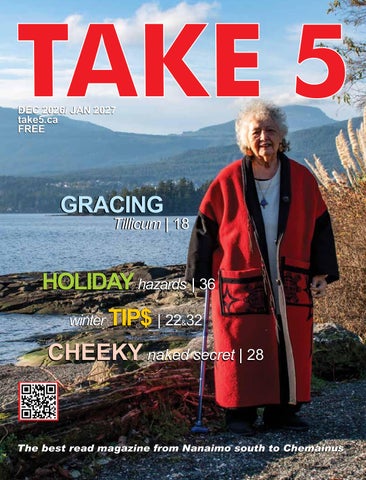
TAKE 5
take5.ca
3
TAKE 5
take5.ca
Letters Accountability and healing for Gaza Worldwide, there is a growing consensus that Israel is committing genocide. In a recent report (October 2026), the UN Independent International Commission of Inquiry stated, “Israeli authorities and forces continue to commit genocidal acts.” Even in the U.S., Israel’s staunchest defender, a 2025 Quinnipiac poll found that 50 per cent of voters think Israel is committing genocide. What needs to happen to stop the killing and destruction? And how will people be held responsible for carrying out, ordering and providing support for the genocide? The answer to these questions may be to establish a Truth and Reconciliation pathway that can lead to accountability, amnesty and healing. First, it can relieve those who committed crimes of the need to deny or justify their acts. Second, it can allow them to view their role in the conflict as a crime, but one that can be forgiven if they are willing to accept responsibility. Third, it can help lessen the shame and guilt they are experiencing and allow them to move on with their lives. Fourth, knowing that others are coming forward may give those responsible the courage to admit their part in the genocide. Following the 1994 genocide in Rwanda, the UN Security Council established the International Criminal Tribunal for Rwanda that same year. It was tasked with prosecuting highlevel leaders and military planners of the genocide. Rwanda established traditional community-based gacaca courts, in which elected local elders served as judges in open-air community tribunals. These courts prioritized trying close to two million cases to rebuild the fractured social fabric. In South Africa, following the 1992 referendum to dismantle minority rule, an interim constitution was passed, paving the way for amnesty to ensure a peaceful transition of power and
5
6
take5.ca
prevent prolonged civil conflict. In 1994, Nelson Mandela was chosen as the country’s first Black leader. South Africa faced the challenge of uniting the country and established a Truth and Reconciliation Commission in 1995. These processes allowed people to be held accountable for their crimes and communities to begin healing. The Palestinian people deserve no less. - Richard Tarnoff is a restorative justice practitioner in Ladysmith. A longer version of this article is at www.ccrjs.ca.
How much more can the environment withstand? There’s something deeply disturbing about watching political leaders applaud new industrial partnerships while the environmental consequences of decades of industrial expansion are unfolding all around us. The recently announced partnership between Snuneymuxw First Nation and Nanaimo Forest Products has been welcomed by Nanaimo Mayor Leonard Krog and B.C. Premier Lorne Doerkson as an economic opportunity. And perhaps it will be, but at what point do we stop celebrating the prospect of more money, more industry and more development long enough to ask what the environment can actually withstand? I support meaningful economic opportunities for Snuneymuxw First Nation, and I’ve never advocated for Harmac’s closure, but let’s not pretend that the interests of major industry, energy providers, port developers and governments are automatically aligned with the interests of our forests, waterways and coastal ecosystems. There’s enormous money to be made in industrial expansion and those financial incentives deserve
DEC/JAN 2027
scrutiny. We’re living through increasingly destructive floods, wildfires, declining fisheries and the accelerating consequences of climate change. Yet governments continue promoting economic models built around extracting, consuming and developing more, while assuring us they’re equally committed to environmental protection. How much longer are we expected to accept that contradiction? Consider Goldstream River, where a Nov. 19 CTV report described a salmon run in crisis, with an estimated 250 coho returning this fall. A century of human interference, altered river conditions and damaged spawning habitat has helped bring a once-thriving natural system to this point. And Goldstream is hardly an isolated warning. We’ve stripped forests, altered watersheds, destroyed wetlands and placed enormous pressure on the Salish Sea, then expressed shock when salmon disappear, orcas struggle, rivers flood and communities face the consequences. Climate change is magnifying the damage, but much of the vulnerability came from decisions our “leaders” made. Cable Bay is another example of the choices confronting us. Residents and environmental advocates, clearly and overwhelmingly opposed to industrial rezoning, presented serious ecological concerns over three nights of public hearings. Those concerns haven’t disappeared simply because a new partnership has been announced. And what about the residents of Cedar, who may live with the consequences of Nanaimo’s industrial decisions but can’t vote for the council making them? The problem isn’t that economic development has no place in our future. It’s that we’ve allowed financial return to dominate, even as the natural systems supporting our communities deteriorate. Governments talk about climate responsibility in one breath and celebrate the prospect of further industrial growth in the next, as though the two positions require no serious reconciliation. It’s a deliberate refusal to confront an environmental crisis that’s been unfolding for decades, and the public’s patience with that refusal is wearing dangerously thin. That frustration is turning into determination, and governments would be foolish to underestimate the growing demand for meaningful action. I’ve lived in Nanaimo for four years, watching these priorities play out while the environmental warnings grow increasingly difficult to ignore. I don’t believe the public is nearly as willing as it once was to accept the familiar promises of jobs, investment and prosperity without asking what else we’re being asked to sacrifice. The evidence isn’t buried in scientific reports or confined to predictions about some distant future. It’s in our rivers, our forests, our fisheries and the communities left to deal with the damage. Our leaders can continue applauding the next lucrative partnership, but they shouldn’t mistake public frustration for ignorance or silence for consent. We’ve seen enough of the consequences. What we’re waiting for now is the political courage to stop making them worse. -L. Ashton Send your letters to editor@take5.ca Please note that letters may be edited for space and legality and do not necessarily represent the opinion of TAKE 5 or its affiliates.
TAKE 5
take5.ca
7
TAKE 5
take5.ca
9
A War Nurse’s Story, Set to Music BY MARINA SACHT A new exhibit honoring Ladysmithborn naval nurse, Sub-Lieutenant Nursing Sister Catherine Dunbar Walker (née King), opened at the Ladysmith Museum on Remembrance Day and is now a permanent part of its exhibits. Storyboards in the alcove on the left as you enter tell her story, and a QR code links to music a Ladysmith student composed in her honour. It is the first museum exhibit for the Music for Veterans Project, a not-forprofit led by Victoria piano teacher Emily Armour. Walker was born in Ladysmith in 1921 and graduated from Ladysmith High School in 1939. She trained at Victoria’s Royal Jubilee Hospital School of Nurs-
Left to Right: Emily Armour (Founder Music for Veterans Project), veteran Devin Wilkins (Emily’s spouse), Sgt (Ret’d) Steve Murgatroyd (Jessica’s husband), and Sgt (Ret’d) Jessica Miller (Founder of Veteran Farm Project Society). Honouring Garden Dedication Ceremony Summer 2026. Photo submitted.
ing, joined the Royal Canadian Navy in 1944 and was posted to Halifax. There she nursed survivors of HMCS Esquimalt, a minesweeper torpedoed off the harbour in April 1945. Lily Ellis composed “Roots of Hope, Rise of the Rose” in her final year at Ladysmith High School, which Walker also attended. Ellis has studied piano with Armour since Grade 8. About a year ago, Ar-
mour emailed her a short list of veterans. “One of them connected to my life perfectly,” Ellis said. Walker was a Ladysmith nurse, and Ellis has volunteered at a hospital in Duncan, where Walker also nursed. She and Armour tried out ideas together, aiming for music that was emotional but also hopeful. Ellis had never enjoyed composing, but this was the first piece she liked because it was “some-
TAKE 5
thing bigger than just music,” she said. Armour started the Music for Veterans Project in 2021 with her students, who each wrote a piece dedicated to a local veteran. Her spouse is a veteran. More than 100 compositions have been written since, each inspired by one specific person. The project runs three programs. Oaks of Remembrance is a living memorial at Royal Oak Burial Park in Victoria, where 12 Garry oaks honour the Canadian Scottish regiment. Another is the Honouring Garden, a partnership with the Veteran Farm Project. The display includes family photos, Walker’s military papers and her naval belt. Her handwritten notes on favourite plants are in a flip book, and a case holds nursing and medical items from the period. More is online at honouringgarden. com. The Ladysmith Museum, at 721 First Ave., is open Saturdays from 11 a.m. to 3 p.m. or by appointment, with extra openings planned over the Christmas break. To book a visit, call 250-2450423 or email info@ladysmithhistoricalsociety.ca.
Meals, Beds and a Kettle BY MARINA SACHT When the red kettles come out in front of our local grocery stores, the money dropped in stays close to home. “A $5 bill that goes into the kettle is going directly to our community,” says Bern Muller, executive director of the Salvation Army Centre of Hope in Nanaimo. The Salvation Army in Nanaimo works from two locations. At 19 Nichols Street, staff shelter people who are unhoused and often living with addiction or mental health challenges, offering warmth, a shower, a safe place to sleep and the chance to work with a case worker. The 8th Street office (505 8th Street) focuses on keeping people housed. Staff work with those at risk of losing their homes, families in crisis, and children needing support, and run men’s and women’s groups plus counselling. “One of the main things the Salvation Army does for the people in Nanaimo is function as a gateway,” Muller explains, connecting people in crisis with the services that can help them move forward. Muller says the need is rising. The
take5.ca
11
shelters are full on a regular basis. This year a seasonal winter shelter has opened, bringing 34 people in from the cold and rain overnight, with a meal in the evening and another on their way out in the morning. Help is needed with the kettle campaign, the daily food delivery and the lunch program. There are 14 kettles out this year, and shifts run two hours, generally starting around 9 a.m. and finishing between 5 and 7 p.m. There are kettles at Country Grocer in south Nanaimo and in Ladysmith. The kettle is a big annual fundraiser, but Muller points out that need doesn’t end at Christmas. “Monthly giving, even $20, adds up and helps keep the doors open, the food flowing and counselors in place.” He also encourages people to consider the Salvation Army in their bequests. “Community partnerships are crucial,” says Muller, and regular support makes a real difference. To volunteer or donate, contact the Salvation Army Centre of Hope in Nanaimo.
Help Bring Christmas Cheer The Ladysmith Resources Centre Association is seeking sponsors, donors, and community partners for this year’s Christmas Cheer Fund. Christmas Cheer provides gift cards to families experiencing financial hardship, helping them purchase food and gifts that meet their needs. This year, LRCA hopes to support 250 families—and reach 300 if funding allows. Complementing Christmas Cheer, LRCA’s Family and Youth Support Services hosts a toy drive where families can choose gifts for their children. Financial contributions, toy donations, and community partnerships help bring comfort, choice, and joy to local families during the holidays. To donate, call 250-245-3079 or email info@lrca.ca.
Giving from the heart. Quentin Goodbody of the Ladysmith & District Historical Society accepts a donation from Ladysmith & District Credit Union Marketing Manager Michael Robinson. The LDCU is sponsoring Magic of The Season exhibit at the Ladysmith Museum. Photo: Marina Sacht
RDN asks residents to map areas that matter The Regional District of Nanaimo (RDN) has launched a project to develop a climate adaptation plan for the natural features that support the region’s communities. The Natural Assets Management is expected to be completed in 2028. The public is invited to share their knowledge, and commenting on the draft plan once it’s developed. More information at getinvolved.rdn.ca/nam-project.
TAKE 5
take5.ca
13
A Holiday Tradition Continues on Vancouver Island The Yellowpoint Christmas Spectacular has brought music, dance, laughter and Christmas magic to audiences across Vancouver Island for 18 seasons. For creator and artistic director Katy Bowen-Roberts, the journey began close to home. She grew up in Ladysmith and dreamed of creating a Christmas show right here on the Island. What started as an idea scribbled on a paper napkin has grown into one of Vancouver Island’s beloved holiday traditions. Eighteen years later, the show is still running, growing and bringing people together. The 2026 production is another allnew show. It features music from The Beatles, Annie, Fleetwood Mac, Hall
& Oates, lively Celtic fiddle, jazz classics made famous by Ella Fitzgerald and Louis Armstrong, and Bing Crosby’s “White Christmas,” alongside plenty of festive favourites. At its heart, Yellowpoint celebrates the joy of live entertainment and the incredible Canadian singers, dancers and musicians who bring each season to life. The tradition of giving back continues, too. This year’s 50/50 proceeds will support Y.A.N.A. in Courtenay, Help Fill a Dream in Victoria, and the Children’s Health Foundation of Vancouver Island in Nanaimo. The show plays in Courtenay December 7 to 9, Victoria December 12 and 13, and Nanaimo December 15 to 20.
Ladysmith’s history at centre of the museum gallery Barry Strasbourg-Thompson, the Ladysmith Museum’s gallery curator, wants the upstairs gallery to focus on local and Canadian art history. He has put out a call for exhibition proposals. “It’s a history museum,” Barry said. He is looking for artists whose work connects to Canadian art and to the story of Ladysmith: logging, mining, canoes and First Nations history. Proposals can include music, writing or theatre, as long
15
Yellowpoint Christmas Spectacular is back. Photo submitted.
as the core is visual art. Other galleries on the Island handle commercial work, he said, and this one should offer something distinct. He also believes the history of art on the West Coast has hardly been exhibited. Thompson says Canadian art history began thousands of years ago with the land’s original settlers, not with English or European settlement. He believes recent events with the United States have pushed Canada into a maturing phase, and he asks how Canadian art can mature too. The gallery sits upstairs in the attic of the museum, at 721 First Ave. The gabled room hosts art shows by local and emerging artists and, when the museum doesn’t need the space for its own exhibitions, gives artists a chance to show their work downtown. The current show, “Clear Light,” runs until Dec. 19. The exhibition describes clear light as a space free of problems and
16
take5.ca
DEC/JAN 2027
any need for change, the spiritual space in which creators exist while working in or performing in their field of fine art. It shows fine artworks produced by creators in this way and explores the tension between everyday life and that state, with calm set against hectic times. The show includes work tied to Quebec’s Automatistes, a group Thompson calls Canada’s second major art movement after the Group of Seven. Thompson plans one exhibit a month and may stretch some to two. Downstairs, in the Museum, Thompson runs his studio. He produces and sells his own work and teaches art classes. A fulltime working fine artist and instructor on Vancouver Island, he has painted for 70 years and comes from a family of artists and art teachers. He has taught since 1980, starting in Ottawa, and calls the current direction of his work Circling Home.
Ladysmith Author Releases Trinity Ladysmith author Barbra Ann King has released Trinity, the third novel in her Bobbie Hill series, following Nikkita (2024) and Angelica (2025). The book draws on a revolutionary horse training method that a very special equine teacher taught to a human. King says readers will laugh, cry and rethink what they know about horses as they explore new possibilities and the magic of relationships between humans and horses. In the novel, Bobbie Hill believes she knows certainty until she loses the life she loves and begins doubting everything. Then a wild, unyielding horse named Trinity enters her life
Barbra Ann King. Photo: Marina Sacht
and forces her to question whether trust, friendship and even herself were ever what she believed. As Bobbie struggles to find her footing, Trinity brings unexpected wisdom, but opening her heart again may take more courage than she imagined. King is an internationally known horse behaviour specialist and the founder of the Relationship Riding© method. A published author who lives in Ladysmith, she has enjoyed writing since she was very young. Readers can buy Trinity on Amazon in Kindle and paperback formats. They can follow King on Facebook at Barbra Ann King, Author, or email barbraannkingauthor@gmail.com.
TAKE 5
A Monster Calls Duncan’s Mercury Players are presenting the fantasy drama A Monster Calls, from November 20 to December 6. The play, based on Patrick Ness’s awardwinning novel, centres on 13-year-old Conor (Ody Draper), who struggles with his mother’s (Sarah Kate Knight) terminal illness. An ancient yew tree visits him nightly and demands the truth he cannot face. Director Maximilian Bethel says the show unfolds “from Conor’s perspective, so the audience is witnessing both Conor’s imagination and the physical world around him.” Dancer Max De Nardi plays the Yew Tree Monster, with actor Rien Vesseur providing the voice. The Monster and a dance ensemble reflect Conor’s inner turmoil. Through their enacted fables, Conor begins to process his grief, fear, exhaustion and guilt. The play offers no easy answers. Instead, it shows that it’s okay to want to hold on to those we love while also wanting to let them go and end the suffering on both sides. Bethel, a Duncan actor and dancer,
take5.ca
17
found his inspiration while re-watching the film at his recently departed grandparents’ house. “This is the story about how we move forward in life after the people we love have moved on from us,” he says. The production contains simulated violence and emotional and mature themes. A Monster Calls runs evenings at 7:30 p.m. on Nov. 20, 21, 27, 28 and Dec. 3, 4, and in matinees at 2:30 p.m. on Nov. 22, 29 and Dec. 6, at Duncan United Church Hall, 246 Ingram Street, Duncan. Tickets $25 at mercuryplayers.org or at Ten Old Books (cash only). Left: Actor Ody Draper (Conor) Photo: Mony Vesseur
Burning the Blues BY EVAN SHUMKA “People listen with their eyes. Before you play a note, they’ve also decided what you sound like,” said Chris Noel, a local blues shouter and string bass player. His band, Chris Noel and the Burning House, can be heard on the local blues festival circuit. I’m not sure what people think Chris sounds like before he plays, but what they see is a man with the look of a friendly sasquatch: long, shaggy beard and long, shaggy locks. He stands quite tall, with big, strong hands from playing bass. As a teenager, he was drawn to that instrument. “I just thought the bass was cool,” he told me. “A lot of the tunes coming out with the popular bands had a prominent bassline, like Motown tunes, even like The Beach Boys.” Since he couldn’t afford his own string bass, his mother, a musician involved with the Vancouver Youth Symphony, told him they would supply him with one if he joined. “All I gotta do is show up once a week, play a tune, take home the music for the tune that we’re gonna play the next week,” he said. “I just wanted the bass.” So he joined up for a while, but not too long. He left home at 17. “I didn’t get along very good with my parents,” he said. “They were pretty
Chris Noel playing a pirate in Master and Commander movie. Photo submitted.
strict and I was a bit of a bad boy.” The bass went back to the symphony. But Chris had other interests: cars, motorcycles – you know, bad boy stuff. He didn’t get involved with music again for some time. While he was living in White Rock, a guy suggested he try out for a local blues band. Chris had gotten his hands on an old, cheap electric bass. “I was terrible,” he said. “I mean, I really couldn’t play.” He played with the band for a while, but they fired him for
playing too many notes. He was bored with sticking to four quarter notes. Playing Beethoven in the symphony orchestra had been more challenging. In his youth, he hadn’t developed the study habits required to advance. “Half the battle of being a musician is learning how to practise, learning how to not sit there and play what you already know how to play,” he said. “You have to push yourself out of your comfort zone … and by the way, it takes more than an hour – it takes just an hour to stay where you’re at.” Chris has done acting as well and shares my love of theatre. After his workplace shut down, he started doing extras work in Vancouver. “It was great when they shut the place down, because I’d been there so many years,” he said. “I felt like I was walking out of jail after doing a life sentence.” As a free man, he worked as one of the whalers on Master and Commander: The Far Side of the World. He spent four or five months filming the Russell Croweled naval epic, set during the Napoleonic Wars. Filming took place predominantly at Baja Studios, where a full-scale replica of the ship was mounted gimbals, allowing it to rock in the gigantic water tank originally built for the filming of Titanic. Some filming also took place on the open sea in a replica of the HMS Rose, which served as the film’s HMS Surprise. Since it was such close quarters on the ship, there wasn’t the same kind of separation between the stars and the extras as on most productions. Chris got to sit with Russell Crowe and get acting tips. He also got sabre training, and on the days when he had nothing to do, he lent a hand to the sailing crew, having sailed since he was a kid. “Movies are 95 per cent boredom and five per cent terror,” he said. When he came back from that job, he performed in an operetta. “The nice thing about stage is you really gotta work every night,” he said. “I lost about 15 pounds. I didn’t have time to stop and have a beer.” These days, he can be found on the blues festival circuit. He and his band played the Chemainus Blues Festival in July. He’s planning to record a new CD, which he told me is 10 years late. His favourite shows to do are private parties. Sometimes it can take time to get through to people. He likes to watch for when the toes start tapping in the audience.
19
Chris Noel (fourth from left) and the Burning House. Photo submitted.
“They might not really start responding until the third or fourth song,” he said. “And you’re gonna hit something there that’s gonna click with ’em.” He said music and acting are tough if you don’t have something that pays the bills to fall back on. As a younger man, he used to turn down offers to tour because he had a stable job with a benefits package. He told me that whether you’re doing community theatre or a show in a small venue, you’re still doing what you want to do. “You know what, success is not money,” he said. “Making people happy and walking away, seeing smiles on their faces — that’s success.”
20
take5.ca
DEC/JAN 2027
Freeze It, Bake It, Grow It: More Ways to Cut Your Grocery Bill BY PAUL LEGACY This month we continue on our theme on cutting our groceries bill with more tips.
Make the Most of Your Freezer Don’t be afraid of the freezer. It can be one of your best tools for saving money. If you have cooked too much food, don’t automatically put the leftovers in the refrigerator and hope someone eats them before they go bad. Freeze them. Freezing meals in smaller portions makes it easier to use them later. It also gives you a homemade alternative to takeout on those evenings when you
don’t feel like cooking. I like to freeze things in portions that make sense for how they will be used. One or two cups of stock might be perfect for a recipe, while a larger container might be better for soup. Freezing food also allows you to take advantage of sales. If something you regularly use is on sale at a good price and you know you will use it before its quality declines, buying a little extra can save money. The important thing is not to buy something simply because it is on sale. A sale isn’t a bargain if the food ends up in the garbage.
Make It Yourself When tomatoes are plentiful, or when fresh or canned tomatoes go on sale, I like to make my own tomato sauce. I can make it in the multi-cooker or on the stove and then freeze it in convenient portions. Homemade tomato sauce can be used for spaghetti, lasagna, pizza, casseroles, soups, or other dishes. There is another benefit to making your own sauce and stock: you know exactly what went into it. You can control the amount of salt, choose your own seasonings, and adjust the flavours to suit your family. And, in my opinion, the
flavour of homemade sauce and stock is hard to beat. Another way I save money is by making my own bread. I make regular bread, whole-wheat bread, sourdough, and English muffins. I watch for flour to go on sale and buy it when the price is good. Making bread is easier than many people think, although it does require some planning because dough needs time to rise. There is also something very satisfying about having homemade bread in the house. You can make a loaf for considerably less than some specialty breads at the store, and you know exactly what ingredients went into it. Homemade bread can also be frozen. If you make more than you can eat, slice it before freezing so you can take out only what you need. Most importantly, don’t be afraid to cook from scratch. The savings may seem small each time you do it, but those small savings add up. There is also something very satisfying about opening your freezer and knowing that you have homemade stock, sauce, bread, meat, or a complete meal ready to go—especially on a night when you don’t want to cook.
or nine months of the year. Instead of buying a large bunch of fresh herbs at the grocery store and using only a small portion, I can pick exactly what I need. Fresh herbs can be surprisingly expensive, particularly when you only need a tablespoon or two for a recipe. Growing your own means that you can use a few leaves today and come back for more tomorrow. Herbs can also make inexpensive meals taste much better. A simple soup, roasted vegetables, potatoes, eggs, pasta, or homemade sauce can be transformed with fresh herbs and seasonings. Apples are especially useful because there are so many ways to preserve them. I like to make apple pie filling and freeze it in portions that are large enough for one pie. When I want a dessert, I simply take a portion out of the freezer and let it thaw. Make a pie crust, add the filling, and you have a homemade dessert for supper without having to buy an expensive prepared dessert. Apples can also be used for applesauce, muffins, crisps, cakes, or simply eaten fresh. Paul Legacy in his kitchen. Photo: Marina Sacht
Grow a Little of Your Own Food You don’t need a large garden to grow some of your own food. Even if you live in an apartment or have very limited outdoor space, tomatoes, herbs, lettuce, and some other vegetables can be grown in pots or planters. Tomatoes are particularly useful because you can eat them fresh during the growing season and preserve them for later. A small herb garden can also save more money than you might expect. I have a small herb garden that I can use for eight
Take Advantage of Your Community Saving money on food doesn’t always mean buying something at the grocery store. Many of us have neighbours who grow vegetables, apples, grapes, or other produce, and sometimes they have far more than they can possibly use. Don’t be afraid to ask whether they have extra. You may also see people putting extra produce at the end of their driveway or by the roadside, for free or for very little money. This can be a wonderful way to get inexpensive seasonal produce while also helping prevent perfectly good food from going to waste. Follow Paul Legacy @ A Legacy in Thyme on Facebook.
Back to Britain brings the pub home for the holidays BY MARINA SACHT Between Christmas and New Year, houses fill up with relatives, neighbours and old friends, and the question is always where everyone will end up. Usually, it’s wherever the glasses are. Step through the door of Back to Britain Pubs in Chemainus and the first thing you notice is the light. It’s low and warm, falling across weathered wood and shelves of curiosities, and it makes you want to stay a while. That’s no accident. Mark Myers and Sandy Pollard have built around 30 custom pubs and bars in people’s homes for 15 years. They’ve called Chemainus home for the last 10. In England, Mark and Sandy point out that the pub has long been the hub of life. “Everything circled around the pub.” The home bar plays the same role, whether it’s a rec-room corner or a full-blown pub with a Liverpool door. It’s a gathering place, and an escape. A place for a Christmas Eve toast, a boisterous game night, or the long, easy conversation on New Year’s Eve that doesn’t want to end. Their showroom features examples of different layouts, inMark Myers and Sandy Pollard in the Back to Britain Pubs showroom. Photo: Bob Burgess
cluding a large bar, a smaller pub area, an Irish-themed “quiet room,” a wood-stove seating area and a tiny W.C. Visitors can wander through and picture which one might suit their own home. The business began, as many good ideas do, with a favour. Mark used to drink at Finnegan’s, a pub in Abbotsford, and one day the owner mentioned he was renovating and needed to find a home for the old bar. Mark took it, hauled it to his porch. “I looked at the way it was built, the bar he gave me, and I thought, I can do this,” he says. Building runs in his blood. Mark started out as a tree man, but his father was a plasterer, and his uncle Bill and his grandfather were bricklayers. His very first bar, built before he met Sandy, was made from an old waterbed for a friend’s living room. It was a hit. Once the couple were together, a little bar went into the basement of their rental house. They took it all down and filled every hole when they moved out, Sandy says, and the landlords never knew. In Chilliwack, a pub took shape in the garage of their new townhouse. Then a neighbour wanted one. Then the neighbour’s friend. Then one of Sandy’s friends from the dental world and her new husband. “And then that was kind of where it went from there,” Sandy says. So what makes a good bar? Mark doesn’t hesitate. “The wood,” he says. Even brand-new lumber, he says, can be made to look as though it has seen a century of Friday nights, and it has taken him years to do it so the effect isn’t obvious. Then comes the lighting, and then the objects, the pieces that carry a story and take a visitor “straight there” to a pub in England. Mark has a lifelong soft spot for the place. As a teenager passing through England, he never got to see the inside of a pub, but he remembers walking by as a boy and catching the smell of the beer. “It’s so magic,” he says. These days he drinks vodka, though he still keeps four cans of Boddingtons in the fridge, saved, Sandy jokes, for the end of the world. He is, by his own admission, always scouring second-hand shops. “I have to,” he says, “because I might miss something.” Mark and Sandy weave their clients’ stories into the work too. For a recent Abbotsford pub, owners Dean and Shannon wanted to honour Dean’s family, so Mark mounted wartime photographs and medals from the Second World War. Behind the bar hangs a black-and-white photo of hundreds of girls from the school in Norwich, England, that Shannon once attended. Global News stopped by to see the result. How long does a bar take? That depends on its size, where it
will stand and how much the client wants done, Mark says. If he can, he builds on site. Otherwise he pre-builds much of the bar in his workshop and moves it. The clients range widely. One man, a fan of real ale, wanted a simple bar for his group’s monthly meetings. An Air Canada pilot and his wife, who flew to England as often as they could just to visit pubs, wanted a taste of those trips at home. Mark does his own research, too. He and Sandy have been to Ireland twice and came home with hundreds of photos of pub interiors. And he has a particular fondness for the old, roughlooking pieces of wood most people would throw away. “They always want the new stuff. I like the old stuff,” he says. It works, he adds, because nobody’s tried it. The couple’s most famous visitor arrived about a year ago, thanks to a chain of connections that began with Mark’s old boss, an arborist in Burnaby. The man’s daughter, Valerie, brought her boyfriend, Chris, to see the pub. Chris turned out to be the lighting designer for jazz pianist Diana Krall. He sent photos. Then, days later, he called: Krall was coming. Mark, who owns “loads” of her records, says he was beside himself. When she arrived with a small crew for a photo shoot, he opened the door and welcomed her in. “She said, ‘Thank you very much,’ probably a dozen times,” Mark recalls. She told him the lighting was perfect. She even phoned her husband, Elvis Costello, in New York on FaceTime to show him the pub’s Liverpool door, as Costello is from Liverpool. Mark says he offered her a compliment of his own. “What you can do with your hands on the piano, I do this,” he told her, gesturing at the woodwork around them. “She got it.” There was one disappointment. The crew expected to stay until about 11 p.m., so Mark slipped out to a belated birthday dinner with his son, who had come from Kamloops. When he returned around 8:30, they were gone. Krall hadn’t been feeling well, Mark says, and he had hoped for a photo of the two of them in the pub. Chris promised she would send something signed instead. It turned out to be a signed double album, which Mark has framed to match the pub’s old-fashioned feel. The British pub is their specialty, but Mark says he’d love to build a music-themed bar, with guitars on the wall and the feel of a café. “I love music,” he says. “This is what this is all about.” For the couple, that’s the point. They want to help people create a space where they can really entertain at home, whether it’s a corner of the basement or a whole room. You can invite your own friends, play your own music and serve your own food and drinks, without paying a premium for the evening, and everyone is already where they need to be at the end of the night. It can be a release, too. Many of their clients, they say, are glad they built, especially through COVID, when a comfortable place to switch off meant a great deal. If you have a space, big or small, Mark says he’ll gladly come and have a look, hear your budget and tell you what’s possible. The Back to Britain showroom is also available for private gatherings of up to 20 people, such as a Christmas party, a birthday or an anniversary. Guests bring their own food and drink, as they would to a house party; they don’t cater or serve alcohol. And if the celebration is one of those long, happy nights, well, that’s what the lighting is for. To see their work, visit the Back to Britain Pubs showroom at 9746 Chemainus Rd or go to backtobritainpubs.com.
25
Those dark winter nights sure do a number on me. This is the time of year when living in my pyjamas and hibernating are very appealing. But as tempting as that polar fleece bathrobe looks, I know that is not going to lead me anywhere good. While we all love the wonderland of winter, there is a darker side. I’m thinking dripping noses, hacking coughs, isolation, and depression. Many people feel low when daylight is short. Seasonal affective disorder, or SAD, is a kind of depression that appears at certain times of the year, and about two to three per cent of Canadians will experience it in their lifetime. Light therapy, which involves sitting near a special light for about half an hour a day, has been proven effective. Spending time outdoors in daylight and arranging
showing themselves more compassion, improving our mental health doesn’t always require big changes,” she said. “Sometimes it starts with simply understanding ourselves and recognizing what we need.” Dr. Laura Reimer who specializes in helping women build strength, improve their nutrition, and feel confident in their bodies through strength coaching, nutrition guidance, and evidence-informed wellness education suggests people “focus on building habits that support the life you want to live. Rather than chasing quick fixe, prioritize getting stronger, eating well, moving regularly, and Ashley Lindsay of Mindful Pathways Counselling Services. Photo submitted.
indoor spaces for maximum sunlight can also help. Ashley Lindsay, a registered clinical counsellor and owner of Mindful Pathways Counselling Services, which has offices in Ladysmith and Nanaimo, encourages people to think about what already supports them, rather than only what they need to fix. “Whether that’s meaningful connection, rest, setting boundaries, or
27
Dr Laura Reimer at squat clinic. Photo submitted.
making time for recovery. You don’t need to do everything perfectly or overhaul your life overnight. Small, consistent changes really do add up.” Cold, wet weather makes it tempting to stay in, but the Canadian Mental Health Association suggests a daily noon-hour walk. The activity and extra natural light is a mood booster. Immunization is one of the most effective ways to protect yourself against severe illness from flu or COVID-19, according to the BC Centre for Disease Control. Both vaccines are free. Register in the Get Vaccinated system to get notified. Pharmacists can give flu vaccine to anyone aged four and up. Locally, Pharmasave in Ladysmith is one of the pharmacies that can help you out. Flu season peaks between December and February, so now is the time to get vaccinated. And remember COVID protocols. Wash your hands often, don’t touch your face, especially your eyes, nose and mouth, and if you have a fever, stay home, and wear your mask. And reach for your Vitamins – especially Vitamin D, which we don’t produce as much during winter.
28
take5.ca
South Wellington’s Cheeky Naked Secret BY DALYS BARNEY “Do you know anything about the nudist colony that was in South Wellington?” That’s the question that got me working on this article, because, prior to that moment, no, I’d never heard of such a thing. Intrigued by the idea, I decided to see what I could find out. It wasn’t long before community members confirmed that, yes, it’s true, there was a private nudist camp (not a colony) on Minetown Road, just off the Island Highway. Many Vancouver Islanders will be familiar with the property: It’s the one that later became known as “Angel Acres” – the site of annual “rock n’ roll” parties hosted by the Nanaimo chapter of the Hells Angels Motorcycle Club. Beginning in 1985, and carrying on throughout most of the ‘90s, South Wellington was home to epic August long-weekend parties that brought thousands of local and even international motorcycle club members to the community. The events, which were also attended by non-patch motorcycle enthusiasts and the public, featured live music (which could be heard throughout the entire community), beer gardens, concessions and food trucks, sand drags, tattoo booths, and wet t-shirt contests. Fond memories of those gatherings live on in the hearts of many, with posters, stickers, t-shirts, and even “good luck acre buck” tokens being cherished as souvenirs. But that’s an article for another day! Long before it ever became Angel Acres, the large piece of property between Kipp and Minetown Roads was
Nudist enjoying Vancouver’s most famous clothing-optional beach, Wreck Beach. Photo: https://commons.wikimedia.org/ wiki/File:Wreck_Beach_in_Vancouver, Travelmodel777
a nudist campground operated by the Nanaimo Tans Club. Founded by former members of Sol Sante, a nudist club based in the Cowichan Valley, the camp in South Wellington hosted private nudist gatherings from about 1968 to 1973. The Nanaimo Tans Club never had very many members – a 1970 newspaper article put membership numbers at 52 – but the club successfully hosted about 500 attendees for the Western Canadian Sunbathing Association’s 1970 regional convention, and the camp property was also featured in one of the association’s promotional films. While skinny-dipping and naked sunbathing have likely always been covertly enjoyed by those seeking a sense of freedom or the thrill of adventure, nudism’s rise in Canada happened during the postwar era. Military service in the Second World War introduced thousands of Canadians to European cultures that had more open-minded attitudes about non-sexual nudity, and servicemen came home with changed perspectives. An influx of European immigrants also brought both experience with and more carefree attitudes about nudism to Canada.
DEC/JAN 2027
From coast to coast, social nudism was embraced, and British Columbia was no exception. The Van Tan Club, based out of North Vancouver, was established in 1939, and is recognized as the country’s oldest continuously operating naturist club. Vancouver’s Wreck Beach, which may have been used by nudists as far back as the 1920s, became a hot spot for nude beach goers in the 1970s and eventually became Canada’s first legally sanctioned clothing-optional beach. Nudist clubs and organizations were founded all over the province, including on Vancouver Island. As well as having sites for camping and a 40’ by 60’ clubhouse, the Nanaimo Tans property in South Wellington had a wide array of recreational activities for members to enjoy, including a large in-ground pool, a sauna (which was reported in a Daily Colonist article as being “one of the largest saunas in Western Canada, capable of accommodating 60 people,” courts for volleyball, badminton, and miniten (a tennis-like sport popular with nudists because it didn’t require a full-sized court), a horseshoe pitch, a zipline, and a climbing net. Shuffleboard and ping-pong tables were also available, and as it was a familyoriented space, there was also a play area for children which had a merry-goround and a kiddie pool. A tall fence was erected all around the property; it didn’t stop local kids from trying to sneak a peek while riding past on fully loaded hay trucks, but for the most part, the camp’s activities were kept very private. As well as the tongue-in-cheek seasonal closure motto “clothed for the winter,” many locals remembered the large “Nanaimo Tans” Coke sign that was located at the camp’s entrance on Minetown Road. I was told by a member of the family that owned the property that the Coca-Cola Company was willing to pay for the sign as long as it featured their oversized bottle cap. And I also have it on good authority that this same sign made a perfect winter sled. In about 1984, the property was sold to the Hells Angels. The selling family was not made aware of who the new owners were until after the sale was completed. Angel Acres had its time, but the property was later subdivided, and the resulting pieces are now privately owned.
TAKE 5
Although the Nanaimo Tans Club has closed, Cowichan’s Sol Sante remains active. Founded in the 1950s, the nonprofit society owns a 175-acre property outside of Cobble Hill, which features a private lake and hiking trails. The club – which has a current membership of over 160 people – advertises itself on its website as “the friendliest club in the West” and “Vancouver Island’s best kept secret.” Hosting a wide variety of clothes-free activities, from pickleball and water volleyball to line dancing, movie nights, and themed parties, the Sol Sante Club welcomes visitors and prospective members to explore nudism in a safe, comfortable, and accepting environment. Dalys Barney is the Digital Collections Assistant at the Vancouver Island University Library. She’s deeply rooted in the mid-Vancouver Island region, having lived in South Wellington, Cassidy, Cedar, Ladysmith, and Chemainus. She regularly writes for British Columbia History magazine and maintains a local history blog at vanislehistoryexplorer.ca
take5.ca
29
An Act of Grace BY FRANCESCA PACCHIANO I met Stz’uminus Elder, Grace Elliott-Nielsen in her office at the Tillicum Lelum Education Centre. It was a spacious room which overlooked the Nanaimo estuary. The cedar walls were decorated with art, photos of her smiling grandchildren, and the framed awards Grace has achieved through her work within the community. Her traditional names, Ti’uqtunat & Wulwitsulwut, mean teacher, leader and belonging to everyone. These names have acted as a guiding force for Grace, informing the way that she directs Tillicum and its ever-increasing programs. “It’s really important to keep in mind that in our lives, we are connected to everything, everything in life, and to respect and work with that.” She grew up on Elliot’s Beach and lived locally for most of her life. She began her career working as a nurse with children in Nanaimo’s old Indian hospital, but she was advised to leave after a year because it was a dangerous environment. “It was quite difficult because there was a lot of racism then… and I was someone that complained if I [saw] that people weren’t treated right.” That spirit of advocacy is what led her to social work and later to the role of Executive Director for Tillicum. Started in the early 1960s as a coffee dropin for Indigenous youth and young adults, Tillicum was actively working to fill places of need within Nanaimo’s urban Aboriginal community. Indigenous access to housing was an early focus of Grace’s work with Tillicum. “I remember one house close to where our office was, and they had their ‘no Indians need to apply’ [sign]. So, I went there and I talked to them [until] the sign went down.” Grace’s passion for her community expanded to work with boards and organizations that made it easier for Indigenous and marginalized communities to access health care. “I was involved in many boards, like BC Health. We set up health committees all over Vancouver Island and the
Stz’uminus Elder, Grace Elliott-Nielsen, community builder. Photo: Bob Burgess
mainland. I became the president of the BC Association of Aboriginal Friendship Centers for 14 years.” She was even a driving force in lobbying for the legalization of midwifery in BC. Under Grace’s leadership, Tillicum runs nearly eighty programs across three different locations, specializing in Education and Training; Health and Counselling; and Social Services. It’s the counselling that’s had the biggest impact on Grace. “I started thinking a lot about family reconstruction…A lot of the families that are having so many difficulties and problems, [especially] ones that have been through residential school. There’s families that started drinking. There’s families that felt their parents just sent them away because they were tired of them and they didn’t really know why they were in residential school. And I said, ‘What I’d really like to do is work with them.’” After several years of working with professionals, and directly with nuns and priests from residential schools, Grace had created a program that worked. Its in-depth counselling with a week-long workshop where families could come and be supported by a team of counsellors and sort through the layers of hurt, anger, and grief. “It was so heavy duty…those people really needed a lot of support and counseling.” During the session, those enrolled stay on-site with meals and housing included. “We have cultural teachers at night and then training during the day…Most people have something they want to work through. I’ve done it myself probably about six times.” The family reconstruction counselling program is one Tillicum has run many times over the years and it’s going to be running again in 2027. “It’s not as easy to set them up anymore and get the space, but I managed to get a hold of some more
money. We’re able to do three weeks, a week at a time, for different areas, for people that are needing or wanting it.” The sessions will take place in Lake Cowichan, but the dates have not yet been announced. For more information regarding these upcoming sessions, Grace recommended reaching out to Tillicum directly. The money to run programs like these can be hard to come by. Tillicum relies on government grants for a portion of their funding. “We managed to get some of the funding that we needed for the young mom’s house and for the daycare.” But donations make up a big part of their subsistence too. There are multiple ways to support, either giving directly to the organization, or by participating in the fundraisers and auctions that happen throughout the year. Their Christmas Hamper program is in full swing but donations can still be made to it. “Food is such a big issue and it’s so costly. We spend a lot of time trying to make sure people have food at Christmas time.” Grace is widely recognized for her work maintaining one of the longest running Aboriginal Friendship Centres in Canada. She has even been awarded the King Charles III Coronation Medal and the late Queen Elizabeth’s Golden Jubilee Medal. She has also been awarded both Federal and Provincial medals and has numerous awards from the Nations across the island and the boards she served on. Today Grace continues to lead Tillicum as Executive Director. She now lives in Cedar by the Sea. When she looks back on the impact of her work, she says it’s always been about connecting with people. “Mind, body, spirit and connection are so important…My dad said that you’re not here for just one person…We’ve had so many different nationalities, different tribes that come through here and they’re like family to me.”
Keep the heat in and the bills down this winter BY MARINA SACHT As cold weather settles over the Mid-Island, if you are like most people, you are dreading the soaring power usage. Heating is the biggest energy cost in most homes this time of year. According to BC Hydro, heating can account for up to 50 per cent of a bill in winter, and costs can rise by as much as 140 per cent compared with the rest of the year. Ken Brownlow of Brownlow and Sons, who has worked in home energy retrofits since 1990, says draft proofing is the place to start. “The biggest heat loss is from air leaking out of your house,” Brownlow said. “Anywhere there’s a draft, you want to try
and eliminate that.” He suggests checking the weatherstripping on doors and around windows. He also recommends sealing where plumbing pipes come through the floor into the house, such as from a basement, and using low-expansion foam around plumbing pipes under kitchen and bathroom sinks. Air sealing is the big one people can do without “spending major dough,” Brownlow said, and most of it homeowners can do themselves. Insulation is the next check. “Most people don’t know how much insulation they have,” Brownlow said, so it doesn’t hurt to have it checked. He says it may be the least expensive energy upgrade, costing much less than replacing windows or doors. Wrap exposed pipes in fitted insulation, which is cheap and easy to install. Cold snaps do happen on the Island, so keep the heat on even when you’re away, because significantly lowering the temperature can risk frozen pipes. Insulation, windows and heat pumps cost more up front but save
the most over time. The province’s Home Renovation Rebate Program is open to any income level. It offers up to $4,000 for heat pumps in homes heated with electricity or wood, up to $1,000 for heat pump water heaters, up to $5,500 for windows and doors and up to $2,000 for insulation. Brownlow says FortisBC customers in the right income bracket should check the utility’s own income-qualified offers. FortisBC lists up to $7,500 for windows and doors, at $750 per window or door, and Brownlow says money is also available for heat pumps and insulation. The cheapest savings come from changing how you heat. BC Hydro advises heating only the rooms you’re using and turning down the heat when you’re away and overnight. A programmable thermostat can do that automatically. Open the drapes on sunny days to let in free heat, and close them at night to hold it in. And check your power consumption regularly. Turn on your dishwasher, and washer and dryers after 11 pm and before 6am for more savings. Better yet, hang your clothes to dry. Along with saving money, this is a good time to think about safety. With all the wet weather, make sure to clear gutters and that downspouts carry water away from the house. If you heat with wood, have the chimney inspected, and test smoke and carbon monoxide detectors. While these may not save you money, they will go a long way towards having a safer home.
Will You Be My Business Partner? Chopstix Salon new owners BY EVAN SHUMKA The idea of fate bringing two people together evokes thoughts of romance or friendship, rarely business. But after spending some time with Susan Hearsey and Shayna Marchant, the new owners of Chopstix Salon, you’ll believe in true business love. “There’s just so many weird similarities in our life,” said Shayna, office manager, who handles everything that’s not hair. She and Susan both grew up in Port Alberni and even went to the same high school. Other synchronicities: Susan’s mom worked at a donut shop that Shayna’s mom now owns, and Shayna and Susan even share the same middle name. “Weird little things that you think, there’s something to this,” Shayna said. “Something in the universe is guiding this to be something.” Chopstix was established in 2000 by Darlene Munn. For its first 20-odd years, the salon was located in a 100-year-old house on First Avenue. “Darlene had built such a great atmosphere at Chopstix,” said Shayna. “You could feel the fun when you went in there. You could feel the good energy and the good vibes.” Susan started there about ten years ago. “I had a job previously that I don’t think respected their stylists very much,” she said. “And I was like, ‘I’m a grown up; I don’t need that.’” She told me that Darlene is a wealth of knowledge and was always supportive of her stylists pursuing opportunities for further education. “There’s not a lot of places as a hairdresser where you get that level of support.” Shayna got to know the salon first as a client. She’d done hair school training previously but was drawn more to working behind the scenes than wielding the scissors herself. She went on to be a stay-at-home mom. When her child reached 17, Shayna felt ready to venture back into the world and knew
Chopstix was the only place for her. She had no résumé, just a letter saying how much she loved the salon and wanted to help out. “Any assisting you need to make your day run smooth, that’s all I wanna do.” Susan added that “she snagged Darlene when she said, ‘I’ll even clean your toilets.’” Darlene had already been thinking of retirement when she received an offer from a developer to buy the old building. Susan and Shayna were her natural successors to keep the business, and the team, together. “If you look at the timecards,” said Shayna, “me and Susan put in the most hours. So, we’re willing to put in the time and the work. … We’re both on the same level in that way, and we need each other. …” “… ’Cause I would forget to pay the rent,” Susan chimed in. Susan had considered taking over the business on her own but worried about inadvertently screwing everyone over if she failed. Shayna approached her and popped the question: “Susan, will you please be my business partner?” And Susan asked her, “What if it doesn’t work out?” “It won’t work out if you don’t have me,” Shayna said. “If we’re together, it’ll work out.” Wherever the salon ended up, they wanted to bring along the fun atmosphere Darlene had created. They searched for nine months to find a new space, hoping to stay in Ladysmith for all their long-time clients. But there was nothing available, even outside of town. They inquired about a deeply purple Pilates studio behind the library at Dunsmuir Square – no dice. Their alternative was a nearby shack, inhabited by spiders. As luck would have it, their accountant, who works in the same building, ran into the owner of the studio, who said she was moving her business. Susan and Shayna pounced on the opportunity and got in touch with Erin Marshall, the landlady. “There were, like, 12 other people,” said Shayna, “that were all trying to get the space, and we—” “—we begged,” said Susan. “Shayna begged, and I showed her pictures of the spiders. ‘This is our plan B,’ we said. ‘Please don’t let us go there.’” The begging and arachnoid imagery paid off, and they got the space. It took much work and many contractors to
Chopstix Salon owners Shayna Marchant and Susan Hearsey. Photo: Evan Shumka
convert the studio into a functional salon. “I think the walls took about seven coats of paint to cover the purple,” said Susan. Now that they’re all set up, they hope to grow their team of stylists but are happy to wait for the right person. They aren’t in a rush to formalize their partnership either, though Susan admits they probably should. They’ve built a strong trust from working so close for five years. “She knows all my business,” said Susan. “I know everything about her,” said Shayna. “I know how she is as a mom, as a wife, as a daughter – as everything. I know her as a human. And I know that I can trust her. I believe in her … and I know she won’t screw me over.” “I think it would be easier for me to get divorced,” Susan said. “That would be easier than trying to separate from business.”
34
Cable Bay Trail: a jewel in limbo BY GUY DAUNCEY If you have never parked at the end of Nicola Road in Cedar and wandered down the trail to the ocean at Dodd Narrows, revelling in the beauty of the maple and cedar trees, followed by the joy of the ocean and the frequent passing of sea lions and orca whales, you’ve been missing one of nature’s jewels, the ecological pride of Nanaimo. The trail has been there for many years, but it’s still unknown to many. This past summer, when a proposal to fell 7,300 trees and rezone almost all
take5.ca
of the lands to the west of the trail as heavy industrial came to Nanaimo City Council, more than 1,000 people took the time to speak or write, 99 per cent of whom said, “Don’t do it!” There followed three long evenings filled with impassioned testimony from naturelovers and ocean-lovers who were astonished that council would even consider clearcutting the land and permitting the noise, fumes and pollution of heavy industry just 50 metres from the trail, in an ecosystem that Paul Chapman from the Nanaimo Area Land Trust has said supports the highest number of endangered and at-risk species in B.C. Our concerns were heard, and council voted 8-1 to send the proposal back to staff for more work. And since then? Silence. Until Nov. 17, when the Snuneymuxw Nation announced an agreement to work with Nanaimo Forest Products (Harmac) as partners, with much ceremony. In due course, we assume that this will produce a new proposal, maybe after consultation with the nature-loving
DEC/JAN 2027
community, or maybe not. Whatever’s going on, it’s currently behind closed doors. Sometime next spring or summer, we assume, a revised rezoning bylaw will come before council and there will be a new public hearing, with two new councillors alongside those who were re-elected in October. We have written copiously of our concerns. Now we sit and wait. So what about the lands on the east side of the trail? They are owned by Calgarybased Wilf Richards and a group of Calgary investors who bought the land in 2005, hoping to build a 3,000-unit residential golf-course community. They sold the west-side lands to Harmac, and when their plan ran into a wall of protest and an obvious absence of water, they came back in 2023 with the current plan to develop 34 single-family homes, with road access from Barnes Road and Ivor Road in Cedar-by-the-Sea. For the Snuneymuxw, the lands on either side of the trail are also treaty-protected sites, but we do not know whether consulta-
Photo below: Image: savecablebay.org and Wikipedia
TAKE 5
take5.ca
tions are happening with the investors. The east-side lands are zoned AR-1 residential, allowing fiveacre lots for “agriculture and rural uses without urban services,” so no public hearing would be needed before the bulldozers move in. Eight of the lots would be immediately adjacent to the trail. What will be required are proof of water and septic drainage for each lot, and an archaeological assessment of the land, which could take a year or so. The future residents would likely want to fell a bunch of trees, assuming they could get a permit from the city. They would also have to get used to the smell of Harmac and the noise from new heavy industrial development, and keep their windows closed on many a summer’s evening. So what are we to do, those of us who love the land and nature’s beauty? A petition to the city to turn the lands into a park has received 22,000 online signatures. A new petition will soon be available. Negotiations have been going on to find ways to buy the land from the investors and preserve it as a park, but they have stalled. Our dilemma, and the reason nothing appears in the media, is that when investors see public interest in buying the land, they typically put the price up. If you have friends or family in Calgary, or know any of the investors, can you tell them that they have the opportunity to do something really special, to preserve this piece of heaven forever? Please, we ask them, come to the table and negotiate a reasonable price. The owls, the eagles, the wildflowers, the maples, the Garry oaks and the abundance of nature are waiting, hoping that their home will not be destroyed. To learn more, visit the Save Cable Bay Facebook page or savecablebay.org.
35
36
take5.ca
DEC/JAN 2027
Who knew what dangers lurked under the Christmas tree? Photo: Marina Sacht
We Survived Christmas As we get older and Christmas draws nearer, memories of Christmases past begin to surface. We remember decorations and toys that were once common but raise eyebrows today. Do you remember when families began switching from cut trees to artificial ones, especially the shiny aluminum trees of the late 1950s and 1960s, which posed a shock risk if strung with electric lights? Generations earlier, families clipped real candles to the branches of dry cut trees, and one stray flame could turn the whole tree into a fire. Then came the big, colourful Christmas bulbs that became so hot you wouldn’t want to touch them. For decades, strings of lights were wired in series, so one burned-out bulb darkened the whole strand, and frayed cords sometimes started tree fires. Even the popular bubble lights of the late 1940s and 1950s held a toxic solvent inside glass tubes that could break. We now know that some spray-on artificial snow of the 1940s and 1950s contained asbestos, and much of the tinsel draped over Christmas trees until the 1970s was made with lead. Angel hair, the spun “hair” on mid-century trees, was really fibreglass that could irritate skin and eyes, and some older orna-
ments from the early 1900s were made of highly flammable celluloid. Glass ornaments were beautiful but fragile: one fall could send shards across the floor. And holly, with its sharp leaves, and mistletoe both had poisonous berries, adding hazards of their own to holiday decorating. Even dessert could bite back. Flaming Christmas pudding, still a tradition in some homes, burned bright with brandy that could spill, and coins baked into it were a choking hazard. The presents beneath the tree could bring risks of their own. Many children wanted an Easy-Bake Oven, introduced in 1963, but its hot bulb could burn little fingers. Creepy Crawlers, another 1960s hit, let kids pour liquid “plastigoop” into metal moulds and bake them on a hot plate. Others dreamed of getting a Daisy BB gun and a tin of BBs to shoot at cans in the backyard, or a cap gun that cracked loudly and left smoke and the odd small burn. Postwar electric train sets came with transformers that could get quite hot and cords that wore out. Some children received wood-burning
kits with tips hot enough to cause serious burns. Chemistry sets encouraged curiosity, but young experimenters didn’t always follow instructions or understand the dangers of mixing chemicals. In the early 1950s, one science kit even included real radioactive samples. Adult supervision wasn’t always close at hand. Then there were lawn darts. In the 1970s and 1980s, we’d throw them high into the air and hope they landed safely on the ground. But a heavy dart with a pointed tip could seriously injure someone if it came down in the wrong place, and both Canada and the United States banned them by 1989. One of my favourite toys was a Meccano set. It contained hundreds of small metal pieces, screws and nuts. We used them to build all kinds of wonderful contraptions. Today, however, small parts are recognized as a choking hazard for young children, and toy materials are subject to safety standards. Christmas toys and decorations have changed for good reason. LED lights stay much cooler than old-fashioned bulbs, and safety rules help keep hazardous materials and small parts away from young children. We can look back fondly on the toys and traditions we enjoyed while remembering that some were riskier than we realized. We are survivors, and that’s as I see it.
TAKE 5
take5.ca
37
38
take5.ca
DEC/JAN 2027
Time is on my side
“The two most powerful warriors are patience and time.” —War and Peace by Leo Tolstoy
I’m hoping, really hoping, that by the time folks are reading this, not only will the Christmas cards be on their way, but any gifts will be decided on and, most importantly, the garlic will finally be in the ground. Halloween was barely over (I mean, I’m pretty sure it was November 2nd) when I started seeing Christmas décor in the stores and TV commercials for the best presents to give your family, your friends, your dog. November! But before I even tackle the holiday season, or a list of New Year’s resolutions, there is still one final chore down on the farm: plant that garlic. My mind goes to the Disney version of Lewis Carroll’s White Rabbit’s mumblings, “I’m late, I’m late, for a very important date! No time to say ‘hello, goodbye,’ I’m late, I’m late, I’m late.” An old-fashioned piece of gardening folklore says that, for best results, one needs to plant garlic buck-naked by the full moon! That would have been October 26th. But from October 23rd to November 8th, I was up to my eyeballs (actually my elbows) in baking (always
Homegrown garlic. Photo submitted
with Island Health-approved gloves on, of course) for the Yellowpoint Drama Group’s play series and the Cedar Farmers’ Christmas Market. But I got a good start on that garlic task. I had already sorted the bulbs by size: small ones I give to friends, medium ones I put in nets and hang in a cool, dry place for winter use, and large ones I set aside to take apart and plant. Today, November 15th, I finally started to separate the bulbs into cloves, paper-bagging them and putting them in the crisper until the Beaver moon on November 24th. Then, fully clothed and probably donning rain gear, I will finally do the planting… I hope. That’s the plan. Ahem. Calming breath. There’s still the Full Cold Supermoon on December 23rd. Always loved that old Rolling Stones song and methinks it should be the farm’s theme song forevermore. Ti-i-iime, is on my side, yes it is. Jackie Moad wishes all Take 5 readers a relaxing and joyous season, with lots of love and laughter in the new year, as she continues to farm that 20-acre organic slice of paradise in Cedar.
40
take5.ca
DEC/JAN 2027
TAKE 5
take5.ca
41