Why Tap Dance Strengthens Rhythm and Pattern Recognition
Tap dance strengthens rhythm and pattern recognition by turning beats into movement and sound. Dancers learn to count, listen, repeat step sequences, follow timing, notice changes, and create rhythmic patterns. This active practice can support focus, memory, coordination, and pattern awareness in a fun and creative way.
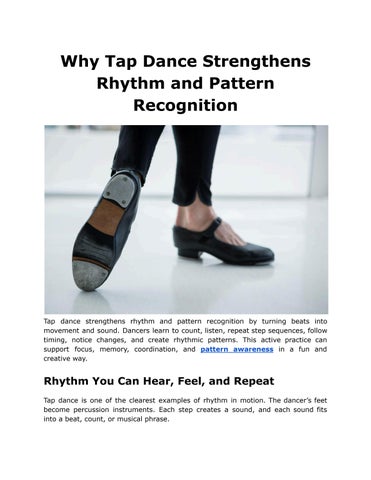
Rhythm You Can Hear, Feel, and Repeat Tap dance is one of the clearest examples of rhythm in motion. The dancer’s feet become percussion instruments. Each step creates a sound, and each sound fits into a beat, count, or musical phrase.
For students and beginners, tap dance is a powerful way to understand patterns. A dancer does not only hear rhythm. They feel it through the body, repeat it with the feet, and shape it into short combinations. Tap dance can help students notice what repeats, what changes, and what comes next. This article explains how tap supports rhythm and pattern recognition through counting, sequencing, listening, memory, coordination, and creative practice.
What Pattern Recognition Means Pattern recognition means noticing repeated structures or relationships. A pattern can happen in music, numbers, words, shapes, movements, or sounds. In tap dance, patterns often appear as repeated rhythms, step orders, counts, or sound combinations. A dancer may notice that a phrase repeats every eight counts, that a step starts on the same beat, or that a rhythm changes after a pause.
Simple Pattern Examples Tap patterns can begin in very simple ways: ● ● ● ●
Step, step, pause, step Right, left, right, hold Slow, quick, quick, slow Count 1, 2, 3, 4, then repeat
These patterns become easier to understand when students clap them, count them, and tap them with their feet.
Tap Dance Turns Feet into Percussion Tap dance differs from many movement activities in that it creates sound. This sound gives dancers clear feedback.
Sound Makes Rhythm Concrete When dancers tap, they can hear if the sound is even, late, early, rushed, or missing. This helps them understand timing directly. For example, if a dancer practices a shuffle and one sound is too quiet, they can hear the difference. If a ball change lands too soon, the rhythm may feel crowded. This sound feedback helps students adjust.
Movement Makes Patterns Active Tap dance also makes patterns physical. Students do not only read or listen to music. They move the pattern with the body. This can make learning feel more active and memorable. A student may remember a rhythm because they remember the feeling of the step, the sound of the tap, and the count that goes with it.
Counting Builds a Clear Rhythm Map Counting is one of the most useful tools in tap dance. It helps students know where each sound belongs.
Beats and Counts A beginner may start by stepping on simple counts: 1, 2, 3, 4 Later, the dancer may add sounds between the counts: 1 and 2 and 3 and 4 This teaches students that rhythm has structure. There are main beats, spaces between beats, pauses, accents, and repeated phrases.
Eight-Count Patterns Many dance combinations are taught in eight-count phrases. This gives students a clear frame for memory and movement. For example, a teacher may teach four counts of shuffles and four counts of flaps. The student learns how one short pattern fits inside a larger phrase. Repeated eight-count patterns help dancers predict where the next step should happen. This prediction is a key part of pattern recognition.
Repetition Helps Patterns Become Familiar Repetition is central to tap training. Students repeat steps and rhythms until they can hear and feel the pattern more clearly.
Repeating Steps with Purpose A dancer may practice shuffles, flaps, or ball changes many times. At first, the focus may be on making the step correctly. Later, the dancer begins to notice sound quality, timing, and rhythm. A repeated shuffle creates a two-sound pattern. A repeated flap creates another two-sound pattern with a change in weight. These simple steps teach students how repeated sounds can form rhythm.
Repetition Builds Memory Repeated practice can help students remember both the movement and the sound. A tap phrase becomes easier when the dancer recognizes smaller parts inside it. Instead of thinking, “This whole combination is hard,” the student can think, “This is a shuffle pattern, then a flap pattern, then a ball change.” Breaking movement into patterns makes learning more manageable.
Sequencing Teaches Order and Structure Tap dance depends on the sequence. Steps must happen in the right order to create the correct rhythm.
Why Order Matters A short tap sequence might include: ● ● ● ●
Shuffle Step Flap Ball change
If the dancer changes the order, the rhythm changes. This teaches students that each part has a place. Sequencing helps students understand beginning, middle, and end. It also helps them follow directions, remember combinations, and connect one movement to the next.
Building Longer Combinations
Teachers often build tap combinations in small sections. Students may learn two counts first, then four counts, then a full eight-count phrase. This step-by-step approach helps students see how small patterns combine into larger patterns. It also builds patience and focus.
Listening Skills Strengthen Rhythm Awareness Tap dance requires careful listening. Dancers listen to music, teachers, classmates, and their own feet.
Hearing Repetition and Change Pattern recognition is not only about finding what repeats. It is also about hearing what changes. A teacher may tap a rhythm, repeat it, then change one sound. Students must listen closely to notice the change. Was the pause longer? Did the rhythm speed up? Did the accent move? This kind of listening helps dancers become more aware of detail.
Call-and-Response Practice Call-and-response is a useful tap exercise. The teacher taps a short rhythm, and students repeat it. This builds listening, memory, timing, and pattern awareness. Students must hear the rhythm, hold it in mind, and recreate it with the feet. Call-and-response can also be playful. Students may answer with the same rhythm or create a simple variation.
Tap Steps Show Rhythm Patterns Clearly Many tap steps are built from clear sound patterns. These steps become building blocks for rhythm and learning.
Shuffles A shuffle has two brushing sounds. The foot brushes forward and back. This simple pattern helps students practice timing, control, and sound clarity.
Flaps A flap has two sounds: a brush and a step. It also includes a weight change. This helps students connect sound, movement, and balance.
Ball Changes A ball change shifts weight from one foot to another. It is often used to connect steps. It helps students feel how movement moves through time.
Cramp Rolls A cramp roll has several sounds in a set order. Students must place the sounds clearly. This supports sequencing and coordination.
Paradiddles Paradiddles use a set sound order that requires control. They help dancers practice rhythm, foot placement, and memory.
Time Steps Time steps are classic tap patterns. They repeat in a structured way, helping dancers understand musical phrasing. Learning a time step can help students hear how a rhythm returns and builds.
Coordination Connects Sound, Movement, and Thought Tap dance asks the brain and body to work together. Dancers must listen, count, balance, shift weight, and make sounds at the same time.
Coordinating the Feet A student may understand the rhythm but needs practice to perform it. The right foot and left foot may have different roles. The dancer must know which foot moves, when it moves, and how much weight it carries. This builds body awareness and focus.
Coordinating with Music
Tap dancers also learn to stay with the music. They must match steps to the beat, respond to tempo, and recognize phrase changes. This can help students understand rhythm as organized rather than random. Music becomes a guide for movement and pattern.
Memory Grows Through Short Tap Phrases Tap combinations help students build memory in small, useful pieces.
Movement Memory With practice, the body begins to remember steps. A dancer may no longer need to think through every detail of a shuffle or flap. This allows more focus on timing and expression. This is often called muscle memory. It means the body becomes more familiar with a repeated action through practice.
Sound Memory Tap also builds sound memory. A student may remember how a rhythm sounds before remembering the names of every step. The sound can guide the movement. This makes tap a strong link between listening and physical learning.
Improvisation Builds Creative Pattern Thinking Improvisation means making rhythms or movements in the moment. In tap dance, improvisation helps students create patterns rather than merely copy them.
Creating Within a Beat A dancer may begin with a simple beat and add sounds. They might repeat a shuffle, add a pause, switch feet, or change the rhythm. This helps students understand how patterns can be built, changed, and repeated.
Thinking While Moving
Improvisation also encourages focus. Students must listen, choose steps, stay on beat, and respond to the rhythm. This can make tap dance feel both creative and challenging. It teaches students that patterns are not only something to memorize. They can also be created.
Practical Ways Through Tap
to Support Pattern Learning
Parents, teachers, and students can support rhythm and pattern skills with simple habits. Helpful ideas include: ● ● ● ● ● ● ● ●
Count out loud before adding speed Clap the rhythm before tapping it Practice short patterns on both feet Break long combinations into small sections Listen for even spacing between sounds Repeat eight-count phrases slowly Use call-and-response games Notice when a step or rhythm repeats
Students who have learning challenges, coordination concerns, or developmental needs may need extra support. Families can speak with qualified dance teachers, educators, or healthcare professionals for guidance when needed.
Tap Dance Builds Rhythm Awareness Through Play
and
Pattern
Tap dance strengthens rhythm and pattern recognition by turning sound, movement, and timing into active learning. Students learn to hear beats, count phrases, repeat step sequences, notice changes, coordinate the body, and create rhythms of their own. These skills may support focus, memory, coordination, and pattern awareness. Results can vary by student, but tap offers a clear and enjoyable way to practice rhythm-based learning.
For parents, teachers, and dancers, tap dance is both an art form and a playful learning experience. With steady practice and good instruction, students can build stronger rhythm, sharper listening, and greater confidence in recognizing patterns.
FAQ How does tap dance strengthen pattern recognition? Tap dance strengthens pattern recognition by helping students hear, count, repeat, remember, and create rhythmic step patterns.
Why is rhythm important in tap dance? Rhythm gives tap dance structure. It helps dancers place sounds on beats, follow timing, and understand musical patterns.
What tap steps help build pattern skills? Shuffles, flaps, ball changes, cramp rolls, paradiddles, and time steps can help students practice repeated sounds and sequences.
Can tap dance support focus and memory? Tap dance may support focus and memory by combining listening, counting, movement, and repetition. Benefits can vary by student.
How can beginners practice tap patterns? Beginners can start by clapping rhythms, counting out loud, practicing slowly, repeating short phrases, and learning simple steps on both feet.