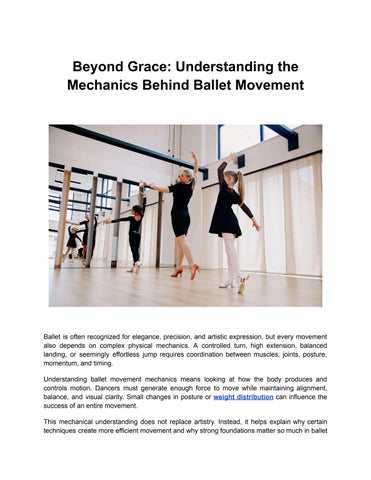
Beyond Grace: Understanding the Mechanics Behind Ballet Movement
Ballet is often recognized for elegance, precision, and artistic expression, but every movement also depends on complex physical mechanics. A controlled turn, high extension, balanced landing, or seemingly effortless jump requires coordination between muscles, joints, posture, momentum, and timing. Understanding ballet movement mechanics means looking at how the body produces and controls motion. Dancers must generate enough force to move while maintaining alignment, balance, and visual clarity. Small changes in posture or weight distribution can influence the success of an entire movement. This mechanical understanding does not replace artistry. Instead, it helps explain why certain techniques create more efficient movement and why strong foundations matter so much in ballet
training. The body becomes both the instrument and the system responsible for producing the performance.
Alignment Creates the Foundation for Movement Alignment is one of the most important elements of ballet technique. The position of the head, shoulders, spine, pelvis, knees, ankles, and feet influences how efficiently force travels through the body. When the body is well aligned, muscles and joints can work together more effectively. Poor alignment can create unnecessary tension and make movements harder to control. For example, if the pelvis is positioned incorrectly, a dancer may compensate through the lower back, knees, or feet. Alignment is especially important during movements that require balance. A dancer standing on one leg must organize the body around a relatively small base of support. Maintaining proper positioning allows the dancer to remain stable while moving the arms, torso, or free leg. Strong alignment therefore supports both technical accuracy and efficiency.
Balance Depends on the Center of Mass Balance in ballet is closely connected to the body's center of mass. To remain stable, a dancer must keep the center of mass positioned appropriately over the base of support. The challenge changes depending on the movement. Standing on two feet provides a relatively wide base. Rising onto demi-pointe or pointe reduces that base significantly. Balancing on one foot reduces it even further. Dancers constantly make small adjustments to maintain stability. Muscles around the ankles, legs, hips, and torso respond to changes in position. These corrections may be almost invisible to the audience, but they are essential to controlled movement. Good balance is therefore not simply the ability to remain still. It is the ability to manage continuous movement while keeping the body organized.
Turnout Requires Coordinated Joint Action Turnout is a defining feature of classical ballet. It refers to the outward rotation of the legs and influences many positions and movements. Effective turnout begins primarily at the hip joints. When dancers attempt to create additional turnout by twisting the knees or feet beyond what the hips can support, alignment can become less efficient.
The mechanics of turnout require coordination between the hips, thighs, knees, ankles, and feet. The goal is not simply to point the toes outward. The entire leg must work as a connected structure. Strong technique uses available hip rotation while maintaining control through the knees and feet. This creates greater stability during pliés, jumps, turns, and traveling movements.
The Role of the Core in Stability The core plays a major role in ballet movement mechanics because it helps stabilize the torso while the arms and legs move. Core control does not mean holding the body rigidly. Ballet requires both stability and mobility. The torso must remain organized while still allowing rotation, extension, and expressive movement. Strong abdominal and back muscles help control the pelvis and spine. This becomes particularly important during balances, turns, extensions, and jumps. For example, when lifting one leg into an extension, the body must resist unnecessary movement in the pelvis and supporting side. Without enough core control, the dancer may compensate by leaning, twisting, or arching. A stable center allows movement to appear cleaner and more deliberate.
Plié Helps Manage Force The plié is one of the most fundamental movements in ballet because it helps dancers generate and absorb force. When a dancer bends the knees before a jump, the body prepares to push against the floor. The legs then extend, creating the force needed to leave the ground. The plié also plays an important role during landing. Instead of allowing the body to stop suddenly, bending the knees helps absorb the force of returning to the floor. This makes the movement smoother and more controlled. Because jumps begin and end through this bending action, proper alignment during plié is essential. The knees, ankles, and feet need to work together while the torso remains supported. A strong plié is therefore not only a basic exercise. It is a mechanical foundation for many larger ballet movements.
Jumps Combine Force and Control Ballet jumps often appear light, but they require powerful coordination. The dancer must push against the floor with enough force to lift the body upward. The hips, knees, ankles, and feet contribute to this action through coordinated extension. Once airborne, the dancer must control the position of the legs, arms, and torso while preparing for the landing. Landing mechanics are just as important as takeoff. The feet make contact with the floor, followed by controlled bending through the ankles, knees, and hips. This helps distribute force instead of allowing it to concentrate suddenly in one area. Efficient jumping therefore combines strength, timing, alignment, and controlled force absorption.
Turns Depend on Momentum and Position Turns such as pirouettes involve both balance and rotational momentum. A dancer begins by generating rotation through coordinated movement of the body. Once the turn begins, body position affects how that rotation continues. Keeping the body organized around a vertical axis helps create a cleaner turn. If the torso shifts away from that axis, balance can become more difficult to maintain. The position of the arms and working leg also influences rotation. Bringing parts of the body closer to the center can help maintain rotational speed, while uncontrolled movement away from the center may disturb stability. Spotting—the quick movement of the head during turning—also supports orientation and helps dancers maintain a consistent direction. Successful turning therefore depends on timing, alignment, momentum, and balance working together.
Foot and Ankle Mechanics Support Precision The feet are among the most important contact points between the dancer and the floor. They contribute to balance, propulsion, landing, and directional control.
Ballet technique often requires dancers to move through the entire foot rather than treating it as one rigid structure. During relevé, jumps, and traveling steps, the foot helps transfer force between the body and the floor. The ankles also contribute to stability. Small adjustments around the ankle help dancers maintain balance, particularly during pointe work or single-leg positions. Strong foot mechanics can make movement appear smoother because force is transferred gradually rather than abruptly. Control through the feet and ankles therefore supports both technical precision and visual quality.
Coordination Produces Fluid Movement Ballet movements rarely involve one body part acting alone. Arms, legs, head, torso, and eyes often need to move in carefully coordinated patterns. This coordination creates the appearance of fluidity. For example, a traveling step may require the legs to generate movement while the arms shape the line of the body and the head directs focus. If these elements occur at different times, the movement may appear disconnected. Strong dancers develop the ability to coordinate multiple actions without making the effort visible. This requires repetition and precise timing. Movement mechanics therefore include not only strength and balance but also the sequencing of actions throughout the body.
Flexibility Must Work With Strength Flexibility is important in ballet, but flexibility alone does not create strong technique. A dancer may be able to move a leg through a large range of motion, but maintaining that position requires muscular control. Without strength, flexibility may be difficult to use safely or consistently. The most effective ballet movement combines mobility with stability. Joints need enough range to achieve the required positions, while muscles need enough strength to control those positions. This balance becomes especially important in extensions, arabesques, développés, and other movements requiring large ranges of motion.
Control is what turns flexibility into usable technique.
Efficient Movement Reduces Unnecessary Tension Ballet technique often aims to create maximum control without unnecessary muscular tension. Excess tension can restrict movement, reduce speed, and make transitions appear stiff. It can also increase fatigue. Efficient dancers learn which muscles need to work strongly and which should remain more relaxed. This selective control allows movement to appear lighter and more natural. For example, maintaining stability through the torso does not require tightening every muscle in the upper body. The shoulders and arms still need freedom to move expressively. Mechanical efficiency therefore depends on using enough muscular effort to control movement without creating resistance against the movement itself.
Repetition Builds Neuromuscular Control Ballet training relies heavily on repetition because movement patterns become more efficient through practice. When dancers repeatedly perform positions and combinations, the nervous system becomes better at coordinating the required muscles. Over time, movements that initially require conscious attention can become more automatic. This allows experienced dancers to focus more on musicality, expression, and performance quality while maintaining technical control. Repetition also helps improve timing. The body learns when to generate force, when to stabilize, and when to release movement. Strong technique is therefore partly the result of developing highly organized movement patterns through consistent practice.
Mechanics Support Artistic Expression Ballet is not performed simply to demonstrate physical efficiency. Its purpose also includes communication and expression. Strong mechanics make that expression more possible.
A dancer who can balance securely has greater freedom to shape an upper-body line. A dancer who controls landing forces can make a jump appear soft. A dancer with coordinated turning mechanics can focus on musical timing and performance rather than struggling to remain upright. Technique creates freedom because it gives dancers more control over how movement is presented. The audience may see grace, emotion, and ease. Beneath that appearance is a complex system of physical coordination.
Understanding Ballet as a Complete Movement System Ballet movement mechanics demonstrate how closely connected the body is during performance. Alignment influences balance. Balance affects turns. Core stability supports extensions. Plié prepares jumps. The feet transfer force, while coordination connects individual actions into complete movement. No single part of the body works independently. This is why strong ballet training emphasizes foundations repeatedly. Small improvements in posture, balance, timing, or force control can influence many other movements. Understanding mechanics also helps explain why technically strong ballet can appear effortless. The dancer is not avoiding physical work. Instead, the body is organizing that work efficiently. Ballet ultimately combines physics, anatomy, coordination, and artistic intention. The beauty of the movement comes partly from the dancer's ability to manage complex physical demands while making those demands almost invisible.
FAQ What are ballet movement mechanics? Ballet movement mechanics describe how the body uses joints, muscles, balance, force, alignment, momentum, and coordination to perform ballet movements.
Why is alignment important in ballet? Alignment helps distribute force efficiently, maintain balance, and reduce unnecessary compensation during movements.
How does plié help with jumping?
Plié prepares the legs to generate force for takeoff and helps absorb force during landing.
Why is core strength important for ballet dancers? Core strength helps stabilize the pelvis and spine while allowing the arms and legs to move with greater control.
Is flexibility enough for good ballet technique? No. Ballet requires flexibility combined with strength, stability, coordination, and control so dancers can safely use their available range of motion.