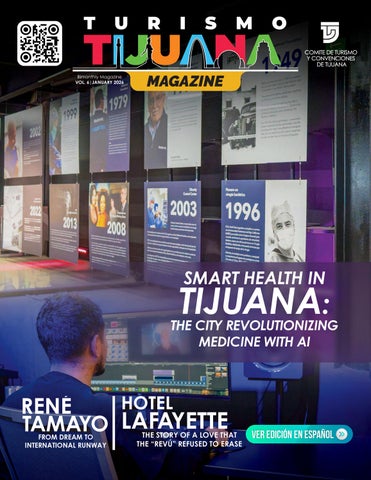
Bimonthly Magazine VOL. 6|JANUARY 2026
cotucotijuana.com
1
C ONT ENIDO Orgullo de nuestra región. Marcas Centenarias en Tijuana ...............................................................pág. 4 Tijuana: De ciudad fronteriza a hub tecnológico global ...............................................................pág. 10 Bacalao a la vizcaína: El sabor que une generaciones
CRÉDITOS COMITÉ EDITORIAL: Mtra. Melissa Pacheco Silveyra Ana Alicia Meneses Martínez Lic. Gabriel Camarena Salinas FUENTE EDITORIAL: Lic. Alma Sofía Villalobos Ruiz. DISEÑO EDITORIAL Y EDICIÓN: David Carrizales Hernández REDACCIÓN Y CORRECCIÓN DE ESTILO: Myrna Sánchez
Tamales, fe y memoria: La escencia del día de la candelaria
7
René Tamayo: Del sueño a la pasarela internacional
...............................................................pág. 14 Telefónica y El Punto referentes del modelo gastro park en Tijuana ...............................................................pág. 16 La inteligencia artificial: El nuevo aliado del turismo moderno. ...............................................................pág. 22 Calibaja: Un motor económico binacional conproyección global
FOTOGRAFÍA: Cristian Cruz Brian Rosales
...............................................................pág. 24
Revista Bimestral Volumen 6
...............................................................pág. 27
© Derechos Reservados Comité de Turismo y Convenciones del Municipio de Tijuana, Estado de Baja California.
...............................................................pág. 34
Manifestaciones bucales del Síndrome Metabólico
pág.
19 Hotel Lafayette: La historia de un amor que La “Revú” se negó a borrar
pág.
29
Entre señas y café: Un Place para la inclusión
Tijuana, destino inclusivo: Cuando la diversidad se convierte en oportunidad
Próximos Events ...............................................................pág. 38
cotucotijuana.com
pág.
...............................................................pág. 12
...............................................................pág. 36
2
Salud inteligente en Tijuana: La ciudad que revoluciona la medicina con IA
El Secreto de Guillermo: Donde la moda encuentra un segundo hogar
pág.
31
DEAR READER: We enthusiastically begin 2026, with Tijuana, the most important border city in Mexico, preparing to offer its best and warmly welcome every tourist who visits us.
congestion of driving through part of the city. It’s worth noting that this overpass represents one of the most important infrastructure projects of the last decade.
Without a doubt, we are certain that 2026 will bring great surprises for our region.
In this edition, readers will have the opportunity to continue learning about Tijuana’s history. This time, we describe companies that were once part of our city’s growth but no longer exist.
In terms of gastronomy, Tijuana has positioned itself as one of the top destinations. Every year, new culinary offerings have emerged, delighting both locals and foreigners. We are confident that 2026 will be no exception, and we will discover new gastronomic options for all tastes. Medical science advances daily, and with it, healthcare professionals—doctors, dentists, hospitals, and the entire value chain—acquire new technologies that make disease detection and treatment more precise, resulting in high-quality care for both locals and those who visit us for medical or health tourism. The advancement of artificial intelligence in the healthcare sector is becoming increasingly commonplace. In terms of infrastructure, the modernization of Tijuana’s airport continues to grow, currently making it the second most connected airport in the country. Furthermore, the completion of the overpass connecting the airport’s access roads to Tijuana’s beach area is planned for this year. This overpass will allow people traveling to southern Tijuana to avoid the traffic
You will also learn about the life of René Tamayo, considered one of Tijuana’s most important talent creators in the fashion world. In this sector, Tijuana has given rise to a great number of talents who have had the opportunity to represent us internationally. In our gastronomy sections, you’ll find Marco Antonio Pérez’s perspective, who will offer tips on how to prepare exquisite cod. Meanwhile, Chef Martín Muñoz will explain the significance of the tamale and its role in Mexican culture. Without a doubt, readers will find interesting information and, above all, learn a little more about the city of Tijuana.
Tijuana awaits you with open arms, live the Tijuana experience.!
cotucotijuana.com
3
Imagen 1. Bazaar Mexicano (1886). Fuente: Arreglada por David Marrón
PRIDE OF OUR REGION. CENTENNIAL BRANDS IN TIJUANA By Araceli Almaraz – El Colegio de la Frontera Norte (El Colef)
Imagen 2. Big Curio Store (1887). Fuente: Arreglada por David Marrón.
4
cotucotijuana.com
T
ijuana’s productive development began steadily in the last quarter of the 19th century. Among the first businesses established in the town were the Bazaar Mexicano, owned by Alejandro Savín (1886), and Jorge Ibs’s curiosity shop, known as the Big Curio Store (1887). Both establishments were located on the same sidewalk (images 1 and 2), across from what was then the Hotel Paris. The sale of Mexican curiosities has stood the test of time. This activity is closely linked to tourism, which has historically been present in Tijuana. With a history spanning approximately 140 years, there are still businesses dedicated to selling these types of products. The longest-running store currently in operation is Mexico Curios, owned by Héctor Santillán. The store has been open since 1952, when a young Héctor started as an employee and later became the owner. Another iconic brand and source is Bodegas Santo Tomás. Although its origins date back to 1888, on the Los Dolores ranch in Ensenada, its historical development and consolidation are deeply linked to the restaurants, casinos, and bars of Tijuana. In the beginning, Spaniards Francisco Andonaegui and Miguel Ormart produced wine that they sold in Ensenada. Later, when General Abelardo L. Rodríguez took over the business in 1931, significant changes were introduced that contributed to the brand’s positioning in the region. The first significant change was the hiring of winemaker Esteban Ferro (image 3), a young man who had recently arrived in
Imagen 4. Trabajadores de la Misión de Santo Tomás. Fuente: Archivo de la familia Ferro
Mexico from Asti, in the Piedmont region of northwestern Italy. Ferro had the confidence of General Rodríguez and revamped the wines of the Misión de Santo Tomás (image 4). Aida Ferro, the winemaker’s daughter, recalls that her father was a pioneer in the region, passing on his winemaking knowledge and taking advantage of the natural conditions of the territory. A second change promoted by the Rodríguez and Ferro administration was the incorporation of technology for bottling wine, which allowed them to modernize production processes and become the first winery in the region to sell bottled wine, in addition to continuing bulk sales. Esteban Ferro’s legacy was continued by subsequent generations of owners and winemakers. With 137 years of history, Bodegas Santo Tomás is today a key reference for regional and national winemaking. On July 4, 2024, an unprecedented event took place in Tijuana: the commemoration of 100 years of the Caesar Salad. This gastronomic brand represents Tijuana’s pride in the legacy and continuity of a recipe that is part of the local identity.
Imagen 3. Esteban Ferro, enólogo. Fuente: Archivo de la familia Ferro. cotucotijuana.com
5
Three generations make up the legacy of Laboratorios Gamboa, a local brand that celebrated 100 years of activity in 2024 (image 7). The original business was Farmacia Gamboa, where pills were manufactured and clinical laboratory services were offered for the first time in the city. Imagen 5. Registro temprano donde se ofreció la Ensalada Caesar. Fuente: Armando Avakian.
The precursor was Caesar Cardini (1896– 1956), who was 20 years old when he first arrived in Tijuana. Together with Max Pozzo, he formally registered a temporary joint venture in 1927, the year in which both embarked on new projects. However, the origin of the Caesar Salad dates back to 1924, when it was already being served in a restaurant in the city (image 5). In 1931, Caesar Cardini opened a hotel on what is now Avenida Revolución—then Calle Libertad. The menu at the Caesar Place Hotel restaurant included the original recipe for what is now an iconic salad.
Imagen 6. Caesar’s Restaurante administrado por la familia Plascencia. Fuente: San Diego Union-Tribune.
In 1945, Cardini sold the property to Kisag Avakian Aramian, ushering in a new era that preserved Cardini’s legacy and continues to this day in the hands of the Avakian family. As contemporary guardians of the recipe, it is also essential to mention the Plascencia family (image 6).
6
cotucotijuana.com
Federico Gamboa Elías (image 8) represents the link between the founding generation and that of his sons. Inspired by the career of his father, who had been a pharmacist, Federico decided to study for a degree in Pharmaceutical Chemistry at the National Autonomous University of Mexico. He graduated in 1968 and, after working at Roche, an international laboratory, he chose to continue the family legacy in Tijuana.
With more than a century of history, Laboratorios Gamboa continues to have a positive impact on the health of the Tijuana population. It currently has 14 branches in the city, all with high-tech equipment, and performs around 100,000 studies per year. These century-old brands are symbols of our region, filling us with pride and giving us our identity.
SMART HEALTH IN TIJUANA:
THE CITY REVOLUTIONIZING MEDICINE WITH AI
Byr Lorena Arellano
T
ijuana, internationally recognized as a leading medical tourism destination, continues to be at the forefront, maintaining this distinction thanks to the excellent training of its healthcare professionals, their ongoing professional development, and the use of modern, state-of-the-art medical infrastructure, offering high-quality services to both local patients and visitors. Opportunities to further strengthen this recognition are being seized, especially in emerging areas such as artificial intelligence (AI), which offers countless application possibilities, noted Dr. Ariel Ortiz Lagardere, general surgeon, bariatric specialist, president of the International Institute of Metabolic Medicine, and medical director of Cyntar Tijuana Hospital.
STREAMLINING PROCESSES AND EDUCATING PATIENTS The specialist explained that AI “concentrates all technological advances and compresses them into a platform that literally thinks for itself,” although it requires training or “education” to solve problems in seconds that previously demanded time, personnel, and resources: “Artificial intelligence is already an integral part of modern life, but no sector is experiencing such an accelerated and profound transformation as healthcare.
What once seemed like science fiction— diagnoses assisted by algorithms, surgeries guided by computer vision, predictive patient analysis, and data-driven surgical education—is now an everyday reality.
“Tijuana, recognized for its dynamism, talent, and leadership in medical tourism, is in a privileged position to become one of the most important smart healthcare epicenters in the Cali Baja region,” he added.
cotucotijuana.com
7
FAST, ACCURATE, AND ACCESSIBLE DIAGNOSTICS AI, he added, not only accelerates processes but completely transforms how diseases are diagnosed. Algorithms can analyze thousands of studies, images, or clinical variables in seconds and detect patterns that would take the human eye much longer to identify.
AI, with access to the same information, resolved it in just 3 seconds, even proposing a treatment and follow-up plan based on the latest medical evidence. Areas of medicine where it is currently applied: Oncology: early detection of millimetersized tumors.
As an example, he recalled an international panel in which several highly qualified specialists analyzed a complex clinical case. It took them 13 minutes to reach a diagnostic and therapeutic conclusion.
Endoscopy: systems that identify lesions in real time. Cardiology: algorithms that predict arrhythmias before they appear clinically. Metabolic disease: models that predict decompensation in diabetes.
He also mentioned that there are specialized platforms integrated into systems that have been in use for decades, which have been enhanced with technology to accelerate diagnoses, interpret studies, define treatment plans, and improve postoperative management: “These platforms not only make diagnoses, but situational diagnoses of all kinds, including the efficiency of a hospital, an administrative system, supplies, and expenditures. It’s impressive what AI is saving us in time and staff burnout,” he stated .
8
cotucotijuana.com
AI BENEFITS FOR PATIENTS AND MEDICAL STAFF Among the benefits for patients, he explained that, through interaction with these tools, people receive immediate diagnostic certainty. In this sense, he clarified that AI does not replace the doctor, but rather complements them by preparing the patient before their in-person appointment.
AI: MAKING MEDICINE MORE HUMANE Ortiz Lagardere commented that, far from distancing the doctor from the patient, AI allows the professional to reconnect with what is truly important: listening, explaining, and supporting. Furthermore, it can help draft clinical notes while the doctor talks with the patient, adapting the communication and providing personalized educational material
On the other hand, AI helps doctors reduce their workload by recording medical records directly in the cloud:
“Medical errors are the third leading cause of death in the United States, and this significantly reduces them because the digital platform doesn’t make mistakes,” he stated.
cotucotijuana.com
9
FROM BORDER CITY TO GLOBAL TECHNOLOGY HUB
A
By Lorena Arellano
city in constant motion and evolution, undergoing a technological transformation: that’s Tijuana. Historically known as a manufacturing border city, Tijuana has been consolidating itself as a global technology hub, thanks to several factors, including: the growth of the local startup ecosystem, the arrival of international technology companies, binational collaboration with San Diego, and the young, creative talent driving this change. Among this community of young creatives and entrepreneurs is Daniel Alcántara García, who serves as operations director at the software development company ArkusNexus.In his opinion, the city’s technological growth has intensified over
10
cotucotijuana.com
the last 15 years, allowing the region to develop in sectors such as gastronomy, tourism, and its own infrastructure. This progress, he added, has been made possible thanks to collaboration with the United States, a country from which customs and business models have been adopted, thus opening new opportunities for Tijuana’s technological growth. Daniel believes that Tijuana’s transition to an innovation hub is largely due to the excellent educational level of its professionals and the phenomenon of migration, which has allowed the city to “adopt” talent from various countries: “Tijuana is becoming a very broad technological community, with a specific purpose: to target global markets,” he stated.
THE ROLE OF STARTUPS IN TECHNOLOGICAL GROWTH Newly created companies based on information and communication technologies, known as startups, are fundamental to economic development, Daniel pointed out. These companies represent the raw material of the growth the city is experiencing and are attractive to all types of investment: “At ArkusNexus, we have worked for 23 years with many startups that are now established companies. The fact that startups from the United States and Mexico are seeking agencies in the region to develop versions of their products attracts even more market share,” he said.
SAN DIEGO AND ITS INFLUENCE When discussing how the proximity to San Diego impacts the region’s technological development, he pointed out that the relationship between the two cities is strengthened by several factors: “The United States seeks to streamline its costs and always looks to the southern border to reduce labor costs. This opens the door to providing them with services and allows the Tijuana market to grow.”
He also mentioned that there are binational projects involving startups from Tijuana and San Diego, promoting the training of professionals from both regions in areas that strengthen the technology hub.
FROM TIJUANA TO THE WORLD Daniel emphasized that software technology has applications in virtually every field and that many of the components used globally are developed by Mexicans. Particularly in Tijuana, work is being done in diverse sectors, and technological applications are being created that are often unknown to the public. He cited the maquiladora industry as an example, which uses systems that generally come from development centers in Tijuana or other parts of the country. Finally, Daniel defined Tijuana as a city that no longer just manufactures or exports, but thinks, designs, creates, and generates technology for the world.
cotucotijuana.com
11
BACALAO A LA VIZCAÍNA:
THE FLAVOR THAT UNITES GENERATIONS
By: Lorena Zamora Arellano
Passionate about cooking, that’s how Marco Antonio Pérez Ruiz defines himself. From a very young age, he discovered his love for gastronomy, growing up surrounded by the aromas and flavors of the dishes his grandmother and mother prepared. That passion led him to enter the kitchen when he was just five or six years old, when he began preparing breakfast for his parents and siblings. Over time, he became a restaurateur for 16 years and was one of the pioneers of Japanese cuisine in Tijuana. Later, he opened a fine Mexican restaurant, a seafood restaurant, and even a taqueria.
12
cotucotijuana.com
Although he no longer cooks professionally, his connection to the kitchen remains intact and has become a way for him to express love for his family and friends. As a cook at heart, he enjoys experimenting, mixing ingredients, and daring to create new flavors to delight the palates of his loved ones. However, there is one dish that holds a special meaning for him: a recipe that has been in his family for over 50 years and that he learned to prepare alongside his recently deceased mother. It is bacalao a la vizcaína (Basque-style cod).
A CULINARY TRADITION INHERITED
PREPARING A GOOD COD
This dish, one of the most traditional in Basque cuisine, is a cherished legacy that Marco Antonio Pérez Ruiz preserves from his mother and prepares every Christmas season.
This cooking enthusiast likes to share some tips for preparing this traditional dish. The first, he assures, is to select a good quality fish, such as Norwegian cod.
“Bacalao a la Vizcaína is a recipe my mother used to make. She passed away a few months ago, and she always prepared it on December 25th, Christmas Day. On that day, we would all gather to eat: her brothers, sisters, nephews, and immediate family.
Parsley, onion, garlic, tomato, baby potatoes, olives, capers, smoked bell peppers, and olive oil are some of the ingredients he uses in his preparation.
It’s a recipe that’s over 50 years old. My mother told me that a very good friend of hers, who was Spanish, shared it with her. At home, it’s a tradition to prepare cod every December 25th. For many years—I think about 20, maybe more—I helped her in the kitchen. I was her sous-chef, her assistant,” he said. For him, continuing this culinary legacy is a way to honor his mother’s memory, to cook with nostalgia, love, and patience.
A DISH THAT REQUIRES PATIENCE Preparing this dish isn’t a quick process: it requires time and patience, something Marco Antonio understands perfectly. For him, cooking it becomes an opportunity to chat, spend time with those around him, and even enjoy a glass of wine.
“The first thing I do is cut the cod into large chunks, about the size of my hand; I cut it into four or five pieces. Then I put it in clean, fresh water for three or four hours; I drain the water, add fresh water, and repeat this process about five or six times. It practically spends a whole day in water to desalinate it and ensure the salt level is right before I start cooking it. I usually look for meatier pieces, with a slightly more pronounced fillet. There are two categories that differ in price: one with bones, which is more economical, and another that comes already cleaned, almost boneless. The preparation takes about 24 hours from desalting to starting the cooking process. The next step is to make a sofrito with all the ingredients and then gradually add the fish, allowing it to cook slowly,” he explained. As a side dish, he recommends mashed potatoes, salad, bread, chilaca peppers, and a good sparkling or red wine.
KEEPING THE MAGIC OF COOKING ALIVE
“I think cod is a dish that requires a lot of patience; you shouldn’t rush it. It takes time, and that’s the key. Anyone who cooks in a hurry, especially this dish, is sure to get a bad result.
Preserving traditions—especially those that evoke childhood memories and the food prepared by grandmothers and mothers—is one of Marco Antonio’s main pieces of advice.
For me, going into the kitchen is about disconnecting from my surroundings, my work, and the daily grind, and dedicating myself to cooking. What I enjoy most is sharing my dishes with the people I love,” he said.
For him, cod à la Vizcaína is the dish that transports him back to his mother’s kitchen, where every bite reminds him of her teachings and the love she instilled in him for gastronomy: “Sometimes difficult times come, crises or family complications, but there’s nothing like being around the kitchen and the table: enjoying ourselves, laughing, and sharing a pleasant moment. Cooking always has that magic of keeping the people you love closest,” he concluded.
cotucotijuana.com
13
TAMALES, FAITH, AND MEMORY:
F
THE ESSENCE OF CANDLEMAS DAY
By: Chef Martín Muñoz
ebruary 2nd in Mexico is no ordinary day. The air is filled with the aroma of cooked masa, banana or corn husks, and the comforting warmth of atole. It is Candlemas Day, a date on which an ancient promise is fulfilled around the table with one of the country’s most important gastronomic treasures: tamales. But why do we eat tamales on this day? How did a religious celebration transform into a culinary festival that unites Latin America and, on the border of Tijuana, acquires a unique sense of identity?
14
cotucotijuana.com
A SYNCRETISM OF TWO WORLDS Candlemas is the result of a profound cultural blending. From the Catholic tradition, it commemorates the Purification of the Virgin Mary and the presentation of the Child Jesus at the temple. From this arose the custom of dressing the Christ Child in special garments and taking him to be blessed, a practice that remains alive in homes and parishes throughout our region. At the same time, the date coincides with the beginning of the pre-Hispanic agricultural cycle. Before the arrival of the Spanish, the indigenous peoples celebrated rituals dedicated to Tláloc, the rain god, and Chalchiuhtlicue, the water goddess, during the first month of the Mexica calendar, Atlcahualo, to bless the seeds and ask for good harvests..
Corn was the sacred element of these offerings. With evangelization, this symbolism was adapted: tamales—made with that same venerated corn—came to be offered in honor of Our Lady of Candelaria, merging beliefs and flavors into a tradition that endures to this day.
This fusion makes Tijuana a culinary destination of excellence, where the culinary roots of all of Mexico are found just steps from the border.
FROM THE ROSCA TO THE TAMALES: THE PROMISE OF JANUARY 6TH
Although Tlaxcala—whose name, Tlaxcallan, means “place of corn bread”—is one of the most emblematic states for this celebration, with its patron saint festivals and grand festivities, the fervor for tamales is experienced with equal enthusiasm in Mexico City, Puebla, Oaxaca, Michoacán, and Jalisco.
The social dynamic is well-known: whoever finds the “little figure” in the Rosca de Reyes (Three Kings’ Bread) on January 6th—a symbol of the Baby Jesus hidden from Herod—becomes a godparent. This discovery is not bad luck, but a blessing that comes with a commitment: to host a tamale party on February 2nd. Thus, the Christmas celebration extends, and family and community ties are strengthened around the table.
Tijuana: A Melting Pot of Flavors on the Border In the Cali-Baja region, this tradition has acquired special significance. Tijuana, a city forged by migrants, doesn’t have just one type of tamale: it has them all. Thanks to the cultural diversity of families from central and southern Mexico, every steamer in Tijuana is a gastronomic map of Mexico:
"
The classics: corn husk tamales with red salsa, rajas con queso (poblano pepper strips with cheese), and sweet tamales filled with pineapple or corn.
"
The classics: tamales wrapped in corn husks with red salsa, rajas con queso (poblano pepper strips with cheese), and sweet tamales filled with pineapple or corn.
"
Border innovation: Tijuana’s cuisine also dares to experiment with contemporary offerings, such as tamales filled with pressed pork rinds, seafood, or sweet versions inspired by popular desserts.
A NATIONAL AND CONTINENTAL CELEBRATION
Corn, however, knows no borders. The tradition also resonates in countries like Guatemala, El Salvador, Colombia, Venezuela, and Spain, each with its own variations and celebrations, confirming that Hispanic heritage and corn unite us as a continent.
WHERE TO EXPERIENCE THE TRADITION IN TIJUANA? In Tijuana, Candlemas Day not only boosts the local economy, supporting hundreds of families and businesses dedicated to making tamales, but also allows new generations—many born on the border—to reconnect with their ancestral roots. One of the must-see events is the Atole and Tamale Fair, organized annually by the Directorate of Indigenous Peoples of the Tijuana City Council, usually in Plaza Bicentenario in the city center. It’s the perfect place to enjoy authentic cuisine, support local businesses, and experience a feast full of flavor and tradition. Whether you prefer a tamale with poblano peppers, an Oaxacan tamale, or a contemporary Tijuana creation, this February 2nd, the place to be is around the table..
Enjoy! And have you had your tamales yet?
cotucotijuana.com
15
TELEFÓNICA AND EL PUNTO LEADING THE GASTRO PARK MODEL IN TIJUANA
By: Elsy Pineda
J
ust over a decade ago, food trucks in Tijuana began to shed their traditional image as lunch counters, evolving into a more ambitious expression of urban gastronomy. Fueled by the city’s culinary boom, young chefs and entrepreneurs began experimenting with new formats, gourmet offerings, and spaces that provided more than just food: a sense of community, identity, and experience. From this transformative moment emerged projects that would mark a turning point in how people eat, meet, and socialize in the city. Among them, Telefónica Gastro Park and El Punto Food Trucks established themselves as two major examples of this concept in Tijuana.
16
cotucotijuana.com
TELEFÓNICA GASTRO PARK: THE PIONEER THAT BECAME A CLASSIC Founded in 2014, Telefónica Gastro Park pioneered the gastro park concept in Tijuana, bringing together diverse culinary offerings under a single vision. From the outset, it has been committed to constant innovation and creating a comprehensive experience. Over the past 11 years, this space has not only remained relevant but has also evolved alongside its clientele, adapting to new trends and expectations.
More than just a gastro park, Telefónica has established itself as an iconic meeting place for gatherings with friends, after-work chats, and casual get-togethers that often stretch into hours. Its success lies in understanding that the experience goes beyond the food: here, the drinks, the music, the service, the ambiance, and the constantly updated facilities all matter, making each visit unique. Furthermore, its facilities reflect the multicultural essence of Tijuana, attracting both locals and international visitors, especially from Southern California. Proof of this is its recent recognition as one of San Diego’s Top 21 restaurants by KPBS, positioning it as an essential culinary destination for those crossing the border in search of authentic experiences. In its culinary offerings, Telefónica brings together a wide variety encompassing Mexican cuisine, seafood, Baja California gastronomy, hamburgers, artisanal hot dogs, Asian and Japanese cuisine, steaks, Mediterranean options, fusion concepts, breakfasts, and a deli featuring regional products. Its beverage selection is one of its greatest distinguishing features, with the Take It Easy bar, its own Lírica brewery, signature cocktails, prepared caguamas (large bottles of beer), and a mocktail bar for those who prefer non-alcoholic options.
Telefónica is open every day from 9:00 a.m., with closing times ranging from 10:00 p.m. to midnight, depending on the day.
cotucotijuana.com
17
EL PUNTO FOOD TRUCKS: IDENTITY, COMMUNITY, AND ENTREPRENEURIAL SPIRIT While Telefónica was pioneering the model, El Punto Food Trucks was establishing itself as the first concept of its kind in the Third Stage of the Río area, a zone that was just beginning to develop. The project was born in late 2014, driven by chef José Humberto Izquierdo Gutiérrez, as a real alternative for recent chef graduates seeking a dignified, permanent, and accessible space to offer unique culinary experiences. From its inception, El Punto aimed to transform the traditional food truck into a more refined format, with tables, service, and concepts that broke with convention. The project grew rapidly, adding other chefs and entrepreneurs until it became, today, a landmark for Tijuana residents and a regular stop for those working in the industrial sector. One of El Punto’s greatest successes has been identifying and catering to a key niche: the manufacturing and office sector, adjusting its hours and operations for those who eat lunch there. This approach has made it a goto spot for engineers, industrial workers, and for foreigners visiting Tijuana for work, without losing its friendly and accessible atmosphere. Currently, El Punto offers a diverse menu that includes chilaquiles and ciabattas with Chidos, sushi and snacks with Clamato, burgers with innovative combinations, gourmet tacos, pizzas and noodles in a fusion style, as well as a beer bar, cocktails, and mocktails. Some of these concepts have grown to expand beyond the restaurant, confirming its role as a culinary incubator.
The restaurant is primarily open from 12:00 p.m. to 7:00 p.m., extending until 9:00 p.m. on Fridays and Saturdays, while Chidos opens at 8:00 a.m. and extends until 1:00 or 2:00 in the morning, maintaining activity even towards the sidewalk and strengthening the nightlife of the place.
TWO SPACES, ONE ESSENCE: EVOLUTION AND EXPERIENCE Telefónica Gastro Park and El Punto Food Trucks represent two key moments in Tijuana’s gastronomic development: one a pioneer that became a classic and a binational benchmark; the other a project that gave identity to an emerging area and created community through entrepreneurship and perseverance. Both share the same vision: understanding that today people are not just looking for a place to eat, but a place to have experiences, connect with others, and create memories. Visiting either of these spaces is to experience the city’s innovative spirit and a gastronomy that, like Tijuana itself, continues to
18
cotucotijuana.com
transform without losing its essence.
RENÉ TAMAYO FROM DREAM TO INTERNATIONAL RUNWAY
By Lorena Arellano
cotucotijuana.com
19
W
hen discussing the fashion industry in Tijuana, it’s impossible not to mention one of the leading figures who has brought national and international recognition to this sector: René Tamayo, director of the Arte Modelos agency and creator of Tijuana Fashion Week by René Tamayo. From a very young age, René was connected to fashion. This love was born from watching his mother—a seamstress by trade—cut fabrics, smelling them, listening to the sound of the scissors, and finally seeing the beautiful designs she created. He believes his passion for fashion is in his DNA, as he inherited from his mother a special sensitivity for identifying textures, colors,
20
cotucotijuana.com
shapes, and lines. Originally from Sonora, he arrived in Tijuana at just 18 years old with a wealth of dreams and aspirations for success. That’s how she enrolled in the Tourism and Marketing program at the Autonomous University of Baja California (UABC). “I’m old school, from when both degrees were combined into a single program. It was a ten-semester program, meaning five years: half Tourism and the other half Marketing. When I started the Marketing semesters, I knew this is for me. I loved public relations, advertising campaigns, market research, conducting interviews, creating graphics, and organizing events,” she shared.
BEGINNINGS OF A SUCCESSFUL PROFESSIONAL LIFE Recalling his beginnings evokes a warm nostalgia in René. He gratefully remembers the experiences that shaped him from his student days and allowed him to connect with influential people, including Ricardo Martínez, Felipe Pavlovich, and Eligio Valencia. Among those memories, his community service at Canirac (National Chamber of the Restaurant and Seasoned Food Industry) and his participation as an advisor to the Tijuana Tourism and Conventions Committee (COTUCO) representing UABC (Autonomous University of Baja California) stand out. This opportunity brought him closer to the organization of important events. “Since I already knew the restaurant owners, it was very easy for me to sell them campaigns for the newspaper El Mexicano or various magazines. They started requesting models from me. Well-established advertising agencies began contacting me and asking, ‘Do you manage the model who appears in that restaurant’s ads?’ And I would say yes. That’s when my focus shifted from advertising to modeling agency, because brands started requesting models, and business grew tremendously,” he recounted.
CONTINUOUS LEARNING Continuous preparation has been key to René Tamayo’s professional success. He recalled that his training began at a young age with courses in Mexico City, Los Angeles, and New York. “Honestly, I’ll never be ashamed to say this: I even sold my car to be able to travel. I thought, ‘Why wouldn’t I go to a convention in New York?’ I went, and to my surprise, one of the models I brought was signed by an agency in Paris. Then came the personality and modeling courses. We started training models with export-quality talent. That, broadly speaking, is how the story of Arte Modelos began. Then came the big events like Fashion Week. I wanted to have my own Fashion Week here, so we submitted all the paperwork to be able to use the name,” he said.
FASHION: A POSITIVE IMAGE FOR TIJUANA In René’s opinion, events like Fashion Week contribute to improving Tijuana’s image both nationally and internationally. “These events put Tijuana on the fashion map. If people had a mistaken idea of the city, this helps
to change it. We even managed to organize model conventions in Tijuana, when before it was almost impossible, because people thought that if you came here, you could be kidnapped. We have managed to eliminate that negative image, not only in Mexico, but in different countries around the world. Agents from Asia, Korea, China, the Philippines, Singapore, Tokyo, Paris, New York, and Mexico City have come with great confidence. Designers also ask us to come and present their collections and models at Fashion Week,” he stated.
SUPPORTING NEW TALENT When asked what it means to be a supporter of local talent, he replies that it’s an honor that new generations look to him as a role model. Today, events like Fashion Week and other projects he pioneered, such as Expo Bodas (Wedding Expo), are being replicated. Over the years, he developed a keen eye for spotting talent in models, designers, photographers, and makeup artists, and he worked to hone it: “Lately—and I don’t know why I didn’t do it before—we’ve been giving awards to designers who started with me and have more than 30 years of experience. No one had recognized them before. Among them are Ivette Alaniz, Jorge Sánchez, Juan de Marcia, the Yanén Institute, with almost six decades of training designers, and Mimy Martínez. All the designers who have presented collections in New York, Paris, Canada, Los Angeles, or Mexico City started here, at Tijuana Fashion Week. I support both emerging and established talent,” he commented. He added that the fashion scene in Tijuana is promising: “Better things are coming. New stores are opening in shopping malls, and designers from other states see Tijuana and Baja California as an untapped market, which fills us with joy.”
UPCOMING PROJECTS One of René Tamayo’s personal projects is to chronicle his life in the fashion world in a book, a project he is already working on. His wish is that, through these pages, those who dedicate themselves to the modeling profession will also be recognized, as it demands discipline, preparation, and effort. For him, one of his greatest dreams is that the work of a model will be seen for what it is: “a profession worthy of reverence.” cotucotijuana.com
21
ARTIFICIAL INTELLIGENCE:
THE NEW ALLY OF MODERN TOURISM By Miguel Ángel Romo
T
he tourism industry is undergoing one of the most profound transformations in its history. Driven by digitalization and technological innovation, artificial intelligence (AI) has become a key tool for improving the traveler experience, optimizing operations, and moving towards more sustainable and intelligent tourism. Artificial intelligence is revolutionizing how we plan and experience our travels. From creating personalized itineraries to real-time language translation, AI-powered tools are making planning more efficient and tailored to individual preferences. Some of the best AI travel planning apps include AskLAYLA, Wonderplan, and others that simplify creating personalized itineraries, adapting to your preferences and budget. These tools offer personalized recommendations and make discovering new destinations more efficient. Today, planning a trip no longer begins at a physical travel agency or requires lengthy internet searches. Thanks to AI, travelers receive recommendations for destinations, hotels, and activities based on their preferences, travel history, and budget. Digital platforms use algorithms capable of anticipating what travelers want even before they request it. Artificial intelligence in tourism is transforming the way we travel, plan, and manage tourism services. Here’s a clear and practical overview: -Personalization: This has raised the expectations of the modern tourist, who seeks unique, efficient experiences adapted to their lifestyle. One of the most visible uses of artificial intelligence in tourism is customer service. Chatbots and virtual assistants operate 24/7, answering questions, managing bookings, and resolving issues in real time and in multiple languages. This not only improves customer satisfaction but also reduces operating costs for tourism businesses.
22
cotucotijuana.com
In hotels, AI enables everything from automated check-in to smart rooms that adjust lighting and temperature according to guest preferences. In airports, computer vision systems streamline security checks and baggage handling, reducing wait times. At the destination level, artificial intelligence contributes to the development of “Smart Destinations”, which are capable of analyzing tourist flows, managing mobility and preventing the saturation of spaces, thus promoting more orderly and sustainable tourism. AI has also revolutionized tourism marketing. By analyzing large volumes of data, companies can better segment their customers, interpret social media opinions, and design more effective campaigns. Even the creation of promotional content is supported by generative AI tools. Despite its benefits, the adoption of artificial intelligence presents significant challenges. Protecting personal data, ensuring transparency in the use of algorithms, and training human capital are fundamental aspects for guaranteeing responsible implementation. AI doesn’t replace the human element, but rather complements it. Personalized service, hospitality, and cultural identity remain at the heart of tourism. Artificial intelligence is not a passing trend, but a structural element of 21st-century tourism. Its proper integration will allow for more memorable, competitive, and sustainable experiences, positioning tourism as an innovative and resilient industry in the face of global challenges. The information presented here is a clear example of how artificial intelligence helps us better understand virtually any topic. This text was generated entirely by this application.
How is AI used in tourism?
1. Customer service
- Chatbots and virtual assistants (24/7) for bookings, changes and questions.
- Personalized responses in multiple languages.
2. Trip Personalization - Recommendations for destinations, hotels and activities according to tastes, budget and previous trips.
- Dynamic offers based on user behavior.
3. Revenue Management
- Automatic price adjustment for hotels, flights and tours based on demand, season and events.
- Occupancy and sales forecasting.
4. Experience at the destination
- Smart tourist guides (AI apps).
- Real-time automatic translation.
- Customized routes and local recommendations.
5. Tourism Marketing
- Advanced customer segmentation.
- Analysis of opinions and reviews on social media.
- Creating more effective campaigns with generative AI. 6. Operations and sustainability - Optimization of resources (energy, cleaning, transport). - Prediction of tourist flows to avoid saturation of destinations.
- Support for sustainable tourism.
Real-world examples:
- Hotels: automatic check-in with facial recognition. - Airports: security and baggage control with artificial vision. - Travel agencies: AI-powered travel planning assistants (like ChatGPT). Straight lines:
- Data protection and privacy.
- Technological dependence.
- Training of tourism staff.
Source: Chat Gpt
cotucotijuana.com
23
CALIBAJA: A BINATIONAL ECONOMIC ENGINE WITH GLOBAL REACH
By: Lorena Arellano Zamora
24
cotucotijuana.com
T
he binational relationship between Tijuana and Southern California is strategic for the region’s economic development and represents a natural competitive advantage that must be strengthened with a strategic vision. This was stated by Roberto Vega Solís, who, during his tenure as president of the Mexican Employers’ Confederation (Coparmex) in Tijuana, prioritized promoting the strengthening of the so-called CaliBaja region. The former president of Coparmex Tijuana is convinced that both sides of the border mutually benefit, given that California is the world’s fifth-largest economy and Baja California is one of the country’s leading manufacturing and export hubs:
“Binational relations in what we call the CaliBaja region are strategic because they form one of the most dynamic and complementary economic ecosystems in the world. This binational relationship is not optional; it is a natural competitive advantage that must be strengthened with a strategic vision. To strengthen this region, it is crucial that we work together to improve and modernize infrastructure, create an efficient border, ensure the smooth flow of labor and goods, guarantee legal certainty, strengthen coordination between governments at the binational level, and share a common vision for economic development and investment,” he stated.
OPPORTUNITIES OF BINATIONAL COLLABORATION Vega Solís, who until last December was president of Coparmex Tijuana, pointed out that binational collaboration allows for the alignment of public policies, the reduction of regulatory frictions, the strengthening of regional supply chains, and the acceleration of innovation processes. He commented that when companies, chambers of commerce, organizations, and academia work together collaboratively, the ideal conditions are created to attract strategic investment, develop specialized talent, facilitate trade, and position the region as a comprehensive, reliable, and professional logistics hub: “It is key that we always maintain institutional coordination between both governments and that, as a bloc, we remain extremely united so that this region is truly competitive compared to other regions of the world,” he stated.
BORDER CHALLENGES FOR ATTRACTING INVESTMENT AND TALENT When referring to the challenges the region currently faces in consolidating itself as a binational platform for innovation, investment, and talent, he indicated that one of the main ones is the border crossing, which is currently slow and inefficient. He considered it necessary to work on improving crossing times, streamlining binational logistics, and creating mechanisms that incentivize greater investment in infrastructure: “We need to be very clear about regulatory alignment and talent development, which, from the outset, must be bilingual and aligned with the needs of the knowledge economy. We also have the major challenge of building a more structured binational governance, with clear laws, greater communication, and regulations that allow us to transform dialogue and ideas into concrete, long-term projects,” he stated.
PROMOTING A BINATIONAL AGENDA A binational agenda that promotes economic and social integration is key. In this regard, Coparmex Tijuana has undertaken various initiatives, such as relaunching the Commission on Binational Affairs, a binational tour to Washington and Mexico City, and the opening of the Coparmex National Meeting in San Diego: “We have promoted common agendas on trade, security, cotucotijuana.com
25
infrastructure, and talent. There has been close collaboration with binational, diplomatic, mobility, and legislative authorities, with the goal of achieving harmonized regulations. Likewise, we have promoted a responsible business vision that understands that economic integration must be accompanied by social impact and sustainable regional development,” he stated.
BUILDING BRIDGES OVER WALLS The former president of Coparmex Tijuana stated that mobility and infrastructure are fundamental issues in the binational economic dynamic. He indicated that the movement of people and goods must be more efficient and agile, making use of technology and relying on modern and functional border infrastructure that directly impacts the attraction of new investments: :
“We are located next to the world’s largest consumer market, and that generates enormous opportunities. Furthermore, having binational, bilingual, and bicultural talent with great innovative capabilities gives us a clear competitive advantage. Few regions in the world have a border as active, participatory, and complementary as that of Tijuana and San Diego, which even shares a binational airport—a proven success worldwide—and which exemplifies how we can build bridges over walls,” he added.
CALIBAJA: A BENCHMARK OF INNOVATION Looking ahead, Roberto Vega Solís envisions the CaliBaja region becoming increasingly integrated and competitive, with a more significant role and consolidated global leadership. He is convinced that it will continue to be a benchmark for innovation, advanced manufacturing, logistics, and high-level talent, and that maintaining and strengthening binational collaboration is essential to achieving this: “We have discussed infrastructure, security, regulation, talent, and quality jobs, but the most important thing is that all of this translates into social well-being, enabling genuine mobility for people, improving quality of life, and leaving no one behind. We want a prosperous, integrated, and competitive region. The world is highly competitive, and I am confident that this region already is and will become even more so: bigger, stronger, and more important,” Vega Solís concluded.
26
cotucotijuana.com
ORAL MANIFESTATIONS OF METABOLIC SYNDROME Dr. María Reina Guillemin Centro de Periodoncia
M
etabolic syndrome is a cluster of conditions that increase the risk of developing heart and blood vessel diseases, such as heart attacks and strokes, type 2 diabetes, chronic kidney disease, certain types of cancer, and other health problems. It is characterized by the presence of at least three of the following factors:
ORAL MANIFESTATIONS OF METABOLIC SYNDROME INCLUDE:
1 Abdominal obesity:Waist circumference
1 Periodontal disease:Loss of the
> 102 cm in men and > 88 cm in women.
supporting tissues of the teeth,
aggressive, located in the root portions
accompanied by gum inflammation,
of the teeth where the dental tissue is
manifesting as spontaneous gingival
less resistant.
2 High blood pressure: > 130/85 mmHg. 3 Hyperglycemia:Fasting glucose > 100 mg/dL. 4 Dyslipidemia:Triglycerides > 150 mg/dL or HDL < 40 mg/dL in men and < 50 mg/dL in women. 5 Insulin resistance:Difficulty for insulin to regulate blood sugar.
Metabolic diseases, such as obesity and type 2 diabetes, have a high prevalence and a significant impact on public health and treatment costs. According to the World Health Organization, in 2022, approximately 2.5 billion adults were overweight, while more than 890 million were obese. Regarding metabolic syndrome in Mexico, it is estimated that more than 36.5 million adults have it, with a prevalence of 57.8% in adults over 40 years of age, indicating that it affects 1 in 2 people.
bleeding or bleeding when brushing, changes in bite, spaces between teeth, gum recession, bad taste in the mouth, bad breath, tooth mobility, and, in severe stages, tooth loss. If left untreated, it impairs proper chewing, creates aesthetic deformities and a loss
3 Caries dental:They are often more
4 Oral candidiasis:Fungal superinfectionCandida albicans, generally related to diabetes and the malfunctioning of the immune system in these individuals. 5 Appearance of mouth ulcers, canker
of self-esteem, as well as complicating
sores, and mucosal lesions:The coating
glucose metabolic control.
surface is altered by the thinning of its
2 Xerostomia or dry mouth:Due to the
outermost layer.
decrease in saliva production, whose protective function is altered, increasing the rate of cavities and periodontal diseases.
cotucotijuana.com
27
E
pidemiological studies have suggested a significant association between periodontitis and metabolic diseases. This bidirectional relationship may be fueled by shared etiological mechanisms, as well as by several lifestyle-related risk factors, including tobacco and alcohol consumption, nutrition, stress and physical activity levels, and sleep duration and quality. These factors promote low-grade systemic inflammation and impair insulin signaling, creating a two-way relationship with periodontitis. Periodontal disease is currently recognized as the sixth complication of diabetes, with periodontitis often being the initial manifestation. Periodontal diseases are very common chronic conditions of infectious-inflammatory origin that affect the supporting tissues of the teeth. Although once considered a problem limited to the oral cavity, the systemic implications of periodontitis and its association with multiple pathologies such as type II diabetes, cardiovascular diseases, metabolic syndrome, and respiratory diseases are now recognized. Periodontitis and metabolic disorders not only frequently coexist but also share common risk factors, such as lifestyle and genetic factors, as well as similar defense mechanisms. This interrelationship may be due to the fact
28
cotucotijuana.com
that both conditions perpetuate each other through chronic inflammatory mechanisms. Periodontitis has been observed to increase levels of proinflammatory cytokines, such as high-sensitivity C-reactive protein, among others, which are responsible for the destruction of the supporting tissues of the teeth. These molecules contribute to systemic inflammation and the development of insulin resistance and type 2 diabetes. Prevention and management of these diseases are very important. Diabetes and hypertension should be controlled, good oral hygiene should be maintained, regular dental visits should be scheduled, tobacco and alcohol should be avoided, and a balanced diet eliminating refined sugars should be followed. Dentists should adopt a multidisciplinary approach, collaborating with physicians to improve glycemic control and reduce systemic inflammation by treating periodontal disease in patients with metabolic disorders. They should be able to interpret blood tests, understand the relationship between metabolic disorders and periodontal disease, and recognize the potential oral manifestations of these metabolic conditions. They should also participate in the multidisciplinary management of patients with other illnesses during dental procedures.
HOTEL
LAFAYETTE
THE STORY OF A LOVE THAT THE “REVÚ” REFUSED TO ERASE
By Elsy Pineda
cotucotijuana.com
29
R
evolución Avenue holds secrets. Among its old facades and walls that have witnessed decades, the memory of Tijuana’s golden age still beats, the Tijuana built on dreams, long nights, and impossible loves. It’s no coincidence that this street is now the city’s historical heart: here, the past continues to speak. In one of these buildings lives a story that resists oblivion. It’s the story of Marie Lafayette and Juan Barbachano, two young people separated by their families’ disapproval, but united by letters that crossed time and walls. They left their messages in the building that now houses the Hotel Lafayette, outlining on paper the plans for clandestine encounters in Tijuana’s most emblematic corners. Fate was relentless. In 1977, an earthquake shook the city and reduced part of the building to rubble. Among them was the last letter: Juan never managed to deliver it. He died just after writing to Marie, leaving his love suspended in a promise that would never be fulfilled. Today, on two floors of that reconstructed building, the Hotel Lafayette stands as a sanctuary of memory. It shares one of its entrances with the historic Pasaje Gómez and occupies the space where, until a few decades ago, the iconic La Especial restaurant stood. Nothing here is accidental: every corner seems to hold a whisper. The hotel offers a boutique experience with an air of old-world glamour. Its 12 rooms—all different—function as time capsules: paintings, vintage advertisements, rescued objects, and newspaper clippings reconstruct not only Tijuana in the 1970s, but also the intimate story of Marie and Juan, a love that refuses to fade. The walls speak. Pages from the newspapers El Mexicano and San Diego Union-Tribune cover the walls like wallpaper, recounting the events that shaped the city during that era. This gesture was made possible by local architects and artists who, with almost archaeological patience, rescued documents and objects from the trash, which are now exhibited as relics. The renovation took place during the pandemic, when Tijuana investors decided to rescue the building—which at the time was operating as a kind of hostel—and restore its dignity. The project, led by Antonio Gamboa Bustamante, director of Grupo Gamsan, opted for an elegant, intimate concept deeply rooted in history.
The challenge was enormous. The building’s age and structural challenges tested the team, but the result is warm and vibrant. The reception area, the lounge with its vintage fireplace, and each guest room evoke a living museum: a space that invites rest, silence, and contemplation, always with Tijuana in mind. “The goal was to create an authentic boutique hotel in the heart of the city, with elements that evoke nostalgia, but with all the modern amenities of a five-star hotel,” shares Gamboa Bustamante. A unique offering unlike any other on Avenida Revolución. The Hotel Lafayette also opens its doors to the city through its wine bar, Bar Bachano, helmed by international chef Miguel Mendoza. From its balcony, guests can observe the hustle and bustle of the avenue while enjoying regional wines and expertly crafted cocktails. It’s not necessary to be a guest to be part of the experience: “We want to contribute to the Tijuana we love, to the Historic Center; we want locals and international visitors to be part of the Hotel Lafayette’s history, which will undoubtedly become a landmark of hospitality in the heart of our city,” says Gamboa. The project aims to make Tijuana residents feel a sense of belonging in this space and pride themselves in a building that, without abandoning its past, has successfully transformed itself. While attracting international visitors, the hotel also caters to locals with special rates. As a final touch, each guest receives a small souvenir: a postcard of old Tijuana, a copy of the letter Juan was never able to deliver to Marie, and a traditional sweet. Details that confirm that, at the Hotel Lafayette, love did not end it simply learned to stay.
The goal was to create an authentic boutique hotel in the heart of the city, with elements that evoke nostalgia, but with all the modern amenities of a five-star hotel 30
cotucotijuana.com
EL SECRETO DE
GUILLERMO O
WHERE FASHION FINDS A SECOND HOME
By Myrna Sánchez
n one of the most emblematic streets of the Gabilondo neighborhood—better known as La Cacho—there’s a space that holds stories, not only within its walls, but also in every garment hanging on its racks. There begins the story of Grethel Serrano Davila, an entrepreneur originally from Sonora who found in Tijuana the ideal place to put down roots and transform an idea into a meaningful project.
Grethel arrived in the city and, like many others, made Tijuana her home. Over time, this vibrant and diverse border city became the perfect setting to launch a business that resonates with the present: conscious fashion. Thus, Guillermo’s Secret was born, a space dedicated to selling pre-loved or secondhand clothing, under a consignment model that promotes responsible consumption and the circular economy.
cotucotijuana.com
31
THE ORIGIN OF A NAME THAT HOLDS SECRETS The project’s name holds a simple yet revealing anecdote. In its early days, many of the women who brought their clothes on consignment did so with a certain secrecy, almost as if it were a secret. They were women of middle-toupper socioeconomic status who timidly approached to sell garments that still had plenty of life left in them. The “secret” referred to this discreet act; “Guillermo” to Guillermo Prieto Street, where the shop is located, in the heart of the Gabilondo neighborhood, one of Tijuana’s most popular areas. But beyond the name, the heart of the project lies in Grethel’s vision. For her, giving clothes a second chance is not just a trend, but an act of social responsibility: to yourself, to your community, and above all, to the environment. Each garment that is reused represents less waste, less unnecessary consumption, and a different way of relating to what we use.
AN EXPERIENCE THAT GOES BEYOND SHOPPING Visiting El Secreto de Guillermo is an experience that goes beyond buying clothes: it’s about discovering pieces with a story, exploring a space that exudes authenticity, and connecting with a creative, conscious, and constantly evolving Tijuana. Among tree-lined streets, cafes, galleries, and restaurants, this project adds to the offerings that make La Cacho a must-see for those seeking experiences with identity.
32
cotucotijuana.com
Like many entrepreneurs, Grethel has faced challenges, learned from experiences, and had moments of doubt. However, her story reflects the Tijuana spirit: resilient, innovative, and deeply human, because El Secreto de Guillermo doesn’t just sell clothes; it tells stories, breaks down prejudices, and proposes a new way of consuming. For those visiting Tijuana with curious eyes, this space is a must-see, a place to support initiatives with purpose and perhaps take home a garment that has already lived a story… and is ready to begin another. In a world where the genuine, the authentic, and the natural seem to be endangered, Guillermo’s Secret stands as a refuge. A place that not only promotes recycling, the reuse of clothing, and responsible consumption, but also a different—and profoundly human—way of doing business.
A “HELLOOOOOOOOOOO” THAT BECAME AN IDENTITY Grethel and her team welcome their customers with the warmth of someone opening their home. A heartfelt “Good morning! How are you?” a genuine smile, and
assistance throughout the store are essential parts of the experience. Here, shopping isn’t a rushed activity, but a moment to feel welcomed, listened to, and cared for. Grethel, who describes herself as a true sales enthusiast, believes she has achieved one of her most important goals: making other women feel good. Creating a real connection with them, especially mothers, wives, or heads of household who, in taking on new roles, have put their own dreams on hold. For many, shopping becomes a moment of rest, reinvention, or respite; a personal space where they can reconnect with themselves. “For some, this is their moment of relaxation, their way to reinvent themselves, or simply that instant when someone, like them, greets them with a warm “Helloooooooooooo,” a phrase with which she begins her social media live streams and which has become a hallmark among her followers,” Grethel shares with a laugh, reflecting the personal touch that characterizes her project. Like many businesses born during or after the pandemic, El Secreto de Guillermo (Guillermo’s Secret) began a little over three years ago through social media. What started as a digital idea soon found its physical space, establishing itself as a meeting point for women who are looking for more than just a garment: they are looking for an experience, a connection, and a story to identify with. Here, the classic “it fits me” means it’s for you, regardless of size. The well-known saying “wear what suits you” takes on a new meaning, because each piece is unique, authentic, and worthy of the best fashion show. Today, this corner of the Gabilondo neighborhood not only invites you to discover conscious fashion, but also Remember that authenticity lives on when it’s built from the heart.
Guillermo’s Secret is located at Av. Guillermo Prieto 2664, C.P. 22044, Gabilondo neighborhood
cotucotijuana.com
33
BETWEEN SIGNS AND COFFEE:
Por Lorena Arellano
A PLACE FOR INCLUSION
In Tijuana, there’s a place where the aroma of coffee mingles with gestures, glances, and smiles. A space that invites you to pause, observe, and connect. It’s the city’s first inclusive café for deaf people, a project born from the dream of an entrepreneurial couple determined to create a meeting place where everyone feels welcome. This is how Seña Casa de Café came about, a concept that opened its doors in mid-2025 and has now become a unique experience for its visitors: a place where communication flows beyond words.
34
cotucotijuana.com
Here, a deaf person can enter with ease, order their favorite drink without needing an interpreter, and enjoy the moment just like anyone else. Mexican Sign Language (LSM) is part of the daily routine, creating an atmosphere of respect and closeness that builds bridges between hearing people and the deaf community.
PREPARING COFFEE WITH PASSION… AND WITH SIGN LANGUAGE At Seña Casa de Café, each cup is prepared with care, but also with a clear intention: to make inclusion an everyday occurrence. Its creators offer not only specialty coffee, but an experience where language becomes an act of empathy. The road to get here wasn’t easy. Learning Mexican Sign Language and training a team willing to communicate in a different way required effort, commitment, and conviction. However, the result is reflected in every interaction: “We were excited about the idea of supporting deaf people, because we often forget the barriers they face daily. We want other businesses to be encouraged to join in the movement for inclusion,” shares the project’s cofounder. The response has been warm. Deaf and hearing people come together in this space, where many visitors are encouraged to order their drinks in sign language, learn new words, or simply observe and participate. Throughout the site, printed LSM materials accompany the tour and turn the visit into a spontaneous learning experience.
A LASTING EXPERIENCE Those who visit Seña Casa de Café not only take away the memory of a great cup of coffee, but also the feeling of having been part of something special. A project that champions empathy, respect, and barrier-free communication. More than just a business, this space proposes a new way of living together and building community, inviting inclusion to become a natural part of everyday life. An inspiring experience that leaves a lasting impression on those who allow themselves to experience it. If you’re looking for a unique spot in Tijuana, Seña Casa de Café is in the Insurgentes Shopping Center, in Río Tijuana Third Stage. It’s open Monday through Saturday from 7:30 a.m. to 8:30 p.m., and Sundays from 8:30 a.m. to 8:30 p.m., ready to welcome those who want to enjoy a coffee… and a connecting experience
We want other businesses to be encouraged to join in the movement for inclusion
cotucotijuana.com
35
TIJUANA, AN INCLUSIVE DESTINATION:
WHEN DIVERSITY BECOMES AN OPPORTUNITY By Iván Morua
L
GBTQ+ tourism has established itself as one of the sectors with the greatest potential to drive local and global economies. With an estimated purchasing power of $4.7 trillion annually and more consistent travel trends than average, this segment represents an opportunity for destinations that embrace inclusion as a development strategy. Tijuana, due to its border location, cultural diversity, and growing tourism infrastructure, is at a pivotal moment to strengthen its identity as an open, safe, and competitive city. Vale Chávez, an international consultant and legal representative of Queer Destinations, highlights the enormous economic potential that truly inclusive hospitality can unleash. According to Chávez, the LGBTQ+ community typically spends 20% to 30% more per trip and extends their stays from five to seven nights, generating revenue in lodging, dining, entertainment, transportation, medical tourism, and cultural experiences. Unlike the average tourist, this segment travels more frequently, participates in more activities, and chooses destinations where they feel safe, respected, and free to express their identity
TIJUANA, AN OPEN AND COMPETITIVE CITY For Tijuana, a city where renowned gastronomy, vibrant nightlife, beaches, artistic creativity, border commerce, and a growing array of specialized services converge, this behavior represents a strategic advantage. “When a destination offers respect and quality, the community returns, recommends it, and invests,” Chávez noted, highlighting that the loyalty of LGBTQ+ tourism multiplies the initial economic impact. But an LGBTQ+-friendly destination isn’t built solely on tourism infrastructure; it requires education, training, and clear policies that guide how everyone is treated. During the interview, Chávez emphasized that the foundation of inclusion is professional development. Often, people working in the tourism sector don’t have bad intentions; they simply don’t know how to communicate appropriately or how to handle sensitive situations. Programs like Hospitality University, promoted by Queer Destinations, offer tools for hotels, restaurants, tour operators, and authorities to ensure respectful service from the very first contact. This training not only improves the visitor experience, but also prevents incidents that can go viral and damage the destination’s image.
36
cotucotijuana.com
INCLUSIVE POLICIES: A VISIBLE COMMITMENT The second pillar is the existence of inclusive policies within tourist establishments. These include nondiscrimination protocols, clear service guidelines, human resources process sensitive to diverse identities, and effective mechanisms for reporting inappropriate conduct. Baja California has begun to move in this direction by receiving the Queer Destinations Committed distinction, a recognition that acknowledges the state’s commitment to inclusion and positions Tijuana within an international standard. For the LGBTQ+ community, this type of certification equates to safety and trust. For the city, it represents competitiveness, reputation, and the attraction of foreign investment.
AUTHENTIC AND RESPONSIBLE COMMUNICATION Communication is another essential element highlighted by Chávez. Effective inclusion is not simply about displaying flags; it involves showcasing real diversity in campaigns, presenting different bodies, identities, and nationalities without stereotypes, and narrating authentic experiences that reflect Tijuana’s multicultural character. This is especially important in a city where unique border dynamics, emerging artistic talents, and internationally renowned cuisine converge. Sensitively showcasing this authenticity allows LGBTQ+ travelers to identify with the city and choose it as their destination with greater confidence.
ECONOMIC IMPACT AND TOURIST LOYALTY The economic impact of an LGBTQ+ friendly destination goes beyond individual spending. It increases hotel occupancy, raises demand for services, invigorates the gastronomy sector, boosts commerce, strengthens medical tourism, allows for the creation of new tourism products, and improves the city’s international image. A satisfied visitor not only returns but also brings more people with them. According to Chávez, the community has high levels of loyalty and recommends destinations where they feel safe, generating a sustained multiplier effect. Tijuana faces a historic opportunity. Inclusion is not only a social value but also a smart strategy for competing globally. With ongoing training, clear policies, responsible communication, and a shared vision between the public and private sectors, the city can consolidate its position as an international benchmark for LGBTQ+ tourism. “Tijuana has it all: authenticity, gastronomy, culture, a border location, and a unique human warmth. When its inclusive hospitality is consolidated, its economic growth will be inevitable,” Chávez emphasized. .
Furthermore, Tijuana boasts a comprehensive value chain that enhances the visitor experience: cafes, museums, theaters, iconic restaurants, beach clubs, shows, culinary routes, and a diverse nightlife. The blend of tradition, innovation, and border life creates a unique appeal. Chávez emphasized that the warmth of Tijuana’s people, as well as the spontaneity with which tourists and locals interact, constitutes a subtle yet deeply valued competitive advantage for the LGBTQ+ community. For many, feeling welcome in every interaction is the deciding factor in their decision to return.
When a destination offers respect and quality, the community returns, recommends it, and invests. cotucotijuana.com
37
JANUARY 2026
Date: February 11 Event: El Seductor Type of Event: Play Place: CECUT Time: 7:00 pm
Date: January 31 Event: Danza ¿Para qué quieren luz los muertos? Type of Event: Cultural Place: Multiforo de Instituto de Servicios Culturales Time: 7:00 pm
Date: February 13 Event: Los Parras en Tijuana con Homenaje a Carlos Parra Type of Event: Concert Place: Audiodrama El Trompo Time: 8:00 pm
Date: February 13 Event: Amor Carcaja2 Presentación de Jorge Flacón y Teo González Type of Event: Comedy Place: El Foro Antiguo Palacio Jai Alai Time: 9:00 pm
Date: January 23 Event: Los Charleños en Tijuana Type of Event: Norteño Concert Place: Casa Blanca, Centro de Espectáculos Time: 8:00 pm
Date: January 31 Event: Goodspeed you Black Emperor Type of Event: Concert Place: Espacio cultural observatorio (Antiguo Cine Bujazán) Time: 7:00 pm
Date: January 23 Event: Lucha y El Rey Type of Event: Lucha libre Place: Gimnasio del Auditorio Municipal Time: 8:30 pm
Date: January 31 Event: Pastilla Type of Event: Concert Place: Black Box Time: 7:00 pm
Date: February 14 Event: Grand Coliseo ¡Festival del amor en Tijuana! Type of Event: Rodeo Place: Nuevo Toreo de Tijuana Time: 5:00 pm
Date: January 25 Event: Pur de Patos Type of Event: Comedy Place: Teatro Zaragoza Time: 8:00 pm
Date: January 31 Event: Noche en la ocho Type of Event: Concert Place: Black Box Time: 7:00 pm
Date: February 14 Event: Mariachi El Bronx Type of Event: Concert Place: Black Blox Time: 7:00 pm
Date: January 25 Event: Tributo Guerreras del Kpop: Regreso a Tijuana Place: El Foro Antiguo Jai Alai Time: 1:00 pm y 4:00 pm
Date: January 31 Event: Amanda Miguel: El me mintió Tour Type of Event: Concert Place: Audio drama El Trompo Time: 9:00 pm
Date: February 20 Event: Porter Gira Rituales: Type of Event: Concert Place: Black Box Time: 7:00 pm
Date: January 20 Event: Cine Club: Cuando todo está perdido Place: Multiforo de Instituto de Servicios Culturales Tijuana Time: 6:00 pm
Date: January 31 Event: Element en Tijuana: Type of Event: Concert de Rock Place: Foro Ah Mun Time: 9:00 pm
Date: February 20 Event: Toc Toc- La gira en Tijuana: con Lolita Cortés y Gran elenco Type of Event: Play Place: El Foro Antiguo Palacio Jai Alai Time: 7:00 pm
Date: January 30 Event: Infames Tour Place: El Foro Antiguo Jai Alai Time: 8:00 pm
Date: January 31 Event: Gran Jaripeo Baile en Tijuana Type of Event: Jaripeo Place: Nuevo Toreo de Tijuana Time: 5:00 pm
Date: January 30 Event: La Original Banda Limón Type of Event: Concert Place: Casa Blanca, Centro de Espectáculos Time: 4:00 am
Date: January 30 Event: AAA Border Tijuana: Lucha Libre WorldWive Type of Event: Lucha libre Place: Auditorio Fausto Gutiérrez Time: 8:30 pm
38
Date: January 31 Event: Danza La pasión de Juana de Arco Type of Event: cultural Place: Foro Experimental del CEART Tijuana Time: 7:00 pm
cotucotijuana.com
Date: February 22 Event: Nargaroth Type of Event: Concert Place: Black Box Time: 7:00 pm
FEBRUARY Date: February 05 Event: Lili Pampín en Tijuana Type of Event: Concert infantil Place: El foro Antiguo Palacio Jai Alai Time: 5:30 pm
Date: February 07 Event: Valentín Xperience Type of Event: Concert Place: Black Box Time: 7:00 pm
Date: February 28 Event: Expo Hats: Exhibición de Marcas y Lanzamientos Type of Event: Exposición Place: Bit Center Time: 3:00 pm
Date: February 28 Event: Reggae Dub Session Type of Event: Concert Place: Foro Ah Mun Time: 7:30 pm
Date: February 28 Event: Los Horóscopos de Durango Type of Event: Concert Place: Audiodrama El Trompo Time: 8:00 pm
MARCH Date: March 07 Event: Zelda Symphonic Experience Type of Event: Concert Place: El Foro Antiguo Palacio Jai Alai Time: 6:00 pm
Date: March 08 Event: EL Show de Elo y Chuy Type of Event: Musical Place: El Foro Antiguo Palacio Jai Alai Time: 5: 00 pm
Date: March 14 Event: Dragon Ball Sinfónico Place: Antiguo Cine Bujazán Time: 8:00 pm
Date: March 19 Event: Front Line Assembly Place: Black Box Time: 7:00 pm
Date: March 21 Event: DisneyFest Place: Foro Ah Mun Time: 8:00 pm
Date: March 26 Event: Mikel Erentxun- Gira Duncan Dhu Tour Type of Event: Concert Place: El Foro Antiguo Palacio Jai Alai
Date: March 27 Event: Pink Turns Blue: Type of Event: Concert Place: Black Box Time: 7:00 pm
APRIL Date: April 04 Event: Maldita Vecindad Type of Event: Concert Place: Audiodrama El Trompo Time: 9:00 pm
Date: April 09 Event: C.R.O Otra Vez en tus Ruinas Tour Place: El Foro Antiguo Palacio Jai Alai Time: 9:00 pm
Date: April 14 Event: 31 minutos: Radio Guaripolo Tour Type of Event: Teatro Place: El Foro Antiguo Palacio Jai Alai Time: 8:30 pm
Date: May 31 Event: Grupo Frontera: Triste pero bien C* Tour Type of Event: Concert Place: Plaza de Toros Monumental
JUNE Date: April 15 Event: Ricardo Montaner: Concert de despedida “El Último Regreso” Type of Event: Concert Place: Plaza de Toros Time: 9:00 pm
Date: Del 18 al 20 de June del 2026 Event: Event Internacional de Paranatación Type of Event: Sports
JULY Date: April 24 Event: Serbia: Suéltame Tour Type of Event: Concert Place: Black Box Time: 7: 00 pm
MAY Date: May 01 Event: Charles Ans Type of Event: Concert Place: Teatro Zaragoza Time: 7: 30 pm
Date: May 02 Event: El Malilla: Tour tu maliante Bebé Type of Event: Concert Place: Estadio Caliente Time: 9:00 pm
Date: May 07 Event: Alex Ubago: Gira ¿Qué pides tú? El Foro Antiguo Palacio Jai Alai Time: 9:00 pm
Date: May 16 Event: Jesse & Joy: El Despecho Tour Type of Event: Concert Place: El Trompo Time: 9:30 pm
Date: May 16 Event: Caloncho El tiempo es mi casa Tour Type of Event: Concert Place: Foro Jai Alai Time: 9:00 pm
Date: May 23 Event: Te vi en el planetario: Type of Event: Concert Place: Black Box Time: 7:00 pm
Date: July 26 Event: 31° Medio Maratón Internacional de Tijuana Type of Event: Sports
SEPTEMBER Date: September 05 Event: Humbe: Dueño del Cielo Tour Type of Event: Concert Place: Plaza de Toros Monumental
OCTOBER Date: October 23 Event: Milla Internacional Tijuana Type of Event: Sports Place: Unidad Deportiva CREA
NOVEMBER Date: November 28 Event: Mago de Oz Type of Event: Concert Place: Audiodrama El Trompo Time: 9:00 pm
DECEMBER Date: December 06 Event: Carrera Jingle Bell Type of Event: Sports
TIJUANAEVENTS.COM
Date: May 30 Event: Intocables Tour Type of Event: Concert Plaza de Toros Monumental
cotucotijuana.com
39
40
cotucotijuana.com