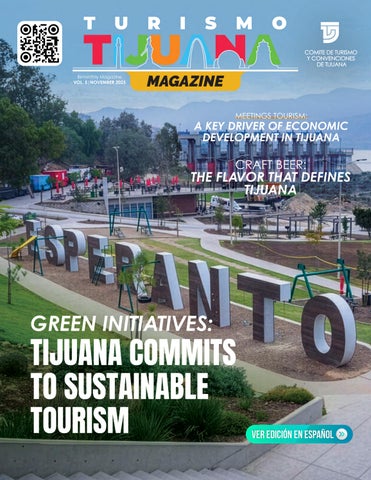
Bimonthly Magazine VOL. 5|NOVEMBER 2025
MEETINGS TOURISM:
A KEY DRIVER OF ECONOMIC DEVELOPMENT IN TIJUANA
CRAFT BEER:
THE FLAVOR THAT DEFINES TIJUANA
cotucotijuana.com
1
C ONT ENIDO Cultural heritage as a promoter of tourism in Tijuana ...............................................................pg. 4 Faith Tourism in Tijuana: History, Art, and Devotion ...............................................................pg. 6 La Revu: The Return of Tijuana’s Heart
CRÉDITOS COMITÉ EDITORIAL: Mtra. Melissa Pacheco Silveyra Ana Alicia Meneses Martínez Lic. Gabriel Camarena Salinas FUENTE EDITORIAL: Lic. Alma Sofía Villalobos Ruiz.
When the Canvas Speaks ...............................................................pg. 20 Tijuana and the Magic of the Day of the Dead ...............................................................pg. 24 Urban Art Transforms Tijuana‘s North Zone ...............................................................pg. 26
DISEÑO EDITORIAL Y EDICIÓN: David Carrizales Hernández REDACCIÓN Y CORRECCIÓN DE ESTILO: Myrna Sánchez
Health and Regeneration in Tijuana: The Rise of Intravenous Infusions ...............................................................pg. 30
Revista Bimestral Volumen 5 © Derechos Reservados Comité de Turismo y Convenciones del Municipio de Tijuana, Estado de Baja California.
pág.
8
...............................................................pg. 10
Green Youth: The Engine of Environmental Change in Tijuana ...............................................................pg. 28
FOTOGRAFÍA: Cristian Cruz
Aeropuerto de Tijuana: Puerta estratégica de México hacia el mundo
Cecut Botanical Garden: A Green Oasis in The Heart of Tijuana ...............................................................pg. 32 From A to Z: Everything women need to know about menopause ...............................................................pg. 34 Recommendations for traveling to Tijuana ...............................................................pg. 36 Upcoming Events ...............................................................pg. 38
XXXIV Tourism Merit Gala: A Tribute To Those Who Enhance Tijuana’s Reputation
pg.
12 Meetings Tourism: A Key Driver of Economic Development In Tijuana
pg.
16 Green Initiatives: Tijuana Commits To Sustainable Tourism
pg.
22
2
cotucotijuana.com
DEAR READERS: Welcome to the fifth edition of Tijuana Magazine. Tijuana, our vibrant and everevolving city, is preparing to celebrate the festivities of November and December 2025 — months filled with tradition, culture, and joy. In this issue, we have gathered articles that reflect the essence of our community, exploring cultural, touristic, and entertainment topics that showcase the pride of being from Tijuana. The Day of the Dead is one of Mexico’s most cherished celebrations. In Tijuana, this tradition holds a special meaning: entire families create colorful altars adorned with marigolds, candles, papel picado, and photographs to honor the memory of their loved ones. This custom, inherited from our ancestors, endures as a symbol of love, respect, and the unbreakable bond between generations. In this edition, we highlight the renovation of one of the city’s most emblematic avenues Avenida Revolución a project that has modernized the urban landscape and created a more accessible and appealing space for residents and visitors. With pedestrian areas, public art, and a wide variety of dining options, this new face of Tijuana reflects the dynamism and creativity that define the world’s most visited border city.
green projects that foster reforestation, the creation of urban parks, and the recovery of public spaces. These initiatives aim to improve residents’ quality of life and provide places where families can enjoy time together in harmony with nature. The Tijuana International Airport, ranked as the second most interconnected in the country, is a source of pride for our city. Thanks to its modern infrastructure and the growing number of national and international flights, it has become a strategic hub for trade, tourism, and business — but above all, a bridge that connects families and friends across Mexico and beyond. Tijuana Magazine continues to celebrate the spirit, history, and identity of a city that never stops reinventing itself. Join us on this journey through a Tijuana that is more modern, greener, and more united than ever.
Thank you for being part of this edition!
Religious tourism is another of Tijuana’s great attractions. Its churches, temples, and sanctuaries captivate visitors with their architectural beauty and deep spiritual value. Each sacred space tells a story that intertwines faith, art, and community, inviting visitors to discover another side of Tijuana’s soul. The City of Tijuana, in collaboration with private initiatives, promotes ambitious cotucotijuana.com
3
CULTURAL HERITAGE AS A PROMOTER OF TOURISM IN TIJUANA They are all drawn to eating typical dishes like Caesar salad, carne asada tacos, or fish tacos; listening to 70s rock music at the Hotel Nelson bar or dancing to it at Tilly’s; visiting the Museum of the Californias at CECUT; and buying local crafts and souvenirs at the Hidalgo Market. They also enjoy the increasingly frequent shows on Avenida Revolución featuring local artists.
C
ultural tourism is among the fastestgrowing segments worldwide and will continue to be so, according to preservation economics experts. These types of visitors, when they come to Tijuana, enjoy learning about the city’s
history, exploring its neighborhoods and landscapes, and seeing the buildings and areas of historical value that explain how the world’s most visited border city evolved.
4
cotucotijuana.com
It is estimated that tourists who visit sites of historical value stay longer and spend 2.5 times more than other types of visitors. Therefore, cultural heritage that is properly identified, interpreted, and restored acquires economic value, in addition to generating numerous social, psychological, and cultural benefits that contribute to a sense of belonging, identity formation, social stability, and a sense of place within the community. Downtown Tijuana and its surrounding neighborhoods boast a vast number of historic buildings, some over 100 years old. Notable examples of architectural significance include the Jai Alai, the Foreign Club, Caesar’s Hotel, the Nelson Hotel, the former Álvaro Obregón School, the Comercial building, and the remains of the Agua Caliente Casino, including the bungalows and the Campestre golf course, to name just a few. There is also a considerable amount of residential architecture and commercial buildings, some still retaining their original facades and signs, such as the sign of what was once the El Águila market, or the ghostly signs of the Cinco de Mayo Building across from the Popo market. The Holanda bakery in the Independencia neighborhood is a recognized icon, as are the Big Boy and El Potrero restaurants on Agua Caliente Boulevard, which are among the few remaining examples associated with
the city’s automotive culture. The shopping arcades along Revolución Avenue are a treasure trove worthy of preservation and revitalization for the enjoyment of locals and visitors alike. The most notable are Villa Colonial, Pasaje Rodríguez, Pasaje Sonia, and Pasaje Gómez. Older streets, such as Arguello, Callejón del Travieso, and Callejón Zeta, also contribute to the sense of place for Tijuana residents and attract visitors to the city. Teniente Guerrero Park, Fundadores Park, and now Esperanto Park next to the Abelardo Rodríguez Dam are examples of how cultural heritage can be integrated into the landscape for the enjoyment of the community. If we explore our city, we’ll find abundant, little-known examples of historic buildings with interesting designs and architectural value in neighborhoods like Pancho Villa, Gabilondo, Playas de Tijuana, Cacho, Chapultepec, Libertad, and Altamira, among others. In these areas, we find houses, buildings, churches, schools, and even a bullring overlooking the sea, alongside a lighthouse, a border monument, and the border fence, forming a significant ensemble in this binational zone. These examples give character to the neighborhoods as spaces of history, and their loss will contribute to urban decay and the devaluation of the cultural image they represent. Groups of historic buildings still exist on some streets that can be identified, assessed, and preserved with appropriate urban planning tools if we want to maintain elements of identity and testimonies of our history, while simultaneously promoting quality tourism.
and restoration experts to advise them on integrating these properties into urban regeneration projects with appropriate interventions that help improve social contexts, the urban image, and foster the development of investment areas that attract tourists who want to enjoy spaces that offer character, historical authenticity, quality, and culture. The old post office building, to give just one example, if restored to preserve its authentic architectural features and given a good use for the community, could spark a significant improvement in the urban landscape of an area that is currently in a state of disrepair. The same is true for underutilized cinemas like the Bujazán, the Real Cinema, and the Teatro Zaragoza, and for many other buildings that go unnoticed but bear witness to a significant urban history, such as the corner apartment buildings on 10th Street that are over seven decades old. Identifying cultural heritage, restoring it, and putting it to good use in a way that makes it profitable allows Tijuana and everyone to benefit. María Eugenia Castillo Chávez Coordinator of Museums and Galleries Baja California Ministry of Culture/BC Institute of Cultural Services Master’s Degree in Monument Restoration. UNAM PhD Candidate in Historic Preservation. Cornell University
Some developers, owners, and authorities are already identifying properties and areas of historical value in the city center, and it is important that they rely on historians cotucotijuana.com
5
FAITH TOURISM IN TIJUANA:
HISTORY, ART, AND DEVOTION
B
By Isaías Plasencia Rosales
achelor of Journalism and Business Administration with a master’s in education, President of the College of Communicators of Baja California. Tijuana, a vibrant and cosmopolitan border city, is not only recognized for its gastronomy, culture, and nightlife, but also for its spiritual richness. Religious tourism in this region offers a profound experience, where faith is intertwined with history, architecture, and popular traditions. The Archdiocese of Tijuana, with its 93 parishes and rectories, is a living testimony to a dynamic and diverse Catholic community that welcomes both locals and visitors.
ICONIC PLACES OF FAITH From the Shrine of Our Lady of Guadalupe to the parishes of Our Lady of Mercy and Saint Mary Star of the Sea, these recommendations stand out for their age, architecture, design, decor, and history, as well as their relevance to major religious events. These are places that not only enrich the soul but also the cultural knowledge of those who visit them.
RELIGIOUS DIVERSITY IN TIJUANA It is worth noting that Tijuana is also home to other important religious denominations, whose communities, temples, and traditions enrich the spiritual fabric of the city. These expressions of faith deserve their own space and will be addressed in future articles, as part of the effort to showcase the religious diversity that coexists harmoniously in this border region.
EXPERIENCE TIJUANA THROUGH ITS SPIRITUALITY Exploring these religious spaces not only allows for moments of contemplation and reflection, but also allows us to discover the history, art, and traditions that have shaped Tijuana’s identity. Each temple, each sculpture, and each pilgrimage are open doors to a deeper understanding of the soul of this city. Visiting these sites is an invitation to discover Tijuana from its spiritual heart. Below, we present a selection of temples and religious spaces that stand out for their age, design, history, and relevance in the spiritual life of the city. Below, we present a selection of temples and religious spaces that stand out for their age, design, history, and relevance to the city’s spiritual life.
SANCTUARY OF THE VIRGIN OF GUADALUPE Downtown | 2nd Street and Niños Héroes 7982 Tijuana’s former cathedral began construction in the 1940s under the guidance of the Missionaries of the Holy Spirit. In 2012, it was declared a Historic Monument. Its sober architecture and serene atmosphere make it a spiritual and cultural landmark.
6
cotucotijuana.com
TIJUANA CATHEDRAL
CHRIST THE KING OF LOS ÁLAMOS LOS ÁLAMOS COLONY
SANTA MARÍA ESTRELLA DEL MAR PARISH
Río Zone | Paseo Centenario Avenue 10150 Also dedicated to Saint Mary of Guadalupe, this modern cathedral is still under construction but is already the venue for various ecclesiastical activities. It promises to become one of the most impressive religious buildings in northern Mexico.
CHURCH OF SAN FRANCISCO DE ASÍS Downtown Zone | 7400 Third Street, across from Teniente Guerrero Park With over fifty years of existence, this church evokes ancient cathedrals. Its architectural design combines local elements with the Churrigueresque style. Carved from stone, its floor plan is shaped like a Latin cross, and its dome—an octagonal drum with a lantern—gives it a monumental appearance. It is a testament to the region’s religious and cultural tradition.
At 23.3 meters tall, this monumental sculpture can be seen from different points in the city. Next to it is the image of Saint Martin de Porres. Both were declared Historic Monuments of Tijuana. Cristo Rey is the second largest sculpture of Christ in Mexico.
CROSS OF CERRO COLORADO
Tijuana Beaches | Paseo Ensenada 950, Jardines del Sol Section Located by the sea, this parish church stands out for its architectural beauty and its active participation in religious and community events. It is a space that invites contemplation in a privileged natural setting.
Annual Celebration | First Sunday of May Every year, hundreds of faithful walks from the Minor Seminary of Tijuana to the top of Cerro Colorado in honor of the Day of the Holy Cross. Along the way, they pray at stations of the Rosary marked by crosses on reddish stone mounds. Upon reaching the summit, a community Mass is celebrated, an ideal experience for those who enjoy hiking and spirituality.
LORD OF MERCY PARISH Colonia Francisco Villa | Av. Abraham González No. 2975 This church is a spiritual meeting point for the local community. Its architecture and history make it a symbol of faith and devotion, hosting important religious celebrations.
cotucotijuana.com
7
TIJUANA AIRPORT: MEXICO’S STRATEGIC GATEWAY TO THE WORLD Grupo Aeroportuario del Pacífico
T
ijuana International Airport (TIJ) has established itself as one of the most dynamic drivers of tourism in Baja California and air connectivity on Mexico’s northern border. Its strategic location, next to the United States border, and the unique advantage of having the Cross Border Xpress (CBX), the innovative pedestrian bridge that connects it directly to San Diego, has driven sustained growth in passenger traffic and route offerings. Today, Tijuana is emerging as one of the most attractive airports for leisure and business travelers, as well as for meetings and conventions tourism.
8
cotucotijuana.com
INFRASTRUCTURE THAT DRIVES THE FUTURE One of the pillars of the airport’s transformation has been the expansion and modernization of its facilities. With the opening of the New Processing Building (NEP) in 2022, a 40,000-square-meter project that expanded the airport by 83%, the terminal took a qualitative leap in efficiency and passenger comfort. This transformation is complemented by the recently announced expansion by Grupo Aeroportuario del Pacífico (GAP), which will increase the terminal building’s surface area by 47%, consolidating Tijuana’s position as one of the most modern terminals in the country.
With an investment of $9.789 billion pesos—the largest investment in the history of this airport—the project includes seven new boarding gates, 46 check-in counters, and eight additional inspection lanes, elements that will strengthen operational efficiency and enhance passenger comfort.
SUSTAINED GROWTH IN CONNECTIVITY AND PASSENGERS The direct impact of the infrastructure investment is reflected in tangible results: in 2024, Tijuana International Airport surpassed 12 million passengers, and in the period from January to September 2025 alone, it handled 9.4 million passengers, 2% more than the same period of the previous year. This growth is due both to the boom in regional tourism and to the preference of travelers seeking quick connections to the north of the country and the United States. For the convention and events sector, having an airport with a greater number of frequencies and improved operational capacity represents an opportunity to attract more congresses, trade shows, and tourist groups that require efficient access and a variety of schedules. Expanding connectivity has been another strategic focus. Currently, seven airlines operate at the terminal, connecting Tijuana with 38 destinations, 35 of which are domestic, making it one of the terminals with the greatest domestic connectivity in Mexico. This strengthens the influx of conventions, trade shows, and tourist groups, boosting the destination’s economy and competitiveness.
A SUCCESSFUL BINATIONAL MODEL The Cross Border Xpress (CBX) continues to be a differentiating element that puts Tijuana on the international map. This one-of-a-kind pedestrian bridge allows passengers to cross the border quickly and safely in just a few minutes. Its expansion and complementary projects not only increase the flow of international tourists but also open opportunities for meeting tourism by facilitating the transit of participants from both Mexico and the United States, offering an efficient border experience.
In addition to advances in technology, the implementation of sustainability initiatives is another element that sets this airport apart. The New Processing Building (NEB) is LEED (Leadership in Energy and Environmental Design) Gold certified. This certification system measures energy consumption, water efficiency, the quality of materials used, and the creation of healthy interior spaces. It is also certified with Airport Carbon Accreditation (ACA) Level 2 Reduction, the only internationally endorsed standard that independently evaluates and recognizes airports’ efforts to manage and reduce their CO2 emissions.
ALLY OF TOURISM AND CONVENTIONS For travelers, airlines, and tour operators, the benefits are clear: more direct flights, shorter connection times, modern and efficient facilities, and a broad commercial offering. At the same time, for the local tourism sector, such as hotels, convention venues, and tour operators, the airport expansion represents an opportunity to raise the quality of services, attract international events, and strengthen Baja California’s offering as a destination for MICE tourism (Meetings, Incentives, Conventions, and Exhibitions).
AN AIRPORT IN CONSTANT EVOLUTION Tijuana International Airport not only responds to current growth but is also preparing for the next stage of regional and international expansion. However, airport growth comes with various challenges. The passenger experience begins long before boarding; therefore, synergy between the airport and authorities at all three levels is essential to sustain the destination’s competitiveness. In conclusion, Tijuana Airport is experiencing a period of consolidation and a vision for the future: it is already a strategic asset for Mexico’s economic and tourism development. More than a point of departure or arrival, Tijuana International Airport has become a gateway to experiences, opportunities, and connections between two nations.
Tijuana International Airport is also advancing in the adoption of technology, with automated screening systems, self-check-in, and more agile security filters. These tools position Tijuana as a modern and efficient terminal.
cotucotijuana.com
9
LA REVU:
THE RETURN OF TIJUANA’S HEART
From tourist icon to vibrant urban space: this is how the most famous avenue on the border is reinventing itself.
R
By Jeronimo Ricardo Franco
evolución Avenue is not just a street: it is the soul of Tijuana. It is the symbol of a city that has known how to transform itself, reinvent itself, and beat strongly once again after its most difficult years. The stories of the tourists who crossed from San Diego during Prohibition, when the United States closed its bars and Tijuana opened its doors to the world, still resonate on its sidewalks. Today, that pioneering spirit is reborn under a new vision: to transform “La Revu” into a modern and vibrant pedestrian space, designed for Tijuana residents and admired by visitors. “From its origins, Avenida Revolución was the connection point between American tourism and the essence of Tijuana. During the decades of the 1920s through the 1980s, this avenue was the tourist heart of the city; but economic crises, insecurity, and a lack of urban renewal plunged it into a
10
cotucotijuana.com
long period of neglect,” explained Héctor Bustamante, president of the Trust for the Transformation of the Historic Center. That abandonment, however, was not the end. About fifteen years ago, a quiet transformation began that today marks a new stage for the city. New bars, cafes, galleries, shops, and cultural spaces have taken over the area with a fresh and creative energy. “The appetite for downtown was reborn among Tijuana residents. Local entrepreneurs invested in opening businesses with a distinct identity, and the more interesting places emerged, the more people returned. In the last five years, we have seen the true catalyst for change: new housing, restored buildings, co-living projects, and a community that wants to live in and explore the city,” Bustamante explained.The new Avenida Revolución no
longer wants to depend on foreign tourism; it wants to win over locals first. Bustamante sums it up clearly: “The project is designed for Tijuana residents. If they embrace the avenue, the tourists will come on their own. Everyone wants to experience the places where locals feel at home.” Currently, the project is in its first phase, with the first two blocks—from Fourth to Sixth—completely renovated: underground infrastructure, new concrete, modern lighting, and regulations to harmonize facades, colors, banners, and street furniture: “It’s about giving public space back to the people. It’s proven that when a street becomes pedestrianized, commerce flourishes. Everyone wins,” he affirmed. But the transformation is not without its challenges. For Bustamante, the biggest challenge isn’t technical, but cultural: “The main challenge is for Tijuana residents to understand that walking is better than driving. We’re tired of the traffic; we need to reconnect with our city. It’s a transition, and it needs to be communicated well.” Resistance to change coexists with hope. Every new business that opens, every family that returns to downtown, every
tourist who once again strolls along the “Revu” (a popular pedestrian street), is a sign that the initiative is on the right track. The project doesn’t depend solely on the government; it’s the result of a collaboration between the community, academia, businesses, and authorities. Participating in its development are firms like Gracia Studio, recognized for their focus on socially responsible architecture, and organizations such as the Tijuana City Council and the Tijuana State Public Services Commission (CESPT). “The most important thing is that this initiative originates from the community. It’s not a political project, but a collective effort that seeks the well-being of everyone,” Bustamante emphasized. The vision is clear: a vibrant avenue day and night, where families can stroll, young people can enjoy themselves, and artists can showcase their talent. A corridor that combines art, gastronomy, entrepreneurship, and culture, generating authentic content that invites exploration. “We don’t want franchises or chains; we want businesses with soul, with local identity, that represent Tijuana’s creativity,” he concluded. cotucotijuana.com
11
XXXIV TOURISM MERIT GALA:
A TRIBUTE TO THOSE WHO ENHANCE TIJUANA’S REPUTATION
By Elsy Pineda
The Plaza Monumental in Playas de Tijuana was the perfect setting for a magical evening, filled with pride and recognition for those who, through their work, talent, and vision, have made this border city increasingly relevant on the national and international tourism map.
glow of candlelight, evoked an atmosphere of unity, pride, and celebration. Authorities, business leaders, activists, and former presidents of the Tijuana Tourism and Conventions Committee (COTUCO) gathered to recognize those who, in 2024, brought honor to the city through their commitment to tourism.
Just meters from the border wall, this historic venue was transformed to host the XXXIV Tourism Merit Gala, an event that paid tribute to the individuals and organizations whose efforts promote Tijuana’s development, image, and prestige worldwide.
This year, the awards took on a new artistic significance: a sculptural work created by visual artist Una Cristiana, crafted from concrete, bronze, and wood. The human figure represents a Tijuana proudly holding their city to their chest: a symbol of strength, identity, and deep roots. Weighing seven kilograms, the piece embodies the resilient spirit of Tijuana, a city that remains a leading force for all of Mexico.
The ambiance, enhanced by the Tijuana Municipal Government Band under the direction of Maestro José Roberto Rubio Díaz, and illuminated by the warm
12
cotucotijuana.com
RAFAEL FERNÁNDEZ DE CASTRO MEDINA
MI CHANTE FOUNDATION
CLAUDIA HORTA MEZA
INTERNATIONAL TOURISM MERIT AWARD
TOURISM MERIT AWARD FOR THE COMPANY
TOURISM MERIT AWARD FOR AN INDIVIDUAL
Dr. Rafael Fernández de Castro Medina, a renowned academic and expert in international relations, received the International Tourism Merit Award for his invaluable work promoting the Cali Baja region, strengthening ties between Mexico and the United States through education, research, and cross-border cooperation. With a degree in Social Sciences from ITAM, a master’s degree in public policy from the University of Texas at Austin, and a doctorate in Political Science from Georgetown University, Fernández de Castro has dedicated his life to studying and understanding the complex bilateral relationship between the two countries. His work has helped build bridges of understanding and development, inspiring generations of young people interested in diplomacy, academia, and regional collaboration. During his acceptance speech, he expressed his deep affection for Tijuana, a city that—he said—represents “that unwavering Mexican spirit that transforms adversity into opportunity.” “My commitment with this award is to continue studying the Cali Baja relationship more diligently, because we are only just taking advantage of a small part of its great potential,” he added..
With just six years of existence, the Mi Chante Foundation has established itself as an inspiring example of how sports and solidarity can transform lives. Founded in Tijuana with the mission of supporting young athletes in achieving their dreams, the foundation promotes values of discipline, perseverance, and self-improvement, providing tools for new generations to develop not only as athletes but also as exemplary citizens. Its main fundraising platform is the Charity Golf Tournament, an event that year after year brings together personalities from the sports and business worlds in an atmosphere of camaraderie and altruism. Each edition pays tribute to an emblematic figure in Mexican sports, including Víctor Regalado, Julio César Chávez, Erik “Terrible” Morales, and José Sulaimán, strengthening the bond between sports, the community, and Tijuana pride. Thanks to its commitment and tangible results, the Mi Chante Foundation was awarded the Tourism Merit Award in the Business category for 2024, a recognition that celebrates its contribution to strengthening Tijuana’s identity as a city that fosters talent, unity, and social development through sports. “We are very pleased with the foundation’s achievements, in which all the athletes represent us in other countries so that people know about Mexico, and about Tijuana. It is a great honor for me to receive this award from the Tourism Committee,” said Abelardo Peña, president of the foundation and a Tijuana native by choice.
A Tijuana resident by choice and a Baja Californian at heart, Claudia Horta Meza was recognized with the Tourism Merit Award in the Individual category for her outstanding work promoting Mexican wine and Baja California’s gastronomy internationally. A certified public accountant by profession and an internationally recognized sommelier, Claudia is the co-founder of Baja Terra and Baja Artesanal, projects that promote the culture of wine pairing and local consumption. Together with her husband, Sergio Castañeda, she leads Casta de Vinos, a winery that has earned 97 international medals and currently has a presence at Disney California Adventure, solidifying its position as a benchmark for Mexican wine abroad. In her speech, Horta expressed her pride in representing Baja California to the world and in promoting the union of gastronomy, wine, and tourism as drivers of regional development: “Every wine tells a story, and that story is born from our land and our cuisine. Baja California has a gastronomy that inspires and a wine that represents us with passion,” she said. Her persistence, passion, and commitment have made her an ambassador for Mexican wine and a tireless promoter of Tijuana as a food and wine destination. The 34th Tourism Merit Awards gala was more than just a ceremony: it was a reminder of the power of the Tijuana community to reinvent itself, join forces, and project its essence to the world..
cotucotijuana.com
13
HONORABLE MENTIONS FOR TOURISM MERIT The 2025 Tourism Merit Awards gala also recognized those who have made tourism, culture, sports, and innovation a platform for promoting our city. Five honorary mentions were awarded to individuals and projects that, through their work and passion, contribute to strengthening Tijuana’s identity..
SILVIA YOLANDA CONTRERAS MEDINA CAREER IN SPORTS PROMOTION An example of discipline, perseverance, and passion for sports, she has left her mark on the world of flag football. A two-time world champion—in 2022 and 2025—her talent and commitment have made her a leading figure in the sport in Mexico..
MUSEO DEL TACO ATTRACTION AND EXPERIENCE GASTRONOMIC AND CULTURAL If there’s one thing that distinguishes Tijuana, it’s its urban cuisine, a fusion of flavors, traditions, and creativity that reflects its multicultural essence. This is how the Taco Museum came about, a space that pays homage to the country’s most emblematic dish and to Tijuana’s identity..
GRECIA PAOLA SOTO RODRÍGUEZ INNOVATION, FASHION AND DESIGN When creativity meets science, stories like that of this Tijuana-based designer emerge, recognized as a pioneer in the fusion of fashion and technology in Mexico. With her Corazón de la Baja dress, a piece featuring an anatomical heart that beats to the rhythm of a human pulse, she revolutionized design in her Garra de Vid collection..
14
cotucotijuana.com
BAJA CALIFORNIA COLLEGE OF BARIATRIC SURGERY AND METABOLIC DISEASES MEDICAL TOURISM Since its creation in 2018, this college has worked tirelessly to strengthen standards of care and promote interdisciplinary collaboration. With its international congress, it has positioned the city as a global epicenter for bariatric surgery.
CELEBRATING 100 YEARS OF CAESAR’S SALAD – PLASCENCIA FAMILY EVENT OF THE YEAR The centennial of Caesar Salad was celebrated with an unprecedented festivities on Avenida Revolución, where the Plascencia family paid homage to the legacy of this iconic dish, which, like few others, has transcended generations and borders. Each of these honorees represents a facet of Tijuana’s soul: passion for sports, culinary creativity, innovation in design, medical excellence, and pride in our traditions. All of them, from their respective fields, contribute to strengthening the region’s tourist appeal and projecting a vibrant, modern image to the world, one deeply committed to its people.
cotucotijuana.com
15
MEETINGS TOURISM: A KEY DRIVER OF ECONOMIC DEVELOPMENT IN TIJUANA By Adrián Sarabia
16
cotucotijuana.com
F
ew industries generate such a broad and sustained impact as meetings tourism. Congresses, conventions, and business gatherings, beyond the exchange of ideas, leave a tangible mark on the local economy, explained Ana Alicia Meneses Martínez, president of the Tijuana Economic Development Council (CDT). She asserted that this type of tourism represents one of the most strategic bets for the city’s economic growth: “Many states are investing in this type of tourism because it generates a very significant economic impact,” she added. According to the leader, the average expenditure of meetings or convention attendee is 92% higher than that of a leisure tourist, with an approximate budget of $1,250 and an average stay of two to three days. These events impact a broad value chain: hotels, restaurants, transportation services, technical suppliers, furniture rentals, audiovisual production, and food services. “From the moment you leave the airport, you’re already generating economic activity: taxi drivers, porters, people who rent equipment, tables, chairs, food… it all adds up,” he noted.
“For a congress to come to Tijuana, we first must convince the national president of the organization to bring it. We’ve gone to Guadalajara, Monterrey, and Mexico City to promote our city as a destination.”
TIJUANA: A TOURIST AND HOSPITAL CITY According to Meneses, Tijuana enjoys a privileged position. Its border location, its gastronomy, and its hotel infrastructure make it a competitive destination on the national map: “Tijuana is a very welcoming city. It receives everyone with open arms; it’s warm, hardworking, and already prepared. New hotels are coming, and that will allow us to host more conferences. Little by little, we can do much more for the city,” he affirms optimistically. The city also benefits from the tourist corridor that includes the Valle de Guadalupe, the lobster route in Puerto Nuevo, and its proximity to San Diego, which expands the range of experiences available to visitors.
Tijuana is a very welcoming city. It receives everyone with open arms; it’s warm, hardworking, and already prepared
According to CDT figures, tourism generates $18 million in direct revenue, 441,000 direct jobs, 342,000 indirect jobs, and contributes 1.4% to the local GDP, confirming its importance as an engine of urban and regional development. Meetings tourism was one of the sectors most affected by the COVID-19 pandemic, Meneses acknowledged. While medical tourism continued to grow, congresses and conventions practically ground to a halt during the first years of lockdown.
“Medical tourism helped hotels a lot to avoid suffering as much. But congress tourism did affect us greatly; we’ve only just begun to see a recovery in the last two years,” he explained. With the support of the Tourism and Conventions Committee (COTUCO), the city has resumed its presence at national trade shows and has begun to attract large medical, business, and civil association events again. The work, he emphasized, requires coordination, promotion, and persuasion:
A STORY THAT BEGAN IN THE HOTEL INDUSTRY
Meneses’ journey in the sector began in the 1980s, when she worked in sales at the Fiesta Americana Tijuana Hotel (now the Grand Hotel Tijuana). It was there that her passion for the hotel industry and event planning was born: “I fell in love with the hotel industry. I saw it as a rewarding sector, where I could grow and also have time for my children. I started with a travel agency, and when the airlines eliminated commissions, I decided to dedicate myself to convention tourism. At that time, no one in Tijuana was doing it,” she recalled. Her vision led her to pave the way in a sector she now considers vital to Tijuana’s economy, founding her business, Baja S.C. Meeting Tourism. Beyond the numbers, meetings tourism represents a positioning and sustainable development strategy for Tijuana. In Ana Alicia Meneses’ words, investing in attracting more conventions is not an expense, but an investment that benefits everyone. However, he also warns that this type of tourism should receive greater attention from municipal and state authorities. cotucotijuana.com
17
CRAFT BEER: THE FLAVOR THAT DEFINES TIJUANA By Adrián Sarabia
18
cotucotijuana.com
I
t’s no secret that Tijuana has established itself as a leading craft beer destination in Mexico. The quality of its products has been a tourist attraction for almost a decade; one could even say that the city has redefined how alcohol is consumed, integrating a unique sensory, cultural, and gastronomic experience on the busiest border in the world. Talking about the history of beer in Tijuana inevitably involves mentioning Cervecería Tijuana, Bosiger (still operating), and even Azteca Craft Beer—projects that, before the year 2000, began to shape a new era for the independent brewing movement. Demian Bosiger, originally from Switzerland and creator of the eponymous brand, was one of the pioneers of craft beer in the city. He arrived from Europe more than 25 years ago and, taking inspiration from German and Czech beers, began brewing his own homebrew. The rest, as they say, is history.
TIJUANA’S FLAVOR AND QUALITY Among Tijuana’s most outstanding beers are Drágula, from Cervecería Insurgente, recognized with multiple gold medals in national and international competitions; Lágrimas Negras, from Cervecería Rámuri, awarded bronze at the World Beer Cup; and Sunny Eyes, awarded silver at the 2025 national competition. Likewise, Illuminati, from Madueño Brewing, won gold at the 2023 Copa Cerveza MX in the Hazy IPA category. Finally, Bossiger Beer stands out with its Barley Wine and Belgian Golden Strong, awarded gold and bronze, respectively, at the 2025 CDMX Professional Competition. The beer taster and expert in craft beer also pointed out that the industry faces significant challenges, such as the increase in production and raw material costs, which impacts the final price for consumers.
This phenomenon has spurred the creation of new businesses and partnerships, from beer tours [...] to collaborations with restaurants and local groups
The proximity to San Diego, one of the world’s craft beer capitals, has decisively influenced the quality and evolution of Tijuana’s beers. For over fifteen years, the first “new” local breweries began offering American styles, stouts, and even sours. It was then that brands like Rámuri, Insurgente, and Border Psycho burst onto the scene and marked the beginning of the city’s beer boom. For Patricia Castillo, creator of “I Wanna Beer With You,” an independent platform dedicated to beer culture, the most significant aspect of this movement has been its boost to tourism and its contribution to giving the city a new identity: “This phenomenon has spurred the creation of new businesses and partnerships, from beer tours and the formal organization of the community through the Tijuana Craft Brewers Association (ACAT), to collaborations with restaurants and local groups like Caesar’s Restaurant, Tacos del Sam, and the Zonkeys, the city’s basketball team. It has even integrated with running clubs and sports activities, transforming breweries into meeting places and social hubs. This urban subculture has given Tijuana a distinctive identity, characterized by its hybrid nature. This blend is reflected in what local breweries currently offer,” she explained.
A SECTOR IN RECOVERY
According to data from Sergio Michel, president of the Tijuana Brewers Association and founder of Cerveza Rámuri, the local brewing industry experienced its greatest boom between 2014 and 2018, with between 64 and 75 active breweries and an average annual production of 4,970,160 liters. However, during the 2019–2020 period, a significant contraction was recorded, with the number of breweries dropping to between 35 and 40, and average production falling to 3,768,324 liters per year. The pandemic (2020–2023) deepened this decline, leaving only between 25 and 30 breweries in operation, with an average production of 1,678,894 liters per year. Starting in 2024, the sector showed signs of recovery: although the number of breweries remained stable, production rebounded to reach an annual average of 3,435,780 liters, reflecting a gradual process of reactivation and consolidation of Tijuana’s craft beer scene. In conclusion, craft beer in Tijuana has gone from being an experimental movement of enthusiasts to becoming a cultural, tourist, and economic engine that defines an essential part of the modern identity of the city and Baja California.
cotucotijuana.com
19
WHEN THE CANVAS SPEAKS
I
By Lic. Alma Sofia Villalobos Ruiz
n our daily lives, we face a pace that never stops. The days seem to repeat themselves in a sequence that combines work, obligations, and responsibilities, leaving barely any room to breathe. Between rush and routine, the mind fills with unfinished thoughts, goals to accomplish, and accumulated fatigue. Thus, little by little, life becomes a mechanical coming and going, where negative emotions begin to weigh on shoulders already feeling
20
cotucotijuana.com
exhausted by personal challenges. Current events confront us with an overabundance of stimuli, news, and demands. Everything happens so fast that sometimes there’s no time to stop and feel. This lack of pause can transform into constant anguish, an invisible knot that tightens the chest and seeks an outlet in any way, often in ways that distance us even further from the calm we so yearn for.
However, routine isn’t all about exhaustion. Hidden among the gray moments are bright moments that give meaning to the day: a sincere conversation, a joyful memory, a song that transports, or an idea that sparks curiosity. These fragments of life, however small they may seem, have immense power if we give them a place within us. Every emotion, even the difficult ones, can become raw material to create something new, something of our own. Art, in any of its forms, is precisely that: a way of translating what we feel into something tangible, of giving color, shape, or rhythm to what normally resides only in the mind. Why not turn something as precious as moments, emotions, and memories into a source of tranquility? Creating art doesn’t require extensive knowledge or perfect results; simply letting your hands move and your mind loosen. Drawing patterns with a pen, making strokes with a pencil, or letting color expand uncontrollably on the paper can become an act of liberation. It’s a wordless language that allows us to express what we sometimes can’t explain. During a fast-paced life, these simple gestures can be a necessary pause, a way to reconnect with oneself. For me, I’ve always been drawn to painting. I discovered that the brush and acrylic could be excellent companions during difficult times in my life. While I paint, time seems to stop; thoughts are effortlessly organized, and external noise fades away. Over time, I began painting pet portraits and found a very special connection. Each stroke is a way to capture the essence of a being who gives love without measure, to immortalize that pure joy that accompanies us so closely. The most beautiful thing is that, without having planned
it, other people began to share their memories with me, their own stories filled with love. Today I can say that this little personal refuge has also become something I can share with others. Beyond being a fulfilling activity, painting pets reminds me that art can unite, heal, and move. Each piece is different, not only because of the color or the technique, but because of the story behind it. And while I appreciate that my work is appreciated, what truly motivates me is that sense of peace that emerges in the process, when the colors begin to come alive, and the mind finally quiets. Creating art, beyond a skill or a hobby, is a form of healing. It reminds us that there is still beauty even in difficult days, that we are still capable of transforming what we feel into something that restores our peace. In a fast-paced world, stopping to create can be a form of resistance, an act of self-love and a reconnection with what is essential. And I’m not alone in that feeling. In Tijuana, many local artists find in art the same need to express themselves, to transform the everyday into something meaningful. Every mural, sculpture, or painting that emerges on this border carries with it a story, an emotion, or a search for identity. We are a diverse community, but we share the impulse to create, to make art a common language that connects hearts, spaces, and experiences. I paint so I don’t forget. Because each of my creations represents a chapter in my life, and now it also counts.
cotucotijuana.com
21
GREEN INITIATIVES:
TIJUANA COMMITS TO SUSTAINABLE TOURISM
The border city is promoting projects that combine development, nature, and well-being.
By Lorena Arellano Zamora
T
ijuana is changing its face. Among its hills, avenues, and new developments, a vision is growing that seeks to balance urban dynamism with respect for nature. Today, the city is promoting a series of projects focused on fostering sustainable tourism, a way of traveling that protects the environment, respects local culture, and generates social and economic benefits for its communities. The green movement has gained strength thanks to collaboration between government, private sector, and civil society. One of its main drivers is Luis Lutteroth del Riego, leader of the Environmental Axis of the Tijuana Economic Development Council (CDT), who has been a key figure in creating spaces that promote a healthier and more sustainable lifestyle.
22
cotucotijuana.com
ESPERANTO PARK: A GREEN LUNG FOR THE CITY Among the most emblematic projects is Esperanto Park, a space that symbolizes the new face of Tijuana. Spanning 320 hectares, this park combines nature and recreation: bike paths, children’s play areas, sports fields, and ample spaces for relaxation and socializing. “Between 11,000 and 12,000 people visit it every weekend, reflecting the enormous need for green and recreational spaces in the city,” says Lutteroth. The design and operation of Esperanto Park have not only transformed a previously underutilized area but have also garnered international recognition. The project was awarded by World Urban Parks (WUP) for best new construction in reclaimed space and
received an Orchid Award in the binational “Orchids & Onions” program. Furthermore, the park is distinguished by its self-sustainability; that is, its maintenance will not depend on public administration, but rather on its own management model that guarantees its longterm viability: “Few infrastructure projects contribute as much to a city as the creation of green spaces,” says Lutteroth. “They not only beautify the surroundings, but also strengthen the physical and mental health of residents and foster a sense of community.”
MORE PARKS, MORE LIFE The municipal government has also committed to promoting environmentally friendly tourism. During the remainder of the administration, plans are underway to create 25 parks, as well as update regulations to ensure these spaces are sustainable. Among the projects under development are Cerro de Las Abejas Park, Ciudad Natura Park, and Florido Park, the latter covering 10 hectares.
However, the challenges are enormous. Currently, Tijuana has less than one square meter of green space per inhabitant, well below the 19 square meters recommended by international standards. Even so, Lutteroth remains optimistic: “We are on the right track. Every tree planted, every park restored, brings us closer to a greener, more humane, and more attractive Tijuana for sustainable tourism.”
A CITY THAT BREATHES THE FUTURE The push for sustainable tourism in Tijuana not only seeks to attract visitors, but also to redefine the city’s relationship with its natural environment. The new parks and green spaces have become places for gathering, community, and pride. With each project, Tijuana demonstrates that development and sustainability can go hand in hand. And as its “green lungs” grow, so does the hope of a city that looks to the future with a clear commitment: to care for its environment so that everyone— residents and visitors alike—can enjoy it.
cotucotijuana.com
23
TIJUANA AND THE MAGIC OF THE DAY OF THE DEAD
I
Por Lic. Celia Garcia Hernandez
n Mexican culture, death holds a special meaning; sometimes we even laugh at it. One Mexican tradition that transcends time is the celebration of the Day of the Dead, in which the memory of loved ones who have passed away is honored, or, as they say, those who “transcended to another plane” or “went ahead of us.” It is a ritual that prioritizes, above all, remembrance over forgetting. Its origins lie in the rituals performed by Catholic religious figures brought by the Spanish, and in the celebrations that indigenous peoples held since pre-Hispanic times.
According to the Catholic calendar, the Day of the Dead is celebrated on November 1st and 2nd: November 1st, All Saints’ Day, is for children who have passed away; and November 2nd is for honoring the faithful departed, that is, adults. That’s why, every year, families gather to place offerings and altars in their homes and cemeteries, decorated with colorful flowers, especially marigolds, papel picado (cut paper decorations), sugar skulls, and other elements. They also place foods that were favorites of the loved one to whom the altar is dedicated. During these days, cemeteries are filled with people and a festive atmosphere prevails. Some families bring musical groups
24
cotucotijuana.com
to sing to their loved ones, transforming the visit into a true celebration. In Mexico, the Day of the Dead celebration can vary depending on the region, but the purpose is the same: to reunite families to welcome back their loved ones who have returned from the afterlife. In Tijuana, being a border city near the United States, you can experience this tradition through various events and activities organized by both the community and government institutions.
ACTIVITIES YOU CAN’T MISS: The Day of the Dead Parade Organized by the Benito Juárez Market and the Floral District, the parade features contingents from schools, universities, sports clubs, associations, and local businesses, as well as riders from ranches in various municipalities of Baja California. Participants wear costumes related to the celebration. The parade culminates in a street fair where you can enjoy food and an artistic and musical program. A Catrina’s contest is also held.
Monumental Altar at the Hidalgo Market This altar is one of the most anticipated each year, erected in memory of the market’s deceased vendors. It is very colorful, includes traditional elements, and is watched over by large Catrina’s, which attract the attention of tourists and visitors. It is set up days before the celebration, but on November 2nd, a mass is held, and afterward, attendees are invited to enjoy tamales and atole. The altar remains on display throughout the month so that more people can visit it.
Also, in the city’s various markets you can find items related to this holiday, allowing you to create your own altar in honor of family or friends. Be part of this tradition!
Visit cemeteries You can’t miss visiting the city’s cemeteries, which throughout the day are filled with people remembering their loved ones. This visit represents an act of love and continuity. It is believed that during these days the souls return to the world of the living to be with their families. Therefore, the altars and visits to the cemetery are not acts of sadness, but of welcome, gratitude, and celebration.
Visit the marigold fields of Mictlán From September to November, another place where you can experience this celebration is Mictlán, near the Corredor 2000 highway. Here you can explore fields of marigolds, take photos in different settings, and learn more about this important Mexican tradition. Mictlán represents the underworld in Mexica and Nahua mythology and is an integral part of the Day of the Dead celebration, as it is believed that the souls of the deceased return from Mictlán to the world of the living during this festival. You can also take this opportunity to buy marigolds and place them on your Day of the Dead altar.
THE DAY OF THE DEAD ALTAR: The Day of the Dead altar has essential traditional elements, although many families add their own personal touch. Here are some of the most common elements: Photo of the deceased: This is the image of the person to whom the altar is dedicated. Some people place the photo in front of a mirror so the deceased can see their loved ones and viceversa. Marigolds: Their aroma and color guide the soul’s home. Traditionally, an arch is formed to represent the gateway to the underworld. Sugar skulls: These represent the ever-present nature of death. Bread of the Dead: This alludes to the Eucharist and brotherhood. Water: To quench the thirst of the souls after their long journey. Candles: Their light helps guide the spirits. Food: The deceased’s favorite dishes, which, just by smelling them, allow them to “taste” them as they did when they were alive. • Salt: Purifies the soul so that it is not corrupted during its journey. Copal and incense: Cleanse the place of evil spirits and allow the soul to enter safely. Ash cross: Represents purification and faith.
cotucotijuana.com
25
URBAN ART I TRANSFORMS TIJUANA’S NORTH ZONE
n the heart of Downtown Tijuana, the North Zone has for years borne the weight of vulnerability: streets marked by insecurity, trash, and the daily abuse of authority. However, amid the gray asphalt and worn walls, color has begun to emerge. An initiative seeks to restore hope to the community and transform its surroundings: a component of the Zones of Peace project, which, through urban art, transforms walls into canvases that tell stories of resistance and rebirth.
By Adrián Sarabia
26
cotucotijuana.com
PEACE ZONES
Gabriela Posada del Real, technical secretary of the Tijuana Peace Zones Project and coordinator of Public Art projects in the Historic Center of Tijuana, is an urban art movement that aims to rebuild the social fabric, regenerate public spaces, preserve memory, and foster pride in the diversity of identities that are part of the Northern Zone of Downtown Tijuana. The objective is to implement a comprehensive strategy in these areas through a coordinated intervention by the federal, state, and municipal governments, under the leadership of the Undersecretariat for Violence Prevention of the Secretariat of Security and Citizen Protection (SSPC), the Central Delegation, and the Secretariat of Culture of Baja California.
“The project consists of creating murals that reflect the daily life and history of the Zona Norte neighborhood of downtown Tijuana. It seeks to contribute to the reconstruction of the social fabric, promoting cohesion, pride, and the diverse identity that characterizes the population that lives there,” he said. “Murals, being a powerful form of cultural expression, allow local talent to showcase their creativity. At the same time, they contribute to urban renewal and the revitalization of vulnerable spaces (deteriorated, abandoned, or littered), improving the aesthetics and environment of the community,” added Posada Del Real. Visual artists such as Montserrat Sánchez Inesta, Garzón Masabó, Iván Arévalo, Enrique Chiu, Pablo Vega, Mode Orozco, Edgar Naíto, and Leonardo Flip, among others, have joined this initiative and created their works with the aim of conveying positive messages, improving the aesthetics and environment of the community.
Every three weeks, she indicated, with the help of the Young Planters of Peace, between four and five murals are painted, and residents participate under the supervision of the lead artist. Each resident can paint the facade of their home with a design that reflects their identity, based on the established color palette. Posada del Real clarified that the project fosters a sense of belonging among the entire Northern Zone community. “We know that for the project to be sustainable, active participation is very important, not just from those who live there. We believe that this is precisely what determines its effectiveness and longevity,” she expressed. According to the project coordinator, 18 murals have been completed in the area so far, with the goal of completing a total of 40 works by the end of the year.
INVITE TO PARTICIPATE Posada del Real emphasized that most residents appreciate the focus on the Northern Zone. They can participate in the design of their own mural, she said, either individually or in groups. The lead artist can provide support and guidance throughout the design process. cotucotijuana.com
27
GREEN YOUTH:
THE ENGINE OF ENVIRONMENTAL CHANGE IN TIJUANA
By Adrián Sarabia
28
cotucotijuana.com
I
n a city facing significant environmental and urban challenges, youth are emerging as a driving force for change. This was demonstrated during the Tenth Environmental Fair, organized by Tijuana Verde, part of Tijuana Innovadora, where more than 600 young exhibitors and up to 2,000 attendees participated with ideas, projects, and prototypes dedicated to environmental protection. For Hernando Durán Cabrera, director of Tijuana Verde, the value of these projects begins long before they are presented at the fair: “The simple fact that a young person is thinking about something positive, creative, and how to do good for society is already a victory. The work begins weeks earlier, when they meet with teachers and friends to make it a reality,” he affirmed. This year, 175 projects were registered, although, due to safety concerns and instructions from Civil Protection, only 132 could be exhibited within the venue. Even so, the turnout once again exceeded expectations, reflecting a growing interest in the environment among younger generations. The main objective is for these initiatives to go beyond a single day of presentation. Therefore, six winning projects—three from university-level projects and three from high school—will receive support through an innovation, incubation, and entrepreneurship seminar, with the aim of helping them evolve into marketable or implementable solutions for the city: “We want some of them to be bankable, to have a life of their own,” emphasized Durán Cabrera, noting that more and more students return year after year to strengthen and refine their proposals.
A MORE CONSCIOUS AND PARTICIPATORY GENERATION According to the director of Tijuana Verde, the new generations are showing an even greater environmental awareness than in previous years: “Seeing a tree being cut down feels almost as if a person were being harmed. They are the first to raise their voices against actions that damage nature.” Durán believes this stance stems from a romantic and protective vision, still free from economic interests, which must be guided to foster real change: “We have to channel them, because they come with the desire to defend what they consider just.” He also acknowledged that structural obstacles still exist, such as the lack of follow-through on public policies and decisions that go against environmental protection. However, he emphasizes that citizen participation is increasing. In addition to promoting innovative solutions, the Environmental Fair opens doors for academic and professional development. “A young person told me that thanks to the fair, they already know which university they want. Another has already chosen a career after seeing a project that inspired them. That broadens their horizons,” he shared. Hernando Durán asserted that if these types of projects were carried out more frequently, “we would be working on how to solve the environmental problems of the city, the state, and the world.” The Tenth Environmental Fair confirmed that Tijuana has a conscious, creative generation ready to act.
cotucotijuana.com
29
HEALTH AND REGENERATION IN TIJUANA:
THE RISE OF INTRAVENOUS INFUSIONS
Byr Adrián Sarabia
30
cotucotijuana.com
M
edical tourism in Tijuana continues to grow, and one of the newest options for those seeking to revitalize themselves and improve their overall well-being is intravenous infusions. These are vitamin-enriched serums that help reduce stress, improve skin health, combat fatigue, and promote detoxification of the body. According to Dr. Héctor Silva, medical director of Better Than Ever: The Recovery Center, these intravenous infusions consist of administering a combination of essential vitamins, minerals, and trace elements directly into the bloodstream, allowing for complete absorption, something difficult to achieve orally alone. This method aims to provide cells with the necessary nutrients to optimize their function. Among the benefits reported by patients are increased energy, improved concentration, better sleep, brighter skin, a strengthened immune system, and support in physical and mental recovery, as well as recovery after illnesses and surgeries. Although a proper diet remains the foundation of health, various medical and lifestyle factors can make it difficult to meet all nutritional requirements. Therefore, Dr. Silva noted, these infusions can serve as a therapeutic complement for those who need it, with effects that often last for several weeks. The recommended frequency depends on each patient, although monthly application is most common. Dr. Silva emphasized that there is scientific evidence regarding the function of each vitamin in the body and concluded that, in addition to promoting healthy habits such as a good diet and physical activity, infusions represent a useful alternative to support overall well-being. Dr. Silva emphasized that there is scientific evidence regarding the function of each vitamin in the body, and concluded that, in addition to promoting healthy habits such as a good diet and physical activity, herbal infusions represent a useful alternative to support overall wellbeing. For her part, Melissa Ruiz, one of the directors of Better Than Ever: The Recovery Center, highlighted that Tijuana has positioned itself as a leader in these types of procedures: “The reality is that this is part of regenerative medicine, and we are experts in these types of treatments because we have made more progress in research processes than in the United States, where they are not yet permitted,” she explained. Ruiz pointed out that patients who come to Tijuana for medical tourism no longer do so solely because of its geographic location or lower costs compared to the neighboring country, but rather because of the experience, innovation, and quality of care that the border city offers.
cotucotijuana.com
31
A GREEN OASIS IN THE HEART OF TIJUANA By Adrián Sarabia
Founded in 1998, the Botanical Garden of the Tijuana Cultural Center (CECUT) is a public space that promotes the appreciation of regional flora. It also complements its natural appeal with a historical component that pays homage to the pre-Hispanic cultures of Mesoamerica through a short walk where replicas of some of their most important sculptures can be seen. The garden boasts 6,400 square meters of green areas and around 150 plant species
32
cotucotijuana.com
native to different Baja Californian landscapes— coasts, deserts, mountains, and valleys—all properly identified with descriptive labels. These species are distributed along the north side of CECUT, where the Foro Luna is located, a remodeled space that serves as a stage for musical performances, children’s theater, poetry readings, and various artistic activities. They can also be seen around the IMAX Dome and in the plant area in front of The Cube.
The species are organized by areas that represent the region’s most characteristic ecosystems:
NON-NATIVE MEDITERRANEAN This group includes introduced plant species that, over time, have become representative of the Baja California region, such as olive trees, vineyards, and aromatic plants used in cooking.
NATIVE MEDITERRANEAN This refers to the coastal scrubland typical of the region, found along the coastline, for example, between Tijuana and Ensenada.
DESERT This includes plants native to the driest areas of Mexico, notably cacti, which are adapted to extreme temperatures and water scarcity.
AGAVETUM This collection is dedicated to the great diversity of maguey plants (Agave), emblematic plants of the Mexican countryside, valued for their natural fibers and their use in the production of traditional beverages.
FLOWERS OF MEXICO A space where the cempoalxóchitl (marigold) and the dahlia, recognized as the quintessential national flower, stand out.
TROPICAL PLANTS A showcase of the world’s diverse tropical plants and how many of them have successfully adapted to the gardens and urban environments of our region.
The CECUT Botanical Garden is open Tuesday through Sunday, from 10:00 a.m. to 7:00 p.m., offering an ideal space for recreation, learning, and connecting with nature. act.
cotucotijuana.com
33
FROM A TO Z
EVERYTHING WOMEN NEED TO KNOW ABOUT MENOPAUSE Dr. Fabián Walters Arballo Medical Director – FERTILITE, Tijuana, México www.fertilite.com.mx Informative article for women seeking well-being and hormonal balance.
T
alking about menopause means talking about a new stage of life. For decades it has been associated with loss, but today we know it can be a transition toward wellbeing, fulfillment, and freedom. Understanding the hormonal, physical, and emotional changes allows us to experience this phase with confidence, health, and purpose..
WHAT IS MENOPAUSE?
Menopause is not a disease. It is a natural process that occurs when the ovaries stop producing estrogen and progesterone, the hormones that regulate the menstrual cycle, fertility, and many bodily functions. It is confirmed when 12 consecutive months have passed without menstruation. Currently, more than 1 billion women worldwide are in this stage of life, and 47 million more are added each year (WHO, 2024). It is not an end: it is the beginning of a wiser, freer, and more body-conscious stage.
AT WHAT AGE DOES IT OCCUR? Most women enter menopause between the ages of 48 and 51, although this can vary. If it occurs earlier, after age 45, it’s called early menopause, and before age 40, premature menopause. Factors such as smoking, genetics, stress, or certain medical treatments can bring it on earlier. Every body has its own rhythm. The important thing is to recognize the signs and seek medical guidance to navigate the change with balance.
STAGES OF HORMONAL CHANGE
MOST COMMON SYMPTOMS
1 Perimenopause: can last between 2 and
Approximately 8 out of 10 women experience symptoms during menopause. Among the most common are:
8 years. Cycles become irregular and symptoms such as hot flashes, insomnia, or anxiety appear. 2 Menopause: the moment when the menstrual cycle stops completely. 3 Postmenopause: later stage where symptoms usually decrease, but the risks of osteoporosis and cardiovascular disease increase.
Hot flashes and night sweats. Mood swings, irritability, or anxiety. Sleep disturbances and fatigue. Decreased sexual desire or vaginal dryness. Weight gain and loss of muscle mass. Changes in skin, hair and nails.
During this transition, estrogen levels can decrease by up to 90%, causing several of the symptoms that women experience.
34
cotucotijuana.com
These symptoms should not be considered normal. There are treatments and medical support available that can help restore physical and emotional well-being.
DIAGNOSIS In most cases, the diagnosis is based on medical history. When a woman over 45 has gone 12 months without menstruation and presents with typical symptoms, menopause can be confirmed. In early or doubtful cases,the doctorYou can request hormonal tests such as FSH, estradiol, or AMH.
COMPREHENSIVE CARE AND TREATMENTS Today, modern medicine understands that menopause is not about “curing,” but about supporting the body through its transition. Every woman needs a personalized plan, tailored to her symptoms, medical history, and lifestyle. 1. Hormone therapy (HT): This is the most effective treatment for hot flashes, insomnia, irritability, and vaginal dryness. When started before age 60 or within 10 years of menopause, it reduces the risk of osteoporosis-related fractures by 40% and improves quality of life (NAMS, 2023). 2. Natural or non-hormonal alternatives: When hormone therapy is not recommended, there are safe options: natural phytoestrogens, exercise, meditation, vitamins (calcium and vitamin D) and a balanced diet. 3. Long-term prevention: Hormonal deficiencies can increase cardiovascular risk. Controlling blood pressure, cholesterol,weight and dreamThey can reduce the risk of metabolic and cardiovascular complications by up to 30%.
SEXUALITY AND SELF-ESTEEM Menopause also transforms one’s relationship with their body. Vaginal dryness or loss of libido can improve with local treatments. In addition to the physical aspect, it’s key to nurture selfesteem and emotional connection. Many women discover that this stage brings a new kind of freedom and confidence.
RECENT DEVELOPMENTS New research shows that women who adopt healthy habits during perimenopause experience fewer symptoms and a better quality of life. Today we have safer treatments, such as selective hormone modulators. estrogen receptor stimulators (SERMs), bioidentical therapies, and programs that integrate nutrition, microbiota, and mental health.
KEYS TO LIVING THIS STAGE TO THE FULLEST Listen to your body and don’t ignore the symptoms. Performs gynecological check-ups and preventive studies. Move around every day and prioritize your rest. Surround yourself with women who inspire you. Remember: hormonal balance also depends on emotional balance.
Menopause doesn’t mark the end of anything. It’s the beginning of a freer, wiser, and more personal stage of life.
cotucotijuana.com
35
RECOMMENDATIONS FOR TRAVELING TO
DOCUMENTATION AND ACCESS If you’re coming from the United States, remember to bring your valid passport and, if necessary, a visa or entry permit (such as the FMM for visitors). If you’re crossing on foot through the San Ysidro or Otay Mesa ports of entry, there is clear signage and support staff to assist tourists.
36
cotucotijuana.com
TRANSPORT AND MOBILITY Tijuana has an extensive network of taxis, ride-hailing services, and local buses. For short distances, taxis from taxi stands or services like Uber are a safe and economical option. If you drive your own vehicle, make sure you have valid insurance for Mexico and respect the speed limits.
SAFETY AND PRECAUTIONS As in any large city, it’s recommended to avoid carrying large amounts of cash, keep your belongings in sight, and stick to well-known tourist areas, especially at night. The safest and most popular areas include Avenida Revolución, Zona Río, Playas de Tijuana, and the Tijuana Cultural Center (CECUT).
GASTRONOMY
CULTURE AND ENTERTAINMENT
SHOPPING AND CRAFTS
Tijuana is internationally recognized as the Capital of Baja-Med Cuisine, a fusion of flavors from the sea and the land. Be sure to try the traditional carne asada tacos, the Caesar salad created in Tijuana at the famous Hotel Caesar’s, and the fresh seafood found in various specialty restaurants. In Tijuana, you’ll find a diverse array of places where you can enjoy delicious food.
The city offers a vibrant cultural scene: the CECUT Museum and its iconic IMAX Dome, art galleries and urban murals in the city center, and festivals throughout the year such as the Coffee and Beer Festival and the Day of the Dead celebrations. Another festival you won’t want to miss is “opera in the street.”.
In the markets of Avenida Revolución you will find Mexican handicrafts, silver jewelry and local products such as mezcal, Baja California coffee and leather goods
LODGING
SHOPPING CENTERS
HEALTH AND SERVICES
Tijuana boasts a wide range of hotels to suit all budgets: from boutique hotels in the Zona Río to options in Playas de Tijuana. Book your stay in advance.
Tijuana boasts excellent shopping malls where you can shop and enjoy yourself. Many of them offer a diverse culinary scene. Some examples include Plaza Rio Tijuana, Plaza Península, Plaza Galerías, and Plaza Landmark.
There are pharmacies, hospitals, and medical tourism clinics with excellent international reputations. If you are seeking medical attention, we suggest scheduling an appointment before your trip. It is advisable to have travel insurance that covers medical care in Mexico.
cotucotijuana.com
37
NOVEMBER Manuel Medrano Date: november 7 Place: Foro Jai Alai Caifanes Date: november 8 Place: Plaza Monumental Playas de Tijuana Date: november 15 Event: Beer Run: Cerveza, Música y diversión Place: Parque Morelos Time: 5:00 pm a 12:00 pm Event type: Concert Date: november 16 Event: Morat gira “Asuntos pendientes” Place: Estadio Mobil Park Time: 8:00 pm Event type: Concert Date: november 18 Event: El Cascanueces en Tijuana 2025: Ballet Ruso en El Foro con el Russian State Ballet Mari El Place: Foro Jai Alai Time: 8:00 pm Event type: Ballet
38
cotucotijuana.com
Date: november 19 Beto Cuevas Place: Foro Jai Alai Time: 6:00 pm Event type: Concert Date: november 22 Los auténticos decadentes Place: Foro Jai Alai Time: 9:00 pm Event type: Concert Date: november 24 - 29 Event: XVII Festival de Literatura en el Norte en Tijuana 2025 Place: CECUT Event type: Festival Date: november 30 Event: Mentiras el musical Place: Foro Jai Alai Time: 4:00 pm Event type: Musical
DECEMBER Date: december 6 Event: José Madero en Tijuana 2025: Gira Saravejo Place: Cine Buzajan Time: 9:00 pm Event type: Concert Date: december 6 Event: Los nuevos Rebeldes y Herencia de Grandes en Tijuana Place: Nuevo Toreo de Tijuana Time: 9:00 pm Event type: Concert Date: december 6 Event: El cascanueces Place: CECUT Time: Pendiente Event type: Ballet Date: december 13 Event: Hermanos de Leche Place: Foro Jai Alai Time: 9:00 pm Event type: Comedy Show Date: december 14 Event: El Lago de los Cisnes Place: Foro Jai Alai Time: 5:30 pm Event type: Ballet
Date: 19 de december Event: Maelo Ruiz en Tijuana Place: Casa blanca centro de espectáculos Time: 8:00 pm Event type: Baile
JANUARY 2026 Date: january 16 Event: Enrollados: Reencuentro del elenco de otro rollo Place: Foro Jai Alai Time: 9:00 pm Event type: Teatro Date: january 22 Event: C- KAN en Tijuana 2026 Place: Audiorama el trompo Time: 8:00 pm Event type: Concert Date: january 30 Event: Infames Tour en Tijuana Place: Foro Jai Alai Time: 8:00 pm Event type: Comedy Show
TIJUANAEVENTOS.COM
cotucotijuana.com
39
40
cotucotijuana.com