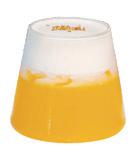
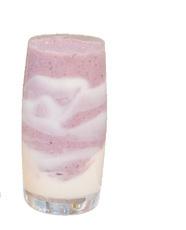
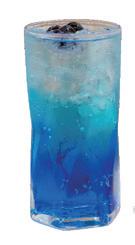
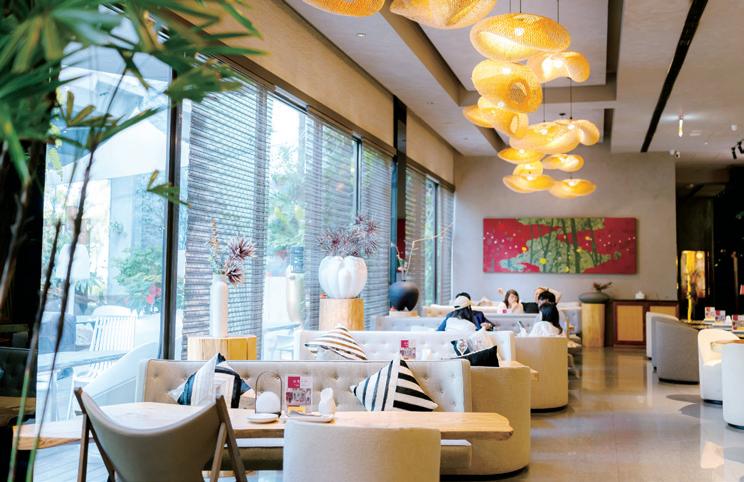
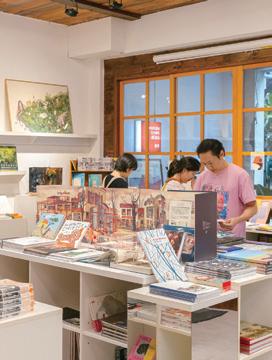
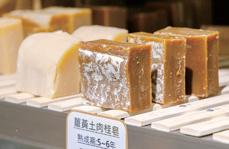
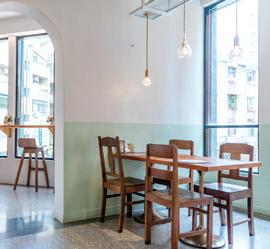
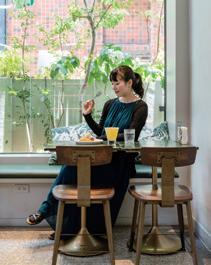
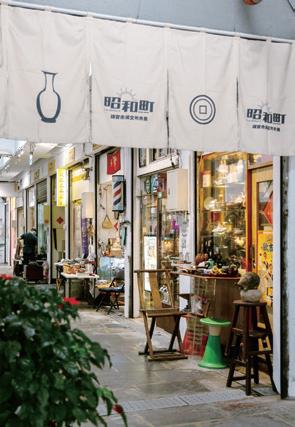
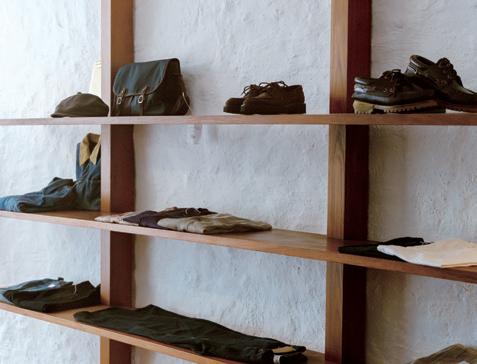
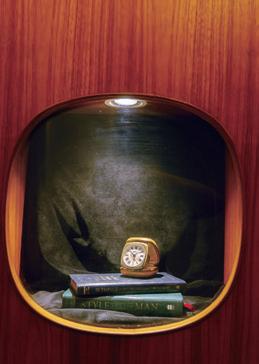
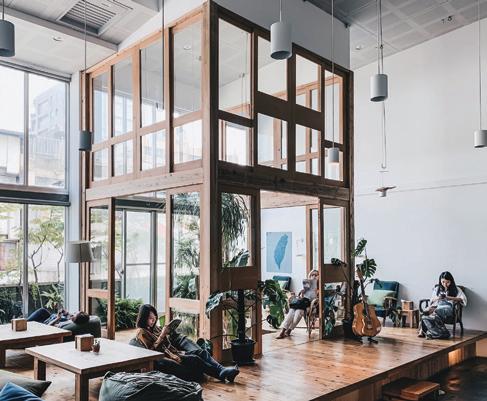
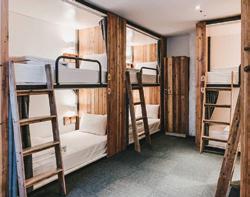
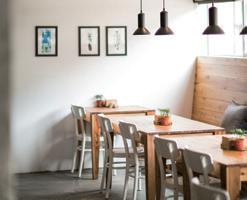
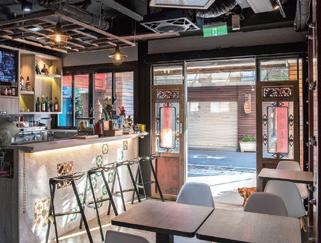
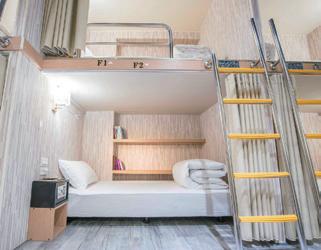
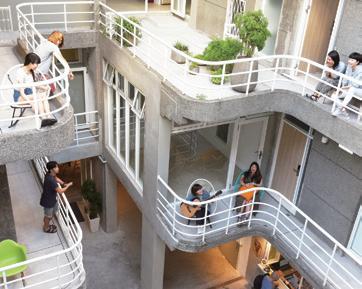
Rongjin Gorgeous Time 167, Jinhua St., Taipei City (02) 2321-8896
台北市立動物園
Taipei Zoo
30, Sec.2, Xinguang Rd., Taipei City (02) 2938-2300 ext .630
台北表演藝術中心
Taipei Performing Arts Center
1, Jiantan Rd., Taipei City (02) 7756-3888
台北當代藝術館
Museum of Contemporary Art (MoCA), Taipei 39 , Changan W. Rd., Taipei City (02) 2552-3721
台北流行音樂中心
Taipei Music Center
99, Sec. 8, Civic Blvd., Taipei City (02) 2788-6620
寶藏巖國際藝術村
Treasure Hill Artist Village
2 , Aly. 14, Ln. 230, Sec. 3, Tingzhou Rd., Taipei City (02) 2364-5313
新富町文化市場
U-mkt (Xinfu Market)
70, Sansui St., Taipei City (02) 2308-1092
美國在台協會
American Institute in Taiwan
100 , Jinhu Rd., Taipei City (02) 2162-2000
台北美國學校
Taipei American School 800 , Sec. 6 , Zhongshan N. Rd., Taipei City (02) 2873-9900
國語日報語文中心
Mandarin Daily News (Language Center)
2F, 2, Fuzhou St., Taipei City (02) 2341-8821
交通部觀光署旅遊服務中心 Travel Service Center, Tourism Administration, MOTC
240 , Dunhua N. Rd., Taipei City (02) 2717-3737
台北市政府秘書處市民服務組 Information and Assistance Division, Secretariat, Taipei City Government 1 , City Hall Rd., Taipei City ( 02) 2720 - 8889 / 1999 ext .1011
台北之家
Taipei Film House
18 , Sec. 2 , Zhongshan N. Rd., Taipei City (02) 2511-7786
台北記憶倉庫
Taipei Info Hub
265, Sec. 1, Zhongxiao W. Rd., Taipei City (02) 2371-4597
松山文創園區
Songshan Cultural and Creative Park
133 , Guangfu S. Rd., Taipei City (02) 2765-1388
華山 1914 文化創意產業園區
Huashan 1914 Creative Park
1 , Sec. 1 , Bade Rd., Taipei City (02) 2358-1914
國立台灣博物館
National Taiwan Museum
2 , Xiangyang Rd., Taipei City (02) 2382-2566
誠品書店台大店、西門店
eslite Bookstore NTU, Ximen
金石堂書店
Kingstone Bookstore
台北市立圖書館
Taipei Public Library (Main & Branches)
台北市各親子館
Parent-child Centers in Taipei
台北市旅遊服務中心
Visitor Information Centers in Taipei
新北捷運環狀線
台北捷運市政府站、忠孝復興站、 台北車站、西門站、民權西路站、 中正紀念堂站 All Stations on Circular Line of New Taipei Metro
Taipei City Hall, Zhongxiao Fuxing, Taipei Main Station, Ximen, Minquan W. Rd. and C.K.S. Memorial Hall of Taipei Metro
Editor’s Note
Welcome to the Taipei of summer, when the air is filled with balmy warmth – and a strong sense of romance! We’ve got three feature articles lined up for you. In our main feature, discover some of the best romantic escape destinations and activities for unconventional dates. Think of combining a scenic mountain-hideaway café or teahouse with splendid city views, appreciating the arts, DIY creation fun, and exciting sessions at a downtown interactive gaming complex or escape room facility.
Next, a duo of themed Taipei cafés that have become couples some unusual pets, the other introducing you to a wide range of eclectic art. Finally, a whirlwind tour of the most romantic nighttime big vistas, found up in city-overlooking mountain spots and in the urban core high up in – and on – tall buildings.
In our regular Themed Walks le, we present in-the-know ideas for photography-themed city explorations. In and Alleys, you ’ll be diving deep into Chaozhou Street, leafy anchor of a slow-living part of the city.
Two Out in Nature expeditions await you. One is a mountain-trail outing through terraced farms and bamboo groves cooled by a lacework of streams and old irrigation canals. The other is a quick visit to one of Taipei living landmark trees, a great banyan by a heritage temple in a sleepy old-timey neighborhood.
Interested in studio-class DIY Fun? Experience creative candle-making with a Taiwanese twist, crafting novel takehome souvenirs in the shape of soup dumplings and bubble tea. And how about true edibles in a pair of Food les, both designed to help you beat the summer heat! First up, a foray into the local world of frozen treats, introducing shops selling gelato and Taiwanese-style shaved ice. Then, a mini-tour of craft-beer bars showcasing innovative and creative boutique breweries.
While here you’ll also need a place to Stay in Style for you, which attractively “double as social hubs and cultural spaces.
Enjoy your summer days in our wonderful city!
Please scan this QR code and complete a short questionnaire to help us improve our magazine.
As a thank-you, you’ll be entered into a lucky draw for a chance to win a fun and practical gift!
We appreciate your time!
PUBLISHER
Hsiang Yu
EDITOR-IN-CHIEF
Chiaying Tzou
DEPUTY EDITOR-IN-CHIEF
Cathy Chen
MANAGING EDITOR
Erhhuan Lien
COVER PHOTO
Chen Cheng-Kuo
Department of Information and Tourism, Taipei City Government
Editors: Rick Charette, Johannes Twellmann, Anna Li
Contributors: Han Cheung, Rick Charette, Ami Barnes, James Baron, Jenna Lynn Cody, Ray Hecht
Design: Ian Tsai, Eve Chang
TAIPEI Subscription Services, Postal Wire Transfer: 4 Issues
Beneficiary Account No.: 16630048
Beneficiary Name: Department of Information and Tourism, Taipei City Government
Domestic Regular Mail
NT$120
Hong Kong/Macau Regular Air Mail
NT$360
Asia/Pacific Region Regular Air Mail
NT$440
NT$600
Europe/US/Africa Regular Air Mail
Online reading: www.travel.taipei/en > Media > TAIPEI
Department of Information and Tourism, Taipei City Government
All rights reserved.
Reproduction in any form without written permission is prohibited.
中華郵政台北雜字 第2372號執照登記為雜誌交寄
Price: NT$30
This magazine was printed with environmentally friendly soy ink. We hope you enjoy reading this issue of TAIPEI . If you have any suggestions, please do not hesitate to contact us.
SUMMER 2026 NO. 44
COVER STORY
ROMANTIC TAIPEI
Taipei for Two
Romantic Escape Destinations and Activities for Unconventional Dates in the City
Paws, Paints, and Pastries
Two Themed Taipei Cafés That Are Perfect for Dates
Taipei’s Most Romantic Nighttime Vistas
Up High in the City’s High-Rises and Mountains
THEMED WALKS
Taipei in Focus
Visiting the City as a Photography Aficionado
LANES AND ALLEYS
Chaozhou Street Discoveries
A Slow-Living Neighborhood with Local Crafts and Creativity
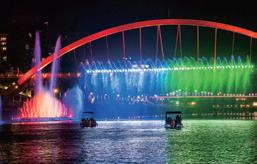
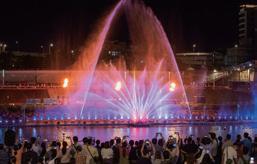
The Taipei Water Dance Festival is a spectacular riverside event that takes place at Xikou Wharf and Rainbow Bridge in Songshan District. This unique festival features mesmerizing water-dance performances along the Keelung River, with waterscreen projections, laser lights, and music combined to create a dazzling nighttime experience. Each evening, visitors can enjoy a colorful synchronized dual-water-fountain performance with a water curtain cascading from the bridge, water fountains shooting up from a platform in the river, and laser beams illuminating the night sky. For a special perspective, boat tours are also available during the shows. On opening and closing days, the water show is accompanied by fireworks. The gala also pairs perfectly with a visit to nearby attractions such as Raohe Street Night Market and Songshan Ciyou Temple.
Xikou Wharf and Rainbow Bridge 錫口碼頭及彩虹橋
June 13-27 (Water dance at 6:30pm, 7:30pm, 8:30pm, and 9:00pm)
2026waterdance.travel.taipei
#02
Taipei Summer Festival
大稻埕夏日節
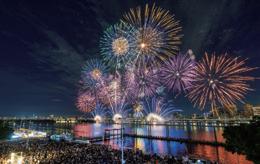
Held every summer before Lunar Valentine’s Day along the banks of the Tamsui River, the Taipei Summer Festival is one of the city’s most enchanting celebrations, transforming the historic Dadaocheng Wharf area and Yanping Riverside Park into a dazzling midsummer spectacle. The 2026 edition will center on two fireworks shows featuring drone art, along with live music performances, and summer street food. Another highlight of the event is the collaboration with international IP and themed installations along the riverbanks. The festival organizer also partners with local vendors and travel agencies to offer exclusive promotions, further enticing both domestic and international visitors to experience Taipei’s historic charm and vibrant riverside atmosphere. taipeisummer.travel.taipei
Flood Gates 3-5, Yanping Riverside Park 延平河濱公園3號至5號水門
July 25 - August 15
#03
Trendy Taipei
潮臺北
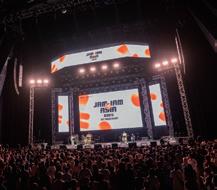
In 2026, Trendy Taipei is set to become louder, bolder, and more vibrant than ever. Under this year’s theme, Taipei in Vibes, the festival reinvents itself by placing music even more firmly at the heart of the city’s story, using sound to paint a fresh portrait of Taipei’s dynamic spirit. The event has a strong focus on collaboration and discovery, bringing together local and international artists. Beyond headline performances, the program highlights emerging talent, cross-genre experiments, and special one-off collaborations, giving audiences a chance to experience unexpected moments throughout the city. What makes the festival special is that it moves beyond traditional stages, expanding across major cultural landmarks in the city in a nonstop, day-and-night urban celebration. In addition to the main venue, the Taipei Music Center, events will also take place at live houses, cultural parks, and open spaces across Taipei.
#04
Taipei Xia-Hai City God Cultural
霞海城隍文化節
Festival
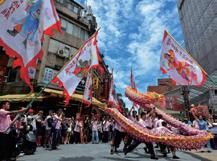
Rooted in a tradition dating back to the Qing Dynasty, the Taipei Xia-Hai City God Cultural Festival is held around Taipei Xia-Hai City God Temple, known as a temple where people pray for love and happy marriages. The festival celebrates the birthday of the City God – Taipei’s divine guardian and deity of justice – with a grand processional parade that draws large crowds each year. Beyond its spectacular temple rituals and river procession ceremony, the festival also embraces contemporary values such as fair trade, environmental sustainability, and social equality through exhibitions, street markets, and live music performances – an unmissable blend of living faith and the vibrant street culture of Dadaocheng.
Bravo the Bear on a Mission !
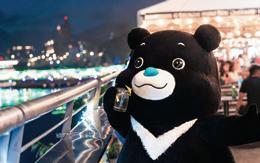
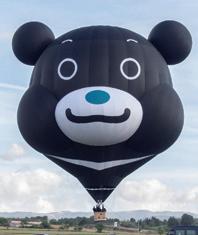
Bravo the Bear is one of Taipei City’s most beloved mascots, adored by children and adults alike for his friendly personality and playful presence throughout the city. Regularly appearing at major events and in public spaces, he has become a familiar and cheerful symbol for residents and visitors. This summer (July 4 – August 20), Bravo is embarking on a special “mission” outside Taipei, heading to Taitung County to take part in the Taiwan International Balloon Festival at Luye Highland. Fans can look forward to the Taipei Bravo hotair balloon, bringing a touch of Taipei’s charm to Taitung. The hotair balloon will also appear at the Taimali Dawn Park on July 23, to welcome the sunrise with everyone.
August is also Bravo’s birthday month — follow his official Facebook page (facebook.com/bravotaipei ) for the latest updates, event news, and birthday celebration activities throughout the season.
Taipei Music Center (main venue)
台北流行音樂中心
August 22 – September 6 trendy.taipei
Taipei Xia-Hai City God Temple
台北霞海城隍廟 June 14 – July 2
Romantic Escape Destinations and Activities for Unconventional Dates in the City
The city of Taipei offers a wide range of ideas for those looking to go beyond the usual dinner-and-movie routine, with options that range from scenic escapes to hands-on experiences. This is a city where couples can move easily from a quiet café or teahouse retreat in the mountains to a fast-paced interactive gaming facility in the heart of the city.
Big, seemingly always bustling Taipei is a surprisingly romantic city for couples, where quaint alleys, mountain lookouts with sweeping night views, and hidden-away cafés serve as countless intimate escapes. The city also features love-themed installations, like the LOVE sign at Taipei 101, riverside love locks, and seasonal light displays, as well as arts, crafts, and diverse other playful activities that are enjoyable for two.
Those looking to unwind, embraced by Mother Nature, can head to the high hills surrounding the city core, including those within Yangmingshan National Park and the Maokong tea-growing area, both just a short ride away from downtown. Besides exploring their trails and viewpoints, visitors can cozy up with a cup of artisanal coffee or a pot of locally grown tea. Set amid lush greenery with open views, these spots are intimate retreats far removed from the city below.
For a change of pace, Taipei’s urban-core cultural spaces offer a wide range of immersive and interactive experiences. Museums, design stores, creative studios, and even restaurants and cafés invite couples to engage and collaborate through exhibitions or hands-on activities that let them create personal keepsakes together.
Couples in the mood for something more high-energy can also tackle shared challenges such as escape rooms and virtual-reality games. While these activities may not be romantic in the traditional sense, they create moments of teamwork, spontaneity, and even lighthearted competition, often creating some of the most memorable moments of a date.
These richly varied experiences highlight Taipei as a city where romance is not just about where you go, but what you do together.
TEXT | HAN CHEUNG PHOTOS | CHEN CHENG-KUO
Yangmingshan Coffee
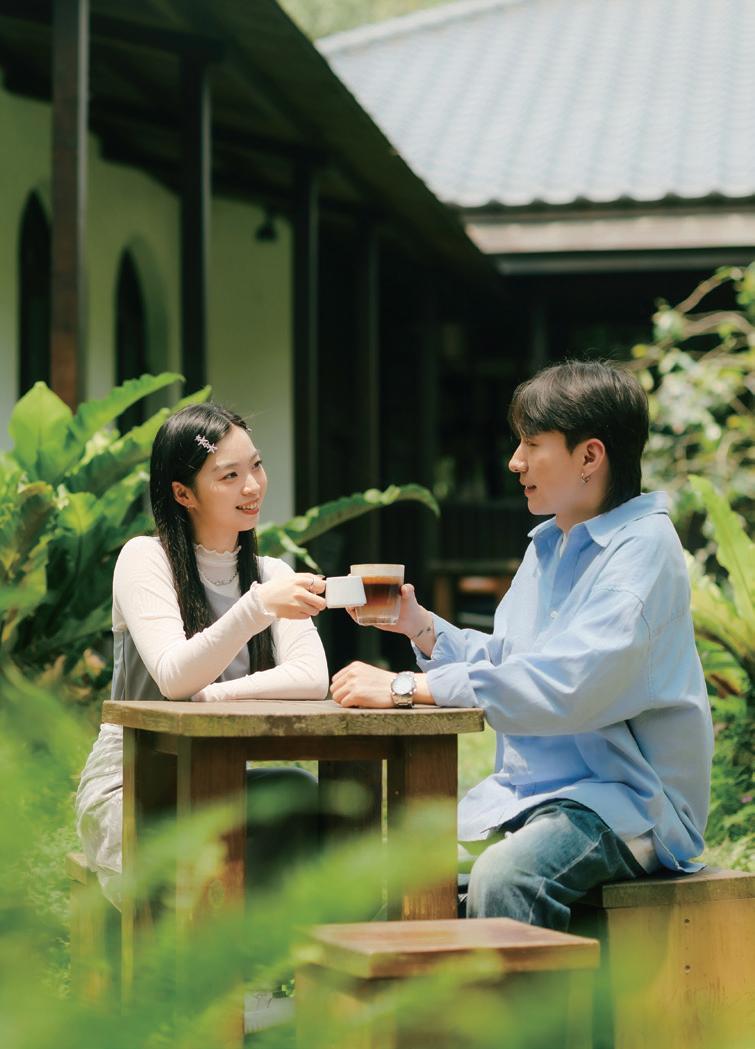
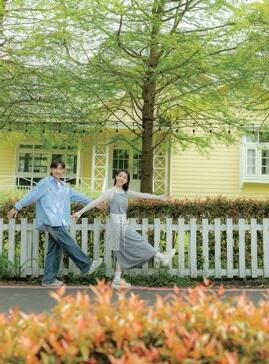
Escape on a date to the tranquil Yangmingshan American Military Housing community, just outside Yangmingshan National Park, home to wooden bungalows with sloped roofs and leafy yards that evoke a dreamy slice of American suburbia. Just a short distance from Chinese Culture University, this neighborhood offers an unexpected detour from busy central Taipei.
Built from American-provided plans, the secluded enclave of 217 homes housed US military officers, advisors, and their families stationed in Taiwan during and after the Korean War. The houses are spaced amid open lawns and feature chimneys and fireplaces for cultural familiarity.
After the US severed diplomatic ties with Taiwan in 1979, the community was gradually vacated, with many houses later leased or left to fall into disrepair. Today, around 150 still stand. Starting in the 2010s, parts of the area began reopening to the public as homey cafés, restaurants, and cultural spaces perfect for couples to spend some quality time together.
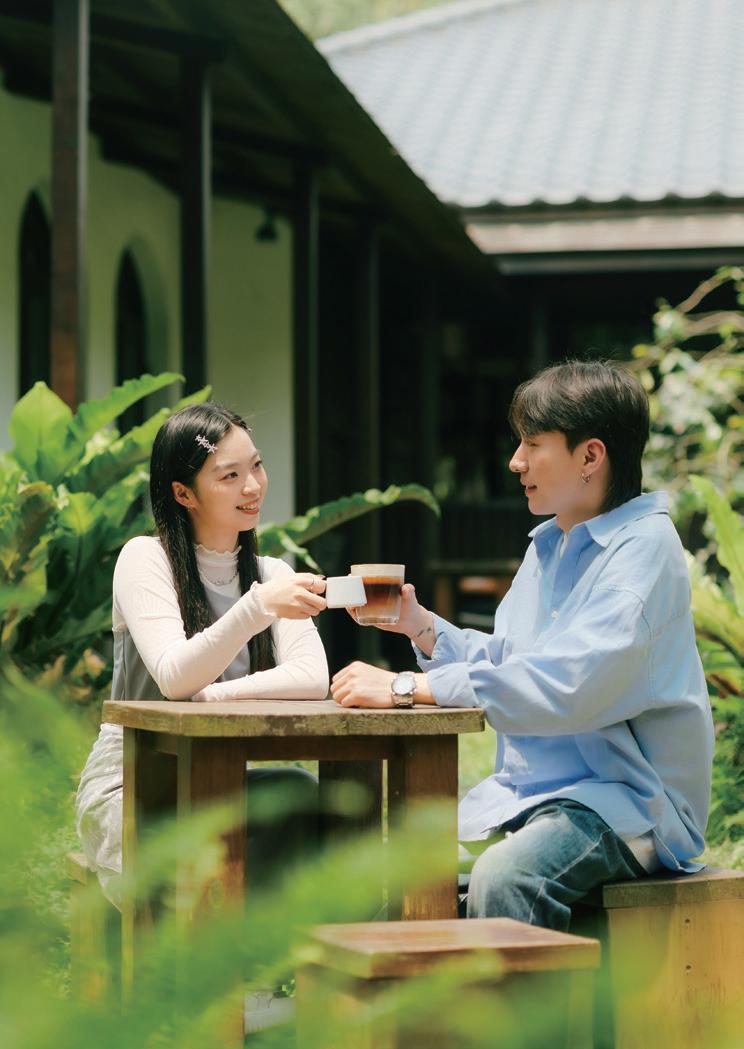
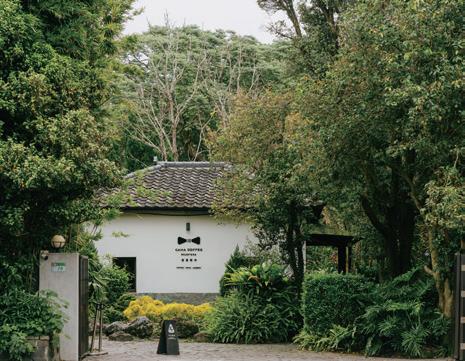
Nearby, on the other side of Gezhi Road, is another example of adaptive reuse of derelict structures. Housed in a Japanese-style building dating to 1937, Cama Coffee Roasters is the flagship outlet of a
premium experiential brand launched by the otherwise ubiquitous Cama Cafe chain. In place of the signature bright-yellow signage you will see at each branch is a subdued stone monument with metal lettering, leading to an estate with dark roof tiles and bold wood trims, set amid lush greenery.
Inside, the white masonry façade gives way to timberframe wings with covered walkways and open decks at the rear. Large windows frame views of the surrounding bamboo groves and garden, ideal for a post-coffee stroll and selfie-taking. The cozy interior includes a roasting laboratory, where you can observe the process and sign up for DIY classes to learn how to select beans and roast them to your taste, for a fun experience with your date. The menu includes brunch sets, salads, and desserts such as the Forest Bûche.
Apart from this café, there are several other restaurants, cafés, and bakeries in the community, perfect to explore during a romantic afternoon. Yangmingshan is, of course, also a great park for outdoor activities together, especially hiking along its many trails. Recommended for leisure walks are the Yangming Park and Erziping Trail.
CAMA COFFEE ROASTERS 豆留森林
70, Gezhi Rd., Shilin Dist. (02) 2861-1218
camacoffeeroasters.com
Mon-Thu 9:30am-6:30pm Fri-Sun 9:30am-7:00pm
Cama Coffee Roasters
Yangmingshan American Military Housing community
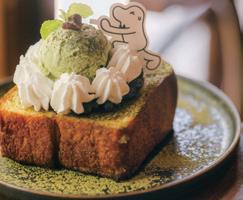
Forest Bûche
Maokong Tea
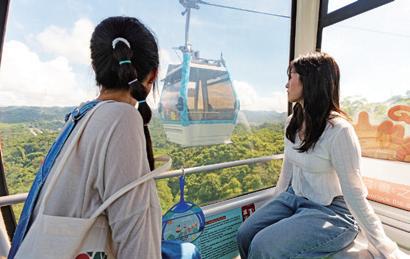
A different kind of romantic mountain escape awaits in Maokong, accessible by a scenic Maokong Gondola ride from the Taipei Zoo Station. The journey is part of the experience, lifting you above the city and over rolling slopes with distant skyline views. A popular option is a “crystal cabin,” fitted with a glass floor that allows you to look straight down at the treetops below.
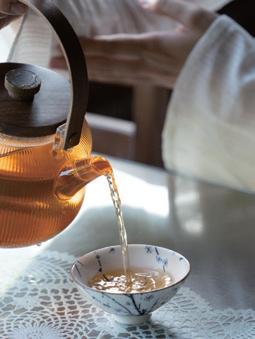
Maokong has long been known for its tea farms and rustic traditional teahouses, where you purchase a packet of tea and slowly brew it over lingering conversation. A visit is meant to be unhurried, with time to sit, sip, and take in the soothing scenery; any remaining tea can be taken home. In addition to its signature Tieguanyin, a heavily roasted oolong, the area is also known for lighter, more delicate Baozhong and other varieties.
Among Maokong’s numerous options, Chenxi Tea House, not far from Maokong Station, stands out for its hillside position and spacious outdoor seating, with views stretching across the surrounding mountains and the city beyond. The food menu offers a range of mostly tea-infused desserts, such as tea jelly and Tieguanyin Basque cake.
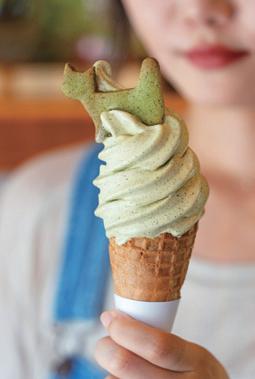
Located close to the gondola station, Maokong Teahouse is a more compact spot known for its tea ice cream and tea-baked eggs, which take two days to prepare. There are Tieguanyin and Baozhong flavors, each topped with a cat-shaped biscuit –also infused with tea. Called “Meow Meow” Ice Cream, these cute icy treats are perfect for taking selfies to remember a fun date in Maokong.
Those tired of sitting can explore walking paths that wind through the tea plantations. The Tea Center Trail, for example, leads to the Maokong Potholes, small, round erosion-created holes in the riverbed rock that give the area its name.
Since many teahouses stay open late and serve full meals, you can take your time taking in the twinkling city lights in the distance in an intimate, conversation-friendly setting without feeling like you need to rush back home.
CHENXI TEA HOUSE 晨曦茶坊 53, Ln. 34, Sec. 3, Zhinan Rd., Wenshan Dist. (02) 2936-4336 instagram.com/chenxi_r16 Mon-Thu 9:30am-12:00am Fri-Sun 9:30am-3:00am
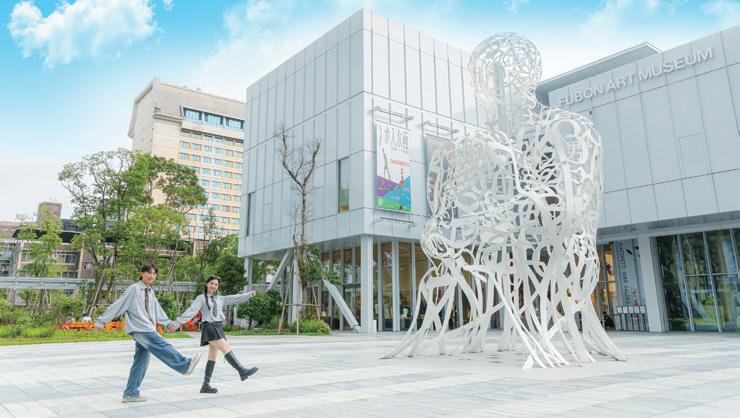
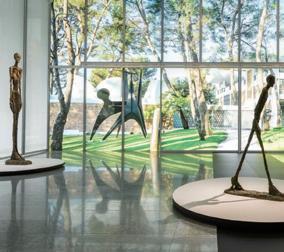
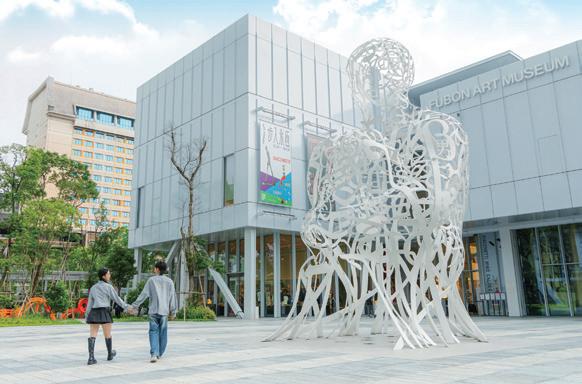
Showcasing works by Western and Asian masters, the Fubon Art Museum offers a more contemplative date option in the heart of Taipei’s Xinyi shopping district. Established by Fubon Financial Holding in 2024, the museum has presented thematic exhibitions primarily featuring such major modern artists as Rodin, Van Gogh, Giacometti, Miró, and Calder, as well as works from the Fubon Art Foundation’s private collection.
The minimalist building, defined by clean lines and light-filled gallery spaces, is topped by a striking red crane used to install large artworks and maintain the façade. It was designed by celebrated Italian architect Renzo Piano in collaboration with Kris Yao from Taiwan. Piano also designed the adjacent Fubon Life Tower, currently the thirdtallest building in Taipei.
Anchoring the museum is a tranquil, landscaped outdoor plaza dotted with irregularly shaped brightorange benches and itself anchored by a large humanoid installation by Jaume Plensa. This is composed of characters and letters from multiple languages, the Chinese characters for “light” and “love” calligraphed by museum director Maggie Tsai. The plaza space is commonly used by couples relaxing before or after visiting the galleries.
The museum is compact and straightforward to browse through, with high ceilings and shifting natural light across the interior, and features Taiwan’s largest column-free exhibition hall. Walking through the museum together is quite an experience, with
the beautifully curated natural light putting you instantly in a good mood. Featuring emerging and established artists, the museum’s exhibitions are often inspiring and give you plenty to talk about. An entire exhibition can generally be seen in under two hours, making it easy to pair the visit with dinner or a walk around Taipei 101 and the surrounding malls, all within walking distance.
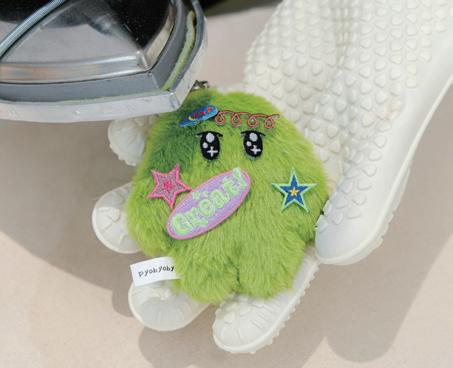
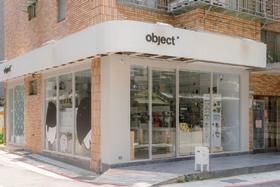
A hands-on stop for couples who enjoy creative activities together, Object Taipei Store specializes in customizable accessories featuring cute, quirky illustrations. One of the most popular items is the No Face doll, which can be decorated with embroidered “wappen” patches.
The brand originated in Seoul in 2013, showcasing the work of emerging local artists, and quickly became a major draw for locals and tourists. It later expanded to Osaka and Nagoya in Japan before arriving in Taipei last year. The street-level storefront is tucked into an alley in the trendy Zhongshan District, known for its boutiques, select shops, lifestyle stores, and cafés.
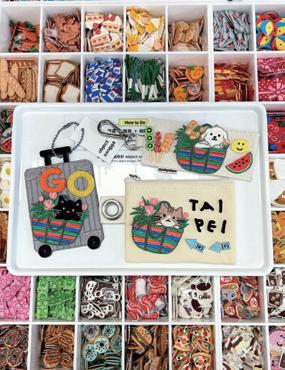
In the center of the brightly-lit store is a large grid-display table with colorful wappen patches and other attachable components. Customers can make simple keyrings by linking them to a “podo” chain, or arrange them on stock items such as cardholders, coin purses, and cup sleeves. Blank dolls by different designers are available, including a Soso love heart version that’s a favorite with sweetheart couples, who often create one each and hang it on their bags.
The appeal for dates lies in the shared decision-making process and the small keepsakes couples leave with. The staff can help with the selection when needed and take care of the ironing, which takes about five minutes. Exclusive to the Taipei store is a milk tea-colored No Face doll, as well as patches featuring Taiwanese cultural motifs such as bubble milk tea, blue-and-white plastic slippers, and the iconic three-color ga-ji shopping bag. The store also presents selected stationery, lifestyle, and decorative goods and spotlights rotating artists, whose work is exhibited in the showroom across the street.
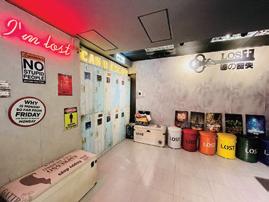
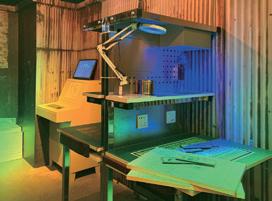
Just two people are enough to enter LOST Taiwan, an escape room operation in Taipei, where couples can bond through solving puzzles together under time pressure. Twenty different scenarios are spread across four branches in Taipei: two in the Ximending area, one in the East District, and one near Taipei Main Station. The experiences generally last for about an hour, making it easy to fit into an evening out, with plenty of dining and drink options near each location.
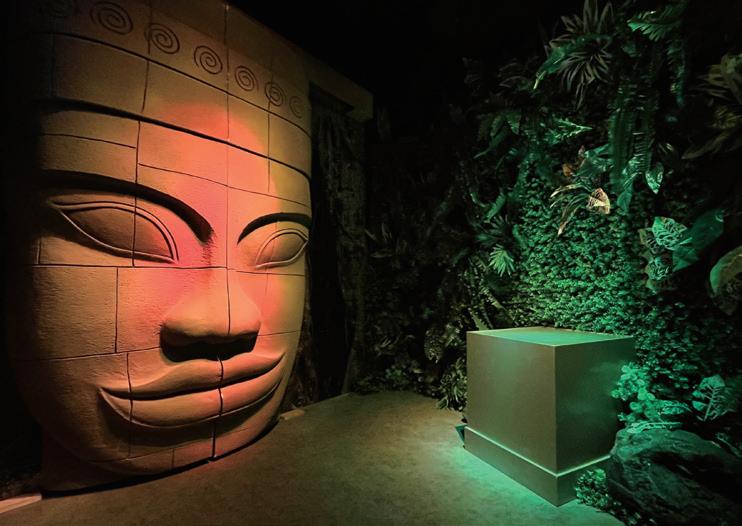
Players can race to retrieve an ancient artifact from Easter Island as a storm closes in, stop the release of the spirit of Qin Shi Huang (first emperor of China) while being trapped in a tomb, pass the admission test to a magic academy aboard an interdimensional train, or attempt a high-stakes bank heist by sneaking into a tightly guarded bank vault to switch out banknotes with counterfeits.
Puzzles range from logic and pattern recognition to handson tasks that require coordination and communication. Rooms feature themed settings and interactive elements, and players are sometimes provided with usable items. Most experiences follow a linear progression, allowing players to work through challenges step by step. Staff provide instructions before the game and monitor progress throughout, offering hints when needed. Both instructions and the games themselves are available in English.
LOST Taiwan promises that the adventures are not scary, and there won’t be any live actors in the rooms. However, there might be special seasonal horror themes, giving couples the chance to find out how they react to facing their deepest fears together – and whether their date is the type to grab their hand or hide behind them. A small number of rooms require at least three participants, so it’s best to check in advance.
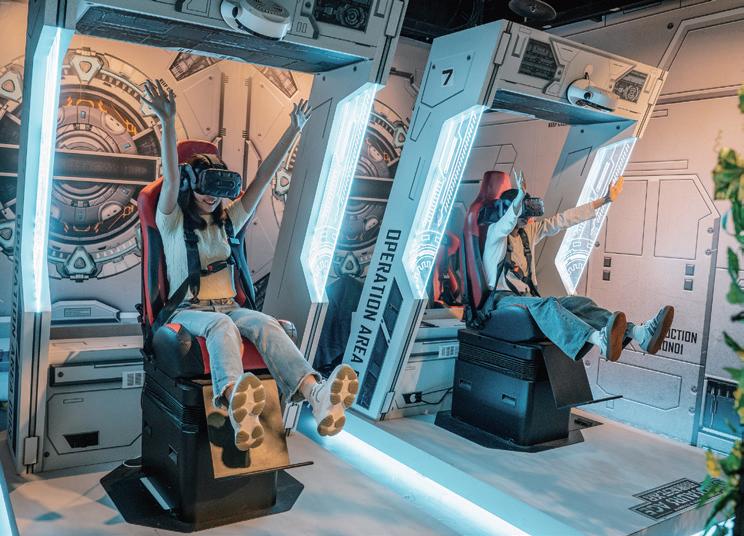
A more tech-driven option, Viveland VR allows couples to explore digital worlds, take on challenges, defeat enemies, and even compete against each other. Offering a diverse range of VR devices and games, the arcade is located in Syntrend Creative Park, a multistory electronics and gaming mall that’s worth exploring on its own.
After a short briefing, players put on headsets and are guided into a shared virtual space, where they can see and interact with each other as avatars. Using handheld controllers, they move, grab objects, and complete tasks within the game, with staff on hand to assist if needed.
According to staff, escape room-style games are the most popular choice for couples, as they require close collaboration and effective communication. One standout is Prince of Persia: The Dagger of Time, where players must escape the Fortress of Time to stop an evil magi. In House of Fear, the puzzles are relatively simple, but players are trapped in a creepy abandoned house with jump scares and spine-chilling encounters.
Shooting games are also a favorite. Couples can team up to fend off zombie hordes using a varied arsenal of weapons in Dead Corps, or square off against each other in a fast-paced, futuristic game of laser tag in Versus. And sometimes, a good old arcade classic like a high-speed car-racing game is all it takes.
Viveland rotates its selection of games so that returning visitors can find new scenarios to try. It is advisable to check availability and book ahead, especially for visits during weekends or peak hours. English versions of the games are available.
Two Themed Taipei Café s That Are Perfect for Dates
TEXT | HAN CHEUNG PHOTOS | VISION
From cute critters to activity-based concepts, themed cafés have become go-to date spots in Taipei. By combining special interests, like the love for comforting exotic pets, with playful interiors, creatively presented dishes, and interactive elements, these venues turn a simple meal into a singular shared experience filled with lighthearted moments and plenty of photo-worthy opportunities, all perfect for a cozy date.
Did you know that the world’s first cat café is said to have opened in Taipei in 1998? Since then, the concept has expanded beyond cats to include dogs, birds, and even more unusual residents such as chinchillas and capybaras, becoming a popular date option during which couples can bond over furry company. The novelty is part of the appeal, but do keep animal welfare in mind when deciding where to go.
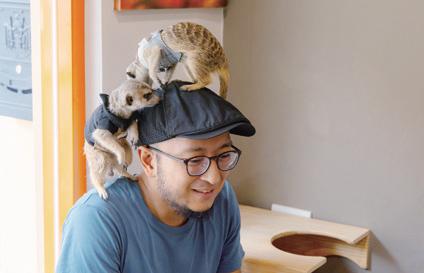
Located north of MRT Xinyi Anhe Station, Meerkat75 Café is home to a family of energetic meerkats, including playful juveniles who rotate shifts to melt customers’ hearts. The animals are usually housed in a glass enclosure at the back of the café, and visitors can book 15-minute slots to meet them up close in a separate room.
There is a set of house rules in place to ensure safe interactions, but once you start playing with the animals, it’s hard not to be immediately charmed. The meerkats are endlessly curious – sniffing at your hands, tugging at your sleeves, and occasionally scrambling right up onto your shoulders or head for a better look. Their tiny, warm weight and bright, inquisitive eyes have a way of melting
For couples, the experience offers something surprisingly sweet: laughing together as a meerkat investigates your partner’s hair, or catching each other’s eye when one of the little creatures decides your lap is the perfect napping spot. Staff are on hand throughout the session to guide visitors and ensure everyone – human and meerkat alike – feels comfortable.
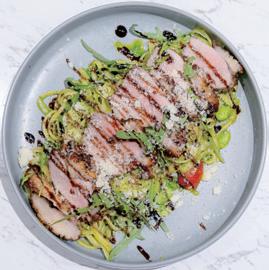
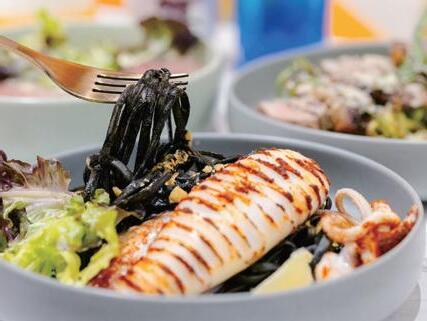
The brightly lit, colorful interior is full of meerkatthemed decorations and merchandise for sale, and all seating offers a clear view of the main enclosure. The menu features a mix of well-presented Western-style dishes, including Spanish Cuttlefish-ink Pasta and Duck Breast & Pesto Pasta, alongside classic desserts such as ice-cream pancake platters and cheesecakes. Colorful drinks, such as a Blue Curacao sparkling drink and an Orange Green Tea with milk foam, add to the playful vibe.
11:00am-8:00pm
11:30am-9:00pm
Duck Breast & PestoPasta
Spanish Cuttlefish-ink Pasta
Careful with the little guys
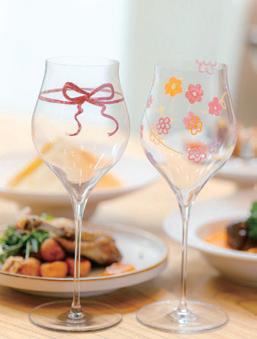
At Poetry, couples are given markers to draw on their drink glasses, adding names, flirtatious doodles, and little jokes that make the experience more creative and personal. While the simple idea is a major draw for dates, this spacious, art-filled, lounge-style bistro with an outdoor garden terrace and private booths offers an intimate yet chic atmosphere well-suited for a romantic night out.
Tucked away from the office towers and traffic near MRT Xihu Station, Poetry feels like a deliberate escape. The owner set out to create a quiet refuge from the busy metropolis, summed up in the line, “arrive like a poem, hide away for a while.” For couples working in the surrounding tech park looking to decompress and reconnect after a long day, the generous layout, well-spaced seating, and private booths offer a kind of breathing room that’s genuinely rare in Taipei. The bistro stays open late, making it a natural choice when the evening calls for lingering.
The façade is defined by a metal-grid wall, allowing the growth of plants through its structure. The doors lead to a striking, solid aspen wood bar that blends well with the industrial elements and quirky art pieces. Inside, the design strikes a balance between modern and cozy, featuring Taiwanese cypress tables paired with European designer furniture and greenery throughout. Floor-to-ceiling
Glasses painted by dining couples
windows bring in soft natural light during the day, while woven lamps create a more intimate, bar-like atmosphere in the evening.
The interior is a natural draw for art-minded couples. Art fills the space, with a particular focus on the whimsical, childlike paintings and sculptures of Juan Ripolles. Toward the back, traditional Taiwanese hand puppets are displayed on shelves, looking slightly out of place yet adding to the intrigue.
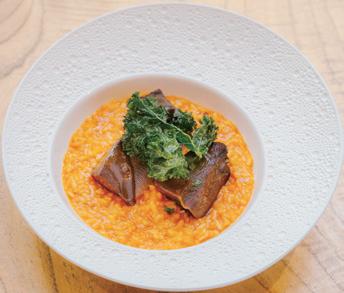
Grilled ox-tongue risotto
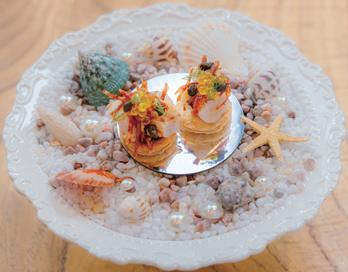
The extensive menu is largely inspired by Spanish cuisine, reinterpreted with Taiwanese ingredients. This season’s signature dish is a grilled ox-tongue risotto with a Basque-style roasted paprika base, topped with a thick, tender slice of ox tongue braised in soy and oyster sauce and served with kale. Other highlights include the rouge duck confit with potato gnocchi and a house-made fermented pineapple chili sauce, as well as a one-bite tapas featuring a pastry base, scallops, chorizo, and black garlic.
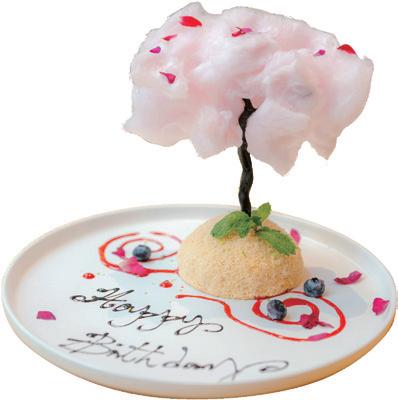
For dessert, a good choice for couples is the Wishing Tree, which resembles a cherry blossom, with pink cotton candy and a chocolate stem set atop a mound of lemon cheesecake, finished with delicate petal-like toppings. The staff can decorate the plate with messages such as
466, Sec. 2, Tiding Blvd., Zhongshan Dist. (02) 8501-5416
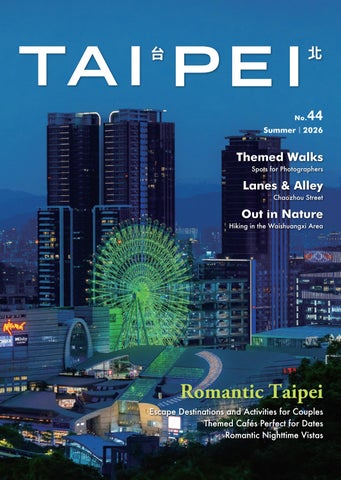
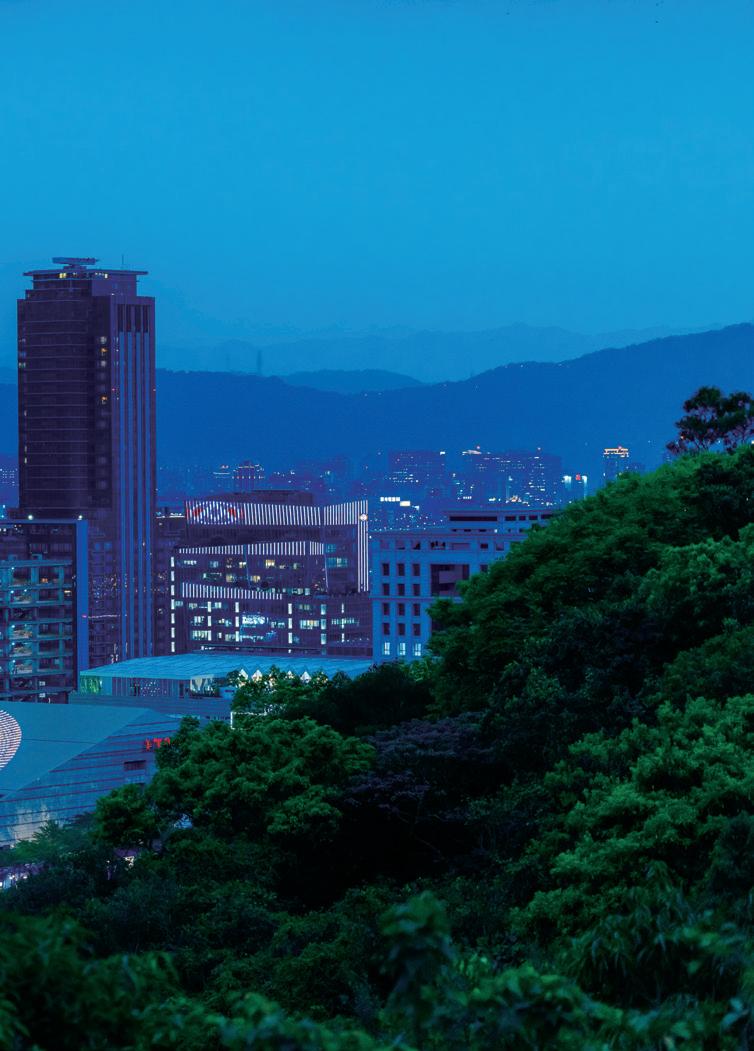
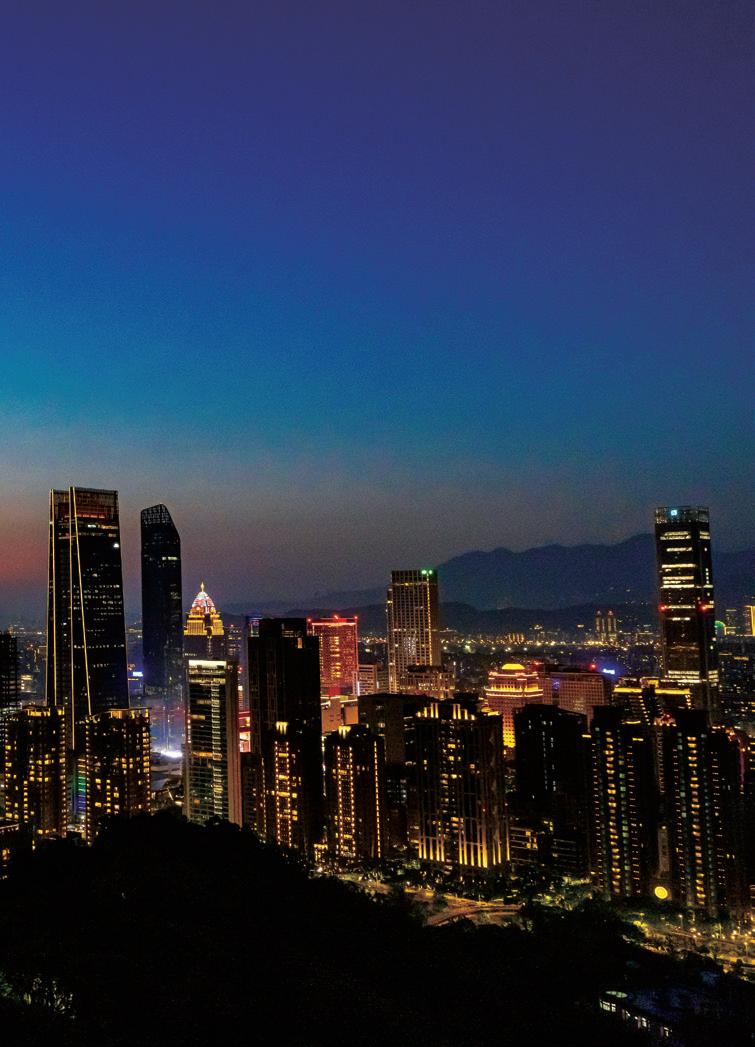
Ah, Taipei … the deeper the night, the more romantic the twinkling panoramas of this city that never sleeps, from vantage points well-known to couples with a twinkle in their eye for each other. Read on to find out where they are, high up in manmade steel-and-concrete towers at dining and recreation hotspots or up in the hills, embraced by nature’s quiet.
Up in Manmade High-Rises
Let’s head deep into the city’s urban busy-ness and high up to panoramas awaiting you and your sweetheart, both “in” and “on” iconic soaring spires created by inspired man.
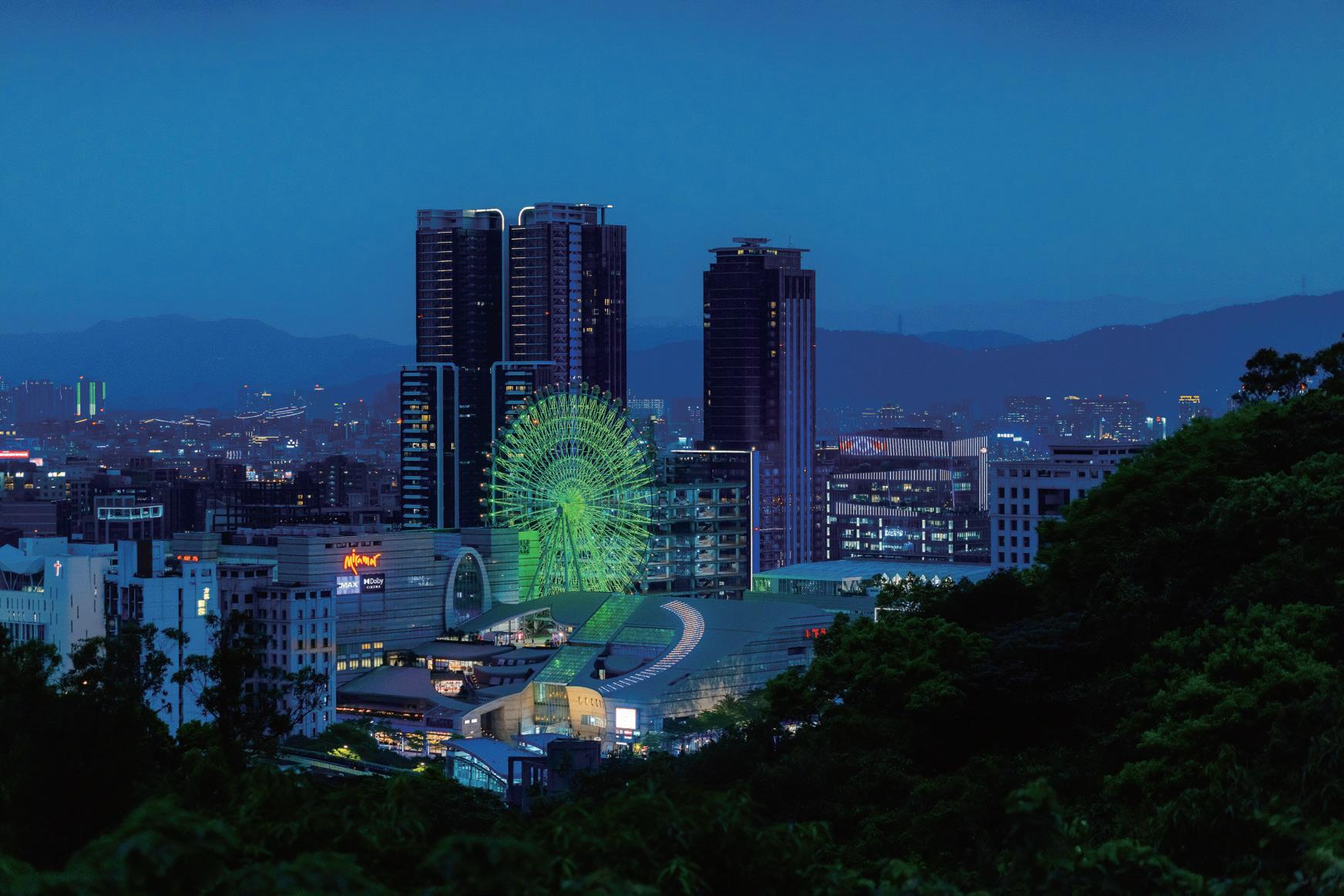
Miramar Ferris Wheel
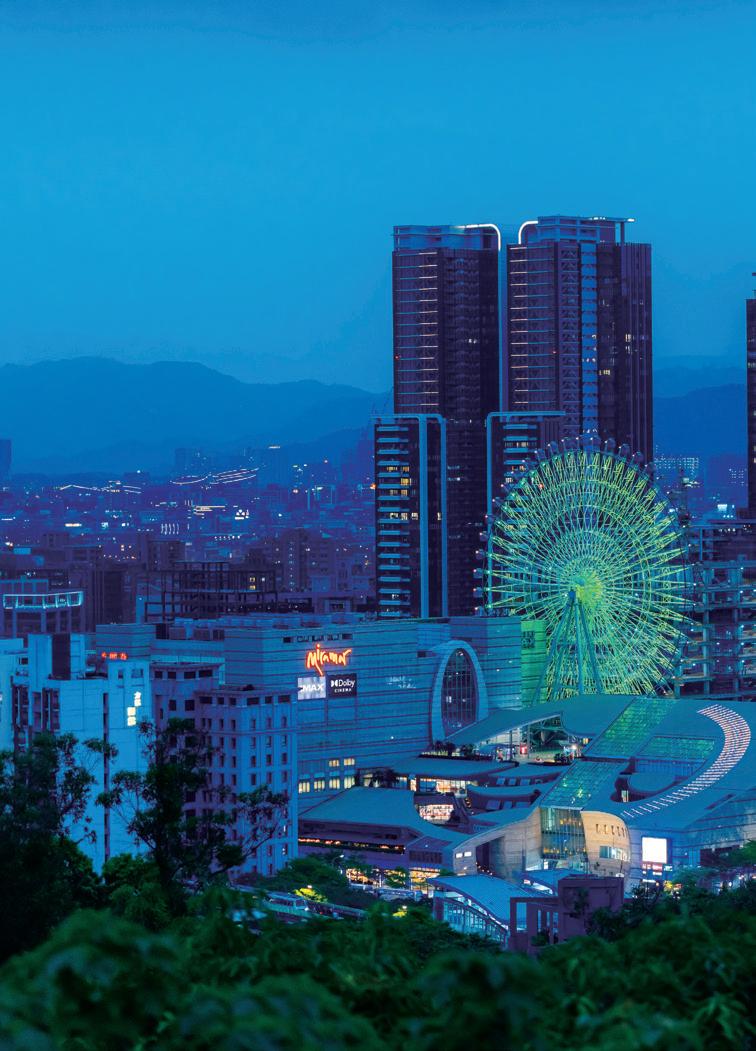
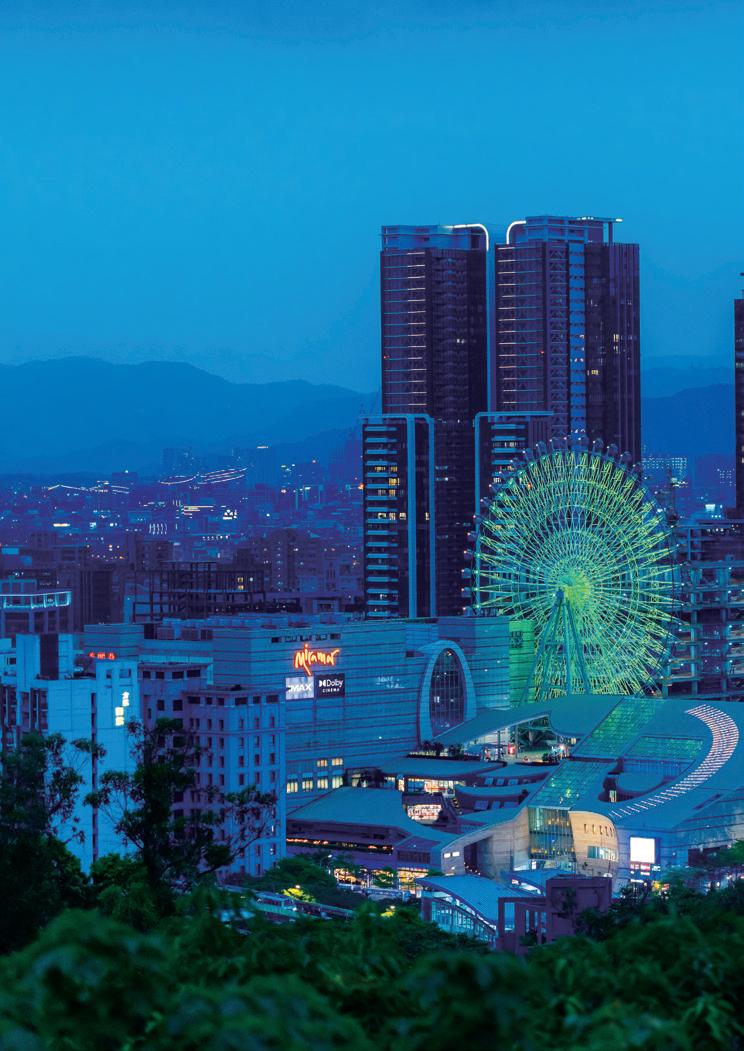
This giant 95-meter-high attraction sits prominently atop the multi-story Miramar Entertainment Park building (shopping/ dining/entertainment). Dazzlingly lit up at night, its carriages are the perfect place to get cozy with that special someone, looking south across Dajia Riverside Park, beyond to planes taking off and landing at Taipei Songshan Airport, and the full city beyond that, lit up east to west. One exhilarating ride takes about 20 minutes.
Taipei 101
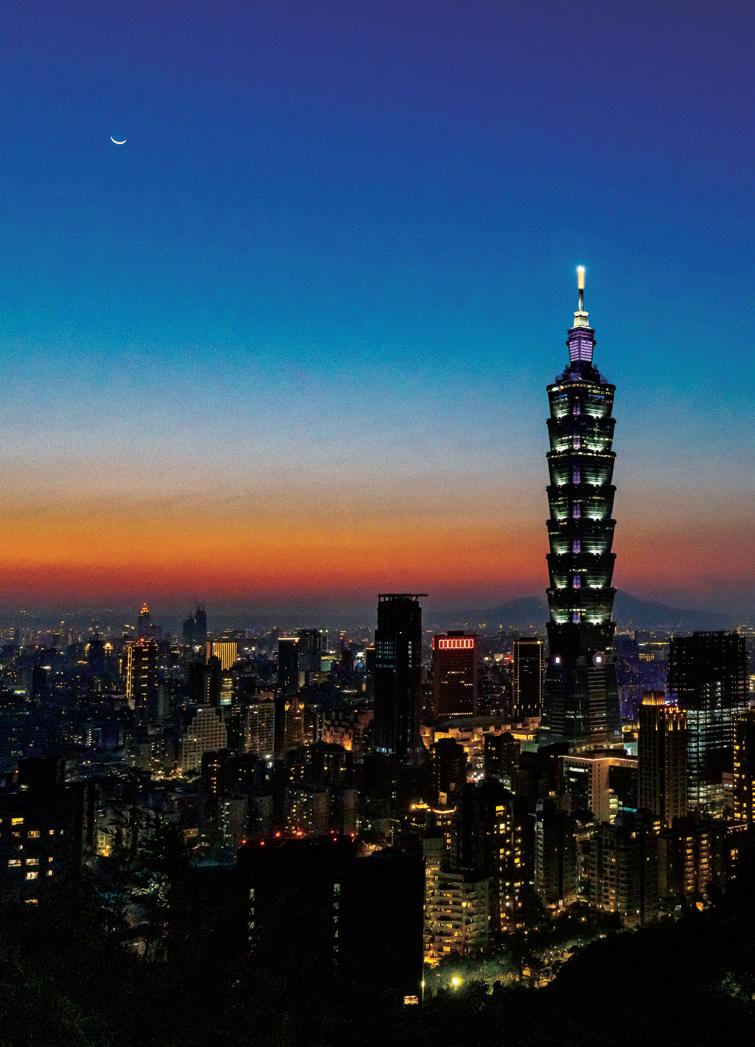
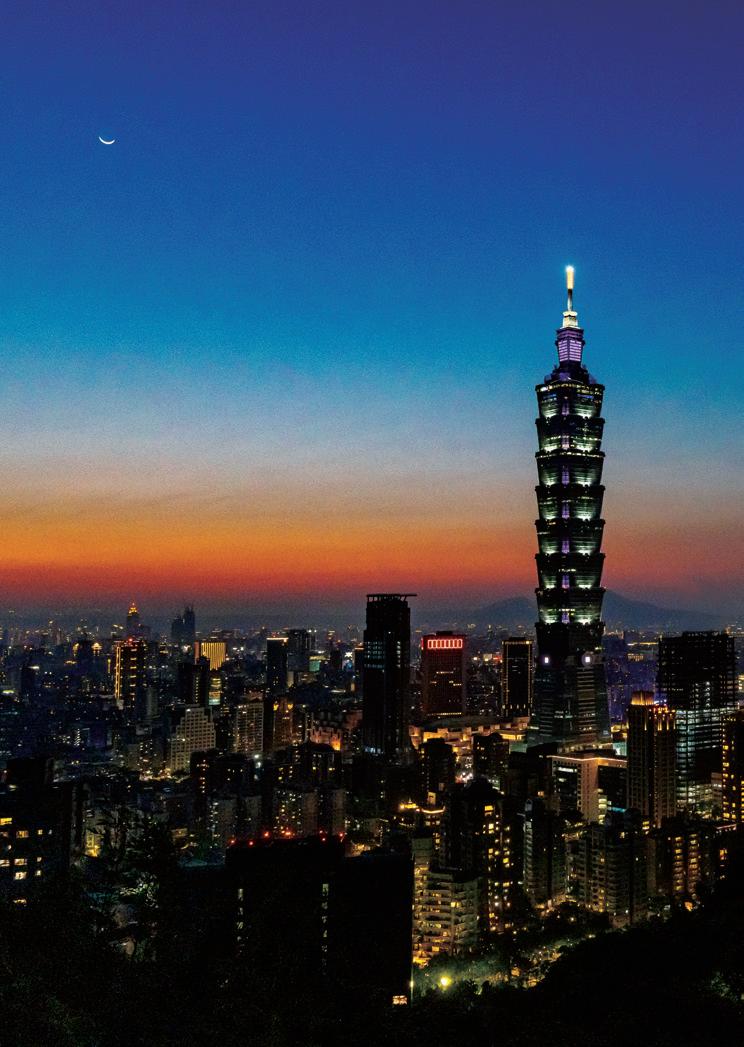
The pinnacle of the downtown Taipei sky is the crown of the skyscraping Taipei 101 tower, Taiwan’s tallest building. Super-fast elevators, racing along at 1,010 meters per minute, fly you to the Observatory on the 89 th floor in just 37 seconds, which is, of course, much more effortless than free climber Alex Honnold’s approach. This level is a 360-degree indoor observation deck, and there is also access to an enclosed outdoor deck on floor 91. Enjoy an array of quality food-and-beverage spots high up in the spire.
Taipei Nan Shan Plaza
This Taipei 101 neighbor is a newer addition to the burgeoning city skyline. Opened in 2019, it is Taiwan’s fourth-tallest building. High-end high-up dining venues fill up floors 46~48 (options on lower levels as well). Renowned names include Chuan Ya (46F, Sichuan cuisine, Michelin-starred), Saffron 46 (46F, Indian cuisine), MiraWan (47F, French cuisine), and Cé La Vi Taipei (48F, contemporary Asian cuisine, sky bar).
Beitou Incinerator
Yes, you just read that title correctly. Romance awaits you up a Taipei incinerator. Enjoy grand night/day views, and surely one of your life’s oddest dining experiences, 120 meters up on the outside of this 40-story-high smokestack at the glass-walled Moonstar, Taipei’s only 360-degree revolving restaurant (completes one turn every 90 min., Western cuisine/afternoon tea). Overlooking the confluence of the Tamsui/Keelung rivers, you can also take in the spectacular sunsets over the Tamsui River and Mt. Guanyin behind it. Live singers perform Fri-Sun.
Up in Nature-Sculpted Hills
Taipei sits in a sea-level basin surrounded by mountains, all hill areas smoothly accessible via the comprehensive public-transport web.
Elephant Mountain Trails
The city’s famed Taipei 101 tower sits in a Taipei Basin east-side nook, and just behind is Four Beasts Mountain, made up of four low peaks. Laced with well-maintained trails that start at the mountain base, many lit at night, the Elephant Mountain Trail is the most popular. Each night, you’ll find photographers and smooching sweethearts taking in the pulsating skyline view at the Six Boulders lookout. (Savor a taste now with a Google search for “Taipei Live Cam Xiangshan.”)
Bishan Temple
Perched high on a ridge of a mountain in the Neihu District, overlooking almost the full basin running far west, is the grandiose Bishan Temple. Each night, its mountainside-overhang courtyard fills up with night-view aficionados. Spend your pre-night hours behind the ridge in the Baishihu area, filled with recreational farms, rustic cafés/eateries, and pleasant trails. (Experience the temple view online with a “Taipei Live Cam Bishan Temple” search.)
Four Seasons Corridor Observation Deck
This viewing deck is in the hills to the north above the renowned Beitou Hot Springs resort area, in the city’s northwest. The expansive wooden platform is right by a roadside in the forestsurrounded Datun Community, an agritourism enclave (mandarin orange picking, bamboo shoot collecting). There’s an unobstructed southerly view taking in the Guandu Plain, Tamsui/Keelung river convergence, and Beitou Incinerator, with Taipei 101 poking above an eastward mountain spur.
Battleship Rock
The huge, flat-topped Battleship Rock in the forested Shilin District hills can be conveniently accessed via the Junjianyan Hiking Trail, which starts on the campus of National Yang Ming Chiao Tung University. This hulking warship-resembling outcrop of sedimentary rock, formed 24 million years ago, offers sweeping views of the Taipei Basin, Tamsui River valley, and the Yangmingshan massif to the north.
Baishihu | 白石湖
Battleship Rock | 軍艦岩
Bishan Temple | 碧山巖開漳聖王廟
Elephant Mountain Trail | 象山親山步道
Four Beasts Mountain | 四獸山
Four Season Corridor Observation Deck | 四季長廊觀景台
Junjianyan Hiking Trail | 軍艦岩親山步道
Miramar Ferris Wheel | 美麗華摩天輪
Moonstar | 星月旋轉餐廳
Six Boulders | 六巨石
Taipei Nan Shan Plaza | 台北南山廣場
TAIPEI in F CUS
Visiting the City as a Photography Aficionado
TEXT | JAMES BARON PHOTOS | CHEN CHENG-KUO
With its blend of traditional and contemporary architecture and its vibrant street scenes, Taipei provides a tantalizing backdrop for photographers. The city also offers a range of options to see photography exhibitions and shop for quality cameras and accessories in attractive stores that themselves double as subject matter for photographers. Here are a few suggestions for a photography-themed outing around the city.
PHOTOGRAPHY MUSEUM
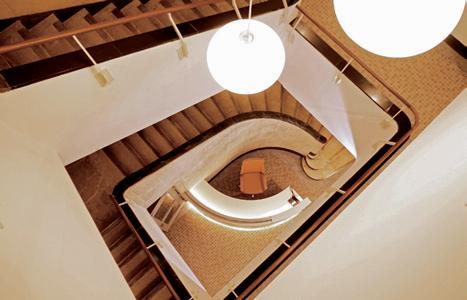
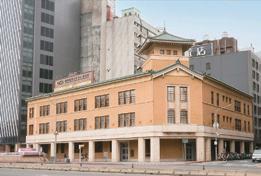
An ideal choice for starting a tour of Taipei with a focus on photography is the National Centerof Photography and Images (NCPI), which is centrally located opposite Taipei Main Station. Constructed in 1937 as the Taiwan headquarters of a Japanese shipping firm with international operations, this museum’s building later housed the Taiwan Navigation Co. and the former Taiwan Provincial Highway Bureau. Today, a permanent exhibition titled Trans-Communication highlights the evolution of the building’s function, noting that, in its current guise as a photo repository, its “transit, exchange and communication” purpose has been maintained.
Regular exhibitions of contemporary works appear alongside thematic displays from the NCPI archive of more than 13,000 images and other assets. Exhibitions often feature pioneers such as Deng Nan-guang, Chang Tsai, and Lee Ming-tiao (the so-called “Three Musketeers” of Taiwanese photography), the photographs being powerful testaments to the dramatic sociopolitical shifts Taiwan has undergone. Lenses have frequently been directed at the marginalized and vulnerable – indigenous peoples, political dissidents during democratization movements, and victims of natural disasters, powerfully evoking Taiwan’s resilience and hope in the face of adversity.
Restoration work on the building began in 2015, with the center opening to the public in 2021. The L-shaped interior optimizes gallery flow and accentuates the striking stairs at the core, an element that prompts visitors to reach for their cameras. Fusing occidental components, including a sturdy colonnade, with Japanese motifs such as a pagoda-type tower, the façade of the neoclassical structure makes for an equally pleasing photo op when departing for the next destination in this list.
NATIONAL CENTER OF PHOTOGRAPHY AND IMAGES
70, Sec. 1, Zhongxiao W. Rd., Zhongzheng Dist. (02) 8978-7040
The roughly 25-minute walk from the NCPI building to Taipei’s historic Dadaocheng neighborhood takes you past myriad other photogenic locations, including Taipei’s North Gate (also known as Beimen), a top-grade national historic site and the best-preserved of the four remaining portals to Taipei’s now-long-gone city walls.
Arriving at Dadaocheng’s historic and tourist-popular Dihua Street, you’ll get a good view of old Taipei. The narrow, usually bustling thoroughfare has inspired imagemakers across media over the years, with Kuo Hsueh-hu’s 1930 painting Festival on South Street perhaps the most iconic impression. The 2014 movie Twa-Tiu-Tiann (Taiwanese for the Mandarin “Dadaocheng”) also provided a memorable snapshot of the area.
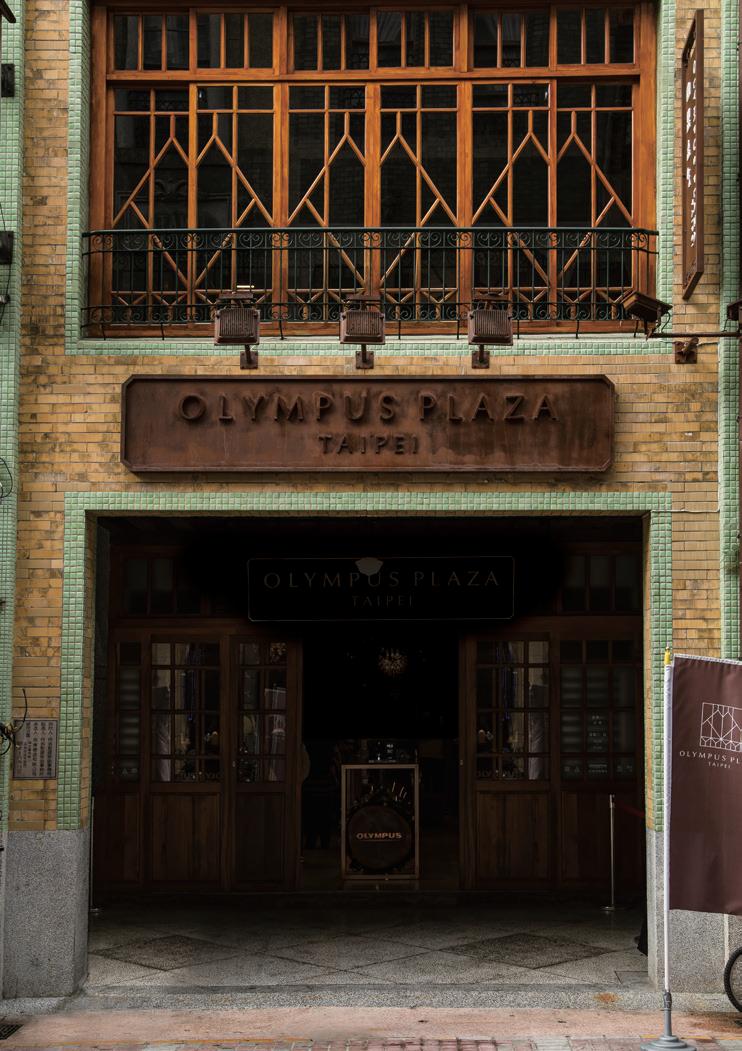
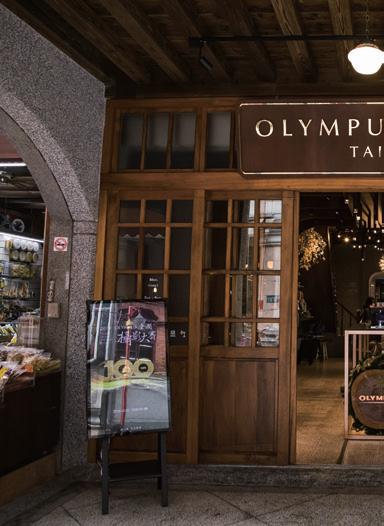
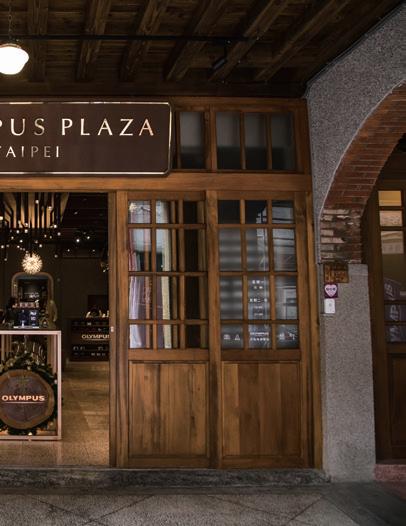
While much of the architecture along the street dates from the 1895~1945 Japanese era, the timber-framed storefronts with sliding doors reveal Qing Dynasty touches. Among these is the understated exterior of the Olympus Plaza Taipei, which opened in 2019, in a building that
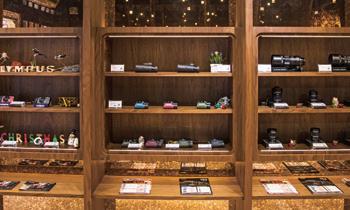
had previously served as a private residence, paediatric clinic, and trading firm during its 100-year history. The building, proud recipient of the 2022 Taipei Architecture Renovation Award, is itself a popular photography subject. Bisecting the interior at knee level is a sturdy log emblazoned with the Olympus logo, the concentric growth rings creating a neat metaphor for a focusing lens. Suspended above, vertical pendant lighting warmly illuminates the products showcased on the display counter.
In addition to a range of cameras, from the vintage Olympus twin-lens reflex models of the 1950s to the latest action devices from Insta360, the store offers photographyrelated souvenirs and paraphernalia, including artisan camera straps from Jouer8, a Taichung-based brand. A studio and an exhibit space where visual arts are intermittently showcased are located on the upper floors.
OLYMPUS PLAZA TAIPEI
142, Sec. 1, Dihua St., Datong Dist. (02) 2553-8826
11:00am-7:00pm (closed on first Mon of month) www.olympusplaza.tw
Olympus Plaza Taipei
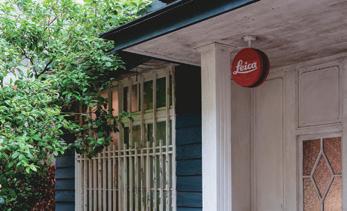
If the Olympus Plaza Taipei communicates style and refinement, the premises of the House of Leica take understated elegance to the next level. Tucked down a leafy lane off Qingtian Street in Daan District, close to the tourist-popular Yongkang Street area, the building is easily overlooked by passing pedestrians. But for the small red orb jutting out from the front-courtyard wall, displaying the cursive white script of the Leica logo, one might mistake this building for one of the area’s restored historical houses, which are off-limits to the public.
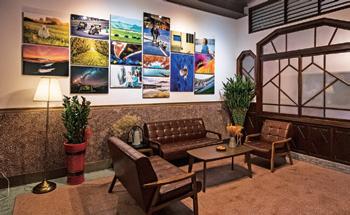
The mellow blue-gray clapboarding of the wooden bungalow, which once served as a dormitory for faculty at Taihoku Imperial University (now National Taiwan University), contrasts with the gleaming surfaces and cabinets of the interior and the glass roof, which floods the space with natural light. Latest cameras, sports optics, and accessories from the German brand are presented. A central washitsu -type space (minus the usual tatami mats), outfitted with a coffee counter that is powered by a handcrafted La Marzocco machine, is used for exhibits, events, and courses presented under the Leica Akademie program. Emphasizing the brand’s global outreach, recent expositions have included winners of the 2025 Leica Oskar Barnack Award, named for the company’s founder. These are focused on underrepresented regions such as the “breakaway” state of Transnistria in Moldova and the plight of marginalized groups, such as Venezuelan immigrants in Mexico. Near the entrance is a bookcase stocked with coffee-table collections from agencies such as Magnum and giants of photography such as Lee Friedlander.
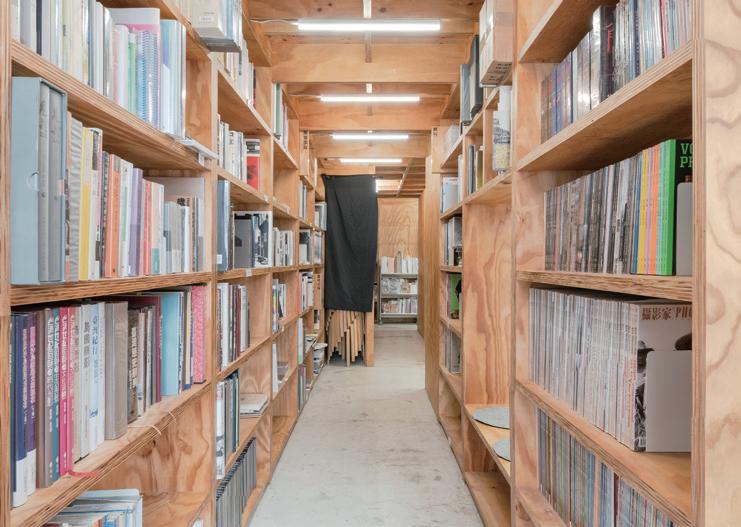
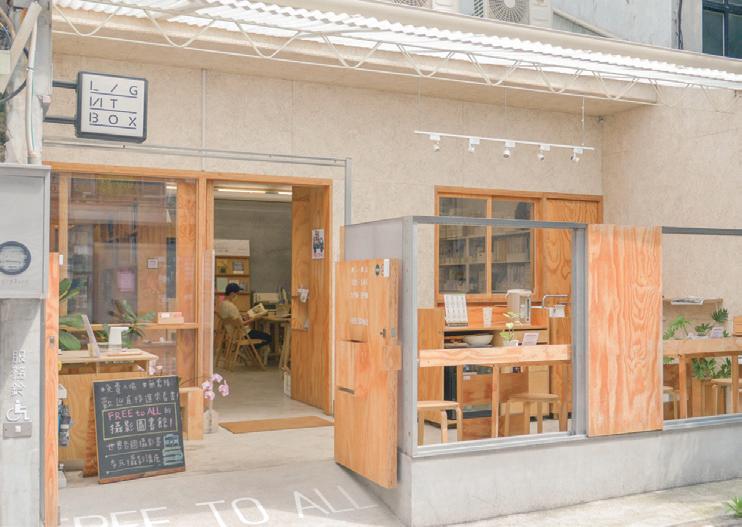
Books are the focal point at Lightbox, a photography library situated a 15-minute walk from the Leica showroom. Run as a nonprofit, Taiwan-focused space, with an emphasis on inclusivity, Lightbox provides a serene, minimalistic space for browsing and contemplation. While the lion’s share of the volumes that line the shelves are photography-focused, plenty are not. Instead, an eclectic mix of works, loosely themed around the idea of impressions, is found.
The library houses many limited-edition and rare photography books, with numerous out-of-print volumes. Among them, the Taiwan Photographic Album, published in 1908 during the Japanese era, preserves the landscapes and customs of Taiwan from a century ago. Other noteworthy works are army physician Rene Coppin’s French-language account of the Sino-French War of 1884~1885 and the contemporary photo essay Becoming Taiwanese by Liang-Pin Tsao, which documents the reinvention of Japanese Shinto shrines in Taiwan as martyrs’ shrines in the post-WWII era.
Regularly hosting lectures, educational tours, and industry events such as the biennial New Wave Photography Award, Lightbox is a must for visitors looking to gain an understanding of Taiwan’s photography environment.
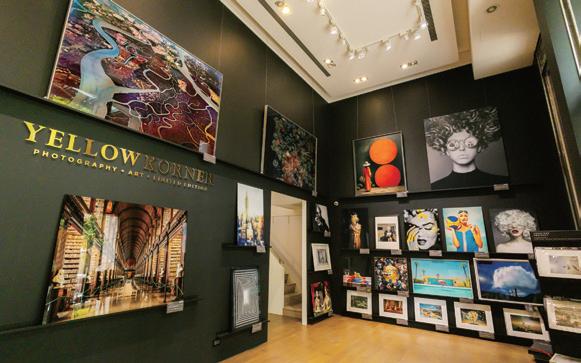
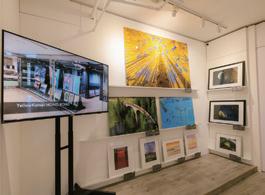
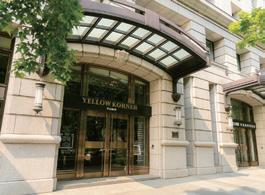
Close to the attractive riverside parklands of Zhongshan’s Dazhi neighborhood, YellowKorner offers limited-edition prints from world-renowned photographers. This branch of the Paris-founded gallery chain opened in 2021, its remit to bring internationally acclaimed photographic artworks to collectors in Taiwan.
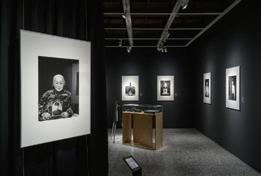
Among the most prominent collectibles is a monochromic portrait of pop-art maestro Andy Warhol brandishing a Polaroid camera with his own image dangling from the device’s ejection slot. Part of a 500-print run, the image was captured by Italian lensman Oscar Toscani.
Elsewhere, works by local photographers such as Po Chen, who first came to prominence in 2010 with an album documenting Indian shantytowns, are also available. Po Chen has more recently focused on images of serene marine vistas, which are credited for their “soothing effects” that “should be prescribed for anyone wanting to embark on the path of zen.”
Developed at the gallery’s own laboratory, high-quality prints of photographs come with QR codes that can be scanned to generate tamper-proof authentication certificates.
Dihua Street | 迪化街 National Taiwan University | 國立臺灣大學 YELLOWKORNER
A Slow-Living Neighborhood with Local Crafts and Creativity
TEXT | JENNA LYNN CODY PHOTOS | VISION
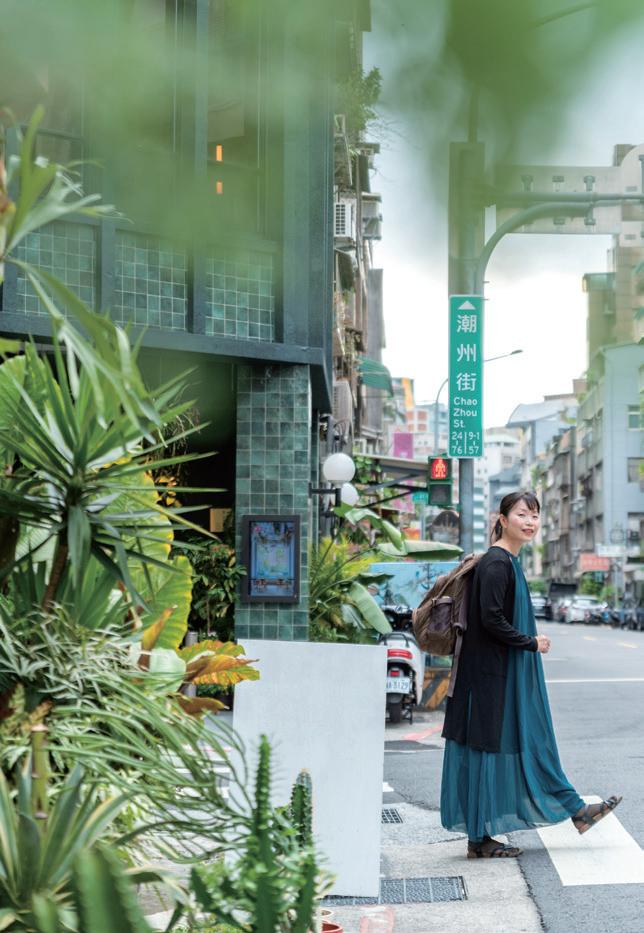
Overlooked for years in favor of more touristy areas, including nearby Yongkang and Lishui streets, Chaozhou Street and its surrounding neighborhood are coming into their own as a haven for artisanal masters with a focus on quality and the “slow life.” On its face, Chaozhou Street may look like just another city street, but walking from its more concrete-dominated western end to the leafy east brings visitors past indie brands, restaurants, coffee beaneries, and more.
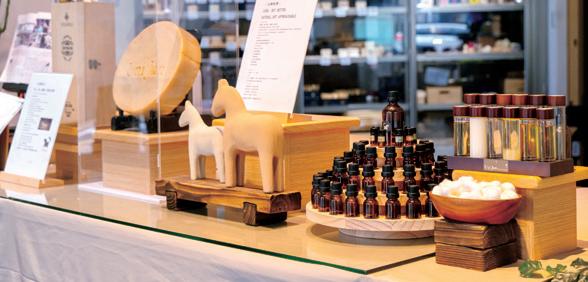
Starting from the western end, visitors will pass Uni Jun, which sells handmade soaps and offers beginner and advanced soap-making classes. Uni Jun is the brainchild of Yang Jun-xiong and Xiao Jiahong, a master soap-maker who studied the technique in Central Asia. Their philosophy is subtractive: eliminating unnecessary preservatives, fragrances, and foaming agents.
What sets Uni Jun apart is its singular focus on aged horse-oil and tussah silk soap – a combination developed over years of research. Horse oil’s rich unsaturated fatty acids nourish and repair the skin barrier, while the addition of silk yields a notably smooth, non-drying lather that suits Taipei’s humid climates particularly well.
Next on our Chaozhou Street itinerary is Maison Temps-Rêves, a bookshop with an artsy, multilingual offering that’s heavy on coffee table books – mostly picture and photography books – as well as storybooks that can be appreciated by children and adults alike. The shop also acts as a gallery space and hosts lectures and book chats.
In English, the French “Maison Temps-Rêves” means “Dreamtime House.” French is not the only language represented, however: there are also books in Mandarin, Korean, Japanese, and more. With a focus on picture books, this isn’t a problem for the monolingual reader: one can still enjoy, for example, a book of pixelated Lego-like scenes depicting images and landscapes from Tokyo without being able to read Japanese. At Maison Temps-Rêves, perusing a picture book might feel like appreciating a small exhibition, watching a movie, or experiencing a journey.
UNI JUN 手工皂坊
74, Sec. 2, Hangzhou S. Rd., Zhongzheng Dist. (02) 2557-9656
facebook.com/unijunsoap Mon-Sat 10:00am-6:30pm
MAISON TEMPS-RÊVES 童里繪本洋行
15, Chaozhou St., Zhongzheng Dist. (02) 2391-8676
www.maisontempsreves.com
Tue-Fri 12:00pm-6:00pm Sat-Sun 11:00am-6:00pm
Uni Jun
Soap made with turmeric and cinnamon
Maison Temps-Rêves
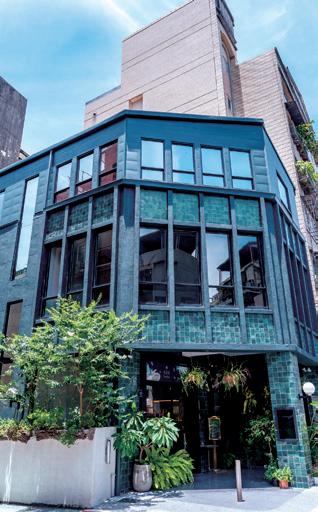
Walking further east from Maison Temps-Rêves, you’ll see an older-style Taiwanese building decked out with holographic second-story windows and phthalo-green – specifically Pantone 5463, a color named “Chaozhou Green” by the designers – paint and zellige-like tiles. This is LivinGreen, a restaurant and café housed in a historic building constructed in 1963 that once served as a police station and dormitory. In 2018, design and branding duo 2 by Wu&Chen renovated the space, a project that won the firm a 2019 Taipei Architecture Renovation Award and 2020 iF and Golden Pin Design awards, among other accolades.
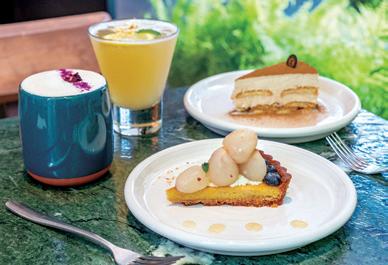
Don’t miss the noodle bar, with mouthwatering offerings such as Dry Mesona Noodles with Spicy Cumin Chicken and Dry Beetroot Noodles with Prawns & Goose Oil currently on the menu. Or stop in for a cup of herbal tea and try a slice of its daily special fruit tart.
As you continue east, Chaozhou Street narrows considerably and becomes leafier and more residential after crossing Jinshan South Road. This is the beginning of the more attractive, but also more touristy, Yongkang Street neighborhood.
At the intersection of Chaozhou and Yongkang streets sits Jinan Market – Showa-cho Antique Market. Housed in a former wet market space on the first floor of an old apartment building, the market offers a mix of twenty or so eclectic stalls selling a range of Taiwanese and Japanese antiques, with a heavy focus on ceramics. This is a beloved spot for browsing old Japanese-era collectibles, retro ceramics, vintage posters, and curious trinkets that reflect Taiwan’s layered cultural history. It’s a great place to soak up the nostalgic atmosphere and hunt for rare finds.
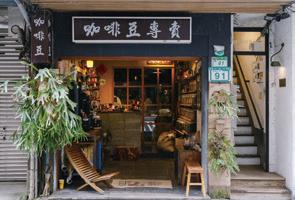
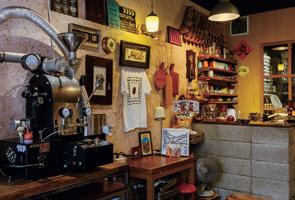
Across the street from the antique market, and technically on Yongkang Street rather than Chaozhou Street, Tzang Tian Coffee Bean is a coffee purist’s destination. Coming from Chaozhou Street, you’ll know it by the scent of roasting coffee beans that wafts into the intersection: this small shop has a big presence.
Founder and operator Lin Shi-bo started his coffee beanery on the premise that he simply loves coffee and hopes to run a business that is familiar and integrated into the neighborhood. Tzang Tian sells hand-roasted coffee beans from around the world, but the shop is most famous for its unparalleled selection of Taiwanese beans. Lin personally travels to the small, sometimes hard-to-reach coffee plantations to select locallysourced beans from Taitung, Tainan, Nantou, and other island areas.
Beside Tzang Tian, a narrow staircase leads to Archive & Secondary Research on the second floor of the same building. A curated vintage shop, the focus here is squarely on “archival” fashion, that is, garments that are significant for their contribution to design history or clothing construction technique. Founded by a team of design scholars and curators, the shop rejects the “fast fashion” cycle.
This is the place to find rare, influential pieces from both wellknown and avant-garde designers, from household names such as Maison Margiela to revolutionary Japanese designers such as Rei Kawakubo. By treating clothing as wearable history rather than disposable goods, the space serves as a vital bridge between fashion’s radical past and its sustainable future.
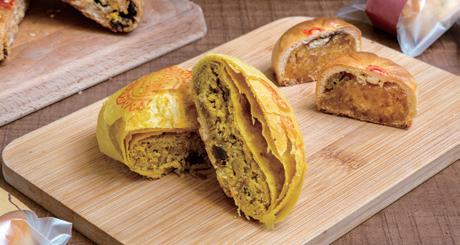
Near the eastern end of Chaozhou Street sits Yearscake, a traditional-style Taiwanese pastry shop founded 70-plus years ago. Originally focused on baked goods for weddings and other celebrations as well as offerings for ancestral rites, Yearscake now offers smaller baked goods for a wider market. Especially popular treats include the milk powder and salted egg
Pastry by Yearscake
Archive & Secondary Research
Now led by the third generation, the shop has undergone a thoughtful rebranding and renovation that honors its roots while embracing a fresh identity. Its new Chinese name, pronounced yi-de-he-zhi , blends characters drawn from the names of all three generations of owners – a quiet tribute to the family legacy behind every pastry. The rebranding also introduced a reimagined store space, where the heritage of a traditional Taiwanese pastry shop is woven with a contemporary aesthetic, creating an experience that feels both nostalgic and new.
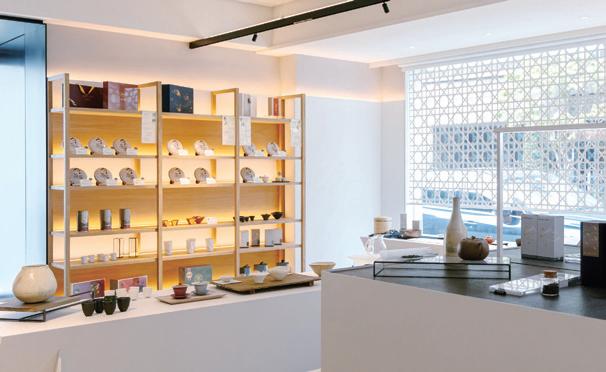
A visit to Chaozhou Street might naturally end at nearby Thètion, a high-concept tea shop with a minimalist aesthetic that caters both to modern tea-lovers and design-conscious consumers.
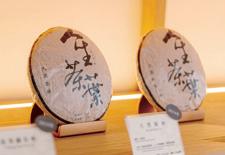
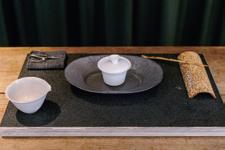
Thètion’s English name is a portmanteau of thè, the French word for tea, and “nation” – literally “tea nation.” The Chinese name, however, evokes the “planting of rain,” that is, the vital mountain mists that nourish high-altitude tea harvests. Specializing in expertly curated oolongs and rare pu-erhs, Thètion functions as both a boutique and a sanctuary. The shop’s minimalist tasting space emphasizes the “mountain-to-cup” journey, focusing on the distinct terroir of Taiwan’s mountain areas.
Like its neighbors on Chaozhou Street, from Uni Jun to LivingGreen to Tzang Tian, Thètion champions a “slow living” philosophy, offering a refined, meditative escape from the city’s bustle.
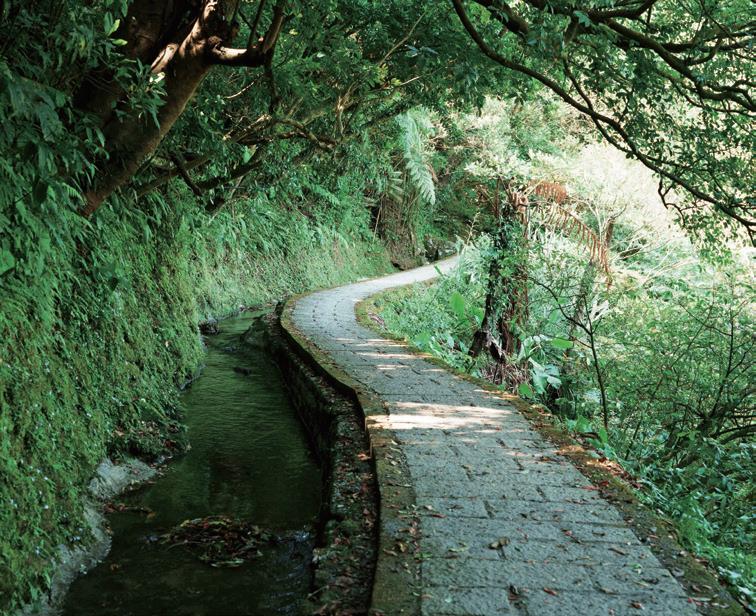
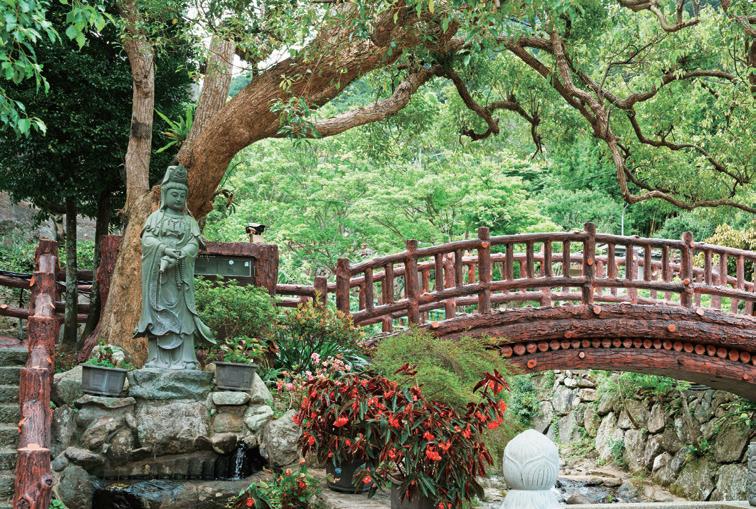
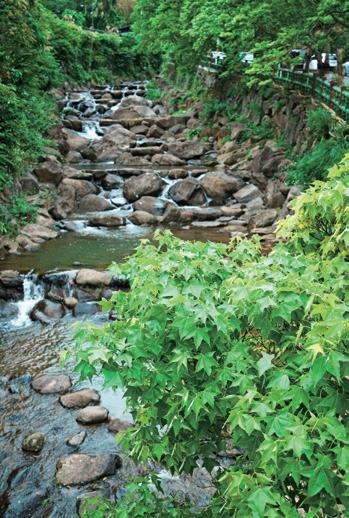
Amid the sweltering summer heat, the watery southeastern corner of Yangmingshan National Park offers a welcome, naturally air-conditioned escape. Hop on the S18 bus at MRT Jiantan Station, and in under 30 minutes, you will have swapped the city streets for terraced farms and bamboo groves cooled by a lacework of streams and old irrigation canals.
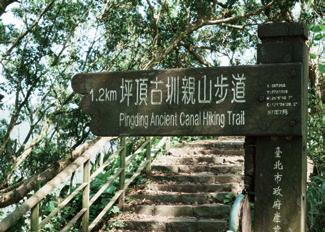
The S18 terminates at Pingding Ancient Canal Hiking Trail entrance. Alight here, pay your respects to the gods of Xihe Temple, and head up the creek-bounded Lane 370. Keep your eyes peeled for a map and fingerpost beside some steps on the left – this marks the start of the 120-minute loop trail that includes the Daqitou Trail and the Pingding Ancient Canal Trail. (Hiking in either direction works, but clockwise involves more steps upfront, while anti-clockwise means the first chunk of ascent is done on the road.)
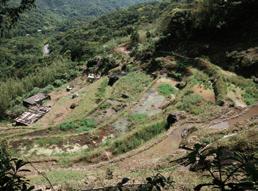
The trail (clockwise) leads up past ramshackle farmers’ huts, where, on weekends, you can purchase hyperlocal vegetables to add to your evening meal. A stream cascades down a rocky channel on the left, and up beyond the lean-tos, the pleasingly organic curves of old paddy terraces hug tight to the contours of the land, their retaining walls manifesting small pockets of usable land where previously there had just been steep slope. Only about half remain in active cultivation, with the rest mostly having been colonized by algae, frogs, and other critters.
While we’re on the subject of things that hop and slither, note that the trails featured on these pages present excellent night-hiking opportunities. The combination of farmland, trees, and waterways makes for a fabulously biodiverse landscape – herpetologists will find plenty to excite them, and you stand a reasonable chance of spotting various types of snakes and nocturnal mammals like giant flying squirrels and masked palm civets. (The last S18 heads back down into the city core around 11pm, so public transport isn’t a problem, but you’ll need to bring a torch because the trail is entirely unlit.)
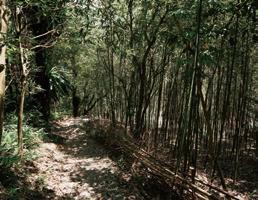
Bamboo grove
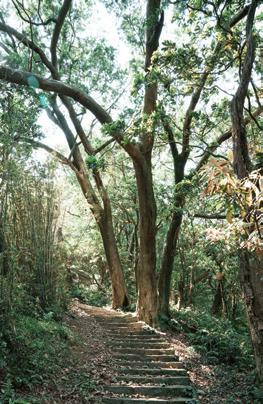
Stone steps
Terraced fields
At the top of the terraces, the trail dips into the dappled shade of a bamboo grove. The steps here are shallow, making it easy to set a slow, steady pace as you climb, and with each gained increment in elevation, the species mix broadens as the farmed woods transition to the untamed. During a visit earlier this year, lizards and skinks basked in sun spots, and a recently excavated hole surrounded by caramel-colored earth offered evidence of a pangolin’s ant buffet.
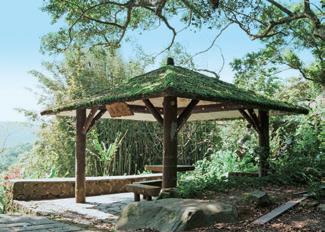
The trail begins to level out as it approaches Qingfeng Pavilion. Sitting at more or less the mid-point of the loop and immediately after its most protracted climb, this is an excellent spot to pause and break the journey. It’s also a trail hub, with several paths fanning out that offer longer adventures. (Straight ahead, Majiao Historic Trail leads experienced hikers past Mt. Xinzuntou and up to Qingtiangang Grassland; left drops into Pingding Village, where you can connect with the route featured on the following pages; a sharp left doubles back to return to where you started via the slightly more challenging Mt. Ewei Trail.) However, to return to the route at hand, head right following the signage directing you towards Pingding Ancient Canal.
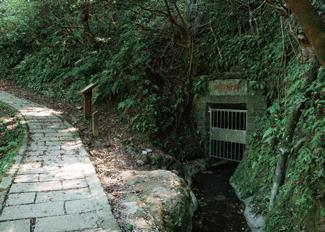
After a short descent, you’ll meet the first of three historic irrigation canals, arriving just at the point where the waterway dives into a 60-meterlong tunnel hewn through the rock. Pingding Ancient Canal (built in 1835) is the oldest of the trio. All three divert water from Neishuang Creek and were vital for the early settlers who developed this region. Despite their age, the canals still irrigate much of the area’s farmland, and if you’ve got extra time, it’s well worth taking a wander along one or two of them to let the sound of running water wash away worldly stresses.
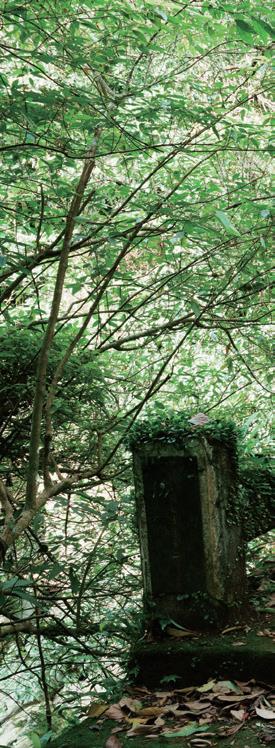
Getting back on track, follow the Pingding Ancient Canal contraflow for a couple of hundred meters, then take the steps heading down on the right. The steps intersect with two more waterways. First up is Pingding New Canal (built in 1849, that “new” has aged into something of a misnomer), then the youngest, Dengfeng Canal (1909). On the far side of this canal, steps continue downwards towards the gurgling hiss of Neishuang Creek. Along the way, you’ll pass the Taoran Pavilion, but be warned, this is not somewhere you want to unpack your sandwiches – the table bears a neat cross formed of guano, indicating it’s a popular bat hangout after dark.
Qingfeng Pavilion
Pingding Ancient Canal
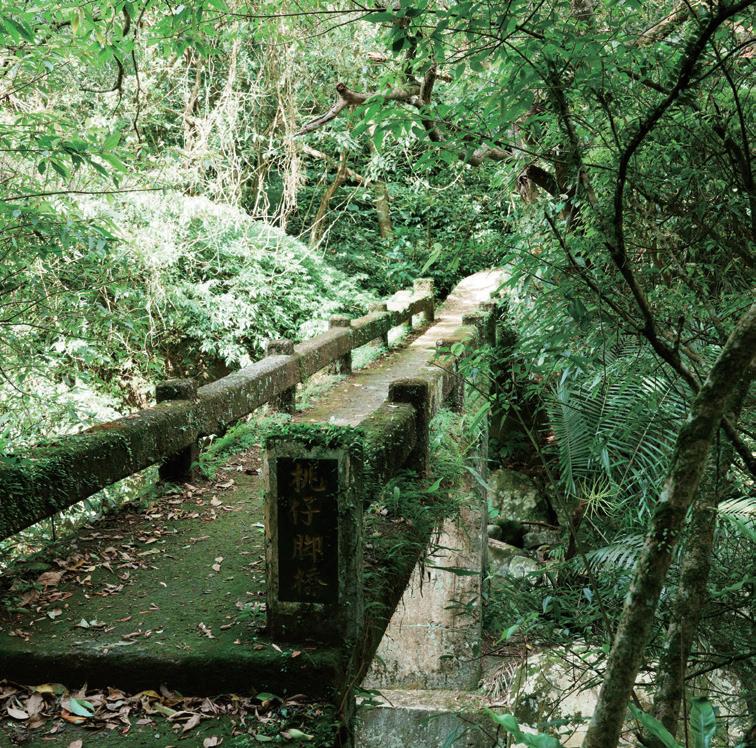
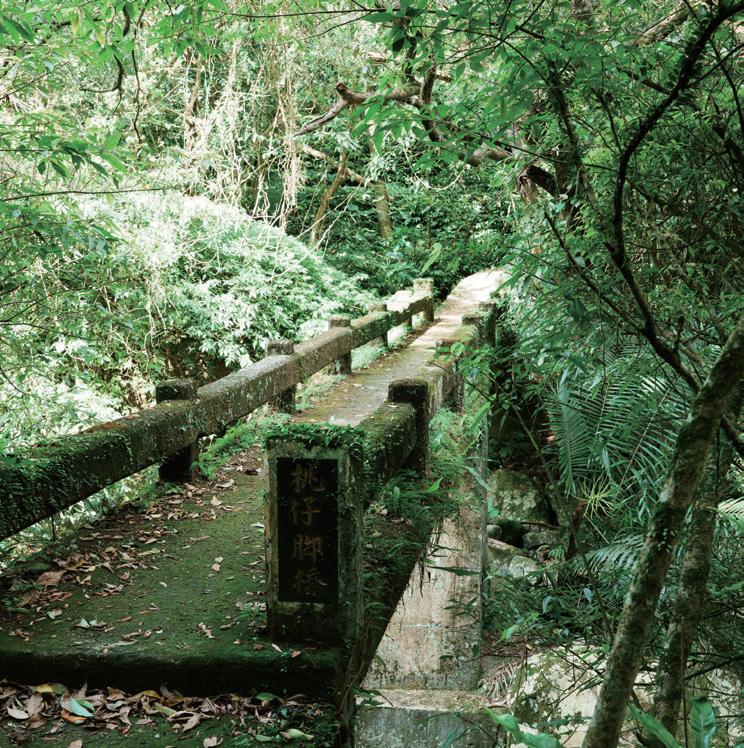
Next, you’ll cross Taozijiao Bridge, which is green with cushioned moss, and you’ll want to take a moment to imbibe the stream’s cool breath before continuing because the trail has one final climb – a sting in the tail, if you will. Fortunately, the ascent is brief, and no more than five minutes later, the path reaches a junction. Turn right here, descending through more bamboo wood, then over the creek one final time before you rejoin the road. (Side note: on fine spring evenings, the creek bed at this location is excellent for firefly viewing.) From here, it’s an easy roll all the way down the road back to where the S18 dropped you off.
Taozijiao Bridge
A Shorter 60-Minute Trail Option
If two hours sounds like too much of a commitment, this one-hour route connecting Shilin’s Xishan Village with the higher settlement of Pingding is a slightly shorter option. Instead of riding the S18 to its final destination, alight at Jiaokeng Bridge and backtrack a short distance to pick up Lane 181 of Sec. 3, Zhishan Road running uphill alongside a creek.
The first noteworthy landmark arrives after just 200 meters in the form of the grand yet solemn Puyi Yuan – a Buddhist temple and meditation center –opposite which you’ll find a fingerpost marking the start of the Pingxi Trail.
Steps first thread through bamboo-cultivation terraces before ducking into the cover of mixed broadleaf forest. At the top of the steps, bear left to follow a narrow farm road into a tiny hamlet. The signpost here appears to direct you left in front of the first house, but you actually need to head to the right of the house and then turn left to proceed through a passageway immediately behind it.
Where the road (quite soon) runs out, the trail reappears, heading down a short flight of steps before
cutting through more farmland. This next stretch is the most scenic part of this hike – a dense wall of trees hedges the right, while a timeless landscape of stepped terraces spreads down the slope to the left. The only indication that you haven’t slipped back a century or more is music blaring from farmers’ portable speakers as they tend their crops. On the far side, the open farmland gives way to trees, and rivulets of diverted water add their cooling melody to the soundscape. (Listen, too, for the sharp, uncannily bird-like call of Swinhoe’s frogs.)
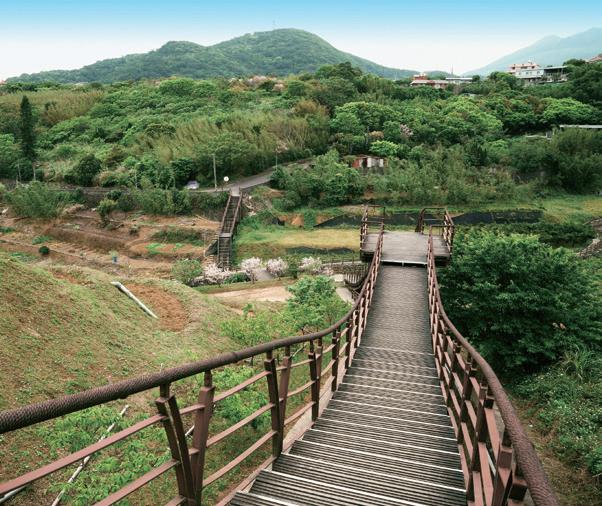
Dense canopy shelters the remainder of the climb, but once the trail spits you out at the edge of Pingding Village, you’ll be fully exposed to the sun again. This small, elevated village is best known for its annual sakura display (Jan-Feb), and Mt. Ewei Terraced Field Sleeper Trail – a photogenic, undulating walkway that dips and arches over the farmland like a soaring dragon. At the top of the terraces, you’ll also find a cluster of cafés, making it a great spot to stop for refreshments before hopping aboard either bus 303 or S19 to return to the city’s urban world.
Daqitou Trail | 大崎頭步道
Dengfeng Canal | 登峰圳
Jiaokeng Bridge | 礁坑橋
Majiao Historic Trail | 瑪礁古道
Mt. Ewei Trail | 鵝尾山步道
Mt. Ewei Terraced Field Sleeper Trail | 鵝尾山水田木棧道
Mt. Xinzuntou | 新圳頭山
Neishuang Creek | 內雙溪
Pingding Ancient Canal Hiking Trail | 坪頂古圳步道
Pingding New Canal | 坪頂新圳
Pingxi Trail | 平溪步道
Puyi Yuan | 普宜苑
Qingfeng Pavilion | 清風亭
Qingtiangang Grassland | 擎天崗草原
Taoran Pavilion | 陶然亭
Taozijiao Bridge | 桃仔腳橋
Xihe Temple | 溪和宮
Neishuang Creek
Mt. Ewei Terraced Field Sleeper Trail
Living
Landmarks
Old and Beautiful Trees with a History
TEXT | TWELLI PHOTOS | VISION
Big old trees growing beside temples are a common sight in Taiwan.
Worshippers can often be found lingering in their shade, enjoying the tranquility and natural aesthetics they provide.
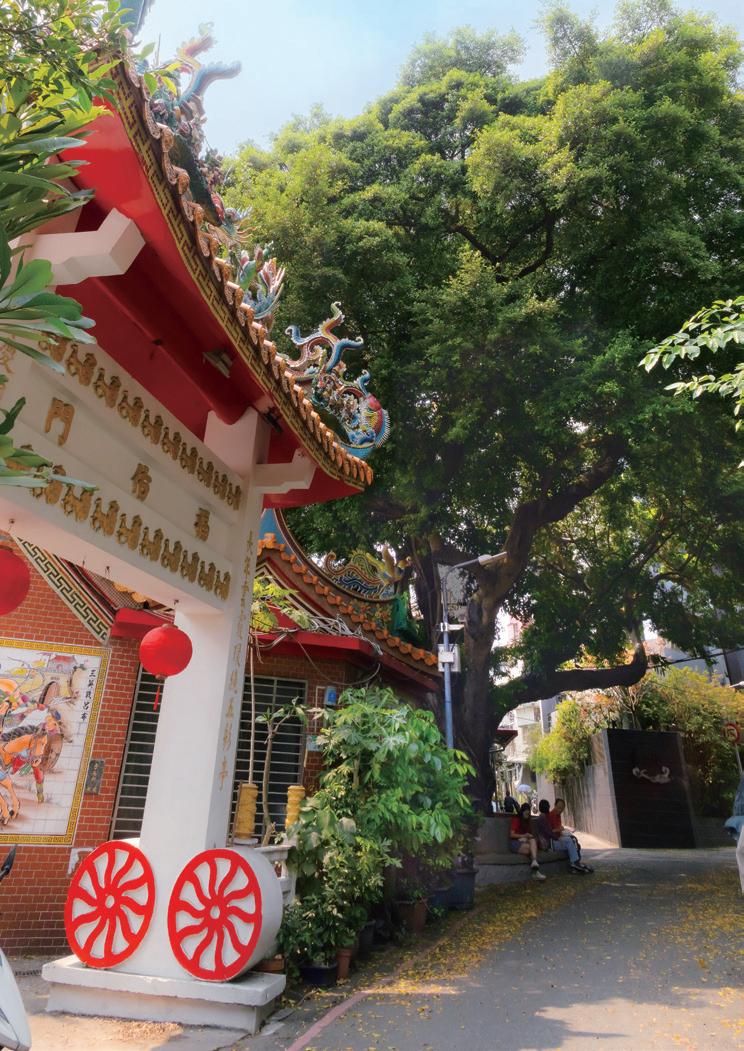
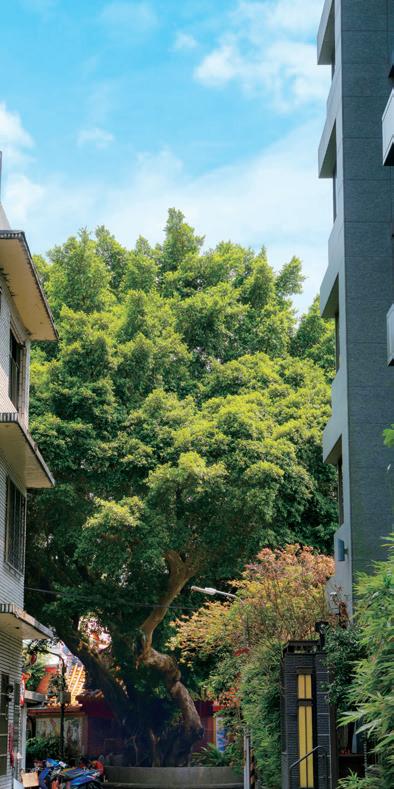
Tucked away in a quiet lane in Taipei’s Guting neighborhood, the Changqing Banyan is one of Taipei’s most remarkable old trees. Officially named and listed by the city government, it had the largest trunk circumference among the 1,146 trees surveyed in 2001, measuring a remarkable 10 meters around. Estimated to be over 250 years old, it is now a registered protected tree.
Legend has it that the banyan once stood at the confluence of two waterways that were part of an important system of canals and irrigation ditches that played a major role in the cultivation of farmland in the Taipei Basin. It was right at the center of the Guting settlement, which was established by immigrants during the Qing dynasty.
Today, the tree can be seen behind Changqing Temple, a small place of worship dedicated to the Earth God. Its predecessor, a shrine dedicated to the Stone God, founded in 1758, was transformed into a proper temple in 1936 during the Japanese era.
The banyan spreads its prodigious canopy over the intersection of Jinjiang Street and the street’s lane 18, its branches nearly touching the fourth floor of the building across the street. It is cherished by local residents, who ensure the tree is cared for whenever it suffers typhoon damage or shows signs of disease. A metal box at the base of the tree, containing incense sticks and water bottles, indicates that the faithful make offerings to the tree or its spirit.
Tree and temple have stood side by side for over two-and-a-half centuries, witnessing the slow transformation of a quiet farming settlement into a hidden-away quarter of a giant bustling city. Today, this remains a space where the past feels closer than the modern-city rush just out of sight and hearing around the corner.
Changqing Banyan Tree | 長慶榕
Changqing Temple | 長慶廟
Guting | 古亭
Stone God | 石頭公
34, Jinjiang Street, Zhongzheng District; about a 3-minute walk from MRT Guting Station (Exit 2)
and Boba to Glow Dumplings
Creative Candlemaking with a TaiwaneseTwist
A common lament of travelers homeward-bound after a Taiwan visit is that leaving means bubble tea is usually no longer available on tap, and even if they’re lucky enough to live near an overseas branch of Din Tai Fung, the unfavorable soup dumpling index is likely to leave them feeling short-changed, too. Well, consider this – Lykke Handcrafts Studio’s delectable handmade candles offer a unique way to assuage that craving.
TEXT | AMI BARNES PHOTOS | CHEN CHENG-KUO
To find Lykke Handcrafts Studio, head to Yongle Market, located at the southern end of the historic and perpetually busy Dihua Street in Taipei’s Dadaocheng neighborhood. Walking in off the street, you’ll find your stockimage wet market. It’s loud and it’s crowded. The fabric market on the second floor is somewhat calmer, but no less visually stimulating. The atmosphere on the next two floors, however, could not be more different. These floors house ateliers and studios where bespectacled tailors are usually found hunched over half-sewn qipaos and curtains in industrious quietude, although, as Tracy – our candlemaking coach and founder of Lykke Handcrafts Studio – led us to her workshop for a 10 o’clock class, few were already at work. (Dressmaking and fashion design are evidently not professions for early risers.)
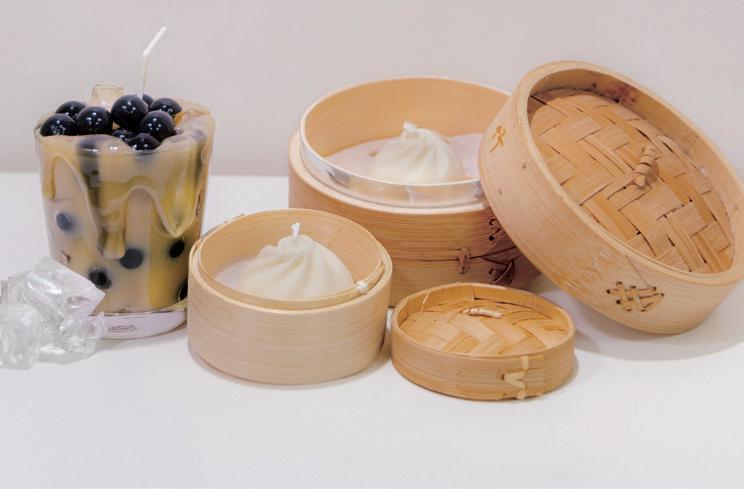
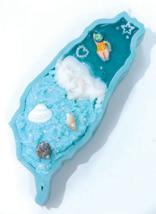
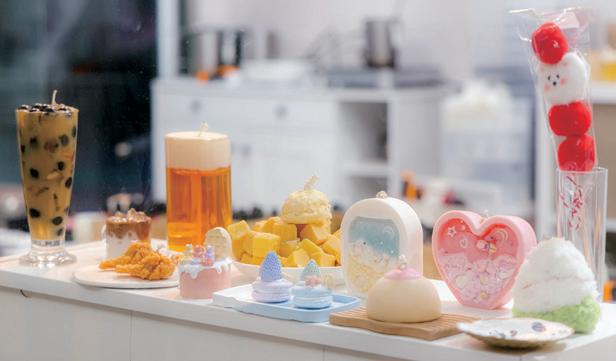
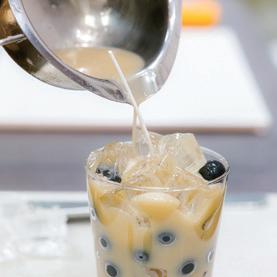
Formerly a schoolteacher, Tracy found herself heading in a different direction after hosting some cultural-exchange classes. For her, there was joy to be found in using crafts as a medium to engage with Taiwanese culture – a sentiment she has captured in the studio’s name (lykke is a Danish/Norwegian word encompassing the happiness of small pleasures and quality time spent with others). Over time, she has honed her offerings, and Lykke now runs several creative candlemaking classes (including the creation of flat candles in the shape of Taiwan). You can also create cute boba-themed fragrant plates made of gypsum. We opted for the most popular class, centered on the creation of a two-candle set featuring a pair of Taiwan’s culinary icons – a steamed dumpling and bubble tea (aka boba).
Candle creations in different shapes, colors, and sizes
Candlemaking at Lykke Handcrafts Studio
Candle in the shape of Taiwan
2
3 4
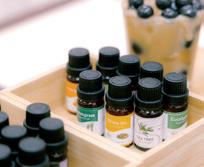
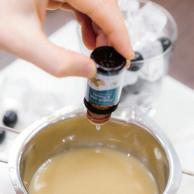
Our first task was picking the essential oils to scent each creation. According to Tracy, a fair few people try to match the fragrances to the food/drink, meaning sweet vanilla and the savory fennel get a lot of use, but if you don’t feel the need to constrain yourself, you can pick from any of the 20 or so options she has to hand. I went with eucalyptus for my dumpling and English pear and freesia for the bubble tea.
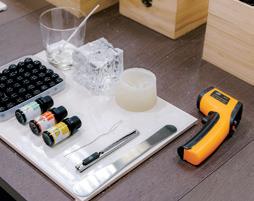
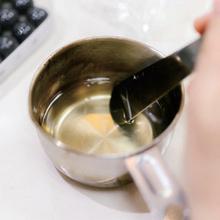
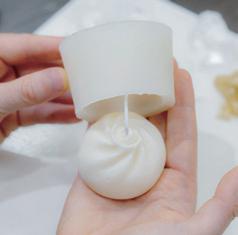
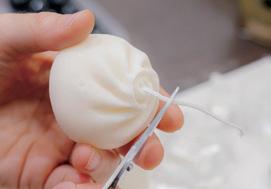
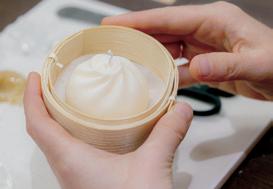
The dumpling candle is made by pouring wax into a silicone mold. The first step thus involved poking a wick through the base of that mold using a looped wire. As I was doing that, Tracy retrieved the melted wax from a small stove, and I added 15 drops of oil, stirring to combine and cool it to the required 65°C. Unlike the real soup dumplings, which tend to be served mouthscaldingly hot, my candle needed to chill in a fridge for a while before it could be demolded and placed in its miniature bamboo steamer.
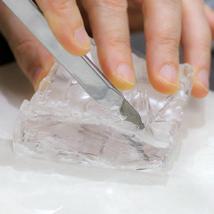
The second candle in the set is even more of a show-stopper and has a marginally more complex construction process. After affixing the wick to the bottom of my container, Tracy handed me a block of “ice” with instructions to cut it into rough ice-cube-sized chunks. Whereas traditional opaque candle wax is used for the dumpling, the bubble tea calls for jelly wax – transparent and squishy, it’s perfect as a stand-in for ice and tapioca pearls. It also happens
Aroma oils
Threading the wick
Trimming the wick
Blending oils into the wax
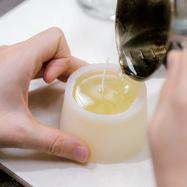
Pouring the wax into the mold Demolding
to be a lot of fun to work with; who doesn’t enjoy slicing and tearing and squidging jelly-like substances?
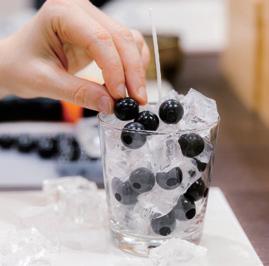
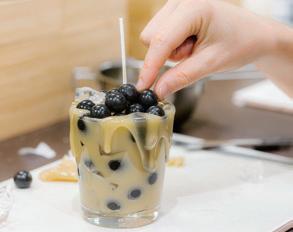
Layering the ice and pearls was the most intricate step. The ice holds the wick in place and keeps the pearls pressed against the outer edge of the glass – important since the milky-tinted “tea” wax obscures anything deeper inside. Jelly wax also cools much quicker than traditional wax, so after adding my essential oil, I just had time to give it a few quick stirs before pouring it in. Tracy then coached me on how to arrange the remaining pearls and ice cubes for that perfect loaded-cup look, then used a hair dryer to melt the piled-up pearls just enough to bond them all together. Both candles came together in around 90 minutes, and the process is simple enough that it should be well within the capabilities of a supervised child.
Before leaving, our creations were safely stored in a box – along with a cute postcard and a bubble tea snack – to ensure they survived the journey home. This is one of several thoughtful touches that make Lykke particularly well-suited to visitors passing through on a short trip. Others include classes being conducted in different languages (including English and Korean), straightforward booking through platforms like Klook, and being one of the rare workshops that run classes for individuals, making it perfect for solo travelers.
You may not have access to unlimited Taiwan treats once you’re back home, but as those of us who settle here long term could tell you, unfettered access to bubble milk tea can be a double-edged sword. Lykke’s candles offer the best of both worlds – all of the joy and no calorie overload.
As the swelter of the Taipei summer settles in, the city’s humidity calls for more than just shade – it demands a frozen intervention. This is the perfect time to seek out cool retreats and indulge in delightful icy treats. Taipei is home to a wide range of dessert shops specializing in gelato – rich Italian-style ice cream – as well as Taiwanese-style shaved ice, with unique creations presenting twists on classic tastes.
TEXT | RAY HECHT PHOTOS | CHEN CHENG-KUO
Starfruit Pineapple ice
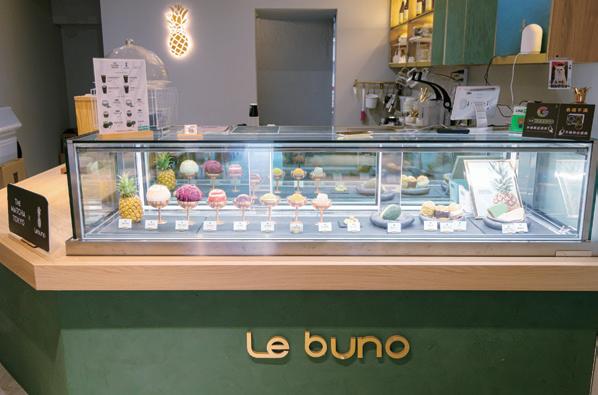
Le Buno can be found in a lane just to the north of MRT Zhongxiao Dunhua Station. The interior features abundant natural wood elements, paired with soft lighting and a fresh, minimalist aesthetic. Tucked away from the bustle of the city streets, it offers a peaceful corner for enjoying desserts and catching up with friends.
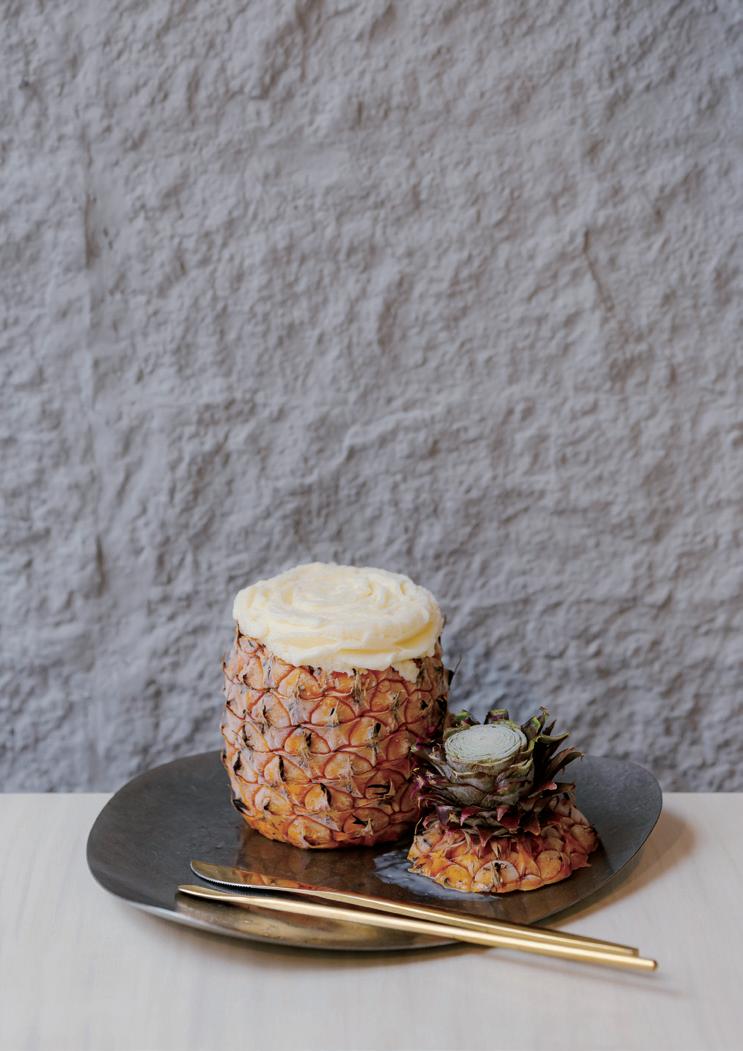
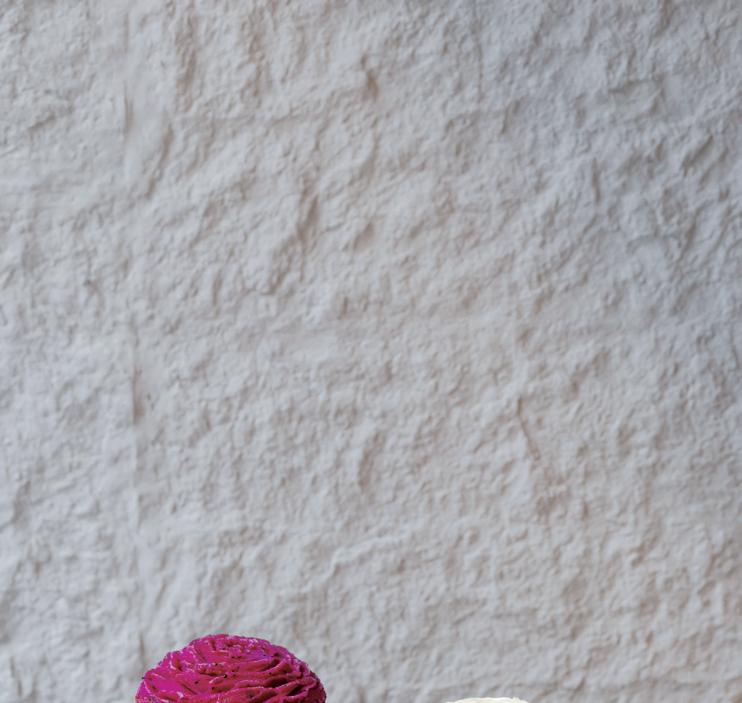
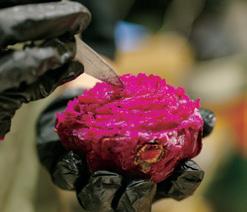
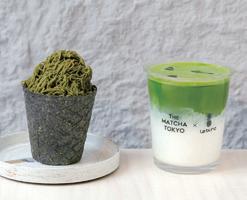
Gelato is the shop’s specialty, with matcha being one of its popular flavors. Le Buno is currently collaborating with The Matcha Tokyo to offer four exclusive co-branded drinks, crafted to the exacting standards of the renowned Japanese teahouse. The extensive menu also includes smoothies, milkshakes, and a variety of lattes. Le Buno’s premium gelato desserts are prominently displayed at the counter. These artisanal scoops are served directly within fruits; the Orange Dragon Fruit, for instance, features vibrant gelato nestled inside a carved-out dragon-fruit shell. If a serving is too large for one person, the store also offers half portions. The Starfruit Pineapple fusion is served in a whole pineapple shell, pairing bright tropical flavors with plenty of fresh pineapple to enjoy after finishing the dessert.
Other popular choices are Honey Apple, Peach Passion Fruit, and Pomelo Lemon. There’s even a Pudding Avocado creation for more adventurous tastes. Drawing on Taiwan’s agricultural abundance, these tropical flavors offer a bright, refreshing escape from the island’s humid summer afternoons.
LE BUNO
58, Ln. 187, Sec. 1, Dunhua S. Rd., Daan Dist. 0901-400-906
instagram.com/le_buno_fruit 1:30pm-10:00pm
The Matcha Mont Blanc and Matcha Tokyo drinks
The ice creations are displayed on the counter of Le Buno
Orange Dragon Fruit
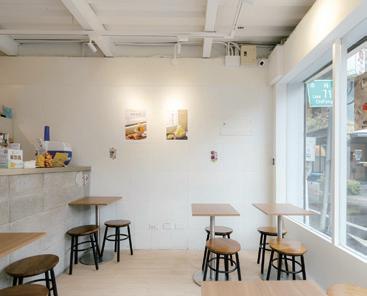
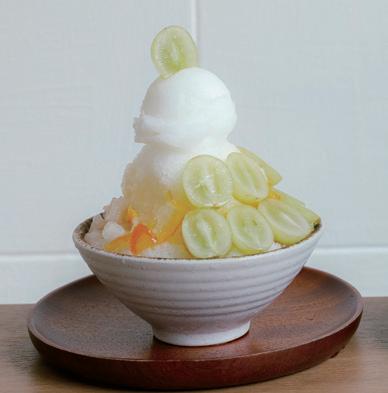
Huo Shih is a stylish, minimalist shop, shaped like a cube. A two-minute stroll from MRT Shuanglian Station, it is nestled on a quiet corner beside leafy Xinzhongshan Linear Park, waiting to be discovered by curious passersby. Located in a tourist-busy area, the shop’s menu is in Chinese, English, and Japanese.
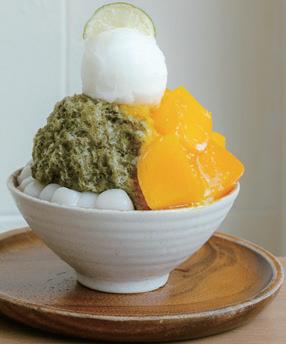
The treats on offer rotate with the seasons, ensuring every type of fruit is served at its peak ripeness. This summer ’ s standout is a shaved ice made with green grapes, pomelo, starch jelly cubes, and a lactobacillus drink (Yakult), delivering a complex explosion of refreshing fruity flavors. The sea-salt lemon ice cream on top has a crisp, sorbet-like texture.
The most popular item at Huo Shih is the summerexclusive “Four Season Mango Summer.” It is made tea, paired with Irwin (glutinous-rice balls), and sea salt lemon ice cream. Like the aforementioned green-grape ice, the creation resembles a work of art.
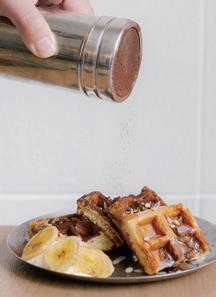
Other must-try flavors are Strawberry, Tomato with Plum, and the Chef’s special, which is created with homemade peanut butter. You also don’t want to miss the waffles, served with a side of crunchy banana chips in whipped cream.
The waffles with chocolate and chewy mochi filling are especially recommended!
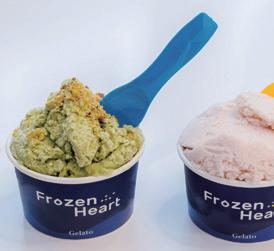
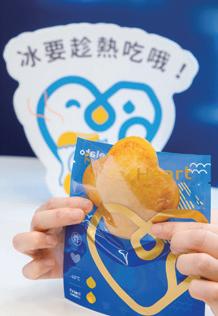
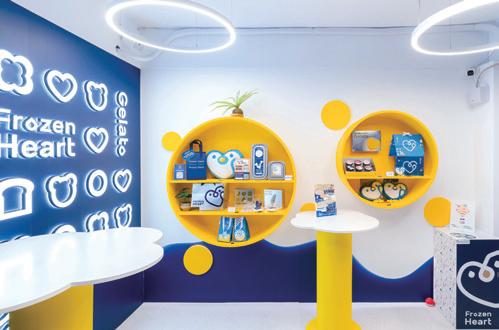
Frozen Heart started in central Taiwan’s Changhua City in 2016 as a night-market food cart operation and has now grown into a chain operation with 37 branches in Taiwan and two abroad. The flagship store in Taipei, opened in 2025, is located close to MRT Zhongxiao Fuxing Station. It takes a bit of searching to find, but it’s worth the effort.
Perhaps the most unusual offering of the shop is fried ice cream, featuring a striking contrast of crispy exterior and cold, creamy interior. Apple Blueberry has a layered fruity profile built from apple, lemon, and blueberry, while Ruby Velvet Milk Tea tastes like the classic creamy drink, which goes well with the fried breaded portion.
Other ice cream flavors include Guava Lime, which is an especially smooth citrus-y combo to try on a hot day, as well as Salted Peanuts and Hazelnut Chocolate. Puli Rose is noteworthy, for it is made with roses from Puli Township in central Taiwan. A very popular choice is Pure Pistachio, made with pistachios from Sicily, Italy, with a rich nutty aroma.
This Frozen Heart branch is a fairly small place, with only a few seats available for a sit-down escape from the heat. There’s also a fun claw machine inside – try your luck for a chance to win a cup of quality gelato, including the signature fried ice cream.
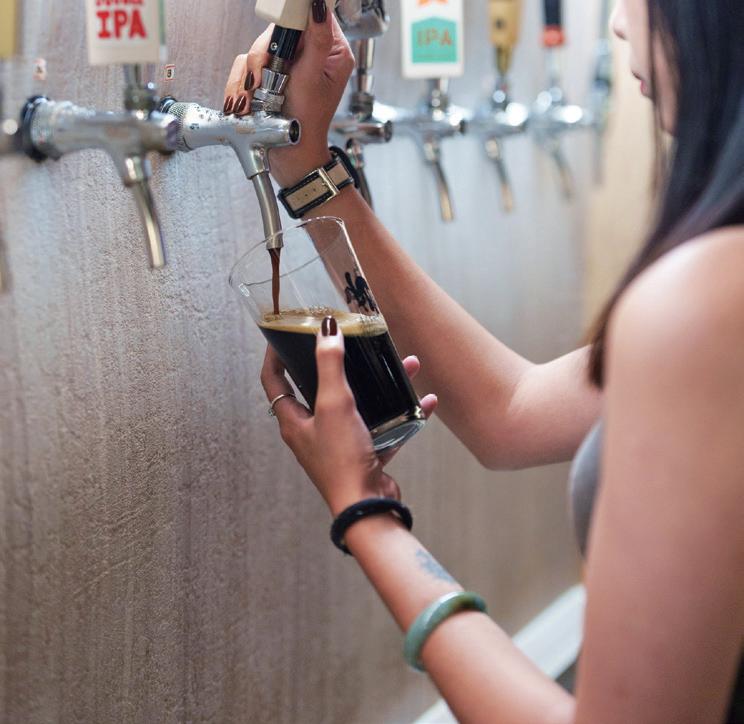
Once the land of lager, with not much more than Taiwan Beer and a few Japanese and American imports on offer, Taipei’s craft beer landscape has undergone a vibrant transformation, with local boutique breweries creating everything from beer-based local flavors to innovative hop-forward IPAs. From the nostalgic vibes and local taps of Floating Taipei in the Dadaocheng community to the frontierinspired aesthetic of Beer Rush and the chilled-out atmosphere of MMO Beer, Taipei now offers a plethora of choices for enjoying cold ones.
Floating Taipei
The Dadaocheng neighborhood functioned as Taipei’s main commercial district during the 1895~1945 Japanese era. As the city later expanded east, the area gradually faded into semi-obscurity. For decades, it was certainly not a place to go for a beer with friends or a night out.
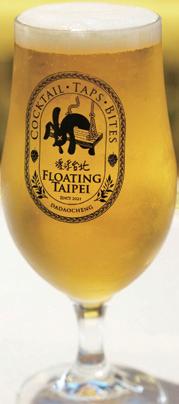
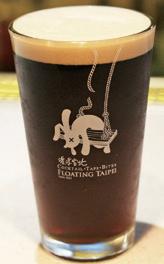
That began to change as a new generation of bars opened in the neighborhood, with a heavy emphasis on beer. After Mikkeller in 2016 came Jim & Dad’s in 2019, and Floating Taipei opened its doors in 2021. With 18 rotating taps and even more canned and bottled beers, along with an extensive cocktail menu, it quickly became a favorite among neighborhood locals and visitors alike.
The exterior is welcoming, with a wood façade and a picture window with a wide sill-cum-bench for enjoying evenings with good weather. Inside, comfortable seating provides a view of the bar’s extensive collection of Funko Pops and baseball-related figurines, featuring well-known players from Taiwanese, Japanese, and American teams.
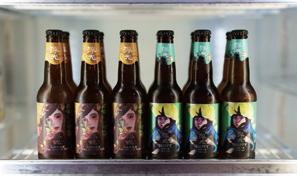
Floating Taipei’s strength is Taiwanese beers, with specific discounts on local brews frequently offered during happy hours. These commonly include beers from well-known local breweries such as Taihu, 23 Brewing Company, Ugly Half, and Red Point. Craft beer is the main draw at Floating, expect Taiwanese IPAs and porters alongside fruit sours, Belgian-style ales, and bold double IPAs from brewers around the world.
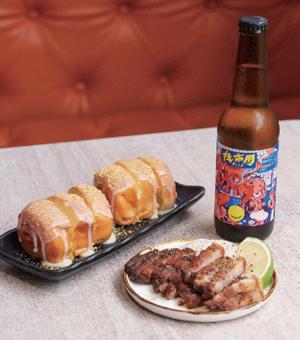
Leaning into Taiwanese charm with its food menu, Floating Taipei’s Hakka Style Salted Pork is a small but intensely flavorful dish of fatty pork strips with a quintessentially Taiwanese flavor. For more of a bite, eat each strip with a slice of the raw onion it’s served on. The Taiwanese fried chicken is tossed in garlic, green onion, and a salt-and-pepper five-spice mix that tastes like it’s straight from a night market.
FLOATING TAIPEI 漂浮台北
340, Nanjing W. Rd., Datong Dist. (02) 2550-0953
instagram.com/floatingtaipei Mon-Thu 6:00pm-1:30am Fri-Sat 6:00pm-2:30am Sun 6:00pm-1:00am
Bottled beer by local breweries
Hakka Style Salted Pork and Sweet Fried Bread
Beer Rush Taproom
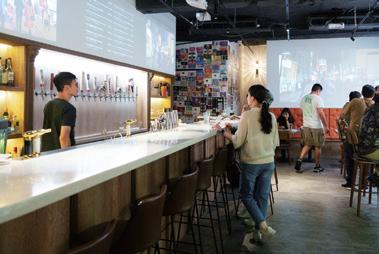
Although beer drinking may be a relatively recent phenomenon in Dadaocheng, eastern Taipei has rarely wanted for choice. The lanes around the Taipei Metro’s Zhongxiao Dunhua and Zhongxiao Fuxing stations in the fashionable East District are dotted with bars and taprooms. Among these is Beer Rush, which takes its inspiration from the gold rushes that played a major role in the 18th- and 19th-century settlement of the American frontier.
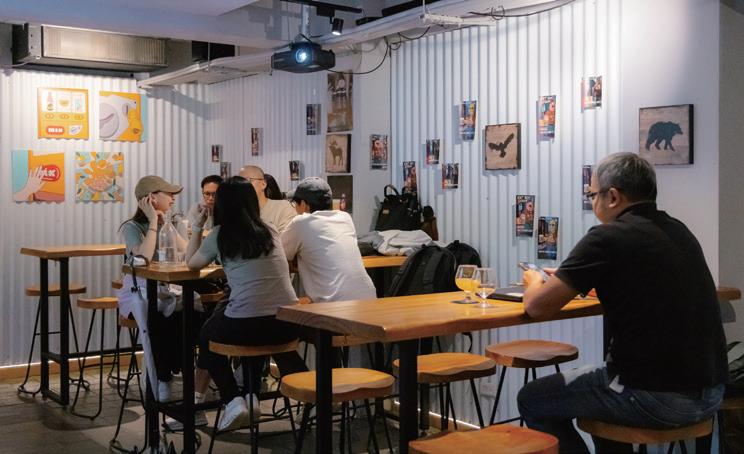
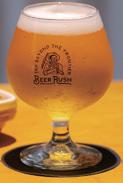
The interior of the joint evokes this old frontier aesthetic, with painted corrugated-tin walls imitating a miner’s shed and silhouettes of bears, eagles, and other animals of the American West on the walls alongside beer-themed posters. The beer is served in signature goblet-like glasses decorated with an image of a gold miner with a hop for a beard. There is a good amount of seating, at least for a compact East District bar, at stools lining long bar tables, and live local professional baseball games are frequently played on a large projector screen.
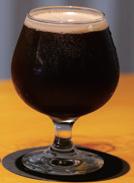
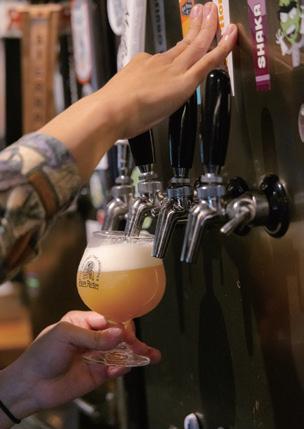
There are twelve taps at Beer Rush, featuring both Taiwanese and international beers. Adventurous palates are well catered to – think hazy DIPAs bursting with tropical fruit, imperial pastry stouts rich with chocolate fudge and caramel, and collaborative releases from well-regarded international breweries. The tap list leans toward bold, hop-forward styles and indulgent, highABV beers rather than playing it safe with approachable lagers, signaling a bar that caters to beer enthusiasts first. For snacks, try the tender, umami-rich signature craft beer fried chicken wings.
BEER RUSH
40, Ln. 51, Sec. 1, Daan Rd., Daan Dist. 0908-696-790
instagram.com/beerrushtaproom
Sun-Thu 5:00pm-12:00am Fri-Sat 5:00pm-1:00am
MMO Beer
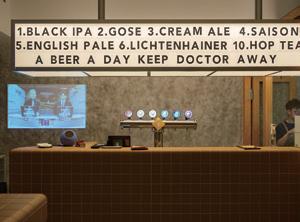
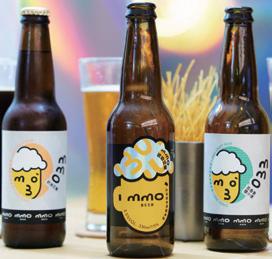
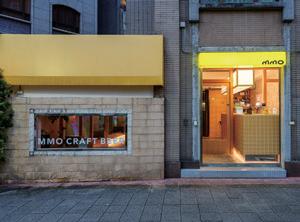
Heading east from Beer Rush, another stalwart on Taipei’s beer-drinking scene can be found across the street from the Dr. Sun Yat-sen Memorial Hall. The name MMO is both a pun on the bar’s address, 330 Guangfu South Road (“MMO” looked at sideways looks like “330”), and the standard beer-bottle size of 330ml.
Opened in 2023, MMO produces a variety of creative beers based on local and international Taiwanese flavors. The jasmine IPA blends the heady florals of jasmine tea with a signature hoppy India Pale Ale, and the winter melon ale is smooth and refreshing. The Earl Grey tea beer is light and fragrant, with subtle citrus notes of bergamot and tea. There is basic bar food on offer, including french fries, chicken nuggets, and Margherita pizza.
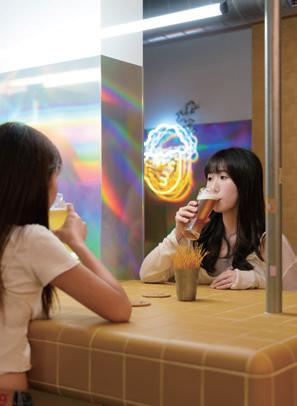
Just as the sign over the taps indicates, MMO’s ethos emphasizes “chill vibes only.” It’s an intimate –some might say tiny – space that encourages socializing and having a laid-back time. Playful iridescent walls with bench seating reflect neon signs, and the bar and solitary bar top seating area are clad in buttery beige tiles, again evoking a relaxing atmosphere.
During quieter hours, a modern Taiwanese R&B and acid jazz playlist invites patrons to while away lazy weekend afternoons. When it gets busy, live DJs perk up the crowd, and MMO often hosts music appreciation nights, including listening evenings dedicated to Taiwanese hip-hop or love songs.
MMO BEER
330, Guangfu S. Rd., Daan Dist. (02) 2776-6360 instagram.com/mmocraftbeer
Sun-Mon 4:00pm-12:00am Sat 3:00pm – 1:00am
Please drink responsibly
Style and Comfort on a Budget
Three Youth Hostels Worth Knowing About in Taipei
TEXT | TWELLI PHOTOS | COURTESY OF THE HOSTELS
Youth hostels have come a long way from their bare-bones, bunk-bed-only origins. In Taipei, some of the best double as social hubs and cultural spaces. Below, we introduce three unique and conveniently located hostels in the city.
Taipei Main Station is the gateway to Taipei for many visitors arriving in the city. It is therefore not surprising that in close proximity to this major transportation hub are numerous accommodation options, including several premium choices located north of the station, which provide backpacking travelers with affordable quality facilities.
Star Hostel Taipei Main Station is one of Taipei’s best-known hostels, and one that has quietly redefined what budget accommodation can look and feel like in Taiwan. Located on Huayin Street, a 5-minute walk from Taipei Main Station’s West 1 Exit, it is best known for its Green Lounge – an inviting two-story skylit atrium with lush plants, raised wooden floors,
and cabin-style seating areas. The hostel has welllit, well-equipped rooms, with the warm use of wood giving every space a homey feel. Dorm and private rooms with ample storage space are available, as are complimentary breakfasts and freshly brewed coffee.
The hostel regularly organizes free guided city walks (around Lungshan Temple) and hikes (Elephant Mountain), giving guests a great start into exploring the city. It also offers daily activities such as game nights, movie nights, and DIY food preparation sessions, including the making of boba tea and tang hu lu (candied fruit skewers). All activities are included in the room rate. Guests can also take advantage of the hostel’s location on Huayin Street, home to several no-frills eateries, for an immediate, authentic taste of the foods that locals like to consume.
Star Hostel Taipei Main Station
Not far from the Star Hostel, on Changan West Road, opposite the Museum of Contemporary Art Taipei (7 minutes from the station’s West 1 Exit), the Flip Flop Hostel occupies a lovingly renovated 1970s building. The name – “flip flops” being the universal footwear of the relaxed backpack traveler – sets the tone perfectly. Step inside and you’ll find a building reborn: a courtyard open to the sky, an independent bookstore (The One Bookstore; two stories, reading corner on second floor), a lounge (common area with simple kitchen, large table, coffee machine, microwave, etc.), and a breakfast place (Good Morning; hostel guests can redeem NT$100 vouchers). The hostel has dorms (mixed/female) and private rooms (single/double/ triple/quadruple), some with en-suite bathrooms.
The courtyard and indoor spaces are sometimes used for cultural activities, including cultural-creative markets, exhibitions, and small-scale concerts. The hostel is especially interesting for architecture lovers and those travelers who enjoy immersing themselves in contemporary culture. From the location, hostel guests can also easily reach the trendy pedestrian-friendly area around MRT Zhongshan Station (Xinzhongshan Linear Park, Chifeng Street), known for its many boutiques, cafés, and bookstores.
For something a little more intimate, Old Door
Hostel & Bar is a small, friendly guesthouse tucked away down a quiet lane just off Zhengzhou Road, facing the Y13 exit of the Taipei City Mall. The hostel’s location is very convenient. The underground mall – home to hundreds of shops selling souvenirs and knick-knacks – connects to Taipei Main Station and the airport metro station, enabling you to make the journey to/from the airport almost exclusively indoors. The ground floor of the hostel functions as a café and bar by day and evening, respectively, serving tea, coffee, and drinks in a relaxed atmosphere, while the upper floors house the guestrooms and shared bathrooms, and the top floor has a common room and kitchen. A freshly made Taiwanese breakfast –egg pancake, toast, and a drink – is included in the room rate.
Despite its central location, the hostel provides a remarkably quiet retreat from the city noise, and the bar downstairs is a great place to sample local craft beers while chatting with the knowledgeable staff. It is also a perfect base for those planning an early-morning trip to Taoyuan International Airport using the nearby Taoyuan Airport MRT station.
To find hostels in Taipei that have been vetted by the Tourism Administration, visit www.taiwanstay.net.tw.
Elephant Mountain | 象山 Lungshan Temple | 龍山寺 Museum of Contemporary Art Taipei | 台北當代藝術館 Xinzhongshan Linear Park | 心中山線形公園
STAR HOSTEL TAIPEI MAIN STATION 信星青年旅館 4F, 50, Huayin St., Datong Dist. starhostel.com.tw
OLD DOOR HOSTEL & BAR 門埕青旅 10, Ln. 21, Zhengzhou Rd., Datong Dist. facebook.com/OldDoorHostel
Flip Flop Hostel
Old Door Hostel & Bar
TRAVEL INFO
METRO TAIPEI
EasyCard
NT$200 (NT$100 value incl.)
SINGLE-JOURNEY TICKET
NT$20 - NT$65
TAIPEI CITY BUS
Adult: NT$15, regardless of using cash or an EasyCard
Student: NT$15 when paying cash; NT$12 when using an EasyCard (Student ID required)
TICKET PRICE Taipei eBus ebus.gov.taipei
Child under 115cm or under six years old: Free (ID required)
Taipei Sightseeing Bus
The open-top, double-decker buses offer a hop-on/hop-off service, allowing tourists to take in the cityscape and visit many of Taipei’s prime destinations. Website: taipeisightseeing.com.tw
YOUBIKE
YouBike is Taipei’s public rental bike system. Register with an EasyCard at en.youbike.com.tw/region/taipei/register or with a credit card via YouBike app to rent a bike, enjoy free insurance, and a memeber-only subsidy. The fee per 30 minutes is listed below.
NT$0 with member-only subsidy
The electric-assisted Youbike 2.0E charges NT$20 per 30 minutes for the first 2 hours, and NT$40 per 30 minutes thereafter. No subsidy is given.
TAIPEI FUN PASS
There are four types of Taipei Fun Pass available: the Unlimited version (attractions+transportation), the Exploring version (attractions +EasyCard), the Classic version (2 attractions+EasyCard) and the Transportation version (transportation only). You can visit Taipei City, New Taipei City, Keelung City, and Taoyuan City within the validity.
TRAVEL INFORMATION SERVICES
Tourism Administration, Ministry of Transportation and Communication: 0800-011-765 Information for Foreigners in Taiwan: 1990
Taipei Citizen Hotline: 1999 (Outside Taipei City, please dial 02-2720-8889)
Taipei Travel Net: travel.taipei/en; presents travel information on Taipei City in Chinese, English, Japanese, Korean, Thai, Indonesian, Vietnamese, and Spanish