No.
45
Autumn 2026
Themed Walks Heritage Buildings
Lanes & Alley Wenzhou Street
Out in Nature Trails and Tea in Maokong
Fine Food Brunch Options Taro Delicacies
Taipei Music Venues and Record Stores Music-Themed Cafés, Bars, and Restaurants The Cityʼs Street Performance Scene
PICK UP POINTS 台北市政府觀光傳播局
Department of Information and Tourism, Taipei City Government 4F, 1, City Hall Rd., Taipei City (02) 2720-8889/1999 ext.7564
桃園國際機場第一航廈
Tourist Service Center at Arrival Lobby, Taiwan Taoyuan International Airport Terminal 1 15, Hangzhan S. Rd., Taoyuan City (03) 398-2194
桃園國際機場第二航廈
Tourist Service Center at Arrival Lobby, Taiwan Taoyuan International Airport Terminal 2 9, Hangzhan S. Rd., Taoyuan City (03) 398-3341
台北松山機場
台北表演藝術中心
Taipei Performing Arts Center 1, Jiantan Rd., Taipei City (02) 7756-3888
台北當代藝術館
Museum of Contemporary Art (MoCA), Taipei 39, Changan W. Rd., Taipei City (02) 2552-3721
台北流行音樂中心 Taipei Music Center
99, Sec. 8, Civic Blvd., Taipei City (02) 2788-6620
寶藏巖國際藝術村
Treasure Hill Artist Village 2, Aly. 14, Ln. 230, Sec. 3, Tingzhou Rd., Taipei City (02) 2364-5313
Taipei Songshan Airport 340-9, Dunhua N. Rd., Taipei City (02) 8770-3430
松山車站
Songshan Station 11, Songshan Rd., Taipei City (02) 2767-3819
南港車站
Nangang Station 313, Sec. 1, Nangang Rd., Taipei City (02) 2783-8645
國立中正紀念堂
National Chiang Kai-shek Memorial Hall 21, Zhongshan S. Rd., Taipei City (02) 2343-1100
士林官邸
Chiang Kai-shek Shilin Residence 60, Fulin Rd., Taipei City (02) 2883-6340
榕錦時光生活園區
Rongjin Gorgeous Time 167, Jinhua St., Taipei City (02) 2321-8896
台北市立動物園 Taipei Zoo
30, Sec.2, Xinguang Rd., Taipei City (02) 2938-2300 ext.630
新富町文化市場
U-mkt (Xinfu Market) 70, Sansui St., Taipei City (02) 2308-1092
美國在台協會
台北之家
Taipei Film House 18, Sec. 2, Zhongshan N. Rd., Taipei City (02) 2511-7786
台北記憶倉庫
Taipei Info Hub 265, Sec. 1, Zhongxiao W. Rd., Taipei City (02) 2371-4597
松山文創園區
Songshan Cultural and Creative Park 133, Guangfu S. Rd., Taipei City (02) 2765-1388
華山 1914 文化創意產業園區 Huashan 1914 Creative Park
1, Sec.1, Bade Rd., Taipei City (02) 2358-1914
國立台灣博物館
National Taiwan Museum 2, Xiangyang Rd., Taipei City (02) 2382-2566
誠品書店台大店、西門店
eslite Bookstore NTU, Ximen
American Institute in Taiwan 100, Jinhu Rd., Taipei City (02) 2162-2000
台北美國學校
Taipei American School 800, Sec. 6, Zhongshan N. Rd., Taipei City (02) 2873-9900
國語日報語文中心
Mandarin Daily News (Language Center) 2F, 2, Fuzhou St., Taipei City (02) 2341-8821
交通部觀光署旅遊服務中心
Travel Service Center, Tourism Administration, MOTC 240, Dunhua N. Rd., Taipei City (02) 2717-3737
台北市政府秘書處市民服務組
Information and Assistance Division, Secretariat, Taipei City Government 1, City Hall Rd., Taipei City (02) 2720-8889/1999 ext.1011
金石堂書店
Kingstone Bookstore
台北市立圖書館
Taipei Public Library (Main & Branches)
台北市各親子館
Parent-child Centers in Taipei
台北市旅遊服務中心
Visitor Information Centers in Taipei
新北捷運環狀線
All Stations on Circular Line of New Taipei Metro
台 北 捷 運 市 政 府 站、 忠 孝 復 興 站、 台 北 車 站、 西 門 站、 民 權 西 路 站、 中正紀念堂站 Taipei City Hall, Zhongxiao Fuxing, Taipei Main Station, Ximen, Minquan W. Rd. and C.K.S. Memorial Hall of Taipei Metro
Editor’s Note Autumn has arrived in Taipei, and the air is filling with a comforting cool. In this city of people with a passion for music, you’ll also find the air filled with its sounds. Use our three cover stories in this issue as your guide to Taipei, a City of Music. In our main feature, go on a whirlwind tour of iconic venues and spaces, from big concert halls to live houses to record stores. In a second feature, immerse yourself in the local music scene through exploratory forays to cafés, bars, and restaurants of iconoclastic personality devoted to the art of listening. And in a third, locate the hotspots for street-performance music, which can be found in commercial areas and cultural-creative parks. Now, let’s take a walk down heritage lanes. In our regular Themed Walks column, our quest is restored Japanese-era landmarks, including wooden dorm-residence complexes, a distinctive police station, and a Tudor-style villa. Our Lanes & Alleys destination is the leafy, heritage-steeped Wenzhou Street neighborhood, a place of “philosophers, poets, and pork buns.” In our Out in Nature articles, we visit the high-hills Maokong area, a day-trip destination of foliage-shaded trails, high-perch old temples, photogenic tea plantations, quaint teahouses, sweet-snack vendors, and the Maokong Gondola. And in another offering, get to know the Taiwanese golden rain trees along Dunhua South Road, which transform beautifully throughout the seasons. Elsewhere, in DIY Fun, you’re in for a round of “tuft love,” with instructors speaking multiple languages helping you craft a unique take-home rug or wall hanging. Then head off on a Fine Food tour of three creative eateries redefining how the city does brunch, followed by another food discovery venture learning how the humble taro has become something of a dessert-maker’s darling. And since each globe-trekker deserves a first-rate Taipei nest to lay their head to rest, this issue’s Stay in Style subject is designer hotels that double as artworks in the city. Enjoy your stay with us!
Please scan this QR code and complete a short questionnaire to help us improve our magazine. As a thank-you, you’ll be entered into a lucky draw for a chance to win a fun and practical gift! We appreciate your time!
NO. 45 AUTUMN 2026
PUBLISHER Hsiang Yu
EDITOR-IN-CHIEF Chiaying Tzou
MANAGING EDITOR Erhhuan Lien
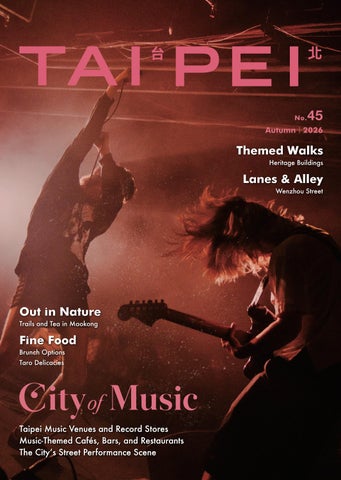
COVER PHOTO The Wall Live House
Department of Information and Tourism, Taipei City Government Add: 4F, 1, City Hall Rd., Taipei, Taiwan, R.O.C. Tel: 1999 (02-2720-8889 outside Taipei City) ext.7566 Email: taipei_quarterly@gov.taipei ISSN: 24137766 GPN: 2010402342
Vision Creative Marketing & Media Co. Editors: Rick Charette, Johannes Twellmann, Anna Li Contributors: Han Cheung, Jenna Lynn Cody, Ami Barnes, Rick Charette, Hollie Younger Design: Ian Tsai, Eve Chang
TAIPEI Subscription Services, Postal Wire Transfer: 4 Issues Beneficiary Account No.: 16630048 Beneficiary Name: Department of Information and Tourism, Taipei City Government Domestic
NT$120
Regular Mail
Hong Kong/Macau
NT$360
Regular Air Mail
Asia/Pacific Region
NT$440
Regular Air Mail
Europe/US/Africa
NT$600
Regular Air Mail
Online reading: www.travel.taipei/en > Media > TAIPEI Department of Information and Tourism, Taipei City Government All rights reserved. Reproduction in any form without written permission is prohibited. 中華郵政台北雜字 第 2372 號執照登記為雜誌交寄 Price: NT$30
This magazine was printed with environmentally friendly soy ink. We hope you enjoy reading this issue of TAIPEI. If you have any suggestions, please do not hesitate to contact us.
CONTENTS COVER STORY TAIPEI, CITY OF MUSIC Tune In to Taipei
06
Where Music Lovers Can Experience the City’s Rich Musical Landscape
Music on the Menu
14
Taipei’s Cafés, Bars, and Restaurants Devoted to the Art of Listening
Where Streets Become Stages
20
Taipei Offers a Variety of Outdoor Spaces for Artists to Showcase Their Skills
THEMED WALKS Walking Through Time
22
Restored Japanese-era Landmarks in Taipei
LANES AND ALLEYS Wenzhou Street Wanderings
28
A Neighborhood of Philosophers, Poets, and Pork Buns
OUT IN NATURE Steep Rewards
34
Trails and Tea in Maokong
Living Landmarks
40
Beautiful Trees with Different Appearances Throughout the Seasons
DIY FUN Tuft Love Stitching Up a Souvenir Worth Keeping
42
FINE FOOD Egg-cellent Eats Three Taipei Spots Redefining Brunch
Going Purple
46 50
Hunting Taipei’s Tastiest Taro Treats
STAY IN STYLE Designed to Dream Stylish Boutique Stays in Taipei
54
SEASONAL HIGHLIGHTS
Seasonal Festivals and Events International Birdwatching Fair #01 Taipei 台北國際賞鳥博覽會 East Asia’s longest-running eco-conservation event, this fair has attracted more than 300,000 visitors since its launch in 1999. Themed “Under Our Wings” this year, the fair brings together numerous international wildlife conser vation groups and domestic organizations for a weekend of exhibitions, interactive games, expert talks, and nature-film screenings that explore the relationship between humans and wild birds. The theme looks at both sides of that relationship: the positive impact of creating artificial habitats, protecting these habitats, and providing stable food sources on bird survival, as well as the challenges birds face from threats like invasive species and habitat fragmentation. Visitors are invited to reflect on this delicate coexistence and consider ways to support it in the future. Guandu Nature Park 關渡自然公園 October 17-18 www.wbst.org.tw
Blanche Taipei #02 Nuit 台北白晝之夜 This, the city’s largest overnight arts festival, transforms public spaces into a one-night, city-wide art museum. Everyone is invited to explore a diverse program of visual art, performances, and installations that unfold after dark. This year’s theme is “Night ka shi,” taking nakashi – a traditional form of live music once deeply rooted in everyday local life – as a cultural entry point to explore how urban culture is translated and carried forward through daily experience. Serving as guest curator is Valérie Senghor, director of Cent Quatre, a vibrant public cultural center in Paris. For the first time, the festival opens the campus of Datong University to the public, and it will also enter the Qingguang Shopping District, giving visitors another dynamic neighborhood to explore after dark. Yuanshan Natural Landscape Park, Yuanshan Park Area of Taipei Expo Park, and Qingguang Shopping District 圓山自然景觀公園、花博公園圓山園區及晴光商圈 October 31 - November 1 www.nuitblanche.taipei
4
SEASONAL HIGHLIGHTS
Spring Festival in Taipei #03 Hot 台北溫泉季 Held annually in Beitou, Taipei’s historic hot-spring district, this festival is a celebration of over a century of local mineralspring bathing culture, with a lineup of cultural performances – including a championship-winning dance troupe from Hokkaido and geigi performers from Yuzawa in Japan – themed festivities centered around MRT Xinbeitou Station and the surrounding parks. Visitors can look forward to stalls offering hot-spring cuisine and cultural-creative products, a performance by the Ming Hwa Yuan Arts & Cultural Group, the Beitou Floral Yukata Festival, and the Golden Melody Night. MRT Xinbeitou Station and surrounding areas 新北投捷運站及周邊地區 October 22–26 facebook.com/taipeihotsprings
King Festival #04 Qingshan 青山王祭 Held in the Bangka area (Wanhua District) and centered on Qingshan Temple, this event is also known as “Bangka Grand Worship.” It honors Qingshan King, a deity believed to protect the community from plague and misfortune. Over several nights, elaborately decorated palanquins carrying the statues of this and other deities parade through narrow historic streets, accompanied by folk performers, temple troupes, firecrackers, and incense smoke. During the procession period, the temple hosts a series of events, including a lively market, musical performances, and arts shows at Bangka Park (currently being renovated; to be reopened in October), with hosts speaking Taiwanese and English. Monga Qingshan Temple 艋舺青山宮 November 28-30 facebook.com/qingshantemple
Smoke-Free Taipei The city is dedicated to creating cleaner air by expanding its smoke-free spaces and introducing designated smoking zones in hightraffic districts. A key feature is the installation of enclosed negative-pressure smoking booths, most notably in the Ximending, Xinzhongshan Linear Park, and Dihua Street areas. Alongside an expanding network of designated smoking areas, which can be found on the map in the “Travel Taipei” app (under “Transportation Information/Interactive Map”), this initiative helps make Taipei more enjoyable for everyone.
Travel Taipei App
©Photos courtesy of event organizers 5
COVER STORY
Tune In to Taipei Discover Where Music Lovers Can Experience the City’s Rich Musical Landscape
TEXT | HAN CHEUNG PHOTOS | VISION, TAIPEI MUSIC CENTER, LEGACY TAIPEI, THE WALL LIVE HOUSE, RIVERSIDE LIVE HOUSE
From sold-out arena concerts to cluttered record stores, music pulses through Taipei in ways both grand and intimate. Explore the venues and shops that keep the city’s music scene alive – catch a live show or dig for treasures at shops known for their vast selections. 6
COVER STORY
Livehouse performance
B
eyond major concerts and multi-day festivals that draw thousands, Taipei’s music culture also thrives in smaller, low-key corners of the city – live houses, DJ party venues, even restaurants with live singers – where locals go to discover new sounds or unwind to an old favorite tune. Over the years, Taipei has developed a variegated network of facilities that support both established artists and emerging talent. The Taipei Music Center embodies this spirit by hosting major concerts as well as smaller acts through spaces across the complex, along with production and rehearsal facilities. Cozier venues across the city give independent musicians a place to experiment, test out new material, and connect directly with audiences. For those who prefer to listen at their own leisure, the city’s record stores offer a chance to browse, discover, and hunt down rare CDs, DVDs, and vinyl records. More than just retail operations, they offer curation, recommendations, and assistance in finding specific items, and remain gathering places for enthusiasts despite the rise of digital streaming. There are countless ways to experience different genres of music in Taipei, whether it be jazz, heavy metal, traditional music, or something entirely new. The following spaces offer just a brief snapshot of the city’s rich musical scene, with many more sounds also waiting to be discovered elsewhere. 7
COVER STORY
Taipei Music Center Since its opening in 2020, the Taipei Music Center in Nangang District has transformed a formerly industrial corner of the city into a destination for popular music, with a packed calendar that brings together local and international talent. Alongside venues for performances ranging from major concerts to intimate live acts, the complex houses exhibition spaces, shops, rehearsal rooms, and recording studios, bringing different facets of the music scene together in one place. One of its f lagship annual programs is the Trendy Taipei – JAM JAM ASIA Music Festival, wh ich each yea r t a ke s plac e in Au g u st a nd September. More than 80 acts from across Asia perform on multiple stages spread across the center’s indoor and outdoor venues, including the stateof-the-art, 5,000-capacity Concert Hall. Curated by a team of veteran musicians and industr y professionals, the lineup features both household names and emerging artists, offering a broad taste of contemporary Asian music. A section of adjoining Civic Boulevard is transformed into a block-party venue, with late-night DJ sets keeping the festivities going into the early hours. The center is also the venue for the TMC Golden Voice Contest, which turns the spotlight on local talent, inviting residents of Taipei, New Taipei, and Keelung City to compete. More than 800 hopefuls applied this year, with 40 finalists competing on an outdoor stage on September 20. The top four finishers will also earn a performance slot at an exclusive concert – a great opportunity to showcase their talents before a larger audience. This year, from October 9 to 11, the center’s
8
outdoor plaza will also serve as the setting for the main stage of the Taipei Jazz Festival (the festival runs from Sept. 4 to Oct. 11). Now in its 20 th year, this citywide entertainment staple brings international and local musicians to indoor and outdoor venues across Taipei, with this year’s program celebrating the 100th birthdays of legends Miles Davis and John Coltrane. An open call gives up-and-coming musicians the chance to compete for a spot on the main stage, while workshops offer a chance to hear and learn from the masters. Beyond the major events and concerts, the center is well worth exploring. The Cultural Cube is Taiwan’s first exhibition space dedicated to music. It houses the immersive permanent exhibition MUSIC, ISLAND, STORIES: POP MUSIC IN TAIWAN, which takes visitors through a century of musical history (note: the exhibition is currently on hold and will resume on Dec. 5). Temporary shows further explore Taiwan’s musical heritage, along with other themes. Dotted across the complex are music-oriented shops selling vintage records, headphones, DJ equipment, and instruments. Along the side of the Cultural Cube is an area that brings together a row of coffee shops and drinking establishments, some open late into the night. Finally, the Creative Hub serves as an incubator for musical talent, housing classrooms, rehearsal rooms, and recording and production studios. TAIPEI MUSIC CENTER 台北流行音樂中心 99, Sec. 8, Civic Blvd., Nangang Dist. (02) 2788-6620 www.tmc.taipei
Live concert in TMC Concert Hall JAM JAM ASIA Music Festival
TMC Concert Hall
COVER STORY
Legacy Taipei
Live Music Venues Housed in a former liquor production facility at Huashan 1914 Creative Park, Legacy Taipei is one of Taipei’s most prominent live music venues. Opened in the historic structure in 2009, the spacious, highceilinged industrial character is retained at the venue, with a completely column-free interior that ensures unobstructed views of the stage. With a capacity of around 1,000 people, Legacy Taipei occupies a space between an intimate live house and a large concert venue, allowing it to accommodate performances of different scales. Touring artists from abroad (like The Click Five this August) and well-known local musicians are regularly hosted, while independent and emerging talent is supported through programs such as The Next Big Thing. Genres run the gamut of contemporary music, from pop, hip-hop, and rock to folk and electronic music. Visitors can grab dinner or drinks at one of the creative park’s restaurants and bars, or browse an exhibition or craft market, before heading inside for a concert.
10
T he Wa l l L ive Hou s e , a ba s ement venue i n the Gonggua n a rea, is a ma instay of Ta ipei ’s independent music scene, hosting a lternative, experimental, and underground acts alongside acclaimed overseas artists. Visitors descend into a long hall with a seating area and full bar, where they can grab a drink and socialize before moving to the performance space. There is also a chance to interact with musicians after shows in this area. The 600-capacity space is cozy enough yet capable of hosting larger acts, with a straightforward, no-frills setup that puts the focus squarely on the stage. Since 2003, The Wall has given emerging Taiwanese musicians a place to build an audience and has served as a regular stop for touring acts. Its programming spans rock, punk, metal, shoegaze, hiphop, electronic, and experimental music, showcasing the scene’s diversity. For more than two decades, the original Riverside Music Café was a vital part of Taipei’s independent music ecosystem, giving young performers a chance to test the stage. The original space closed in 2023, but Riverside Live House continues at its larger, more polished sister location in the historic The Red House in the bustling Ximending area. With a capacity of 500 people, this is a stage for mid-sized concerts alongside music-related talks and other cultural events. The event schedule mostly features pop, indie, and jazz, alongside folk, rock, world music, and other performances. Established Taiwanese singers and international musicians can play more intimate shows here, while new talent and independent bands are also supported.
The Wall Live House
The Wall Live House
LEGACY TAIPEI 1, Sec. 1, Bade Rd., Zhongzheng Dist. (Building M5A inside Huashan 1914 Creative Park) (02) 2395-6660 www.legacy.com.tw THE WALL LIVE HOUSE B1, 200, Sec. 4, Roosevelt Rd., Wenshan Dist. (02) 2930-0162 instagram.com/thewalllivehouse RIVERSIDE LIVE HOUSE 河岸留言 177, Xining S. Rd., Wanhua Dist. (02) 2370-8805 instagram.com/riversidemusic.tw
Riverside Live House
COVER STORY
Record Stores Celebrating its 50th anniversary this year, Chia Chia Record is a cherished part of the memories of many who grew up in Taipei. Originally located in a group of now-demolished market buildings, the CD and record store remains near its original site, accessed through a small, arched stairway in a commercial building on the edge of Ximending’s pedestrian area. It has a second branch on Hankou Street near Taipei Main Station. The store prides itself on the sheer diversity of its catalog, carrying both popular releases and less commercially viable titles to meet the varied tastes
Chia Chia Record
12
of its customers. Its selection covers everything from pop and rock to heavy metal, classical, jazz, Japanese, Korean, and Cantopop, as well as film soundtracks, all sorted into specif ic subgenres. There’s also a DVD section with movies, dramas, and live concerts. This spirit has helped the store survive the rise of chain CD stores in the 1990s and early 2000s, as well as the onslaught of digital music. Rather than seeing streaming as a threat, the store’s owner views it as a discovery tool, allowing listeners to explore new artists and genres before seeking out physical copies.
COVER STORY
Chia Chia Record
For music lovers who want to stay out late but aren’t interested in clubs or live houses, Eslite Music at Songshan Cultural and Creative Park offers a quieter alternative. Open around the clock as part of the Eslite Spectrum Songyan complex’s 24-hour third f loor, the store invites visitors to browse CDs, vinyl records, and other music-related goods into the early hours, alongside a bookstore and other cultural-creative offerings on the same f loor. Its curated selection spans niche genres and hard-to-find releases, and several listening stations let patrons sample albums on headphones for as long as they like – a tradition inherited from Eslite’s original Dunnan branch, which first popularized the concept as part of the world’s first 24-hour bookstore before closing in 2020. The enterprise continues the same approach today at Songyan, with themed displays and staff recommendations. It is known for its vinyl selection, which includes movie, drama, anime, and video game soundtracks. The store also hosts the annual “24 Hours of Vinyl” market, with a different theme each year, featuring tens of thousands of new and used records, album-sharing sessions, talks, and DJ workshops. Other music talks, listening events, and live performances are also regularly held at the store.
The Eslite Music CHIA CHIA RECORD 佳佳唱片行 2-3F, 110, Sec. 1, Zhonghua Rd., Wanhua Dist. (02) 2311-4990 www.ccr.com.tw 10:30am-9:30pm THE ESLITE MUSIC 誠品音樂松菸 3F, 88, Yanchang Rd., Xinyi Dist. (02) 6636-5888
Concert Hall | 表演廳 Creative Hub | 產業區 Cultural Cube | 文化館 Gongguan | 公館 Huashan 1914 Creative Park | 華山 1914 文化創意產業園區 MUSIC, ISLAND, STORIES: POP MUSIC IN TAIWAN | 唱 我們的歌 流行音樂故事展 Songshan Cultural and Creative Park | 松山文創園區 Taipei Jazz Festival | 台北爵士音樂節 The Next Big Thing | 大團誕生 The Red House | 西門紅樓 TMC Golden Voice Contest | 北流金舞台歌唱大賽 Trendy Taipei | 潮臺北 Ximending | 西門町
13
COVER STORY
Discover Taipei’s Cafés, Bars, and Restaurants Devoted to the Art of Listening TEXT | JENNA LYNN CODY PHOTOS | VISION
Taipei’s music scene extends well beyond concert halls, nightclubs, and cultural venues. Across the city are cafés, bars, and restaurants offering patrons different listening experiences, from vinyl parties and cassette tape sessions to themed concerts and intimate pop nights. Many of these places are steeped in nostalgia, reintroducing visitors to the sounds and culture of a highlighted bygone era.
14
COVER STORY
T
ucked away on a quiet lane right by Daan Park, Sounds Good is a café dedicated to the art of analog listening, stocking tens of thousands of vinyls alongside pre-1950s shellac records, tapes, CDs, and musical antiques – including a 101-year-old phonograph that must be cranked by hand. Founder Lin Pei-ru began building her collection around 2015, when she acquired more than 7,000 vinyl records from a long-time enthusiast. She promised not to sell them, and instead dedicated herself to piecing together a musical map of the vinyl era spanning classical music, jazz, opera, pop, rock, film scores, and even cartoon theme songs and tunes from traditional glove-puppetry shows. She initially shared the collection through a membersonly club, before making it available to the public with Sounds Good in 2021. The industrial-chic space features retro and modern elements, with musical motifs and installations greeting patrons from the entrance onward. Themed exhibits showcase rare artifacts and introduce musicians from the vinyl era. Visitors can request that specific music be played or book a paid session at the listening room downstairs. The food menu features most ly Western fa re, including the signature open-faced beef sandwich, and fusion dishes such as creamy mentaiko udon with egg yolk. An Elvis sandwich is served on thick toast with yogurt. Drinks include music-themed cocktails, single-origin coffees, herbal teas, and smoothies. The space a lso ser ves a s a gathering point for musicians and music lovers. Listening sessions, talks, and live performances are held regularly, and songwriter nights give musicians a stage to try out new material. Sounds Good also houses a professional vinyl recording studio.
Vinyl records at Sounds Good
Vintage vinyl records
Music-themed cocktails
SOUNDS GOOD 聲色 1-3, Ln. 30, Sec. 2, Xinsheng S. Rd., Daan Dist. (02) 2358-1668 soundsgoodtaipei.com.tw Tue-Sun 10:00am-6:00pm
15
COVER STORY
Located on the edge of the historic Dadaocheng area, Sidoli Radio is a café, music shop, and cultural space rolled into one. The retro shopfront features a recessed wood-and-glass façade that evokes the look of a classic radio station, complete with the words “ON AIR” in old-school lettering on both the door and the A-frame signboard. The design also pays homage to the traditional tailor shops that once crowded this area, which was a major center for Taiwan’s textile and fabric trade. The nostalgia theme is continued inside, where a vintage Philips radio sits beside the entrance, and a 1960s SABA Freiburg 100 vacuum-tube radio is displayed farther inside among other antique artifacts. Microphone-shaped lights and other musical references appear throughout the narrow, high-ceilinged interior, which features a variety of seating, including a glassfronted booth. Displays from rotating exhibits can be found throughout the space. A working recording studio also catches the eye – podcasts and other audio projects are produced here, and DJs spin their favorite records. A staircase in the middle of the room leads to a tiny, narrow former air-raid shelter that houses what is said to 16
COVER STORY
be Taiwan’s smallest record store. The shop is primarily focused on cassette tapes, along with vinyl records and other music-related goods. The collection mostly features older Taiwanese and Western hits, as well as some newer works by independent musicians. Founded in 2020 by designer Joe Fang, cultural-tourism specialist Yu Chih-wei, and author/event curator Carol Lin, Sidoli Radio was created around the idea of using sound to preserve memories and local culture. The studio team collects stories from people and places around Taiwan and is putting together an online neighborhood-focused audio library. Patrons can purchase a blank cassette tape and, for a fee, have a 15-minute audio story recorded onto it, creating a personal souvenir that can also become part of Sidoli Radio’s growing archive. Upon entry, patrons are given a random vintage cassette tape with a folded menu hidden inside. They can request a portable player and earphones to listen to the tape, which might bring them way back or lead them to discover “new” music from the past. There are specialty coffee drinks such as brown-sugar cream cold brew and osmanthus latte, while the food leans toward lighter fare, including croissants with salted butter as well
as a selection of toasts and panini sandwiches. The desserts are also popular, especially the signature Island Rover Affogato, served with a dropper of white soy sauce for an unexpected savory twist. The place changes into a bar on Friday and Saturday evenings with DJs and music events. The drinks menu shifts toward sake, local craft beer, and creative Taiwanese spirits, including a marigold Tieguanyin highball. The smaller food menu includes desserts, dumplings, and baguettes served with black curry dip. Events include regular live shows such as Team Lee Fang Beat (a playful homophone of the Mandarin “let’s hear your beat”) hosted by Lee Han, who talks about music, plays records, and invites enthusiasts to share their prized finds. Guest DJs bring their own styles or collaborate on themed listening parties, while special events and collaborations with other creatives are also held throughout the year.
SIDOLI RADIO 小島裡 245, Changan W. Rd., Datong Dist. sidoli.tw Wed-Sun 10:00am-6:00pm Fri-Sat 7:00pm-12:00am
Former air-raid shelter turned record store
Listening to a vintage cassette tape
17
Live performance at Yuppy Bookstore Yuppy Bookstore
EZ5 Live House pub grub
Live performance at EZ5
COVER STORY
Hidden inside an aging commercial building in Taipei’s East District, a striking-red corridor and staircase lined with bookshelves lead to an unexpected world. Follow the steps down and emerge in the decadent, theatrical interior of Yuppy Bookstore, inspired by the romantic world of 1930s Paris and reminiscent of a literary salon, anchored by a large classic clock pointing at 19:30. The enterprise opened more than a decade ago as a small shop sharing a couple’s favorite books and films. But they soon wanted it to be more than just a standard bookstore, wondering how they could turn it into a space that embodied an “urban yuppie lifestyle.” When the space next door became available, they decided to take the leap. Designing the expansion themselves, they drew inspiration from Woody Allen’s film Midnight in Paris, the raw, distressed concrete walls and elegant antique furniture and chandeliers creating a striking contrast. The expanded space became an event venue hosting mini-concerts, film director discussions, as well as talks focused mainly on architecture and urban travel. The afternoon-tea concert series takes patrons on nostalgic music journeys, with programs ranging from Italian love songs and Western oldies to country legends, 1990s pop divas, and vintage Taiwanese hits. Evening shows feature more jazz, funk, old-school rock, Latin music, and Broadway showtunes as well as Mandopop hits from the 1980s and 1990s. Some concerts are movie-themed. Yuppy offers a full food menu, from snacks and salads to burgers, steaks, and seafood. Smoothies, coffees, teas, and alcoholic drinks are also available.
YUPPY BOOKSTORE 雅痞書店 3F, 1, Ln. 126, Sec. 1, Fuxing S. Rd., Daan Dist. (02) 2731-7477 www.yup.com.tw Wed-Sun 12:30pm-9:00pm EZ5 LIVE HOUSE 211, Sec. 2, Anhe Rd., Daan Dist. (02) 2738-3995 www.ez5.com.tw Sun-Mon 8:00pm-1:30am
EZ5 Live House has been one of Taipei’s most enduring destinations for live popular music. Founded in 1991, the Anhe Road venue has built its reputation around local pop singers performing with a live band in an intimate, lounge-like setting. Today, EZ5 remains a prime showcase for vocal performance. Patrons come specifically to hear the singers, who range from up-and-coming artists to established performers with a dedicated following, as well as household names who occasionally make special appearances. Shows take place nightly, generally featuring three acts singing Mandarin pop, Taiwanese ballads, and Western classics – not only covers, but songs they have personally released. The venue has long been a launching pad for singers who have gone on to become major recording artists. Some of Taiwan’s best-known singers have been regular performers here, including multiple-time Golden Melody Award winners Tiger Huang and A-Lin. The cover fee includes two items from the menu, which features fried snacks and finger foods, along with a wide selection of alcoholic and soft drinks. EZ5 Story Pitchers are specialty cocktails inspired by signature songs of the venue’s artists. EZ5’s decor has remained largely unchanged for decades: a dimly lit, American-style basement bar with wooden tables and chairs encircling a low stage, placing performers just a meter or two from the audience. This proximity draws attention to the music itself, allowing guests to fully appreciate the performers’ voices and musicianship. No wonder it has become a mecca for all music lovers in Taipei.
Carol Lin | 林凱洛 Daan Park | 大安森林公園 Dadaocheng | 大稻埕 Joe Fang | 方序中 Lee Han | 李翰 Lin Pei-ru | 林珮如 Tiger Huang | 黃小琥 Yu Chih-wei | 游智維 Please drink responsibly
19
COVER STORY
WHERE BECOME Taipei Offers a Variety of Outdoor Spaces for Artists to Showcase Their Skills TEXT | HAN CHEUNG ILLUSTRATIONS | VISION
Apart from its live-music venues of all sizes that give professional musicians stages to perform (see previous two articles), Taipei also has a thriving street-performance scene that showcases a diverse range of talent, from musicians and dancers to magicians and circus entertainers. Put on in designated areas with high foot traffic, these acts transform everyday public spaces into stages for creativity.
S
treet performance has a real presence across Taipei, with more than 200 designated spots across 74 locations. The city previously used a review-based application system for performers but switched to open registration in 2021 to encourage greater diversity. Streetperformer festivals and competitions are also held periodically to help pave professional career paths for buskers. Set against a backdrop of towering skyscrapers and luxury department stores, music fills Taipei’s glitzy Xinyi Shopping District. The wide-open spaces around Taipei 101 and Xiangti Avenue Plaza provide ample room for performances ranging from solo singer-songwriters with acoustic guitars or keyboards to full bands and vocal groups. Dance crews and other street acts perform here too, but music remains the district’s main draw, creating a lively atmosphere throughout the pedestrian areas. Ximending, Taipei’s youth and pop-culture hub, is home to one of the city’s liveliest street music scenes. Its pedestrian-friendly streets and compact network of lanes create an atmosphere where performances seem to be taking place on nearly every block, especially in the plaza outside Exit 6 of MRT Ximen Station. An eclectic mix of musicians – from singer-songwriters and pop cover artists to K-pop dance cover groups and hip-hop performers – compete for attention here. You may also come across performers playing unconventional instruments, such as empty paint buckets, while dancers, magicians, circus acts, and visual artists add to the area’s vibrant atmosphere. Stretching above the underground MRT line between Zhongshan and Shuanglian stations, Xinzhongshan Linear Park winds through a trendy neighborhood filled with independent shops, cafés, and eateries. Known for its flowing walkways and generous public seating, the park is a popular place to linger. Buskers take center stage around the distinctive elevated viewing platform outside Exit 4 of Zhongshan Station, entertaining visitors enjoying a leisurely afternoon or evening, especially during the weekend craft markets. With its relaxed, café-culture atmosphere, the park is particularly well suited to acoustic sets and mellow live music performances.
20
COVER STORY
Compared with the busy pedestrian streets and the linear park, cultural-creative parks provide a slower-paced setting with designated areas where people can watch performances amid lush greenery and historic architecture.
Songshan Cultural and Creative Park
Opened in 1937 as a tobacco factory, this site has been transformed into a sprawling arts and design destination. Its wide spaces, tree-lined paths, and historic buildings create an atmospheric backdrop for buskers, who provide another layer of entertainment to the vibrant markets, outdoor exhibitions, and curated events that are regularly staged throughout the grounds. The park has several areas for performers, ranging from spots along the main thoroughfares to quieter, leafy areas such as the Baroque Garden. Performances are limited to weekends between 10 am and 6 pm. The venue has become a major platform for street artists through the annual Taipei Buskers Festival (being held Oct. 9-10 this year), which brings together performers from Taiwan and abroad.
Huashan 1914 Creative Park
Occupying a former winery and sake distillery, this century-old complex hosts rotating art exhibitions, independent boutiques, cafés, bars, and an arthouse movie theater. Alongside pop-up events, creative markets, and concerts, street performers entertain visitors in designated spaces found between the buildings. The performances here tend to be highly interactive and family-friendly. The area by the south entrance to the Art Boulevard often features balloon artists, while a verdant wooden pavilion hosts magicians, hat manipulators, and immersive storytelling performers. The Melaleuca Square transforms an outdoor plaza shaded by tall Melaleuca trees into a small performance space. A staircase added during the site’s renovation doubles as audience seating, allowing visitors to sit and enjoy variety shows. Some performers combine multiple skills into a unique show built around a storyline or theme. Acts run on weekends, generally between 2 pm and 6 pm. For more info about Taipei’s busking scene, visit tpbusker.gov.taipei.
Art Boulevard | 藝術大街 Baroque Garden | 巴洛克花園 Huashan 1914 Creative Park | 華山 1914 文創園區 Melaleuca Square | 千層野台 Songshan Cultural and Creative Park | 松山文創園區 Taipei Buskers Festival | 台北街頭藝術嘉年華 Ximending | 西門町 Xiangti Avenue Plaza | 香堤大道廣場 Xinyi Shopping District | 信義商圈 Xinzhongshan Linear Park | 心中山線形公園
21
THEMED WALKS
Walking Through Time
Restored Japanese-era Landmarks in Taipei
TEXT | JENNA LYNN CODY
PHOTOS | VISION
Autumn is the perfect time to discover the architectural treasures of Taipei’s past through historic Japanese-era structures that have been beautifully reimagined. From tranquil wooden dormitory residences to an imposing police station and a unique Tudor-style villa, visitors and residents alike can enjoy beautifully restored heritage sites that seamlessly bridge Taiwan’s Japanese history with modern-day art, dining, and culture. 22
THEMED WALKS
I
f you want to explore historic architecture while learning more about Taiwan’s literary heritage, two great places to start are the Taiwan Literature Hub and the Taiwan Literature Base. Both are housed in beautifully restored historic buildings and operate as branches of the National Museum of Taiwan Literature (NMTL). The Taiwan Literature Hub is located just west of Huashan 1914 Creative Park. Its building is a converted brick grain warehouse dating from the 1950s, originally used by the Taiwan Provincial Food Agency to distribute rice and other essential goods. Designated a historic site in 2016, the property was taken over by the NMTL, which completed a major restoration project in 2025. The restoration preserved the original timber framing and roof tiles as visible reminders of the building’s history. The previously sealed western wall was opened to bring in natural light and reconnect the building with the surrounding streetscape, while a discreet glass elevator was added. On the east side, the original concrete wall remains, complemented by new metal panels and a more welcoming entrance framed by greenery. Today, the building is divided into several zones: the Literary Showcase for exhibitions, the Literary Sandbox and CrossLit Studio for experimental projects or workshops, and the Literary Proposal Lab as a space to explore new forms of literary adaption.
© Ministry of Culture
A short walk south of Huashan 1914 Creative Park, between Lane 53 on Qidong Street and Jinan Road, the Taiwan Literature Base comprises seven restored Japanese-era dormitories – the city’s largest surviving cluster of its kind. Stone paths wind through a peaceful central courtyard to the buildings, where visitors can relax in comfortable spaces devoted to Taiwanese literature or explore exhibits that blend original architectural features with Taiwan’s literary history. (Read about the complex in a previous TAIPEI article: bit.ly/ zhongxiao-xinsheng) Exhibition inside the Taiwan Literature Hub
TAIWAN LITERATURE HUB 台灣文學糧倉 26, Hangzhou N. Rd., Zhongzheng Dist. (02) 2322-5616 TAIWAN LITERATURE BASE 台灣文學基地 27, Sec. 2, Jinan Rd., Zhongzheng Dist. (02) 2327-9657 tp.nmtl.gov.tw facebook.com/TaiwanLiteratureBaseHub Tue-Sun 10:00am-6:00pm
Taiwan Literature Base
23
THEMED WALKS
Close to the tourist-popular Yongkang Street area, curious explorers can discover another group of renovated houses that once served as dormitories for Japanese officials. Those visitors who venture beyond the bustling Yongk a ng Street enclave a re rewa rded wit h a network of quiet lanes cherished by Taipei locals for their nostalgic charm, where decades-old banyan trees drape over moss-covered walls, concealing beautifully restored wooden homes. Designed to maximize natural light and airf low, these houses
Japanese-style roof 24
offered a welcome respite from Taiwan’s subtropical heat and humidity. Just off Lishui Street, 0km is a cluster of Japanesestyle buildings that once housed officials from the forestry department of the Japanese government, then known as the Sanrinka. Struck by Taiwan’s vast mountain forests yet challenged by their seemingly impenetrable terra in, t he Sanrinka set out to accomplish what the Qing Dynasty government had never attempted: to systematically survey and map the island’s forests, managing them as both a sustainable resource and a valuable asset for the Japanese empire.
Wooden structure
THEMED WALKS
Select shop inside 0km
A fter the Japanese left Taiwan in 1945, the buildings served as housing for officials from the National Forestry Bureau before eventually being abandoned and falling into disrepair. A 15-year preservation effort led by the Forestry Bureau (now the Forestry and Nature Conservation Agency) and the Taipei City Government ultimately restored the complex, with its redesign spearheaded by the private-sector CMP Group. The name “0km” reflects a surveying term: the “0 kilometer” point is the fixed starting point from which mountain trails, railway lines, and forest boundaries are mea su red. Here, t he restored complex wa s envisioned as a symbolic trailhead, inviting Taipei residents to begin their own journey into the history of Taiwan’s forest surveying. 0km occupies two rows of restored dormitories on either side of a quiet lane linking Lishui Street and Jinshan South Road. On the south side are three buildings, two of which serve as exhibition spaces dedicated to Taiwan’s forests and mountains, while the third is home to a branch of a renowned vegetarian restaurant. Across the lane, the three buildings on the north side contain a café, a select shop, and an artisanal eyewear store. Even if you don’t plan to browse the shops or stop for a bite, the complex is well worth exploring. Wa nder t he pe ac ef u l g rou nd s, ad m i re t he beautifully restored architecture, and take in the rich greenery of the Multi-layered Woodland and the Second-growth Garden. 0KM 山物所 21, Ln. 203, Sec. 2, Jinshan S. Rd., Daan Dist. (02) 7755-7526 www.0km.com.tw 11:00am-7:00pm
Exploring the 0km complex
Second-growth Garden 25
THEMED WALKS
© Department of Cultural Affairs
Besides dormitories, the Japanese also left behind a number of more imposing structures. While some are linked to a difficult chapter of Taiwan’s history, many have since been thoughtfully repurposed as cultural heritage sites. A 10-minute walk northwest of MRT Shuanglian Station, the former Taipei North Police Station – now home to the Taiwan New Cultural Movement Memorial Museum – stands out for its imposing scale and historical presence. Inside, visitors are welcomed by a striking original grand staircase lined with pale, dustyblue tiles, while a glass viewing panel in the floor below offers a glimpse of the building’s original foundations. Built by the Japanese government in 1933, the structure originally served as both a police headquarters and a detention center. Over the decades, alterations obscured much of its original character, until a meticulous restoration project launched in 2014 peeled away later additions, revealing the building’s dignified pre-war appearance once again. The decision to transform this former symbol of colonial authority into a museum celebrating Taiwanese
26
Taiwan New Cultural Movement Memorial Museum
self-determination was a deliberate one. In Japaneseera Taiwan, the New Cultural Movement sought to promote local culture and self-determination through literature, the arts, and journalism. And Chiang Weishui, a renowned advocate of the movement, was once imprisoned at this very site. The museum’s design also preserves traces of its darker past: on the first f loor, visitors can look into the distinctive fan-shaped detention wing and jail cells, a sobering reminder of the dissidents once confined within these walls. Beyond these physical remnants, comprehensive, mostly bilingual exhibits chronicle the achievements and struggles of Taiwan’s early democracy advocates during the New Cultural Movement.
TAIWAN NEW CULTURAL MOVEMENT MEMORIAL MUSEUM 台灣新文化運動紀念館 87, Ningxia Rd., Datong Dist. (02) 2557-0087 tncmmm.gov.taipei Tue-Sun 9:30am-5:30pm
© Department of Cultural Affairs
THEMED WALKS
Tudor Revival mansion adjacent to the Taipei Fine Arts Museum
Many of Taipei’s historic buildings are Western-influenced. Found along the city’s riverfront districts are mansions and commercial buildings built by wealthy local merchants during the late Qing period and early Japanese era. At the northern edge of the Taipei Fine Arts Museum grounds, a grand Tudor Revival mansion has captured the imagination of Taipei residents for decades. Now operated by lifestyle and dining brand ACME, the mansion serves as a contemporary art exhibition and event space, as well as a café. Built between 1913 and 1914 by tea merchant Chen Chaochun, the mansion was originally known as Yuanshan Mansion. Chen envisioned it as a country villa for entertaining guests, including local and international businesspeople, diplomats, and intellectuals. After Chen’s death, the building was used as a dormitory for the Japanese military before being abandoned for several years after World War II. It later became a private residence until the 1970s. Designated as a historic site in the 1980s, it was subsequently managed by the Taipei Fine Arts Museum under the name Taipei Story House. In 2021, management was taken over by ACME, and the villa was renamed Maison ACME. The rooms now host rotating exhibitions of modern art, photography, and design, reflecting Taipei’s vibrant creative scene. The building retains many of its original features, including its distinctive Tudor-style exterior. The ground floor is defined by red-brick walls and a grand entrance framed by classical Ionic columns, while the second floor is constructed in wood, showcasing the signature English Tudor timber framing. Inside, visitors can still admire the two original fireplaces, each decorated with colorful Art Nouveau Majolica tiles featuring floral motifs. In addition to its indoor seating, Café ACME also offers outdoor seating. On a pleasant day, it’s the perfect spot to admire the Tudor façade while sipping coffee or enjoying its excellent cuisine.
Bathroom and fireplace in Art Nouveau style MAISON ACME 圓山別邸 181-1, Sec. 3, Zhongshan N. Rd., Zhongshan Dist. (02) 6617-7979 acmetaipei.com/pages/maison-acme_ Tue-Sun 11:00am-5:00pm
Chen Chao-chun | 陳朝駿 Chiang Wei-shui | 蔣渭水 CrossLit Studio | 文學跨域舞台 Huashan 1914 Creative Park | 華山 1914 文化創意產業園區 Literary Proposal | 文學跨域提案所 Literary Sandbox | 文學沙盒 Literary Showcase | 文學展間 Multi-layered Woodland | 複森林 Second-growth Garden | 次森林 Taipei Fine Arts Museum | 台北市立美術館
27
LANES & ALLEYS
Wenzhou Street Wanderings A Neighborhood of Philosophers, Poets, and Pork Buns TEXT | JENNA LYNN CODY PHOTOS | VISION
Steeped both in history and leafy charm, Taipei’s Wenzhou Street and its surrounding neighborhood are a vibrant hub of intellectual heritage and culinary treasures. Wander through the quiet lanes where National Taiwan University’s professors once lived in Japanese-era wooden homes, recharge at vintage-inspired cafés, and feast your way through generous bowls of local-style noodles and beloved, decades-old street snacks.
28
Yin Hai-Kuang�s Residence
LANES & ALLEYS
A perfect start to a walk down Wenzhou Street is a cluster of historic buildings that have been restored and opened to the public. Near the northern terminus of Wenzhou Street, Tai Jingnong Humanities Hall is a stately Japaneseera home that was once the residence of Professor Tai Jingnong, head of the Department of Chinese Literature at National Taiwan University (NTU) and one of Taiwan’s most celebrated calligraphers. Even if you’ve never heard of him, you might have seen his work – the elegant calligraphy of the words “National Taiwan University” above the university’s main gate was penned by Tai. A sense of calm greets visitors as they step inside, trading their shoes for slippers. The entrance is especially striking, with an unusual layered gabled roof and deep, overlapping eaves – a refined architectural feature that is rarely found in Taiwan’s Japanese-era homes. Inside, tatami rooms and warm wood finishes invite quiet reflection. Tai’s calligraphy, personal items, manuscripts, and old photographs are thoughtfully displayed throughout the intimate spaces, giving visitors a glimpse into both the beauty of the house and the life of one of Taiwan’s most admired calligraphers.
TAI JINGNONG HUMANITIES HALL 臺靜農人文會館 25, Wenzhou St., Daan Dist. (02) 2369-8498 tjn.ntu.edu.tw Mon-Sat 10:00-12:00pm, 1:30pm-5:00pm
Entrance of Tai Jingnong Humanities Hall 29
LANES & ALLEYS
Down a tranquil, shady alley lined with Japanesestyle houses, Yin Hai-kuang’s Residence is a bucolic escape from downtown Taipei. Philosopher, writer, and outspoken advocate of freedom and democracy, Yin Hai-kuang was one of Taiwan’s most inf luential public intellectuals during the dictatorship era. Through his essays in the dissident magazine Free China Journal, he challenged authoritarian rule and championed freedom, democracy, and human rights. His writings ultimately cost him his university career, and he spent the rest of his life under government surveillance with the agents who were monitoring him lingering in the streets and alleys around this very house. When the Yins moved into the residence, which was in a dilapidated state, they immediately set about fixing it up. Yin Hai-kuang himself built the hill on the grounds of the residence you can see today, topping it with a small table and chairs fashioned from cement bricks. In the house, visitors can watch a film about Yin’s life and look at family photographs, letters, and other artifacts. The residence was declared a historic site in 2003.
Yin Hai-kuang�s Residence
Grand Courtyard
Around the corner from Yin Hai-kuang’s Residence, the Grand Courtyard is one of the finest examples of heritage NTU faculty housing in Taipei. Once the residence of Thomé H. Fang, a professor of philosophy at National Taiwan University, it now serves as an art exhibition space and restaurant. Built by the Japanese in 1931, the Grand Courtyard takes its name from its expansive, parklike grounds with lush gardens and mature heritage trees. Originally used as quarters for naval officers before later serving as a primary school and, from 1952, faculty housing, the complex was severely damaged by f ire before undergoing a careful restoration beginning in 2015. Today, visitors can admire the graceful blend of Japanese wooden corridors, elegant arched windows and doorways, and the subtle woody fragrance of Taiwan cypress used throughout the restoration. YIN HAI-KUANG’ S RESIDENCE 殷海光故居 1-1, Aly. 16, Ln. 18, Wenzhou St., Daan Dist. (02) 2364-5310 www.yin.org.tw Tue, Thu, Sat 11:00am-5:00pm Wed, Fri 1:00pm-5:00pm GRAND COURTYARD 大院子 10, Ln. 248, Sec. 1, Heping E. Rd., Daan Dist. (02) 2369-7357 facebook.com/TheHistoricalGrandCourtyard 10:00am-8:00pm
Garden inside Grand Courtyard
LANES & ALLEYS
After a stroll through the Wenzhou Street area’s cultural offerings, visitors might want a snack or drink to relax. Several good options are found along the serene alleys. In the alleys near Wenzhou Street, Tampopo Kissa feels like a cozy, cute portal to Showa-era Japan. Stepping inside, guests are immediately greeted by rich dark-wood paneling, warm amber lighting, retro patterned wallpaper, and vintage memorabilia that exude nostalgic charm with a hint of anime-meetsdiner sweetness. Even the na me is adorable: tampopo is the Japanese word for “dandelion,” and a kissa-ten, which literally translates to “tea drinking shop,” is a type of retro coffee shop popular in Japan for simple, hearty food and a quiet atmosphere. The menu captures the essence of classic Japanese café fare, offering dishes like savory Napolitan spaghetti and f luffy pancakes. The real highlight, however, is its sweet treats and beverages. The sodas come in an array of neon colors, but their signature orange cheese f lan steals the show. A silky, rich dessert balancing creamy cheese notes with a bright citrus tang under a bittersweet caramel glaze. Pair it with their vibrant fresh fruit tea, packed with real fruit slices. On a quiet intersection of lanes surrounded by nondescript apartment buildings, a plentiful bloom from a nearby f lowering tree and copious potted tropical plants surround Café Chamber. W hile not on Wenzhou Street itself, this quiet, cool café is absolutely worth a stop for those exploring the neighborhood. Stepping inside this small establishment is like a trip in a time machine to a Jazz Age salon that’s been accented with Victorian decor. Guests can sit in alcoves set with anything from a red velvet sofa, a marble-topped coffee table, and an antique gramophone to a leather Chesterfield sofa next to an ornate gold-framed mirror, or bar tops with Art Deco accents, some with outside views. The cold-drip coffee setup near the door lends the space a steampunk vibe, and the music is jazzy, mellow, and vintage-inspired. Café Chamber focuses on drinks and desserts, with quiche as the sole savory option. Alongside Western, herbal, and Taiwanese teas, they offer beers, wines, and cocktails. Though espresso is absent, café au lait is available. For drip coffee, options include the medium-dark roast Flowers of Shanghai – a balanced, rich Guatemala Antigua bean; the dark-roast Café Chamber No. 15, an annual limited edition blending their five most popular coffees; and the dark-roasted Black Samurai, specially crafted to reduce bitterness.
TAMPOPO KISSA 炭波波 • 喫茶 11, Aly. 3, Ln. 74, Wenzhou St., Daan Dist. (02) 2362-9668 instagram.com/tampopo_kissa Tue-Sun 10:30am-9:00pm
CAFÉ CHAMBER 秘氏咖啡 30, Ln. 4, Pucheng St., Daan Dist. (02) 8369-1012 www.cafechamber.com Tue-Sun 11:00am-7:00pm
31
LANES & ALLEYS
The Wenzhou Street area is also well-known for Taiwanese food and snacks. If you’re peckish, try steam-fried pork buns or shredded radish cake. For those with bigger appetites, a big bowl of noodles should do the trick. Hutu Noodles, between Taishun and Wenzhou streets, is a funky out-of-the-way spot where locals go to get their noodle fix or an affordable meal. It looks like a small eatery from the street, but the interior is surprisingly spacious. The decor is offbeat, with old-school tables and stools, and walls decorated with a pastiche of black cat graphics and pictures of Taiwanese boy-band stars, most notably FEniX from the idol survival show Atom Boyz. The restaurant’s signature Hutu Noodles are as memorable for their story as their f lavor. According to local lore, hutu, meaning “muddle-headed,” refers to an early kitchen mishap when the owner accidentally turned dough meant for dumpling wrappers into noodles. The unexpected creation proved so delicious that it became the house specialty. The broad, hand-cut noodles are served in a rich, umami-packed broth thickened to a silky consistency similar to geng soup, then topped with wilted mustard greens, ribbons of egg, and generous slices of pork. The portions are famously hearty, so come with an appetite. The fried-sauce noodles are also fantastic; the same thick noodles are used as base. These are topped with a dark, savory fried pork mince sauce that doesn’t skimp on the meat or fat. A short walk from Wenzhou Street, Wenzhou Street Radish Pancake has been serving up golden-fried snacks for over fifty years. For between NT$30 and 45, they offer onion pancakes, adzuki-bean pancakes, egg pancakes, and their standout item, daikon (radish) pancakes. The cooks work tirelessly behind a massive deep fryer, where they cook up each item to order. Be ready to line up, as the queue for these oily treats often snakes around on the sidewalk. Orders are taken in advance to keep everything moving efficiently, but customers tend to buy in bulk for family or friends. There’s no interior seating, but a few benches are provided outside.
Wenzhou Street Radish Pancake
Hutu Noodles
LANES & ALLEYS
Hsu-Ji Pan-Fried Pork Buns
The daikon pancakes are delectable; the perfectly crisp outer pancake gives way to a slightly bread-like texture encasing a substantial mound of shredded white radish. They’re served piping hot, so grab a few napkins and eat slowly. For a little extra flavor, add some thick soy sauce and chili bean paste from the bottles provided. Originally located under a rain shelter in Shida Night Market, Hsu-Ji Pan-Fried Pork Buns has been serving up crispy, juicy sheng jian bao (Shanghai-style pan-fried buns) since 1984. Queues run down the street, so it’s a good idea to get there early. Pan-fried buns are made by placing pork-filled buns, which resemble dumplings but with thicker, breadier skins, onto a cast-iron skillet. They’re fried at the bottom, and then a small amount of water is poured over the top. The skillet is covered tightly, causing the water to steam the buns. This is how they get their signature golden, crispy bottom with a pillowy top. Smaller and more delicate than typical thick-crusted buns, Hsu-Ji’s bite-sized gems feature paper-thin skins stuffed with savory minced pork and sweet Taiwanese cabbage. Each bun bursts with rich, piping-hot broth. Topped with toasted sesame seeds, they remain a quintessential, budget-friendly street-food favorite for locals and travelers alike.
HUTU NOODLES 糊塗麵 11, Ln. 22, Wenzhou St., Daan Dist. (02) 2366-1288 Tue-Sun 11:00am-8:00pm WENZHOU STREET RADISH PANCAKE 溫州街蘿蔔絲餅達人 186-1, Sec. 1, Heping E. Rd., Daan Dist. (02) 2369-5649 Mon-Sat 7:00am-8:00pm HSU-JI PAN-FRIED PORK BUNS 許記生煎包 19, Longquan St., Daan Dist. 0910-083-685 3:30pm-11:00pm
Atom Boyz | 原子少年 Free China Journal | 自由中國 geng | 羹 National Taiwan University | 國立台灣大學 sheng jian bao | 生煎包 Shida Night Market | 師大夜市 Tai Jing-nong | 臺靜農 Taishun Street | 泰順街 Thomé H. Fang | 方東美 Wenzhou Street | 溫州街 Yin Hai-Kuang | 殷海光 33
OUT IN NATURE
Steep Rewards Trails and Tea in Maokong
TEXT | AMI BARNES
PHOTOS | RAY CHANG, VISION
Raindrops on tea fields and gondolas rising, moss-dampened footsteps and trails multiplying, comfort in cup form that steeping tea brings – these are a few of the wonderful things … to enjoy in Maokong. No matter how many times you return, this Taipei City hilly tea-growing area never fails to delight with its perfect mix of easy hikes and serious tea.
34
OUT IN NATURE
Feilong Trail trailhead
T
here are multiple ways one can approach Maokong, swiftest among which involves no more effort than waiting in line for a ride on the Maokong Gondola and enjoying the views as it does all the hard work. This is undoubtedly a fine choice, but you might be judged for taking the easy option. For those who wish to earn their lunch, a perfect route up from the Wenshan District flatlands is the Feilong Trail. The route starts from the lower campus of National Chengchi University (NCCU). If you’re itching to get hiking, then by all means, crack on, but if you’ve got a minute to spare, take a stroll through the campus’s treelined boulevards. The university’s most arresting building is Dah Hsian Seetoo Library located northeast of the main campus. Conjured into concrete and glass, its spare exterior – from one angle a hulking mass, from another, airy enough to float on water – seems to embody the ideal academic duality of discipline and vision, while the interior is a paean to light, literature, and the god of studiously cramming in aesthetically pleasing surrounds.
Zhangshan Temple
Once you’re suitably warmed up, take the NCCU’s east-side entrance on Sec. 2, Zhinan Road. Cross the bridge over Zhinan Stream and take the stairs down to the riverside path. Find the trailhead of the Chengda Rear Mountain Trail, then climb the moss-covered concrete steps to the Dawn Pavilion. After crossing a quiet road, the trail connects with the Feilong Trail, where shaded stone steps lead all the way up to Zhangshan Temple.
Dah Hsian Seetoo Library
35
OUT IN NATURE
Zhanghu Trail
Pond along the Zhangshu Trail
36
Zhangshan Temple is a popular hiker hangout, and not just because of the handsome views it commands over the Taipei Basin. It is famed for the free-flowing, locally grown Tieguanyin tea dispensed from a giant urn, perfect for quenching step-induced thirst. (Don’t worry if you have forgotten your bottle; you can grab one of the communal mugs – just make sure to leave it washed for the next user.) The temple sits at the northeastern confluence of two linked trails: the Zhangshu Trail and Zhanghu Trail. If you’ve noticed a theme with the nomenclature, well done; all three derive from the camphor trees (the zhang in the names, meaning “camphor”) that once covered the area in abundant quantities. For visitors arriving by gondola, the two trails pair nicely into a little loop, but if coming from the Feilong Trail, you’d be better off picking just one of them. Heading onwards past the temple, follow the lane uphill until it joins a second road on a dogleg. Bear right, and you’ll find the entrance to the Zhanghu Trail roughly 50 meters on – you’ll know you’ve arrived when you see the steps. This opening section is similar to the Feilong Trail, but with extra farming scenery. Ferns and exuberant grasses jostle for space at ankle-level, while bamboo and acacia offer dappled shade. Every now and then, some
OUT IN NATURE
enterprising farmer has managed to wrest a small patch of land to grow squash or some combination of the scores of leafy greens seen in Taiwanese markets, but by and large, it feels like the plots are just one season away from being overrun by weeds. Passing through a hamlet with a teahouse and a teatree oil farm, the trail continues its ascent, occasional views of tea terraces adding variety to the terrain. The climb eases upon reaching the next junction, where the trail heads left, briefly straddling the Taipei/New Taipei City border. Here, a playful element has been added in the form of large-scale musical instruments designed to interact with nature – oversized windchimes and giant metal leaves sing with the wind and the rain. Why? Well, aside from “because whimsy” being a perfectly valid answer, the Mountain Theatre, the outdoor performing space of the renowned U-Theatre, a longestablished arts troupe that melds Tai Chi, natureoriented meditation, and drumming, is close by. Still climbing, the trail passes first a forlorn-looking shrine dedicated to the souls of unwed dead women, and then comes to a crossroads: left to take a shortcut down to the Zhangshu Trail, passing the trailhead before finally descending to the gondola, or right towards Yinhe Cave.
Now, if you read that Zhanghu Trail description thinking, “I did enough climbing just making it up to Zhangshan Temple,” here’s an alternative proposition. At that “dogleg” junction just beyond Zhangshan Temple, walking 50 meters to the left will bring you to the start of the Zhangshu Trail – a path that (if you want an honest appraisal) offers a much better exertion-to-reward ratio. This gentle paved route (part of the Taipei Grand Trail) meanders along the hillside through terraced farms and a rotating calendar of f loral landscapes (in autumn, zinnias take center stage). One of the trail’s highlights is a photogenic pond featuring a waterwheel and a water buffalo statue that appears to float on the water.
Cat-chaped windchime
Cute hut along the Zhangshu Trail
37
OUT IN NATURE
Shan Shang Tofu Pudding
Lazy Day Cafe
The Zhanghu and Zhangshu trails converge at Lane 38, Section 3, Zhinan Rd, not far from the gondola’s Maokong Station and right in the middle of Maokong’s greatest concentration of eateries. For snacks, my favorite is Shan Shang Tofu Pudding (located just across the road from an old charcoal kiln), while for coffee, you can’t beat the shrub-sheltered seclusion and calm of Lazy Day Cafe a bit further east along the main road. But it’s tea, not snacks and coffee, that Maokong is best known for, and the best teahouses are mostly located a little further west on the road that runs past the gondola terminus. One of the first that you’ll come to is Found Your Tea. Sitting on the left and a little way back from the road, this is a newer establishment with a mix of indoor and outdoor seating. As well as the essential tea-taster sets, the (fully English) menu includes the kinds of traditional snacks taken with tea (roasted nuts, meat jerky, candied fruits), and a wide range of to-share dishes – think tea-oil noodles, spicy eggplant, three-
38
Found Your Tea teahouse
cup chicken, bamboo shoots – with many vegetarian options among them. A 20-minute walk along the road is another good choice: Yaoyue Teahouse. It holds the title of second-ever teahouse opened in Maokong. The dishes and drinks on offer are not much different from other teahouses in Maokong, but what sets Yaoyue apart is the fact that it is open 24/7 – there’s something intangibly special about sitting out on the deck at dusk and watching the steam rise from your cup as the pools of lantern light battle to keep the forest shadows at bay. Legs stretched and appetites sated, it’s time to head back down. Close to the gondola station, look out for the entrance to the Sanxuan Temple Trail on the right. Well-signposted steps lead down as far as Zhinan Elementary School before taking a sharp left turn, climbing again to rejoin the Feilong Trail. (Or you could just take the gondola. You won’t be judged this time.)
OUT IN NATURE
Maokong Gondola Dah Hsian Seetoo Library | 達賢圖書館 Feilong Trail | 飛龍步道 Found Your Tea | 找茶屋 Lazy Day Cafe | 小日子 Maokong | 貓空
National Chengchi University | 國立政治大學 Sanxuan Temple Trail | 三玄宮步道 Shan Shang Tofu Pudding | 山上豆花 Taipei Grand Trail | 台北大縱走 U-Theatre | 優人神鼓
Yaoyue Teahouse | 邀月茶坊 Zhanghu Trail | 樟湖步道 Zhangshan Temple | 樟山寺 Zhangshu Trail | 樟樹步道 Zhinan Stream | 指南溪
The Three “ Maos” The Taiwanese take great delight in both wordplay and numbered groupings of scenic attractions – a fact the Taipei City Government has neatly exploited with its current Sanmao Project ( 三貓計畫 ), which translates to “three maos (cats).” Taking its name from the Maokong Gondola, Taipei Zoo’s beloved giant pandas (maoxiong in Mandarin), and Maokong’s tea culture, the Sanmao experience offers visitors an integrated adventure linking wildlife, scenery, and local flavor. Online ticket bundles include zoo entrance, a gondola day pass, and either a tea or temple experience. From October to November this year, there will also be a new art installation at the Maokong Gondola Station featuring Bravo!Bear, Taipei City’s beloved mascot. Made of eco-friendly materials to echo the Sanmao spirit, this is a great new check-in spot for tourists visiting this charming area.
Maokong is known for tea plantations and distant views of the city 39
OUT IN NATURE
Living Landmarks
Beautiful Trees with Different Appearances Throughout the Seasons
TEXT | TWELLI
PHOTOS | iStock
The Taiwanese golden rain trees along Dunhua South Road, appearing in different colors throughout the seasons, are one of the most enchanting natural sights in central Taipei.
40
OUT IN NATURE
© Public Works Department
E
xcept for a short stretch at its northern end, Dunhua North/South Road is a straight boulevard running from Taipei Songshan Airport in the north to Keelung Road in the south. Along its entire length, the eight-lane thoroughfare is lined with trees, their canopies often meeting above the traffic to create something of a “green tunnel,” a rare sight in Taipei’s urban jungle. While the northern section of the road, from the airport to Xinyi Road, is mainly lined with evergreen camphor trees – whose beauty lies in the graceful shape of their trunks – the southern section, stretching for roughly two kilometers, is planted with Taiwanese golden rain trees. Endemic to the island, these trees are well suited to the urban environment, tolerating air pollution and drought while thriving in full sun. T h rou g hout t he se a son s, t h i s de ciduou s be aut y t r a n sfor m s continuously: Fresh green buds emerge in spring, followed by a lush green canopy in summer. Early autumn brings brilliant golden-yellow flower clusters, while by October the flowers have given way to striking crimsonred seed capsules. In early winter, the capsules fade to pale tan as the leaves turn yellow and fall. The English name comes directly from the way the flowers fall. In a light breeze, the yellow foliage drifts gently to the ground like raindrops, creating the impression of a shower of golden rain. The radiant colors are even more stunning from higher grounds such as the Shangri-La Far Eastern hotel or the elevated Brown Line of the Taipei Metro between the Technology Building and Liuzhangli stations. Tr y to catch a glimpse of the trees as the train crosses Dunhua South Road.
Dunhua North/South Road | 敦化南 / 北路 Taipei Songshan Airport | 台北松山機場 Taiwanese golden rain tree | 台灣欒樹
41
DIY FUN
p a Souvenir Worth Keeping U g n i h Stitc TEXT | HOLLIE YOUNGER PHOTOS | CHEN CHENG-KUO
If you’re looking for relaxing, crafty fun on a quiet Taipei afternoon, look no further than the studio Maoxxi. There, you can craft a unique souvenir, stitching your very own mini rug, wall hanging, or other creation. The kind and patient instructors will teach you how to take a bundle of colorful yarn and turn it into a one-of-a-kind artwork to take home. 42
A wide range of colorful yarn
Cute tufting creations
Handling a heavy tufting gun
L
ocated a few minutes’ walk from MRT Guting Station, the homely little Maoxxi studio is tucked into the basement of a narrow-front multistory residential building, and if you’re lucky, an adorable fluffy puppy will be waiting to greet you.
Rug tufting is definitely a skill and an art form, but it’s surprisingly easy once you get the hang of it, and a super-relaxing way to unwind. For the uninitiated, tufting involves using an electric tufting gun to punch yarn through a stretched piece of backing cloth – you work from the back of the canvas, following a printed or traced design, while the image itself takes shape on the other side. Designs can be as small as a cute pompom phone stand or as large as a floor rug, with projects taking anywhere from two to four or more hours, depending on complexity. However, the instructors encourage regular breaks and refreshments – those tufting guns are heavy! The maximum group size is eight, though the activity is best enjoyed in smaller groups – this is a great choice for date nights, girls’ days, and family fun, with children aged over 12 welcome to take the classes. The experience can be booked online as late as a day in advance, pending availability. There are three instructors, Linda, Fang, and Eliza, who offer instructions in four languages: Mandarin, Cantonese, Japanese, and English. You can opt for creating a 40cm-by-40cm rug or two small items, such as a keyboard wrist rest, a small pouch, a coaster, or a hair clip. For a rug, you can also choose your own design, which is sent to the studio a day in advance for staff to trace onto the canvas, ready for you to stitch. Many choose to tuft a mini rug in the image of a beloved pet, but anime characters, couple photos, and kitschy home-decor designs are also popular, says Linda, my instructor today.
43
DIY FUN
1 Practice session
2 Selecting the wool color
3 Tufting the shape
4 Applying the glue
Cute auspicious rugs
44
A custom rug makes the perfect housewarming present for a friend, and that’s exactly what I’m going to craft today. I’ll be stitching a cute mini rug in the shape of Taiwan with a kitschy smiley face, using one color for the infill, one for the border, and one for the eyes and mouth. The first step is to sit down at the canvas to learn how to use the tufting gun. It’s pretty heavy at two kilograms and, at first, the process seems trickier than it actually is – after some initial struggles, however, I soon get the hang of it. Simply point the gun at the canvas, apply some pressure, and pull the trigger – it’ll sew the thread in for you. I trace the lines with the tufting gun, but don’t worry, as there is a practice session first on how to create vertical, horizontal, and wiggly lines to make sure you’ve got it down pat. And most importantly, the canvas is very forgiving. If you stitch incorrectly, you can just pull the threads out and start again, so you’re free to get creative and make mistakes. The next step is to select the wool I’ll be using, and it’s tough to pick from the dozens of funky colors, but Linda is there to help out with color-matching advice. I
DIY FUN
5 Cutting out the shape
6 Attaching a grippy backing
7 Snipping out straggly threads
8 Trimming with a razor
opt for my favorite shade of blue, with a purple border. Once I’ve stitched out my design, I check for any gaps and holes that need filling before cutting the design free from the canvas. Now the little hand-sized rug is cut out in front of me; I use a hot glue gun to press down the edges, attach a grippy backing, and slot in a hook so it can be hung on a wall. Finally, I brush it through with a comb and snip out any straggly long threads that remain, and take a razor to trim it down to the desired length. Linda also teaches me how to separate the threads with tweezers and trim the edges so that my smiley-face design appears more defined against the blue background. And just like that, we’re done! Perhaps the best part of the experience is the teaching style. The instructors explain everything clearly and slowly, but also take a back seat and let you make mistakes and figure out how to fix them on your own. Heading home with a new skill under my belt, my cute new keepsake has a lot of personality and will make the perfect one-of-a-kind gift made with love.
MAOXXI 毛系 2, Ln. 65, Sec. 2, Hangzhou S. Rd., Daan Dist. instagram.com/maoxxi_studio 10:00am-2:00pm, 4:00-8:00pm (by appointment only)
45
FINE FOOD
Egg-cellent Eats
h Thr c n u ee Tai r B g n pei Spots Redefini
ad k S al o Por a g a M
Fried C Eggs Behicken nedict
TEXT | JENNA LYNN CODY
PHOTOS | VISION, M ONE CAFE
Brunch in Taipei used to mean racing to a Taiwanese breakfast shop before it closed at around noon, or hitting up one of the few Western-style restaurants that was both open and doing brunch right. Today, however, Taipei restaurateurs are redefining how the city does brunch. Whether you’re craving an omelet, eggs Benedict – classic or with a fusion twist – or crispy and soft Taiwanese egg pancakes, there’s a brunch spot in Taipei that has just what you’re looking for. 46
FINE FOOD
Knock Knock Heaven Chengde-Nanxi branch
Knock Knock Heaven Knock Knock Heaven�s Chengde-Nanxi branch opened in March 2026. Just steps from fashionable Chifeng Street in Zhongshan District and near MRT Shuanglian Station, the kitchen focuses on playful Asian-Western and global fusion cuisine, reimagining familiar regional f lavors as modern bistro dishes. Located inside a residential building, the space draws its concept from an imagined ruin, with white, gray, and pale blue stone columns creating a richly textured visual language – embracing imperfection as an aesthetic in its own right, as if a white paradise had descended into the present day. Pure white walls, half-moon archways, and weathered Roman-style columns are set against deconstructed signage and slogans, all bathed in warm, sunset-toned lighting. The floral arrangements throughout the space have also become a favorite detail among visitors. Set against Knock Knock Heaven’s austere decor, the food is a riot of color – nowhere more so than in its lineup of Taiwanese-inf lected eggs Benedict. The Taiwanese Fermented Tofu Fried Chicken Eggs Benedict reimagines a local classic as an elevated brunch dish: crispy chicken marinated in fermented tofu, a soft poached egg, and velvety hollandaise carrying the same deep umami notes, all set over crisp-edged, cheesefilled potato waff les. The Spice Pickled Fish Eggs Benedict swaps in another Taiwanese staple, layering tender fish and tangy suancai (fermented mustard greens) over the poached egg and hollandaise for a sharper, more savory take on the same format. KNOCK KNOCK HEAVEN (CHENGDE-NANXI) 2F, 99, Sec. 2, Chengde Rd., Datong Dist. (02) 2555-2381 instagram.com/kk.heaven Mon-Fri 9:30am-3:30pm, 4:30pm-9:00pm Sat-Sun 9:30am-9:00pm
Ro
se
ma
ry R
This August, Knock Knock Heaven debuted a Magao Salted Pork Warm Salad. Built around the diversity of Taiwan’s agricultural landscape, the salad is centered on savory salted pork seasoned with a bright, lemony punch of magao (a peppercorn-like spice often used by Taiwan’s indigenous peoples). Served with crunchy fried lotus root and a delicate poached egg, the dish is finished with a house-made red guava dressing that adds a subtle fruity contrast to the layers of pork, colorful mixed greens, and cheese cubes. Many of the other offerings are similarly intriguing. There are international flavors, including the Korean “Magic Sauce” Steak Shakshuka and the Chili Oil Turkish Yoghurt Dip with Poached Egg & Nuts. Sweet options include the Nutty Tiramisu Dutch Baby Pancake and the appetizer Mozzarella Grapefruit Salad. The drink menu is fascinating as well, offering everything from the Osmanthus Americano to the Knock Knock Red Guava Sparkling Water. Also try the Dragon Fruit Revive, a bright fuchsia smoothie made with red dragon fruit, pineapple, and apple juices. For a sweet treat, go for the Pistachio Chocolate Brain Booster Smoothie, which is topped with chocolate foam, ground pistachio, and toasted marshmallows.
oa s
te d
Chic
ken Br un
c h P l a t te r
47
FINE FOOD M One Deluxe Omelette and hash browns
Fettuccini with Burrata Cheese and Tomato Sauce and Duck Confit with Kale Risotto
ug
h
M One Cafe
Sh
r im
pB
i s qu e
with Crispy C
hee
s
o eS
ur
do
Knock Knock Heaven is a master of fusion cuisine, but if a classic Western brunch is what you’re after, M One has you covered. Located in a stylish Daan District neighborhood, in the lanes just southeast of MRT Zhongxiao Fuxing Station, M One Cafe has been in operation since 2010. The café gained its current sleek interior following renovations in 2021. It has since become one of Taipei’s most popular brunch destinations. Reservations are highly recommended, especially on weekends. The interior is stylish and minimalist, featuring light-wood veneers, mirrored walls, and green accents. The extensive menu includes tempting dishes such as Fettuccine with Burrata Cheese and Tomato Meat Sauce, along with several variations of eggs Benedict, the classic American brunch dish. M One Cafe is best known, however, for its freshly pan-fried hash browns, which diners praise for their texture – golden and crisp on the outside, yet tender within. Paired with the omelets and fresh juices the café is also loved for, they make an integral part of a standout brunch. The M One Deluxe Omelette is another top choice: packed with bacon, ham, mushrooms, asparagus, peppers, tomato, and cheese, it has just about everything a diner could want, finished with sliced avocado beneath a layer of melted cheese. Order the hash browns alongside it for a top-notch brunch experience.
M On ru eF
i
tB
48
ow l
M ONE CAFE 6-1, Ln. 27, Sec. 4, Renai Rd., Daan Dist. (02) 8773-2136 instagram.com/m_one_cafe 7:30am-10:00pm
M One Cafe
FINE FOOD
Sof t Power
Caramelized brown sugar soy milk
SOFT POWER 軟食力 21, Aly. 30, Ln. 135, Sec. 2, Minquan E. Rd., Zhongshan Dist. (02) 2731-6200 facebook.com/softpowerbrunch 7:00am-2:00pm
D a n b i n g a n d sw
Soy
Chifeng Street | 赤峰街 danbing | 蛋餅 fantuan | 飯糰 magao | 馬告
mi
ot eet-p
a to
ba
ll s
lk
n wa Tai
Taiwan has its own ta ke on brunch in the form of local breakfast joints serving t rad it iona l fa re such a s ric e rol ls, eg g pancakes, and soy milk. Soft Power is helping to transform these classic breakfast staples into a gourmet experience. When three young entrepreneurs founded the business in 2017, their mission was to elevate the Taiwanese breakfast experience as Western-style brunch options were becoming increasingly popular. The name is a play on words, referring to both the eatery’s soft, southern Taiwan-style danbing (egg pancakes) and Taiwan’s “soft power” in the culinary world. Located in Zhongshan District, a short walk north of the well-known Xingtian Temple, Soft Power is a welcoming space with understated décor. A façade featuring wood-frame windows and a door with traditional Taiwanese texturedglass panes opens onto an interior of warm wood tones and crisp white tile. The best way to enjoy Soft Power is with a dining companion. The generously portioned twoperson combo includes two danbing, one fantuan (a rice roll stuffed with fillings), two drinks, and one side dish. Most items can be customized, although some options, such as a pork-floss fantuan, incur a small surcharge. The most popular side is the fried tangyuan – sweet glutinous-rice balls with a crisp exterior and chewy center. Also well worth trying are the fried sweet-potato balls, made with yellow sweet potato and purple ube. The danbing are the real stars, though. Many locals consider Soft Power’s among the best in Taipei, a view shared by Michelin, which has bestowed the eatery with Bib Gourmand status since 2024.
es
eB
urg
er
suancai | 酸菜 tangyuan | 湯圓 Xingtian Temple | 行天宮
Soft Power
FINE FOOD
Hunting Taipei’s Tastiest Taro Treats TEXT | AMI BARNES PHOTOS | VISION
Looking at the raw corms, taro’s appeal is not immediately obvious, but concealed beneath the rough, hairy exterior lies a starchy flesh that – when cooked – is silken in texture with a delicately earthy or nutty flavor and inherent sweetness. Add in its naturally pastel-purple hue and versatility, and it’s easy to see why the humble taro has become something of a dessert-maker’s darling. 50
FINE FOOD
SIANG SHUAI CAKE If you’re wondering why there are so many shops in Taipei specializing in taro-based food items, well, at least part of the credit should go to Siang Shuai Cake. Established in 1982 with its original store in Guting, the company (which now has multiple stores in Taipei) is cited as being the originator of the famed taro roll cake. Over the decades, their menu has expanded to include a broader lineup of taro-based treats, but their signature item – a hefty baton of moist sponge encasing a smooth taro-paste filling – is still as popular as it ever was. The cake is particularly popular as a souvenir with both domestic and international tourists, and can easily be brought aboard international flights as a carry-on item. Other popular taro-f lavored treats from the bakery include its melt-in-your-mouth taro ice cream, made with 100% fresh milk, and its taro ice brick cake, which features a thick layer of taro ice cream sandwiched between thin, soft layers of cake.
SIANG SHUAI CAKE (GUTING BRANCH) 香帥蛋糕 ( 古亭店 ) 96, Sec. 3, Roosevelt Rd., Zhongzheng Dist. (02) 2362-1438 www.scake.com.tw 9:00am-9:00pm
Taro roll cake
TARO DESSERT A favorite snack stop among the bright minds populating National Taiwan University is Taro Dessert. Even if you didn’t know it was right next to a university, you’d quickly figure out who the target demographic is – from the youthful aesthetic featuring artwork of fantasy landscapes where taro-paste rivers flow through mochi mountains, to the extensive menu of eminently Instagrammable dishes and portions so generous that only someone with the metabolism of an active twenty-something could polish a whole one off in one sitting, everything is tailored towards the tastes of a more youthful clientele. Picking just one taro dessert to sample here can be a tall order – taro Basque cheesecake, taro and pistachio shortbread bites, sweet taro soup with ice cream and mochi, all are enticing. But if you want maximum taro bang for your buck, you can’t go wrong with one of the fresh-milk boxes. Prettiest among these is the Taro Milk Box, which comes in two varieties, with or without a side serving of salted custard. A thick layer of taro paste is topped with light chiffon cake and fresh cream, then capped with a second substantial slab of taro paste and decorated with mini taro and sweet potato balls that glisten like gemstones. Another version pairs taro with pistachio, and if you’re willing to venture away from our star root, options include dessert-shop staples like mango, strawberry, and matcha.
Taro Dessert TARO DESSERT 芋芋甜點舖 5, Ln. 76, Sec. 3, Xinsheng S. Rd., Daan Dist. (02) 2366-0588 www.tarodessert.com.tw 12:00pm-8:00pm
Taro Milk Box 51
FINE FOOD
TARO NUMMIES For grab-and-go treats, Taro Nummies is a good bet. This micro chain (Taipei branches near Dihua Street and Xingtian Temple) offers taro treats with a bakedgood bias. Shelf-stable taro snacks like sun cakes or taro and mung bean pastries are available for souvenir shoppers, but the chiller cabinet is where they keep the good stuff. Among these, the taro puffs are standout options – the buttery, explosively crisp pastry is the perfect, lightly salted foil for the silken taro paste filling, so smooth it could almost be ice cream. And speaking of cream, those with a serious sweet tooth might prefer the taro pie – a deeply indulgent confection in which light sponge is layered up with a denser, nuttier-tasting taro paste and oozings of fluffy cream.
Taro puffs
TARO NUMMIES 食芋堂 5, Ln. 297, Songjiang Rd., Zhongshan Dist. (02) 7716-3336 www.taro1985.com Mon-Fri 12:00pm-6:00pm Sat-Sun 12:00pm-5:00pm Taro pie
YU YU YUAN
Yu Yu Yuan ice counter
Taro ice 52
Hidden down a side lane within striking distance of Taipei Tianmu Baseball Stadium, Yu Yu Yuan is an independent, tarocentric dessert shop established by a married couple whose progeny’s love of sweet things spurred them to create puddings that are as healthy as could be (think low sugar and fresh, intentionally sourced ingredients). The shop’s interior is decorated with muted naturals, all pale stone grays and woody browns, with the only splashes of color coming from the neon purple store sign and the bowls of toppings neatly arranged on the counter. Sweet-potato balls, crystalline tapioca pearls, adzuki beans and mung beans, Job’s tears, peanuts, and wobbling chunks of grass jelly, each waiting to add texture and tone to mounds of ice or bowls of sweetened soup. The signature summer dish is taro ice – a thin taro sauce ladled over a pile of shaved ice, loaded with chunks of melt-in-the-mouth taro f lesh, chewy taro balls, and brown sugar pearls, topped with a scoop of rich taro paste, then finished with a drizzle of condensed milk. Of course, the menu extends far beyond taro (tofu pudding, adzuki bean soup, mochi), but if you’re a taro fiend, nothing beats the simplicity of an all-taro dish. YU YU YUAN 芋芋苑 78, Ln. 200, Shidong Rd., Shilin Dist. (02) 2838-3563 facebook.com/yuyuyuan.taro 11:30pm-10:30pm
FINE FOOD
HAND-SHAKEN DRINKS Being the versatile vegetable that it is, taro can be enjoyed in any number of ways, and in the home of bubble tea, naturally one of those ways is through a straw, courtesy of one of the nation’s 16,000+ drinks shops. Though readily available most of the year (harvest season runs August through April), in Taiwan taro has acquired a reputation as being more of a winter flavor – perhaps because it transcends the hot/cold barrier – and during this period the major chains compete, one after another rolling out seasonal menus centering the flavorful root. Macu’s (www.macutea.com.tw) trio of indulgently creamy taro drinks (taro and fresh milk, one with added pearls, and a unique taro and sweetcorn concoction) and Wanpo Tea Shop’s (wanpotea.com) taro options are popular enough that they return during each winter season. Other operations with taro items on the menu are Milksha (www.milksha.com) and Coco (www.coco-tea. com). They offer the sweet, simple combination of taro and fresh milk – the taro’s earthy nuttiness lifted by the milk’s natural sweetness. Coco also does a version with added sweet potato and taro balls (opt for the lowest-sugar version if you don’t want to be bouncing off the walls). True ta ro a f icionados may a lso wa nt to seek out a branch of Taro Yuan (www.taroyuan.com) – a hybrid drinks/dessert chain with a whole menu of taro comestibles. Beyond the standard fresh milk and boba, there are options with green tea, adzuki beans, and grass jelly, and (for lucky summer visitors) the taro smoothie with mango and sago is an absolute must – or maybe mustn’t, because once you’ve tried one, you might devote an unhealthy amount of time thinking about when you will be able to have another.
Mochi Taro Milk Tea © Wanpo Tea Shop
Coco | 都可 Dihua Street | 迪化街 Macu | 麻古茶坊 Milksha | 迷客夏 National Taiwan University | 國立台灣大學 Taipei Tianmu Baseball Stadium | 台北市立天母棒球場 Taro Yuan | 清原 Wanpo Tea Shop | 萬波島嶼紅茶 Xingtian Temple | 行天宮
Fresh Taro Milk © Milksha
53
STAY IN STYLE
Designed to Dream
TEXT | RICK CHARETTE
PHOTOS | COURTESY OF THE HOTELS
Taipei’s boutique hotels are a playground for design lovers, blending sleek modernism with local cultural flourishes. Stunning properties feature vintage mid-20th-century accents, retro nightlife-zone neon, and fairytale-escape whimsy. Offering a place to rest, they also provide immersive sensory experiences.
H
Hua Shan Din by Cosmos Creation HUA SHAN DIN BY COSMOS CREATION 天成文旅 - 華山町 79, Sec. 2, Zhongxiao E. Rd., Zhongzheng Dist. (02) 2351-5188 www.huashandin.com.tw 54
ua Shan Din by Cosmos Creation stands on Zhongxiao East Road, one of Taipei’s major high streets, looking across a key intersection at Huashan 1914 Creative Park. The design concept has a formal title: “Preserving Huashan 1950.” Drawing on historical and cultural research, the hotel weaves together two aspects of the neighborhood’s heritage: the former brewery complex, now home to the creative park, and the building’s past as a bank-vault warehouse. Original double-iron window grilles, air vents, and the distinctive funnel-top columns supporting its beamless slab structure have been preserved. Once commonly used in warehouses, shops, and archives, this design provided excellent natural light and ventilation. Playful vintage touches, including vault-style door handles, checkbook-inspired notepads, and old-fashioned telephones, complement the restored features. The project earned the hotel a Taipei Architecture Renovation Award. Unique amenities include an on-site art gallery, a retro Englishstyle pub/restaurant, and a snack station in a traditional Taiwanese convenience-shop style.
STAY IN STYLE
Stylish Boutique Stays in Taipei
Just Café
Just a short walk from MRT Zhongshan Station, Just Sleep Taipei Zhongshan – a business hotel brand under the Silks Hotel Group – sits in the heart of Taipei’s historic Tiaotong area. During the Japanese era this was an upscale nightlife district; today it’s a lively neighborhood with Japanese-style bars and restaurants. The design theme of Just Sleep centers on a “no boundary” concept, reinterpreting the culture of the Tiaotong through walls, lighting, and furnishings while preserving the building’s original structure. Heavily inspired by vintage neon lighting, it captures the nostalgic charm of the historic neighborhood while keeping a sleek, modern touch. Creative circular chandeliers and glass-globe lights bounce off the interior’s warm wood elements, building an intimate, artistic retro-modern atmosphere. Key amenities include the Just Café (Western/Taiwanese/Japanese), helmed by a five-star chef from the Regent Taipei and blending American diner and Showa-era kissaten influences with vivid colors and velvet seating for a cinematic feel. JUST SLEEP TAIPEI ZHONGSHAN 捷絲旅台北中山館 39, Ln. 135, Sec. 1, Zhongshan N. Rd., Zhongshan Dist. (02) 7735-5000 www.justsleephotels.com/zhongshan
Along a vibrant commercial artery within the historydense old walled city area, Finders Hotel is about halfway between the city’s key transport hub, Taipei Main Station, and the bustling shopping district of Ximending. The design theme: enchanted storybook “secret hideaway” urban forest. Whimsical fairytale aesthetics – twinkling fairy lights, tree replicas, and playful forestanimal sculptures, deer motifs prominent – are blended with functional, family-oriented communal spaces. While the lobby area is a visually saturated jungle escape, the guestrooms are more toned down, featuring modern styling while subtly pulling in the commonarea theme with green-accent walls, wood tones, and nature-inspired décor elements like mounted antler art. Highlight amenities include an arcade-style common area emphasizing social connection, with games and a vibrant kids’ play zone, along with a 24/7 free snack bar and self-service laundromat. FINDERS HOTEL 路境行旅 86, Sec. 1, Chongqing S. Rd., Zhongzheng Dist. (02) 2389-9595 www.findershotel.com
Lobby area
Guestroom decor
55
TRAVEL INFO METRO TAIPEI
EasyCard NT$200 (NT$100 value incl.)
Service Hours: 6:00am - 12:00 midnight Customer Service Hotline: (02)218-12345
SINGLE-JOURNEY TICKET NT$20 - NT$65
DAY PASS NT$150
24HR PASS NT$180
48HR PASS NT$280
72HR PASS NT$380
TAIPEI CITY BUS TICKET PRICE
FOR MORE INFORMATION
Adult: NT$15, regardless of using cash or an EasyCard Student: NT$15 when paying cash; NT$12 when using an EasyCard (Student ID required) Child under 115cm or under six years old: Free (ID required)
Taipei eBus ebus.gov.taipei
Taipei Sightseeing Bus The open-top, double-decker buses offer a hop-on/hop-off service, allowing tourists to take in the cityscape and visit many of Taipei’s prime destinations. Website: taipeisightseeing.com.tw
YOUBIKE YouBike is Taipei’s public rental bike system. Register with an EasyCard at en.youbike.com.tw/region/taipei/register or with a credit card via YouBike app to rent a bike, enjoy free insurance, and a memeber-only subsidy. The fee per 30 minutes is listed below. Within 30 minutes
30 minutes to 4 hours
4 hours to 8 hours
Over 8 hours
NT$0 with member-only subsidy
NT$10 per 30 minutes
NT$20 per 30 minutes
NT$40 per 30 minutes
The electric-assisted Youbike 2.0E charges NT$20 per 30 minutes for the first 2 hours, and NT$40 per 30 minutes thereafter. No subsidy is given.
TAIPEI FUN PASS There are four types of Taipei Fun Pass available: the Unlimited version (attractions+transportation), the Exploring version (attractions +EasyCard), the Classic version (2 attractions+EasyCard) and the Transportation version (transportation only). You can visit Taipei City, New Taipei City, Keelung City, and Taoyuan City within the validity.
Unlimited 1 Day Pass/ 2 Day Pass/ 3 Day Pass NT$1,300/1,700/2,000
Exploring 2 Day Pass/ 3 Day Pass/ 4 Day Pass NT$650/850/1,050
Classic Taipei 101 + National Palace Museum 14-Day Valid NT$950
TRAVEL INFORMATION SERVICES Tourism Administration, Ministry of Transportation and Communication: 0800-011-765 Information for Foreigners in Taiwan: 1990 Taipei Citizen Hotline: 1999 (Outside Taipei City, please dial 02-2720-8889) Taipei Travel Net: travel.taipei/en; presents travel information on Taipei City in Chinese, English, Japanese, Korean, Thai, Indonesian, Vietnamese, and Spanish
Transportation 1 Day Pass/2 Day Pass/ 3 Day Pass/5 Day Pass NT$210/340/470/730
AD
AD
Direct Partner
Organizer