NAKATOMI HAJIME
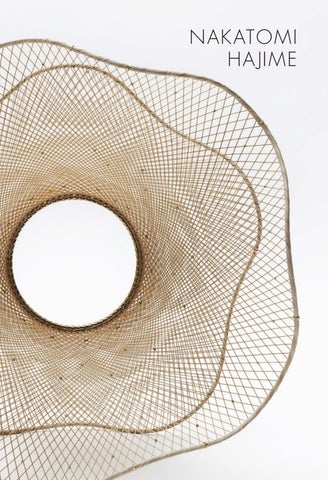
NAKATOMI HAJIME
Throughout his life, as if guided there, Nakatomi Hajime has moved to places where pivotal moments in the history of modern bamboo art occurred.
Nakatomi was born and raised in Osaka, where Hayakawa Shokosai I challenged the fine basket tradition of copying Chinese styles to proudly establish modern Japanese bamboo art; where his son Hayakawa Shokosai III revolutionized what a basket could be by introducing his innovative random plaiting; where Tanabe Chikuunsai I redefined Japanese literati style bamboo art. Nakatomi went to college in Tokyo, where Iizuka Rokansai struck out against the entrenched Osaka bamboo tradition and established an Eastern Japan school. Then, Nakatomi discovered bamboo art through the work of Shono Shounsai, the Living National Treasure from Oita, who introduced sculptural expression to bamboo art in 1956. After moving to Beppu in Oita Prefecture, Nakatomi studied under Honda Syoryu who, along with Morigami Jin, is credited as one of the bamboo artists who broke away from the Beppu style of heavy, ornate jar-shaped baskets by creating light and airy contemporary forms.
Nakatomi attended Waseda University in Tokyo, one of the most prestigious colleges in Japan, studying business and commerce. Nakatomi had no prior involvement in the arts but found himself drawn to ceramics and joined the campus art club. While in college, he worked as a waiter at the Takashimaya department store. One day at his workplace, he saw a large photo of a striking bamboo sculpture by Shono Shounsai entitled Flame Though Nakatomi had thought of pursuing a career in ceramics after graduation, this encounter with bamboo art started to change his course. Some days later, he met the bamboo artist Ohashi Shigeomi, who told him that there was a bamboo craft training center in Beppu, a city on the southern island of Kyushu. Nakatomi went to Beppu to visit the training center. After that visit, he spent his college years studying the few books available on bamboo art, imagining himself entering the training school.
In spring of the year 2000, Nakatomi passed the entrance exams and enrolled at the training center. There were 30 students in his class. After Nakatomi successfully completed the two-year course, he was introduced to Honda Syoryu, a well-known bamboo artist. At that time, Honda was busy creating sculptures for the American market and looking for someone to assist him. Nakatomi remembers being struck by the unique worldview of Honda’s work, which was unlike anything he had seen before. Nakatomi worked as Honda’s assistant from April 2002 to August 2005.
Looking back on this time, Nakatomi said:
Witnessing Honda’s works gradually take shape right before my eyes has been immensely valuable in my own creative process today. Being present for the moment when genuine art is born in the hands of an extremely talented artist was an invaluable experience. While technical skill is necessary, my apprenticeship taught me that skill isn’t the most crucial element in creating art. Observing the master artist at work felt akin to a religious act, a form of devotion. It makes perfect sense that many great artists possess deep faith like Honda, who believes in the Lotus Sutra; Shono Shounsai, who practiced Zen meditation; and Iizuka Rokansai, who chanted Buddhist prayers while working. While Honda certainly influenced my technique, I feel the most profound impact lay in his spiritual approach to creation.
Nakatomi has another mentor: Shono Tokuzo, a great bamboo sculptor and son of Shono Shounsai. In 2003, Nakatomi won the Grand Prize at the Crafts in Daily Life Exhibition, when Shono Tokuzo was serving as the head judge. After that competition, Shono took a keen interest in this young talent. Shono invited Nakatomi to join the Renko-kai, an art and antiques study group originally founded by Shono Shounsai. The Shono family’s beautiful traditional home and garden, called Shikuntei, has long served as a salon for artists and cultural figures, attracting numerous guests from both Japan and abroad. Attending Shono’s study group every month, Nakatomi learned not only about antiques but also about traditional Japanese spatial arrangements and how objects inhabit space.
Nakatomi came to bamboo art shortly after Robert Coffland and TAI Gallery introduced the art form to the Western world. Rob and I met Nakatomi in 2002. From the beginning, it was obvious that he was intelligent and talented. Coffland liked Nakatomi and brought him to the U.S. for events and demonstrations and included him in group shows. TAI Gallery began to show Nakatomi’s modern bamboo baskets and small sculptures from the Prism series. Nakatomi continued showing his works in Japan. At one time, I felt that Nakatomi’s wide-ranging interests might be hindering his career as an artist; I sensed some kind of hesitation in his creative works. However, around the time Nakatomi started to develop the Frill series in the mid-2010s, his artistic direction became much clearer. The FLY series became a huge hit in Japan, and he was awarded many public and private commissions. His work was shown across the world, in Paris, Venice, Nice, Hong Kong, New York, and Kuala Lumpur. A solo exhibition at TAI Modern had long been overdue, and a few years ago Margo and I sat down with Nakatomi and his representative to ask if he would finally have his first solo show with us.
n
K oichiro Okada
June 2026
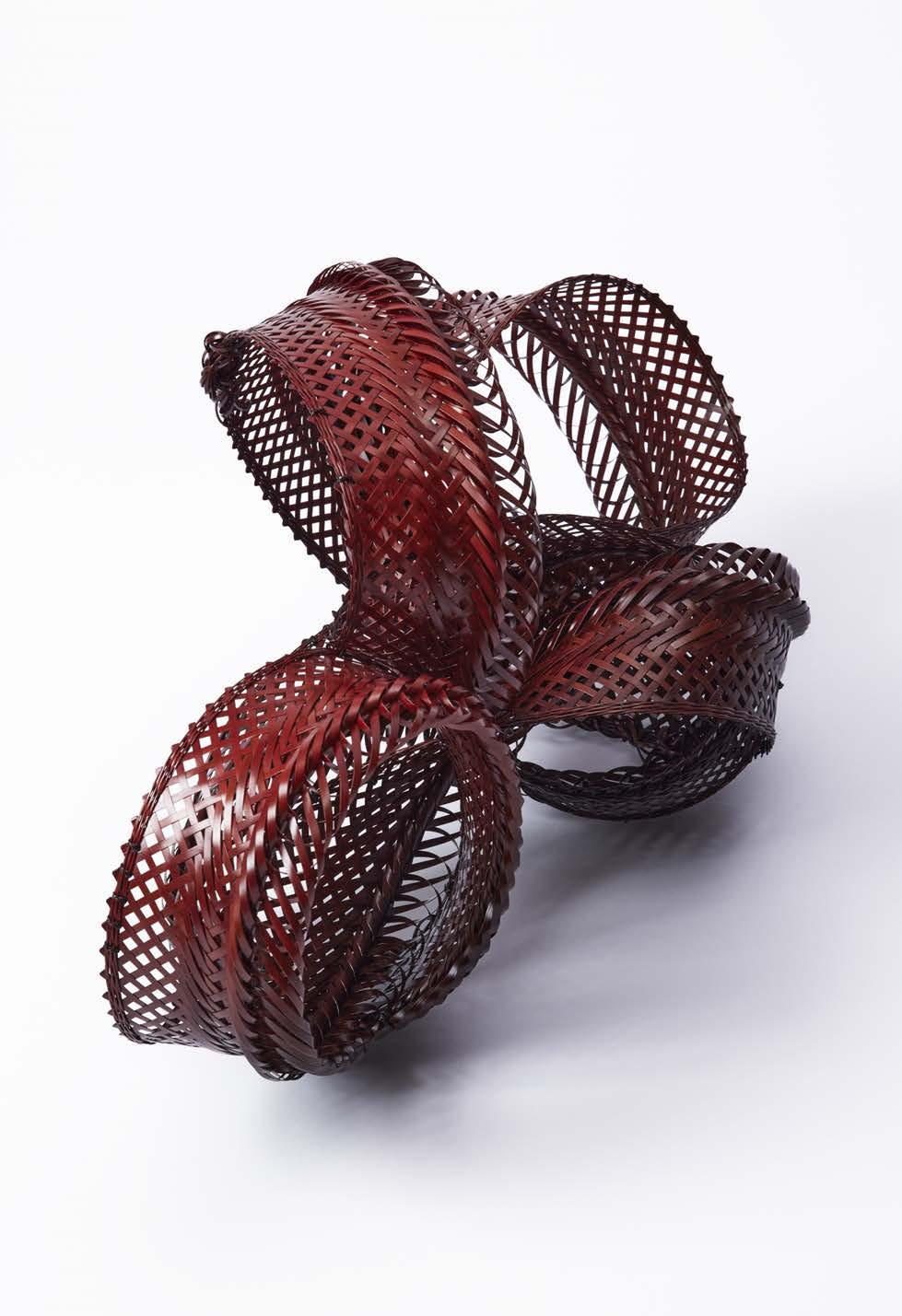
Frill: One Hand Clapping , 2025, 13.5 × 22.5 × 11.75 inches
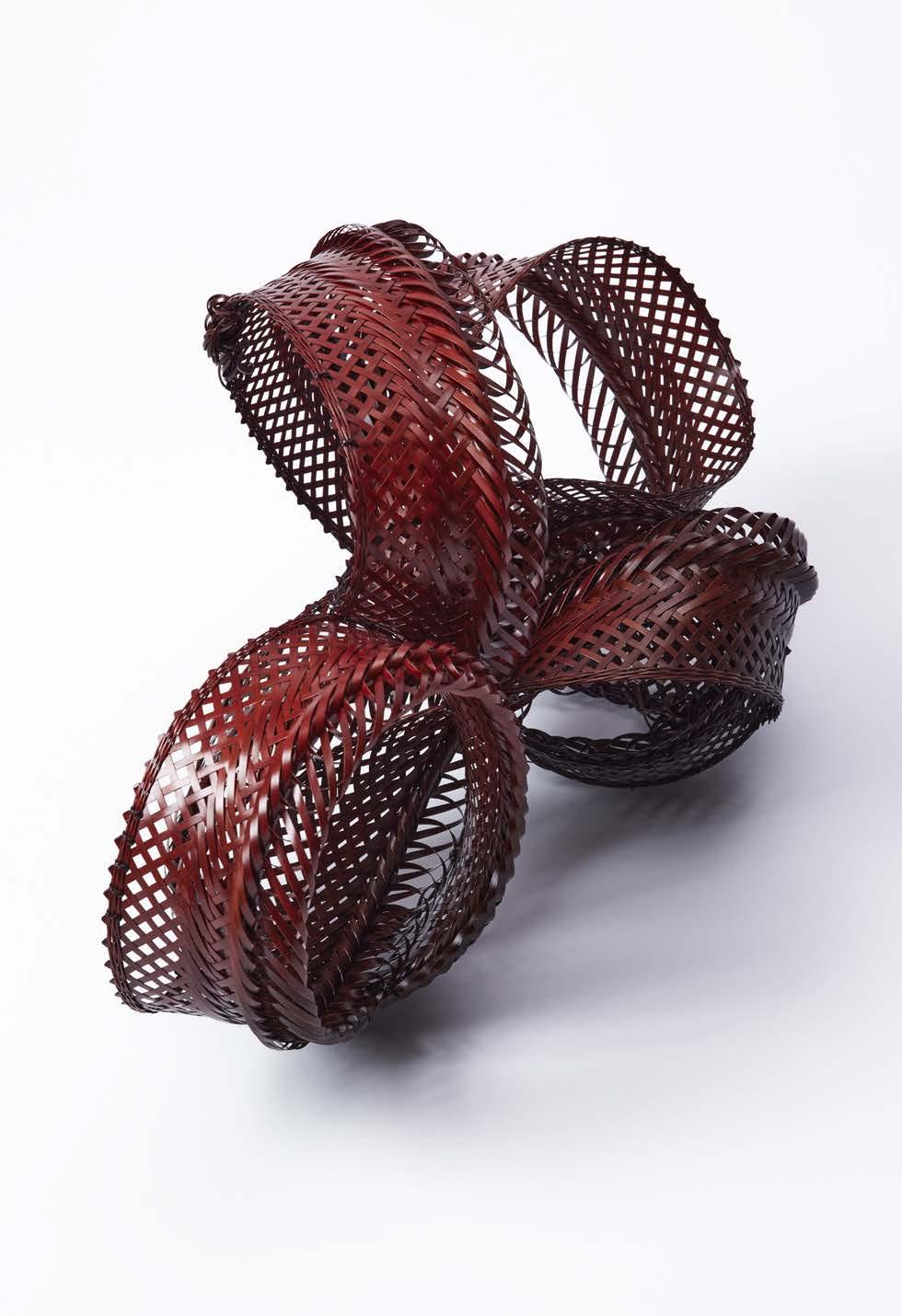
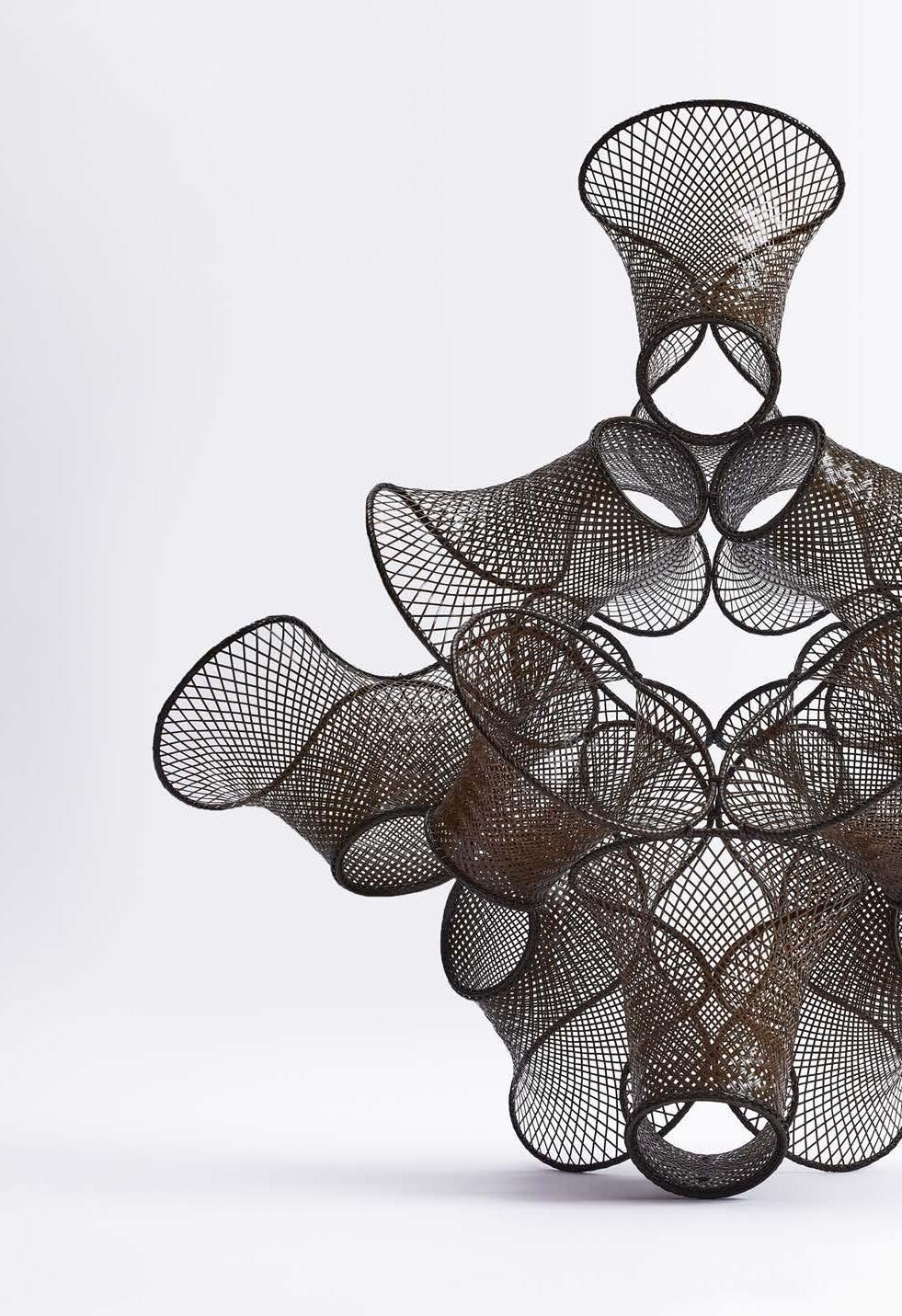
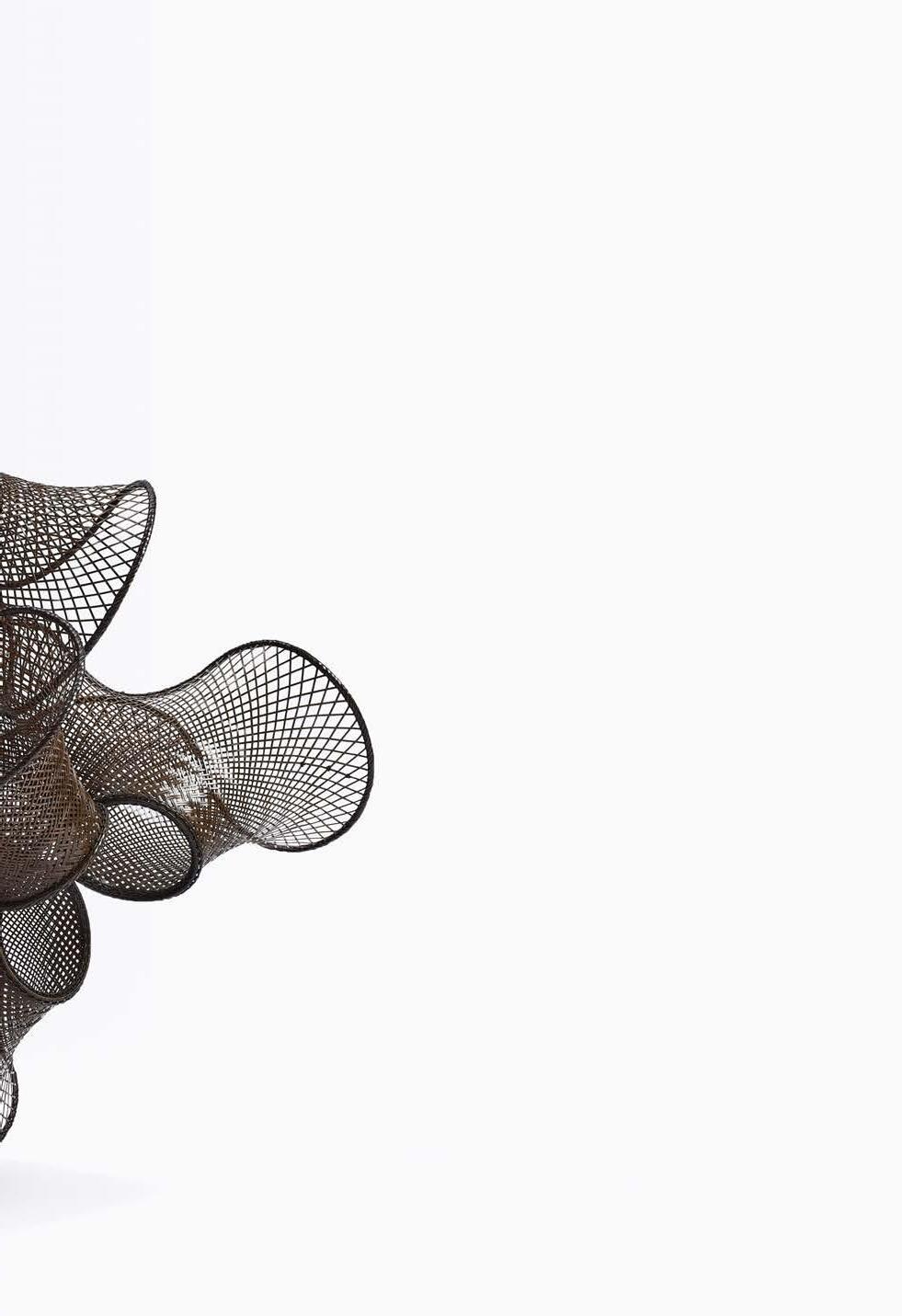
FLY: Shirabyoushi , 2023, 29 × 31 × 16.5 inches
ARTIST
STATEMENT
My creative process begins with the question: “What does it mean for something not to look like bamboo?” I believe that what truly defines bamboo is that which still shines through, even when it doesn’t look like bamboo at first glance. This is why my works feature colors, shapes, sizes, and materials not typically found in traditional bamboo art. My mission is to express the mysterious beauty that arises from the essence of bamboo using a methodology unlike any that has come before. Of course, many bamboo artists have created wonderful works using their own methods. The fact that these works captivate people all over the world demonstrates that there is a universal beauty within them. I, too, was captivated by these works and stepped into this world. However, as a latecomer to the field, I wish to express the beauty of bamboo through a course different from the traditional one. I believe that by doing so, I can open up new possibilities for bamboo. Many people who see my work murmur, “Is this really bamboo?” Yet, such small reactions cast a faint light on the path I am taking. In other words, they give me the conviction that a new form of bamboo art is being born here. Bamboo holds vast, unexplored territory that has yet to be expressed. I feel as though there is an inexhaustible source of beauty there. I have been creating works since 2002, and initially, under the guidance of my mentor, Honda Syoryu, I created works based on woven construction. These are my early works, delicately woven using various techniques. Although these works won several awards and were highly acclaimed, I eventually began to question the mindset that prioritized technique. This was around the time I turned 30. I felt as though I had fallen into a narrow, dead-end world by being too fixated on technique. The world I was seeking was not there. Wasn’t there another way to express the beauty of bamboo? Amidst such doubts, as I trudged along, I arrived at the question: What does it mean for something not to look like bamboo? Over the course of a quarter-century, this line of inquiry has produced five main series: Prism , Musubi (tie or knot), Auspicious 8 , Frill , and FLY
A turning point came in 2013, when I installed my work in 42 guest rooms at The RitzCarlton, Kyoto. Fourteen years earlier, in 1999, I had been working as a staff member at The Ritz- Carlton, Osaka. I had just failed the entrance exam for a bamboo school and was spending my days simply trying to earn enough money to retake it. I wanted to dive into the world of bamboo, but I couldn’t even get my foot in the door. I was consumed by a sense of urgency and deep anxiety, with no clear vision of my future. Even as I helped create happy memories at the hotel’s wedding venue, I was tormented by the inner dilemma of wondering, “Who on earth am I going to become?” Back then, I could never have imagined that the day would come when I would be welcomed back to my former workplace as an artist.
When I received the inquiry, I eagerly accepted the commission with the single - minded desire to create a work that would repay the debt I owed a work that would save my former self. When I stood face - to - face with my own work in the completed guest room, I felt a deep sense of vindication.
Since that experience, I have continued to install my work in public spaces almost every year. In Japan, a country prone to earthquakes, bamboo a light and highly elastic material makes perfect sense in spatial design. But more than that, I am convinced that the true essence of bamboo art lies in its ability to infuse modern, sterile spaces with the Japanese spirit and natural tranquility unique to bamboo. Of course, incorporating traditional materials into modern spaces comes with its own challenges. If we cling too tightly to traditional forms, the work will stand out in the space as a relic of the past. Furthermore, as the scale of the work increases, we must fundamentally reinvent conventional techniques. The process of interpreting the atmosphere of a space from mere blueprints and refining a concept is a multi-layered intellectual challenge distinct from studio production. The most difficult aspect is the immense amount of coordination required between the many stakeholders involved in a project—owners, architects, construction companies, installers, and transporters. There have been more than a few times when the sheer complexity of it all made me want to throw in the towel. However, I feel it is precisely this struggle that holds value. Expanding into public spaces means breaking new ground in bamboo art, and above all, it allows me to create places where many people can experience the beauty of bamboo.
Although bamboo has been a familiar presence in Japan since ancient times, bamboo as art is still not widely known. This is likely due to the small number of artists and the amount of time required for creation, both of which limit the number of works produced. That is why it is vitally significant for me to continue to create works for the public. This challenge cannot be achieved by my efforts alone. Fortunately, Oita Prefecture, where I am based, is home to a gathering of young artists with high aspirations and technical skills. Collaborating with them not only makes large-scale expressions possible but also provides them with a stable livelihood, creating a virtuous cycle that passes these skills on to the next generation. Through the medium of bamboo, I hope to serve as a bridge connecting traditional techniques, contemporary spaces, and the leaders of the future.
Ignoring the objections of those around me, I knocked on the door to the world of bamboo art at the age of 25, and before I knew it, I had passed 50. Confucius once said, “At 30, one stands firm; at 40, one is free from confusion; at 50, one knows one’s destiny.” But what is my destiny? Looking back, I feel those days were spent playing with bamboo, wrestling with it, being defeated by it, and occasionally finding a connection with it. Recently I have been combining bamboo with other materials, such as gold, pushing even further from the ‘bamboo - like’ and finding that the essence of bamboo only becomes more present. Through such works, I aim to express the mysterious beauty of bamboo. And to create works that bring happiness to the viewer. I believe that is the true calling I am meant to pursue.
n Nakatomi
Hajime
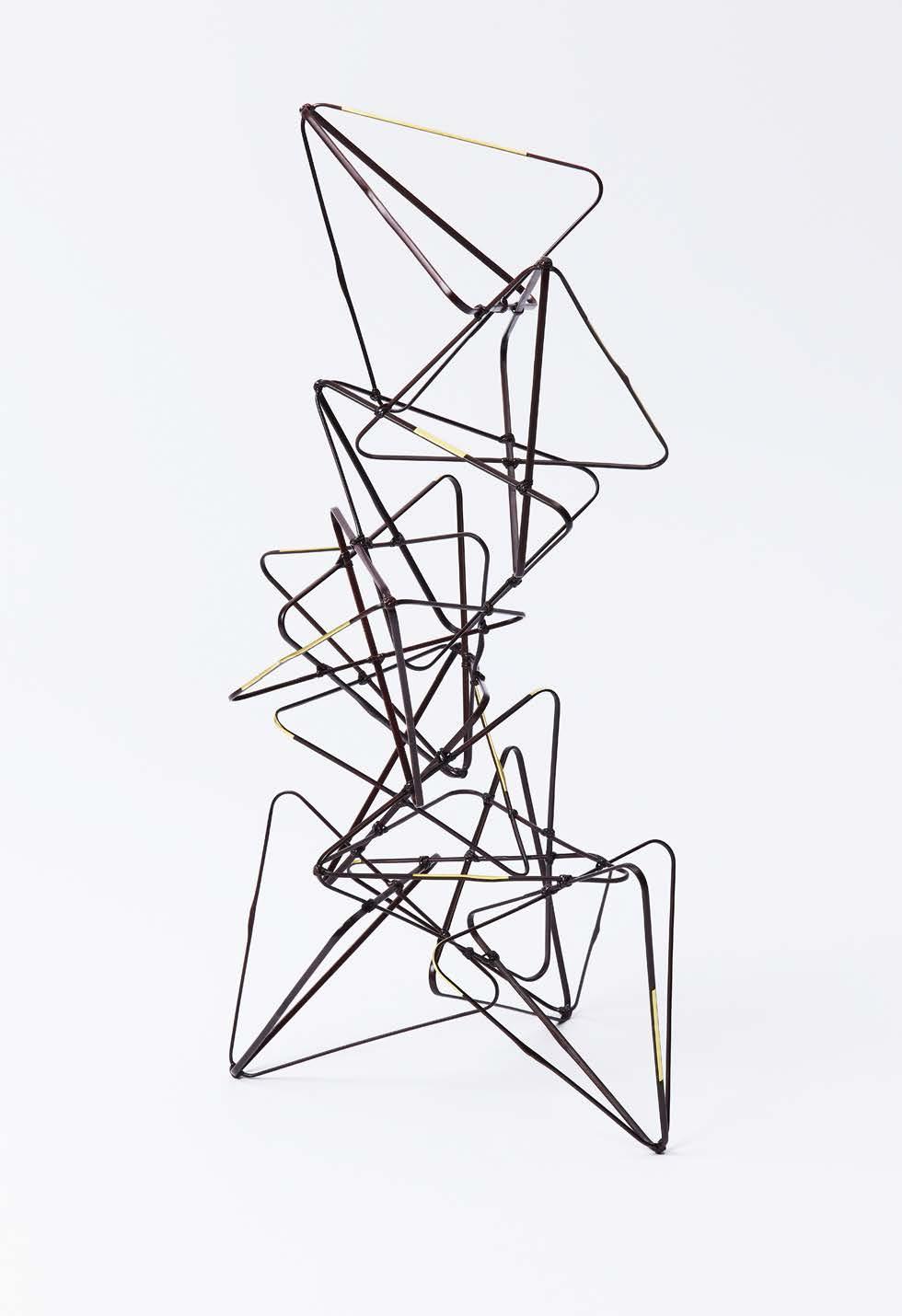
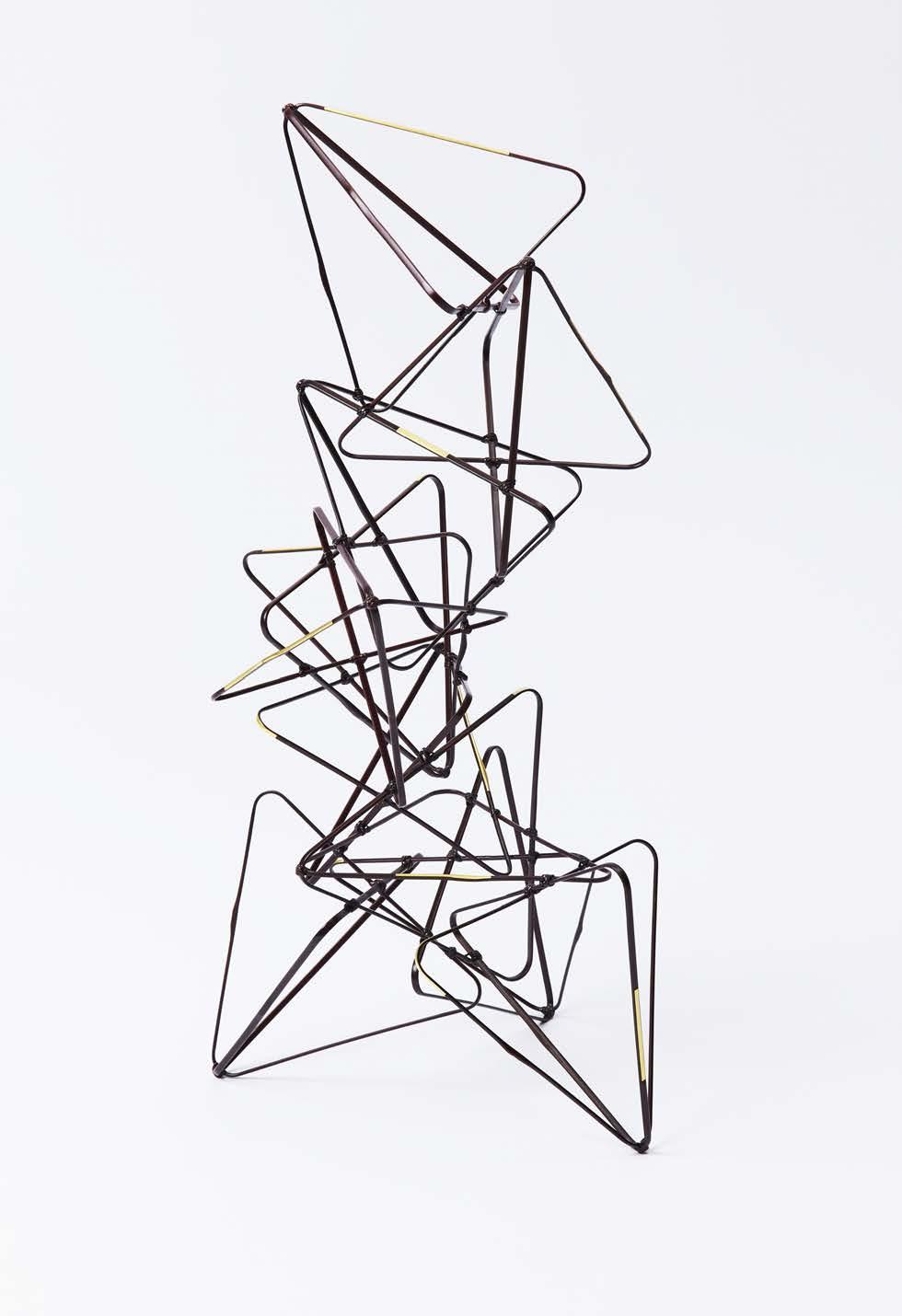
Prism Triangle: Gold 04 , 2024, 18.75 × 9.5 × 8.25 inches

PRISM
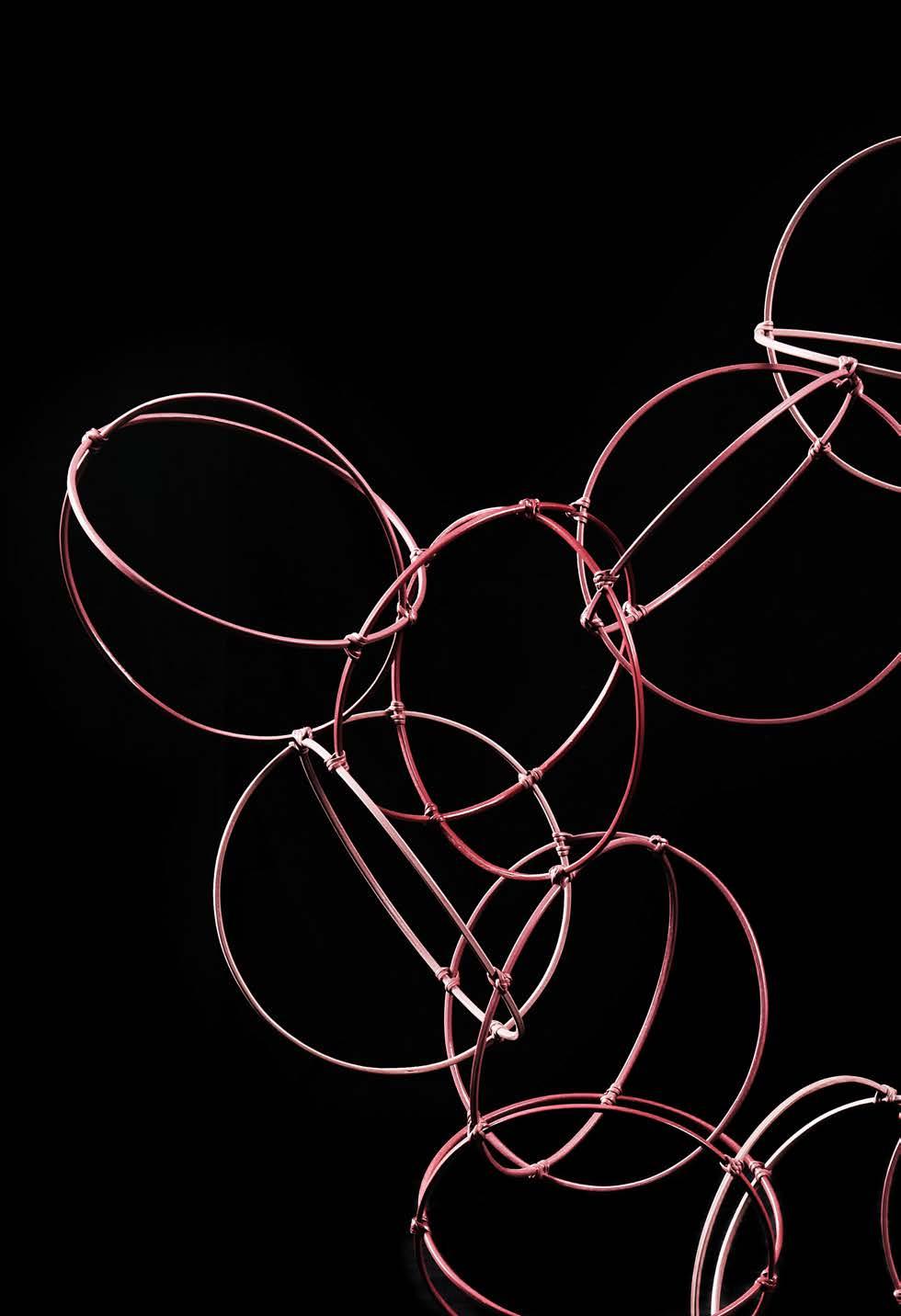
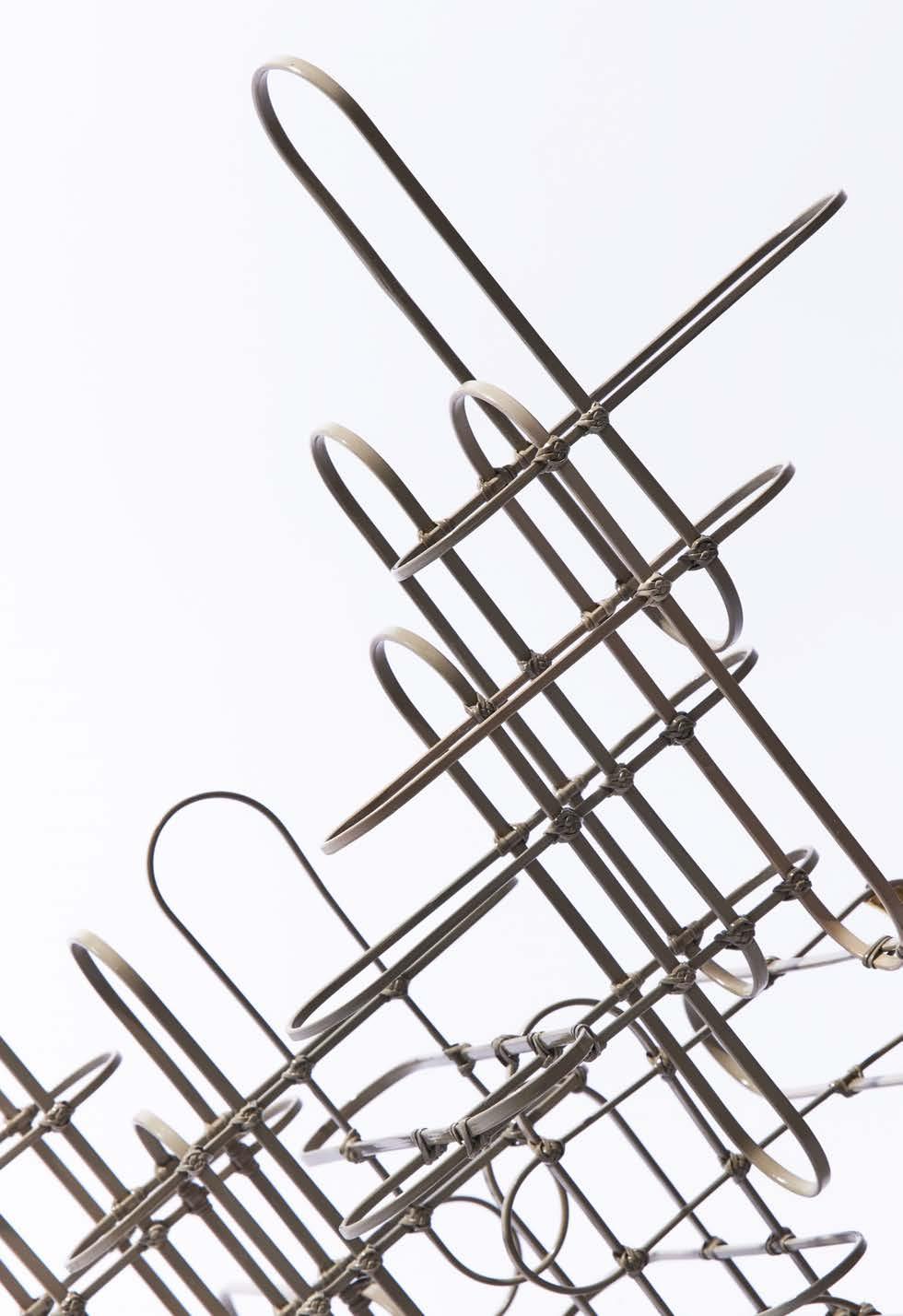
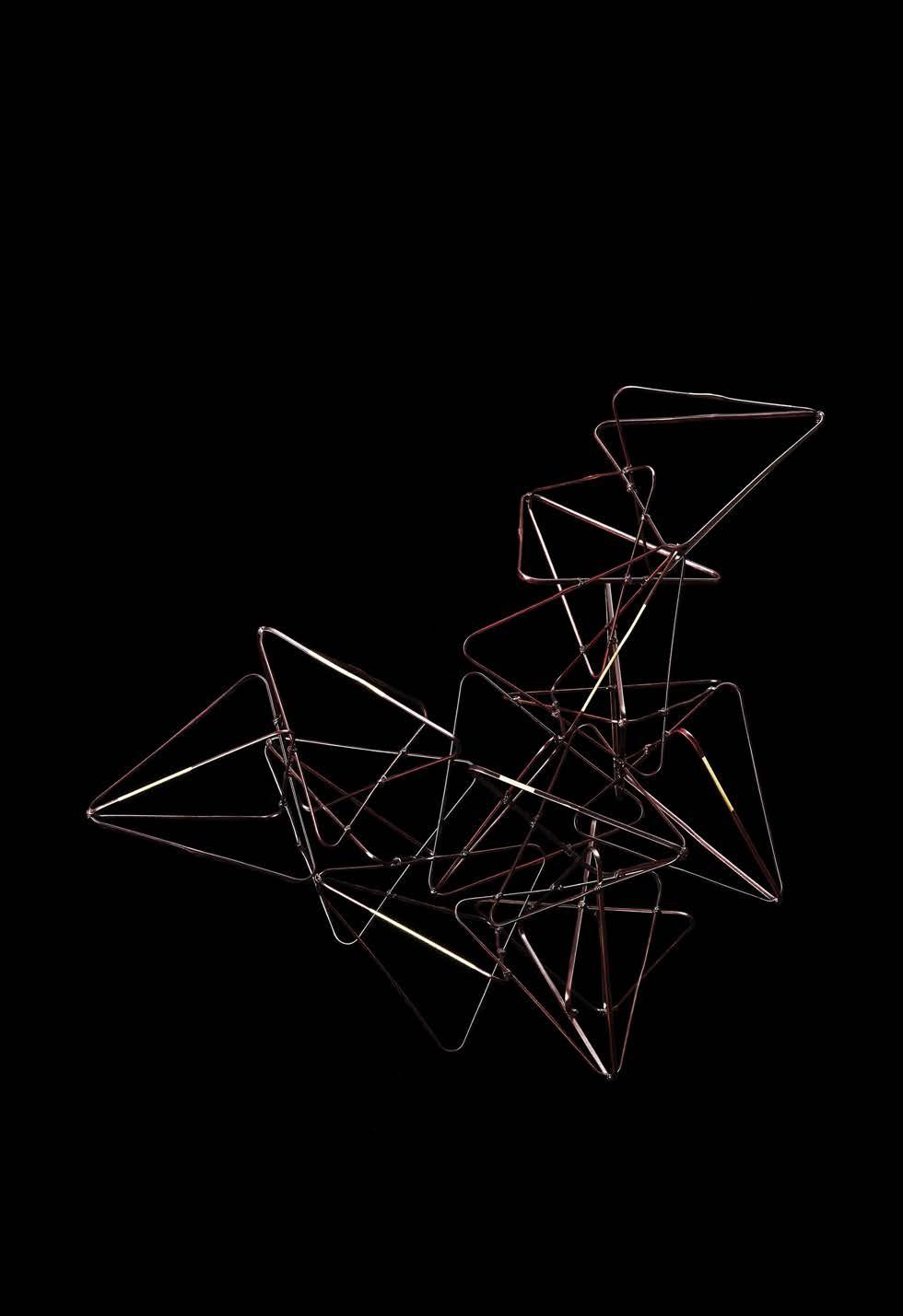
The Prism series, which began in 2007, consists of four geometric units: circles, triangles, squares, and ovals. These are musical, light - hearted sculptures created by freely assembling simple units, much like improvised jazz. Bamboo inherently contains geometric elements. These include the vertical thrust of growing bamboo, the parallel lines of a bamboo grove, nodes that appear as points along a straight line, and the circular cross - sections of cut bamboo. Traditional weaving techniques are fundamentally geometric, so bamboo and geometry are a natural fit. But what happens if I create a work without using conventional methods, without relying on special techniques, without complex structures, and without weaving? It is a challenge to see if a work can stand on its own without relying on traditional techniques. Through trial and error, I finally created a sculpture imbued with a poetic atmosphere.
The discovery that an artwork can be made simply by arranging these simple units brought about a major shift in my creative process. However, just because it is simple does not mean it is easy to create. Precisely because it is simple, there are many processes necessary to achieve a high level of perfection. There is a great deal of invisible effort and time involved, and the production time is surprisingly long. It can sometimes take me more than two years from the start of creation to completion. While the whole piece is created improvisationally, it is rarely finalized in a single attempt. I take my time making small adjustments bit by bit to raise the level of perfection.
Until the Prism series, almost no artist had consciously created works using a simple unit structure. To do so risked negating the history of bamboo craftsmanship, which had refined traditional weaving techniques. In fact, the reaction from Japanese bamboo artists was sharply critical, so I had my doubts about whether this method was correct. It was a great gift that this series was accepted by American collectors. It gave me the courage to follow the path I believed in.
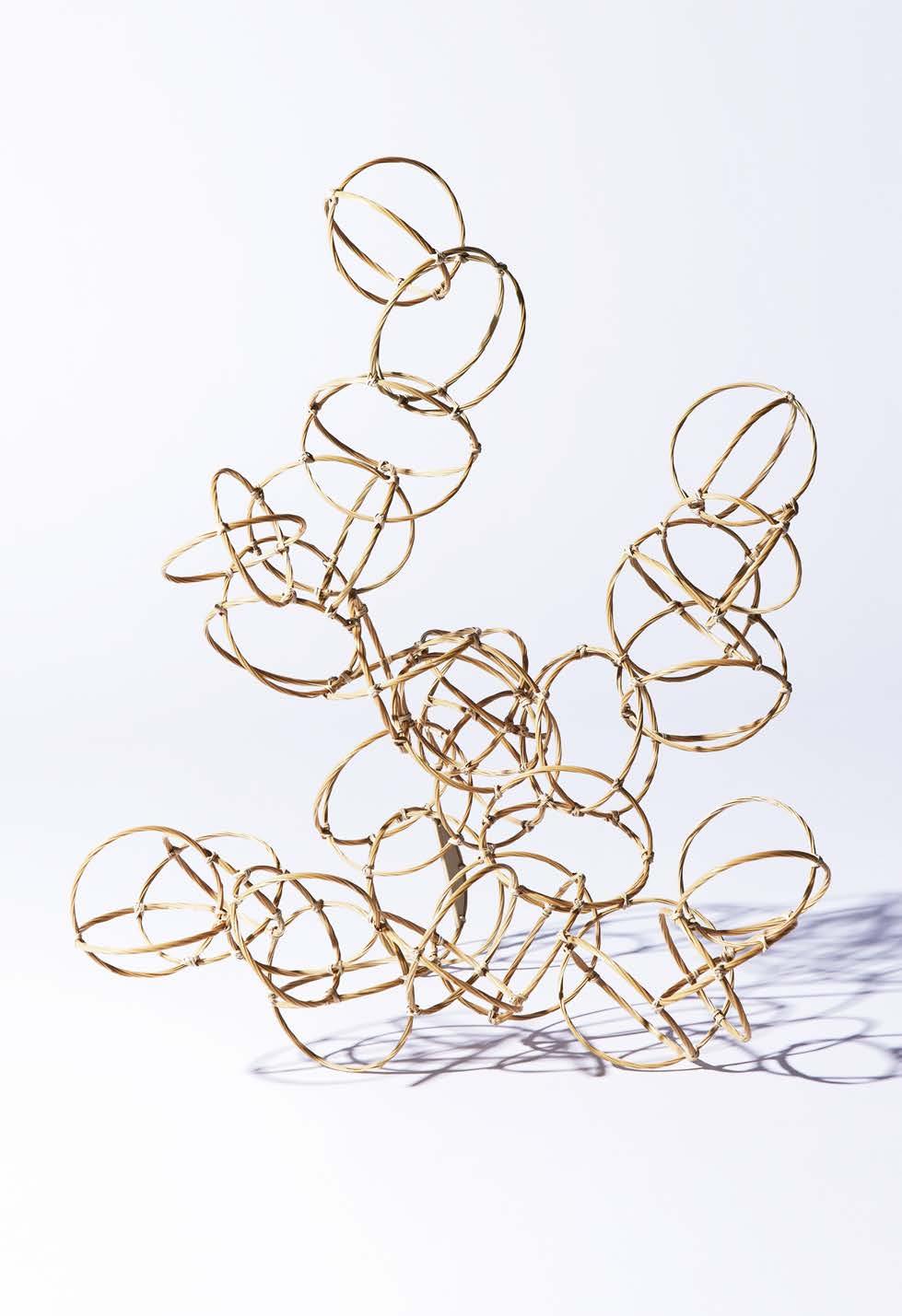
Prism Circle: Twist 01, 2025, 15.5 ×13.5 × 11.75 inches 17
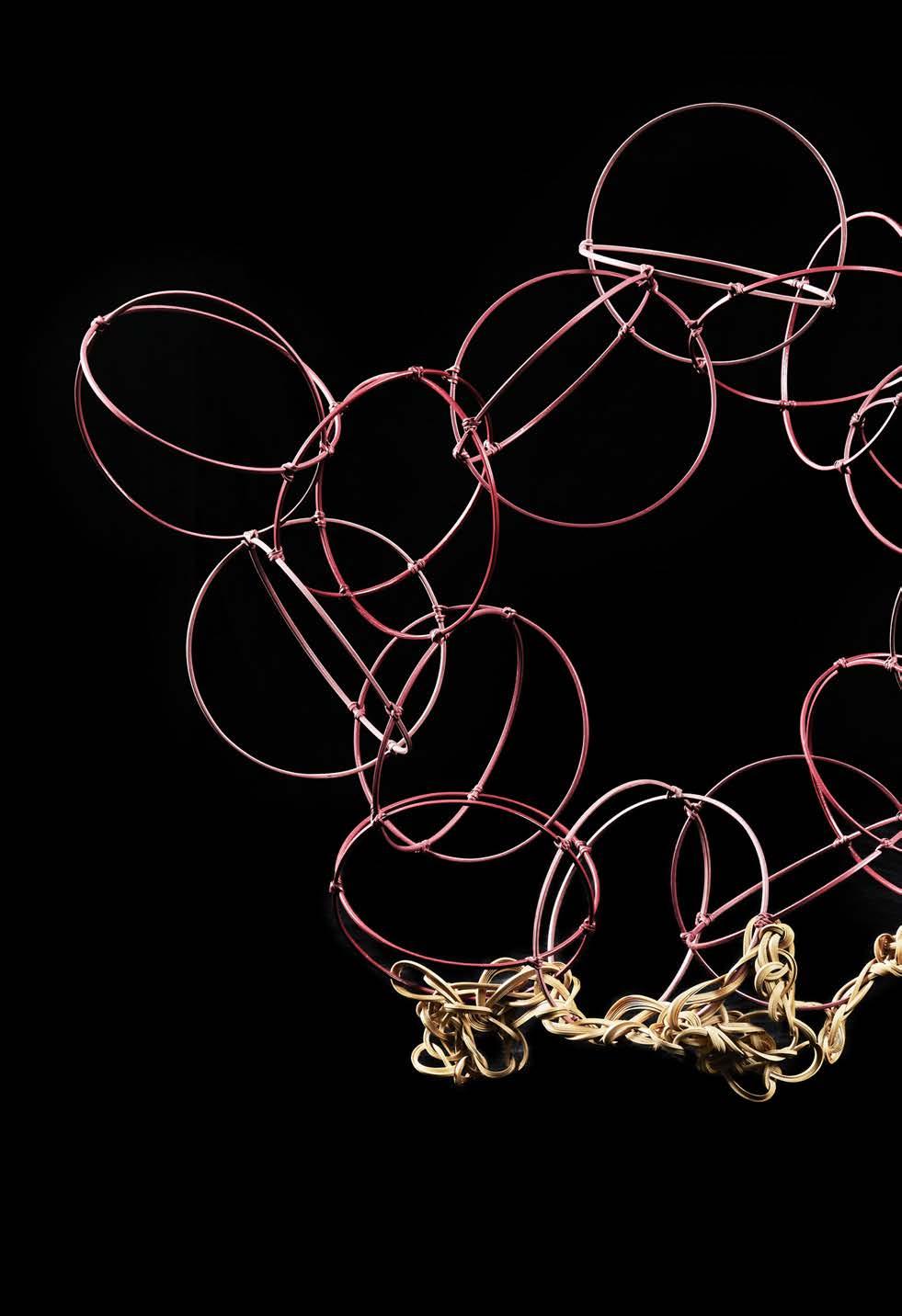
18 Prism Circle: Spring Walk , 2022, 14.75 ×16 × 5.5 inches
MUSUBI
In 2011, I began creating the Musubi series. These are works created using a simple technique of bundling several thin bamboo strips and tying a series of knots. In Japanese culture, the concept of musubi (knot or tie) holds profound significance. Examples include the shimenawa ( sacred straw ropes) in front of shrine sanctuaries, the knots on the sekimori-ishi ( barrier stones) placed in Japanese and tea gardens, and the mizuhiki ( decorative cord) tied around gift wrappings. Throughout Japan, a musubi indicates that something precious exists within. In the Kojiki , Japan’s oldest history book, written in 712 CE, the name of the god of creation is recorded as “Takamimusubi.” The word Musuhi , which sounds the same as the Japanese word musubi, means “the natural birth of things,” while hi signifies spiritual power. The fact that the god’s name is “Musuhi” implies the creation of things through spiritual power. Inspired by these concepts, I began to focus solely on tying knots with bamboo. The rural temple I was living in at the time, as well as my participation in the Antique Art Research Society led by Shono Tokuzo - sensei, likely influenced me. My consciousness was beginning to turn toward the foundations of Japanese culture. While there are few standalone works in this series, musubi turn up throughout my other series. I do not include knots merely as decoration. By incorporating knots, I implicitly suggest that there is something significant lying beneath the surface of the work. Sometimes I tie a knot into a round Prism unit to play on the word enmusubi ( which can mean both “tying a bond” and “circle - knot”), or I might add a knot simply for fun. It is a simple technique, but it is difficult to create a complete work just by tying a knot. The form is so free and fluid that it is all the more difficult. Conversely, precisely because the endpoint is not immediately clear, the joy when the work is finally completed is all the greater.
AUSPICIOUS 8
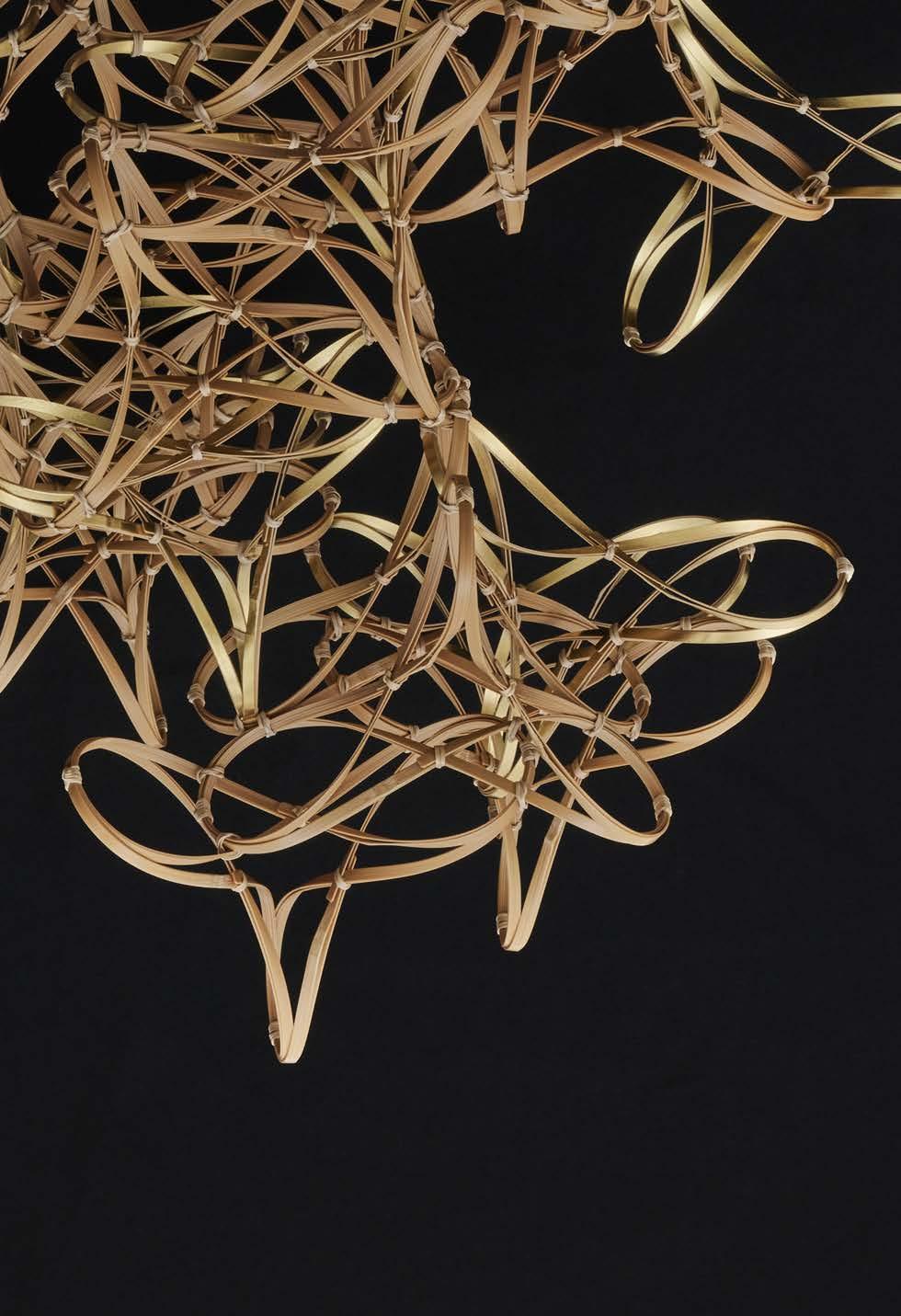
In 2012, I moved to Taketa, a castle town in the mountains. Soon after, the Auspicious 8 series was born. These works consist of the number 8 as a basic unit, connected in a random pattern. Shortly after I moved to Taketa, there was a major flood, and even the mountain behind my house collapsed. This town is surrounded by mountains on all sides and has historically been prone to disasters. While there is nothing we can do against natural disasters, I began crafting the shape of the number 8 out of bamboo with a prayer for peace and safety. In Japan, the kanji character for “eight” ( ) is considered auspicious because it spreads outward like a fan, so I am playing the kanji against the numeral 8. Since ancient times, people have drawn patterns imbued with auspicious wishes for good health, long life, the prosperity of descendants, and wealth. I wanted to do the same. It is similar to the act of folding origami cranes to pray for peace. Why do people create things in the first place? We don’t create things solely for practical use. This series was born from the idea that we sometimes create things to imbue them with talismanic meaning or to express auspicious wishes. It is precisely when people face adversity that a sincere desire for happiness arises, and they want to give that a concrete form. Using bamboo a plant long considered auspicious to express this is fitting. That is how I arrived at the shape of the number 8. As a side note, after I began creating this series, I got married, and my daughter was born on August 8th. I was amazed by this too - perfect coincidence.

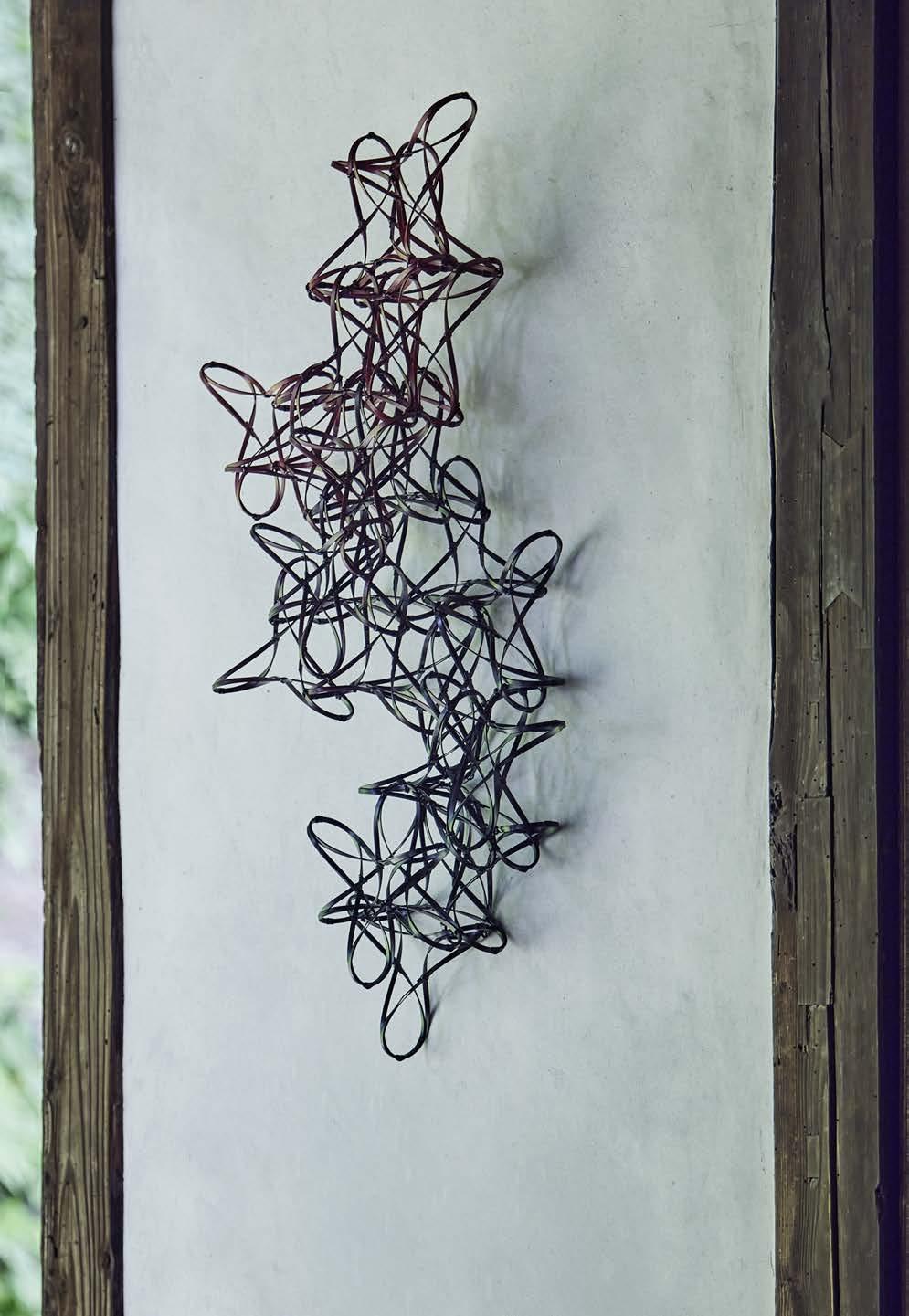
Auspicious 8: Glow , 2025, 28.75 ×15 × 4.75

FRILL
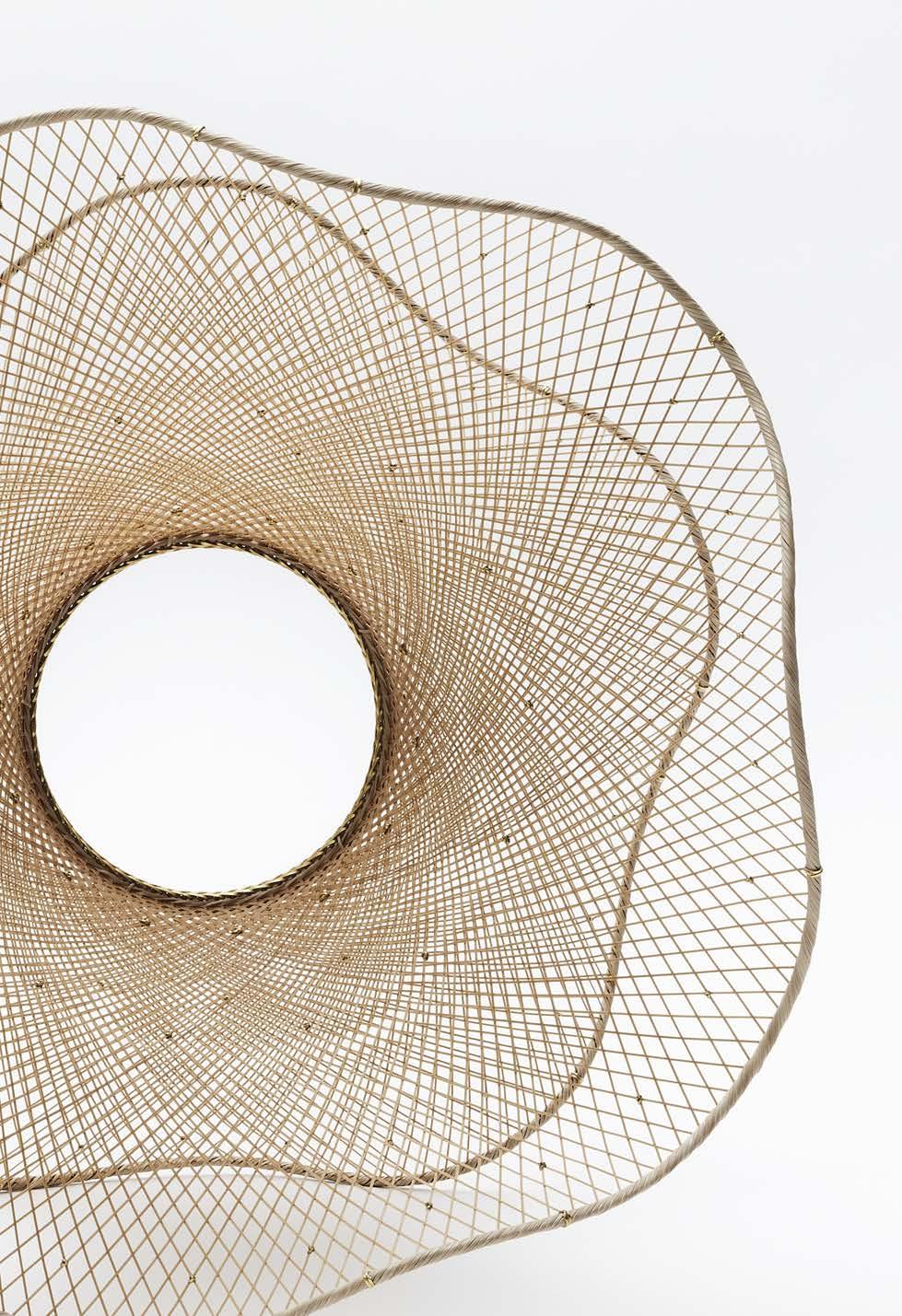
My daughter was born in 2015, and shortly thereafter, the Frill series was born. The feminine things that filled the world around me the soft atmosphere and the warm feelings these took shape. This work expresses the energy-charged softness of a newborn baby emerging through the long birth canal. After much trial and error, the work finally came together in 2017. I had avoided weaving for a while, but this work brought me back to it. Weaving is truly enjoyable; I felt it from the bottom of my heart. At first glance, the Frill series may seem difficult, but like my previous series, it doesn’t use any special techniques. It also shares the ability to be connected to create larger pieces. The central section is made from simple yotsume - ami plaiting; from there, bamboo strips are wrapped around the edges to form a band, creating a simple structure with an improvised form. While bamboo, with its characteristic tendency to stretch towards the sky, naturally evokes straight lines, it actually yields to curves without resistance. Frill is composed entirely of curves, pursuing a sense of softness. It is a work that does not look like bamboo, yet can only be created with bamboo.
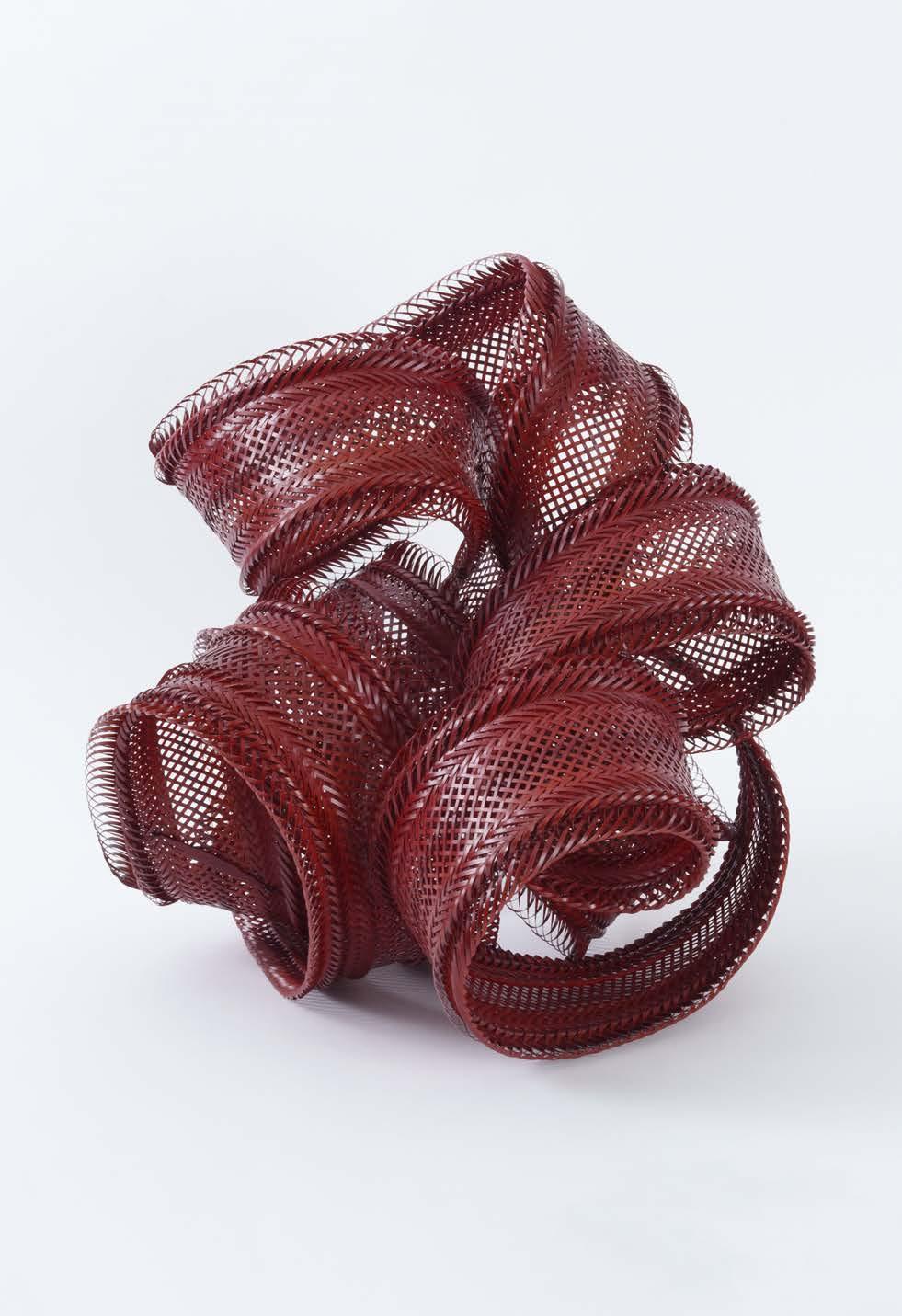
Frill: Surging Waves II , 2023, 20.5 ×19 × 18.5 inches
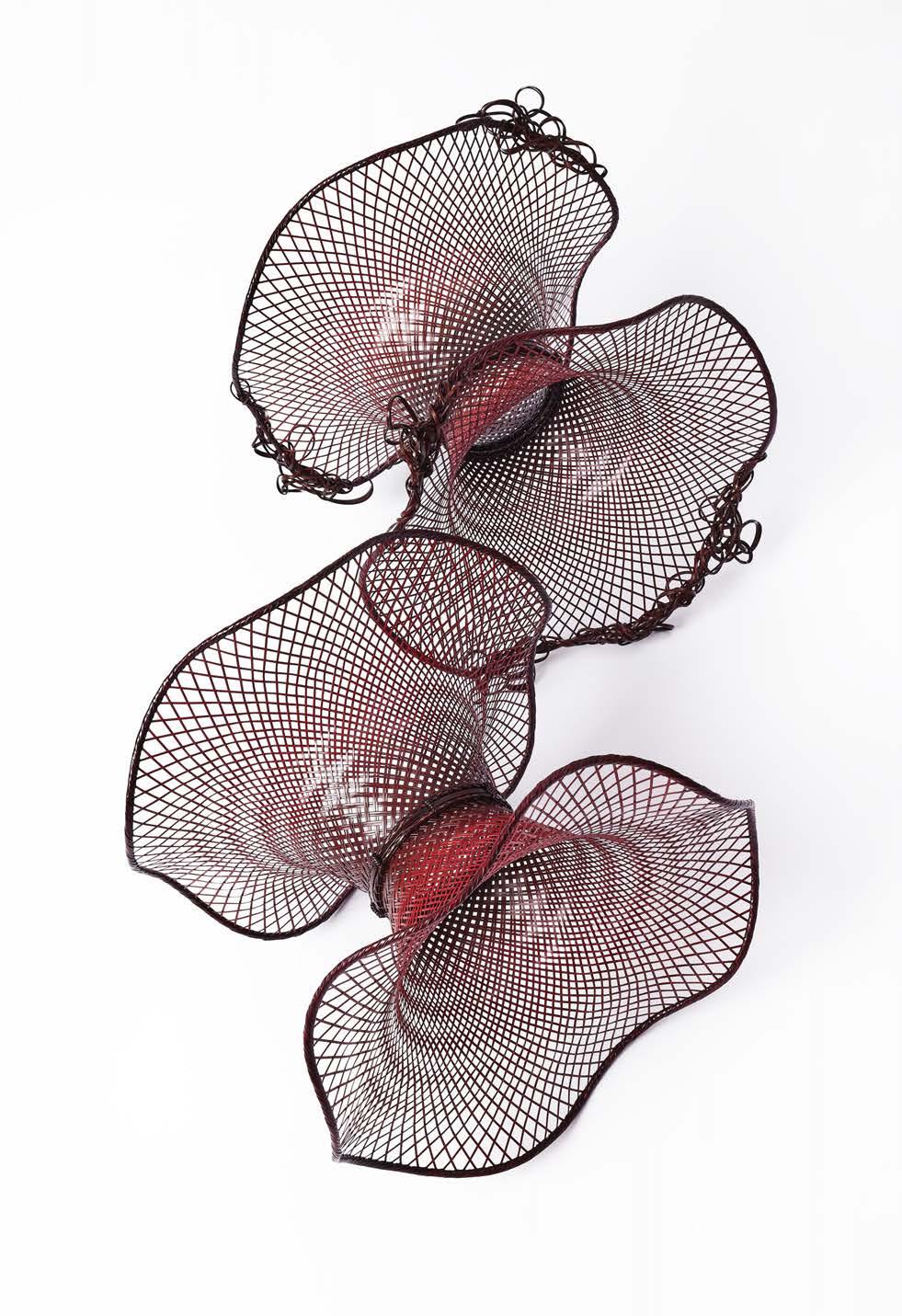
FLY
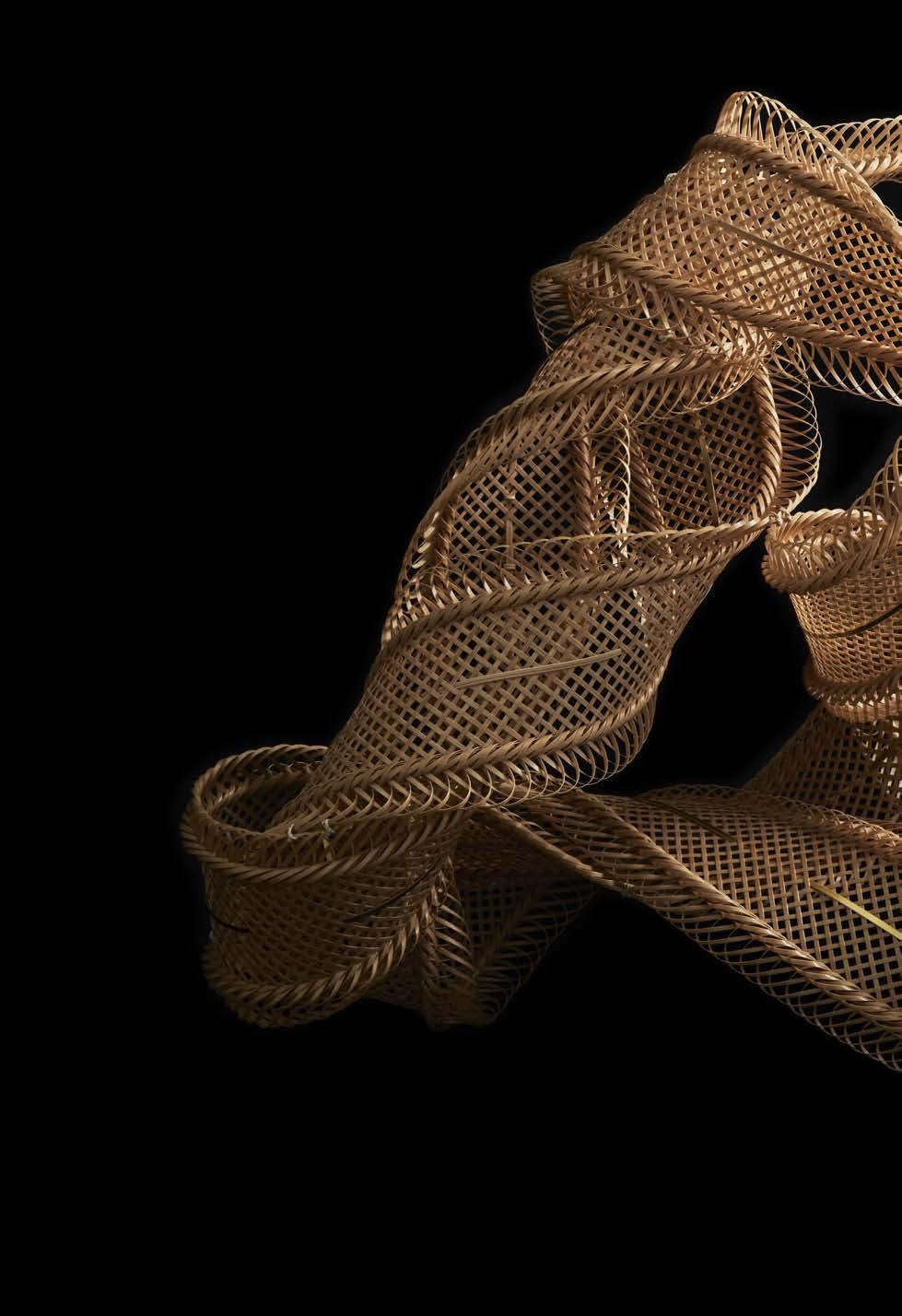
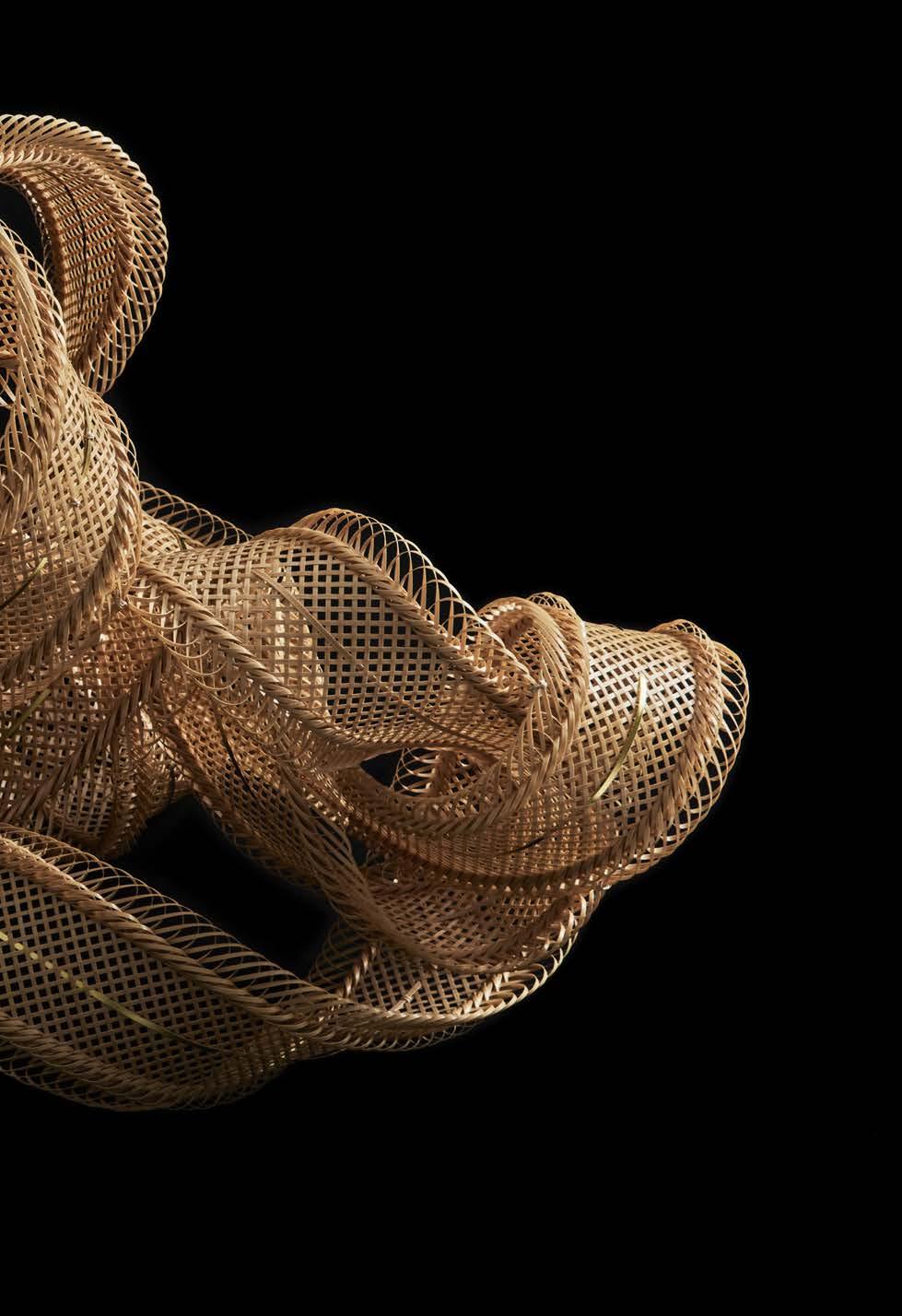
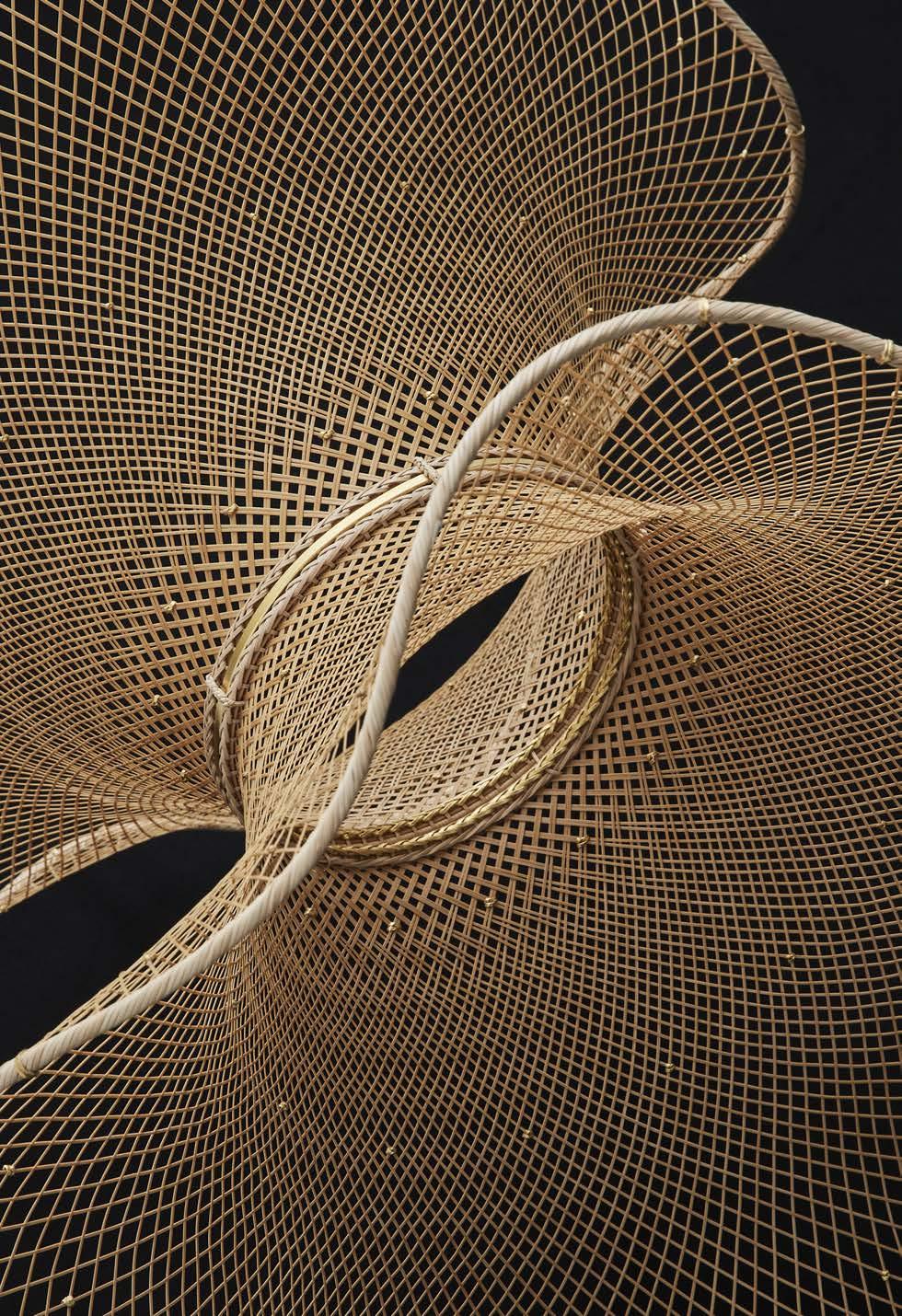
In 2020, the FLY series was born. These are light, airy works with a sense of floating, created using a simple openwork weaving technique. About eight years after moving to Taketa, I happened to notice that this area is home to a great many flying creatures birds, butterflies, bees, dragonflies, and more. I use the music room of a decommissioned junior high school as my studio, and I am always seeing creatures fly by through the windows. Because nature is so abundant here, there are many insects and many birds to eat them. When I open the window, dragonflies and bees flit about inside the room, while birds glide through the sky. What kind of landscape would unfold if I created a piece using bamboo, which is rooted firmly in the earth, to evoke the image of creatures flying in the sky? It was this curiosity that led me to begin this series. These works are composed of a translucent weave resembling a dragonfly’s wings with an undulating edge that flutters like the movement of a butterfly. It was born from the profound influence of the natural creatures that surround me. Since bamboo is inherently a lightweight material, it resonates perfectly with the visual lightness of this piece. FLY uses the lightness of bamboo to express the gracefulness of creatures in flight.

FLY: Small Warp II , 2025, 13.5 ×12.5 × 11.25 inches
FLY : Small Warp, 2024, 12.25 ×12 .25 × 10.25 inches
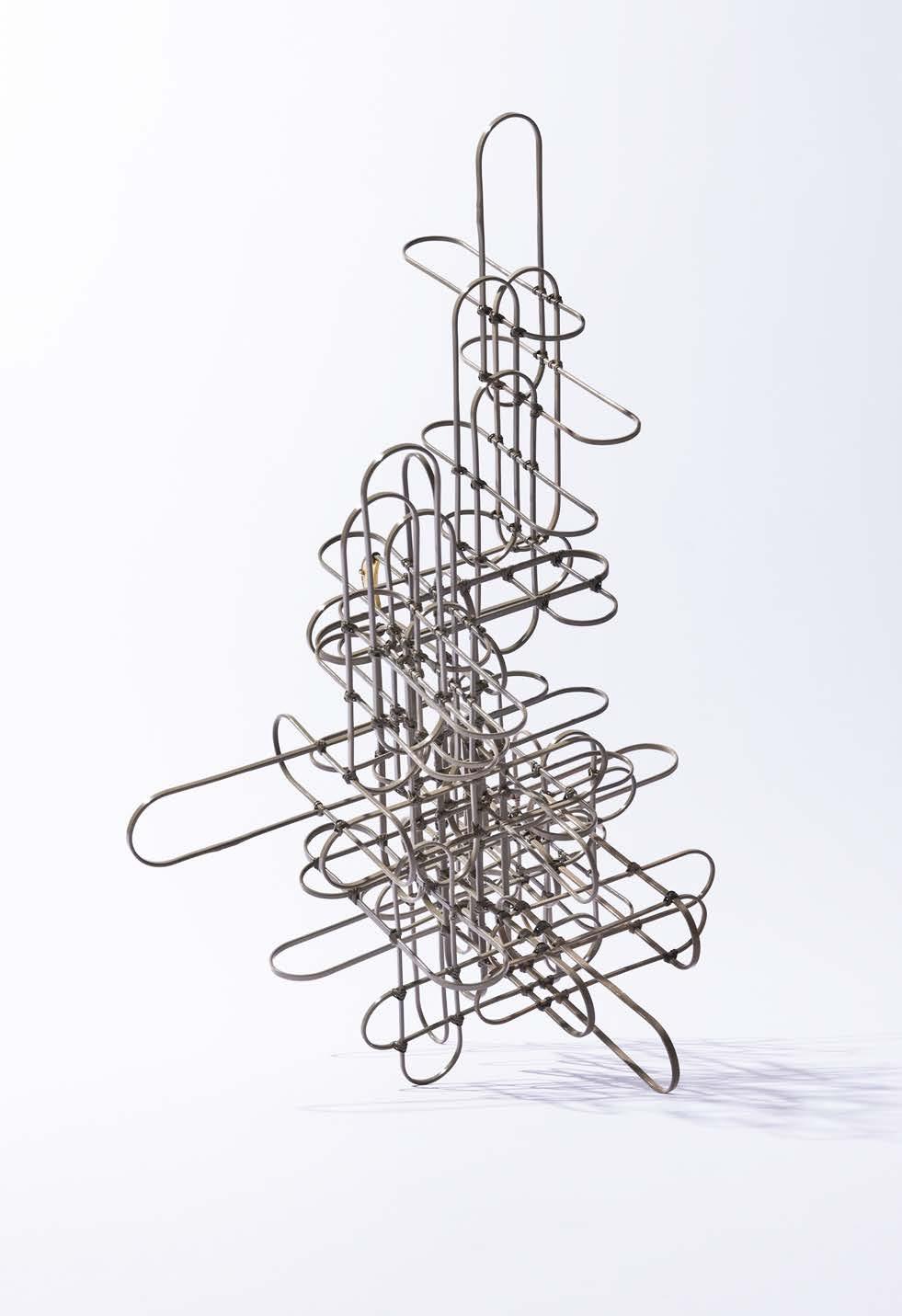
Prism Ellipse: Moon in the Clouds , 2025, 16.5 ×18 × 9 inches
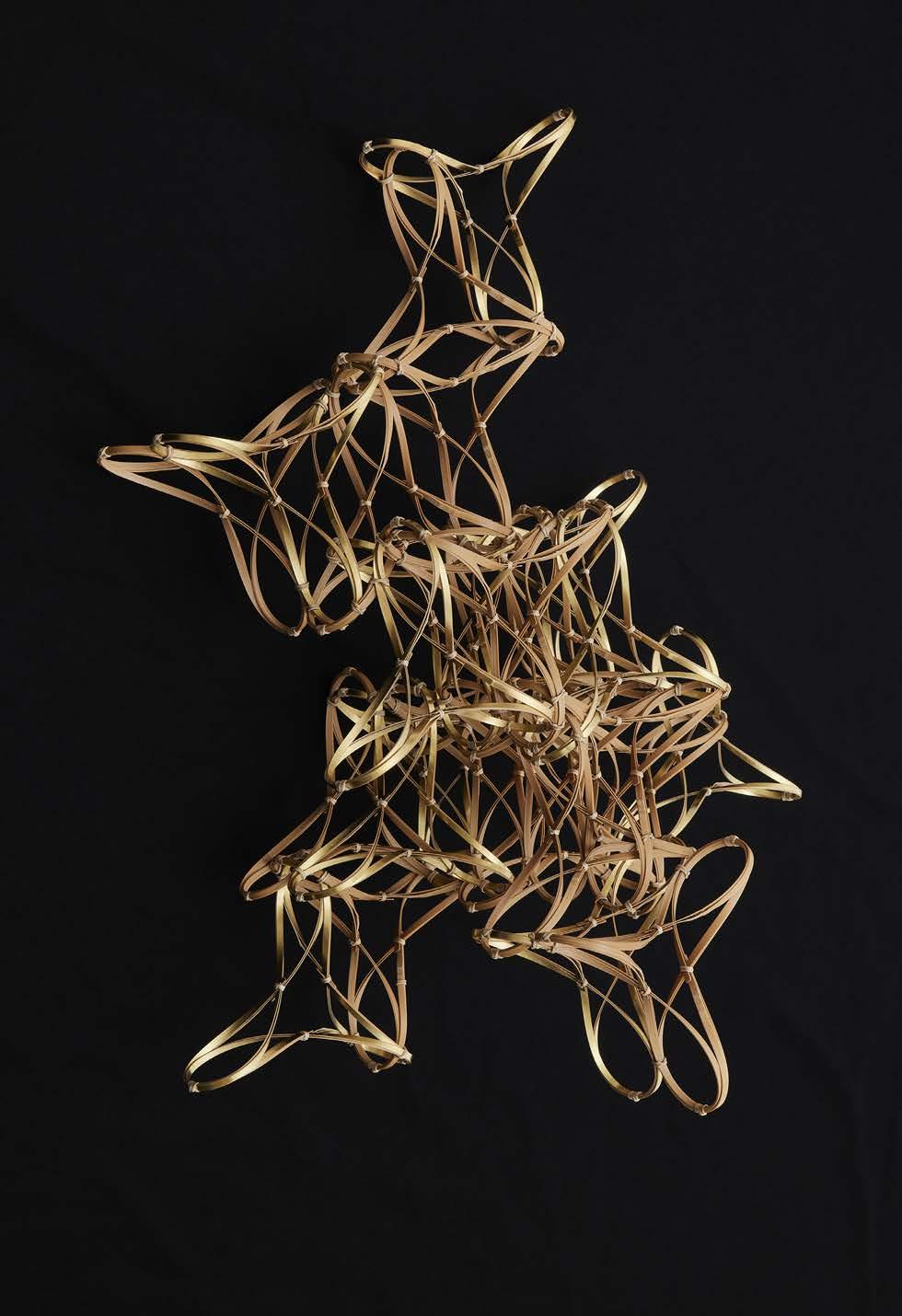
Auspicious 8: Strata I , 2026, 21.25 ×19.75 × 9.5 inches
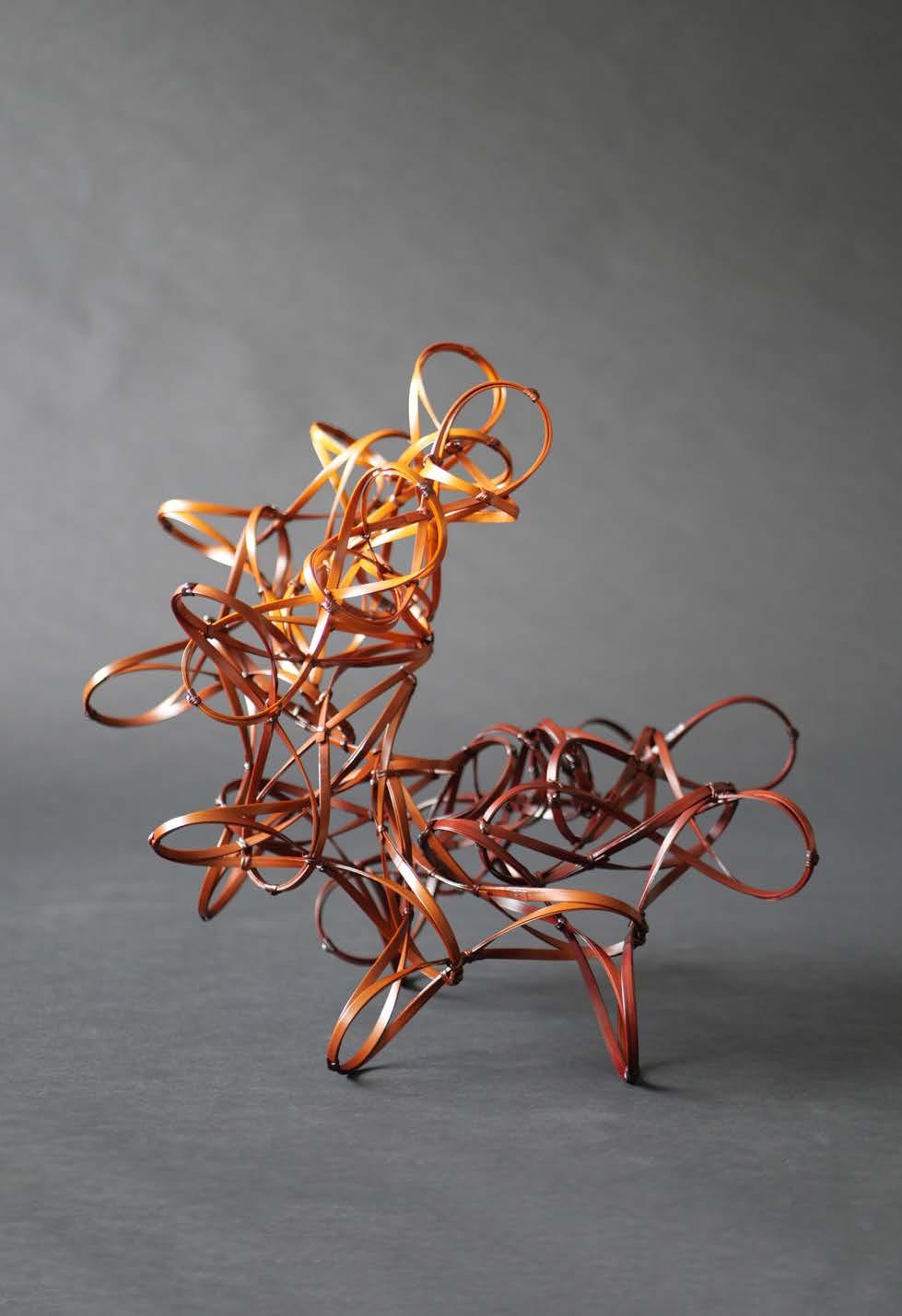
Auspicious 8: Infinity Loop , 2026, 13.75 × 15.5 × 11.75 inches
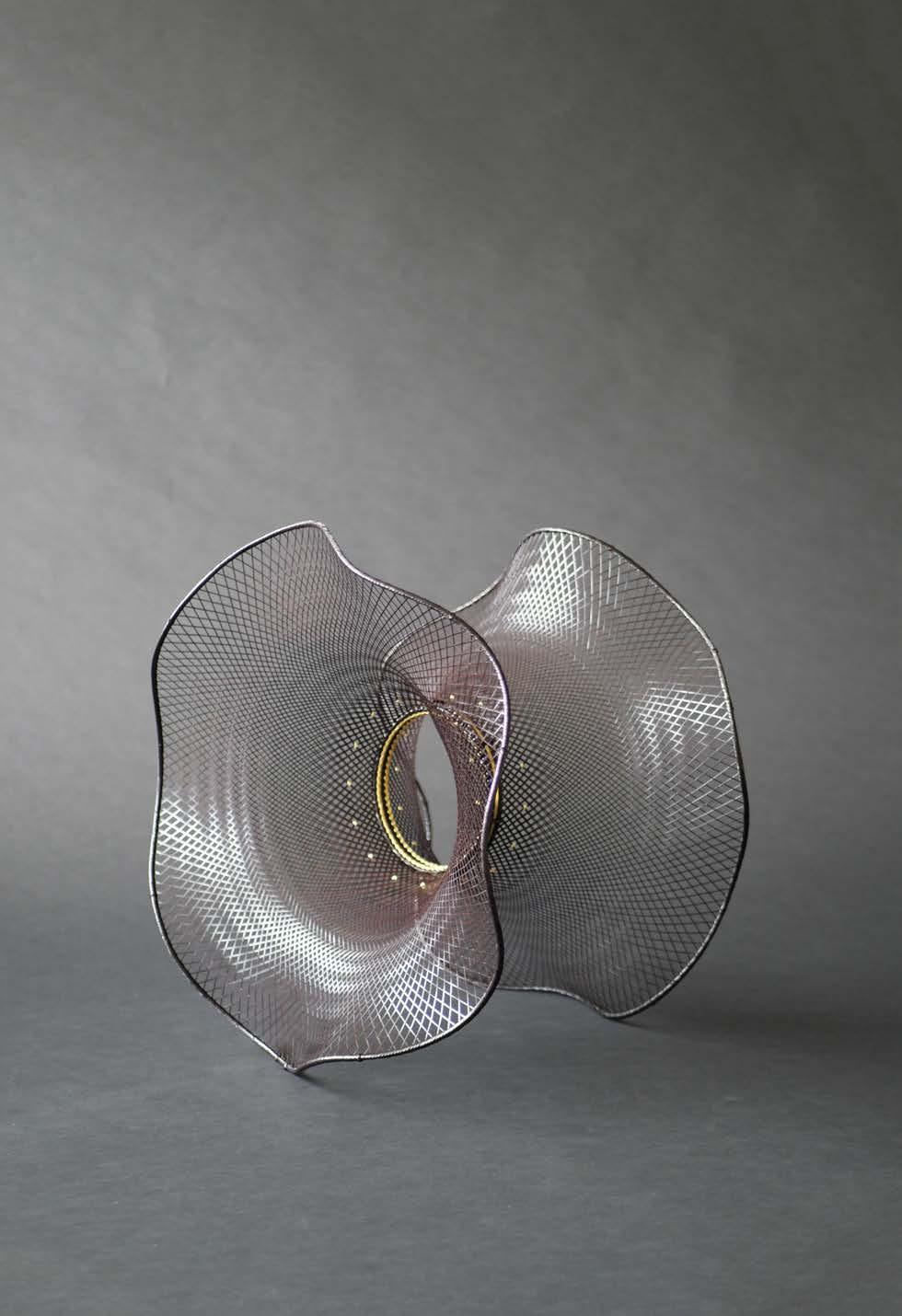
FLY: Halo III , 2026, 17.75 × 17.75 × 14.75 inches
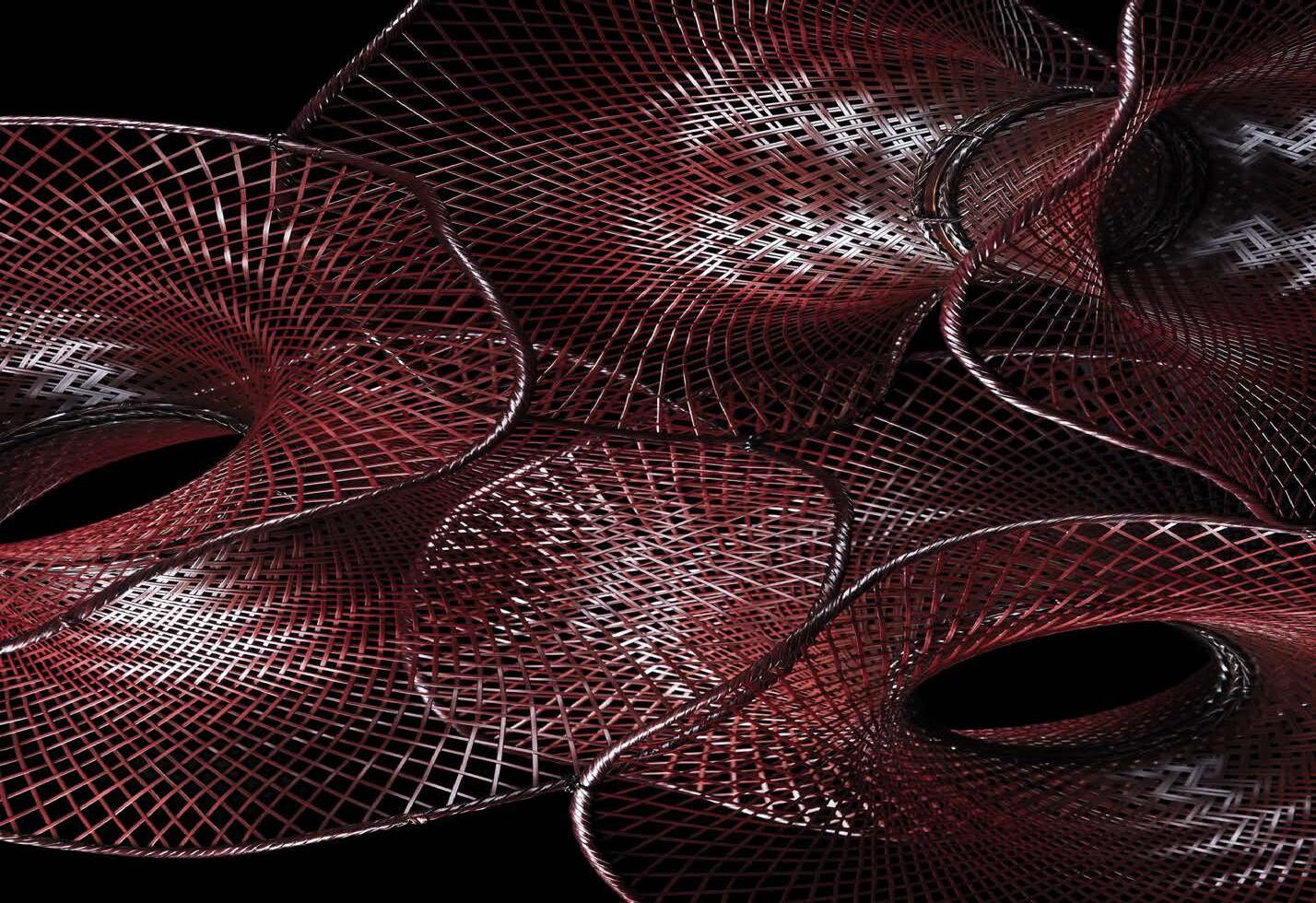
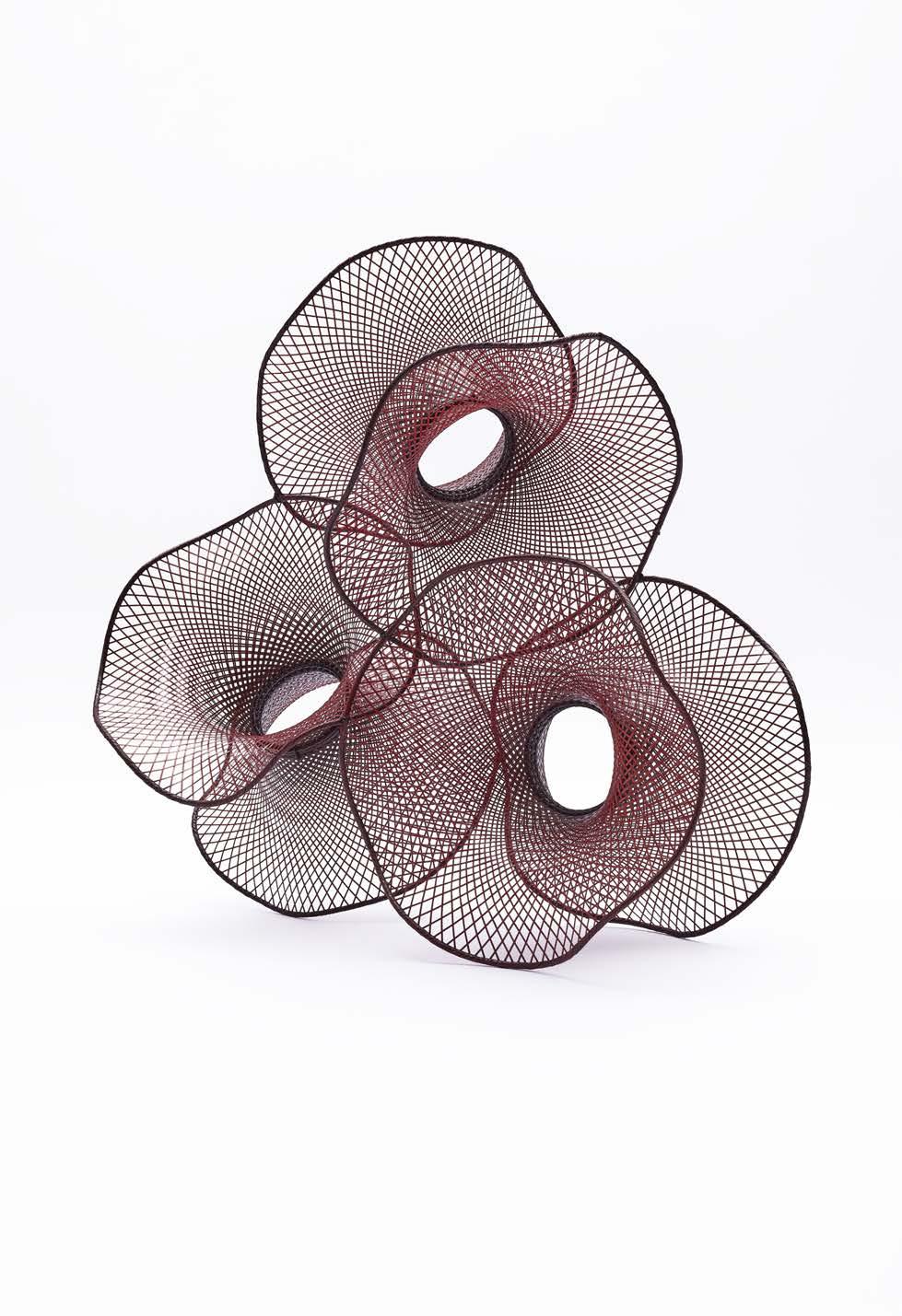
FLY: Trio , 2024, 23.75 × 25 × 15.25 inches
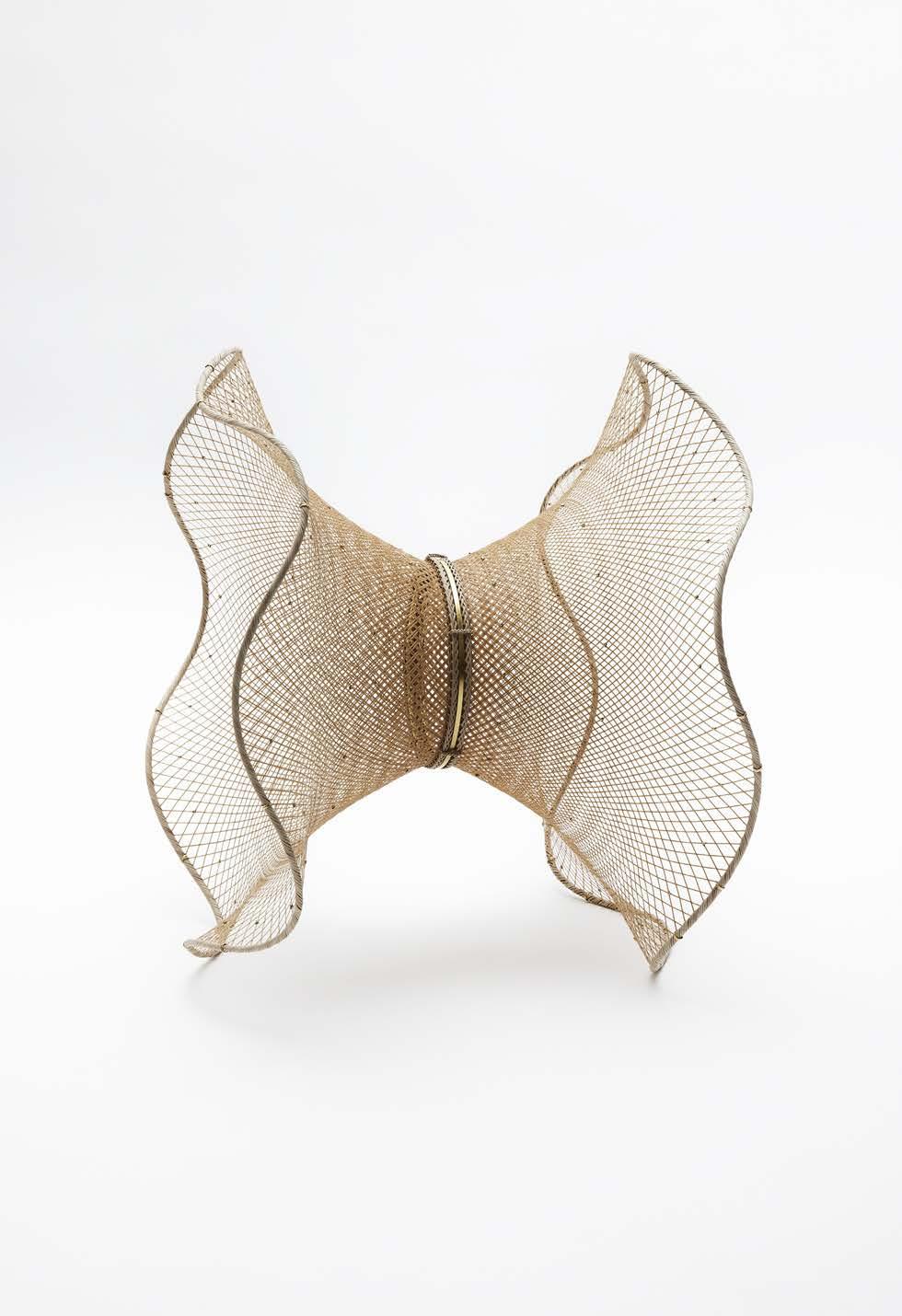
FLY: Halo II , 2026, 17.25 ×17.25 × 15.5 inches
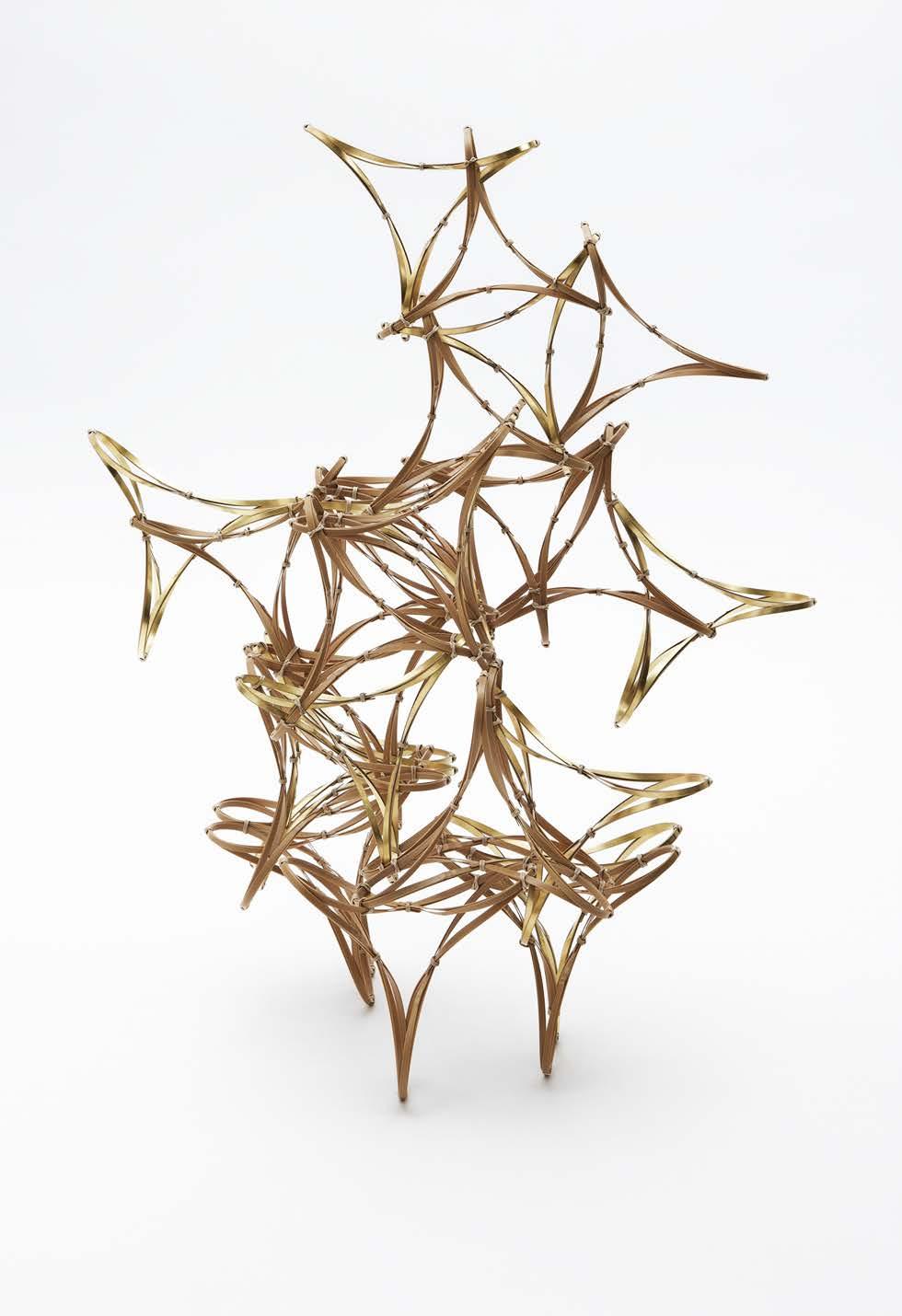
Auspicious 8: Strata II , 2026, 21 ×17.75 × 9.5 inches
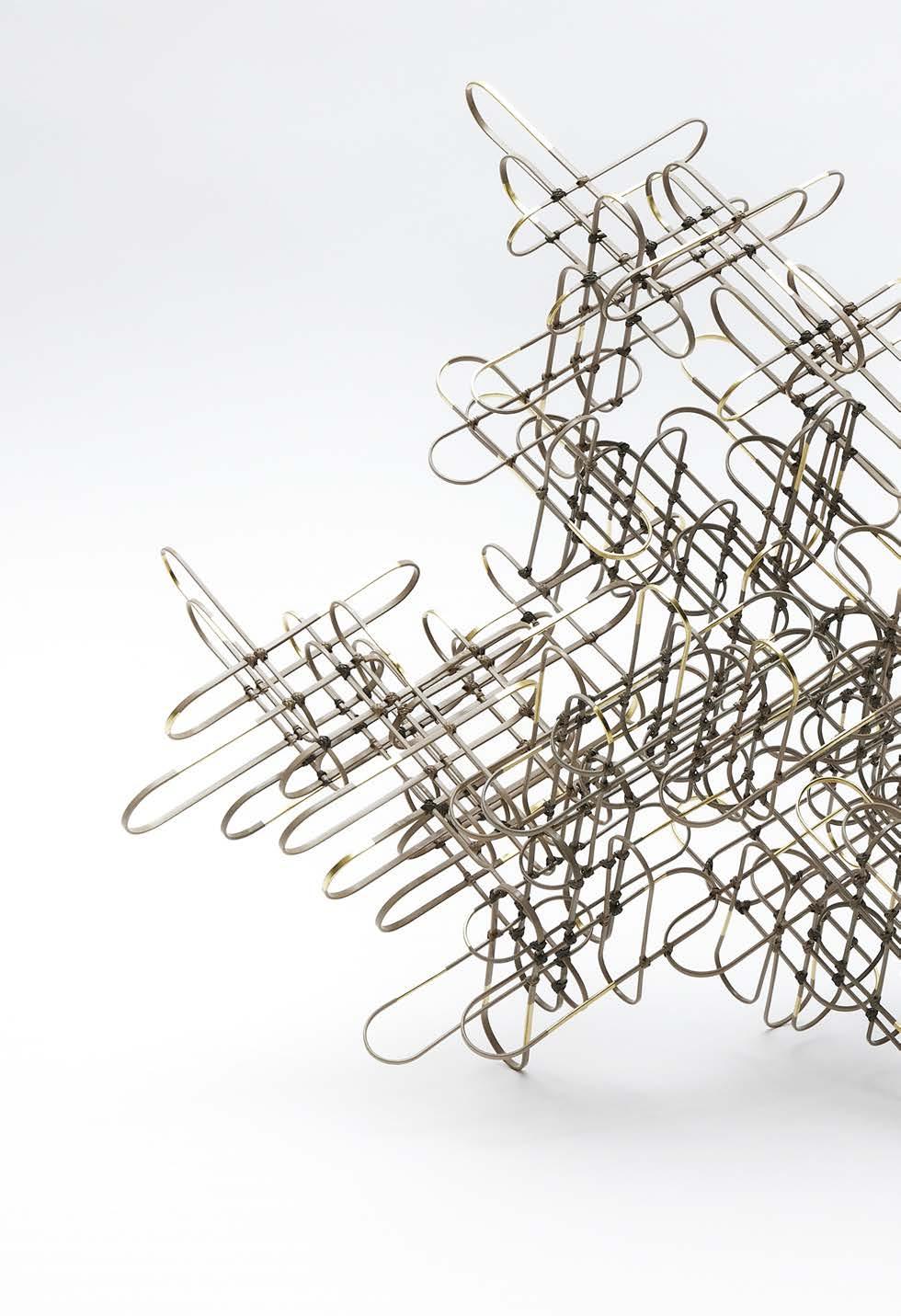
Prism Ellipse: Golden Clouds , 2026, 18.25 × 25.5 × 15.5 inches
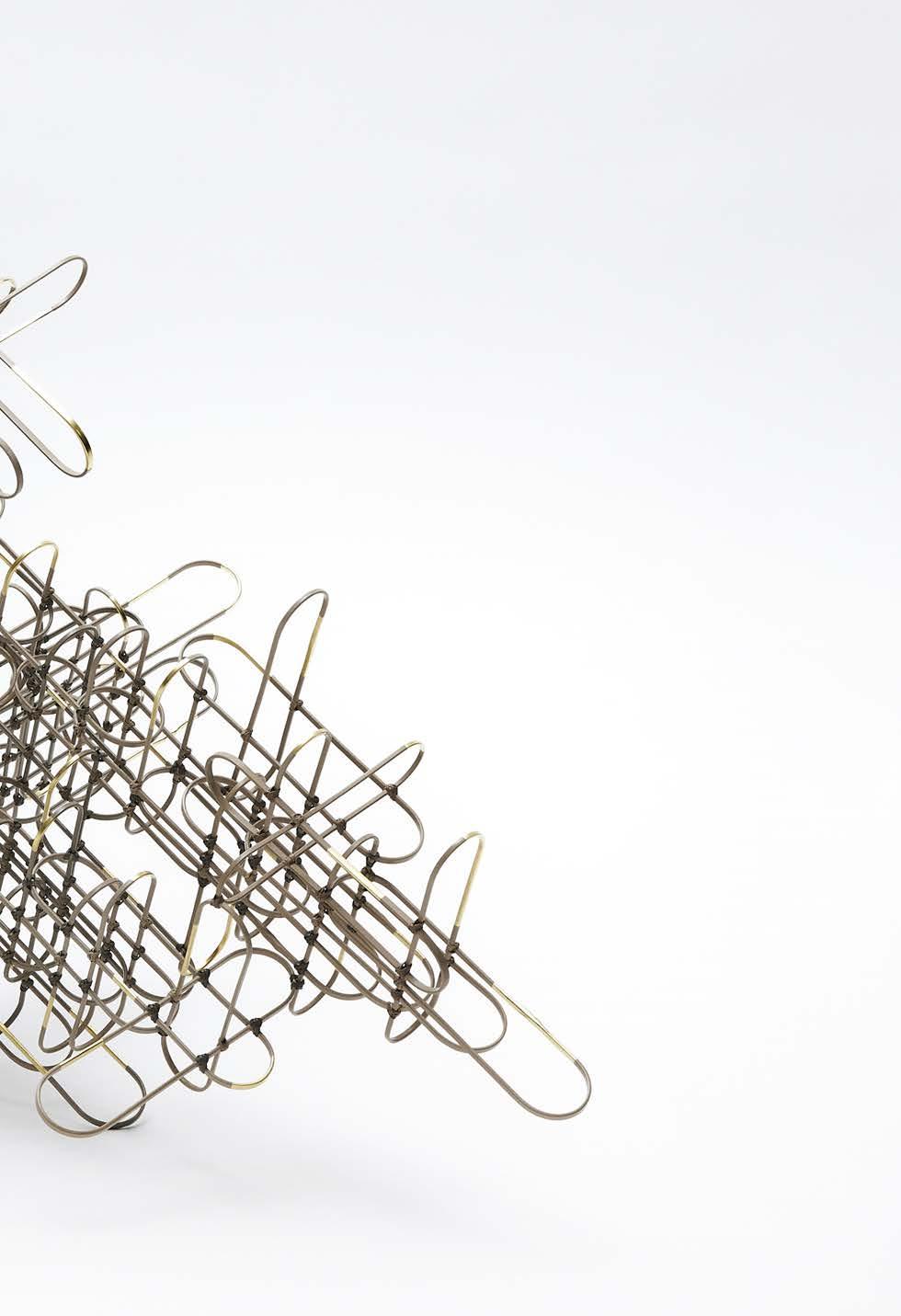
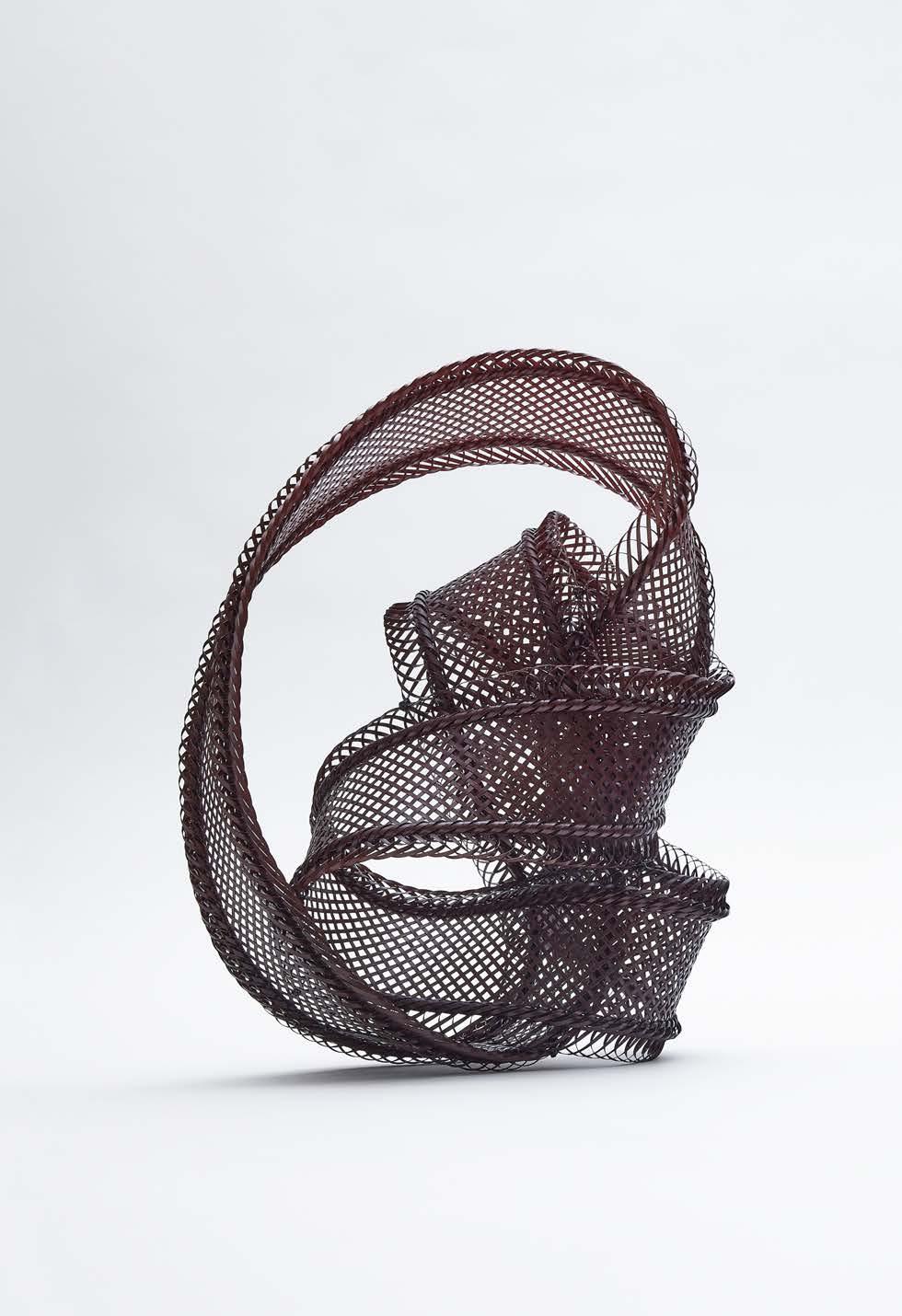
Frill: Arc / Vertical , 2026, 14.25 ×11 × 6.75 inches
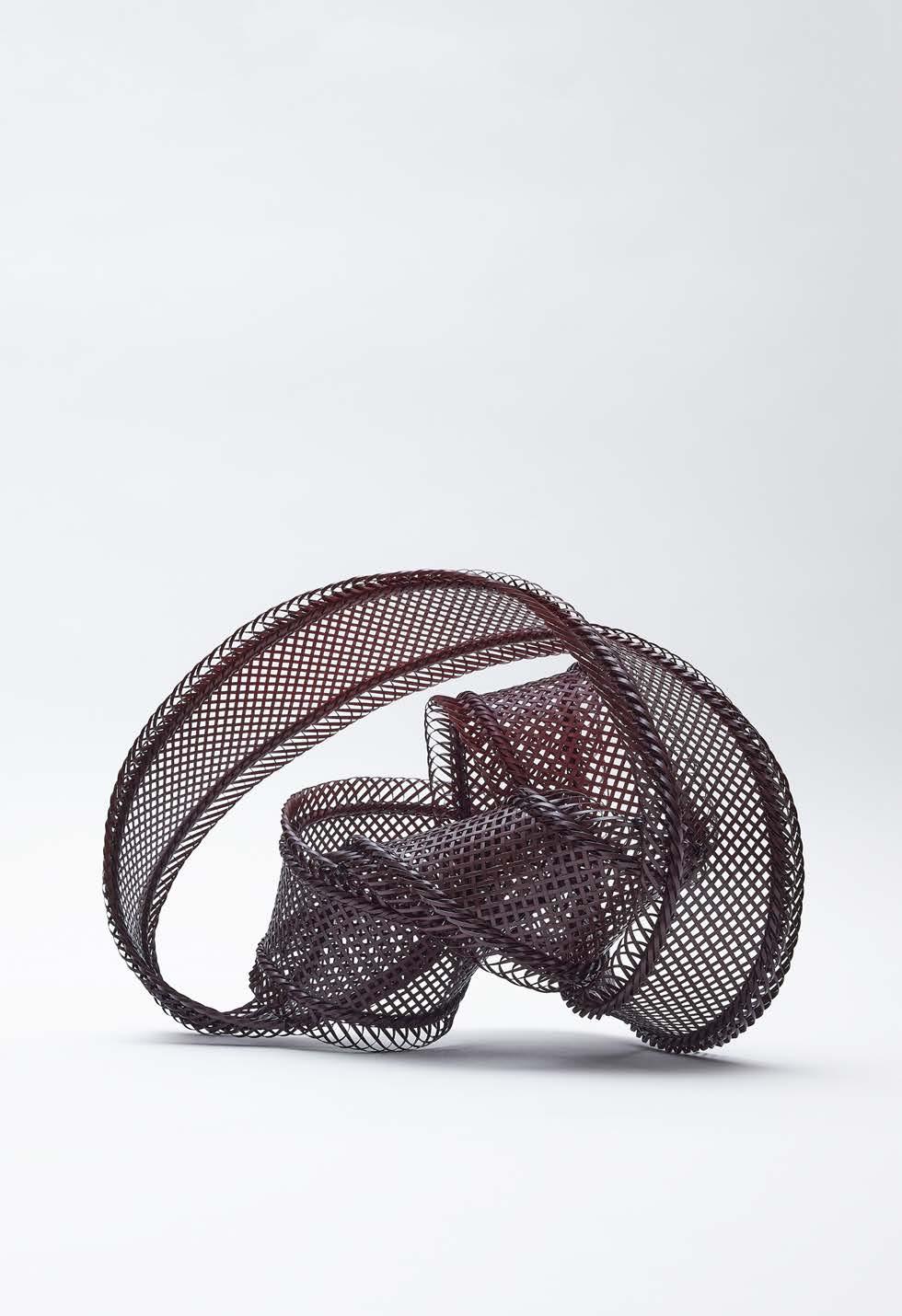
Frill: Arc/ Horizon , 2026, 10 ×15.5 × 9 inches 37
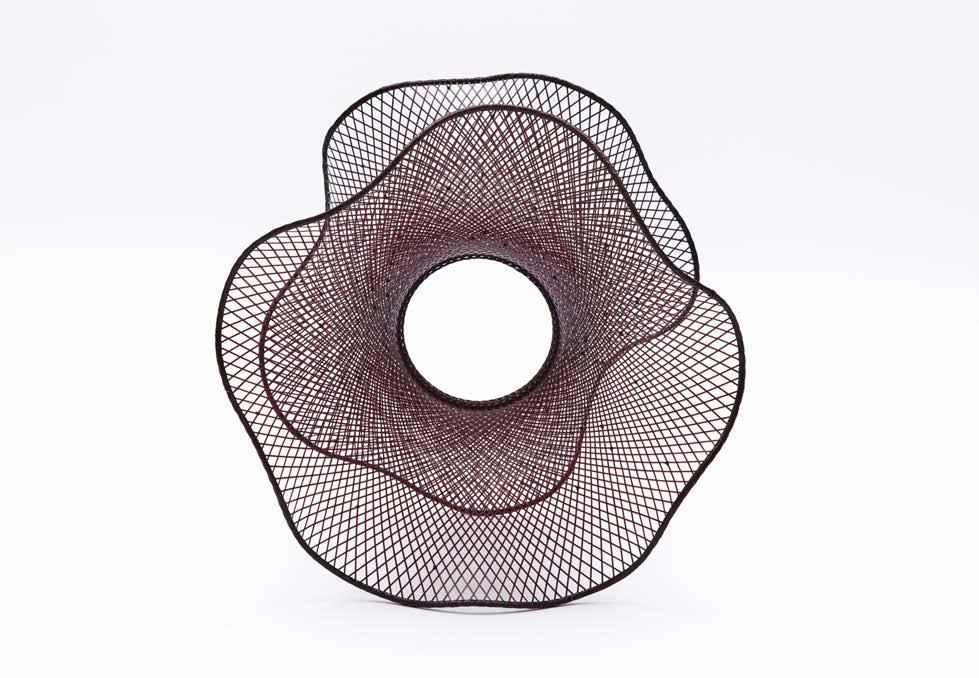
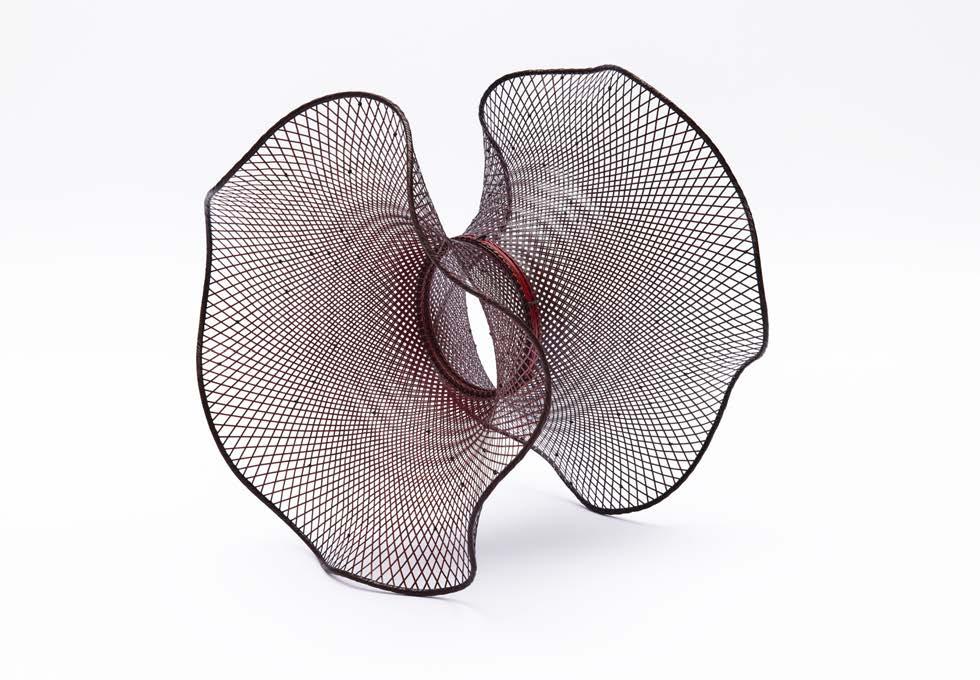
FLY: Stardust , 2023, 17 ×17.5 × 15.5 inches (two views)
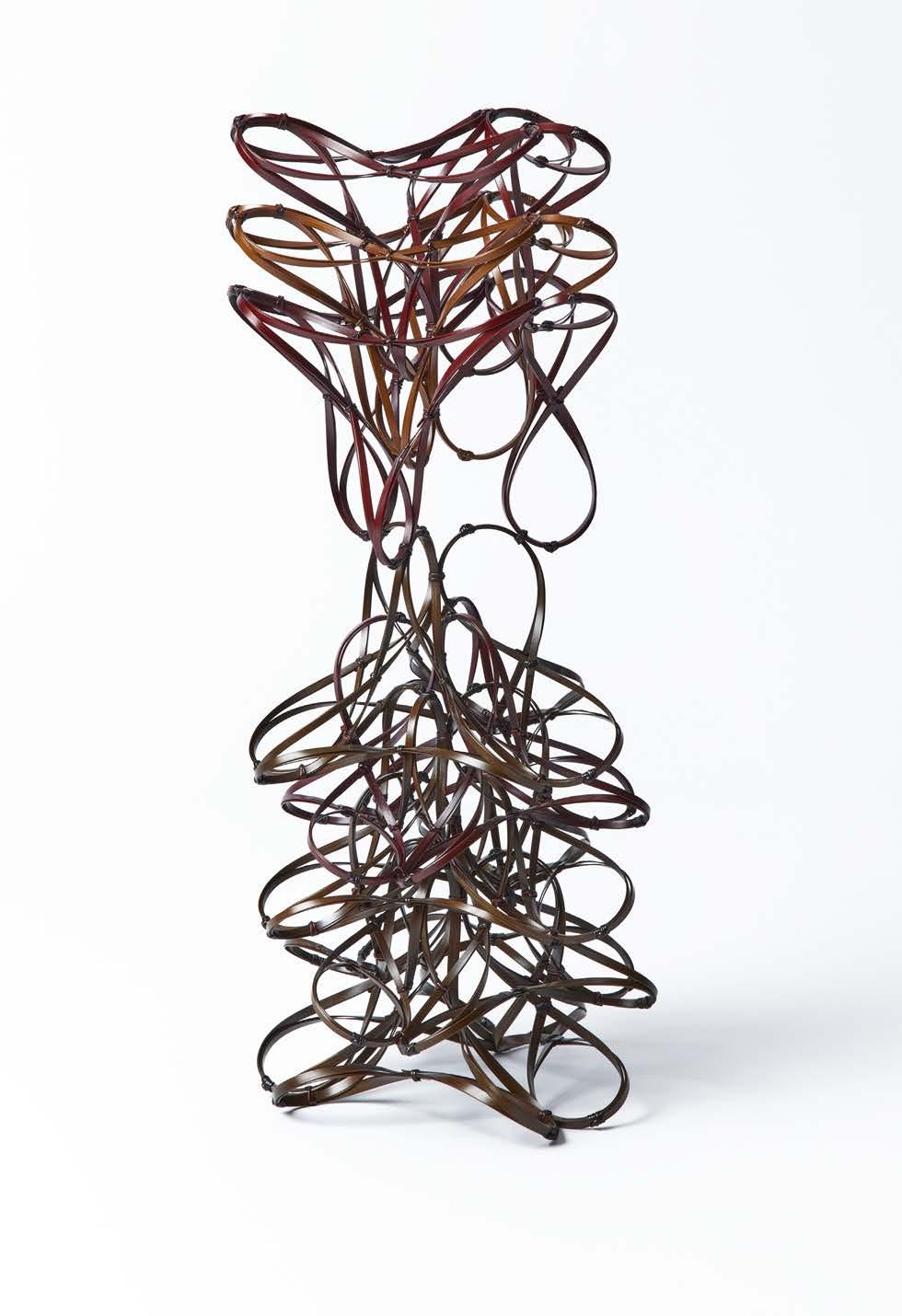
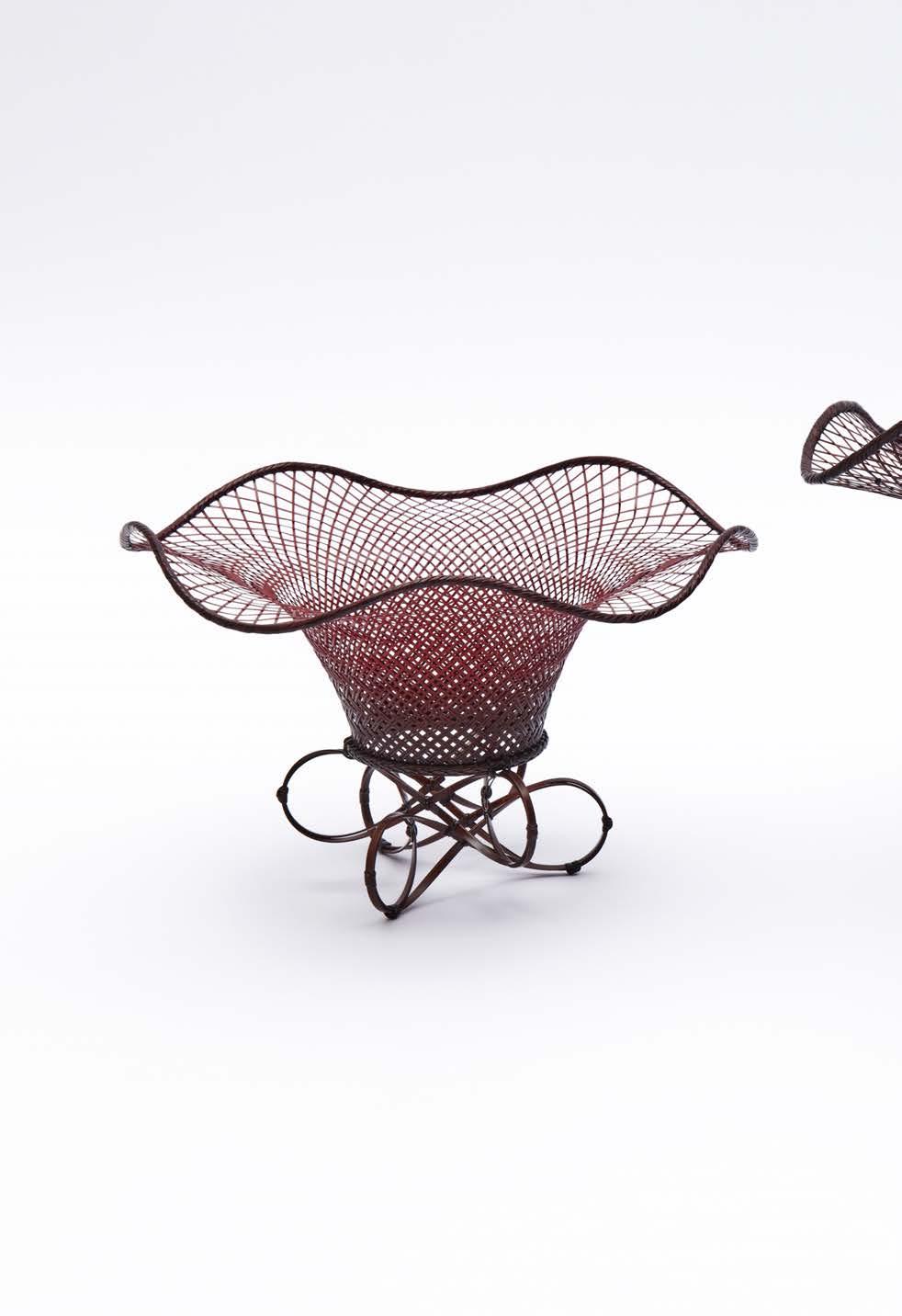
FLY: Flower III , 2024, 8 ×12.25 × 12.25 inches
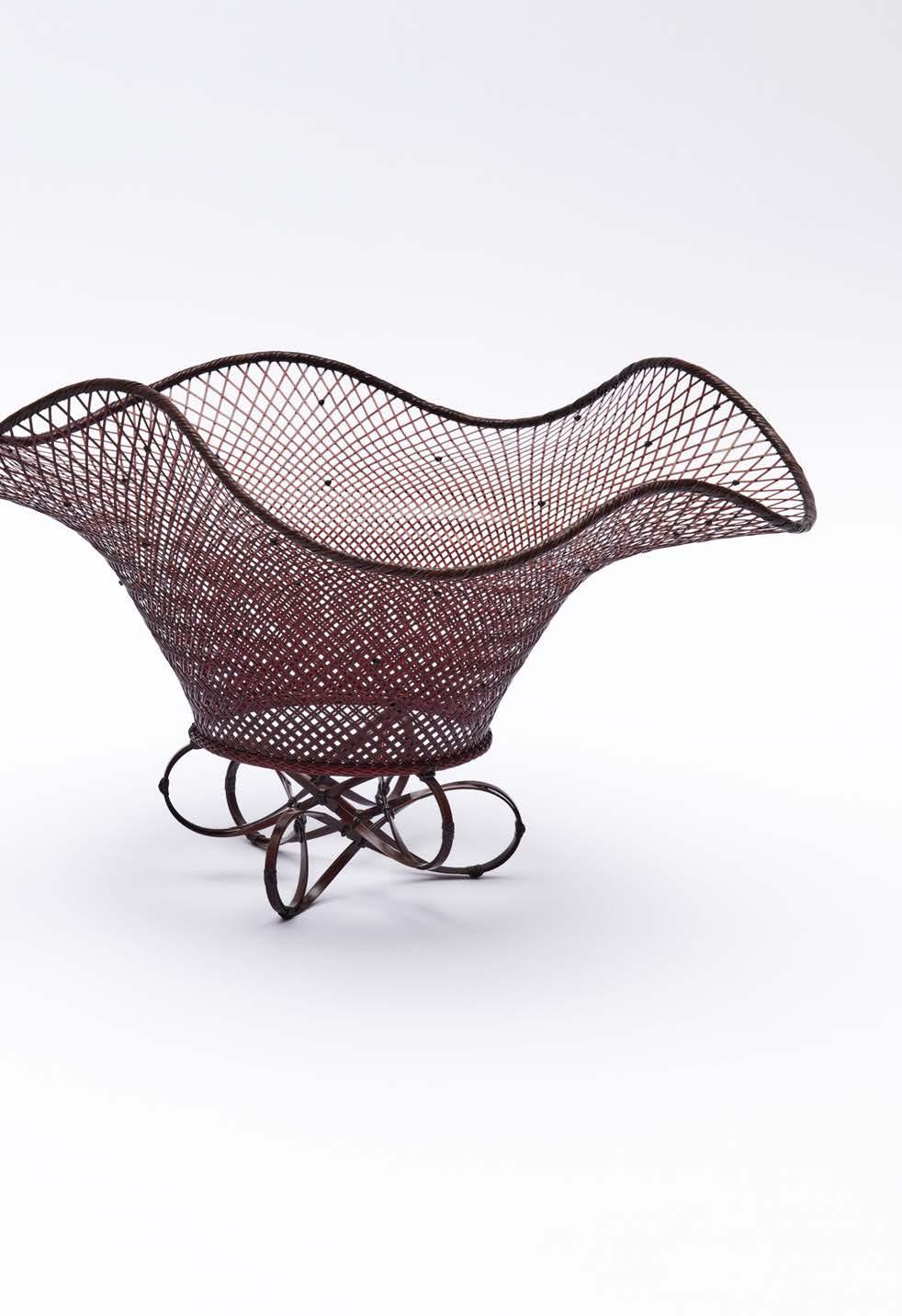
FLY: Flower II , 2023, 11 ×17.25 × 17.25 inches
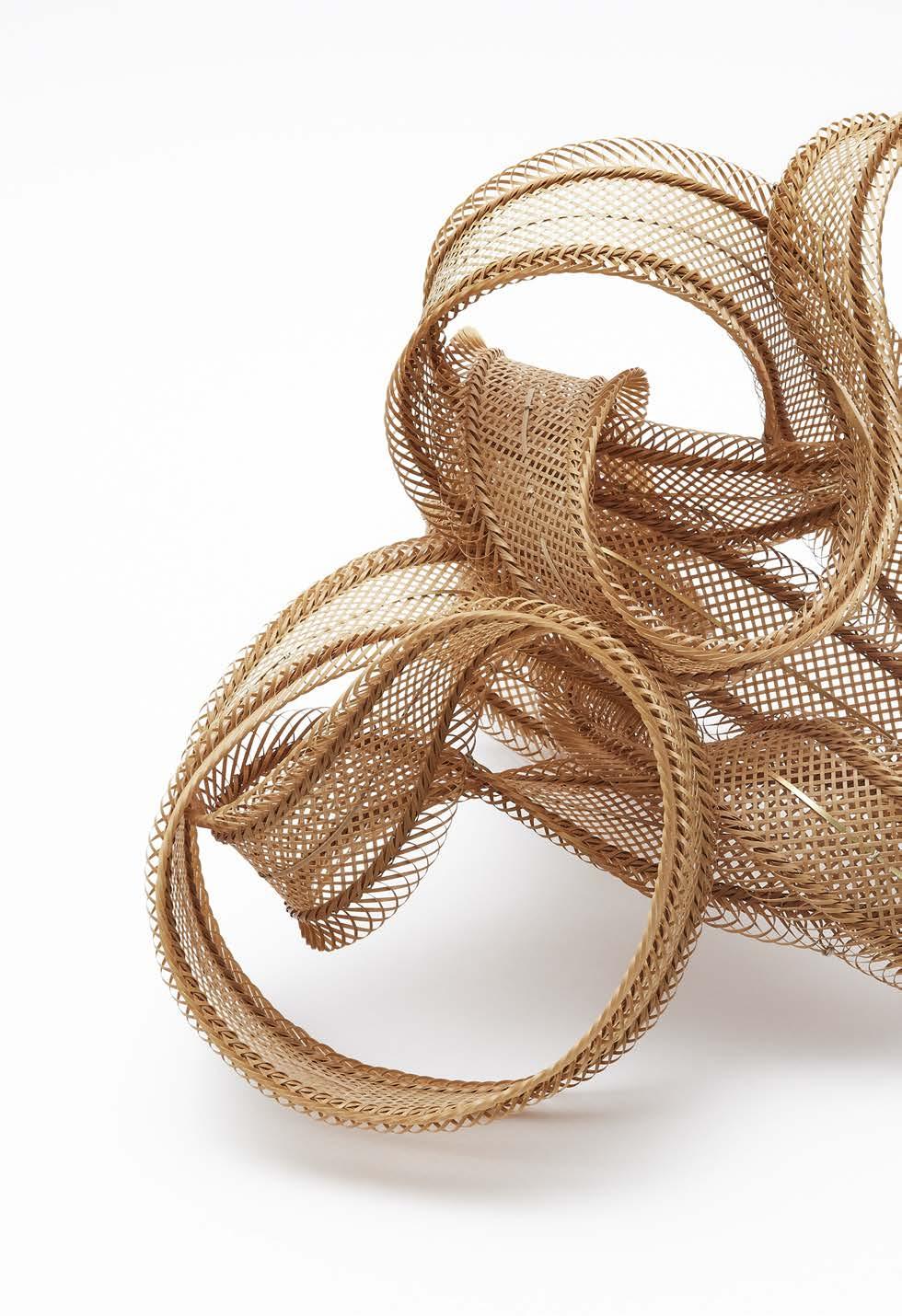
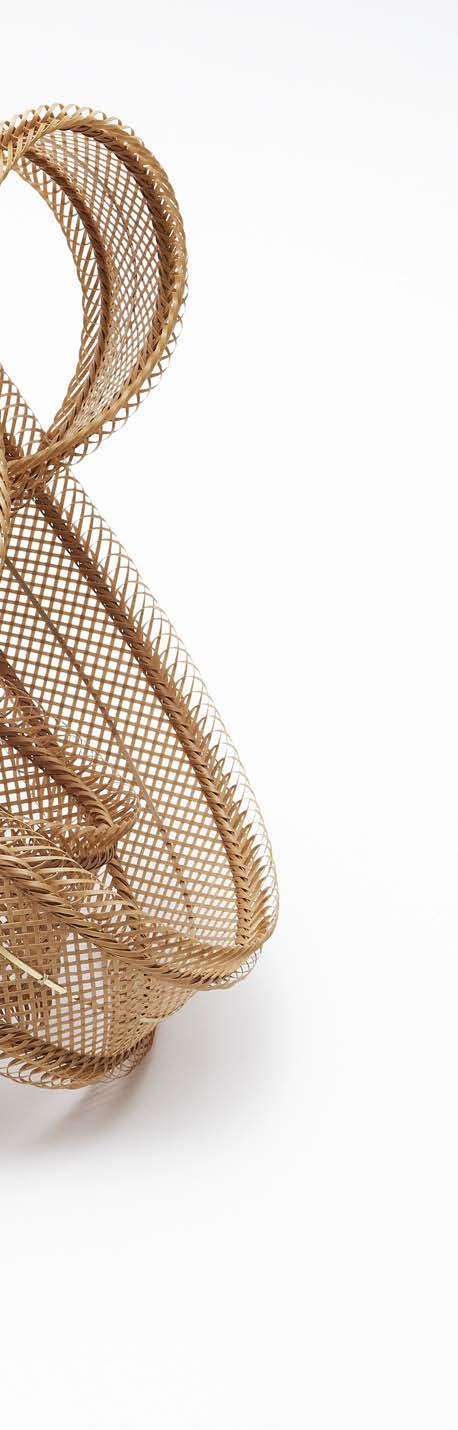
Frill: Golden Vein II , 2026, 18.25 × 20 × 16.5 inches
All photographs by Minamoto Tadayuki except page 23 by Kubo Takashi and pages 28 and 29 by Nakatomi Hajime.