
Photo Brian Walker
A low snowpack didn't get in the way of slopeside fun for these ladies.
Serving Lake Tahoe’s South Shore Since 1994





























I’ve had a bit of interest from people seeking to replace Tahoe Guy as a regular Mountain News columnist but I am wondering if more people are out there. So, if any of our readers are interested in taking his place — doesn’t have to be a parenting columnist, could be anything — please email me with a concept and a sample column around 900 words.
I talked to one person who told me he has things to say, but doesn’t like to write, just talk. Well, with technology these days, you can speak into a phone and have it transcribed for you. Voila! Instant column.
I remember when spell check came along and then grammar check programs and I have used both. I also like to have a thesaurus handy and I’ve relied on editors and proofreaders — human ones. But AI has taken written composition to a whole new level — and mostly not in a good way, in my estimation. So where is the line between use of acceptable writing aides and having a soulless program take over for human expression?
Recently, the Sacramento Bee announced that AI will take apart stories written by its human reporters and rewrite them several different ways to target differ-
ent audiences. An education story may be recast to appeal to parents or teachers or taxpayers, depending. The Bee’s journalism trade union is none too happy about this development, with one employee calling it “icky” and exploitive.
It all feels a bit like the industrial revolution when machines took over for craftsmen in manufacturing.
The Arts and Crafts movement sprung up to champion the thought and care that went into goods made by actual people, rendering them superior. While artisan craftsmanship still provides valuable products today, the world has largely moved on. Will the same happen with more cerebral pursuits? Are we fighting a losing battle?
Here at the Mountain News we are committed to human-generated content. All our columnists and writers have distinctive voices not easily imitated. I am thinking of fashioning an official policy regarding the use of technology in our pages, however, and am trying to figure out just what our guidelines should be. How much assistance, if any, is allowable? Let me know your thoughts on the matter.


Mike’s column this month touches on these very issues. He asks ChatGPT to weigh in on Tahoe. Read what it came up with and judge its effectiveness at identifying our issues. He also writes about his experience with technology as a teacher and how he has reached the conclusion that pencil and paper learning is more effective for students.
The nation is in a frenzy over the upcoming midterm elections which could change the balance of power in our country. With open congressional races on both the California and Nevada side of the state line, we give an overview of the upcoming primaries this month. Everyone pretty much already has their opinions on the big issues at play, so we decided to take a look at Tahoe issues that could be affected by the election. Oh, and see who is giving how much in our local campaigns.
Speaking of the election, June 2 will be a trifecta for me. Not only is it election day, it’s also my daughter’s birthday and the opening day of the farmers’ market. I’ll report back next month.
At a time when the community is celebrating the opening of the city’s flagship recreation center, there is a troubling pattern developing at City Hall of resignations by the professionals entrusted to manage the city. First the city manager; now the city attorney. Could this be random turnover or the leading edge of an exodus?
Multiple sources point to a corrosive political environment fueled by Councilmember David Jinkens’ repeated public undermining of the executive staff. In tense and angry tantrums, he has challenged, reprimanded, and attempted to subordinate officials hired for their expertise, sending a clear message that independent professional judgment is welcome only when it aligns with his own.
It follows that the departure of the city manager and now the city attorney were influenced by the excessive and tedious challenges to their authority

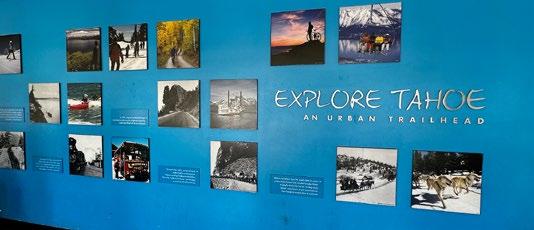
“Is Explore Tahoe a waste of space?”
Just curious

brought by Mr. Jinkens and his attempts to micromanage the city from the dais. The role of city council members is to focus on policy decisions, while the day-to-day operations of the city are the purview of the city manager. This kind of intimidation and shadow management by a council member is exactly why the International City Management Association discourages former city managers from serving on the same city’s council. Mr. Jinkens was the SLT City Manager from 2002-2010. Further evidence of Mr. Jinkens’ inappropriate behavior surfaced at the March 24 council meeting where he called disruptive audience members “crazies,” later seeming to tell them to leave the room with a repeated “Adios.” This is improper.



Besides, it is the job of the mayor to keep order at meetings, (Keith Roberts was the acting mayor that night) not individual council members.
In an April 21 South Tahoe Now Op/Ed titled, “City Council needs to do better for staff and community,” Paula Peterson calls for a new city ethics policy and updated protocols, noting that the public can be removed from meetings and elected officials can be censured or even recalled.
On Facebook, Manuel Rivera Lopez writes, “I think (Jinkens) is the nightmare... He’s disrespectful, condescending and always confused about how things work or what’s being discussed.”
Government organizations rarely unravel all at once. The damage can start with just one elected official who confuses disruption with leadership. The result is a fractured council and the loss of valuable employees. There is a stark difference between challenging the status quo in pursuit of better governance and “burning down” City Hall.
City Attorney Heather Stroud has served the city since 2018. Her professionalism and strict adherence to government protocols and municipal law have elevated the standards of the entire organization. She saved the city millions by reducing the budget of the city attorney’s office. She promoted a culture of playing by the rules rather than making up the rules, as happened with some former,
less competent city attorneys. Big loss for the city.
That has certainly been true with the new Rec Center. With 856 annual passes sold and daily users at nearly 300, this place has become a beehive of activity. There are still a few operational kinks to work out. Be patient. Parking, at times, is tight, but overall is meeting demand. The city and El Dorado County (library) negotiated the shared use of this now expanded parking lot. A project of this size and scope doesn’t happen without the help of visionaries. Three key people (there were many others) who turned an idea into a reality are former City Manager Joe Irvin, Project Manager Ricky Riddle and Parks and Rec Director John Stark who, along with his team, will bring this building to life.
If you met local septuagenarian Joyce Clinton today, you would have no idea that in an earlier life she spent 20 years at sea, survived a hurricane that sunk her boat and killed fellow travelers, then found herself on a deserted island, eating coconuts to survive. In 1994 she was at the center of an international news story when she and fellow diving companion, Terry Kennedy, documented and then reported the illegal slaughter of giant manta rays in the Sea of Cortez, which ultimately led to marine protections. Their story (The Last Dive) was part of this year’s Tahoe Documentary Film Festival. Not all heroes wear a cape.
To be continued….

With an average of 3,076 monthly visitors to Explore Tahoe in 2025, one could conclude the space is being well used. After
with facts and photos about Tahoe today and decades ago. It’s a definite history lesson.
Since November 2018, Lake Tahoe
utilities for the property and bear custodial services costs for the leased premises,” explained Olga Tikhomirova, South Tahoe’s
environment, history, arts and culture in and around the Tahoe basin.”
The lease does not include use of the second floor.
The city owns the entire Stateline Transit Center, which includes the two-story Explore Tahoe building. At the get-go, the top floor was considered transit office space before being deemed general administrative
“With
all, that’s nearly 37,000 people annually passing through the doors.
For the first three months of 2026, the visitor center averaged 2,498 people a month. Its busiest time is June, July and August.
Explore Tahoe opened in July 2007 after 2.5 years of planning. The goal then was to “eventually” hit 2,000 visitors a day, a milestone yet to be met.
The center was a group effort between the city of South Lake Tahoe, California Tahoe Conservancy, U.S. Forest Service and Tahoe Heritage Foundation. While it is part of the transit center, the main entrance faces Highway 50 near the Marriott Timber Lodge in South Lake Tahoe.
CTC contributed the bulk of the funds—$1,825,500. This included a $97,000 planning grant in 2004, a $1,400,000 implementation grant in 2005, supplemental grants of $160,000 in March 2007 and $168,500 in December 2007.
It was designed to be a one-stop recreation outlet, thus the reason it was called an urban trailhead. At that time, study after study proved visitors needed help getting outdoors in this overly built environment.
Explore Tahoe in some ways is like a mini visitors’ center one might expect at a national park because it’s not just a bunch of tourism-related brochures. Exhibits cater to all ages, with a huge interactive topographical map of the terrain covered by the Lake Tahoe Basin Management Unit.
An hour-long video with images of years gone by and current day scenarios is available to watch. Walls are decorated
Visitors Authority has leased the site from the city. The city council approved a contract extension in 2023 that expires in November 2028.
LTVA was in need of a location after its El Dorado County-owned site on Lake Tahoe Boulevard became uninhabitable. That building has since been remodeled and expanded for the Cal-Tahoe ambulance headquarters.
“Throughout the summer of 2018, we operated a pop-up visitor station in California, but could not find a suitable permanent location for the visitor center. We were advised by the city that the TTD lease at Explore Tahoe was expiring in November 2018, and asked if they would consider leasing the downstairs space to the LTVA to operate a visitor center in that location,” Sue Barton, LTVA’s chief operation officer, said.
The sign out front still calls Explore Tahoe an urban trailhead. Barton said that designation is less relevant these days.
“We now recommend commercial activities, which we understand was not originally allowed,” Barton said.
Even so, staff still recommends plenty of outdoor recreation. Most people come in asking about hiking, dining, transit and other activities, as well as itinerary planning.
LTVA does not change the exhibits, nor does it have any plans to make changes to Explore Tahoe in the future.
The city is essentially giving LTVA the space for free.
“In lieu of paying rent for use of the leased premises, lessee will provide visitor services, staffing and pay one-quarter of the
director of finance. “LTVA shall provide delivery of general visitor services, including distribution of information on recreation,





Publisher’s note: This is one in a series of stories written about immigrants living on the South Shore.
By Sal Lopez
It has become increasingly evident that there has been a rise of authoritarian regimes since the beginning of the 21st century. This is in great part due to the events surrounding the attack on the World Trade Center in New York in 2001.
I believe this affects us in the Lake Tahoe Basin since we are a tourist destination, which can present problems of security and safety for those who want to come to enjoy what Tahoe has to offer.
Many nations were caught flatfooted and had to rapidly come up with adequate methods of security to protect their citizens and residents. In addition, such methods had to be put into place because of an increase of gun violence. As a result, an alarming number of countries have chosen to elect right-wing governments to deal with this.
There has also been a backlash due to increased immigration to places such as Europe and the United States. Thus, countries such as France and Germany have tried to enact legislation to stem this increasing tide. Countries like Brazil and Hungary have instituted right of center regimes as a response to such changes, implementing tools such as control of the press, expanding the role of the executive branch and subverting the power of the legislative branch to enact laws to keep the executive in check.
One of the several tools such regimes have used to secure their hold on power is the creation of an effective police apparatus. We are able to go back in history to find examples of this. One case in point is the Roman Empire under Caesar Augustus. This period was considered the Pax Romana (The Roman Peace). Things were





relatively calm during his reign as opposed to the previous reign of his uncle Julius Caesar.
However, in order to ensure things remained calm, he had an enormous number of Roman legions scattered throughout the empire to secure this peace.
He also sent procurators to the provinces who were only too willing to carry out his iron-fisted policies. One only has to look to the province of Judea, which had a long history of unrest. People there were in anticipation of a messiah who would deliver them from the Roman oppression after years of rebellion. In order to deal with this unrest, Caesar Tiberius sent one of his most repressive procurators, Pontius Pilatus, to keep the province under control. He was quick to send unruly individuals to the cross to send a message that he would not tolerate dissent.
When he determined that a particular person, Jesus Christ, was going to be a pain in his side, his solution to the problem was crucifixion, despite Pilate’s wife’s efforts to urge him to avoid him altogether. He knew that he would have to answer to Tiberius if he didn’t effectively deal with the situation.
In the late 1400s, the Spanish Catholic monarchs were successful in defeating the Moors in Granada and driving them from the Iberian Peninsula. Shortly following that, a royal decree was issued expelling the Jews. To secure their hold on the lives of their subjects, both in
Spain and in their possessions, the Spanish Inquisition was created. Anyone suspected of not being a loyal subject and a faithful Catholic was tortured into submission and in many cases burned at the stake.
To protect themselves, those Jews and Muslims remaining in Spain quickly converted but continued to secretly practice their religious rituals at home. This type of repression continued until the early 1800s when Napoleon invaded Spain, suppressed the Inquisition and opened its dungeons, freeing its prisoners.
Several decades later, in order to fill the gap left by the absence of the Inquisition, the Civil Guard was created. This police force was used by the dictator Francisco Franco to secure his hold on power for almost 40 years. Spaniards quickly learned to toe the line under the ever-present watchful eye of members of the Civil Guard.
One of the most notorious examples of the creation and utilization of a repressive police apparatus by an authoritarian state was the Gestapo under Hitler’s Germany. Though there was a police force at the time, the Nazis determined that in order to effectively control dissent in the country, it was necessary to create a “special” police force only answerable to the Nazi leadership to scatter across Germany and later to its conquered territories to quell
unrest, much like what was done during the time of the Roman Empire.
From there came the creation of detention centers in Germany and Poland and eventually the infamous death camps of Auschwitz, Treblinka and others.
There are many today who believe we are living in a type of authoritarian state under this current Trump administration in the United States. The government has found it necessary to utilize the institutions of law enforcement that are currently in place such as the FBI, the Justice Department and Immigration and Customs Enforcement (ICE) to go after its perceived “enemies.” Though ICE was originally created in the early 2000s in response to 9/11 and to replace the existing Immigration and Naturalization Service (INS), the Trump administration has taken it a step further, transforming it into a type of personal police force to go around the country as a type of iron fist to curb opposition, at times violently, in some instances resulting in death.
In addition, detention centers have sprung up in parts of the country to hold undocumented residents and even U.S. citizens, denying them due process, access to legal counsel and medical care. These centers have been reported to be in appalling condition and there have been several deaths while people were waiting to be processed.

What all this ICE activity has created for the Tahoe immigrant community has been a heightened level of fear and uncertainty. Though we haven't experienced what we've seen in cities such as Los Angeles and Minneapolis, immigrants see what is on TV and social media and are afraid to do essential things, such as going grocery shopping and keeping doctor’s appointments.
Complicating matters for this community is the state line and the approach each of the two states has taken with regard to ICE activity. Engaging in what has been a normal activity, such as going to Costco in Carson City, has become riskier. Yet places such as the South Shore have depended in large part on the immigrant community to keep the local economic machinery humming. Though things look pretty bleak at the moment, the resistance to these measures is beginning to score victories. There is hope that the system of democratic institutions currently in place will put a check on the excesses of this administration, whether it be in the courts or at the ballot box, so that we as a nation do not have to suffer the fate of authoritarian states such as Rome, Spain and Germany.
Sal Lopez is emeritus faculty at Lake Tahoe Community College.





The dollars are rolling in as various candidates and ballot measures gear up to persuade voters in the upcoming June primary.
Campaign financial disclosure documents in the El Dorado County Treasurer-Tax Collector race show challenger Corey Leikauf outpacing appointed incumbent Sean Coppola. Through mid-April, Leikauf had amassed a total of $47,059 in contributions to Coppola’s $30,658.36.

Fifteen donors are funding 70 percent of Leikauf’s campaign thus far with contributions ranging from $1,000 to $7,400—that largest figure coming from Ron and Darin Mittlestaedt, founders of Waste Connections and current owners of TooGood Winery. Developer Kevin Nagle donated $5,000 to Leikauf. Commenting on his contributors, Leikauf told the Mountain News “a lot of the support has come from local residents and business owners I’ve talked with throughout the campaign. After getting to know me and my background, they chose to support in whatever way they felt comfortable, in some cases that meant
giving more, in others it’s been smaller contributions or just helping spread the word.”
Coppola loaned himself $10,000 to help build his campaign. He said donating to himself was a way to show other donors and voters that he has skin in the game.
“This is my money, too and I’m not going to just spend money willy-nilly just to spend money. As a candidate for treasurertax collector this is a good opportunity to show that.” Coppola received $11,399.36 in in-kind donations from family members who purchased campaign materials and supplies for Coppola, then donated them to his campaign. Coppola said donations were structured that way to “save a step.” Coppola’s biggest outside contribution came from retiree Charles Nunn, who donated $1010.
Leikauf, son of El Dorado County Sheriff Jeff Leikauf, received $1,000 from
from
Sacramento
The Measure B Committee, supporting the South Lake Tahoe Library parcel tax, raised $16,974 through April 18, with $5,000 donated by the local Friends of the Library and $8,000 from Friends of the Library in Placerville.
Linda Reichel donated $1,500 to Measure B. She and husband, Jeff, also donated $4,754.50 in support of Measure G. That committee raised a total of $12,659.92 with other notable contributions coming from the Tahoe Chamber ($2,500) and Bruce Eisner ($1,000).
No organized committees have been formed or are spending money in opposition to these two local ballot measures.
Outgoing Nevada Congressman Mark Amodei said the biggest issue facing the Tahoe basin is wildfire. “If the forest burns down, Tahoe isn’t Tahoe anymore. You have all that sediment loading,” clouding the lake, “you have massive burn scars. It’s a major whack to the ecosystem, it’s a major whack to the economy. There aren’t other Tahoes floating around out there.”

As the largest landowner in the basin, the US Forest Service has a major role to play in preventing devastating wildfires, which is why the next congressperson from the district, which includes the Nevada side of the lake, needs to have an in-depth understanding of how the agency works, especially with regard to President Trump’s
reorganization, and how to partner with state and local agencies around the lake. Amodei also said tourism needs to be moderated, “so we’re not destroying the basin by having it overrun with people.”
The next representative will need to have a deep knowledge of Tahoe or do a lot of homework as well as partner with others in the delegation, said Amodei, who grew up in Carson, vacationed at the Lake and whose second job was as a park aide at Sand Harbor —“picking up trash, dumping trash and cleaning bathrooms.” He said he bonded with late California Senator Dianne Feinstein, who grew up vacationing on the West Shore, over Tahoe issues.
The key congressional mission for Tahoe is “stewardship,” said Amodei, which “takes action and collaboration.”
Twenty-five candidates — 11 Democrats, 13 Republicans and one American Independent — are running to replace Amodei, who is retiring after sixteen years in office.
Those with Tahoe connections include former South Lake Tahoe Councilmember Bruce Grego, who is running on the Republican side of the ticket after moving to the Carson Valley several years ago and wealthy tech entrepreneur and former Federal Reserve staffer Greg Kidd, who lives in Tahoe and is running as a Democrat. Amodei has endorsed rancher James
Settlemeyer, a Republican and currently head of the Nevada Department of Conservation and Natural Resources. Given Settelmeyer’s personal, professional and political background, he said Settelmeyer knows Tahoe and its issues “from soup to nuts.”
On the California side, Tahoe now falls into newly redrawn Congressional District 3, which stretches down to the Sacramento suburbs. Republican candidate Christine Bish has spent a lot of time in Tahoe. Her mother used to own the restaurant My Favorite Place, where Bish worked as a waitress and more. Bish told the Mountain News she is a “constitutional conservative,” with a fierce, pro-environment bent. Bish
first got involved in politics in 2020, running for congress against Doris Matsui, spurred on by a cancer diagnosis she believes was caused by industrially polluted wells in her water district.
Democrats Chris Bennett and Heidi Hall, of the eight-candidate contingent for District 3, have each made the trek to Tahoe to speak at LTCC. Bennett staffer Caitlin Enright told the Mountain News he is concerned about recent actions taken by NV Energy for supplying and pricing electrical service in the community. Representative Kevin Kiley, who is the outgoing Tahoe representative on the California side, was unavailable for an interview.


This summer TAMBA will work with the Lake Tahoe Basin Management Unit to build 45 miles of multi-use trails The USFS plan approved earlier this year will also open 111.2 miles to e-bikes.
Find out about volunteering for South Tahoe High School’s June 12 grad night by emailing sthsgradnight@gmail.com.
Registration is open for the 42nd annual Hersh Herschman Memorial Tahoe Tennis Classic tournament in Zephyr Cove July 30-Aug. 2.
Volunteer with the Tahoe Rim Trail Association (https://shorturl.at/A20eL) on June 6, National Trails Day, to work at Van Sickle Bi-State Park.
The 2nd annual Coyote Country Steak Cookoff is June 6 from noon-6 p.m. at Lake Tahoe Community College.
Tahoe Transportation District is taking over the Emerald Bay Shuttle, which returns for the second year on Memorial Day and will run through Labor Day.
Gambero Rosso a premiere Italian food and wine magazine, for the second year in a row has named Gastromaniac one of the top Italian restaurants. It’s the only restaurant in the basin with this distinction.
South Lake Tahoe City Councilmember David Jinkens was recently named 2026 Economic Development Champion by the California Association for Local Economic Development, a statewide professional organization. Jinkens was one of the founders of the 46-year-old organization.
Lake Tahoe Historical Society volunteer and retired teacher Larry Lambdin will give a talk titled "From Lake Valley School to Lake Tahoe Unified South Shore Schools from 1952 to Present" on May 19
from 6-7 p.m. at South Tahoe Association of Realtors, 2307 James Ave. Bring photos or memorabilia from your school days in South Lake Tahoe to share.
The 77th annual Highway 50 Wagon Train leaves Round Hill on May 31 headed to Placerville. It will make a brief stop at the South Lake Tahoe History Museum at about 11 a.m.
Nevada State Historic Preservation Office wants residents to share the places that matter most to them. Call (775) 6843427 to leave a brief recorded message describing a place in Nevada that is important to you or make a submission online at shpo.nv.gov/yournevada.
The Washoe Tribal Conservation Corps is hand-thinning 33-forested acres and creating piles to be burned later on California Tahoe Conservancy land near Lake Tahoe Airport. The conservancy also awarded a $110,000 grant to Lake Tahoe Community College to provide wilderness first aid training to tribal members. In addition, LTCC received a $710,000 grant from the Wildlife Conservation Board to restore Trout Creek Meadow, which borders its campus. It is working with the Washoe Tribe to formulate a plan to revitalize the property and improve its ecological function
Despite closing its South Lake Tahoe office, the Humane Society of Truckee-Tahoe continues to provide numerous services for the community. Spay/neuter vouchers, pet food supplies through Bread and Broth and the Phoenix food pantry, and therapy animal visits to Barton and the South Lake Tahoe library are still being offered. For more information, visit https:// hstt.org.
The California Tahoe Conservancy
plans to begin surveying 57 of its properties for wildland habitat, fire safety, open space and recreation. People living adjacent to Conservancy lots may see staffers out working to complete these tasks.
The St. Theresa’s Religious Education Department is hosting its annual shredding fundraiser on May 23 from 10am to 1pm in the church parking lot. Safely dispose of financial documents, medical records, and other personal and confidential papers. Suggested donation, $15 to $20 per box.
The Boys & Girls Club is seeking volunteers for its annual Brewfest on August 29. Volunteers receive free entry to the event. Sign up at https://bit.ly/TBF-Volunteer.
The South Tahoe Public Utility District is offering free tours of its wastewater treatment plant on May 20 at 1pm and 5pm to give the public a behind-the-scenes look at how the facility operates and how it protects Lake Tahoe. Advance registration is required at stpud.us/events.
The US Forest Services is proposing to deregulate certain leasing practices to align with how the private real estate market operates. To read the proposed rule, visit https://www.federalregister.gov/ public-inspection/2026-08937/administrative-site-leases. Comments accepted through June 5 at https://www.regulations. gov.
The Lake Tahoe Unified School District is hosting a community conversation on facility improvements and upgrades on May 19 at 6pm at district offices. There will be updates on the Measure U bond measure and other district projects.
Soroptimist International of South Lake Tahoe recently awarded $35,000 in
community service grants to 12 local organizations for programs to improve the lives of women and children.
Douglas County is alerting residents to scam emails appearing to originate from its planning department with a link for recipients to pay a special permit fee. Douglas County does not ask for financial payments or information via email.
Al Tahoe Firewise is hosting a community bbq at Fire Station #2 on May 23 from 11am to 2pm. Information on fire insurance, ladder fuels and an auction to support wildfire safety and prevention. Cost, $10.
The Lake Tahoe Unified School District and Lake Tahoe Educational Foundation will be hosting an induction ceremony into the district’s Hall of Distinction followed by a celebration on May 21.
This year’s honorees are Kathi Jensen, Bob Grant, Ivone Larson, Manny Alvarez and Brooke Laine. For tickets, visit https://www.ltedf.org
Travis Thane has been appointed the new fire chief for the US Forest Service Lake Tahoe Basin Management Unit. He was most recently a division chief on the Eldorado National Forest.
Carlos D. Trujeque Leal and Maddie Smith have been named Lake Tahoe Community College men’s soccer coach and women’s soccer coach respectively. Both are LTCC alums.
Barton Memorial Hospital again received an “A” for patient safety from the Leapfrog Group, an independent, national watchdog group.
Got a community item for Heard? Email mountainnews2@gmail.com, subject line “Heard.”

Did you know South Tahoe High School students can earn real college credits. . . for free. . . while still in high school? Through our Dual Enrollment partnership with Lake Tahoe Community College, students in many classes, including CTE such as Culinar y Ar ts, Dental, Spor ts Medicine, Exercise Science, and Visual Ar ts, are getting a genuine head start on their future without a single dollar of college tuition This is happening right here at STHS, in our own community When students leave South Tahoe High School, they will already have a jump start on college

Dual Enrollment Classes at STHS
CTE Classes:
Culinary 1 & 2
Baking
Digital Art
Dental Assisting 1, 2, & 3
Sports Med 1, 2, & 4
Exercise Science 1 & 2
Viking Ambassador: Mental Health




Free Dog Houses


Celebrating Mr. Richard Kinnett.....STHS Certified Teacher of the Year. Some teachers teach from a textbook Richard K nnett teaches from a forest
As South Tahoe High School s CTE “Tahoe Science” Forestry & Natural Resources nstructor, Mr Kinnett has turned the Tahoe Basin into one of the most remarkable classrooms in the region. H s students don't just read about ecosystems they restore them

They've planted 1,000 trees in the Tamarack burn area, built defensible space alongs de Lake Valley Fire Department, dug out f re hydrants, and counted bald eagles on the lake at dawn. This year, one of his students completed wildland firefighter cert fication and was hired by the Meyers Forest Service Station before he even graduated from high school.
Mr K nnett is building futures f you ve seen what his students are do ng out there, you already know why he was named STHS Cert fied Teacher of the Year.
Mr. Kinnett, your hard work does not go unnoticed. We see you. We appreciate you. Thank you. Tahoe Sc ence
Your college journey starts here.... at STHS. Get on our JOB Board.
Need Summer Employees?

Free Physicals for HS Athletes
June 1 at Barton st 11th @ 4:30, 10 @ 5:00, h 9 @ 5:30, 8 @ 6:00 th th

Award Night
Four years of hard work
One big night Sen or Award Night June 3 from 5–7 p m In the Theater.
AI and SLT
Artificial Intelligence, aka AI, has been such an overwhelming issue for us in education of late that I thought I’d see if I could have a little fun with it for this month’s column. And maybe it’ll provide a little diversion and levity for you as well.
If you’ve wondered what the issues are in SLT these days, AI does indeed have opinions. And as is often the case with AI, those opinions are a little suspect. You tell me if AI is on target or throwing pitches into the stands.
The “top priority” they cite is making sure everyone is “Bear Wise” and “managing” the local bear population. I’m not sure if ChatGPT is sophisticated enough

for euphemism, and I’m going to assume that AI isn’t suggesting we euthanize more bears. But, yes, bears are an issue for many, and they are moving into more areas they haven’t typically been in, which is endangering more property — and of course, the bears themselves as a result.
Along with getting bear wise, given the scant snowpack this year, we need to be “water wise” and “fire wise” (yes, I know — that’s rich, coming from the guy that started a fire in his own front yard with stain rags). But let’s move on.
Housing affordability and regulation comes next. OK, no argument here. Somewhere around two-thirds of residents are spending at least 30 percent of their income
on rent. There’s no good spin to put on that. Also noted is the usual VHR controversy, which will no doubt continue to be a controversy into the distant future. Oh, and road construction comes up, in case you didn’t know this was a thing.
School report
I don’t know if this is a report as much as an observation I thought I’d pass along.
In the years leading up to and through Covid, I would say that my instruction had evolved to about 85 percent digitally based and 15 percent pen/pencil and paper; schools everywhere had embraced Chromebooks and Canvas or similar platforms. In the years following Covid, I would say I’ve shifted the opposite direction to where it’s about 15 percent digital today, if even that. I’m speaking for myself only here, but I don’t think I’m unique in this turnabout.
To detail the reasoning behind this shift would get pretty involved, so let’s just say that I grew more concerned about the wisdom of where we had gone with student technology, coupled with watching their 24 / 7 access to all that smartphones allow — and we all know what they allow.
To find a group of young people today just hanging out at a table on campus, talking or goofing with each other — not staring into their phones — fills you with amazement and joy, so what does that say?
Another reason for my shift was that I saw a bigger difference between how young people compose by hand versus by

machine; it seems that the brain works differently in those two scenarios — especially for developing writers.
Meantime, I know parents continue to struggle with this extremely challenging issue of how much tech access to allow their kids, how to hold the line when their kids’ friends have the latest phones, how to keep their kids safe and free from the addictions that smartphones have fueled. It’s one of the most difficult parenting challenges to come along, without a doubt, and it requires conviction, fortitude, and a consistent, unified front.
A quick Tahoe Knight Monsters update Your Tahoe Knight Monsters took the Kansas City Mavericks to overtime once but ultimately got swept in four games to exit the ECHL’s Kelly Cup Playoffs.
Player note: fan-favorite, assistant captain Anthony Collins was released by the Knight Monsters in early April. He’s the kind of player that keeps his teammates from getting abused and everybody skates a few inches taller when he’s on the ice. I know we fans will miss his presence and we wish him well in whatever lies ahead.
An NHL note
We are in the midst of the most exciting sports window of the year — of course, I’m talking about the Stanley Cup Playoffs. Shoot me an email and let me know your team. I’m originally a Sabres fan from the ‘90s Matt Barnaby era, but then became a Sharks devotee.
As always, feel free to email mikesmutterings@gmail.com




































Late storms then helped clear out winter inventory.
“We have been servicing bikes really since February, as soon as the trails were dry,” Turner said.
As is typical, clothing is the big seller at the longtime retailer, representing about 60 percent of sales, which is followed by seasonal items. The store changed tactics recently to cater to day or weekend trippers who need a small cooler or some other product just for their Tahoe vacation.
Sports Ltd. has also benefited from the addition of Target next door, which is drawing more people to the center as a whole.
Lodging and tourism
South Lake Tahoe through March, the most current data available, has collected a wee bit more (1.9 percent) in lodging taxes going to the General Fund than it did the previous fiscal year for the same six-month period.
However, transient occupancy tax
Continued from page 16
recreation complex, is up 4.2 percent.
South Lake Tahoe’s mid-year budget report in March said projections are for property tax, TOT and sales tax to grow between 1.25 and 3 percent.
“Overall, current-year operating revenues are projected to remain largely flat compared to the adopted budget, with modest increases anticipated in several non-major revenue sources and property tax. Sales tax and transient occupancy tax projections remain largely unchanged,” the staff report for the March 24 City Council meeting says.
might be the one.”
Blue Room Research, which provides LTVA with monthly reports, predicts the following for summer on the South Shore:
• Consumer sentiment is slightly up and there's still a strong demand for travel;
• Booking window will be short;
• Drive market travel may be up because of gas, and the "one tank" trip might be the trend, so more visitors from within a fourhour distance;
Higher-end properties will not be as impacted as the higher household income visitors are more insulated from gas prices, airline prices, inflation and lodging rates; Visitors will look for deals and for value-add packages/offers.
about 150 days, from mid-November to mid-April.
Still, officials remain optimistic the no-snow trend will not be replicated next season.
“Long-term forecasters are already seeing what they’re calling a super El Niño forming in the Pacific this summer, so we are potentially looking forward to a big winter next season for our 80th anniversary,” Jake Stern with Sierra said.
• Retail/rental revenue for North American resort and ski area store locations was down 6.6 percent. Heavenly closed April 9, Northstar on April 5. The late spring storms allowed Kirkwood Mountain Resort, the other Tahoe area Vail property, to stay open until April 19.
"The winter of 2025-26 has been one of the most challenging winters in
While it depends who you ask if winter 2025-26 was an economic bust, many businesses and tourism folks are bullish on this summer.
“We actually had a great winter. I think it was probably because of the weather, with people not able to do much skiing and other winter activities,” Lacey

Ficklin, manager of Lake Tahoe Bleu Wave, said.
Her fingers are crossed that wild and deadly weather like last June and into July does not repeat. The boating industry suffered last summer because of Mother Nature.
“Right now we are looking better than we did last year,” Ficklin said in terms of bookings. “We do lot of private charters and weddings, and those are up from last summer.”
Holiday Market in Meyers definitely noticed a drop in customers during the winter. It’s usually a go-to stop for people heading to and from the slopes, as well as for those renting homes in the area.
“We were going strong until the third quarter when we saw a decline in tourism here. We have not seen an uptick other than a few weeks here and there,” Nathan Minnis, store leader, said.
He said revenues are off five to six percent from a year ago. For the prior eight years Holiday Market had experienced year-over-year growth.
“We are expecting a good summer, but really have no idea. We are going to prepare as though they are all going to come back,” Minnis said of the tourists.
Jared Hare of Blue Tahoe Taxi said 2025 was his slowest year in the ten years he’s been in business. While he operates on the North Shore, it’s common for him to have drops on the South Shore for people going to summer concerts, bachelor and bachelorette parties, or some other activity.
New Year’s Day is always his busiest day of the year. He’s optimistic about the rest of this year because he’s seen a steady uptick in business since Jan. 1. Foot traffic into Sports Ltd. in winter

flowed with the arrival and departure of tourists.
“When the storms came are when the crowds were here, but only then,” Adam Turner, who does marketing for the South Lake Tahoe sporting goods store, said. He said the firm snow brought in locals who broke an edge, needed a tuneup or had some other equipment issue.
is down 9.7 percent for hotels and off 39.6 percent for hosted rentals. Property management vacation home rentals and timeshares are up 53.5 percent.
Measure P TOT, which is an addon with revenues dedicated to the new
Continued on page 17

While sales tax is another economic indicator, those numbers lag several months behind in reporting, with no numbers available for this year.
“South Lake Tahoe’s receipts from October through December were 3.4 percent above the fourth sales period in 2024,” according to city documents. “California’s local one-cent sales and use tax receipts posted moderate growth during the fourth quarter, reflecting resilient consumer behavior despite persistent economic headwinds.”
That report went on to say: “Stubbornly high fuel prices may also dampen travel and tourism through summer, leaving little room for broad-based sales tax growth in the year.”
Douglas County did not respond to an inquiry about its winter revenues and summer projections.
South Shore tourism officials are on the fence a bit regarding the continual rise in gas prices.
“Our winter was not as bad as some western mountain areas. We all had light winters, but we are not as dependent on international or long-haul travel as we have strong drive markets within a few hours,” said Carol Chaplin, Lake Tahoe Visitor Authority’s president and CEO. “As for summer, we hope stable is what happens. As for gas prices, we haven’t really been hard hit with previous hikes, but this one
The most current report says, “In March, domestic and international inmarket visitor Visa card spending totaled $33.3 million, a 5.9 percent decrease compared to same month last year. Domestic cards accounted for most of the spending at $32.4 million, down 5.8 percent (year-over-year), while international card spending fell 9.9 percent (year-over-year) to total $856,000 for the month.”
South Lake Tahoe Lodging Association reports occupancy for properties in the city are up 9.8 percent in the first two months of the year compared to 2025, with the average daily rate up 1.6 percent.
Jerry Bindel, lodging association president, admits the second quarter will be “challenging” with Heavenly closing early, but added “the rest of the year looks great so far.”
Summer concerts and other events are spurring advanced bookings.
“Usually, higher gas prices have a net positive effect on our destination as we are still one tank of gas away from our major visitor markets,” Bindel said. “Often the longer trips and flight trips are affected more by higher gas/fuel/ticket pricing.”
For those who do fly, most come via Reno. The airport reports passenger numbers up 2.1 percent in March compared to 2025, up 2.2 percent in February, up 0.3 percent in January, down 3.7 percent in December 2025 compared to 2024, and up 0.2 percent in November. The airport, though, does not track where people go once they arrive in Reno.
Abysmal ski season
Not counting the ski season following the Caldor Fire, which ravaged much of Sierra-at-Tahoe’s terrain and some infrastructure, this was the second shortest season in the resort’s history. The worst was 2014-15, which was also bad for all Tahoe resorts.
Even though this winter’s snowfall was about double the 2014-15 season, rain on snow and warm weather melted the white stuff to the point it no longer existed.
Sierra was open all of 87 days this season. Normal would be five months,
• In 2025, travel spending in California reached $158.9 billion, a 1.7 percent increase from $156.2 billion in 2024.
• Travel-generated employment grew by approximately 4,350 jobs in 2025, bringing the total number of travel-supported jobs in California to about 1.2 million—a 0.4 percent increase from the previous year.
• Travel-generated state and local tax revenue grew to $13.6 billion in 2025, up from $13.2 billion in 2024—a 3.6% increase.
• Spending on accommodations grew to $35.2 billion in 2025, an increase of 2.2 percent.
• Spending on food service generated $38.5 billion, an increase of 4.6 percent.
• Visitors who stayed in a hotel, motel, or short-term vacation rental spent a combined $83 billion in 2025, an increase of 2.7 percent compared to 2024.
While the spokesperson for Heavenly Mountain Resort did not answer questions, parent company Vail Resorts in late April released statistics about the season for the entire company.
Vail Resorts reported through April 19 the following figures compared to the 2024-25 season:
• Skier visits were down 14.9 percent.
• Lift revenue, including an allocated portion of season pass evenue for each applicable period, was down 5.6 percent.
• Ski school revenue was down 12 percent.
• Dining revenue was down 11.7 percent.
history across the Western U.S., with record low snowfall and historically warm temperatures negatively impacting visitation and spending throughout the season,” Vail CEO Rob Katz said in a release. “March conditions saw a continuation of low snowfall and warmer temperatures well outside of historical norms, leading to weaker late-season visitation and earlier than planned closures for many resorts across the Western U.S.” The next earnings call for the company will be in June. Katz will likely update investors on preseason pass sales, which were lagging in April.
With the three main factors influencing wildfires being fuel, weather and topography, South Shore fire officials are worried this could be a bad year.
was May-October, though now it’s year-round—even for Tahoe firefighters, with personnel and equipment often being sent to outof-area blazes.
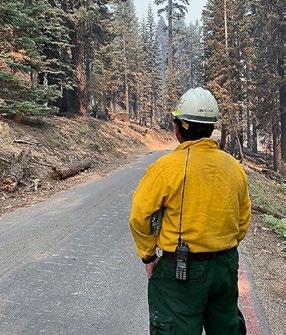
chief with Tahoe Douglas Fire Protection District. “Predictions say we will also enter back into a drought this summer.”
Justin Collins, National Weather Service meteorologist in Reno, said the Climate Prediction Center forecasts above normal temperatures and below normal precipitation through June for the Lake Tahoe Basin.
“We are going to see extra dry fuels heading into summer,” Collins said. “All the ingredients coming together are not good.”
Tahoe’s topography—being a basin—can be problematic. Fire loves to run uphill. So, depending on the ignition point and initial winds, it could be devastating.
“I think everybody is on edge just based on the low precipitation we have had,”
South Lake Tahoe Fire Chief
became the 673-acre Gondola Fire that threatened 550 structures and forced the evacuation of hundreds of people.
The June 24, 2007, Angora Fire was wind driven from the getgo, wiping out 254 homes in the Upper Truckee neighborhood in a matter of hours and charring more than 3,000 acres.
Drennan said there was one red flag day last year but expects several this summer. These National Weather Service alerts warn firefighters, land managers and the public to conditions that are ripe for fire ignitions and their rapid spread.
Schaffer said the norm is to have about 15 red flag days a season, an increase since the Gondola and Angora fires when a half dozen was common. Tahoe Douglas flies a red flag at its
a natural barrier. Mother Nature proved those people wrong. Wildfires are getting bigger and more destructive, turning most everything in their path to ash.
“I never thought in my wildest dreams we would have a fire like that move into the basin. It was a real eye-opener,” McNamara said of Caldor. While he has only been with the Tahoe department since December, for two weeks he worked the Caldor as a member of the Reno Fire Department.
The Gondola, Angora and Caldor fires were all human caused, though no one has been held accountable for any of them. Scars from these fires are still prominent on the South Shore.
“When the Caldor Fire burned into the Tahoe basin, it already had a lot of energy, which
FIRE
Continued from page 18
low snowpack. We can expect wildfires to be more difficult to control, and we will rely on more resources to suppress them.”
Preparation matters
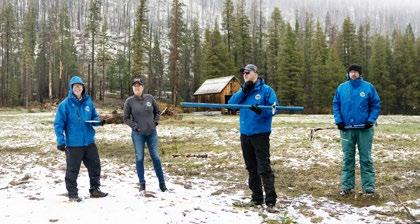
Last month’s snow survey on Echo Summit near the entrance to Sierra-at-Tahoe was the second lowest April measurement on record at that location. The lowest was in 2015 when there was no snow on the ground, whereas a few patches existed this April.
Beyond what this means for water
with the Northern California Geographic Area Coordination to pre-position shared resources at the airport when available as we have done in past years,” Chester said.
The Forest Service and CalFire move equipment, especially aerial apparatuses, around as warranted. Sometimes it’s precautionary, other times it’s to fight a fire.
“From the prevention side, we provide numerous services and education to our community members regarding preplanning for evacuations, home hardening, defensible space and how to build their situational awareness during fire season,” Tahoe Douglas interim Fire Chief
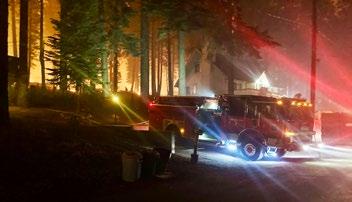
Fuel moisture is a biggie— even for pine trees. It’s one thing when grasses and other low growing vegetation dry out, it’s another when trees have little water content—which is the case this year—possibly leading to devastating crown fires.
“Regional and national fire activity is already on the rise with resources being mobilized early this year. The fire season is yearround and LTBMU firefighters actively respond to incidents throughout the year,” said John Chester, acting fire management officer for Lake Tahoe Basin Management Unit. Historically, fire season
Lake Valley Fire Protection District Fire Chief John McNamara, who worked 20 years for Reno Fire, said the worst fires there were in October, November, December and January. Plus, the town of Paradise in Butte County was wiped on a mid-November day in 2018.
“The National Interagency Coordination Center predicts significant wildfire potential outlook starting in June for our area. The heat wave we experienced in March was well above normal temperatures and it diminished the already low snowpack,” said Keegan Schaffer, wildland fire and fuels division
Jim Drennan said. “All of us are paying close attention to fuel weather and predicted weather coming in.”
Prior Tahoe fires
Wind was a huge issue when someone threw a cigarette from a Heavenly Mountain Resort gondola car between towers 11 and 12 on July 2, 2002. This
stations on these days and has info on its website for the public to access.
The rise in red flag days is one reality of climate change. Decreasing snowpack and increased rainfall are other indicators.
Until the 2021 Dixie and Caldor fires, most experts believed the Sierra Crest would be
is evident from the fire scar that spans the hillside. The Angora Fire was the same type of wind-driven fire which accounted for its rapid spread,” Chester said. “This year, wildland fuels are ripe for burning sooner due to our dry winter and
Continued on page 19
users in the flatlands, it’s a foreboding message for local fire officials who know this means fuels will dry out much sooner at lake level and in the higher reaches of the basin.
These folks are doing what they can to prep for this season but also want residents to do their part.
South Lake Tahoe Fire brought in its fuels reduction crew in April, a month earlier than normal. This was a team of four that is now eight. Three defensible space inspectors are being hired. Funding for these positions comes from outside the normal fire budget.
Tahoe Douglas has wrapped up its seasonal hiring with more than 30 on board.
The local Forest Service office is bringing on additional first responders, with annual fire training under way.
“LTBMU fire staffing is comparable to previous years, and we expect to fully staff our fire engines, Tallac Hotshots and prevention crew,” Chester said.
Shelter drills, hands-on training and more prep work are all embedded in each agency’s protocols. Lake Tahoe Regional Fire Chiefs is a group that meets regularly, as do teams specific to California and Nevada.
Lake Valley this spring applied for a federal grant that would go toward the purchase of more equipment.
“The LTBMU will closely coordinate
Bryce Cranch said.
Lake Valley crews this month will meet with fire adaptive communities in the Meyers area. When these neighbors have workdays, the plan is to send an engine so personnel may answer questions about mitigating the spread of fire.
Fire officials want locals to work on creating defensible space where they live and work, clear pine needles from roofs and gutters, have a go-bag ready and heed evacuation notifications early.
“You need to anticipate you will not be getting any help. The worst-case scenario is your house needs to survive without a fire engine in your driveway,” McNamara said. “Defensible spacing does wonders.”
It’s also encouraged to download the Watch Duty app, sign up for notifications like reverse 911, bookmark the Perimeter Map website and have an evacuation route thought out ahead of time.
And when there is a fire—because it’s not an if situation, it’s a when—don’t fly a drone. The USFS reported 218 drone sightings above wildfires in 2025. The seven prior years there were a total of 125. Airspaces must shut down when drones fly, so that means fire suppression is on hold.
The other thing to become educated about is fire restrictions around the basin, whether it’s at a residence, campground or in the forest.



I love my mom’s potato salad, but it has been years since I made it. I thought a refresher from her would be in my best interest as well as yours. It had gotten to the point that I made it without looking at the recipe, so I wanted to make sure I had it locked in before sharing it with you.
Years ago, she switched from russet potatoes to red and added mustard, thus reducing the amount of mayo.
To my surprise, mom informed me she has a new favorite recipe. So, that is what she made and that is what is below.
Mom has a ritual of making potato salad on Easter. This has more to do with acknowledging the arrival of spring than it does with a resurrection. So, this past Easter weekend is when we had it.
It’s interesting that a dish that can be made year-round without real environmental concerns of what’s in season still has a
season of its own. I totally agree with mom that potato salad is a warm weather recipe.
While May can be iffy in Tahoe, we are definitely headed into warm weather food season. Plus, this makes for a great Memorial Day side, potluck dish or satiating comfort food.
What makes this recipe so different from mom’s original recipe is that zero mayonnaise is used. It’s even better the next day, so you might want to make this the day before you plan to serve it.
It calls for whole grain Dijon mustard. This was super pricy at a regular grocery store. While it is a critical ingredient, I think regular Dijon would do the trick.
I’m pretty sure this is also going to be my go-to potato salad recipe from now on. I love the tanginess and the fact it doesn’t have mayo.



Ingredients
3 pounds red new potatoes
¼ C red wine vinegar
3 T whole grain Dijon mustard ½ C olive oil
6 scallions, chopped ½ C parsley, finely chopped ¼ C dill, chopped
and pepper
Directions
Put potatoes in a large pot, cover with water. Bring to a boil. Cook until
Drain and let potatoes cool. Once cool, cut them in half.
Combine the vinegar and mustard in a bowl that is big enough to hold the potatoes. Gradually whisk in olive oil. Add cut potatoes to the vinaigrette. Gently mix thoroughly. Add scallions, parsley and dill. Combine all ingredients. Add salt and pepper to taste.

To the editor,
I am urging voters to support MeasureI am urging voters to support Measure G on the ballot on June 2. Measure G would continue the original Measure S, approved by the voters on September 19, 2000.
The foresight of those voters has resulted in these community improvements:
• Measure S funds built:
• The ice arena;
• The community’s first synthetic field at Lake Tahoe Community College (LTCC), including the support facilities (restrooms and parking) for all the fields; and
• Funded improvements to Paradise Park.
Combined with Measure R, it provided the maintenance funds for:
• The synthetic field;
• Paradise Park;
• Pre-Measure-S bike trails;
• Snow removal on City and County bike trails; and
• New bike trails that were expected to be built with construction grant funds. With assured maintenance, over 20 new miles of
Class 1(off-highway) trails have been constructed in the years since Measure S was approved by the voters.
In addition to all the above, Measure G expands maintenance to include:
• School district fields; and,
• The natural turf fields at LTCC built by the city.
The two percent per year increase in Measure G (the same as happens on your annual property tax bill) will protect against inflation from 2030 to 2060. In 2030-31, the annual cost to homeowners (on their property tax bill) would go from $18 to $18.36, with similar small annual increases each year until 2060.
Thirty more years of assured bicycle trail maintenance funding is near certain to attract grant funds to construct many more miles of new Class 1 trails, as it has since 2000.
Measure G improves recreation now, and for the next generation of community residents.
Please vote Yes for our community’s future.
John E. Upton





As part of the Mountain News coverage of the embezzlement case involving former South Lake Tahoe Mayor Tamara Wallace, we sought records about whether she or her husband, Duane, ever held a concealed weapons permit. While the El Dorado County Sheriff’s Office is refusing to release any information regarding concealed weapons permits possibly held by the couple, citing a personal privacy exemption, it did provide comprehensive data on such permits it has issued, with names withheld.
In 2025, the sheriff’s department issued or renewed 1,673 concealed weapons permits in the county, 72 of those to residents of South Lake Tahoe — 62 to males and ten to females. The oldest Tahoe permittee was an 84-year-old male, while the youngest was a 22-year-old male.
The sheriff’s office denied four permit applications in 2025 and revoked two permits, including that of a 60-year-old South Lake Tahoe male.
Out-of-state residents may obtain a concealed weapons permit in California if
they intend to work in or visit a particular location. Residents of Minden, Stateline and Genoa obtained permits from El Dorado County in 2025, and permits were granted to people from other parts of Nevada, as well as applicants from Idaho, Washington, Utah and Texas.
To obtain a California concealed weapons permit, applicants must be at least 21 years old, pass a background check, submit to an interview, be of good moral character and complete a 16-hour weapons training course for each and every firearm to be carried, as well as an eight-hour refresher course for each renewal. Permits are good for two years at a time. Applicants must be the registered legal owner of any firearms they wish to carry.
Handguns of most types, including semi-automatic, qualify as concealed weapons. After-market modifications may render a weapon ineligible. Derringers and rifles are prohibited.





There comes a time in everyone’s life when they have to do the hard thing. Worse than looking at our butt in a three-way mirror. Harder than pretending to listen to your hubby describe his last boat trip in every fishy detail. More horrifying than attending a co-ed baby shower.
Yes. Eventually we may have to surrender control of our imaginary world, toss our inflated ego into the burn pile and relearn a skill we were taught in kindergarten. We have to say, “I’m sorry.”
Because things would be so much better if we did. Yes, it requires admitting some wrongdoing. And conjuring some empathy for others. Healthy, yet very un-human practices. You may have noticed your dog will plead for forgiveness and apologize before any human does.
And there are times when an “I’m sorry” should become a mantra, uttered non-stop, until you’re air-lifted off the planet.
Someone I know had one of those times. She was invited by her friend, the “Hostess,” to go on a three-day backpacking trip
in Mammoth with 12 mules and 12 equally stubborn women. And the invitee, let’s call her the “Hostage,” said yes. Mostly because her husband pushed her out the door due to a conflicting event, which turned out to be a three-day poker party.
Upon arriving, Hostess immediately fixates on Hostage’s Salomon running/hiking shoes. “You absolutely cannot wear those! They’re completely worthless.” In fear of being shoe-whipped, Hostage does not dare mention she ran the 165-mile Rim Trail in these exact shoes. Hostess hands Hostage a pair of old hiking boots she was throwing away because she bought herself “a brand-new pair.”
During the drive to Mammoth, sharing pleasantries, Hostess becomes unpleasant, saying, “I’ve always hated all your friends.” Then stops speaking until Hostage makes the mistake of asking the question that men have been castrated for uttering.
“Are you on your period?”
And in normal female fashion, Hostess screams “No!”
Twenty awkward minutes

later, they pull into a gas station. Hostess asks, “Do you have a tampon?”
At Mammoth, the mules are packed and the hikers study maps to find their way out of the pack station.
Hostage, the only one with a camera, is designated photographer. Five minutes later, Hostess screams, “Stop taking pictures of me!” Hostage happily agrees.
Two miles up the trail, Hostess stops. “I’ve got blisters!! Give me back my old boots.” Hostage relinquishes old boots, willing to go barefoot if it will silence Hostess.
Hostess takes charge, leading hikers over raging streams, bouldering, cliff climbing, and bushwhacking the entire way. Meanwhile, the mules take the trail that
leads directly to the campsite. Although the mules are carrying all the food, gear and glamping tents, they arrive two hours before those who’ve survived the hike.
Unfortunately, Hostage assumed that a two-man tent would work for two women of varying ego sizes. While others have mega-size glamping tents, Hostage balances pixie sticks and covers them with a tarp on a six-foot square of rock and stick-free ground. Hostess glares.
“I’m not the kind of person who is so selfish that I would pick the best spot.”
Hostage picks up tarp-tent between her fingers, lifts and places it onto a rock pile.
“Is this better?”
(Although offered, other campers refuse this superior location, choosing to be closer to the fire, with views of a mountain lake.)
That evening, Hostess enjoys fuming by the campfire. At bedtime, she squeezes into the tarp, smothers under her covers and turns her back to Hostage.
Hostage cannot resist say-
ing, “I guess this means you’re not sleeping with me tonight,” copping the line from every frustrated husband since the earliest cave dwellers.
Soon hikers are hitting up Hostage for her filtered water, rather than drink their canteen of beaver-poop giardia water. Hostage says, “I’m sorry. No.”
Hostage is not sorry, so it doesn’t count.
Hostage is requested to provide 24-hour massages to soothe a sullen teen. Sullen teen, missing her self-prescribed THC infusions and favorite soap opera, demands to leave. Hostage fakes sad face. And the mules gleefully run for the barn.
Sullen declares she can’t walk. Calls are made for a Search and Rescue team and a personal helicopter ride home. Sullen is rescued just in time for her THC-infused soap opera.
Now, I believe we can all agree that someone needs to say, “I’m sorry.” But they haven’t. However, I promise you, the mules are patiently waiting.



It was the year 1885, Germany. The inventors of the world were working hard to replace the horse as the main form of transportation. For 68 years, since Baron Karl von Drais invented the Draisine in 1817, bicycles had been the best bet if you wanted to get around without that big, beautiful, stinky animal. The Draisine was just like a modern kids’ strider bike, but for adults . rather
rich adults, at that time. By 1885, the “safety bicycle” was the most common, having moved on from the penny-farthing, the most unsafe bicycle ever made because of the tendency for a rider to go over the bars or “take a header,” which is where that term we use today comes from.


This was an especially dangerous fall since you were sitting atop a wheel that was commonly 48 inches tall — a long way down! Oh, and did I mention the dirt and mud, or maybe cobblestone streets and no helmets? Ouch. A horse will commonly walk along at about four miles per hour; a person will walk at about three miles per hour, but a one-speed bicycle of the time, with its solid rubber tires, could do a ripping 10 to 12 miles per hour!
Enter Gottlieb Daimler and Wilhelm Maybach of Bad Cannstatt, Germany. These two inventors were the first to add a gas-powered engine to a bicycle. The petrol-powered engine that they chose to use was a fairly new creation and the first fourstroke engine built and patented by Nikolaus Otto in 1876. The bike was called the Daimler Reitwagen. The configuration was strange compared to bicycles of the day: it didn’t lean like a bike because it had two large wooden
Tahoe license plates are paying off.
In March, the California Tahoe Conservancy and Nevada Division of State Lands, which oversee the distribution of funds from their respective states, allocated cash collected from the specialized plates.
Both programs started in 1998 as a way to fund environmental projects in the basin.
In California, the initial plate costs $50, then $40 to renew. Approximately 96 percent of those dollars reach the CTC.
In March, the CTC announced its intention to sign a two-year marketing contract with S. Groner Associates of Cerritos. A main goal is to increase sales by 20 percent over the 2025 numbers.
New sales last year were 2,251, with 17,638 renewals. Renewals for the most part have been decreasing since 2021 when they were at 18,503. New sales that year were 1,868. Sales have increased about nine percent each of the last two years.
The CTC annually receives $750,000 from the plates. There was a time when that figure was more than $1 million.


Division of State Lands distributed this year went to:
• Bourne Meadows Basin biochar effectiveness project. This summer marks the beginning of project monitoring.
• Lam Watah boardwalk construction is planned for this fall.
outrigger wheels, what we might call training wheels today, the frame was made of wood, with wooden spokes and rims that rolled on iron “tires.” Ooh, talk about a comfortable ride, yeah, no! But it could self-propel along at a top speed of about 10 miles per hour.
These two visionaries are widely considered the inventors of the motorcycle though there had already been nearly a decade of creators adding steam engines to bicycles. Yes, steam engines, a small boiler and high-pressure steam between your legs — yikes! There was even an American inventor named Sylvester H. Roper who created a twin cylinder, coal-fired steam engine for his bikes. He was seeing some success with his motor bike, but then died in an accident while demonstrating his machine in 1869.
Some of the steam engine efforts were used in three-wheeled machines, which then eventually morphed into four-wheelers — yeah, we call those cars, but they did use a few other names at first. The steam engines did have much better success in cars than in motor bikes where the steamers never really took off. Fortunately, they could put that boiler somewhere other than between your legs in the four-wheelers and larger boilers could be used. And you thought warming up
your car in the winter was inconvenient; how about getting that boiler fired up and up to steam temperature before you could cruise along to the grocery store?
Well, bicycles became something totally different as they gave birth to the motorcycle industry and changed twowheeled transportation forever. But they just couldn’t kill the mighty “push bike,” as they called them in New Zealand when I bike toured there in the ‘80s.
As we know, history has a way of repeating itself. Here they are, putting motors on bicycles again. This time the motors are electric and the tires provide a much more comfortable ride than those iron clad wheels. And 10 miles per hour? The rules are the only limit to top speed these days on ebikes, but no one follows those rules anyway. I got to ride a full-sized electric motorcycle that hit 70 miles per hour before I could blink — whoa. And if that Daimler name is familiar to you, yes, they also went on to manufacture cars.
I think I will hold off on the ebike craze right now. I’m waiting for the new, nuclear-powered bikes — yeah, a little plutonium between your legs will be sick!
Let’s play
In Nevada, $25 of the initial $61 fee and $20 of the $30 annual renewal support causes in the basin. More than 36,000 Nevadans have purchased or renewed their Nevada Lake Tahoe license plate through the years.
In total, more than $14 million has been generated by the Nevada plates, which has funded more than 197 projects in the Silver State.
At the March CTC board meeting, $110,000 was earmarked for Lake Tahoe Community College’s Wilderness Education-Washoe Partnership Program; up to $60,000 to the city of Richmond for the Pathfinders: Youth Outdoors Program; and up to $30,000 to the Golden Gate Bird Alliance for the Birding for Everyone Fellowship.
Those dollars are all part of the Tahoe for All grants program.
“One of the uses for California Lake Tahoe license plate funds is to support recreation and public access in the Lake Tahoe Basin in line with the Conservancy’s mission, strategic plan and racial equity
action plan. In California and nationwide, outdoor access and its benefits are not equitably available to all communities,” Chris Mertens, CTC’s recreation and public access program supervisor, said. “The Conservancy board has emphasized that Tahoe for All grants should provide opportunities for people from across California to access programming that occurs within the basin.”
Other recent or ongoing projects receiving California plate money include:
• Demolition of Motel 6.
• Management and maintenance of Carnelian West Beach, Patton Landing Beach, Sandy Beach, Moon Dune Beach, North Tahoe Beach and Secline Beach. (CTC owns them all.)
• Facility and access improvements at Patton Landing Beach and North Tahoe Beach are expected to begin in 2027.
The more than $1.2 million the Nevada
• Spencer’s Cabin Historic Restoration at Spooner Lake. Design will begin this year, with restoration completed in 2027.
• Guiding whitebark pine restoration in the Lake Tahoe Basin.
• Sand Harbor State Park boat dock repair to be completed by summer.
• Tahoe AIS Defense Team and Eyes on the Lake golden mussel prevention.
• Chipmunk genetic analysis and land management implications. The study starting this spring will provide the first documented data on Allen’s chipmunk.
• TRPA’s Tahoe in Depth summer and winter 2026 editions.
• Updating TRPA’s Lake Tahoe Recreation Threshold, a first since 1982.
• Highway 50 summit wildlife and trail crossing study to determine the feasibility, location, and possible structure of a pedestrian and animal crossing.


A little bit of this and a little bit of that
I really like movies that mix genres or take you places unexpected, but without disrupting the flow of the film. I especially like when a film mixes comedy with genres like crime or horror. I am not usually a big horror fan, but when you mix in comedy, then it’s fun. I remember the first time I saw a real horror/comedy back in 1981 with American Werewolf in London, and soon after that, Evil Dead II. These are real horror films, with scary stuff and lots of blood, but with comedy threaded throughout that could vary from irony and satire to full on slapstick. And I think the key is, the film must treat the genre seriously and have a good script that doesn’t turn it into a parody of itself (which is a whole other genre like the Scary Movie franchise).
Later films like Shaun of the Dead (2013) even added romance to the comedy while paying homage to zombies. Some films are predominantly comedies with horror thrown in, like Beetlejuice, where we get some fantasy/horror but all still good fun. Other films mix genres with horror very well, such as From Dusk Till Dawn, combining a crime thriller with a vampire film, or the recent mul-
tiple Academy Award nominee, Sinners, which takes a luscious period drama, then adds a big vampire finish.
I also like films where the genre is given settings or characters that mix it with another genre, like Cowboys and Aliens (2011), which mixes a western with scifi, or Who Framed Roger Rabbit, combining broad comedy and animation with a classic detective noir.
Along these lines, there’s a highly imaginative, action/fantasy/horror film out on HBO called Dust Bunny. As the film begins, we see floating pieces of lint gathering to land under the bed of a little 10-year-old girl named Aurora. Aurora lives in New York and thinks there is now a monster under her bed that will eat you if you touch the floor at night. Her parents don’t believe her and one night she hears the monster eat them.
The next day she follows her mysterious neighbor and finds that he kills real-life monsters as a hit man for hire. She wants his help killing the monster she believes ate her family and offers him $300, which she stole from a church collection plate. He sus-
pects that her parents may have fallen victim to assassins who were gunning for him and killed her parents by mistake. He thinks Aurora has invented the monster to explain the trauma she has experienced, and so he takes her under his wing. Unfortunately, he discovers there are other assassins out to kill the girl for some reason, as well as himself, and he tries to protect her while trying to figure out the mystery of why she and her parents were a target, Throughout the film we see things through both Aurora’s eyes and her neighbor’s. For her, the monster is real (and it is one scary dust bunny), while her neighbor just sees the other assassins. But eventually those two worlds will come together.
Dust Bunny is as if the film
Leon: The Professional were directed by Guillermo del Toro, with the settings, from the New York apartment to the streets of Chinatown, very stylized and looking like a dark version of a Wes Anderson film. The fight scenes play out like a John Wick film, but without any blood, and then there’s the monster. All of which makes Dust Bunny an imaginative mix of genres, creating a stylish
and darkly amusing fairy tale that is fun to watch. Teresa is not big on violence, so she missed this one.
However, Teresa did watch a new crime thriller starring Chris Hemsworth out on Prime called Crime 101
Set in Los Angeles, Hemsworth plays Mike, an elusive jewel thief whose string of heists along the 101 freeway have never been solved by the police.
A detective, Lou, played by Mark Ruffalo, is convinced he has found a pattern. With no evidence at any of the crime scenes, he continues to pursue his theory, even as his boss tells him to let it go. Mike, who has never used violence in his robberies, works with a fence named Money, played by Nick Nolte (whose gravelly voice has gotten so bad you can barely understand him). A job Mike had planned but decided not to do, is taken by Money and given to a violent, young biker named Ormon, who almost botches the job, killing a guard in the process. Wanting to get completely out of the thieving business, Mike plans one final big score, which crosses his path with a disillusioned insurance broker, played by Halle Berry, who has
consistently been shoved under the glass ceiling. Berry is coerced into helping Mike, even as she informs the detective Lou of what is coming down. Money sets the biker to follow Mike to rob him after the heist. As the heist approaches, everyone is looking to get what they want and the line between hunter and hunted begins to blur as it all heads to the finish.
Crime 101 is a smart, well-crafted crime thriller that is clean and simple with just enough twists and turns to keep you guessing what will happen next. It is beautifully filmed with the city front and center and is a good addition to those modern noir films where Los Angeles is the backdrop. With a run time of two hours and 20 minutes, there is time for each of the main characters to be given enough background to show their motivations and give us a feel for who they are beyond the surface, as they deal with the choices they make and how those choices will transform their lives. Overall, Crime 101 is a Los Angeles crime thriller with classic motifs, but with characters that step beyond the classic style. Teresa also liked it.
*$2,000 incentive available to low-income residents or residents of designated low-income communities





For at least the second year in a row, El Dorado County grand jurors found half of the positions vacant at the South Lake Tahoe jail.
“Correctional officers stated they believe the primary reason for the staffing shortage is because jails in surrounding counties pay higher wages,” the report, which was released in April, said. “Recruiting staff in South Lake Tahoe presents unique challenges, including the high cost of housing and the requirement that mandatory department training be conducted in Placerville.”
Salaries got the blame in the 202425 report as well.
The grand jury recommends the county conduct a compensation study for correctional officers by the end of the year. The panel also wants the sheriff to work with human resources to “develop a plan for recruitment opportunities to specifically address the application process, testing, training, and incentives for open positions located in South Lake Tahoe by Dec. 9, 2026.”
Staff shortages result in overtime, an issue the Mountain News has addressed in previous salary stories.
The inability to staff female correctional workers in Tahoe on a 24/7 basis

means all female inmates are housed in Placerville.
“In the past year, the facility has experienced one suicide, one attempted suicide, and one other death. The South Lake Tahoe jail has maintained a record of zero escapes over the past two years,” the report said.