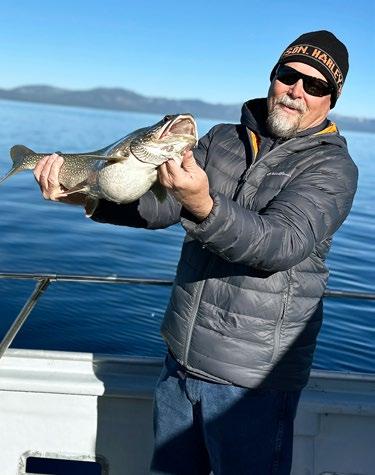
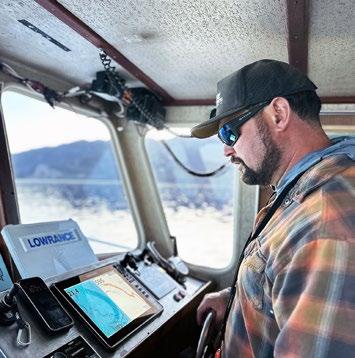
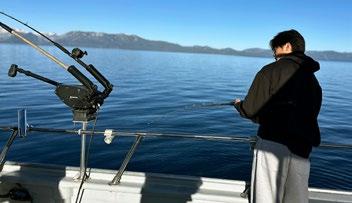
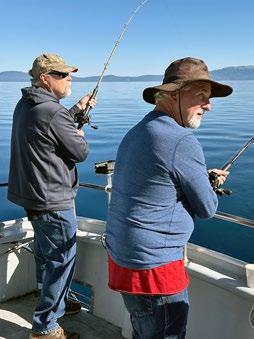
This month we go out on the Prophet with Captain Zach Gordon as he guides visitors in plumbing the depths of Tahoe and becoming authors of their own fish tales.
Holmes final bell Trish I've got questions a look inside
Photo Kathryn Reed Dinner!
Serving Lake Tahoe’s South Shore Since 1994
Photo Kathryn Reed
BODIES LOVE PILATES!
In 1976, to celebrate the United States bicentennial, my parents took me on a cross-country road trip to Washington, D.C. We stopped at various historical spots along the way and once we reached our nation’s capital, checked all the items off our list in terms of sightseeing and immersing ourselves in the country’s history and foundations. We went to the Lincoln Memorial, toured the White House, visited Colonial Williamsburg and lots of other things I don’t fully recall 50 years later. The one image that is seared in my mind is touring the US Mint and watching sheets and sheets of currency roll off the press. And who can forget Arthur Fiedler conducting the Boston Pops in rousing national concert of patriotic music?
This year’s national celebration did not have the same energy and excitement to me. Our leaders seem to be sniping at each other, trying to pull the country in different directions and there seems to be no unity around the idea of America. The Great American State Fair held on the Washington Mall was an inspired idea, but the ex-
ecution seemed lackluster and most of the musical acts pulled out because they felt the event was too politicized in some ways.
Communities around the country galvanized to host local celebrations that captured the spirit of this milestone, including our own South Lake Tahoe Independence Day Parade in which the city council — split on various issues — rode together on one float, showing how it’s done. I often skip our fireworks show due to the crowds and craziness, but decided to go out this year and found a not-too-crowded stretch of shore — I’m not saying where —from which to cap off what turned out to be a quietly meaningful day.
As well as our nation’s birthday, July also marks 32 years in business for the Mountain News, still young by historical standards but an achievement I think we can be proud of.
This month, Gary looks back on adventures with his dog — excursions that are no longer possible due to age, infirmity and some serious medical issues. His col-
umn had special resonance to me as we had to put down the family dog just prior to our deadline. Choco, a chocolate lab we adopted as a puppy, was 14 years old and he, too, tagged along on backcountry skiing expeditions, hikes, mountain bike rides and trips to the water. For most of his life he retained a puppy’s youthful energy. He always strained on the leash when walking, racing ahead to smell the next thing, greet other dogs and people and pick up random sticks. It was never a leisurely stroll. More recently he developed mobility issues — a real shame given his enthusiasm for bounding through life — and slowly seemed to waste away both mentally and physically and lost life’s light, until it became clear it was time to go. Wherever he is, I hope he has joined the Mountain News’ original dog, Scoop, and they are enjoying a life as partners in canine crime.
The Legacy of Mrs. Holmes
The Haase family’s Lake Tahoe story began in 1962 when Karin’s parents (Carol and Gary) moved from Berkeley to South Lake Tahoe after her dad accepted a job as a pharmacist for Shelley’s Drugs in Bijou.
The young couple and their first child (Mara) settled into mountain life in the unincorporated South Shore with a yearround population of 12,000. Karin was the number two child in a lineup that eventually included five kids. This was a household where having an athletic A-game was required for survival. Being competitive doesn’t begin to describe this family’s guiding principles. They are the kind of people who can turn an Easter egg hunt into a high-stakes Olympic-level competition. They are good sports, but winning is always the goal.
By eighth grade Karin was already showing signs of exceptional athletic ability. She set the Bijou Elementary School record for pull-ups (16), a mark that may still stand today.
In high school, she earned varsity letters in three sports all four years (XC skiing, XC running and track — she was a five-minute miler). This puts her in the
rarefied company of less than one percent of all high school athletes. So yes, she was a rock star.
Fresh out of UC Davis in 1988 with a degree in physical education, she considered a career as a physical therapist. Instead, a teaching opportunity changed her life. No one could have predicted then just how many lives that decision would ultimately change.
She is reluctant to talk about herself and her storied career as an educator, coach and principal. She is more comfortable talking about the accomplishments of others, which is one of the reasons she is loved and respected by so many. How she saved the Olympic track at the middle school is an example of how Karin views
the world. She believes anything is possible, even when everyone else thinks something is impossible. When students were getting hurt on the deteriorating track, she knew something had to be done. Someone needed to fix the track. She became that someone. Years of fundraising and planning eventually brought generous community members, the school district, and local businesses together to make this million-dollar restoration project a reality. It happened because Karin Holmes refused to believe the project was impossible. Some of her other accomplishments have also been game changers: convincing the school district to continue funding athletic and music programs at the middle school, developing an innovative math program at Sierra House, and coaching championship XC and track teams. There had never been a school that swept all four team titles at the Tah-Neva League Cross Country Championships until 2006 when Karin brought her mighty team to Carson City’s Centennial Park and won it all. She has made it her mission to transform others into the best version of themselves. She thrives on the victories of others. She has received numerous awards and trophies over her career, but her own victories are not part of her scorecard. Her playbook is simple: Be kind, no whining, and get the job done.
she endeavors to do a no-fail mission. Karin’s 37-year career as an educator, coach and then as a principal has been a master class in achievement, tenacity, and the belief that anything is possible. Her successes cannot be measured by awards or titles alone, but by the confidence she built in children, the careers she nurtured in
Guided Hikes
teachers, the schools she strengthened, and the countless lives forever changed because she chose to be a mentor.
The fabric of a community comes from people who can connect with others, inspire action, and create a feeling of family. Karin Holmes is one of those exceptional people who understands the human connection and makes us all feel part of something bigger than ourselves. She is a coach, a teacher, a mother, an athlete (though not a golfer like her husband Chris) and devoted member of the Tahoe community. If you went to South Tahoe Middle School or Sierra House Elementary or ran cross country, you know Mrs. Holmes. You know about her commitment to healthier kids who love the outdoors, the “Figure 8,” the “sixth grade Olympics,” the track restoration project, the Legends Run, the cross-country championships and her ice cream parties. As a young teacher, she set out to change the world. She was and still is a force of nature. She considers everything
“Does it still make sense to ban new drive-throughs in the basin?”
Curious local
Her influence will continue with every student who dares to think bigger and every teacher who leads with confidence and compassion. Among her many accomplishments, her ability to help others find their superpower is her most enduring quality. Helping and then watching others soar is her legacy.
LIFE AFTER SCHOOL
Now retired from LTUSD, her second act is still ahead. She has a Saturday night music gig playing piano at St. Theresa’s, teaches confirmation classes, stays involved with community foundations and works at her daughter’s law firm (HolmesChristian LLP). There is also a Lego construction project underway in her living room, helping son Isaiah navigate middle and high school, and family and friends to entertain at her famous backyard parties. Life is good!
“Yes” is the short answer to the question above, according to the Tahoe Regional Planning Agency, which instituted the regulation via the 1987
reduction goals of California and Nevada. The new threshold category includes a single standard — vehicle miles traveled per capita, which was in attainment during
Regional Plan as a way to improve air quality in the basin.
“The policy was part of broader strategies to reduce direct sources of air pollution, engine idling, inefficient wood stoves, construction activities, and other particulate-producing uses,” said Jeff Cowen, TRPA spokesperson.
The bi-state regulatory agency does not have a list of drive-throughs either in operation or existing in structures not being used like the old Wells Fargo bank site in Stateline.
It’s hard to know the impact the drivethrough policy has because monitoring is not that detailed. Air quality testing is done in a broader sense.
“The most recent environmental threshold evaluation report showed 11 out of 13 air quality standards are in attainment. Regional visibility fell out of attainment during the reporting period (2020-23) due to heavy wildfires,” Cowen said.
“TRPA adopted the Transportation and Sustainable Communities threshold category in 2021 to improve strategies to reduce reliance on the automobile, and to improve mobility options and support attainment of greenhouse gas emission
the reporting period. Numerous policies and programs, as well as spillover benefits such as cleaner cars, combine to achieve those kinds of results. Sometimes big outliers like wildfire smoke can show up in a four-year environmental report, while incremental improvements and holding a baseline are part of the long-term trend.”
TRPA and others would like the basin to practically be car-free, but public transit doesn’t function well enough — especially on the South Shore — for that to be a reality. Electeds and others are working to ban personal vehicles in the Emerald Bay area, though the U.S. Forest Service has not joined that chorus.
While the local powers that be work on air quality issues, it’s still the policy in both states that residents of the Lake Tahoe Basin only have to smog check their vehicles at a change of ownership. TRPA has no say in this arena.
The whole purpose of smog checks is to keep the air clean, which dovetails into all the health and environmental reasons clean air is important. However, the population in the basin is such that the smog mandate is not a factor, according to the states.
Back to drive-throughs.
Asked if the Governing Board or staff would reconsider revoking the policy in light of automobiles being more emissions friendly, including the proliferation of electric vehicles, and some automatically turning off instead of idling, the answer was essentially “no.”
“Regional and statewide goals call for the continued reduction of greenhouse gas emissions. More efficient and zero-emission vehicles help reduce greenhouse gas emissions, but reliance on the automobile has impacts beyond tailpipe emissions and the impacts of car use on water quality continue,” Cowen said. “TRPA land-use policies also seek to create more walkable and bikeable communities, improve mobility options, and reduce traffic congestion. The 2003 TRPA staff report was clear that new drive-up windows would be taking a step backward.”
Drive-through bans also help with lake clarity — which is one of TRPA’s main reasons for existing.
“Maintaining and improving air quality protects quality of life for residents and visitors, maintains clear vistas, and reduces pollutants that can impact the clarity of the lake through entrained dust and atmospheric pollutants such as nitrogen, which can help algae grow when it settles out of the air and into the lake,” Cowen said.
TRPA isn’t closing drive-throughs; it’s just not allowing new ones to be built.
“A drive-up window is an existing, non-conforming use, which cannot be reestablished if the use is discontinued for two years or more. The use also cannot be continued if the building where it is located is physically altered in a way that removes the drive-up window, such as a structural remodel or teardown/rebuild,” Cowen elaborated.
While some might take issue with whether the data cited from 1987 (39 years ago) and 2003 (23 years ago) is still relevant, the feds say drive-throughs are bad.
“Idling for more than 10 seconds uses more fuel than stopping and restarting your engine does,” the U.S. Department of Energy reported earlier this year. “Idling reduces your vehicle’s fuel economy, costs you money and decreases air quality.”
The agency recommends people turn off their engine — weather permitting — if a drive-through line is long.
The Department of Energy also advocates for idle-free zones at schools: “It’s especially important for caregivers waiting to pick up schoolchildren to minimize idling because vehicle emissions are more concentrated near the ground where children breathe. Poor air quality can contribute to asthma and other ailments, and children’s lungs are more susceptible to damage than adults’ lungs are.”
t GOT A
QUESTION?
Email: mountainnews2@gmail.com Mail: P.O. Box 8974, South Lake Tahoe, CA 95618.
Rules allow a drive-through to continue operating when a business closes if the subsequent operations are similar. So, the old Jack-in-the-Box drive-through in South Lake Tahoe can operate again when the site becomes Starbucks. However, if that location were to be converted to something other than food and beverage, like a bank, the drive-through would have to be abandoned.
Photo Kathryn Reed
Starbucks is allowed to keep the drive-through at the former Jack-in-the-Box location in South Lake Tahoe.
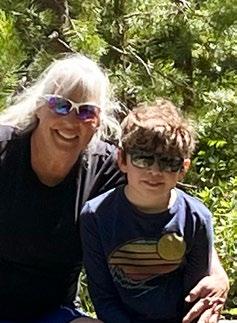
Photo Provided Karin Holmes and son Isaiah.
On the poop patrol
Going to the bathroom is one of the most private activities, but what people flush away may not be as private as people think and contains all sorts of information about us and our communities from illness to drug use and manufacturing and other potentially illegal activity. Recent reporting in the New York Times revealed that more and more jurisdictions around the country are testing raw sewage and using it to inform law enforcement and public health activities.
A 2024 study in and around Las Vegas by a consortium of wastewater treatment organizations, scientists and medical personnel tracked drug use in the city and discovered a 200 percent increase in meth and heroin consumption since 2010 and a “stark increase” in fentanyl consumption beginning in 2022. Also, drugs in Las Vegas wastewater systems spike during events like the Super Bowl or the EDC music festival, in which presence of ecstasy in the wastewater is significantly increased.
By testing samples at different
collection points in Las Vegas, trends in drug use can be narrowed down by neighborhood or time period and can guide public health responses — such as issuing targeted advisories, beefing up treatment and education, increasing the availability of overdose supplies in a certain area or allowing medical providers to be prepared. So far, this type of information has not been used in specific criminal investigations, though it has been used to identify overall patterns in illegal drug activity.
Douglas County District Attorney Mark Jackson told the Mountain News that wastewater testing has never been a part of any case brought by his office. Since wastewater commingles in shared pipes, tying a test result to any particular person or location would be difficult, he said. Testing the wastewater in a secondary pipe that serves only a few houses could help narrow down a search for illegal activity but would not be enough on its own to bring a case or secure a conviction, he said. The Douglas County Sheriff’s Department said it, likewise, has never
used wastewater testing as an investigative tool, though Undersheriff Ron Elges called the concept “interesting.” Lt. Scott Crivelli with the South Lake Tahoe Police Department said wastewater testing in not in its investigatory toolbox. The El Dorado County Sheriff’s Office and the El Dorado County District Attorney did not respond to Mountain News questions regarding wastewater testing.
South Tahoe Public Utility District Spokesperson Shelly Thomsen said her agency has never been asked to collect or test wastewater for law enforcement purposes. STPUD does, however, test two raw sewage samples per week for various bacteria and viruses from the flu to SARS to mpox and others. This program was initiated during the COVID pandemic to trace and predict COVID outbreaks. The
data collected is shared with the El Dorado County Public Health Department, said Thomsen. County public health officials were not available to provide information and examples about how it utilizes this knowledge.
Some privacy advocates have raised concerns about wastewater testing as samples also contain highly identifiable individual material such as DNA. Agencies engaging in the practice are relying on the theory that it is parallel to trash. Settled law has determined that the trash we throw away is not private once we put it out on the curb and it is collected and by extension, the wastewater in a municipal system falls into this same category, though the issue hasn’t been tested in a court of law as of yet.
The other ones
Publisher’s note: This is one in a series of stories written about immigration issues on the South Shore.
You’re on the playground. A group of kids starts looking at you as if you have two heads. Or like you have your fly down. Or maybe something way worse. You wipe at your nose to be sure no boogers. You check your fly. You look behind you, hoping they are actually looking at someone else.
Nope. They are looking at you. And they clearly have no respect for you.
Now, if you are a girl like me, you start to wonder, “Do they think I’m ugly, dumb or weak?”
Whomever you are, you start feeling the stereotypes come down. Whatever group you fall in, you are reduced to that. You start to doubt yourself. “Maybe I am dumb and weak.” Fear takes over.
And then one kid comes over and says exactly what you were afraid of: “You throw like a weakling girl!” Or, “You are so bossy.” Or, “Dumb girls aren’t allowed here.” The others join in. You know where this goes. And it can go really, really far.
We all know some version of this situation. Sometimes we
to a rigid division of "us" (the in-group) versus "them" (the outgroup).
Othering doesn’t happen overnight. It relies on specific social and psychological mechanisms to get people to override their otherwise natural tendency toward compassion and empathy. One of these mechanisms is essentializing. This is when people reduce an entire group of people to a single, negative characteristic. For example, “they are all dumb,” “all lazy,” or "all untrustworthy.”
The next mechanism is dehumanizing. Here people portray the out-group as less than human, which makes it easier to deny them basic rights or empathy. Once there are enough people who have bought into the negative characteristic, then
othering abound. European powers justified colonizing other nations by othering indigenous peoples to justify mistreating them and taking land or resources. More recently, political rhetoric has framed immigrants not as individuals fleeing hardship or seeking opportunity, but as a threat to national identity, and thereby establishing rigid divisions to justify brutal and overblown treatment.
Sometimes othering is subtle, too. I bet you can think of an example from your life.
The funny thing about othering is that it is totally inaccurate. Any social scientist will
Othering is a process where a dominant group views or treats another group of people as fundamentally different and inferior to themselves. Instead of seeing people as unique individuals, othering reduces them to a set of negative stereotypes.
are the one being stereotyped and bullied. Sometimes we fall into the stereotyping and bullying. Either way, it is a thing. It’s called “othering.”
Othering is a process where a dominant group views or treats another group of people as fundamentally different and inferior to themselves. Instead of seeing people as unique individuals, othering reduces them to a set of negative stereotypes. It shifts the dynamic from the complexity of unique human beings that we really are
the in-group can start using or abusing the out-group without accountability.
A third mechanism is the us vs. them binary. Once a group has created a strict divide where "us" represents good and normal, then the "them" can represent bad or strange. This dynamic keeps people afraid. If you are in the in-group, you are afraid to lose your standing with others. If you are in the out-group, you are afraid to draw out more abuse and therefore you stay silent.
Historical examples of
tell you that every person is unique and every group is diverse, representing the huge range within every human characteristic — from intelligence to height, personality to physical strength, talents to preferences. We are each unique in all the world.
Interestingly, scientists also
remind us that we human beings have a lot in common. We share over 99 percent of the same DNA, have the same basic needs, and are primarily made of water. We all need food, shelter and safety to survive, and love, respect and belonging to thrive.
So why would we ever participate in othering?
To answer, we must face even more tough questions. First, ask yourself when you have experienced othering. Also, when have you participated in othering? You can always be honest in the quiet of your own mind.
Next, aim some compassion at yourself. Love up your broken heart from that day on the playground. Or the high school bathroom. Or the breakroom at work. Understand you are not the only one who has experienced othering. Acknowledge how much it hurts and degrades people. Finally, fess up to your own othering. We all do it. Really. When did you see someone getting treated as “other” and stand by silently? When did you join in because you were afraid to lose your place in the in group? Remember to have some compassion for yourself, but be willing to aim for greater compassion and truth. If we are aware of othering, we can make a difference. We can speak up and remind people of our common humanity. We can remind people that all people are worthy of care and compassion. Together, we can create a culture where othering is uncool, and respect for our common humanity is the name of the game.
Annie Davidson is a South Lake Tahoe resident.
Photo STPUD
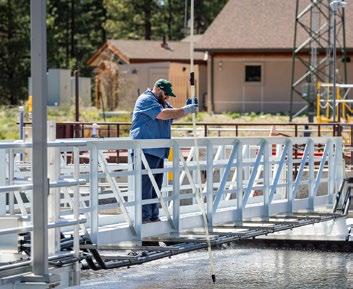
STPUD tests its wastewater to identify and track outbreaks of various diseases.
by Todd Borg
STPUD increasing its water supply
South Tahoe Public Utility District is in the early stages of a multi-year, multimillion-dollar project to bring water
to be 16 inches in diameter. The old well will be filled and sealed.
The first phase begins this summer, which includes drilling the holes, installing well casings and conducting pumping tests to determine the size of the well. Bids for the drilling portion of the well project went out in June, with estimates at about $2.2 million for that part of the work.
A test well was drilled there last summer. Estimates are it will pump at least 800 gallons per minute but could be as much as 2,000 gallons/minute.
STPUD relies solely on groundwater, while some districts in the basin—mostly in Nevada—use lake water.
capacity up to state regulations.
“California water code says we have to meet our maximum daily demand with our biggest well offline,” said Mark Seelos, STPUD’s water resources manager. That means full operation on July 4 with that well not operating. “Currently, we are short about 1,000 gallons per minute in the main pressure zone.”
To come into compliance, the district is building two wells—one a replacement, the other an addition.
When the wells come online, targeted for 2028, this will give the district 12 active wells and two emergency standby wells.
All of this work is for consumption— not fire suppression. South Tahoe PUD bolsters its fire capabilities by upsizing tanks and water lines and putting in boosters and hydrants.
Next year brings engineering designs for both locations, well house design, deciding on the pump and electrical gear.
The Sunset well, behind the Hangar brewery, will be drilled about 50 feet from the one that’s online. It will be about 500 feet deep, similar to the current one. The existing well pumps about 600 gallons per minute, while the new is estimated to pump up to 2,000 gallons per minute.
“Three years ago, we began a well asset management program. We have wells that range in age from 20 years to over 50 years,” Seelos explained. “Sunset was next in line for rehabilitation, but when we did the inspection on the site the condition was so poor it was basically a teardown with the well house, the piping and things like that.”
That well was drilled in 1992 with a 10-inch diameter. The new one is projected
The well houses are estimated to be $2 million to $3 million each. They should be constructed in 2028, with the well tied into the system that year.
The Tanglewood site is expected to incur more costs because the 1960s-era 6-inch water line will likely need to be upsized to accommodate the capacity to tie into the system along Lake Tahoe Boulevard. Sunset’s water line was upsized in 2014.
The well on Tanglewood Drive will be on property the district has owned since the early 1990s.
“The purpose for Tanglewood is twofold. It corrects the capacity deficit and secondly, as a lot of older wells are aging out, we are getting ahead of the curve there and ahead of asset replacement,” Seelos said.
“Our pumping has really had no effect on aquifer storage. Our groundwater supply is stable year to year. We have a relatively small groundwater basin compared to the watershed area,” Seelos said. “Even in a low snow year we get a nice top-off to the groundwater level.”
The district also deliberately stays away from drilling near the PCE (tetrachloroethylene) plume at the Y. STPUD had contaminated wells there that were capped years ago. In the past, the district has supplied
water to Lukins
and
water districts when their wells had issues or water was not drinkable. The interties still exist as does the one with
Park
As has always been the case, contamination is the No. 1 threat to the water supply. Arsenic is a naturally occurring contaminate, for which public districts regularly test.
Brothers
Tahoe Keys
Lakeside
Water System at the state line.
Mark Seelos
Photo Kimberly Miles/BESST
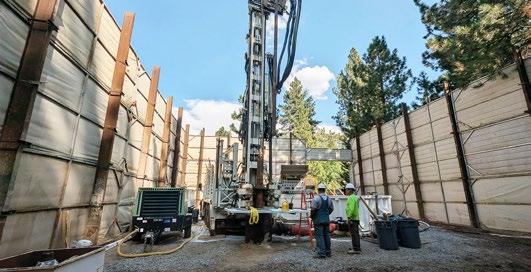
Crews in 2025 use a rotating drill bit to bore deep into the ground on Tanglewood Drive to determine if this is a good well site.
Al Tahoe Firewise is holding a document shredding fundraiser on August 8 from 10am to 2pm at the American Legion parking lot. Suggested donation $10 to $15 per box or bag. On that same day and time, the organization is also hosting a yard clean-up and barbeque. Gather next to Fire Station #2 to meet and mingle and obtain supplies.
The Father Grace Memorial Golf Tournament, to be held September 3, is seeking sponsors and raffle prizes. To donate or register to participate, visit tahoecatholic.com/golf2026.
When Jeff DeFranco leaves the presidency of Lake Tahoe Community College in August, Vice President of Administrative Services Russi Egan will take the helm on an interim basis until the board hires a permanent replacement.
LTCC’s Intensive Spanish Summer Institute returns July 27-31.
Tahoe Paradise Park is this year’s location for the Valhalla Ren Faire, which runs Aug. 15-16.
A study by luxury travel advisors The Resorts Collection ranked Lake Tahoe — California and Nevada — as the 43rd most popular domestic vacation destination based on Google searches. Key West, Fla., was No. 1.
The California Tahoe Conservancy has allocated $10 million for improvements at Van Sickle Bi-State Park, which includes: a 0.4-mile paved shared-use trail; a park entrance plaza; two picnic areas; a state line monument; stormwater improvements; and other accessibility improvements. The Greenway connector, which is the northernmost section of the Memorial Greenway, will be a 0.35-mile shared-use trail connect-
ing Van Sickle to a nearby neighborhood.
Charcoal and wood fires are prohibited in all California State Parks’ day-use areas in the Tahoe area. This includes Emerald Bay, D.L. Bliss, Sugar Pine Point and Donner Memorial state parks, and Kings Beach and Tahoe state recreation areas.
Propane or gas grills are welcome.
CPA Weldon Wulstein who had offices in South Lake Tahoe and Gardnerville, and three non-locals have been found guilty of preparing hundreds of false tax returns for clients who purchased a tax shelter. Wulstein could be calling federal prison home for years to come.
Former South Lake Tahoe resident Daniel Chartraw was found guilty on federal charges involving fraudulent cryptocurrency companies, sham business ventures, and false investment guarantees that caused substantial financial losses to numerous victims across the country. Chartraw, who is scheduled to be sentenced in September, faces a maximum statutory penalty of 20 years in prison and a $250,000 fine for each count.
Tahoe Douglas and South Lake Tahoe Rotary clubs combined efforts on the Helping Hands project to distribute moisturizing hand cleanser to those in need. Nonprofits wanting to distribute the product to needy clients may contact Conrad Buedel at conradbuedel@gmail.com or (775) 9010891.
Twelve local organizations shared $35,000 in grants from Soroptimist International of South Lake Tahoe
Time to comment on the U.S. Forest Service’s proposed national directive for managing recreational climbing opportunities on national forests and grasslands,
including giving input on the use and maintenance of fixed anchors and equipment. Read the proposed policy and comment here: https://shorturl.at/yuIsr.
The newest members of the Lahontan Water Quality Control Board — Courtney Henderson of Truckee and Edwin Alonzo of Victorville — were appointed by Gov. Gavin Newsom.
During Clean Tahoe’s annual Dump Day people unloaded 416,674 pounds of debris; 85 refrigerators were decommissioned; 162 TVs and monitors, 50,382 pounds of metal, 329 tires and 99 mattresses were recycled; and 3,000 pounds of paper were shredded.
Local artists, makers, and businesses are invited to submit stories and events to Becky at editor@tahoeculture.com for her Tahoe Mountain Culture website.
The South Lake Tahoe Police Department is beefing up publicity and enforcement of the city’s prohibition on alcohol consumption and open containers on city beaches.
Scout Troop 594 is open to ages 10 to 18 and offers various outdoor activities while building skills, developing leadership and contributing to the community. Simply put, they do cool stuff. Email SLTScoutTroop594@gmail.com for more info.
Local historians Dave and Gayle Woodruff will recount vacations and family lore at Lakeview Commons on July 21 at 6:30pm as part of the Tahoe History Talks series. This humorous, reflective program will link to the larger shared American past. So far this summer, six illegal boat launches attempting to access Lake Tahoe with tampered inspection stickers were intercepted and blocked by various boat ramp
and marina personnel around the lake, one resulting in a $5,000 fine. The purpose of the inspection program is to prevent aquatic invasive species from entering the lake.
The Tahoe Art League Studio Tour takes place July 31-August 22 featuring 38 local artists. Every third Thursday, the organization hosts a community mingle featuring a local artist, hands on creativity sessions are held every Monday and the summer show is currently on display. Visit TALart.org for more information.
Spanish Literature Professor Dr. John Rosenberg will speak at Lake Tahoe Community College on July 28 at 6pm regarding northern Spain’s Camino de Santiago, a celebrated pilgrimage route described as a living tapestry of European history and culture. The lecture will be in English.
Look for an upcoming Friends of the Library community celebration of the passage of Measure B. The organization is also hosting a book sale at the South Lake Tahoe Library on July 18 from 10am to 3pm.
More than $359,000 in scholarships were awarded to 133 Lake Tahoe Community College students and graduates at the annual scholarship luncheon last month.
The Tahoe Plant Book update is underway and volunteer citizen science data is needed to document and identify the location and prevalence of various species. Visit https://sites.google.com/view/tahoeplant-book/home for information on how to participate.
Got a community item for Heard? Email mountainnews2@gmail.com, subject line “Heard.”
Global warming driving travel to Tahoe
“As far as having microbreweries on the bus, no, we’re not going down that road,” said Jim Marino, executive director of the Tahoe Transportation District. He was responding to a Mountain News query about how to make public transit more fun. According to UC Davis Professor of Transportation Susan Handy at
Handy gave examples of the fun factor in other locales from Crested Butte’s repurposed, mural-clad school buses to the British double decker buses used in Davis to Boulder, Colorado naming its bus lines Hop, Skip and Jump rather than using numbers.
a late June Tahoe Environmental Research Center presentation, the four “F”s of successful public transit are that it be fast, free, frequent and fun. While transit around the basin has focused on the first three, the “fun” element has not been emphasized as much. “There is a stigma around using public transit in this country. How do we make transit cool?” asked Handy.
The South Shore used to have the Nifty Fifty Trolley many years ago, but those vehicles are now old, dilapidated and unusable, said Marino. What TTD is focused most on is making public transit “more accessible and dropping the barriers,” said Marino. He mentioned the new phone app developed by TTD which allows people to determine how to get from one place to another in Tahoe on public transit and to track a bus’s location and arrival in real time. He also said TTD is making an effort to publicize that people can use public transit to get to various outdoor recreation spots, not just ride around town.
Carol Chaplin, executive director of the Lake Tahoe Visitor’s Authority, says her agency tries to promote the use of public transportation as a viable travel alternative and contributes some funding, but is not involved in its actual
operation or implementation.
“Anecdotally, we always hear
pollution
of
how friendly and informative the drivers are, so that’s something they definitely help with —
Regional Planning Agency spokesman, “The fun in transit is in making transit easy and enjoyable as an alternative to driving. The vision is for transit to be seamlessly integrated into the overall transportation network. When it’s easy to use and riders don’t need to worry about parking and traffic, they can enjoy their day and their destination more.”
Transit needs to take center stage in Tahoe, said Handy, due to global warming. As temperatures rise, more and more people are heading for Tahoe to cool off.
This has implications not just for tailpipe emissions, which put more greenhouse gases in the atmosphere, but also for congestion, bike and pedestrian safety, human health, overall visitor experience, protection of wildlife, noise and water
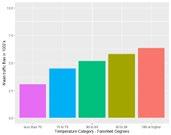
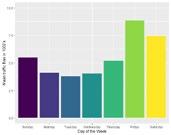
or other natural disasters, Handy said, and improving and increasing transit in Tahoe is the most politically viable and logistically convenient way to cut down on travel by private car. Handy and the co-authors of the study she presented — Escaping the heat: Climate change and visitation to the Lake Tahoe region — derived figures for 2018, the most recent year for which data was available and focused most particularly on traffic coming over Echo Summit. In the summer, for every day in which the average temperature in Sacramento is ten degrees above normal, an average of 660 additional cars arrive over Echo Summit, resulting in an increase of 17,259 vehicle miles
driver culture.”
Said Jeff Cowen, the Tahoe
Photo Provided
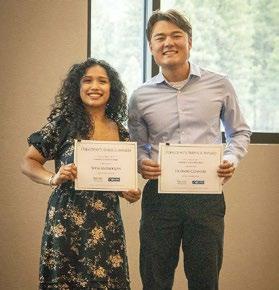
Sofia Marroquin and Hudson Conners were presented with the President's Service Award at the LTCC scholarship luncheon.
Photo Mountain News file photo
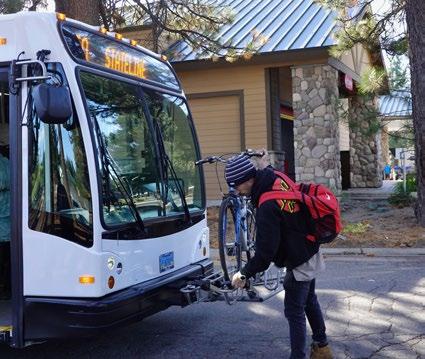
Bikes and buses are two ways to cut down on cars in the Lake Tahoe Basin.
Graphic Courtesy Susan Handy
Dr. Susan Handy
Too frequent a thing lately . . . but I wanted to express my sorrow and condolences to all those who knew and loved “Coach Jerry” Erickson. May the angels embrace you and all those we’ve lost.
Trail Time: Part 2
I left off talking about Angora Ridge, so let’s move over toward Echo Summit for the next two trails.
I would recommend the obvious Echo Lakes trail but not for biking. It’s heavily traveled, but 100 percent of it is beautiful. Right down by the chalet, you can often find a parking spot because they
Happy trails
have a two-hour limit. And you can easily do a good scamper and back within that time; besides, I don’t know if anyone really enforces it (shhhhhh!). Also, if you go off trail right above the spillway, you can scoot up above the snow cannons and have some nice views of the South Shore and Lake Tahoe.
Hopping across Highway 50 at Echo Summit, an old favorite is the PCT out toward Meiss Meadow — especially if you’re trying to avoid bikes. At one time, the handful of parking spots outside of the Adventure Mountain gate were self-pay to the “Iron Ranger,” but they are now free — although the Iron Ranger is still there.
Maybe you could drop a nice note of appreciation for the free parking. This trail is amazing for the varied ferns and other flora, the junipers, the rocks and more. It’s good for hiking and trail scampering. Out to Christmas Valley from there, an even older favorite of mine is the Upper Truckee River trail up to Elbert Lake. Well, it is a trail, but only for about three-quarters of a mile; from there, you get to go “adventuring” and find your way, which is its own kind of fun. If you’re looking for solitude, you will find it up there.
Moving up Highway 89 a bit, you have the whole Big Meadows trail system, including Round and Dardanelles (which you can also access from the Christmas Valley trail on the highway side of the river). Round Lake and Dardanelles are each about three to four miles out, maybe 1,200-1,300 feet elevation gain.
Round Lake trail is known for its unique volcanic geology and the lake serves as the headwaters for the Upper Truckee. To me, it’s a must-do. A less-traveled trail is the turnoff to Scotts Lake with less elevation but a fun ride back down.
We need to take a brief detour out of the basin to talk about Grass Lake and Hope Valley — a couple amazing gems that we mostly just drive through. In the Grass Lake area, from either side of the bog, you can mostly off-trail scramble up Waterhouse. It is not for those who like to stay on defined trails, but then again, you can tell where you’re heading by just going up, right?
Mostly for mountain bikers, across
No snow melts Vail Resorts’ coffers
Winter came and went in a blink of an eye. For Vail Resorts it was a black eye.
During the third quarter earnings call in June, “challenging” was one of the most used words. Lack of snow translated into fewer people hitting the slopes, which impacted sales of most everything at the company’s properties.
the road is the famous Mr. Toad’s Wild Ride, which ends up down in Meyers and eventually connects to Powerline and all that. But it’s a nice hike all the same and you can get some great lake views up there. At the Hope Valley end of Grass Lake, you can also do a different trail out to the aforementioned Scotts Lake or down into Hope Valley.
So, back on the South Shore, I have to mention High Meadows, accessed either from Pioneer Trail or High Meadows Road trailhead (there are other ways, but you get the idea). Cold Creek running through the meadow up there is worth the journey alone, but from there you can go on up to Star Lake and connect to the TRT. Great for hiking, trail running (if you like uphill) and of course, stellar biking, depending on how you do it, it’s about 3.5 miles up with around 1,400 feet elevation gain. You can walk or ride the unpaved road up the right side or the left side trail.
And this one no big secret, the Van Sickle trail at Stateline is a must. It’s probably the quickest route to the best views on the South Shore and also connects to the TRT where you get amazing views, including east into Nevada — an underrated vista.
I’m probably forgetting some, and I’ll admit, there are a couple I’m leaving out on purpose because . . well, you get the idea. Shoot me an email with your favorite local trails.
As always, mikesmutterings@gmail. com
Locally, Vail Resorts owns Heavenly Mountain Resort, Kirkwood Mountain Resort and Northstar. Vail’s Colorado and Utah properties also suffered from receiving little white stuff.
Officials reported resort revenue for the quarter declining seven percent compared to the previous year, saying it was “primarily driven by unfavorable weather conditions that impacted visitation and revenue for both local and destination guests, particularly at our resorts in the Rockies and in Tahoe.”
Visitation was off 15 percent, though lift revenues were only down five percent, which is attributed to season pass sales increasing three percent before the lifts started turning last November.
“When you look back over 40 years, the prior worst decline in visitation outside
of Covid-related closures for the Rockies was down eight percent in 2012, which illustrates the unprecedented severity of the conditions and the anomaly we just expe-
rienced,” CEO Rob Katz said. Dismal conditions in 2025-26 are also impacting pass sales for the upcoming season. In the earnings call it was not-
ed through May 26, Epic pass sales were down 10 percent for 2026-27.
The Epic pass was introduced in 2008 as a way to reward riders by offering a cheaper alternative to daily lift ticket prices while providing the opportunity to ski/board at any Vail property. For the upcoming season, that pass costs $1,119. The Tahoe Local pass is what people around here tend to buy, which for $699 provides access to Vail’s three resorts in the area.
The $597 Tahoe Value pass comes with more restrictions.
“Looking back over the past several decades, U.S. ski market data indicates that visitation typically fully recovers following a season with poor conditions if the subsequent season has normal conditions,” Katz said. “And we believe we are well positioned to capture that visitation recovery with the pass and lift ticket product and marketing strategies we have developed. That said, given how unprecedented this past season was, it's hard to know with certainty how any of this will play out.”
Photo Kathryn Reed
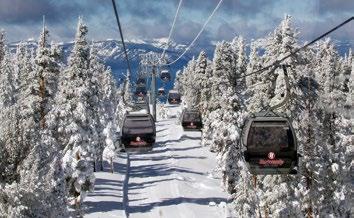
Heavenly Mountain Resort isn’t alone in hoping conditions this coming season look more like this photograph.
It’s a fishy business
Music. It’s what makes a fish bite. Just ask Tyler Chia.
While everyone else had dinner chilling on ice, he didn’t have so much as a nibble.
Then Capt. Zach Gordon asked Chia what tunes he wanted to listen to. The country got eighty-sixed, as it wasn’t
were biting—no Kokanee salmon, no brown or rainbow trout.
Robert Aronsen, who was a resident of South Lake Tahoe at the time, still holds the record—37.6 pounds—for the largest Mackinaw from Lake Tahoe. This was back in 1974.
and Ryan. The Orange County trio are in town while their wife/mom is at a conference. Mike Behrens of Arizona is on his first visit to Tahoe, with catching a Mackinaw a primary goal—which he did more than once. He was celebrating his 47th wedding anniversary. Part of the fun included this fishing expedition
helping anyone. Drake was Chia’s answer and the solution to his fish drought. Within minutes Chia was working two lines. A massive grin filled his boyish face as he stood on deck on this cool June morning with a Mackinaw in each hand.
Fifteen Mackinaw, also known as lake trout, were hauled in that day by the six men aboard Tahoe Sportfishing’s largest boat, the Prophet. Most of these weighed less than six pounds, but still plenty of meat for dinner. Everyone was planning to take their catch to MacDuff’s Pub for the restaurant to prepare three ways—beerbattered, blackened and sautéed.
Lake Tahoe doesn’t have a minimum weight for fish pulled from its water. The main rule is no more than five total per person. It can become catch-and-release if people have more than they can consume.
On this excursion, only Mackinaw
Destination fishing
Mergansers dart in the shallow water, making the only ripple on the glassy waters.
Capt. Gordon keeps the mood light on his vessel that departs from Ski Run Marina at the break of dawn. With how the sun dips behind the various ridges on the East Shore, it is like experiencing multiple sunrises in one morning.
Then the top of Mount Tallac comes out of the dark. Soon it is completely awash in sunlight. Only fishing boats are out at this hour. That changes as the air temperature rises.
Daylight awakens the vocal cords of those onboard. Introductions. Pleasantries.
A few light-hearted jokes. Building camaraderie for what will become a collaborative effort to land fish after fish after fish.
Tommy Chia is with his sons, Tyler
with his childhood buddy Jack Johnson of Wisconsin. Scott Olson traveled from Sonoma. He says he only catches fish on guided trips. All were fishing Lake Tahoe for the first time.
After deckhand Nate Mitchell threaded live red-sided bass minnows onto the hooks and the lines were dispatched to a depth of a couple hundred feet, Gordon surveyed his brood. He pointed to Olson.
“He looks fishy.” That’s a compliment, meaning he’s the one to watch, the one who is going to reel in multiple fish and likely be the one to feed everyone onboard.
Gordon, who has been a captain since 2007, was spot on. Within minutes Olson’s pole arced. He brought in an approximately 2.5-pound Mackinaw.
“When I had him it felt like 10 pounds,” Olson said. “I need to rest my arm.”
Gordon is full of clever quips: “Come on, we put three in the lake last night so there are two left.”
Fish No. 2 went to Olson. He was definitely “fishy” the entire trip.
When lines hit the bottom, Gordon chimed: “We don’t want to catch the plug to the lake and drain the whole thing.”
Hook, line and sinker
Lake Tahoe and its tributaries have been fishing meccas for eons. Fish were a staple of the Washoe Indians who lived at the lake during the summer.
Now recreational fishing charters ply the water year-round, with more than a dozen outfitters working all ends of the lake. Commercial fishing, where the haul is sold off, is not allowed at Lake Tahoe.
South Lake Tahoe government officials were not able to quantify the economic impact of fishing charters, and Lake Tahoe Visitors Authority doesn’t market fishing as an activity. Even so, fishing is big business for those with the boats and poles.
“It’s not like being on the ocean and
FISHING
Continued on page 17
FISHING
Continued from page 16
trying to fill your freezer. It really is about the experience—going on Lake Tahoe, fishing Tahoe, the scenic views, and the
really, really cool experience that not many places in the world are offering.”
Shearer grew up fishing; he almost had to. In 1997, the year before he was born, his dad, John, bought the South Lake Tahoe outfitter from Dean Lockwood.
opportunity to catch fish and eat it that same night,” said Zach Shearer, operations manager with Tahoe Sportfishing. “It’s a
Lockwood opened the business in 1953.
The Prophet, one of the first boats Shearer purchased, was overhauled last
year—with this being the first full season back on Tahoe. The 43-foot Delta has new, quieter engines that are better for the environment.
Tahoe Sportfishing with its six boats has the largest fleet of fishing vessels on Lake Tahoe. All boats are Coast Guard certified. All are also ocean-worthy, which is a good thing considering Lake Tahoe gets plenty rough.
“Lake trout is what we fish for most of the year. They are always moving, doing different things,” Shearer said.
“A big benefit of fishing year-round is consistently knowing where they are because the hot spots always change.”
Captains tap into the Tahoe Environmental Research Center’s website to get information about the currents in the lake. They are forecasted from data collected via buoys in the water. Currents can move 100 feet a minute.
Sonar also helps locate fish along the various shelves.
About 50 percent of Tahoe Sportfishing’s customers are repeat clientele. For others, this is a bucket list item. Still others want a day on the lake. Afternoon charters tend to be more about hanging out than hauling in one’s limit.
While fishing licenses from California and Nevada work for individuals in both states, captains need to be certified by each state if they want to take the boat anywhere on the lake. Gordon is the only captain with Tahoe Sportfishing who has a Nevada captain’s license. Two captains with other outfitters also have a Nevada license.
And it might not just be fish you catch. Gordon joked with one of the guys who had a piece of wood on the line: “Bring it in. It might be the only thing you catch.” Then Gordon offered to take the man’s picture with the wood, which made everyone on board laugh. Fishing really is more than fishing.
Photo Kathryn Reed
Capt. Zach Gordon navigates the fishing boat Prophet toward the Cave Rock area.
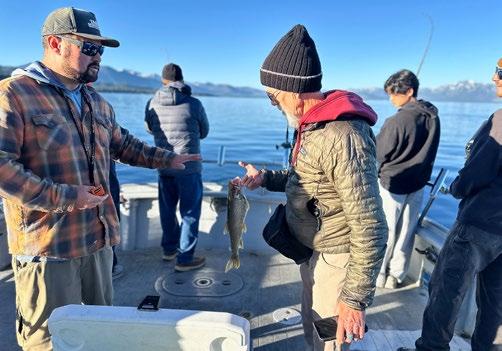
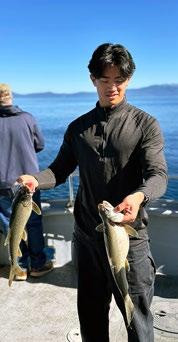
Photo Kathryn Reed Tyler Chia of Southern California shows off his nearly simultaneous haul.
Photo Kathryn Reed
Capt. Zach Gordon, left, congratulates Scott Olson on reeling in the first fish of the day.
Photo Kathryn Reed
Fishing is an activity Mike Behrens, left, and Jack Johnson have been doing together since childhood.
Photo Kathryn Reed
Ryan Chia’s patience pays off with a multi-catch day.
Rewriting a fish tale
If the road to hell really is paved with good intentions, it’s easy to surmise where those who thought it a good idea to introduce nonnative species to Lake Tahoe will end up.
Lahontan cutthroat in the 1930s.
Other native fish at Lake Tahoe include tui chub, Tahoe sucker, mountain whitefish, Lahontan redside shiners and speckled dace.
proposed the reintroduction of the native species to Fallen Leaf Lake in 1999, with the first stocking occurring in 2002.
TROUT
Continued from page 19
sportfishing and to restore the wrongs committed years ago.
Zach Gordon, a boat captain and guide for Tahoe Sportfishing, calls the efforts wasteful and unsuccessful.
Then again, with wildlife biologists and others working feverishly to re-establish Lahontan cutthroat trout (LCT) in the lake, maybe another road is being paved for those who committed the earlier misdeeds.
Mackinaw, also known as lake trout, were first introduced here in the late 1800s.
The USFWS hatchery in the Carson Valley is the main source of LCT that are stocked at Tahoe and other Sierra lakes.
To this day one of the things they dine on are the LCT.
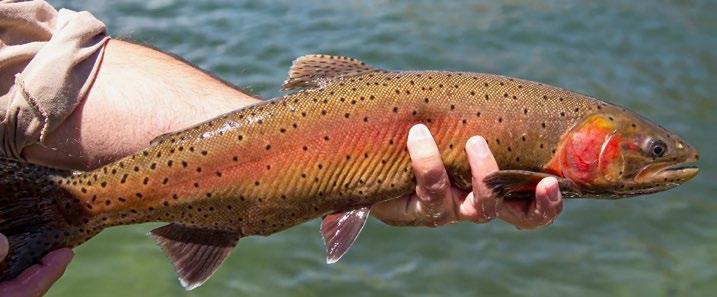
LCT are Tahoe’s only native trout, and they are on the federal engendered species list.
Logging, overfishing, dams and other water diversions along with the introduction of nonnatives led to the demise of the
This century the feds along with both states have been working to bring LCT back to Tahoe and its tributaries, as well as to Echo and Fallen Leaf lakes. Nevada Department of Wildlife since 2022 has stocked Tahoe with 100,000 LCT.
The U.S. Fish & Wildlife Service
“In part we are trying to fix the problem we created,” said Sam Sedillo, NDOW fisheries biologist. The purpose to stock Tahoe, he said, is for sport fishing. The fish are tagged, with the hope people who catch them will report data back to his agency for their research purposes.
“We are not taking rainbow out of tributaries,” Sedillo explained. “What NDOW does with rainbow trout at the structure is we tag them. We will spawn fish onsite, take them to the hatchery, and release them back to Tahoe downstream so they are not moving into the tributary to spawn.”
Cross breeding of rainbow and LCT would eventually lead to the demise of the latter.
Lahontan cutthroat trout is Nevada’s state fish. The largest one to be reeled in— 41 pounds—was in 1925 at Pyramid Lake.
While Sedillo is optimistic about the studies going on at Incline and Third creeks in Incline Village, he said it’s too
Nevada and California’s wildlife departments are the main agencies working on LCT; however, it’s a collaborative effort
Logging, overfishing, dams and other water diversions along with the introduction of nonnatives led to the demise of the Lahontan cutthroat in the 1930s.
soon to know if LCT will be successfully re-established in the basin.
2012 was the first time Lahontan cutthroat reproduced naturally in the Lake Tahoe Basin in more than 70 years.
The goal is to have Third Creek be home to spawning cutthroat without rainbow trout able to make it up the same passage.
that includes the Washoe Tribe, Tahoe Regional Planning Agency, USFWS and Lake Tahoe Basin Management Unit.
“For TRPA, recovering this native species is both a goal of the environmental
TROUT
Continued on page 19
threshold standards for wildlife and a major project of the Lake Tahoe environmental improvement program,” said Jeff Cowen, TRPA spokesperson. “The biggest challenges for the recovery effort include reconnecting habitat by removing fish passage barriers in streams and rivers like bridges and culverts installed during Tahoe’s development. Also, hybridization with rainbow trout which share spawning ground and predation by Mackinaw trout which sometimes feed on their eggs.”
A West Shore project could be good
For years there has been a concern that LCT will decimate the rainbow trout population, which would impact the sport fishing industry.
Common nonnatives in addition to Mackinaw and rainbow trout include brown trout and Kokanee salmon.
Other fish seen and caught in the lake that are obviously not native include goldfish being dumped from personal aquariums. Some have grown to 15 inches
news for the LCT. Caltrans is replacing the bridge at Meeks Bay, which ties into the tribe’s restoration of Meeks Meadow, while the Forest Service is removing the historic marina and making improvements to the creek. A goal is LCT will spawn again in Meeks Creek.
Tens of millions of dollars have and are being spent on getting Lahontan cutthroat trout to call Lake Tahoe and its tributaries home again. It’s all for
long. Largemouth bass, bluegill and crappie are other species the natives have to compete against.
What no one plans to do is remove the nonnative trout and salmon.
“We are not going to permit or go out and haphazardly remove sport fish in the lake for something that isn’t guaranteed,” Sedillo said. “An effort to remove nonnative fish is not worth it any shape or form, and it would not be successful either.”
Photo California Department of Fish and Wildlife
Millions of dollars are being spent on re-establishing Lahontan cutthroat trout in Lake Tahoe and other nearby lakes.
Council plays it close to the vest in city manager search
The key sticking point in hiring a city manager for South Lake Tahoe seems to be agreeing on a salary and compensation package.
Since the application period closed April 2, the city council discussed three times in closed session whom to appoint. In two meetings
since June 16, council members discussed the salary and compensation package. But whether they have chosen a specific candidate remains unclear.
“We’re having trouble reaching agreements with different can-
didates,” Councilmember Keith Roberts told the Mountain News indicating the council is negotiating with more than one person.
Mayor Cody Bass told the Mountain News that at the July 8 closed session meeting he hoped for unanimous agreement among the council about which person to offer the job to and how much to pay that person, along with other contract specifications. The preferred candidate might then come back with a counteroffer. If the process goes smoothly, said Bass, the council could publicly select someone at its first meeting in August.
However, the July 8 meeting ended without the council reporting any action, so it’s hard to know if the council didn’t come to an agreement or if they decided to offer someone the position but are continuing with their more private approach.
Roberts and Bass declined
to provide any more information — including how many people applied or how many made it to the finalist pool or specifics about the process, citing the confidentiality rules of closed session.
The city clerk’s office likewise declined to release information regarding candidates, citing closed session confidentiality and personnel privacy exemptions.
This is all considerably more murky and less transparent than other city manager searches.
In 2010, the city council publicly voted to offer the city manager job to Tony O’Rourke. That announcement was followed by contract negotiations for the position. This time, the process appears to be reversed.
When O’Rourke left two years later, the city council appointed Assistant City Manager Nancy Kerry to the post of interim city manager, then gave her the job permanently a few months lat-
er without going through a search process.
Following Kerry, Frank Rush prevailed over five other finalists to get the job in 2018.
When Joe Irvin, the most recent city manager who departed for Malibu in February was hired, the city hosted a community meet and greet with the four finalists, whose names, background and qualifications were shared prior to the council making its choice.
The city also hosted a community question and answer session with the top five finalists for police chief when Dave Stevenson was chosen in 2020. Stevenson’s successor, Jeff Roberson, was appointed by Irvin without any type of public process.
Bass said keeping the search more private this time was guided by the consultant hired to find a new city manager. A phone call to consultant Bob Murray and Associates, which the city has previous-
ly employed, went unreturned.
Bass also said some applicants don’t want their current employer to know they’re looking for another job.
Irvin’s salary when he left the city was $222,397 annually with periodic cost of living increases built in.
Hilary Roverud, assistant city manager, is interim city manager. How much information, if any, about applicants and finalists for high profile municipal jobs is or should be public is a somewhat gray area. According to the First Amendment Coalition’s website, some courts have said the public is entitled to a lot of information about potential municipal leaders given the authority and power they exercise. Other courts have decided applicants have a right to privacy.
Sunny summer soup
I’m not a big fan of hot soup this time of year. I’m also not a big fan of tomatoes in winter, the time of year when I prefer soup. That is why I make tomato soup in summer.
Ideally, make enough so you can have tomato soup in winter that is full of the flavors of summer. Freezer bags are great for storing soup because they can lie flat, taking up little room. Of course, if you are trying not to use plastic, then glass containers work great.
Every tomato has a little different flavor profile. Use what you grow, or what you find at a farmers’ market. Even in summer I won’t use store bought tomatoes for certain recipes—this being one of them.
How much this recipe makes will depend on whether you ladle the soup into a bowl or a cup. I like to serve this soup in
a cup paired with half of a grilled cheese sandwich. The other half and another cup are for dinner the next night. Any leftover soup gets frozen.
If you don’t want to heat up the house with the oven, roast the tomatoes on the barbecue.
Using butter instead of oil to cook the onions will make it richer; it also means the soup will no longer be vegan—if that matters. Adding a splash of red wine will enhance the flavors as well.
To add a little zip to the soup, consider blending in red pepper flakes or a dash of hot sauce.
I love that the tomatoes, garlic, basil and onion are all available at a farmers’ market. This really is summer in a bowl.
Ingredients
10 medium sized tomatoes
1 large head garlic
1 medium red onion
3 C basil leaves, plus small leaves for garnish
4 C vegetable broth
Olive or avocado oil
Salt and pepper
Directions
Heat oven to 400 degrees.
Slice tomatoes in half. Place on rimmed cookie sheet.
Place individual cloves of garlic (without the papery covering) on top of the tomatoes. Heavily drizzle tomatoes with oil.
Bake tomatoes for at least 40
minutes, or until tomatoes look a little shriveled, juices are filling baking sheet and garlic is browning.
While tomatoes cook, put a tablespoon or two of butter or oil in a pan.
Over low-medium heat, cook the sliced red onion. Stir occasionally. Onions should be translucent and slightly brown.
Remove from heat.
Pour broth into large pot over medium heat. Add onions, basil, garlic and tomatoes—including juices from the pan. Use immersion blender to combine all the ingredients. If using a standing blender, mix ingredients in batches.
Add salt and pepper to your liking.
Bring soup to a simmer. Serve hot.
Garnish with basil leaves.
(And don’t forget to make the grilled cheese sandwich.)
On the restoration trail
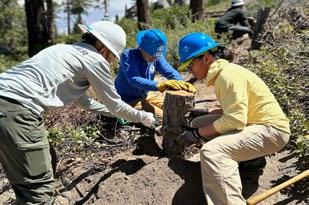
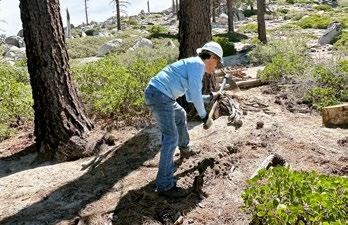
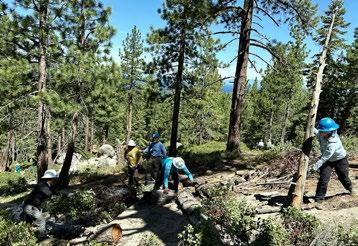
Loppers, picks, shovels, mallets, McLeods, saws, carts and other items dotted the hillside. Instead of this lineup of tools being employed to build something, they were used to decommission 1,300 feet of social trails in Van Sickle Bi-State Park in June.
Finding a shortcut seems ingrained in human behavior. In nature this means
really works.
“I’ve done a lot of landscaping. There is a lot of crossover with this work,” said Andy Rothman, a trail leader.
Other debris from the slash piles were scattered about in a semi-methodical way to look as natural as possible. Only plant material found on-site and hand tools were used.
creating trails in places that weren’t meant to be walked on.
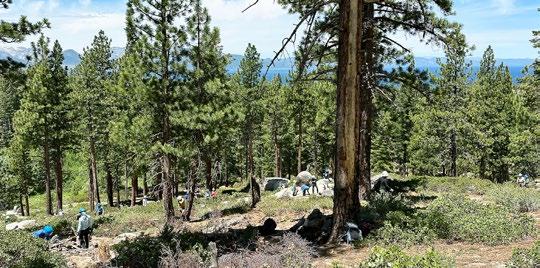
Fifty-five volunteers alongside a slew of Tahoe Rim Trail Association personnel set about creating a landscape that no longer invited people to get off the designated route. After several hours the user-created trails were no longer visible. It went beyond just not being inviting. No evidence of their existence could be seen.
Normally slash piles are disposed of by fire. Not so last month. Nevada State Parks crews left them for the Tahoe Rim Trail folks to use.
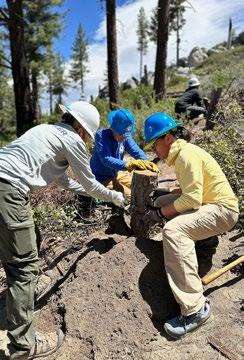
Using picks, shovels and McLeods (a type of cross between a hoe and a rake), holes were dug to “plant” logs like they were mini trees.
“Ice-berging is a more permanent way to decommission switchbacks,” Shea Imgarten, a TRTA trail crew leader, explained. “They can last 20 years. It’s better than throwing logs and needles on the dirt.”
Rocks found by volunteers helped stabilize the planted log, with dirt filling in the hole.
Manzanita—some from the slash piles, some trimmed from plants growing slopeside—were replanted. Not whole bushes, but trimmings. This propagation
These trails were about seven-tenths of a mile in from the main parking lot, in between the initial vista point and the waterfall.
Some worked from the top, others from the bottom. At the end, looking up or down, only those who were there
beforehand would likely be able to know where the work occurred.
In the end, TRTA Executive Director Lindsey Schultz declared this was the best those trails have looked in 20 years.
Land and water
When hikers create their own trails, it can lead to unintended consequences like trampling sensitive habitat and the inevitable destabilization of the ground which creates erosion problems. This in turn can lead to sediment reaching Lake Tahoe.
Sediment is a major reason the lake’s clarity isn’t what it once was. Clarity is worse in the summer compared to winter readings.
The annual Lake Tahoe Clarity Report released in June shows the annual average clarity remains at a plateau.
“In 2025, as in previous years, the seasonal decrease in water clarity appears to be well correlated with the seasonal peak of particles,” the report states. “Given that water clarity has not shown an overall trend toward
improvement in several decades, we suggest that understanding the nature of the particles is a priority area for research
to identify the current drivers of water clarity.”
Why this day?
The American Hiking Society launched National Trails Day in 1993. It is always the first Saturday of June. Organizations across the country put on various events with the goal of getting community members to be trail stewards.
“What is really cool is people will go up there in the next years and won’t know what each of you did today,” Schultz told the group before work started. “But you’ll know. That will be inside of you forever.”
She reflected on her first trail day as a 9-year-old when her dad took her to Mount Rose. “It’s moments like those when you don’t necessarily know the impact you are having on one’s life,” she said.
“You might get a small human in your life to know the importance of conservation,” Schultz said. She was once that child. This was her 15th Trails Day.
Eileen Mosse remembers reading a Sunset magazine article in the 1980s about the Tahoe Rim Trail that led her to declare she would be part of it one day. Now that she lives in the Carson City area most of the year with husband Leon, she is a guide in training. Last year they completed the 165-mile trail in segments.
On this particular Saturday the couple was doing everything asked of them and then some: digging, lifting, hauling, burying, sawing.
For South Lake Tahoe’s Larry Green, this was his 13th Trail Day. He’s a lover of working with rocks—building stairs in particular. The Lake Tahoe Community College math instructor admits he might be the only one out there using math to figure out the best build.
While stair building was not on the agenda this particular day, Green was seen with a variety of tools in his hands and seeming to never take a break.
Of the 750,000 people who use the Tahoe Rim Trail each year, less than two percent give back in terms of financial donations. Grant funding is drying up, making donations all the more imperative. In fact, the Youth Backcountry Program, which serves several Tahoe kids, was facing a $90,000 funding gap going into this summer.
TRTA still needs volunteers to work this summer. Check out the calendar: https://tahoerimtrail.org/events-calendar/.
SMALL BATTERY. BIG DANGER.
Photo Kathryn Reed
Larry Green of South Lake Tahoe has been volunteering on National Trails Day for 13 years
Photo Kathryn Reed
TRTA crew leader Shea Imgarten, right, brings material to help mask a social trail at Van Sickle.
Photo Kathryn Reed
Eileen Mosse, from left, Andy Rothman and Seyil Yoon stabilize a log during the "ice-berging" process of trail decommissioning.
Also at Van Sickle on that first Saturday of June were 28 volunteers with the League to Save Lake Tahoe, who picked up 137 pounds of trash in the park and Stateline area.
Photo Kathryn Reed
Volunteers spread out at Van Sickle Bi-State Park to decommission user-created trails.
Introducing our panel of Tahoe experts
After 54 years spent living in this community, full time, without a break from the opinionated, passionate and feral locals, I’m feeling a responsibility to share — or perhaps warn — visitors coming to Lake Tahoe. Not because I’m a responsible person, but I do have a conscience (though severely eroded by age and Lagunitas IPA) and now believe it’s my duty.
Therefore, I cornered some locals, asked them a few impertinent questions and I’m calling it journalism. Same questions. No coaching. No wrong answers. Well. Almost no wrong answers.
Let’s just call this endeavor my favorite form of volunteering — painless. Can be done while seated. And designed to offer visitors info that is impractical, illusive, and ultimately useless.
Meet your panel, our esteemed Tahoe Mountain News columnists:
Mike Filce: Juvenile delinquent posing as a grown ass man.
Gary Bell: Kid on Perennial Recess.
Hubby: Accidental Philosopher.
Peggy: Slayer of bullshit.
Trish Tomer: Observer and Instigator. What’s the one warning you’d give someone visiting Tahoe for the very first time?
Mike: Don’t drive up on a Friday, don’t leave on a Sunday, and maybe avoid
Stateline. If it’s wintery, have good tires.
Gary: Slow down.
Hubby: Don’t leave your bike unlocked in Stateline.
Peggy: Tahoe is not a theme park. Treat it like a fragile ecosystem.
Trish: If you’re planning to hike Mt. Tallac or the Tahoe Rim Trail, don’t wear new hiking boots or high heels unless they’re really, really cute.
Favorite mode of transportation in July?
Mike: Bike.
Gary: My retro Pro Cruiser.
Hubby: Bicycle and boat.
Peggy: Walking.
Trish: Mental telepathy. Tourists — one word.
Mike: I’m probably a worse one.
Gary: Challenging.
Hubby: Everyone. In life, we’re all tourists. We don’t own this place. Peggy: Abundant.
Trish: Yo! RemoveEarbudsWhenNatureIsTalkingToYou.
Where do locals actually eat in July?
Mike: D-Sky, Steamers, EBC, Classic Cue, Gastro, Jalapenos, Jalisco, Los Mexicanos, Maria’s, airport, etc.
Gary: Gary’s House.
Hubby: Hard boiled eggs in a boat on Fallen Leaf Lake with my Labrador.
Peggy: At home.
Trish: Dos Bitches Cantina at My House. Open 24/7. No shirt. No shoes. No pants. No problem.
What’s something about Tahoe that Google will never tell you?
Mike: That homeowner’s insurance is affordable here.
Gary: Be Nice.
Hubby: How to catch a fish. They’ll tell you. But they’ll be wrong.
Peggy: In the summer, beaches are full by 8am.
Trish: Everything that really matters in Tahoe is un-Google-able.
Where do you go in July to escape the tourists?
Mike: The less-traveled trails and fishing spots.
Gary: Deep in the forest.
Hubby: Only my Labrador knows. And he’s not telling.
Peggy: The places I won’t post on social media.
Trish: I beg Scottie to beam me up.
What’s your survival strategy for July?
Mike: Fishing, hiking, biking. Gary: Stay out of the way. Hubby: Hunker.
Peggy: Shop early and stay home on the weekends.
Trish: Lagunitas IPA, ear plugs and a blindfold.
What would you tell your July self from 20 years ago?
Mike: Keep doin’ what you’re doin’.
Gary: Don’t go to that party.
Hubby: Stop picking up heavy items. Stay off ladders. Get a job with a pension.
Peggy: Protect the places you love.
Trish: If you’re in a traffic jam at Stateline on your way to the beach and wearing a bikini, leaving your car to purchase half-price beer and Bloody Marys from a casino and then reselling them to customers stuck in their cars is not a viable career option.
What’s the one Tahoe experience that never makes it into any guidebook — but should?
Mike: Raking pine needles and cones.
Gary: Meteor showers.
Hubby: Won’t say. It will get in a guidebook.
Peggy: Sitting quietly near the shore experiencing the Lake Effect.
Trish: Mining the secret spots and stories from Tahoe’s quirky, curious, clever locals.
What’s your favorite illegal activity?
Mike: Keeping library books until they’re overdue.
Gary: Only my dog knows that.
Hubby: Peeing on all four corners of my property.
Peggy: Not illegal and not an actual activity: Eating ice cream.
Trish: Selling beer and cocktails to people stuck in a traffic jam at Stateline.
Thank you for getting to know our Tahoe locals. The answers from our crack team of longtime residents are finely curated, factually based, and genuinely unhelpful. And if some find these responses offensive, yet true, my job is done.
P.S. Apologies to Heather, TMN Editor and CEO of Complaints and Diaper Changes.
Dog days of summer
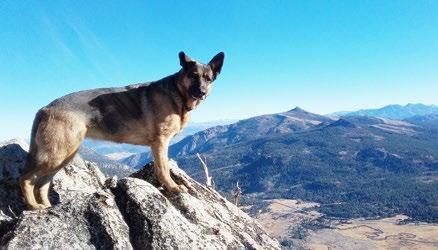
I know this is not the first time I have mentioned this here, but I have no problem saying it again: my favorite person to ski, hike, camp, ride with is my dog! No offense to my wife who is really fun for all of the above, but doggie is always ready to go, never complains and does not care how stupid the adventure might be or how dark it gets before returning home. Water and maybe a snack. Too hot, yeah,
maybe sometimes; too cold, well, really never, and I never have to share my beer at the end of the fun — okay, maybe a little tiny sample.
One difficulty is my dogs have never really been into appreciating a good view. You know, they just kind of sit there going, “Ah, can we go now? Hey,
how about this nice stick? Do you want it? No? How about this one? I’ll bring it over anyway!”
You just want to say, “Wow, look at that awesome canyon down there we just climbed out of.”
“Stick, stick, can we go now?”
“Okay, let’s go — no, not that way. I know there are some chipmunks over there; save it for the trip down!” Always excited and ready to go.
Well, those days have come to an end. She is still with us but has aged out of doing the active, fun stuff. On top of that, she has some serious medical issues, so small walks with the occasional perk-up for a chipmunk running by. It is amazing to me, this stage of our dog’s life. Their bodies are losing capabilities, but their minds are smarter than ever, very intuitive, so communicative; they know what you are doing and what they need to do. They understand . . unlike us humans, for whom the body goes down-
hill and the brain follows right behind!
All this fun and health talk leads us to a visit with our veterinarian, Dr. Powell at Blue Lake Animal Care Center. We really like the crew there; they are wonderful people and good at what they do. Sender, our dog, freaks out at the place: “Are they going to poke needles in me our stick something up my butt?”
“No, not this time; you will be just fine.”
She sits there, shaking, “I don’t believe you!”
Dr. Powell is so good, so knowledgeable, and understanding of a dog’s situation. He also has this very dry, sarcastic humor that is enjoyable and he can whip that out at just the right moments.
He is also an endurance athlete, uh, maniac. At this visit, he was about to head down to do the Escape from Alcatraz swim in the San Francisco Bay.
Naturally the discussion turns to bikes. While we like to ride, he prefers to run. I respond, “Running is what you do when something is chasing you to eat you.”
The Doc asks if we ride ebikes; no, we don’t. Then he says his biggest problem with ebikes is people riding them too hard with their dogs. He explains he has seen a huge rise in injuries like stress fractures and lig-
ament tears. People are going too fast and too far without enough awareness of their dog’s situation. I mentioned that we can confirm this because we live where we can see people going by on a popular local trail. We are always amazed by the number of people on ebikes, some pedaling, but many not even pedaling — just throttling along, not doing anything while their dog is way behind and obviously struggling to keep up. From a fair distance, we can see that these doggies are no longer having a fun run; they are doing everything possible to stay with their lazy, insensitive mom or dad. I am surprised Dr. Powell didn’t mention heart attacks. He did ask if I would mind mentioning this.
Oh, and do dog parents notice the coyotes? We have a good-sized pack of coyotes living in the woods that the trail passes through. There is no doubt the coyotes are sitting just out of view, watching those tired, lagging pups. The dog owner has no idea that their dog is being watched as a possible easy meal since it is tired and separated just enough to be an easy target. It has happened.
Slow down, don’t go so far, and let your dog set the pace. Be mindful.
Connecting Students to Careers
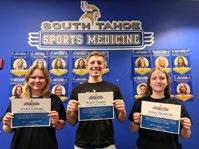
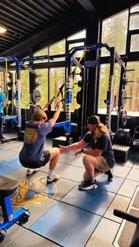
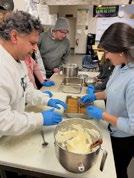
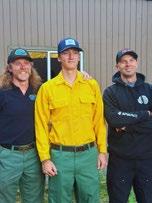
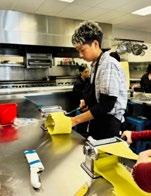
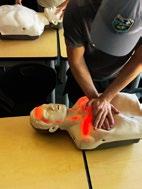
This year South Tahoe High School's Career & Technical Education (CTE) students showed up and showed out. A Forestr y & Natural Resources student became the first from STHS to earn his wildland firefighter certification. Sports Med students traveled to L A and competed against 800+ students from across the countr y Construction students built Tahoe-style doghouses and gave them away to the community for free And that's just a FEW of the highlights this is what CTE looks like at South Tahoe High School, and we could not be more proud of these kids
Photo Gary Bell Sender enjoying the view.
Enro led Bak ng Class
Handmade Pasta
Wildland F re Certif ed Water Qual ty Test ng
Field Trips
Earthy films for summer
Pixar is back on top with the release of Toy Story 5 the franchise which, back in 1995, started it all for the animation company that became the gold standard for animated films. For quite a while they had hit after hit and could seemingly do no wrong.
Their first film that wasn’t a huge success was Cars 2 in 2011, but it wasn’t until 2015 that there was trouble in paradise when The Good Dinosaur was considered a bomb (by Pixar standards); it made only $332 million globally, but with a budget so big, it actually lost about $85 million. There was production drama as well and the critical response agreed that it wasn’t bad but didn’t live up to Pixar standards.
Disney had taken over the company in 2006 and celebrated a string of hits starting with the first Cars and hitting it big with Up in 2009. Films like Brave (2012) were financial hits but received less critical acclaim while sequels of their best films were as common as original stories. But Pixar was no longer a sure thing. They were now big enough that corporate issues could overshadow the creative spirit of the organization.
Though there were still original hits like Coco, some later films did not do well, and films like Soul and Turning Red were
bumped to Disney streaming after mediocre, short runs at theatres.
Of course, like the entire industry, they were slammed by COVID and the difficulties of recovering theatre audiences. So after Inside Out 2 (2024) and Toy Story 5 both having big box office success, Pixar has a little breathing room — along with the hope that people have started consistently going back to theatres.
One of the films Disney/ Pixar released this spring, which had a decent run at the box office before Disney began to stream it a couple months ago, is Hoppers It stands out because after Elio (2025) failed miserably at the box office, it is another original story trying to find success.
Hoppers follows Mabel, a young girl who learned to deal with her anger and frustration by absorbing nature in a place called the glade, with her grandmother who taught her to appreciate how nature connects us all and balances our internal struggles. But years later, when Mabel, now 19 and still mourning the passing of her grandmother, realizes that the town’s mayor plans to build a freeway through her beloved glade, she mobilizes to try and stop it. Striking out with her fellow humans, Mabel visits her science professor, Dr. Sam, who has
developed technology to transfer a human consciousness into a realistic robot animal (think Avatar). Once in, the person can communicate with all other animals.
Seeing an opportunity, Mabel hijacks a robot beaver, transfers herself into it, and runs out to find other animals to help her save the glade. She befriends another beaver, the mammal king, George (though he does not know she is human) and convinces him and other animals to help her. Though her cause is righteous, Mabel is impulsive, reckless and will do anything to achieve her goals, including using her new friends, and when things go wrong, she digs in deeper, unwilling to give up, even at the expense of the animals helping her.
Though Hoppers creates an original story, the animation is below Pixar’s best. Much like The Good Dinosaur and similar films, Hoppers has some beautiful and detailed backgrounds but with animal and human characters that are more cartoon-like, creating a less connected overall look. Fitting the story, the themes are very Pixar. There’s the environment vs. human impact, as well as how we navigate grief and move forward with both passion and restraint. Of course, there are many heartfelt moments as well as humor, both
light and dark, and being Pixar, they get away with more dark humor than most family films. Overall, Hoppers is a solid, original film from the company that still mostly does animation right. Sorry, Teresa missed this one.
On a brief side note, there’s a new documentary that just dropped on HBO called Earth, Wind & Fire (To Be Celestial vs. That's the Weight of the World) Earth, Wind & Fire was one of the supergroups of the ‘70s that spanned multiple genres, including jazz, R&B, soul, funk, disco, pop, Latin and Afro-pop. This film follows the nine-time Grammy Award-winning band, tracing their beginnings and mostly following late founding member, Maurice White. It covers their rise to the top and the ups and downs of their success.
The band was unique in that they imbued their music with a deeper philosophical and spiritual meaning, promoting a message of peace and love. Drawing from the band's visual, audio, and written archives, including some never-before-seen footage, the film also features candid interviews with band members, colleagues and family as well as high-profile fans like Barack and Michelle Obama, Stevie Wonder, Flea and Lionel Richie.
The film traces not only White’s difficult childhood that would forge his worldview but also the band’s influence on the next generation of artists, such as Prince and Stevie Wonder, as well as its resurgence through sampling and collaborations with today's hip-hop artists.
Earth, Wind & Fire was also known for its elaborate stage shows. With 10 to 14 musicians, including horns, woodwinds, Latin and African percussion, keyboards, synthesizers and unique instruments like the kalimba, they created a high energy performance with dazzling visuals. Exploring the band's evolution from jazz to soul, R&B, Afro-funk, disco, and beyond, the film details how White tried to keep his message in the music while navigating the difficulties of success that affected his relationships with both his family and the band.
Overall, Earth, Wind & Fire (To Be Celestial vs. That's the Weight of the World) is a tribute to White as the founder and leader and also the band that created an iconic sound spanning decades, leaving a far-reaching cultural impact. Teresa gave it a thumbs up.
Photo Disney/Pixar
In Hoppers the animal kingdom takes center stage.
WARMING
Continued from page 13
which temperatures are above historical norms in Sacramento.
Summit respectively, according to the study.
A total of 1.4 million vehicles came into Tahoe via Echo Summit in 2018. An additional 1.7 million came into Tahoe via Tahoe City and 2.6 million came in over Spooner Summit, according to the study’s calculations.
REGISTER TO ATTEND CLASSES REQUEST PRIVATE SESSIONS
These figures were arrived at through intercept surveys, where a sample of people were stopped and asked about their travel in Tahoe, GPS data collected from cellphones, traffic counts provided by Caltrans and NDOT, and broader household travel surveys.
Handy also noted that biking is another alternative to travelling by car around Tahoe and encouraged the continued construction and connectivity of bike trails around the lake.
During an audience
discussion after Handy’s presentation, one woman questioned how to make public transit more appealing for people who, say, want to bring pets, coolers, beach toys and other cumbersome items to their final destination. Getting people out of their cars when they come to Tahoe would also entail having enough parking space for those cars when they arrive, observed one audience member. Handy replied coordinating and dovetailing with other public transit systems outside the basin would be key to cutting down on that number.
An average of 1.2 million riders annually use public transit in the basin, according to TRPA. To double that number would cost an additional $25 million a year, Handy said. While this would no doubt entail transit subsidies from various sources, gas taxes meant to cover road construction, repair and other amenities for car travel aren’t self-sustaining, either, said Handy. “No transit system makes money. That’s on us to say we support this and go to our policymakers and tell them what we want.”
Photo Provided
After inadvertently failing to showcase the winners of the local annual Kiwanis Spelling Bee last month, the Mountain News salutes the various teams who participated. The Bijou Elementary School team, pictured here, took first place in the 5th-grade division.